All about dinosaurs, fossils and prehistoric animals by Everything Dinosaur team members.

Articles, features and information which have slightly more scientific content with an emphasis on palaeontology, such as updates on academic papers, published papers etc.

9 05, 2024

Tyrannosaurus rex Was Not as Clever as a Primate According to New Research

By |2024-05-07T12:48:53+01:00May 9th, 2024|Categories: Adobe CS5, Dinosaur Fans, Main Page, Palaeontological articles, Photos/Pictures of Fossils, Teaching|0 Comments

New scientific research has challenged the findings of a 2023 study that concluded T. rex may have been as clever as a primate. How smart was T. rex? That is a fascinating question, one that body and trace fossils cannot really answer. The idea that the Dinosauria were slow, lumbering, stupid giants has largely been debunked. However, scientists have continued to puzzle over their cognitive abilities.

In April 2023, Everything Dinosaur blogged about a controversial study by Dr Suzana Herculano-Houzel from the Department of Psychology at Vanderbilt University (Tennessee). Doctor Herculano-Houzel postulated that Tyrannosaurus rex had around 3 billion cerebral neurons. The Brazilian neuroscientist implied that this super-sized predator had cognitive capabilities that matched primates.

Titus the T.rex exhibit. A T. rex skeleton on display.

The spectacular Titus the T. rex exhibit at Wollaton Hall.  How smart was T. rex?  A newly published paper challenges an earlier study that postulated that this theropod was as clever as an extant primate. Picture credit: Everything Dinosaur.

Picture credit: Everything Dinosaur

The earlier paper proposed that large theropods such as Tyrannosaurus rex were long-lived, and remarkably intelligent.  It was postulated that these animals had “macaque or baboon-like cognition”.

To read Everything Dinosaur’s blog post about this paper: How Big was a T. rex Brain?

Challenging Established Views About Dinosaur Intelligence

The research challenged established views on dinosaur biology and inferred behaviours.  In addition, the earlier paper raised questions about whether neuron count estimates could benefit research on extinct animals in general.  However, a team of international scientists, including Dr Darren Naish (University of Southampton), have refuted these claims.  In a study published in “The Anatomical Record”, the researchers conclude that Tyrannosaurus rex was probably about as smart as a modern crocodile.

Their work reaffirms older theories about the intelligence of large theropods. Soft tissue structures like dinosaur brains rarely survive as fossils. Scientists can use endocasts, moulds made of the brain cavity to estimate brain size and structure. This is imperfect. For example, in extant crocodilians the brain only occupies about a third of the cranial cavity. In mammals and birds nearly 100% of this cavity is occupied by the brain.  By revisiting Herculano-Houzel’s (2023) work, the researchers identified several crucial discrepancies regarding interpretation and analysis of data.

Dr Herculano-Houzel probably overestimated the size of the brain of T. rex. It was assumed that the brain filled the whole of the endocranial cavity. In essence, the brain size of T. rex was modelled on mammals and birds, but this new study suggests crocodilians are a better analogy.

How smart was T. rex?

Blue: olfactory bulb and tracts, Green: pallium (homologous to the mammalian cerebral cortex), Orange: cerebellum, Yellow: diencephalon and optic tectum, Violet: brain stem. Olfactory structures, pallium and subpallium comprise the telencephalon. The overlay in grey indicates extinct taxa, the brain morphologies of which are estimated. The brain morphology of extinct ornithodirans is similar when compared to living reptiles. Picture credit: Caspar et al.

How Smart was T. rex?

The data used by Dr Herculano-Houzel was found to be inconsistent. For instance, brain size estimates had included other structures that are located in the cranium, but not part of the brain, the olfactory bulb for example. In addition, the earlier study had used a mixture of both juvenile and adult tyrannosaurs.  The use of not fully mature animals in the study could have led to inaccurate results.

The team revised the estimates of encephalisation and telencephalic neuron counts in the Dinosauria.  For large-bodied theropods in particular, this study estimated significantly lower neuron counts than previously proposed.  Their phylogenetic modelling indicated a neuron count for T. rex at between 250 million and 1.7 billion neurons.  Although the data spread was substantial, the results modelled reflect the neuron counts found in extant crocodilians.  This dataset did not produce neuron counts approaching those found in primates.

A close-up view of the Rebor T. rex Tusk figure.

A close-up view of the detail on the head of the Rebor T. rex Tusk dinosaur model.  Although this theropod was a formidable predator, its intelligence may have been overestimated. Picture credit: Everything Dinosaur.


Picture credit: Everything Dinosaur

The image (above) shows a close-up view of a 1:35 scale model of a Rebor Tyrannosaurus rex.

To view the Rebor range of prehistoric animals available from Everything Dinosaur: Rebor Dinosaur and Prehistoric Animal Figures.

Brain Size May Not Represent the Best Measure of Cognitive Abilities

Furthermore, the researchers reviewed the suitability of neurological variables such as neuron numbers and relative brain size to predict cognitive complexity, metabolic rate and life history traits in dinosaurs.  They concluded that these measures are not helpful when trying to assess the cognition of extinct creatures.

The team stated that trying to gauge the cognitive abilities of dinosaurs without close living analogues is extremely challenging.  Neuron numbers might be considered a minor component in an assessment of intelligence and much more work is required to build a robust framework to better understand the level of cognition in extinct animals.  In addition, the team concluded that given the depiction of dinosaurs in the popular media, researchers should acknowledge the limitations of the presented inferences to allow their audience to delineate between reasoned conclusions and speculation.

So, when it comes to calculating how smart was T. rex?  Scientists have yet to devise robust models to explore dinosaur intelligence.

Everything Dinosaur acknowledges the assistance of the open-source paper (Caspar et al) published in the journal The Anatomical Record in the compilation of this article.

The scientific paper: “How smart was T. rex? Testing claims of exceptional cognition in dinosaurs and the application of neuron count estimates in palaeontological research” by Kai R. Caspar, Cristián Gutiérrez-Ibáñez, Ornella C. Bertrand, Thomas Carr, Jennifer A. D. Colbourne, Arthur Erb, Hady George, Thomas R. Holtz Jr, Darren Naish, Douglas R. Wylie and Grant R. Hurlburt published in The Anatomical Record.

Visit the award-winning Everything Dinosaur website: Dinosaur Models and Toys.

6 05, 2024

Researchers Discover World’s First Tapeworm Body Fossil

By |2024-05-06T15:02:47+01:00May 6th, 2024|Categories: Dinosaur and Prehistoric Animal News Stories, Main Page, Palaeontological articles, Photos/Pictures of Fossils|0 Comments

International researchers including scientists from Nanjing Institute of Geology and Palaeontology (China) have found a tapeworm fossil preserved in amber.  The amber was mined in Myanmar and is believed to date from approximately 99 million years ago.  The three-dimensionally preserved fossil displays unique external and internal features.  These features most closely resemble the tentacles of the trypanorhynch tapeworms that parasitise marine elasmobranchs (sharks and rays).

It is a mystery as to how the marine parasite ended up preserved in tree resin.  One theory is that the carcase of an elasmobranch was scavenged by a theropod dinosaur. The dinosaur fed on the carcase close to where a pine tree was exuding resin.  As the dinosaur tore the carcase apart part of the parasite was flung at the tree and entombed in the resin as it seeped from the bark.

How as a marine tapeworm preserved in tree resin?

A hypothetical ecological reconstruction of the fossil trypanorhynch tapeworm (drawn by YANG Dinghua). The fossil tapeworm was lodged in the intestine of an elasmobranch and the dead host was possibly scavenged by a dinosaur on a strandline with pine resin extruding nearby. Picture credit: Cihang Luo.

Studying a Tapeworm Fossil

Tapeworms are a type of parasitic flatworm (Class Cestoda). Many have complex life cycles, with larvae developing in one host before invading a secondary host in which they grow to adults and produce eggs.  Some six thousand species are known, and they infect all major groups of vertebrates including mammals and ourselves.  Their fossil record is extremely sparse.  However, there is a record of possible tapeworm eggs having been preserved in the coprolite of a Permian shark.

Researcher Wang Bo (Nanjing Institute of Geology and Palaeontology), commented that the fossil is the first ever tapeworm body fossil found. The specimen provides direct evidence of the evolution of the Cestoda.

Fossil tapeworm compared to an extant tapeworm.

The fossil tapeworm from mid-Cretaceous Kachin amber (circa 99 million years ago) and the comparison with the tentacle of an extant trypanorhynch tapeworm. (A) Microscopic image of fossil tapeworm. (B) Micro-CT image of fossil tapeworm. (C) Scanning electron microscopy image of an extant trypanorhynch tapeworm. Picture credit: Cihang Luo.

The discovery demonstrates the remarkable preservation properties of amber.

How Did the Marine Tapeworm Become Trapped in Tree Resin?

PhD student Luo Cihang (Nanjing Institute of Geology and Palaeontology), suggested how a marine tapeworm became trapped in tree resin.

He proposed:

“It may have parasitised the intestines of a ray. The ray’s body was washed ashore and was preyed upon by a dinosaur.  As the dinosaur consumed the internal organs of the ray, the worm fell out and become enveloped in nearby resin.”

The research, conducted by scientists from multiple countries including China, Germany, the United Kingdom and Myanmar, was recently published in the academic journal Geology.

Internal structure of fossil tapeworm compared to an extant tapeworm.

The comparison of the internal structure of the fossil (A) with the tentacle of an extant trypanorhynch tapeworm (B). Abbreviation: ivt—invaginated tentacle. Picture credit: Cihang Luo.

A Remarkable Fossil Find

A spokesperson from Everything Dinosaur commented that this was a remarkable and unique fossil discovery.  To find a tapeworm fossil preserved in amber is astonishing.  Furthermore, it added to the growing body of evidence that amber from Myanmar was produced from Cretaceous trees growing close to the coast.  Amber from Myanmar has yielded some amazing fossils, including the shell of an ammonite.  The ammonite shell preserved in the tree resin is further evidence that this Cretaceous forest was close to a marine environment.

To read Everything Dinosaur’s early blog post about the ammonite shell preserved in amber: Ammonite Shell Preserved in Amber from Myanmar.

The scientists conclude that the exquisite preservation provides and exceptional example of a marine endoparasite.  The study provides, arguably the most convincing body fossil of a flatworm discovered to date.

Everything Dinosaur acknowledges the assistance of a media release requested from the Chinese Academy of Sciences in the compilation of this article.

The scientific paper: “Exceptional preservation of a marine tapeworm tentacle in Cretaceous amber” by Cihang Luo, Harry W. Palm, Yuhui Zhuang, Edmund A. Jarzembowski, Thet Tin Nyunt and Bo Wang published in Geology.

The Everything Dinosaur website: Prehistoric Animal Models and Fossil Replicas.

17 04, 2024

Ichthyotitan severnensis – A Colossus of the Late Triassic

By |2024-04-17T19:03:57+01:00April 17th, 2024|Categories: Adobe CS5, Dinosaur and Prehistoric Animal News Stories, Dinosaur Fans, Main Page, Palaeontological articles, Photos/Pictures of Fossils|0 Comments

A scientific paper has just been published in the open-access journal PLOS ONE that describes a new species of giant ichthyosaur. This huge marine reptile, named Ichthyotitan severnensis could have been about as big as a blue whale (Balaenoptera musculus).  The discovery of the fragmentary remains of a second gigantic jawbone in Somerset supports the hypothesis that giant ichthyosaurs were present in the Late Triassic ecosystem.

Ichthyotitan severnensis illustrated.

A washed-up Ichthyotitan severnensis carcase on the beach being visited by two hungry theropod dinosaurs and a flock of curious pterosaurs. Picture credit: Sergey Krasovskiy.

Giant Ichthyosaurs from Somerset

Fossil collector and co-author of this study Paul de la Salle, found a portion of fossil jaw in May 2016. He later returned to the location (the beach at Lilstock, west Somerset) and found more pieces that together formed a partial surangular more than a metre in length.  The second fragmentary jawbone, also a surangular was found on a beach a few miles to the east of the original fossil discovery.

In May 2020, Father and daughter, Justin and Ruby Reynolds from Braunton, Devon found the first pieces of the second surangular.  They were fossil hunting on the beach at Blue Anchor. Ruby, then aged eleven found the first chunk of fossil bone and went onto to find several more fragments.

Realising that Ruby may have discovered something of considerable scientific value, the family contacted leading ichthyosaur expert, Dr Dean Lomax, a palaeontologist at The University of Manchester. Dr Lomax, who is also a 1851 Research Fellow at the University of Bristol, contacted Paul de la Salle as he recognised the striking similarity between the two fossil finds.

Dr Dean Lomax commented:

“I was amazed by the find. In 2018, my team (including Paul de la Salle) studied and described Paul’s giant jawbone and we had hoped that one day another would come to light. This new specimen is more complete, better preserved, and shows that we now have two of these giant bones – called a surangular – that have a unique shape and structure. I became very excited, to say the least.”

Photographs of the surangular bones associated with the giant marine reptile Ichthyotitan severnensis.

Photograph of the nearly complete giant jawbone (surangular), along with a comparison with the 2018 bone (middle and bottom) found by Paul de la Salle. Picture credit: Dr Dean Lomax.

Hunting for More Fossil Evidence

Justin and Ruby, together with Paul, Dr Lomax, and several family members, visited the site to hunt for more pieces of fossil bone. Over time, the team found additional fragments of the same jaw which fit together perfectly, like a multimillion-year-old ichthyosaur jigsaw.

Father Justin explained:

“When Ruby and I found the first two pieces we were very excited as we realised that this was something important and unusual. When I found the back part of the jaw, I was thrilled because that is one of the defining parts of Paul’s earlier discovery.”

The last piece of bone was recovered in October 2022.

Some of the research team members with Ichthyotitan severnensis fossil bones.

Part of the research team in 2020 examining the initial finds (at the back) of the new discovery made by Ruby and Justin Reynolds. Additional sections of the bone were subsequently discovered. From left to right, Dr Dean Lomax, Ruby Reynolds, Justin Reynolds and Paul de la Salle. Picture credit: Dr Dean Lomax.

Ichthyotitan severnensis

Lead author of the study, Dr Lomax commented that the jaw fossils belong to a new species of enormous ichthyosaur.  It would have measured perhaps as much as twenty-five metres in length.  Ichthyotitan severnensis was probably larger than any extant toothed whale.  Based on comparisons with better known shastasaurid ichthyosaurs, it could have been as big as a blue whale.  Analysis of the geology of the two fossil sites along with a detailed comparison of the two surangular fossils supports the team’s hypothesis that these fossils represent an enormous ichthyosaur that is new to science.

Ichthyotitan severnensis scale drawing by Everything Dinosaur.

An Ichthyotitan severnensis scale drawing. Picture credit: Everything Dinosaur.

Picture credit: Everything Dinosaur

The genus and species name translates as “giant fish lizard of the Severn”.

The fossil material is estimated to be around 202 million years old, dating to the end of the Triassic (Rhaetian faunal stage).  Gigantic ichthyosaurs (Shastasauridae) swam in the seas while the Dinosauria were beginning to dominate terrestrial environments.  Ichthyotitan was one of the last of the shastasaurids, these Somerset fossils represent the last of their kind.  The Shastasauridae family are thought to have become extinct at the end of the Triassic.

Ichthyotitan severnensis was not the world’s first giant marine reptile, but de la Salles’ and Reynolds’ discoveries are unique among those known to science. These two bones appear to be approximately thirteen million years younger than their latest geologic relatives, including Shonisaurus sikanniensis (British Columbia, Canada), and Himalayasaurus tibetensis from Tibet, China.

Dr Lomax added:

“I was highly impressed that Ruby and Justin correctly identified the discovery as another enormous jawbone from an ichthyosaur. They recognised that it matched the one we described in 2018. I asked them whether they would like to join my team to study and describe this fossil, including naming it. They jumped at the chance. For Ruby, especially, she is now a published scientist who not only found but also helped to name a type of gigantic prehistoric reptile. There are probably not many 15-year-olds who can say that! A Mary Anning in the making, perhaps.”

Ruby exclaimed:

“It was so cool to discover part of this gigantic ichthyosaur. I am very proud to have played a part in a scientific discovery like this.”

A life reconstruction of a pair of Ichthyotitan severnensis.

A giant pair of swimming Ichthyotitan severnensis. Picture credit: Gabriel Ugueto.

Not Yet Fully Grown

Further examinations of the bones’ internal structures have been carried out by master’s student, Marcello Perillo, from the University of Bonn, Germany. His research confirmed the ichthyosaur origin of the bones and also revealed that the animal was still growing at the time of death.

He said:

“We could confirm the unique set of histological characters typical of giant ichthyosaur lower jaws: the anomalous periosteal growth of these bones hints at yet to be understood bone developmental strategies, now lost in the deep time, that likely allowed Late Triassic ichthyosaurs to reach the known biological limits of vertebrates in terms of size. So much about these giants is still shrouded by mystery, but one fossil at a time we will be able to unravel their secret.”

Concluding the work, Paul de la Salle added:

“To think that my discovery in 2016 would spark so much interest in these enormous creatures fills me with joy. When I found the first jawbone, I knew it was something special. To have a second that confirms our findings is incredible. I am overjoyed.”

Ichthyotitan severnensis Fossils on Public Display

The fossilised remains will soon be put on display at the Bristol Museum and Art Gallery (Bristol).

Dr Lomax summarised the study:

“This research has been ongoing for almost eight years. It is quite remarkable to think that gigantic, blue whale-sized ichthyosaurs were swimming in the oceans around what was the UK during the Triassic Period. These jawbones provide tantalising evidence that perhaps one day a complete skull or skeleton of one of these giants might be found. You never know.”

To read Everything Dinosaur’s 2018 article about the first surangular fossil discovery: Late Triassic Giant Ichthyosaurs.

Everything Dinosaur acknowledges the assistance of a media release from the University of Manchester in the compilation of this article.

The scientific paper “The last giants: New evidence for giant Late Triassic (Rhaetian) ichthyosaurs from the UK” by Lomax D. R., de la Salle, P., Perillo, M., Reynolds, J., Reynolds, R. and Waldron, J. F. published in PLOS ONE.

Visit the website of Dr Dean Lomax: British Palaeontologist Dr Dean Lomax.

11 04, 2024

New Study of Ancient Jawless Fish Suggests They were Filter-feeders

By |2024-04-10T14:47:06+01:00April 11th, 2024|Categories: Adobe CS5, Dinosaur and Prehistoric Animal News Stories, Main Page, Palaeontological articles, Photos/Pictures of Fossils|0 Comments

Newly published research has demonstrated that early, jawless fish (agnathans), used bony plates surrounding their mouths to modify the mouth’s shape whilst feeding.  CT scans of a three-dimensionally preserved Rhinopteraspis fossil suggest that these early vertebrates were suspension feeders, not hunters or scavengers.  The study, led by scientists from the University of Birmingham helps to improve our understanding of the evolution of feeding ecology.  The Devonian pteraspidid heterostracan Rhinopteraspis dunensis, the jawless fish studied, was probably a nektonic filter-feeder.

Rhinopteraspis fossil.

The anterior portion of a three-dimensionally preserved Rhinopteraspis dunensis specimen. CT scans of the fossilised remains of this Devonian fish enabled scientists to study feeding ecology. Picture credit: University of Birmingham.

Studying the Feeding Behaviours of Early Vertebrates

Scientists often use the inferred feeding behaviours of early vertebrates to help piece together the evolution of Vertebrata.  Different jaw morphologies and jaw composition can suggest a wide range of feeding strategies.  In the jawless fishes many competing theories have been proposed for their feeding habits.  For example, scientists have examined whether these animals were passive feeders or active hunters.

A new paper, published in the Proceedings of the Royal Society B reconstructs the feeding apparatus of the Devonian pteraspidid Rhinopteraspis dunensis.  Computerised tomography enabled the research team to construct 3D models of the fish’s mouth.  The images revealed the structure and arrangement of finger-like bones that project from the lower “lip” of the animal’s mouth.  The researchers suggest that these projections controlled the mouth’s size and shape as it filtered food particles from the water.

Senior author and project lead Dr Ivan Sansom (University of Birmingham) stated:

“The application of CT scanning techniques to the study of fossil fish is revealing so much new information about these ancient vertebrates and giving us the opportunity to study precious and unique specimens without destructive investigation.”

Rhinopteraspis fossil.

Three-dimensional reconstruction of the oral region of Rhinopteraspis dunensis (NHMUK PV P 73217). Picture credit: University of Birmingham.

A Remarkable Rhinopteraspis Fossil

The Rhinopteraspis fossil used in the study is part of the London Natural History Museum fossil collection. It is specimen number NHMUK PV P 73217. It consists of an almost complete anterior portion of the animal. The entire headshield is present along with body scales. Although the Rhinopteraspis fossil has been compressed laterally, elements associated with the oral cavity appear to have maintained their original shape and relative location.

Dr Richard Dearden (University of Birmingham) and lead author of the study explained:

“In this case, these methods have allowed us to fit all of the small bones of this animal’s mouth together, and try and understand how it fed from this integrated system rather than by using isolated bones. Instead of a steady trend towards ‘active food acquisition’ – scavenging or hunting – we see a real diversity and range of feeding behaviours among our earliest vertebrate relatives.”

To read a related article that questioned whether heterostracans were suspension feeders: New Study Features Extremely Old Vertebrate.

Bony Plates with Limited Movement

The mineralised plates around the mouth had limited movement.  It is unlikely that these early vertebrates were hunters capable of biting.  Many Pteraspidiformes had elongated, bony snouts this would have made it difficult to strain food particles from sediment.  However, the mouth plates would have allowed it to control the opening of the mouth, and perhaps strain food from water in a way also used by animals such as flamingos or mussels.

This new study offers a new perspective on the evolution of feeding strategies in early vertebrates.  Many current hypotheses argue that there was a long-term evolutionary trend away from passive food collection and consumption to predatory behaviour.  This research challenges these earlier theories and suggests that primitive fish had a broad range of different feeding behaviours long before the evolution of a jaw structure.

Everything Dinosaur acknowledges the assistance of a media release from the University of Birmingham in the compilation of this article.

The scientific paper: “The three-dimensionally articulated oral apparatus of a Devonian heterostracan sheds light on feeding in Palaeozoic jawless fishes” by Richard P. Dearden, Andy S. Jones, Sam Giles, Agnese Lanzetti, Madleen Grohganz, Zerina Johanson, Stephan Lautenschlager, Emma Randle, Philip C. J. Donoghue and Ivan J. Sansom published in the Proceedings of the Royal Society B.

The Everything Dinosaur website: Prehistoric Animal Models and Figures.

10 04, 2024

Twelve New Australian Sauropods Described

By |2024-04-10T19:08:17+01:00April 10th, 2024|Categories: Adobe CS5, Dinosaur and Prehistoric Animal News Stories, Dinosaur Fans, Main Page, Palaeontological articles, Photos/Pictures of Fossils|0 Comments

Twelve new Australian sauropods have been classified following a comprehensive reassessment of Winton Formation fossil remains.  Twelve new sauropod fossil specimens from the Winton Formation (Queensland, Australia) have been described. The extensive review, which involved CT scanning hundreds of fossil bones, has resolved the known sauropods from the Winton Formation into three distinct taxa.

Assessment of Twelve New Australian Sauropods Confirms Three Taxa

The taxa are Diamantinasaurus matildae, Savannasaurus elliottorum and Wintonotitan wattsi. A fourth sauropod, Australotitan cooperensis is now considered an indeterminate diamantinasaurian. The review suggests that the material previously assigned to A. cooperensis might represent a Diamantinasaurus. If this is the case, then Diamantinasaurus was capable of growing much larger than earlier studies indicated. A. cooperensis may become nomen dubium (dubious scientific name not widely recognised).

Twelve Australian sauropods described.

PhD candidate Samantha Beeston scanning Diamantinasaurus fossil material.  Picture credit: Australian Age of Dinosaurs Museum of Natural History.

Picture credit: Australian Age of Dinosaurs Museum of Natural History

The ground-breaking study into these enormous, ground-shaking dinosaurs was led by University of College London PhD candidate Samantha Beeston in collaboration with the Australian Age of Dinosaurs Museum of Natural History. Beeston’s research was conducted as part of her Master’s thesis at Swinburne University of Technology, under the supervision of Dr Stephen Poropat (now at the Western Australian Organic and Isotope Geochemistry Centre, Curtin University). The paper has been published in the open-access journal PeerJ.

Australotitan cooperensis life reconstruction

A life reconstruction of Australotitan cooperensis, the largest known animal to have ever lived in Australia. A reassessment of the fossilised bones suggests that A. cooperensis might be nomen dubium as the fossil remains could represent a very large specimen of Diamantinasaurus matildae.  Picture credit: Queensland Museum.

Picture credit: Queensland Museum

To read an earlier blog article (2015) about titanosaur fossil remains later named A. cooperensis awaiting scientific description: Super-sized Aussie Titanosaur Awaits Scientific Description.

Twelve new Australian sauropods described.

A sauropod excavation site photographed in 2011.  Picture credit: Australian Age of Dinosaurs Museum of Natural History.

Picture credit: Australian Age of Dinosaurs Museum of Natural History

Three Australian Sauropods

The researchers were able to assign two new specimens to Diamantinasaurus matildae. In addition, two specimens were assigned to Savannasaurus elliottorum with three more being assigned to Wintonotitan wattsi. The other five specimens are too incomplete to classify at the genus level. They have been described as indeterminate diamantinasaurians.  A lack of comparable specimens with overlapping bones has hampered precise classification of these five specimens.

The three recognised Winton Formation sauropod taxa are:

  • Diamantinasaurus matildae – named in 2009 (Hocknull et al).
  • Savannasaurus elliottorum – named in 2016 (Poropat et al).
  • Wintonotitan wattsi – named in 2009 in the same scientific paper as D. matildae and the theropod Australovenator wintonensis (Hocknull et al).

Over five hundred sauropod bones were scanned as part of this research. This innovative approach enabled the scientists to evaluate each bone and compare it to other fossil specimens in the Museum’s extensive collection. The study has led to a better understanding of the unique traits that help to separate known species.  Student Samantha Beeston explained that as there are so few bones preserved for Australotitan it makes it very difficult, if not impossible to assign new specimens to it, or to differentiate it from any of the other Winton Formation sauropod taxa.

She added: “Due to the limited fossil evidence for Australotitan, resolving its classification will be challenging.”

Twevel new Australian sauropods described in new study.

Student Samantha Beeston scanning the toe bone of Diamantinasaurus.  Picture credit: Australian Age of Dinosaurs Museum of Natural History.

Picture credit: Australian Age of Dinosaurs Museum of Natural History

Significant for Australian Palaeontology

David Elliott, the Executive Chairman of the Australian Age of Dinosaurs Museum of Natural History commented that he was delighted to have more sauropod specimens in the Museum’s collection assigned to distinct species. He explained that having a better understanding of autapomorphies and anatomical traits leading to more confident assignment of taxa was a significant leap forward in Australian palaeontological research.  The twelve new Australian sauropods would provide the basis for further research into the dinosaurs of the Winton Formation.

He added:

“These dinosaurs help demonstrate the diverse natural history of Australia during the Cretaceous Period and will become important exhibits at the new Australian Age of Dinosaurs Museum of Natural History.”

The "Devil Dave" sauropod site (2017).

Volunteers work at the “Devil Dave” sauropod excavation site (2017).  Picture credit: Australian Age of Dinosaurs Museum of Natural History.

Picture credit: Australian Age of Dinosaurs Museum of Natural History

Everything Dinosaur acknowledges the assistance of a media release from the Australia Age of Dinosaurs Museum of Natural History in the compilation of this article.

The scientific paper: “Reappraisal of sauropod dinosaur diversity in the Upper Cretaceous Winton Formation of Queensland, Australia, through 3D digitisation and description of new specimens” by Samantha L. Beeston​, Stephen F. Poropat, Philip D. Mannion, Adele H. Pentland, Mackenzie J. Enchelmaier, Trish Sloan and David A. Elliott published in PeerJ.

The Everything Dinosaur website: Dinosaur Models and Toys.

5 04, 2024

A New Study into the Pathology and Diseases of Predatory Dinosaurs

By |2024-04-05T10:20:47+01:00April 5th, 2024|Categories: Dinosaur and Prehistoric Animal News Stories, Dinosaur Fans, Main Page, Palaeontological articles|0 Comments

A new study has provided fresh insights into the pathologies associated with predatory dinosaurs.  Researchers have examined in forensic detail the pathologies associated with three South American abelisaurids.  In addition, the scientists have compiled a comprehensive database of theropod dinosaur fossil pathologies.  This database may shed light on the behaviour of different types of theropod.  For example, allosaurids had a great frequency of fractures.  This suggests that these carnivorous dinosaurs were extremely active, and this might infer a relation to hunting strategies and behaviours.  It may also indicate the type of prey that allosaurids tackled.

The three abelisaurid dinosaurs examined in this research were Elemgasem nubilus, Aucasaurus garridoi and Quilmesaurus curriei.  These three predatory dinosaurs all lived in Patagonia during the Late Cretaceous.

Diseases identified in predatory dinosaurs.

Life reconstruction of the abelisaurs involved in this study. Aucasaurus garridoi (A) MCF-PVPH-236 (congenital malformation in anterior caudal vertebrae). Elemgasem nubilus (B) MCF-PVPH-380 (spondyloarthropathy in middle and posterior caudal elements). Quilmesaurus curriei(C) MPCA-PV-100 (possible pathology in the right tibia).  Picture credit: Alessio Ciaffi.

Picture credit: Alessio Ciaffi

The research project conducted by scientists from CONICET has revealed new details of the pathologies associated with theropods. The research has been published in the journal BMC Ecology and Evolution.

A Study Consisting of Three Phases

The palaeontologists noticed deformations on the external surface of some bones at a macroscopic level, especially in the caudal vertebrae of the Elemgasem and Aucasaurus specimens. This finding led to the hypothesis that these deformations resulted from possible pathologies.  The team decided to conduct a more detailed examination of the morphology of the fossilised bones. The internal structure was also examined at the microscopic level.

The research programme was split into three distinct phases. Firstly, the external structure of the bones showing potential pathologies was examined. Secondly, bone histology on the Quilmesaurus and Elemgasem specimens was undertaken whilst CT scans were carried out on the Aucasaurus fossils to evaluate how possible pathologies had affected surrounding tissues.

Aucasaurus garridoi pathology.

A specimen of the abelisaurid Aucasaurus garridoi was found to have a congenital developmental disease, despite which the animal was able to live for many years. Picture credit: Alessio Ciaffi.

Picture credit: Alessio Ciaffi

A Database of Diseases and other Pathologies of Predatory Dinosaurs

The detailed analysis revealed three distinct types of pathologies. The Aucasaurus specimen had a congenital developmental disease, which indicated that this individual was born with a malformation that, despite this, allowed the animal to live for many years.  In the case of Elemgasem, spondyloarthropathy or spondyloarthritis was diagnosed, a disease also present in humans, which causes the fusion of vertebrae and the consequent inflammation. On the other hand, the Quilmesaurus specimen showed signs of some pathology that could not be precisely determined. This pathology seemed different from those identified in the other two abelisaurids.

This work led onto the third phase of the study. The team compiled a database which documented all the known cases of pathologies in theropod dinosaurs.  Statistical analysis provided the scientists with potential insights into theropod lifestyle and behaviour. For instance, the high number of fractures observed in the Allosauridae. In addition, tyrannosaurids had bite marks which resulted in infections such as trichomonosis. The incidence of bite marks in tyrannosaurs suggests that tyrannosaurids indulged in very aggressive intraspecific social behaviour.

To read an earlier article from Everything Dinosaur documenting trichomonosis in an iconic T. rex specimen: Some Tyrannosaurs Suffered from Parasitic Infections.

Corresponding author of the newly published paper, Mattia Antonio Baiano (Ernesto Bachmann Municipal Museum) commented:

“This work not only expands our knowledge about dinosaur health, but also highlights the presence of diseases that persist today, suggesting possible connections between the study of extinct organisms and the research of contemporary diseases.”

Mattia Baiano conducts fieldwork.

Corresponding author Mattia Baiano conducts fieldwork. Picture credit: courtesy of the researchers.

Picture credit: Courtesy of the Researchers

A Fresh Perspective on the Lives of Predatory Dinosaurs

The research team concluded that statistical examination of the distribution of injuries associated with different theropod families could provide a fresh perspective regarding theropod behaviour. Different lifestyles and behaviours may underlie the frequency of different injuries among theropod taxa.

Co-author Diego Pol, CONICET researcher at the “Egidio Feruglio” Paleontological Museum added:

“It is a very interesting work since it brings together specialties from different researchers and tries to discover a little of the marks left on the skeleton by the behaviours of dinosaurs.”

Diego Pol one of the co-authors of the diseases in predatory dinosaurs paper.

Diego Pol one of the co-authors of the diseases in predatory dinosaurs paper.

Picture credit: Courtesy of the Researchers

Everything Dinosaur acknowledges the assistance of a media release from CONICET in the compilation of this article.

The scientific paper: “New information on paleopathologies in non-avian theropod dinosaurs: a case study on South American abelisaurids” by Mattia A. Baiano, Ignacio A. Cerda, Filippo Bertozzo and Diego Pol published in BMC Ecology and Evolution.

The Everything Dinosaur website: Dinosaur Toys and Models.

23 03, 2024

A New Iguanodontian Dinosaur from Portugal

By |2024-09-18T13:36:52+01:00March 23rd, 2024|Categories: Adobe CS5, Dinosaur and Prehistoric Animal News Stories, Dinosaur Fans, Main Page, Palaeontological articles, Photos/Pictures of Fossils|0 Comments

A new species of Late Jurassic iguanodontian has been described from fossils discovered in western Portugal. The dinosaur has been named Hesperonyx martinhotomasorum. The discovery of this dinosaur adds to the diversity of relatively small ornithopods known from the Lourinhã Formation.  The fossil material consisting of a partial left hindlimb and isolated forelimb bones were excavated from the cliffs at the picturesque Porto Dinheiro beach (Lourinhã, Portugal). The fossils probably represent a single, individual dinosaur.

Hesperonyx martinhotomasorum life reconstruction.

Hesperonyx martinhotomasorum life reconstruction. Picture credit: Victor Carvalho.

Hesperonyx martinhotomasorum

The researchers conclude that this dinosaur had a body length of between 3-4 metres. It was rather small when compared to Early Cretaceous iguanodontians such as Iguanodon bernissartensis which had an estimated length of approximately 10 metres and weighed around 5 tonnes. The forelimb bones lack modifications for quadrupedal locomotion. Hesperonyx probably was a biped and considerably more agile than later, much larger iguanodontians.

Hesperonyx roamed western Portugal approximately 150 million years ago (Late Jurassic). The research project was a collaboration between scientists from the NOVA School of Science and Technology, University of Zaragoza and University of Bonn, supported by the local Museu da Lourinhã and Sociedade de História Natural de Torres Vedras.

Co-author Bruno Camilo studying dinosaur limb bones.

Co-author of the study Bruno Camilo, head of Sociedade of História Natural of Torres Vedras (Universidade NOVA de Lisboa). Picture credit: Universidade NOVA de Lisboa.

A New Dinosaur Taxon

The almost complete and semi-articulated left hindlimb was discovered in the summer of 2021. The fossil material was cleaned and prepared in the Museu da Lourinhã laboratory. The morphology of the bones puzzled the researchers. 

Student and co-author of the scientific paper Lucrezia Ferrari who worked on the fossilised material commented:

“It simply did not match anything we have seen before.”

The team were quietly confident that these fossils represented a new dinosaur taxon.

Fossil preparation (Hesperonyx paper).

Student Lucrezia Ferrari who worked on the fossil preparation and presented a thesis on this new ornithopod dinosaur as part of her Master’s degree. Picture credit: Universidade NOVA de Lisboa.

Filippo Maria Rotatori, lead author of the paper published in the Journal of Vertebrate Palaeontology added:

“It was something familiar, but it has several features that just looked unusual.  It was some kind of bipedal herbivorous dinosaur, but such animal was never recorded in Portugal before.   It’s a new species. One more in the highly diverse ecosystem of the Portuguese Jurassic.”

What’s in a Name?

The genus name is derived from “Hesperus” the Greek God, whose name is associated with the planet Venus and it being seen in the western sky. This is a nod to the fact that the fossils come from the western region of Portugal. The genus name also contains the Greek “onyx” meaning claw. The specific name honours Micael Martinho and Carla Alexandra Tomás for their dedicated work as fossil preparators at the Museu da Lourinhã.

Hesperonyx toe bones and researchers.

Lead author of the scientific paper, Filippo Maria Rotatori with the preparators Micael Martinho and Carla Tomás (Museu da Lourinhã) with the toe bones. The trivial name of this new dinosaur honours Micael and Carlo and recognises their dedication to the work of fossil preparation. Picture credit: Universidade NOVA de Lisboa.

Hesperonyx martinhotomasorum – A Small Iguanodontian Dinosaur

The Iguanodontia is an extensive and specious clade of ornithischian dinosaurs. These herbivores were abundant during the Jurassic and Cretaceous. Their early origins are not well understood. This is due to the lack of fossil material representing basal members of this clade. The fossil record of early iguanodontians is particularly poor in Europe. Only a handful of European species are currently recognised. For example, Cumnoria prestwichii and the geologically older Callovosaurus leedsi, both these dinosaurs are associated with English Jurassic deposits (Oxfordshire and Cambridgeshire respectively).

The discovery of Hesperonyx adds to the diversity of small ornithopod dinosaurs already recognised in the fossil record of the Lourinhã Formation.  It was an unexpected fossil find. Hesperonyx demonstrates that there are probably many more types of dinosaur awaiting discovery in the Upper Jurassic strata of western Portugal.

Hesperonyx martinhotomasorum limb bones in life position.

The partial left hindlimb of Hesperonyx martinhotomasorum assembled to reflect the position within the skeleton. Picture credit: Inês Marques.

Miguel Moreno-Azanza, the main advisor of Filippo, noted:

“This is a wonderful discovery, and also a great example of how scientific collaborations in palaeontology can help to reach great results.”

Hesperonyx martinhotomasorum paper co-author Miguel Moreno-Azanza, from Zaragoza University

Miguel Moreno-Azanza, from Zaragoza University, co-author of the Hesperonyx scientific paper with a titanosaur egg fossil and an Ampelosaurus model. Picture credit: Universidade NOVA de Lisboa.

Everything Dinosaur recognises the assistance of a media release and personal email correspondence with the lead author in the compilation of this article.

The scientific paper: “An unexpected early-diverging iguanodontian dinosaur (Ornithischia, Ornithopoda) from the Upper Jurassic of Portugal” by Filippo Maria Rotatori, Lucrezia Ferrari, Cristina Sequero, Bruno Camilo, Octávio Mateus and Miguel Moreno-Azanza published in the Journal of Vertebrate Palaeontology.

15 03, 2024

Were Eurypterids More Closely Related to Horseshoe Crabs or Scorpions?

By |2024-03-17T05:47:56+00:00March 15th, 2024|Categories: Adobe CS5, Dinosaur Fans, Main Page, Palaeontological articles, Photos/Pictures of Fossils|0 Comments

At Everything Dinosaur, we receive quite a lot of emails from customers and fans of prehistoric animals. Many of these emails are requests asking for more information about prehistoric animal figures. However, customers also contact us wanting help with answering a specific query about extinct creatures and life in the past. For example, we were recently asked what animals alive today are the closest relative of the eurypterids?

A splendid pair of sea scorpion fossils on display. Museum fossil on display.
A pair of eurypterid fossil specimens on display at the London Natural History Museum. Picture credit: Everything Dinosaur.

Picture credit: Everything Dinosaur

Answering a Question About Eurypterids

Eurypterids were members of the Arthropoda phylum. Specifically, they are part of the Subphylum Chelicerata (pronounced kel-iss-ser-rat-ah), which also contains the spiders, mites, scorpions and horseshoe crabs. These animals have a pair of jointed appendages that are located in front of their mouths (chelicerae – kel-iss-ser-ray). For most, they are modest feeding appendages such as seen in horseshoe crabs. In the spiders these chelicerae form venom injecting fangs. In some eurypterids such as the Pterygotidae, these appendages evolved into giant pincers designed for grabbing prey.

A sea scorpion claw
A stunning fossil of a sea scorpion (eurypterid) claw housed at the National Museum Cardiff (Wales) photographed in 2019 when team members at Everything Dinosaur visited. Picture credit: Everything Dinosaur.

Picture credit: Everything Dinosaur

Scorpiones or Xiphosurans?

Scientists remain uncertain as to whether extant scorpions or xiphosurans such as the horseshoe crab are the closest living relatives to the extinct eurypterids. Scorpions share a similar body plan, although scorpions are entirely terrestrial. Xiphosurans share the aquatic habit and also have an anatomy that is similar to the “sea scorpions” in some respects. Eurypterid feeding was probably more similar to that of xiphosurans.

The question of phylogeny remains unresolved. The lack of soft tissue preservation in “sea scorpions” and the flattened nature of most eurypterid fossils have hampered research. The absence of a clear eurypterid analogue from living chelicerates may indicate that the eurypterids occupied an ecological niche that was intermediate between xiphosurans and the Order Scorpiones.

The Everything Dinosaur website: Everything Dinosaur.

11 03, 2024

Spinosaurus Research – Inferring the Lifestyle of a Huge Theropod Dinosaur

By |2024-03-23T15:01:48+00:00March 11th, 2024|Categories: Adobe CS5, Dinosaur Fans, Main Page, Palaeontological articles|0 Comments

Recently, Everything Dinosaur team members wrote a blog post summarising the findings of the latest scientific paper on Spinosaurus aegyptiacus. This paper (Myhrvold et al), outlined some drawbacks in using bone density analysis to infer an extinct animal’s habits and lifestyle. They outlined some errors and omissions in a previous study that concluded Spinosaurus and Baryonyx walkeri, were capable of submerging and hunting underwater.

CollectA Deluxe Spinosaurus
The CollectA Deluxe Spinosaurus dinosaur model. A recently introduced (2022) updated replica of the giant, North African theropod Spinosaurus. This paper (Fabbri et al), postulated that dense bones associated with this dinosaur were adaptations to help this animal dive and to stay underwater.

An Extensively Studied Theropod

Named and described in 1915 (Stromer), Spinosaurus aegyptiacus has been the subject of intense research over the last decade. It was perhaps the longest theropod dinosaur of all. Some palaeontologists have estimated that S. aegyptiacus was up to fifteen metres long. Its mode of hunting and behaviour has come under detailed scrutiny since a detailed description, based on new fossil material was published in 2014.

This paper proposed that Spinosaurus was a semi-aquatic, obligate quadruped.

To read Everything Dinosaur’s 2014 blog post: Spinosaurus – Four Legs are Better than Two.

Spinosaurus swimming.
Very much at home in the water according to the 2014 study. Picture credit: Davide Bonadonna, Nizar Ibrahim, Simone Maganuco.

A Shoreline Stalker or an Underwater Predator?

Palaeontologists continued to debate whether Spinosaurus aegyptiacus and its near relatives were underwater predators, or shoreline stalkers. The 2014 research paper proposed that although Spinosaurus was a capable swimmer it was not a fully aquatic, underwater predator.

However, in 2020 a paper published in the journal Nature described Spinosaurus caudal vertebrae. These bones suggested that S. aegyptiacus had a broad tail. This could be used to propel itself through the water.

To read Everything Dinosaur’s 2020 post: Spinosaurus The River Monster.

Papo Limited Edition Spinosaurus Model. A Papo model retirement (2023).
The Papo Limited-edition Spinosaurus dinosaur model (2019). This model reflected the broad tail that was to be revealed in a forthcoming scientific paper. Picture credit: Everything Dinosaur.

Picture credit: Everything Dinosaur

The picture (above) shows the Papo limited-edition Spinosaurus aegyptiacus figure. This model depicts Spinosaurus as a quadruped and emphasises the broad, deep tail.

To view the range of Papo figures in stock: Papo Prehistoric Animal Figures.

However, in 2022 a scientific paper was published in the journal “eLife” that challenged the aquatic lifestyle. Palaeontologists led by scientists from the University of Chicago argued that Spinosaurus and Baryonyx walkeri would have been unstable when surface swimming. They also concluded that these dinosaurs would be too buoyant to dive and remain fully submerged.

Everything Dinosaur’s blog post covering this research: Spinosaurus Not an Aquatic Dinosaur.

Dense Bones Acting Like Ballast

Also, in 2022 another assessment using a statistical analysis of bone density proposed that Spinosaurus could dive and stay submerged (Fabbri et al). The heavy bones acted like ballast. This anatomical adaptation is seen in extant birds such as penguins and also in some mammals like manatees. These researchers also argued that some other spinosaurids, such as Suchomimus lacked these dense bones and were probably waders.

The blog post covering this research: Bone Density Study Proposes Some Spinosaurids were Fully Aquatic.

The new study (Myhrvold et al), criticised the complex statistical methodology (pFDA) used in the bone density study. The team concluded that the study undertaken by Fabbri et al had measurement errors and was flawed. It was not possible to infer an aquatic habit for spinosaurids based on this data.

To read Everything Dinosaur’s article on the research by Myhrvold et al: Back to the Shore for Spinosaurus.

The researchers demonstrated that it is important to use consistent and objective criteria to decide which species to include and exclude, as well as how to classify their behaviour. The findings also demonstrate the importance of taking measurement errors and individual variations into account when assessing bone density.

The debate over the lifestyle and habits of spinosaurids is likely to continue. We look forward to the next instalment in this long-running debate.

Visit the Everything Dinosaur website: Everything Dinosaur.

10 03, 2024

A New Lower Permian Amphibian is Scientifically Described

By |2024-03-06T21:14:57+00:00March 10th, 2024|Categories: Adobe CS5, Dinosaur and Prehistoric Animal News Stories, Main Page, Palaeontological articles, Photos/Pictures of Fossils|0 Comments

Researchers have scientifically described a new taxon of amphibian from the Lower Permian of Germany. The animal has been named Bromerpeton subcolossus. Researchers from the Museum für Naturkunde in Berlin (Germany) in collaboration with colleagues from the United States suggest that this small tetrapod probably spent much of its time underground.

Holotype of Bromerpeton subcolossus (specimen number MNG 16545).
A prepared block revealing the Bromerpeton subcolossus holotype (specimen number MNG 16545). Picture credit: Carola Radke.

Bromerpeton subcolossus

A block of undescribed fossils was carefully cleaned and prepared at the Carnegie Museum of Natural History in Pittsburgh (USA). When these fossils were examined in detail it was discovered that they represented a new taxon. Bromerpeton has been classified as a member of the Recumbirostra clade.

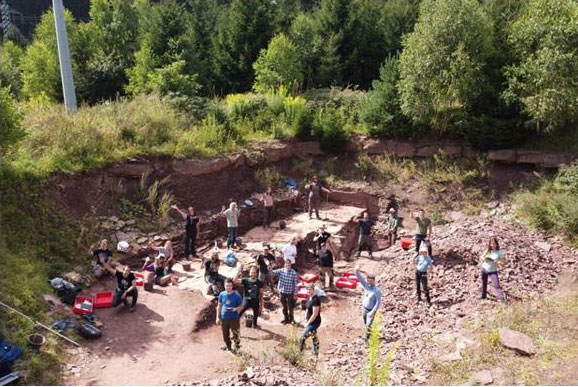
The fossil material comes from the famous “Bromacker” location in Thuringia, central Germany. The siltstones and sandstones preserve both trace and body fossils of early tetrapods. More than a dozen new species have been named and described. This fossil site was formed by the deposition of sediments in a high plateau environment. Most Permian vertebrate fossil sites represent lowland ecosystems close to bodies of water.

Computed tomography (CT) scans revealed an exceptionally well-preserved right forelimb with five fingers. This is an unusual characteristic within the Recumbirostra clade. Most have only three or four digits on the manus.

Lead author of the paper, Dr Mark MacDougall (Museum für Naturkunde – Berlin), explained that Bromerpeton subcolossus was less than fifteen centimetres in length. Its skull was just two centimetres long.

Fossorial (Burrowing) Adaptations

Despite being diminutive, Bromerpeton possessed sturdy limbs with a broad manus (hand) and pointed claws. The researchers postulate that Bromerpeton subcolossus dug burrows and spent much of its time underground. The fossil material is estimated to be around 290 million years old (Lower Permian).

Dr Mark MacDougall remarked:

“Bromerpeton may be small, but it provides a lot of new information about the evolution and ecology of early tetrapods and in particular the Recumbirostra, a group that has received a lot of attention in recent years. Our discovery also contributes to understanding the diversity of the Lower Permian Bromacker ecosystem.”

Everything Dinosaur acknowledges the assistance of a media release from the Museum für Naturkunde (Berlin) in the compilation of this article.

The scientific paper: “A new recumbirostran ‘microsaur’ from the lower Permian Bromacker locality, Thuringia, Germany, and its fossorial adaptations” by Mark MacDougall, Andréas Jannel, Amy Henrici, David S Berman, Stuart S. Sumida, Thomas Martens, Nadia Fröbisch and Jörg Fröbisch published in Scientific Reports.

Visit the Everything Dinosaur website: Everything Dinosaur.

Go to Top