All about dinosaurs, fossils and prehistoric animals by Everything Dinosaur team members.

Articles, features and information which have slightly more scientific content with an emphasis on palaeontology, such as updates on academic papers, published papers etc.

5 04, 2024

A New Study into the Pathology and Diseases of Predatory Dinosaurs

By |2024-04-05T10:20:47+01:00April 5th, 2024|Categories: Dinosaur and Prehistoric Animal News Stories, Dinosaur Fans, Main Page, Palaeontological articles|0 Comments

A new study has provided fresh insights into the pathologies associated with predatory dinosaurs.  Researchers have examined in forensic detail the pathologies associated with three South American abelisaurids.  In addition, the scientists have compiled a comprehensive database of theropod dinosaur fossil pathologies.  This database may shed light on the behaviour of different types of theropod.  For example, allosaurids had a great frequency of fractures.  This suggests that these carnivorous dinosaurs were extremely active, and this might infer a relation to hunting strategies and behaviours.  It may also indicate the type of prey that allosaurids tackled.

The three abelisaurid dinosaurs examined in this research were Elemgasem nubilus, Aucasaurus garridoi and Quilmesaurus curriei.  These three predatory dinosaurs all lived in Patagonia during the Late Cretaceous.

Diseases identified in predatory dinosaurs.

Life reconstruction of the abelisaurs involved in this study. Aucasaurus garridoi (A) MCF-PVPH-236 (congenital malformation in anterior caudal vertebrae). Elemgasem nubilus (B) MCF-PVPH-380 (spondyloarthropathy in middle and posterior caudal elements). Quilmesaurus curriei(C) MPCA-PV-100 (possible pathology in the right tibia).  Picture credit: Alessio Ciaffi.

Picture credit: Alessio Ciaffi

The research project conducted by scientists from CONICET has revealed new details of the pathologies associated with theropods. The research has been published in the journal BMC Ecology and Evolution.

A Study Consisting of Three Phases

The palaeontologists noticed deformations on the external surface of some bones at a macroscopic level, especially in the caudal vertebrae of the Elemgasem and Aucasaurus specimens. This finding led to the hypothesis that these deformations resulted from possible pathologies.  The team decided to conduct a more detailed examination of the morphology of the fossilised bones. The internal structure was also examined at the microscopic level.

The research programme was split into three distinct phases. Firstly, the external structure of the bones showing potential pathologies was examined. Secondly, bone histology on the Quilmesaurus and Elemgasem specimens was undertaken whilst CT scans were carried out on the Aucasaurus fossils to evaluate how possible pathologies had affected surrounding tissues.

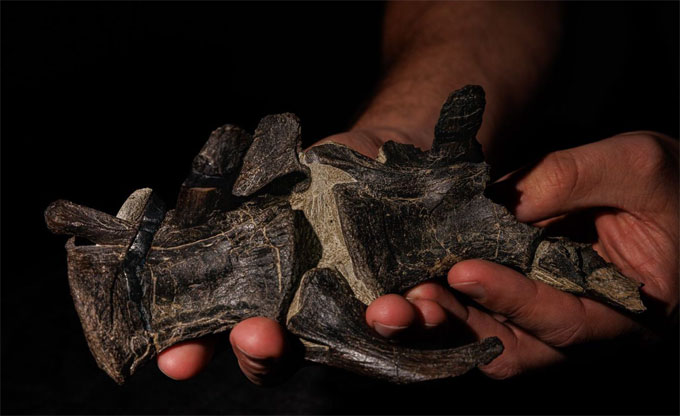
Aucasaurus garridoi pathology.

A specimen of the abelisaurid Aucasaurus garridoi was found to have a congenital developmental disease, despite which the animal was able to live for many years. Picture credit: Alessio Ciaffi.

Picture credit: Alessio Ciaffi

A Database of Diseases and other Pathologies of Predatory Dinosaurs

The detailed analysis revealed three distinct types of pathologies. The Aucasaurus specimen had a congenital developmental disease, which indicated that this individual was born with a malformation that, despite this, allowed the animal to live for many years.  In the case of Elemgasem, spondyloarthropathy or spondyloarthritis was diagnosed, a disease also present in humans, which causes the fusion of vertebrae and the consequent inflammation. On the other hand, the Quilmesaurus specimen showed signs of some pathology that could not be precisely determined. This pathology seemed different from those identified in the other two abelisaurids.

This work led onto the third phase of the study. The team compiled a database which documented all the known cases of pathologies in theropod dinosaurs.  Statistical analysis provided the scientists with potential insights into theropod lifestyle and behaviour. For instance, the high number of fractures observed in the Allosauridae. In addition, tyrannosaurids had bite marks which resulted in infections such as trichomonosis. The incidence of bite marks in tyrannosaurs suggests that tyrannosaurids indulged in very aggressive intraspecific social behaviour.

To read an earlier article from Everything Dinosaur documenting trichomonosis in an iconic T. rex specimen: Some Tyrannosaurs Suffered from Parasitic Infections.

Corresponding author of the newly published paper, Mattia Antonio Baiano (Ernesto Bachmann Municipal Museum) commented:

“This work not only expands our knowledge about dinosaur health, but also highlights the presence of diseases that persist today, suggesting possible connections between the study of extinct organisms and the research of contemporary diseases.”

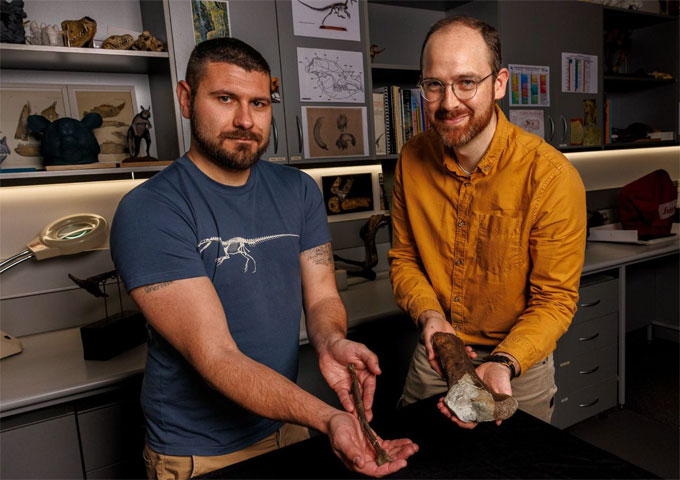
Mattia Baiano conducts fieldwork.

Corresponding author Mattia Baiano conducts fieldwork. Picture credit: courtesy of the researchers.

Picture credit: Courtesy of the Researchers

A Fresh Perspective on the Lives of Predatory Dinosaurs

The research team concluded that statistical examination of the distribution of injuries associated with different theropod families could provide a fresh perspective regarding theropod behaviour. Different lifestyles and behaviours may underlie the frequency of different injuries among theropod taxa.

Co-author Diego Pol, CONICET researcher at the “Egidio Feruglio” Paleontological Museum added:

“It is a very interesting work since it brings together specialties from different researchers and tries to discover a little of the marks left on the skeleton by the behaviours of dinosaurs.”

Diego Pol one of the co-authors of the diseases in predatory dinosaurs paper.

Diego Pol one of the co-authors of the diseases in predatory dinosaurs paper.

Picture credit: Courtesy of the Researchers

Everything Dinosaur acknowledges the assistance of a media release from CONICET in the compilation of this article.

The scientific paper: “New information on paleopathologies in non-avian theropod dinosaurs: a case study on South American abelisaurids” by Mattia A. Baiano, Ignacio A. Cerda, Filippo Bertozzo and Diego Pol published in BMC Ecology and Evolution.

The Everything Dinosaur website: Dinosaur Toys and Models.

23 03, 2024

A New Iguanodontian Dinosaur from Portugal

By |2024-09-18T13:36:52+01:00March 23rd, 2024|Categories: Adobe CS5, Dinosaur and Prehistoric Animal News Stories, Dinosaur Fans, Main Page, Palaeontological articles, Photos/Pictures of Fossils|0 Comments

A new species of Late Jurassic iguanodontian has been described from fossils discovered in western Portugal. The dinosaur has been named Hesperonyx martinhotomasorum. The discovery of this dinosaur adds to the diversity of relatively small ornithopods known from the Lourinhã Formation.  The fossil material consisting of a partial left hindlimb and isolated forelimb bones were excavated from the cliffs at the picturesque Porto Dinheiro beach (Lourinhã, Portugal). The fossils probably represent a single, individual dinosaur.

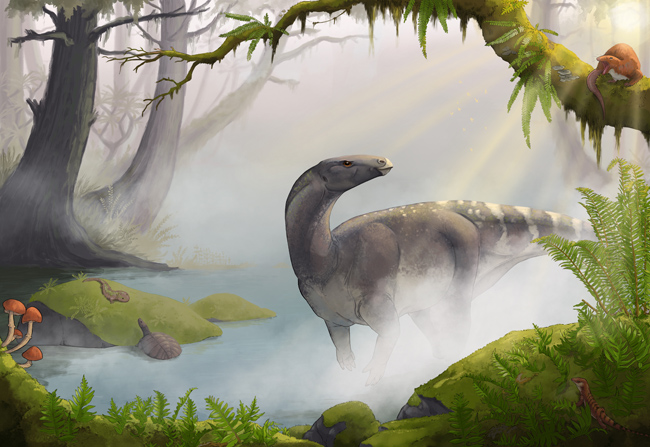
Hesperonyx martinhotomasorum life reconstruction.

Hesperonyx martinhotomasorum life reconstruction. Picture credit: Victor Carvalho.

Hesperonyx martinhotomasorum

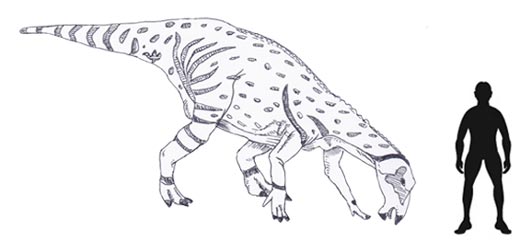
The researchers conclude that this dinosaur had a body length of between 3-4 metres. It was rather small when compared to Early Cretaceous iguanodontians such as Iguanodon bernissartensis which had an estimated length of approximately 10 metres and weighed around 5 tonnes. The forelimb bones lack modifications for quadrupedal locomotion. Hesperonyx probably was a biped and considerably more agile than later, much larger iguanodontians.

Hesperonyx roamed western Portugal approximately 150 million years ago (Late Jurassic). The research project was a collaboration between scientists from the NOVA School of Science and Technology, University of Zaragoza and University of Bonn, supported by the local Museu da Lourinhã and Sociedade de História Natural de Torres Vedras.

Co-author Bruno Camilo studying dinosaur limb bones.

Co-author of the study Bruno Camilo, head of Sociedade of História Natural of Torres Vedras (Universidade NOVA de Lisboa). Picture credit: Universidade NOVA de Lisboa.

A New Dinosaur Taxon

The almost complete and semi-articulated left hindlimb was discovered in the summer of 2021. The fossil material was cleaned and prepared in the Museu da Lourinhã laboratory. The morphology of the bones puzzled the researchers. 

Student and co-author of the scientific paper Lucrezia Ferrari who worked on the fossilised material commented:

“It simply did not match anything we have seen before.”

The team were quietly confident that these fossils represented a new dinosaur taxon.

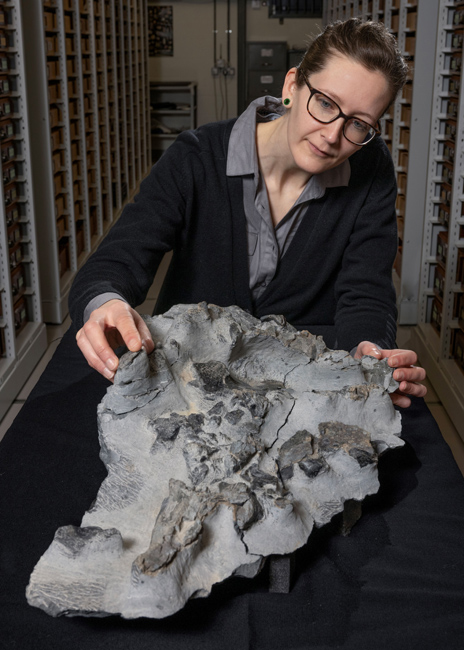
Fossil preparation (Hesperonyx paper).

Student Lucrezia Ferrari who worked on the fossil preparation and presented a thesis on this new ornithopod dinosaur as part of her Master’s degree. Picture credit: Universidade NOVA de Lisboa.

Filippo Maria Rotatori, lead author of the paper published in the Journal of Vertebrate Palaeontology added:

“It was something familiar, but it has several features that just looked unusual.  It was some kind of bipedal herbivorous dinosaur, but such animal was never recorded in Portugal before.   It’s a new species. One more in the highly diverse ecosystem of the Portuguese Jurassic.”

What’s in a Name?

The genus name is derived from “Hesperus” the Greek God, whose name is associated with the planet Venus and it being seen in the western sky. This is a nod to the fact that the fossils come from the western region of Portugal. The genus name also contains the Greek “onyx” meaning claw. The specific name honours Micael Martinho and Carla Alexandra Tomás for their dedicated work as fossil preparators at the Museu da Lourinhã.

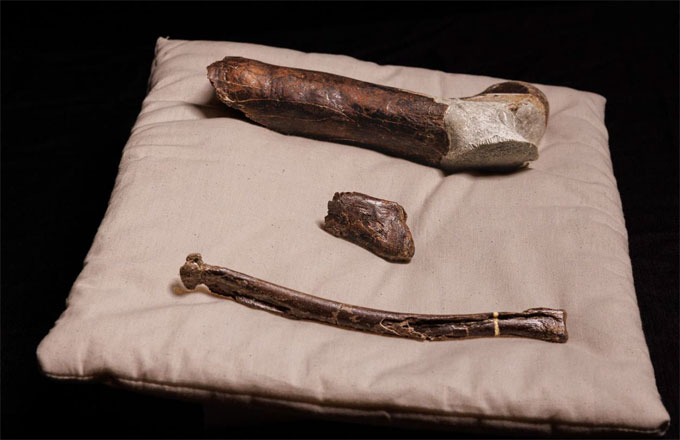
Hesperonyx toe bones and researchers.

Lead author of the scientific paper, Filippo Maria Rotatori with the preparators Micael Martinho and Carla Tomás (Museu da Lourinhã) with the toe bones. The trivial name of this new dinosaur honours Micael and Carlo and recognises their dedication to the work of fossil preparation. Picture credit: Universidade NOVA de Lisboa.

Hesperonyx martinhotomasorum – A Small Iguanodontian Dinosaur

The Iguanodontia is an extensive and specious clade of ornithischian dinosaurs. These herbivores were abundant during the Jurassic and Cretaceous. Their early origins are not well understood. This is due to the lack of fossil material representing basal members of this clade. The fossil record of early iguanodontians is particularly poor in Europe. Only a handful of European species are currently recognised. For example, Cumnoria prestwichii and the geologically older Callovosaurus leedsi, both these dinosaurs are associated with English Jurassic deposits (Oxfordshire and Cambridgeshire respectively).

The discovery of Hesperonyx adds to the diversity of small ornithopod dinosaurs already recognised in the fossil record of the Lourinhã Formation.  It was an unexpected fossil find. Hesperonyx demonstrates that there are probably many more types of dinosaur awaiting discovery in the Upper Jurassic strata of western Portugal.

Hesperonyx martinhotomasorum limb bones in life position.

The partial left hindlimb of Hesperonyx martinhotomasorum assembled to reflect the position within the skeleton. Picture credit: Inês Marques.

Miguel Moreno-Azanza, the main advisor of Filippo, noted:

“This is a wonderful discovery, and also a great example of how scientific collaborations in palaeontology can help to reach great results.”

Hesperonyx martinhotomasorum paper co-author Miguel Moreno-Azanza, from Zaragoza University

Miguel Moreno-Azanza, from Zaragoza University, co-author of the Hesperonyx scientific paper with a titanosaur egg fossil and an Ampelosaurus model. Picture credit: Universidade NOVA de Lisboa.

Everything Dinosaur recognises the assistance of a media release and personal email correspondence with the lead author in the compilation of this article.

The scientific paper: “An unexpected early-diverging iguanodontian dinosaur (Ornithischia, Ornithopoda) from the Upper Jurassic of Portugal” by Filippo Maria Rotatori, Lucrezia Ferrari, Cristina Sequero, Bruno Camilo, Octávio Mateus and Miguel Moreno-Azanza published in the Journal of Vertebrate Palaeontology.

15 03, 2024

Were Eurypterids More Closely Related to Horseshoe Crabs or Scorpions?

By |2024-03-17T05:47:56+00:00March 15th, 2024|Categories: Adobe CS5, Dinosaur Fans, Main Page, Palaeontological articles, Photos/Pictures of Fossils|0 Comments

At Everything Dinosaur, we receive quite a lot of emails from customers and fans of prehistoric animals. Many of these emails are requests asking for more information about prehistoric animal figures. However, customers also contact us wanting help with answering a specific query about extinct creatures and life in the past. For example, we were recently asked what animals alive today are the closest relative of the eurypterids?

A splendid pair of sea scorpion fossils on display. Museum fossil on display.
A pair of eurypterid fossil specimens on display at the London Natural History Museum. Picture credit: Everything Dinosaur.

Picture credit: Everything Dinosaur

Answering a Question About Eurypterids

Eurypterids were members of the Arthropoda phylum. Specifically, they are part of the Subphylum Chelicerata (pronounced kel-iss-ser-rat-ah), which also contains the spiders, mites, scorpions and horseshoe crabs. These animals have a pair of jointed appendages that are located in front of their mouths (chelicerae – kel-iss-ser-ray). For most, they are modest feeding appendages such as seen in horseshoe crabs. In the spiders these chelicerae form venom injecting fangs. In some eurypterids such as the Pterygotidae, these appendages evolved into giant pincers designed for grabbing prey.

A sea scorpion claw
A stunning fossil of a sea scorpion (eurypterid) claw housed at the National Museum Cardiff (Wales) photographed in 2019 when team members at Everything Dinosaur visited. Picture credit: Everything Dinosaur.

Picture credit: Everything Dinosaur

Scorpiones or Xiphosurans?

Scientists remain uncertain as to whether extant scorpions or xiphosurans such as the horseshoe crab are the closest living relatives to the extinct eurypterids. Scorpions share a similar body plan, although scorpions are entirely terrestrial. Xiphosurans share the aquatic habit and also have an anatomy that is similar to the “sea scorpions” in some respects. Eurypterid feeding was probably more similar to that of xiphosurans.

The question of phylogeny remains unresolved. The lack of soft tissue preservation in “sea scorpions” and the flattened nature of most eurypterid fossils have hampered research. The absence of a clear eurypterid analogue from living chelicerates may indicate that the eurypterids occupied an ecological niche that was intermediate between xiphosurans and the Order Scorpiones.

The Everything Dinosaur website: Everything Dinosaur.

11 03, 2024

Spinosaurus Research – Inferring the Lifestyle of a Huge Theropod Dinosaur

By |2024-03-23T15:01:48+00:00March 11th, 2024|Categories: Adobe CS5, Dinosaur Fans, Main Page, Palaeontological articles|0 Comments

Recently, Everything Dinosaur team members wrote a blog post summarising the findings of the latest scientific paper on Spinosaurus aegyptiacus. This paper (Myhrvold et al), outlined some drawbacks in using bone density analysis to infer an extinct animal’s habits and lifestyle. They outlined some errors and omissions in a previous study that concluded Spinosaurus and Baryonyx walkeri, were capable of submerging and hunting underwater.

CollectA Deluxe Spinosaurus
The CollectA Deluxe Spinosaurus dinosaur model. A recently introduced (2022) updated replica of the giant, North African theropod Spinosaurus. This paper (Fabbri et al), postulated that dense bones associated with this dinosaur were adaptations to help this animal dive and to stay underwater.

An Extensively Studied Theropod

Named and described in 1915 (Stromer), Spinosaurus aegyptiacus has been the subject of intense research over the last decade. It was perhaps the longest theropod dinosaur of all. Some palaeontologists have estimated that S. aegyptiacus was up to fifteen metres long. Its mode of hunting and behaviour has come under detailed scrutiny since a detailed description, based on new fossil material was published in 2014.

This paper proposed that Spinosaurus was a semi-aquatic, obligate quadruped.

To read Everything Dinosaur’s 2014 blog post: Spinosaurus – Four Legs are Better than Two.

Spinosaurus swimming.
Very much at home in the water according to the 2014 study. Picture credit: Davide Bonadonna, Nizar Ibrahim, Simone Maganuco.

A Shoreline Stalker or an Underwater Predator?

Palaeontologists continued to debate whether Spinosaurus aegyptiacus and its near relatives were underwater predators, or shoreline stalkers. The 2014 research paper proposed that although Spinosaurus was a capable swimmer it was not a fully aquatic, underwater predator.

However, in 2020 a paper published in the journal Nature described Spinosaurus caudal vertebrae. These bones suggested that S. aegyptiacus had a broad tail. This could be used to propel itself through the water.

To read Everything Dinosaur’s 2020 post: Spinosaurus The River Monster.

Papo Limited Edition Spinosaurus Model. A Papo model retirement (2023).
The Papo Limited-edition Spinosaurus dinosaur model (2019). This model reflected the broad tail that was to be revealed in a forthcoming scientific paper. Picture credit: Everything Dinosaur.

Picture credit: Everything Dinosaur

The picture (above) shows the Papo limited-edition Spinosaurus aegyptiacus figure. This model depicts Spinosaurus as a quadruped and emphasises the broad, deep tail.

To view the range of Papo figures in stock: Papo Prehistoric Animal Figures.

However, in 2022 a scientific paper was published in the journal “eLife” that challenged the aquatic lifestyle. Palaeontologists led by scientists from the University of Chicago argued that Spinosaurus and Baryonyx walkeri would have been unstable when surface swimming. They also concluded that these dinosaurs would be too buoyant to dive and remain fully submerged.

Everything Dinosaur’s blog post covering this research: Spinosaurus Not an Aquatic Dinosaur.

Dense Bones Acting Like Ballast

Also, in 2022 another assessment using a statistical analysis of bone density proposed that Spinosaurus could dive and stay submerged (Fabbri et al). The heavy bones acted like ballast. This anatomical adaptation is seen in extant birds such as penguins and also in some mammals like manatees. These researchers also argued that some other spinosaurids, such as Suchomimus lacked these dense bones and were probably waders.

The blog post covering this research: Bone Density Study Proposes Some Spinosaurids were Fully Aquatic.

The new study (Myhrvold et al), criticised the complex statistical methodology (pFDA) used in the bone density study. The team concluded that the study undertaken by Fabbri et al had measurement errors and was flawed. It was not possible to infer an aquatic habit for spinosaurids based on this data.

To read Everything Dinosaur’s article on the research by Myhrvold et al: Back to the Shore for Spinosaurus.

The researchers demonstrated that it is important to use consistent and objective criteria to decide which species to include and exclude, as well as how to classify their behaviour. The findings also demonstrate the importance of taking measurement errors and individual variations into account when assessing bone density.

The debate over the lifestyle and habits of spinosaurids is likely to continue. We look forward to the next instalment in this long-running debate.

Visit the Everything Dinosaur website: Everything Dinosaur.

10 03, 2024

A New Lower Permian Amphibian is Scientifically Described

By |2024-03-06T21:14:57+00:00March 10th, 2024|Categories: Adobe CS5, Dinosaur and Prehistoric Animal News Stories, Main Page, Palaeontological articles, Photos/Pictures of Fossils|0 Comments

Researchers have scientifically described a new taxon of amphibian from the Lower Permian of Germany. The animal has been named Bromerpeton subcolossus. Researchers from the Museum für Naturkunde in Berlin (Germany) in collaboration with colleagues from the United States suggest that this small tetrapod probably spent much of its time underground.

Holotype of Bromerpeton subcolossus (specimen number MNG 16545).
A prepared block revealing the Bromerpeton subcolossus holotype (specimen number MNG 16545). Picture credit: Carola Radke.

Bromerpeton subcolossus

A block of undescribed fossils was carefully cleaned and prepared at the Carnegie Museum of Natural History in Pittsburgh (USA). When these fossils were examined in detail it was discovered that they represented a new taxon. Bromerpeton has been classified as a member of the Recumbirostra clade.

The fossil material comes from the famous “Bromacker” location in Thuringia, central Germany. The siltstones and sandstones preserve both trace and body fossils of early tetrapods. More than a dozen new species have been named and described. This fossil site was formed by the deposition of sediments in a high plateau environment. Most Permian vertebrate fossil sites represent lowland ecosystems close to bodies of water.

Computed tomography (CT) scans revealed an exceptionally well-preserved right forelimb with five fingers. This is an unusual characteristic within the Recumbirostra clade. Most have only three or four digits on the manus.

Lead author of the paper, Dr Mark MacDougall (Museum für Naturkunde – Berlin), explained that Bromerpeton subcolossus was less than fifteen centimetres in length. Its skull was just two centimetres long.

Fossorial (Burrowing) Adaptations

Despite being diminutive, Bromerpeton possessed sturdy limbs with a broad manus (hand) and pointed claws. The researchers postulate that Bromerpeton subcolossus dug burrows and spent much of its time underground. The fossil material is estimated to be around 290 million years old (Lower Permian).

Dr Mark MacDougall remarked:

“Bromerpeton may be small, but it provides a lot of new information about the evolution and ecology of early tetrapods and in particular the Recumbirostra, a group that has received a lot of attention in recent years. Our discovery also contributes to understanding the diversity of the Lower Permian Bromacker ecosystem.”

Everything Dinosaur acknowledges the assistance of a media release from the Museum für Naturkunde (Berlin) in the compilation of this article.

The scientific paper: “A new recumbirostran ‘microsaur’ from the lower Permian Bromacker locality, Thuringia, Germany, and its fossorial adaptations” by Mark MacDougall, Andréas Jannel, Amy Henrici, David S Berman, Stuart S. Sumida, Thomas Martens, Nadia Fröbisch and Jörg Fröbisch published in Scientific Reports.

Visit the Everything Dinosaur website: Everything Dinosaur.

9 03, 2024

New Research Identifies Earth’s Oldest Forest in Devon Cliffs

By |2024-03-12T14:11:28+00:00March 9th, 2024|Categories: Adobe CS5, Dinosaur and Prehistoric Animal News Stories, Dinosaur Fans, Main Page, Palaeontological articles, Photos/Pictures of Fossils|0 Comments

Evidence of a Devonian fossil forest has been found in the high sandstone cliffs located near Minehead in Devon. Researchers from the University of Cambridge and the University of Cardiff have discovered the oldest fossilised trees ever found in the UK. The fossil remains of the trees, known as Calamophyton represent the oldest known fossil forest on Earth.

Fossilised tree stumps near the town of Gilboa (New York, USA) and a quarry at nearby Cairo, New York are thought to be 380 and 385 million years old respectively. The Gilboa site is dominated by remains of Wattieza trees. These trees are related to the Calamophyton trees identified at the Devon site. They are both members of the Pseudosporochnales Order and are distantly related to modern ferns.

Devonian strata in the cliffs near Minehead.
The cliffs close to the Butlin’s holiday camp near Minehead (Devon) where the fossils were found. Picture credit: Neil Davies (University of Cambridge).

Devonian Fossil Forest

The Devonian fossil forest is thought to be around four million years older than the tree fossils discovered in New York. The forest is approximately 390 million years old (Eifelian faunal stage of the Middle Devonian).

Devon fossil forest details of a fallen tree trunk.
Detail of a fallen tree truck. Picture credit: Chris Berry (University of Cardiff).

The fossils were found near the town of Minehead. The site is located on the south bank of the Bristol Channel, near a Butlin’s holiday camp. The fossilised trees, known as Calamophyton, at first glance resemble palm trees, but they are not related to modern angiosperms. Rather than solid wood, their trunks were thin and hollow in the centre. They also lacked leaves, and their branches were covered in hundreds of twig-like structures.

Devon fossil forest life reconstruction (Calamophyton).
Devon fossil forest life reconstruction showing Calamophyton. Picture credit: Peter Giesen/Chris Berry.

Evidence of Arthropods Found

The trees were much shorter than extant trees. The largest specimens were between two and four metres high. As the trees grew, they shed their branches. The floor of the forest was covered in a dense mat of decaying vegetation. This was home to an array of invertebrates and arthropod tracks have been discovered at this site.

Arthropod tracks recorded at the Devon fossil forest site.
Arthropod tracks recorded at the Devon fossil forest site. Picture credit: Neil Davies (University of Cambridge).

A Devonian Ecosystem

It had been thought that these sandstone cliffs were largely devoid of fossils. This remarkable discovery demonstrates how early trees helped to stabilise riverbanks and coastlines hundreds of millions of years ago. It was during the Devonian that the first extensive terrestrial forests formed.

The Devonian lasted between 419 million and 359 million years ago. During this geological period the first complex terrestrial ecosystems evolved. By the end of the Devonian, the first seed-bearing plants (pteridosperms) appeared and the earliest land animals, mostly arthropods, were well-established.

Small tree stumps.
A photograph showing an area of small tree stumps. Picture credit: Neil Davies (University of Cambridge).

Fundamentally Changing Life on Earth

Commenting on the significance of the fossil forest discovery, one of the paper’s co-authors, Professor Neil Davies (Cambridge University), stated:

“The Devonian period fundamentally changed life on Earth. It also changed how water and land interacted with each other, since trees and other plants helped stabilise sediment through their root systems, but little is known about the very earliest forests.”

The Devonian fossil forest identified by the researchers was found in the Hangman Sandstone Formation, along the north Devon and west Somerset coasts. During the Devonian period, this region was not attached to the rest of England, but instead lay further south, connected to parts of Germany and Belgium, where similar Devonian fossils have been found.

Ripple marks on the forest floor.
Ripple marks on the forest floor. Picture credit: Neil Davies (University of Cambridge).

Studying the Ecology of the Earliest Forests on Earth

Co-author Dr Christopher Berry (Cardiff University) commented:

“When I first saw pictures of the tree trunks I immediately knew what they were, based on 30 years of studying this type of tree worldwide. It was amazing to see them so near to home. But the most revealing insight comes from seeing, for the first time, these trees in the positions where they grew. It is our first opportunity to look directly at the ecology of this earliest type of forest, to interpret the environment in which Calamophyton trees were growing, and to evaluate their impact on the sedimentary system.”

During the Devonian, this location was a semi-arid plain, criss-crossed by small river channels spilling out from mountains to the northwest. The fieldwork was undertaken along the highest sea-cliffs in England, some of which are only accessible by boat. The sandstone formation is in fact rich with plant fossil material. The researchers identified fossilised plants and plant debris, fossilised tree logs, traces of roots and sedimentary structures, preserved within the sandstone.

Tree stump in cross-section
Cross section of tree stump. Picture credit: Neil Davies (University of Cambridge).

A Weird Forest

Professor Davies explained:

“This was a pretty weird forest – not like any forest you would see today. There wasn’t any undergrowth to speak of and grass hadn’t yet appeared, but there were lots of twigs dropped by these densely-packed trees, which had a big effect on the landscape.”

Small Devonian plant twigs.
Small plant twigs. Picture credit: Chris Berry (University of Cardiff).

This was the first time in the history of our planet that large plants could grow together on land. The sheer abundance of debris shed by the Calamophyton trees built up within layers of sediment. The sediment affected the way that the rivers flowed across the landscape, the first time that the course of rivers could be affected in this way.

Professor Davies added:

“The evidence contained in these fossils preserves a key stage in Earth’s development, when rivers started to operate in a fundamentally different way than they had before, becoming the great erosive force they are today. People sometimes think that British rocks have been looked at enough, but this shows that revisiting them can yield important new discoveries.”

Everything Dinosaur acknowledges the assistance of a media release from the University of Cambridge in the compilation of this article.

The scientific paper: “Earth’s earliest forest: fossilized trees and vegetation-induced sedimentary structures from the Middle Devonian (Eifelian) Hangman Sandstone Formation, Somerset and Devon, SW England” by Neil S. Davies, William J. McMahon and Christopher M. Berry published in Journal of the Geological Society.

Visit the award-winning Everything Dinosaur website: Visit Everything Dinosaur.

8 03, 2024

New Research Suggests its Back to the Shore for Spinosaurus

By |2024-03-10T13:21:34+00:00March 8th, 2024|Categories: Adobe CS5, Dinosaur Fans, Main Page, Palaeontological articles|0 Comments

The spinosaurids represent an extremely unusual type of theropod. Their mode of hunting and lifestyle remains controversial. Over recent years more fossil material associated with perhaps the most derived spinosaurid Spinosaurus aegyptiacus, has been studied. In addition, new lines of enquiry have been explored in a bid to better understand these bizarre carnivorous dinosaurs. Some scientists have argued that Spinosaurus was a fully aquatic, underwater pursuit predator. Others have argued that this dinosaur stayed in the shallows or waded into the water to catch fish in a similar manner to extant bears.

Spinosaurus underwater.
Spinosaurus, the longest predatory dinosaur known, is opening its elongate jaws, studded with conical teeth, to catch a sawskate. Contrary to previous suggestions, this animal was not a heron-like wader – it was a “river monster”, actively pursuing prey in a vast river system located in modern-day North Africa. Dense bones in the skeleton of Spinosaurus strongly suggest it spent a substantial amount of time submerged in the water. However, newly published research (Myhrvold et al) has challenged this view of Spinosaurus. Picture credit: Davide Bonadonna.

Spinosaurus aegyptiacus Bone Density Study

Numerous lines of enquiry have been explored in a bid to resolve these questions. A recently published study (Fabbri et al) sought to resolve this matter. They applied a statistical method and explored spinosaurid bone density. Animals like manatees have especially dense bones that enable them to stay submerged. These researchers examined spinosaurid bone density in comparison to the bone densities of extant animals which are adapted to an aquatic life. They concluded that Spinosaurus and its close relative Baryonyx (B. walkeri) were capable of submerging themselves underwater to hunt.

However, newly published research has challenged these conclusions. Scientists from the University of Chicago along with collaborators from the Royal Tyrrell Museum (Canada) and other co-authors have outlined some of the pitfalls in using statistical measurements of bone density to infer a lifestyle. The team identified inconsistencies and they proposed that it was difficult to draw conclusions when taxa are represented by limited data.

PNSO Aymen the Spinosaurus.
Striding across the landscape but with water close by, the new for 2024 PNSO Aymen the Spinosaurus dinosaur model. Scientists remain uncertain as to whether Spinosaurus was able to fully submerge and pursue prey.

The picture above shows the recently introduced PNSO Spinosaurus model. The replica contains a number of anatomical traits identified in contemporary scientific papers. For example, the PNSO Spinosaurus has a broad tail. However, it is depicted as a terrestrial, bipedal animal and not a semi-aquatic quadruped.

To view the range of PNSO prehistoric animals available from Everything Dinosaur: PNSO Dinosaur and Prehistoric Animal Models.

Could Some Spinosaurs Dive?

Writing in the open-access journal “PLOS One” the scientists argue that the previous research was not robust enough to conclude that S. aegyptiacus and Baryonyx walkeri were fully submerged “subaqueous foragers.” Their findings not only invalidate the conclusions of the earlier bone density analysis, but also have important implications for future quantitative uses of bone compactness and discriminant analysis in palaeontology.

To read Everything Dinosaur’s blog post about the earlier research: Bone Density Study Indicates that Some Spinosaurids were Semi-aquatic.

The dense bones found in the relatively short hindlimbs, may have been an adaptation to support the animal’s great weight as it moved on land. The research team, which included Paul Sereno (University of Chicago), propose that Spinosaurus aegyptiacus probably could not dive. Instead, it may have waded in water around two metres deep, without floating. This permitted it to ambush fish with its huge claws and elongated jaws.

The scientific paper: “Diving dinosaurs? Caveats on the use of bone compactness and pFDA for inferring lifestyle” by Nathan P. Myhrvold, Stephanie L. Baumgart, Daniel Vidal, Frank E. Fish, Donald M. Henderson, Evan T. Saitta and Paul C. Sereno published in PLOS One.

The Everything Dinosaur website: Everything Dinosaur.

5 03, 2024

Khinjaria acuta A Bizarre New Mosasaur from Morocco

By |2024-03-10T10:09:18+00:00March 5th, 2024|Categories: Adobe CS5, Dinosaur and Prehistoric Animal News Stories, Dinosaur Fans, Main Page, Palaeontological articles, Photos/Pictures of Fossils|0 Comments

A new mosasaur taxon from the Late Cretaceous of Morocco has been scientifically described. Khinjaria acuta was as long as an Orca (Orcinus orca). It had a robust skull, strong jaws and dagger-like teeth. The researchers contrast today’s marine ecosystems with few apex predators, with the Late Cretaceous marine environment. Writing in the journal “Cretaceous Research” the researchers portray an ancient marine ecosystem teeming with predators.

Khinjaria acuta life reconstruction.
A Khinjaria acuta life reconstruction. Picture credit: Andrey Atuchin.

Khinjaria acuta

The study is based on a skull and parts of the postcranial skeleton collected from a phosphate mine southeast of Casablanca (Morocco). Researchers from the University of Bath, the Marrakech Museum of Natural History, the Museum National d’ Histoire Naturelle (NMNH) in Paris (France), Southern Methodist University in Texas (USA), and the University of the Basque Country (Bilbao) were involved.

Measuring around eight metres in length, Khinjaria used its long, dagger-like teeth to seize prey. It was part of an extraordinarily diverse fauna of predators that inhabited the Atlantic Ocean off the coast of Morocco during the Maastrichtian faunal stage of the Late Cretaceous.

Khinjaria acuta skull (top) with explanatory line drawing (bottom).
A photograph of the skull material (top) with a line drawing of the skull fossil (bottom). Picture credit: University of Bath.

The Sheer Diversity of Top Predators in the Marine Ecosystem

One of the authors of the scientific paper, Dr Nick Longrich (University of Bath), stated:

“What’s remarkable here is the sheer diversity of top predators. We have multiple species growing larger than a great white shark, and they’re top predators, but they all have different teeth, suggesting they’re hunting in different ways.”

The reconstructed skull of Khinjaria acuta shown in lateral view.
The reconstructed skull of Khinjaria acuta shown in lateral view. Picture credit: Nick Longrich.

Dr Longrich added:

“Some mosasaurs had teeth to pierce prey, others to cut, tear, or crush. Now we have Khinjaria, with a short face full of huge, dagger-shaped teeth. This is one of the most diverse marine faunas seen anywhere, at any time in history, and it existed just before the marine reptiles and the dinosaurs went extinct.”

A Diversity of Moroccan Marine Reptiles

Fossil discoveries have highlighted the astonishing diversity of large marine reptiles in the environment. Their different dentition suggests that many were not directly competing, that niche partitioning was occurring. For example, the researchers conducted a phylogenetic analysis and placed Khinjaria in a mosasaur clade which they named the Selmasaurini. Also placed in this clade was the Moroccan plioplatecarpine mosasaur Gavialimimus almaghribensis. This mosasaur was a specialised fish hunter.

To read Everything Dinosaur’s article about Gavialimimus almaghribensis: A New Species of Mosasaur from Morocco.

Mosasaurs, plesiosaurs and giant sea turtles disappeared, along with entire families of fish at the end of the Cretaceous. This led to the evolution of modern marine ecosystems with whales and seals as apex predators along with teleost fish such as swordfish and tuna.

Dr Longrich commented:

“There seems to have been a huge change in the ecosystem structure in the past 66 million years. This incredible diversity of top predators in the Late Cretaceous is unusual, and we don’t see that in modern marine communities.”

Estimated size of Khinjaria.
A Khinjaria silhouette next to a diver to show the approximate scale. Picture credit: Nick Longrich.

An Ecosystem Different from a Modern Marine Ecosystem

Modern marine food chains have just a few large apex predators, animals like orcas, white sharks, and leopard seals. The Late Cretaceous had many more types of marine predators.

Dr Longrich continued:

“Modern ecosystems have predators like baleen whales and dolphins that eat small prey, and not many things eating large prey. The Cretaceous has a huge number of marine reptile species that take large prey. Whether there’s something about marine reptiles that caused the ecosystem to be different, or the prey, or perhaps the environment, we don’t know. But this was an incredibly dangerous time to be a fish, a sea turtle, or even a marine reptile.”

Professor Nathalie Bardet, (Natural History Museum of Paris), explained:

“The Phosphates of Morocco deposit in a shallow and warm epicontinental sea, under a system of upwellings; these zones are caused by currents of deep, cold, nutrient-rich waters rising towards the surface, providing food for large numbers of sea creatures and, as a result, supporting a lot of predators. This is probably one of the explanations for this extraordinary paleobiodiversity observed in Morocco at the end of the Cretaceous.”.

The phosphate mines of Morocco have provided a wealth of marine fossil material. The specimens collected include the “saw-toothed” mosasaur Xenodens, Stelladens which had teeth with additional cutting edges and Thalassotitan whose teeth were conical in shape and massive.

Everything Dinosaur acknowledges the assistance of a media release from the University of Bath in the compilation of this article.

The scientific paper: “A bizarre new plioplatecarpine mosasaurid from the Maastrichtian of Morocco” by Nicholas R. Longrich, Michael J. Polcyn, Nour-Eddine Jalil, Xabier Pereda-Suberbiola and Nathalie Bardet published in Cretaceous Research.

Take a look at the Everything Dinosaur website: Everything Dinosaur.

24 02, 2024

Studying Sea Scorpion Fossils – How Did Eurypterids Breathe?

By |2024-03-16T17:25:24+00:00February 24th, 2024|Categories: Adobe CS5, Educational Activities, Main Page, Palaeontological articles, Photos/Pictures of Fossils|0 Comments

The eurypterids were an extremely successful group of arthropods. These animals are often referred to as “sea scorpions”. However, their taxonomic relationship to extant scorpions remains unclear and they were not confined to marine environments. These invertebrates are members of the Subphylum Chelicerata (claw horns) and are members of the Eurypterida Order. Approximately 250 different species have been named. One of the fascinating aspects of eurypterids is understanding how they breathed.

Examining sea scorpion fossils
A fossil of a sea scorpion (eurypterid) on display at the Manchester Museum. Note the pointed end segment (telson). Probably an example of the Silurian eurypterid Eurypterus. Picture credit: Everything Dinosaur.

Picture credit: Everything Dinosaur

How Did Eurypterids Breathe?

Most palaeontologists believe that eurypterids evolved in marine environments. However, fossils have been found in association with estuarine and freshwater environments. Carboniferous trackways suggest that some eurypterids may have been amphibious and able to spend some time on land.

No eurypterid is thought to have been wholly or primarily terrestrial. There is some remarkable fossil evidence to suggest that they did evolve air-breathing organs. When discussing respiration, it is thought that the primary organs of aquatic respiration are likely to have been retained at least in part.

The extant horseshoe crab (Limulus) may provide an analogue. These animals inhabit marine environments although they do venture into shallow water to mate and onto the shore to lay eggs. Horseshoe crabs have five pairs of gills located on their abdomen (Opisthosoma). Each pair of gills consists of flap-like structures covering a series of membranes that resemble the pages from a book. These are called lamellae, but their morphology has given rise to the popular term “book lungs”. Oxygen is absorbed via gaseous exchange on the surface area of the lamellae.

CollectA Horseshoe crab model in ventral view
The CollectA Horseshoe crab model in ventral view (view of the underside). Picture credit: Everything Dinosaur.

Picture credit: Everything Dinosaur

The image (above) shows a ventral view of the popular CollectA horseshoe crab model.

To view the range of CollectA models in stock: CollectA Prehistoric Animal Models and Figures.

Four Pairs of Book Gills or Five?

Debate still continues as to whether eurypterids had four pairs of book gills or five. A specimen of Onychopterella augusti from Late Ordovician strata located in South Africa preserved four pairs of vertical book gills. The book gills were located in the third to sixth segments of the abdomen. It has been suggested that all eurypterids had four pairs of book gills rather than the five pairs seen in xiphosurans such as horseshoe crabs.

Terrestrial scorpions also have four pairs of vertically orientated book lungs, located in the third to sixth body segments. It is not known whether this is case of synapomorphy (shared characteristic different from that of their latest common ancestor). This anatomical similarity could indicate that scorpions (Order Scorpiones) are more closely related to eurypterids than previously thought. The phylogenetic relationship between eurypterids and other members of the Arthropoda remains controversial.

Pancaked Sea Scorpion Fossils

Unfortunately, most fossil specimens of eurypterids are squashed flat and may only represent exuviae (shed exoskeletons after moulting [ecdysis]).

Two Pterygotus sea scorpion fossils.
Examples of the Pterygotioidea eurypterid lineage. Note the flattened, blade-like telson that probably helped with propulsion or acted like a rudder helping to steer the animal through the water. The fossils represent Pterygotus anglicus. A pair of beautiful sea scorpion fossils. Picture credit: Everything Dinosaur.

Picture credit: Everything Dinosaur

Visit the Everything Dinosaur website: The Everything Dinosaur website.

23 02, 2024

Dinocephalosaurus and the Year of the Dragon

By |2024-02-23T13:53:07+00:00February 23rd, 2024|Categories: Adobe CS5, Dinosaur and Prehistoric Animal News Stories, Dinosaur Fans, Main Page, Palaeontological articles, Photos/Pictures of Fossils|1 Comment

A team of scientists have described new specimens of Dinocephalosaurus orientalis a bizarre, Triassic marine reptile. First scientifically described in 2003 (Li Chun), this new study has permitted scientists to construct the enormous neck of this animal in detail.

Measuring up to five metres in length, Dinocephalosaurus orientalis had an extremely long and flexible neck. The neck contains a total of thirty-two vertebrae. Tanystropheus in contrast, had thirteen cervical vertebrae. In some specimens the neck is 1.7 metres in length. It is much longer than the animal’s torso. The researchers compare D. orientalis to the Tanystropheus taxon. Tanystropheus is known from the Middle Triassic of Europe and China. Whilst Tanystropheus and Dinocephalosaurus had similar body shapes, these reptiles were not closely related. The long necks seen in these two taxa are an example of convergent evolution.

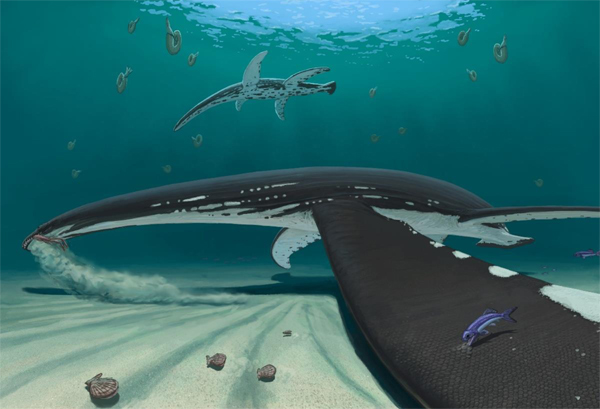
Dinocephalosaurus orientalis life reconstruction.
Dinocephalosaurus orientalis swimming amongst some prehistoric fish known as Saurichthys. Picture credit: Marlene Donelly.

Dinocephalosaurus orientalis A Remarkable Marine Reptile

The scientific paper describing the animal is published in full in the academic journal Earth and Environmental Science: Transactions of the Royal Society of Edinburgh – forming the entirety of the latest volume.

Fellow of the Royal Society of Edinburgh and Editor-in-Chief of the RSE’s academic journal Transactions, Professor Robert Ellam FRSE commented:

“This remarkable marine reptile is another example of the stunning fossils that continue to be discovered in China”.

Comparisons with Tanystropheus

Both reptiles were of similar size and have several features of the skull in common, including a fish-trap type of dentition. However, Dinocephalosaurus is unique in possessing several more vertebrae both in the neck and in the torso, giving the animal a much more snake-like appearance. The neck of Dinocephalosaurus was more flexible than the neck of Tanystropheus. The fossils analysed in the newly published paper come from the Guizhou Province of China.

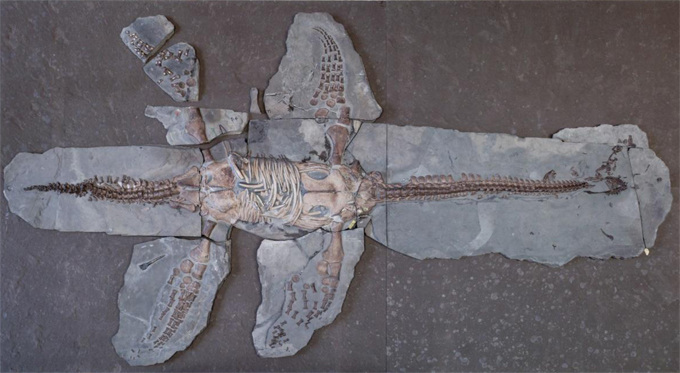
Dinocephalosaurus orientalis fossil specimen.
A nearly complete and articulated specimen of Dinocephalosaurus orientalis. Picture credit: The Royal Society of Edinburgh.

Dr Nick Fraser FRSE, Keeper of Natural Sciences at National Museums Scotland stated:

“This discovery allows us to see this remarkable long-necked animal in full for the very first time. It is yet one more example of the weird and wonderful world of the Triassic that continues to baffle palaeontologists. We are certain that it will capture imaginations across the globe due to its striking appearance, reminiscent of the long and snake-like, mythical Chinese Dragon.”

Appropriate for the “Year of the Dragon”

As we have now entered the Chinese “Year of the Dragon”, a new scientific paper on a Chinese reptile that superficially resembled a mythical dragon is highly appropriate. The fossils were studied over a period of ten years by researchers from Scotland, China, America and Germany.

Professor Li Chun from the Institute of Vertebrate Palaeontology and Palaeoanthropology in China, the scientist who originally described Dinocephalosaurus orientalis said:

“This has been an international effort. Working together with colleagues from the United States of America, the United Kingdom and Europe, we used newly discovered specimens housed at the Chinese Academy of Sciences to build on our existing knowledge of this animal. Among all of the extraordinary finds we have made in the Triassic of Guizhou Province, Dinocephalosaurus probably stands out as the most remarkable.”

Scientists propose that Dinocephalosaurus was superbly adapted to its marine environment. Given the length of its neck, moving on land would have been difficult. A remarkable fossil described in 2017 revealed that Dinocephalosaurus was viviparous (live birth). This remains the only record of viviparity associated with the Archosauromorpha.

To read Everything Dinosaur’s blog post about this discovery: First Evidence of Live Birth in Ancient Dinosaur Relative.

Dinocephalosaurus orientalis – Significant Fossil Discoveries

Dr Stephan Spiekman, a postdoctoral researcher based at the Stuttgart State Museum of Natural History, commented:

“As an early-career researcher, it has been an incredible experience to contribute to these significant findings. We hope that our future research will help us understand more about the evolution of this group of animals, and particularly how the elongate neck functioned.”

The paper describing the animal is published in full in the academic journal Earth and Environmental Science: Transactions of the Royal Society of Edinburgh – forming the entirety of the latest volume. The journal was first published in 1788.

Everything Dinosaur acknowledges the assistance of media releases from the Royal Society of Edinburgh and National Museums Scotland in the compilation of this article.

Visit the Everything Dinosaur website: Everything Dinosaur.

Go to Top