All about dinosaurs, fossils and prehistoric animals by Everything Dinosaur team members.

Articles, features and information which have slightly more scientific content with an emphasis on palaeontology, such as updates on academic papers, published papers etc.

25 06, 2024

A Remarkable New Creature from the Famous Burgess Shale

By |2024-06-29T06:02:57+01:00June 25th, 2024|Categories: Main Page, Palaeontological articles, Photos/Pictures of Fossils|0 Comments

A newly published scientific paper has described a new taxon from the famous Burgess Shale deposits of British Columbia.  The new taxon has been named Entothyreos synnaustrus.  Its discovery will help palaeontologists to better understand how arthropod-like features evolved in the ancestors of the Arthropoda.  Entothyreos helps to broaden our understanding about how major anatomical innovations within invertebrates came about.

Entothyreos synnaustrus fossil specimens.

Entothyreos synnaustrus fossil specimens. ROMIP 59505. A, full slab, with Entothyreos paratype specimens numbered 1–9. Insets as indicated. B, ROMIP 59505.2, anterior section with front limbs. C, ROMIP 59505. 3. dissociated anterior section. D, ROMIP 59505.5, dissociated spines and dorsolateral sheets. E, ROMIP 59505.6, anterior section F, ROMIP 59505.7, isolated spine and claw. G, H, ROMIP 59505.8, isolated spines and claws. G, full specimen. H, close-up of claws of posterior lobopod. I, ROMIP 59505.9. fragment of posterior section showing dissociated dorsolateral sclerotic trunk sheets and spines. Scale bars: A, 50 mm; B, D, E, G, I, 5 mm; C, F, 2.5 mm and H, 1 mm. Picture credit: Aria and Caron.

Entothyreos synnaustrus from the Tulip Beds

The fossil material comes from the Tulip Beds locality at the base of the Campsite Cliff Shale Member. This location was discovered in 1983 by a Royal Ontario Museum field team.  The site has yielded over ten thousand fossils, a rich array of soft-bodied organisms including the filter feeding Siphusauctum gregarium. The tulip-shaped body of S. gregarium inspired the location’s name.

To read an Everything Dinosaur blog post about Siphusauctum gregarium: Picking Tulips from the Burgess Shale.

The Burgess Shale biota was preserved by rapid mudflow deposits. The first specimens of the new species were collected in 1989.  Most of the fossil material having been collected in subsequent field expeditions in 1996, 2000, 2008 and 2016. A total of fifty-one specimens of E. synnaustrus have been identified to date.

Entothyreos synnaustrus taphonomy.

Entothyreos synnaustrus taphonomy. A, Paratype ROMIP 53233. Full specimen (posterior region missing). Spine arrangement quasi in place but underlying plates not visible. B, paratype ROMIP 53241. Possible moult with spine arrangement little disturbed, missing endocuticular plates. C, paratype ROMIP 53244. Weathered specimen preserving annulated posterior lobopods (arrow). D–H, paratype ROMIP 53239. D, full specimen (composite image of the part and counterpart, specimen immersed in water). Insets as indicated. E, close-up of a pair of anterior lobopods. Inset is F. F, close-up of proximal-most portion of lobopods with dense array of setae or small spines. G, EDS imaging of carbon (red) showing minute elements along spines otherwise rich in aluminium (light blue). H, BSE imaging of anterior spines showing minute external ornamentation. Scale bars: A, B, 10 mm; C, D, 5 mm; E, H 2 mm; F and G 1 mm. Picture credit: Aria and Caron.

The Evolution of the Arthropoda

The evolution of an exoskeleton consisting of hardened body parts (sclerites) connected by flexible joints is a defining characteristic of the Arthropoda.  The development of this body structure, referred to as arthrodization is considered one of the most significant evolutionary advancements in the animal kingdom.  The arthrodization of their limbs, known as arthropodization, likely emerged before the arthrodization of their bodies. Both of these key features first appeared during the rapid diversification of life known as the Cambrian explosion.  Entothyreos synnaustrus has been classified as a lobopodian.  Lobopodians are animals such as the extinct, bizarre Hallucigenia from the Cambrian as well as extant tardigrades and the velvet worms (Onychophora).  These animals are close relatives of arthropods but do not possess the sclerites of true arthropods.

Entothyreos synnaustrus, demonstrates a distinct system of overlapping and hardened body plates along its trunk. It also had hardened rings surrounding the bases of its limbs. While the limb rings likely provided protection, the trunk plates may have helped this animal stand upright and feed.  It is thought to have been a filter feeder, filtering particles of food from the water column.

Entothyreos synnaustrus line drawings (dorsal and lateral views).

Technical drawings from Entothyreos synnaustrus in lateral view (A) and dorsal view (B). Picture credit: Danielle Dufault/Royal Ontario Museum.

Entothyreos synnaustrus Developing Specialised Parts of the Body

Other related lobopodian fossils also show evidence of having separate ring-like structures that connected the bases of their spiny appendages, with these structures covered by the outer layer of the lobopodian’s soft body.  Importantly, this newly described taxon has tubby clawed legs, appendages adapted for filter feeding and spines. This newly described taxon has different parts of its five-centimetre-long body performing different functions.  This specialisation is a trait found in arthropods and indeed in more derived invertebrates.

Entothyreos synnaustrus line tracings

Entothyreos synnaustrus line tracings. A, paratype ROMIP 64650, full specimen and B, holotype ROMIP 53234, central trunk section. Paratype ROMIP 66325 (C) central trunk section. Colours: dark yellow, surface cuticular layer; light orange, sclerotic sheet; purple, intercalary element. Line legend as indicated in A. Picture credit: Aria and Caron.

The Late Neoproterozoic and the Early Palaeozoic saw dramatic changes in life on our planet. Organisms went from amorphous unstructured creatures to ones with a definitive shape and specialised body areas. During the Cambrian organisms became more derived than the Ediacaran biota and we begin to see the evolutionary changes and radiation of the major animal groups we see today.

The discovery of Entothyreos synnaustrus suggests that the evolution of arthropod-like features, such as segmented and hardened body parts, may have emerged in parallel among the ancestors of arthropods. This broadens our understanding of how major anatomical innovations can arise in the history of life.

Entothyreos synnaustrus life reconstruction

A life reconstruction of the newly described Entothyreos synnaustrus, part of the Burgess Shale Cambrian biota. Picture credit: Danielle Dufault/Royal Ontario Museum.

The Challenge of Interpreting Cambrian Fossils

One of the huge challenges faced by palaeontologists studying Cambrian fossils is trying to work out where in the Animalia the organisms should be placed.  Numerous Cambrian organisms have been identified, some of which demonstrate some, but not all the features seen in the Arthropoda.  For example, the “Walking Cactus” – Diania cactiformis is one such animal.  D. cactiformis is known from the Lower Cambrian Maotianshan shale of China.  It is around twelve million years older than Entothyreos synnaustrus.  It has jointed legs, which is a trait associated with the Arthropoda.  However, it has no discernible head, eyes or gills.

To read an article about the amazing Diania cactiformisA Transitional Fossil Between Worms and Arthropods.

Palaeontologists remain uncertain as to how and in which order the characteristics associated with the arthropods evolved.  The scientific description of E. synnaustrus helps to inform the debate.

Everything Dinosaur acknowledges the assistance of Associate Professor Jean-Bernard Caron at the University of Toronto in the compilation of this article.

The scientific paper: “Deep origin of articulation strategies in panarthropods: evidence from a new luolishaniid lobopodian (Panarthropoda) from the Tulip Beds, Burgess Shale” by Cédric Aria and Jean-Bernard Caron published in the Journal of Systematic Palaeontology.

The Everything Dinosaur website: Dinosaur and Prehistoric Animal Models.
7 06, 2024

The Oldest Harvestmen from Germany is Described in New Study

By |2024-06-16T11:41:18+01:00June 7th, 2024|Categories: Dinosaur and Prehistoric Animal News Stories, Main Page, Palaeontological articles, Photos/Pictures of Fossils|0 Comments

The oldest harvestmen known from Germany have been described. This is the first formal description of fossil harvestmen from the Eocene.  The newly described harvestmen (Arachnida: Opiliones), come from the famous Messel Pit fossil deposit.  The fossils are believed to be around 47-48 million years old.  Writing in the journal “Palaeobiodiversity and Palaeoenvironments” the research team describe these arachnids as Leiobunum messelense sp. nov. and Leiobunum schaali sp. nov.

The research team concluded that these “daddy long legs” arachnids were iridescent.  Iridescent harvestmen today are found in tropical rainforests.  Their discovery in the Messel shale helps to support the theory that in the Eocene this was a subtropical or tropical forest habitat.  In the past, tropical arachnids lived in Germany, perhaps they will again due to climate change.

Oldest harvestmen from Germany,

An iridescent harvestman fossil from the Messel shales of Germany. Picture credit: Senckenberg.

Picture credit: Senckenberg

The Oldest Harvestmen

Harvestmen (Arachnida: Opiliones) are one of the most diverse lineages of arachnids, with more than 6,700 living species. From the fossil record, about sixty species are known, the oldest of which goes back more than 410 million years (Early Devonian). Arachnid fossils are rare.  Most ancient harvestman species have been identified from remains preserved in amber.

To read an article about the discovery of a new species of harvestman from an amber nodule: Harvestman Preserved in Amber.

The Messel Pit near Darmstadt in Hesse, Germany is one of the most important fossil sites in Europe.  Many spectacular vertebrate fossils have been found including bats, early horses, snakes and primates.  Invertebrate fossils have been found too.

Part of the Messel gallery (Senckenberg Museum).

The atmospheric Messel gallery at the Senckenberg Museum (Frankfurt). Hundreds of specimens from the Messel Pit are on display.  Picture credit: Everything Dinosaur.

Picture credit: Everything Dinosaur

Now the site has recorded fossils assigned to the Opiliones Order. The presence of a large plate covering part of the abdomen, enabled the research team to assign the fossils to a family called the Sclerosomatidae.  This family of harvestmen is still found in the Northern Hemisphere today.

Iridescent Harvestmen

The fossils have a shiny, metallic appearance.  It is likely that these animals were able to reflect light and had iridescent bodies.  This has not been observed before in a fossil harvestman specimen.  Iridescent harvestmen are found today, but most are confined to the tropical forests of southeastern Asia.  The presence of iridescent harvestmen fits the consensus that the Messel Pit represents a former volcanic lake surround by a tropical forest.

During the Eocene, tropical arachnids lived in Germany.  Intriguingly, an iridescent harvestman species has been reported in Germany.  It is thought this species has taken advantage of climate change to move into Europe from its native Africa.

Everything Dinosaur acknowledges the assistance of a media release from the Museum für Naturkunde Berlin in the compilation of this article.

The scientific paper: “Iridescent harvestmen (Arachnida: Opiliones: Sclerosomatidae) from the Eocene of Messel, Germany” by Christian Bartel, Jason A. Dunlop and Sonja Wedmann published in Palaeobiodiversity and Palaeoenvironments.

Visit the award-winning Everything Dinosaur website: Prehistoric Animal Models and Toys.

6 06, 2024

A New, Giant Oxfordshire Pterosaur is Unearthed

By |2024-06-10T14:14:18+01:00June 6th, 2024|Categories: Dinosaur and Prehistoric Animal News Stories, Dinosaur Fans, Main Page, Palaeontological articles, Photos/Pictures of Fossils|0 Comments

A partial wing bone from a huge, Jurassic pterosaur has been unearthed south of Oxford.  The Abingdon pterosaur discovery suggests that some Jurassic pterosaurs had wingspans in excess of three metres.  The fossil bone (specimen number EC K2576) was found when strata representing the Upper Jurassic was exposed on the floor of a gravel quarry.  The fossil bone is not complete.  It consists of three pieces but from this single bone, a size of the overall wingspan can be estimated.  The wing bone is believed to be around 148 million years old (Tithonian faunal stage of the Late Jurassic).

The Abingdon pterosaur discovery, a view of the wing bone.

Left wing phalanx 1 of a pterodactyloid pterosaur from the Kimmeridge Clay Formation of Abingdon, Oxfordshire. The specimen number is EC K2576. Original specimen (A) and B, simplified interpretive drawing. Scale bar = 10 mm. Picture credit: University of Portsmouth.

The Abingdon Pterosaur Discovery

In the early summer of 2022, geologist Dr James Etienne came across the well-preserved specimen when exploring temporary exposures of the Kimmeridge Clay Formation.  Numerous other fossils were found including ammonites and bivalves that acted as biostratigraphic markers, helping to confirm the edge of the deposits.  In addition, fossils of sharks and a vertebra from a marine crocodile were found.  Several bones from ichthyosaurs and plesiosaurs were also identified.

Researchers from the universities of Portsmouth and Leicester collaborated with Dr Etienne and a scientific paper outlining this discovery has been published.  The wing bone has been assigned to an adult ctenochasmatoid (Ctenochasmatoidea clade).  This clade of pterosaurs was globally distributed.  They tended to have slender wings, long hind legs, elongate and narrow jaws lined with bristle-like teeth.  Their fossils are associated with aquatic environments.  The three pieces of bone that have been found represent the first phalanx from the left wing.

Abingdon pterosaur discovery,

A life reconstruction of the Abingdon pterosaur based on a typical ctenochasmatoid pterosaur. Picture credit: Hamzah Imran.

The picture (above) shows a life reconstruction of a typical ctenochasmatoid pterosaur.  It was drawn by University of Portsmouth student Hamzah Imran.

Co-author of the scientific paper, Professor David Martill (University of Portsmouth), stated:

“When the bone was discovered, it was certainly notable for its size. We carried out a numerical analysis and came up with a maximum wingspan of 3.75 metres. Although this would be small for a Cretaceous pterosaur, it’s absolutely huge for a Jurassic one!”

The location of the Abingdon pterosaur fossil find.

Map showing locality of the newly discovered pterodactyloid pterosaur wing phalanx EC K2576 from the Kimmeridge Clay Formation. Picture credit: University of Portsmouth.

Professor Martill added:

“This fossil is also particularly special because it is one of the first records of this type of pterosaur from the Jurassic period in the United Kingdom.”

The Size of Jurassic Pterosaurs

Whilst many of the Cretaceous pterosaurs were gigantic, most Jurassic and Triassic pterosaur genera were much smaller.  Most early Mesozoic pterosaurs had wingspans of around one or two metres.  However, this Abingdon pterosaur discovery, suggests that some Jurassic flying reptiles could grow much larger.

With an estimated wingspan of around 3.75 metres, this gives the Abingdon pterosaur a wingspan comparable to the largest living, volant birds.  The pterosaur has not been formally named, but the researchers nicknamed the pterosaur “Abfab”.

Co-author of the paper, Dr Dave Unwin (University of Leicester), explained:

“Abfab, our nickname for the Abingdon pterosaur, shows that pterodactyloids, advanced pterosaurs that completely dominated the Cretaceous, achieved spectacularly large sizes almost immediately after they first appeared in the Middle Jurassic right about the time the dinosaurian ancestors of birds were taking to the air.”

A Reappraisal of the Size of Dearc sgiathanach

In early 2022, a paper was published (Jagielska et al) that described a large pterosaur from the Isle of Skye.  This pterosaur was named Dearc sgiathanach.  These fossils represent the most complete skeleton of a Middle Jurassic pterosaur ever found in the UK. Wingspan estimates for Dearc vary, with estimates ranging from 1.9 to 3.8 metres.  As part of the analysis of the Abingdon ctenochasmatoid phalanx the researchers re-examined the wingspan calculations for Dearc sgiathanach.

Dearc is geologically much older than the Abingdon specimen.  It is also a very different type of pterosaur.  It is a rhamphorhynchine.  The humerus of Dearc is substantial. It measures 112 mm in length. It is one of the largest Jurassic pterosaur humerus fossils known, but larger humeri, most notably from the geologically younger Solnhofen Limestone deposits of Germany have been described.

To read Everything Dinosaur’s blog post about the scientific description of Dearc sgiathanachFantastic Pterosaur Fossil from the Isle of Skye.

Challenging Conclusions Made in the 2022 Dearc sgiathanach Paper

The research team challenged the conclusions made by Jagielska et al in their 2022 paper. They contest that the calculation of wingspan size for Dearc sgiathanach was based on a close comparison with the highly derived rhamphorhynchine Rhamphorhynchus. Rhamphorhynchus had a long forelimb and relatively elongate wing-finger. However, phylogenetic analysis suggests that Dearc was not closely related to Rhamphorhynchus. It was more closely related to basal rhamphorhynchines such as Angustinaripterus. Comparing the wing bones of Dearc to more closely related pterosaurs (Angustaripterini) led this research team to conclude that Dearc was still a sizable Jurassic pterosaur, but its wingspan was probably around two metres.

Jurassic pterosaur wingspan comparisons.

A selection of outlines of large Jurassic pterosaur wingspans. Left pterodactyloids, right ‘rhamphorhynchoids’. Dual silhouettes indicate the lower and upper end member estimates on wingspan based on comparative morphological analysis. Dearc sgiathanach based upon revised wingspan estimate in this study. Picture credit: University of Portsmouth.

The Abingdon Pterosaur Discovery Represents one of the Largest Jurassic Flying Reptiles Known to Science

Professor Martill commented on the Abingdon pterosaur discovery:

“This specimen [specimen number EC K2576] is now one of the largest known pterosaurs from the Jurassic period worldwide, surpassed only by a specimen in Switzerland with an estimated wingspan of up to five metres.”

Everything Dinosaur acknowledges the assistance of a media release from the University of Portsmouth in the compilation of this article.

The scientific paper: “A ‘giant’ pterodactyloid pterosaur from the British Jurassic” by James L. Etienne, Roy E. Smith, David M. Unwin, Robert S.H. Smyth, and David M. Martill published in the Proceedings of the Geologists’ Association.

The Everything Dinosaur website: Dinosaur and Prehistoric Animal Models.
4 06, 2024

Musankwa – A New Sauropodmorph from Zimbabwe

By |2024-06-16T11:44:18+01:00June 4th, 2024|Categories: Dinosaur and Prehistoric Animal News Stories, Dinosaur Fans, Main Page, Palaeontological articles, Photos/Pictures of Fossils|0 Comments

Fossils found on the shoreline of Lake Kariba in northwestern Zimbabwe represent a completely new species of dinosaur.  This new dinosaur, a sauropodomorph, has been named Musankwa sanyatiensis.  It is only the fourth dinosaur species named from Zimbabwe.  The study involved the Natural History Museum of Zimbabwe, Stony Brook University (New York) and the University of the Witwatersrand (South Africa). The research was led by Professor Paul Barrett of the London Natural History Museum.

Musankwa sanyatiensis life reconstruction.

Artist reconstruction of Musankwa sanyatiensis, walking in Triassic shallow waters past a temnospondyl (metoposaur). Picture credit: Atashni Moopen.

A New Late Triassic Sauropodmorph Dinosaur

The discovery of Musankwa sanyatiensis is extremely significant.  It is the first dinosaur to be named from the Mid-Zambezi Basin in more than fifty years.  In addition, Musankwa will help to inform palaeontologists about the evolution of Late Triassic sauropodomorphs.

The four dinosaurs to be named and described from fossils found in Zimbabwe are:

  • Megapnosaurus rhodesiensis (a coelophysoid, formerly known as Syntarsus and named in 1969).
  • Vulcanodon karibaensis (a primitive, Early Jurassic sauropod named in 1972).
  • Mbiresaurus raathi (a basal, Late Triassic sauropodomorph named in 2022).
  • Musankwa sanyatiensis (a basal sauropodomorph named in 2024).

M. sanyatiensis is known from hind leg bones which represent a single, individual animal.  The right femur, tibia and astragalus were distinct from all other Late Triassic massopodan sauropodomorphs, so the researchers were confident that this was a new species.

One of the co-authors of the paper, Assistant Professor Kimberley Chapelle (Stony Brook University) commented:

“Despite the limited fossil material, these bones possess unique features that distinguish them from those of other dinosaurs living at the same time.”

Musankwa sanyatiensis fossil site location map.

Musankwa sanyatiensis fossil site location map. The geographic setting of the Mid-Zambezi Basin and Spurwing Island in northwest Zimbabwe.  Picture credit: Lara Sciscio.

Musankwa sanyatiensis Named After a Houseboat

This new dinosaur was named after the houseboat “Musankwa”.  The vessel was used by the research team for accommodation and as a makeshift laboratory.  It was supplied by David and Julie Glynn. The crew Godfrey Swalika, Simbarashe Mangoroma, Never Mapira and Coster Katupu provided essential logistical support to the field team.

The house-boat that housed the research team.

The houseboat “Musankwa”, the vessel that functioned as the home and mobile laboratory during two field expeditions to Lake Kariba in 2017–2018, which was made available through the generosity of David and Julie Glynn, and whose crew, Coster Katupu, Godfrey Swalika, Simbarashe Mangoroma, and Never Mapira, provided essential logistic support. Picture credit: Jonah Choiniere.

Phylogenetic analysis places Musankwa sanyatiensis as the earliest branching member of the Massopoda lineage of sauropodomorphs.  It is thought to have been bipedal and weighed around 390 kilograms.  Although no giant, Musankwa was one of the biggest dinosaurs known from the Late Triassic of southern Africa.

African Dinosaurs

Africa has a long history of dinosaur fossil discovery.  The first dinosaur from the Southern Hemisphere was found in South Africa just three years after Sir Richard Owen coined the term “Dinosauria”.  Remarkably, most dinosaur fossils from the continent have been found in just ten countries.  Most of these are from north Africa, from countries like Morocco and Egypt.  The dinosaurs of southern Africa are poorly known in comparison.

Professor Paul Barrett explained:

“Put simply, there have been fewer people looking for and unearthing dinosaurs in comparison with other regions of the world.”

Excavating the fossilised remains of Musankwa sanyatiensis.

The international research team composed of scientists from Zimbabwe, South Africa and the UK at the Musankwa sanyatiensis fossil locality on Spurwing Island, Lake Kariba, Zimbabwe. Picture credit: Lara Sciscio.

To read an article about the discovery of a giant sauropod from Angola: A New Giant Sauropod – Angolatitan.

Although there have been only a few dinosaurs named and described from southern Africa, those that have been found are historically and scientifically significant.  Some of the geologically oldest dinosaurs have been described, such as Nyasasaurus parringtoni from Tanzania and Mbiresaurus raathi from Zimbabwe.

An article from 2012 outlining the significance of Nyasasaurus parringtoni to dinosaur research: Putting Back the Date of the First Dinosaurs to Evolve.

The research team commented that the Late Triassic-Early Jurassic sediments of Zimbabwe are crucial for understanding the End-Triassic extinction.  This was a catastrophic event that dramatically reshaped Earth’s biodiversity around 200 million years ago. The geology provides insights into how different fossil-bearing sediments around the world correspond in age and help in piecing together the global picture of ancient life.

Musankwa sanyatiensis leg bones.

Musankwa sanyatiensis leg bones as they were discovered in the ground on Spurwing Island, Lake Kariba, Zimbabwe.  Picture credit: Paul Barrett.

Musankwa sanyatiensis Highlighting the Untapped Potential of Southern Africa

The formal description of Musankwa sanyatiensis highlights the latent potential of southern Africa.  It is likely that many more significant fossil discoveries will be made.

Professor Paul Barrett commented:

“Over the last six years, many new fossil sites have been recorded in Zimbabwe, yielding a diverse array of prehistoric animals, including the first sub-Saharan mainland African phytosaurs [ancient crocodile-like reptiles], metoposaurid amphibians [giant armoured amphibians], lungfish, and other reptile remains.”

As more parts of southern Africa are explored for prehistoric animal fossils, there is hope that more important discoveries will be made.  These fossils will shed light on dinosaur evolution and the ecosystems they inhabited.

Dr Kimberley Chapelle added:

“Based on where it sits on the dinosaur family tree, Musankwa sanyatiensis is the first dinosaur of its kind from Zimbabwe.  It, therefore, highlights the potential of the region for further palaeontological discoveries.”

Musankwa sanyatiensis image.

Musankwa sanyatiensis fossil bones in situ, after mechanical preparation, and after CT scanning. Artist reconstruction of Musankwa sanyatiensis showing position of fossil bones. Picture credit: Barrett et al. 2024, Atashni Moopen.

Everything Dinosaur acknowledges the assistance of a media release by the University of the Witwatersrand in the compilation of this article.

The scientific paper: “A new Late Triassic sauropodomorph dinosaur from the Mid-Zambezi Basin, Zimbabwe” by Barrett, P.M., Chapelle, K.E.J., Sciscio, L., Broderick, T.J., Zondo, M., Munyikwa, D., and Choiniere, J.N.  Published in Acta Palaeontologica Polonica.

Visit the award-winning Everything Dinosaur website: Dinosaur and Prehistoric Animal Toys.

11 05, 2024

Glaswegian Prehistoric Shrimp Fossil Revealed to be New Species

By |2024-05-09T22:03:19+01:00May 11th, 2024|Categories: Main Page, Palaeontological articles, Photos/Pictures of Fossils|0 Comments

The people of Glasgow have been recognised as a new species of prehistoric crustacean has been named in their honour.  The newly described taxon has been named Tealliocaris weegie.  The small but robust shrimp was part of a marine ecosystem that thrived in what was to eventually become Scotland over 330 million years ago.  The scientific paper describing this “wee beastie” was published in the Royal Society of Edinburgh’s journal Earth and Environmental Science Transactions.

Tealliocaris weegie fossil

The Tealliocaris weegie fossil. Picture credit: The Hunterian/University of Glasgow.

Tealliocaris weegie

This little shrimp was preserved in shale, the remnants of an ancient Carboniferous seabed.  The fossil comes from the world-famous site from which the Bearsden Shark (Akmonistion zangerii) was excavated in the early 1980s.

To read an article from 2015 on the Bearsden Shark: Rare Scottish Prehistoric Shark is Honoured.

Both the Bearsden Shark specimen and an example of the Tealliocaris weegie shrimp fossil can be seen on display at The Hunterian, University of Glasgow.

The Glaswegian shrimp was originally thought to be a variant of another species but is now known to belong to a different genus, which meant it warranted its own scientific name. The authors of the paper (Dr Neil Clark and Dr Andrew Ross) thought that it would be appropriate to name the new species in honour of the people of Greater Glasgow and in the local dialect.

Dr Neil Clark examines a dinosaur footprint.

Dr Neil Clark Curator of Palaeontology at the Hunterian University of Glasgow. Picture credit; The Hunterian/University of Glasgow.


Dr Neil Clark, Curator of Palaeontology at The Hunterian, explained:

“It is quite rare that any fossil is recognised as a new species and particularly the fossilised remains of a shrimp. I am especially proud, as a Glaswegian myself, that we were able to name a fossil shrimp Tealliocaris weegie. Named after the people of Glasgow, this must surely be one of the oldest ‘Weegies’ at over 330 million years old.”

Professor Rob Ellam FRSE, Emeritus Professor at the University of Glasgow and Editor of the Transactions journal added:

“This new species of fossil crustacean is basically a tiny fossil version of what we eat as scampi today.  This paper goes to show that there is still great science to be done with fossils that can be discovered on our own doorstep. Moreover, naming one of the new species Tealliocaris weegie shows that there is still room in the serious world of professional palaeontology and scientific publishing for a welcome bit of light-hearted Glaswegian banter.”

Professor Rob Ellam FRSE.

Professor Rob Ellam. Picture credit: The Hunterian/University of Glasgow.

An Exceptionally Rare Form of Fossil Preservation

These prehistoric shrimps, fish, sharks, and other animals lived in an equatorial lagoon when Scotland straddled the equator during the Carboniferous. The exceptional preservation suggests that the bottom of the lagoon was anoxic (low in oxygen) thus preventing scavengers from destroying the remains and allowing the fossils to remain intact through the millions of years before being excavated.  Bacterial decay of the shrimps in anoxic conditions has promoted the replacement of the soft tissues by calcium phosphate. This very rare form of preservation can be found in deposits known as Konservat Lagerstätte.  This is a German term used to describe a highly fossiliferous deposit with exceptional specimen preservation.

Co-author Dr Andre Ross, the Principal Curator of Palaeobiology at National Museums Scotland stated:

“This new species of crustacean, along with others collected recently from the Scottish Borders, now in the collections of National Museums Scotland, add to our knowledge of life at the beginning of the Carboniferous, 350-330 million years ago, when back-boned animals were starting to colonise the land.”

Dr Andrew Ross Principal Curator of Palaeontology at National Museums Scotland.

Co-author of the scientific paper Dr Andrew Ross Principal Curator of Palaeontology at National Museums Scotland. Picture credit: Phil Wilkinson.

The Bearsden site and other nearby locations are extremely important to palaeontologists.  The preservation of specimens is remarkable.  In some fossils, the muscles and blood vessels can be observed in the partially decayed bodies of the crustaceans as a result of being preserved in phosphates.

Everything Dinosaur acknowledges the assistance of a media release from The Hunterian Museum (Scotland) in the compilation of this article.

The scientific paper: “Caridoid crustaceans from the Ballagan Formation (Tournaisian, Lower Carboniferous) of Willie’s Hole, Chirnside, Scottish Borders, UK” by Neil D. L. Clark and Andrew J. Ross published in the Royal Society of Edinburgh’s journal Earth and Environmental Science Transactions.

The award-winning Everything Dinosaur website: Prehistoric Animal Models and Toys.

9 05, 2024

Tyrannosaurus rex Was Not as Clever as a Primate According to New Research

By |2024-05-07T12:48:53+01:00May 9th, 2024|Categories: Adobe CS5, Dinosaur Fans, Main Page, Palaeontological articles, Photos/Pictures of Fossils, Teaching|0 Comments

New scientific research has challenged the findings of a 2023 study that concluded T. rex may have been as clever as a primate. How smart was T. rex? That is a fascinating question, one that body and trace fossils cannot really answer. The idea that the Dinosauria were slow, lumbering, stupid giants has largely been debunked. However, scientists have continued to puzzle over their cognitive abilities.

In April 2023, Everything Dinosaur blogged about a controversial study by Dr Suzana Herculano-Houzel from the Department of Psychology at Vanderbilt University (Tennessee). Doctor Herculano-Houzel postulated that Tyrannosaurus rex had around 3 billion cerebral neurons. The Brazilian neuroscientist implied that this super-sized predator had cognitive capabilities that matched primates.

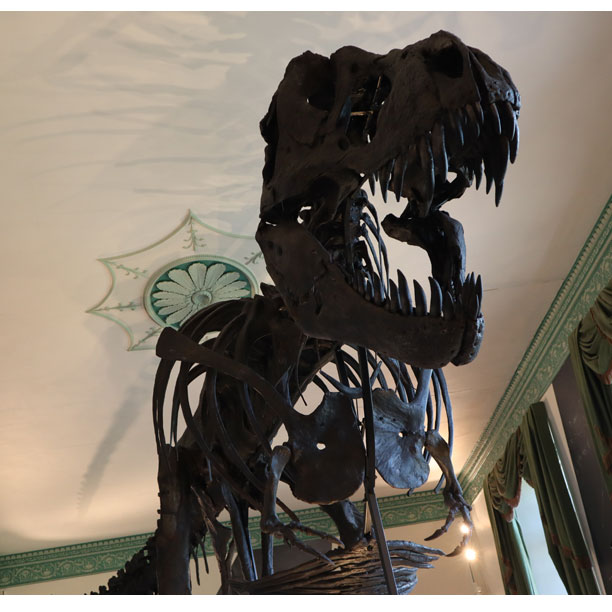
Titus the T.rex exhibit. A T. rex skeleton on display.

The spectacular Titus the T. rex exhibit at Wollaton Hall.  How smart was T. rex?  A newly published paper challenges an earlier study that postulated that this theropod was as clever as an extant primate. Picture credit: Everything Dinosaur.

Picture credit: Everything Dinosaur

The earlier paper proposed that large theropods such as Tyrannosaurus rex were long-lived, and remarkably intelligent.  It was postulated that these animals had “macaque or baboon-like cognition”.

To read Everything Dinosaur’s blog post about this paper: How Big was a T. rex Brain?

Challenging Established Views About Dinosaur Intelligence

The research challenged established views on dinosaur biology and inferred behaviours.  In addition, the earlier paper raised questions about whether neuron count estimates could benefit research on extinct animals in general.  However, a team of international scientists, including Dr Darren Naish (University of Southampton), have refuted these claims.  In a study published in “The Anatomical Record”, the researchers conclude that Tyrannosaurus rex was probably about as smart as a modern crocodile.

Their work reaffirms older theories about the intelligence of large theropods. Soft tissue structures like dinosaur brains rarely survive as fossils. Scientists can use endocasts, moulds made of the brain cavity to estimate brain size and structure. This is imperfect. For example, in extant crocodilians the brain only occupies about a third of the cranial cavity. In mammals and birds nearly 100% of this cavity is occupied by the brain.  By revisiting Herculano-Houzel’s (2023) work, the researchers identified several crucial discrepancies regarding interpretation and analysis of data.

Dr Herculano-Houzel probably overestimated the size of the brain of T. rex. It was assumed that the brain filled the whole of the endocranial cavity. In essence, the brain size of T. rex was modelled on mammals and birds, but this new study suggests crocodilians are a better analogy.

How smart was T. rex?

Blue: olfactory bulb and tracts, Green: pallium (homologous to the mammalian cerebral cortex), Orange: cerebellum, Yellow: diencephalon and optic tectum, Violet: brain stem. Olfactory structures, pallium and subpallium comprise the telencephalon. The overlay in grey indicates extinct taxa, the brain morphologies of which are estimated. The brain morphology of extinct ornithodirans is similar when compared to living reptiles. Picture credit: Caspar et al.

How Smart was T. rex?

The data used by Dr Herculano-Houzel was found to be inconsistent. For instance, brain size estimates had included other structures that are located in the cranium, but not part of the brain, the olfactory bulb for example. In addition, the earlier study had used a mixture of both juvenile and adult tyrannosaurs.  The use of not fully mature animals in the study could have led to inaccurate results.

The team revised the estimates of encephalisation and telencephalic neuron counts in the Dinosauria.  For large-bodied theropods in particular, this study estimated significantly lower neuron counts than previously proposed.  Their phylogenetic modelling indicated a neuron count for T. rex at between 250 million and 1.7 billion neurons.  Although the data spread was substantial, the results modelled reflect the neuron counts found in extant crocodilians.  This dataset did not produce neuron counts approaching those found in primates.

A close-up view of the Rebor T. rex Tusk figure.

A close-up view of the detail on the head of the Rebor T. rex Tusk dinosaur model.  Although this theropod was a formidable predator, its intelligence may have been overestimated. Picture credit: Everything Dinosaur.


Picture credit: Everything Dinosaur

The image (above) shows a close-up view of a 1:35 scale model of a Rebor Tyrannosaurus rex.

To view the Rebor range of prehistoric animals available from Everything Dinosaur: Rebor Dinosaur and Prehistoric Animal Figures.

Brain Size May Not Represent the Best Measure of Cognitive Abilities

Furthermore, the researchers reviewed the suitability of neurological variables such as neuron numbers and relative brain size to predict cognitive complexity, metabolic rate and life history traits in dinosaurs.  They concluded that these measures are not helpful when trying to assess the cognition of extinct creatures.

The team stated that trying to gauge the cognitive abilities of dinosaurs without close living analogues is extremely challenging.  Neuron numbers might be considered a minor component in an assessment of intelligence and much more work is required to build a robust framework to better understand the level of cognition in extinct animals.  In addition, the team concluded that given the depiction of dinosaurs in the popular media, researchers should acknowledge the limitations of the presented inferences to allow their audience to delineate between reasoned conclusions and speculation.

So, when it comes to calculating how smart was T. rex?  Scientists have yet to devise robust models to explore dinosaur intelligence.

Everything Dinosaur acknowledges the assistance of the open-source paper (Caspar et al) published in the journal The Anatomical Record in the compilation of this article.

The scientific paper: “How smart was T. rex? Testing claims of exceptional cognition in dinosaurs and the application of neuron count estimates in palaeontological research” by Kai R. Caspar, Cristián Gutiérrez-Ibáñez, Ornella C. Bertrand, Thomas Carr, Jennifer A. D. Colbourne, Arthur Erb, Hady George, Thomas R. Holtz Jr, Darren Naish, Douglas R. Wylie and Grant R. Hurlburt published in The Anatomical Record.

Visit the award-winning Everything Dinosaur website: Dinosaur Models and Toys.

6 05, 2024

Researchers Discover World’s First Tapeworm Body Fossil

By |2024-05-06T15:02:47+01:00May 6th, 2024|Categories: Dinosaur and Prehistoric Animal News Stories, Main Page, Palaeontological articles, Photos/Pictures of Fossils|0 Comments

International researchers including scientists from Nanjing Institute of Geology and Palaeontology (China) have found a tapeworm fossil preserved in amber.  The amber was mined in Myanmar and is believed to date from approximately 99 million years ago.  The three-dimensionally preserved fossil displays unique external and internal features.  These features most closely resemble the tentacles of the trypanorhynch tapeworms that parasitise marine elasmobranchs (sharks and rays).

It is a mystery as to how the marine parasite ended up preserved in tree resin.  One theory is that the carcase of an elasmobranch was scavenged by a theropod dinosaur. The dinosaur fed on the carcase close to where a pine tree was exuding resin.  As the dinosaur tore the carcase apart part of the parasite was flung at the tree and entombed in the resin as it seeped from the bark.

How as a marine tapeworm preserved in tree resin?

A hypothetical ecological reconstruction of the fossil trypanorhynch tapeworm (drawn by YANG Dinghua). The fossil tapeworm was lodged in the intestine of an elasmobranch and the dead host was possibly scavenged by a dinosaur on a strandline with pine resin extruding nearby. Picture credit: Cihang Luo.

Studying a Tapeworm Fossil

Tapeworms are a type of parasitic flatworm (Class Cestoda). Many have complex life cycles, with larvae developing in one host before invading a secondary host in which they grow to adults and produce eggs.  Some six thousand species are known, and they infect all major groups of vertebrates including mammals and ourselves.  Their fossil record is extremely sparse.  However, there is a record of possible tapeworm eggs having been preserved in the coprolite of a Permian shark.

Researcher Wang Bo (Nanjing Institute of Geology and Palaeontology), commented that the fossil is the first ever tapeworm body fossil found. The specimen provides direct evidence of the evolution of the Cestoda.

Fossil tapeworm compared to an extant tapeworm.

The fossil tapeworm from mid-Cretaceous Kachin amber (circa 99 million years ago) and the comparison with the tentacle of an extant trypanorhynch tapeworm. (A) Microscopic image of fossil tapeworm. (B) Micro-CT image of fossil tapeworm. (C) Scanning electron microscopy image of an extant trypanorhynch tapeworm. Picture credit: Cihang Luo.

The discovery demonstrates the remarkable preservation properties of amber.

How Did the Marine Tapeworm Become Trapped in Tree Resin?

PhD student Luo Cihang (Nanjing Institute of Geology and Palaeontology), suggested how a marine tapeworm became trapped in tree resin.

He proposed:

“It may have parasitised the intestines of a ray. The ray’s body was washed ashore and was preyed upon by a dinosaur.  As the dinosaur consumed the internal organs of the ray, the worm fell out and become enveloped in nearby resin.”

The research, conducted by scientists from multiple countries including China, Germany, the United Kingdom and Myanmar, was recently published in the academic journal Geology.

Internal structure of fossil tapeworm compared to an extant tapeworm.

The comparison of the internal structure of the fossil (A) with the tentacle of an extant trypanorhynch tapeworm (B). Abbreviation: ivt—invaginated tentacle. Picture credit: Cihang Luo.

A Remarkable Fossil Find

A spokesperson from Everything Dinosaur commented that this was a remarkable and unique fossil discovery.  To find a tapeworm fossil preserved in amber is astonishing.  Furthermore, it added to the growing body of evidence that amber from Myanmar was produced from Cretaceous trees growing close to the coast.  Amber from Myanmar has yielded some amazing fossils, including the shell of an ammonite.  The ammonite shell preserved in the tree resin is further evidence that this Cretaceous forest was close to a marine environment.

To read Everything Dinosaur’s early blog post about the ammonite shell preserved in amber: Ammonite Shell Preserved in Amber from Myanmar.

The scientists conclude that the exquisite preservation provides and exceptional example of a marine endoparasite.  The study provides, arguably the most convincing body fossil of a flatworm discovered to date.

Everything Dinosaur acknowledges the assistance of a media release requested from the Chinese Academy of Sciences in the compilation of this article.

The scientific paper: “Exceptional preservation of a marine tapeworm tentacle in Cretaceous amber” by Cihang Luo, Harry W. Palm, Yuhui Zhuang, Edmund A. Jarzembowski, Thet Tin Nyunt and Bo Wang published in Geology.

The Everything Dinosaur website: Prehistoric Animal Models and Fossil Replicas.

17 04, 2024

Ichthyotitan severnensis – A Colossus of the Late Triassic

By |2024-04-17T19:03:57+01:00April 17th, 2024|Categories: Adobe CS5, Dinosaur and Prehistoric Animal News Stories, Dinosaur Fans, Main Page, Palaeontological articles, Photos/Pictures of Fossils|0 Comments

A scientific paper has just been published in the open-access journal PLOS ONE that describes a new species of giant ichthyosaur. This huge marine reptile, named Ichthyotitan severnensis could have been about as big as a blue whale (Balaenoptera musculus).  The discovery of the fragmentary remains of a second gigantic jawbone in Somerset supports the hypothesis that giant ichthyosaurs were present in the Late Triassic ecosystem.

Ichthyotitan severnensis illustrated.

A washed-up Ichthyotitan severnensis carcase on the beach being visited by two hungry theropod dinosaurs and a flock of curious pterosaurs. Picture credit: Sergey Krasovskiy.

Giant Ichthyosaurs from Somerset

Fossil collector and co-author of this study Paul de la Salle, found a portion of fossil jaw in May 2016. He later returned to the location (the beach at Lilstock, west Somerset) and found more pieces that together formed a partial surangular more than a metre in length.  The second fragmentary jawbone, also a surangular was found on a beach a few miles to the east of the original fossil discovery.

In May 2020, Father and daughter, Justin and Ruby Reynolds from Braunton, Devon found the first pieces of the second surangular.  They were fossil hunting on the beach at Blue Anchor. Ruby, then aged eleven found the first chunk of fossil bone and went onto to find several more fragments.

Realising that Ruby may have discovered something of considerable scientific value, the family contacted leading ichthyosaur expert, Dr Dean Lomax, a palaeontologist at The University of Manchester. Dr Lomax, who is also a 1851 Research Fellow at the University of Bristol, contacted Paul de la Salle as he recognised the striking similarity between the two fossil finds.

Dr Dean Lomax commented:

“I was amazed by the find. In 2018, my team (including Paul de la Salle) studied and described Paul’s giant jawbone and we had hoped that one day another would come to light. This new specimen is more complete, better preserved, and shows that we now have two of these giant bones – called a surangular – that have a unique shape and structure. I became very excited, to say the least.”

Photographs of the surangular bones associated with the giant marine reptile Ichthyotitan severnensis.

Photograph of the nearly complete giant jawbone (surangular), along with a comparison with the 2018 bone (middle and bottom) found by Paul de la Salle. Picture credit: Dr Dean Lomax.

Hunting for More Fossil Evidence

Justin and Ruby, together with Paul, Dr Lomax, and several family members, visited the site to hunt for more pieces of fossil bone. Over time, the team found additional fragments of the same jaw which fit together perfectly, like a multimillion-year-old ichthyosaur jigsaw.

Father Justin explained:

“When Ruby and I found the first two pieces we were very excited as we realised that this was something important and unusual. When I found the back part of the jaw, I was thrilled because that is one of the defining parts of Paul’s earlier discovery.”

The last piece of bone was recovered in October 2022.

Some of the research team members with Ichthyotitan severnensis fossil bones.

Part of the research team in 2020 examining the initial finds (at the back) of the new discovery made by Ruby and Justin Reynolds. Additional sections of the bone were subsequently discovered. From left to right, Dr Dean Lomax, Ruby Reynolds, Justin Reynolds and Paul de la Salle. Picture credit: Dr Dean Lomax.

Ichthyotitan severnensis

Lead author of the study, Dr Lomax commented that the jaw fossils belong to a new species of enormous ichthyosaur.  It would have measured perhaps as much as twenty-five metres in length.  Ichthyotitan severnensis was probably larger than any extant toothed whale.  Based on comparisons with better known shastasaurid ichthyosaurs, it could have been as big as a blue whale.  Analysis of the geology of the two fossil sites along with a detailed comparison of the two surangular fossils supports the team’s hypothesis that these fossils represent an enormous ichthyosaur that is new to science.

Ichthyotitan severnensis scale drawing by Everything Dinosaur.

An Ichthyotitan severnensis scale drawing. Picture credit: Everything Dinosaur.

Picture credit: Everything Dinosaur

The genus and species name translates as “giant fish lizard of the Severn”.

The fossil material is estimated to be around 202 million years old, dating to the end of the Triassic (Rhaetian faunal stage).  Gigantic ichthyosaurs (Shastasauridae) swam in the seas while the Dinosauria were beginning to dominate terrestrial environments.  Ichthyotitan was one of the last of the shastasaurids, these Somerset fossils represent the last of their kind.  The Shastasauridae family are thought to have become extinct at the end of the Triassic.

Ichthyotitan severnensis was not the world’s first giant marine reptile, but de la Salles’ and Reynolds’ discoveries are unique among those known to science. These two bones appear to be approximately thirteen million years younger than their latest geologic relatives, including Shonisaurus sikanniensis (British Columbia, Canada), and Himalayasaurus tibetensis from Tibet, China.

Dr Lomax added:

“I was highly impressed that Ruby and Justin correctly identified the discovery as another enormous jawbone from an ichthyosaur. They recognised that it matched the one we described in 2018. I asked them whether they would like to join my team to study and describe this fossil, including naming it. They jumped at the chance. For Ruby, especially, she is now a published scientist who not only found but also helped to name a type of gigantic prehistoric reptile. There are probably not many 15-year-olds who can say that! A Mary Anning in the making, perhaps.”

Ruby exclaimed:

“It was so cool to discover part of this gigantic ichthyosaur. I am very proud to have played a part in a scientific discovery like this.”

A life reconstruction of a pair of Ichthyotitan severnensis.

A giant pair of swimming Ichthyotitan severnensis. Picture credit: Gabriel Ugueto.

Not Yet Fully Grown

Further examinations of the bones’ internal structures have been carried out by master’s student, Marcello Perillo, from the University of Bonn, Germany. His research confirmed the ichthyosaur origin of the bones and also revealed that the animal was still growing at the time of death.

He said:

“We could confirm the unique set of histological characters typical of giant ichthyosaur lower jaws: the anomalous periosteal growth of these bones hints at yet to be understood bone developmental strategies, now lost in the deep time, that likely allowed Late Triassic ichthyosaurs to reach the known biological limits of vertebrates in terms of size. So much about these giants is still shrouded by mystery, but one fossil at a time we will be able to unravel their secret.”

Concluding the work, Paul de la Salle added:

“To think that my discovery in 2016 would spark so much interest in these enormous creatures fills me with joy. When I found the first jawbone, I knew it was something special. To have a second that confirms our findings is incredible. I am overjoyed.”

Ichthyotitan severnensis Fossils on Public Display

The fossilised remains will soon be put on display at the Bristol Museum and Art Gallery (Bristol).

Dr Lomax summarised the study:

“This research has been ongoing for almost eight years. It is quite remarkable to think that gigantic, blue whale-sized ichthyosaurs were swimming in the oceans around what was the UK during the Triassic Period. These jawbones provide tantalising evidence that perhaps one day a complete skull or skeleton of one of these giants might be found. You never know.”

To read Everything Dinosaur’s 2018 article about the first surangular fossil discovery: Late Triassic Giant Ichthyosaurs.

Everything Dinosaur acknowledges the assistance of a media release from the University of Manchester in the compilation of this article.

The scientific paper “The last giants: New evidence for giant Late Triassic (Rhaetian) ichthyosaurs from the UK” by Lomax D. R., de la Salle, P., Perillo, M., Reynolds, J., Reynolds, R. and Waldron, J. F. published in PLOS ONE.

Visit the website of Dr Dean Lomax: British Palaeontologist Dr Dean Lomax.

11 04, 2024

New Study of Ancient Jawless Fish Suggests They were Filter-feeders

By |2024-04-10T14:47:06+01:00April 11th, 2024|Categories: Adobe CS5, Dinosaur and Prehistoric Animal News Stories, Main Page, Palaeontological articles, Photos/Pictures of Fossils|0 Comments

Newly published research has demonstrated that early, jawless fish (agnathans), used bony plates surrounding their mouths to modify the mouth’s shape whilst feeding.  CT scans of a three-dimensionally preserved Rhinopteraspis fossil suggest that these early vertebrates were suspension feeders, not hunters or scavengers.  The study, led by scientists from the University of Birmingham helps to improve our understanding of the evolution of feeding ecology.  The Devonian pteraspidid heterostracan Rhinopteraspis dunensis, the jawless fish studied, was probably a nektonic filter-feeder.

Rhinopteraspis fossil.

The anterior portion of a three-dimensionally preserved Rhinopteraspis dunensis specimen. CT scans of the fossilised remains of this Devonian fish enabled scientists to study feeding ecology. Picture credit: University of Birmingham.

Studying the Feeding Behaviours of Early Vertebrates

Scientists often use the inferred feeding behaviours of early vertebrates to help piece together the evolution of Vertebrata.  Different jaw morphologies and jaw composition can suggest a wide range of feeding strategies.  In the jawless fishes many competing theories have been proposed for their feeding habits.  For example, scientists have examined whether these animals were passive feeders or active hunters.

A new paper, published in the Proceedings of the Royal Society B reconstructs the feeding apparatus of the Devonian pteraspidid Rhinopteraspis dunensis.  Computerised tomography enabled the research team to construct 3D models of the fish’s mouth.  The images revealed the structure and arrangement of finger-like bones that project from the lower “lip” of the animal’s mouth.  The researchers suggest that these projections controlled the mouth’s size and shape as it filtered food particles from the water.

Senior author and project lead Dr Ivan Sansom (University of Birmingham) stated:

“The application of CT scanning techniques to the study of fossil fish is revealing so much new information about these ancient vertebrates and giving us the opportunity to study precious and unique specimens without destructive investigation.”

Rhinopteraspis fossil.

Three-dimensional reconstruction of the oral region of Rhinopteraspis dunensis (NHMUK PV P 73217). Picture credit: University of Birmingham.

A Remarkable Rhinopteraspis Fossil

The Rhinopteraspis fossil used in the study is part of the London Natural History Museum fossil collection. It is specimen number NHMUK PV P 73217. It consists of an almost complete anterior portion of the animal. The entire headshield is present along with body scales. Although the Rhinopteraspis fossil has been compressed laterally, elements associated with the oral cavity appear to have maintained their original shape and relative location.

Dr Richard Dearden (University of Birmingham) and lead author of the study explained:

“In this case, these methods have allowed us to fit all of the small bones of this animal’s mouth together, and try and understand how it fed from this integrated system rather than by using isolated bones. Instead of a steady trend towards ‘active food acquisition’ – scavenging or hunting – we see a real diversity and range of feeding behaviours among our earliest vertebrate relatives.”

To read a related article that questioned whether heterostracans were suspension feeders: New Study Features Extremely Old Vertebrate.

Bony Plates with Limited Movement

The mineralised plates around the mouth had limited movement.  It is unlikely that these early vertebrates were hunters capable of biting.  Many Pteraspidiformes had elongated, bony snouts this would have made it difficult to strain food particles from sediment.  However, the mouth plates would have allowed it to control the opening of the mouth, and perhaps strain food from water in a way also used by animals such as flamingos or mussels.

This new study offers a new perspective on the evolution of feeding strategies in early vertebrates.  Many current hypotheses argue that there was a long-term evolutionary trend away from passive food collection and consumption to predatory behaviour.  This research challenges these earlier theories and suggests that primitive fish had a broad range of different feeding behaviours long before the evolution of a jaw structure.

Everything Dinosaur acknowledges the assistance of a media release from the University of Birmingham in the compilation of this article.

The scientific paper: “The three-dimensionally articulated oral apparatus of a Devonian heterostracan sheds light on feeding in Palaeozoic jawless fishes” by Richard P. Dearden, Andy S. Jones, Sam Giles, Agnese Lanzetti, Madleen Grohganz, Zerina Johanson, Stephan Lautenschlager, Emma Randle, Philip C. J. Donoghue and Ivan J. Sansom published in the Proceedings of the Royal Society B.

The Everything Dinosaur website: Prehistoric Animal Models and Figures.

10 04, 2024

Twelve New Australian Sauropods Described

By |2024-04-10T19:08:17+01:00April 10th, 2024|Categories: Adobe CS5, Dinosaur and Prehistoric Animal News Stories, Dinosaur Fans, Main Page, Palaeontological articles, Photos/Pictures of Fossils|0 Comments

Twelve new Australian sauropods have been classified following a comprehensive reassessment of Winton Formation fossil remains.  Twelve new sauropod fossil specimens from the Winton Formation (Queensland, Australia) have been described. The extensive review, which involved CT scanning hundreds of fossil bones, has resolved the known sauropods from the Winton Formation into three distinct taxa.

Assessment of Twelve New Australian Sauropods Confirms Three Taxa

The taxa are Diamantinasaurus matildae, Savannasaurus elliottorum and Wintonotitan wattsi. A fourth sauropod, Australotitan cooperensis is now considered an indeterminate diamantinasaurian. The review suggests that the material previously assigned to A. cooperensis might represent a Diamantinasaurus. If this is the case, then Diamantinasaurus was capable of growing much larger than earlier studies indicated. A. cooperensis may become nomen dubium (dubious scientific name not widely recognised).

Twelve Australian sauropods described.

PhD candidate Samantha Beeston scanning Diamantinasaurus fossil material.  Picture credit: Australian Age of Dinosaurs Museum of Natural History.

Picture credit: Australian Age of Dinosaurs Museum of Natural History

The ground-breaking study into these enormous, ground-shaking dinosaurs was led by University of College London PhD candidate Samantha Beeston in collaboration with the Australian Age of Dinosaurs Museum of Natural History. Beeston’s research was conducted as part of her Master’s thesis at Swinburne University of Technology, under the supervision of Dr Stephen Poropat (now at the Western Australian Organic and Isotope Geochemistry Centre, Curtin University). The paper has been published in the open-access journal PeerJ.

Australotitan cooperensis life reconstruction

A life reconstruction of Australotitan cooperensis, the largest known animal to have ever lived in Australia. A reassessment of the fossilised bones suggests that A. cooperensis might be nomen dubium as the fossil remains could represent a very large specimen of Diamantinasaurus matildae.  Picture credit: Queensland Museum.

Picture credit: Queensland Museum

To read an earlier blog article (2015) about titanosaur fossil remains later named A. cooperensis awaiting scientific description: Super-sized Aussie Titanosaur Awaits Scientific Description.

Twelve new Australian sauropods described.

A sauropod excavation site photographed in 2011.  Picture credit: Australian Age of Dinosaurs Museum of Natural History.

Picture credit: Australian Age of Dinosaurs Museum of Natural History

Three Australian Sauropods

The researchers were able to assign two new specimens to Diamantinasaurus matildae. In addition, two specimens were assigned to Savannasaurus elliottorum with three more being assigned to Wintonotitan wattsi. The other five specimens are too incomplete to classify at the genus level. They have been described as indeterminate diamantinasaurians.  A lack of comparable specimens with overlapping bones has hampered precise classification of these five specimens.

The three recognised Winton Formation sauropod taxa are:

  • Diamantinasaurus matildae – named in 2009 (Hocknull et al).
  • Savannasaurus elliottorum – named in 2016 (Poropat et al).
  • Wintonotitan wattsi – named in 2009 in the same scientific paper as D. matildae and the theropod Australovenator wintonensis (Hocknull et al).

Over five hundred sauropod bones were scanned as part of this research. This innovative approach enabled the scientists to evaluate each bone and compare it to other fossil specimens in the Museum’s extensive collection. The study has led to a better understanding of the unique traits that help to separate known species.  Student Samantha Beeston explained that as there are so few bones preserved for Australotitan it makes it very difficult, if not impossible to assign new specimens to it, or to differentiate it from any of the other Winton Formation sauropod taxa.

She added: “Due to the limited fossil evidence for Australotitan, resolving its classification will be challenging.”

Twevel new Australian sauropods described in new study.

Student Samantha Beeston scanning the toe bone of Diamantinasaurus.  Picture credit: Australian Age of Dinosaurs Museum of Natural History.

Picture credit: Australian Age of Dinosaurs Museum of Natural History

Significant for Australian Palaeontology

David Elliott, the Executive Chairman of the Australian Age of Dinosaurs Museum of Natural History commented that he was delighted to have more sauropod specimens in the Museum’s collection assigned to distinct species. He explained that having a better understanding of autapomorphies and anatomical traits leading to more confident assignment of taxa was a significant leap forward in Australian palaeontological research.  The twelve new Australian sauropods would provide the basis for further research into the dinosaurs of the Winton Formation.

He added:

“These dinosaurs help demonstrate the diverse natural history of Australia during the Cretaceous Period and will become important exhibits at the new Australian Age of Dinosaurs Museum of Natural History.”

The "Devil Dave" sauropod site (2017).

Volunteers work at the “Devil Dave” sauropod excavation site (2017).  Picture credit: Australian Age of Dinosaurs Museum of Natural History.

Picture credit: Australian Age of Dinosaurs Museum of Natural History

Everything Dinosaur acknowledges the assistance of a media release from the Australia Age of Dinosaurs Museum of Natural History in the compilation of this article.

The scientific paper: “Reappraisal of sauropod dinosaur diversity in the Upper Cretaceous Winton Formation of Queensland, Australia, through 3D digitisation and description of new specimens” by Samantha L. Beeston​, Stephen F. Poropat, Philip D. Mannion, Adele H. Pentland, Mackenzie J. Enchelmaier, Trish Sloan and David A. Elliott published in PeerJ.

The Everything Dinosaur website: Dinosaur Models and Toys.

Go to Top