All about dinosaurs, fossils and prehistoric animals by Everything Dinosaur team members.

Articles, features and information which have slightly more scientific content with an emphasis on palaeontology, such as updates on academic papers, published papers etc.

8 08, 2024

The Remarkable Wollemi Pine

By |2024-08-25T08:11:57+01:00August 8th, 2024|Categories: Palaeontological articles|0 Comments

During a short visit to Cambridge, Everything Dinosaur team members were able to examine a specimen of the remarkable Wollemi pine (Wollemia nobilis). This tree is regarded as a “living fossil”.  However, its fossil record is extremely poor and scientists are uncertain of its phylogeny.  What is certain, is that this gymnosperm is exceptionally rare.

In 1994, a small grove of fewer than a hundred Wollemi pines were found in a deep gorge in the Blue Mountains (New South Wales). The location remains a secret as this sheltered area is the only known habitat for these remarkable trees. This amazing discovery sparked a global effort to study and conserve the Wollemi pine, which is now considered one of the rarest trees on the planet. Two Wollemi pines have been potted into large planters flanking the glasshouses at the Cambridge University Botanic Gardens. In addition, a third specimen is located close to another ancient type of tree, a Dawn Redwood.

Wollemia nobilis (Wollemi pine).

A young Wollemi pine (Wollemia nobilis) at the Cambridge University Botanic Garden. Picture credit: Everything Dinosaur.

Picture credit: Everything Dinosaur

The Extremely Rare Wollemi Pine

Ironically, the Wollemi pine (Wollemia nobilis) is not a pine.  It is thought to be a member of the Araucariaceae, a family of coniferous trees with three living genera, Agathis, the Wollemi pine and the Araucaria (monkey puzzle tree).   These trees flourished during the Mesozoic. They had a global distribution, although these days they are mostly confined to the Southern Hemisphere.  Wollemia nobilis shares several characteristics with both Araucaria and Agathis. Genetic studies have proved controversial, as they lacked consistency of method. However, many palaeobotanists consider Wollemia nobilis as a sister taxon to Agathis within the Araucariaceae and therefore more closely related to Agathis than it is to Araucaria.

A collection of prehistoric plants including ferns, horsetails and a Wollemi pine.

A piece of plant prehistoric history. A small Wollemi pine surrounded by ferns and horsetails. These are ancient plants representing taxa that evolved before flowering plants. Picture credit: Everything Dinosaur.

Picture credit: Everything Dinosaur

Models of Prehistoric Plants

For dinosaur model fans and collectors keen to build dioramas, there are not that many prehistoric plant models.  Safari Ltd used to include three prehistoric plant models within their range (Tree fern, Agathis and a Cycad). Sadly, all three of these figures have been retired.  Thankfully, diorama builders can rely on CollectA to provide models of prehistoric plants.  The company has introduced replicas of many prehistoric trees and plants.  For instance, CollectA have made a replica of Williamsonia, an example of a member of the Bennettitales Order of seed plants.

The CollectA Williamsonia plant.

The CollectA Williamsonia prehistoric plant, a great addition to dinosaur dioramas.

To view the CollectA not-to-scale model range: CollectA Prehistoric Life Models.

Mike from Everything Dinosaur commented:

“It was fascinating to learn more about the remarkable Wollemi pine.  The Cambridge University Botanic Gardens are amazing.  We are so pleased that model makers and diorama builders still have the CollectA prehistoric plants to help them with their prehistoric landscapes.”

The award-winning Everything Dinosaur website: Prehistoric Animal and Plants Models.

7 08, 2024

New Research Explains How Large Pterosaurs Took to the Air

By |2024-08-08T13:25:17+01:00August 7th, 2024|Categories: Palaeontological articles|0 Comments

Newly published research suggests that large pterosaurs probably used all four limbs to propel themselves into the air, as seen in bats today.  Take-off is a vital part of powered flight.  The physical effort required to launch is dictated by body mass.  The bigger and heavier you are, the greater the physical effort required to take to the air.  This rule likely constrains the size of birds, yet extinct pterosaurs are known to have reached far larger sizes. How did pterosaurs launch?

The new study, published in the journal “PeerJ” suggest that large pterosaurs took off using a similar method as bats.  In essence, the researchers conclude that big flying reptiles used all four limbs to propel themselves into the air. This is referred to as “quadrupedal launching”.

Mojo Fun Tropeognathus.

The Mojo Fun Tropeognathus pterosaur model.  The researchers used a life-size computer-generated model of an ornithocheirid pterosaur such as Tropeognathus to conduct their research.

The picture above shows a typical ornithocheirid pterosaur (Tropeognathus). This is a model from the Mojo Fun prehistoric and extinct range.

To view this range of prehistoric animal figures: Mojo Fun Prehistoric Animal Models.

Quadrupedal Launching of Large Pterosaurs

This research helps scientists to understand the unique anatomy and biology of the Pterosauria.  In addition, it provides a new perspective on how flying reptiles became airborne, despite some taxa having wingspans in excess of ten metres. The scientific paper sheds new light on the flight initiating jumping ability of these archosaurs.

The research was conducted by scientists at the University of Bristol, the University of Keele, Liverpool John Moores University and Universidade Federal do ABC, São Bernardo do Campo, Brazil.  The team constructed a computer model of the skeleton and muscles of an ornithocheiraean pterosaur with a wingspan of five metres. Thirty-four key muscles were modelled to estimate limb movements through three alternative take-off motions.

The three alternative take-off motions:

  • a vertical jump using just the hind legs, as seen in many ground-dwelling birds.
  • a less vertical jump using just the legs, more similar to the jump used by birds that fly frequently.
  • a four-limbed jump using the wings as well in a motion more akin to the take-off jump of a bat.

By reproducing these take-off motions using the large pterosaur model, the team were able to understand the forces generated to push the reptile into the air.

Large pterosaurs and their take-off method is studied. This is a model of an ornithocheirid pterosaur.

A replica of an ornithocheirid pterosaur based on Cambridge Greensand fossil remains. Picture credit: Everything Dinosaur.

Picture credit: Everything Dinosaur

The Bigger the Animal the Greater the Challenge of Becoming Airborne

Lead author of the study, Dr Ben Griffin (University of Bristol), explained:

“Larger animals have greater challenges to overcome in order to fly making the ability of animals as large as pterosaurs to do so especially fascinating. Unlike birds which mainly rely on their hindlimbs, our models indicate that pterosaurs were more likely to rely on all four of their limbs to propel themselves into the air.”

The researchers examined one of the long-standing questions about the underlying biomechanics of the Pterosauria. This study not only enhances the understanding of pterosaur biology but also provides broader insights into the limits and dynamics of flight in large vertebrates. By comparing pterosaurs with modern birds and bats, this research highlights the remarkable evolutionary solutions to the challenge of powered flight.

There are no living analogues for large pterosaurs. Hence, scientists rely on computer modelling to provide data on these remarkable creatures. After all, pterosaurs were the first vertebrates to evolve powered flight.

Everything Dinosaur acknowledges the assistance of a media release from the University of Bristol in the compilation of this article.

The scientific paper: “Modelling take-off moment arms in an ornithocheiraean pterosaur” by Benjamin W. Griffin​, Elizabeth Martin-Silverstone, Rodrigo V. Pêgas, Erik Anthony Meilak, Fabiana R. Costa, Colin Palmer and Emily J. Rayfield published in PeerJ.

The award-winning Everything Dinosaur website: Pterosaur Models and Toys.

31 07, 2024

A New Deep-snouted Tyrannosaur from Asia

By |2024-08-01T16:58:12+01:00July 31st, 2024|Categories: Palaeontological articles|0 Comments

Another week, and another new dinosaur.  This time, it is a tyrannosaur, and it has been named Asiatyrannus xui.  The fossils consist of a nearly complete skull and postcranial material. The postcranial material comprises leg bones and caudal vertebrae. A cross-sectional analysis of the right fibula has permitted the researchers to estimate the age of this tyrannosaur. It was at least thirteen years old when it met its demise.

Asiatyrannus co-existed with the much larger, Qianzhousaurus sinensis. Qianzhousaurus had a long, narrow snout.  When it was formally described in 2014 it was nicknamed “Pinocchio rex”.  The different skull morphologies and their different body sizes suggest that Asiatyrannus xui and Qianzhousaurus sinensis likely had different feeding strategies and occupied different ecological niches.  Asiatyrannus is the first deep-snouted tyrannosaurid to have been described from the Late Cretaceous of south-eastern China.

Asiatyrannus xui skeletal reconstruction.

A skeletal reconstruction of the newly described (2024) deep-snouted Asian tyrannosaur (Asiatyrannus xui). Known fossil material in (A) shown in yellow. Photographs of the fossils (B-H). Picture credit: Zheng et al.

Picture credit: Zheng et al

Asiatyrannus xui

The fossil material was unearthed in September 2017 at a construction site in Shahe Town, Nankang District, Ganzhou City (Jiangxi Province).  The fossils were taken to the Zhejiang Museum of Natural History, Hangzhou, China for cleaning and preparation.  The genus name translates as “Asian tyrant king”, whilst the species name honours Dr Xing Xu (Institute of Vertebrate Paleontology and Paleoanthropology, Chinese Academy of Sciences).  Dr Xing Xu has made a huge contribution to the study of Chinese dinosaurs including research into and the naming of other tyrannosaurs (Dilong, Guanlong and Yutyrannus).

The discovery of Asiatyrannus highlights the diversification of deep-snouted tyrannosaurids towards the end of the Cretaceous.  It demonstrates that during the Late Cretaceous (Maastrichtian), different types of tyrannosaurs co-existed in south-eastern China.  Numerous dinosaurs are known from the strata in this area (Nanxiong Formation).  Ornithischians and sauropods have been described, but the majority of dinosaurs discovered are theropods, overwhelmingly oviraptorosaurs.

To read a blog post from 2016 about another oviraptorosaur from the Nanxiong Formation: Tongtianlong – A New Oviraptorosaur.

For an article describing a new oviraptorosaur (Corythoraptor) named in 2017: Another New Oviraptorosaur from Jiangxi Province.

Isolated teeth and other fragmentary elements suggest that there could have been other tyrannosaurid taxa present in this area at the very end of the Cretaceous.

Asiatyrannus xui skull and line drawing.

Photograph (A) and line drawing (B) of the skull of Asiatyrannus xui (ZMNH M30360) in right lateral view. Picture credit: Zheng et al.

Picture credit: Zheng et al

Tyrannosaurid Growth Spurts

The open-access study published in “Scientific Reports”, includes details of bone histology.  This analysis revealed that this dinosaur died when it was a least thirteen years of age.  This is significant as the research team conclude that whilst this individual was not fully-grown, it had already passed through its most rapid growth phase.  Early tyrannosauroids such as Guanlong and Moros reached their adult size at around six to seven years of age.  In contrast, large-bodied tyrannosaurs from the Late Cretaceous (Campanian/Maastrichtian) such as Daspletosaurus, Tyrannosaurus rex and Albertosaurus had rapid growth spurts in their teenage years.  These theropods did not reach their full adult size until at least twenty years old.

Qianzhousaurus and Asiatyrannus xui

The skull of Asiatyrannus measures 47.5 cm in length.  Based on this, and the limb sizes, the research team estimate that Asiatyrannus had a body length of around 3.5 to 4 metres.  Qianzhousaurus (Q. sinensis) was over twice as big.  It had an estimated body length of around 9 metres.

These two carnivores very probably co-existed.  The long-snouted Qianzhousaurus was likely to have been the apex predator, with the smaller Asiatyrannus having the role of a secondary predator in the ecosystem.  Their different body sizes, and different shaped skulls suggest that these two dinosaurs may have had different hunting behaviours and perhaps, preyed on different animals.  They may not have directly competed, each tyrannosaur becoming adapted to a different ecological niche.  This could be an example of niche partitioning within coeval tyrannosaurids.

Asiatyrannus xui and Qianzhousaurus sinensis size comparison.

A size comparison between the probable, coeval tyrannosaurids Qianzhousaurus and Asiatyrannus. Picture credit: Everything Dinosaur.

Picture credit: Everything Dinosaur

The image above shows an approximate size comparison between the newly described Asiatyrannus xui and the probably coeval Qianzhousaurus sinensis.

Note: the models used to show the comparison are the PNSO Lythronax and Qianzhousaurus figures.

To view the PNSO range of prehistoric animal models: PNSO Dinosaur Models.

Implications for Mid-sized Theropod Carnivores

The paper’s authors comment that the discovery of Asiatyrannus might have implications for the way in which Mesozoic ecosystems are perceived.  Medium-sized carnivorous dinosaurs are relatively rare in the fossil record.  For example, in the Late Cretaceous carnivore guilds are monopolised by tyrannosaurids.  Adult, medium-sized predators are exceptionally rare.  Scientists have postulated that the “missing mid-sized” niches in the theropod guilds of Late Cretaceous Laramidia and Asia could be a consequence of these types of carnivores being outcompeted by juveniles and sub-adults of much larger taxa.

To read an article about a scientific paper that postulates the juveniles of apex predators out-competed mid-sized theropod carnivores: Why Are There So Few Medium-sized Carnivorous Dinosaurs?

The polar tyrannosaur Nanuqsaurus (N. hoglundi) was thought to be a mid-sized Late Cretaceous carnivore.  However, new fossil material from the Prince Creek Formation of Alaska suggests that it was comparable in size to the likes of Gorgosaurus and Daspletosaurus.  In the light of the continuing speculation as to the taxonomic validity of Nanotyrannus, the paper’s authors propose that Asiatyrannus xui currently represents the only definitive small to medium-sized member of the tyrannosaur family.

Everything Dinosaur acknowledges the assistance of the scientific paper in the compilation of this article. The paper is licensed under a Creative Commons Attribution 4.0 International License: The Creative Commons License.

The scientific paper: “The first deep-snouted tyrannosaur from Upper Cretaceous Ganzhou City of southeastern China” by Wenjie Zheng, Xingsheng Jin, Junfang Xie and Tianming Du published in Scientific Reports.

25 07, 2024

New Brachiopod Study Sheds Light on Biodiversity

By |2024-07-25T10:04:11+01:00July 25th, 2024|Categories: Palaeontological articles|0 Comments

Research into a living fossil has provided scientists with a fresh perspective on animal evolution.  A new brachiopod study, involving the careful analysis of over a thousand genera, indicates these ancient creatures were diversifying and evolving but this did not result in many new species.  The research published in the journal “Nature Ecology & Evolution”, challenges some of the core principles of evolution.

Let’s hear it for the humble brachiopod!

What is a Brachiopod?

Brachiopods (Brachiopoda) are shelled animals that originated during the Cambrian.  Many resemble Roman oil lamps, hence their common name “lamp-shells”.  Their shells consist of two parts (valves), with one part larger than the other.  They are entirely marine and benthic.  These filter feeders have shells around two to five centimetres in diameter, although some genera grew much larger.  Although superficially similar to molluscs such as clams, mussels and oysters, they are not closely related.

New brachiopod study sheds light on biodiversity.

Triassic brachiopod fossils (left), recent brachiopod shells (right). Picture credit: Zhen Guo.

Picture credit: Zhen Guo

In many species of brachiopod, the animal is attached to the sea floor by a fleshy stalk (pedicle).  The presence of a pedicle is indicated by the hole located on the larger of the valves (see picture above).  They were abundant in the Palaeozoic and Mesozoic and are often the most common fossil found in Palaeozoic marine deposits.  These ancient creatures are still around today but most species are confined to deep water.  Some 12,000 fossil species have been named.  In contrast, it has been estimated that there are less than 500 extant species.

More than 700 different fossils found at Wren's Nest

Lots of brachiopod and coral fossils to find at Wren’s Nest.  The strata were deposited during the Silurian, a time when the Brachiopoda were abundant. Picture credit: Everything Dinosaur.

Picture credit: Everything Dinosaur

New Brachiopod Study

This new brachiopod study is a collaboration between the University of Bristol, the China University of Geosciences and the Open University.  The team found that following the end-Permian mass extinction event, the Brachiopoda were evolving in new directions, but this did not lead to many new species.  In comparison, the Mollusca became increasingly dominant.  Today, the Mollusca is an amazingly diverse phylum with more than 50,000 species. The Brachiopoda currently contains just 394 known species.  The research team found that brachiopods were evolving new shell shapes and ecological behaviours following the end-Permian mass extinction, but their diversity did not grow.

Lead author Dr Zhen Guo (China University of Geosciences) explained:

“In the Palaeozoic, from 540 to 250 million years ago, brachiopods ruled the seabed.  Most of them are quite small–you could hold twenty of them in your hands; but others were big and thick-shelled and lived a long time. Their shells were anything from circular to widely stretched and they had either smooth shells or carried deep ridges and troughs.”

Professor Michael Benton (University of Bristol), a co-author of the new brachiopod study, commented:

“The brachiopods were hit very hard by the end-Permian mass extinction 252 million years ago.  The group could have disappeared completely, and indeed from that point, molluscs just became more and more successful. For a long time, it was thought that the brachiopods remained rare because the survivors were stuck in just a few modes of life.”

Studying Over 1,000 Brachiopod Genera

This new research involved the analysis of a vast brachiopod database.  More than 1,000 genera were studied.  This database was comprised of brachiopods that lived after the Permian.  For each genus, the analysts recorded dozens of measurements of the overall shape of the shells, their external sculpture, and internal anatomy. These features were analysed together to provide measurements of overall diversity of shapes for each major brachiopod group at each point in geological time. This measure of “diversity of shape”, is referred to in biology as “disparity”.  An understanding of shape innovations and changes over time could then be plotted.

These Mesozoic-Cenozoic brachiopods were adapting to different modes of life, but there were fewer species evolving than expected.

Brachiopods showing adaptations to different environments.

Reconstructions of some Mesozoic-Cenozoic brachiopods, showing adaptations to certain environments. Picture credit: Shunyi Shi.

Picture credit: Shunyi Shi

The co-author from the Open University, Dr Tom Stubbs added:

“In fact, the post-extinction brachiopods were innovating and trying new modes of life. One group, the terebratulids, were diversifying their body shapes and ecological functions from the end of the Permian to the present day, but their diversity did not increase.”

To read about an earlier, related brachiopod study conducted by University of Bristol researchers: Brachiopods and Bivalves (Mollusca) Faunal Turnover Study.

Unexpected Results

Fellow researcher Professor Zhong-Qiang Chen of the China University of Geosciences said:

“This was quite unexpected. Brachiopods were far from failures after the end-Permian extinction. They were evolving in new directions and exploring new modes of life, just as the molluscs were at the same time. But this did not turn into evolutionary success in terms of the numbers of species. Despite their bursts of evolution in form and function, they could not spread widely, and the exact reason remains unclear.”

Modern brachiopods represent the tip of the ecological iceberg for this once immensely abundant phylum.  Extant species do not provide scientists with an understanding of their extremely successful lineage, but we don’t know why these marine creatures did not become super-abundant again after the Permian.

Dr Zhen Guo explained the importance of this research.  This new brachiopod study suggests that disparity and diversity are effectively decoupled, at least as far as the Brachiopoda after the Permian are concerned.

Dr Zhen Guo concluded:

“It’s important to understand modern biodiversity in terms of the processes that lie behind it.”

Everything Dinosaur acknowledges the assistance of a media release from the University of Bristol in the compilation of this article.

The scientific paper: “Morphological innovation did not drive diversification in Mesozoic–Cenozoic brachiopods” by Zhen Guo, Michael J. Benton, Thomas L. Stubbs, and Zhong-Qiang Chen published in Nature Ecology & Evolution.

The Everything Dinosaur website: Prehistoric Animal Toys.

24 07, 2024

Rare Jurassic Mammaliaform Fossils Reveal Details About Ontogeny

By |2024-07-26T12:27:57+01:00July 24th, 2024|Categories: Palaeontological articles|0 Comments

A research paper published this week in the journal “Nature” has revealed that early mammals may have lived much longer than their modern-day counterparts.  The study describes two Krusatodon kirtlingtonensis fossil specimens.  These mouse-sized mammals lived approximately 166 million years ago (Bathonian faunal stage of the Middle Jurassic).  The fossils come from the remarkable Jurassic strata found on the Isle of Skye.

The research led by National Museums Scotland describes the fossilised remains of one adult and one juvenile.  The adult K. kirtlingtonensis is thought to have been around seven years old when it perished.  The juvenile is thought to have been between seven to twenty-four months old when it died.  It was still in the process of replacing its deciduous dentition (milk teeth) with its final, adult set of teeth.

Dr Elsa Panciroli with enlarged, 3D printed models of Krusatodon kirtlingtonensis.

National Museums Scotland’s Dr Elsa Panciroli with enlarged, 3D printed models of Krusatodon kirtlingtonensis skeletons. Picture credit: Duncan Mc Glynn.

Picture credit: Duncan Mc Glynn

The scientists conclude that early diverging mammaliaforms did not experience the same life histories as extant small-bodied mammals. Furthermore, the fundamental shift to faster growth over a shorter lifespan may not have taken place in mammaliaforms until during or after the Middle Jurassic.

Two Krusatodon kirtlingtonensis Fossil Specimens

These two Krusatodon kirtlingtonensis fossils are extremely significant.  The adult specimen represents one of the earliest fossil discoveries from the Isle of Skye.  It was found in the 1970s.  This specimen is one of the most complete Jurassic mammaliaform skeletons known to science.  The juvenile fossil was found more recently (2016).  It is the only known skeleton of an immature Jurassic mammaliaform. Indeed, there is no other record of an adult and juvenile from the same Jurassic mammaliaform taxon.

The Isle of Skye is one of the most important locations in the world for Middle Jurassic fossils.  Vertebrate body and trace fossils confirm the presence of a rich biota of dinosaurs, pterosaurs and early mammals. This new study focusing on K. kirtlingtonensis underscores the significance of the Scottish island to palaeontology.

An article about the discovery of a large, new species of pterosaur (Dearc sgiathanach): Fantastic Pterosaur from the Isle of Skye.

Krusatodon kirtlingtonensis skull fossil material held in the hand.

Dr Elsa Panciroli examines the barnacle encrusted fossil which contained Krusatodon kirtlingtonensis material. Picture credit: Duncan Mc Glynn.

Picture credit: Duncan Mc Glynn

X-ray Computed Tomography Employed

The discovery of a juvenile and adult of the same species of Jurassic mammaliaform is unique.  As a result, a ground-breaking comparative analysis into their growth and life history (ontogeny) was undertaken. The ages of the specimens at death were determined using X-ray imaging to count the growth rings in their teeth.  Therefore, the age of each animal at the time they died could be established.  The X-ray computed tomography was carried out in several laboratories, including the European Synchrotron (ESRF) located in Grenoble, France.

Extant small mammals have much shorter lifespans.  Many live for less than a year.  They mature quickly, losing their milk teeth and weaning within months of birth.  In addition, most small mammals living today rapidly reach sexual maturity and breeding age. The Krusatodon fossils reveal for the first time that the earliest mammals didn’t finish replacing their milk teeth until well into their second year of life, possibly later.  The researchers conclude that mammals grew more slowly in the Jurassic than they do today.  This suggests a fundamental shift in the growth patterns and life expectancy of mammals must have taken place during or after the Middle Jurassic.

Krusatodon kirtlingtonensis life reconstruction.

An adult and young Krusatodon kirtlingtonensis life reconstruction. A stegosaur can be seen in the background. Fossilised tracks found on the Isle of Skye indicate the presence of stegosaurs in the ecosystem.  Picture credit Maija Karala.

Picture credit: Maija Karala

Dr Elsa Panciroli, lead author and Associate Researcher of Palaeobiology at National Museums Scotland, commented:

“These fossils are among the most complete mammals from this time period in the world. They give us unprecedented insights into the lives of the first mammals in the time of dinosaurs. Although on the outside Krusatodon looked like a shrew or mouse, on the inside it was quite different; it grew more slowly and lived much longer than small mammals do today. As a result, it probably had quite a different physiology and life history as well. Skye’s fossils are really putting Scotland firmly on the map when it comes to understanding mammal evolution. This is just the tip of the iceberg in terms of what they can tell us.”

Dr Elsa Panciroli examines two Krusatodon kirtlingtonensis fossils.

National Museums Scotland’s Dr Elsa Panciroli pointing out details on a high-resolution scan of the Krusatodon kirtlingtonensis fossils. Picture credit: Duncan Mc Glynn.

Picture credit: Duncan Mc Glynn

Analysis of Teeth Growth Patterns Yields Surprising Results

Co-author Dr Elis Newham, a Postdoctoral Research Associate at Queen Mary University of London explained:

“Our study benefited greatly from a new technique we developed using synchrotron X-ray technology. This allowed us to analyse growth patterns in the teeth of these fossils, much like counting tree rings. It was surprising to discover that Krusatodon, while showing a similar development pattern to modern mammals, grew much slower and lived longer. This research emphasises the value of studying juvenile fossils, and the X-ray cementochronology technique offers a powerful tool for unlocking these secrets from the past.”

Dr Stig Walsh, Senior Curator of Vertebrate Palaeobiology at National Museums Scotland and fellow co-author on the research, said:

“Even in the context of the amazing palaeontological finds on Skye in recent years, these fossils are remarkable. Mammal fossils of this age are exceptionally rare worldwide, and most are just single teeth found by sieving sediment. To find two such rare fossil skeletons of the same species at different growth stages has rewritten our understanding of the lives of the very earliest mammals. We’re thrilled they are both now part of Scotland’s National Collection, an important part of the global fossil record, and will be preserved for generations of researchers to come.”

National Museums Scotland's Dr Elsa Panciroli examines two Krusatodon kirtlingtonensis fossils.

National Museums Scotland’s Dr Elsa Panciroli examines two Krusatodon kirtlingtonensis fossils. Picture credit: Duncan Mc Glynn.

Picture credit: Duncan Mc Glynn

International Collaboration

In addition to National Museums Scotland, the study also involved researchers from the American Museum of Natural History (New York), the University of Chicago, the European Synchrotron Radiation Facility, and Queen Mary University of London.

Co-author Professor Roger Benson (American Museum of Natural History), described the juvenile fossil material:

“When we found the tiny juvenile skull, I didn’t realise what we’d found right away. The part of the fossil that was sticking out of the rock was blasted by erosion, surrounded by barnacles, and looked just like a piece of ash. I used micro-CT scanning, a form of 3D X-ray imaging, and was very surprised to see a whole skull in the rock. For science, it’s really remarkable to have this fossil and it told us a lot about growth and life history in some of the earliest mammals.”

To read a blog post from 2019 about greater legal protection for Scottish fossil sites: Legal Protection for Isle of Skye Fossils.

Everything Dinosaur acknowledges the assistance of a media release from National Museums Scotland in the compilation of this article.

The scientific paper: “Jurassic fossil juvenile reveals prolonged life history in early mammals” by Elsa Panciroli, Roger B. J. Benson, Vincent Fernandez, Nicholas C. Fraser, Matt Humpage, Zhe-Xi Luo, Elis Newham and Stig Walsh published in the journal Nature.

The Everything Dinosaur website: Prehistoric Animal Models and Toys.

19 07, 2024

Remarkable Stegosaurus Skeleton Sells for a Record Amount ($44.6 million USD)

By |2024-07-21T11:52:03+01:00July 19th, 2024|Categories: Palaeontological articles|0 Comments

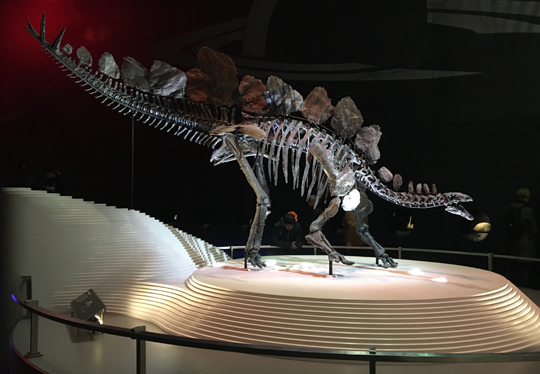
And so, the hammer came down and bidding ended on a remarkable Stegosaurus fossil skeleton that had been offered for sale at the auction house Sotheby’s (New York).  The Stegosaurus specimen, nicknamed “Apex” sold for a whopping $44.6 million USD (£34.5 million GBP).  This is a world record amount for a dinosaur fossil.  It had an estimated value of between $4 million and $6 million USD.  However, as the bidding started this was soon exceeded.

Seven bidders wanted this Stegosaurus, and they were prepared to pay big bucks to get it.  After fifteen minutes of frantic excitement lot thirteen was sold.  Unsurprisingly, given the sums involved, the Stegosaurus fossil skeleton was purchased by an anonymous bidder.  The buyer is believed to be a billionaire hedge fund owner (Kenneth Griffin).

"Apex" the Stegosaurus fossil skeleton.

The stunning Stegosaurus skeleton “Apex” sold for a world record amount of $44.6 million USD at Sotheby’s New York. Picture credit: Matthew Sherman.

Picture credit: Matthew Sherman

“Apex” A Stunning Stegosaurus Fossil Skeleton

“Apex” was discovered on privately owned land in Moffat County, Colorado.  The land is owned by a commercial palaeontologist called Jason Cooper.  It is ironic, that the dig site was close to the small town of Dinosaur. The material, representing a single animal, consists of 254 fossil bones. This represents nearly eighty percent of the entire skeleton. The estimated number of bones in a Stegosaurus skeleton is 319, give or take the odd chevron.

Not only is it one of the most complete large dinosaur skeletons discovered, the bones bear witness to some remarkable pathology that helps tell the tale of this iconic Late Jurassic herbivore. The mounted skeleton measures over 8.2 metres long.

The impressive "thagomizer" on "Apex" the Stegosaurus fossil skeleton.

The impressive “thagomizer” on “Apex” the Stegosaurus fossil skeleton. Picture credit: Matthew Sherman.

Picture credit: Matthew Sherman

Auction House and Commercial Palaeontologist Co-operating Closely

Cassandra Hatton, Sotheby’s Global Head of Science & Popular Culture worked closely with Jason Cooper from the day of discovery onwards.  The fossils were carefully documented and excavated.  The material was prepared and mounted and at each stage the highest standards of transparency were adhered to.  The aim being to preserve as much information about the fossils as possible.  Skin impressions were noted and three, tiny ossicles representing throat armour were carefully extracted from the Morrison Formation matrix.  These also ended up as part of the Stegosaurus lot.

This is the first time an auction house has been so intimately involved with a dinosaur skeleton.

Cassandra stated:

“This sale has been years in the making, and at every turn, we have worked closely with Jason Cooper, from the moment of its discovery in Dinosaur, Colorado, to its sale in New York.  I am thrilled that such an important specimen has now taken its place in history, some 150 million years since it roamed the planet.  This remarkable result underscores our unwavering commitment to preserving these ancient treasures.”

Following the sale, the anonymous buyer is believed to have remarked:

“Apex was born in America and is going to stay in America!”

An Amazing Specimen

The fossil was preserved in hard sandstone and the black colour is typical of Morrison Formation specimens.  The fossils represent a fully-grown, robust adult and the fossilisation is described as “superb”, with little or no distortion.  Along with the skin impressions, fragile cervical plates and elements of the pebbly throat armour have been preserved.  Some fossil bones indicate the presence of arthritis.  This suggests “Apex” lived to an old age.  There are no signs of combat injuries or trauma on the bones.  In addition, there is no evidence of post-mortem scavenging by theropod dinosaurs.

A spokesperson from Everything Dinosaur commented that it was hoped that this remarkable Stegosaurus fossil skeleton would be made available to science for further study.

The spokesperson added:

“Commercial palaeontologists play an important role as they excavate specimens that could have been lost to science through erosion and weathering.  To excavate, clean and prepare such a remarkable specimen would have probably cost hundreds of thousands of dollars. Whilst we understand the importance of financial gain in these situations, and we suspect a portion of the money will be reinvested in further field work and research, hopefully, this specimen will be made available to the scientific community for further analysis and study.”

Sotheby’s Natural History Auction

The auction featured numerous amazing fossil specimens as well as meteorites, minerals, gogottes and for the first time, Palaeolithic tools including tools made by Neanderthals.  The Neanderthal tools sold for $22,800 USD, much higher than the pre-auction estimate.  A large iridescent ammonite fetched an eye-watering $72,000 USD.

Other fossils in the auction included mass mortality trilobite fossils from Morocco, Megalodon otodus teeth, fossil eurypterids from New York and beautiful fossilised fish. The natural history themed auction also featured meteorites and rare minerals including a large lapiz lazuli tower from Afghanistan.

The auction also included numerous dinosaur fossils such as a Tyrannosaurus rex femur, two T. rex teeth and an Edmontosaurus (E. annectens) skull.

Edmontosaurus skull in Sotheby's auction.

Lot 26 the Edmontosaurus skull with an estimated value of between $40,000 and $60,000 USD. Picture credit: Sotheby’s New York.

Picture credit: Sotheby’s New York

Auctions of fossils and other rare objects can be controversial.  For example, Everything Dinosaur has previously reported upon the seizure of a Tarbosaurus specimen after evidence emerged that it had been illegally smuggled out of Mongolia.

To read more about this: Tyrannosaur Skeleton Smuggled out of Mongolia.

Sadly, there is a lot of illegal fossil collecting taking place. Many of these specimens are sold on the black market and find their way into Europe and America.  However, the authorities in many countries are cracking down on this illegal trade and some perpetrators have been jailed.

Fossil dealer incarcerated: American Fossil Dealer is Jailed.

The spokesperson from Everything Dinosaur commented:

“It is worrying to read of other rare items being offered for auction, particularly the Palaeolithic tools.  The large sums of money these lots are sold for could incentivise unscrupulous parties to exploit archaeological sites as well as fossil quarries.  Let us hope that sales such as this leads to closer regulation and greater co-operation between countries.”

Everything Dinosaur acknowledges the assistance of a media release from Sotheby’s New York “The most valuable fossil ever sold at auction “apex” achieves $44.6m at Sotheby’s”.  This media release was available to download from the Sotheby’s New York website on 18th July 2024.

12 07, 2024

A New Species of Early Tetrapod from the Lower Permian of Germany

By |2024-07-16T14:04:52+01:00July 12th, 2024|Categories: Palaeontological articles|0 Comments

Researchers have identified a new species of early tetrapod from the Lower Permian of Germany. It is a plant-eater, and it has been named Diadectes dreigleichenensis.  The fossils originate from the Bromacker locality in central Germany.  The ancient creatures from the Bromacker locality lived approximately 290 million years ago.  The site is helping palaeontologists to better understand the evolution of herbivory in early vertebrate ecosystems.

Diadectes dreigleichenensis skull material.

Fossil skull material showing the teeth in the jaws and palatal teeth rows. A new species of advanced reptiliomorph has been named (Diadectes dreigleichenensis). Picture credit: Carola Radke, Museum für Naturkunde Berlin.

Picture credit: Carola Radke, Museum für Naturkunde Berlin

Diadectes dreigleichenensis

The lower Permian Bromacker locality, situated in the UNESCO Global Geopark Thüringen Inselsberg – Drei Gleichen, central Germany, represents a unique inland fossil ecosystem that preserves a diverse early tetrapod fauna.  This palaeoenvironment is dominated by advanced reptiliomorphs, land animals that show a variety of amphibian as well as reptilian traits.  Lead author of the study, PhD student Jasper Ponstein (Museum für Naturkunde and the Humboldt-Universität zu Berlin) explained that the research team examined skull and jaw material representing the Diadectomorpha.  The research has been published in the Royal Society Open Science.

The researchers used traditional examination techniques that involved carefully measuring the bones in the skull and jaws and comparing them to specimens in other collections.  In addition, CT scans were undertaken to reveal fine details obscured by matrix.  This research supports the identification of a third species of the group, representing a second species of the genus Diadectes, from Bromacker. This adds to the already diverse fauna of this herbivore-dominated ecosystem.

Since the 1990s palaeontologists have described fossil specimens belonging to the Diadectes genus from the Bromacker site. These specimens had all been assigned to a single species – Diadectes absitus.  Diadectes is a member of the Diadectidae family.  This family of reptilomorphs show both amphibian and amniote characteristics.  They evolved during the Early Carboniferous (Mississippian subperiod), and their fossils are known from America, Asia and Europe. These animals are typically, robust, heavily-built tetrapods.  They had strong, deep jawbones and molar-like teeth adapted to a diet of plants.

Diadectes dreigleichenensis fossi jaw.

Diadectes dreigleichenensis fossil jawbone shown in lateral view. The jaw is robust, and the molar-like teeth are adapted for the efficient grinding of plant material. Picture credit: Carola Radke, Museum für Naturkunde Berlin.

Picture credit: Carola Radke, Museum für Naturkunde Berlin

The Diadectomorpha include the earliest known herbivorous tetrapods, which evolved 305 million years ago in North America during the Late Carboniferous. Through the Late Carboniferous and much of the early Permian, herbivores remained a rare component of their respective ecosystem.

Abundant Early Herbivores

The Bromacker quarry is extremely significant.  It preserves evidence of the earliest ecosystem known in which herbivores were highly abundant.  Palaeontologists consider the Bromacker locality as the first modern ecosystem with a food chain that is recognisable today.  Herbivores make up the greatest proportion of vertebrates present.  In comparison, there are few secondary and apex predators.  The herbivore fossil record at this location includes numerous and exquisitely preserved skeletons of the diadectomorphs Diadectes absitus and Orobates pabsti, the pot-bellied caseid Martensius bromackerensis and the small agile lizard-like bolosaurid Eudibamus cursoris.

Jasper Ponstein outlined how the study was undertaken.  He stated:

“These skulls are preserved with the jaws firmly attached to the rest of the skull. Key features related to feeding, like the tooth row and the shape of the jaw joint, are obscured by the skull.  Through the CT-scans, we could actually reconstruct what these regions look like and compare the different specimens”.

The detailed study of the skull fossils revealed that diadectomorphs have a sinuous row of teeth on their lower jaws.  In addition, there are two rows of conical teeth located on the palate and a long blade-like process connected to the jaw joint.  The teeth in the lower jaw are widely spaced to maximise the available plant grinding surface. The blade-like process of the jaw joint probably played a role in helping to support the jaw whilst plant material was masticated. These adaptations allowed diadectomorphs to more effectively grind vegetation. Furthermore, the powerful CT images revealed a few replacement teeth within the palate. This suggests that diadectomorphs occasionally replaced their palatal teeth as well.

These observations enabled the research team to conclude that there was sufficient variation between the skulls to erect a new species – Diadectes dreigleichenensis.

Ponstein remarked:

“We named the species after UNESCO Global Geopark Thüringen Inselsberg – Drei Gleichen, which also contains the world-famous Bromacker locality. The species name is after Drei Gleichen, which means three of the same, in reference to the seemingly similar looking three diadectids from Bromacker, just like three iconic castles from the Middle Ages, each situated on a hilltop between Gotha and Erfurt within the Geopark.”

Co-author Professor Jörg Fröbisch (Humboldt-Universität zu Berlin) added:

“The ongoing Bromacker project is a prime example of an innovative and interdisciplinary research and science communication program, building on a multiple-decade-long international collaboration.”

Everything Dinosaur acknowledges the assistance of a media release from the Museum für Naturkunde, Berlin in the compilation of this article.

The scientific paper: “A comprehensive phylogeny and revised taxonomy of Diadectomorpha with a discussion on the origin of tetrapod herbivory” by Ponstein, J., MacDougall, M.J., and Fröbisch, J. 2024 published in the Royal Society Open Science.

The award-winning Everything Dinosaur website: Dinosaur Toys and Models.

10 07, 2024

Comptonatus chasei A New Dinosaur from the Isle of Wight

By |2024-07-14T13:39:06+01:00July 10th, 2024|Categories: Palaeontological articles|0 Comments

Researchers have named a new species of iguanodontian dinosaur from fossils found on the Isle of Wight.  The dinosaur has been named Comptonatus chasei.  The fossil material represents the most complete iguanodontian skeleton discovered in the Wealden Group for over a hundred years.  This new taxon has been erected based on numerous unique characteristics (autapomorphies) related to the skull, the straight dentary bone and a markedly expanded pubic hip bone described as being “the size of a dinner plate”.

Comptonatus chasei life reconstruction.

A view of the head of the newly described iguanodontian Comptonatus chasei. Picture credit: John Sibbick.

Comptonatus chasei

The fossil material is around 125 million years old (Barremian faunal stage). The dinosaur fossils was found in the cliffs of Compton Bay on the Isle of Wight in 2013 by fossil collector Nick Chase, before he tragically died of cancer.  Dr Jeremy Lockwood, helped with the excavation of the bones and teeth. He then spent years carefully comparing these fossils to other Wealden Group iguanodontians before he was confident that these fossils represented a new species.

Comptonatus chasei fossil location.

Dr Jeremy Lockwood walking on the beach in front of the cliffs that mark the excavation site. Picture credit: University of Portsmouth.

Dr Lockwood has become synonymous with Isle of Wight ornithopods along with Professor David Martill (University of Portsmouth) and Professor Susannah Maidment (London Natural History Museum).  These three scientists described Brighstoneus simmondsi, another Isle of Wight ornithopod in 2021.  The discovery of Comptonatus chasei demonstrates that these dinosaurs were particularly diverse during the Barremian to early Aptian faunal stages.

Three Isle of Wight iguanodontian dinosaurs.

Lateral views of the skulls of three taxa of Isle of Wight iguanodontian dinosaurs. Comptonatus chasei (A), Brighstoneus simmondsi (B) and Mantellisaurus atherfieldensis (C). Picture credit: University of Portsmouth.

Honouring the Late Nick Chase

A total of 149 fossil bones were collected.  The genus name translates as “Compton thunderer”.  This dinosaur was named after Compton Bay where the fossils were found and the “thunderer” element of the genus name relates to the large size of this dinosaur.   Bone histology indicates that the animal was around five or six years old when it died. It is estimated to have weighed around nine hundred kilograms.

The species name honours Nick Chase, winner of the Palaeontological Association’s Mary Anning Award in 2018, who made the initial discovery and through his lifetime contributed enormously to the collections at the Dinosaur Isle Museum on the Isle of Wight, and the Natural History Museum, London.

The late Nick Chase who found the fossil remains in 2013.

The late Nick Chase who found the fossil remains in 2013. The species name honours him, a winner of the Palaeontological Association’s Mary Anning Award in 2018, Nick Chase made the initial discovery. During his lifetime he contributed enormously to the study of the dinosaur biota of the Wessex Formation. Picture credit: University of Portsmouth.

Dr Lockwood commented:

“Nick had a phenomenal nose for finding dinosaur bones – he really was a modern-day Mary Anning. He collected fossils daily in all weathers and donated them to museums. I was hoping we’d spend our dotage collecting together as we were of similar ages, but sadly that wasn’t to be the case. Despite his many wonderful discoveries over the years, including the most complete Iguanodon skull ever found in Britain, this is the first dinosaur to be named after him.”

Comptonatus fossil excavation.

The Comptonatus chasei excavation in 2013. Nick Chase (in the foreground sketching), Steve Hutt (blue jumper), Jeremy Lockwood (wearing gloves), and Penny Newberry examining the exposed fossil material. Picture credit: University of Portsmouth.

Unique Autapomorphies

During the collection and initial preparation it was thought that these fossils represented a Mantellisaurus atherfieldensis. However, a detailed study identified several autapomorphies (unique characteristics) that led to the erection of a new taxon.

Dr Lockwood explained:

“I’ve been able to show this dinosaur is different because of certain unique features in its skull, teeth and other parts of its body. For example its lower jaw has a straight bottom edge, whereas most iguanodontians have a jaw that curves downwards. It also has a very large pubic hip bone, which is much bigger than other similar dinosaurs. It’s like a dinner plate!”

Comptonatus pubis bone.

The large pubis bone of Comptonatus pubis. The enlarged blade-like feature of the pubis is a unique characteristic that helped to define this new taxon. Picture credit: University of Portsmouth.

The scientists are uncertain as to why the pubic hip bone is so large. It could have been for muscle attachments indicating that this ornithopod had a different mode of locomotion. Perhaps it could have helped support the large stomach, or played a role in respiration.

The Geological Setting of Comptonatus chasei

Comptonatus chasei and Brighstoneus simmondsi fossils are associated with the Wessex Formation of the Wealden Group.  However, the deposits where Brighstoneous fossils have been found might be two million years older than the strata associated with C. chasei.  Conversely, Mantellisaurus atherfieldensis is geologically younger than Comptonatus.  Mantellisaurus fossils seem confined to the overlying Vectis Formation (Wealden Group).  This means that Comptonatus and Brighstoneus lived during the early Barremian faunal stage of the Cretaceous.  Mantellisaurus lived several million years later (late Barremian).

The scientists state that the Wessex Formation may have supported a greater diversity than previously realised, or that evolutionary and or migratory pressures resulted in faunal turnover. Comptonatus provides further evidence for a greater iguanodontian diversity and it is now unclear as to which iguanodontian taxon or taxa dominated the Wessex sub-basin during the Barremian.  In addition, the researchers postulate that a reassessment of ornithopod fossil material may be required, as with our improved understanding of the differences between these taxa, more new species might be identified.

Isle of Wight Dinosaur Taxa

Despite only four new dinosaur species being described on the Isle of Wight in the whole of the 20th century, there have been eight new species named in the last five years.  A remarkable number of new dinosaur taxa have been described from fossils found on the Isle of Wight. Ornithischians such as Vectidromeus insularis, Brighstoneus simmondsi and Vectipelta barretti have been named.

To read more about Vectidromeus insularisVectidromeus – A New Hypsilophodontid.

An article on Brighstoneus simmondsiA New Iguanodontid from the Isle of Wight.

Brighstoneus scale drawing

A scale drawing of the recently described Isle of Wight iguanodontian Brighstoneus.  CollectA added a model of Brighstoneus simmondsi to their CollectA Age of Dinosaur Popular range of figures.  Picture credit: Everything Dinosaur.

Picture credit: Everything Dinosaur

A new, armoured dinosaur from the Isle of Wight described in 2023 (Vectipelta barretti): New Armoured Dinosaur Honours Natural History Museum Professor.

In addition, several theropod dinosaurs have been described including Vectiraptor greeni, Ceratosuchops inferodios and Riparovenator milnerae. Furthermore, there is evidence of a gigantic spinosaurid (the “white rock spinosaurid”). These discoveries suggest that the Wessex Formation supported a greater diversity of dinosaurs than previously realised. It could also indicate a substantial faunal turnover during the deposition of the Wessex Formation deposits.

Ancient relative of Velociraptor from “Dinosaur Isle”: Early Cretaceous Dromaeosaurid from the Isle of Wight.

To read about Ceratosuchops inferodios and Riparovenator milneraeTwo New Spinosaurids from the Isle of Wight.

News about the enormous “white rock spinosaurid”: Super-sized Carnivorous Dinosaur from the Isle of Wight.

Everything Dinosaur acknowledges the assistance of a media release from the University of Portsmouth in the compilation of this article.

The scientific paper: “Comptonatus chasei, a new iguanodontian dinosaur from the Lower Cretaceous Wessex Formation of the Isle of Wight, southern England” by Jeremy A. F. Lockwood, David M. Martill and Susannah C. R. Maidment published in the Journal of Systematic Palaeontology.

The Everything Dinosaur website: Dinosaur Models.

7 07, 2024

Nine New Species of Fossil Grapes Described

By |2024-07-07T16:30:09+01:00July 7th, 2024|Categories: Palaeontological articles|0 Comments

A newly published study led by scientists from the Field Museum in Chicago (USA) includes descriptions of nine new species of fossil grapes.  The paper, published in the journal “Nature Plants” reveals how the extinction of the non-avian dinosaurs may have permitted grape vines to spread and diversify.  Some of the newly described grape taxa are the oldest found to date in the Western Hemisphere.  The fossils were found in Peru, Panama and Columbia and range in age from sixty million years old to around nineteen million years old.  The seeds range in geological age from the Palaeocene Epoch to the Miocene Epoch.

Fossil grapes.

Fossil grape (photograph top left) with computer model generated from CT fossil scans (top right). Line drawings illustrating the fossil by Pollyanna von Knorring (below). Picture credit: Fabiany Herrera.

Picture credit: Fabiany Herrera

Studying Fossil Grapes

These fossil seeds from Central and South America help to show how the grape family (Vitis) spread in the years following the extinction of the dinosaurs.

Lead author of the paper Fabiany Herrera (assistant curator of palaeobotany at the Field Museum in Chicago), commented:

“These are the oldest grapes ever found in this part of the world, and they’re a few million years younger than the oldest ones ever found on the other side of the planet.  This discovery is important because it shows that after the extinction of the dinosaurs, grapes really started to spread across the world.”

It is rare for fruits to be preserved in the fossil record.  However, seeds are more likely to survive the fossilisation process.  What palaeobotanists know about the evolution of angiosperms has been greatly enhanced by studying seeds and fossil pollen.  The earliest known grape seed fossils were found in India.  They are approximately sixty-six million years old.  At this time, there was a global extinction event.  This extinction was probably caused by the impact of an extra-terrestrial bolide.  This devastated life on Earth and led to a re-setting of ecosystems.  The composition of forests was altered as the extinction event affected both fauna and flora.

Nine species of fossil grapes identified. Researcher Fabiany Herrera holding a fossil specimen.

Fabiany Herrera in the field holding a grape fossil. Picture credit: Fabiany Herrera.

Picture credit: Fabiany Herrera

Dinosaur Extinction Helped Grape Growers

Herrera and his colleagues postulate that the extinction of the Dinosauria helped alter the flora within forests.

Co-author Mónica Carvalho explained:

“Large animals, such as dinosaurs, are known to alter their surrounding ecosystems. We think that if there were large dinosaurs roaming through the forest, they were likely knocking down trees, effectively maintaining forests more open than they are today.”

With the dinosaurs having died out and the absence of large mammals during the Palaeocene, forests became more crowded.  There were no large animals present to deplete the forest understorey and create a more open environment.  These new, dense forests provided an opportunity for plants like vines to become more widespread.  Ultimately, modern-day wine producers might have to thank dinosaurs for the evolution of the grape family of plants.

The diversification of mammals and birds may also have aided the spread of vines by helping to spread their seeds.

The Significance and Importance of Fossil Grapes

In 2013, Herrera’s PhD advisor and senior author of the new paper, Steven Manchester, published the paper describing the oldest known grape seed fossil from India.  Herrera suspected that ancient grape vines existed in South America too.

Herrera commented:

“Grapes have an extensive fossil record that starts about fifty million years ago.  I wanted to discover one in South America, but it was like looking for a needle in a haystack.  I’ve been looking for the oldest grape in the Western Hemisphere since I was an undergraduate student.”

Field work in the Colombian Andes with study co-author Mónica Carvalho provided the breakthrough.  Mónica discovered a fossilised grape seed.  The specimen was at least sixty million years old.  It was the first grape fossil to be found in South America.

Mónica Carvalho studying fossil grapes.

Mónica Carvalho excitedly holding a grape fossil. Picture credit: Fabiany Herrera.

Picture credit: Fabiany Herrera

A Tiny Fossil Seed

The fossil seed is extremely small. However, Herrera and Carvalho were able to identify it based on its particular shape, size, and other morphological features. CT scans were undertaken to examine the fossil’s internal structure and confirm its affinity with the grape family.  This new taxon was named Lithouva susmanii.  The binomial name translates as “Susman’s stone grape”.  The name honours Arther T. Susman a supporter of South American palaeobotany at the Field Museum.

Co-author Gregory Stull of the National Museum of Natural History (Washington DC) explained the significance of these fossil grapes:

 “This new species is also important because it supports a South American origin of the group in which the common grape vine Vitis evolved.”

The field studies in Central and South America led to the scientific description of nine new species of fossil grapes.  These fossilised seeds not only tell the story of grapes’ spread across the Western Hemisphere, but also of the many extinctions and dispersals the grape family has undergone. The fossils are only distant relatives of the grapes native to the Western Hemisphere and a few, like the two species of Leea identified are only found in the Eastern Hemisphere today.

A Tumultuous Evolutionary Journey

These fossils suggest that the evolutionary journey of the grape family has been tumultuous.  Herrera commented that the fossil record of grapes demonstrates that these plants are extremely resilient.

Given the mass extinction our planet is currently facing, Herrera commented that studies like this one are valuable because they reveal patterns about how biodiversity crises play out.

Everything Dinosaur acknowledges the assistance of a media release from the Field Museum (Chicago) in the compilation of this article.

The scientific paper: “Cenozoic seeds of Vitaceae reveal a deep history of extinction and dispersal in the Neotropics” by Fabiany Herrera, Mónica R. Carvalho, Gregory W. Stull, Carlos Jaramillo and Steven R. Manchester published in Nature Plants.

The Everything Dinosaur website: Everything Dinosaur.

28 06, 2024

Ammonites Still a Success at the End of the Cretaceous

By |2024-06-30T22:26:20+01:00June 28th, 2024|Categories: Palaeontological articles|0 Comments

Ammonites were not in decline immediately before the End-Cretaceous extinction event that wiped out the dinosaurs.  Newly published research led by the University of Bristol has found that there is evidence to indicate that these cephalopods were still relatively successful at the end of the Age of Dinosaurs.  The study suggests the fate of ammonites was not set in stone.  Instead, the final few million years of their evolutionary history is more complex than previously thought.  Ammonite fossils might be very familiar, but we still have a lot to learn about the ammonoids.

Ammonite Biozones

Demonstrating a sequence of ammonite fossils identified from specific strata that helps to form a biostratigraphic column.  Ammonites provide an important resource to help with the relative dating of strata.  It was thought these marine molluscs were in decline in the Late Cretaceous, but new research challenges this theory.  Picture credit: Everything Dinosaur.

Picture credit: Everything Dinosaur

Ammonite Fossils

Ammonites were marine molluscs that flourished in the Earth’s seas and oceans for more than 350 million years before they became extinct.  They died out during the same chance event that wiped out the dinosaurs, pterosaurs and most of the marine reptiles sixty-six million years ago.

It had been suggested that the extinction of the ammonites was inevitable as changes in climate and marine biota took hold.  It had been thought that the number of species was in decline at the end of the Cretaceous.

Newly published research challenges this assertion.  Writing in the journal “Nature Communications”, the scientists demonstrate that a detailed study of the ammonite fossil record reveals a more nuanced and complex picture.

Lead author of the study Dr Joseph Flannery-Sutherland (University of Bristol), stated:

“The fossil record tells us some of the story, but it is often an unreliable narrator. Patterns of diversity can just reflect patterns of sampling, essentially where and when we have found new fossil species, rather than actual biological history.  Analysing the existing Late Cretaceous ammonite fossil record as though it were the complete, global story is probably why previous researchers have thought they were in long-term ecological decline.”

CollectA Pravitoceras model.

The colourful heteromorphic ammonoid model – CollectA Pravitoceras.  An ammonite of the Late Cretaceous.

The picture (above) shows a model of an ammonite with an irregularly coiled shell (heteromorphic ammonite).  This is the CollectA Pravitoceras ammonite figure from the “CollectA Prehistoric Life” range.

To view the range of CollectA prehistoric animal models and figures in stock at Everything Dinosaur: CollectA Prehistoric Life Models and Figures.

A Database of Late Cretaceous Ammonite Fossils

In a bid to better understand Late Cretaceous ammonite speciation the researchers constructed a new database of Late Cretaceous ammonite fossils to help fill in the sampling gaps in their record.

Co-author of the study, Cameron Crossan, a 2023 graduate of the University of Bristol’s Palaeobiology MSc programme, explained:

“We drew on museum collections to provide new sources of specimens rather than just relying on what had already been published.  This way we could be sure that we were getting a more accurate picture of their biodiversity prior to their total extinction.”

Using this database, the researchers then analysed how ammonite speciation and extinction rates varied in different parts of the world. If ammonites were in decline through the Late Cretaceous, then their extinction rates would have been generally higher than their speciation rates wherever the team looked.  However, the team found that the balance of speciation and extinction changed both through geological time and between different geographic regions.

Ammonites basking under the Late Cretaceous sun.

Two different types of ammonite (a regularly coiled homomorphic ammonite and an irregularly coiled heteromorphic ammonite) in a Late Cretaceous marine environment. Picture credit: Callum Pursall.

The differences in ammonoid diversification in different parts of the world has not been fully explored.  However, it is crucial to understanding their state prior to the mass extinction event.

Co-author Dr James Witts (London Natural History Museum), explained:

“These differences in ammonoid diversification around the world is a crucial part of why their Late Cretaceous story has been misunderstood.  Their fossil record in parts of North America is very well sampled, but if you looked at this alone then you might think that they were struggling, while they were actually flourishing in other regions.  Their extinction really was a chance event and not an inevitable outcome.”

Why Did Ammonoids Continue to be Successful?

To discover more about the factors responsible for the continued success of ammonoids, the team looked for possible influencing criteria that might have caused their diversity to change.  There are two contrasting theories.  Were speciation and extinction rates driven mainly by environmental conditions like sea temperatures and sea levels (the Court Jester Hypothesis), or by biological processes like pressure from predators and intraspecific competition (the Red Queen Hypothesis).

Co- author Dr Corinne Myers (University of New Mexico) commented:

“What we found was that the causes of ammonite speciation and extinction were as geographically varied as the rates themselves.  You couldn’t just look at their total fossil record and say that their diversity was driven entirely by changing temperature, for example. It was more complex than that and depended on where in the world they were living.”

Dr Flannery-Sutherland added:

“Palaeontologists are frequently fans of silver bullet narratives for what drove changes in a group’s fossil diversity, but our work shows that things are not always so straightforward. We can’t necessarily trust global fossil datasets and need to analyse them at regional scales. This way we can capture a much more nuanced picture of how diversity changed across space and through time, which also shows how variation in the balance of Red Queen versus Court Jester effects shaped these changes.”

Everything Dinosaur acknowledges the assistance of a media release from the University of Bristol in the compilation of this article.

The scientific paper: “Late Cretaceous ammonoids show that drivers of diversification are regionally heterogeneous” by Joseph Flannery-Sutherland, Cameron Crossan, Corinne Myers, Austin Hendy, Neil Landman and James Witts published in Nature Communications.

The Everything Dinosaur website: Prehistoric Animal Models and Toys.

Go to Top