All about dinosaurs, fossils and prehistoric animals by Everything Dinosaur team members.

Everything Dinosaur’s product news.

14 07, 2014

Flags out for CollectA

By |2023-03-14T09:30:17+00:00July 14th, 2014|Categories: Dinosaur Fans, Everything Dinosaur News and Updates, Everything Dinosaur Products, Main Page|2 Comments

New CollectA Models – Dinosaurs and Prehistoric Mammals

Fact sheets have been prepared, scale drawings commissioned and checked and its full speed ahead at the Everything Dinosaur warehouse as team members eagerly await the arrival of the latest batch of 2014 CollectA dinosaur and prehistoric animal models. Staff have had prototypes of the new models for some time and indeed, Everything Dinosaur was one of the first organisations to get stocks of the Quetzalcoatlus with prey, the Ichthyovenator and the delightful Xenoceratops, soon we will be able to add a lot more including a replica of a palm tree.

New CollectA Models

New CollectA Models for 2014

New CollectA prehistoric animal models.  The photograph shows the new for 2014 CollectA dinosaur and prehistoric animal models.  Picture credit: Everything Dinosaur.

Picture credit: Everything Dinosaur

The full list of models due into stock goes something like this: Deluxe 1:20 scale Arsinoitherium, Deluxe 1:40 scale Therizinosaurus, more stock of the extremely popular Deluxe Carcharodontosaurus, the Coconut Palm Tree replica, Bistahieversor, Saurophaganax, Gastonia, the juvenile T. rex, and the mighty Mosasaurus.  Almost too many for us to remember.

To view the CollectA scale model range: CollectA Deluxe Prehistoric Life Figures.

New CollectA Models due to Arrive Shortly

Is there room in our warehouse for all of these?  Picture credit: Everything Dinosaur.

Picture credit: Everything Dinosaur

To view Everything Dinosaur’s range of CollectA models: CollectA Dinosaur and Prehistoric Animal Models.

For fans of prehistoric scenery, Everything Dinosaur will be adding the CollectA Coconut Palm model to its stock.  This model of a stand of palm trees is ideal for helping to create prehistoric scenes.  Palm trees are a relatively ancient group of flowering plants (angiosperms), with palm tree fossils associated with Upper Cretaceous and Early Palaeogene strata.

New for 2014 The CollectA Palm Tree Replica

Tropical Plants from CollectA.

So its full steam ahead for CollectA.

12 07, 2014

CollectA Dead Stegosaurus Model – A Video Review

By |2023-03-14T09:18:47+00:00July 12th, 2014|Categories: Dinosaur Fans, Everything Dinosaur Products, Everything Dinosaur videos, Product Reviews|0 Comments

A Video Review of the CollectA Dead Stegosaurus Corpse

The second, deceased dinosaur model to be included in the CollectA prehistoric animal replicas range is a model of a Stegosaurus corpse.  In this brief video (five minutes, thirty-two seconds), Everything Dinosaur looks at this dinosaur model in more detail and comments on the quality of this replica as well as explaining the pattern of the wounds such as the bite marks on the body.

CollectA Dead Stegosaurus Corpse

Everything Dinosaur’s Video Review (CollectA Stegosaurus Corpse)

Video credit: Everything Dinosaur

Most prehistoric animal model collectors have a number of stegosaurs in their collection, thanks to CollectA, they can now obtain an authentic replica of a dead Stegosaurus, which is ideal for dioramas and for creating prehistoric scenes.  Bring on the theropods.

A CollectA Saurophaganax Model Feeds on the CollectA Dead Stegosaurus Corpse

A Saurophaganax has killed a Stegosaurus.

Food for a dinosaur? Picture credit: Everything Dinosaur.

Picture credit: Everything Dinosaur

A spokesperson from Everything Dinosaur confirmed that the CollectA dead Stegosaurus dinosaur model was popular with collectors.

To see the range of CollectA prehistoric animal models available from Everything Dinosaur: CollectA Prehistoric Life Dinosaur Models.

7 07, 2014

CollectA Quetzalcoatlus with Prey Model

By |2023-03-14T08:56:15+00:00July 7th, 2014|Categories: Dinosaur Fans, Everything Dinosaur Products, Product Reviews|1 Comment

Quetzalcoatlus with Prey Model Reviewed

Over the last twenty years or so, our knowledge about flying reptiles (the pterosaurs), has greatly increased, thanks to amazing, new fossil discoveries from countries such as Brazil and China and also as a consequence of sophisticated and innovative research carried out on a number of specimens housed in museum collections and this is a review of the recently introduced CollectA Quetzalcoatlus with prey prehistoric animal model.

Most flying reptile models depict these reptiles with their wings stretched out as if in flight, but this new replica bucks this trend by showing a Quetzalcoatlus on the ground, in a quadrupedal  pose.  Quetzalcoatlus fossils have been found in Texas and it was one of the very last of the pterosaurs, living at the end of the Age of Dinosaurs.

The CollectA Quetzalcoatlus with Prey Model

A modern interpretation of a flying reptile.

A modern interpretation of a flying reptile. Picture credit: Everything Dinosaur.

Picture credit: Everything Dinosaur

Quetzalcoatlus

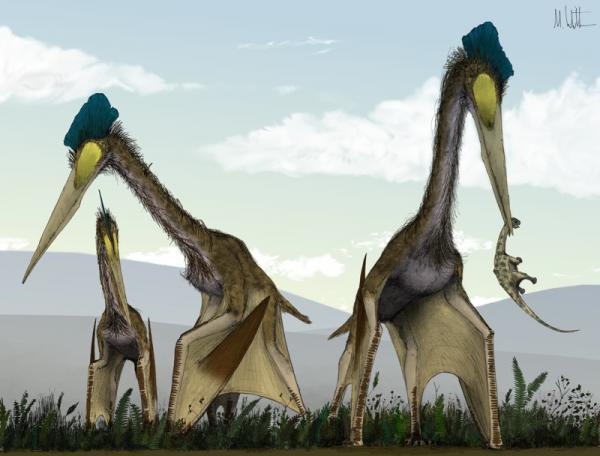
Fossils of this pterosaur have been found in sediments that were laid down inland.  Palaeontologists have long debated how such a huge animal, with a wingspan in excess of ten metres, and standing taller than a giraffe, might have lived.  Perhaps, pterosaurs like Quetzalcoatlus filled the ecological niche of scavengers, like vultures do today.  An alternative view is that these large animals were active hunters, stalking the open plains and snatching up prey, just like Marabou storks do today in sub-Saharan Africa.

Did Large Azhdarchid Pterosaurs Stalk Prey on the Ground?

Some Pterosaurs were as tall as a giraffe.

Some pterosaurs were as tall as a giraffe.

Picture credit: M. Witton

The model depicts Quetzalcoatlus having just grabbed a baby titanosaur, the titanosaur species is an Alamosaurus, a long-necked dinosaur whose fossils have been found in the southern United States in rocks that date to approximately the same time as the strata in which Quetzalcoatlus fossils were found.  The Quetzalcoatlus with titanosaur model, portrays this large pterosaur as an active hunter, although it is very likely that in common with most other carnivores, these reptiles would have fed on the carcases of dead dinosaurs too.  The titanosaur has been glued into the long beak,  however, we are aware of a number of model collectors who have carefully filed down the pegs that help secure the baby dinosaur in place, thus removing the titanosaur from out of the Quetzalcoatlus’s mouth.  The baby dinosaur can be removed but we would urge caution for anyone attempting to do this.

The Quetzalcoatlus with Prey (Close up)

Feeding on young Titanosaurs.

Feeding on young titanosaurs. Picture credit Everything Dinosaur.

Picture credit: Everything Dinosaur

CollectA Quetzalcoatlus with Prey

The model has been carefully painted, the body is brown in colour with a pale yellow underside.  The enormous beak has been painted mostly black, but it does reveal lots of detail, some flashes of colour for example, and the sculptors have been keen to depict the nostrils, these can be located roughly half-way along the beak’s length.  The folded wings are painted a battleship grey.

The body of this flying reptile has been textured to give the impression that it was covered in a shaggy, rough-looking coat.  A number of pterosaur fossils have now been excavated that reveal that these reptiles had bodies that were covered in hair-like structures.

The model measures around 12 centimetres tall, based on an adult azhdarchid pterosaur like Quetzalcoatlus standing close to 6 metres high, we estimate that this replica is in approximately  1:48 scale.  The head looks massive in comparison to the body-size and the tiny feet, however, these proportions are correct.  Pterosaurs like Quetzalcoatlus had the longest skulls of any terrestrial tetrapod.  This model is part of the huge CollectA prehistoric animal model series, this is a not-to-scale range of figures.

CollectA also make a number of scale model prehistoric animals, these are often referred to as “Deluxe”.  There is even a Pterosaur represented in this model series (Pteranodon).

To view the CollectA range of scale models: CollectA Deluxe Prehistoric Life.

Reflecting a Modern Interpretation of the Pterosauria

A long, shaggy, insulating coat.

A long, shaggy, insulating coat. Picture credit: Everything Dinosaur.

Picture credit: Everything Dinosaur

This is a beautifully crafted, hand-painted replica of a Quetzalcoatlus with prey.  It is an exciting addition to the CollectA range of prehistoric animals and we at Everything Dinosaur send out a Quetzalcoatlus fact sheet with each model that we sell.

To view the CollectA range of not to scale prehistoric animals: CollectA Prehistoric Life Models.

5 07, 2014

New Wild Safari Dinosaurs Ammonite Model Reviewed

By |2024-05-02T11:52:09+01:00July 5th, 2014|Categories: Dinosaur Fans, Educational Activities, Everything Dinosaur Products, Photos of Everything Dinosaur Products, Product Reviews, Teaching|0 Comments

A Review of the Wild Safari Dinosaurs Ammonite Model

The design team at Safari Ltd have produced a number of prehistoric animal replicas over the years, broadening the scope of their Wild Safari Dinosaurs range to include other extinct creatures and not just dinosaurs.  In 2014, a model of an ammonite was introduced to the delight of teachers, fossil hunters and model collectors alike.

Wild Safari Dinosaurs Ammonite

The Ammonite Model (Wild Safari Dinosaurs)

Large eyes, deeply ribbed shell perhaps a model of a Pavlovia spp?

Large eyes, deeply ribbed shell perhaps a model of a Pavlovia spp?

Studying Cephalopods

Ammonites are an extinct group of cephalopods, that belong to the extremely diverse Mollusca phylum.  Ammonite fossils, because of their abundance and variety, are very important to geologists and palaeontologists.  Along with two other types of Mollusc, the bivalves and the gastropods, (for example snails), ammonite fossils help scientists to date geological strata relative to other rock formations.

Closely related to living cephalopods such as squid, the nautilus and cuttlefish, ammonites lived in chambered shells.  In most species the shells were coiled round and the animal lived in the last section of the outer whorl of the coil, in what is referred to as the body chamber.  The shells made of aragonite, a form of calcium carbonate, are extremely numerous in the fossil record, although the soft parts, the ammonite’s actual  body tissues are virtually unknown.

Describing an Ammonite

It is believed that ammonites had eight, grasping arms and  two much larger tentacles.  These two tentacles had many suckers on the end which helped these animals grab prey.  It is likely that because of the variety and diversity of ammonite species, that these creatures occupied a number of niches in marine food webs.  For example, large actively swimming species could have hunted fish, crustaceans or jellyfish, others may have been scavengers, many smaller species probably fed on plankton.

The Ammonite Model from Safari Ltd

A great Ammonite model for use in schools, museums and for model collectors.

A great ammonite model for use in schools, museums and for model collectors. Picture credit: Everything Dinosaur.

Picture credit: Everything Dinosaur

The Safari Ltd replica is beautifully painted, the coiled shell being a metallic bronze colour, the body chamber battleship grey with the animal itself painted in subtle oranges and pinks.  Note the large eye, like modern cephalopods such as squid and cuttlefish, ammonites very probably had excellent eyesight.  They were probably visual hunters, their large eyes giving them excellent peripheral vision to help them avoid predators.

When viewed from the front, a good view of the muscular arms can be obtained.  The two specialised tentacles are painted a lighter colour and can be seen projecting downwards.  The ends, of these two tentacles have been provided with a number of round suckers by the design team at Safari Ltd, these represent the soft, fleshy pad called the dactylus, the apparatus with which the ammonite could grasp and secure prey.

A View from the Front (Anterior View) of the Ammonite Model

Eight arms and two grasping tentacles.

Eight arms and two grasping tentacles. Picture credit: Everything Dinosaur.

Picture credit: Everything Dinosaur

Projecting out from underneath is the hypernome, a narrow, muscular tube that squirted water, providing the ammonite with a form of jet propulsion.

Describing the Shell

The shell has very prominent ribs which are raised in the last whorl of the shell to form two rows of parallel spines.  Such ornamentation would have helped protect the ammonite from attack, perhaps deterring a marine reptile such as a mosasaur from taking a bite.  Whilst these spines would have assisted with the animal’s defence, they do not help much with streamlining.  It may be difficult to identify the precise species that the sculptors at Safari Ltd have based their model on, but due to the shape of the shell, those large ribs and projecting points, the model probably represents quite a slow swimming species.

The Wild Safari Dinosaurs Ammonite Model

A super model of an Ammonite.

A super model of an ammonite. Picture credit: Everything Dinosaur.

Picture credit: Everything Dinosaur

This ammonite measures a fraction under eleven centimetres in length and the shell has a diameter of six and a half centimetres.  It is not possible to put a scale on this figure, most ammonite species were small, with shells only a few centimetres across, although the fossil record has preserved the remains of some giant forms with shells in excess of two metres in diameter.

To view the range of Safari Ltd models: Safari Ltd. Prehistoric Animal Models.

It is great to see a replica of an ammonite added to the Wild Safari Dinos model range.  It is ideal for use in schools as an inexpensive teaching aid when exploring fossils and in addition it can be added to the display cases of ammonite fossil material to give viewers an appreciation of what the animal actually may have looked like.

This is an exciting addition to the Wild Safari Dinosaurs model range made by Safari Ltd and it means that Everything Dinosaur now has an ammonite replica to supply to model collectors and fans of prehistoric animals.  We even supply a fact sheet all about ammonites and this will be sent out with model sales.

4 07, 2014

CollectA Quetzalcoatlus with Prey Video Review

By |2023-03-14T08:42:58+00:00July 4th, 2014|Categories: Dinosaur Fans, Everything Dinosaur Products, Everything Dinosaur videos, Product Reviews|0 Comments

A Video Review of the Quetzalcoatlus with Prey Model (CollectA)

In 2014, those clever people at CollectA introduced another pterosaur model into their not-to-scale range of prehistoric animals.  Not only did this new figure depict a flying reptile on the ground and not in a flying pose with wings outstretched, it also portrayed Quetzalcoatlus as a hunter of dinosaurs.  The Quetzalcoatlus with prey model shows this large pterosaur with a baby Alamosaurus in its huge beak.

CollectA Quetzalcoatlus with Prey

The Quetzalcoatlus with Prey Model (CollectA)

A Quetzalcoatlus has snatched up a baby dinosaur.

A Quetzalcoatlus has snatched up a baby dinosaur. Picture credit: Everything Dinosaur.

Picture credit: Everything Dinosaur

To view Everything Dinosaur’s range of CollectA, not-to-scale prehistoric animal figures: CollectA Prehistoric Life Models.

With such an amazing model in the CollectA range, our experts at Everything Dinosaur felt compelled to make a short video review of this replica.

Everything Dinosaur’s Video Review (CollectA Quetzalcoatlus with Prey Model)

Video credit: Everything Dinosaur

In this five minute video (four minutes fifty-seven seconds), Everything Dinosaur looks at this model in a little more detail.  Why the unfortunate Alamosaurus model was chosen as the prey is explained and team members comment on the colouration, size and scale of this replica.

As for pronunciation, the only species in the Quetzalcoatlus genus named to date is Q. northropi named in 1975.  The genus name comes from the feathered serpent God of  the Aztec people called Quetzalcoatl.  The genus name is pronounced kwet-zal-co-at-lus or kwet-zal-coat-lus, but one thing is for sure, the genus name of this huge, Late Cretaceous, azhdarchid pterosaur needs a bit of a run up when it comes to saying it.

2 07, 2014

New Papo Dilophosaurus Reviewed

By |2024-05-01T15:28:07+01:00July 2nd, 2014|Categories: Dinosaur Fans, Everything Dinosaur Products, Product Reviews|0 Comments

A Review of the Papo Dilophosaurus Dinosaur Model

One of three new models introduced into the Papo dinosaurs range in 2014, is this super replica of the Early Jurassic carnivorous dinosaur known as Dilophosaurus and this is a review of this replica by Everything Dinosaur team members.  This year marks the 60th anniversary of the naming of this meat-eating dinosaur.  The first fossils ascribed to Dilophosaurus were found in the state of Arizona, in the USA, more specimens have been discovered in similar aged rocks but this time in China.  This suggests that dinosaurs like Dilophosaurus were a very widespread and successful genus during a time when the number of different types of carnivorous dinosaur was rapidly increasing.

The Papo Dilophosaurus Dinosaur Model

Fossils found 60 years ago helped to describe Dilophosaurus.

Fossils found 60 years ago helped to describe Dilophosaurus.

Picture credit: Everything Dinosaur

Papo Dilophosaurus Dinosaur Model

The model is posed with the three-fingered claws of the right hand resting on the ground.  This helps balance this replica and permits the design team at Papo to keep the hind feet roughly in proportion to the rest of the animal’s body.  Compared to later, larger theropods, the arms of Dilophosaurus were relatively long.  The hands and claws would have helped this dinosaur grasp and overcome struggling prey, as the jaws, although lined with sharply pointed teeth were actually quite weak.

The most significant distinguishing feature of this dinosaur are the pair of thin, semi-circular crests that run the length of the top of the skull.  The crests reflect the known fossil material very accurately, they even retain a small, backward pointing extension at the rear of the crest, the “Dilophosaurus notch” as it is often referred to as.

The artists have painted the pair of crests a bright crimson colour.  These crests, were probably used for display or for signalling.  As far as we at Everything Dinosaur know, the crests have never been found attached to the skull.  However, the standard restoration with a pair of parallel crests running along the snout seems the most convincing interpretation of the fossil material.

“Double Crested Lizard” – The Papo Dilophosaurus

Papo Dinosaur Dilophosaurus Model

Papo Dilophosaurus dinosaur model. Picture credit: Everything Dinosaur.

Picture credit: Everything Dinosaur

The model measures 14 cm in length, but as the tail is curled back over the body, the actual figure is nearer 18 cm to 19 cm in length.  Based on the species from Arizona named Dilophosaurus wetherilli, we estimate that this model is in approximately 1:35 scale, although the maximum size of Dilophosaurus species remains unknown.  Some individuals could have exceeded 6 and 1/2 metres in length.

To view Everything Dinosaur’s range of Papo prehistoric animal models: Papo Dinosaur Models.

An Excellent Replica

The replica is exceptionally well painted and seems to depict Dilophosaurus on the move.  This model does have an articulated jaw, on some of the models the jaws are quite stiff but if the head is dipped in hot water for a few seconds then the jaw joint becomes more flexible and the beautiful detail inside the tooth lined jaws can be seen.  Even the distinctive kink in the upper jaw can be clearly made out.

The Papo Dilophosaurus Does Have an Articulated Lower Jaw

The Papo Dilophosaurus dinosaur model has an articulated jaw.

The Papo Dilophosaurus dinosaur model has an articulated jaw. Picture credit: Everything Dinosaur.

Picture credit: Everything Dinosaur

The light tan underside gives way to a darker greyish/brown top colouring with flashes of blue stripes along the back, the tail and down the hind legs.  There is also a metallic orange stripe running from the back of the skull, down the long neck finishing at the hips.  This is a very striking replica and an excellent addition to the Papo Dinosaurs model range.

One of the nice things that we are seeing as Papo extends their model series, is that new models such as this Dilophosaurus work very well to scale when compared with existing Papo replicas.  For example, the Dilophosaurus is in a comparable scale to the Late Jurassic Allosaurus model also made by Papo.

The Papo Allosaurus and the Papo Dilophosaurus Dinosaurs

The Papo Allosaurus and the Papo Dilophosaurus dinosaur models are roughly to the same scale.

The Papo Allosaurus and the Papo Dilophosaurus dinosaur models are roughly to the same scale. Picture credit: Everything Dinosaur.

Picture credit: Everything Dinosaur

All in all this is an excellent Dilophosaurus dinosaur model and one that is a welcome addition to the Papo prehistoric animals model range.

28 06, 2014

Wild Safari Dinosaurs Ammonite Model – A Video Review

By |2023-03-13T20:24:53+00:00June 28th, 2014|Categories: Everything Dinosaur Products, Everything Dinosaur videos, Product Reviews|0 Comments

Video Review of Ammonite Model

Safari Ltd have introduced a replica of an ammonite into their Wild Safari Dinosaurs model range.  This model series certainly has a lot more than just dinosaur models to offer collectors and this new ammonite replica is a welcome addition.

In this short video review (six minutes and twelve seconds long), Everything Dinosaur discusses the merits of this model and explains why its introduction will prove very helpful to teachers and fossil collectors.

Wild Safari Dinosaurs Ammonite

Wild Safari Dinosaurs Ammonite Model Reviewed

Video credit: Everything Dinosaur

Although the soft parts of members of the Ammonoidea are virtually unknown in the fossil record, this replica reflects what palaeontologists actually think that the soft tissues of ammonites looked like. From the front the animal looks quite foreboding with its two long tentacles and eight muscular arms.  Imagine how you would feel if a three-metre-long specimen came hurtling towards you out of the dark waters – very scary!

The Wild Safari Dinosaurs ammonite model and the rest of the Safari Ltd prehistoric animal model range can be seen here: Safari Ltd. Wild Safari Dinos Models and Figures.

This ammonite model is great for use in schools as a teaching resource and it will also find a role in helping to explain ammonite fossils in museum display cases.

26 06, 2014

New Papo Dilophosaurus Video Review

By |2024-05-01T15:28:32+01:00June 26th, 2014|Categories: Dinosaur Fans, Everything Dinosaur Products, Everything Dinosaur videos, Product Reviews|0 Comments

Papo Dilophosaurus Dinosaur Model – A Video Review

With the introduction of the second Papo prehistoric animal figure for 2014, it is time to get the camcorder out again and to produce a video review of this new addition to Everything Dinosaur’s range.  In this short video, we reveal a surprise about this dinosaur model and comment on how this replica reflects the known Dilophosaurus fossil material.

Papo Dilophosaurus

Everything Dinosaur’s Video Review

Video credit: Everything Dinosaur

The video lasts for five minutes and ten seconds, we examine the model in a little more detail.  Naturally, the Everything Dinosaur team members focus on those bizarre crests, after all, the name Dilophosaurus does mean “double crested lizard”.  The pose of the model is discussed as is the colouration, on what is an excellent new addition to the Papo prehistoric animals model range.

To view the Papo Dilophosaurus and the rest of the Papo prehistoric animals:  Papo Dinosaurs and Prehistoric Animal Models.

19 06, 2014

New Papo Mini Dinosaurs Model Set Reviewed

By |2024-05-02T06:11:28+01:00June 19th, 2014|Categories: Dinosaur Fans, Everything Dinosaur Products, Photos of Everything Dinosaur Products, Product Reviews|0 Comments

A Review of the Papo Mini Dinosaurs Tub

Papo, the France based figure and replica manufacturer, have for some time marketed a series of smaller models sold in tubs which mirror animals already included in the company’s larger model collections.  In 2014, Papo have added a tub of mini dinosaur models to their portfolio and this is a review of that model set.

Papo Mini Dinosaurs

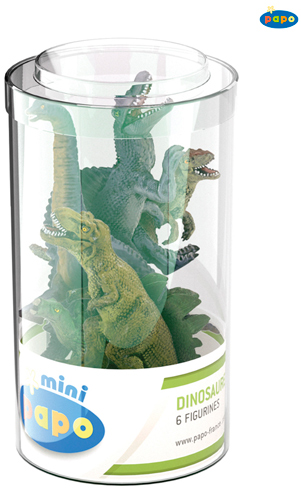
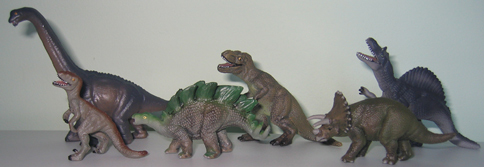
The tub of dinosaurs contains six figures, three herbivores and three carnivores.  Namely, Triceratops, Stegosaurus, Brachiosaurus with the meat-eaters being Velociraptor, Spinosaurus and T. rex.  It is not surprising that Papo have chosen these particular dinosaurs, firstly Papo already makes large models of these six members of the Dinosauria and secondly, in Everything Dinosaur’s annual prehistoric animal survey, all six dinosaurs regularly feature in the top ten.

To view the list of top ten prehistoric animals for 2013: Top Ten List.

 The Papo Mini Dinosaurs Model Tub

A dinosaur model set that contains six figures.

A dinosaur model set that contains six figures.

Picture credit: Everything Dinosaur

The three theropods, that is the Velociraptor, the Tyrannosaurus rex and the Spinosaurus have been posed with their tails resting on the ground, what is termed a tripodal stance.  Although tail drag marks have been preserved in the fossil record, it is very likely that these sorts of dinosaur held their tails out behind them.  We think the stance is purely to help stabilise the models to make them easier to stand up, especially if being played with on a carpet for example.

We don’t think any of the models will win any awards for anatomical accuracy, they have been designed very much with the young dinosaur fan in mind and not the serious model collector but they are appealing and quite quirky and for anyone collecting the Papo prehistoric animal model range, they are a worthwhile addition.

The Papo Mini Dinosaurs Model Set

A dinosaur model set which features six prehistoric animals.

A dinosaur model set which features six prehistoric animals.

Picture credit: Everything Dinosaur

Although not to scale, there are a couple of points worth making.  For example, the Velociraptor figure works well when used in any dioramas featuring the larger Papo dinosaur models.

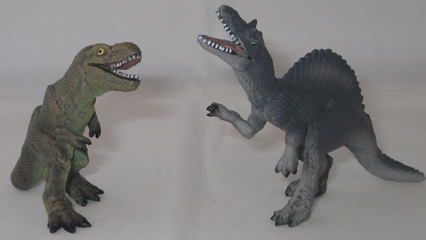
In addition, something that young dinosaur fans will approve of, is the fact that the Spinosaurus replica is larger than the T. rex model in this series.  This reflects what is seen in the fossil record with Spinosaurus (S. aegyptiacus) regarded by many palaeontologists as the largest land carnivore of all time.

The Papo Mini Dinosaurs Tyrannosaurus rex and Spinosaurus Compared

Spinosaurus is just a little bigger than the T. rex figure.

Spinosaurus is just a little bigger than the T. rex figure.

Picture credit: Everything Dinosaur

The models measure in size from the diminutive Velociraptor which measures around 5 centimetres long to the Brachiosaurus which stands nearly 9 centimetres tall and is around 10 centimetres in length, the skin textures have been very well crafted and they are an ideal dinosaur model gift set for children from 3 years and upwards

Papo prehistoric animal models tend to have a characteristic look about them and we at Everything Dinosaur have long suspected that the design team at Papo have been heavily influenced by the look of the prehistoric animals featured in the Jurassic Park movie franchise. The colour of the Spinosaurus  model reminded us of the Spinosaurus seen in Jurassic Park 3 and the look of the T. rex model brought to mind the final scene in the first Jurassic Park film when the T. rex knocks the Jurassic Park banner to the ground.

One thing about these small models, is that they can always be used to represent babies when shown next to the larger models in the Papo model range.

The Baby Stegosaurus (Mini Dinosaurs) and the Papo Stegosaurus Dinosaur Model

An adult and baby Stegosaurus perhaps?

An adult and baby Stegosaurus perhaps?

Picture credit: Everything Dinosaur

This is an excellent dinosaur model play set, one that is a welcome addition to the Papo prehistoric animal series.

To view Everything Dinosaur’s range of Papo prehistoric animal models: Papo Prehistoric Animal Models.

15 06, 2014

Wonderful Dinosaur Summer Party Fun

By |2024-04-12T09:02:59+01:00June 15th, 2014|Categories: Dinosaur Fans, Everything Dinosaur Products, Main Page, Photos of Everything Dinosaur Products, Press Releases|0 Comments

Giant Inflatable Tyrannosaurus rex

Get into the summer party mood with this super-sized, inflatable T. rex from Everything Dinosaur.  This inflatable dinosaur stands an impressive 1.83 metres (six feet) tall when inflated and is bound to make young dinosaur fans roar with excitement.

Everything Dinosaur

Six Foot Tall Inflatable Tyrannosaurus rex

Just add air for lots of dinosaur fun.

Just add air for lots of dinosaur fun.

Picture credit: Everything Dinosaur

Tyrannosaurus rex

This giant dinosaur inflatable can be blown up by a foot pump, a hand pump or good, old fashioned, lung power.  On test, our friendly dinosaur enthusiasts were able to blow it up in about five minutes or so.  This makes a super addition to a dinosaur party, or indeed for use in schools when Reception/Foundation stage children are learning all about dinosaurs.  It was pointed out to us, that this inflatable is actually taller than every member of the Everything Dinosaur team.

To view Everything Dinosaur’s range of dinosaur themed toys and gifts: Prehistoric Animal Toys and Gifts.

It certainly is an impressive dinosaur.  Palaeontologists have calculated the growth rate of dinosaurs and they too, just like us, had growth spurts.  Tyrannosaurus rex babies probably grew very quickly in their first few years, after all, small dinosaurs could have ended up as lunch for bigger dinosaurs.  From hatching, Tyrannosaurus rex probably reached a length of around two metres within the first year of its life, still, it had a long way to go to reach the 13-14 metre giant that some tyrannosaur fossils indicate.

Inflatable T. rex from Everything Dinosaur

Six foot high inflatable T. rex

Six foot high inflatable T. rex.

Picture credit: Everything Dinosaur

With the debate regarding whether or not dinosaurs were warm-blooded (endothermic) or cold-blooded (ectothermic) or indeed somewhere in between (mesothermic) likely to continue for a very long time, at least young dinosaur fans can relax on the beach with a giant inflatable dinosaur to keep them company.

Go to Top