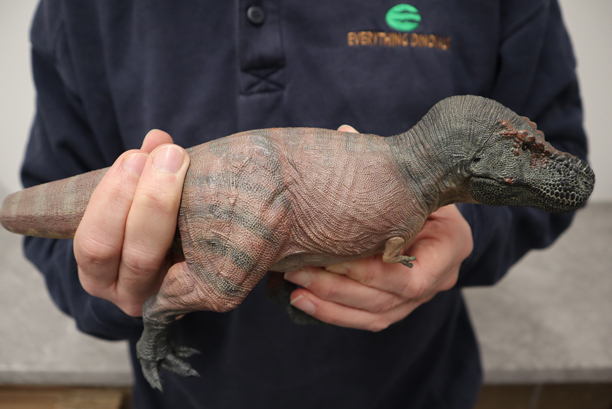
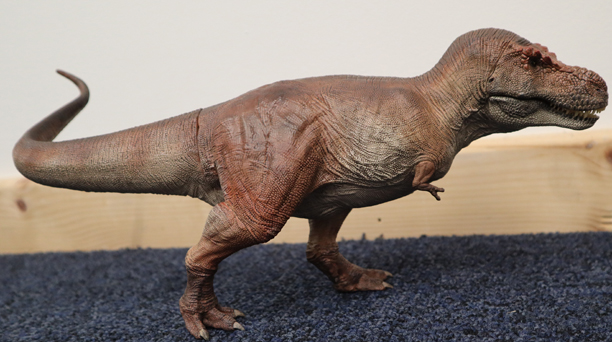
New for 2022 Rebor Tyrannosaurus rex figures in stock at Everything Dinosaur. The Rebor T. rex Kiss Mountain and the Rebor T. rex Tusk King T. rex Requiem figures have arrived at Everything Dinosaur’s warehouse. The “Kiss” figure has been given lips, whilst the “Tusk” replica has a more typical overbite as seen in earlier Rebor tyrannosaurs.
The Rebor Kiss T. rex figure (Mountain), this tyrannosaur model has been given lips. Picture credit: Everything Dinosaur.
The Rebor T. rex Kiss Mountain Model
The Rebor T. rex Kiss Mountain model measures a little over 40 cm in length and that impressive head stands around 14 cm off the ground. Like its counterpart figure T. rex Tusk, this figure has a declared scale of 1:35.
A dinosaur model with lips. The new for 2022 Rebor T. rex Kiss Mountain model in 1:35 scale. A wonderful model of a Tyrannosaurus rex. Picture credit: Everything Dinosaur.
Rebor T. rex Tusk King T. rex Requiem Model
The Rebor T. rex figure called Tusk (T. rex Tusk King T. rex Requiem) has a colouration superficially similar to the original Rebor King T. rex, which was the second tyrannosauroid model to be made by Rebor. It has an articulated jaw and moveable arms, but depicts this iconic tyrannosaur without lips. Tusk is the same size and scale as the Kiss figure.
Such is the stability of these excellent theropods, that they were able to be placed on the office carpet without the need of the clear, plastic support that is supplied with these figures.
The Rebor T. rex Tusk King T. rex Requiem model is supplied with a transparent plastic support base, but our models appear quite stable even standing on our office carpet without the need for the support stand. Picture credit: Everything Dinosaur.
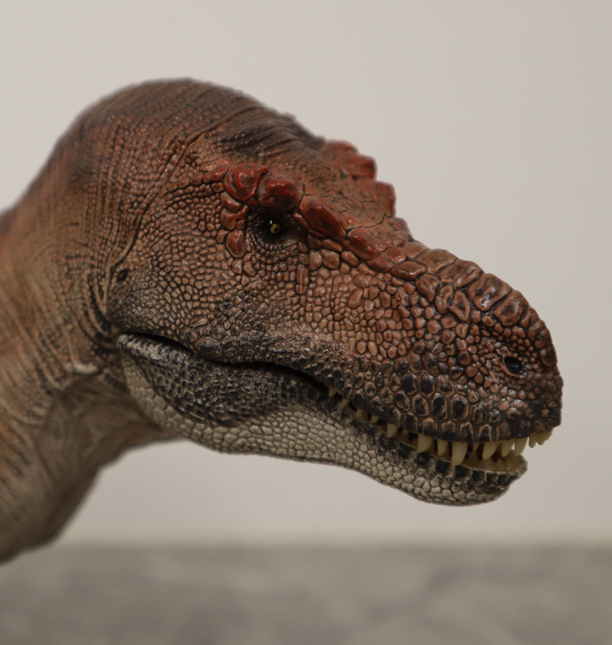
Both models have been beautifully painted and show some stunning details. A spokesperson from Everything Dinosaur commented on the impressive lacrimal crests of these models, particularly the crimson-coloured crests of Tusk.
A close-up view of the detail on the head of the Rebor T. rex Tusk dinosaur model. The Rebor figure has most impressive lacrimal crests. Picture credit: Everything Dinosaur.
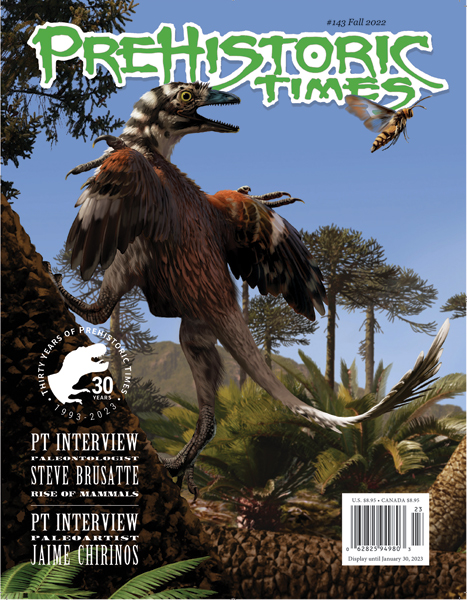
The editor of “Prehistoric Times” magazine sent Everything Dinosaur a preview of the front cover of the next edition (issue 143). The stunning illustration is by Jaime Chirinos, a celebrated palaeoartist who has provided artwork for numerous media releases associated with scientific papers.
The front cover of “Prehistoric Times” issue 143 (fall/autumn) 2022. The front cover illustration depicts an Auriornis – a controversial Chinese, crow-sized theropod. The superb illustration is by Jaime Chirinos.
Auriornis xui
The small, feathered animal attempting to catch an insect on the cover of the magazine is the controversial Auriornis (A. xui). This theropod measured around fifty centimetres in length and it was formally named and scientifically described in 2013 (Godefroit et al).
The fossil material was acquired from a local dealer who claimed that the specimen came from exposures of the Tiaojishan Formation. This geological formation has been dated to the Late Jurassic (Oxfordian faunal stage) and it was proposed that Auriornis lived approximately 160 million years ago. This would make Auriornis one of the earliest avialans known to science, pre-dating the famous Archaeopteryx by around 10 million years.
Unfortunately, the provenance of the fossil material is difficult to prove. It has been suggested that this fossil is much younger than previously thought. The holotype may have come from exposures of the Yixian Formation which would suggest that this little hunter lived in the Early Cretaceous around 130 to 112 million years ago.
Perhaps issue 143 of “Prehistoric Times” magazine or a future edition will examine in detail the evidence relating to the dating of the Auriornis fossil material.
“Prehistoric Times” Magazine
We do know that the next edition of this popular quarterly magazine will include an in-depth interview with Steve Brusatte. Following on from Steve’s highly acclaimed book “The Rise and Fall of the Dinosaurs”, he has produced a follow-up looking at the success of the Mammalia. The new book is entitled “The Rise and Reign of the Mammals” and in the latest edition of the magazine Steve talks about what inspired him to produce this new book and his work as a vertebrate palaeontologist.
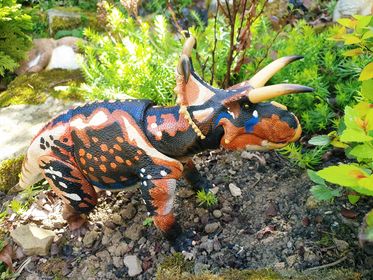
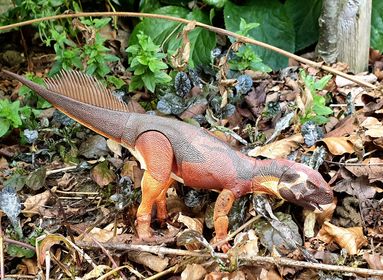
A pair of Beasts of the Mesozoic articulated dinosaur models on display in a carefully selected garden setting. The Albertaceratops and Psittacosaurus models look very photogenic. Our thanks to Caldey who sent into Everything Dinosaur some photographs of the latest additions to her prehistoric animal model collection.
The Beasts of the Mesozoic Albertaceratops dinosaur model. The photographer has taken great care to ensure that the foliage included in the shot looks in proportion to this large dinosaur. Picture credit: Caldey.
Taking advantage of a sunny day, Caldey took some of her new acquisitions out into the garden to take some photographs. She carefully selected appropriate backdrops, wanting to shoot images of vegetation that gave an impression of scale and size. The choice of plants included in the pictures was important to Caldey, she wanted to include plants and other foliage that might be in keeping with the ancient environments that these dinosaurs lived in.
For the Albertaceratops, which roamed North America during the Late Cretaceous approximately 78-76 million years ago (Campanian faunal stage of the Cretaceous), this task was not too onerous. Albertaceratops would have been familiar with many of the plants and trees commonly found in gardens today. However, for the Psittacosaurus, selecting a suitable background could be a little more challenging.
The Beasts of the Mesozoic Psittacosaurus model goes for a stroll in the garden. Picture credit: Caldey.
Psittacosaurus is known from the Early Cretaceous. This dinosaur having a much wider geographical distribution when compared to the distantly related Albertaceratops. It also had a much larger temporal range. Caldey has selected a background with fewer angiosperms (flowering plants), which is in keeping with the palaeoenvironment associated with the Psittacosaurus genus.
Our thanks to Caldey for sending into Everything Dinosaur her carefully conceived dinosaur photographs.
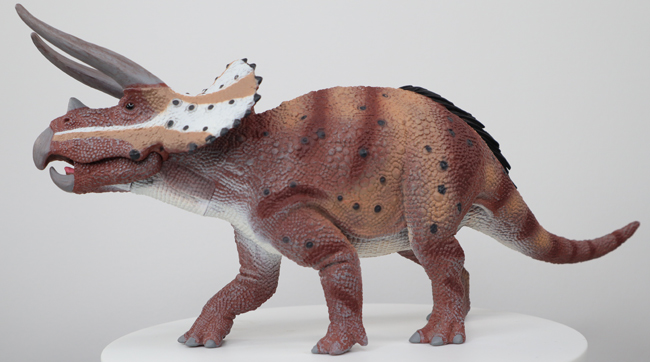
Team members at Everything Dinosaur have been most impressed with the new for 2022 CollectA deluxe 1:40 scale Triceratops horridus dinosaur model. This new, horned dinosaur figure is largely based on the fossil specimen nicknamed “Horridus” which is on display at Melbourne Museum (Victoria, Australia).
CollectA Triceratops horridus dinosaur model (left lateral view). This 1:40 scale dinosaur model is based on the fossilised remains of a Triceratops that is the centrepiece of an exhibition at Melbourne Museum in Victoria, Australia. Picture credit: Everything Dinosaur.
Triceratops horridus
The Museums Victoria Triceratops fossils, representing some 87% of the bones from an individual animal, were excavated from Upper Cretaceous (Hell Creek Formation) deposits in Montana (USA). The bones from the tail (caudal vertebrae) were almost all present, and for the first time palaeontologists were able to accurately re-create the tail of this iconic dinosaur. The CollectA Deluxe 1:40 scale Triceratops figure reflects the data, and the tail is in proportion with the rest of the dinosaur model.
In addition, the excellent condition of the skull bones and the frill of this dinosaur enabled the design team at CollectA to accurately reconstruct the head of a Triceratops. The Montana specimen has the most complete skull and neck frill of any Triceratops found to date. The bones make up more than 99% of the skull skeletal material. CollectA have been able to use this skeleton to accurately depict the head and the neck frill on their dinosaur model.
The Skin of a Triceratops
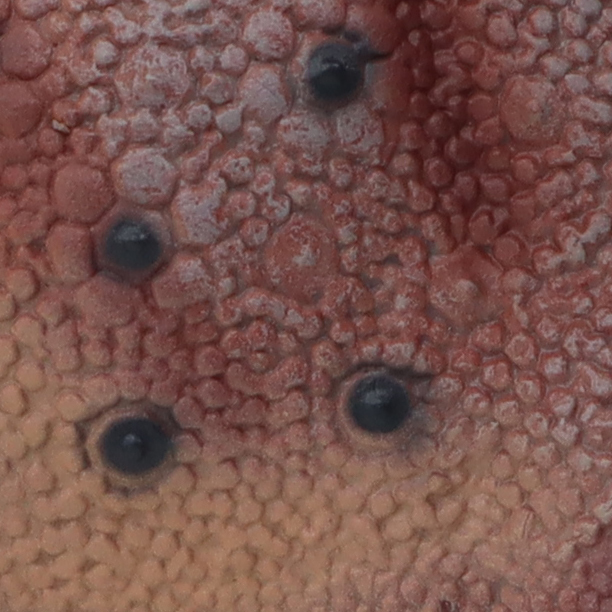
The beautifully detailed skin of the CollectA T. horridus model is based on a second Triceratops fossil nicknamed “Lane” from the Lance Formation. These fossils (specimen number BHI-6273) include stunning skin impressions that indicate that Triceratops had a skin like no other known ornithishcian. Triceratops was covered in large scales, many of which were hexagonal in shape. In addition, this dinosaur had raised, conical tubercles embedded in its skin some of which were over 10 cm in diameter.
A close-up view of the skin texture on the new for 2022 CollectA Deluxe Triceratops horridus model. The texture accurately reflects the known fossil record. Picture credit: Everything Dinosaur.
No formal scientific paper has been published yet on the skin of “three-horned face”. These fossils are on display at the Houston Museum of Natural Science (Texas).
Team members at Everything Dinosaur congratulate CollectA for creating such a magnificent Triceratops horridus dinosaur model.
Everything Dinosaur has continued to maintain its 5-star customer service rating with the independent ratings agency Feefo. The UK-based company that specialises in the sale of dinosaur models, toys and games has maintained its extremely high rating for customer service, despite the current economic difficulties and global supply issues.
Everything Dinosaur’s certificate confirming the Platinum Trusted Service Award. Everything Dinosaur has been able to maintain its extremely high customer service rating throughout the first three quarters of 2022.
There are currently over four hundred independent, genuine customer reviews about Everything Dinosaur on Feefo’s website. The feedback and comments come from customers from all over the world, from Europe, the USA, Canada, Asia and Australia/New Zealand.
A spokesperson from Everything Dinosaur commented:
“We are grateful for all the feedback and comments that we receive. We are truly humbled to have been able to maintain top marks for our customer service and product quality despite the unprecedented difficulties surrounding the trading environment at the moment.”
Recent Examples of Customer Feedback
Typical examples of customer feedback received by Everything Dinosaur include this comment from long-time customer Mary:
“Everything Dinosaur did their usual trick of making us feel like their only customers, keeping us advised where the order was at all times, and in general making buying dinosaurs absolutely painless!”
Linda provided feedback stating:
“Great people to deal with. Always answer all questions nearly immediately. The products are such high quality. Love everything dinosaurs you’re the best!!!!!!”
Fabrizio wrote from Italy:
“Really good service.”
A few days earlier we heard from Rafael from Brazil who sent feedback stating:
“Ótimo serviço. Em relação ao produto estava tudo nos conformes. Comprarei novamente.”
Team members at Everything Dinosaur replied in Brazilian Portuguese thanking him for his comments which roughly translate as:
“Great service. In relation to the product everything was in compliance. I will buy again.”
Everything Dinosaur wins the Platinum Service Award in 2022. Everything Dinosaur has won numerous awards for its customer service.
The spokesperson from Everything Dinosaur added that team members were working hard to maintain customer service standards as they prepare for the busy fourth quarter trading period. He thanked all the customers who had taken the time and trouble to leave feedback.
An analysis of the teeth of a small shrew-like animal known as Brasilodon quadrangularis from Upper Triassic strata in the Paraná Basin of Brazil indicates that its fossils might represent the lineage towards true mammals. As such, it pushes back the origins of Mammaliaformes by 20 million years.
Analysis of three lower jaws from B. quadrangularis, each jaw representing a different growth stage demonstrates diphyodont dentition, a key characteristic of mammals.
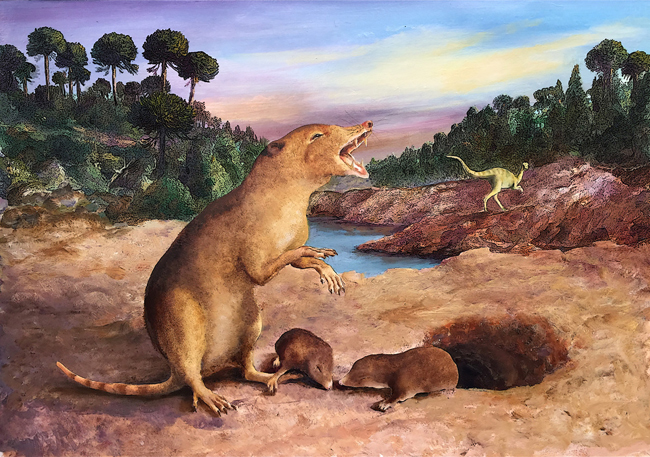
A life reconstruction of Brasilodon quadrangularis a contemporary of some of the oldest dinosaurs, one of which can be seen in the background. Picture credit: 2022 Anatomical Society Wiley.
Diphyodonty a Trait of Mammals and Their Near Relatives
Brasilodon is the oldest extinct vertebrate with two successive sets of teeth which includes only one set of replacements (diphyodonty). The first set starts developing during the embryonic stage and a second and last set of teeth develops once the animal is born. The dental replacement pattern occurs with the same temporal and morphological pattern that is a key feature of mammals. This differs from that of reptiles who regenerate new teeth multiple times during their lives, (polyphyodonty).
Researchers from the London Natural History Museum and King’s College London contributed to this international research programme which was led by scientists from the Federal University of Rio Grande do Sul.
Corresponding author of the paper, published in the “Journal of Anatomy”, Dr Martha Richter (Earth Sciences Department, Natural History Museum), commented:
“Comparative studies with recent mammal dentitions and tooth replacement modes suggest that this [B. quadrangularis] was a placental, relatively short-lived animal. Dated at 225.42 million years old, this is the oldest known mammal in the fossil record contributing to our understanding of the ecological landscape of this period and the evolution of modern mammals.”
20 Million Years Older than Morganucodon
The genus Morganucodon had been thought to represent the earliest mammaliaform, its fossils having been found in Europe (Wales), China and North America. Morganucodon fossil material is associated with the very latest Norian and the Rhaetian faunal stages of the Late Triassic. However, the genus Brasilodon is associated with much older Triassic deposition which took place around 225 million years ago.
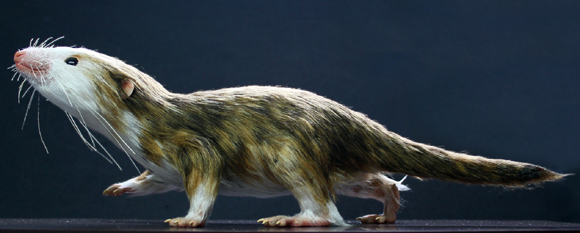
A model of the Late Triassic mammaliaform Morganucodon. Picture credit: University of Birmingham.
Mammalian Characteristics
Diphyodonty is a complex and unique phenomenon that along with tooth replacement involves profound, time-controlled changes to the skull anatomy, for instance the closure of the secondary palate (the roof of the mouth) that permits the young to suckle, while breathing at the same time. It has also been shown to be linked to endothermy and even placentation (live birth) and that other significant mammalian trait, the growth of hair and fur.
Brasilodon comes from the Caturrita Formation which preserves a rich assemblage of fossil vertebrates including sphenodonts, lepidosaurs, rhynchosaurs, dicynodonts and numerous cynodonts as well as silesaurids and dinosaurs (theropods and sauropodomorphs). Fossils also found in this formation hint at an ancestor of the Pterosauria (Faxinalipterus).
Brasilodon probably lived in burrows like many rodents today.
Everything Dinosaur acknowledges the assistance of a press release from the Natural History Museum (London) in the compilation of this article.
The scientific paper: “Diphyodont tooth replacement of Brasilodon—A Late Triassic eucynodont that challenges the time of origin of mammals” by Sergio F. Cabreira, Cesar L. Schultz, Lúcio R. da Silva, Luiz Henrique Puricelli Lora, Cristiane Pakulski, Rodrigo C. B. do Rêgo, Marina B. Soares, Moya Meredith Smith and Martha Richter published in the Journal of Anatomy.
The two CollectA deluxe 1:15 scale dinosaur models are back in stock at Everything Dinosaur. The 1:15 scale Triceratops and the 1:15 scale T. rex are available once again. These popular figures are the largest figures in the CollectA Prehistoric World model series.
The 1:15 scale Tyrannosaurus rex dinosaur model from CollectA.
The CollectA 1:15 scale Tyrannosaurus rex Dinosaur Model
The CollectA 1:15 scale Tyrannosaurus rex dinosaur model is huge! It measures 93 cm long and the end of the tail is around 44 cm off the ground. The T. rex figure is estimated to be approximately the size of a baby Tyrannosaurus rex at around a month old.
This hand-painted model is beautifully detailed, and it is presented on its own display base.
The carry case for the CollectA 1:15 Triceratops and the 1:15 T. rex dinosaur model. The red dot denotes that this carry case contains the Triceratops figure. The box is huge, as are the models inside, note how small Everything Dinosaur’s bespoke cardboard boxes that they use for model packaging look in the photograph. Picture credit: Everything Dinosaur.
The CollectA Deluxe 1:15 scale Triceratops Dinosaur Model
The CollectA 1:15 scale Triceratops dinosaur model. A dinosaur model based on the latest scientific interpretation of an iconic ceratopsian.
Hand-painted and with stunning, skin texture this is a Triceratops dinosaur model based on the latest scientific evidence. Both the 1:15 scale Triceratops and the 1:15 scale Tyrannosaurus rex figures have proved extremely popular with dinosaur fans and model collectors.
The Triceratops model measures 72 cm in length and those impressive brow horns are around 30 cm off the ground.
The measurements of both the crouching T. rex and the Triceratops figures are given on the side of the model’s carry case. The 1:15 scale T. rex model measures 93 cm in length and the Triceratops is around 70 cm long. Picture credit: Everything Dinosaur.
A collection of beautiful prehistoric animal illustrations by renowned, British palaeoartist John Sibbick is to be auctioned later this month (September 2022). The pencil and gouache drawings are part of a huge art collection amassed by Anthony Beeson.
A tyrannosaur attacks a hadrosaur. Stunning artwork in the collection of the late Anthony Beeson. Picture credit: John Sibbick.
A Lifetime of Prehistoric Animal Art Collecting
Polymath Anthony Beeson was the creative driving force behind the highly successful, award-winning dinosaur and prehistoric animal figure series manufactured by CollectA. In the attic of his modest home on the outskirts of Bristol, he kept his huge collection of dinosaur books, toys and other prehistoric animal themed memorabilia. He spent nearly four decades as the Art Librarian at Bristol’s central library and his eclectic range of interests from fine art, ceramics, antique jewellery and pottery are reflected in his personal collection. He had a fascination for and a great knowledge of Roman and Greek art and archaeology and amassed an enormous number of artefacts and curios.
With Anthony’s sad passing earlier this year, an auction has been organised by the Estate executors so that some of Anthony’s treasured possessions can be passed onto other collectors to enjoy.
The original pencil drawing of a resting Albertosaurus by John Sibbick, part of the estate of the late Anthony Beeson.
The Auction
Some of this amazing collection, reflecting a lifetime of collecting is being auctioned later this month (September 2022) by the auctioneers Chorley’s, details of which can be found here: Chorley’s the Auctioneers.
The auction featuring Anthony’s collection of John Sibbick palaeoart is to take place on the 20th and 21st September (2022) and on-line bidding will be available. This is an opportunity for fans of prehistoric animal art to purchase original pencil and gouache drawings by John Sibbick.
An illustration of the hadrosaurid Mandschurosaurus by John Sibbick. Part of the estate of Anthony Beeson being auctioned by Chorley’s.
Foraging dinosaurs. Pencil artwork by John Sibbick. This illustration is part of the estate of the late Anthony Beeson.
A Rare Opportunity
Amongst the extensive lots are some original pencil and gouache dinosaur illustrations by renowned British artist, John Sibbick. Anthony often remarked to Everything Dinosaur team members how John Sibbick was his favourite palaeoartist and his work had influenced many of the prehistoric animal model designs that Anthony worked on for the CollectA range.
The auction is a rare opportunity to purchase original, signed artwork from a famous British artist, artwork that has been used to illustrate many books about prehistoric animals and dinosaurs.
Everything Dinosaur acknowledges the assistance of Laura Milne of Chorley’s for her assistance in the compilation of this article and permission to reproduce the images.
Researchers have re-examined the fossilised remains of a Late Triassic, herbivorous dinosaur that had been assigned to the Plateosaurus genus and determined that the fossils represent a new species. The new dinosaur has been named Tuebingosaurus maierfritzorum and unlike Plateosaurus it was an obligate quadruped.
Skeletal silhouette of Tuebingosaurus with ascribed fossil bones shown in white. Silhouette of person provides the scale. The attribution of the bone marked in grey (fibula) is uncertain. Picture credit: Omar Rafael Regalado Fernandez / Ingmar Werneburg.
The genus Plateosaurus was erected in 1837 (Hermann von Meyer), before the term Dinosauria was coined, it was one of the first dinosaurs to be scientifically described. It has earned a reputation as somewhat of a taxonomic waste basket with numerous species assigned to it, often based on poorly preserved or fragmentary fossil remains.
Researchers at the University of Tübingen’s Senckenberg Centre for Human Evolution and Palaeoenvironment in Germany reassessed fossil bones discovered in Trossingen in 1922 and identified several unique anatomical traits leading them to conclude that these remains did not represent Plateosaurus as had previously been thought. Indeed, the bones are so different that they do not belong to a member of the Plateosauridae family, but most likely represent a member of the related clade the Massopoda.
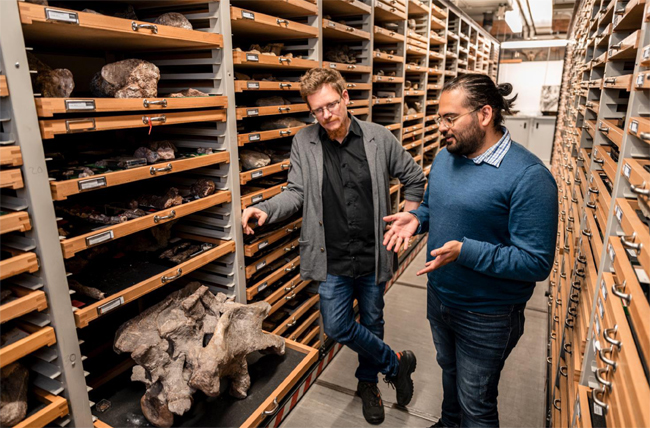
Ingmar Werneburg (left) and Omar Rafael Regalado Fernandez (right) in the archive of the paleontological collection at Tübingen. The hips of Tuebingosaurus maierfritzorum can be seen in the foreground. Picture credit: Valentin Marquardt/Universität Tübingen.
Broader and More Robust Hips
Writing in the journal “Vertebrate Zoology”, the researchers, Dr Omar Rafael Regalado Fernandez and Dr Ingmar Werneburg demonstrate that the hips are much broader and more robust when compared with plateosaurs. In addition, the limb bones such as the femur are unusually large and the fused sacral vertebrae are characteristic of an obligate quadruped and not Plateosaurus that are believed to have been facultative bipeds (quadrupeds, but capable of walking on their hind legs if the need arose).
Two phalanges (toe bones) (centre) of Tuebingosaurus maierfritzorum in a display cabinet at the Württemberg Hall. Picture credit: Valentin Marquardt/Universität Tübingen.
The Swabian Alb Mountains
The fossil bones of Tuebingosaurus maierfritzorum display characteristics of sauropods, the super-sized, long-necked dinosaurs such as Diplodocus, Brontosaurus and Brachiosaurus that dominated terrestrial faunas some fifty million years after Tuebingosaurus roamed. The fossil material is part of Tübingen’s paleontological collection. It originated from a quarry site near Trossingen at the edge of the Swabian Alb mountain range in Baden-Württemberg (Germany). The area is famous for its extensive plateosaur bonebeds and the huge amount of Plateosaurus fossils collected confirm that this lizard-hipped genus was extremely common in the Late Triassic and that Plateosaurus lived in large herds.
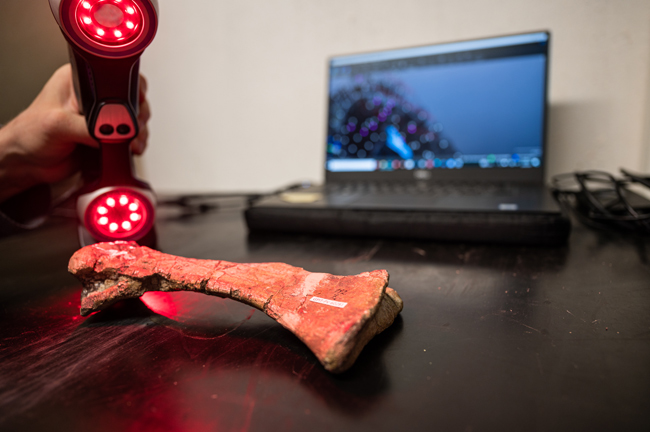
Three-dimensional image of a footbone from Tuebingosaurus being made with a handheld laser scanner. Picture credit: Valentin Marquardt/Universität Tübingen.
Following the in-depth analysis, which included scanning limb bones to provide a data source to compare to Plateosaurus fossils, the scientists concluded that these fossils represent a dinosaur more closely related to the Sauropoda than Plateosaurus.
The Trossingen Biota
Examination of the matrix material found in association with the Tuebingosaurus fossils, and the surface condition of the bones suggests that this dinosaur sunk into a swamp when it died. The bones on the left side of the body were exposed on the surface for several years and show signs of weathering.
Several different types of dinosaur are known from the Plateosaurus dominated Trossingen Formation, which dates to the Norian-Rhaetian faunal stages of the Late Triassic. Coelophysoids such as Liliensternus, which at around 5 metres long, could have predated upon Tuebingosaurus juveniles have been found. The Trossingen Formation has also yielded fragmentary fossils of other miscellaneous theropods plus evidence of different types of prosauropod.
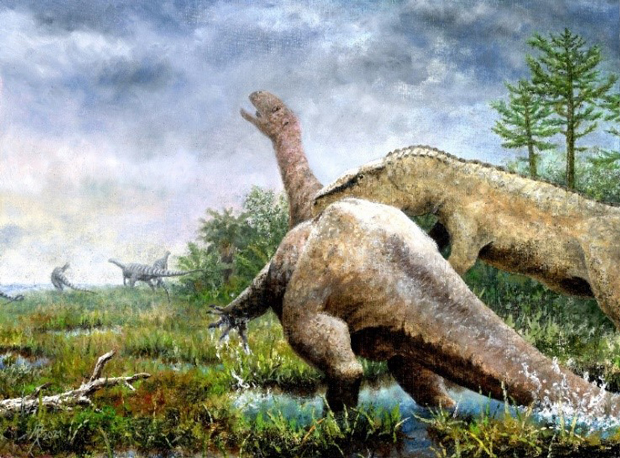
The large rauisuchian Teratosaurus (T. suevicus) is also known from the Trossingen Formation and in the image below an unfortunate Tuebingosaurus is being attacked by this six-metre-long, predator from the crocodilian lineage of the Archosauria.
Reconstruction how the death of Tuebingosaurus maierfritzorum may have occurred. Bones of the predatory archosaur Teratosaurus were also found in Trossingen. However, it has only been proven that Tuebingosaurus fell on its right side. Weathering indicates that the bones on the left side of the body probably lay for several years on the surface. Picture credit: Marcus Burkhardt.
Tuebingosaurus maierfritzorum
The individual bones of Tuebingosaurus maierfritzorum (pronounced Too-bin-go-sore-us my-ah-frits-zor-um), had been stored separately but have now been united in their own permanent display case. The genus name honours the university city of Tübingen and its inhabitants, whilst the specific name pays tribute to two German zoologists, Professor Wolfgang Maier from Tübingen and Professor Uwe Fritz from Senckenberg Natural History Collections in Dresden.
This new dinosaur species has now been described in the latest edition of the Senckenberg Natural Science Society’s journal Vertebrate Zoology, which also pays tribute to Wolfgang Maier on his 80th birthday.
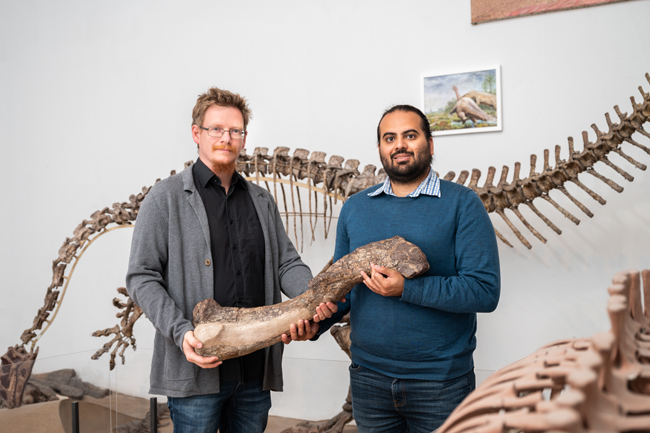
Researchers Ingmar Werneburg (left) and Omar Rafael Regalado Fernandez (right) hold a femur from Tuebingosaurus maierfritzorum. Picture credit: Valentin Marquardt/Universität Tübingen.
Everything Dinosaur acknowledges the assistance of a media release from the University of Tübingen in the compilation of this article.
The scientific paper: “A new massopodan sauropodomorph from Trossingen Formation (Germany) hidden as ‘Plateosaurus’ for 100 years in the historical Tübingen collection” by Omar Rafael Regalado Fernández, Ingmar Werneburg published in Vertebrate Zoology.
The new for 2022 CollectA Deluxe 1:40 scale Triceratops horridus dinosaur model is now in stock at Everything Dinosaur. This dinosaur scale model is based on the most complete T. horridus fossil specimen known to science. The fossils, excavated from Hell Creek Formation deposits in Montana (USA), are now part of a major, permanent dinosaur exhibition at Melbourne Museum (Victoria, Australia).
The CollectA Deluxe 1:40 scale Triceratops horridus is the last of the new for 2022 figures to arrive at Everything Dinosaur and continues a recent trend to have new CollectA figures named after a specific species and not a genus.
Another new for 2022 figure, the pterosaur model Pteranodon sternbergi, which came into stock at Everything Dinosaur a few months ago, also represents a distinct species. This model was introduced in this format to distinguish it from the Pteranodon (P. longiceps) in 1:15 scale.
The new for 2022 CollectA Pteranodon sternbergi model. A very colourful replica of a Late Cretaceous pterosaur sometimes referred to as Geosternbergia. This pterosaur figures continues the CollectA trend to introduce new figures based on a named species within a genus.
Accurately Depicting the Head and Neck of a Triceratops
The exhibit at Melbourne Museum is entitled “Triceratops: Fate of the Dinosaurs” and the Triceratops skeleton upon which this exhibition is based has been appropriately nicknamed “Horridus”. The design team at CollectA were able to use the fossilised skull of this dinosaur to help them accurately depict the head and the neck shield of this iconic ceratopsian.
The skull and neck frill of “Horridus” are the most complete of any known Triceratops specimen (more than 99% complete) and the assembled frill measures nearly 1.5 metres wide.
A close-up view of the striking colouration on the head and neck shield of the new for 2022 CollectA Triceratops horridus dinosaur model. Picture credit: Everything Dinosaur.
An Articulated Lower Jaw
A spokesperson from Everything Dinosaur confirmed that this new CollectA figure had an articulated lower jaw. The jaw can be a little stiff and it does not open very wide. To ease the jaw, the head can be dipped into hot water for 2-3 seconds to help ease the movement of this articulated component of the model.
The CollectA T. horridus ceratopsian figure in right lateral view. This Triceratops dinosaur model has an articulated lower jaw. Picture credit: Everything Dinosaur.
The spokesperson from Everything Dinosaur added:
“The Triceratops horridus figure was one of the dinosaurs designed by the late Anthony Beeson. Anthony had explained to Everything Dinosaur how keen he was to create an updated Triceratops, a figure with skin texture reminiscent of recent fossil discoveries. He was very excited at the possibility of combining the evidence, on T. horridus skin texture, some of which remains unpublished, with the new anatomical details revealed by the Melbourne Museum specimen.”
The new for 2022 CollectA T. horridus dinosaur model in 1:40 scale (anterior view). Picture credit: Everything Dinosaur.
To view the large range of CollectA prehistoric animal scale models available from Everything Dinosaur including horned dinosaur models: CollectA Deluxe Prehistoric Life Figures.