All about dinosaurs, fossils and prehistoric animals by Everything Dinosaur team members.

Dinosaur and prehistoric animal themed articles, features and stories.

29 05, 2023

The New PNSO Meraxes Model Reviewed

By |2024-01-02T20:10:29+00:00May 29th, 2023|Categories: Adobe CS5, Dinosaur Fans, Everything Dinosaur Products, Main Page, Product Reviews|0 Comments

Dinosaur fan and model collector William sent into Everything Dinosaur his review of the recently introduced PNSO Meraxes model. William began his review by highlighting how quickly PNSO have produced a replica of Meraxes. This dinosaur was only named and scientifically described last year (2022).

He explained that collectors can never have enough PNSO theropods in their collections. The head sculpt was praised for its scientific accuracy. The well-defined lacrimal crests and the nasal ridge were commented upon. The model has an articulated lower jaw. When the mouth is opened the characteristic “shark-like” teeth of the theropod can be seen.
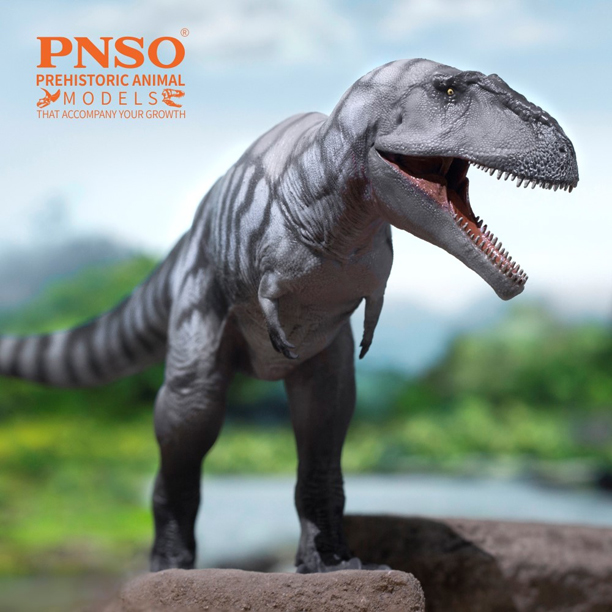
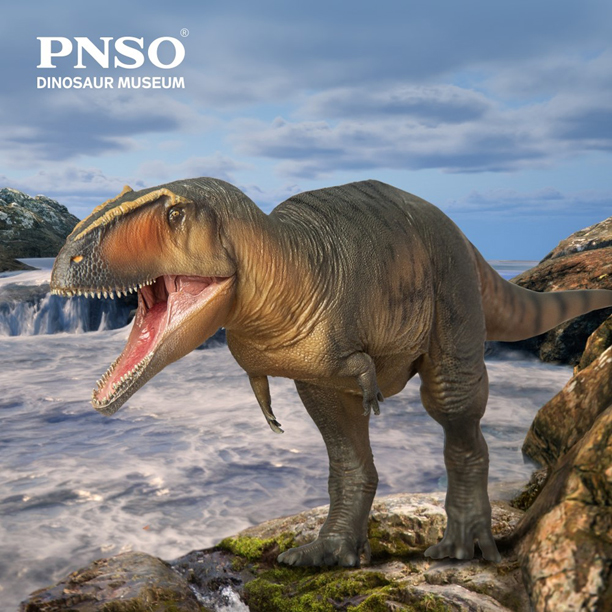
Meraxes dinosaur model (PNSO)
The carcharodontosaurid from the Late Cretaceous of Argentina Meraxes gigas. The PNSO model is in stock at Everything Dinosaur in the spring (2023).

To read Everything Dinosaur’s article about the discovery of Meraxes gigas: Meraxes gigas A New Giant Carcharodontosaurid from Argentina.

The PNSO Meraxes Model

The reviewer states that the body sculpt is highly accurate and reflects what is known about this predator from the holotype fossil material. The figure has a muscular neck, a strong body and a powerful tail. He comments that members of the Carcharodontosauridae family tended to have very similar body shapes.

William explains:

“From start to finish all areas are detailed to the highest degree. No blank spots on the PNSO Meraxes model, there is even a cloaca.”

When reviewing the dinosaur’s limbs, the reviewer outlines the evolutionary path of these giant theropods. Reference is made to an earlier PNSO model review (Giganotosaurus 2.0). The small, highly detailed muscled forearms and the hands are well armed with the three fingered hand retaining powerful claws.

The reviewer comments that a new unique feature of “Mungo” are the pair of ankle spur claws that may have been used in intraspecific combat.
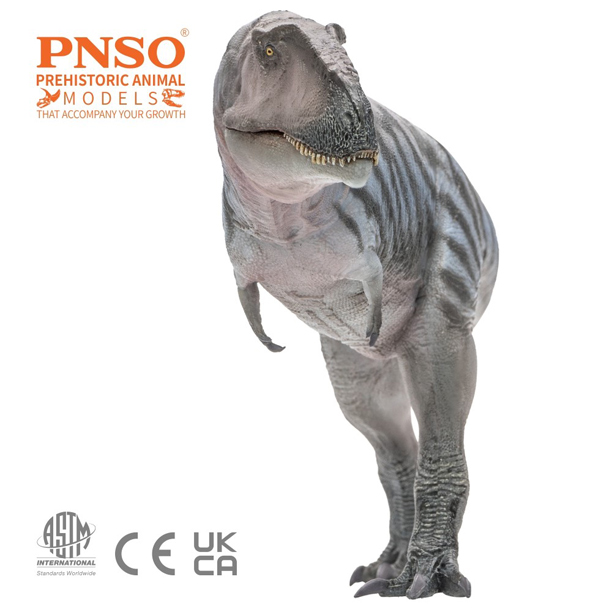
PNSO Mungo the Meraxes
The new for 2023 PNSO Mungo the Meraxes dinosaur model, which will be available shortly from Everything Dinosaur.

The Dinosaur Model’s Colour Scheme

The main body colour is described as a mixture of stunning silver which phases into a silvery-blue. There is a rose tint added to the face, head, neck and jaw area. The charcoal stripes have been executed with careful consideration. The stripes on the tail are reminiscent of those seen on extant tigers.

William comments that the model measures around 11.9 inches long. The head height is 4.1 inches and the declared scale 1:35.

As with previous model reviews, William confirms that the PNSO Meraxes model is supplied with a transparent support stand, full-colour booklet and a poster.

To view the range of PNSO prehistoric animal figures available from Everything Dinosaur: Age of Dinosaurs PNSO Models.
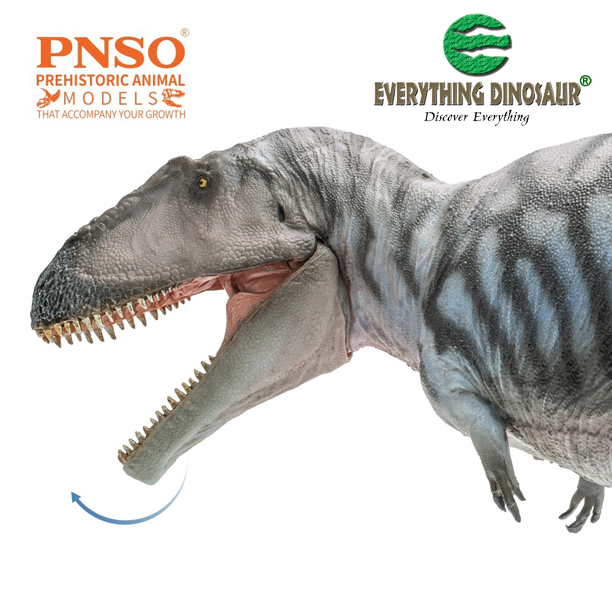
PNSO Mungo the Meraxes with an articulated jaw.
The Meraxes model will have an articulated lower jaw.

Meraxes gigas

William also sent in some information about this dinosaur’s fossils and their discovery.

Time Period: Late Cretaceous 95–93.9 million years ago (Cenomanian stage).

Location: Argentina Province of Mendoza in the western central of the Cuyo region.

Discovery: Meraxes’s holotype the “Campanas carcharodontosaurid” was found in 2012. It is the most complete carcharodontosaurid skeleton ever unearthed. The skull material permitted scientists to better understand the skull morphology of other carcharodontosaurids including Giganotosaurus and Mapusaurus.

The name Meraxes is derived from the name of a great, grey, female dragon from the fantasy book series, “A Song of Ice and Fire” by George R. R. Martin. William speculated whether the colour scheme chosen for the PNSO figure had been influenced by this book.

Classification:

Order: Theropoda.

Superfamily: Allosauroidea.

Clade: Carcharodontosauria.

Family: Carcharodontosauridae.

Subfamily: Giganotosaurini.

Genus: Meraxes.

Species: M. gigas.

William commented that this dinosaur has been estimated to have been around 33 feet long, with a head height of 9 feet. It weighed approximately 4.26 tonnes.

In concluding his review William declared:

“Meraxes is the second of three recent Carcharodontosauridae releases by PNSO. “Mungo” alone is spectacular by himself from his sculpt to paint application, to the spurs on his heels. No soul can say he is a toy, he is a museum display piece or teaching aid demonstrating what a theropod should be.”

William added:

“Purchasing from Everything Dinosaur is fast, safe and secure with no nonsense.”

Visit the award-winning Everything Dinosaur website: Everything Dinosaur.

28 05, 2023

New Nanmu Studio Giganotosaurus Dinosaur Models

By |2024-01-02T20:14:44+00:00May 28th, 2023|Categories: Adobe CS5, Dinosaur Fans, Everything Dinosaur News and Updates, Everything Dinosaur Newsletters, Everything Dinosaur Products, Main Page, Press Releases|0 Comments

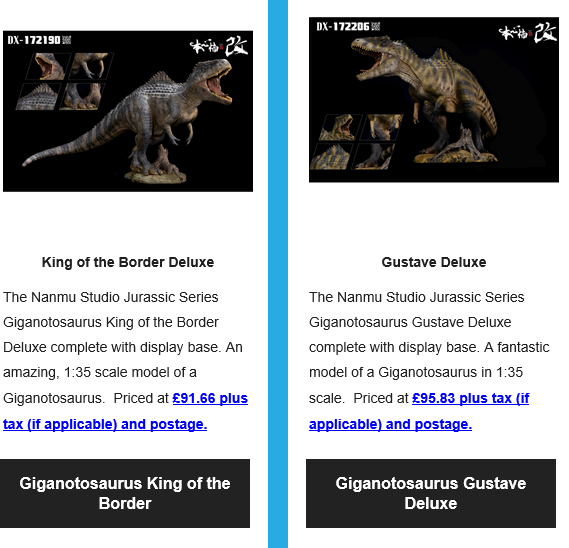
The Nanmu Studio Jurassic Series Giganotosaurus dinosaur models have arrived in stock at Everything Dinosaur. These three exciting dinosaur figures feature in the latest Everything Dinosaur company newsletter. The dinosaur replicas are named “Gustave”, “Typhon” and “King of the Border”. They pay tribute to the Giganotosaurus featured in the film “Jurassic World Dominion”.

Giganotosaurus dinosaur models.
The Nanmu Studio Jurassic Series Giganotosaurus Typhon Deluxe model complete with display base. Picture credit: Everything Dinosaur.

Picture credit: Everything Dinosaur

Jurassic Series Giganotosaurus Dinosaur Models

The headline model in the latest Everything Dinosaur newsletter is the Nanmu Studio Jurassic Series Giganotosaurus Typhon Deluxe figure. This beautifully detailed figure comes complete with a display base and an Everything Dinosaur fact sheet.

To request to subscribe to Everything Dinosaur’s free newsletter: Email Everything Dinosaur.

Each of the Giganotosaurus dinosaur models measures 44 cm in length approximately. When secured to their display base the models have a head height of 18.5 centimetres. The dinosaur model display base (supplied with each figure), measures 14 cm x 8 cm.

Gustave and King of the Border

The latest Everything Dinosaur customer newsletter also features Gustave and King of the Border. Everything Dinosaur offers three new Nanmu Studio Giganotosaurus figures.

Giganotosaurus dinosaur models.
The Nanmu Studio Jurassic Series Giganotosaurus King of the Border Deluxe (left). The Nanmu Studio Jurassic Series Giganotosaurus Gustave Deluxe (right). Picture credit: Everything Dinosaur.

Picture credit: Everything Dinosaur

A spokesperson for the UK-based mail order company commented:

“We are delighted to have brought into stock these three figures. Each Giganotosaurus dinosaur model is beautifully painted. We decided to only bring the models that included display bases out of China. These figures are large and heavy, when displayed without the base they might fall over and get damaged.”

To view the range of Nanmu Studio prehistoric animal models in stock at Everything Dinosaur: Nanmu Studio Giganotosaurus Dinosaur Models and Prehistoric Animal Figures.

27 05, 2023

Illustrating The Amazing”Prehistoric Planet” Animals

By |2024-01-02T20:15:14+00:00May 27th, 2023|Categories: Dinosaur and Prehistoric Animal Drawings, Dinosaur Fans, Main Page, Press Releases|0 Comments

The second series of “Prehistoric Planet” has recently concluded, the last episode “North America” having been broadcast yesterday on Apple+TV. The programmes have proved to be immensely popular with dinosaur fans and natural history film viewers. The five episodes in the series have achieved an audience rating of 100% on Rotten Tomatoes.

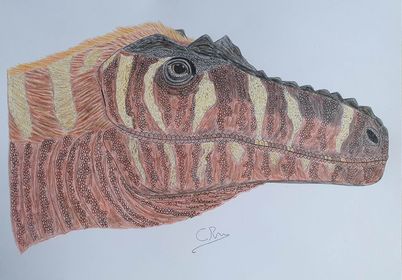
The programmes have also inspired lots of prehistoric animal fans to create drawings of the dinosaurs featured. For example, young artist Caldey sent in a magnificent illustration of a Qianzhousaurus concentrating intently as it hunted prey.

Theropod dinosaur drawn by Caldey.
A beautiful illustration of a theropod dinosaur stalking prey. Picture credit: Caldey.

Picture credit: Caldey

“Prehistoric Planet” Qianzhousaurus and Corythoraptor

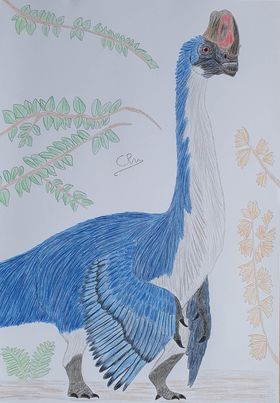
In a beautifully crafted scene, a female Qianzhousaurus stalks a flock of Corythoraptors in a Late Cretaceous forest. The first hunt is unsuccessful and the Corythoraptors escape. However, with the approach of a storm, the odds turn in the favour of the hunter and this clever theropod is able to catch her quarry.

Feathered dinosaur illustration (Caldey).
A beautiful illustration showing the diversity of theropod dinosaurs. Picture credit: Caldey.

Picture credit: Caldey

Qianzhousaurus although a Late Cretaceous tyrannosaur, was not closely related to Tyrannosaurus rex. It has been classified as a member of the Alioramini tribe of long-snouted tyrannosaurs within the Tyrannosauridae. Corythoraptor is an oviraptorid. Oviraptorids seem to have been particularly abundant in the Late Cretaceous of China.

To view models and replicas of Qianzhousaurus and other Asian dinosaurs: PNSO Dinosaur Models and Figures.

“Prehistoric Planet” has continued to delight, entertain and inform.

A spokesperson from Everything Dinosaur commented:

“Thank you Caldey for sending in your stunning illustrations. We hope you enjoyed watching the five television programmes. We have printed out the drawings and put them on display in our office and warehouse.”

Visit Everything Dinosaur’s website: Everything Dinosaur.

26 05, 2023

Diapsid Fossil Teeth Provide New Information on Ecosystem Recovery

By |2023-07-06T11:11:42+01:00May 26th, 2023|Categories: Dinosaur and Prehistoric Animal News Stories, Dinosaur Fans, Main Page, Palaeontological articles|0 Comments

A new study examining diapsid fossil teeth from Lower Triassic sediments in South Africa has provided further evidence of the recovery of terrestrial ecosystems after the end-Permian mass extinction event. The research highlights the growing diversity of archosauromorphs following the extinction of parareptiles and therapsids.

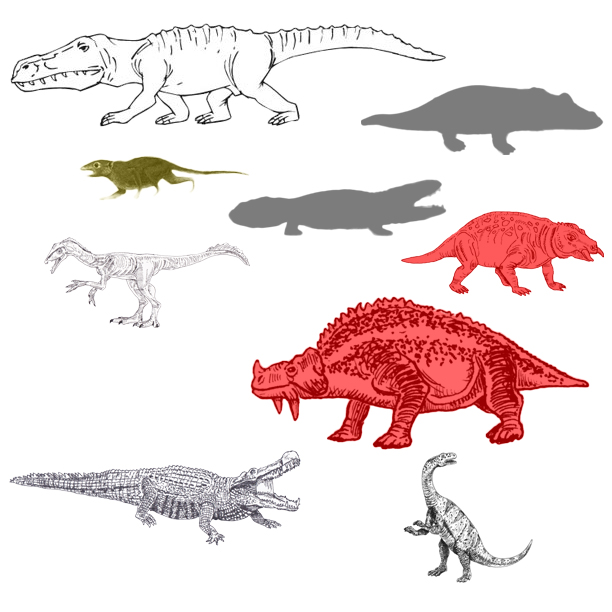
Diapsid fossil teeth study sees rise of Archosauromorpha in southern Africa.
Diapsid fossil teeth study sees rise of the Archosauromorpha in southern Africa. Temnospondyls (grey), archosauromorphs (monochrome), early mammals (yellow) and extinct therapsids (red). Picture credit: Everything Dinosaur.

For models and replicas of Permian and Triassic prehistoric animals: CollectA Deluxe Prehistoric Animal Figures.

Picture credit: Everything Dinosaur

Fossil Diapsid Teeth Study

The research team collected teeth from the Driefontein locality in Free State Province, South Africa. The strata represent Lower Triassic deposits (late Olenekian stage). The rocks are part of the Burgersdorp Formation and form part of the Karoo Basin, which provides an extensive geological record, crucially deposition that occurred before and after the end-Permian extinction event.

A total of 102 teeth were collected. The scientists identified 81 diapsid teeth with the remaining teeth classified as coming from temnospondyls. Analysis of the tooth morphology demonstrated that there was a greater diversity of archosauromorphs and other diapsids.

This research suggests that diapsids, especially archosauromorphs benefitted from the mass extinction event. They played an important role in the recovery of terrestrial ecosystems. Archosauromorphs filled many of the niches left vacant after the extinction of therapsids and anapsid reptiles.

Prehistoric life in South Africa
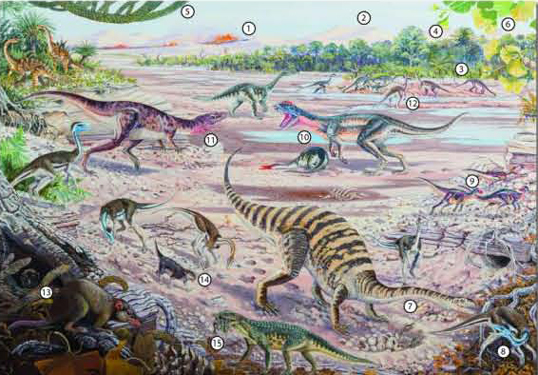
The prehistoric life of South Africa. The image shows the diverse flora and fauna that had evolved in South Africa by the Early Jurassic (Hettangian faunal stage). Archosaurs dominated terrestrial ecosystems but shared these habitats with other diapsids and early mammals. Picture credit: The Evolutionary Studies Institute (The University of Witwatersrand).

For an explanation of the fauna and flora depicted in the image (above): Celebrating the Rise of South African Dinosaurs.

The Rise of the Dinosauria

The fossil teeth from Driefontein provide palaeontologists with an important window into how terrestrial ecosystems recovered. The largest mass extinction recorded in the Phanerozoic occurred approximately 252 million years ago. The end-Permian mass extinction event devastated both marine and terrestrial ecosystems. The Karoo Basin may yield further evidence to help palaeontologists to better understand how life bounced back from the mass extinction event. It may also help scientists to understand how the Archosauromorpha were able to gain an evolutionary advantage over other tetrapods. This may have ultimately helped the Dinosauria and their close relatives to dominate terrestrial habitats.

The scientific paper: “A diverse diapsid tooth assemblage from the Early Triassic (Driefontein locality, South Africa) records the recovery of diapsids following the end-Permian mass extinction” by Devin K. Hoffman, John P. Hancox and Sterling J. Nesbitt published in Plos One.

Visit Everything Dinosaur’s award-winning website: Visit Everything Dinosaur.

23 05, 2023

Popular Papo Running T. rex Model Spotted at Museum

By |2024-01-02T06:47:49+00:00May 23rd, 2023|Categories: Adobe CS5, Dinosaur Fans, Everything Dinosaur Products, Main Page, Photos of Everything Dinosaur Products|0 Comments

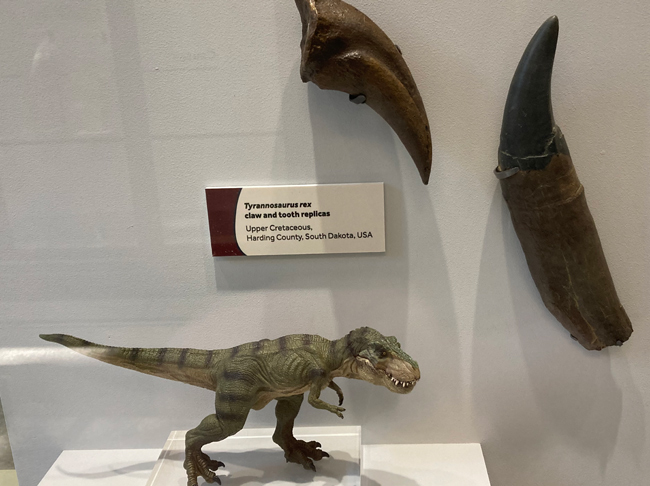
The Papo running T. rex dinosaur model was spotted by a sharp-eyed team member of Everything Dinosaur whilst on a visit to a local museum. The popular Papo dinosaur figure was in a display case next to a replica claw and a replica tooth of a Tyrannosaurus rex. The Papo running T. rex model was helping museum visitors to get an impression of what this huge theropod might have looked like.

Papo running T. rex
A Papo green running Tyrannosaurus rex model on display next to a replica of a T. rex tooth and a T. rex claw. An exhibit at the Manchester Museum. Picture credit: Everything Dinosaur.

Picture credit: Everything Dinosaur

The model in the display case is not a scale dinosaur model. It does help to demonstrate the size of the claw and the T. rex tooth. This Papo running T. rex figure measures 33 centimetres long.

The Papo Running T. rex Dinosaur Model

The Papo running T. rex dinosaur model was introduced into the Papo “Les Dinosaures” range in 2012. Since its introduction, it has sold well and been a firm favourite amongst model collectors. It is one of several T. rex models in the Papo range.

A brown coloured version was also introduced. This was a limited-edition figure. The limited-edition figure was withdrawn from sale after a few months. Everything Dinosaur lobbied Papo and the model was re-introduced. The brown running T. rex figure is available from Everything Dinosaur.

To view the Everything Dinosaur YouTube video review of the Papo running T. rex: Papo Green running T. rex YouTube Video Review.

Dinosaur Models in Museums

A spokesperson from Everything Dinosaur commented that whilst the Papo figure may not be the most accurate figure of a T. rex, the model helps to contextualise the museum display.

Children seeing the familiar dinosaur model in a museum display can make the link between the toys that they play with and the actual animals that the model represents.

The spokesperson added:

“Children were excited to see the T. rex exhibit. Many also recognised the Papo dinosaur model. Hopefully, they can make a connection between toys and fossils.”

To view the Papo “Les Dinosaures” range at Everything Dinosaur: Papo Dinosaurs and Prehistoric Animal Models.

21 05, 2023

The New PNSO Giganotosaurus 2.0 Reviewed

By |2024-01-02T20:16:18+00:00May 21st, 2023|Categories: Adobe CS5, Dinosaur Fans, Everything Dinosaur Products, Main Page, Product Reviews|0 Comments

Our thanks to dinosaur fan and model collector William who sent into Everything Dinosaur his review of the new 2.0 PNSO Giganotosaurus figure. The reviewer commented that the head sculpt of this new PNSO theropod had been influenced by recent carcharodontosaurid research.

The detailing around the eyes and the ridges on the naris are praised.

PNSO Lucas the Giganotosaurus dinosaur model (new for 2023).
The new PNSO Lucas the Giganotosaurus dinosaur model.

PNSO Giganotosaurus 2.0

The deep set of the nostrils and skull shape is commented upon. When the articulated jaw is opened, rows of sharp teeth are displayed.

William comments:

“The PNSO Giganotosaurus is the most accurate Giganotosaurus carolinii head sculpt created to date.”

The reviewer states that dinosaur fans have a true Giganotosaurus standing before them when the model is unpacked. It has powerful neck muscles, a broad, strong back and a muscular tail. A wealth of varied folds and scales cover the model’s main torso.

“From top to bottom no area goes unloved. All is covered in the details never missed by PNSO and the figure has a cloaca.”

Giganotosaurus Limbs

The arms end in hands with fearsome claws. The middle digit is slightly larger than the other two. The hindlimbs are robust and powerful. The left foot is slightly raised as if this dinosaur was captured in mid stride. The reviewer comments on the colour scheme chosen for the model. He praises the subtle application of ochre around the snout. The orange eye is almost watching you. The fudge brown of the lacrimal crest and nasal ridges draws the eye towards the head.

PNSO Giganotosaurus dinosaur model.
The PNSO Giganotosaurus dinosaur model in stock at Everything Dinosaur in the spring (2023).

The Model Measurements

As with previous reviews, William provides the model’s measurements.

Scale = 1:35 with a length of 14 inches and a head height of approximately 3.5 inches. He explains that the figure is supplied with a clear, support stand. The Giganotosaurus box contains a full-colour booklet and dinosaur posters.

Time Period: Late Cretaceous 99.6–95 million years ago (Cenomanian).

Location: Argentina, Patagonia, Villa El Chocón, in the Neuquén Province.

The Science Behind the PNSO Giganotosaurus

Just ten years after the discovery of the fossils of Baryonyx walkeri, once again good fortune led to the discovery of another theropod dinosaur. Rubén D. Carolini was cruising the Villa El Chocón Badlands when he spotted a dinosaur bone (tibia). He contacted professional palaeontologists and at the 1994 meeting of the Society of Vertebrate Paleontology, Giganotosaurus was introduced to the world.

Giganotosaurus carolinii means Carolini’s giant southern lizard and the first illustration was created by renowned artist James Gurney. After viewing photos taken at the fossil site of the holotype, the team was offered funding to recover the specimen by Don Lessem. The team recovered 70% of the holotype skeleton which is now preserved and exhibited in the Ernesto Bachmann Paleontological Museum in Villa El Chocón.

To view the PNSO product range available from Everything Dinosaur: PNSO Age of Dinosaurs Figures and Models.

Lucas the Giganotosaurus has an articulated lower jaw.

Theropod Classification

As part of his review William provided information on this dinosaur’s taxonomy.

Order: Theropoda

Superfamily: Allosauroidea

Clade: Carcharodontosauria

Family: Carcharodontosauridae

Tribe: Giganotosaurini

Genus: Giganotosaurus

Species: G. carolinii

William explained that palaeontologists estimate the length of this dinosaur at around 43 feet. It may have weighed in excess of 13 tons. It was the apex predator in the ecosystem. Giganotosaurus may have hunted titanosaurs. Perhaps packs of these carnivores mobbed large titanosaurs, or perhaps hunting tactics were more co-ordinated. Our thanks to William for providing some suggestions as to the hunting tactics employed by these super-sized predators.

The reviewer concluded by praising Everything Dinosaur and the manufacturer stating that PNSO had created a most accurate version of Giganotosaurus. He commented on the other theropod dinosaurs that PNSO had recently introduced and suggested that a Concavenator model should be included in the range.

William added:

“My thanks to all the team at Everything Dinosaur. Praise where praise is due to Everything Dinosaur. A Giga thank you to you all for your hard work now and in the future. With Everything Dinosaur, we are given a great choice of delivery options, and all are fairly priced.”

Our thanks to William for sending into Everything Dinosaur his comprehensive PNSO Giganotosaurus 2.0 model review.

Visit Everything Dinosaur’s award-winning website: Everything Dinosaur.
20 05, 2023

“April” the Tenontosaurus Dinosaur Fossil on Display

By |2023-05-28T06:52:42+01:00May 20th, 2023|Categories: Dinosaur Fans, Main Page, Photos/Pictures of Fossils|0 Comments

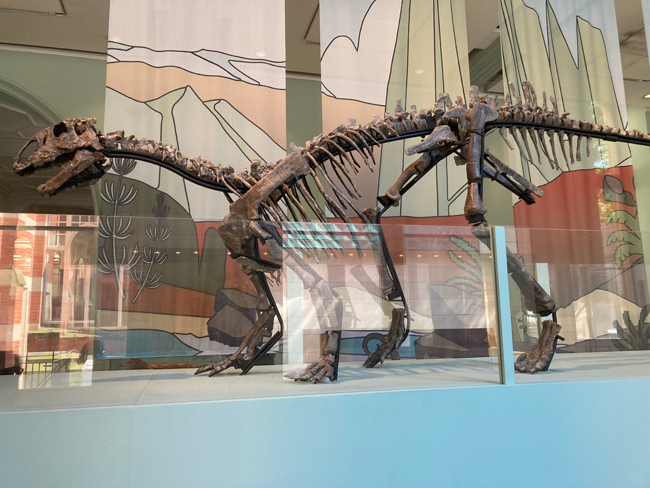
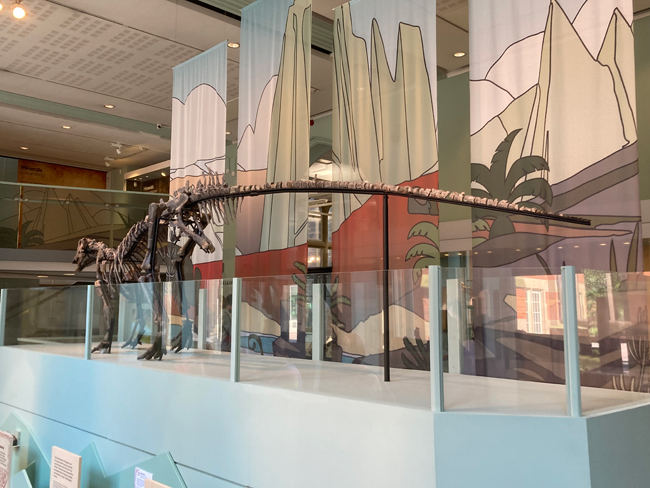
Everything Dinosaur took a break from picking and packing orders to visit the recently refurbished Manchester Museum. One of the new exhibits is “April” the Tenontosaurus dinosaur fossil. The display includes actual fossil bones of a Tenontosaurus, and the exhibit depicts this ornithischian dinosaur as a quadruped.

Tenontosaurus dinosaur fossil on display at the Manchester Museum.
“April” the Tenontosaurus on display at the Manchester Museum. Picture credit: Everything Dinosaur.

Picture credit: Everything Dinosaur

An Important Dinosaur Fossil Specimen

The fossils were discovered on private land in Montana, USA back in 1994 and acquired by the University of Manchester in 1999. The fossils (specimen number MANCH LL.12275) represent one of the best-preserved and most complete Tenontosaurus tilletti known to science. The specimen was originally displayed as a biped. The dinosaur was posed rearing up on its hind legs. During the conservation work to prepare the fossils for display, researchers demonstrated that this dinosaur spent most of its time walking on all fours.

It was named “April” after the wife of Barry James who originally prepared this stunning fossil dinosaur for exhibition.

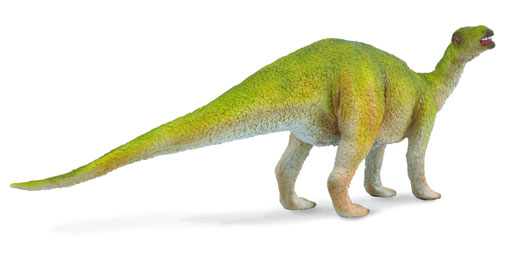
CollectA Tenontosaurus model.
The CollectA Age of Dinosaurs Tenontosaurus model.

The picture (above) shows a CollectA Tenontosaurus dinosaur model. To view the range of CollectA not-to-scale prehistoric animal models: CollectA Prehistoric Life Models.

Gastroliths

Gastroliths (stomach stones) were found in the body cavity of this dinosaur. Some types of dinosaur swallowed stones to help them grind up tough plants and aid digestion. These stones were held in a gizzard and helped to break down plant-material and assisted in the extraction of nutrients.

Only a handful of examples of gastroliths being associated with ornithopods have been reported. “April” the Tenontosaurus is the largest ornithopod dinosaur known to science associated with gastroliths.

To read about recent research on this important iguanodontian specimen: “April” the Tenontosaurus Reveals Her Secrets.

Tenontosaurus Dinosaur Fossil

“April” the Tenontosaurus dinosaur fossil has been granted her own special display area. There are plenty of information panels informing visitors about the dinosaur and highlighting important areas of research. The gastroliths are on display too. It is only when visitors get close to the fossils that they can appreciate the impressive length of the dinosaur’s tail.

Whilst the dinosaur might be nicknamed “April”, Everything Dinosaur team members are uncertain as to whether there has been any research to identify whether the bones do indeed represent a female.

A Tenontosaurus dinosaur fossil on display.
The length of the tail of Tenontosaurus can be appreciated. The Tenontosaurus known as “April” exhibited at the Manchester Museum. Picture credit: Everything Dinosaur.

Picture credit: Everything Dinosaur

A spokesperson from Everything Dinosaur praised the Manchester Museum for its excellent Tenontosaurus dinosaur fossil display and commented on the friendliness of the staff.

Visit Everything Dinosaur’s award-winning website: Everything Dinosaur.
19 05, 2023

The Beautiful PNSO Basilosaurus Model is Retired

By |2024-01-02T20:16:42+00:00May 19th, 2023|Categories: Dinosaur and Prehistoric Animal Drawings, Dinosaur Fans, Everything Dinosaur News and Updates, Everything Dinosaur Products, Main Page, Press Releases|0 Comments

The PNSO Basilosaurus model, part of the PNSO Age of Dinosaurs range is to be retired. It was one of the first PNSO figures to be introduced, Everything Dinosaur can now confirm that it is out of production.

PNSO Age of Dinosaurs Basilosaurus replica. A PNSO Basilosaurus model.
The PNSO Age of Dinosaurs Basilosaurus model.

The PNSO Basilosaurus Model

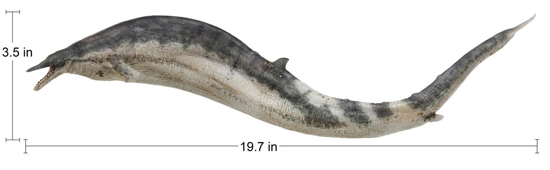
This large prehistoric whale figure was one of the first PNSO replicas to be supplied complete with transparent display stands. Measuring close to twenty inches in length (more than fifty centimetres long), this figure needed a lot of shelf space. Two species of Basilosaurus are known. Basilosaurus cetoides (the type species) was named by Sir Richard Owen (1839). A second species Basilosaurus isis was erected in 1904 (Andrews).

The PNSO Basilosaurus replica.
The Basilosaurus replica (PNSO). This replica is one of the first large figures to be made by PNSO.

A spokesperson from Everything Dinosaur commented:

“We are sorry to see the Basilosaurus retired. It was a fantastic figure of a Late Eocene prehistoric whale. PNSO have expanded their model range dramatically over recent years, model retirements are to be expected. PNSO will continue to add to their popular mid-size model range. We will announce a new PNSO figure in the very near future.”

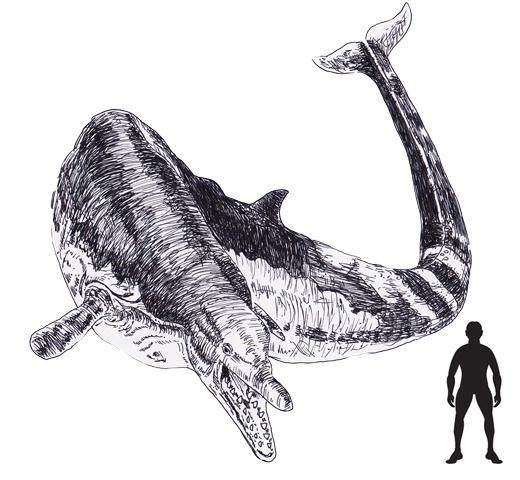
PNSO Basilosaurus illustration.
An illustration of Basilosaurus. The human figure provides a scale. Picture credit: Everything Dinosaur.

Picture credit: Everything Dinosaur

To view the PNSO Age of Dinosaurs figures in stock at Everything Dinosaur: PNSO Dinosaur and Prehistoric Animal Figures.

18 05, 2023

Terrific Tyrannosaur Illustration by Caldey

By |2024-01-02T06:48:05+00:00May 18th, 2023|Categories: Dinosaur and Prehistoric Animal Drawings, Dinosaur Fans, Main Page|0 Comments

Our thanks to young Caldey for sending into Everything Dinosaur a superb tyrannosaur illustration inspired by the theropod dinosaurs featured in the television series Prehistoric Planet II.

Following the pattern of the first season’s ground-breaking series, Prehistoric Planet II will be shown over five consecutive nights starting on May 22nd. It is being broadcast by Apple TV+. Season one covered Coasts, Deserts, Freshwater, Ice Worlds and Forests. The five programmes making up season two will feature Islands, Badlands, Swamps, Oceans and North America. Viewers can expect to see more prehistoric animals including pterosaurs, marine reptiles and of course dinosaurs. Perennial favourites return such as Velociraptor, Triceratops and tyrannosaurs, the subject of Caldey’s beautiful drawing.

Tyrannosaur illustration by Caldey
A wonderful illustration of a tyrannosaur from the Prehistoric Planet II trailer.

Tyrannosaur Illustration

A spokesperson from Everything Dinosaur thanked Caldey for sending in her drawing of a fearsome tyrannosaur and commented;

“Series one was nominated for several awards including the Television Critics Association award for Outstanding Achievement in News and Information. We expect series two to be equally successful, if not more so. Dinosaur fans young and old are looking forward to the start of the new series. Our thanks to Caldey for creating such a terrific tyrannosaur illustration.”

Narrated by Sir David Attenborough

All the programmes will be narrated by Sir David Attenborough. Season two will include a special segment on each programme providing an in-depth analysis of the palaeontology used as the basis for the episode. This new segment, entitled “Prehistoric Planet Uncovered”, will provide viewers with the opportunity to hear from the scientists who advised the production team.

Just like Caldey, we are looking forward to Prehistoric Planet II.

Visit Everything Dinosaur’s award-winning website: Everything Dinosaur.
16 05, 2023

A Spectacular Tyrannosaur Dentary

By |2024-01-02T20:18:37+00:00May 16th, 2023|Categories: Adobe CS5, Dinosaur Fans, Main Page, Photos/Pictures of Fossils|0 Comments

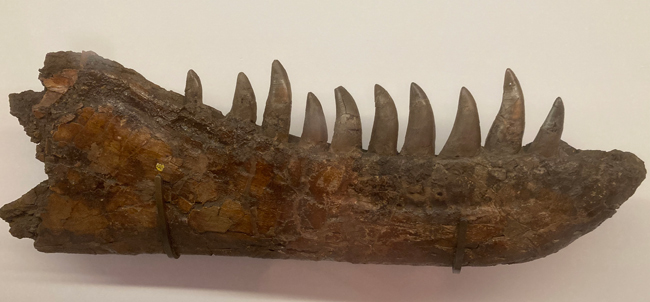
Dinosaur fans will know that there were many different tyrannosaur taxa. Whilst on a visit to a museum, an Everything Dinosaur team member spotted a tyrannosaur dentary. The theropod jawbone was located away from the Tyrannosaurus rex exhibit. The fossil represents a member of the Tyrannosauridae family. The fossil is from a Daspletosaurus. The accompanying information did not state the species.

Daspletosaurus dentary.
A Daspletosaurus dentary on display at a museum (Natural History Museum London). Picture credit: Everything Dinosaur.

Daspletosaurus

Daspletosaurus roamed western North America (Laramidia) during the Late Cretaceous (Campanian faunal stage). Several species have been assigned to this genus. The genus was erected in 1970 (D. torosus). Subsequently, other species have been assigned including Daspletosaurus horneri in 2017 and Daspletosaurus wilsoni (2022).

To read about the naming of Daspletosaurus horneri: New Species of Daspletosaurus Announced.

For an article on the recently described: Daspletosaurus wilsoni: New Daspletosaurus Species Named.

There remains some uncertainty as to the taxonomic position of several tyrannosaur specimens known from the Late Cretaceous of North America.

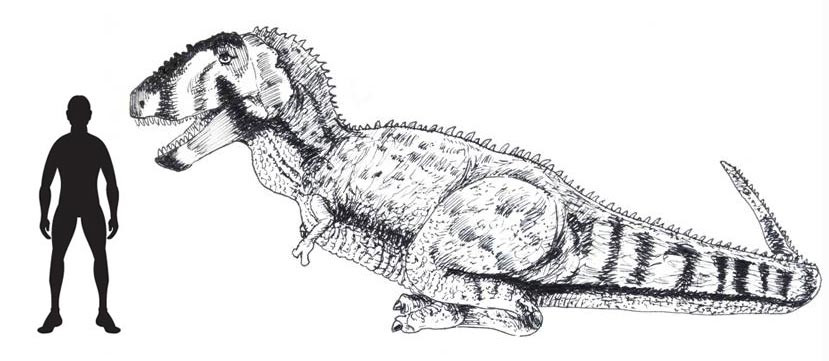
Drawing of Daspletosaurus.
Larger tyrannosaur present in the Late Cretaceous ecosystem. An illustration of Daspletosaurus. Picture credit: Everything Dinosaur.

Picture credit: Everything Dinosaur

The picture (above) depicts a Daspletosaurus based on the CollectA model. To view this range of models and figures: CollectA Age of Dinosaurs Prehistoric Animal Models.

The Tyrannosaur Dentary

The tyrannosaur jawbone (right dentary) depicts the typical D-shaped crowns associated with these theropods. A total of ten teeth can be viewed in the jawbone (buccal view). The buccal view shows the side of the jaw that is adjacent to the cheek.

Although Daspletosaurus was a large and powerful hunter, the lower jaw is less robust than the fossils associated with Tyrannosaurus rex.

A spokesperson from Everything Dinosaur commented:

“The dentary is in an exceptional state of preservation. Museum visitors could easily overlook this excellent tyrannosaur dentary. However, fossils such as these can tell palaeontologists a lot about the Daspletosaurus genus and theropod dinosaurs in general.”

Visit Everything Dinosaur’s award-winning website: Everything Dinosaur.
Go to Top