All about dinosaurs, fossils and prehistoric animals by Everything Dinosaur team members.

Fossil finds, new dinosaur discoveries, news and views from the world of palaeontology and other Earth sciences.

18 05, 2017

Time to Question Where Life on Earth Started

By |2023-07-22T21:36:40+01:00May 18th, 2017|Categories: Dinosaur and Prehistoric Animal News Stories, Geology, Main Page|0 Comments

Earliest Evidence for Microbial Life on Land

Fossils which reputedly show evidence of microbial life in hot springs have been found in Australian rocks that date from 3.48 billion years ago.  The hot spring deposits found in the Pilbara region of Western Australia, have pushed back by some 580 million years, the earliest known existence of micro-organisms living in terrestrial freshwater habitats, albeit, in a very inhospitable place.  This discovery has reignited the debate as to where the first life on planet Earth might have originated.

Tiny Bubbles Preserved in the Rocks Could Demonstrate Early Microbial Life in Hot Springs
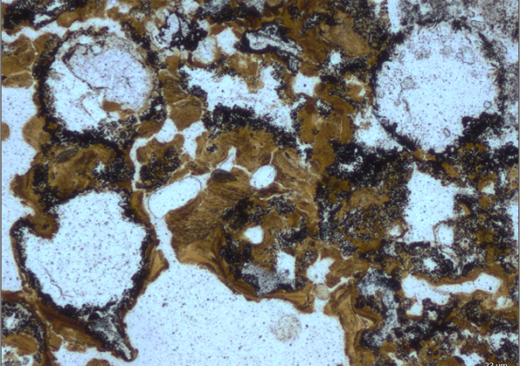
Evidence of early microbial life (Pilbara Craton).

Spherical bubbles preserved in 3.48 billion year old rocks in the Dresser Formation in the Pilbara Craton in Western Australia provide evidence for early life having lived in ancient hot springs on land.

Picture credit: University of New South Wales

The Remote Pilbara Region of Western Australia

The remote and very beautiful Pilbara region of Western Australia has exposures of extremely ancient sandstones, some of the oldest sedimentary rocks known.  These strata were formed in the Paleoarchean Era and it has been at the centre of research for evidence of micro-fossils and signs of very early life on Earth for a number of decades.  The Australian authorities are hoping to get UNESCO World Heritage status recognition for those parts of the Pilbara Craton that have provided evidence for very primitive, organic lifeforms.

To read an article from 2011 about micro-fossils preserved in Pilbara sandstones that indicate microbial life from 3.4 billion years ago: Are These the Oldest Fossils on Earth?

A Freshwater or a Marine Origin for Life on Earth?

The debate as to when life on Earth began has caused great controversy amongst scientists.  Resolving when the very first organisms evolved has proved extremely difficult, for example, back in the autumn of 2016, Everything Dinosaur published an article about an intriguing study of ancient Greenland rocks that might show evidence of microbial life, specifically stromatolites that existed in a shallow marine environment some 3.7 billion years ago.

For the article on the research on the Greenland rocks: 3.7 Billion-Year-Old Microbes?

What is equally as controversial, is where on Earth did life begin?

Writing in the academic journal “Nature Communications”, lead author, PhD student Tara Djokic (University of New South Wales) and her fellow researchers conclude that parts of the Pilbara Craton strata were formed from hot spring deposits and these rocks provide evidence that life may not have originated in a marine environment.

The Remote and Desolate Sandstone Ridges Represent Strata Formed Some 3.48 Billion Years Ago
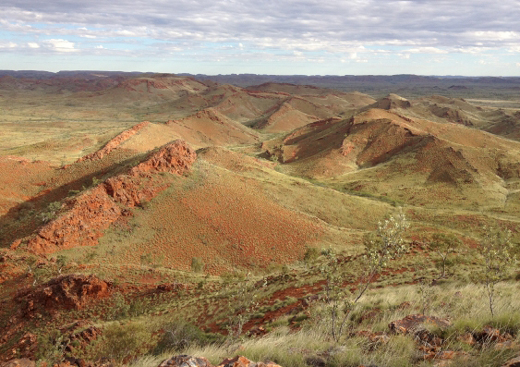
A view of the remote Dresser Formation, Pilbara Craton (Western Australia).

Ridges in the ancient Dresser Formation in the Pilbara Craton of Western Australia that preserve ancient stromatolites and hot spring deposits.

Picture credit: Kathleen Campbell

Extremophiles Living in Hot Springs (Microbial Life)

Scientists are aware that microbial life such as bacteria and those other prokaryotes – archaea are capable of surviving in very hostile environments.  The specialised archaea are often referred to as extremophiles as these organisms can tolerate and thrive in environments that would prove fatal to most other forms of life.  These extreme conditions include heat and high concentrations of noxious materials, the sort of conditions you can find in a geyser or hot spring.

Tara and her co-workers, which included Professors Martin Van Kranendonk, Malcolm Walter and Colin Ward (University of New South Wales) and Professor Kathleen Campbell (Auckland University), took samples from the ancient Dresser Formation in the Pilbara Craton and employed a variety of techniques to analyse their contents.  Microscopic sections of rock were prepared and a study of these samples led the team to conclude that they had found potential biological signatures and physical evidence of organic life preserved within the ancient strata.

Tara Djokic explained:

“Our exciting findings don’t just extend back the record of life living in hot springs by some three billion years, they indicate that life was inhabiting the land much earlier than previously thought, up to about 580 million years earlier.  This may have implications for an origin of life in freshwater hot springs on land, rather than the more widely discussed idea that life developed in the ocean and adapted to land later.”

Researchers Examining the Rocks
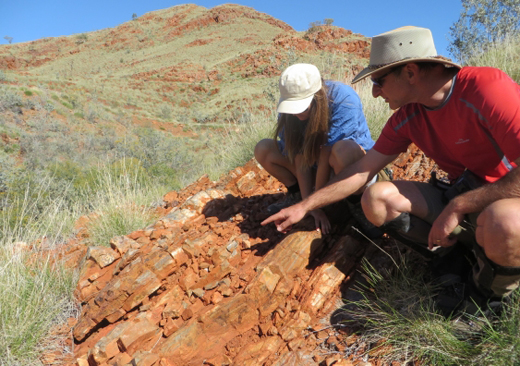
Looking for signs of ancient life in the Pilbara Craton.

Tara Djokic and Professor Martin Van Kranendonk in the Pilbara in Western Australia.

Picture credit: Kathleen Campbell

Charles Darwin’s “Warm Little Pond” – The Evolution of Microbial Life

Where life originated has taxed academics, religious leaders and philosophers for centuries.  There are several theories, for example, the first organisms could have come to Earth via a comet, meteorite or asteroid impact, or life could have evolved here on Earth, perhaps in the deep sea around hydrothermal vents.  Other scientists have argued that life as we know it began on land, in the extreme environments of hot springs and geysers – the “warm little pond” as Charles Darwin is believed to have indicated.

The Discovery of Geyserite
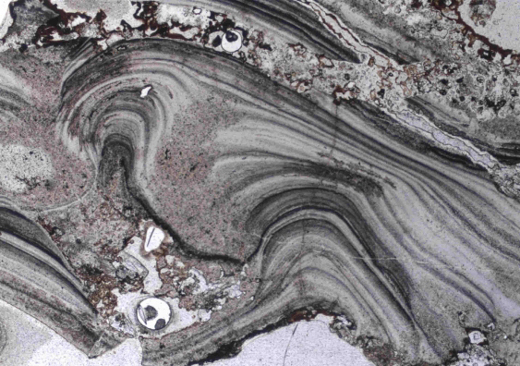
Evidence of geyseyrite in the Dresser Formation.

A microscopic image of geyserite textures from the ancient Dresser Formation in the Pilbara Craton in Western Australia. This shows that surface hot spring deposits once existed there 3.48 billion years ago.

Picture credit: The University of New South Wales

Evidence of Geyserite

Microscopic polished slices revealed the presence of the mineral geyserite in the Dresser Formation deposits.  Geyserite (a form of silica), is associated with mineral deposits formed from hot springs or geysers, if extremophiles can survive in these harsh habitats today, then it is possible that they could have survived in very similar conditions on the primordial Earth.

Doctorate student Tara Djokic commented:

“The discovery of potential biological signatures in these ancient hot springs in Western Australia provides a geological perspective that may lend weight to a land-based origin of life.”

Researchers Examining the Waters Surrounding Hydrothermal Vents in New Zealand
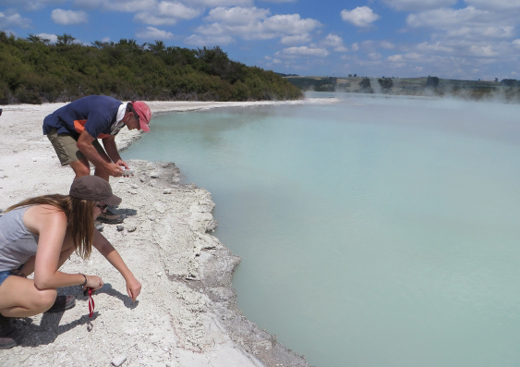
Looking for signs of life in a hot spring.

Researchers examining the hot waters surrounding the hydrothermal vents at Rotokawa (New Zealand).

Picture credit: Kathleen Campbell

Within the Pilbara hot spring deposits, the researchers also discovered stromatolites, layered rock structures created by communities of ancient microbes.  In addition, there were other signs of early life in the deposits, including fossilised micro-stromatolites, microbial palisade textures and well preserved bubbles that are inferred to have been trapped in sticky microbial slime to preserve the bubble shape.

Out of this World Implications – The Search for Life on Mars

The researchers comment that their work has major implications with the regards to the search for extra-terrestrial life, particularly the search for life on Mars.  The rocks that make up the Pilbara Craton are about the same age as much of the crust on the red planet.  Ancient hot spring deposits on Mars could be a good place to search for evidence of long-extinct life.

NASA is currently planning a news Mars Rover mission (due to launch in 2020), one of the potential landing sites for the Mars land vehicle is the Columbia Hills.  Previous Mars expeditions have identified silicates that could have been formed in the presence of hot water from a thermal vent.  If evidence of ancient life on Earth, preserved in strata formed in a hot spring environment can be found, then such life processes may well have come about on Mars too and some evidence might be preserved in the ancient Martian rocks.
17 05, 2017

“Winged Serpent” Found in Ancient Sinkhole

By |2023-07-22T21:26:53+01:00May 17th, 2017|Categories: Dinosaur and Prehistoric Animal News Stories, Main Page, Photos/Pictures of Fossils|0 Comments

Zilantophis schuberti –  A New Species of Snake from the Gray Fossil Site

A newly described species of prehistoric snake is helping herpetologists to better understand the evolution of modern snakes.  The new species, named Zilantophis schuberti is described in a scientific paper published this week in the “Journal of Herpetology”, it lived approximately five million years ago, a time when our planet’s global average temperature was rising.  Scientists hope that this new discovery will provide helpful information so that they can better understand the ways in which today’s fauna will adapt with the onset of global warming.

An Illustration of the Newly Described Snake – Zilantophis schuberti

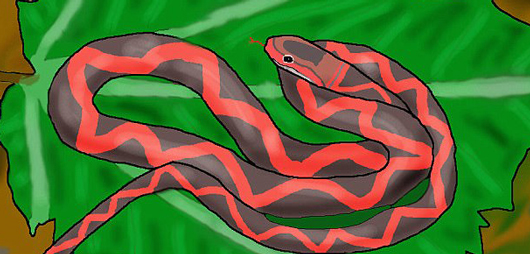
Zilantophis schuberti iIllustration.

A speculative drawing of the tiny snake – Zilantophis.

Picture credit: Steven Jasinski (University of Pennsylvania)

A Famous Fossil Site

Co-author of the paper, Steven Jasinski (PhD student at the University of Pennsylvania), explained that the fossils come from the famous Gray Fossil Site, close to East Tennessee State University, Jasinski and fellow author David Moscato (State Museum of Pennsylvania), report the discovery of highly modified, snake vertebrae, with wing-like struts, most probably to anchor strong back muscles.  The morphology (shape) of these bones do not match any living species of snake, it has been speculated that these snakes developed specialised vertebrae to help them push through compacted leaf litter as they hunted for insects and other small prey.  The specialised vertebrae may also have been an adaptation for digging or possibly swimming.  The idea that Zilantophis was aquatic is difficult to rule out.

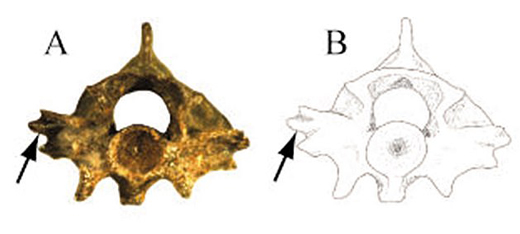
Photograph and Line Drawing of a Highly-Modified Vertebra

Zilantophis schuberti vertebra (A) and line drawing (B).

The arrow notes the location of wing-like projections that gave the species its name (Zilantophis schuberti).

Picture credit: Steven Jasinski (University of Pennsylvania)

PhD student Steven commented:

“Snakes don’t have arms or legs,but they have high numbers of vertebrae.  These are often the bones that palaeontologists use to identify fossil snakes.”

*Snakes and lizards belong to the Order Squamata, snakes evolved from limbed reptiles and recently Everything Dinosaur reported on the chance discovery of a 115-million-year-old fossil that provides evidence of the transition from reptiles with limbs to the serpentine form.

To read the article: First Fossil Snake with Four Limbs Described.

Named After a Mythical Creature

The genus name is derived from Zilant, a winged serpent from Tatar mythology.  The trivial name honours Blaine Schubert, the executive director of East Tennessee State’s Don Sundquist Centre of Excellence in Palaeontology, who acted as mentor and adviser to the authors whilst they studied there.  The ancient snake’s name translates as “Schubert’s winged snake”.

At only a few centimetres in length, Zilantophis was no monster, the tiny vertebrae had to be meticulously separated from the dark clay sediment of the Gray Fossil Site.  The researchers conclude that this Late Miocene/Early Pliocene snake is most closely related to rat snakes (Pantherophis) and kingsnakes (Lampropeltis), both of which are relatively common in North America today.  In total, the field team found evidence of seven different snake genera at the dig site, the descendants of which can still be found in east Tennessee today.

Field Team Members Working at the Sinkhole Dig Site

Field team staff exploring the Gray Fossil Site.

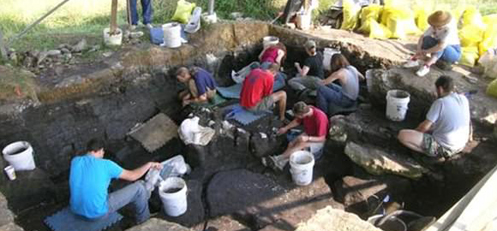
Field team members excavating the sinkhole (Gray Fossil Site).

Picture credit: Steven Jasinski (University of Pennsylvania)

Snake genera identified include:

  • Garter snakes (Thamnophis)
  • Rat snakes (Pantherophis)
  • Pine snakes (Pituophis)
  • Whip snakes (Masticophis)
  • Water snakes (Nerodia)

Zilantophis schuberti and all the snakes listed above, are members of the Colubridae snake family, the largest and most specious group of extant snakes.  The authors comment that the Late Miocene was seeing a transition in snake fauna.  Boas had dominated the serpentine fauna of North America, but gradually the boas went into decline and they were replaced by the colubrids, which are typically much smaller and more mobile than boas.  This faunal change coincided with extensive climate change, with forests being replaced by open prairies as a result of a drying climate.

Steven Jasinski explained:

“Zilantophis was part of this period of change.  It shows that colubrids were diversifying at this time, including forms that did not make it to the present day.”

The Importance of the Gray Fossil Site

The Gray Fossil Site, located close to the town of Gray in Washington County (Tennessee), represents deposits from a sinkhole that accumulated in the Late Miocene to the very Early Pliocene Epochs.  As the clay deposits straddle the Miocene/Pliocene boundary, the strata and the fossils contained therein have provided researchers with an opportunity to study changing biodiversity at a time when the Earth’s climate was undergoing rapid change.  Discovered seventeen years ago, during the construction of a road, the site represents the accumulated debris from the bottom of a large pond, that occasionally dried out.  A wide variety of vertebrate fossils have been excavated from the site, including several large mammals, transitional forms of the American alligator, turtles, snakes and amphibians.

Excavating the Skull of a Tapir from the Dig Site

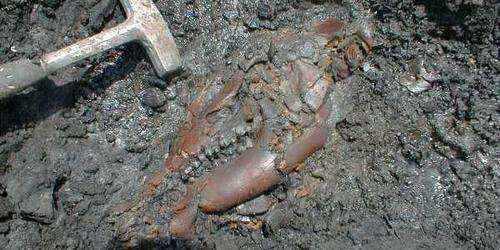
The skull of a Tapir (Gray Fossil Site).

A tapir skull from the Gray Fossil Site (eastern Tennessee).

Picture credit: University of Pennsylvania

The Gray Fossil Site, has yet to be fully explored but it has already provided a hugely important window into the changing environment of North America between 7 million years ago and 4.5 million years ago (approximately).  This new research represents the first formal survey of snake fossils at the location, the discovery of Zilantophis, which dates from the Hemphillian stage of the North American Land Mammal Ages (NALMA), is helping scientists to understand evolutionary change at a crucial time in the history of the fauna of North America, a time when modern animals and plants were becoming established.

13 05, 2017

Zuul – The Destroyer of Shins

By |2023-07-22T17:52:51+01:00May 13th, 2017|Categories: Dinosaur and Prehistoric Animal News Stories, Dinosaur Fans, Main Page, Photos/Pictures of Fossils|0 Comments

 Zuul crurivastator – A New Ankylosaurid from the Judith River Formation of Montana

Another day and another new dinosaur, this time an armoured dinosaur from the Coal Ridge Member of the Judith River Formation (Montana).  Researchers from the Royal Ontario Museum, describe Zuul crurivastator, pronounced Zoo-ul cruh-uh-vass-tate-or, in a paper published this week in the journal of the Royal Society.  The genus name honours a fictional monster from the 1984 movie “Ghostbusters”.  The research team, that includes Victoria Arbour and David Evans, were reminded of the monster “Zuul the Gatekeeper of Gozer”, when studying the dinosaur’s prominent horns and ridges on the exquisitely preserved skull.

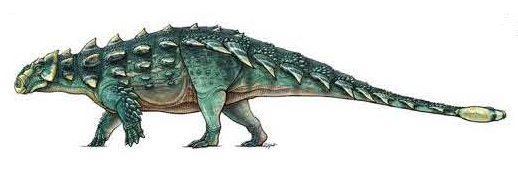
A Life Restoration of the Newly Described Late Cretaceous Ankylosaurid Zuul crurivastator

An ankylosaurid - Zuul crurivastator.

Life restoration of Zuul crurivastator (Danielle Dufault).

Picture credit: Danielle Dufault

The species name crurivastator means “destroyer of shins”, after the bony tail club, which on this specimen, was fifty-two centimetres long.  The club could inflict severe damage to the legs of any Theropod dinosaur aiming to make a meal out of Zuul.  The club may also have been used during intraspecific combat, with ankylosaurids fighting over territory or mates.

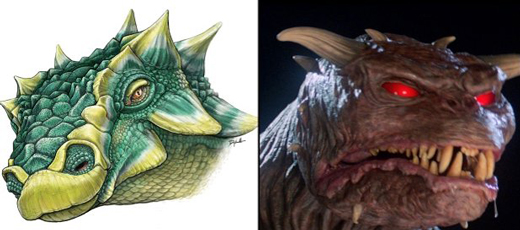
An Illustration of the Head of Z. crurivastator Compared to the Fictional Movie Character

Ghostbuster Zuul compared to the dinosaur.

Zuul compared to the Ghostbuster Figure (Zuul).

Picture credit: Danielle Dufault and CBS

Most Complete Ankylosaurid Specimen Found in North America

Entire, or very nearly entire fossilised skeletons are exceptionally rare.  This is the first ankylosaurid specimen with an almost full set of skull bones to be found, it also has a virtually intact tail club.  Z. crurivastator represents the most complete ankylosaurid found to date in the whole of North America.

The fossil material (ROM 75860) was discovered by chance during the removal of overburden as a field team excavated the remains of a tyrannosaurid.  This six-metre-long armoured dinosaur is believed to lived between 76.2 and 75.2 million years ago (Campanian faunal stage of the Late Cretaceous.

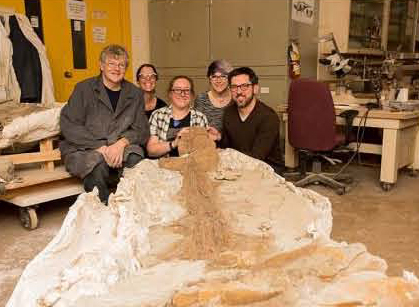
The Posterior Portion of the Specimen with Members of the Research Team

Zuul crurivastator fossil material.

From left to right Ian Morrison (palaeontology technician, Marianne Mader (Director, Centre for Earth&Space/Fossils and Evolution), Victoria Arbour (NSERC postdoctoral fellow), Danielle Dufault (scientific illustrator) and David Evans (Temerty Chair in Vertebrate Palaeontology

Picture credit: Brian Boyle/Royal Ontario Museum

Lots of Taxa within the Sandstone Block

The majority of the skeleton was preserved in a sandstone concretion.  The tail, pelvis and dorsal vertebrae were articulated, whilst elements of the anterior of the specimen including the skull were disarticulated but in relative close association to their position in the skeleton when this dinosaur was alive.  Assigned to the tribe Ankylosaurini, a phylogenetic analysis nests Zuul crurivastator closer to Scolosaurus cutleri and Dyoplosaurus acutosquameus than to either Euplocephalus and Ankylosaurus.

The dinosaur was found upside down and was excavated in two large blocks, the largest of which, containing the torso, weighed more than 15 tonnes and is still undergoing preparation.  The dig site also produced the remains of numerous other Late Cretaceous animals and plants, including theropods, hadrosaurids, turtles, crocodilyforms as well as invertebrates and fossils of some of the vegetation that the armoured dinosaur might have fed upon.

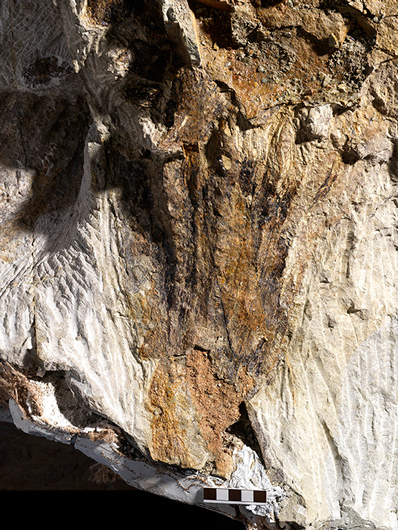
The presence of abundant soft tissue preservation across the skeleton, including in situ osteoderms, skin impressions and dark films that probably represent preserved keratin, make this exceptional skeleton an important reference for understanding the evolution of dermal and epidermal structures within the Ankylosaurinae clade.

A Close View of Preserved Soft Tissue on a Bony Spike on the Tail of Zuul

Soft tissue preservation (Zuul).

Preserved soft tissue sheath of a bony spike on the tail of Zuul (Brian Boyle) Royal Ontario Museum

Picture credit: Brian Boyle/Royal Ontario Museum

The Skull and Jaws

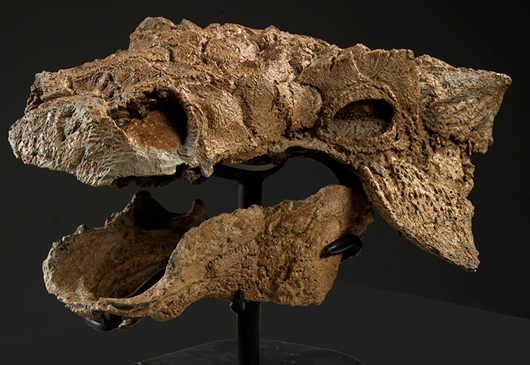
The skull and jaws represent some of the best preserved ankylosaurid material ever found.  Once the skull had been prepared, the scientists were amazed at the detail that was revealed.  It led to comments that the skull and the jaws looked like that they had sculpted just a few days earlier, rather than representing the remains of an animal that roamed the United States at least 75 million years ago.

The Beautifully Preserved Skull and Jaws of Zuul crurivastator

Zuul crurivastator skull and lower jaw.

The skull and lower jaw of Zuul.

Picture credit: Brian Boyle/Royal Ontario Museum

Zuul crurivastator

The newest member of the ankylosaurids had four large horns on its head.  One directly behind each eye (squamosal horn) and another horn that stuck out sideways from just underneath and slightly behind each eye-socket (quadratojugal horn).  It is these horns and the arrangement of the bony scales on the snout that enable palaeontologists to identify different types of ankylosaur.

Co-author of the scientific paper, David Evans (Curator of Vertebrate Palaeontology at the Royal Ontario Museum), stated:

“The preservation of Zuul is truly remarkable.  Not only is the skeleton almost completely intact, but large parts of the bony armour in the skin are still in its natural position.  Most excitingly, soft tissues such as scales and the horny sheaths of spikes are preserved, which will be a focus of our future research.”

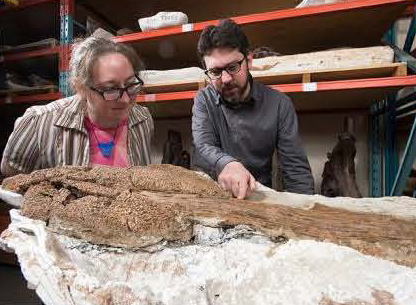
Royal Ontario Museum Palaeontologists Victoria Arbour and David Evans Study the Fossil

David Evans and Victoria Arbour study the bony club tail.

Victoria Arbour and David Evans study the bony club tail.

Picture credit: Brian Boyle/Royal Ontario Museum

The scientific paper: “A new Ankylosaurine Dinosaur from the Judith River Formation of Montana, USA, Based on an Exceptional Skeleton with Soft Tissue Preservation” by Victoria M. Arbour and David C. Evans.

Visit the Everything Dinosaur website: Everything Dinosaur.

11 05, 2017

“Baby Louie” Dinosaur Fossil Identified as New Species

By |2023-07-22T17:08:52+01:00May 11th, 2017|Categories: Dinosaur and Prehistoric Animal News Stories, Dinosaur Fans, Main Page, Photos/Pictures of Fossils|0 Comments

A New Species of Giant Oviraptorosaur – Beibeilong sinensis

The mystery of the world’s largest dinosaur eggs has been solved, and an infamous baby dinosaur fossil once the property of the Indianapolis Children’s Museum, now has a family.  In 1993, a fossilised clutch of giant dinosaur eggs and an associated embryo dinosaur skeleton was discovered east of the small village of Zhaoying, close to the township of Yangcheng, Xixia County, in western Henan Province.  Like many thousands of dinosaur egg fossils found in this part of central China, the specimen was illegally sold overseas to a buyer in America.

A Baby Dinosaur Fossil

The fossil was then sold to the Indianapolis Children’s Museum in 2001.  Subsequently, the partial nest with the small, articulated dinosaur skeleton, nick-named “Baby Louie”, was repatriated to China and it is currently housed in the Henan Geological Museum.

In a paper this week in “Nature Communications”, researchers which include Darla Zelenitsky (University of Calgary) and Professor Phil Currie (University of Alberta), have identified a new species of giant Oviraptorosaur – “Baby Louie” represents potentially one of the largest feathered creatures known to science.

The dinosaur has been named Beibeilong sinensis, the name means “baby dragon from China”.

Photographs of the Holotype Fossil Material (Beibeilong sinensis)

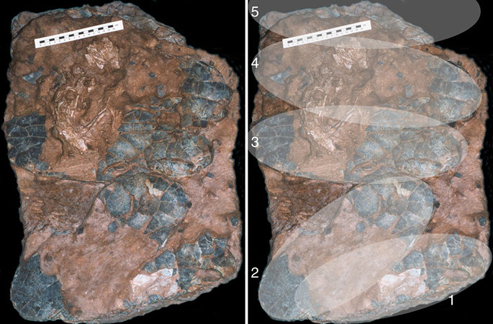
Beibeilong sinensis egg fossils with impression of egg size and position overlaid.  The story of a baby dinosaur fossil.

Right image shows schematic overlay of approximate locations of individual eggs. Eggs 1 through 4 are in an upper layer just beneath the skeleton, whereas egg 5 is in a lower layer of the block. Scale bar is in centimetres.

Picture credit: Nature Communications/Darla Zelenitsky

The picture above shows two images of the holotype nest fossil from which the new species of dinosaur, B. sinensis was described.  The picture on the left shows the fossil material with the embryo fossil located just below the scale bar.  On the second photograph, the location of five of the eggs making up the clutch have been superimposed on the fossil to give an indication of their position.

Giant Dinosaur Eggs

The eggs were given their own oogenus, Macroelongatoolithus (the name means “large elongate stone eggs”).  These are the largest-known type of dinosaur eggs with some fossils measuring around sixty centimetres in length.  The eggs associated with the Beibeilong embryo measure about forty-five centimetres long.   That’s about three times as long as a typical Ostrich egg (Struthio camelus), although Ostrich eggs are more ovoid in shape.  The research team suggest that the dinosaurs which laid these eggs, giant caenagnathid Oviraptorosaurs, created nests that may have been around three metres in diameter.

An Artist’s Illustration of the Giant Oviraptorosaur Beibeilong sinensis

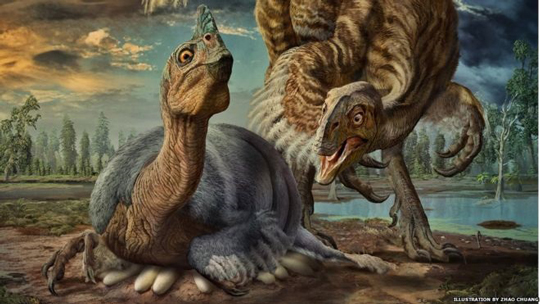
Beibeilong nesting scene.

A breeding pair of Beibeilong dinosaurs and their nest of giant dinosaur eggs.

 Picture credit: Zhao Chuang

The Gigantoraptor Effect

The discovery of the giant fragmentary fossils of a strange theropod (Gigantoraptor erlianensis) in 2005 changed views on the Oviraptorosauria clade forever.  When formally described in 2007, Gigantoraptor was at least five times bigger than any other known oviraptorid.  Palaeontologists had proof that giant, beaked dinosaurs existed.

To read about the discovery of Gigantoraptor: New Giant Member of the Oviraptorosauria – Gigantoraptor.

Beibeilong becomes the second genus of giant members of the Oviraptorosauria.  If “Baby Louie” had lived, then this dinosaur might have reached a length of eight metres or more and it would have easily weighed more than a tonne.  Beibeilong has been assigned to the Caenagnathidae, an enigmatic group of beaked theropods closely related to the Oviraptoridae and nested with them into the Oviraptorosauria clade.

A Scale Drawing of a Giant Caenagnathid Oviraptorosaur (G. erlianensis)

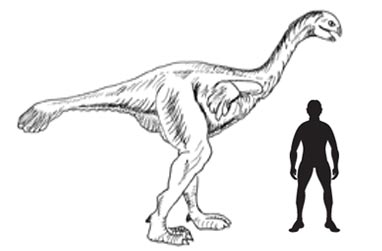
Gigantoraptor scale drawing.

The largest feathered animal known to science (Gigantoraptor).  Picture credit: Everything Dinosaur.

Picture credit: Everything Dinosaur

Originally, the Caenagnathidae family was erected to describe, what was thought at the time, a lineage of extinct birds.  Over the last thirty years or so, more fossil discoveries have been made in North America and Asia.  When first described Gigantoraptor was thought to be a member of the Oviraptoridae, however, Gigantoraptor is now joined in the Caenagnathidae by perhaps, the equally large Beibeilong.

An Abundance of Giant Dinosaur Egg Fossils

The Beibeilong material was excavated from strata from the Gaogou Formation (Upper Cretaceous, Cenomanian to Turonian faunal stages).  The research team suggest that Beibeilong roamed central China some ninety million years ago, twenty million years earlier than Gigantoraptor.

An abundance of Macroelongatoolithus eggs reported from Asia and North America is in stark contrast to the very few bones found of giant caenagnathids.  Thanks to the association between “Baby Louie” and the giant eggs, the first known association between skeletal remains and eggs of caenagnathids, palaeontologists are confident that these giant, beaked dinosaurs may have been relatively common throughout the Northern Hemisphere during the Late Cretaceous.

A View of the Dinosaur Embryo Skeleton (Beibeilong sinensis) and Accompanying Line Drawing

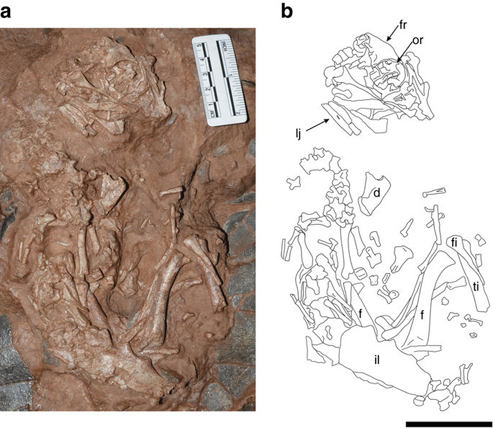
Beibeilong fossil and line drawing.

“Baby Louie” fossil (Beibeilong sinensis) and line drawing – scale bar = 5 cm.

Picture credit: Nature Communications/Darla Zelenitsky

The picture above shows a close view of the embryo skeleton (left) and a simplified line drawing highlighting important bones.

Key

fr = frontal bone (skull), or = orbit (skull), lj = lower jaw, d = dentary, fi = fibula, ti – tibia, il= ilium, f = femur.

Visit the Everything Dinosaur website: Everything Dinosaur.

10 05, 2017

Amazing Ammonite “Tool Mark” Fossil

By |2023-07-22T16:59:06+01:00May 10th, 2017|Categories: Dinosaur and Prehistoric Animal News Stories, Main Page, Photos/Pictures of Fossils|0 Comments

Ammonite Fossil Captures Brief Moment in Deep Time

Every once in a while, a fossil is found that provides a remarkable insight into life in the past.  An example of this is an Ammonite fossil that dates from the Late Jurassic.  The shell of the dead ammonite was rolled along the floor of a shallow lagoon, before it finally came to rest on the finely grained sediment.  An event that lasted for perhaps just a few seconds has been preserved within the fossil record, it has persisted for over 150 million years.

An Artist’s Illustration of the Ammonite Shell Drag

Ammonite shell drag.

Capturing a moment in the Late Jurassic (cephalopod shell trackway).

Picture credit: Manchester University

The Solnhofen Plattenkalk (Solnhofen limestone)

Located in the southern German State of Bavaria, the world-famous limestone beds that form the Solnhofen Lagerstätte, preserve, in exquisite detail, a remarkable fossil record of animals and plants including soft-bodied creatures such as jelly fish and delicate insects such as dragonflies.  Many vertebrate fossils have also been excavated, perhaps the most famous of which are the fossils of the theropod Archaeopteryx, referred to as “Urvogel”, German for “first bird”.

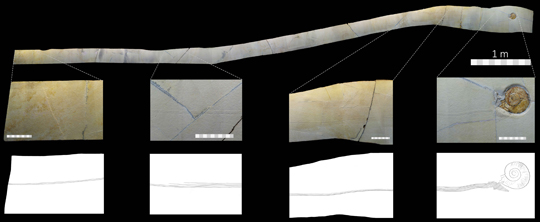
The international team of scientists, which includes palaeontologist Dean Lomax (Manchester University), have been studying the 8.5-metre-long trackway a fossil of an ammonite shell as it was rolled along the soft, carbonate mud by the lagoonal currents.  At the end of the track, the cricket ball-sized ammonite (Subplanites rueppellianus) came to rest.

The Team of Scientists Mapped the Progress of the Ammonite Shell Across the Bed of the Lagoon

Ammonite body and trace fossil.

Mapping the path of the Ammonite shell across the floor of the lagoon.

Picture credit: Manchester University

The picture above shows the track of the ammonite (left to right), with line drawings of each element of the highlighted “tool mark” fossil shown below.  The ammonite itself can be found at the end of the track (extreme right).  The ammonite, a specimen of S. rueppellianus was already dead when the track was made, although fossils such as this have been found before, it is an extremely rare find.  Technically, although the shell left a drag mark in the sediment and the body fossil is preserved, the track itself can’t really be regarded as a trace fossil.

Studying Ammonite Trace Fossils

Trace fossils such as trails, footprints, burrows and borings preserve evidence of the activity of animals.  As the ammonite was dead when the track was created, it should not really be referred to as a trace fossil.  A more accurate term might be “tool mark” to describe the fossilised movement of the shell across the lagoon floor.

Dean, lead author of the scientific paper published in the on-line academic journal PLOS One, commented:

“With fossils, we usually find body fossils, such as bones, teeth or shells, or trace fossils, such as tracks and burrows.  However, the drag mark has not been made by the ammonite in life and does not reflect behaviour.  Instead, the drag mark was created by the lake’s current moving the ammonite shell.  It is easy to understand why such fossils have been misinterpreted as the traces of living organisms.”

Visit the website of Dr Dean Lomax: British Palaeontologist Dr Dean Lomax.

A Spectacular Record of a Late Jurassic Ecosystem

During the Late Jurassic, much of western Europe was covered by a warm, tropical sea.  There were islands and these were home to an array of dinosaurs and other exotic creatures.  The landscape included stagnant lagoons that had limited access to the open sea.  These shallow bodies of water were extremely saline and very few organisms could tolerate the harsh conditions.

As a result, if animal or plant remains were washed into the lagoon from the land, or if, in this case, an ammonite was washed into the lagoon from the sea, there were very few scavengers or micro-organisms around to ingest the organic material.  The still waters, devoid of life, helped the preservation of these animal and plant remains. Slowly, they would have become buried in the soft, finely grained mud at the bottom of the lagoon, or in this case a rare current had disturbed the rotting ammonite and rolled the shell along the lagoonal floor, before the shell finally fell over and came to rest.

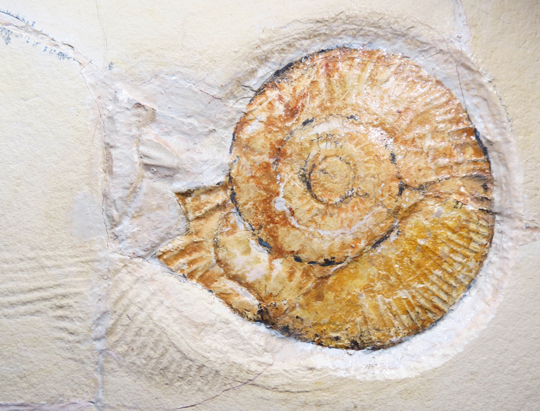
Subplanites rueppellianus Fossil Preserved at the End of the Trackway

Subplanites rueppellianus fossil.

Subplanites rueppellianus preserved at the end of the track.

Picture credit: Manchester University

Plotting the Movement of the Ammonite

How exactly did the fossil move after it had already died?  Ammonites had gas chambers, which they used to control their buoyancy and movement, similar to a submarine.  However, the shell of the ammonite was probably empty and the authors of the study speculate that some of the gas remained present in the shell.  This meant the ammonite did not sink straight to the bottom and fall over.  Instead, the S. rueppellianus shell was dragged along the bottom of the tropical lagoon by what must have been a calm and steady current.

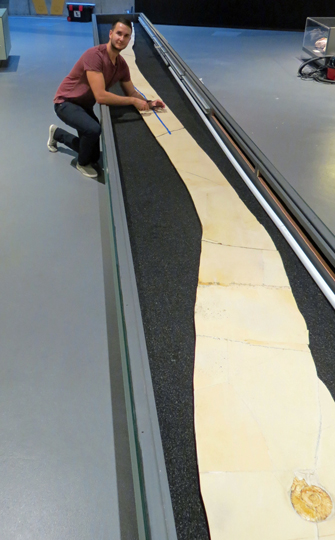
Dean Lomax Provides a Scale for the 8.5-metre-long Fossil Drag Mark

Examining the ammonite trace fossil.

Dean Lomax (University of Manchester) examines the trace fossil.

Picture credit: Manchester University

The start of the drag mark is not preserved, so the shell may have been rolling for much longer.  The mark was created by contact of the ammonite’s ribs (ridges on the shell), with the lagoon floor.  The mark begins with just two lines, suggesting only two of the ammonite’s ribs were in contact with the bottom of the lagoon.  The number of ribs increases along the drag marks length.

Dean Lomax added:

“Fossils such as this are super rare and provide a snapshot of an unusual moment in deep time.”

Revolutionising the Way Palaeontologists Can Showcase Fossil Material

Intricate digital photogrammetry and three-dimensional modelling was used by the research team to create a detailed video of the fossil, showing the progression of the ammonite until its final resting place.

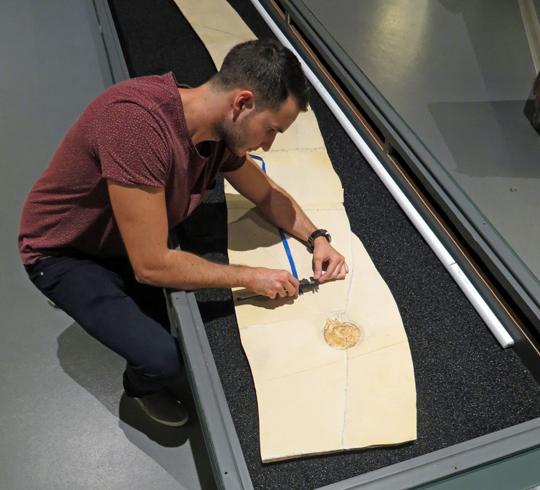
Dean Lomax Carefully Maps the Final Movements of the Ammonite Shell

Mapping an ammonite trace fossil.

Analysing the final movements of the ammonite shell.

Picture credit: Manchester University

Palaeontologist Peter Falkingham, (Liverpool John Moores University) and one of the co-authors of the study explained:

“We created a virtual model of the fossil by compiling over 600 photographs of the specimen.  We then created a video, which shows the drag mark and the preserved Ammonite.  Such modern techniques, like the photogrammetry method we used, have really revolutionised the way palaeontologists can study fossils.”

Everything Dinosaur acknowledges the help of the University of Manchester Press Team for their help in the compilation of this article.

Visit the Everything Dinosaur website: The Everything Dinosaur Website.

5 05, 2017

Whipping Up Interest in Whiplash Dinosaurs

By |2023-07-22T15:47:00+01:00May 5th, 2017|Categories: Dinosaur and Prehistoric Animal News Stories, Dinosaur Fans, Main Page|0 Comments

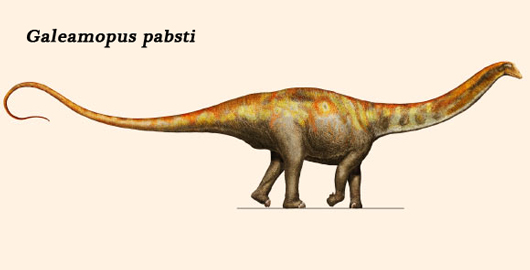
New Species of Diplodocid Dinosaur – Galeamopus pabsti

Writing in the academic journal “Peer J”, palaeontologists Emanuel Tschopp and Octávio Mateus (Universidade Nova de Lisboa), have identified a new species of diplodocid dinosaur within the Galeamopus genus.  The dinosaur has been named Galeamopus pabsti. The fossils, which come from the Upper Jurassic Morrison Formation, specifically the Howe-Scott Quarry in the northern Bighorn Basin in Wyoming, (USA), further demonstrate the diversity of sauropods associated with the Late Jurassic fauna of western North America.

A New Species of Diplodocid Dinosaur

Galeamopus pabsti illustrated.

A life reconstruction of G. pabsti.

Picture credit: Davide Bonadonna with additional annotation by Everything Dinosaur

The Galeamopus Genus

Excavation began in 1995, by a Swiss field team led by palaeontologists Dr Hans-Jakob ‘Kirby’ Siber and Dr Ben Pabst (The Dinosaur Museum (Sauriermuseum) in Aathal, Switzerland).  The trivial name, honours Dr Pabst in recognition of his contribution to dinosaur fossil preparation and exhibition mounting.

This is the second member of the Galeamopus genus to be identified, the first species G. hayi, was erected in 2015, when Emanuel Tschopp and Octávio Mateus, along with colleagues from Oxford University and the Raymond M. Alf, Museum of Palaeontology, (Claremont, California, USA), published a paper that resurrected the genus Brontosaurus following an extensive review of the Diplodocidae.

For an article on the 2015 paper: The Return of Brontosaurus.

Nearly Complete Fossil Specimen Just Missing the Tail

Importantly, much of the skull, although broken apart, was collected along with around the majority of the anterior portion of the skeleton.  The presence of fossilised wood and freshwater bivalves indicated that this individual had come to rest in a stream channel.  The skull has helped to assign a new species within the Galeamopus genus and the robust limb bones, such as the very sturdy upper arm bone (humerus), helps to distinguish the Galeamopus genus from the more gracile and slender Diplodocus.

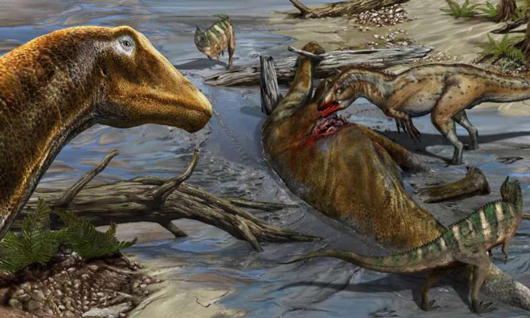
Dr Emanuel Tschopp, who holds a number of academic posts including a position at the University of Turin, commented that the bones represent a young adult and that this dinosaur could have reached lengths in excess of twenty-seven metres.  Bite marks on the ribs and shed theropod teeth found in association with the bones suggest that the dinosaur’s carcase was scavenged before it was finally buried.

A Late Jurassic Scene – Galeamopus pabsti Scavenged by Theropods

Scavenging the carcase of Galeamopus.

The carcase of Galeamopus is scavenged by an Allosaurus whilst two smaller Ceratosaurus approach.

Picture credit: Davide Bonadonna

Galeamopus pabsti

Dr Tschopp stated:

“Diplodocids are among the best-known sauropod dinosaurs.  Numerous specimens of currently fifteen accepted species belonging to ten genera have been reported from the Late Jurassic to Early Cretaceous of North and South America, Europe, and Africa.  However, the highest diversity is known from the Upper Jurassic Morrison Formation of the western United States, a recent review [the 2015 paper] recognised twelve valid, named species, and possibly three additional, yet unnamed ones.”

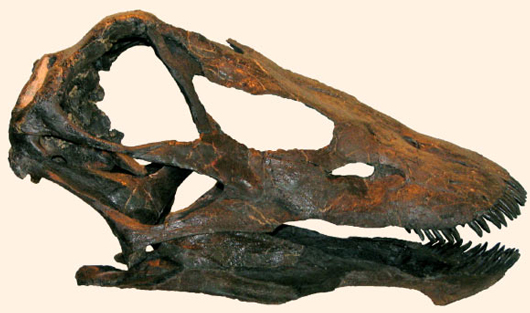
A View of the Reconstructed Skull of Galeamopus pabsti

Diplodocid skull (G. pabsti).

A right lateral view of the reconstructed skull of G. pabsti.

Picture credit: Emanuel Tschopp and Octávio Mateus

A Long Tail?

Although, the tail bones are missing, the scientists are confident that like all the other diplodocids, Galeamopus pabsti had a long tail, which in this case, represents more than half of the animal’s total body length.  This long whip-like tail may have been used to help herd members keep in contact with each other or perhaps it had a role in defence.  If attacked these dinosaurs might have lashed out with their tails, or perhaps moved them so quickly that they would have made a sonic boom (breaking the sound barrier).

Visit the Everything Dinosaur website: Everything Dinosaur.

3 05, 2017

The Last Dinosaur from Africa a New Abelisaurid is Described

By |2024-02-25T08:00:22+00:00May 3rd, 2017|Categories: Dinosaur and Prehistoric Animal News Stories, Dinosaur Fans, Main Page|0 Comments

Chenanisaurus barbaricus – Substantial Abelisaurid from Late Cretaceous Morocco

One of the last types of dinosaur to have existed in north Africa has been described in a new scientific paper published in the journal “Cretaceous Research”.  A fragment of jaw bone (dentary) and isolated teeth discovered in a phosphate mine at Sidi Chennane in the Oulad Abdoun Basin, (Morocco), has enabled scientists to identify a new species of abelisaurid.  The dinosaur, named Chenanisaurus barbaricus may belong to an as-yet undescribed family of Abelisaurs unique to Africa.

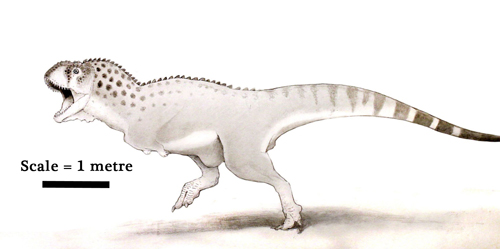
An Illustration of the Late Cretaceous Abelisaurid Chenanisaurus barbaricus

Chenanisaurus barbaricus illustration.

An illustration of Chenanisaurus barbaricus.

Picture credit: University of Bath with additional annotation by Everything Dinosaur

A Blunt Snout with an Unusually Short and Robust Jaw

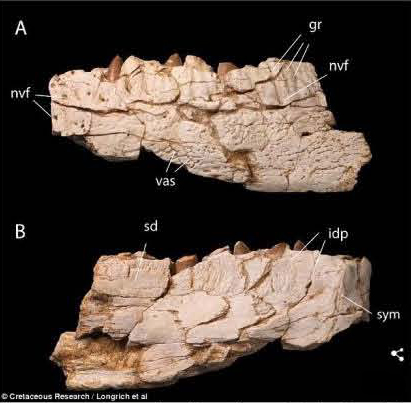
Analysis of the fragment of dentary, along with the associated teeth, indicates that the jaw of this dinosaur was very short, even for an abelisaurid.  The morphology of the jaw is described as being even more extreme than that seen in other abelisaurids such as Carnotaurus.  Extensive wear on the teeth suggests hypercarnivory (diet consisting of more than 70 percent meat), Chenanisaurus was around 7-8 metres in length and it may have been an apex predator within the Late Cretaceous ecosystem.

A Photograph Showing Two Views of the Jaw Fragment

Jaw fragment fossil C. barbaricus.

Jaw fragment fossil (labial and buccal view).

Picture credit: University of Bath

Marine Deposits from a Phosphate Mine

Lead author of the scientific paper, Dr Nick Longrich (Milner Centre for Evolution at the University of Bath), along with colleagues from Morocco, France, and Spain studied the jaw fossil and teeth that had been found in 66-million-year-old strata in a phosphate mine located in northern Morocco.  Dinosaur fossils from the end of the Cretaceous (Maastrichtian faunal stage) are exceptionally rare in north Africa.  Rising sea levels had isolated Africa as the super-continent of Gondwana continued to break up and from about 95 million years onwards, much of the former terrestrial habitat of the Dinosauria in north Africa was lost to the sea.

Commenting on the rarity of the fossil find, Dr Longrich stated:

“This find was unusual because it’s a dinosaur from marine rocks – it’s a bit like hunting for fossil whales, and finding a fossil lion.  It’s an incredibly rare find – almost like winning the lottery.  But the phosphate mines are so rich, it’s like buying a million lottery tickets, so we actually have a chance to find rare dinosaurs like this one.”

Chenanisaurus barbaricus – Confirming a Distinct African Terrestrial Fauna

Not only was Chenanisaurus barbaricus one of the last dinosaurs to roam our planet, its discovery supports the idea of a distinct north African terrestrial fauna towards the end of the Age of Dinosaurs.  During the Maastrichtian faunal stage of the Late Cretaceous, horned dinosaurs and hadrosaurids were the most common and specious large, plant-eating dinosaurs in North America and Asia, whereas a different group of dinosaurs dominated terrestrial ecosystems in South America, India and Madagascar (Titanosauriformes and abelisaurids).  In North America and Asia, the dominant, apex predators were Tyrannosaurs.

In 2004, a paper published in the “Journal of African Earth Studies”, provided details of a right hindlimb (femur, tibia and fibula), that had been found in phosphate deposits near the town of Khouribga (central Morocco).  Just like Chenanisaurus, these fossils date from approximately 66 million years ago and were also found in marine rocks.
Team members at Everything Dinosaur are not aware of a new genus having been established as a result of the discovery of the leg bones, but their presence in the rocks does indicate that titanosaurids survived in north Africa until the very end of the Cretaceous.  These fossils along with the Chenanisaurus material suggests the persistence of a classic Gondwanan abelisaurid/titanosaurid fauna in mainland Africa right up to end- Cretaceous extinction event.
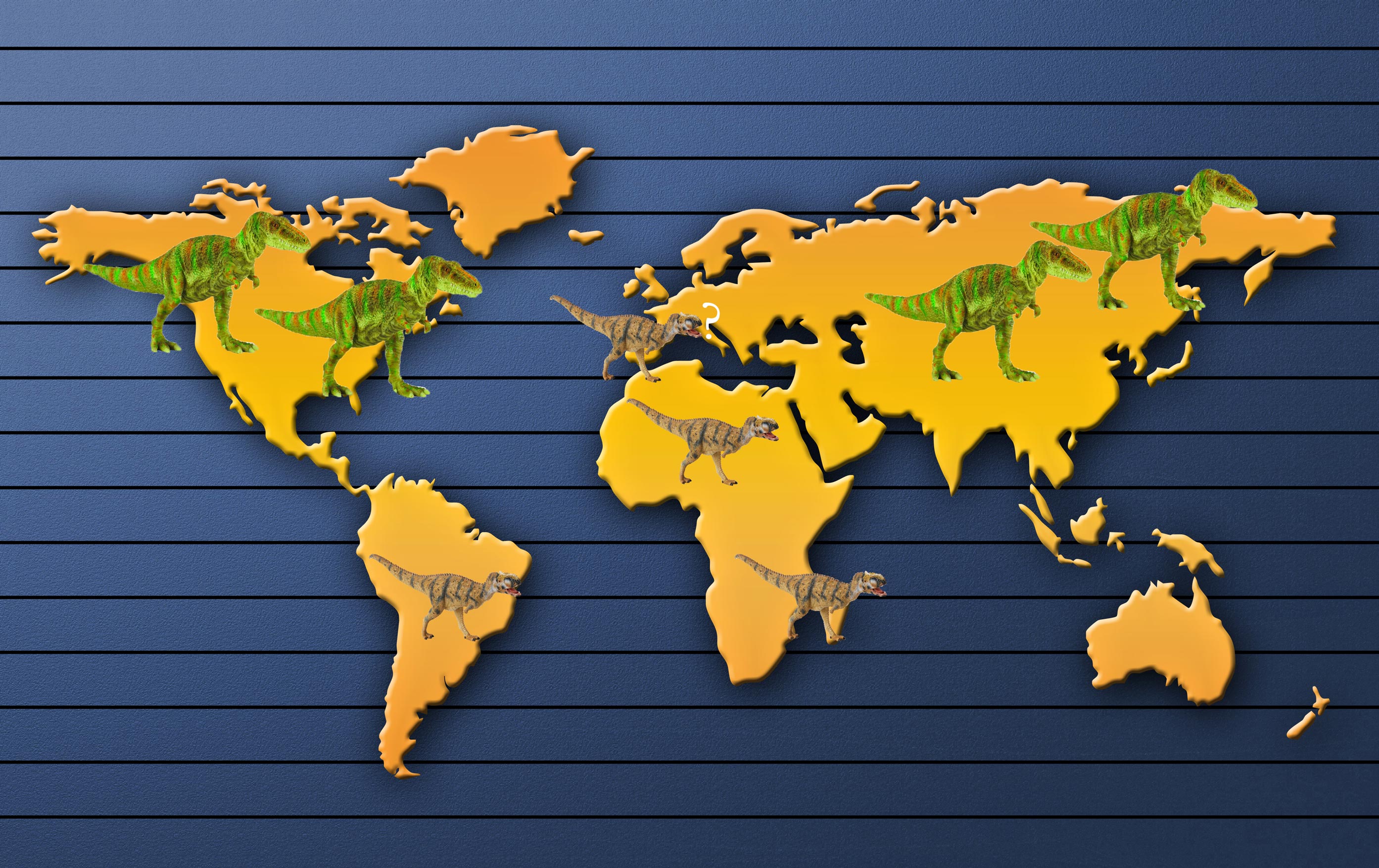
Tyrannosaurid versus Abelisaurid Distribution

Abelisaurid versus tyrannosaurid distribution.

Tyrannosaurid versus abelisaurid distribution. Picture credit: Everything Dinosaur.

Picture credit: Everything Dinosaur

Key

Tyrannosaurids = green

Abelisaurids = brown

The picture above shows a general distribution of apex predatory dinosaurs in the Late Cretaceous, with the exception of southern Europe, tyrannosaurids dominated the apex predator positions in Laurasia, whilst the abelisaurids dominated in the regions that made up Gondwana.

Phylogenetic Analysis

Phylogenetic analysis undertaken by the research team suggests that Chenanisaurus may represent a lineage of abelisaurids that is distinct from those previously described from the latest Cretaceous of South America, Indo-Madagascar, and Europe, consistent with the hypothesis that the fragmentation of Gondwana led to the evolution of endemic dinosaur faunas during the Late Cretaceous.

Dr Longrich added:

“We have virtually no dinosaur fossils from this time period in Morocco, it may even be the first dinosaur named from the end-Cretaceous of Africa.  It’s also one of the last dinosaurs in Africa before the mass extinction that wiped out the dinosaurs.  It is an exciting find because it shows just how different the fauna was in the Southern Hemisphere at this time.”

Visit Everything Dinosaur’s website: Everything Dinosaur.

2 05, 2017

Basal Brachiosaurids – Vouivria damparisensis a New Dinosaur Taxon

By |2024-05-08T20:16:09+01:00May 2nd, 2017|Categories: Dinosaur and Prehistoric Animal News Stories, Dinosaur Fans, Main Page|0 Comments

French Revolution for the Brachiosauridae

This week there have been a number of papers published announcing newly described dinosaurs.  In time, we will get around to writing about several of them, but first, let’s take a look at the basal brachiosaurid Vouivria damparisensis, which has been described from fossil material representing a single animal that was first discovered back in 1934.

Earliest Relative of Brachiosaurus from north-eastern France

Vouivria damparisensis (brachiosaurid).

A newly described basal brachiosaurid Vouivria damparisensis.

Picture credit: Imperial College London

Vouivria damparisensis

Writing in the journal “Peer J”, lead author Dr Philip Mannion (Dept. of Earth Science and Engineering at Imperial College, London) and his co-workers Ronan Allain (Natural History Museum, Paris) and Oliver Moine (Laboratory of Physical Geography, CNRS / University Paris 1 Panthéon-Sorbonne), propose that these fossils represent the earliest known brachiosaurid, a family of dinosaurs that include such well-known animals as Brachiosaurus and Giraffatitan.  However, despite the high profile (no pun intended), of “arm lizard” in particular, surprisingly, very little is known about the evolution of these sauropods, Vouivria helps to fill in some significant gaps.

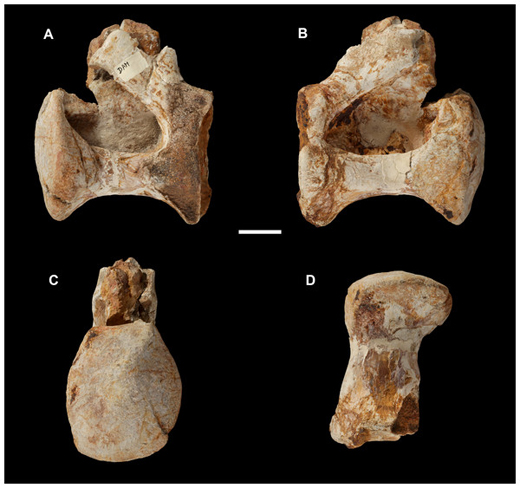
A Photograph of a Dorsal Vertebra from Vouivria damparisensis

A back bone of Vouivria.

A dorsal vertebra of Vouivria.

Picture credit: Peer J

The picture above shows a bone from the spine of V. damparisensis.  The bone comes from the front part of the dorsal vertebrae, (A) left lateral view, (B) right lateral view, (C) anterior view; (D) ventral view. Scale bar equals five centimetres.

Middle/Late Oxfordian Sauropod

The Brachiosauridae seem to have had their heyday in the Late Jurassic, Vouivria is important as relatively few sauropods are known from rocks of this age.  Most Sauropod fossils from the Jurassic are associated with rocks that were laid down in the latter stages of this geological period, namely during the Kimmeridgian–Tithonian faunal stages.  Vouivria damparisensis comes from strata that is several million years older, having lived around 160 – 158 million years ago.  In addition, it is known from relatively complete remains.

Contrast this with the UK’s Late Jurassic sauropod fossil material, in particular the likes of Duriatitan (D. humerocristatus), which like Vouivria, has been assigned to the Titanosauriformes, the clade of long-necked dinosaurs to which the Brachiosauridae family belongs.  Duriatitan is known from a single fossil bone (left femur) and this fossil, which comes from Dorset, was found in rocks that are believed to be about four million years younger than the rocks in which Vouivria was discovered.

At an estimated 15 tonnes and some 15 metres in length, Vouivria was a sizeable beast.  It is likely that this dinosaur fed on the upper storeys of pine trees and Araucaria, using its long neck to reach parts of trees that other herbivorous dinosaurs could not reach.

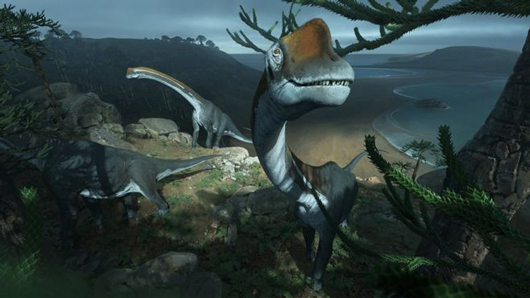
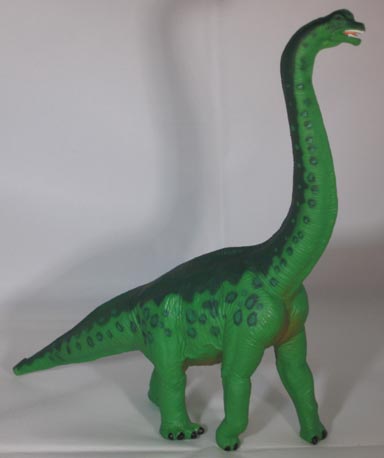
An Illustration of a Typical Brachiosaurid

Brachiosaurus dinosaur model.

A colourful Brachiosaurus dinosaur model.

Picture credit: Everything Dinosaur

The model featured above is from the: Wild Safari Prehistoric World Models.

Revolutionising the Brachiosauridae Family Tree

The researchers were able to conduct an analysis of the Brachiosauridae family tree and an assessment of the evolutionary relationships indicates that by the Early Cretaceous, brachiosaurids were restricted to Africa and the United States.  They were probably extinct in Europe.

Furthermore, the team were able to postulate that fossils that most likely represent brachiosaurids are only known from the USA, Africa and western Europe.  Previously, studies examining the fossils of another long-necked dinosaur, Padillasaurus (P. leivaensis), from Lower Cretaceous rocks of Columbia, had suggested that Padillasaurus was a brachiosaurid.  The detailed description of Vouivria casts doubt on this suggesting that Padillasaurus was not a member of the Brachiosauridae and that as a result brachiosaurids remain unknown from South America.  Padillasaurus is placed within the Somphospondyli, another clade of Titanosauriformes, related to the brachiosaurids, but one with a much more global distribution.

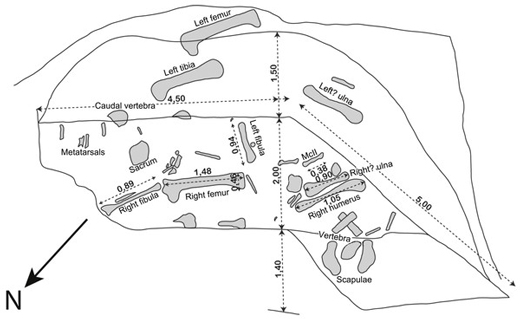
A Modified Map Showing the Original Location of the Fossil Bones at the Dig Site

The layout of the bones of Vouivria damparisensis.

A map showing the position of the bones at the original dig site.

Picture credit: Peer J modified from Dorlodot (1934)

Building upon the original 1934 description (Dorlodot) and the subsequent reassessment of the fossil material Lapparent (1943), before the fossil material was confined to storage, the researchers have provided a valuable insight into the radiation and geographical spread of brachiosaurids.  The current fossil evidence suggests that this type of sauropod spanned the Late Jurassic (Oxfordian) through to the Late Albian/Early Cenomanian of the Cretaceous.  The last of the brachiosaurids lived in what is now known as the United States and it is likely that by the earliest Late Cretaceous (approximately 98 million years ago), the Brachiosauridae were extinct.

A Better Understanding of the Palaeoenvironment

The scientific paper provides a better understanding of how the remains of the dinosaur were preserved.  During this period of Earth’s history, much of what we now know as western Europe consisted of a series of low-lying tropical islands.  The earlier studies had concluded that as the rocks in which this dinosaur was found originally come from a coastal environment, then the corpse of Vouivria was probably washed out to sea.  More detailed analysis of the surround rocks and sediments tell a different story.  The researchers conclude that Vouivria died in a lagoon, a habitat that existed during a brief decline in sea levels.  When sea levels rose again, the carcase was buried.

Commenting on the importance of these fossils, lead author of the study Dr Philip Mannion (Imperial College London), stated:

“We don’t know what this creature died from, but millions of years later it is providing important evidence to help us understand in more detail the evolution of brachiosaurid sauropods and a much bigger group of dinosaurs that they belonged to, called Titanosauriformes.”

Visit the award-winning Everything Dinosaur website: Everything Dinosaur.

30 04, 2017

DNA from Ancient Hominins Discovered in Cave Sediments

By |2023-06-17T19:21:26+01:00April 30th, 2017|Categories: Dinosaur and Prehistoric Animal News Stories, Geology, Main Page, Palaeontological articles|0 Comments

DNA from Cave Sediments Reveals Ancient Human Occupants

Close to the Belgium town of Modave, there is a large cave.  It overlooks the Hoyoux River, a tributary of the Meuse and although no human bones have ever been found at this cave site, palaeoanthropologists are confident that it was once occupied by ancient hominins as animal bones with stone tool cut marks are associated with the site.

The Trou Al’Wesse Cave

The cave is called Trou Al’Wesse (“Wasp Cave” in Walloon) and thanks to a remarkable application of technology, scientists now know that some fifty thousand years ago, a Neanderthal relieved himself inside the cave.  That person’s urine and faeces may have long since decomposed but, left in the cave sediments were minute traces of his DNA.  Researchers have shown that they can find and identify such genetic traces of ancient humans, enabling them to test for the presence of ancient hominins even at sites where no human bones have been discovered.

In addition, the same technique can be used to map other mammalian fauna at these locations.  The scientists, including researchers from the Max Planck Institute for Evolutionary Anthropology (Leipzig, Germany) propose that this technique could become a standard tool in palaeoarchaeology.

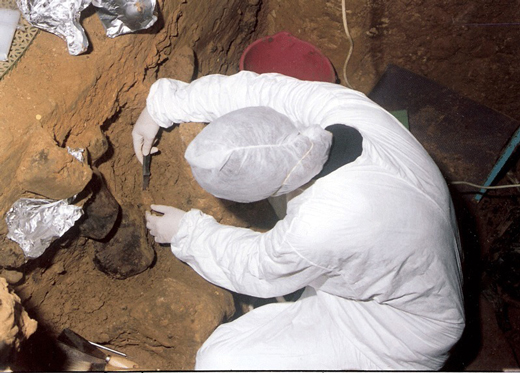
Excavations at the site of El Sidrón, (Spain) – One of the Cave Sites in the Study

Searching for evidence of ancient hominin DNA.

Excavations at the site of El Sidrón, Spain.

Picture credit: El Sidrón research team

The Secrets of Cave Soils and Sediments

Human remains are extremely rare and although scientists are aware of the existence of ancient hominins such as the Denisovans, they are only known from a handful of fossilised bones (literally, a single finger bone and a possible femur, plus some teeth).  However, cave soils and sediments themselves can provide genetic evidence in the form of tiny traces of ancient hominin DNA.  By examining cave soils and sediments and extracting genetic traces, scientists can gain a better understanding of the evolutionary history of humans, even if no bones or stone tools are present.

The research team members collected eighty-five sediment samples from seven caves in Europe and Russia that humans are known to have entered or even lived in during the Pleistocene Epoch.  The samples dated from between 14,000 and 550,000 years ago.  Using a refined DNA analysis technique, one that was originally designed to identify plant and animal DNA, the team were able to search specifically for hominin genetic evidence.

The Significance of this Research for Detecting Ancient Hominins

Commenting on the significance of this research, Matthias Meyer (Max Planck Institute for Evolutionary Anthropology) and co-author of the study published in the journal “Science” stated:

“We know that several components of sediments can bind DNA.  We therefore decided to investigate whether hominin DNA may survive in sediments at archaeological sites known to have been occupied by ancient hominins.”

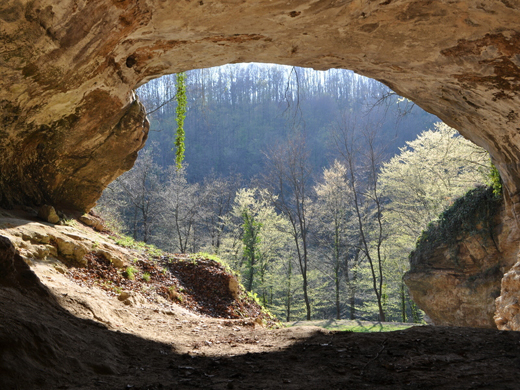
Entrance to the Archaeological Site of Vindija Cave, Croatia

Searching for traces of ancient human DNA.

Entrance to the archaeological site of Vindija Cave, Croatia.

Picture credit: Max Planck Institute for Evolutionary Anthropology/J.Krause

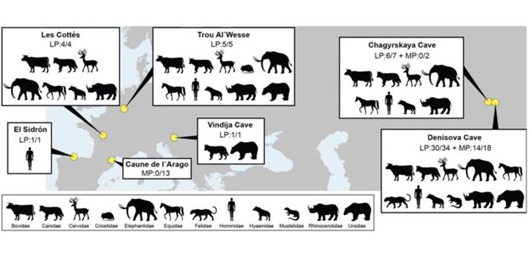
The picture above shows a view from the entrance of Vindija Cave in northern Croatia, one of the seven sites studied.  Analysis of microscopic amounts of mitochondrial DNA at the Vindija Cave location confirmed the presence of several large mammals including Cave Bears at this location.  The researchers found evidence of a total of twelve different mammalian families across the sites that were included in this study, including enigmatic, extinct species such as Woolly Mammoth, Woolly Rhinoceros and Cave Hyena.

Mitochondrial DNA

 Mitochondrial DNA Helps Map the Presence of Large Mammals (Including Hominins)

DNA analysis identifies cave inhabitants.

DNA analysis helps map the presence of mammalian fauna in the absence of body fossils.

Picture credit: Journal Science

Once animal DNA had been mapped the researchers turned their attention to identifying ancient human genetic traces within the samples.

Lead author of the research paper, PhD student Viviane Slon (Max Planck Institute for Evolutionary Anthropology), explained:

“From the preliminary results, we suspected that in most of our samples, DNA from other mammals was too abundant to detect small traces of human DNA.  We then switched strategies and started targeting specifically DNA fragments of human origin.”

In total, nine samples from four cave sites contained enough ancient hominin DNA to permit further analysis.  Of these, eight sediment samples contained Neanderthal mitochondrial DNA, either from one or multiple individuals, whilst one sample contained evidence of Denisovan DNA.  The majority of these samples were taken from archaeological layers or sites where no Neanderthal bones or teeth had been previously found.

A New, Important Tool for Palaeoanthropology

Svante Pääbo, another co-author of the paper and director of the Evolutionary Genetics department at the Max Planck Institute for Evolutionary Anthropology commented that the ability to retrieve ancient hominin DNA from sediments represented a significant advance in palaeoanthropology and archaeology.  The use of this technique could become a standard analytical procedure in future.

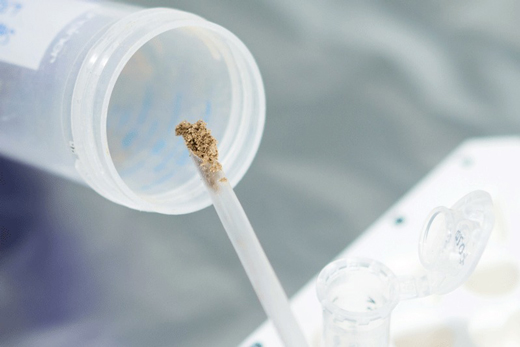
A Sample Ready for Testing

Testing cave sediments for ancient human DNA.

A cave sediment sample is prepared for DNA testing.

Picture credit: Max Planck Institute for Evolutionary Anthropology/S. Tüpke

Even sediment samples that were stored at room temperature for years still yielded DNA.  Analyses of these and of freshly-excavated sediment samples recovered from archaeological sites where no human remains are found will shed light on these sites’ former occupants and our joint genetic history.

Everything Dinosaur acknowledges the contribution of the Max Planck Institute for Evolutionary Anthropology in the compilation of this article.

Visit the Everything Dinosaur website: Everything Dinosaur.

29 04, 2017

Japan’s Most Complete Dinosaur Discovery

By |2023-06-17T17:44:00+01:00April 29th, 2017|Categories: Dinosaur and Prehistoric Animal News Stories, Dinosaur Fans, Main Page|0 Comments

Late Cretaceous Hadrosaur “Japan’s Greatest Dinosaur Fossil Find”

Scientists for Hokkaido University and Hobetsu Museum have announced the discovery of the fossilised remains of a Late Cretaceous duck-billed dinosaur.  In truth, a number of fragmentary fossils relating to a dinosaur had been found some years earlier, most notably caudal vertebrae (tail bones), before a more detailed and larger scale excavation was carried out to determine just how much of the dinosaur skeleton laid buried on a steep slope forming part of the large hills on the island of Hokkaido.

A Duck-billed Dinosaur Skeleton

Many hundreds of hours of fieldwork later and some six tons of material have been removed containing one hundred and ninety fossils which represent the remains of an eight-metre-long hadrosaurid.  The fossils of this duck-billed dinosaur are the largest and most complete dinosaur discovery from Japan.  In a country where understatement tends to be the norm, some commentators have stated that the discovery of these fossils represent “one of the greatest discoveries in Japanese dinosaur research history.”

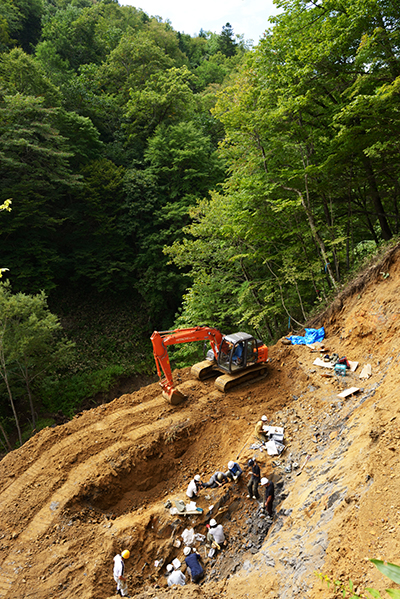
A Photograph Taken in 2013 Showing the Position of the Dig Site

Digging up the  duck-billed dinosaur bones (Hokkaido, Japan).

The outcrop on the steep slope where the fossilised remains of the duck-billed dinosaur were found on Hokkaido (Japan).

Picture credit: Hobetsu Museum

Found in Marine Deposits

The hadrosaurid bones were found in the marine deposits of the Upper Cretaceous Hakobuchi Formation.  These sediments represent continental shelf strata, with a water depth of anything from 80 to 200 metres.  Scientists are not sure how the terrestrial dinosaur came to be located in offshore rock sediments.  Perhaps the dinosaur was washed out to sea and drowned or, the carcase of a dinosaur could have travelled out to sea with the gases inside its large gut keeping it afloat before the body cavity was ruptured and the corpse sank and settled on the seabed.  Ammonites and other zonal fossils indicate that the rocks from which the dinosaur was excavated are approximately 72 million years old (Late Campanian to Early Maastrichtian faunal stage).

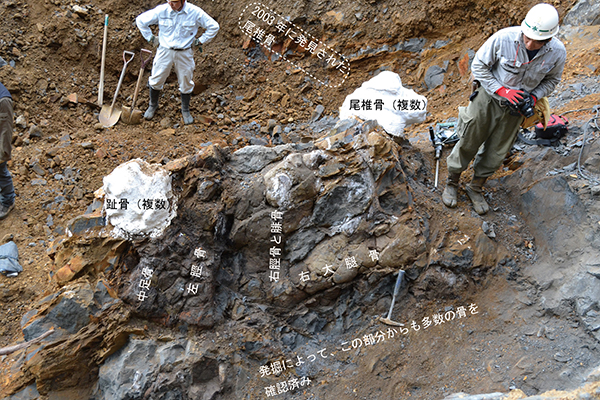
A Photograph Showing the Dig Site with the Location of Several Bones Mapped Out

Part-way through the Japanese dinosaur excavation.

A photograph showing a large rock nodule with fossil dinosaur bone positions marked.

Picture credit: Hobetsu Museum

An Incredibly Rare Find

Japanese dinosaur discoveries are few and far between, with most of Japan’s dinosaurs having been described from a few, isolated fragments.  Experts say it’s incredibly rare to unearth so many fossils and be able to piece back together almost the entire skeleton.  Researchers from Hokkaido University and Hobetsu Museum are confident that these fossils will prove to be a new species of duck-billed dinosaur.

The excavation and preparation work has taken a total of four years.  Fortunately, the researchers had been posting regular updates on their progress to keep the inhabitants of the nearby town of Mukawa (on the southern coast of Hokkaido), fully informed and to deter any curious parties attempting to remove any of the partially excavated remains.

Commenting on the significance of the discovery, Professor Yoshitsugu Kobayashi (Hokkaido University) stated:

“The fossils are also valuable in global terms.  We hope to discover what kind of dinosaur habitat existed along the coast.”

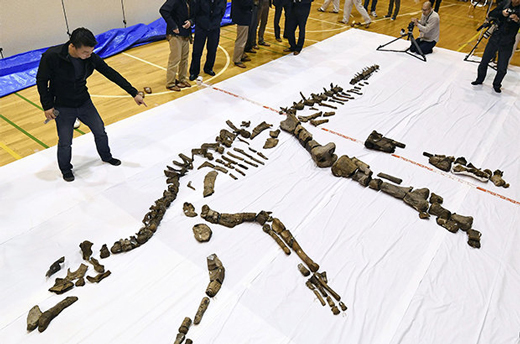
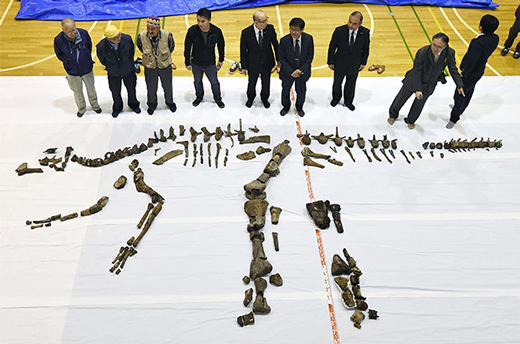
The Cleaned Bones Laid Out in Anatomical Position (Japanese Hadrosaurid)

Japanese hadrosaurid fossils.

Remains of a Late Cretaceous herbivorous dinosaur found in Japan.

Picture credit: Avalon Red

For models of hadrosaurs and other dinosaurs: PNSO Age of Dinosaurs Figures.

The Hadrosaurid Fossils Probably Represent a New Species

Japanese hadrosaurid fossils.

The fossils of this duck-billed dinosaur represent the largest and most complete dinosaur discovery from Japan.

Picture credit: Avalon Red

The picture above shows the scale of the dinosaur and the number of fossil bones discovered, laid out in approximate anatomical position.  The articulated section of caudal vertebrae, one of the first fossil finds at the site, are shown on the far right of the photograph.

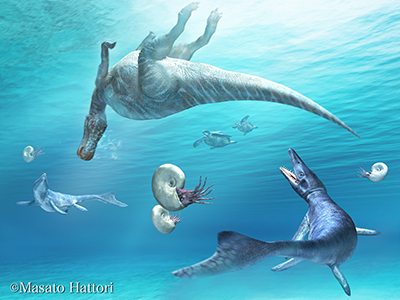
An Artist’s Impression of the Hadrosaurid Corpse Floating Out to Sea

Dinosaur corpse washed out to sea.

An artist’s illustration of the duck-billed dinosaur carcase washed out to sea.

Picture credit: Masato Hattori

The “Mukawa Dragon”

The dinosaur has been nick-named the “Mukawa dragon” and it is hoped that an exhibit will soon be created telling the story of how this duck-billed dinosaur came to rest at the bottom of a shallow tropical sea and what its carcase can tell palaeontologists about life in the Late Cretaceous.

Other Japanese dinosaur discoveries:

Schoolboy finds dinosaur bone: Japanese Schoolboy Finds Dinosaur Toe Bone.

Hinting at a Japanese theropod: Fragmentary Fossil Teeth Indicate Large Japanese Theropod Dinosaur.

Go to Top