All about dinosaurs, fossils and prehistoric animals by Everything Dinosaur team members.

Fossil finds, new dinosaur discoveries, news and views from the world of palaeontology and other Earth sciences.

2 06, 2017

Montana’s First Definitive Camarasaurus

By |2023-07-25T06:27:47+01:00June 2nd, 2017|Categories: Dinosaur and Prehistoric Animal News Stories, Dinosaur Fans, Main Page|0 Comments

The Northernmost Camarasaurus

Scientists have announced the discovery of a Camarasaurus specimen from the state of Montana. Dinosaurs from Montana are nothing new, however, this is the first definitive evidence that this sauropod ranged as far north as the Treasure State.

Writing in the on-line academic journal PLOS One, the researchers, Cary Woodruff, the Director of Palaeontology at the Great Plains Dinosaur Museum, (Malta, Montana) and Dr John Foster (Museum of Moab, Utah) describe the partial, articulated remains of a Camarasaurus specimen from Morrison Formation exposures located in the Little Snowy Mountains, Fergus County, Montana.  The scientists conclude that further exploration of Upper Jurassic sediments may yield further dinosaur fossil material, helping palaeontologists to learn more about the ecosystem and the dinosaur fauna within it that lived in more northerly latitudes of North America.

An Illustration of the Late Jurassic Sauropod Camarasaurus
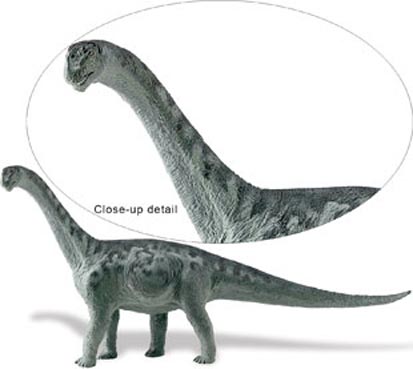
Camarasaurus dinosaur model.

Camarasaurus dinosaur model.

The Curious Camarasaurus

The Camarasaurus genus was erected by the famous American palaeontologist Edward Drinker Cope in 1877.  Numerous fossil specimens have been collected from the Morrison Formation of the western United States, in fact Camarasaurus is represented in the Morrison Formation by more than 530 specimens, it is one of the most studied and therefore, best-known sauropods in the world.  Although it shared the Late Jurassic habitat of western North America with a number of other long-necked dinosaurs, animals such as Diplodocus, Apatosaurus, Brontosaurus and Brachiosaurus, it is by far, the most abundant sauropod taxon known from the Morrison Formation.  It also appears to have had one of the highest population densities amongst the large herbivorous dinosaurs during the Jurassic.

At the moment, a total of four species are recognised:

  1. C. lentus named in 1889
  2. C. grandis named in 1877
  3. C. supremus named in 1877
  4. C. lewisi named in 1988

The vast majority of Camarasaurus fossil remains (82%) are only identifiable down to the genus level.  The Montana remains consisting of a nearly complete skull, articulated neck vertebra, rib fragments, part of the shoulder girdle and limb bones cannot be assigned to a species, but enough of the skeleton has been recovered to confirm the Camarasaurus diagnosis.

Views of the Skull Material of the Montana Camarasaurus (GPDM 220)
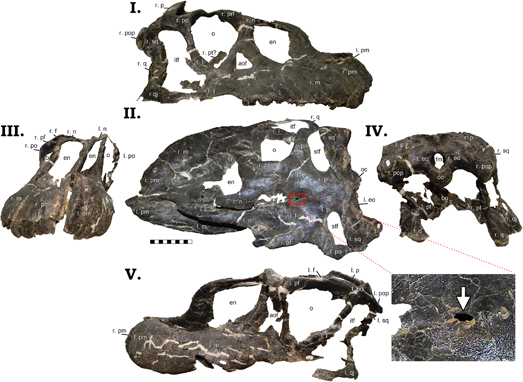
Camarasaurus skull material.

Views of the skull material of the Camarasaurus found in Montana.

Picture credit: PLOS One

The picture above shows various views of the partial Camarasaurus skull (I) – right lateral view, dorsal view (II), viewed from the front (III), viewed from the rear (IV) and left lateral view (V).

Camarasaurus Specimen Claims to Fame

The fossils had been known about for some years, and the dinosaur had been nick-named “Ralph” in honour of the rancher’s land, on which the dinosaur was discovered.  Collecting began in 2005, although it has taken some years to fully prepare the specimen.  GPDM 220 may represent the most northernmost sauropod fossils yet found in the Morrison Formation.  The fossils may also represent the most northerly sauropod remains found in North America.

Scrappy fossil material ascribed to sauropods in general and Camarasaurus in specific have been found in Montana before, but this is the first time, as far as we at Everything Dinosaur are aware, that the fossils have been substantial enough to permit identification down to the genus level.

A Model of a Camarasaurus
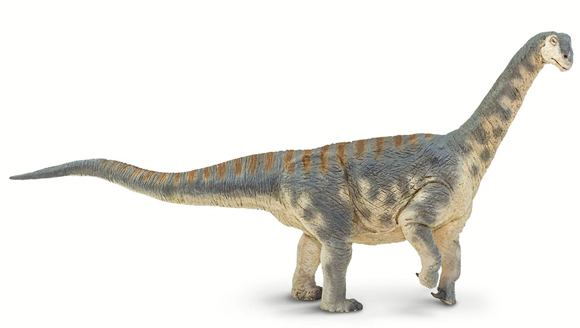
Wild Safari Prehistoric World Camarasaurus dinosaur model.

The award-winning Wild Safari Prehistoric World Camarasaurus dinosaur model.

 Although relatively small when compared to Camarasaurus remains from Wyoming and Utah, the bones represent an adult animal, histological analysis of a core taken from the femur and an analysis of a rib bone, indicates that this dinosaur was at least thirty years old when it died (possibly older, perhaps thirty-five).  The palaeontologists speculate that Montana was not an ideal habitat for Camarasaurus, this may explain the relative small size of the specimen.  A firmer conclusion cannot be made due to the paucity of Camarasaurus specimens from northerly latitudes and the potential for under-sampling of dinosaur fossil remains in unfavourable ecosystems.

Limb Bones from the Montana Camarasaurus
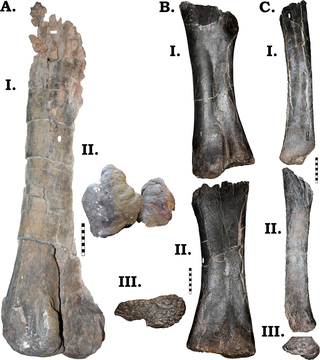
Montana Camarasaurus limb elements.

Limb elements for the Camarasaurus (Montana specimen).

Picture credit: PLOS One

The picture above shows various limb elements associated with the skeleton.  An incomplete left femur (A) is shown in a posterior view (I) and distal view (II).  A partial right tibia is shown (B) in (I) anterior view, (II) posterior view and (III) distal view, whereas, (C) represents an incomplete left fibula in (I) anterior, (II) posterior and (III) distal view).  The scale bar = ten centimetres.

Hinting at More Camarasaurus Fossil Discoveries to Come

The research team are confident that further examination of Morrison Formation exposures in Montana will yield a lot more dinosaur fossil remains.  For example, the Camarasaurus fossil material was found in association with an as yet, undescribed stegosaur as well as two theropod teeth.

A spokesperson from Everything Dinosaur stated:

“The publication of this scientific paper goes to show, that the Morrison Formation, particularly those extensive exposures outside of Wyoming and Utah, can still surprise palaeontologists.  Further fieldwork will undoubtedly reveal several more specimens from Montana, adding to our knowledge of the dinosaur fauna from more northern parts of the United States in the Late Jurassic.”

Visit the Everything Dinosaur website: Everything Dinosaur.
1 06, 2017

T. rex Protein Shake as New Research Challenges Previous Studies

By |2024-05-09T08:22:34+01:00June 1st, 2017|Categories: Dinosaur and Prehistoric Animal News Stories, Dinosaur Fans, Main Page|0 Comments

Doubt Cast Over Studies that Identified Dinosaur Proteins

One of the most controversial areas of palaeontology, perhaps within the whole of scientific endeavour, is the search for evidence of dinosaur organic remains within the fossil record.  Could “Jurassic Park/Jurassic World” ever become a reality?  In the future, could you see a Stegosaurus in a zoo or a Triceratops in a safari park?  A re-analysis of an experiment carried out a decade ago, that claimed to have identified collagen in the femur of a Tyrannosaurus rex, has cast some serious doubts.

Researchers at the University of Manchester in collaboration with colleagues at the National Museums Scotland, have concluded that the protein sequences identified in the original study did not come from the Late Cretaceous, their source was somewhat more mundane and their discovery has more to do with cross contamination from bones of other animals analysed in the laboratory.

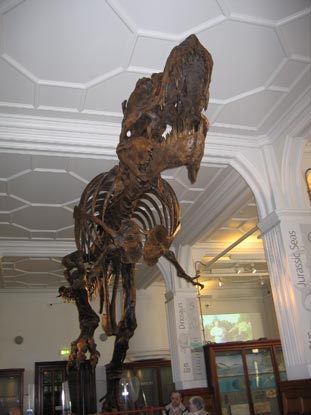
Tyrannosaurid Fossil Material – No Proteins Though

Warm-blooded dinosaurs.

T. rex skeleton on display at Manchester Museum.

Picture credit: Everything Dinosaur

The Search for Dinosaur Proteins

The claim that protein sequences (peptides) had been identified in 68-million-year-old T. rex fossils caused a sensation.  Remnants of organic material could have provided palaeontologists with tangible evidence, that one day, with ever increasing amounts of organic material being discovered, then it might just be possible to create animals reminiscent of these long extinct reptiles.  Prehistoric proteins might well have supplied the first possible glimpse of the steps towards rebuilding dinosaurs.  Think of it as “dinosaur cloning 101”.

To read an article that discusses the consequences of the original T. rex protein study: The Seemingly Impossible – the Hunt for Dino DNA.

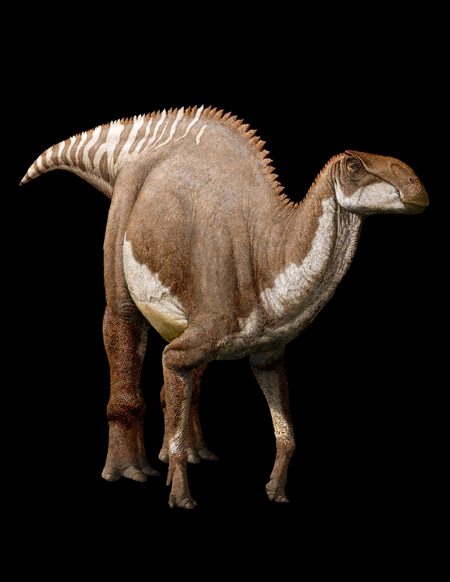
The discovery, announced in 2005, was not met with universal acceptance and it caused much debate within the scientific community.  A second study, this time on a duck-billed dinosaur Brachylophosaurus (Brachylophosaurus canadensis), undertaken by the same team identified permineralised blood vessels and further evidence of dinosaur proteins: Ancient Proteins from Duck-billed Dinosaur.  This research was carried out in 2009 and replicated in 2017.  Writing in the “Journal of Proteome Research” scientists from North Carolina State University with colleagues from North-western University and the University of Texas – Austin, repeated the 2009 study and replicated the results – claiming proteins from dinosaur collagen had been found.

Brachylophosaurus Illustrated

The Late Cretaceous Brachylophosaurus.

Brachylophosaurus illustrated.

Picture credit: Houston Museum of Natural Science

Able to Repeat the Research and Reproduce the Results

One of the main criticisms of these experiments was that it was proving extremely difficult to repeat the work and get the same results.  In addition, preventing contamination of the samples was a challenge, with many scientists casting doubts on the original research, claiming the proteins found were as a result of bacterial contamination.

Dr Mike Buckley (University of Manchester’s School of Earth and Environmental Sciences), an author of the newly published scientific paper in the “Proceedings of the Royal Society B” explained:

“The discovery of proteins in dinosaur bones sent a shockwave around the world, both among scientists and the public.  It appeared that fiction was now being converted to fact through the application of new techniques.”

A team from Manchester University and the National Museums Scotland, led by Dr Buckley set out to explore the possibility of whether the claimed dinosaur peptides could have come from contamination from modern animals, given that ostriches and alligators were used as comparators and controls in the original research.  The scientists analysed samples of bone from three different ostriches and found strong matches to all of the originally reported fossil peptides from both the T. rex and the Brachylophosaurus.

This new study emphasises the need for robust authentication criteria when attempting to identify biomolecular sequence information from truly ancient fossilised remains.

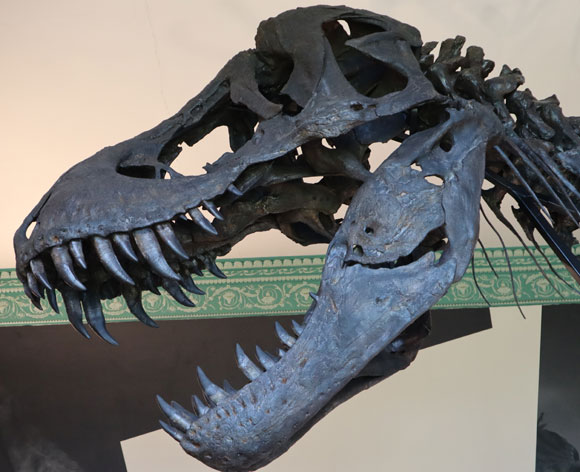
Museums Rather Than Zoos the Best Place to See a Tyrannosaurus rex

Titus the T. rex Skull and Jaws. Dinosaur extinction.

The skull of the T. rex exhibit on display at Wollaton Hall (Nottingham). Picture credit: Everything Dinosaur.

Picture credit: Everything Dinosaur

Dr Buckley stated:

“Our work set out to identify the collagen fingerprints for both ostrich and alligator and was not intending to debunk the previous studies.  However, we soon realised that our results were pulling the rug from beneath the paradigm that collagen might survive the ravages of deep time.”

Can Organic Material Survive for Millions of Years?

The big question is whether or not delicate organic remains can survive for millions of years.  There have been a number of papers published recently that have thrown up some surprising results, for example, back in 2015 Everything Dinosaur reported on the research undertaken at the Imperial College (London), that identified potential organic fibres (collagen) and cellular structures*.  

There is a growing body of evidence to suggest that the one day, we might have a much better understanding of the biology of long extinct creatures.  Microscopic remnants of collagen, a key protein within bone, has been found in several studies.  However, the survival of collagen sequences beyond 3.5 million years old has not been achieved and validated by any other team trying to replicate work carried out.

Co-author of this research and Professor of Natural History at The University of Manchester, Phil Manning, added:

“The fossil record is offering new information on a daily basis through the application of new technology, but we must never forget that when results show us something that we really want to see, that we make sure of our interpretation.  The alleged discovery of protein sequences in dinosaur bones has led many unsuccessful attempts to repeat these remarkable claims.  It seems we were trying to reproduce something that was beyond the current detection limits of our science”.

Experiments Involving the Detection of Minute Quantities of Organic Material Require the Strictest Hygiene Measures

Fossil fragment used to extract ancient DNA

“Flogging a dead horse” to extract DNA.

Picture credit: Dr Orlando

The researchers conclude that the controls used to constrain the evolutionary relationships between extinct and existing organisms have to be completely isolated from the subject of study (i.e. the dinosaur bone), so that the highly sensitive techniques do not pick-up residues of misleading contaminants.  This is leading to a false ceiling for other scientists to achieve, which in reality is highly challenging.  What was being described as dinosaur organic material, may just be the ghostly traces of the other organic material such as the protein sequences from the bird and reptile bones used in the research that are being picked up by the highly sensitive scientific instrumentation.

In conclusion, Dr Buckley stated:

“We are seeing something similar in our study, as to what happened with the ancient DNA world over twenty years ago when the scientific world had to recalibrate their aspirations when it came to the survival of this delicate molecule of life through deep time.  It seems that the idiom that exceptional claims require exceptional evidence remains.”

Regardless of the true nature of the dinosaur peptides, this new study highlights the difficulty of differentiating such sequences with confidence.  The results not only imply that cross-contamination cannot be ruled out, but that appropriate measures to test for the accuracy of the results stated should be further evaluated.

*To read more about the research undertaken by the Imperial College London: Fibres and Cellular Structures Observed in Dinosaur Fossils.

Everything Dinosaur acknowledges the help and support of the University of Manchester in the compilation of this article.

Visit the Everything Dinosaur website: Everything Dinosaur.
31 05, 2017

Oldest Swinger in Town – Torrejonia wilsoni a Remarkable Primate Revealed by New Fossil Discoveries

By |2024-05-09T08:29:32+01:00May 31st, 2017|Categories: Dinosaur and Prehistoric Animal News Stories, Main Page, Palaeontological articles|2 Comments

New Mexico’s Oldest Primate Torrejonia wilsoni

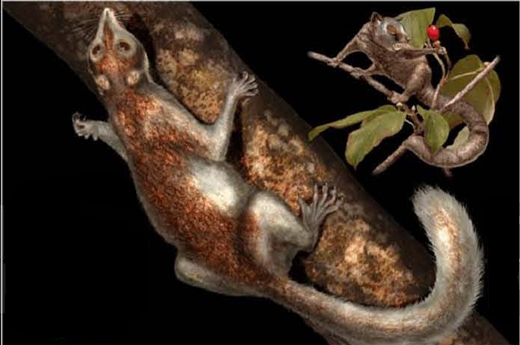
A partial fossilised skeleton of a very ancient ancestor of humans discovered in north-western New Mexico has revealed that the first primates lived in trees and that they were not obligate ground-dwellers.  More complete fossil material shows that the Palaeocene plesiadapiform known as Torrejonia wilsoni was adapted for a life in the trees.  The fossil discovery is important as most of the Palaeocene mammals associated with the first primates (Euprimates) are only known from a handful of bones and isolated teeth.

The Torrejonia wilsoni Fossil Material Indicates an Arboreal Existence

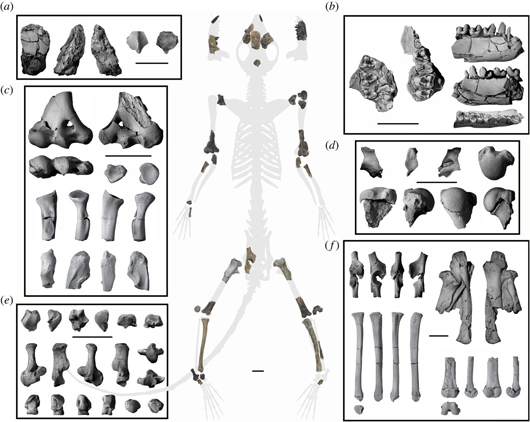
Torrejonia wilsoni fossil material (T. wilsoni).

A skeleton composite of Torrejonia wilsoni (NMMNH P-54500).

Picture credit: Royal Society Open Science

The picture shows illustrations of the fossil material of T. wilsoni (specimen number NMMNH P-54500), with the bones and teeth mapped onto a line drawing of the animal.  Scale bar equals 1 cm.

Box a = elements from the skull

b = parts of the jaws

c = arm bones

d = the shoulder blade (scapula- fragmentary)

e = elements from the astragalus (ankle)

Box f = leg bones

Getting into the Swing of Things Once the Dinosaurs Had Died Out

It may sound surprising, but one of the first groups of mammals to rapidly diversify and to become more specious after the extinction of the dinosaurs were the Euarchonta (tree shrews, colugos and primates).  These creatures have their origins in the Late Cretaceous and with the extinction of the non-avian dinosaurs, within a few million years, a number of new Euarchonta families had evolved.  The sediments that form the Early Palaeocene Nacimiento Formation (San Juan Basin, New Mexico), are one of the most important lithological units for fossils of these small mammals.

A fragmentary skeleton of the plesiadapiform Torrejonia wilsoni found in Torrejonian-aged deposits (NALMA – North American Land Mammal Ages), dating to around 62 million-years-ago, indicates that this animal had an arboreal existence.  Previously, many researchers had proposed that the plesiadapiforms, an extinct group of primitive placental mammals, close to the ancestry of primates, had been terrestrial creatures.  However, unlike most of the fossils associated with this group of mammals, this specimen of T. wilsoni provided scientists with key insights into the animal’s limbs and joints and a subsequent analysis revealed that it would have been at home in the trees.

Illustrations of Typical Plesiadapiforms

Illustrations of plesiadapiforms.

Illustrations of plesiadapiforms Plesiadapis cookei (centre) and Carpolestes simpsoni (top right).

Picture credit: DMP (Princeton Field Guild to Prehistoric Mammals)

Torrejonia wilsoni

Dr Thomas Williamson (New Mexico Museum of Natural History and Science), one of the authors of the academic paper published today in the on-line journals of the Royal Society Open Science found the fossil material with his twin sons Ryan and Taylor.  Teeth associated with the skeleton allowed the researchers to identify the fossil material as T. wilsoni, no easy task as the skeleton was found jumbled up and mixed in with two other mammals, a partial skeleton of Acmeodon secans and an almost complete skeleton of Mixodectes pungens.

Lead author of the study, Stephen Chester (University of New York) stated:

“This is the oldest partial skeleton of a plesiadapiform and it shows that they undoubtedly lived in trees.  We now have anatomical evidence from the shoulder, elbow, hip, knee and ankle joints that allows us to assess where these animals lived in a way that was impossible when we only had their teeth and jaws”.

In addition, the research team contend that all of the geologically oldest primates known from skeletal remains, encompassing several species, were tree-dwellers.  It seems that the plesiadapiforms, the last of which died out in the Late Eocene, had forward facing eyes and relied more on smell than living primates do.  Analysis of the skeleton of Torrejonia wilsoni places plesiadapiforms as a transitional group between other mammals and the true primates.

Visit the Everything Dinosaur website: Everything Dinosaur.
30 05, 2017

Digging It Up in the City

By |2023-07-23T08:41:45+01:00May 30th, 2017|Categories: Dinosaur and Prehistoric Animal News Stories, Dinosaur Fans, Main Page, Photos/Pictures of Fossils|0 Comments

Dinosaur Excavation Work Starts in Yanji City

Palaeontologists at the Chinese Academy of Sciences (CAS), are used to working in all sorts of environments as they strive to excavate the wealth of dinosaur fossils to be found at key locations in China.  This week, a field team will be starting work at a new dig site, one with all the conveniences of a modern city, as the excavation work will be taking place in Yanji City, (Jilin Province, north-eastern China), with an approximate population of 400,000 people, the scientists will not be short of company.

Chinese Dinosaur Fossils

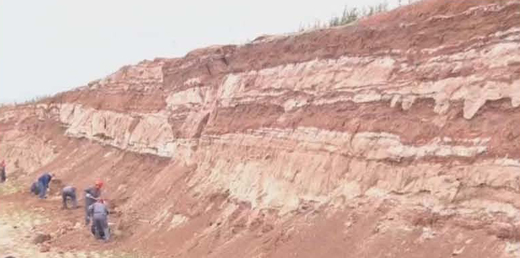
Field Team Members Begin Exploring the Cretaceous Strata

Yanji City dinosaur excavations.

Field team workers exploring the Cretaceous sediments in Yanji City.

Picture credit: Chinese Academy of Sciences

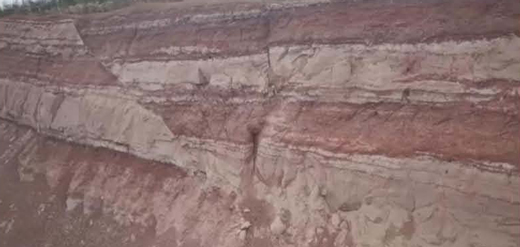
In a press release from the CAS, it is stated that the dinosaur fossil excavation will cover an area of approximately ten square kilometres and this is the first excavation of its kind to be carried out in a modern urban area.  Although the strata in the Yanji Basin is known for its substantial plant fossil remains, including flowering plants (angiosperms), this is the first time that dinosaur fossils have been discovered in Yanji City.  Experts state that the different coloured bands of strata represent non-marine sediments that were laid down when this area was experiencing climate change.

Zhang Lizhao, a researcher at the Institute of Vertebrate Palaeontology and Palaeoanthropology (IVPP) commented:

“We can see that the geological layers show different colours including red, purplish red and light colours.  The geological layer with the colour of purplish red means that, when the layer was formed, the dinosaurs lived in a hot and humid climate.  The layers with the light colours were formed during periods with dry and cold weather. We are basically sure that the geologic body here was formed between the late Early Cretaceous and the very early Late Cretaceous.”

Dinosaur Fossil Discoveries

The rocks being explored are around 100 million years of age, they represent sediments laid down between the Albian faunal stage (the last faunal stage of the Lower Cretaceous) and the Cenomanian stage, the first faunal stage of the Upper Cretaceous, a time when global sea levels were extremely high and many terrestrial animal populations were consequently isolated.  Dinosaur fossils from the Lower Cretaceous to the Upper Cretaceous transition are relatively rare and these excavations could perhaps provide new information on the evolution of different types of dinosaur especially the Titanosauriformes, Ceratopsia and theropods.

The Very Distinct and Striking Bands of Strata at the Dig Site

Rock formations of Yanji City (north-eastern China).

Yanji City rock formations.

Picture credit: Chinese Academy of Sciences

The picture above shows the clearly defined bands of strata.  Observers can see a defined fault line in the photograph.  Jilin Province is prone to earthquakes and other seismic activity.

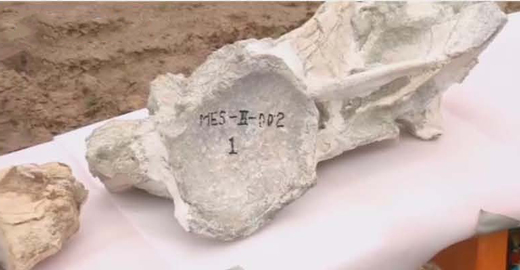
A Large Dinosaur Dorsal Vertebra (right) Partial view of Articulated Caudal Vertebrae (left)

Yanji City dinosaur fossils (vertebrae).

Isolated dorsal vertebrae (potential titanosauriform) right with partial view of two articulated caudal vertebrae on the left.

Picture credit: Chinese Academy of Sciences

The picture above shows some of the fossil found, the centrum of the dorsal vertebra has been labelled for identification purposes.  Everything Dinosaur team members have identified these bones as from probable titanosauriforms.

Fossil Material Uncovered at the Dig Site

Partial dinosaur limb bone.

Dinosaur limb bone (partial).

Picture credit: Chinese Academy of Sciences

Six Different Types of Dinosaur

Researchers have commented that at least six different types of dinosaur may have inhabited this part of China around 100 million years ago. They are confident that much more fossil material will be found helping palaeontologists to better understand the biota of this part of the world during a time of climate change.

A spokesperson from Everything Dinosaur commented:

“The fossils found at this extensive site in Yanji City, will add to our knowledge of terrestrial faunas during the Albian to Cenomanian transition.  It is likely that a number of new dinosaur species will be identified.”

The Everything Dinosaur website: Everything Dinosaur.

26 05, 2017

The Curious World of Pliosauridae Research

By |2023-07-23T06:52:12+01:00May 26th, 2017|Categories: Dinosaur and Prehistoric Animal News Stories, Dinosaur Fans, Main Page|0 Comments

Bucking the Trend – Luskhan itilensis

Writing in the academic journal “Current Biology”, a team of international scientists which includes Roger Benson and Valentin Fischer (Department of Earth Sciences, Oxford University), have published details of a new species of ancient marine reptile, a short-necked plesiosaur that bucks the trend for the Pliosauridae.  Instead of being an apex predator, roles traditionally applied to monstrous animals such as Kronosaurus, Liopleurodon, the recently described (2013), Megacephalosaurus and Pliosaurus, the first of these large-bodied, big-skulled reptiles to be scientifically described, this new species probably hunted an entirely different sort of prey.

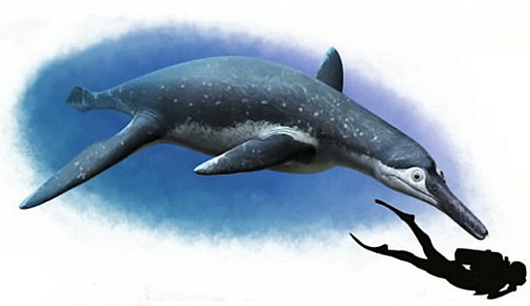
An Illustration of the Newly Described Pliosaurid – Luskhan itilensis

Luskhan itilensis.

An illustration of the pliosaurid Luskhan itilensis from Russia.

Picture credit: Andrey Atuchin

Feeding on Squid and Small Fish?

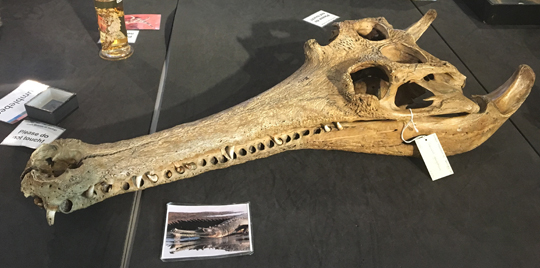
The rostrum of the newly described, highly unusual pliosaurid, is very narrow and it resembles the jaws of extant fish-eaters today such as the rare Gharial and the almost equally endangered (or, in the case of the Yangtze River Dolphin functionally extinct*) River Dolphins.

The Yangtze River Dolphin (Baiji)

The skull of a gharial.

The skull of a gharial from the Grant Museum of Zoology (London).  Picture credit: Everything Dinosaur.

Picture credit: Everything Dinosaur

The long snout suggests that this newly described pliosaur, named Luskhan itilensis specialised in catching small fish and squid.  Many palaeontologists suggest that the Pliosauridae were not capable of diving to great depths and they were confined to the Epipelagic zone (from the ocean surface to a depth of approximately 200 metres), whereas Sperm Whales, the largest toothed predators today, are capable of diving to much greater depths in pursuit of squid and other prey.

“Master Spirit of the Volga”

The fossilised remains of the marine reptile were initially discovered in the autumn of 2002 by one of the co-authors of the scientific paper Gleb N. Uspensky (Natural Science Museum, Ulyanovsk State University, Ulyanovsk, Russia).  The material comes from the right bank of the Volga, near to the town of Ulyanovsk, the bedding plane from which the fossil material, including a 1.5-metre-long skull was excavated, dates from the Lower Cretaceous (Hauterivian faunal stage).

Luskhan itilensis

Pliosaurids (Pliosauridae) are a family within the Order Plesiosauria.  They typically have large skulls, powerful jaws, a rigid body and propelled themselves through the water using their four flippers, although recent studies have shown that only the front pair of flippers were involved in propulsion.  The flight of the Plesiosauria: The Plesiosauria, Penguins and Underwater Flight.  The Plesiosauria swam in a unique way, not found in other vertebrates and now it seems that one group, the Pliosauridae, adapted to a wider range of ecological niches than previously thought.

Luskhan itilensis (the name means “Master Spirit of the Volga”), very probably did not specialise in hunting other marine reptiles, it filled a different role in the marine ecosystem of the Early Cretaceous.

Commenting on the significance of the discovery, Dr Valentin Fischer (Oxford University and lecturer at the University of Liège), the lead author of the study, stated that the specialised jaw:

“Is the most striking feature, which suggests that Pliosaurs had colonised a much wider range of ecological niches than previously thought.”

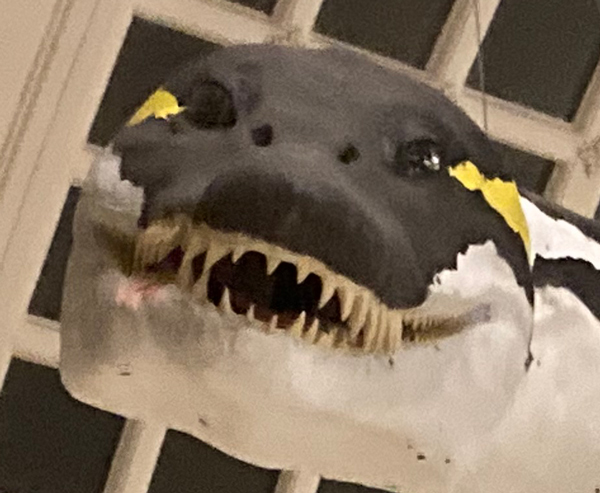
Not All Pliosaurs were Apex Predators

"Deadly Doris" pliosaur replica.

A close-up view of the pliosaur that is suspended above the ground floor at the Bristol Museum and Art Gallery (Bristol, England). The life-size replica was nicknamed “Deadly Doris”. Picture credit: Everything Dinosaur

Picture credit: Everything Dinosaur

Postcranial Plasticity (Repeatedly Evolving Long and Short-Necked Body Plans)

Of all the types of marine reptiles that evolved during the Mesozoic, the Plesiosauria was one of the most successful, having a fossil record of some 140 million years or so.  During their long evolutionary history, plesiosaurs repeatedly evolved long and short-necked body plans.

In general terms, the Plesiosauria can be split into two sub-groups, the short-necked Pliosauridae and the longer-necked plesiosaurs, although this is an over simplification.  The discovery of Luskhan, further muddies the evolutionary waters somewhat, as its skull shows affinities to the very distantly related Polcotylidae.  A family of plesiosaurs, on the long-necked lineage side of the family tree, which evolved into fast-swimming fish hunters.

Study of the skull of L. itilensis indicates an evolutionary convergence of the cranial structure of typical polycotylids such as Dolichorhynchops.  Distantly related animals evolve and ultimately resemble one another because they occupy similar ecological niches, such as the same hunting and feeding strategies.

The researchers conclude that the discovery of Luskhan itilensis demonstrates the ecological diversity of the Pliosauridae and reveals that these marine reptiles had a more complicated evolutionary history than their simple depiction as apex predators suggests.

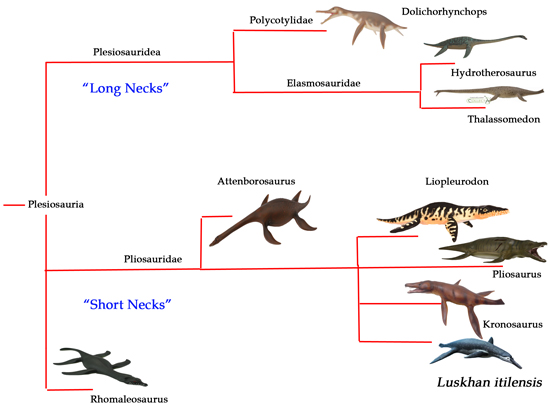
CollectA Models Help Demonstrate Cladistic Relationships Within the Plesiosauria

Plesiosauria cladistics.

Cladistic relationships in the Plesiosauria (simplified and not to scale).

Picture credit: Everything Dinosaur with the utilisation of an illustration by Andrey Atuchin

The picture above shows a simplified view of the taxonomic relationships between members of the Plesiosauria.  The length of the lines do not relate to geological age and the images of the animals are not to scale.

CollectA Prehistoric Life and Deluxe replicas have been used to illustrate the cladogram.  To view the range of marine reptile models available from Everything Dinosaur: CollectA Deluxe Prehistoric Life Models.

CollectA Age of Dinosaurs Popular models: CollectA Prehistoric Life Figures.

The researchers conclude that the apex predator niche associated with the Pliosauridae does not necessarily reflect the diversity of this marine reptile family and that the pliosaurs repeatedly evolved long-jawed, specialist fish and squid catchers during their extensive evolutionary history.

* Functionally extinct – so few animals that there is no viable breeding population.

The Scientific Paper: “Plasticity and Convergence in the Evolution of Short-Necked Plesiosaurs” by Valentin Fischer, Roger B.J. Benson, Nikolay G. Zverkov, Laura C. Soul, Maxim S. Arkhangelsky, Olivier Lambert, Ilya M. Stenshin, Gleb N. Uspensky, Patrick S. Druckenmiller.

Visit the award-winning Everything Dinosaur website: Everything Dinosaur.
25 05, 2017

Amazing Ceratopsid Tooth Paper Published (Part 2)

By |2024-05-09T08:26:02+01:00May 25th, 2017|Categories: Dinosaur and Prehistoric Animal News Stories, Dinosaur Fans, Main Page|0 Comments

Owl Creek Ceratopsid Tooth and Palaeoenvironment Implications

Yesterday, team members at Everything Dinosaur published an article on the discovery of a single fossil ceratopsid tooth. It had been found in Union County (Mississippi).  This discovery, the first evidence of a dinosaur from the Owl Creek Formation, has implications for the way in which palaeontologists perceive the ecosystems that existed on the ancient landmasses of Laramidia and Appalachia.

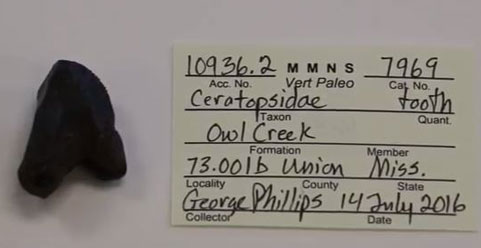
Museum Specimen 7969- The Ceratopsid Tooth

Fossil tooth of a dinosaur from Mississippi.

Horned dinosaur tooth discovered in Mississippi.

Picture credit:  Mississippi Museum of Natural Science (MDWFP)

To read yesterday’s article: Ceratopsid Tooth Paper Published (Part 1).

Why So Few Horned Dinosaur Fossils Found in Marine Sediments?

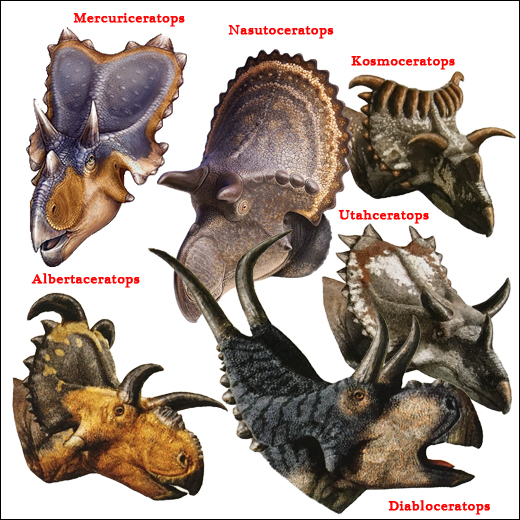
Palaeontologists know that during the latter stages of the Cretaceous, there were many different types of horned dinosaur (ceratopsian).  Lots of fossil evidence has been discovered in western North America and a myriad of different forms have been described, particularly over the last ten years or so.  The likes of Triceratops may have first been described back in the late 1880s but so many different horned dinosaur genera have been established in recently times, that numerous vertebrate palaeontologists refer to the last decade as the “Golden Age of Horned Dinosaur Discoveries”.

New Ceratopsian Faces Since 2007

So many different horned dinosaurs.

Illustrations of different horned dinosaurs that have been named since 2006.

Picture credit: Everything Dinosaur with artwork from Julius Csotonyi, Danielle Dufault and the Canadian Museum of Natural History/Andrey Atuchin

Despite all these horned dinosaur fossil discoveries, the Owl Creek Formation tooth, is one of only a handful of North American ceratopsian fossils which have been found associated with marine strata.  The question is why?

Duck-billed Dinosaur Fossils in Marine Sediments

Compared to other types of Late Cretaceous dinosaur – ceratopsids, theropods, ankylosaurids, et al, hadrosaur fossils are the most common dinosaur fossils to be found in marine rocks laid down towards the end of the Cretaceous.  Duck-billed dinosaur fossils in marine sediments, are hardly what you would call abundant, but in relation to other large, obviously terrestrial dinosaurs, hadrosaur fossils are more numerous in those rocks associated with having been laid down under the sea.

Although the fossil record shows a degree of bias, dinosaurs such as some of the smaller theropods and the Pachycephalosaurs may be under-represented for example, this still does not explain why, compared to the hadrosaurs, the almost equally specious and abundant horned dinosaurs don’t show up in marine deposits.  Ceratopsians may have preferred slightly different habitats than the hadrosaurs.  Research undertaken in 2010 (Eberth), suggested that most of the horned dinosaur fossil remains were associated with lake, alluvial or coastal plain habitats, at least amongst the Ceratopsidae family.

Ceratopsians Such as Triceratops May Have Preferred Different Habitats Compared to Hadrosaurs

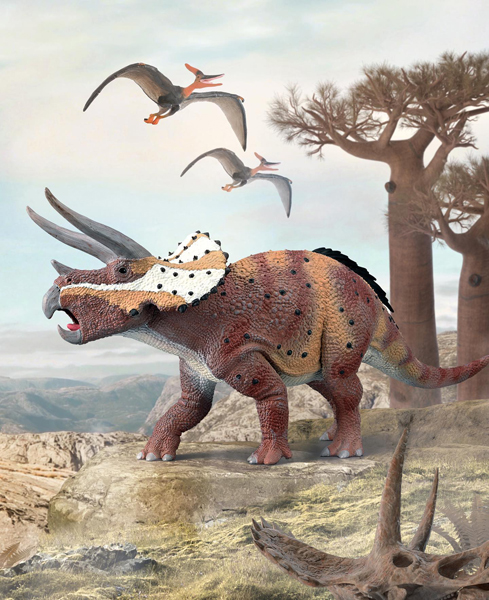
Ceratopsian habitats highlighted by the CollectA Deluxe Triceratops horridus.

Ceratopsian habitats highlighted by the CollectA Deluxe Triceratops horridus.

The picture (above) shows at CollectA Deluxe Triceratops model.

To view the CollectA Deluxe range: CollectA Deluxe/Supreme Figures.

The alluvial, low-lying wetland areas are strongly associated with river channels and these specific areas can be divided into two distinct parts.

  1. The riparian influenced part – the river and the river/channel margins.
  2. The floodplain – areas not adjacent to the river or the channel margins but flooded by the river when the river burst its banks.

Horned Dinosaurs Associated with Floodplains

Put into simple terms, dinosaurs such as Triceratops have left fossils associated with floodplain (muddy) deposits, whereas, duck-billed dinosaurs such as Edmontosaurus fossils are more associated with fluviatile (sandy) deposits.

If transport along river channels are the most common cause of “bloat and float” carcases, then, the lack of horned dinosaur fossils in marine sediments could be explained by ceratopsids, preferring to live on those parts of the floodplain, not very near to the river.  They may have had a preference for habitats outside of the riparian zones.

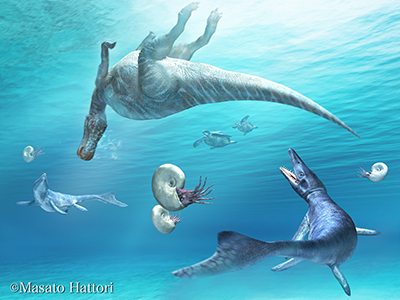
A Hadrosaur Corpse Floating Out to Sea (Bloat and Float Scenario)

Dinosaur corpse washed out to sea.

An artist’s illustration of the duck-billed dinosaur carcase washed out to sea.

Picture credit: Masato Hattori

Visit the website of Everything Dinosaur: Everything Dinosaur.

24 05, 2017

Amazing Ceratopsid Tooth Paper Published (Part 1)

By |2024-05-09T08:26:25+01:00May 24th, 2017|Categories: Dinosaur and Prehistoric Animal News Stories, Dinosaur Fans, Main Page|0 Comments

Paper on the First Reported Horned Dinosaur Tooth from Eastern North America Published

In July 2016, Everything Dinosaur team members reported the discovery of a single tooth from a horned dinosaur in North America.  Given the dental batteries that these herbivorous dinosaurs possessed, that teeth, being extremely hard, stand up well to the fossilisation process and given the number of new North American ceratopsid species named in the last decade, this fossil find might not sound that surprising.

It’s not really about what was found, but where it was found, as the fossil tooth is the first horned dinosaur tooth to come to the attention of the scientific community from the eastern part of the United States.  To a palaeontologist this is a big deal, a very big deal indeed!

Views and Accompanying Computer Generated Images of the Single Tooth

Ceratopsid tooth from eastern North America.

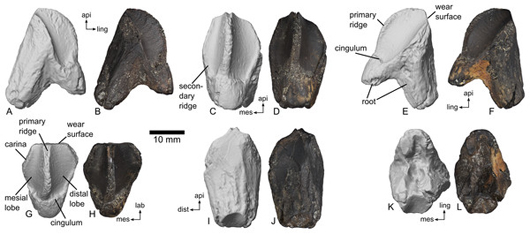
Various views of the horned dinosaur tooth (Own Formation, northern Mississippi).

Picture credit: PeerJ

To read Everything Dinosaur’s earlier article about the ceratopsid tooth fossil find: Horned Dinosaur Tooth Discovered in Northern Mississippi.

North America in the Late Cretaceous – A Tale of Two Landmasses

A variety of different types of horned dinosaur evolved in the western part of North America during the Late Cretaceous (Campanian faunal stage through to the Maastrichtian faunal stage).  However, during this period in Earth’s history, the landmass we now know as North America looked very different.  The continent was split into two parts, by a large, shallow sea (Western Interior Seaway).  At its fullest extent, this shallow sea stretched from the Gulf of Mexico, through the United States and Canada to the Arctic circle.

Size estimates vary, but it has been suggested (U.S. Geological Survey), that at its maximum, the sea was between 1,900 and 3,000 miles long between 600 to 1,000 miles in diameter.  Bordering the sea in the west was the long, narrow strip of land – Laramidia, whilst to the east, the landmass called Appalachia could be found.  Sea levels rose and fell over this period, eventually the Western Interior Seaway contracted, retreating south as plate movements pushed up the landmasses.  At the time of the dinosaur extinction, this once great area of tropical sea was reduced to a strip of water around the Gulf of Mexico, covering parts of the south-western USA.

Horned Dinosaurs Migrated from Laramidia to Appalachia

The dinosaur tooth, a single fossil specimen from the right side of the lower jaw (right dentary), was discovered by George Phillips, (curator of Palaeontology at the Mississippi Museum of Natural Science), as he explored a stream bed in Union County (Mississippi), that is known to yield marine fossils that date from the very end of the age of dinosaurs (Maastrichtian faunal stage).

The tooth was found in association with a mosasaur tooth, ammonite remains, brachiopods and other fossils.  Based on the stratigraphic evidence and the fossil assemblage associated with the tooth, the authors of the scientific paper, published in PeerJ, conclude that this tooth provides evidence that at some time during the very Late Cretaceous horned dinosaurs were able to migrate from Laramidia to Appalachia over a land bridge.

George commented:

“A land bridge before the end of the Cretaceous could have allowed horned dinosaurs to migrate or disperse through Texas or Arkansas, right before they were all killed in the calamity [a reference to the K/Pg impact event].”

Chasmosaurines Went East

Migrating Chasmosaurine dinosaurs into eastern North America.

A potential horned dinosaur migration route into eastern North America.

Picture credit: PeerJ with additional annotation by Everything Dinosaur

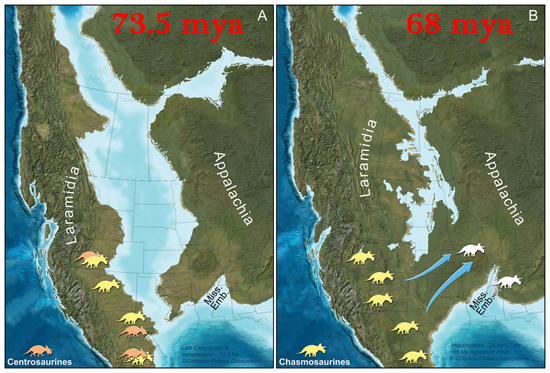
The picture shows two views of North America in the Late Cretaceous (A) around 73.5 million years ago (mya) and (B) around 68 million years ago (mya).  The authors suggest that horned dinosaurs were able to migrate eastwards from Laramidia into the Mississippi Embayment (Miss Emb), area of Appalachia.  Only Chasmosaurine horned dinosaurs are shown migrating into Appalachia (B).  The identity of the horned dinosaur to which the tooth belonged, is unknown, but if the land bridge existed towards the very end of the Cretaceous, then by this date centrosaurine dinosaurs may well have become extinct in North America.  No fossils of ceratopsids assigned to the Centrosaurinae clade have been found in rocks dating from the Late Maastrichtian.

A Typical Ceratopsian Tooth

Tooth of a Triceratops.

A typical tooth of a ceratopsian with its two distinct dental roots. Picture credit: Everything Dinosaur.

Picture credit: Everything Dinosaur

The picture above shows a typical ceratopsian tooth, from the Chasmosaurine Triceratops.  The fossil tooth from the Owl Creek Formation is the first evidence of dinosaurs to have been found in this formation, (the tooth is the first large, terrestrial animal fossil to have been found in the very well-known and thoroughly explored Owl Creek Formation).  It shows the typical ceratopsid tooth features, including the double root, and a prominent, blade-like carina (serrated edge).

The specimen (MMNS VP-7969), shows little sign of wear so it is unlikely that this fossil had been transported a great distance from where it was found.  It is tantalising to think, that perhaps, a little further upstream more horned dinosaur fossils are awaiting discovery, yet to be exposed by erosion.

Not Reworked and No Floating Carcase from Laramidia

The researchers reject the idea that the tooth has ended up in the stream bed having been eroded out of other rocks and re-deposited in the Owl Creek Formation.  The tooth is too pristine and therefore reworking from notably older Cretaceous-aged rocks is rejected.  In addition, the authors of the paper, Dr Andrew Farke (Raymond M. Alf Museum of Palaeontology, Claremont, California) and George Phillips, discount the idea that the tooth came from a carcase of a horned dinosaur that floated across from Laramidia.

The tooth, they postulate, provides evidence of a land bridge and that at least one kind of dinosaur migrated eastwards to populate the other half of the North American landmass.

A Model of the Late Cretaceous Horned Dinosaur Triceratops (T. horridus)

Nanmu Studio Heavy Lance Triceratops

The Nanmu Studio Heavy Lance Triceratops (tricolor version) dinosaur model (in lateral view).

Picture credit: Everything Dinosaur

To view the range of ceratopsian figures in stock at Everything Dinosaur, as well as other dinosaur models: Dinosaur and Prehistoric Animal Models.

The scientific paper: “The First Reported Ceratopsid Dinosaur from eastern North America (Owl Creek Formation, Upper Cretaceous, Mississippi, USA) by Andrew A. Farke and George E. Phillips published in the journal “PeerJ”.

This fossil discovery provides an intriguing insight into Late Cretaceous palaeoenvironments and the types of dinosaurs that inhabited them, more about this in a follow-up article.

Visit the Everything Dinosaur website: Everything Dinosaur.
23 05, 2017

New Dinosaurs of China Exhibition Coming to Nottingham

By |2024-05-09T08:26:54+01:00May 23rd, 2017|Categories: Dinosaur and Prehistoric Animal News Stories, Dinosaur Fans, Educational Activities, Main Page, Teaching|0 Comments

Major Feathered Dinosaur Exhibition Coming to Nottingham

An exhibition highlighting the evolution of feathered dinosaurs is coming to the UK.

The idea that dinosaurs are not extinct might ruffle a few feathers.  However, the Dinosauria essentially consists of two parts, avian dinosaurs (birds) and non-avian dinosaurs, iconic prehistoric animals such as Tyrannosaurus rex, Stegosaurus and Triceratops. It is the bird lineage, that is very much still with us today.  No need to get into a flap if this statement confuses, a major dinosaur exhibition starting this summer will provide all the answers.

Dinosaurs of China Exhibition Coming to Nottinghamshire

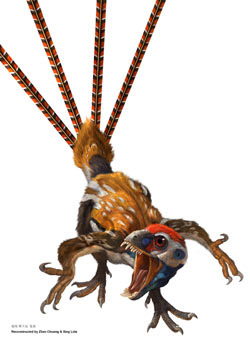
Sinornithosaurus

One of the stars of the “Dinosaurs of China” exhibition – Sinornithosaurus.

Picture credit: Zhao Chuang

A Once-in-a-Lifetime Event

Opening its doors on the 1st of July, the “Dinosaurs of China – Ground Shakers to Feathered Flyers” exhibition will tell the story of how one group of dinosaurs evolved into birds and you can expect to meet an incredible cast of characters on the way.  Located at two venues, (Wollaton Hall and the Nottingham Lakeside Arts Centre), this family-friendly dinosaur exhibition provides a once-in-a-lifetime opportunity to view amazing fossils and skeletons that have never been outside of Asia before.

For models of feathered dinosaurs and other prehistoric animals: Everything Dinosaur and Prehistoric Animal Models.

Ground Shakers and Feathered Dinosaurs

Highlights of the exhibition will include an enormous, rearing long-necked dinosaur Mamenchisaurus that looks down at you from a head height of thirteen metres, that’s twice as high as a giraffe!  If the mighty double-decker-bus-sized Mamenchisaurus doesn’t get your young dinosaur fans roaring with excitement then look out for Sinraptor, a vicious carnivorous dinosaur that once roamed China some 160 million years ago. With a skull almost a metre in length and a set of powerful jaws lined with serrated teeth, Sinraptor was a formidable predator, one that could probably run faster than you!

Had you been around in the Late Jurassic and been unfortunate to meet this hypercarnivore, Sinraptor would very probably have viewed you as potential prey and tried to eat you.

The Fearsome Sinraptor (S. dongi)

PNSO Sinraptor dinosaur model

The stunning PNSO Xinchuan the Sinraptor dinosaur model.

See Sinraptor Fossils

The model shown above is a PNSO Sinraptor.

To view the PNSO range of prehistoric animal models: PNSO Age of Dinosaurs Models and Figures.

If you like meat-eating dinosaurs, take time out to visit the bizarre double-crested Dilophosaurus on display at the Nottingham Lakeside Arts Centre and whilst there, sign up for one of the exciting dinosaur themed activities, all aimed at educating and inspiring the next generation of young palaeontologists.  A comprehensive programme of prehistoric animal arts, crafts, fossil exploration, workshops and story-telling has been designed to run in conjunction with the exhibition.  Booking early is recommended to avoid disappointment.

Running from 1st July through the summer holidays and ending on the 29th October, the “Dinosaurs of China” exhibition provides a rare opportunity to get up close to some of the most astonishing and scientifically important fossil discoveries ever made.

Feathered Flyers and Feathered Dinosaurs

Telling the story of how dinosaurs evolved into birds, the carefully crafted exhibition will entertain, inform and enthral, with visitors getting the chance to meet a dinosaur ensemble including several bizarre members of the Dinosauria.  Take the buck-toothed Epidexipteryx (pronounced epi-decks-ip-ter-icks) for example, a dinosaur that may have lived like a squirrel and winkled grubs out of tree holes like an aye-aye.

Dinosaurs Don’t Get Much Stranger than Epidexipteryx

The dinosaur called Epidexipteryx hui.

Epidexipteryx hui

Picture Credit: Zhao Chuang, Xing Lida/Nature

For further information about this exciting dinosaur exhibition coming to the UK this summer visit the Wollaton Hall website.

Visit Everything Dinosaur’s website: Everything Dinosaur.
21 05, 2017

Megazostrodontidae and Molars Explored in New Scientific Paper

By |2024-05-09T08:27:35+01:00May 21st, 2017|Categories: Dinosaur and Prehistoric Animal News Stories, Dinosaur Fans, Main Page|0 Comments

Wareolestes rex – Uniting English Teeth with a Scottish Jawbone

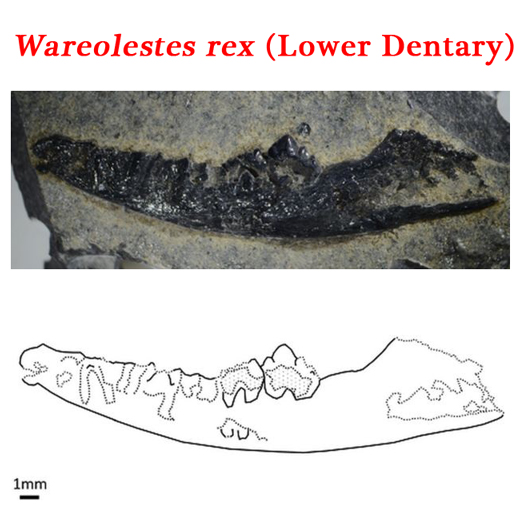
This month has seen the publication of a scientific paper on one of the lesser known animals of the Middle Jurassic, a very distant ancestor of us and one that roamed the land that we now know as the United Kingdom.  The fossil collection attributed to the morganucodontan Wareolestes (W. rex), an animal named from four isolated teeth found in Oxfordshire (England), has increased with the description of a partial jawbone (left dentary), complete with several teeth.

Writing in the publication of the Palaeontological Association, the researchers from Oxford University and the National Museums of Scotland, conclude that this animal had milk teeth, as adult teeth were identified that had not yet erupted through the jawline.  This means that this little mammaliaform (close to a true mammal but not quite), was a juvenile and the jaw fossil indicates that Wareolestes replaced its teeth once, just like humans, dogs, cats, horses and many other types of extant mammal.

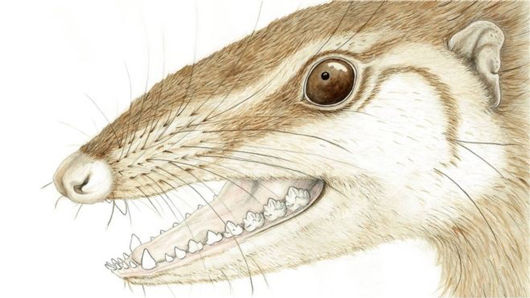
An Illustration of the Head of Wareolestes rex

The Middle Jurassic mammaliaform (W. rex).

An illustration of Wareolestes rex.

Picture credit: Elsa Panciroli

In addition, the pattern of tooth replacement reflects an important stage in mammalian evolution and is linked to the production of milk to feed offspring.  This discovery marks the first time that mammaliaform tooth replacement has been identified from Scottish fossil material.

Jawbone from the Isle of Skye

The two-centimetre-long jawbone was found on the Isle of Skye (Kilmaluag Formation), in rocks that were laid down some 165 million years ago, when this part of the world consisted of tropical islands surrounded by a warm shallow sea (Bathonian faunal stage).  The Middle Jurassic was an important time for mammalian evolution, unfortunately, there are very few fossil bearing exposures around the world that record evidence of life on our planet during this important period.  The Isle of Skye is one of these locations, along with a handful of other places including the western United States.

To read more about Scotland’s Mid Jurassic heritage: What Does Scotland Have in Common with Wyoming?

Linking English Teeth to a Scottish Jaw

The teeth and the newly described jawbone, although tiny by the standards of most dinosaurs, the dentary of Wareolestes is about as big an average sized tooth in the lower jaw of Megalosaurus (M. bucklandii), tells palaeontologists that Wareolestes was quite big for a mammaliaform.  Wareolestes grew to be around the size of a pet guinea pig, not massive, but most of the Middle Jurassic mammaliaforms were not much bigger than shrews.

Wareolestes rex was named and described from those few isolated teeth found in Oxfordshire.  Controversy surrounded the first tooth to be found, the holotype.  Scientists were not sure whether the tooth represented a tooth from the upper (maxilla) or lower jaw (dentary), they were not sure from which side of the mouth the tooth came from.  An analysis of the holotype tooth with the newly described Scottish jawbone clarifies the situation.  The original tooth from the Kirklington mammal beds in Oxfordshire came from the left side of the lower jaw (dentary).

The Fossil Jaw and a Line Drawing

Jawbone and line drawing of Wareolestes jawbone fossil.

The fossil jawbone from the Isle of Skye (Wareolestes).

This little fur-covered animal, may have been nocturnal, a strategy that would have helped the guinea pig-sized Wareolestes avoid predators – crocodylomorphs and theropod dinosaurs for example.  Like other morganucodontans, it was probably insectivorous.  Careful CT scans and the creation of three-dimensional fossil images, allowed the English and Scottish-based researchers to identify the unerupted replacement teeth in the jaw.  Had this Wareolestes perished just a few weeks later, then it is very likely that the adult teeth would have been in place and scientists would not have had confirmation of the diphyodont (two sets of teeth), nature of this little beastie.

The Specialised Teeth of Mammals

Mammals have specialised teeth, canines, incisors, molars and such like.  Reptiles in contrast, have dentition that tends to be more homogeneous (all similar shapes).  Wareolestes had teeth very similar to those of a modern mammal.  This animal had “milk” teeth which were replaced by “adult” teeth as the animal grew.  It can be inferred from this that adult females looked after and nurtured their young.  Milk may have been secreted from modified pores for their offspring to lap up.  There may have been small grooves or channels in this patch of skin with the milk pore, to help the liquid pool and collect so that the baby Wareolestes could feed.

This is an exciting discovery and we are looking forward to hearing more about fossil finds from the field work on the Isle of Skye.  Researchers from Oxford University (England) and the National Museums of Scotland (Scotland), have found a jawbone fossil (Scotland) that solves a mystery surrounding some isolated teeth found decades earlier in England.  The story has a sense of closure about it, just like the fitting cusps and crowns associated with those specialised teeth of mammals.  However, we suspect that the dedicated team behind this particular piece of research will publish more papers about Middle Jurassic fossil finds, we can’t wait to get our teeth into them.

19 05, 2017

Say it with Flowers from the Danian to be Exact

By |2023-07-22T21:43:26+01:00May 19th, 2017|Categories: Dinosaur and Prehistoric Animal News Stories, Dinosaur Fans, Main Page, Palaeontological articles|0 Comments

Flowering After a Disaster – Oldest Buckthorn Fossilised Flowers

Next week sees the start of the prestigious Chelsea Flower Show.  The great and the good will be attending this Royal Horticultural Society event, regarded by many gardeners and growers as the highlight of the year.  Today, Everything Dinosaur turns its attention to a paper published earlier this month in the journal PLOS ONE.  A team of researchers have found fossils of flowering plants that were once growing in Argentina, not long after, (in geological terms anyway), the global catastrophe that wiped out the non-avian dinosaurs.  The fossils represent plants of the Rhamnaceae family, commonly referred to as Buckthorns.  These plants have a global distribution today and a number of species can be found in parks and gardens in the UK.

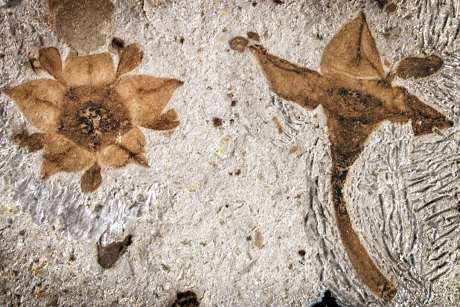
Two Fossilised Flowers Identified as Members of the Rhamnaceae Family (Buckthorn)

Two Buckthorn flower fossils.

Two fossilised Buckthorn flowers next to each were discovered in shales of the Salamanca Formation in Chubut Province, Patagonia, Argentina.

Picture credit: Nathan Jud/Cornell University (USA)

Flowering After the Fern Spike

A lot has been written about the mass extinction event that marked the demise of the non-avian Dinosauria, some 66 million years ago.  However, as well as the dinosaurs, pterosaurs and many kinds of marine reptile, other groups of animals (and plants), were devastated in the impact event and its aftermath.  Plant families were decimated too and researchers have been examining strata that were laid down in the years following the end Cretaceous extinction event in a bid to assess how ecosystems recovered.

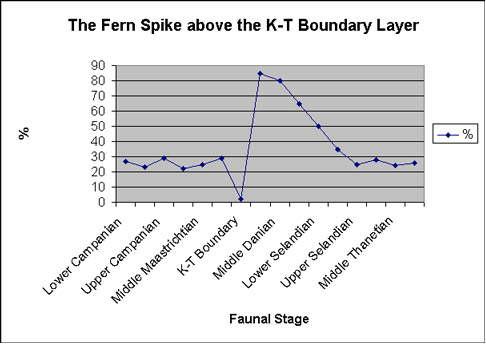
Micro-fossil studies indicate that it was the ferns that were the first major group of plants to recover after the end Cretaceous mass extinction.  In the Late Cretaceous (Maastrichtian faunal stage), fern spores make up around 10 to 25% of the plant micro-fossil assemblage.  In Danian Epoch deposits, laid down at the very beginning of the Palaeocene, scientists find that in some parts of the world, fossilised fern spores make up nearly 99% of the plant micro-fossil assemblage.  This is referred to as the “Fern Spike”, ferns recovering quicker than angiosperms and other types of plants.  This recovery is echoed today, as ferns are often the first to colonise land devastated by a volcanic eruption.

The “Fern Spike” – Plotted Against Geological Time

Plotting the Danian fern spike.

A graph showing the recovery of ferns after the Cretaceous mass extinction.  Graph credit: Everything Dinosaur.
Graph credit: Everything Dinosaur

The research team including lead author Nathan Jud (Cornell University), report on the discovery of the first fossilised flowers post the Cretaceous extinction to be found in South America.  The fossils date to the early Palaeocene (Danian faunal stage), less than one million years after the extra-terrestrial impact event.  The flowers and other plant fossils were found in shales which form part of the Salamanca Formation (Chubut Province, Patagonia).

Commenting on the significance of their discovery, Nathan Jud stated:

“The fossilised flowers provide a new window into the earliest Palaeocene communities in South America and they are giving us the opportunity to compare the response to the extinction event on different continents.”

The Origins of the Rhamnaceae Family

Plants of the Rhamnaceae family might have a global distribution today, but from where did this highly successful group of shrubs, trees and bushes originate?  Scientists have argued about whether early Buckthorns originated in the ancient super-continent Gondwana, which later split and includes most of the landmasses in the Southern Hemisphere today.  Or did the Rhamnaceae evolve further north on another super-continent from the Mesozoic – Laurasia?

Dr Jud commented:

“This and a handful of other recently discovered fossils from the Southern Hemisphere, supports a Gondwanan origin for the Rhamnaceae, in spite of the relative scarcity of fossils in the Southern Hemisphere relative to the Northern Hemisphere.”

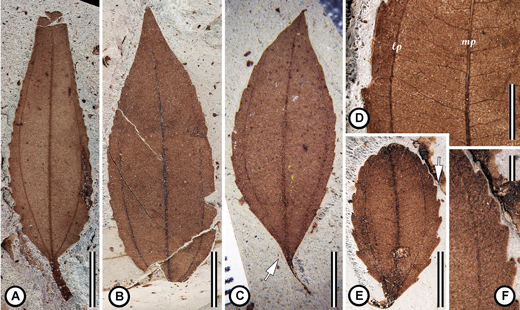
Fossilised Leaves from the Salamanca Formation (Buckthorn Family)

Views of Buckthorn leaves (Danian faunal stage).

Buckthorn fossils (leaves).

Picture credit: Nathan Jud/Cornell University and PLOS ONE

Buckthorn Fossilised Flowers

The scientists, which include Ari Iglesias (Universidad Nacional del Comahue, Argentina), and Peter Wilf (Pennsylvania State University), suggest that fossils found in southern Mexico and Columbia provide evidence that the first members of the Rhamnaceae family evolved in the Late Cretaceous, shortly before the extinction event.  Although, many types of plant died out at the end of the Mesozoic, the ancestors of extant Buckthorns were able to make it through the global catastrophe.

A plausible scenario is that the Rhamnaceae first evolved in the equatorial region of Gondwana, but survived the extinction event by clinging on in the southern most portion of South America, many thousands of kilometres from the Yucatan peninsula impact site.  These plants were then able to re-colonise other parts of the world in the aftermath of the extinction event, perhaps taking advantage of the niches in ecosystems vacated by recently extinct plant species.

The Salamanca Formation is among the most precisely-dated sites of the Palaeocene. The age of the fossils was corroborated by radiometric dating (using radioactive isotopes), the global palaeomagnetic sequence (signatures of reversals of Earth’s magnetic field found in the samples), along with the mapping of zonal fossils (relative dating).

In conclusion, Dr Jud stated:

“These are the only flowers of Danian age for which we have good age control.  Researchers have discovered other fossilised flowers in India and China from around the Danian, but their dates are not as precise.”

Go to Top