All about dinosaurs, fossils and prehistoric animals by Everything Dinosaur team members.

Fossil finds, new dinosaur discoveries, news and views from the world of palaeontology and other Earth sciences.

28 04, 2017

Remarkable Fossil with “Can-opener” Claws – Tokummia katalepsis

By |2024-05-08T20:07:20+01:00April 28th, 2017|Categories: Dinosaur and Prehistoric Animal News Stories, Dinosaur Fans, Main Page, Photos/Pictures of Fossils|0 Comments

The Origins of the Mandibulate Body Plan

Scientists at the University of Toronto in collaboration with colleagues at the Royal Ontario Museum, have published this week a scientific paper describing Tokummia katalepsis, a predator from the Cambrian, one that has provided palaeontologists with a better understanding of the evolution of one of the most numerous and diverse group of animals on Earth.

Tokummia katalepsis

The fossils, collected during extensive field work exploring 508-million-year-old sedimentary rocks near Marble Canyon in Kootenay National Park, (British Columbia), shed light on the origin of a group of arthropods collectively known as the Mandibulata.  The Mandibulata is a clade of the phylum Arthropoda that consists of millipedes, centipedes, the crustacea and insects.  Mandibulates are united by having a pair of specialised jaws “mandibles”, which can be used for a variety of purposes such as hunting, biting, cutting food into smaller pieces, digging, carrying items and constructing nests.

A Computer-Generated Image of Tokummia katalepsis
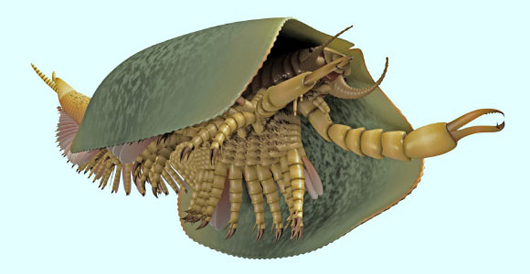
Tokummia katalepsis computer generated image.

A three-dimensional computer generated image of Tokummia katalepsis showing serrated pincers and the pair of mandibles.

Picture credit: Royal Ontario Museum

Studying the Arthropoda

The mandibulates constitute the largest, most speciose and most varied clade within the Arthropoda, but their evolutionary origins are poorly understood.  The discovery of several well-preserved specimens of T. katalepsis documents, for the first time, the anatomy of an early member of the Mandibulata.

Commenting on the significance of this research, Cédric Aria (University of Toronto) and lead author of the paper published in the journal “Nature” stated:

“In spite of their colossal diversity today, the origin of mandibulates had largely remained a mystery.  Before now we’ve had only sparse hints at what the first arthropods with mandibles could have looked like and no idea of what could have been other key characteristics that triggered the unrivalled diversification of that group.”

One of the T. katalepsis Fossils Used in the Study
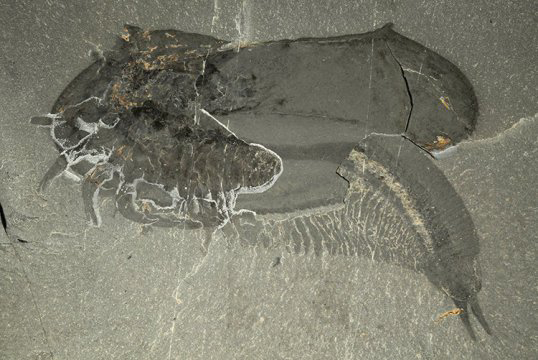
Tokummia fossil material.

The flattened fossil of Tokummia showing numerous legs, the dorsal carapace and the specialised pincers.

Picture credit: Jean-Bernard Caron (Royal Ontario Museum)

The photograph above shows one of the beautifully preserved fossils found in 2014.  This specimen of Tokummia katalepsis shows a number of strong legs on the left partially protruding from the body, the shape of the bivalved carapace and dozens of small paddle-like limbs below the trunk at the lower right.

A Cross Between a Crab, a Centipede and a Can-opener

Described by some observers as looking like a cross between a crab, a centipede and a can-opener, Tokummia lived in a tropical sea that teemed with early marine life-forms including the ancestors of vertebrates.  At around ten centimetres in length, T. katalepsis was one of the largest predators in the ecosystem.  It had large pincers which the researchers thought would have been too delicate to tackle shelled animals like brachiopods and bivalves.

The research team postulate that Tokummia was primarily benthic (living on the sea floor), where it scuttled about digging into the sediment to catch soft bodied creatures such as worms.  The claws reminded the scientists of a can-opener, once grasped, any unfortunate prey would have been cut up into more easily digestible pieces by those revolutionary, broad, serrated mandibles.

The genus name honours Tokumm Creek, a small river that runs through Marble Canyon, the location of the fossil finds.  The species or trivial name is derived from the ancient Greek for “grasping”.

A Computer-Generated Image from a Video that Demonstrates Tokummia Locomotion
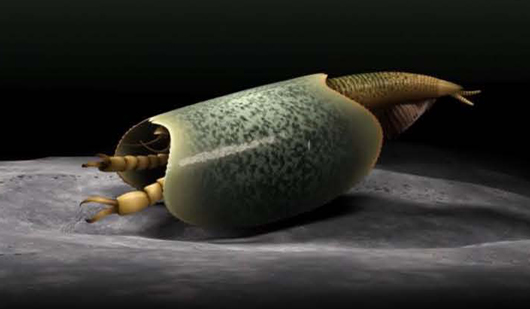
Tokummia katalepsis - computer generated image.

A computer animated image showing the basic body plan of Tokummia katalepsis.

Picture credit: Royal Ontario Museum

Co-author of the scientific paper and an expert on the Burgess Shale biota, Jean-Bernard Caron (Royal Ontario Museum and an Associate Professor at the University of Toronto), stated:

“This spectacular new predator, one of the largest and best preserved soft-bodied arthropods from Marble Canyon, joins the ranks of the many unusual marine creatures that lived during the Cambrian Explosion, a period of rapid evolutionary charge starting about half a billion years ago when most major animal groups first emerged in the fossil record.”

Numerous Fossil Specimens Studied

Careful mechanical preparation of the numerous specimens coupled with photographic work carried out under differing wavelengths of light, revealed the details of the Tokummia body plan.  The segmented trunk of Tokummia consisted of fifty small segments covered by a wide, two-piece carapace.  The delicate fossils show evidence of the pair of broad, notched mandibles as well as the large but quite delicate-looking front claws (maxillipeds), which are typical features of extant mandibulates.

Importantly, the animal bears subdivided limb bases with tiny projections called endites, which can be found in the larvae of certain crustaceans alive today and are now thought to have been critical innovations for the evolution of the various legs of mandibulates, and even for the mandibles themselves.

Fossils Providing an Insight into the Evolution of the Mandibulata
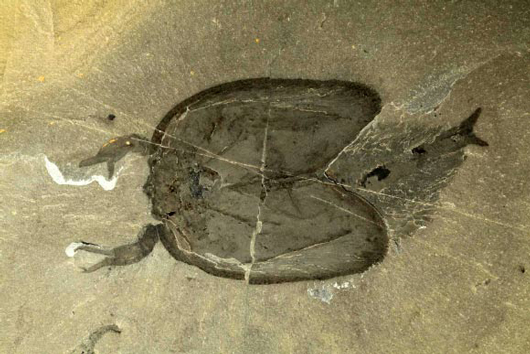
Tokummia katalepsis fossil.

Dorsal/ventral view of Tokummia katalepsis fossil material.

Picture credit: Royal Ontario Museum

Tokummia katalepsis Similar to Living Members of the Myriapoda

Graduate student Cédric Aria added that the many segments that make up the body are very reminiscent of living Myriapoda, the sub-phylum of Arthropoda that includes centipedes, millipedes and their relatives.

He went onto state:

“Tokummia also lacks the typical second antenna found in crustaceans, which illustrates a very surprising convergence with such terrestrial mandibulates.”

The study also resolves the affinities of other emblematic fossils excavated from Canada’s famous Burgess Shale deposits, more than a hundred years after their initial discovery.  Burgess Shale fossils such as Branchiocaris, Canadaspis and Odaraia form with Tokummia, a group of crustacean-like arthropods that can now be placed at the base of all mandibulates, they can be regarded as basal members of the Mandibulata.

The scientific paper: “Burgess Shale Fossils Illustrate the Origin of the Mandibulate Body Plan”: by Cédric Aria and Jean-Bernard Caron, published in the journal “Nature”.

Visit Everything Dinosaur’s website: Everything Dinosaur.
26 04, 2017

A Remarkable Headless Duck-Billed Dinosaur is Reunited with Skull

By |2024-05-07T15:32:42+01:00April 26th, 2017|Categories: Dinosaur and Prehistoric Animal News Stories, Dinosaur Fans, Main Page, Photos/Pictures of Fossils|0 Comments

Corythosaurus Fossil Gets its Head Back

Scientists from the University of Alberta have been able to reunite the fossilised body of a Corythosaurus to its head, nearly one hundred years after the skull fossil was removed from the dig site.

Researchers have matched the headless skeleton to a Corythosaurus skull (C. excavatus) from the university’s Palaeontology Museum that had been collected in 1920 by the eminent George Sternberg during field work in what is now called the Dinosaur Provincial Park (southern Alberta).

Graduate Katherine Bramble, a co-author of the scientific paper that appears in the latest issue of “Cretaceous Research” commented:

“Based on our results, we believed there was potential that the skull and this specimen belonged together.”

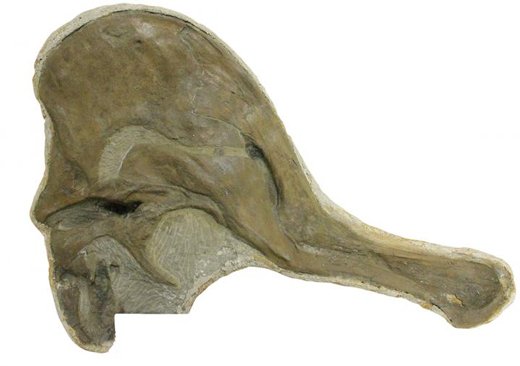
The Corythosaurus (C. excavatus) Skull Collected by George Sternberg in 1920

Corythosaurus fossil skull.

The Corythosaurus skull collected by George Sternberg in 1920.

Picture credit: The University of Alberta

Trophy Hunting When it Came to Dinosaur Fossils

The Corythosaurus skull shown in lateral view (above) was collected in 1920 and designated the holotype fossil for a new hadrosaurid (Corythosaurus excavatus) by C. W. Gilmore in 1923.  The skull, (UALVP 13) became part of the University’s vertebrate fossil collection.  In 1992, a previously uncovered, weathered, Corythosaurus skeleton was found.  A field team from the University of Alberta collected the specimen in 2012 and research undertaken by Darren Tanke (a technician at the Royal Tyrrell Museum), a co-author of the paper indicated that the body remains could be associated with the already known skull material.

In the 19th and early 20th century, palaeontologists in North America were almost faced with an embarrassment of riches when it came to dinosaur fossils.  The extensive fossil deposits in Utah, Montana and southern Alberta led to many field teams simply “cherry picking” and only collecting the most spectacular of fossils, items such as claws, skulls, dermal armour, horns and teeth.  It is relatively common for a field team working in the Dinosaur Provincial Park to come across specimens missing skull material.

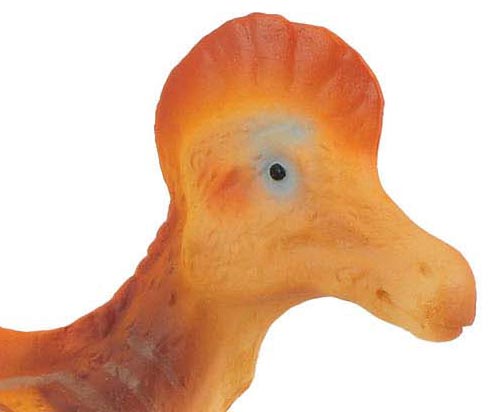
A Close-Up View of a Corythosaurus Dinosaur Model

CollectA Corythosaurus dinosaur model.

A close up of the head of Corythosaurus.

Picture credit: Everything Dinosaur

To view the CollectA series of prehistoric animal models: CollectA Age of Dinosaurs Figures.

Corythosaurus Lower Jaw (Dentary) Found

In addition, an isolated hadrosaur dentary (lower jaw bone), found in 1992, close to the articulated, postcranial skeleton may be one of the missing jaw fossils from the holotype skull.  The idea that this postcranial material be the skeleton of the holotype of Corythosaurus excavatus was tested using anatomical information and statistical analyses.  Statistical comparisons suggest that it is possible that the skull and dentary belong to the same individual.  Furthermore, the researchers postulate that the postcranial material could belong to the UALVP 13 skull.

Katherine Bramble explained:

“Using anatomical measurements of the skull and the skeleton, we conducted a statistical analysis.  Based on these results, we believed there was potential that the skull and this specimen belonged together.”

Matching Disparate Fossils to Individual Dinosaurs

This discovery highlights a growing field of study in palaeontology, wherein, scientists try to develop new ways of determining whether various parts of a skeleton, often located in different museum collections, belong to the same individual.  For this paper, the team used anatomical measurements, but there are several other ways of matching up fossil bones, such as conducting a chemical analysis on the surrounding matrix to identify the rocks from which the fossils were found.

The scientific paper, “Reuniting the ‘head hunted’ Corythosaurus excavatus (Dinosauria: Hadrosauridae) holotype skull with its dentary and postcranium,” published in the journal of “Cretaceous Research.”

The Everything Dinosaur website: Everything Dinosaur.

25 04, 2017

Amazing Fossil Fungus Discovery Rocks Geology and Biology

By |2024-05-08T20:08:28+01:00April 25th, 2017|Categories: Dinosaur and Prehistoric Animal News Stories, Geology, Main Page|0 Comments

Fungus-Like Forms Found in 2.4 Billion-Year-Old Rocks

An international team of researchers, including scientists from the Swedish Museum of Natural History, Stockholm University and the University of California, have identified microscopic structures found in tiny bubbles and pores in ancient basalt that resemble fungi.  If these fungi-like structures are indeed Palaeoproterozoic remnants of members of the Kingdom Fungi, then this discovery could push back the date for the oldest fungi by between 1,000 and 2,000 million years.

Palaeoproterozoic Remnants

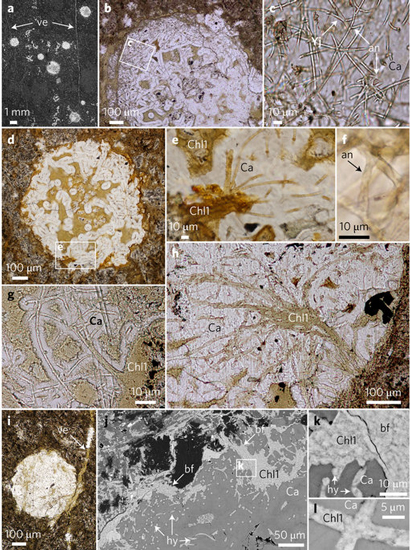
Thin Sections of the Ongeluk Basalt Showing Evidence of Mycelium

Ancient fungi in ancient marine rocks.

Views of treated micro-slides showing potential mycelium.

Picture credit: Nature, Ecology and Evolution (Swedish Museum of Natural History)

Over the last few decades, cores drilled deep into the seabed and other exploration techniques utilised to build knowledge of the biota present in oceanic sediments and crustal rocks have revealed that many different types of fungi thrive in these environments.  The fossil record of fungi is extremely intermittent and the identification of possible fungal remnants in the fossil record is controversial to say the least, (look up the Devonian Prototaxites for further details).

The Fossil Record of Fungi

However, many geologists and palaeontologists have proposed that the fossil record for such extremophiles does date back to at least the Early Devonian, a time when primitive plants and fungi were beginning to diversify and radiate in terrestrial environments.  Drill cores taken from the Ongeluk Formation in South Africa show microscopic signs of filamentous fossils in vesicles and fractures.  The filaments form mycelium-like structures growing from a basal film attached to the internal rock surfaces and they look very similar to the structures attributed to fungi found in rocks which are hundreds of millions of years younger.

The Ongeluk fossils, are two to three times older than current age estimates of the Kingdom Fungi. Unless they represent an unknown branch of fungus-like organisms, which are new to science, the fossils imply that the fungal clade is considerably older than previously thought, and that fungal origin and early evolution may lie in the deep ocean rather than in terrestrial environments.

The Ongeluk discovery suggests that life has inhabited deep sea oceanic rocks for more than 2.4 billion years.

The Impact on Eukaryotes

The jumbles of tangled threads, which are only a few microns across, if they are fungi, belong to the Eukaryote Domain (Eukarya), a diverse group containing at least four Phyla and some 6,000 species, (fungi include the familiar mushrooms and toadstools plus yeasts and moulds).  Eukaryotes have cells that are complex with a distinct nucleus protected by a membrane.  Animals and plants are also Eukaryotes and the discovery of such ancient life forms, preserved in ocean rocks has implications for the early history of the whole of the Eukarya, as well as potentially, pushing back the date for the evolution of the first fungi to around 2.4 billion-years-ago.

Commenting on the significance of this research, lead author of the scientific paper, Stefan Bengtson (Department of Palaeobiology and Nordic Center for Earth Evolution, Swedish Museum of Natural History), stated:

“The deep biosphere [where the fossils were found] represents a large portion of the Earth, but we know very little about its biology and even less about its evolutionary history.”

The Professor added, that there was a clear possibility that these fossils represent the world’s oldest fossil fungi, much older than anything else known to the scientific community.

He went onto state:

“If they are not fungi, they are probably an extinct branch of Eukaryotes or even giant Prokaryotes.”

The Impact on the Hunt for Life on Other Planets

A spokesperson from Everything Dinosaur commented that if these fossils represent fungi occupying gas bubbles in lava that form rocks in the seabed, it demonstrates how organisms can survive in extreme habitats.  Tests have indicated that the rocks where the structures were found could have been as hot as 250 degrees Celsius and these lifeforms would have had to survive without sunlight and cope with immense pressure.

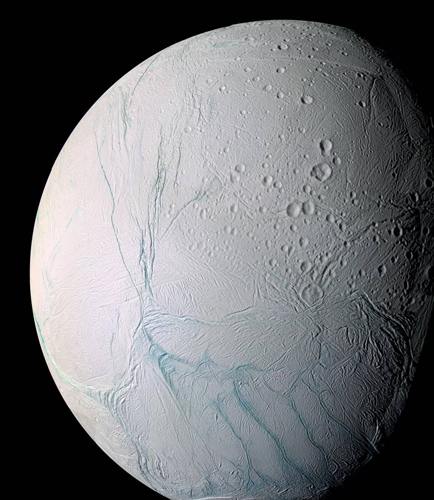
If the fossil record for such fungi is extended by billions of years on our own planet, then it raises the intriguing possibility that such life forms may well have evolved and if they did, they probably still exist in extreme environments elsewhere in our solar system.  The watery environment trapped under the ice of Saturn’s moon Enceladus could harbour the sort of conditions where organisms such as these could still thrive.

Saturn’s Icy Moon Enceladus – Perhaps Home to Marine Crustal Fungi?

Saturn's icy moon Enceladus.

A view of the moon Enceladus – could this icy world harbour fungi?

Picture credit: NASA

Visit Everything Dinosaur’s website: Everything Dinosaur.
24 04, 2017

Amazing and Lucky Dinosaur Fossil Egg Discovery in China

By |2024-05-08T20:12:41+01:00April 24th, 2017|Categories: Dinosaur and Prehistoric Animal News Stories, Dinosaur Fans|0 Comments

Five Dinosaur Fossil Eggs Found by Chance

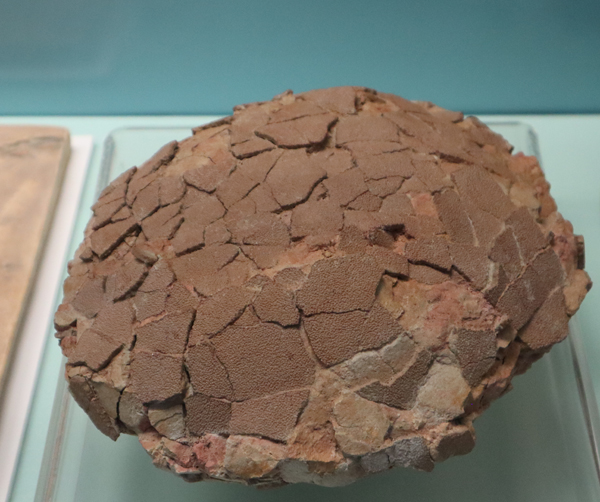
Construction workers have unearthed five dinosaur eggs in the city of Foshan (Guangdong Province, south-eastern China).  The eggs, preserved in red sandstone, were laid by a herbivore, but scientists are unable to identify the genera.  The eggs are quite rounded in shape and measure approximately 13-14 centimetres in diameter.  The strata dates from around 70 million years ago (Late Cretaceous) and the fossils have been taken to a local museum for safekeeping and further study.

Dinosaur Egg Fossils

A Dinosaur Egg – The Chinese Eggs were Briefly Put on Display Before Being Removed for Further Analysis

Dinosaur eggs studied by palaeontologists.

A dinosaur egg fossil. Picture credit: Everything Dinosaur.

Picture credit: Everything Dinosaur

For models and replicas of dinosaurs and other prehistoric animals: Prehistoric Animals and Dinosaur Figures.

The two blocks containing the fossils were found at a depth of eight metres and Qiu Licheng from Guangdong’s Archaeological Institute in China commented:

“We found five eggs, three were destroyed, but they are still visible.  The other two have their imprints on the stone.”

Dinosaur Eggs from the Foshan Area

The discovery was made last Monday and video footage has been taken showing the construction site and the fossils that were found.  Dinosaur eggs have been found in the Foshan area before, although to find a clutch is quite significant.  Local palaeontologists are hopeful that these fossils will help to provide a clearer picture of what life was like in this part of China during the Maastrichtian faunal stage of the Late Cretaceous.

The “Red Beds” of sandstone have produced a number of dinosaur fossils, including theropods.  At least three different types of dinosaur egg fossil have been described and in some parts of southern and south-eastern China, they act almost like index fossils helping to date the relative ages of sediments.  A spokesperson from Everything Dinosaur commented that titanosaurs are known to have lived in this part of China around 70 million years ago, but the eggs are too small to be ascribed to a type of titanosaur with any confidence.  The eggs may have come from a hadrosaurid.

Visit the Everything Dinosaur website: Everything Dinosaur.

21 04, 2017

New Species of Hyaenodont from Egypt Described

By |2023-06-17T10:44:37+01:00April 21st, 2017|Categories: Dinosaur and Prehistoric Animal News Stories, Main Page, Photos/Pictures of Fossils|0 Comments

Masrasector nananubis – From the Late Eocene of Egypt

Everything Dinosaur highlights the discovery of a new species of hyaenodont from Egypt (Masrasector nananubis).

If people are asked to name a meat-eating mammal, you can expect to get answers such as tiger, bear or lion.  Those of us with more of a domestic outlook on life might mention cats and dogs, but for a significant portion of the Cenozoic, sometimes referred to as the “Age of Mammals”, the Carnivora, the Order to which bears, cats and dogs belong, did not get a look in.  Prior to the evolution of many types of recognisable carnivorous mammal alive today, other types of mammals filled the role of hypercarnivores*.

The Hyaenodonta

One such group was the Hyaenodonta.  A diverse clade of carnivorous mammals that filled a variety of roles in terrestrial ecosystems in both the New and the Old World.  Writing in the on-line academic journal PLOS One, scientists from Ohio University and the University of Southern California have published details of a new species of Yorkshire terrier-sized hyaenodont, the beautifully preserved skull and jaws are helping palaeontologists to understand more about the evolution and phylogeny of this extinct group, a group that has no close relatives alive today.

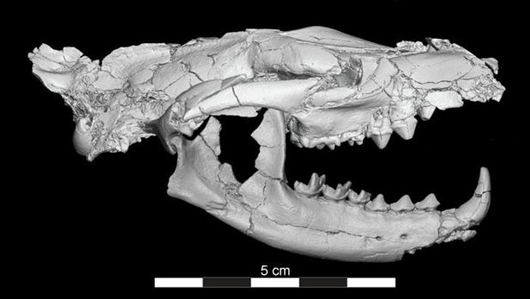
The Skull and Jaws of a Newly Identified Species of Hyaenodont

Skull and jaws of Masrasector nananubis.

Computer generated image showing the skull and jaws of Masrasector nananubis (right lateral view).

Picture credit: PLOS One

Masrasector nananubis – Named after a God of Ancient Egypt

The Late Eocene deposits of the Fayum Depression (Egypt), have provided scientists with a substantial number of mammal fossils, including a number of hyaenodonts, the latest to be added to this list is Masrasector nananubis.  It has been classified as member of the Hyaenodontidae, specifically part of the teratodontine clade, a poorly known group which are distinguished from other hyaenodonts by subtle differences in the shape of their skulls, jaws and teeth.

Masrasector translates as “the Egyptian slicer”, a reference to the large molars (carnassials).  The species or trivial name honours Anubis, the jackal-faced Egyptian god of mummification.  The premolars and molars of Masrasector have larger grinding surfaces when compared to other hyaenodonts.  The researchers have speculated that Masrasector nananubis may have supplemented its diet of small mammals, amphibians, reptiles and insects by feeding on fruit and nuts.  This suggests that, like other members of the Teratodontinae clade, it may not have relied on meat consumption as much as other hyaenodonts that were hypercarnivorous.  It has been suggested that M. nananubis may have been mesocarnivorous*.

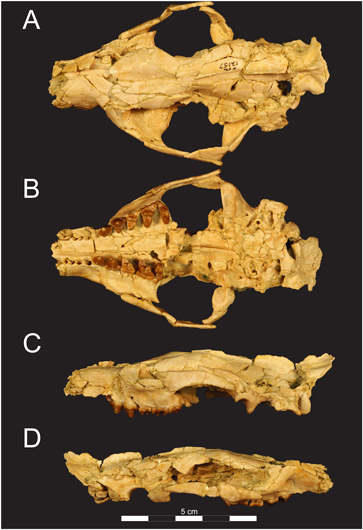
Views of the Skull of Masrasector nananubis

Cranium material of Masrasector.

Views of the skull of Masrasector (hyaenodont).

Picture credit: PLOS One

An Important Fossil Discovery

It may be true that hyaenodont fossils are known from Africa, North America, Asia and Europe and that the genus Hyaenodon survived for around twenty-six million years, the longest temporal spam known for a fossil mammal, but the discovery of these Masrasector fossils is still very significant.  The fossils comprise largely complete skulls, jaws, and parts of the skeleton, making them one of the most complete known African hyaenodonts from the Paleogene found to date.  Previously, researchers only had isolated bones and teeth fragments to work with, frustrating palaeontologists as they attempt to piece together the family tree representing the Hyaenodontidae.

The fossils come from a dig site (locality 41) in the Fayum Depression, the well-consolidated clays have been dated to the Late Priabonian of the Eocene (approximately 34 million years ago).  The Masrasector material represents some of the oldest fossils known for this type of hyaenodont.

Important Fossils (Masrasector nananubis)

Commenting on the importance of the fossils, corresponding author for the study, Matthew R. Borths (Department of Biomedical Sciences, Heritage College of Osteopathic Medicine, Ohio University), stated:

“These fossils might be the oldest and most complete ever discovered, but there is still much that remains to be discovered as the fossils of other members of this group are fragmentary.  Masrasector can be used as a cornerstone of character development for exploring the evolution and diversity of other hyaenodontids.”

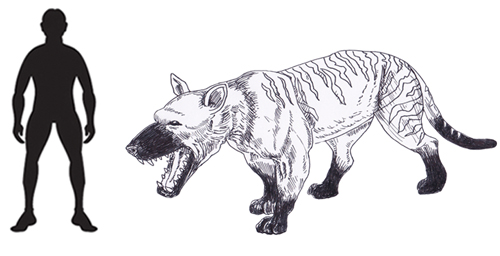
An Illustration of the Giant Hyaenodont (H. gigas)

Hyaenodon gigas scale drawing.

A scale drawing of the giant Hyaenodon gigas.  Picture credit: Everything Dinosaur.

Picture credit: Everything Dinosaur

To view models and replicas of hyaeonodonts (whilst stocks last) and other prehistoric creatures: Wild Safari Figures and Models.

Matthew went onto add:

“Hyaenodonts were the top predators in Africa after the extinction of the dinosaurs.  This new species is associated with a dozen specimens, including skulls and arm bones, which means we can explore what it ate, how it moved, and consider why these carnivorous mammals died off as the relatives of dogs, cats, and hyenas moved into Africa.”

Explaining Terms

Hypercarnivore* an animal which has at least 70% of its diet made up of meat.

Mesocarnivore* an animal which has around 50% to 70% of its diet made up of meat.

The scientific paper: “Craniodental and Humeral Morphology of a New Species of Masrasector (Teratodontinae, Hyaenodonta, Placentalia) from the Late Eocene of Egypt and Locomotor Diversity in Hyaenodonts” by Matthew R. Borths and Erik R Seiffert published in PLOS One.

Visit Everything Dinosaur’s website: Everything Dinosaur.
19 04, 2017

Rare Prehistoric Seagull from the Outback

By |2024-05-07T15:31:53+01:00April 19th, 2017|Categories: Dinosaur and Prehistoric Animal News Stories, Dinosaur Fans, Main Page|0 Comments

Nanantius eos and the Eromanga Sea

A new species of prehistoric bird from the Cretaceous has been described – Nanantius eos.

The Queensland town of Richmond may be several hundred miles from the Coral Sea that laps against the coast of north-eastern Australia, but back in the Cretaceous this part of world, famous for its droughts and arid outback, was covered for millions of years by a shallow, tropical sea (the Eromanga Sea), that teemed with prehistoric life.  Thanks to the efforts of volunteers and the dedicated researchers at Richmond’s Kronosaurus Korner a new ancient resident has been identified, not a sea monster, or an ancient fish but a primitive bird that probably filled an ecological niche similar to today’s seagulls.

Nanantius eos

Swooping into view comes Nanantius eos, the name translates as dawn dwarf-enantiornithine*.  Slighter smaller than a Common Tern (Sterna hirundo), perhaps weighing no more than a couple of hundred grammes, the fossils come from marine sandstone deposits that were laid down more than 100 million years ago, (Aptian to Albian faunal stage of the Cretaceous).

Fossils of Nanantius have been found in Winton sandstone exposures around three-hundred miles to the south-west of Richmond, but these consist of only a few isolated bones.  Working at a site just eight miles from the centre of Richmond, Dr Patrick Smith (Curator at the Kronosaurus Korner Fossil Museum), is confident that the number of bird bones found so far indicates that there might be complete skeletons present in the deposit.

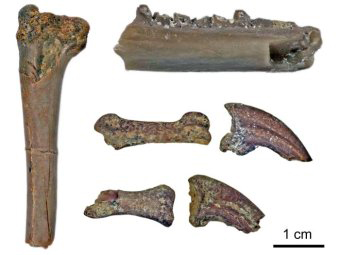
Pictures of the Fossil Material Ascribed to Nanantius eos from the Richmond Site

Nanantius fossils from the Richmond site.

Nanantius eos fossils including a partial humerus (left).

Picture credit: Dr Patrick Smith

Dr Smith commented:

“It’s very, very rare to find dinosaurs out here, there’s only been about a handful known, so finding these dinosaur birds is amazing.  We haven’t had any of these sorts of primitive birds found in Richmond.”

The “Richmond Raptor”

Volunteer Mike D’Arcy found the first evidence of a fossil bird some five years ago.  Ever since his first discovery, he has been busy recruiting volunteers to help him find more fossil evidence.  As, for much of the Early Cretaceous, Richmond was underwater and many miles from land, it is surprising to find evidence of an enantiornithine bird in marine sandstone deposits.

Scientists are unsure how the bird fossils came to be deposited.  Do they represent an accumulation of carcases of birds washed out to sea?  Or perhaps flocks of Nanantius eos (which was probably a capable flyer), may have flown out far to sea in order to feed.  Mike has nick-named the bird the “Richmond Raptor”.  It did have small, sharp teeth in its jaws and claws on its wings but small fish and insects were probably its choice of prey.

Volunteer Mike D’Arcy Working at the Fossil Site

Volunteer Mike D'Arcy working at the dig site.

Mike D’Arcy at the fossil dig site.

Picture credit: Mike D’Arcy

A spokesperson from Everything Dinosaur commented:

“Local residents can play an important role in helping palaeontologists to collect fossils from sites, that the palaeontologists themselves may not have time to visit and explore themselves.  Thanks to these volunteers, many fossils that would otherwise have been eroded away can be saved, permitting scientists the opportunity to study them.”

Likely Member of the Enantiornithine Clade*

Although described as a member of the Enantiornithes clade, a group of abundant, primitive birds of the Cretaceous, it is hoped that the Richmond fossils will be able to confirm this assessment.  Previously, fossils found near the small town of Boulia, (Queensland), included a partial tibiotarsus (ankle and lower leg bone), were attributed to Nanantius.  The shape of this bone was once thought to be diagnostic of the enantiornithines but more recent Mesozoic bird discoveries have cast doubt on the morphology of the tibiotarsus being suitably diagnostic of a enantiornithine affinity.  With more fossil bones found, including limb elements (humerus and unguals), palaeontologists may be able to confirm the taxonomic position of N. eos.

Examining a Pedal Ungual (Nanantius eos)

Viewing a claw fossil of Nanantius eos (Cretaceous bird).

Mike D’Arcy examining one of the fossil toe claws.

Picture credit: Mike D’Arcy

The Search for More Evidence of Nanantius eos

Mike D’Arcy added:

“The first half a dozen pieces I got, we couldn’t really assign what it was and it wasn’t until we got the humerus that we could say it was definitely a bird.”

The fossils are currently on display at the Kronosaurus Korner Fossil Museum. Nanantius is regarded as seabird as fossils have been found in association with marine deposits.

In addition, in 2003, a paper was published in the “Proceedings of the Royal Society – Biology” that described the stomach contents discovered in association with a gravid female ichthyosaur (Platypterygius longmani).  Amongst the fossilised remains of baby turtles and fish, the scientists discovered limb bones from an enantiornithine bird, probably from the Nanantius genus.  How the bones came to be in the body cavity of an ichthyosaur is unknown, perhaps the marine reptile grabbed the bird as it rested on the water, or maybe the ichthyosaur had fed on a corpse that had been washed out to sea.

Visit the website of Everything Dinosaur: Everything Dinosaur.

18 04, 2017

New Species of Arowana Fish from the Eocene of China

By |2023-06-16T07:27:29+01:00April 18th, 2017|Categories: Dinosaur and Prehistoric Animal News Stories, Main Page, Photos/Pictures of Fossils|0 Comments

The Origins of the Dragon Fish (Scleropages)

Scientists from the Institute of Vertebrate Palaeontology and Palaeoanthropology (IVPP) have published details of the discovery of beautifully preserved fish fossils from China that have helped map the origins of one of the most valuable and sought after aquarium fishes in the world.  Scleropages formosus, the Asian Arowana, otherwise known as the Dragon Fish from south-eastern Asia, quite rare in the wild these days, but it is highly regarded amongst freshwater aquarium owners, who can splash out thousands of dollars to acquire particularly colourful specimens.

Scleropages sinensis

In a scientific paper published in the journal “Vertebrata PalAsiatica”, Dr Zhang Jiangyong (IVPP) in collaboration with Dr Mark Wilson (University of Alberta), report on the discovery of a new species of osteoglossid fish from the Early Eocene Xiwanpu Formation in Hunan and the Yangxi Formation in Hubei, (China).  The prehistoric fish is remarkable similar to the extant species and it has been named Scleropages sinensis (the name translates as “hard scaled leaves from China”, a reference to the robust tough body scales that characterises these fish).

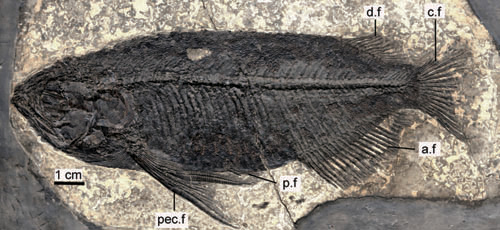
The Holotype Fossil Material of Scleropages sinensis

The holotype fossil material of S. sinensis.

Holotype of Scleropages sinensis.

Picture credit: Zhang Jiangyong (IVPP)

The picture above shows the beautifully preserved holotype specimen of S. sinensis.  The fins are labelled (df) = dorsal fin, (cf) = caudal fin, (af) = anal fin, (pf and pec f) = pectoral fins, scale bar 1 centimetre.

An Almost Complete Body Fossil

This is the first time a nearly complete body fossil of this genus has been described.  Previously, the fossil record only consisted of individual scales, otoliths (calcified structures from the inner ear) and isolated fragmentary bones.  The discovery of Scleropages sinensis dates the divergence of Scleropages from the closely related Osteoglossum to at least as far back as the Early Eocene.  The fish fossils represent a number of different ontogenetic (growth stages). The largest specimens are 17.5 centimetres in length, the smallest under 8 centimetres long.

Fossil Scleropages are known from the Maastrichtian of India, the Maastrichtian/Late Palaeocene of Africa, the Palaeocene of Europe, the Eocene of Sumatra, and the Oligocene of Australia.   All of these earlier records are scales, otoliths and isolated bone fragments. Therefore, these newly described Chinese fossils are the first skeletons of fossil Scleropages ever unearthed in the world.

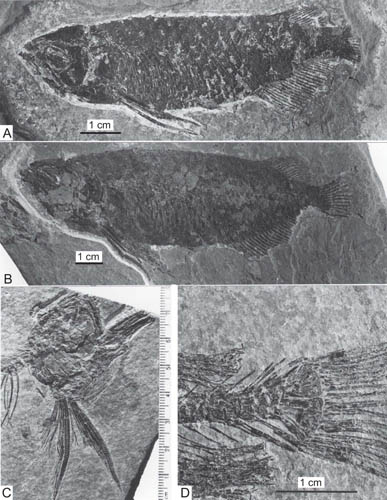
Views of the Scleropages Fossil Material

Views of Scleropages sinensis fossil material.

Scleropages sinensis fossil material (various views).

Picture credit: Zhang Jiangyong (IVPP)

Dr Zhang stated:

“This new fish resembles Scleropages in skull bones, caudal skeleton, the shape and position of fins, and reticulate scales.  Therefore, it must belong to the genus.”

Studying Extant Species

The extant species of Scleropages inhabits lakes, swamps and flooded forests as well as slowly meandering rivers. It is a carnivorous fish preying on insects, worms, small amphibians, other fish, small mammals and even birds.  The fish is renowned for its jumping, the researchers propose that Scleropages sinensis may have filled a similar niche in the Eocene ecosystem, but being smaller it probably had a more restricted diet than its extant relative.  Analysis of the fossil material suggests that sexual dimorphism may have existed in S. sinensis.

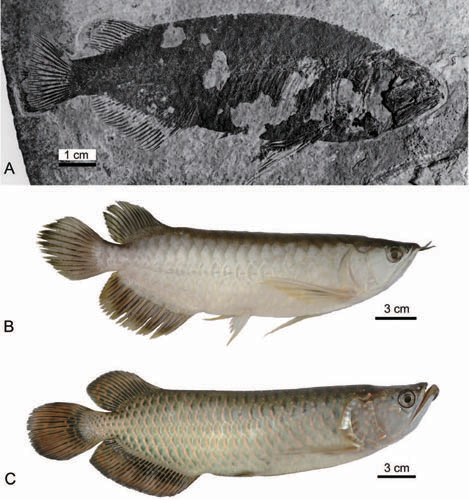
Comparing the Extinct Species with Living Species

Living species of Scleropages compared to the fossil material.

Comparison between Scleropages sinensis (A) and the living species S. formosus (B), S. leichardti.

Picture credit: Zhang Jiangyong (IVPP)

The Everything Dinosaur website: Everything Dinosaur.

16 04, 2017

Elk Hunter Stumbles Across Rare Elasmosaurid

By |2024-05-08T20:10:22+01:00April 16th, 2017|Categories: Dinosaur and Prehistoric Animal News Stories, Dinosaur Fans, Main Page|5 Comments

Nakonanectes bradti – Shortest Neck and Youngest Elasmosaur from the Western Interior Seaway

A new genus of elasmosaurid has been added to the list of marine reptiles associated with the Western Interior Seaway.  Named Nakonanectes bradti, this fish-eating monster lived around 70 million-years ago.  A paper detailing the discovery has been published this week in the “Journal of Vertebrate Palaeontology”, Nakonanectes is the youngest elasmosaurid, stratigraphically speaking from the Western Interior Seaway, it also had a very short neck, short at least, when compared to other Late Cretaceous elasmosaurids.

To view models and replicas of elasmosaurids and other marine reptiles: CollectA Deluxe Prehistoric Life Models.

A New Genus of Short-Necked Elasmosaurid from Montana

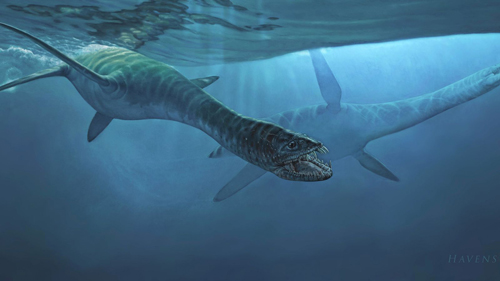
Nakonanectes illustrated.

An illustration of the newly described elasmosaurid Nakonanectes bradti.

Picture credit: James Havens

Marine Reptile Discovered by an Elk Hunter

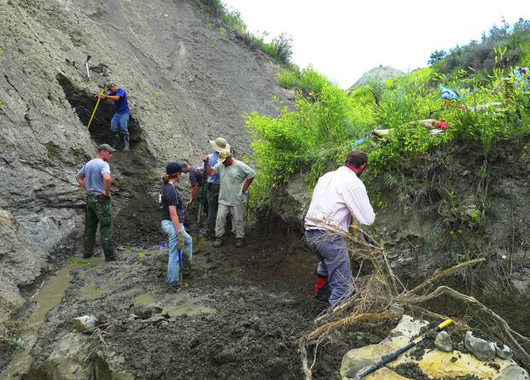
David Bradt in 2010, stumbled across fossils of the marine reptile whilst out hunting for elk in Montana’s Charles M. Russell National Wildlife Refuge.  He noticed a series of articulated bones in a stream bed and thinking that the fossils might represent a dinosaur, David alerted the authorities.  When a field team visited the remote site, they followed the trail of bone fragments uphill and discovered more fossils including the remains of an exquisitely preserved skull.  The Late Cretaceous reptile has been named after the native Nakona people of Montana and the trivial name honours David Bradt.

Field Team Members Working at the Excavation Site

Excavating the elasmosaurid fossil bones.

The location of the elasmosaurid bones.

Picture credit: Erin Clark/Associated Press

One of the authors of the scientific paper, Pat Druckenmiller (University of Alaska Museum of the North), commented:

“This group [elasmosaurids] is famous for having ridiculously long necks, I mean necks that have as many as seventy-six vertebrae [Albertonectes].  What absolutely shocked us when we dug it out, it only had somewhere around forty vertebrae.”

Nakonanectes bradti Compared to Albertonectes vanderveldei

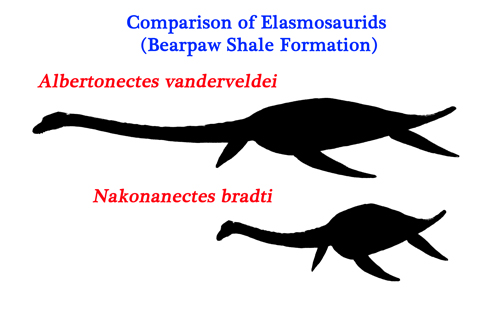
The Bearpaw Shale Formation has provided scientists with a number of intriguing Cretaceous vertebrate fossils, including Albertonectes (A. vanderveldei).  It is regarded as the longest plesiosaur known (estimated to have been more than twelve metres long).  Albertonectes also has the longest neck of any Plesiosaur described to date.  The neck is estimated to have been around seven metres long.  The single specimen (holotype) of Albertonectes comes from the Bearpaw Shale Formation, however, these fossils were found in Alberta (near Lethbridge) and as such, come from exposures some two hundred miles north-west of the stream bed in Montana where the remains of Nakonanectes were found.

Nakonanectes bradti is believed to have had around 39-42 neck bones (cervical vertebrate).  In comparison, Albertonectes had a body length twice as long and its neck was two-and-a-half times the length of N. bradti.

Comparing the Size of Nakonanectes to Albertonectes

Elasmosaurid neck size comparison.

Elasmosaurid size comparisons (Bearpaw Shale Formation).

Picture credit: Everything Dinosaur

Studying Nakonanectes

The palaeontologists conclude that the neck of Nakonanectes was about 2.3 metres long.  It is difficult to accurately date the strata that makes up the Bearpaw Shale Formation.  These two very different elasmosaurids may not have co-existed, but the discovery of Nakonanectes indicates that there was considerable variety in the neck length of members of the Elasmosauridae.  It also suggests that as the Cretaceous period progressed so at least one lineage of elasmosaurs evolved shorter necks.

The scientific paper: “A New Elasmosaurid (Sauropterygia, Plesiosauria) from the Bearpaw Shale (Late Cretaceous, Maastrichtian) of Montana Demonstrates Multiple Evolutionary Reductions of Neck Length within Elasmosauridae”, by Serratos, D. J., P. Druckenmiller, and R. B. J. Benson published in the Journal of Vertebrate Palaeontology.

Visit Everything Dinosaur’s website: Everything Dinosaur.
15 04, 2017

New Tiny Dromaeosaurid from the Jehol Biota

By |2023-06-16T06:48:28+01:00April 15th, 2017|Categories: Dinosaur and Prehistoric Animal News Stories, Dinosaur Fans, Main Page|0 Comments

Zhongjianosaurus yangi from the Early Cretaceous of China

Researchers from the Chinese Academy of Sciences have published information on-line about the discovery of another dromaeosaurid from the Lower Cretaceous Yixian Formation of Liaoning Province (north-eastern China).

Zhongjianosaurus yangi

The little, long-legged “raptor”, that measured around eighty centimetres in length has been described as looking like “Microraptor on silts”.  The dinosaur has been named Zhongjianosaurus yangi, in honour of Yang Zhongjian regarded as the founder of vertebrate palaeontology in China.  The forelimbs are nearly as robust as the back legs which is a little unusual.  In addition, the ulna (bone in the lower arm), is longer than the humerus (upper arm bone), an anatomical feature that this dinosaur shares with many volant (capable of flight), birds.  The forelimb anatomy of Z. yangi contrasts with the anatomy of most non-avian theropods, where the ulna is almost always much shorter than the humerus.

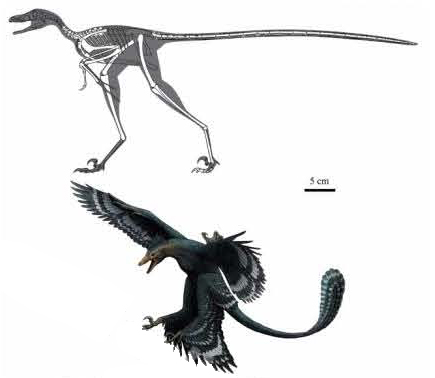
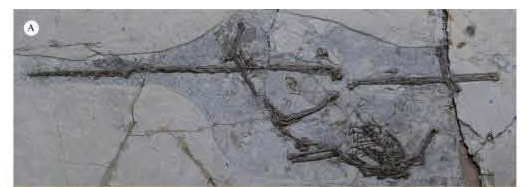
A Skeletal Drawing and an Illustration of Zhongjianosaurus yangi

Skeletal drawing and illustration of Zhongjianosaurus.

Zhongjianosaurus fossil material (in white) shown in a skeletal drawing with a scientific illustration below.

Picture credit: Chinese Academy of Sciences

In the skeletal drawing (above) the fossil material assigned to Z. yangi is shown in white.  Note the skull has not been found (scale bar equals five centimetres).

Eight Dromaeosaurid Species from the Jehol Group – Niche Partitioning

The dromaeosaurids, which are a group of maniraptoran theropods, are globally distributed and they have left a relatively extensive fossil record, but the earliest representatives of the Dromaeosauridae family come from the Lower Cretaceous Jehol Group of western Liaoning Province.  So far, a total of eight dromaeosaurid species have been reported from the Jehol Group, they are remarkably diverse and show numerous differences in their body plans which indicate that each type of dromaeosaurid was adapted to a different habitat or niche in the ecosystem.

This newly described dinosaur, Zhongjianosaurus yangi, classified from a single slab of fossilised bones continues this trend for dromaeosaur diversity.  It is many times lighter than the largest dromaeosaurid (Tianyuraptor ostromi), known from this locality.  With an estimated 0.31 kilogramme mass, the Z. yangi holotype representing an adult individual, confirms that some Jehol dromaeosaurids are among the smallest known non-avialan theropods described to date.

To view articulated models of dromaeosaurids and other dinosaurs: Beasts of the Mesozoic Articulated Models.

The Holotype Fossil Material (Post-cranial Material) of Z. yangi

The holotype fossil material of Zhongjianosaurus yangi.

The holotype of Zhongjianosaurus yangi.

Picture credit: Chinese Academy of Sciences

A Member of the Microraptorinae (Zhongjianosaurus yangi)

Zhongjianosaurus yangi has been assigned to the Microraptorinae sub-family and the single fossil specimen was excavated from strata representing lake deposits in Sihedang, Lingyuan County, (western Liaoning).  The ninth dromaeosaurid of the Jehol Biota is difficult to date accurately, as Sihedang strata lacks biostratigraphical markers.  Z. yangi has been tentatively dated to the Aptian faunal stage of the Early Cretaceous (125 million-years-ago approximately).

Many of the other dromaeosaur fossils have been retrieved from private collections and they subsequently lack stratigraphical context.  However, even if all nine different types of dromaeosaurid did not live at the same geological time they certainly represent a very disparate group and this suggests that these little dinosaurs adapted to different habitats and perhaps sources of food (niche partitioning).

Galapagos Finches

As reported in the advanced on-line publication, the researchers, Xing Xu and Zi-Chuan Qin propose that this collection of dromaeosaurids demonstrates niche partitioning and they compare the Jehol Dromaeosaurs to Darwin’s Galapagos finches.  Darwin noted that although the finches on the various islands that make up the Galapagos shared a common ancestor, they showed remarkable diversity in beak form and function.

In the absence of cranial material, it is not possible to identify what the tiny Zhongjianosaurus ate, but it is postulated that it could have been an insectivore, perhaps living high up in the tree canopy to escape the fast-running, larger hypercarnivores (other dromaeosaurs), that roamed the forest floor.  Zhongjianosaurus was very probably feathered and those robust forelimbs could have supported wings that helped it to glide or flap its way from branch to branch.

The scientific paper: “A New Tiny Dromaeosaurid Dinosaur from the Lower Cretaceous Jehol Group of Western Liaoning and Niche Differentiation Among the Jehol Dromaeosaurids”, by Xing Xu and Zi-Chuan Qin (Chinese Academy of Sciences).

Visit Everything Dinosaur’s website: Everything Dinosaur.
14 04, 2017

Moabosaurus of the Aptian of North America

By |2023-06-16T06:30:15+01:00April 14th, 2017|Categories: Dinosaur and Prehistoric Animal News Stories, Dinosaur Fans, Main Page|0 Comments

Moabosaurus utahensis – Adding to the Early Cretaceous Dinosaur Fauna of North America

Researchers from Brigham Young University writing in the University of Michigan’s Contributions from the Museum of Palaeontology, have published details of Utah’s latest dinosaur discovery, an Early Cretaceous Sauropod that roamed the western United States some 125 million-years-ago.  At a little under ten metres in length, Moabosaurus may not be the largest member of the Sauropodomorpha, but it remains a very significant dinosaur discovery nonetheless.

Moabosaurus utahensis

Compared to the earlier Morrison Formation fauna, not that much is known about the dinosaurs that roamed this part of the United States during the (Aptian faunal stage).  Moabosaurus, shared its lush, flood plain world, that was prone to prolonged droughts with dinosaurs such as Cedarosaurus (sauropod) and Gastonia (armoured dinosaur), as well as a variety of theropods.

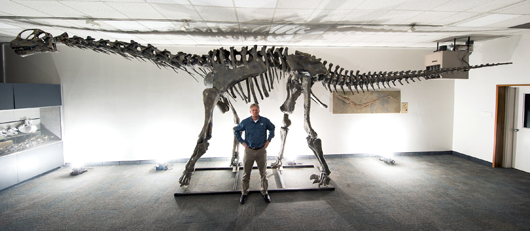
The Mounted Skeleton (Composite) Ready for Display

Moabosaurus ready for display.

Brooks Britt, Brigham Young University geology professor, poses in front of Moabosaurus.

Picture credit: Jaren Wilkey/Brigham Young University

Observant readers will note that the skull on this composite mount is actually a cast of a Camarasaurus skull.

The picture above shows Brigham Young University professor and lead author of the scientific paper, Brooks Britt, posing in front of the mounted exhibit of Moabosaurus (M. utahensis).  The fossils assigned to this new dinosaur genus, were all excavated from the Dalton Wells Quarry, some twelve miles north-west of the town of Moab (Utah).

Moabosaurus Fossil Bones

Around 5,500 fragmentary bones were found entombed in the mudstone, the majority of which represents Moabosaurus, although the fossils were badly damaged, in part due to being trampled by other dinosaurs and from insect damage (probably beetle larvae), that fed on the bones when they had been initially buried.

Based on braincase sampling and other fossil finds, the researchers have suggested that at least eighteen individuals are represented.  The bones were also transported a short distance by water and buried in sediments reworked from the much older Morrison Formation.

For models and replicas of Morrison Formation and Cedar Mountain Formation dinosaurs: PNSO Age of Dinosaurs Models.

Dalton Wells Quarry – Yellow Cat Member of the Cedar Mountain Formation

The preparation of a shattered femur which measures around 1.3 metres in length indicates that this dinosaur grew to about 9.75 metres in size.  Everything Dinosaur team members estimate that this herbivore might have weighed as much as an African elephant.  Palaeontologists tend to agree that, based on the current evidence, there was a substantial decline of sauropod diversity in North America from the Late Jurassic and into the Early Cretaceous.

As to where Moabosaurus fits into the sauropod family tree, that remains open to debate.  The researchers, which included Brigham Young University Museum of Palaeontology Curator Rod Scheetz and biology professor Michael Whiting plus a co-worker from Auburn University (Alabama), carried out four different taxonomic assessments using three different data sets.  Moabosaurus has been identified as a neosauropod, two studies indicate that this dinosaur has affinities with the Macronaria, as such, it is regarded as a basal titanosauriform.

Sorting the Taxonomy

It has been proposed that Moabosaurus was closely related to Turiasaurus (T. riodevensis) of the Early Cretaceous of Spain and Tendaguria (T. tanzaniensis) from the Late Jurassic of Tanzania.  Further phylogenetic studies will help to define the exact position of Moabosaurus in the sauropod family tree.

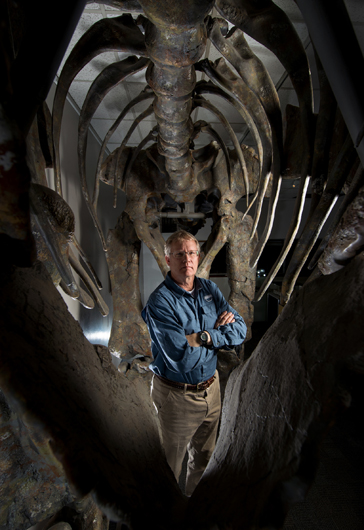
A View of the Mounted Exhibit of Moabosaurus

A view of Moabosaurus.

Professor Brooks Britt poses in the body cavity of Moabosaurus.

Picture credit: Jaren Wilkey/Brigham Young University

If Moabosaurus is closely related to Turiasaurus and Tendaguria then it suggests that land bridges may have existed between Gondwana and Laurasia to permit the mixing of faunas for longer into the Cretaceous than previously thought.  Analysis of zircon crystals, remnants of volcanic activity, indicate that Moabosaurus lived during the very earliest part of the Aptian faunal stage.  The phylogeny of Moabosaurus remains contentious.  In the scientific paper, “Moabosaurus utahensis – A New Sauropod from the Early Cretaceous of North America”, there is some discussion as to whether Nemegtosaurus and Quaesitosaurus (both from the Late Cretaceous of Mongolia), are sister taxa.

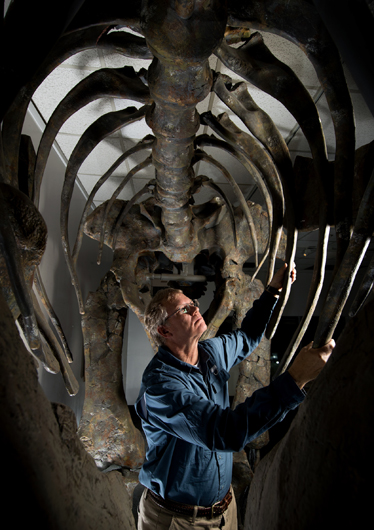
Examining the Sturdy Ribs of Moabosaurus

Moabosaurus being examined.

Moabosaurus and Geology Professor Brooks Britt.

Picture credit: Jaren Wilkey/Brigham Young University

This Moabosaurus Perished in a Severe Drought

A previous study indicated that a large number of Moabosaurus and other dinosaurs died in a severe drought.  Survivors trampled their fallen companions’ bodies, smashing and crushing their bones.  After the drought ended, streams eroded the land, and transported the bones a short distance, where they were again trampled.  Meanwhile, insects in the soils fed on the bones, leaving behind tell-tale burrow marks.

Professor Britt stated:

“We’re lucky to get anything out of this site.  Most bones we find are fragmentary, so only a small percentage of them are usable and that’s why it took so long to get this animal put together.  We had to collect huge numbers of bones in order to get enough that were complete.”

Visit the Everything Dinosaur website: Everything Dinosaur.
Go to Top