All about dinosaurs, fossils and prehistoric animals by Everything Dinosaur team members.

Fossil finds, new dinosaur discoveries, news and views from the world of palaeontology and other Earth sciences.

13 04, 2017

The Dinosaurian Body Plan and Wonderful Alan Charig Remembered

By |2024-05-07T15:33:07+01:00April 13th, 2017|Categories: Dinosaur and Prehistoric Animal News Stories, Dinosaur Fans, Main Page, Photos/Pictures of Fossils|2 Comments

Teleocrater rhadinus and Dr Alan Charig

There’s a book on our office shelves, its dust jacket is faded and torn and the pages are yellowed with age, not surprising really as it was printed in 1973.  Although many of the passages, diagrams and ideas contained within it, have long since been superseded, it is treated with great reverence as it is one of the first dinosaur books I ever owned.  Entitled “Before the Ark” it accompanied a ten-part television series on vertebrate palaeontology produced by the BBC.

Written by Alan Charig and Brenda Horsfield, (Dr Charig wrote and presented the television series too), it remains a treasured possession and today, with the publication of a scientific paper in the journal “Nature”, we remember Dr Charig, a man who is still having an influence on science, even though he passed away some twenty years ago.

“Before the Ark” and Teleocrater – Tribute to Dr Alan Charig
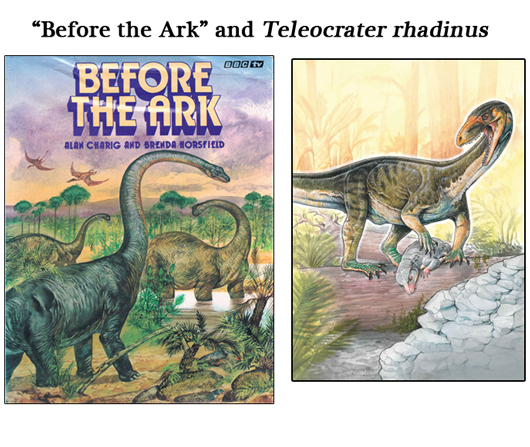
"Before the Ark" and Teleocrater.

“Before the Ark” and Teleocrater (before the dinosaurs).

Picture credit: BBC with T. rhadinus artwork by Gabriel Lio (Museo Argentino de Ciencias Naturales)

Early Dinosaur Counsin with “Crocodile-like” Appearance

Writing in the journal “Nature”, the researchers which include Sterling Nesbitt, assistant professor of geosciences at Virginia Tech, Roger Smith (University of Witwatersrand) and Paul Barrett of the Natural History Museum (London), describe more complete fossil material relating to Teleocrater rhadinus and formally establish this genus which helps to fill a critical gap in the fossil record leading to the evolution of the dinosaurs.

Teleocrater (the name means “slender complete basin” in reference to the reptile’s light build and the fully closed hip socket), was first proposed by Alan Charig back in the 1950s.  He was a PhD student at Cambridge University writing a doctoral thesis on Triassic reptiles of Tanganyika (now Tanzania).  Alan was being supervised by Francis Rex Parrington, a vertebrate palaeontologist who had uncovered the very first fossils of what we now refer to as Teleocrater rhadinus, during fieldwork in Tanganyika in 1933.

Fieldwork undertaken in 2015, led to the discovery of more fossil material and crucially limb elements and ankle bones which have helped determine where amongst the Archosaurs Teleocrater should be placed.

Team Members Extracting Fossil Material
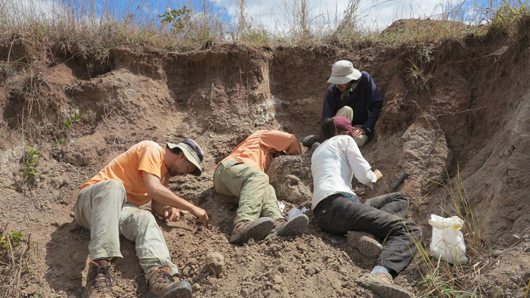
Excavating the fossils of Teleocrater and other Triassic animals.

Excavating the remains of Teleocrater rhadinus and other animals in southern Tanzania in 2015.

Picture credit: Roger Smith

Published photographs show authors Christian Sidor (left), Sterling Nesbitt, Kenneth Angielczyk (in the purple top and white floppy hat), along with Michelle Stocker (right), looking for Triassic vertebrates in exposures of the Manda Beds (Anisian faunal stage of the Middle Triassic) of southern Tanzania.

All Fossil Material from the Manda Beds

Francis R. Parrington collected the first fossil specimens from the Manda Beds in the Ruhuhu Basin of southern Tanzania.  These fossils were studied by Alan Charig for his doctorate, but much of Alan’s work on Teleocrater was never published.  Dr Charig went to Tanzania to search for more fossils in 1963, but it was not until the expedition of 2015, that the crucially important limb and ankle bones were recovered that demonstrated where on the Archosauria family tree Teleocrater should sit.

The ankle bones and other skeletal elements demonstrate that Teleocrater is more closely related to dinosaurs and birds than it is to crocodiles. It sits on the family tree of the archosaurs at the base of the Avemetatarsalian branch, the “bird-line Archosaurs”, sometimes also referred to as the Ornithodira.  The researchers conclude that Teleocrater and its near relatives split off from other avemetatarsalians before the evolutionary split between the Pterosauria (flying reptiles) and the dinosaurs.

Establishing T. rhadinus on the Archosauria Family Tree
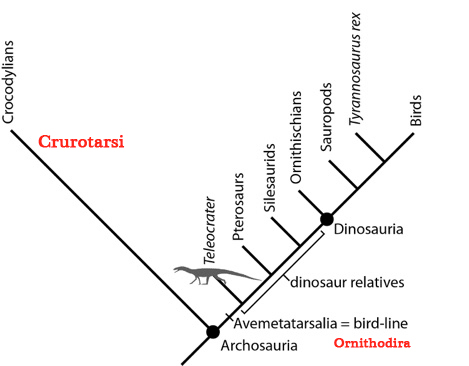
The phylogeny of Teleocrater.

Teleocrater is more closely related to pterosaurs and dinosaurs (including birds) than to crocodilians.

Picture credit: Sterling Nesbitt of Virginia Tech with additional annotation by Everything Dinosaur

The Big Two Branches of the Archosauria

The Archosauria clade consists of birds and crocodiles plus an array of extinct creatures which include the dinosaurs, silesaurids and the flying reptiles (pterosaurs).  This huge group of reptiles can be generally divided up into two distinct branches, based on the anatomy of the ankle bones.  On one branch, we have the crocodiles and their relatives (Crurotarsi), which tend to have a sprawling gait, whilst on the other branch we have the Avemetatarsalia, otherwise referred to as the ornithodirans, which tend to have their limbs directly under their hips and have a more upright gait, similar to mammals.

Dr Charig never got the opportunity to study fossils of the ankle bone, he passed away in 1997, without being able to complete his assessment of this reptile.  The researchers have honoured the contribution made by Alan Charig by naming him as an author on the 2017 paper and formally recognising the name Teleocrater, that he was the first to use.

Excavating the Fossils of Teleocrater
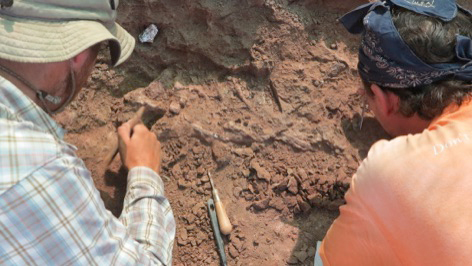
Excavating the fossils of Teleocrater and other Triassic animals.

Excavating the remains of Teleocrater rhadinus and other animals in southern Tanzania in 2015.

Picture credit: Roger Smith

Uniting the Aphanosauria Clade – Dinosaur Ancestors on All Fours

Teleocrater helps to cement the establishment of the Aphanosauria clade, a group of long-necked, slender-limbed, carnivores that lived in the Middle Triassic and were geographically widespread across Pangaea.  The Crurotarsi archosaurs, those crocodile-like creatures were thought to be highly diversified and geographically widespread across the super-continent Pangaea.  It now seems that the other branch of the Archosauria, the Avemetatarsalia, may have been equally as diverse and as widespread as their crocodile-like cousins.

Previously, palaeontologists have postulated that the earliest dinosaur relatives were chicken-sized and bipedal.  Thanks to the 2015 fossil discoveries and the work first undertaken by F. R. Parrington and Alan Charig, scientists have a different body plan to consider.  T. rhadinus which roamed the area that was to become Tanzania some 245 million-years-ago, was much larger at around three metres long and it was a quadruped.

An Illustration of the Early Avemetatarsalian Teleocrater rhadinus
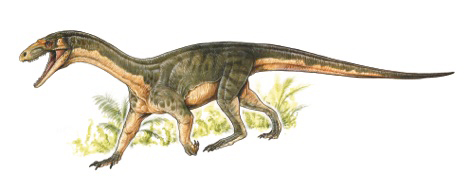
T. rhadinus illustration.

A life reconstruction of Teleocrater rhadinus.

Picture credit:  Gabriel Lio (Museo Argentino de Ciencias Naturales)

Remembering Dr Alan Charig

Alan Charig studied the fossils of what we now know as Teleocrater rhadinus.  Twenty years after his death, scientists can place this enigmatic reptile and its relatives within the avemetatarsalian branch of the Archosauria, Teleocrater represents one of the earliest members of this sub-branch, a lineage that eventually led to the dinosaurs and the birds.

In addition, with a more complete picture of Teleocrater, palaeontologists have another puzzle to ponder.  If the early branch members of the Avemetatarsalia were more species-rich and more widely geographically distributed than previously thought, then several early dinosauromorphs used to help scientists to understand how the body plan of the Dinosauria evolved, may represent specialised forms rather than the typical ancestral avemetatarsalian body plan.

Today, we reflect on the work of Dr Alan Charig and his mentor Francis Rex Parrington.  The researchers writing in the journal “Nature” have helped to put flesh onto those bones first examined all those years ago.  For my part, my thanks to Alan Charig for helping to write such a beautiful book and for inspiring a generation of science writers and enthusiasts.

The scientific paper: “The Earliest Bird-line Archosaurs and he Assembly of the Dinosaur Body Plan” by Sterling J. Nesbitt, Richard J. Butler, Martín D. Ezcurra, Paul M. Barrett, Michelle R. Stocker, Kenneth D. Angielczyk, Roger M. H. Smith, Christian A. Sidor, Grzegorz Niedźwiedzki, Andrey G. Sennikov & Alan J. Charig published in the journal “Nature”.

Everything Dinosaur acknowledges the help of Virginia Tech in the compilation of this article.

Visit the Everything Dinosaur website: Everything Dinosaur.
12 04, 2017

Chinese Fossil Sites Under Threat

By |2023-06-15T07:31:08+01:00April 12th, 2017|Categories: Dinosaur and Prehistoric Animal News Stories, Main Page, Photos/Pictures of Fossils|0 Comments

Mining Operations Damage Famous Fossil Site

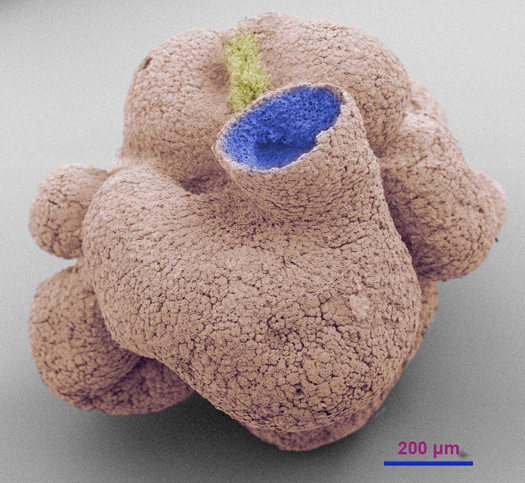
An article in the South China Morning Post highlights the growing concern expressed by the scientific community over damage to a globally important fossil site in Guizhou Province (south-western China).  Phosphorous mining operations are wiping away fossil evidence of some of the earliest organisms classified as animals known to science.  The tiny micro-fossils preserved in strata exposed in Weng’an county, represent the remains of multi-cellular organisms, marine sponges that once thrived in an ancient sea some 600 million years ago.

A False Colour Image Showing One of the Sponge-Like Micro-fossils (Doushantuo Formation)

Sponge-like Ediacaran micro-fossil.

A scanning electron microscope image of the 600 million-year-old sponge-like animal fossil (false colour image).

Picture credit: NIGPAS (Chinese Academy of Sciences)

Fossil Site Under Threat

Professor Zhu Maoyan and his colleagues at the Nanjing Institute of Geology and Palaeontology have called for urgent measures to be taken to help protect the Weng’an biota.  The world-renowned fossil site, one of the few places that preserves traces of Ediacaran fauna, is threatened as hundreds of mining trucks are transporting rocks from the area every day.  Weng’an county has one of Asia’s largest phosphorus reserves.  The mining business contributes more than sixty per cent of the county government’s annual tax income.  Intensive mining in the area has led to cases of massive subsidence.

The professor, who has led a number of field teams to explore the fossiliferous sediments, that first came to the attention of palaeontologists less than twenty years ago, stated:

“Six hundred million years of life’s evolutionary history is being traded to help produce a bowl of rice.”

The demand for phosphorous to make fertiliser is increasing, unfortunately, the rocks that form the Doushantuo Formation of Guizhou Province are a rich source of this important element.  However, local officials in Weng’an county have promised action after a fossil site covering about three square kilometres was nearly destroyed and buried under huge heaps of debris caused by subsidence.

The Doushantuo Formation

The micro-fossils preserved in the phosphorite rocks of the Doushantuo Formation, preserve the remains of 600 million-year-old, sponge-like organisms.  Professor Zhu commented that the Weng’an biota was remarkable because of the abundance of fossils and their fine state of preservation, with details shown down to a cellular level.

The professor added:

“There may not be another place like it in the whole world.”

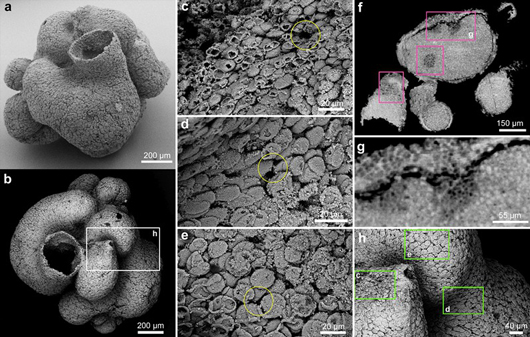
Features of the Fossils are Similar to Extant Sponge Anatomy

Precambrian sponge-like fossils.

Views of the sponge-like fossils from south-western China.

Picture credit: NIGPAS (Chinese Academy of Sciences)

The picture above shows various views of micro-fossils from the Weng’an county location including highly magnified views of what be a holdfast structure (c, d, e, f, g and h).

Professor Zhu stressed that both local government and the public had failed to realise that the exposures in Weng’an county are unique and very valuable to science.  It was suggested that a “core area” be chosen and then this site given protection.

To read an article featuring research by Virginia Tech College of Science and the Chinese Academy of Sciences which looks at the fossil evidence from the Doushantuo Formation: New Research Suggests Multicellular Life Started Earlier Than Previously Thought.

Visit the Everything Dinosaur website: Everything Dinosaur.
11 04, 2017

Getting our Heads Around Beautiful Edmontosaurus Skulls

By |2024-05-07T15:16:02+01:00April 11th, 2017|Categories: Dinosaur and Prehistoric Animal News Stories, Dinosaur Fans, Main Page|0 Comments

New Paper Published on Edmontosaurus

Scientists from the Canadian Museum of Nature in collaboration with colleagues from the Beijing Museum of Natural History have published a paper in the on-line academic journal PLOS One that provides a fresh analysis of the iconic North American dinosaur Edmontosaurus.  The researchers effectively develop the ideas put forward when this duck-billed dinosaur was first described a hundred years ago and help to highlight the differences between the two species currently assigned to the Edmontosaurus genus.  In addition, they cast doubt over the recently named and described Alaskan Hadrosaur Ugrunaaluk kuukpikensis (named and described in 2015), instead they suggest that these fossils belong to a species of Edmontosaurus.

The “Lizard from Edmonton” Named in 1917

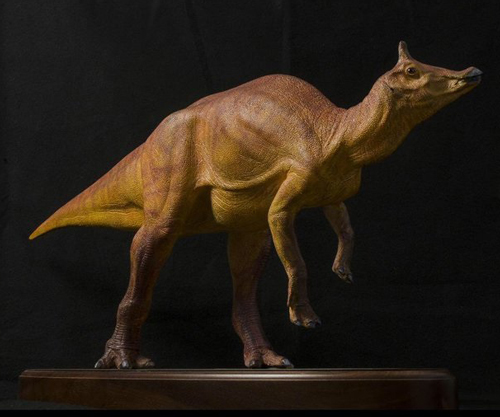
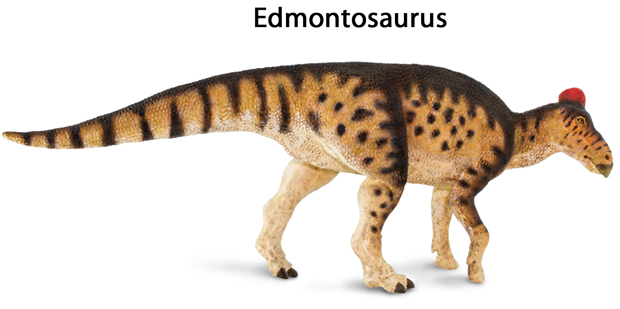
Wild Safari Prehistoric World Emontosaurus model.

The Wild Safari Prehistoric World Edmontosaurus dinosaur model.

Picture credit: Everything Dinosaur

For models and replicas of Edmontosaurus and other hadrosaurs: Wild Safari Prehistoric World Figures.

Cranial Anatomy of Edmontosaurus regalis

The scientists, which included Dr Jordan Mallon (Canadian Museum of Nature), who recently published a new paper casting doubt on how to tell female from male dinosaurs: No Visual Difference Between Boy Dinosaurs and Girl Dinosaurs looked again at the E. regalis holotype and the paratype material which come from the Horseshoe Canyon Formation (southern Alberta, Canada).

It was the pioneering Canadian palaeontologist Lawrence Lambe who first named and described Edmontosaurus back in 1917.  The holotype (CMN 2288), the fossil specimen on which the original description of Edmontosaurus (E. regalis) is based, consists of an incomplete skull and partial skeleton.

The paratype (CMN 2289), the specimen that has proved to be most beneficial in the clarification Edmontosaurus as it shows features not seen on, or are more distinct that those found in the holotype, consists of an incomplete but partially articulated skull in addition to significant elements from the rest of the skeleton.  The researchers were able to identify a number of unique anatomical characteristics that help to distinguish E. regalis from E. annectens.

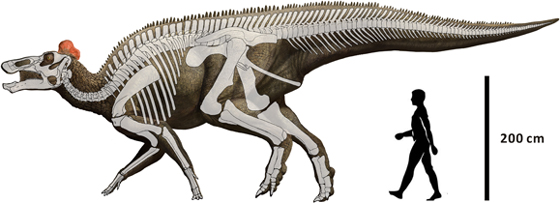
A Scale Drawing of Edmontosaurus regalis

A scale drawing of E. regalis.

A scale drawing of Edmontosaurus regalis. Note the colourful red comb on the top of the skull.

Picture credit: PLOS One

A “Soft, Fleshy Comb”

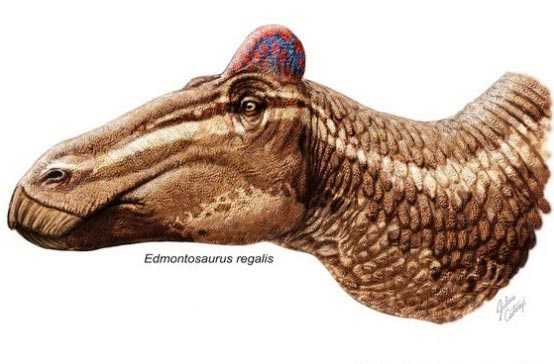
In the picture above, the scale drawing of Edmontosaurus is shown sporting a “soft, fleshy comb” on top of the skull.  Recent research suggests that E. regalis did indeed have a comb, a bit like a giant rooster.

Edmontosaurus with a soft tissue crest.

Soft-tissue crests in members of the Dinosauria.

Picture credit: Julius Csotonyi

To read an article published in 2013 that suggests members of the Hadrosaurinae had soft-tissue crests: Duck-billed Dinosaur with a Comb Like a Rooster.

With a better understanding of the differences between the two species of Edmontosaurus, the team could then develop their ideas, applying them to related duck-billed dinosaurs such as the giant Shantungosaurus from the Late Cretaceous of China, enabling them to revise this part of the Hadrosaurinae family tree.

Edmontosaurus regalis Compared to Edmontosaurus annectens

Corresponding author for the paper, Dr Hai Xing has published previously, describing differences between Edmontosaurus and Shantungosaurus.  Analysis of the skull bones of Edmontosaurus enabled Dr Xing and his colleagues to add a further three distinguishing characteristics to help tell the difference between E. regalis and E. annectens, (adult specimens).  In addition, the researchers identified a unique feature of the jugal (a bone in the cheek area linking the maxilla to the eye-socket),

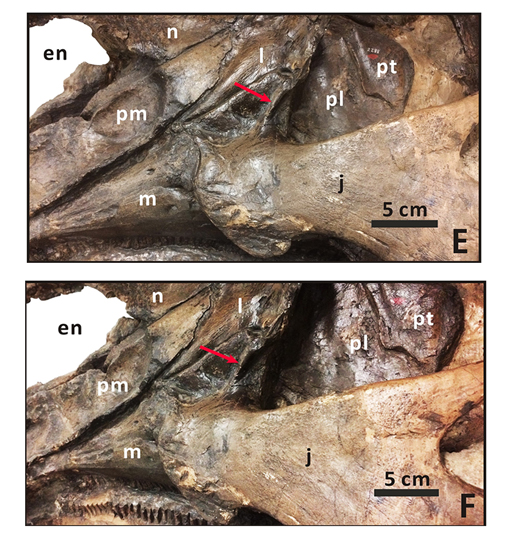
Views of the Holotype E. regalis Material

A unique feature of E. regalis (jugal bone).

Close-ups of the jugal anterior process of CMN 2288 in lateral (E) and posterolateral (F) views.

Picture credit: PLOS One

Key

  • en =external naris
  • n =nasal bone
  • j = jugal bone
  • pm = premaxilla (front of the top jaw)
  • m = maxilla (part of the top jaw)
  • p = palatine (bone related to the palate)
  • pt = pterygoid bone

The red arrow (E and F), points to the sharp, posterodorsally tilted ridge of bone that pushes into the eye-socket area.  This feature is unique to Edmontosaurus regalis.

Ugrunaaluk kuukpikensis – Nomen dubium

In 2015, a new type of flat-skulled hadrosaur was described (U. kuukpikensis), based mostly on fossils excavated from the Liscomb bonebed in the Price Creek Formation of northern Alaska.  This new dinosaur, was thought to be quite closely related to Edmontosaurus, it was assigned to the Edmontosaurini tribe, but Xing et al argue that as the description was based on fossils of juveniles and as their study sheds new light on the anatomy of Edmontosaurus, Ugrunaaluk kuukpikensis may not be a valid genus.  Instead, they suggest that the Liscomb bonebed material represents a northern occurrence of Edmontosaurus (E. regalis).

Whilst the team are quick to praise the meticulous approach of Mori, Druckenmiller and Erickson they suggest that given the relatively small size of the Ugrunaaluk fossils and the lack of overlap between these specimens and known Edmontosaurus fossils it is not credible to assert a new genus based on the evidence to date.  U. kuukpikensis becomes a Nomen dubium (dubious name).

To read about the discovery of the Alaskan duck-billed dinosaur fossils: Duck-billed Dinosaur from Alaska.

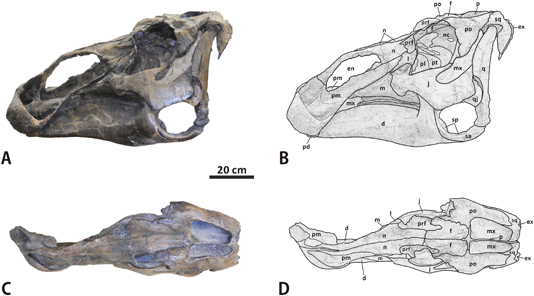
Views of the Holotype Skull Material (CMN 2288)

Edmontosaurus skull material (holotype - E. regalis).

CMN 2288 the holotype skull fossil of E. regalis (left lateral view and dorsal view, with accompanying line drawings).

Picture credit: PLOS One

The scientific paper: “Supplementary Cranial Description of the Types of Edmontosaurus regalis (Ornithischia: Hadrosauridae), with Comments on the Phylogenetics and Biogeography of Hadrosaurinae” by Hai Xing, Jordan C. Mallon, Margaret L. Currie published in PLOS One.

Visit the Everything Dinosaur website: Everything Dinosaur.
9 04, 2017

Chicxulub Impact Event Not Responsible for Dinosaur Extinction

By |2023-06-14T06:22:16+01:00April 9th, 2017|Categories: Dinosaur and Prehistoric Animal News Stories, Dinosaur Fans, Main Page, Photos/Pictures of Fossils|0 Comments

Mexican Tracksites Indicate Decline of Dinosaurs Prior to Impact Event

A team of scientists based in Germany and Mexico have published a paper that challenges the commonly held belief that the extraterrestrial impact event marked by the Chicxulub crater resulted in the extinction of the dinosaurs and their flying cousins the pterosaurs.  In addition, studies of marine sediments indicate that at least one species of ammonite Sphenodiscus pleurisepta may have survived into the Palaeogene.

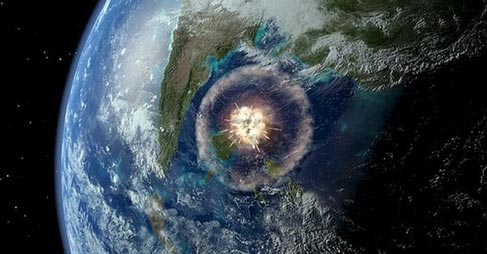
Chicxulub Extraterrestrial Impact Not the Cause of Global Mass Extinctions

Chicxulub impact event.

An artists’s impression of the impact event.

Exploring the Fossil Assemblage of the Cretaceous/Palaeogene Boundary

Writing in the journal of the “Geological Society of America Bulletin”, the researchers which include lead author Professor Wolfgang Stinnesbeck of Heidelberg University, Professor Eberhard Frey (State Museum of Natural History, Karlsruhe) and scientists from the Museo del Desierto, Coahuila, (Mexico), postulate that the dinosaurs and the flying reptiles were in long-term decline before the Chicxulub impact and the global mass extinction that marked the end of the Mesozoic.

The scientists also postulate that Aves (birds), had spread and diversified at the same time as the Dinosauria was in decline.  Furthermore, based on fossil evidence, the team contend that at least one type of ammonite, Sphenodiscus pleurisepta persisted into the Cenozoic.

These conclusions were drawn from a comprehensive study of upper Cretaceous sedimentary sandstone rocks, laid down at the very end of the “Age of Dinosaurs”.  The tracks and body fossils found at two localities in the Mexican state of Coahuila, depict life on the shore and the surrounding waters of a shrinking inland sea.  Both sites represent sandstones within the Las Encinas Formation of north-eastern Mexico.

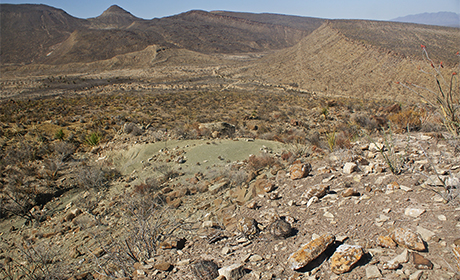
Remote Fossil Site in North-eastern Mexico (Las Encinas Formation)

Fossil site in north-eastern Mexico

One of the remote and isolated sites where the fossils were found.

Picture credit: Professor Stinnesbeck/Heidelberg University

The trackway assemblages at Amargos and Rancho San Francisco respectively, were produced by at least six different types of birds, while trackways of azhdarchoid pterosaurs are rare.  Only a single footprint made by a dinosaur (Theropod) was recorded.

Professor Stinnesbeck commented:

“Dinosaur tracks, however, are rare.  Only a single footprint comes from a predatory dinosaur.”

Lack of Pterosaur Fossil Evidence

The scarcity of pterosaur fossils was also noted.  The scientists state that azhdarchoid pterosaur fossils are rare.  Azhdarchids include some of the most famous and largest pterosaurs of all – Quetzalcoatlus Hatzegopteryx and Arambourgiania.  Most of the Pterosauria had become extinct by the Maastrichtian faunal stage of the Late Cretaceous.  From their heyday in the Early Cretaceous when at least ten pterosaur families existed, by the very end of the Cretaceous only two families of pterosaur are known in the fossil record.

Pterosaur Fossils Such as These Tracks are Very Rare

Pterosaur fossil tracks.

Pterosaur fossil tracks (north-eastern Mexico).

Picture credit: Professor Stinnesbeck/Heidelberg University

The photograph above shows prints of Azhdharchidea pterosaurs in a sandstone of the Upper Cretaceous, location – Rancho San Francisco near Paredon, north-eastern Mexico.

Research into the two locations Amargos and Rancho San Francisco, indicate a gradual decline of the dinosaurs with a simultaneous increase in the diversity of birds even before the end of the Cretaceous.

Professor Stinnesbeck added:

“Until now, it was generally assumed that the dinosaurs died out first and bird species diversified afterwards.  Our data, however, substantiate the theory that birds ascended before dinosaurs became extinct.”

The team postulate that the extraterrestrial impact event was not the cause of the dinosaur and pterosaur extinction, these reptiles were already on their way out, long before that event took place.  This idea of only a few dinosaur species persisting until the very end of the Mesozoic has been proposed before.  A count of dinosaur fossils found in the famous Hell Creek Formation of Montana supported the theory that the Dinosauria were already in decline by the end of the Cretaceous, the fossil assemblage in the very youngest rocks was dominated by just a handful of species.

Ammonites Survived into the Cenozoic

In the scientific paper, the researchers comment that the ammonites were not wiped out by the asteroid/comet/meteor strike.  Professor Stinnesbeck and his colleagues suggest that the species Sphenodiscus pleurisepta, a type of ammonite known from the United States and Mexico, survived, albeit in a declining state into the Palaeogene.

The geology professor stated:

“The effects of the Chicxulub impact were therefore not the cause of a global mass extinction, which probably came about considerably less catastrophically than previously assumed.”

Studying the Chicxulub Impact Event

The power of the extraterrestrial impact is evidenced by the abundance of crystalline clay minerals that are rounded in shape (smectite spherules), within a two-and-a-half metre-thick layer of strata.

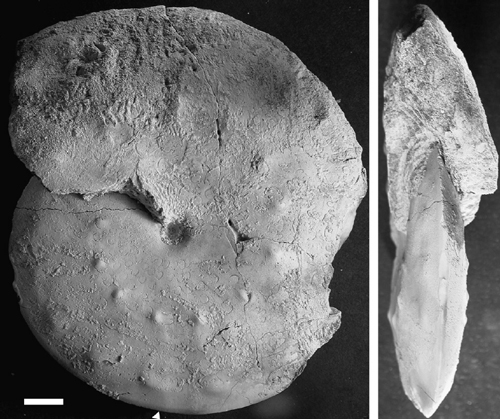
The Last Ammonite (Sphenodiscus pleurisepta)?

Sphenodiscus pleurisepta fossil ammonite.

Sphenodiscus pleurisepta ammonite fossil.

Picture credit: Conrad

The picture above shows a typical fossil of S. pleurisepta (picture of the holotype fossil), scale bar equals 1 cm.

For models and replicas of ammonites and other prehistoric animals: CollectA Prehistoric Life Figures.

The fifty million year decline of the Dinosauria: Bayesian Analysis Sheds New Light on Dinosaur Decline.

To read about other ammonites that may have persisted into the Cenozoic: Unravelling an Ammonite Mystery.

7 04, 2017

California to get a State Dinosaur? An Intriguing Question!

By |2024-05-07T15:17:26+01:00April 7th, 2017|Categories: Dinosaur and Prehistoric Animal News Stories, Dinosaur Fans, Main Page|0 Comments

One Step Closer to a State Dinosaur for California

California is one step closer to joining a select group of American States that have their own State dinosaur.  A vote in the “Golden State’s” legislative assembly was passed and the duck-billed dinosaur Augustynolophus morrisi is nearer to becoming the official dinosaur of the most populous State in the Union.  California already has a substantial number of State symbols, including the Leatherback Turtle (Dermochelys coriacea), the State marine reptile and the artichoke (Cynara cardunculus), California’s State vegetable.

The Hadrosaur Augustynolophus morrisi Could Become the State Dinosaur for California

Augustynolophus image.

Augustynolophus could become California’s State dinosaur.

Picture credit: Augustynolophus Twitter Account

Augustynolophus morrisi

Assembly member, Richard Bloom, the representative for Santa Monica, introduced a bill at the beginning of the year to make this Late Cretaceous, duck-billed dinosaur a state symbol.  The vote yesterday moved Augustynolophus nearer to becoming adopted.  Augustynolophus (pronounced August-steen-ah-pho-lus mor-riss-eye) fossils, including a fragmentary skull, have been found in the Moreno Formation, the fossils represent the most complete dinosaur discovered in California.  In fact, despite California’s size, it is the third largest State in the United States, very few dinosaurs are associated with this part of America.

We at Everything Dinosaur, think that just one other dinosaur genus Saurolophus is associated with California and these fossils, also from the Moreno Formation, may have been reassigned to Augustynolophus.

Helping to Support Learning and Educational Opportunities

The reason why lawmakers in California are keen to adopt a dinosaur as a symbol is that they hope that the dinosaur will promote learning and support educational opportunities.  California already has an official state fossil, Smilodon californicus – a sub-species of Sabre-toothed cat known from the famous La Brea Tar Pits close to the centre of Los Angeles.

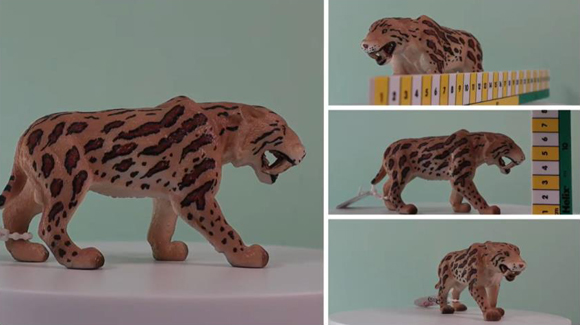
Images of a Smilodon Figure (Mojo Fun Smilodon)

Views of the Mojo Smilodon.

Various views of the Mojo Smilodon model.  Picture credit: Everything Dinosaur.

Picture credit: Everything Dinosaur

The picture (above) shows a Mojo Fun Smilodon figure.

To view the Mojo Fun range of prehistoric animal models: Mojo Fun Prehistoric and Extinct Models.

Twitter Account for a Dinosaur

Augustynolophus has its own Twitter account (@augustynolophus), you can follow the progress of the legislation on Twitter.  The Californian Senate have to vote and if the outcome is favourable then the Governor will have the final say.

Only seven of the fifty States that make up the USA have official State dinosaurs:

  • Wyoming – Triceratops
  • Texas – Paluxysaurus jonesi (Sauroposeidon)
  • Oklahoma – Acrocanthosaurus atokensis
  • New Jersey – Hadrosaurus foulkii
  • Missouri – Hypsibema missouriensis
  • Maryland – Astrodon johnstoni
  • Colorado – Stegosaurus armatus

To read an article about British Columbia debating whether to introduce an official fossil for the Canadian Province: Four Contenders for the Official Fossil for Canadian Province.

To see the Everything Dinosaur website: Everything Dinosaur.
5 04, 2017

Hunting for Tasmanian Tigers Scientists Embark on New Quest

By |2024-05-07T15:18:06+01:00April 5th, 2017|Categories: Animal News Stories, Dinosaur and Prehistoric Animal News Stories, Main Page|0 Comments

Scientists Prepare to Set Camera Traps in Hunt for Thylacine

Ever since the last known Thylacine died in Hobart zoo back in 1936, there have been numerous “sightings” both in Tasmania and on the Australian mainland of this marsupial, frequently referred to as the “Tasmanian Tiger”.  Most of these reports have been dismissed either as hoaxes, or as observers mistaking foxes or feral dogs for the largest carnivorous marsupial known to have co-existed with modern man during the Holocene Epoch.

Grainy photographs and blurred film footage have come to prominence from time to time, helping to fuel the debate as to whether Thylacines (Thylacinus cynocephalus), which were believed to have been hunted to extinction, might just have survived, with a few scattered populations holding on.

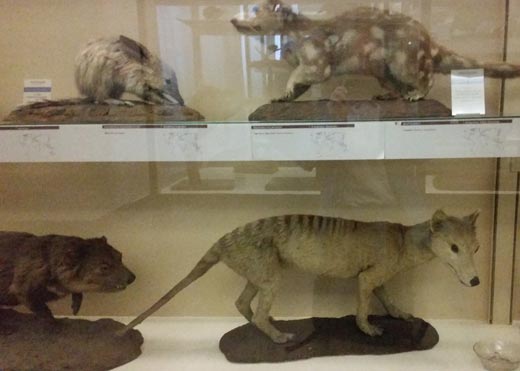
A Stuffed Thylacine (Thylacinus cynocephalus) in a Museum

A Tasmanian tiger exhibit.

Stuffed Thylacine (Tasmanian tiger).  Picture credit: Everything Dinosaur.

Picture credit: Everything Dinosaur.

To view the range of CollectA models: CollectA Age of Dinosaurs Popular Models.

Scientific Expedition to a Remote Location in Northern Queensland

A field team will be dispatched to the remote Cape York Peninsula (northern Queensland), in a bid to search for evidence of the existence of a surviving Thylacine population.  The team, led by Professor Bill Laurance of James Cook University (Queensland), hope to set fifty camera traps in the area so that photographic proof can be established.  The Cape York Peninsula has been chosen as a number of credible witness accounts of possible sightings, including one from a tourism operator and former park ranger, have occurred in the locality.

Professor Laurance commented:

“All observations of putative Thylacines to date have been at night, and in one case four animals were observed at close range, about 20 feet away, with a spotlight.  We have cross-checked the descriptions we received of eye shine colour, body size and shape, animal behaviour, and other attributes, and these are inconsistent with known attributes of other large-bodied species in north Queensland such as dingoes, wild dogs or feral pigs.”

The exact destination of the field team is being kept a closely guarded secret.  Nearly four thousand reported sightings have been recorded on the Australian mainland, it is the reports from qualified rangers, Aboriginal communities and the many credible witnesses that offer the tantalising prospect of a live population being identified.

Ranger Patrick Shears, explained that local Aboriginals call the beast the “moonlight tiger” and that many observers claim that these marsupials approach quite close, before turning their long, stiff tails and trotting away into the darkness.

A Reward Offered for a Living Thylacine

Tasmanian tour operator Stuart Malcolm has offered an $1.75 million AUD (£1 million GBP), reward for proof that the Thylacine has survived to the present day.  Professor Laurance and his team are not interested in any reward money, after all, it was a bounty placed on each dead Thylacine recorded, that helped devastate the species in Tasmania.

The Professor is not particularly sanguine when it comes to the chances of the expedition being a success.  He has stated that it is very unlikely that the Thylacine has survived on the Australian mainland.   However, with a number of credible reports to guide them, it seems that if the Tasmanian Tiger has survived anywhere on the mainland of Australia, the Cape York Peninsula is a good place to start looking.

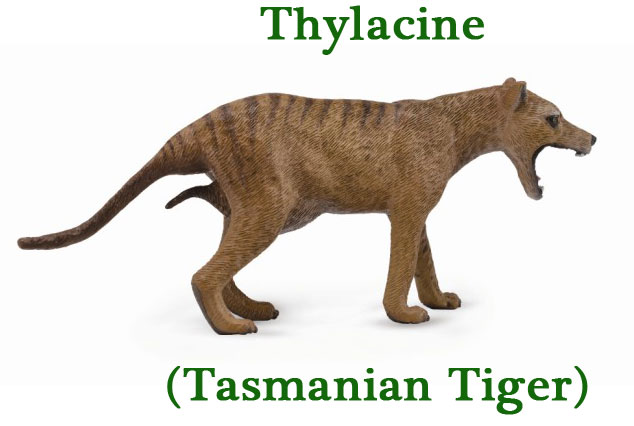
CollectA introduced a finely detailed model of a female Thylacine into their model range last year.  This model is quite hard to find, but not as difficult as a live Thylacine to track down.  Everything Dinosaur stocks this model, for the CollectA Thylacine and other rare CollectA models: CollectA Prehistoric Life Figures.

The CollectA Prehistoric Life Thylacine Model

The CollectA Thylacine replica.

The CollectA Thylacine model.

Everything Dinosaur intends to add a second Thylacine model to its already, extensive range later in the year.   Check this blog for more details about the model and also for updates on the Queensland expedition.

Visit Everything Dinosaur’s award-winning website: Everything Dinosaur.

4 04, 2017

The Cognitive Abilities of Neanderthals

By |2023-06-13T09:59:04+01:00April 4th, 2017|Categories: Dinosaur and Prehistoric Animal News Stories, Main Page|0 Comments

Carved Raven Leg Bone Hints at Sophisticated Neanderthals

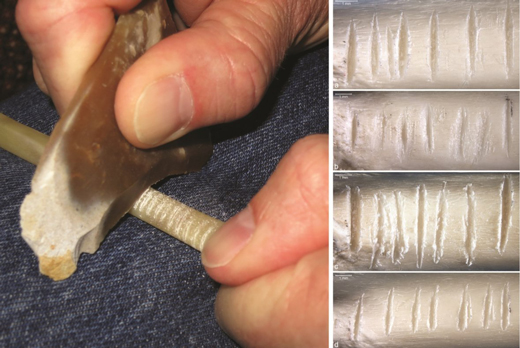
An international team of scientists, including researchers from the Université de Bordeaux (France), Cambridge University and the University of the Witwatersrand, (Johannesburg, South Africa), have published a paper in the on line journal PLOS One reporting on the discovery of a fragment of bone with seven notches that seem to have been deliberately carved into it.  The bone, a radius (lower leg bone), from a Raven (Corvus corax), represents the first instance of a bird bone from a Neanderthal site bearing modifications that cannot be explained as the result of butchery activities and for which a symbolic argument can be built on direct rather than circumstantial evidence.

Changing Views About Neanderthals

Palaeoanthropologists are changing their views about the Neanderthals, for so long our closest relative had been depicted as brutish “ape-men”, but there is a growing body of evidence to suggest that Neanderthals were sophisticated, they had a culture and their cognitive abilities may have been underestimated.  Neanderthals were sophisticated and capable of abstract thought.

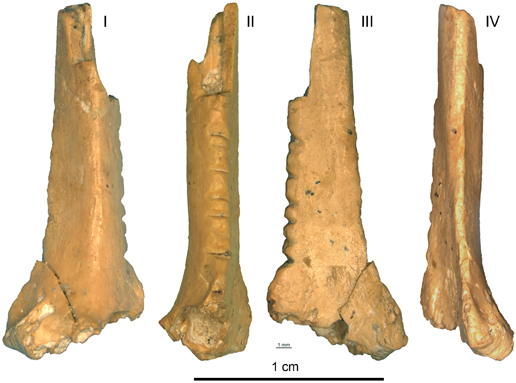
Seven Notches Carved with Care into the Raven Bone

Raven bone may have been deliberately carved by a Neanderthal

Various views of the carved raven bone.

Picture credit: PLOS One

When first described by fieldworkers, the raven bone was regarded as an intentionally notched object, possibly used as an eyeless needle in which the notches may have been used to fix a thread or perhaps the leg bone was carved as a form of decoration.

For models and replicas of Neanderthals (whilst stocks last): CollectA Prehistoric Life Figures.

A Neanderthal Rock Shelter in Crimea

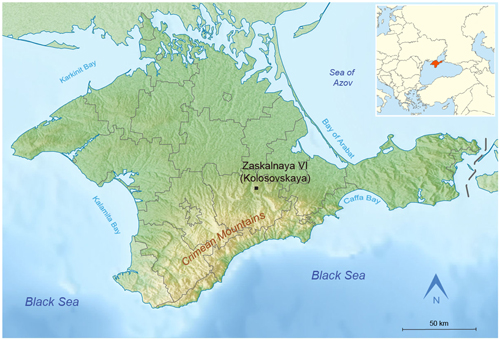
The bone was found amongst debris which included a variety of bird bones in a rock shelter located in the Crimean Mountains (Zaskalnaya VI rock shelter).  The bone comes from a layer associated with stone tools that indicate that the notches were carved between 43,000 and 38,000 years ago (Micoquian stone tool technology of the Middle Palaeolithic).   The scientists set out to recreate the marks using turkey leg bones and to examine the degree of regularity and intentionality of the set of notches.  Microscopic analysis suggests that they were produced by a careful to-and-fro movement of a sharp stone blade across the bone and that two notches were added to fill in the gap between previously cut notches, probably to increase the visual consistency of the pattern or perhaps to increase the object’s utility.

The Location of the Rock Shelter (Zaskalnaya VI rock shelter)

Neanderthal rock shelter (Crimea)

(Zaskalnaya VI rock shelter).

Picture credit: PLOS One

A Happy Hunting Ground for Scientists

The Crimea and southern Russia have proved a happy hunting ground for archaeologists and palaeontologists studying the distribution and dispersal of Neanderthals.  Several sites are known from eastern Crimea (notably the open sites at Karabai and Sary-Kaya).  On the western side, there is a collapsed cave (Kabazi), that has also yielded a number of significant H.  neanderthalensis related discoveries.

Much of the research in this part of the world has been focused on assessing how well adapted the Neanderthals were to the cold.  Despite a number of papers having been published that suggests the Neanderthals were biologically better adapted to a cold climate than our own species (H. sapiens), evidence from the Crimea challenges this.  Settlement can be plotted against climate fluctuations, with more northerly settlement coinciding with inter-glacial warm periods.  A number of eminent figures have stated that Neanderthals were no more cold adapted than anatomically modern humans.

Neanderthal Technology Helped Them Survive the Cold

In recent research (Aiello and Wheeler), it was concluded that physiological traits can only have made a modest difference to Neanderthal survival potential and that the easiest solution to keeping warm was culture led not biologically driven.  To survive the cold, the answer is more insulation this equates to better clothing that is better made.

Could the carved notches in the bone played a role in helping to sort ties and fastenings for clothing?

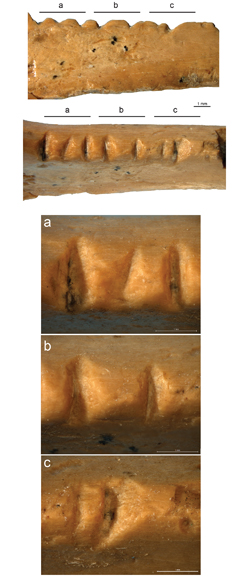
A Close View of the Notches Carved into the Raven Leg Bone

Carved notches on a Raven's leg bone.

Magnified images showing the uniformity of the carved notches.

Picture credit: PLOS One

The picture shows a profile view (top) and a view of the cut marks (dorsal view).  Photograph (a) shows notches 1-3, (b) shows a magnified view of the notches 4-5 and picture (c) shows notches 6-7 (scale bar 1 mm).

A Skilful Neanderthal with a Sharp Eye

A statistical analysis of the spacing in conjunction with experiments undertaken on turkey bones to recreate the marks, suggest that the carver took great care over the placement and the precision of the notches.  The marks could have had a symbolic meaning for the maker, the researchers conclude that although there is still a lot of controversy surrounding the idea of whether Neanderthal cognition was comparable to H. sapiens, the cuts in the bone are not from butchery, the engravings show great artistry and skill.  This evidence demonstrates the idea that there may have been more to the Neanderthals than previously thought.

Researchers Attempted to Recreate the Cut Marks in Turkey Bones

Turkey bone carving to mimic Neanderthal behaviour.

Researchers attempt to recreate the marks made by Neanderthals.

Picture credit: Francesco d’Errico (Université de Bordeaux)

To read an article that suggests Neanderthals may have has some medicinal knowledge: Neanderthals and Aspirin.

For a feature on redefining the Neanderthals: Changing Perceptions About Homo neanderthalensis

The scientific paper: “A Decorated Raven Bone from the Zaskalnaya VI (Kolosovskaya) Neanderthal site, Crimea”, by Ana Majkić, Sarah Evans, Vadim Stepanchuk, Alexander Tsvelykh, Francesco d’Errico published in PLOS One.

Visit Everything Dinosaur’s website: Everything Dinosaur.

3 04, 2017

No Visual Difference Between Boy Dinosaurs and Girl Dinosaurs

By |2023-06-13T09:42:58+01:00April 3rd, 2017|Categories: Dinosaur and Prehistoric Animal News Stories, Dinosaur Fans, Main Page|1 Comment

No Sexual Dimorphism in the Dinosauria

A couple of weeks ago, Everything Dinosaur reported on the publishing of a new scientific paper that set out to re-define the Dinosauria.  A new model for plotting the various branches of the dinosaur family tree has been proposed, meat-eating dinosaurs such as Tyrannosaurus rex and Velociraptor find themselves aligned with the ornithischians (bird-hipped dinosaurs), whereas iconic dinosaurs such as Diplodocus and the less iconic Herrerasaurus might just be outside of the Dinosauria altogether.  A new study has just been published that postulates that there was no sexual dimorphism within the Dinosauria.

To read more about the reclassification of the dinosaurs: Root and Branch Reform of the Dinosaur Family Tree.

That’s science, fundamental principles get challenged and in the light of new evidence, accepted thinking can be overturned.

Challenging the Idea of Sexual Dimorphism in the Dinosauria

Also, last month, Dr Jordan Mallon, palaeontologist and post-doctoral fellow of the Canadian Museum of Nature, published in the journal “Paleobiology” a fascinating article which challenges another fundamental precept of dinosaurs.  Dr Mallon argues that there is no proof that male dinosaurs looked different from females.

Many Scientific Papers Had Proposed Evidence for Sexual Dimorphism in Dinosaurs (including Stegosaurs)

The difference between girl and boy stegosaurids.

Females may have had reduced plates that were more spiky.

Picture credit: Evan Siatta with additional annotation by Everything Dinosaur

The Emperor’s New Clothes Syndrome

Dr Mallon conducted a detailed statistical analysis on nine different dinosaur taxa.  Dinosaurs that have relatively well-documented fossil records, including skull material which is believed to represent animals of different ages (ontogenetic stages), dinosaurs about which sexual dimorphism has been reported, inferred or at least debated in the past.

The dinosaurs studied:

  1. Coelophysis bauri
  2. Coelophysis rhodesiensis
  3. Stegoceras validum
  4. Allosaurus fragilis
  5. Stegosaurus mjosi
  6. Kentrosaurus aethiopicus
  7. Tyrannosaurus rex
  8. Plateosaurus sp.
  9. Protoceratops andrewsi

With crocodilians and many birds displaying sexual dimorphism, take alligators and the often-cited peacocks for example, as these animals are closely related to the Dinosauria, then surely dinosaurs were sexually dimorphic too?  But it could it be a case of the “Emperor’s New Clothes”?  Scientists expected to find evidence in the fossil record demonstrating differences between the boys and the girls and a large body of evidence based on the shape and size of bones has been gathered to reinforce this hypothesis – but just how valid is this idea?

An Extensive Statistical Analysis Searching for Evidence of Sexual Dimorphism

Dr Mallon set about conducting a wide-ranging, in-depth statistical analysis of sexual dimorphism in the Dinosauria, the first such investigation, as far as we, at Everything Dinosaur, are aware.   Previously published papers were re-visited including the intriguingly titled “The King’s New Clothes: A Fresh Look at Tyrannosaurus rex”, written by our chum Pete Larson, twenty years ago.  In addition, amongst the numerous papers referenced in his thought-provoking piece: “Recognising Sexual Dimorphism in the Fossil Record: Lessons from Nonavian Dinosaurs”, Dr Mallon looked at the research undertaken in 2015 by Maiorino, Farke, Kotsakis and Piras* into Protoceratops andrewsi, one of the species subjected to statistical analysis in this new study.

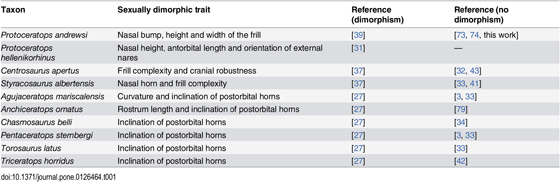
In the Maiorino et al paper, a number of examples of sexually dimorphic traits were listed amongst the Ceratopsia (see table below).

Sexually Dimorphic Traits within Horned Dinosaurs

Sexual dimorphism in horned dinosaurs.

A table outlining proposed sexual dimorphism in horned dinosaurs.

Table credit: L. Maiorino et al (from a paper also referenced by Dr Mallon).

Skull Measurements Not Characteristic of Sexual Dimorphism

The team concluded that anatomical traits such as the height and width of the frill and skull size thus may not be sexually dimorphic.  When careful measurements were considered, it seems that the size of the frill and skull size could not determine the boys from the girls, at least not in this Asian Late Cretaceous dinosaur.

Trying to Spot the Girls Amongst the Boys (P. andrewsi)

Assessing sexual dimorphism in Protoceratops.

Using frill and skull measurements to identify sexual dimorphism in Protoceratops.

Picture credit: L. Maiorino et al

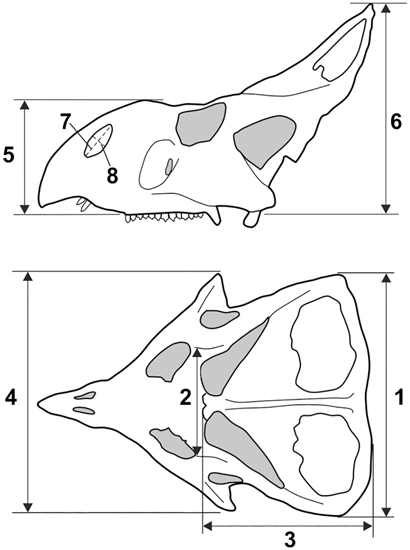
Dr Mallon concurs.  In the 2015 study, scientists measured a number of traits within a sample set of twenty-nine Protoceratops skulls.

They measured:

1 – Width of the frill.
2 – Postorbital width of the skull.
3 – Length of the frill.
4 – Width of the skull across jugals.
5 – Nasal height of the skull.
6 – Height of the frill.
7 – Length of external nares.
8 – Width of external nares.

The 2015 study could not determine two distinct clusters of measurements when the skulls were assessed.  If they had, then these two unambiguous groups would have supported the idea that Protoceratops at least, exhibited sexual dimorphism.

Protoceratops One of Nine Different Dinosaurs Incorporated within the Study

Protoceratops on display.

A Protoceratops exhibit on display at The Naturmuseum Senckenberg (Frankfurt, Germany). Picture credit: Everything Dinosaur.

Picture credit: Everything Dinosaur

Why is Sexual Dimorphism in the Dinosauria Such a Big Deal?

The fossil record can only tell us so much.  For instance, inferring behaviour is extremely difficult.  Most palaeontologists now agree that many dinosaurs lived in herds (should that be flocks)?  If sexual dimorphism can be identified that it will provide critical information about the role of sexual selection in the evolution of different types of dinosaurs, as well as supporting the idea that many dinosaurs indulged in visual displays and intraspecific combat.

Dr Mallon argues that quantifiable data to support this hypothesis is often lacking.  A review of existing literature was undertaken to identify quantitative evidence for differences between the boy dinosaurs and the girls and according to this new research, the good doctor could find no evidence for sexual dimorphism in the nine taxa studied.

This contradicts many existing perceptions, but as with all science it is a question of evaluating the evidence.

Looking for Medullary Bone

Dr Mallon states that he can’t be certain that dinosaurs were not sexually dimorphic, it’s just that the available evidence precludes its detection.  A helpful start would be to positively identify females by the presence of unlaid eggs in the body cavity or medullary bone within fossil material and indeed there have been some examples already found.  However, more data is needed before we can positively distinguish the males from the females.

Things would of course be much easier, if nonavian dinosaurs were still around today.  All we would need is some volunteers willing to lift the tail of a Triceratops or probe the private parts of a Pachycephalosaurus, would anyone want to give it a try?

* The Protoceratops paper: L. Maiorino , A. A. Farke , T. Kotsakis , and P. Piras . 2015. “Males resemble Females: Re-evaluating Sexual Dimorphism in Protoceratops andrewsi (Neoceratopsia, Protoceratopsidae)”. PLoS ONE 10:e0126464. doi: 10.1371/journal.pone.0126464.

An article published in December 2016 that looks at the potential evolutionary advantage of different sized members of the same Coelophysis flock: Sizing Up Early Dinosaurs – Variation an Evolutionary Advantage.

Visit the award-winning Everything Dinosaur website: Visit Everything Dinosaur’s Website.

1 04, 2017

New Species of Daspletosaurus Announced

By |2023-06-13T09:16:58+01:00April 1st, 2017|Categories: Dinosaur and Prehistoric Animal News Stories, Dinosaur Fans, Main Page|0 Comments

Tyrannosaurids with Sensitive Snouts (Daspletosaurus horneri)

Scientists based in the United States have announced the discovery of a second species of Daspletosaurus, a member of the tyrannosaur family and analysis of the skull and jaws indicate that these carnivores, like crocodilians, had sensitive snouts.

The new species has been named Daspletosaurus horneri, “Horner’s frightful lizard”, the trivial name honours palaeontologist Jack Horner.  John “Jack” Horner, was believed to be the inspiration for the character of Alan Grant in Michael Crichton’s novel “Jurassic Park”.  From relatively humble beginnings, Horner established himself as one of the world’s most famous and eminent palaeontologists.  In late 2015, he announced his retirement from the post of Curator of Palaeontology at the Museum of Rockies after thirty-three years in the post.

The Facial Features of Daspletosaurus horneri

The facial features of Daspletosaurus horneri.

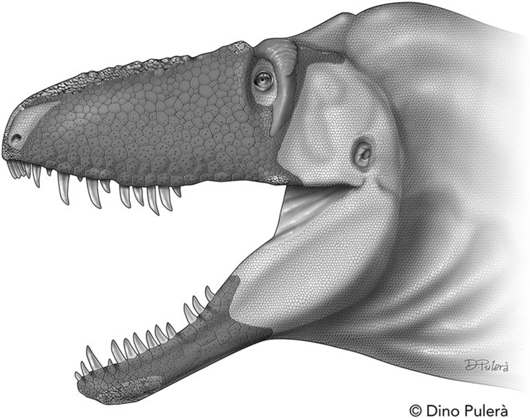
Bone texture indicates large zones of large, flat scales and subordinate regions of armour-like skin. Integumentary sense organs occur on the flat scales that cover the densest regions of neurovascular foramina. The region outside of the crocodilian-like skin is reconstructed with small scales after fossilised skin impressions of tyrannosaurids.

Picture credit: Dino Pulerà

Daspletosaurus horneri and Daspletosaurus torosus

Fossils from an adult, a subadult and a lower jaw ascribed to a juvenile were found in close proximity in strata that forms the upper portion of the Two Medicine Formation (Montana).  A phylogenetic analysis places this new tyrannosaurid as the sister species to Daspletosaurus torosus, named in 1970, when fossil material formerly associated with the genus Gorgosaurus was reassessed and assigned to a new genus.  D. torosus is known from strata that dates from between 76.7 mya to 75.2 mya.

The fossils ascribed to D. horneri are found in slightly younger rocks, estimated to date from 75.1 mya to 74.4 mya.   Given how closely related these two dinosaurs were, their geographical proximity and temporal succession, the researchers postulate that these two forms of Daspletosaurus represent a single anagenetic lineage.

An Illustration of Daspletosaurus (D. torosus)

Drawing of Daspletosaurus.

A scale drawing of Daspletosaurus.  Picture credit: Everything Dinosaur.

Picture credit: Everything Dinosaur

The picture (above) shows an illustration based on the CollectA Age of Dinosaurs Daspletosaurus model.

To view the CollectA model range: CollectA Age of Dinosaurs Popular Range.

What is an Anagenetic Lineage?

Lead author of the paper, Professor Thomas Carr and his collaborators, argue that Daspletosaurus horneri evolved directly from its older, close relative Daspletosaurus torosus.  This is a form of evolution known as anagenesis – one species gradually evolves over a period of time into a new species.  An anagenetic lineage occurs when one population representing a single species, over thousands and thousands of years, gradually accumulates change.  These changes eventually become sufficiently distinct from the earlier form that descendants can be labelled a brand new species.

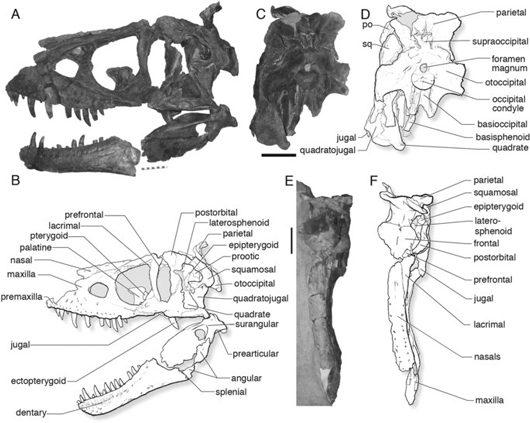
The Skull and Jaws of the Daspletosaurus horneri Holotype

Skull and jaws of D. horneri with line drawings.

Views of the skull and jaws of the holotype fossil material (D. horneri).

Picture credit: Scientific Reports

The picture above shows photographs and line drawings of some of the holotype fossil material (skull and jaws – MOR 590).  Photograph (A) shows MOR 590 in left lateral view, (B) represents the line drawing of this fossil material.  In photograph (C) an anterior view of the skull material is shown, (D) is the accompanying line drawing.  Photograph (E) shows the skull in dorsal (top down) view, with (F), the line drawing of the top of the skull.

Sensitive Nerves on the Face of Daspletosaurus

Facial bone texture indicates a scaly skin, no sign of lips but a vast array of sensitive nerve openings (foramina).  The researchers conclude that these foramina would have allowed hundreds of branches of the trigeminal nerve to reach the surface of the snout, turning the dinosaur’s face into a sensitive third “hand”.

The scientists, which include David Varricchio (Montana State University) and Jayc Sedlmayr (School of Medicine, Louisiana State University) compared these structures to the beaks of birds and the snouts of living crocodilians.  Crocodiles and alligators have thousands of integumentary sensory organs around their jaws, the jaws help these reptiles to explore and understand their surroundings.

Commenting on the similarities between living crocodiles and the MOR 590 skull and jaw material, lead author Professor Thomas Carr stated:

“Given that the foramina are identical in Tyrannosaurs, [that] indicates that they had super-sensitive skin as well.”

The trigeminal nerve plays a special sensory role in many mammals, reptiles and birds, carrying sensory signals from whiskers and electrical receptors and enabling snakes such as the pit viper to home in on infrared radiation from warm-blooded prey.  The snouts and jaws of tyrannosaurids could have been very sensitive, it has been speculated that these dinosaurs could have rubbed their faces together during courtship.  Although, this is just speculation, similar behaviour is seen in extant animals today, so amorous tyrannosaurids could have rubbed their snouts together as part of bond forming or pre-mating rituals.

To read an article about potential courtship behaviour in theropod dinosaurs: Dance of the Dinosaurs.

Visit the award-winning Everything Dinosaur website: Everything Dinosaur.
30 03, 2017

“Standing Dinosaur Crouching Bird” the Evolution of the Avian Stance Outlined in New Research

By |2024-05-07T15:24:51+01:00March 30th, 2017|Categories: Dinosaur and Prehistoric Animal News Stories, Dinosaur Fans, Main Page|0 Comments

Detailed Molecular Analysis of Fossilised Tissue Reveals Gradual Evolution of Avian Stance

It may be seventeen years since the release of the multi-award winning film “Crouching Tiger, Hidden Dragon”, but today, we draw similarities between one of director’s Ang Lee’s most successful movies and a new scientific paper published in the on line journal “Nature Communications” that illuminates how the crouched posture of modern birds evolved from their more straight-limbed dinosaur ancestors.  It’s really a case of “standing dinosaur evolves into crouching bird”.  The fossils associated with the study represent Confuciusornis sanctus.

Just like the film released in 2000AD, the research is the culmination of extensive collaboration between China and the West.  A joint study between scientists from the Royal Veterinary College, led by Professor John Hutchinson and Professor Baoyu Jiang (Nanjing University, China) and associates have analysed the perfectly preserved soft tissues around the ankle joint of a 125-million-year-old, early bird called Confuciusornis and used this data to work out the evolutionary path the birds took towards their more crouched posture.

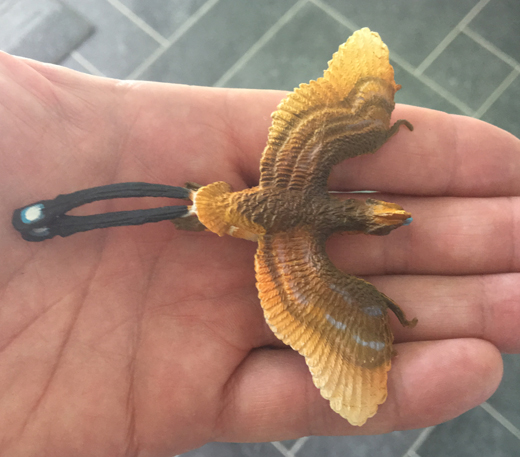
An Model of the Early Cretaceous Bird Confuciusornis (C. sanctus)

PNSO Confuciusornis model. Cretaceous birds.

“A bird in the hand”, the Confuciusornis model from PNSO. Picture credit: Everything Dinosaur.

Picture credit: Everything Dinosaur

To view models and replicas of Confuciusornis and other prehistoric animals: PNSO Age of Dinosaurs Replicas.

The Early Cretaceous Bird – Confuciusornis

Known from hundreds of beautifully preserved specimens excavated from Lower Cretaceous strata associated with the Yixian and Jiufotang Formations of Liaoning Province (north-eastern China), Confuciusornis was a pigeon-sized bird that shows a number of anatomical adaptations over more primitive creatures such as Archaeopteryx.  For example, Confuciusornis had a toothless beak, compressed caudal vertebrae (pygostyle) and a deeper chest to support more powerful flight muscles.  The males possessed a pair of extremely long tail feathers (see illustration above), whilst the females tended to be smaller and lacked long tail feathers.

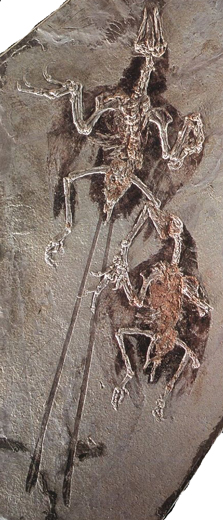
A Pair of Confuciusornis Fossils (Male and Female)

Confuciusornis fossil birds.

A pair of Confuciusornis fossil birds (Liaoning Province).

Examining the Lower Leg

The researchers examined the lower leg of one specimen which had soft tissues preserved, including the remnants of cartilage and ligaments, around the ankle joint.  These fossils have been preserved in layers of very finely-grained volcanic ash, enabling exquisite details from animals that lived more than 120 million years ago to be studied.

Dr Jiang stated:

“These soft tissues were not just preserved as an ashen replacement of the former tissue, as sometimes happens.  Rather, the cellular and fibrous structure of the tissues was preserved at a microscopic level.”

Multiple spectroscopic imaging methods in conjunction with X-ray synchrotron analysis enabled the team to examine these tissues at the molecular level.  Some of the bird’s original organic chemistry was identified.  In particular, the team found evidence of fragments of the collagen proteins that made up the leg ligaments, which matched the preservation at the microscopic tissue level of detail.

Tissue Preservation in a Confuciusornis Specimen

The team’s findings concur with an increasing body of evidence that, under certain special conditions, some biological molecules including even amino acids or partial proteins, can persist over millions of years in the fossil record.

To read an article about the discovery of dinosaur proteins in 175-million-year-old Sauropodomorpha: More Dinosaur Proteins Found – Lufengosaurus.

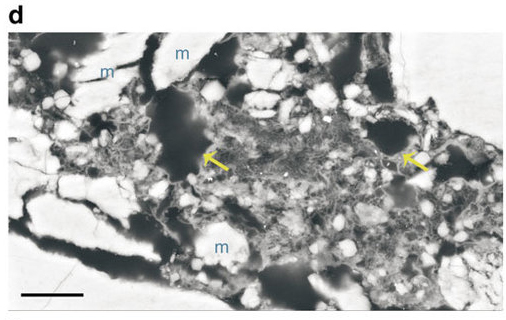
Highly Magnified Image (Micrograph) Showing Organic Structures at the Cellular Level (C. sanctus)

Confuciusornis micrograph.

Confuciusornis micrograph of ankle area showing cells (yellow arrows).

Picture credit: Nature Communications

The image above shows a cross-sectional slice of the ankle area with a large area of mineralisation (m) visible in the fibrocartilage within the ankle joint.  The yellow arrows equate to cells, scale bar 10 μm (microns).

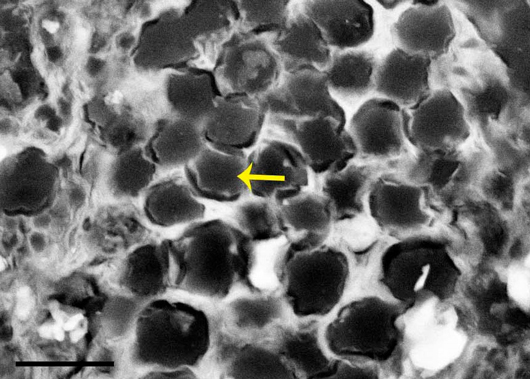
Scanning Electron Micrograph of the Fossil Tissue

Soft tissue preservation (Confuciusornis fossil).

Soft tissue preservation in a Confuciusornis fossil.

Picture credit: Royal Veterinary College

The image above shows a cross-sectional slice of tendon or ligament fibres (arrow) from a scanning electron micrograph of the fossil tissue (scale not stated).

An Exceptional Fossil

Professor Roy Wogelius (University of Manchester), one of the co-authors of the scientific paper, commented:

“The preservation in this fossil was exceptional and allowed us to resolve subtle but important chemical and structural details within this critical early species of bird.”

The researchers then reconsidered this evidence in light of the whole anatomy of the Confuciusornis leg, and that of its cousins from earlier dinosaurs to extinct and even modern birds.  Using this data, the team were able to obtain more information that potentially maps out how the straight-limbed ancestors of birds (theropod dinosaurs), evolved the crouching gait.

Professor Hutchinson stated:

“Once we were confident that some of the remnants of the soft tissues around the ankle joint still remained around the ankle, we could reconstruct parts of the ankle beyond just the bones.  The new information we gained about the anatomy of the cartilages and tendons show that this early bird had an ankle whose form fits an intermediate function between that of early dinosaurs and modern birds.”

Professor Hutchinson added:

“Overall this reinforced other lines of evidence that the more crouched, zigzag limb posture of birds evolved gradually from early dinosaurs to birds, with even these early birds having limbs that were built and worked differently from those of living birds, but were approaching the modern condition.”

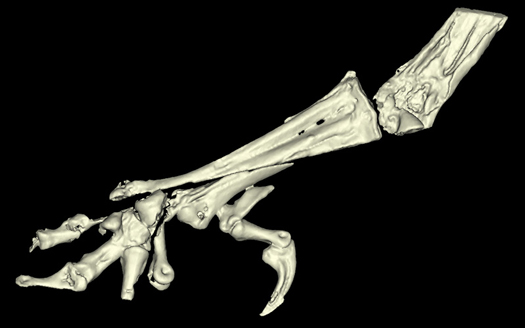
Three-Dimensional Computer Image of the Fossilised Right Lower Leg (C. sanctus)

3-D image of the right lower leg of a fossil bird.

A three-dimensional, computer generated image of the lower right leg of Confuciusornis.

Picture credit: Royal Veterinary College

An Insight into the Evolution of Modern Birds

This multi-technique study involving scientists from both Chinese and British academic institutions, has provided a new insight into the evolution of modern birds.

The team have essentially plotted the evolution of the ankles of modern birds from their reptilian ancestors.  By comparing the confuciusornithid material with that of later Enantiornithines and those primitive birds believed to be more closely related to modern Aves (Neornithes), such as the Ornithurae, the researchers have shown that as the number of main toes was reduced, the foot narrowed and became more robust.

The hypotarsus process became more prominent and enlarged and the orientation of the foot altered towards a more crouching gait.  This led on to the development of fibrocartilages, mineralisations and ultimately bony ridges and grooves to enhance the leverage of as well as enclose and guide the foot tendons which are seen in most modern birds today.

Everything Dinosaur acknowledges the assistance of a media release from the Royal Veterinary College in the compilation of this article.

Visit Everything Dinosaur’s award-winning website: Everything Dinosaur.
Go to Top