All about dinosaurs, fossils and prehistoric animals by Everything Dinosaur team members.

Fossil finds, new dinosaur discoveries, news and views from the world of palaeontology and other Earth sciences.

29 03, 2017

Dinosaurs of the Dampier Peninsula (Australia)

By |2023-06-12T08:51:40+01:00March 29th, 2017|Categories: Dinosaur and Prehistoric Animal News Stories, Dinosaur Fans, Main Page|1 Comment

Tracking Down Australia’s Early Cretaceous Dinosaur Ichnofauna

A number of media outlets have covered details of the new scientific paper published in the “Journal of Vertebrate Palaeontology” that maps the extensive dinosaur tracks located on the Dampier Peninsula of Western Australia.  The focus of many of these reports has been on the discovery of giant sauropod footprints, which at around 1.7 metres long, have been dubbed “the biggest dinosaur footprints in the world”.

Biggest Dinosaur Footprint in the World?
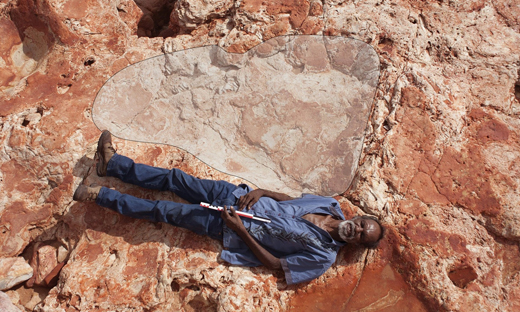
Giant dinosaur tracks of the Dampier Peninsula (Western Australia).

Richard Hunter lies next to the giant dinosaur footprint.

Picture credit: University of Queensland

Certainly, the picture of the individual print, with one of the field team, lawman Richard Hunter lying alongside, has captured the public’s imagination.  However, some of the key findings of the academic paper have been somewhat overlooked in the mainstream media.  In this article, we will briefly summarise some of the main points.

The Importance of the Broome Sandstones

The sandstone rocks of the Dampier Peninsula contain a vast amount of very well-preserved dinosaur tracks, prints and trackways.  They have been studied periodically since the 1960s but were and remain, part of the myth culture related to creation for the indigenous people.  The sandstones date from the Lower Cretaceous (Valanginian to Barremian faunal stages), that’s around 140 to 125 million years ago (mya).

The date of these rocks in Western Australia equates to around about the same time as the Wealden Supergroup was being formed, strata that is exposed in southern England, including the Isle of Wight and has yielded a wealth of dinosaur fossil material.

So, the trackways and prints preserved in Western Australia, permit scientists to compare and contrast the different dinosaur faunas that existed in different parts of the world, this is one of the key points from the mapping of the Australian tracks.  In addition, these rocks are much older than the dinosaur fossil bearing strata in other parts of Australia, notably Queensland, the Winton area for example.

Dinosaur Tracks

The trace fossils preserved on the peninsula provide the main record of non-avian dinosaurs in the western half of Australia, this ichnofauna provides the only detailed glimpse of Australia’s Dinosaurian fauna during the first half of the Early Cretaceous.

A Dinosaur Thoroughfare – Extensive Dinosaurian Tracks Mapped
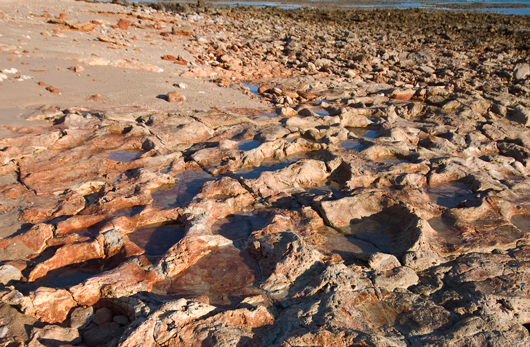
A dinosaur thoroughfare.

Extensive dinosaur tracks (Broome sandstone).

Picture credit: Queensland University

One of the implications for this study, is that the sauropod tracks provide scientists with an opportunity to research further how such large browsers and grazers shaped the environment and the ecosystem, just as elephants influence the flora to be found in Africa, where these extant herbivores are located in significant numbers (see photograph above, showing extensive Sauropodomorpha tracks – dinoturbation).

The Number of Tracks and the Different Types of Dinosaur They Represent

The research team, which was led by Dr Steve Salisbury (Queensland University), were invited by the area’s Goolarabooloo Traditional Custodians, to map and document the sacred trackways.  From 2011 to 2016, the field team spent hundreds of hours recording, photographing, casting and mapping the trace fossils, a task made extremely difficult by the extent of the trackways and the fact that most of them were only exposed at low tide.  Drones were used to provide an aerial view of the footprints, perhaps one of the most diverse Dinosaurian ichnofaunas found to date.

To read an article about the mapping work: Mapping the Dinosaur Heritage of Western Australia.

Forty-eight discrete Dinosaurian tracksites were identified in this area.  Thousands of tracks were examined and measured in situ and using three-dimensional photogrammetry.  Tracksites were concentrated in three main areas along the coast: Yanijarri in the north, Walmadany in the middle, especially around James Price Point and Kardilakan–Jajal Buru in the south.

Dinosaur Tracks and the Palaeoclimate

The researchers describe the palaeoclimate as a large braided river system within a flood plain that was periodically flooded, located close to the sea.  Most of the dinosaur tracks are found in horizons that represent layers generated between the periodic floods.

Of the thousands of tracks studied, 150 could be assigned to the type of dinosaur likely to have made them.  At least eleven and possibly as many as twenty-one different track types were recorded:

  • Five different theropod tracks
  • More than six types of sauropod tracks – including those 1.7 metre long prints left by the giant form.
  • Six types of armoured dinosaur tracks
  • Four types of ornithopod tracks

Eleven of these track types could formally be assigned or compared to existing or new ichnotaxa, whereas the remaining ten represent morphotypes that, although distinct, are currently too poorly represented to confidently assign to existing or new ichnotaxa.

One of the Newly Described Ichnotaxa – A Giant Eight-Metre-Plus Ornithopod Named Walmadanyichnus hunteri
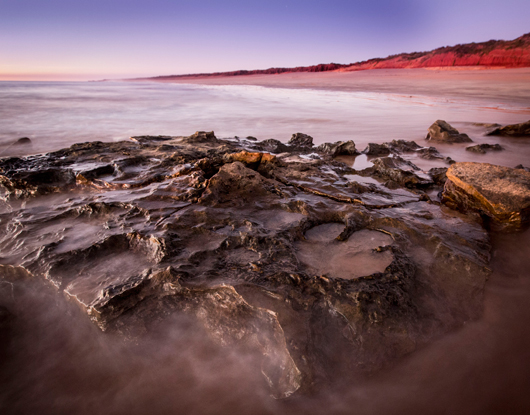
Walmadanyichnus hunteri

A giant Early Cretaceous ornithpod Walmadanyichnus.

Picture credit: Queensland University

The Diversity of Theropod Dinosaur Tracks Mapped
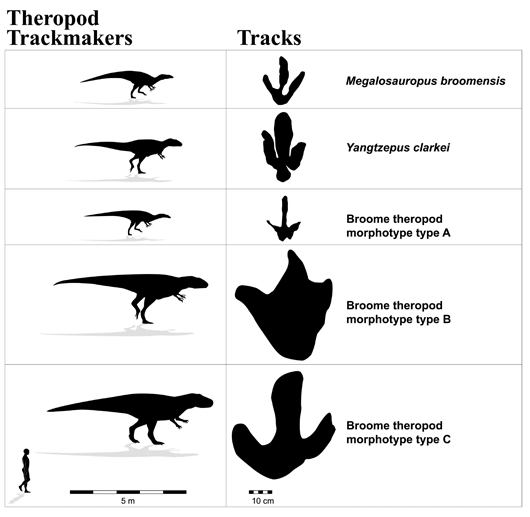
Broome Theropoda.

Broome sandstone theropod track types.

Picture credit: Queensland University

Describing the Ichnotaxa

The researchers from Queensland University in collaboration with their associates at James Cook University, demonstrate that only two of the ichnotaxa described in this new paper, relate to already described dinosaur species.  Tracks assigned to the small theropod Megalosauropus broomensis and the fleet-footed ornithopod Wintonopus latomorum have been described before.

The team have identified a total of six new ichnotaxa:

  • One new theropod ichnotaxon – Yangtzepus clarkei (see illustration above).
  • Two new ornithopod ichnotaxa – Wintonopus middletonae and the eight-metre-long giant Walmadanyichnus hunteri (see photograph of track in this article).
  • One new sauropod ichnotaxon – Oobardjidama foulkesi (see illustration below).
  • Two new thyreophoran ichnotaxa – Garbina roeorum and Luluichnus mueckei (see illustration further down this page).

Sauropod Trackmakers (Broome Sandstone)
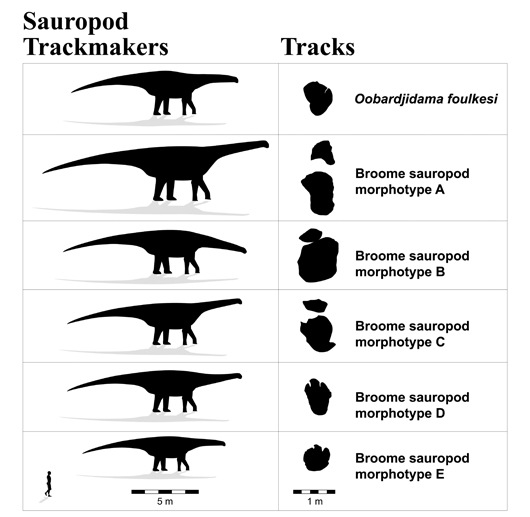
Several different types of Sauropod track identified from the Dampier Peninsula.

The sauropod biota of the Dampier Peninsula (Early Cretaceous, western Australia).

Picture credit: Queensland University

The Importance of the Armoured Dinosaurs (Thyreophora)

The researchers conclude that the trace fossils preserved on the Dampier Peninsula provide a unique insight into the dinosaur dominated biota of this portion of Gondwanaland in the Early Cretaceous.  Both the sauropods and ornithopods seem to be diverse and abundant, with the armoured dinosaurs, the only fully quadrupedal bird-hipped dinosaurs recorded.

Importantly, the scientists report trackways associated with stegosaurids and overall, a higher density of armoured dinosaurs as well as many different types of theropod (carnivorous dinosaur), including at least two substantial meat-eaters (Broome theropod morphotypes B and C), which probably were apex predators.  These large carnivores had plenty of prey, the paper, published in the “Journal of Vertebrate Palaeontology” also alludes to large bodied ornithopods as well as, giant sauropodomorphs.

Illustrating the Dinosaur Biota of the Dampier Peninsula Based on Tracksite Evidence
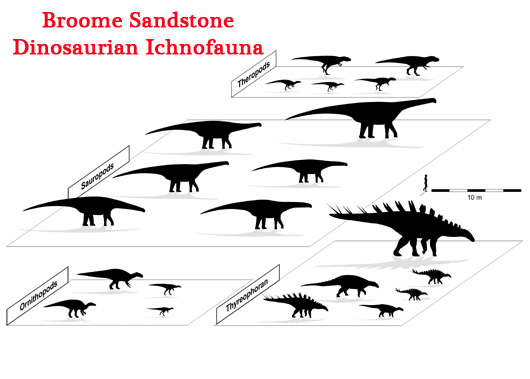
The dinosaur biota as illustrated by trace fossils (Broome sandstones).

The Broome sandstone dinosaurs.

Picture credit: Queensland University with additional annotation by Everything Dinosaur

For models and replicas of stegosaurs, ornithopods and theropod dinosaurs: PNSO Age of Dinosaurs Models.

A Giant Stegosaurian Indicated by Dinosaur Tracks

Note the giant stegosaurid dinosaur, depicted in the illustration above.  Some of the stegosaurid prints are around eighty centimetres long and approximately seventy centimetres across.  This armoured dinosaur rivals the Broome sandstone sauropods in terms of size.  Assigned to the ichnogenus Garbina, the trackways indicate a truly huge armoured dinosaur.  Although Everything Dinosaur team members, having read the scientific paper, cannot find any specific size calculations for this dinosaur, the tracks are considerably bigger than those assigned to the ichnotaxon Garbina roeorum.  This stegosaurid, could be one of the largest armoured dinosaurs yet described, with a body length exceeding eleven metres.

A Biota More Representative of the Late Jurassic than the Early Cretaceous

In many respects, the biota represented by the Broome sandstone tracks suggest a carryover of typical megafauna from the Late Jurassic, a time when the majority of Dinosaurian clades had a more cosmopolitan distribution prior to the break up of the super-continent of Pangaea.  Although the fossil record for the Lower Cretaceous of Gondwana is very poor, a similar mix of taxa occurs in the Barremian–lower Aptian La Amarga Formation (Argentina) and the Berriasian–Hauterivian Kirkwood Formation of South Africa.  The persistence of this fauna across the Jurassic-Cretaceous boundary in South America, Africa, and Australia might be characteristic of Gondwanan Dinosaurian faunas more broadly.

The Dampier Peninsula tracksites suggest that the extinction event that affected dinosaurs in the Northern Hemisphere across the Jurassic/Cretaceous boundary may not have been as severe further south (Gondwana).  The disappearance of stegosaurids from Australia as indicated by the lack of fossils in younger Cretaceous strata and the apparent decline in Theropoda diversity by the middle Cretaceous indicates that, similar to what may have happened in South America, Australia passed through a period of faunal turnover from 140 mya to around 125 mya.

The Tracks of a Large Stegosaur (Garbina ichnogenus)
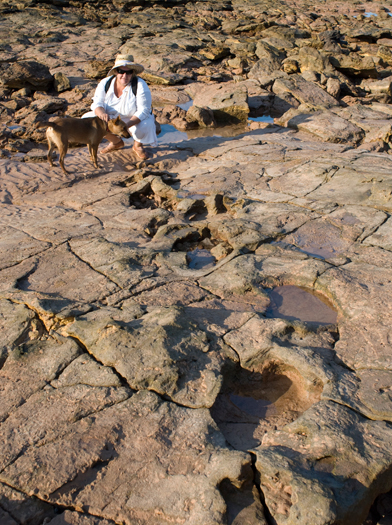
Tracks of a Stegosaur.

Field worker Louise Middleton and a stegosaurid trackway (Garbina).

Picture credit: Queensland University

The World’s Biggest Dinosaur Footprint

If we briefly side step (no pun intended), the issue as to whether the Sauropodomorpha belong within the Order Dinosauria (see our article posted up on March 23rd, which explains about a potential re-classification of dinosaurs), is one of the Broome sandstone prints the biggest dinosaur footprint yet described?

To read an article from 2016 about a dinosaur titanosauriform print found in Mongolia: Giant Dinosaur Footprint from the Gobi Desert.

For an early article on the  mapping of the Broome sandstone dinosaur tracks: Mapping the Dinosaur Heritage of Western Australia.

The Sauropodomorpha Track with a Scale Drawing of the Potential Size of the Dinosaur
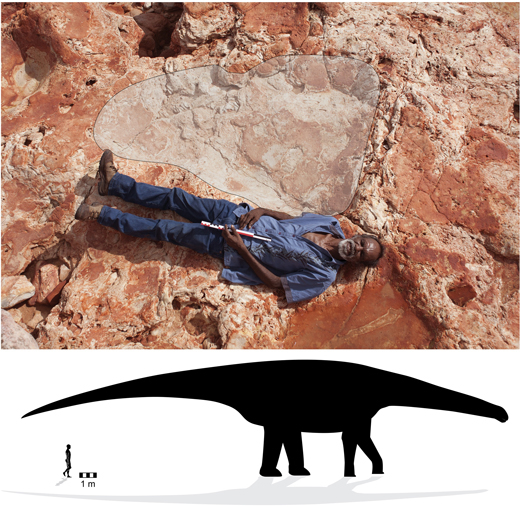
Broome sandstone giant Sauropod print.

Richard Hunter provides the scale next to the giant sauropod print. Scale depiction of dinosaur provided below.

Picture credit: Queensland University

The picture above shows the actual image released by Queensland University to illustrate the potential size of the dinosaur which made the series of prints which measure up to 1.7 metres in length.

Assessments of stride length suggest a sauropod dinosaur with a hip height of around 5.3 to 5.5 metres.  The line drawing provides scale, potentially the long-necked dinosaur that made these tracks could have exceeded twenty-five metres in length.

Unable to Assign an Ichnogenus from the Sauropod Dinosaur Tracks

There is not enough information at the moment to assign an ichnogenus to this sauropodomorph, it has been named “Broome sauropod morphotype A”.  Certainly, these 1.7 metre long prints are amongst the biggest yet found.

In October 2009, Everything Dinosaur reported on the discovery of a series of huge sauropod tracks in eastern France, to read about this: On the Trail of France’s Sauropod Big Foot.

The scientific paper: “The Dinosaurian Ichnofauna of the Lower Cretaceous (Valanginian–Barremian) Broome Sandstone of the Walmadany area (James Price Point), Dampier Peninsula, Western Australia”, by Salisbury, S. W., A. Romilio, M. C. Herne, R. T. Tucker, and J. P. Nair.  Published in Journal of Vertebrate Palaeontology.

Visit Everything Dinosaur’s award-winning website: Everything Dinosaur.
26 03, 2017

Increase in Fish Vision Preceded the Evolution of Tetrapods

By |2023-06-12T07:21:14+01:00March 26th, 2017|Categories: Dinosaur and Prehistoric Animal News Stories, Dinosaur Fans, Main Page|0 Comments

Massive Increase in Visual Range Preceded the Origin of Terrestrial Vertebrates

One of the most significant steps (no pun intended), in vertebrate evolution took place some 385 million-years-ago when some types of sarcopterygian fish evolved rudimentary limbs and started to clamber around on land.  These fish were the ancestors of all the tetrapods (four-legged vertebrates), amphibians, reptiles, birds, mammals and of course ourselves.  It could be argued that our species, Homo sapiens, is nothing more than a highly modified fish!  How and why the transition from living in a watery world to one of a terrestrial lifestyle took place is hotly debated by palaeontologists.

Tetrapod Evolution

One team of researchers from the Northwestern University (Illinois), in collaboration with colleagues from the Natural History Museum of Los Angeles County and optical imaging specialists, have come up with a remarkable theory that explains the move from the water to the land.

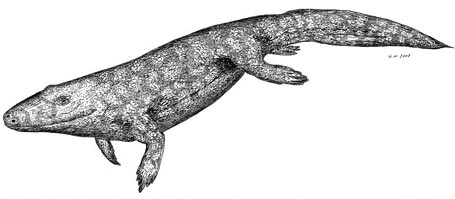
Note the Eyes Located on the Top of the Skull in this Early Tetrapod

An Illustration of the Polish tetrapod.

Meet our next of fin. An illustration of an early tetrapod.

Improvement in eyesight was the driver for the momentous leap from water onto land and not limb evolution linked to a better ability to clamber about on terra firma.

For models and replicas of early tetrapods: CollectA Age of Dinosaurs (Prehistoric Life) Models.

Looking at the Position of the Eyes

The scientists which included corresponding authors Malcolm MacIver and Lars Schmitz (Northwestern University), spent a year running simulations comparing many different types of fossil.  The researchers noticed that there was a dramatic increase in fish eye size, the eyes tripled in size and they shifted from the sides of the head to the top of the skull.  These adaptations took place long before the first modified fins looking like limbs evolved.

The team speculate that before permanent life on land came about, certain types of fish became ambush predators, hunting terrestrial invertebrates using similar tactics to modern-day crocodiles.  Eyes near the top of the head would have allowed these creatures to observe the land without giving themselves away.  They could spot potential prey on the land.  Being able to spot potential food provided a distinct advantage and as light travels better in air than it does in water, these fish could see a lot further.  Natural selection led to the evolution of bigger eyes and better eyesight.

The “buena vista” (good view) hypothesis that the study proposes states that being able to see food opportunities far away provided a stimulus to drive the evolution of locomotion to reach the potential prey.  This aided the natural selection for improved, stronger limbs, first for brief forays onto land to ambush prey and later for a life in a terrestrial environment.

The Evolution of Bigger, Better Eyes Capable of Seeing Further Preceded the Conquest of the Land

Video credit: Northwestern State

Hunting on Land

Hunting on land was a mental game changer for the early tetrapods and we applaud the team behind the research who have collaborated with animators to produce a very helpful explanatory video.  The video written and produced by Kristin Pichaske with the collaboration of Malcolm MacIver is provided here and it is great to see research summarised in such a way so as to make it much more accessible.  Our congratulations to everyone involved in the study and also to the team behind this most informative video.

For an article on the evolution of tetrapod locomotion: Walking Fish Provides Clues to the First Tetrapods.

Visit the Everything Dinosaur website: Everything Dinosaur.
25 03, 2017

Dinosaur Egg Thief Suspect Arrested in China an Important Development

By |2024-05-07T15:25:32+01:00March 25th, 2017|Categories: Dinosaur and Prehistoric Animal News Stories, Dinosaur Fans, Main Page|0 Comments

Chinese Authorities Make Arrests in “Crack Down” on Dinosaur Egg Thieves

Official Chinese State media has reported the arrest of a man accused of stealing dozens of fossilised dinosaur eggs.  A number of specimens have been recovered but many more are, as yet, unaccounted for.  China has some of the strictest regulations and laws in the world, when it comes to protecting rare artefacts including fossil remains.  Sadly, despite the very best efforts of the authorities there is a thriving black market in illegally acquired fossils, with huge sums of money being exchanged for dinosaur fossils including teeth, bones and fossilised eggs.

A Photograph of a Dinosaur Egg (Liverpool Museum)

Chinese dinosaur fossils. A fossilised dinosaur egg.

A fossilised dinosaur egg (Theropoda). Picture credit: Everything Dinosaur.

Picture credit: Everything Dinosaur

Dinosaur Egg Thief Arrested

The media report states that a Chinese citizen with the surname Wang has been accused of stealing eighty dinosaur eggs from a collector in Zhejiang Province on the night of January 9th 2017.  Three other accomplices are believed to have been involved according to the report from the Xinhua News Agency.  Mr Wang had previously visited the collector twice under the pretext of making a prospective purchase, agency sources have stated.

The four suspects are believed to have divided up the stolen property and Mr Wang took home a total of twenty-seven eggs.  Police raided Mr Wang’s home earlier this month after arresting him, during the search of the property in Huanan County (Heilongjiang Province), the authorities were able to recover the stolen eggs, the remaining fossils, an estimated fifty or so specimens, have yet to be recovered.

Protoceratops Dinosaur – Eggs from These Dinosaurs were the First to be Scientifically Described

Protoceratops on display.

A Protoceratops exhibit on display at The Naturmuseum Senckenberg (Frankfurt, Germany). Picture credit: Everything Dinosaur.

Picture credit: Everything Dinosaur

The three accomplices have also been apprehended, Heilongjiang police have confirmed that Mr Wang was in police custody but no further information about the other parties involved was provided.

Visit Everything Dinosaur’s website: Everything Dinosaur.
Increasing Fossil Thefts

Over the last five decades or so, as China’s geology has been explored in more detail, a treasure trove of fossil material has been discovered, including numerous dinosaur fossils.  The Institute of Vertebrate Palaeontology and Palaeoanthropology (IVPP) in Beijing is believed to hold the world’s largest collection of vertebrate fossils.  Sadly, despite it being illegal to export fossils and other material out of China, thefts still occur and many important fossils have been sent overseas to end up in the hands of private collectors.

Fossil protection legislation in the People’s Republic of China is comprehensive, the illegal excavation and export of vertebrate fossils including eggs was covered in the 1982 Cultural Relics Protection Law.  This law was developed from existing rules and regulations that had been in place prior to the Cultural Revolution.  More recently, legislation in this area was reviewed (2010-2013) and a number of Chinese scientific institutions have published guidelines and procedures to help organisations that are based outside China to stay on the right side of the law.

Dinosaur Eggs and Nests are Highly Sought After by Collectors

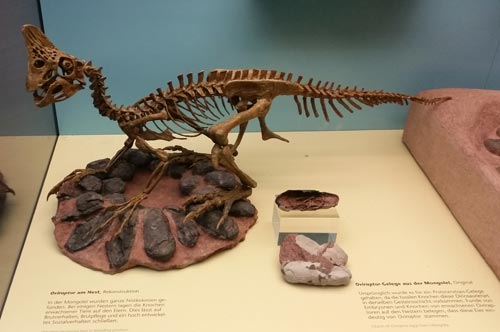
An Oviraptor and dinosaur eggs exhibit.

An Oviraptor and its nest. Picture credit: Everything Dinosaur.

Picture credit: Everything Dinosaur

For models and replicas of oviraptor and other prehistoric animals: CollectA Prehistoric Animal Models.

All too often Everything Dinosaur has had to report on this blog incidences of fossil theft, illegal excavations or deliberate vandalism to an important fossil site.

For an article published in 2015 about a seizure of hundreds of stolen Chinese dinosaur eggs: Chinese Authorities Seize Dinosaur Eggs.

To read an article from 2014 about the theft of a dinosaur footprint from Utah (United States): Dinosaur Footprint Stolen.

Nicolas Cage agrees to return stolen dinosaur fossil: Hollywood Star Agrees to Return Tarbosaurus Fossil.

23 03, 2017

Root and Branch Reform for the Dinosaur Family Tree

By |2023-07-22T08:38:17+01:00March 23rd, 2017|Categories: Dinosaur and Prehistoric Animal News Stories, Dinosaur Fans, Main Page, Palaeontological articles|0 Comments

Dinosaur Family Tree Given a Hefty Shake

So, the scientific paper is out, published in the journal Nature and with the snappy title “A New Hypothesis of Dinosaur Relationships and Early Dinosaur Evolution”.  Just about everything that we thought we knew about when, where and how the dinosaurs evolved has been turned on its head.  In addition, the dinosaur family tree has been re-drawn, all the text books written about these iconic prehistoric animals published since 1887, basically got it wrong!  It’s a big story, it dwarfs Argentinosaurus!  So, let’s take a step back and examine what exactly does this new paper mean.

New Study Suggests Tyrannosaurus rex was put on the Wrong Branch of the Dinosaur Family Tree

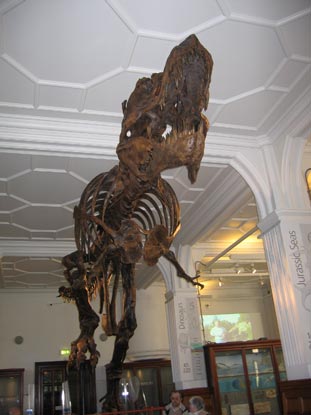
Tyrannosaurus rex cast skeleton on display

The dinosaur family tree is being re-drawn.  Picture credit: Everything Dinosaur.

Picture credit: Everything Dinosaur

Summarising the Key Findings

We have tried to summarise the key findings as:

  • The clades that make up the Order Dinosauria, need to be rearranged.
  • Theropod dinosaurs which are closely related to modern birds, previously classified as saurischian dinosaurs (lizard-hipped), need to be grouped with the bird-hipped forms in a new clade proposed as the Ornithoscelida.
  • Bird-hipped dinosaurs (Ornithischia) clade now directly associated with the evolution of birds.
  • Lizard-hipped Sauropodomorpha, the clade that includes Diplodocus, Plateosaurus and Argentinosaurus et al would now fall outside the Order Dinosauria.
  • The definition of what a dinosaur is (Dinosauria) would have to be changed to allow the Sauropodomorpha back in.
  • The first dinosaurs may not have evolved in the Southern Hemisphere (South America or southern Africa – Gondwana), but they may have evolved further north on the landmass called Laurasia.
  • Under this new redrawing of the dinosaur family tree, some of the dinosauriforms (ancestors of the Dinosauria), such as Saltopus (fossils from Scotland) and the controversial Agnosphitys (fossils from Avon), provide evidence to support the idea that some of the very first dinosaurs may have evolved in the area we now know as the UK.
  • The first types of dinosaur may have been omnivores and not carnivores as generally accepted.
  • With this re-definition of dinosaur evolution, the first dinosaurs evolved some 247 million years ago, pushing the origins of the Dinosauria back some 15 million years.

The Traditional Dinosaur Family Tree Compared to the New Model

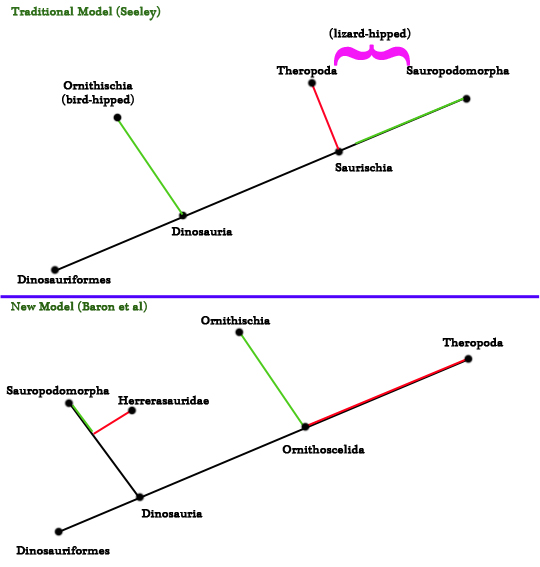
Comparing different views on the dinosaur family tree.

Simplified diagram comparing traditional view of the dinosaur family tree with the new model.

Picture credit: Everything Dinosaur (from Baron et al 2017)

The Dinosaur Family Tree

The picture above shows (top) the traditional view of the dinosaur family tree as proposed by Henry Govier Seeley in a paper entitled “On the Classification of the Fossil Animals Commonly Named Dinosauria” published in the Proceedings of the Royal Society (London) back in 1887.   This has been the accepted, conventional interpretation for the last 130 years or so.

The new model is depicted (bottom), this interpretation reflects in part, the dinosaur family proposed by Thomas Huxley in a paper published in 1870, entitled “On the Classification of the Dinosauria with Observations on the Dinosauria of the Trias” in the quarterly journal of the Geological Society.

Back in 1870, Huxley looked at compsognathids, iguanodontids, megalosaurs and the primitive armoured dinosaur Scelidosaurus and found enough common characteristics amongst these different types of dinosaur to unite them into a single clade, which he called the Ornithoscelida (orn-nith-oh-skel-lie-dah).  The research team, writing in the academic journal “Nature” had many thousands more fossils to study than either Huxley or Seeley, they conclude that Huxley’s interpretation has more validity than the conventional view that gives precedence to Seeley’s interpretation.  Baron et al suggest that the term Ornithoscelida be resurrected to apply to ornithischians and the Theropoda.

Hypercarnivory (Meat-eating) Evolved Twice

Everything Dinosaur’s comparison of the two family trees shows something else.  The green lines lead to those groups of dinosaurs that were predominantly herbivorous, whilst the red lines lead to dinosaur types that comprise mainly carnivores.  In the new model, the Sauropodomorpha, dinosaurs like Diplodocus and their kind are placed outside the new definition of the Dinosauria.  The herrerasaurids (Herrerasauridae), with their confusing array of dinosaur and non-dinosaur traits, are also placed outside the new strict definition of what dinosaurs are.  Dinosaurs like Herrerasaurus are not classified as theropods in this new model, which means that meat-eating in dinosaurs evolved twice, once in the herrerasaurids and once in the Theropoda.

Herrerasaurus Gets a New Status within the Revised Dinosaur Family Tree

An illustration of a Triassic dinosaur Herrerasaurus.

Herrerasaurus illustration.  Picture credit: Everything Dinosaur.

Picture credit: Everything Dinosaur

Science Itself Evolves

At Everything Dinosaur, we define science as “the search for truth”.  The authors of this new paper, graduate student Matthew Baron, Dr David Norman (Cambridge University) and Professor Paul Barrett (London Natural History Museum), reviewed a total of seventy-four different types of dinosaur and looked at their common traits and characteristics.   They started with a blank sheet of paper, bravely set aside conventional thinking and tried to find the best fit for the scientific evidence.

Explaining the researcher’s approach, a spokesperson from Everything Dinosaur commented:

“When you put together a jig-saw puzzle, you might refer to the picture on the front of the box to guide you.  What these scientists did was to look at the jigsaw pieces, ignoring the picture on the front of the box and they worked out which pieces fitted together well and which pieces didn’t.  They took a fresh look at the evidence and came up with a new way of mapping out the dinosaur family tree.  Based on the evidence, they found a better way to put the jigsaw pieces together.”

The researchers carefully studied thousands of fossil bones and mapped 457 anatomical characteristics across the 74 different types of dinosaur.  This meticulous study led them to re-draw the cladogram that represents the dinosaur family tree.

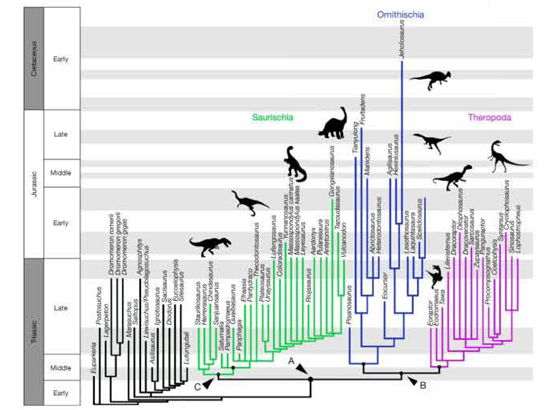
A Phylogenetic Relationship of Early Dinosaurs Plotted Against Geological Time

Re-drawing the dinosaur family tree.

The phylogenetic relationships between early dinosaurs.

The diagram above show the newly proposed phylogenetic relationship plotted against geological time for the early dinosaurs and their close relatives (Dinosauriformes).

A = the least inclusive grouping (clade) that includes the House Sparrow, Triceratops and Diplodocus.
B = the least inclusive grouping (clade) that includes the House Sparrow and Triceratops (the Ornithoscelida).
C = the most inclusive clade that contains Diplodocus but not Triceratops – (the new definition of the Saurischia).

Not “Throwing the Baby Out with the Bathwater”

This is a fascinating and intriguing insight into the phylogenetic relationships of the Dinosauria and their closest relatives.  However, numerous studies have been conducted in the past and Henry Govier Seeley’s analysis has held sway.  Some of the conclusions drawn are likely to be challenged by other palaeontologists and the debate as to the cladistic relationships and the implications for how, when and where the dinosaurs evolved is going to continue.

Take for example, the idea that the dinosaurs may have evolved further north than previously thought.  The fossils from Scotland and the west country of England (Avon) are highly fragmentary and far from complete.  Indeed, much of the Triassic material ascribed to early types of dinosaur or their near relatives, the Silesauridae, is very piecemeal.  Many more fossils need to be found before a clearer picture as to the origins of the Dinosauria can be established.

Footnote

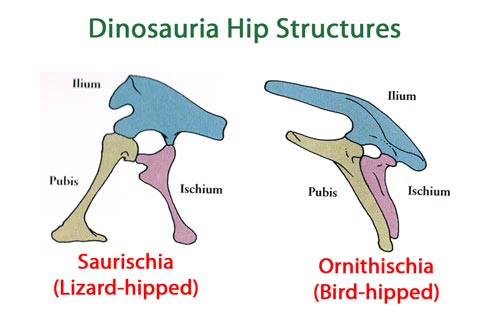
Back in April 27th 2015, Everything Dinosaur published a blog article all about the discovery of a bizarre new theropod dinosaur named Chilesaurus (C. diegosuarezi).  Although it was classified as a member of the lizard-hipped Theropoda, a group that were predominately meat-eaters, this Late Jurassic, South American dinosaur took a very different evolutionary path – it seems to have become a herbivore.  Chilesaurus, shows anatomical characteristics quite unlike any other theropod dinosaur.   Not least, the pubis bone is projecting backwards, which is similar in orientation to the layout of the pelvic girdles of ornithischian (bird-hipped) dinosaurs.

Our article about this very curious dinosaur required us to use an annotated diagram that showed the differences in the hip bones of the Saurischia (lizard-hipped) and the Ornithischia (bird-hipped) dinosaurs.  We are honoured that this same illustration was used by the BBC in the coverage of this new scientific paper.

Classifying the Dinosauria by Their Hip Bones

The shape of the hip bones help to classify the Dinosauria.

Classifying dinosaurs by the shape of their hip bones.

Picture credit: Everything Dinosaur

The scientific paper: “A New Hypothesis of Dinosaur Relationships and Early Dinosaur Evolution” M. Baron et al published in the journal Nature.

Visit the Everything Dinosaur website: Everything Dinosaur.
22 03, 2017

Newly Described Silurian Fossil Honours the Remarkable Sir David Attenborough

By |2024-05-07T15:26:29+01:00March 22nd, 2017|Categories: Dinosaur and Prehistoric Animal News Stories, Dinosaur Fans, Main Page, Palaeontological articles|0 Comments

Fossil Discovery Named in Honour of Sir David Attenborough’s 90th Birthday

Sir David Attenborough has been honoured by an international team of scientists who have named a newly described Silurian arthropod after the veteran broadcaster and naturalist.  Sir David has had a number of new species named in his honour, this 430 million-year-old, distant relative of today’s crabs and lobsters joins a long list of flora and fauna that includes wild flowers and a Jurassic pliosaur (Attenborosaurus conybeari).

To read an article about a kitten-sized marsupial lion named after Sir David: Attenborough’s New Kitty”.

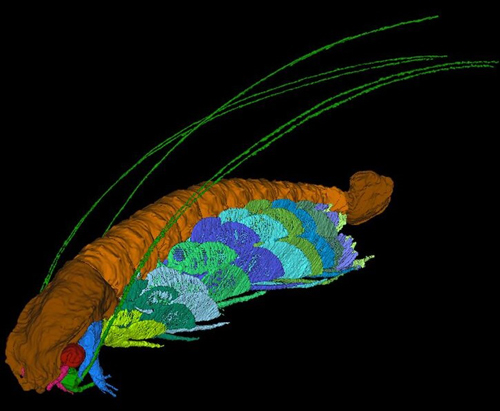
Honouring Sir David Attenborough – Cascolus ravitis

An image (computer generated) of the Silurian Arthropod Cascolus ravitis.

A computer generated image of the newly described Silurian arthropod Cascolus ravitis.

Picture credit: Professor David Siveter et al

Sir David grew up in Leicestershire, he and his family lived on the campus of the former University College Leicester, where his father was the principal.  As a boy, Sir David often explored the exposed Jurassic outcrops, near to his Leicester home hunting for fossils.  His love of the local countryside and the animals and plants that surrounded his home, fuelled his passion to become a scientist.

A Three-dimensional Arthropod Fossil

The fossil specimen, which measures less than ten millimetres long, is described as “exceptionally well-preserved in three-dimensions”.  The researchers, which include scientists from Imperial College (London), Oxford University and Yale (United States), as well as Leicester University, have been able to identify the exoskeleton and other parts of the animal, such as the delicate antennae, legs and the compound eyes.

It has been assigned to the Crustacea sub-phylum and joins a remarkable fossil assemblage representing a marine biota preserved when ash from a volcano covered an ancient underwater ecosystem.  The actual location of the fossil site is a closely guarded secret, the site can be found in the county of Herefordshire, close to the Welsh border.  At this location, the limestone rock sequence is interrupted by a fine-grained bedding plane that represents ash from a volcanic eruption that smothered the seabed.  The ash buried all the creatures in and around the seafloor at the time, creating a unique opportunity for palaeontologists to study this ancient habitat.

Professor David Siveter (Department of Geology, Leicester University), commented:

“Such a well-preserved fossil is exciting, and this particular one is a unique example of its kind in the fossil record, and so we can establish it as a new species of a new genus.”

Cascolus ravitis

The genus name is derived from “castrum” meaning stronghold and “colus” which translates from the Old English as “dwelling in”, terms from which the surname Attenborough is derived.  The species name is a combination of “Ratae”, the Roman name for Leicester, “vita” which means life and “commeatis” a messenger.

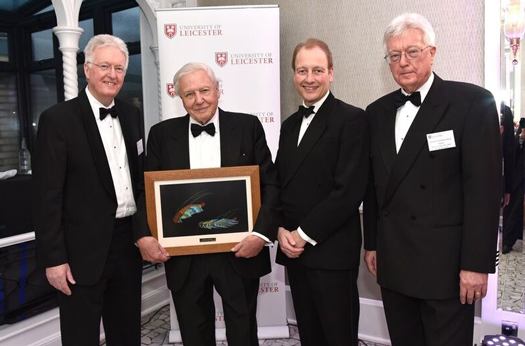
Sir David Attenborough Receiving a High-Resolution Image of the Fossil Named in His Honour

Sir David Attenborough receiving a copy of the high resolution image of Cascolus ravitis

Sir David Attenborough receiving a high resolution of the newly described Silurian fossil.

Picture credit: Leicester University

Left to right: Derek Siveter, (University of Oxford), Sir David Attenborough, Professor Paul Boyle, President and Vice-Chancellor of University of Leicester and David Siveter, University of Leicester.

Honouring Sir David Attenborough

Speaking about his latest honour, the nonagenarian, who will be celebrating his 91st birthday in a few weeks’ time, stated:

“The biggest compliment that a biologist or palaeontologist can pay to another one is to name a fossil in his honour and I take this as a very great compliment.  I was once a scientist so I’m very honoured and flattered that the Professor should say such nice things about me now.”

To read about other fossil discoveries from the Herefordshire site: The Kite Runner from the Silurian of England.

Prehistoric marine parasites: Prehistoric Parasites from the Silurian.

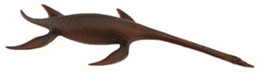
Sir David Attenborough has had a Genus of Jurassic Pliosaur Named in His Honour

Attenborosaurus conybeari

Named in honour of Sir David Atttenborough.

Picture credit: Everything Dinosaur

To view models and replicas of marine reptiles: CollectA Age of Dinosaurs Models and Figures.

Everything Dinosaur acknowledges the help of a press release from Leicester University in the compilation of this article.

The research is published in the journal Proceedings of the Royal Society B (Biology).

Visit the Everything Dinosaur website: Everything Dinosaur.
19 03, 2017

Dinosaurs Learn to Stand on Their Two Feet

By |2023-06-08T15:38:44+01:00March 19th, 2017|Categories: Dinosaur and Prehistoric Animal News Stories, Dinosaur Fans, Main Page, Palaeontological articles|0 Comments

New Theory as to Why Bipedalism Evolved in the Dinosauria

Iconic dinosaurs such as Tyrannosaurus rex, Velociraptor, Coelophysis and Carnotaurus were all bipeds.  That is, they evolved the ability to walk on their hind legs.  Bipedalism is a trait that seems to have evolved early in history of the Dinosauria and it is a characteristic that is widespread amongst both lizard-hipped and bird-hipped forms.  It had been suggested that bipedalism arose in the ancestors of dinosaurs, to allow the forelimbs to be freed from a locomotive role, allowing them to have other uses, primarily to seize and grasp prey.

However, a team of scientists from the Department of Biological Sciences at the University of Alberta (Canada), have put forward a new theory to explain why some dinosaurs stood on two feet instead of four.  The ancestors of the dinosaurs had a “need for speed”!

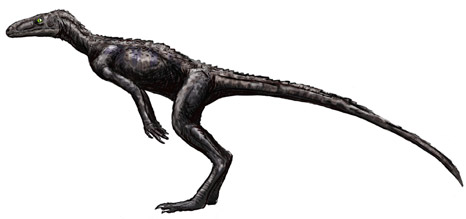
The Basal Dinosauriform Marasuchus (M. lilloensis) is Typical of a Bipedal Ancestor of the Dinosauria

The basal dinosauriform Marasuchus from the Late Triassic of Argentina

The basal dinosauriform archosaur Marasuchus of the Late Triassic. A potential ancestor of the Dinosauria.

Picture credit: Pterosauriablog (author Taylor Reints)

The picture above shows the crow-sized Marasuchus, fossils of which come from the La Rioja Province (north-eastern Argentina), specifically from the Chañares Formation.  This fast running, bipedal reptile lived some 242 – 235 million years ago and the University of Alberta researchers argue that the presence of big muscles (the caudofemoralis), associated with the back of the legs and tail were central to driving the evolution of bipedalism amongst the archosaurs that were to eventually lead to the evolution of the dinosaurs.

From All Fours to Just Two Legs

Publishing in the academic periodical “The Journal of Theoretical Biology” lead author, Scott Persons and is co-worker Professor Phil Currie, argue that basal dinosauriforms were essentially quadrupeds but they evolved to stand upright, a characteristic that was passed onto their descendants the dinosaurs.

The scientists challenge the idea that bipedalism came about in order to help with the seizing of prey.

Persons stated:

“While that works for some of the very, very early dinosaurs, which were certainly carnivorous, you see a bunch of herbivorous dinosaurs evolve later on and a good many of those groups actually keep their bipedal stance, which is a little strange.”

Big Muscles in the Tail

The researchers argue, that strong muscles at the base of the tail helped to power the hind legs of these prototype dinosaurs.  This allowed them to run faster and for longer.  Hind legs evolved to become longer, whilst the forelimbs became shorter to reduce body weight and to improve balance and agility.  Some of these proto-dinosaurs gave up quadrupedalism entirely.

However, as all young dinosaur fans will happily tell you, there were lots of four-legged dinosaurs, examples being Triceratops, Stegosaurus and Diplodocus.  These dinosaurs were herbivores, they evolved heavy defensive weapons, horns and armour which meant that a faster, cursorial lifestyle was sacrificed.  As plant-eaters, they evolved ever larger stomachs and digestive tracts to help them process the tough plant material they ate, bigger guts also led to a reversion back to being a quadruped.

Palaeontologist Scott Persons added:

“In the groups where speed was no longer a concern, they often went back to being a quadruped”

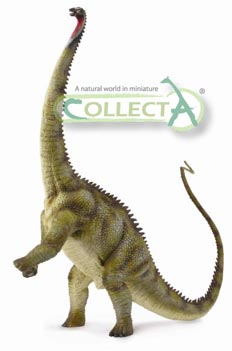
A Rearing Diplodocus – A Four-Legged Dinosaur

CollectA Rearing Diplodocus.

Model was introduced in 2013.

Picture credit: Everything Dinosaur

The picture (above) shows a rearing Diplodocus in the CollectA model range.

To view this range: CollectA Prehistoric Life Figures.

Studying Sauropods (Dinosauria)

If you take the lizard-hipped, Sauropoda for instance, these herbivores evolved into a myriad of forms, but they all had the same basic body plan and there was a trend towards gigantism within this infraorder.  However, it has been suggested that those strong, muscular tails and powerful back legs enabled these dinosaurs to rear up to feed higher up in the vegetative canopy.  It has been suggested that baby sauropods may have retained the ability to run on their hind legs, probably to help them escape predators.

To read an article about proposed bipedalism in juvenile sauropods: Facultative Bipedalism in Young Sauropods.

The powerful caudofemoralis muscle provides a greater source of propulsion to the back legs and it is the presence of this tail muscle that may have given the impetus to developing a two-legged stance.

Modern Lizards Provide a Clue

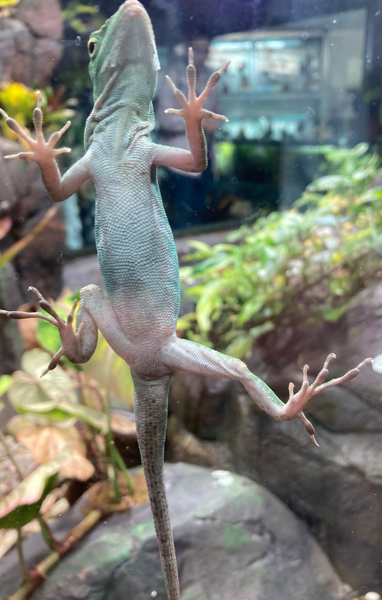
Modern facultatively bipedal lizards offer an analog for the first stages in the evolution of dinosaurian bipedalism.   In biology, the term facultative refers to the ability of many organisms to do things by choice rather than by obligation.  Facultatively bipedal lizards may spend most of the time on all fours, but when the need arises, such as to escape danger, these reptiles can revert to a bipedal stance.  An example of a living facultative biped lizard is the Australian frilled lizard (Chlamydosaurus kingii).  Extant lizards are capable of remarkable feats of locomotion.

An Example of a Living Reptilian and Remarkable Locomotion

An Anole lizard climbs a window,

An example of lizard locomotion. Picture credit: Everything Dinosaur.

Picture credit: Everything Dinosaur

Why Don’t Fast Mammals Run on Two Legs?

Biomechanically, running on four legs is more efficient than running on two legs.  However, the University of Alberta researchers concluded that the behaviour of synapsid reptiles, distant ancestors of today’s fast running horses, cats, camels, and grey hounds, during the Permian, may explain the lack of bipeds amongst the Mammalia.

In the Permian geological period, it seems some animals started losing the reptilian trait of a strong leg-powering tail muscle.  Around that time, many creatures were becoming burrowers, (adapting to a fossorial lifestyle), so they needed strong front limbs for digging.  Big back legs and a long, powerful tail would have made it tough to manoeuvre in the confines of a burrow, as well as making it easier for a pursuing predator to snatch them by their tail.

The scientists postulate that living underground may have helped those proto-mammals survive the Permian mass extinction.  Their descendants would have evolved to run fast, but without the tail muscles that would have caused them to stand upright.

The Biological Merits of Tetrapods (Not Just the Dinosauria)

Commenting on the biological merits of tetrapods evolving to favour one set of legs for running Scott Persons stated:

“That’s a really funny and strange adaptation.  Why would you choose to use just one set of limbs to help you run away when you’re most desperate?  And the answer has to do with that great big tail muscle [caudofemoralis].  It effectively sort of overpowers the back legs relative to the front legs.  What the lizards are effectively doing is popping a wheelie as they speed off.”

That cursorial advantage explains the relative abundance of cursorial facultative bipeds and obligate bipeds among fossil diapsids and the relative scarcity of either amongst the Mammalia and their close relatives.  Having lost their caudofemoralis in the Permian, perhaps in the context of adapting to a fossorial lifestyle, the mammalian line has been disinclined towards bipedalism, but, having never lost the caudofemoralis of their ancestors, the basal dinosauriforms and their relatives were more inclined to adopting a bipedal stance.

A Tale in a Tail!  Researchers Explain the Presence of Bipedalism within the Dinosauria

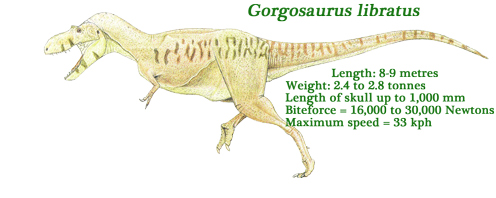
Gorgosaurus libratus illustrated.

Faster and slightly more nimble when compared to the biggest Albertosaurus dinosaurs.

Picture credit: Everything Dinosaur

Visit the award-winning Everything Dinosaur website: Everything Dinosaur.
18 03, 2017

T. rex Has the Monopoly on Dinosaur Public Relations

By |2023-06-08T15:47:56+01:00March 18th, 2017|Categories: Dinosaur and Prehistoric Animal News Stories, Dinosaur Fans, Main Page|0 Comments

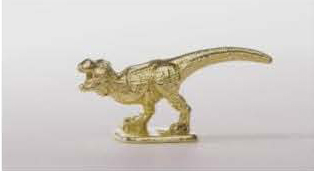
T. rex Game Piece Destined for Monopoly

The makers of the family favourite board game “Monopoly” have announced that a Tyrannosaurus rex playing piece will be added to the game later this year.  The game “Monopoly” first went on sale in 1935, by the mid 1930s, T. rex was already established as a “superstar” amongst the Dinosauria.  This iconic dinosaur, famous for its tiny arms and huge jaws was one of the figures selected for new versions of the game, following a public vote.

The New T. rex Monopoly Game Piece

Tyrannosaurus rex added to board game (Monopoly).

T. rex game piece being added to Monopoly board game.

Picture credit: BBC News

Tyrannosaurus rex

Palaeontologists, now know that Tyrannosaurus rex was not the largest carnivorous dinosaur.  However, it was one of the very last of huge theropod dinosaurs to evolve and the tyrannosaurs seem to have been a very long lived group of meat-eating dinosaurs.  The first tyrannosaurs evolved during the Jurassic and one of the earliest was the tyrannosauroid Guanlong (G. wucaii), known from the Shishugou Formation of China.  Guanlong was formally described in 2006 and it is believed to have lived some 160 million years ago (Oxfordian faunal stage of the Late Jurassic).

Despite the huge increase in different types of dinosaur, T. rex seems to dominate still.  This Late Cretaceous meat-eater has a special place in the public’s affection.  No dinosaur movie seems complete without an appearance of Tyrannosaurus rex, here at Everything Dinosaur, T. rex models out sell all the other dinosaur models by a ratio of 4 :1.  Tyrannosaurus rex certainly seems to have cornered the market when it comes to dinosaur public relations.

For models and replicas of Tyrannosaurus rex and other dinosaurs: Mojo Fun Prehistoric and Extinct Animal Models.

T. rex Remains Popular

Tyrannosaurus rex is as popular as ever, now Monopoly fans can play with a T. rex game piece.  We are not sure how a fully-grown Tyrannosaurus rex would have coped with Bond Street, the Waterworks or even the Old Kent Road, but we are sure this new addition to the family board game will be most welcome.

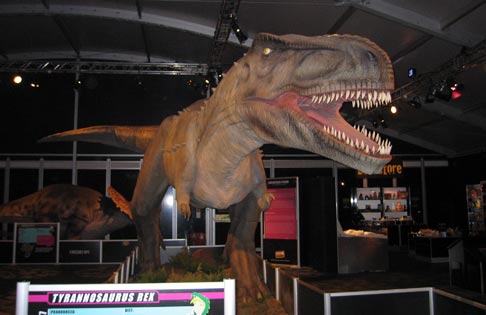
Theropods in London!  Does T. rex Have a Monopoly?

T. rex on display. Dinosaurs Unleashed.

Ferocious T. rex.  This dinosaur is a perennial favourite.  Picture credit: Everything Dinosaur.

Picture credit: Everything Dinosaur

The Everything Dinosaur website: Everything Dinosaur.
17 03, 2017

Primitive Neornithischian Dinosaurs and Seed Dispersal as New Scientific Papers are Published

By |2024-05-07T15:29:44+01:00March 17th, 2017|Categories: Dinosaur and Prehistoric Animal News Stories, Dinosaur Fans, Main Page, Palaeontological articles|0 Comments

Plant-Eating Dinosaurs Probably Played an Important Role in Seed Dispersal

Time to catch up on our reading and first on the list of papers is this fascinating insight into the relationship between plant-eating dinosaurs and seed dispersal.  An international team of scientists from Portugal, Spain and Argentina have described a new species of primitive, bird-hipped dinosaur and an assessment of the body cavity led to the discovery of the dinosaur’s last meal.  Permineralised seeds, most of which having been identified as coming from cycads (Cycadales), suggest that herbivorous dinosaurs played an important role in seed dispersal, just as many plant-eating mammals do today.

The New Argentinian Dinosaur Isaberrysaura mollensis is Related to Kulindadromeus from Siberia

A scale model of the feathered dinosaur Kulindadromeus.

A 1:1 scale model of Kulindadromeus.

Picture credit: T. Hubin/RBINS

Plant-eating Dinosaurs

The researchers which include lead author, Leonardo Salgado (CONICET – Universidad Nacional de Río Negro), conducted a phylogenetic analysis and assigned this new dinosaur species to the basal Ornithopoda, suggesting that it is closely related to Kulindadromeus (K. zabaikalicus), fossils of which are known from geologically younger strata found in Siberia.  However, this new dinosaur, named Isaberrysaura was much larger, with an estimated body length of approximately six metres.

The Feeding Habits of Herbivorous Dinosaurs

Despite some two-thirds of all the dinosaurs described to date being plant-eaters, there is little direct evidence of the feeding habits of herbivorous dinosaurs that matches the stomach contents preserved within a carcase.  Most unaltered gut content that has been found is associated with much later dinosaurs -hadrosaurids and ornithopods.  This is the first time that gut contents have been identified in association with the remains of a basal neornithischian.

For models and replicas of ornithischians and other dinosaurs: Prehistoric Animal Models and Dinosaur Figures.

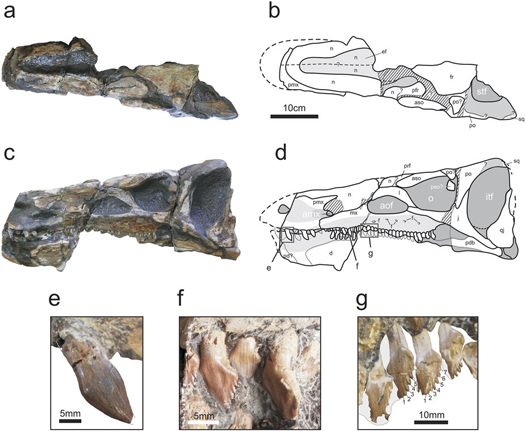
The specimen, representing a single individual, consists of an almost complete skull, vertebrae, part of the left shoulder blade (scapula), along with ribs and elements from the pelvic girdle.  It was excavated from the Los Molles Formation (Neuquén Basin, Argentina), from sediments that suggest a coastal-delta environment, the presence of the zone ammonite Sonninia altecostata in the same fossil bed, indicate that Isaberrysaura lived some 170 million years ago (Early Bajocian faunal stage of the Middle Jurassic).

These are the first dinosaur remains found in this geological unit and the one of the oldest dinosaurs known from the Neuquén Basin.  In addition, this is the first neornithischian dinosaur known from the Jurassic of South America.  The skull and the teeth show some affinity with basal stegosaurids which suggests that both the Thyreophora and neornithischian dinosaurs shared a lot of similar features (potential evidence of convergent evolution amongst plant-eating dinosaurs).

Isaberrysaura mollensis – Views of the Skull and Teeth

Isaberrysaura mollensis - views of the skull and teeth.

The skull in (a) dorsal and left lateral view (c) with corresponding line drawings (b and d). Premaxillary tooth (e) and maxillary teeth (e and f).

Picture credit: Scientific Reports

Why Isaberrysaura?

This month, we have once again been celebrating International Women’s Day (March 8th), it is pleasing to note that the female form of “saurus” has been chosen when it came to naming this new dinosaur, as the genus has been erected to honour Isabel Valdivia Berry, who reported the finding of the holotype material.  In the body cavity, the researchers were able to identify a mass of permineralised seeds.  These were identified as belonging mostly to the Cycadales group of plants.  These tough seeds would have passed through the dinosaur’s gut and would have been deposited in the dung.  This fossil discovery suggests a possible and unexpected role of bird-hipped dinosaurs, that of Jurassic seed-dispersal agents.

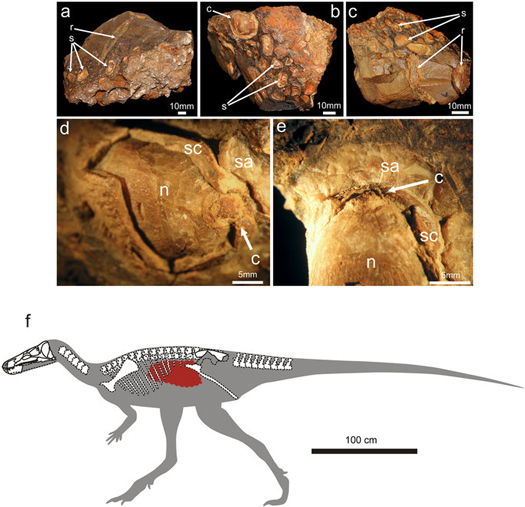
An Analysis of the Gut Contents of Isaberrysaura

The gut contents of Isaberrysaura mollensis.

Permineralised seeds identified in the gut cavity of Isaberrysaura mollensis.

The photograph above shows images of the body cavity showing evidence of the seed fossils.

Some of the fossils show that their fleshy seed-coats are still intact (sc = sarcotesta), this indicates that these seeds were swallowed whole with little or no chewing action in the mouth.

The scientific paper: “A New Primitive Neornithischian Dinosaur from the Jurassic of Patagonia with Gut Contents”, published in the journal “Scientific Reports”.

Visit the Everything Dinosaur website: Everything Dinosaur.
15 03, 2017

Not All Mesozoic Crocodiles Were Giants According to New Study

By |2024-05-07T15:28:40+01:00March 15th, 2017|Categories: Dinosaur and Prehistoric Animal News Stories, Dinosaur Fans, Main Page, Palaeontological articles|0 Comments

Knoetschkesuchus – Living on an Island

Last month, scientists published in the on-line academic journal “PLOS ONE” a paper that provided details of the discovery of a new species of Late Jurassic terrestrial crocodile, but this animal was no ground-shaking giant, like most of its kind (atoposaurids), it probably had a maximum length of under a metre and it would have weighed a couple of kilogrammes or so.

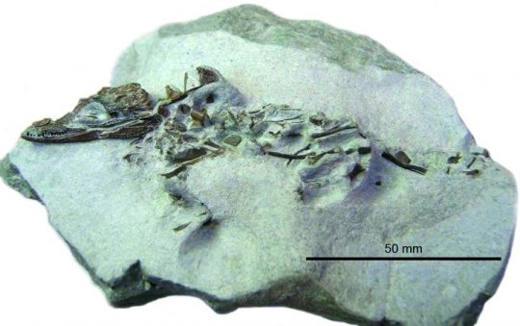
Lead author of the research paper, Daniela Schwarz (Leibniz Institute for Evolutionary and Biodiversity Research, Germany), in collaboration with colleagues, re-examined fossils including skull material (an adult and a juvenile specimen), that had previously been assigned to the atoposaurid Theriosuchus – a genus of crocodile-like reptile that is known from a large number of fossils dating from the Late Jurassic and into the Early Cretaceous from places as far apart as Thailand and southern England.  However, when the beautifully preserved fossils were studied using CT scans and three-dimensional images of the fossil material created, a number of autapomorphies were identified to allow the erection of a new genus.

A View of the Larger Specimen of Knoetschkesuchus langenbergensis

Knoetschkesuchus langenbergensis fossil material (larger specimen).

Knoetschkesuchus langenbergensis fossil material.

Picture credit: PLOS ONE

Knoetschkesuchus langenbergensis

The little crocodile has been named Knoetschkesuchus langenbergensis, the fossils come from the famous Langenberg Quarry, located near the town of Goslar, Lower Saxony, northern Germany.  The limestones and marls that form the quarry site, were laid down in shallow inlets associated with an island archipelago.  The Knoetschkesuchus material comes from Bed 83, the same location as the fossils of the dwarf sauropod Europasaurus (E. holgeri).

For replicas and models of ancient crocodilians and other prehistoric animals: Mojo Fun Prehistoric and Extinct Models.

Lots of Terrestrial Crocodiles in the Mesozoic

Knoetschkesuchus langenbergensis fossil material has been dated to the Upper Kimmeridgian stage of the Jurassic, approximately 154 million years ago, like most members of the Atoposauridae it had large eyes and it may have been a fast runner.  The researchers conclude that the Langenberg Quarry fossils represent a new species because of unique features of the skull, such as openings in the jaw bone and in front of the eye, as well as the shape and placement of the animal’s tiny teeth.

The teeth are heterodont in nature (different shapes), at the tip of the snout they are pointy and needle-like, very typical of a small crocodilian.  Towards the back of the jaws they are broader and more rounded, particularly in the lower jaw.  It has been suggested that these teeth were adapted for crushing hard-shelled prey, such as snails, which are known from abundant gastropod fossils associated with Bed 83.

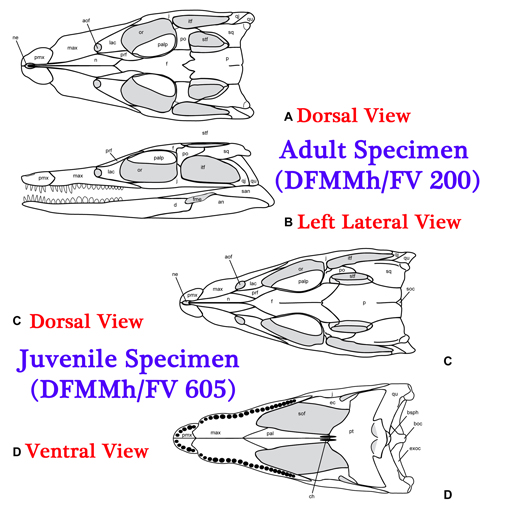
Line Drawings Showing Various Views of Both the Adult and Juvenile Skull Specimens

Knoetschkesuchus skull illustrations

Knoetschkesuchus skull drawings.

Picture credit: PLOS ONE with additional annotation by Everything Dinosaur

Note

Elements of the adult skull fossil have been drawn based on scaled-up material from the juvenile specimen.

Dr Schwarz commented:

“The study describes a new diminutive crocodile Knoetschkesuchus langenbergensis that lived around 154 Million years ago in north-western Germany.  Knoetschkesuchus belongs to the evolutionary lineage that leads to modern crocodiles and preserves for the first time in this group two skulls in 3-D, allowing us detailed anatomical studies via micro-CT images.  Our research is part of the Europasaurus-Project which studies the remains of a unique Jurassic island ecosystem in northern Germany.”

A Unique Island Ecosystem

The Langenberg Quarry preserves the remains of a unique Late Jurassic European ecosystem.  The islands were relatively small and this led to a divergence between residents of these islands and their ancestors which lived on the larger landmasses to the east.  For example, in response to limited food resources and space, the sauropod Europasaurus became a dwarf form.

The atoposaurid crocodiles probably filled a number of ecological niches within the food chain, including that of arboreal predators.  These distant ancestors of today’s crocodiles were in turn preyed upon by a variety of theropod dinosaurs, the majority of which are only known from fragmentary teeth.  What is quite remarkable, is the diversity of the theropod teeth found in Upper Jurassic deposits of northern Germany.  Studies have suggested that representatives of the Tyrannosauroidea, as well as Allosauroidea, Megalosauroidea and probably Ceratosauria roamed this part of the world some 155 to 150 million years ago.

The genus name (Knoetschkesuchus) is a combination of the family name of Nils Knötschke, and suchus (from the Greek meaning crocodile).  The genus name honours of Nils Knötschke (Dinosaurier-Freilichtmuseum Münchehagen), who collected, prepared, and curated several important fossil specimens from the Langenberg Quarry.

Visit the Everything Dinosaur website: Everything Dinosaur.
14 03, 2017

Pushing Back the Origins of Complex Life

By |2023-06-08T13:35:56+01:00March 14th, 2017|Categories: Dinosaur and Prehistoric Animal News Stories, Main Page, Palaeontological articles|0 Comments

Scientists Uncover Evidence of the Earliest Plants

One of the most significant steps in the history of life on Earth may have occurred earlier than previously thought, according to a new study published by Scandinavian scientists in the on line academic journal “PLOS Biology”.  The evolution of simple, non-nucleated cells (prokaryotes) to large, more complex and specialist cells (eukaryotes) may have taken place some 400 million years earlier.  The team might have uncovered evidence of the oldest plants known to science.

Red Algae – Look Out for the Stacked Plates

The researchers which include Therese Sallstedt (Swedish Museum of Natural History), examined exquisitely preserved, three-dimensional fossils, found in very ancient sedimentary rocks from central India (Vindhyan basin).  These rocks are known for their abundance of micro-fossils, and the researchers analysed the minute fossil remains that represent a biota that once existed in a shallow sea.  The team identified structures within the micro-fossils that correspond to chloroplasts, which are found within plant cells today.

The strata has been dated to approximately 1.6 billion years ago, the photosynthetic biomats amidst extensive cyanobacterial micro-fossils, had filaments and other features such as plate-like discs that represent stacked cells that are very reminiscent of red algae (Rhodophyta).  Prior to this discovery, experts believed that the earliest eukaryotes evolved some 1.2 billion years ago, as demonstrated by the oldest known multicellular organism Bangiomorpha pubescens, found in Canadian rocks around 1.2 billion years old.  Bangiomorpha is related to today’s red algae, it seems, from this new evidence, that the multicellular Rhodophyta, complete with their complex cells containing a nucleus, have been on Earth for far longer than previously thought.

Two Forms of Red Algae

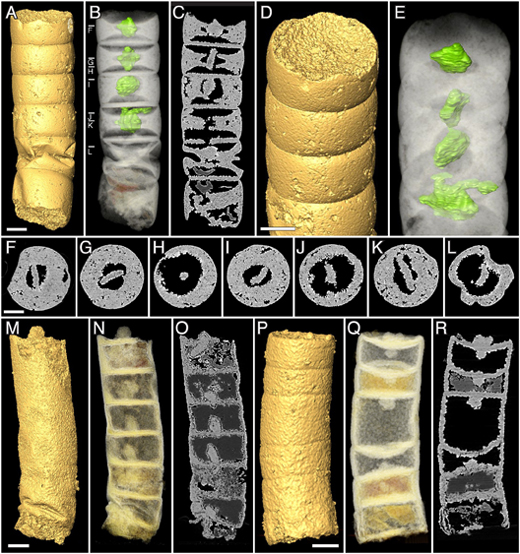
The fossils appear to show two distinct types of red algae: Rafatazmia chitrakootensis, characterised as filamentous in shape and containing large plate-like, stacked discs that the researchers think may be parts of algal chloroplasts and Ramathallus lobatus, which would have been more rounded in shape and fatter.

Digital Images of Rafatazmia chitrakootensis

Evidence of the oldest plants uncovered.

Rafatazmia chitrakootensis digital images of the ancient eukaryote (chloroplast structures highlighted green).

Picture credit: PLOS Biology

The picture above shows (A–L) Holotype, NRM X4258.  (A) Surface rendering.  (B) Volume rendering with rhomboidal disks coloured for visibility.  (C) Virtual slice. (D) Surface.  (E) Volume. (F–L) Transverse slices (positions indicated in B).  (M–O) NRM X5620, surface, volume, slice.  (P–R) NRM X5574, surface, volume, slice.  Scale bars 50 μm.

The Earliest Plants

Most scientists already believed that red algae (Rhodophyta) to be some of the earliest eukaryotic organisms to evolve.  Pushing the date back by some 400 million years or so, has implications for our understanding of evolution as a whole and may help clear questions about the rates at which mutations occur in the genome over time.

The scientific paper: “Three-dimensional Preservation of Cellular and Subcellular Structures Suggests 1.6 billion-year-old Crown-group Red Algae”, published in “PLOS Biology.”

Visit the Everything Dinosaur website: Everything Dinosaur.
Go to Top