All about dinosaurs, fossils and prehistoric animals by Everything Dinosaur team members.

Fossil finds, new dinosaur discoveries, news and views from the world of palaeontology and other Earth sciences.

24 02, 2018

In Search of a Prehistoric Landscape Under the Sea

By |2023-09-16T17:25:35+01:00February 24th, 2018|Categories: Dinosaur and Prehistoric Animal News Stories, Geology, Main Page|0 Comments

Exploring the Ancient Landscape Under the Irish Sea

A team of international scientists are setting out to map and explore the extensive submerged prehistoric landscape that lies under the Irish Sea.  The research team includes members of the Irish Marine Institute and the Institute of Technology Sligo and the University College Cork and they aim to explore the prehistoric landscape and search for evidence of human activity and habitation.

At the end of the last Ice Age, huge areas of habitable land in Europe were flooded as sea levels rose.  Scientists estimate that the water rose by around 120 metres, (as a guide, St Paul’s Cathedral is around 111 metres tall), beneath the waves lies a virtually unknown palaeolandscape of plains, hills, marshlands and river valleys.

A Map Showing the Maximum Extent of the Marine Palaeolandscapes
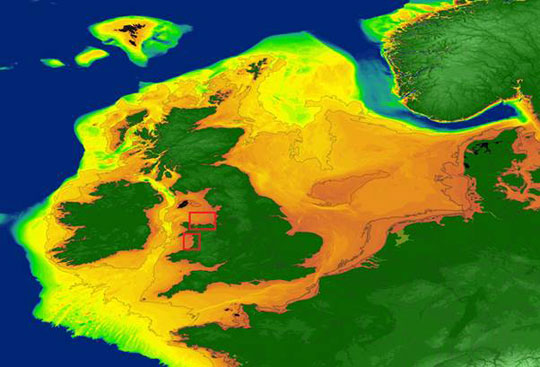
The extent of the palaeolandscape prior to sea level changes.
Approximate maximum extent of marine palaeolandscapes off the Irish and British coasts (survey areas in red).

Picture credit: University of Bradford

A Prehistoric Landscape Similar to Doggerland

The researchers are confident that the palaeolandscape between Great Britain and Ireland will be similar to that of Doggerland, an area of the southern North Sea and currently the best-known example of a palaeolandscape in Europe.  Doggerland has been extensively researched by Professor Vince Gaffney from the University of Bradford, Principal Investigator of the “Europe’s Lost Frontiers” Project.

The “Last Frontiers” Project

Lost Frontiers is an ERC-funded Advanced Grant project based at Bradford University (West Yorkshire).   The purpose is to better understand the transition between nomadic, hunter gathering populations to sedentary farming communities in north-western Europe.  The “Lost Frontiers” team are studying the evidence for inundated palaeolandscapes around the British coast using seismic reflectance data sets to generate topographical maps of these hidden landscapes.

Environmental data from these areas is then being used to reconstruct and simulate the palaeoenvironments of these areas using ancient DNA extracted directly from sediment cores as well as traditional environmental data.

Professor Gaffney commented:

“Research by the project team has also provided accurate maps for the submerged lands that lie between Ireland and Britain and these are suspected to hold crucial information regarding the first settlers of Ireland and adjacent lands along the Atlantic corridor.”

Drilling Sediment Cores to Explore an Ancient Submerged Landscape

Around sixty sediment cores are going to be drilled at twenty carefully selected sites in Liverpool and Cardigan Bays, these cores will then be analysed by the research team in order to build up a picture of how the landscape changed over time.  Analysis of plant spores and pollen will help to establish the type of landscape that once existed under the waves, from this and using Doggerland research as a benchmark, the existence of different types of megafauna can be inferred.

The Coastal Vessel RV Celtic Voyager Will be the Base of Operations
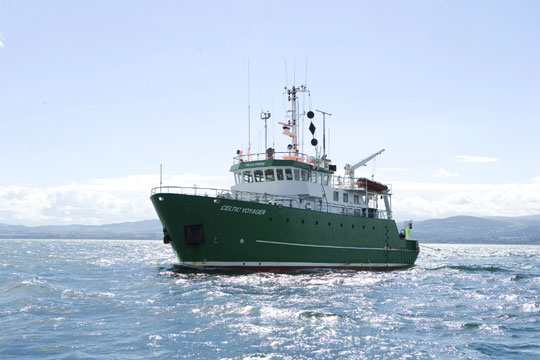
RV Coastal Voyager
The coastal vessel RV Celtic Voyager will be the base of operations for the research team and core drilling staff.

Picture credit: Bradford University

Commenting on the significance of this research Dr James Bonsall (Institute of Technology Sligo), stated:

“It is very exciting, as we’re using cutting-edge technology to retrieve the first evidence for life within landscapes that were inundated by rising sea levels thousands of years ago.  This is the first time that this range of techniques has been employed on submerged landscapes under the Irish Sea.  Today, we perceive the Irish Sea as a large body of water, a sea that separates us from Britain and mainland Europe, a sea that gives us an identity as a proud island nation.”

Dr Bonsall added:

But 18,000 years ago, Ireland, Britain and Europe were part of a single landmass that gradually flooded over thousands of years, forming the islands that we know today.  We’re going to find out where, when, why and how people lived on a landscape that today is located beneath the waves.”

Reconstructing Ancient Landscapes

The researchers hope to reconstruct and simulate the palaeoenvironments of the Irish Sea, using ancient DNA, analysed in the laboratories at the University of Warwick, and palaeoenvironmental data extracted from the sediment cores.  This information will help the team to build up a picture of the lives of the people who once lived on the land between what is now Ireland and Great Britain.

Mapping the Palaeolandscapes of the Irish Sea
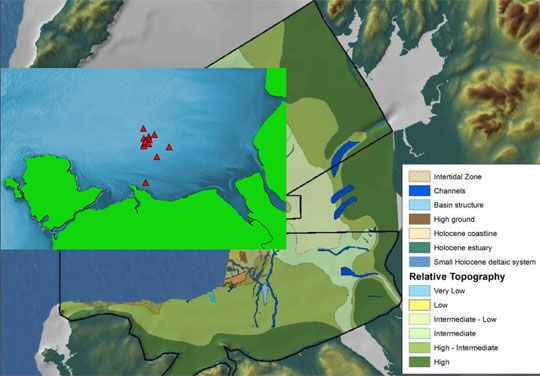
Red triangles indicate survey sites.
Geology of the survey area and core sampling sites (red triangles).

Picture credit: Bradford University

Dr Martin Bates (University of Wales) added:

“This is a very exciting opportunity as the cores we are collecting are the first drilled in the Cardigan Bay sea bed since perhaps the 1970s.  They are going to provide us with material that will really help us to understand how Cardigan Bay changed as the sea flooded across the landscape during the time that people were coming back to Wales after the last glaciation.”

Everything Dinosaur acknowledges the help of a press release from the University of Bradford in the compilation of this article.

Visit the Everything Dinosaur website: Everything Dinosaur.
23 02, 2018

Neanderthals Thought Like Us According to New Research

By |2024-05-04T18:25:46+01:00February 23rd, 2018|Categories: Dinosaur and Prehistoric Animal Drawings, Dinosaur and Prehistoric Animal News Stories, Main Page|0 Comments

Iberian Neanderthals Created Cave Art

The image of the Neanderthal (Homo neanderthalensis), has changed radically over the last few decades.  Gone are the images of a brutish, “ape-man” as depicted by 20th century artists such as Burian and Charles Knight.  A lot of evidence has emerged in recent years that supports the idea that Neanderthals, our closest cousins, were as sophisticated as us with a rich and diverse culture.

A new study, published in the journal “Science”, proposes that Iberian Neanderthals, created cave paintings as early as 64,000 years ago and that these paintings were as complex as those associated with our own species.  Neanderthal artists used symbolism, geometric shapes and linear signs just as complicated as those drawn by H. sapiens.

Abstract and Symbolic Cave Art Created by Neanderthals

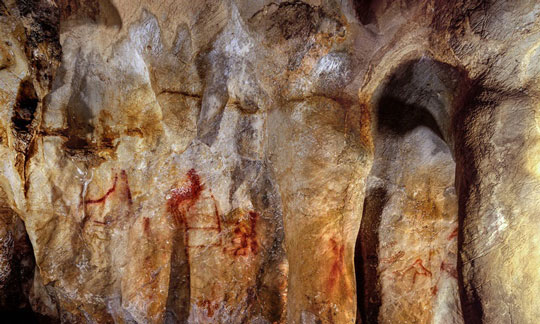
Evidence of Neanderthal Cave Art (Spain).
La Pasiega, section C, cave wall with paintings.  The ladder shape composed of red horizontal and vertical lines (centre left) dates to older than 64,000 years and was made by Neanderthals.

Picture credit: P. Saura

What Does it Mean to be Human?

Defining what it means to be human (Homo sapiens), has just become a little more complicated.  It was once thought that our ability to create abstract art, to use symbols and to develop a culture was a defining characteristic that elevated our species above all the other hominins.

Lead author of the new research, Dirk Hoffmann of the Max Planck Institute for Evolutionary Anthropology (Leipzig, Germany) explained:

“The emergence of symbolic material culture represents a fundamental threshold in the evolution of humankind.  It is one of the main pillars of what makes us human.  Artefacts whose functional value lies not so much in their practical but rather in their symbolic use are proxies for fundamental aspects of human cognition as we know it.”

Homo neanderthalensis Had a Culture Too

Early symbolic artefacts, like pigment-coloured shells that possibly served as body ornamentation, are documented for the Middle Stone Age in North and South Africa.  These have been dated to approximately 70,000 years ago (middle Tarantian stage of the Pleistocene Epoch) and are associated with anatomically and behaviourally modern humans.  There is evidence in Europe for cave art, sculpted figures, decorated bone tools and jewellery made of bone, tooth, ivory, shell or stone that dates back to the so-called “Upper Palaeolithic Revolution” around 40,000 years ago.  These artefacts, researchers concluded, must have been created by modern humans who were spreading all over Europe after their arrival from Africa.

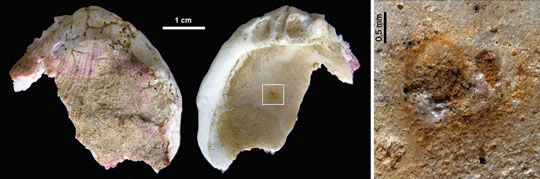
A Shell with Traces of Pigmentation – An Object Dating from at Least 115,000 Years Ago

Shell Fragment with Signs of Pigmentation.
A shell with remnants of pigments found in sediments in Cueva de los Aviones (Spain).  It dates to between 115,000 and 120,000 years of age.

Picture credit: João Zilhão (Catalan Institution for Research and Advanced Studies

Cave Art Previously Only Associated with Homo sapiens

Cave paintings are a particularly impressive statement of culture and the use of symbolic behaviour.  To date, cave art and paintings have only been attributed to modern humans.  A lack of precise dating has hindered attempts to prove that Homo neanderthalensis painted on cave walls too.  The perpetrators of cave art cannot usually be identified directly, the age of the paintings is the only determinant, providing indirect evidence of who created the paintings based on their geological age.  However, a new advanced dating technique has permitted more precise dating and this research suggests that Neanderthals were just as artistic as ourselves.

Post-doctoral researcher Hoffmann added:

“Dating cave art accurately and precisely, but without destroying it, has so far been difficult to accomplish.  Thanks to recent technical developments we can now obtain a minimum age for cave art using Uranium-Thorium (U-Th) dating of carbonate crusts overlying the pigments.”

Uranium-Thorium Dating

Uranium-Thorium dating is very precise and it relies on the radioactive decay of uranium isotopes into thorium, this methodology can accurately date calcium carbonate deposits and formations associated with cave art and it can determine the age of calcium carbonate which is up to half a million years old – more than enough scope to chronologically test all forms of cave painting.

Dating Cave Art Using Uranium-Thorium Analysis

Calcium Carbonate deposits help to date cave art.
Calcite crust on top of the red ladder shape sign.  The U-Th method dates the formation of the crust which gives a minimum age for the underlying painting.

Picture credit: João Zilhão (Catalan Institution for Research and Advanced Studies

The international team of researchers, which included scientists from the University of Southampton, analysed more than sixty carbonate samples from three different cave sites in Spain: La Pasiega in north-eastern Spain, Ardales in southern Spain and Maltravieso in the western part of the country.  All three sites contain paintings mostly in red, sometimes in black, that show groups of animals, dots and geometric signs, hand stencils, hand prints and engravings.

Commenting on the team’s findings Alistair Pike (Southampton University), stated:

“Our dating results show that the cave art at these three sites in Spain is much older than previously thought.  With an age in excess of 64,000 years it predates the earliest traces of modern humans in Europe by more than 20,000 years.  The cave art must thus have been created by Neanderthals.”

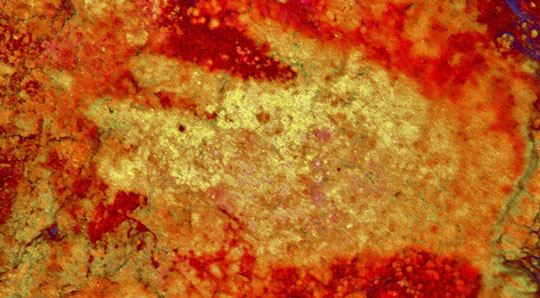
Neanderthal hand stencil.
Stencil of a Neanderthal hand on a cave wall in Maltravieso (colour enhanced), almost completely covered with calcite.  It is older than 66,000 years

Picture credit: H. Collado (Quaternary-Prehistory Research Group, Spain)

Evidence of a Complex Thought Process

The early cave paintings created in red pigments comprise of dots, lines, discs and hand stencils.  The hand prints were made by the artist blowing red paint over the hand, using it as a form of stencil.  To create such intricate artwork, the perpetrator would have had to plan their work, provide a suitable light source and mix pigments.  Choice of location was essential too.

Cave art specialist and co-author Paul Pettitt (University of Durham) asserted:

“Neanderthals created meaningful symbols in meaningful places.”

The research team concludes that Neanderthals possessed a much more rich and complex symbolic behaviour than previously assumed.  This new research will help to change the long-held prejudices against the intelligence and intellectual abilities of these hominins that are so closely related to ourselves.

The Sophisticated Homo neanderthalensis

Fellow author João Zilhão (Catalan Institution for Research and Advanced Studies), explained the implications of this and other research that reveals a more sophisticated Neanderthal.  It can be concluded that modern humans and Neanderthals shared symbolic thinking and must have been “cognitively indistinguishable”.

Research Professor Zilhão commented:

“On our search for the origins of language and advanced human cognition we must therefore look much farther back in time, more than half a million years ago, to the common ancestor of Neanderthals and modern humans.”

As the weekend approaches, why don’t you take time out to create some artwork, harness your inner Neanderthal…

The scientific paper: “U-Th Dating of Carbonate Crusts Reveals Neandertal Origin of Iberian Cave Art” by D. L. Hoffmann, C. D. Standish, M. García-Diez, P. B. Pettitt, J. A. Milton, J. Zilhão, J. J. Alcolea-González, P. Cantalejo-Duarte, H. Collado, R. de Balbín, M. Lorblanchet, J. Ramos-Muñoz G.-Ch. Weniger, A. W. G. Pike published in the journal “Science”.

Everything Dinosaur acknowledges the help of a press release from the Max Planck Institute for Evolutionary Anthropology in the compilation of this article.

Visit the Everything Dinosaur website: Everything Dinosaur.
22 02, 2018

Ground-Dwelling Birds Provide Clues to Theropod Dinosaur Locomotion

By |2023-09-16T16:24:50+01:00February 22nd, 2018|Categories: Animal News Stories, Dinosaur and Prehistoric Animal News Stories, Dinosaur Fans, Main Page, Palaeontological articles|0 Comments

Observe How Ground-Dwelling Birds Move to Learn About Theropod Locomotion

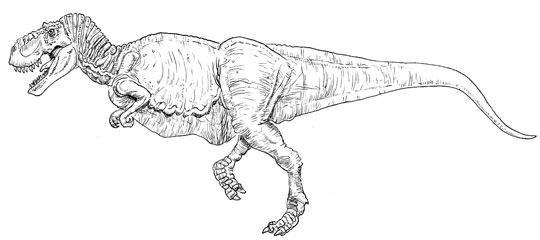
Just how fast could T. rex run?  Over the years, there have been a number of papers published that looked at the locomotion of big theropod dinosaurs.  Computer models, three-dimensional analysis of trackways using state-of-the-art LIDAR (light detection and ranging), biomechanics, kinetic studies, so many disciples and so many areas of research.  One way of obtaining a better understanding of the movements of large, bipedal dinosaurs is to take a look at the dinosaurs that are still with us today, the birds.  By studying extant Aves, scientists can gain an insight into the locomotion of non-avian members of the Theropoda.

How Did Big Theropod Dinosaurs Move About?

Birds provide clues to Theropod locomotion.
T. rex locomotion. Picture credit: Everything Dinosaur.

Picture credit: Everything Dinosaur

Visit the Everything Dinosaur website: Everything Dinosaur.

Studying Extant Avian Dinosaurs

Writing in the academic on-line journal PLOS One, a team of international scientists, which included Professor John Hutchinson from the Royal Veterinary College, Hertfordshire, set about gaining a greater appreciation of just how birds move by examining in detail the locomotion of twelve types of ground-dwelling bird, some of them flightless, such as the emu and ostrich, whilst others are accomplished flyers such as the Japanese quail and the Australian white ibis.

Aerial ability or the lack of it was not important, the team were interested in examining how birds of various sizes and body weights moved about, effectively recording their body movements using high speed cameras as these birds walked or ran across a track.  The species were selected based on the fact that these birds spend a lot of time on the ground.   By virtue of spending most of their lives (in the case of the emu and ostrich, all of their lives), on the ground, these feathered friends have well-developed hind limb locomotor systems.

Scaling Up to a Seven Tonne Theropod

There was a considerable variation in body size amongst the participants.  The smallest species represented being the Chinese painted quail, that weighed in at around 45 grammes, the largest being the ostrich which at 80 kilos represents a body mass some 1,780 times heavier.

The scientific paper deals with some of the problems of trying to use birds to test the locomotive abilities of big meat-eating dinosaurs.  Any studies using an 80-kg ostrich would require nearly a 100 fold extrapolation to equate to the body weight of a fully-grown Tyrannosaurus rex for example.  The researchers comment in the paper that the absolute range of body masses encompassed by modern birds is small compared to that encompassed by extinct, non-avian theropod dinosaurs.

They postulate that whilst it may be reasonable to extrapolate to a 200-kilogramme flightless moa from New Zealand, is it reasonable to extrapolate to an eight tonne tyrannosaur?

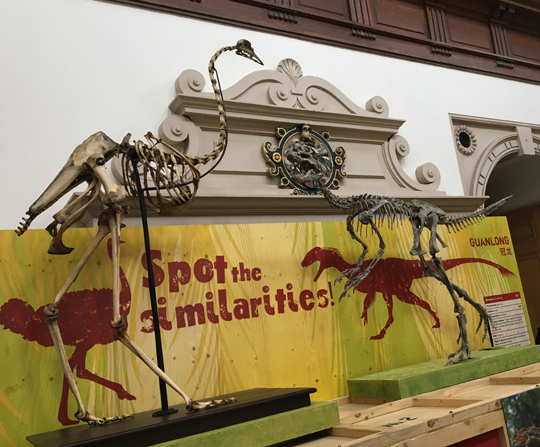
The Skeleton of an Ostrich (left) Compared to a Dinosaur Skeleton (right)

Ostrich skeleton compared to Guanlong dinosaur skeleton.
The skeleton of an extant ostrich compared to a theropod dinosaur (Guanlong). Picture credit: Everything Dinosaur.

Picture credit: Everything Dinosaur

That point notwithstanding, birds are closely related to the likes of Tyrannosaurus rex and as such they make a better test subject than that other animal that is an obligate biped – us.  Data on how humans walk and run was also collated and studied, but Homo sapiens does move differently when compared to ground-dwelling birds, there are some very significant differences.   This research looked at the kinetics of bipedal movement, that is, those forces that cause motion (gravity, torque, friction and so forth).  It also examined the kinematics of motion, the study of describing movement, usually by measuring the precise motion of parts of the body such as the joints.  Kinematics involves looking at acceleration, velocity and braking.

When it comes to examining the differences in terrestrial motion between Aves and ourselves, perhaps the most significant difference is that in birds, all kinematic and kinetic parameters analysed changed continuously as velocity increased, whilst in humans all but one of those same parameters changed abruptly at the walk-run transition.  Think of it as birds being able to move through the gears a little more smoothly than their two-legged human counterparts.

Ground Reaction Force (GRF)

Particular attention was devoted to the ground reaction force (GRF), the force that the feet exert upon the ground.  The research team confirmed previous assessments of bird locomotion.  Birds have a highly continuous locomotor repertoire compared to humans.  Our discrete “walking” and “running” gaits are not easily distinguishable based on kinematic patterns alone.  If birds have a more continuous locomotion profile based on body mass and the speed of movement, then this means that scientists can develop equations that allows them to predict the potential locomotor capabilities of extinct creatures – Tyrannosaurus rex for example.

Lead author of the scientific paper, Peter Bishop (Queensland Museum) explained:

“Since birds, also known as “avian dinosaurs”, are actually just dinosaurs that didn’t become extinct, they were ideal models to study how their extinct cousins would have moved.  So, you’d be foolish to start anywhere else.”

The predictive model that the team has produced is able to explain 79–93% of the observed variation in kinematics and 69–83% of the observed variation in Ground Reaction Forces.

When used in extrapolation tests to examine the gaits of extinct animals, the results produced were within expected levels.  There are caveats however, this study also found that the location of the whole-body centre of mass may exert an important influence on the nature of the Ground Reaction Forces, some caution is needed before applying this model to a thirteen metre monster like T. rex, after all most extinct theropod dinosaurs had substantial tails, whilst birds have a reduced tail in the form of a pygostyle and the presence/absence of a tail will have a bearing on locomotion.  The research team conclude that further investigation of the movement of dinosaurs is required.

A couple of years ago, a group of scientists mounted prosthetic tails on chickens and assessed how the presence of a tail altered their locomotion.

To read an article on this study: Walking Dinosaurs Chicken Run.

Differences in Muscles and the Skeleton

Extant birds also have a very different skeleton compared to theropod dinosaurs such as Allosaurus, Giganotosaurus, Megalosaurus and Tyrannosaurus rex.  The anatomy of birds varies considerable from that of a dinosaur, although there are striking similarities, the presence of a wish bone and a digitigrade stance for example.  Extinct non-avian theropods have different limb proportions and their leg muscles and their position (as influenced, in part by that long tail), are different.  Theropod dinosaurs also had a different centre of gravity compared to birds.

For an article that looks at the evolution of the stance of birds from their dinosaur ancestors: Standing Dinosaur, Crouching Bird.

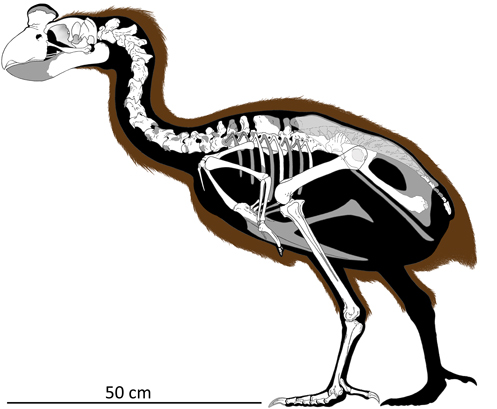
The Research Will Help with the Locomotion of Extinct Flightless Birds (Sylviornis)

Sylviornis from New Caledonia.
Scale bar = 50 cm, a skeletal reconstruction of the giant, flightless bird from New Caledonia Sylviornis.

The Queensland Museum scientist Peter Bishop added that understanding the locomotion of giant, extinct theropods such as the Late Cretaceous tyrannosaurids not only excited the curiosity of the public but was crucial to understanding a wide range of scientific questions.

He stated:

“Locomotion is important for understanding other parts of dinosaur ecology, how you find food, how you find mates, how you avoid becoming food yourself?  It could also help contribute to models of dinosaur migration and even help settle debates about whether they were warm-blooded.  But for me, the most interesting part of dinosaur locomotion is that it’s the most critical part of how dinosaurs evolved into birds.  There were a lot of changes in locomotion … including the development of powered flight.”

Next Steps

The research team hope to test their equations on more species of birds and also to develop computer programmes that can model how large bipedal dinosaurs would have moved.

An article published in 2013 that looks at the evolution of the gait of birds: Birds Have the Dinosauria to Thank for Their Crouching Gait.

For dinosaur and prehistoric animal models: Dinosaur and Prehistoric Animal Models.

21 02, 2018

Plants May Have Originated 100 Million Years Earlier

By |2023-09-16T16:09:55+01:00February 21st, 2018|Categories: Dinosaur and Prehistoric Animal News Stories, Main Page, Photos/Pictures of Fossils|0 Comments

Pushing Back the Origins of Plants by 100 Million Years

An analysis of the genes of living plants has revealed that the very first plants may have evolved 100 million years earlier than the fossil record suggests.  Writing in the academic journal “Proceedings of the National Academy of Sciences (USA)”, researchers conclude that the first plants to colonise the Earth evolved around 500 million years ago, whereas, the current known fossil record provides evidence of plant spores from Ordovician-aged rocks and the first Rhyniophytes, Bryophytes and Lycophytes originated in the Silurian approximately 420 to 400 million years ago.

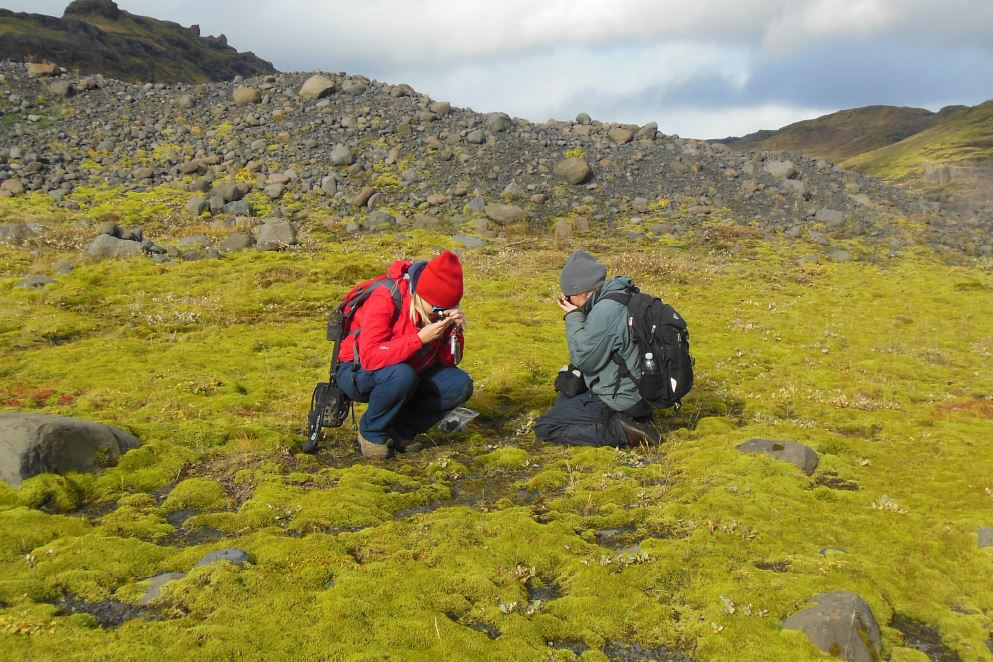
The Research Team Examined the Origins of Early Land Plants

Researching into the origins of early land plants.
Early land plants would have resembled the flora found in this Icelandic lava field.

Picture credit: Paul Kenrick (Natural History Museum, London)

Lead author of the study, Dr Philip Donoghue (Department of Earth Sciences, Bristol University) commented:

“Land plants emerged on land half a billion years ago, tens of millions of years older than the fossil record alone suggests.”

Evolved from Pond Scum

The current theory is that true plants, capable of surviving in a terrestrial environment evolved from “pond scum”.  Plants play a hugely important role in shaping the climate of our planet through photosynthesis and respiration.  The greening of the Earth permitted terrestrial environments to be opened up for exploitation by the first land animals.  Plants can help to establish and maintain soils and the roots of plants play a vital role in the physical and chemical weathering of rocks.  The breaking down of rocks is a key process in the carbon cycle that regulates the Earth’s atmosphere and climate.

Tracing Evolution Using a Molecular Clock

The scientists, which included Dr Mark Puttick from the Natural History Museum (London), used a molecular clock which analysed the combined evidence of genetic differences between related living species and the fossils of ancient ancestors.   The concept of a molecular clock works on the assumption that evolutionary changes occur at regular time intervals.  If the rate of genetic change (mutation), in the DNA of an organism can be compared to the genome of a closely related species then their relationship can be tracked back through time, identifying the characteristics of a common ancestor.  Tracking back using this methodology, the team concluded that the first plants evolved much earlier than previously thought.

Co-lead author of the research, Dr Jennifer Morris (Bristol University), explained:

“The global spread of plants and their adaptations to life on land, led to an increase in continental weathering rates that ultimately resulted in a dramatic decrease the levels of the “greenhouse gas” carbon dioxide in the atmosphere and global cooling.  Previous attempts to model these changes in the atmosphere have accepted the plant fossil record at face value, our research shows that these fossil ages underestimate the origins of land plants and so these models need to be revised.”

An Incomplete and Sparse Fossil Record

The fossil record of early plants is particularly poor.  It is far too incomplete to act as a reliable guide to the evolution and origin of land plants.  The molecular clock allowed the team to compare differences in the genetic make-up of extant plant species, these relative genetic differences were then converted into geological ages using the sparse fossil record as a loose framework.  This work suggests that the ancestor of land plants was living in the middle of the Cambrian and it is similar in age as the first known terrestrial animals.

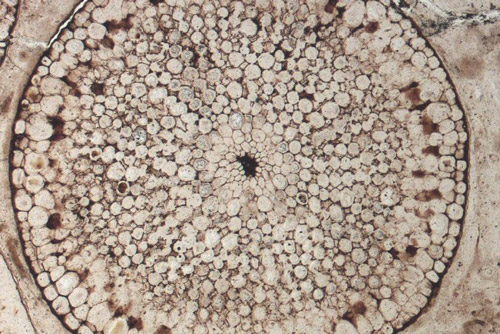
A Cross Section of the Devonian Land Plant Rhynia gwynne-vaughanii from Scotland

An image of the early vascular plant Rhynia gwynne-vaughanii (Devonian).
A cross section of the early vascular plant – Rhynia gwynne-vaughanii.

Picture credit: Natural History Museum, London

A Taxonomic Conundrum

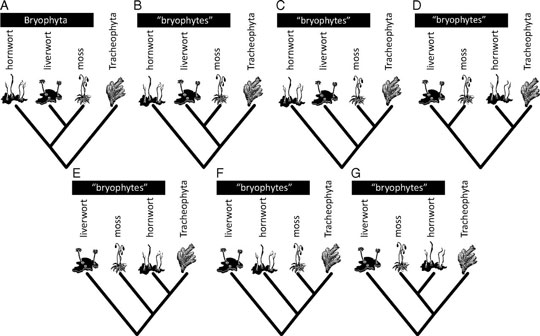
The research into the origins of land plants has been complicated as the taxonomic relationships between the earliest land plants are not clear and distinct.  Using similarities in the shape and structure of land plants, scientists have mapped a number of conflicting outcomes for a cladistic analysis of early plant relationships between the most primitive groups such as the Bryophytes (liverworts and mosses) and the vascular plants (Tracheophytes) and a primitive sub-group of vascular plants, the Lycophytes.  Using the molecular clock model to map phylogenetic relationships the team identified several evolutionary family trees for the early plants.  The liverworts could be a sister clade to all other land plants, with either mosses, hornworts or a moss-hornwort grouping as the sister group to the Tracheophytes.

Seven Alternative Cladistic Relationships for Early Plants were Considered in the Study

The possible cladistic relationships between early land plants.

Picture credit: Proceedings of the National Academy of Sciences

However, when each of these phylogenetic relationships was tested in turn, against the molecular clock model, the end result still indicated an origin of land plants some 100 million years earlier than previously thought.  The researchers conclude that the first land plants may therefore have originated during the Late Cambrian or at the latest during the Early Ordovician.

The scientific paper: “Timescale of Early Land Plant Evolution” by J. L. Morris, M. N. Puttick, J. Clark, D. Edwards, P. Kenrick, S. Pressel, C. H. Wellman, Z. Yang, H. Schneider and P. C. J. Donoghue, published in the Proceedings of the National Academy of Sciences (USA).

Visit the Everything Dinosaur website: Everything Dinosaur.

16 02, 2018

Lizards Up on Two Feet in the Early Cretaceous

By |2023-09-16T15:04:03+01:00February 16th, 2018|Categories: Dinosaur and Prehistoric Animal News Stories, Dinosaur Fans, Main Page, Photos/Pictures of Fossils|0 Comments

Lizards Sprinted to Safety to Avoid Predation

A team of international scientists writing in the journal “Scientific Reports”, have described the oldest lizard trackways known to science that record bipedal behaviour.  The little lizards lived around 110 million years ago, in what is now South Korea, it has been speculated that just like extant lizards, they took to their hind legs to avoid being eaten.

Lizard Trackways

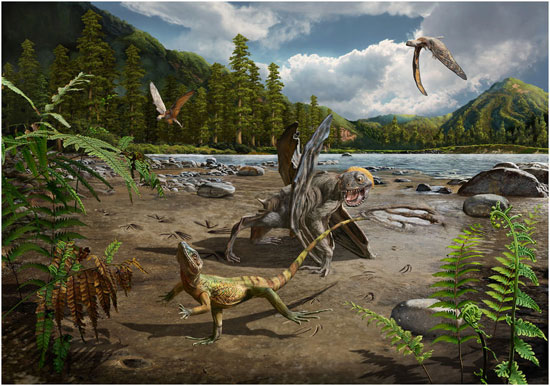
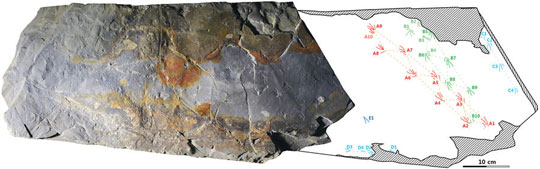
The mudstone slab preserves a total of twenty-nine prints, representing four trackways made by lizards.  The lizard trackways occur in the same horizon as the pterosaur ichnotaxon, Pteraichnus koreanensis, it has been speculated that these small animals were taking to their hind legs and sprinting away to avoid the attention of marauding flying reptiles.

A Lizard Escapes from a Pterosaur (Early Cretaceous of South Korea)

A lizard takes to its hind legs to avoid the attentions of a Pterosaur.
A lizard sprints away from an attacking Pterosaur (Pteraichnus koreanensis).

Picture credit: Zhao Chuang

Rare Lizard Trace Fossils from the Hasandong Formation

The researchers from the Chinese Academy of Sciences, Seoul National University, the Korea Institute of Geoscience and Mineral Resources along with Anthony Fiorillo of the Perot Museum of Nature and Science (Dallas, Texas) studied the mudstone slab, which measures approximately seventy centimetres by thirty centimetres in size and identified the tiny tracks, as that of a basal member of the Iguania Infraorder of lizards.

The team came to this conclusion as living iguanians, such as those in the Basiliscus genus (basilisk lizards), have strong hind legs and are facultative bipeds, that is, capable of running on their back legs when the need arises.  The fossil record also shows that these types of lizards were present in Asia during the Early Cretaceous.

The Mudstone Slab with Trace Fossils and Accompanying Line Drawing

Fossilised lizard tracks and line drawing.
Photograph of the fossil slab with accompanying line drawing.

Picture credit: Scientific Reports

The trace fossils were excavated from an old quarry adjacent to Hadong power station in Hadong County, in south-central South Korea.  It is believed that the strata in this area (Hasandong Formation) was laid down around 112 to 110  million years ago (Aptian/Albian faunal stages of the Early Cretaceous).  The well-preserved lizard trackways have allowed the scientists to examine in detail the hand (manus) and foot (pes) anatomy of the ancient lizard.

When Did Lizards Develop Bipedal Capabilities?

Although, bipedal locomotion is known today and the Squamata (lizards and snakes), are the most specious of all the living reptile types, the fossil record for these creatures is particularly sparse.  Palaeontologists, remain uncertain as to when bipedal locomotion in lizards arose, although it has been inferred based on the relative proportions of front and hind limbs as seen in Tijubina pontei, an Early Cretaceous lizard, whose fossils are associated with the Crato Formation of Brazil.

The lizard trackways discovered in South Korea suggest that bipedal locomotion in ancient lizards is deeply rooted in the phylogeny of lizard evolution.

Hand and Foot Tracks (Manus and Pes)

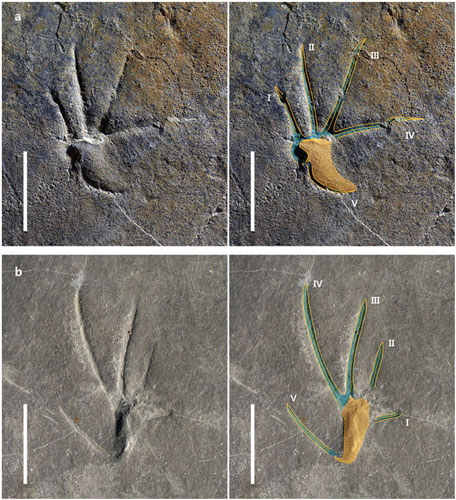
Hand and foot prints Sauripes hadongensis.
Manus and pes tracks of Sauripes hadongensis, (a) Enlarged photograph and drawing of a manus imprint (B1). (b) A pes imprint (A6).

Picture credit: Scientific Reports

Sauripes hadongensis

The foot prints (pes) are plantigrade, indicating that this lizard walked on its toes and heels, just like us and all lizards today, as opposed to the digitigrade locomotion of the Dinosauria.  Although the individual prints are very small, around two centimetres in length, the five toes (pentadactyl), are clearly defined. 

The lizard tracks appear in the same horizon as the pterosaur ichnotaxon Pteraichnus koreanensis and it has been speculated that the lizards could have been escaping from a flying reptile.  Behaving as a facultative biped, would also have elevated the head and this would have permitted the lizards to keep a better look out for aerial predators.

The scientists have estimated the ancient lizard’s body length by comparing the trackways to the extant lizard Tropidurus torquatus, a living member of the Infraorder Iguania.  The ichnotaxon has been named Sauripes hadongensis which translates as “lizard foot from Hadong County”.

An Illustration of the Bipedal Locomotion of the Ancient Lizard

An illustration of the running lizard (bipedal running).
An illustration showing the bipedal interpretation of the lizard trackway (SVL – snout to vent length and PL – pes length).

Picture credit: Scientific Reports

The Palaeoenvironment of Lower Cretaceous South Korea

The mudstone strata has produced tridactyl (three-toed) dinosaur tracks as well as trace fossils representing the tracks of small pterosaurs.  Fossilised plants are also associated with these layers of rock.  It is suggested that the mudstone represents deposits from a swampy area or possibly the margins of a lake. 

The Hasandong Formation has yielded numerous body fossils including several different types of vertebrate (turtles, pterosaurs, crocodilians and dinosaurs).  These fossilised bones are isolated, broken and highly fragmentary, indicating that they may have been exposed on the surface for some considerable time prior to subsequent burial.  They also may have been transported for some distance before deposition.  This taphonomy suggests that large rivers crossed this location, the mudstone slab may have been sited in an area away from a main river channel, that was subjected to periodic flooding by water with low energy, otherwise the delicate prints may not have been preserved.

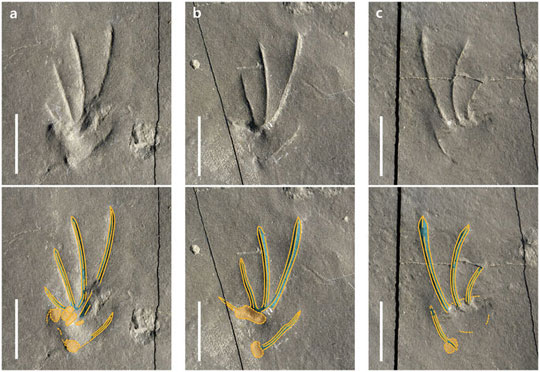
Photographs of Individual Hind Foot Prints (Pes) with Digits Highlighted

Pes tracks of Sauripes hadongensis.
Photographs of the foot prints of Sauripes hadongensis with the digits highlighted.

Picture credit: Scientific Reports

To read Everything Dinosaur’s 2014 article about the discovery of a tiny Theropod dinosaur from South Korea: Tiny Terror from South Korea.

The scientific paper: “Lizards Ran Bipedally 110 Million Years Ago” by Hang-Jae Lee, Yuong-Nam Lee, Anthony R. Fiorillo and Junchang Lü published in Scientific Reports.

Visit the Everything Dinosaur website: Everything Dinosaur.

12 02, 2018

Stepping into the Lower Cretaceous of Maryland

By |2023-09-16T13:09:42+01:00February 12th, 2018|Categories: Dinosaur and Prehistoric Animal News Stories, Dinosaur Fans, Main Page, Photos/Pictures of Fossils|0 Comments

Diverse Footprint Assemblage Reveals Early Cretaceous Biota

Back in 2012, Everything Dinosaur reported upon the discovery of a partial nodosaurid dinosaur footprint found at NASA’s Goddard Space Flight Centre in Greenbelt, Maryland (USA).  Subsequent excavations have revealed a diverse trace fossil assemblage, preserving footprints of dinosaurs, mammals and flying reptiles (Pterosauria) located in a single slab of sandstone.  This remarkable fossil records a snapshot in deep geological time and shows how different types of animals interacted in a wetland environment.

Studying Trace Fossils (Dinosaur Footprint)

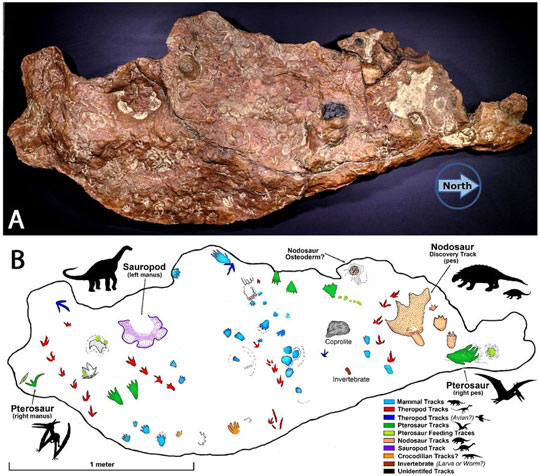
A View of the Cast of the Actual Fossil that Records the Entire Track Bearing Surface

Goddard Space Centre (NASA) trackways.
The cast of the track bearing surface reveals over 70 trace fossils.

Picture credit: Scientific Reports

Co-corresponding author of the scientific paper, published in the journal “Scientific Reports”, Ray Stanford (NASA, Goddard Space Flight Centre), the scientist who first discovered trace fossil evidence at the Goddard site, commented:

“It’s a time machine.  We can look across a few days of activity of these animals and we can picture it.  We see the interaction of how they pass in relation to each other.  This enables us to look deeply into ancient times on Earth.  It’s just tremendously exciting.”

Natural Impressions

The single slab of iron-rich sandstone measures over two metres in length and the cast of the fossil (see above), represents at least eight different track types denoting dinosaurs, crocodilians, pterosaurs and mammals.  All the tracks are preserved as natural impressions (concave epireliefs) and at least twenty-six mammalian tracks have been identified.  Analysis of the fossil material suggests that all the impressions were made within a relatively short time of each other, the fossil (GSFC-VP1) can be interpreted as snapshot recording the activities of a diverse biota around a wetland area during the Early Cretaceous (Albian/Aptian faunal stages).

A Schematic Showing the Extant of the Trace and Body Fossils Preserved

Trackways represent a diverse biota.
Goddard Space Flight Centre (NASA) tracks – schematic drawing.

Picture credit: Scientific Reports with additional annotations by Everything Dinosaur

Tracking the Dinosaurs

The track that first highlighted the potential of the site “the discovery track”, which is coloured light brown in the drawing above, and situated in the north-eastern corner of the sandstone slab, has been identified as a nodosaurid print.  This single print measures around 29 centimetres in diameter.  The posterior (heel) region is obscured by a smaller track of uncertain providence.  The small track could represent a print made by a juvenile nodosaur.  If this is the case, then this section of the fossil could show the tracks made by an adult and juvenile armoured dinosaur as they walked together (see silhouettes adjacent to the track illustration).

Potential Nodosaurid Scute

A single, black object with a raised ridge is also preserved.  This has been interpreted as an individual scute from a nodosaurid.  Measuring five centimetres across, the fossil is surrounded by a polygonal pattern consistent with the surrounding integument associated with nodosaurid skin impressions.  The unique taphonomy of the Patuxent Formation that is exposed at the Goddard Space Flight Centre and other locations in Maryland has already provided palaeontologists with the beautifully-preserved impression of the rear half of an articulated baby nodosaurid.  This dinosaur was named Propanoplosaurus marylandicus by Stanford et al in 2011.

The Object Identified as a Nodosaurid Scute (Dermal Armour)

Potential Nodosaurid Scute
(A) photograph of nodosaurid scute and associated polygonal pattern of surrounding integument, (B) simplified outline of polygonal pattern.

Picture credit: Scientific Reports

The large nodosaurid print along with the track made by the left front foot of a sauropod (see single print outlined in light purple and the silhouette on the schematic), confirms the presence of large dinosaurs in the area.

Small Theropod Dinosaurs Systematically Searching for Food

Four parallel trackway patterns made by crow-sized theropod dinosaurs have been identified.  The outermost tracks of the group have been labelled in the schematic T1 and T4.  This parallel pattern and the short distance between individual footprints suggest that these small meat-eaters were moving slowly and working together to systematically comb the area for food.

Martin Lockley (University of Colorado, Denver) and co-corresponding author with Ray Stanford explained:

“It looks as if they were making a sweep across the area.”

Theropod Trackways T1 and T4 Illustrated

Theropod tracks.
Goddard Space Flight Centre (theropod tracks).

Picture credit: Scientific Reports

The picture above shows drawings of various theropod tracks,  T1 consists of six footprints, whilst T4 is comprised of five individual prints (diagrams A and B).  The short stride length indicates very short steps, consistent with the idea that these little meat-eating dinosaurs were carefully scrutinising the area, probably hunting for food.  Diagrams C and D represent isolated tracks with toe digits widely separated (divarication) – note the scale bar = 20 cm.

Marvellous Mammalian Tracks

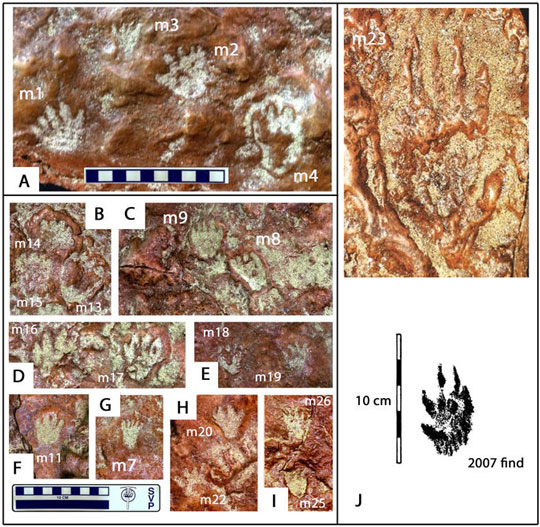
The dinosaur tracks might first catch the eye, but the real stars of this Early Cretaceous “dance floor” are the collection of mammalian prints.  At least twenty-six mammal tracks have been identified.  The largest print, covering around twenty-five square centimetres is the largest mammal footprint ever discovered from the Cretaceous.  This suggests that there were plenty of mammals about and some of them were quite big, about the size of a Highland terrier or a raccoon.

The researchers conclude that most of the mammalian prints represent small squirrel-sized animals and the study has resulted in the erection of a new ichnotaxon Sederipes goddardensis.  The genus name roughly translates from the Latin as “sitting foot” as some of these impressions indicate that the small mammals sat up in a similar way to extant prairie dogs.  The trivial name honours the Goddard Space Flight Centre.

Mammal Tracks as Identified on the GSFC-VP1 Specimen

Examples of mammal tracks.
Early Cretaceous mammal tracks (GSFC-VP1).

Picture credit: Scientific Reports

A Dinosaur Footprint and Diverse Mammal Tracks

The photograph (above), shows examples of the diverse mammal tracks.  Tracks m1-m4 include the holotype ichnofossils of the new ichnotaxon Sederipes goddardensis.  Note scale bar and (J) which denotes a large, five-toed track with an image of a similar track described in 2007.

The authors believe the wide diversity and number of tracks show many of the animals were in the area actively feeding at the same time.  It has been proposed that the mammals may have been feeding on worms and grubs, the small carnivorous theropods were after the mammals, and the pterosaur tracks found in situ could suggest that flying reptiles were hunting in the vicinity too, perhaps after both the mammals and their reptile contemporaries.

The scientific paper: “A Diverse Mammal-dominated, Footprint Assemblage from Wetland Deposits in the Lower Cretaceous of Maryland” by Ray Stanford, Martin G. Lockley, Compton Tucker, Stephen Godfrey and Sheila M. Stanford published in Scientific Reports.

To read Everything Dinosaur’s 2012 article about the initial footprint discovery: Space Age Meets Dinosaur Age.

Photograph of the Cast and Schematic Drawing

Schematic drawing and fossil cast (GSFC-VP1)
GSFC-VP1 cast and schematic drawing. The diagram shows the variety of trace fossils including a large, potential sauropod dinosaur footprint.

Picture credit: Scientific Reports

Visit the Everything Dinosaur website: Everything Dinosaur.

11 02, 2018

Magma Outflow from Mid-Ocean Ridges Contributed to Dinosaur Demise

By |2023-09-16T12:51:24+01:00February 11th, 2018|Categories: Dinosaur and Prehistoric Animal News Stories, Dinosaur Fans, Geology, Main Page|0 Comments

Magma Outpourings Along Oceanic Boundaries of Tectonic Plates

Scientists have concluded that magma outpourings along the edges of tectonic plates in the deep ocean may have contributed to the mass extinction event that marked the end of the Mesozoic.  The increased volcanic activity could have contributed to the non-avian dinosaur extinction.

Researchers from the University of Oregon, in collaboration with colleagues from the University of Minnesota, identified gravity-related fluctuations dating to around the time of the end Cretaceous along ocean ridges that point to the worldwide release of volcanic magma.   The outpouring of molten rock could have contributed to the global climatic catastrophe that marked the extinction of about 70% of all terrestrial lifeforms including the dinosaurs and their flying reptile cousins (Pterosauria).

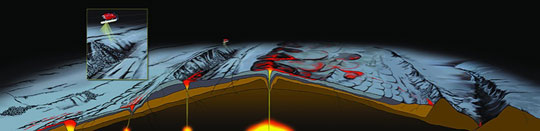
The Extra-terrestrial Impact Event Could Have Exacerbated Volcanism Including Along Oceanic Ridges

Magma flows along ocean ridges.
Increased outpourings of magma along ancient ocean ridges could have contributed to the end Cretaceous extinction event.

Picture credit: University of Oregon/E. Paul Oberlander, Woods Hole Oceanographic Institution, Graphic Services

Lead author of the scientific paper, published in the academic journal “Science Advances” Joseph Byrnes, (Department of Earth Sciences, University of Minnesota), stated:

“We found evidence for a previously unknown period of globally heighted volcanic activity during the mass-extinction event.”

A “One-two” Knockout Blow

The team’s analysis of the strength of gravity along these ancient ocean ridges, points to a pulse of accelerated global volcanism that along with the massive outpourings known as the Deccan Traps of India would have significantly impacted upon the planet’s climate.

How much the enormous Deccan Traps contributed to the demise of the Dinosauria has been debated for decades.  Huge volcanic events, fortunately quite rare, such as the outpourings of molten rock that at some places in India, are more than two kilometres thick and cover much of the western portion of the sub-continent, can have a colossal effect on the Earth’s climate.  When these events do occur, they are very often linked to global mass extinctions.  The expulsion of gas and ash into the air can block out the sun causing plants to die and ecosystems to collapse.  Acid rain is also associated with the release of sulphur dioxide into the atmosphere from volcanoes.

With the discovery of the Chicxulub impact crater on the Yucatan Peninsula (Mexico), scientists have debated how much of an effect the Deccan Traps eruptions did have.  Seismic data suggests that part of India was already active when the extra-terrestrial body hit the Earth around 66 million years ago, however, the impact was so massive, the resulting seismic shock waves moved through the Earth’s crust and probably led to an acceleration of those eruptions.

Co-author, Leif Karlstrom added:

“Our work suggests a connection between these exceedingly rare and catastrophic events, distributed over the entire planet.  The meteorite’s impact may have influenced volcanic eruptions that were already going on, making for a one-two punch.”

The idea that the impact event increased volcanism gained credence in 2015 following research from scientists based that the University of California, Berkeley.  They proposed that powerful seismic waves could have exacerbated distant volcanic eruptions, making the Deccan Traps even more active.

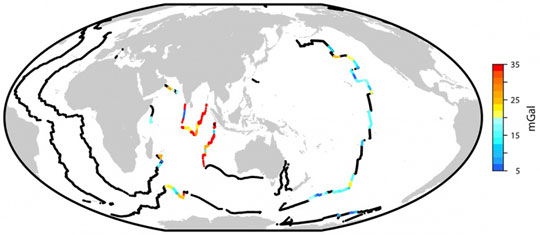
Mapping Gravity Anomalies in Mid-Ocean Late Cretaceous Environments

Mapping gravity anomolies.
Coloured and black lines mark mid-ocean ridges 66 million years ago and reflect seafloor spreading rates and gravity anomalies after the impact event.

Picture credit: Joseph Byrnes

The Chicxulub Impact Event

This new research extends this exacerbated eruption idea to oceanic basins worldwide.  To conduct the research, a geological map of the seafloor was divided into equally sized sections and the history of the ocean basins plotted back in time for more than 100 million years.  At around 66 million years ago, the approximate time of the Chicxulub impact event, evidence for a “short-lived pulse of marine magmatism”, along the ancient ocean ridges where tectonic plates meet was found.  This pulse is indicated by a spike in the rate of the occurrence of free-air gravity anomalies found in the data.

Free-air gravity anomalies, measured in tiny increments (milligals), account for variations in gravitational acceleration, found from satellite measurements of additional seawater collecting where the Earth’s gravity is stronger.  Byrnes found changes in free-air gravity anomalies of between five and twenty milligals associated with seafloor created in the first million years after the impact event.

The scientific paper: “Anomalous K-Pg–aged Seafloor Attributed to Impact-induced Mid-Ocean Ridge Magmatism” by Joseph S. Byrnes and Leif Karlstrom published in the journal “Science Advances”

The Everything Dinosaur website: Everything Dinosaur.

10 02, 2018

Polar Hypsilophodonts in the Spotlight

By |2023-09-16T12:24:27+01:00February 10th, 2018|Categories: Dinosaur and Prehistoric Animal News Stories, Dinosaur Fans, Main Page|0 Comments

New Study Looks at the Growth Rates of Polar Hypsilophodonts

Researchers from Museums Victoria (Melbourne, Australia) and the Oklahoma State University Centre for Health Studies, have published a new paper in the academic journal “Scientific Reports” that examines the growth rates of polar dinosaurs, specifically the growth rates of those fleet-footed ornithischians the hypsilophodontids.  Palaeontologists have long-debated whether these small dinosaurs, which were geographically widespread during the Early Cretaceous, showed different growth rates between high latitude forms and those that lived closer to the Equator.

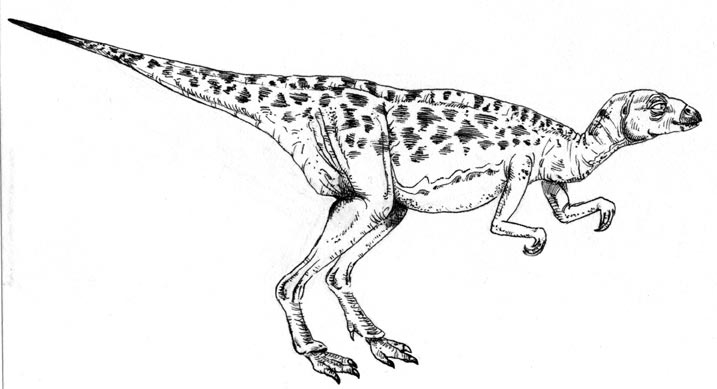
An Illustration of a Typical Hypsilophodont Dinosaur

Hypsilophodont.
A typical hypsilophodontid dinosaur. Picture credit: Everything Dinosaur.

Picture credit: Everything Dinosaur

The Perils of Being a “Polar” Dinosaur

Dinosaurs that lived in high latitude habitats such as those that lived on the southernmost portions of Gondwana, had to endure low temperatures, plus periods of prolonged darkness as the sun dropped below the horizon.  Although, nowhere near is as cold as the Antarctic today, close to the South Pole in the Early Cretaceous was quite a foreboding, formidable environment.  However, several types of non-avian dinosaurs, including several hypsilophodonts seem to have flourished.  Four taxa have been described to date, from two principle locations namely:

  • Fulgurotherium australe from the Flat Rocks and Dinosaur Cove locations (Victoria)
  • Qantassaurus intrepidus (Flat Rocks location)
  • Leaellynasaura amicagraphica from Dinosaur Cove
  • Atlascopcosaurus loadsi (Dinosaur Cove)

As all these genera are named from fragmentary remains (elements from the jaw and individual teeth), with the exception of L. amicagraphica, which is known from more substantial material, in the absence of more fossil remains some of these taxa are regarded as nomen dubia.

The microstructure of limb bones (femora and tibias) were analysed to identify growth trends, the study revealed that there were probably two genera present in those fossils studied which had come from Dinosaur Cove.  Bone microstructure alone, could not distinguish taxa within the sample of bones from the Flat Rocks area.  The researchers, which included Dr Thomas Rich and his partner Dr Patricia Vickers-Rich conclude that further histological study of hypsilophodont material from these sites may help to confirm the number of genera present as well as to help improve the data on polar dinosaur growth rates.  Leaellynasaura was named in honour of the couple’s daughter Leaellyn Rich.

Several Hypsilophont Species Likely

Flat Rocks and the Dinosaur Cove locations are separated by Port Phillip Bay, they are approximately 120 miles (200 kilometres) apart.  These areas are also distant from a geological perspective, with the Flat Rocks locality being made up of sedimentary rocks that date from around 133 – 128 million years ago (Late Valanginian or Barremian faunal stages of the Early Cretaceous).

Whereas, the rocks that formed Dinosaur Cove on the other side of Cape Otway, are much younger, being laid down approximately 106 million years ago (Albian faunal stage of the Early Cretaceous).  Based on the temporal range that these fossils represent, then it is quite likely that these dinosaur fossils from the coast of Victoria do, indeed, represent several genera.

Growth Rates Amongst Polar Hypsilophodonts

The research into the bone microstructure of the limb bones of these types of polar dinosaur reveals that both the Flat Rocks and Dinosaur Cove specimens were growing in a similar way, at a similar rate to many typical small-bodied vertebrates.  These animals tended to have lower annual growth rates when compared to larger vertebrates.

The palaeontologists note that the large (eight metres long), ornithischian Maiasaura from the Late Cretaceous of the United States took around eight years to reach adult size, whereas one of the specimens in the study seems to have reached maturity a year earlier, but it was a much smaller-bodied dinosaur, only growing at a fraction of the rate of the larger Maiasaura.

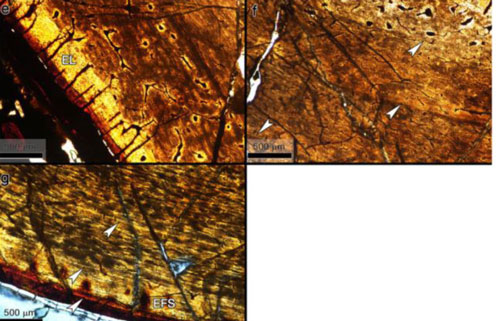
Transverse Sections from the Femur of a Hypsilophodont Used in the Study

Bone microstructure and histology in hypsilophodont limb bones.
Images of a cross-section of a hypsilophodont right femur showing histology and bone microstructure.

Picture credit: Scientific Reports

A Slow Growth Rate

The researchers did note that although the polar hypsilophodontids grew quite slowly compared to their larger relatives, the bone histology studies revealed that they had a relatively elevated growth rate for the first few years of their life.  Growing up relatively quickly, or at least reaching a certain threshold body size could have been an evolutionary response to avoid predation.

The paper published in “Scientific Reports”, is the first study of its kind into the growth rates of Australian polar hypsilophodonts.  The team conclude that these dinosaurs might have reached maturity in about five to seven years.  As adults, these genera only rarely exceeded lengths of 2.8 metres, most of which was tail and individual body mass for most of these dinosaurs was under fifty kilograms.

The research could be extended to include an analysis of hypsilophodontid limb bones excavated from lower latitudes.  A more complete comparison between the ontogeny of hypsilophodonts from different parts of the world could then be made.

Visit the website of Everything Dinosaur: Everything Dinosaur.

9 02, 2018

Out of Africa – Much Earlier Than Expected

By |2023-09-16T12:17:25+01:00February 9th, 2018|Categories: Dinosaur and Prehistoric Animal News Stories, Main Page, Photos/Pictures of Fossils|0 Comments

Human Jawbone Fossil Rewrites our History

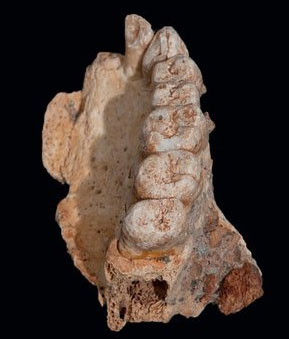
The discovery of a fossilised upper jawbone, complete with teeth, has rewritten the history of our own species and supports the theory as proposed by genetic studies that H. sapiens migrated out of Africa much earlier than previously thought.

Human Jawbone Fossil

Most palaeoanthropologists contend that our species Homo sapiens originated in Africa and then at some point in the distant past migrated out of Africa spreading into the Middle East, Asia and Europe before colonising the rest of the world.  Human fossils found outside Africa have been dated to 120,000 to 90,000 years ago (Tarantian faunal stage of the Late Pleistocene), the discovery of a human jawbone fossil at Misliya Cave on the western slopes of Mount Carmel, Israel, demonstrates that modern humans were already present in northern Israel at least 55,000 years earlier.

The Fossil Jawbone that Reinforces the Idea that Modern Humans Migrated Out of Africa Much Earlier

Modern human jawbone fossil.
The left maxilla from a modern human found in northern Israel.

Picture credit:  Israel Hershkovitz Tel Aviv University

Levallois Technology

The international team of scientists, including  Israel Hershkovitz (Tel Aviv University) and Rolf Quam from the Department of Anthropology at Binghamton University, examined the sediments in the cave associated with the human jawbone fossil find.

There has been a research project associated with the Misliya Cave site for several years.  This new research builds upon previous studies and it supports the idea that the people at this location were making and using a range of sophisticated stone tools reminiscent of the tools associated with the earliest modern humans in Africa (Levallois technology).  The sediments reveal a series of well-defined hearths as well as numerous animal remains and stone tools.  An analysis of the human remains, dating the sediments and the fossil itself, suggests an approximate age range of between 177,000 and 194,000 years old, making this jawbone the oldest member of the Homo sapiens species to have been found outside of Africa.

The research team conclude, that the fossil, known as the “Misliya maxilla” along with the abundant stone tools, indicates that the emergence of this technology is linked to the appearance of our species in this region of the Middle East.

For an article that summarises research from 2016 that questions the relatively late migration of modern humans out of Africa: Out of Africa Earlier than Thought?

Another 2016 article that looks at the evidence in support of a theory that suggests modern humans evolved independently in Asia: Did Humans Evolve Independently in Asia?

Visit the Everything Dinosaur website: Everything Dinosaur.

8 02, 2018

Dinosaurs Reveal the Geographical Signature of a Remarkable Evolutionary Radiation (Part 2)

By |2024-05-08T20:25:05+01:00February 8th, 2018|Categories: Dinosaur and Prehistoric Animal News Stories, Dinosaur Fans, Main Page|0 Comments

Dinosaurs Reveal the Geographical Signature of an Evolutionary Radiation

Yesterday, Everything Dinosaur posted an article on the newly published scientific paper that examined how the Dinosauria radiated out from their suspected South American origins and came to dominate terrestrial ecosystems around the world.  The research was conducted by scientists based at Reading University and their paper was published this week in the academic journal “Nature Ecology & Evolution”.

To read our article on this research: The Evolutionary Radiation of the Dinosauria Mapped.

Building on an Earlier Study

Building upon earlier research, the Reading University scientists believe that the dinosaurs were already in decline before the final coup de grâce that marked the end of the Cretaceous and the demise of the non-avian dinosaurs.  The dinosaurs spread across the planet, but they began to run out of space to migrate into, becoming victims of their own success.

Everything Dinosaur has received special permission from the University to publish some of the images created by the researchers that plot the routes taken by various dinosaur species as they spread across the world.

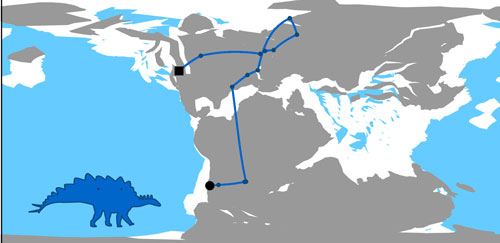
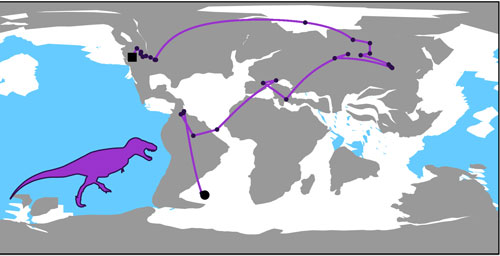
The pictures (below), show six reconstructed paths from the dinosaurian root node (black circle) to the fossilised species (black square).  The coloured circles represent the centroids of the reconstructed ancestral locations (these are used for visualisation purposes only and posterior distributions of estimated ancestral locations are used in all analyses).  These maps help to demonstrate the conclusions drawn by the researchers.  Take for example, the first image, that of the path of Rhoetosaurus (R. brownei).  R. brownei was a sauropod, its fossils are found in eastern Australia and it lived some 170 million years ago.

The Evolutionary Path of Rhoetosaurus brownei

Picture credit: University of Reading (silhouette credit: Remes K, Ortega F, Fierro I, Joger U, Kosma R et al, silhouette represents Spinophorosaurus nigerensis)

The Evolutionary Path of Archaeopteryx lithographica is Plotted

Plotting the evolutionary path of Archaeopteryx lithographica.
The evolutionary path of Archaeopteryx lithographica.

Picture credit: University of Reading (silhouette credit: Scott Hartman)

Studying the Dinosauria

Archaeopteryx lithographica lived around 150 million years ago, its fossils have been found in the limestone quarries of southern Germany.  All the evolutionary paths that have been created by the researchers have been plotted onto geological age level palaeomaps from the time at which the fossil species is dated to (grey).  All preceding age level palaeomaps are plotted in white.

Plotting the Path of the Ornithischian Dinosaur Stegosaurus stenops

Plotting the evolutionary path of the armoured dinosaur Stegosaurus stenops.
Plotting the evolutionary path of Stegosaurus stenops.

Picture credit: University of Reading (silhouette credit: Scott Hartman)

Like Archaeopteryx, Stegosaurus stenops fossils are associated with Upper Jurassic strata.  However, this research suggests that unlike the Archaeopteryx lineage, which migrated into eastern Laurasia, the evolutionary path of S. stenops was oriented towards western Laurasia, fossils of this iconic armoured ornithischian being associated with the Morrison Formation of the western United States.

The Evolutionary Path of Andesaurus delgadoi is Plotted

The evolutionary path of Andesaurus delgadoi is plotted.
Plotting the path of the titanosaur Andesaurus delgadoi.

Picture credit: University of Reading (silhouette credit: T. Tischler, the silhouette represents the related titanosaurid Wintonotitan wattsi)

Late Cretaceous Migrations

The titanosaurid A. delgadoi lived some 97 million years ago (Cenomanian faunal stage of the Late Cretaceous).  Note how the world map has changed in the illustrations, reflecting the change in the position of the continents.  The known fossil evidence suggests that the majority of the titanosaurids were restricted to Gondwana for most of the Cretaceous species.  Only in the very Late Cretaceous did a land bridge form, permitting these dinosaurs to migrate into North America.

Path of Dromaeosaurus albertensis 

Plotting the path of Dromaeosaurus albertensis .
The path of D. albertensis, dromaeosaurs migrated into North America from high latitudes.

Picture credit: University of Reading (silhouette represents Dromaeosauroides bornholmensis known from Upper Cretaceous rocks from Denmark)

The researchers conclude that the dromaeosaurids associated with North America crossed over from northern Asia.

Last but not least, no evolutionary study mapping the spread of the dinosaurs would be complete without reference being made to the Tyrannosauroidea.  The map below, shows the path plotted for Tyrannosaurus rex.

Plotting the Path for T. rex

Plotting the evolutionary path of Tyrannosaurus rex.
T. rex evolutionary path is plotted.

Picture credit: University of Reading

From their South America origins, this most famous of the Theropoda seems to have traversed Laurasia before heading westwards to become the dominant, apex predators in the Late Cretaceous (Laramidia and (most likely) Appalachia).

The authors of the scientific paper state that all silhouettes were downloaded from www.phylopicdotorg.

The scientific paper: “Dinosaurs Reveal the Geographical Signature of an Evolutionary Radiation” by Ciara O’Donovan, Andrew Meade and Chris Venditti published in Nature Ecology & Evolution.

Everything Dinosaur acknowledges the help of Reading University in the compilation of this article.

Visit the Everything Dinosaur website: Everything Dinosaur.
Go to Top