All about dinosaurs, fossils and prehistoric animals by Everything Dinosaur team members.

Fossil finds, new dinosaur discoveries, news and views from the world of palaeontology and other Earth sciences.

7 02, 2018

Evolutionary Radiation of the Dinosauria Mapped

By |2023-09-16T12:00:58+01:00February 7th, 2018|Categories: Dinosaur and Prehistoric Animal News Stories, Dinosaur Fans, Main Page|0 Comments

Dinosaurs Reveal the Geographical Signature of an Evolutionary Radiation

The fact that the dinosaurs came to dominate terrestrial ecosystems during the Mesozoic is not controversial.  There is plenty of fossil evidence to suggest that dinosaurs evolved into a myriad of different species (some 1,300 genera have been described to date), these fossils are geographically widespread.  Thanks, in part, to their origins on the supercontinent Pangaea and to the vagaries of continental drift, dinosaurs lived all over the world, from the Antarctic to the Arctic circle.

Evolutionary Radiation of the Dinosaurs

However, not that much is known about how the dinosaurs spread and became globally distributed.  Indeed, just how quickly the Dinosauria radiated and how soon they rose to prominence in terrestrial ecosystems remains very much open to debate.  Researchers from the University of Reading have attempted to map the geographical spread of the “terrible lizards” and they conclude that the migration of dinosaurs around the world was so rapid, that eventually they ran out of land to colonise and this might have contributed to their extinction.

Dinosaurs Spread from South America to the Rest of the World
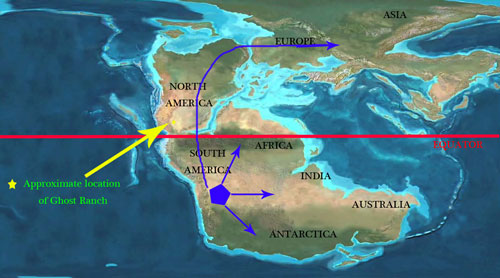
Dinosaur diversification and migration coincided with the break-up of Pangaea.
The spread of the Dinosauria – if they originated in South America.  The approximate location of the famous Triassic fossil site (Ghost Ranch) is indicated by the yellow arrow.

Picture credit: Everything Dinosaur

The Evolution of the Dinosaurs – It’s a Bit of a Puzzle

Just when and where the dinosaurs rose to dominate the land is hotly debated.  The fossil record for early dinosaurs is very poor and extremely fragmentary.  This problem is compounded by the blurring of the definition of the Dinosauria, as living alongside the true dinosaurs for tens of millions of years were their closely related counterparts which together with the dinosaurs comprise the clade Dinosauromorpha.  Palaeontologists can find it extremely difficult to distinguish between a true Triassic dinosaur and a contemporary dinosauromorph.  It seems that in the Triassic, the ancestral forms of the Dinosauria, lived alongside the true dinosaurs for millions of years.

This problem is compounded by the fact that the dinosaur/pterosaur/bird branch of the Archosauria (Avemetatarsalia), were in the evolutionary shadow of the crocodile branch of the “ruling reptiles” the Crurotarsi, for much of the Middle and Late Triassic.  If you were able to interview a Coelophysis or a Tawa (both dinosaurs from the famous Ghost Ranch location of New Mexico), they would have described an ecosystem dominated by other types of archosaur, not dinosaurs.  With the exception of the abundance of Coelophysis specimens, there are relatively few dinosaur fossils from the Ghost Ranch location, dinosaurs may have only made up around 20% of the terrestrial fauna.

Coelophysis – A Typical Example of a Triassic Theropod
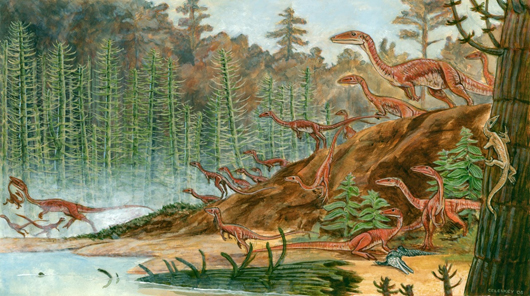
Coelophysis flock.
A flock of Coelophysis descend on a waterhole (Ghost Ranch).

Picture credit: Matt Celeskey

Jumping into the Jurassic

After the End Triassic mass extinction event, it seems to have been a different story.  The dinosaurs seem to have rapidly risen to dominance and soon the landscape was being dominated by giant herbivores such as the long-necked cetiosaurs and the first super-sized carnivores such as Dilophosaurus, Cryolophosaurus and the first of the megalosaurs.  The Reading University team modelled the spread of the dinosaurs by reconstructing the dinosaurs’ ancestral locations (using South America as the starting point for the dinosaur radiation), they then examined the spatial mechanisms that underpinned the spread of the Dinosauria.  The research shows that the speed of this expansion meant that the dinosaurs quickly became cosmopolitan and subsequently ran out of land.  This lack of space then seriously impeded their ability to produce new species.

Typical Early Jurassic Dinosaurs Show an Increase in Size Compared to Late Triassic Counterparts
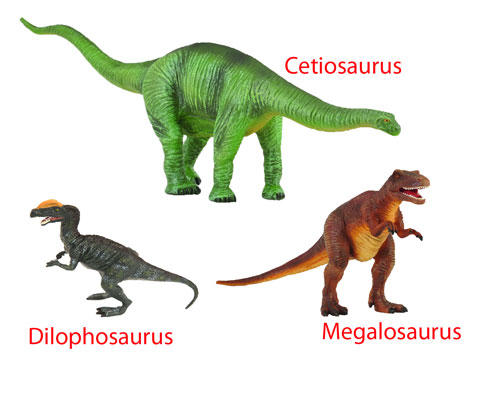
Early Jurassic giants.
Examples of some of the larger dinosaurs from the Early Jurassic. Picture credit: Everything Dinosaur.

Picture credit: Everything Dinosaur

Building Upon Previous Research

This new study, published in “Nature Ecology and Evolution”, builds upon previous research from Reading University, published in 2016, that concluded that the dinosaurs were in decline around 50 million years before the mass extinction event that saw the demise of the non-avian forms.

To read Everything Dinosaur’s article about the 2016 study: The Fifty Million Year Decline of the Dinosaurs.

Lead author of this new research, evolutionary biologist at the University of Reading, Ciara O’Donovan explained:

“Fossil evidence has shown us where the dinosaurs started out and where they died, but there is an important middle period that little was known about.  Our research fills this gap in prehistory by revealing how the dinosaurs spread, how fast they moved and what directions they moved in through time.  The dinosaurs exploded out of South America in a frenzy of movement to cover the planet.  It was during this time that diverse forms evolved and eventually led to species such as the fearsome Tyrannosaurus rex, Archaeopteryx (the earliest bird) and the gigantic, long necked Diplodocus.  This honeymoon period could not last forever though, and the dinosaurs eventually filled every available habitat on Earth.  There was nowhere new for species to move to, which may have prevented new species from arising, contributing to the dinosaurs’ pre-asteroid decline.  In essence, they were perhaps too successful for their own good.”

Using a Novel Statistical Analysis

The Reading University team developed a novel, statistical analytical method to help reveal where the ancestor of every dinosaur species lived.  This data was plotted onto a three-dimensional world map.  The analysis revealed that the dinosaurs spread virtually unchecked across the landmass of Pangaea at a rate of 1,000 kilometres (600 hundred miles), per million years.  They dominated every terrestrial habitat, across the globe as the supercontinent of Pangaea broke apart.

Sympatric Speciation

As the space left available for the Dinosauria to expand into was used up, the evolutionary driver for the development of new species might have changed.  The scientists conclude that dinosaurs initially diversified into new kinds driven by the expansion into new environments and habitats, but this driver for change was gradually replaced by sympatric speciation (new species evolving to exploit new niches within their existing environment).  This fundamental change in the way that dinosaurs evolved could have left them vulnerable to global catastrophes such as the extra-terrestrial impact event and the subsequent climate devastation that occurred some sixty-six million years ago.

Dinosaurs in Decline Many Millions of Years Before the End Cretaceous Mass Extinction
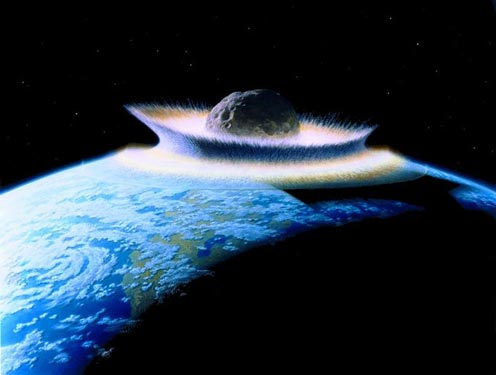
Earth impact event.
Cataclysmic impact event that led to the extinction of the dinosaurs.

Picture credit: Don Davis (commissioned by NASA)

Dr Chris Venditti, evolutionary biologist at the University of Reading and co-author of the paper, commented:

“Early dinosaurs had a blank canvas and spread quickly across the devastated Earth, taking up every opportunity in their path.  Virtually every door was open to them as there was no competition from other species.  The inability of the dinosaurs to adapt rapidly enough as the Earth became full may explain why they were in decline prior to the asteroid strike, and why they were so they were so susceptible to almost total extinction when it hit.”

The scientific paper: “Dinosaurs Reveal the Geographical Signature of an Evolutionary Radiation” by Ciara O’Donovan, Andrew Meade and Chris Venditti published in Nature Ecology & Evolution.

Everything Dinosaur acknowledges the help of the University of Reading in the compilation of this article.

View the Everything Dinosaur website: Everything Dinosaur.
6 02, 2018

When Did Flowers Evolve? A Fantastic Question

By |2024-05-04T18:29:16+01:00February 6th, 2018|Categories: Dinosaur and Prehistoric Animal News Stories, Dinosaur Fans, Main Page, Palaeontological articles|1 Comment

The Origin of the Angiosperms (Flowering Plants)

Scientists have concluded that the angiosperms (flowering plants), probably evolved between 149 and 256 million years ago.  In a paper published in the academic journal “New Phytologist”, the researchers, which included scientists from the Chinese Academy of Sciences as well as Bristol University, conducted a comprehensive analysis of genetic data from 644 plant taxa.  This led them to conclude that, based on this dataset, the flowering plants that dominate the terrestrial flora of the world probably originated as early as the Late Permian or perhaps as recently as the Late Jurassic.

Arguiing over the Origins of the Angiosperms

This new research suggests that flowering plants are not as old as suggested by previous molecular studies, nor as recent as the fossil record for angiosperms reveals.  The team’s conclusions underline the power of using complementary studies based on molecular data and the fossil record, in conjunction with different approaches to infer evolutionary timescales, allowing the establishment of a better understanding of the evolution of organisms.

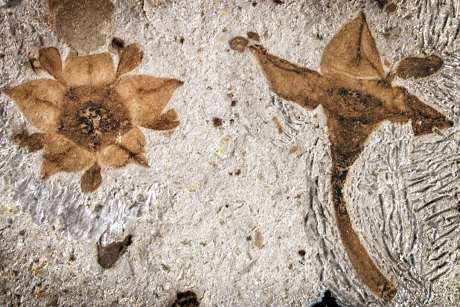
Ancient Buckthorn Flowers Preserved as Fossils

Two Buckthorn flower fossils.
Two fossilised Buckthorn flowers next to each other were discovered in shales of the Salamanca Formation in Chubut Province, Patagonia, Argentina.

Picture credit: Nathan Jud/Cornell University (USA)

The “Abominable Mystery”

Darwin commented that the origin of flowering plants was an “abominable mystery”, the palaeogeographical origins of flowering plants , which today are represented by nearly 300,000 species remains a controversial area in palaeobotany.  Recently, Everything Dinosaur published an article documenting research that suggested that a downsizing in the genome of plants helped the angiosperms become the dominant flora, but when the first flowering plants evolved has proved very difficult to establish.

To read the article on the angiosperm genome study: Downsizing DNA Brings Success to Flowering Plants.

Lead author of the scientific paper, Dr Jose Barba-Montoya (University College, London) explained:

“The discrepancy between estimates of flowering plant evolution from molecular data and fossil records has caused much debate.  To uncover the key to solving the mystery of when flowers originated, we carefully analysed the genetic make-up of flowering plants, and the rate at which mutations accumulate in their genomes.”

The Paucity of the Angiosperm Fossil Record

The fossil record for flowering plants, is very fragmentary.  Angiosperms appear to have radiated and diversified very suddenly around 125 million years ago.  The expansion of the flowering plants may have precipitated substantial changes in the fauna of the Cretaceous, this rapid change in fauna and flora is termed the “Cretaceous Terrestrial Revolution”, a short period in geological time when pollinators, herbivores and their predators underwent an explosive co-evolution.

The Rapid Evolution of Flowering Plants May Have Led to the “Cretaceous Terrestrial Revolution”

When did flowering plants evolve?
When flowering plants evolved there was a burst in evolution as symbiotic relationships formed.

Picture credit: Bristol University

A Much Older Origin of the Angiosperms

Molecular-clock dating studies, however, have suggested a much older origin for flowering plants.  This  implies a cryptic evolution of flowers that has yet to be supported by fossil discoveries.  The discovery of wing scales from 200-million-year-old representatives of the Lepidoptera (moths and butterflies), hinted that flowering plants may have originated earlier than previously thought, after all, the adult butterflies and moths might well have fed on nectar from flowering plants.

To read Everything Dinosaur’s article about the ancient wing scales from Lepidoptera: Ancient Butterflies Flutter By.

Professor Philip Donoghue (University of Bristol’s School of Earth Science), a senior author of the newly published  study, stated:

“In large part, the discrepancy between these two approaches [the fossil record and molecular dating] is an artefact of false precision on both palaeontological and molecular evolutionary timescales.”

Palaeontological timescales calibrate the family tree of plants to geological time based on the oldest fossil evidence for its component branches.  Molecular timescales build on this approach, using additional evidence from genomes for the genetic distances between species, aiming to overcome gaps in the fossil record.  Molecular clocks predict the age of organisms by looking at the rate of mutation between different genomes.

Senior author of the study, Professor Ziheng Yang (University College, London) added:

“Previous studies into molecular timescales failed to explore the implications of experimental variables and so they inaccurately estimate the probable age of flowering plants with undue precision.”

Plotting Evolutionary Origins

As a history of the evolution of the flowering plants, the fossil record which is particularly poor, is inadequate and conclusions based on the paucity of fossils are not possible.  The scientists compiled a substantial collection of genetic data for many flowering plant groups including a dataset of eighty-three genes from over six hundred taxa.  This evidence in conjunction with an extensive review of the fossil record allowed the team to plot the potential origins of the angiosperms within upper and lower limits of geological time.

Co-author of the study, Dr Mario dos Reis (Queen Mary University, London) stated:

“By using Bayesian statistical methods that borrow tools from physics and mathematics to model how the evolutionary rate changes with time, we showed that there are broad uncertainties in the estimates of flowering plant age, all compatible with Early to Mid-Cretaceous origin for the group.”

Scientists may be some way off, being able to pin down the origins of flowering plants, more fossils, particularly of primitive Angiosperms are needed, but at least this new study has attempted to define the uncertainties associated with the evolution of this type of flora.

The scientific paper: “Constraining Uncertainty in the Timescale of Angiosperm Evolution and the Veracity of a Cretaceous Terrestrial Revolution” by J. Barba-Montoya, M. dos Reis, H. Schneider, PCJ Donoghue and Z. Yang published in the journal “New Phytologist”.

Everything Dinosaur acknowledges the assistance of a press release from Bristol University in the compilation of this article.

Visit the Everything Dinosaur website: Everything Dinosaur.
5 02, 2018

The Tale of the Spiders with Tails

By |2023-09-16T10:58:57+01:00February 5th, 2018|Categories: Dinosaur and Prehistoric Animal News Stories, Main Page, Photos/Pictures of Fossils|1 Comment

Prehistoric Spiders Had Tails

A team of international scientists, including researchers from the University of Manchester, have announced the discovery of a new species of Cretaceous-aged spider.  The arachnid (Class Arachnida), which was preserved in amber from Myanmar (burmite), is helping palaeontologists to better understand the evolution of these very successful and diverse, eight-legged invertebrates.  This new spider species, named Chimerarachne yingi possessed a whip-like tail, a characteristic associated with ancestral forms and the most primitive types of extant spider, but the burmite has preserved a spider with this characteristic, that lived at least 250 million years after the first spiders evolved.

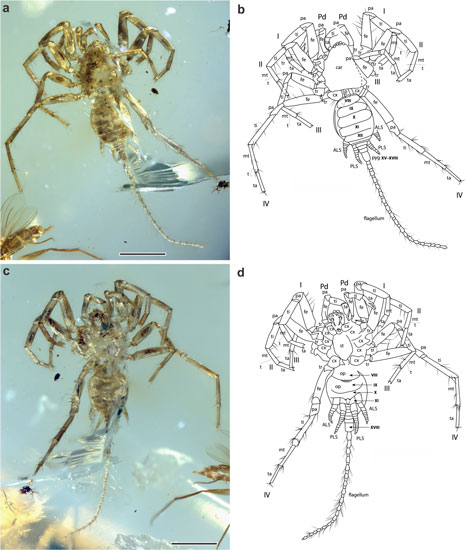
Photographs of the Spider Fossil with Accompanying Line Drawings

Chimerarachne yingi fossil and line drawings (dorsal and ventral views).
Chimerarachne yingi dorsal view (a) with accompanying line drawing and (b) ventral view with accompanying line drawing.

Picture credit: The University of Manchester

Chimerarachne yingi – Potentially a Transitional Fossil

The characteristics of today’s spiders are very well known.  These creatures have eight legs, several eyes and can spin silk, often to create cobwebs.  A “whip-like tail” is one feature that you would not normally associate with these particular creepy-crawlies.  The researchers, writing in the academic journal “Nature Ecology and Evolution”, conclude that the specimen might represent a transitional fossil, it possesses a tail (flagellum) and as such, the fossil may help scientists to better understand how the Arachnida evolved and diversified.

What is a Transitional Fossil?

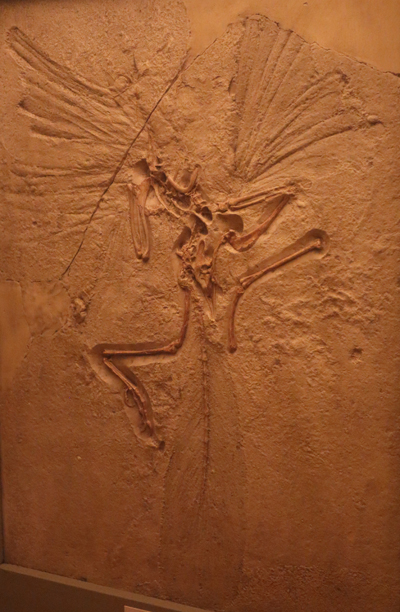
Transitional fossils are defined as any fossil that demonstrates traits that are common to both an ancestral group and descendants.  Perhaps the best-known example is Archaeopteryx lithographica from the Late Jurassic of southern Germany.  The “Urvogel” shows both reptilian traits and characteristics of a bird, so it is regarded as a transitional fossil highlighting the evolution of one part of the Theropoda into modern Aves (birds).

A Fossil of the “Urvogel” Archaeopteryx Regarded as a Transitional Form

Archaeopteryx fossil cast
Archaeopteryx fossil cast. Picture credit: Everything Dinosaur.

Picture credit: Everything Dinosaur

Chimerarachne yingi

The genus name comes from the Greek chimera – a mythical beast that was made up of parts from numerous animals.  The research team conclude that this new species belongs to an extinct group of spiders which were very closely related to true spiders.  What makes the fossil so unique, and different to spiders of today, is the fact it has a tail.  The discovery sheds important light on where modern spiders may have evolved from.

The Arachnida is an extremely successful class of invertebrates.  Spiders are the most diverse and numerous of all the arachnids, together spiders are grouped into the Order Aranae, some 47,000 living species have been documented.  Their evolutionary origins are obscure, but the first spiders may have evolved in the Late Devonian.  Over hundreds of millions of years, they have evolved several key innovations found only in this group.  These include spinnerets for producing silk for webs (as well as for other purposes like egg-wrapping), modified male mouthparts (pedipalps), unique to each species, which are used to transfer sperm to the female during mating, and venom for paralysing prey.

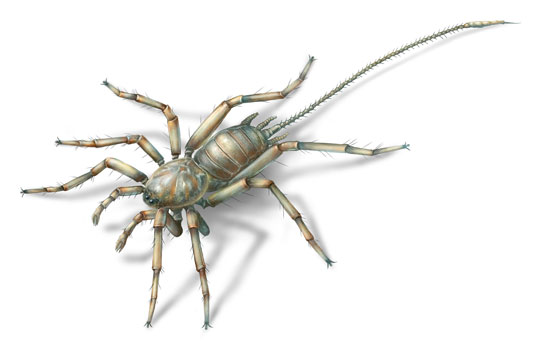
An Illustration of the Newly Described Cretaceous Arachnid Chimerarachne yingi

Cretaceous spider illustrated (Chimerarachne yingi).
Chimerarachne yingi illustrated (note the whip-like tail, the flagellum).

Picture credit: The University of Manchester

The researchers, led by Bo Wang from the Chinese Academy of Sciences and including Dr Russell Garwood (University of Manchester), state that Chimerarachne yingi closely resembles a member of the most primitive group of modern living spiders – the mesotheles.  These spiders have a segmented abdomen unlike other groups found today, such as the mygalomorphs (Mygalomorphae), which include well-known spider species like tarantulas and funnel-webs.  Mesothelae spiders are restricted to south-east Asia, China and Japan today, but in the past they probably had a world-wide distribution (across the ancient super-continent of Pangaea).

Several Important Spider Characteristics

Chimerarachne yingi has several important spider features such as the spinnerets and a modified male pedipalp, but, outside of the obvious tail, it also demonstrates some anatomical differences. For instance, the male pedipalp organ of Chimerarachne appears quite simple, more like that of a mygalomorph spider than a mesothele spider.

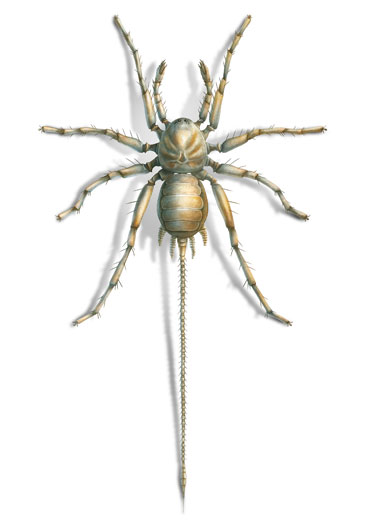
Note the Long “Whip-like Tail” (Flagellum)

Ancient spider illustrated - Chimerarachne yingi.
Chimerarachne yingi illustrated (dorsal view).

Picture credit: The University of Manchester

Dr Garwood explained:

“Based on what we see in mesotheles, we also would have expected the common ancestor of spiders alive today to have had four pairs of spinnerets, all positioned in the middle of the underside of the abdomen.  Chimerarachne only has two pairs of well-developed spinnerets, towards the back of the animal, and another pair that is apparently in the process of formation.”

Working Out the Evolutionary Tree of the Arachnida

The team studied the fossil using a range of different techniques.  One of Dr Garwood’s roles in the study was to help work out where this fossil sits in the evolutionary tree of the Arachnida.

Dr Garwood added:

“Perhaps the most interesting aspect of the new fossil is the fact that more than 200 million years after spiders originated, close relatives, quite unlike arachnids alive today, were still living alongside true spiders.”

Despite the beautiful state of preservation, the scientists are unable to state what function the tail might have had, or indeed, if this spider had a venomous bite.

Co-author of the study, published today, Dr Jason Dunlop (Museum Für Naturkunde in Berlin) stated:

“We don’t know whether Chimerarachne was venomous.  We do know that the arachnid ancestor probably had a tail and living groups like whip scorpions also have a whip-like tail. Chimerarachne appears to have retained this primitive feature.  Taken together, Chimerarachne has a unique body plan among the arachnids and raises important questions about what an early spider looked like, and how the spinnerets and pedipalp organ may have evolved.”

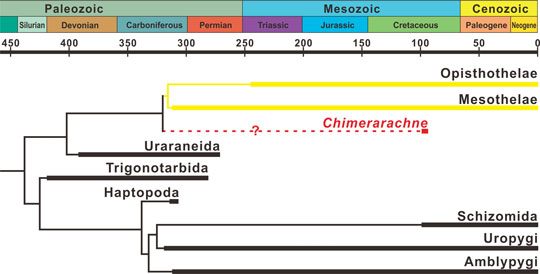
A Timescale Outlining the Proposed Evolution of the Chimerarachne

A timescale of Chimerarachne evolution.
A timescale showing the proposed evolutionary time scale for the Chimerarachne.

Picture credit: The University of Manchester

Despite its appearance, the research team have concluded that C. yingi is not a direct ancestor of modern day spiders.  Spider fossils, although very rare, go back a long way into deep geological time.  Instead Chimerarachne belongs to an extinct lineage of spider-like arachnids which shared a common ancestor with the spiders, some of whom survived into the mid-Cretaceous of Southeast Asia.

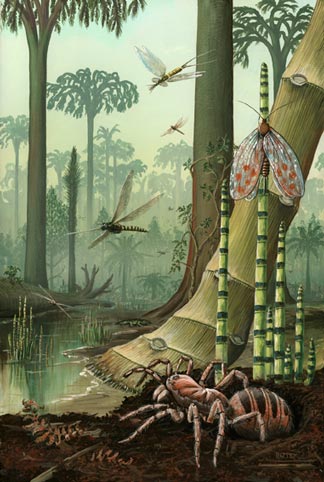
By the Late Carboniferous Arachnids Represented a Diverse and Important Group of Terrestrial Predators

A carboniferous scene.
By the Carboniferous the insects and the mostly predatory arachnids were already highly diversified.

Picture credit: Richard Bizley

The scientific paper: “Cretaceous Arachnid Chimerarachne yingi et sp. nov. Illuminates Spider Origins”, by Wang, B., Dunlop, J. A., Selden, P. A., Garwood, R. J., Shear, W. A., Müller, P. & Lei, X published in the journal Nature Ecology and Evolution.

Everything Dinosaur acknowledges the assistance of the University of Manchester in the compilation of this article.

Visit the Everything Dinosaur website: Everything Dinosaur.
3 02, 2018

Clevosaurus cambrica – Evidence of Island Dwarfism in the Ancient Triassic

By |2023-09-16T06:50:59+01:00February 3rd, 2018|Categories: Dinosaur and Prehistoric Animal News Stories, Dinosaur Fans, Main Page|0 Comments

Fossil from South Wales Identified as New Triassic Species

In the 1950s the Pant-y-ffynnon Quarry in South Glamorgan (Wales), provided a wide variety of vertebrate fossils giving palaeontologists an insight into the fauna of an ancient Triassic archipelago.  However, a comprehensive analysis of the fossil material was not carried out.  Scientists from the University of Bristol including an undergraduate student have undertaken a systematic review of the specimens and this has resulted in the naming of a new species of Rhynchocephalian.  The little reptile has been named Clevosaurus cambrica and this newly described animal hints at adaptive radiation for the clevosaurs on the island chain.  In addition, since the researchers found no evidence of any reptiles in excess of two metres, they propose that the palaeofauna represents a possible example of insular dwarfism.

The concept of insular dwarfism (sometimes referred to as the “island rule” involves residents of islands with limited resources tending to become smaller overtime when compared to their mainland counterparts.

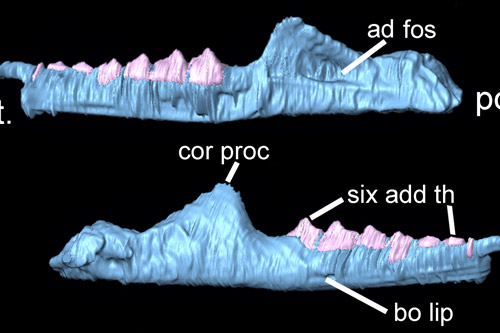
A Three-Dimensional Computer-generated Image of the Jawbone of C. cambrica

Clevosaurus cambrica jaw.
A three-dimensional image of the jaw of Clevosaurus cambrica.

Picture credit: Bristol University

Clevosaurus cambrica – “Gloucester Lizard from Wales”

Emily Keeble’s final-year project for a degree in palaeontology at the School of Earth Sciences, (Bristol University) involved a reappraisal of the  Pant-y-ffynnon Quarry specimens.  Working alongside her course supervisors, the undergraduate was able to identify a new species of Clevosaurus, a type of reptile that was widespread across the supercontinent Pangaea in the Late Triassic.  Clevosaurus was named after “Clevum”, the Latin name for the city of Gloucester, as a number of species have been identified from this locality.  The trivial name “cambrica” honours Wales, where the fossil quarry is located.

In the Late Triassic, the hills of South Wales and the south-western part of England formed an archipelago that was inhabited by early dinosaurs, crocodylomorphs distantly related to modern crocodiles and alligators along with representatives of the Sphenodontidae such as the clevosaurs.  The once diverse and geographically reptile family – the Sphenodontidae is today, represented by the rare Tuatara (Sphenodon punctatus) which is limited to a few small islands off New Zealand.

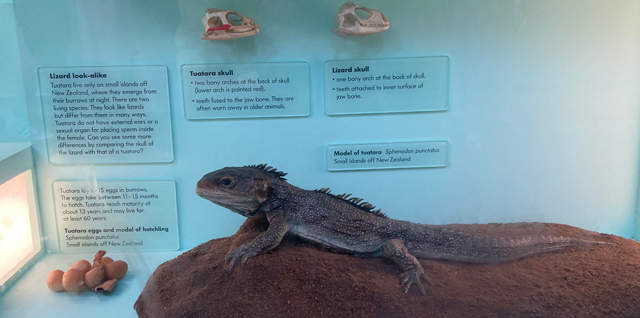
Clevosaurus cambrica Would Have Looked Like a Tuatara

Tuatara information on display at a museum.
Tuatara information on display at a museum. Picture credit: Everything Dinosaur.

Picture credit: Everything Dinosaur

Commenting on the significance of her discovery, Emily said:

“The new species, Clevosaurus cambrica lived side-by-side with a small dinosaur, Pantydraco, and an early crocodile-like animal, Terrestrisuchus.  We compared it with other examples of Clevosaurus from locations around Bristol and South Gloucestershire, but our new beast is quite different in the arrangement of its teeth.”

Clevosaurus cambrica has been identified based on some articulated bones and some isolated fragments.  An analysis of the teeth in the jaws provided evidence that this small reptile probably was an insectivore.  The shape of the teeth and their arrangement identified the fossil as a new species.

Professor Mike Benton, a co-author of the paper and one of Emily’s supervisors added:

“We were lucky to find quite a lot of the skeleton and Emily was able to scan the blocks and make 3-D reconstructions of the skull, neck, shoulder and arm region.”

Evidence of Insular Dwarfism

The researchers conclude that the archipelago held a relatively impoverished fauna, dominated by rhynchocephalians such as the clevosaurs.  The new species has a dental morphology that is intermediate between the Late Triassic Clevosaurus hudsoni, from Cromhall Quarry to the east, and the younger C. convallis from Pant Quarry to the west, suggesting adaptive radiation of clevosaurs in the palaeo-archipelago.  Adaptive radiation is the term used to describe the evolutionary process whereby organisms diverge from a common ancestor to fill a multitude of different ecological niches, think of Darwin’s finches on the Galapagos Islands, for example.

Co-author of the paper and co-supervisor of Emily Dr Whiteside (Bristol University) explained:

“The dinosaurs, crocodiles, and lizards were isolated to some extent on their islands, and perhaps smaller ones were better at surviving in the changed ecologies of the islands.”

The scientific paper: “The terrestrial fauna of the Late Triassic Pant-y-ffynnon Quarry fissures, South Wales, UK and a new species of Clevosaurus (Lepidosauria: Rhynchocephalia)” by Keeble et al published in the Proceedings of the Geologists’ Association.

Everything Dinosaur acknowledges the help of a press release from Bristol University in the compilation of this article.

Visit the Everything Dinosaur website: Everything Dinosaur.
1 02, 2018

Rare Ichthyosaur Specimen Only the Second to be Described

By |2023-09-16T06:02:09+01:00February 1st, 2018|Categories: Dinosaur and Prehistoric Animal News Stories, Dinosaur Fans, Main Page, Photos/Pictures of Fossils|0 Comments

Second Specimen of Wahlisaurus massarae to be Described

A rare 200 million-year-old specimen of a “fish lizard” has been discovered in a private collection twenty-two years after it was originally found.  The fossil is only the second example of Wahlisaurus massarae, a species of ichthyosaur, to have been described.  The new species was established in 2016, by University of Manchester palaeontologist, Dean Lomax following his detailed assessment of a fossil specimen that had been found in Nottinghamshire many decades ago.

Wahlisaurus massarae

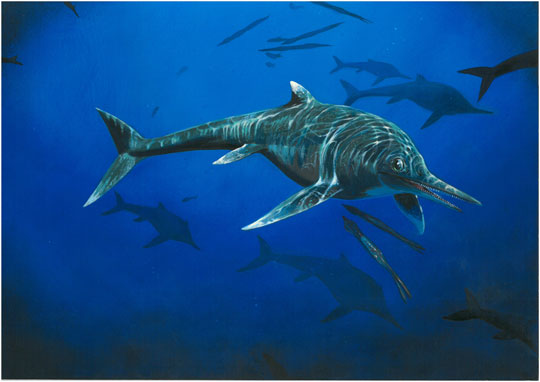
An Illustration of Wahlisaurus massarae

Wahlisaurus massarae illustrated
An illustration of the ichthyosaur known as Wahlisaurus massarae.

Picture credit: James McKay

To read Everything Dinosaur’s 2016 article on the discovery of W. massaraeNew Species of British Marine Reptile Surfaces.

This second example of Wahlisaurus was originally found in 1996.  It has now been donated to the Bristol Museum and Art Gallery, an institution that houses several examples of marine reptiles, including a specimen of Excalibosaurus, which, until the naming of Wahlisaurus two years ago had been the most recent species of ichthyosaur from the British Isles to have been scientifically described.

Ichthyosaurs in the Limelight

The Ichthyosauria clade has been much in the news of late.  For example, earlier this month the discovery of a large ichthyosaur fossil in the cliffs close to Lyme Regis in Dorset, was the subject of a BBC television documentary, narrated by Sir David Attenborough.

To read Everything Dinosaur’s article on “Attenborough and the Sea Dragon”: Attenborough and the Sea Dragon (BBC).

Dean Lomax named W. massarae in honour of two vertebrate palaeontologists who had spent much of their lives studying marine reptiles (Professor Judy Massare and Bill Wahl).

Dean commented:

“When Wahlisaurus was announced, I was a little nervous about what other palaeontologists would make of it, considering the new species was known only from a single specimen.  As a scientist you learn to question almost everything and be as critical as you can be.  My analysis suggested it was something new, but some palaeontologists questioned this and said it was just variation of an existing species.”

Visit the website of Dr Dean Lomax: British Palaeontologist Dr Dean Lomax.

Clues in the Shape of the Coracoid Bone

In this new research, Dean teamed up with Dr Mark Evans, palaeontologist and curator at the New Walk Museum, Leicester, and fossil collector, Simon Carpenter from Somerset.  The study focused on a specimen Dean identified in Simon’s personal collection, which is an almost complete coracoid bone (part of the shoulder girdle, otherwise referred to as the pectoral girdle).  This bone had exactly the same unique features of the equivalent bone in the holotype of Wahlisaurus described in 2016.  Simon’s fossil specimen was originally collected twenty years ago, from a quarry in northern Somerset.  Once the specimen’s rarity was realised, Simon immediately donated it to Bristol Museum and Art Gallery.

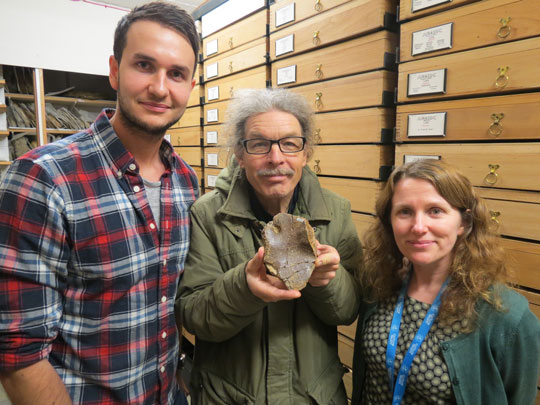
Dean Lomax, Simon Carpenter and Deborah Hutchinson with the Coracoid Specimen

Dean Lomax with Simon Carpenter and Deborah Hutchinson pose with the M. massarae coracoid.
Dean Lomax, (left), Simon Carpenter (centre) and Deborah Hutchinson from the Bristol Museum and Art Gallery (right) with the coracoid specimen.

Picture credit: Manchester University

Dean added:

“You can only imagine my sheer excitement to find a specimen of Wahlisaurus in Simon’s collection.  It was such a wonderful moment.  When you have just one specimen, “variation” can be called upon, but when you double the number of specimens you have it gives even more credibility to your research.”

The new discovery is from a time known as the Triassic-Jurassic boundary, right after a world-wide mass extinction.  For these reasons, the team have been unable to determine exactly whether the ichthyosaur was Late Triassic or Early Jurassic in age, although it is roughly 200 million-years-old.

A Better Understanding of the Skull Structure

As part of the research, Dr Evans cleaned the bones and removed additional rock from the first specimen.  This assisted in a detailed re-examination of the original skull, which led to the discovery of additional bones helping scientists to better understand the morphology of the skull of this British marine reptile.

Finding evidence to help confirm the validity of a genus within a private fossil collection helps to demonstrate the important contribution that can be made to science by dedicated and responsible fossil collectors.

The scientific paper: “An Ichthyosaur from the UK Triassic–Jurassic boundary: A second specimen of the Leptonectid Ichthyosaur Wahlisaurus massarae Lomax 2016” by Lomax, D. R., Evans, M. and Carpenter S., published in the Geological Journal.

For models and replicas of ichthyosaurs and other marine reptile figures: Prehistoric Animal Models and Figures Including Marine Reptiles.

31 01, 2018

Mansourasaurus shahinae the Rosetta Stone of the Dinosauria

By |2023-08-30T20:16:31+01:00January 31st, 2018|Categories: Dinosaur and Prehistoric Animal News Stories, Dinosaur Fans, Main Page, Palaeontological articles|0 Comments

Mansourasaurus shahinae the Rosetta Stone of the Dinosauria

The Rosetta Stone, with its three different languages carved into the rock, provided the breakthrough for archaeologists, enabling them to decipher Egyptian hieroglyphic writing.  A new dinosaur discovery, which just like the Rosetta Stone heralds from Egypt, is helping palaeontologists to decipher the relationship between Late Cretaceous African dinosaurs and their counterparts elsewhere in the world.  The dinosaur has been named Mansourasaurus shahinae and up until now, no reasonably complete dinosaur skeleton from Upper Cretaceous strata in continental Africa had ever been found.

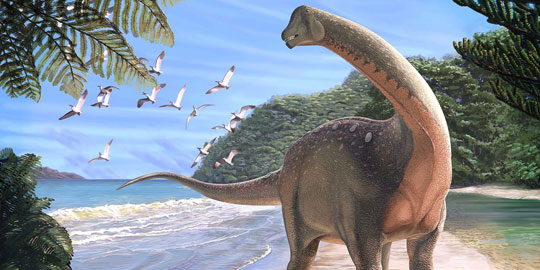
An Illustration of the Newly Described Titanosaur Mansourasaurus shahinae

An illustration of the newly described dinosaur Mansourasaurus.
Mansourasaurus illustrated.  Note the bony scales (osteoderms on the body).

Picture credit: Andrew Mcafee (Carnegie Museum of Natural History)

Helping to Characterise the Late Cretaceous Dinosaur Fauna of Africa

As titanosaurs go, Mansourasaurus is not a ground-shaker in terms of its size, it was approximately ten metres in length and was perhaps as heavy as Africa’s largest land animal today, an African elephant (Loxodonta).  It was not fully grown (bones not entirely fused), but it would not have reached the size of leviathans such as Paralititan (P. stromeri), which roamed North Africa some fifteen million years earlier. 

However, its discovery is seismic as it permits palaeontologists to better understand the evolution of Late Cretaceous African dinosaurs and their taxonomic relationship to other dinosaurs that lived elsewhere in the world during the last few million years of the Mesozoic.

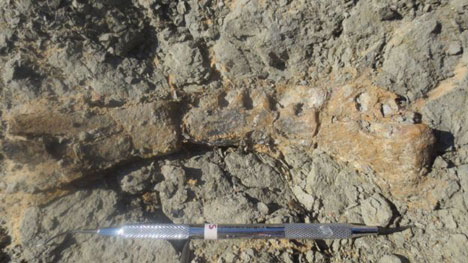
The Fossilised Jawbone of M. shahinae Photographed at the Dig Site

Mansourasaurus jawbone fossil.
Mansourasaurus jawbone in situ.

Picture credit: Mansoura University

Mansourasaurus shahinae – Conflicting Theories and Conflicting Ideas

Very few Late Cretaceous African dinosaurs have been described.  Fossil finds from Upper Cretaceous strata in this part of the world are very rare, what fossils have been found are extremely fragmentary and don’t reveal much information about the sort of dinosaurs that these seldom found bones represent.  Did the dinosaurs living on the African continent in the Late Cretaceous evolve into a distinct biota or were they closely related to other types of dinosaur living on other landmasses?

In addition, if the Late Cretaceous African dinosaurs were closely related to other dinosaurs living elsewhere, were they more closely related to those dinosaurs known from South America, Europe, Asia or even Madagascar?

A remarkable fossil discovery from strata estimated to be around 80 million-years-old (Campanian faunal stage of the Late Cretaceous), will help scientists to answer some of these questions.  Just like the famous Rosetta Stone, these petrified dinosaur bones will help scientists to decipher, at least in part, the evolutionary relationships of African titanosaurs.

Phylogentic Assessment of Titanosaurs

Field work at the Dakhla Oasis of the Egyptian Sahara, led by Dr Hesham Sallam (Mansoura University), in 2013, led to the discovery of the partial remains of a sauropod dinosaur, one that was identified as a member of the Titanosauria clade – a group of long-necked, herbivorous dinosaurs that were geographically widespread during the Cretaceous.  By studying these bones, palaeontologists were able to work out which other titanosaurs were closely related to Mansourasaurus.  The phylogenetic assessment published along with the rest of the paper in the journal Nature, Ecology & Evolution, indicates that M. shahinae is related to titanosaurs from southern Europe and eastern Asia.

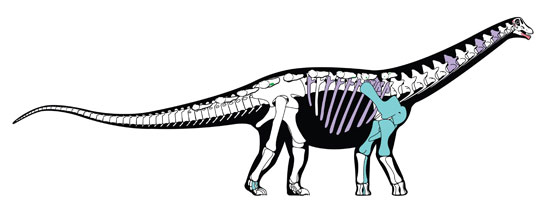
A Reconstruction of the Skeleton of Mansourasaurus

Mansourasaurus shahinae skeleton reconstruction.
A skeletal reconstruction of the newly described titanosaur Mansourasaurus shahinae.

Picture credit: Andrew Mcafee (Carnegie Museum of Natural History)

The Dinosaurian  Palaeobiogeography of Gondwanan Landmasses

The fossils come from rocks that make up the Quseir Formation, these sediments were laid down in a warm, humid, tropical environment.  A low-lying, verdant floodplain that was criss-crossed by large rivers and numerous lakes.  The picture (above) reveals how much of the skeleton has been excavated since the initial fossil discovery around five years ago.  Fragments of the skull and the lower jawbone have been recovered along with cervical vertebrae (neck bones), ribs, elements from the front limbs and a portion of the hind foot.  Numerous bony scales are associated with these bones, this suggests that Mansaurasaurus, like many other titanosaurs, was covered in osteoderms.

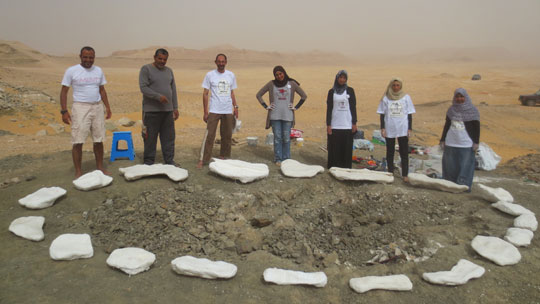
Members of the Field Team from Mansoura University Pose Next to the Jacketed Fossil Bones

Mansoura University field team members pose next to the plaster-jacketed remains of Mansourasaurus.
The all-Egyptian field team from Mansoura University (Egypt) pose with the plaster-jacketed remains of Mansourasaurus.

Picture credit: Mansoura University

Piecing Together the Geographical and Faunal Links Between Late Cretaceous Africa and Other Landmasses

The discovery of Mansourasaurus will help scientists to piece together the geographical and biological links between the Late Cretaceous of Africa and other continents.  The fossil bones can be used just like the Rosetta Stone, to compare and contrast with known fossil finds and future titanosaurid fossil discoveries.

The research team conclude that as Mansourasaurus was closely related to Eurasian titanosaurs, this indicates that these dinosaurs spread between Europe, Asia and north Africa after the tectonic separation of Africa from the landmass that was to form the continent of South America.  In essence, Mansourasaurus hints at a north African dinosaur assemblage that mirrors the sort of dinosaur fauna known from the Late Cretaceous of Europe and Asia.  The team’s findings support the idea that land bridges existed between Africa and other parts of the world, allowing this faunal interchange.  The theory that the African mainland was completely isolated in the latter years of the Cretaceous has been undermined.

A spokesperson from Everything Dinosaur stated:

“This is a very significant fossil discovery.  It marks a new chapter in our understanding of the evolution and spread of Late Cretaceous titanosaurs, it might even herald a new chapter in the history of vertebrate palaeontology in northern Africa, as we are confident that more dinosaur specimens are still out there in the Egyptian Western Desert awaiting discovery.”

The scientific paper: “New Egyptian Sauropod Reveals Late Cretaceous Dinosaur Dispersal between Europe and Africa” by Hesham M. Sallam, Eric Gorscak, Patrick M. O’Connor, Iman A. El-Dawoudi, Sanaa El-Sayed, Sara Saber, Mahmoud A. Kora, Joseph J. W. Sertich, Erik R. Seiffert & Matthew C. Lamanna published in the journal Nature, Ecology & Evolution.

Visit the Everything Dinosaur website: Everything Dinosaur.
23 01, 2018

Moroccan Authorities Investigate Unusual Mexican Dinosaur Auction

By |2024-02-25T08:00:43+00:00January 23rd, 2018|Categories: Dinosaur and Prehistoric Animal News Stories, Dinosaur Fans, Main Page|0 Comments

Culture Ministry Investigates Sale of Atlasaurus Caudal Vertebrae

Moroccan authorities are investigating the sale of a dinosaur’s tail that was sold by the Mexican auction house Morton, to an anonymous buyer for around $97,000 USD ($1.8 million Mexican pesos).  The auction, which took place last Tuesday, was held in Mexico City.  It helped to raise funds for the reconstruction of schools damaged by earthquakes that occurred in Mexico during the autumn.  Any sum over the reserve price was to be donated to the earthquake relief fund.

The Dinosaur Tail (Atlasaurus imelakei) on Display Prior to the Auction

Atlasaurus Caudal Vertebrae (auction exhibit).
The Atlasaurus tail on display in the foyer of the BBVA Bancomer Tower (Mexico City).

Picture credit: Reuters/Daniel Becerril

Atlasaurus imelakei

The four-metre long specimen, weighs around 180 kilograms and represents a partial tail of a sauropod dinosaur from Morocco called Atlasaurus (A. imelakei).  Regarded as a member of the macronarian group of sauropods, Atlasaurus was distantly related to Brachiosaurus and Giraffatitan.  It lived in North Africa during the Middle Jurassic (Bathonian faunal stage) and it is known from numerous isolated bones and articulated specimens.  Atlasaurus had very long limbs, proportionately longer than most other members of the Sauropoda.   Its neck was relatively short compared to later macronarians.

Palaeontologists have speculated that the proportionately longer legs evolved to help this herbivorous dinosaur reach food, that other plant-eating dinosaurs could not obtain.  The long legs of Atlasaurus are regarded as an example of an evolutionary adaptation to achieve niche partitioning within North African dinosaurs.

Culture Ministry Becomes Involved in the Mexican Dinosaur Auction

The auction of the fossilised tail bones has come to the attention of the Moroccan Ministry of Culture, which has launched an investigation to find out the origin and provenance of the fossil material.  The fossil was sold as part of a specialist auction, managed by the Morton Auction House.  A percentage of the sale proceeds being reportedly donated to the Bancomer Foundation to help support reconstruction efforts in those parts of Mexico affected by the recent earthquakes.  Media reports suggest that around $21,500 USD ($400,000 Mexican pesos), was to be donated from the sale of the fossil.

The fossil very likely originated from the Azilal region of Morocco.  The specimen has been restored, around 70% of the material is actual fossil bone.  Steps are being taken to determine how the specimen ended up in the auction.  This is not the first time Moroccan authorities have intervened in a case like this.  In April 2017, a Late Cretaceous plesiosaur fossil exhibit was removed from a Paris auction after an agreement was reached with the Binoche and Giquello auction company.

Tracing the Tale of a Tail

Several sources have stated that the Atlasaurus tail bones were acquired by the Morton Auction House from the Petra Gallery, which specialises in the sale of fossils and minerals.  The acquisition by the Morton Auction House from the Petra Gallery has been confirmed by Morton’s Press and Public Relations representative Kristina Velfu.

Ernesto Durán, the director of the Petra Gallery has stated that the fossil was bought legally in the United States and both a receipt and legal import document are available to prove the purchase as legitimate.

In Mexico, the selling of fossils found within the country is illegal, as they are considered part of the country’s heritage.  However, the law in Mexico does not prohibit the sale of fossils found outside its borders.  The Atlasaurus specimen very probably originated in Morocco, the authorities are interesting in tracing how the fossil came to be in the United States, where it was excavated from and what documentation (if any), exists with regards to its movement out of the country.

We at Everything Dinosaur, will watch how this story unfolds.

16 01, 2018

A New Fast Running Ornithopod from Down Under

By |2023-08-30T08:15:59+01:00January 16th, 2018|Categories: Dinosaur and Prehistoric Animal News Stories, Dinosaur Fans, Main Page|0 Comments

Diluvicursor pickeringi – Turkey to Rhea-sized Herbivore from the Early Cretaceous

Analysis of the fossilised remains of a little ornithopod have led to the establishment of a new species of dinosaur, one that roamed the Australian-Antarctic rift valley approximately 113 million years ago.  Described from an almost complete tail and a partial right hind limb including foot bones, the dinosaur has been named Diluvicursor pickeringi (pronounced di-loovy-cursor pickering-i).

The species name honours David Pickering, (formerly Museums Victoria’s Vertebrate Palaeontology Collections Manager), a scientist who played a key role in the study of Early Cretaceous vertebrate fossils from the Otway and Gippsland Basins of the Australian State of Victoria.  David sadly passed away following complications after a serious car accident whilst the fossil material was being prepared and studied.

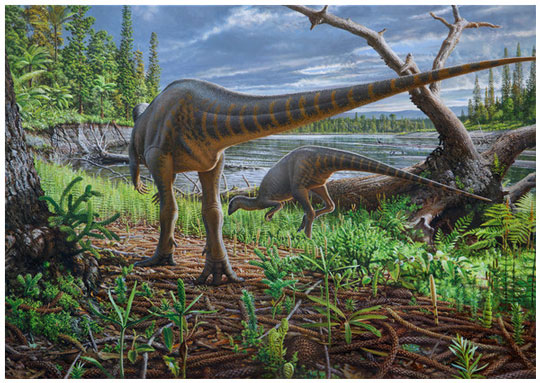
An Illustration of a Pair of Diluvicursor pickeringi Feeding Near a Fast-flowing River

Diluvicursor pickeringi illustrated.
A pair of Diluvicursor dinosaurs feeding next to a fast running river in the Antarctica/Australia rift valley 113 million years ago.

Picture credit: P. Trusler

A Fossil Discovery in 2005

The fossils of this dinosaur described as being about the size of a turkey or a rhea (estimated maximum total body length, including tail at around 2.3 metres), were found on five slabs of rock that form part of a deposit representing a log jam event created in a high-energy (fast-flowing) river.  Writing in the academic journal “Peer J”, the authors of the scientific paper state that this newly described herbivorous dinosaur will help to shed new light on the phylogenetic relationships and the diversity of Ornithopoda of the Southern Hemisphere.

Dr Matt Herne (University of Queensland) and the corresponding author for the paper explained the significance of the fossils, which were excavated from a sea platform near Cape Otway.

He stated:

“Diluvicursor shows for the first time that there were at least two distinct body-types among closely related ornithopods , small, two-legged plant-eating dinosaurs in this part of Australia.  One called Leaellynasaura was lightly built with an extraordinarily long tail, while the other, Diluvicursor, was more solidly built, with a far shorter tail.”

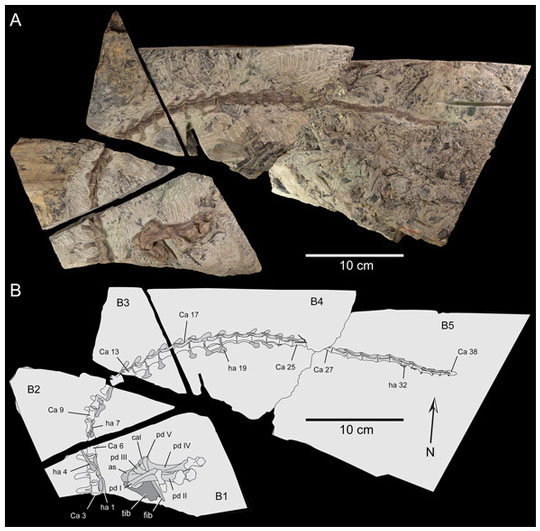
The Holotype Fossil Material of Diluvicursor pickeringi

The holotype of Diluvicursor and a schematic drawing
The five blocks (B1 to B5) of the holotype fossil of Diluvicursor (NMV P221080) note scale bar 10 cm. A schematic diagram of the fossil material is shown below (scale bar 10 cm).

Picture credit: Peer J

A Fast Running Dinosaur

Analysis of the leg bones suggest that Diluvicursor was a fast running dinosaur.  The corpse of this dinosaur, representing a juvenile animal, came to rest mixed up with other debris deposited by a fast-flowing river.  The genus name reflects these two conclusions, Diluvicursor translates as “flood runner”.

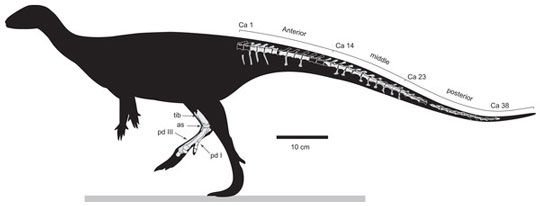
The Proposed Body Shape of Diluvicursor with the Known Fossil Bones in Skeletal Position

Diluvicursor illustration showing known bones (scale bar = 10 cm).
Diluvicursor schematic restoration in left lateral view, showing preserved bones (light shading) and incomplete caudal vertebrae (outlined).

Picture credit: Peer J

Volunteer prospector George Caspar discovered the fossil material in 2005 whilst exploring a coastal shore platform which forms part of the Eumeralla Formation of south-eastern Australia.   It is likely the carcass became trapped and buried along with flood-transported tree stumps, logs and branches in deep scours at the base of what was once a powerful river.

Dr Herne added:

“The Diluvicursor skeleton was discovered in 2005, but it’s taken this long to fully understand the geology of the area where it was found, and also Diluvicursor’s relationships.  Much of the fossil vertebrate material from this site has yet to be described, so we hope to discover further dinosaur species, specimens and other exciting animals there.”

Diluvicursor pickeringi with an Injured Foot

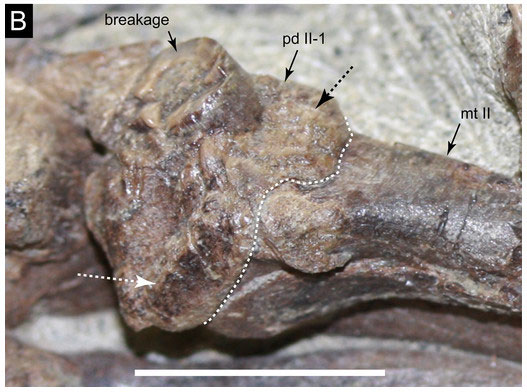
A close examination of the right foot of the Diluvicursor specimen suggest that this dinosaur may have injured its foot some time before it perished.  Some of the bones are not aligned correctly and although this could be as a result of taphonomy, preserved roughened bone surfaces, suggest some form of trauma or disease.  The scientists conclude that the affected joint in the foot could have been immobilised.  The researchers are hopeful that further examination including a scan of the foot using synchrotron radiation X-rays will produce more data.

The Pathology on the Right Foot of the Diluvicursor Specimen

Diluvicursor pathology of the right foot.
A close up view of the second toe. Dotted line in B indicates rugose bone on the proximal margin of pedal digit IV-1. Dashed arrows in A–B indicate areas of osteophytosis (bone spurs around the damaged joint).

Picture credit: Peer J

There are plans to display the post cranial fossil material at Melbourne Museum and the aim is to build up a much more complete picture of the palaeoenvironment of this part of Gondwana during the Albian faunal stage of the Cretaceous.  Other scientists involved in this study include Dr Steven Salisbury, PhD student Jay Nair and Dr Vera Weisbecker (University of Queensland), along with colleagues from Monash University.

The scientific paper: “A New Small-bodied Ornithopod (Dinosauria, Ornithischia) from a Deep, High-energy Early Cretaceous River of the Australian–Antarctic Rift System” by Matthew C. Herne​, Alan M. Tait, Vera Weisbecker, Michael Hall, Jay P. Nair, Michael Cleeland and Steven W. Salisbury published in Peer J.

Everything Dinosaur acknowledges the help of the University of Queensland in the compilation of this article.

Visit the Everything Dinosaur website: Everything Dinosaur.
15 01, 2018

Rainbow Feathered Jurassic Dinosaur Described in New Research

By |2024-05-10T18:26:47+01:00January 15th, 2018|Categories: Dinosaur and Prehistoric Animal News Stories, Dinosaur Fans, Main Page, Photos/Pictures of Fossils|0 Comments

Caihong juji – A Very Flashy Dinosaur

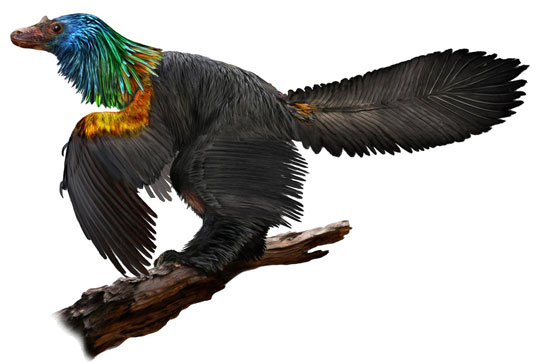
A team of scientists, writing in the journal “Nature Communications”, have described a new species of feathered dinosaur from Jurassic-aged rocks in China.  The dinosaur has been named Caihong juji, which means “rainbow with the big crest” in Mandarin.  This duck-sized dinosaur sported a bony crest on the top of its snout and its neck feathers may have been iridescent, as brightly coloured as feathers seen on humming birds today.

An Illustration of the Newly Described Feathered Dinosaur Caihong juji

Caihong juji illustrated.
An illustration of the Jurassic feathered dinosaur Caihong juji.

Picture credit: Velizar Simeonovski

Caihong juji A Bird-like Dinosaur

Caihong has been assigned a basal position in the Deinonychosauria, a clade of theropod dinosaurs that includes the dromaeosaurids and the troodontids and it roamed the forests of northern China some 161 million years ago (Oxfordian faunal stage of the Jurassic).  Although it was very bird-like, it was very different from its contemporary Anchiornis (A. huxleyi), as it lacked the bird-like triangular skull, however, it did possess proportionately long forearms.  C. juji had a long, narrow skull, superficially similar to the skulls of the much later Velociraptorinae.

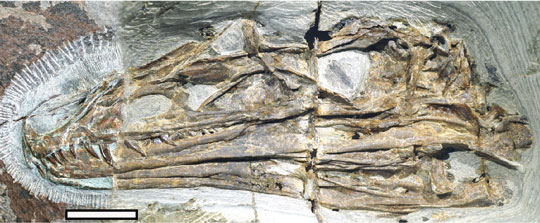
The Fossilised Skull of the Newly Described Basal Deinonychosaur Caihong juji

Skull of the newly described Caihong juji (left lateral view).
The skull of the newly described Caihong juji.  White scale bar = 1 cm.

Picture credit: Hu et al

A Shaggy Ruff of Rainbow Feathers

Lead author of the study, Professor Dongyu Hu (Shenyang Normal University), in collaboration with scientists from the University of Ghent, the Chinese Academy of Sciences, the University of Texas at Austin and the University of Geosciences (Beijing), subjected the fossil specimen to scanning electron microscope analysis to characterise 2,460 structures associated with the feathers.

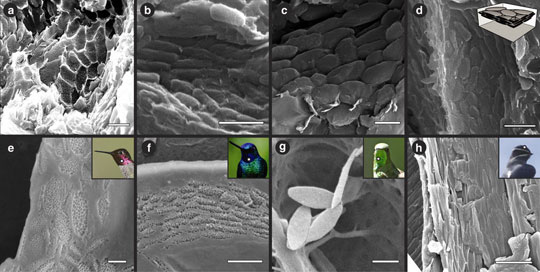
Cross-sectional focused ion beam imaging revealed the presence of melanosomes, which are responsible for pigmentation and colouration.  When these fossil structures were compared to extant birds, the scientists were able to determine that Caihong had a shaggy ruff of iridescent, brightly-coloured feathers.

Platelet-like Nanostructures Indicate Iridescent Feathers (Caihong juji)

Nanostructures in Caihong juji compared to melanosomes in living birds.
Comparing melanosomes found in the fossil material to extant Aves.  All scale bars = 1,000 nm.

Picture credit: Nature Communications/Chao P.C.

The scanning electron microscope images above show platelet-like nanostructures on the fossilised feathers of C. juji (a-d).  These structures are then compared with melanosomes found in living birds, (e) Anna’s humming bird (Calypte anna), (f) a white tailed starfrontlet (Coeligena phalerata), a black-tailed trainbearer (Lesbia victoriae) and a moustached treeswift (Hemiprocne mystacea), picture (h).

Commenting on the significance of the discovery, Professor Julia Clarke (University of Texas at Austin) stated:

“Iridescent colouration is well known to be linked to sexual selection and signalling and we report its earliest evidence in dinosaurs.  The dinosaur may have a cute nickname in English, Rainbow, but it has serious scientific implications.”

A Combination of Ancient and More Modern Features

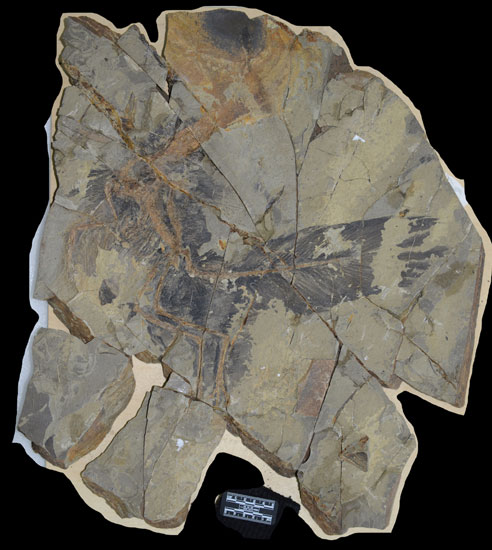
The fossil material, consisting of a slab and its counter slab was discovered by a farmer in 2014 at Gangou, Qinglong, (northern Hebei Province).  The rocks in this area are associated with the Tiaojishan Formation and exposures are also found in the neighbouring province of Liaoning.  Numerous feathered theropods have been found in the compressed volcanic ash layers and other sedimentary rocks associated with this region of northern China.

Caihong possessed a bony crest, a feature associated with earlier theropods from the Triassic and the Early Jurassic, the crest may have played a role in display or perhaps helping to distinguish males from females.  The bony crest could have evolved as a result of sexual selection pressure.  This ancient theropod feature contrasts with the identification of feathers with iridescence, this is the first time that such a feature has been identified in a non-avian dinosaur.

Caihong juji Fossil Material

Caihong juji holotype.
The crushed and flattened remains of Caihong juji (holotype specimen). The bones are coloured brown, whilst the feather impressions are black.

Picture credit: Nature Communications

For dinosaur and prehistoric animal models: Prehistoric Animal and Dinosaur Figures.

Asymmetrical Feathers

Caihong is also the earliest known dinosaur to have had asymmetrical feathers, similar in shape and structure to those feathers found on the wings of modern birds that help to control flight.  However, unlike extant birds, Caihong’s asymmetrical feathers were on its tail, not its short forelimbs, a discovery that suggests that early birds may have used their tails to help steer or to assist with lift.

Co-author of the research, Xing Xu (Chinese Academy of Sciences) explained:

“The tail feathers are asymmetrical but wing feathers are not, a bizarre feature previously unknown among dinosaurs including birds.  This suggests that controlling [flight] might have first evolved with tail feathers during some kind of aerial locomotion.”

Professor Clarke added:

“This combination of traits is unusual.  It has a rather Velociraptor-looking low and long skull with this fully feathered, shaggy kind of plumage and a big fan tail.  It is really cool… or maybe creepy looking depending on your perspective.”

An examination of the tail feathers associated with the 40 centimetre-long Caihong specimen suggests that the tail feathers would have provided a larger surface area than the famous Archaeopteryx, a theropod capable of powered flight, that lived a few million years later.  A spokesperson from Everything Dinosaur explained, that although Caihong could have been arboreal and it may have hopped from branch to branch, it was probably not volant (capable of powered flight).

Evidence of Mosaic Evolution

The combination of ancient and more modern anatomical traits in this basal deinonychosaur is an example of mosaic evolution, whereby, several different traits evolve independently.  The team hope to continue their research in a bid to understand how Caihong juji fits into the story of the evolution of flight in the Dinosauria.

The scientific paper: “A Bony-crested Jurassic Dinosaur with Evidence of Iridescent Plumage Highlights Complexity in Early Paravian Evolution” by Dongyu Hu, Julia A. Clarke, Chad M. Eliason, Rui Qiu, Quanguo Li, Matthew D. Shawkey, Cuilin Zhao, Liliana D’Alba, Jinkai Jiang and Xing Xu published in the journal “Nature Communications.”

Everything Dinosaur acknowledges the assistance of a press release from the University of Texas at Austin in the compilation of this article.

Everything Dinosaur website: Everything Dinosaur.
13 01, 2018

Downsizing DNA Brings Success to Flowering Plants According to New Study

By |2024-05-10T18:09:47+01:00January 13th, 2018|Categories: Dinosaur and Prehistoric Animal News Stories, Main Page|0 Comments

Angiosperms Downsized Their Genomes

Recently, Everything Dinosaur published an article on the remarkable discovery of Lepidoptera wing scales in Upper Triassic/Early Jurassic drill cores from Germany.  This fossil evidence suggested that butterflies and moths were around some 200 million years ago.  This raised the question, what did the adult insects feed on?  Butterflies and moths are closely associated with feeding on the nectar produced by flowering plants (angiosperms), this led to speculation that, as some scientists have already suggested, flowering plants evolved much earlier than previously thought.

A Water Lily in Flower (Angiosperm)

A water lily in flower.
From the time of the dinosaurs – a water lily, an angiosperm (flowering plant).  Picture credit: Everything Dinosaur.

Picture credit: Everything Dinosaur

Whenever the flowering plants (angiosperms) evolved, they seem to have out-competed other types of plants such as gymnosperms, pteridosperms and the very ancient Lycopodiophyta, for example.  How did they do this?  After all, they are the most diverse of all the land plants with something like 300,000 species.  Scientists from San Francisco State University and Yale, writing in the academic journal PLoS – Biology, propose that a downsizing in the plant’s genome is the key to their success.

Thinking Smaller

Current thinking is that the angiosperms, radiated and diversified very rapidly, becoming the dominant terrestrial vegetation by the Late Cretaceous.  Flowering plants took over the world, leading to the astonishing variety of plants we find today.  The scientists conclude that at a critical point in the evolution of the angiosperms, they downsized their genomes.

Flowering plants reduced the amount of DNA held within the nucleus of each cell, this permitted these plants to make smaller cells and to build leaves with more sophisticated and complicated structures, of great assistance when it comes to improving the efficiency of photosynthesis, along with the use of energy and the management of each cell body.  This reduction in the genome, is likely to have given angiosperms a competitive advantage over other types of plants.

Co-author of the study, Assistant Professor of Biology (San Francisco State University), Kevin Simonin explained:

“Flowering plants are the most important group of plants on Earth, and now we finally know why they’ve been so successful.”

The Rise of Flowers Puzzles Darwin

Prior to the evolution of the angiosperms, terrestrial vegetation was dominated by ferns, horsetails, clubmosses, cycads and their relatives along with conifers.  Flowering plants took over and make up more than 90 percent of all the land plant species around today.  Even Charles Darwin was perplexed by the success of the angiosperms and scientists ever since have been offering potential reasons for it, ranging from the influence of pollinators (such as those ancient butterflies and moths referred to earlier), to a reshuffling of genes.  What has been missing is an explanation of just how flowering plants became so successful in the first place.

Flowering Plants in the Cretaceous

Artwork illustrates new book on fossil insects.
A mayfly rests on a primitive flowering plant – a Cretaceous scene.

Picture credit: Richard Bizley

Working in collaboration with Adam Roddy (Yale University), Assistant Professor Simonin, undertook a review of the current literature and demonstrated that flowering plants went through a dramatic genome downsizing as they evolved.  In comparison, the genomes of other plants, competing with flowers remain relatively unchanged.  Smaller genomes means the option to make smaller cells, with those smaller building blocks, the team showed, flowering plants can construct more complicated networks of veins to keep their cells hydrated and more pores (stomata) in their leaves to draw in the carbon dioxide they need to make food.  More stomata, permitted more efficient gaseous exchange, both oxygen and CO2.

Finer Genomes Make Finer Flowering Plants

The researchers mapped the genome downsizing patterns they had identified and applied a phylogenetic assessment to their data.  They discovered that flowering plants began to downsize their genomes at around the time they were beginning to dominate terrestrial flora.  According to this study, having a greater variety of cellular building blocks apparently gave flowering plants an edge over conifers and other types of plant.  It is not only the flowering plants that have benefited, pollinators have also become more successful and much of the food that we consume and that we feed to domestic animals comes from angiosperms.

The idea to investigate the size of the genome of flowering plants, came indirectly from one of Assistant Professor Simonin’s students.  During a lecture, the student enquired whether whales had big genomes?  Simonin began to think more about the size of cellular genetic material and its impact on plant physiology.

An Illustration of Prehistoric Flowers – Archaefructus

Archaefructus prehistoric flowers.
Prehistoric Flowers (Archaefructus).

Picture credit: Associated Press

He explained:

“It sent me down this whole path of genome-size research.  It reinvented the research in my lab in many ways.”

On-going Research

Research is continuing in this field of botany.  San Francisco State University scientists in conjunction with colleagues from other academic bodies are currently exploring some groups of flowering plants that don’t seem to have reduced their genomes.  In certain environments, perhaps where photosynthesis is more difficult, there might not be a competitive advantage to be gained.  There might be no evolutionary pressure for plants to create smaller cells.  This new study, has shed some much needed light on a puzzle that Charles Darwin referred to as “an abominable mystery”

To read about the research into Late Triassic/Early Jurassic Lepidoptera: Ancient Butterflies Flutter By.

Everything Dinosaur acknowledges the help of the San Francisco State University in the compilation of this article.

Visit the Everything Dinosaur website: Everything Dinosaur.
Go to Top