All about dinosaurs, fossils and prehistoric animals by Everything Dinosaur team members.

Fossil finds, new dinosaur discoveries, news and views from the world of palaeontology and other Earth sciences.

11 01, 2018

Ancient Butterflies, Flutter By as New Research is Published

By |2024-05-10T18:10:17+01:00January 11th, 2018|Categories: Dinosaur and Prehistoric Animal News Stories, Main Page, Photos/Pictures of Fossils|0 Comments

Fossilised Wing Scales Provide Evidence of Triassic Moths and Butterflies

Butterflies and moths might be regarded as delicate creatures, what with the diaphanous wings and light-weight bodies, but a new study published in the journal “Science Advances” suggests that the Lepidoptera have been around for many millions of years longer than previously thought.  The new fossil discoveries, made by an international team of scientists led by Timo van Eldijk and Bas van de Schootbrugge (Utrecht University), have also challenged the presumed co-evolution between flowering plants (angiosperms) and pollinating insects.

Triassic Moths and Butterflies

Fossil Evidence for Ancient Moths and Butterflies
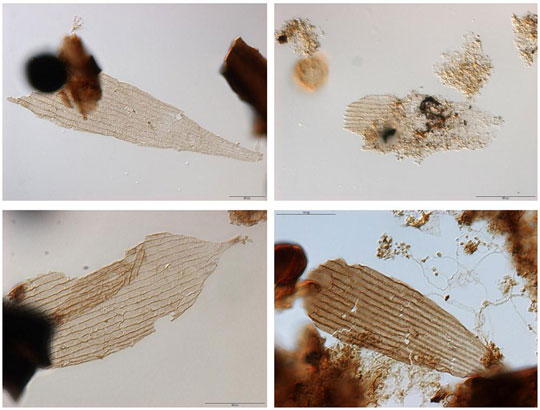
Fossil scales of moths and butterflies.
Fossil scales of moths and butterflies as found in the drill cores from Schandelah, Lower Saxony (Germany).

Picture credit: University of Utrecht

A core drilled into sediments in Schandelah, Lower Saxony (northern Germany), revealed microscopic wing scales some 70 million years older than the oldest, confirmed fossils of flowering plants.  The team’s findings suggest that wing and body scales found in rocks some 201 million years old, provide evidence that the Lepidoptera survived the end-Triassic mass extinction event.  Indeed, like the Dinosauria, moths and butterflies may have benefited from the extinction event, being able to exploit environmental niches vacated by extinct species.

Drilling into Ancient Rocks Triassic/Jurassic Strata
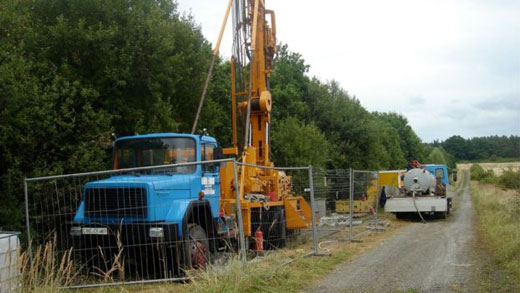
Drill cores reveal evidence of prehistoric moths and butterflies.
Drilling to produce the cores (northern Germany).

Picture credit: University of Utrecht/Dr Bas van de Schootbrugge

Commenting on the significance of the core drill study, Utrecht University student Timo van Eldijk explained:

“The mass extinction event occurred at the end of the Triassic and was associated with massive volcanism as the super continent Pangaea started to break apart.  As a result, biodiversity on land and in the oceans suffered a setback with many key Triassic species going extinct, including many primitive reptiles.  However, one major group of insects, the Lepidoptera, moths and butterflies, appeared unaffected.  Instead, this group diversified during a period of ecological turnover.”

The Moth and Butterfly “Tongue”

Extant butterflies and moths have a well-known association with flowering plants.  As they feed on the nectar with their long proboscis (an elongated, sucking mouthpart), they pick up pollen and therefore play an important role in angiosperm reproduction.

Dr Bas van de Schootbrugge (Department of Earth Sciences, Utrecht University) stated:

“The fossil remains contain distinctive hollow scales and provide clear evidence for a group of moths with sucking mouthparts, which is related to the vast majority of living moths and butterflies.”

A Scanning Electron Microscope Image of the Wing Scales on an Extant Moth Species
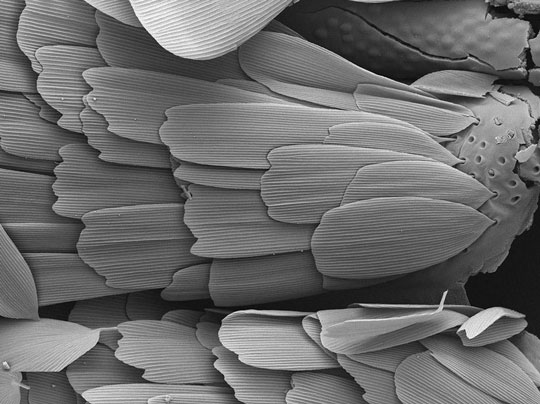
A scanning electron microscope image of Glossata wing scales.
A scanning electron microscope image showing the wing scales on a modern-day Glossata moth.

Picture credit: University of Utrecht

What Did the Triassic Lepidoptera Feed On?

If there were moths and butterflies about some 201 million years ago, some 70 million years before the first flowering plants, then what were the adult animal’s feeding on?  The researchers conclude that the first lepidopterans were feeding on non-flowering seed plants (gymnosperms), one of the most successful plant groups of the early Mesozoic.  The earliest proboscid moths (Glossata), likely used their long, sucking mouthparts to feast on the sugary pollination beads secreted by several groups of gymnosperms.

There is another tantalising and very controversial aspect that is worth considering.  What if the flowering plants evolved much earlier than previously thought?

In 2013, Everything Dinosaur published an article providing information on some intriguing research that suggested flowering plants originated more than 240 million years ago, in the Early Triassic.  If flowering plants were around over 100 million years earlier than previously thought than a symbiotic relationship between early Lepidoptera and early angiosperms could have already been in place.

To read the article about evidence for Lower Triassic flowering plant fossils: Saying it with Flowers 100 Million Years Before Anyone Expected.

On the basis of the fossilised wing and body scales recovered from Upper Triassic and Lower Jurassic sediments, the scientists have provided the earliest evidence to date for moths and butterflies.  The diversity of the scales found confirm a Late Triassic radiation of lepidopteran forms, including the divergence of the Glossata, a clade that consists of the living butterflies and moths with a sucking proboscis.   The team conclude that the early evolution of the Lepidoptera was probably not severely interrupted by the end-Triassic mass extinction event.

Providing an Insight into Today’s Climate Change

MSc student Timo Van Eldijk stated:

“This evidence has transformed our understanding of the evolutionary history of moths and butterflies as well as their resilience to extinction.  By studying how insects and their evolution was affected by dramatic greenhouse warming at the start of the Jurassic, we hope to provide insight into how insects might respond to the human-induced climate change challenges we face today.”

An Example of an Extant Member of the Glossata Clade
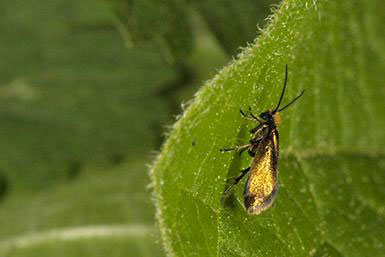
A living member of the Glossata clade.
An extant Glossata moth with similar wing scales to those found in the Upper Triassic/Lower Jurassic drill cores.

Picture credit: Hossein Rajaei/Staatliches Museum für Naturkunde Stuttgart (Stuttgart, Germany)

The scientific paper: “A Triassic-Jurassic Window into the Evolution of Lepidoptera” by Timo van Eldijk, Torsten Wappler, Paul Strother, Carolien van der Weijst, Hossein Rajaei, Henk Visscher and Bas van de Schootbrugge, published in the journal “Science Advances”.

Everything Dinosaur acknowledges the assistance of a press release from the University of Utrecht in the compilation of this article.

Visit the Everything Dinosaur website: Everything Dinosaur.
9 01, 2018

On the Trail of Megalodon Ancestors

By |2023-08-28T08:37:18+01:00January 9th, 2018|Categories: Dinosaur and Prehistoric Animal News Stories, Main Page, Photos/Pictures of Fossils|0 Comments

Scientists in Alabama Solve Forty-Year Shark Puzzle

A team of scientists from the University of Alabama and the McWane Science Centre (Birmingham, Alabama), have solved a four-decade-long prehistoric shark mystery, naming a new species of Late Cretaceous marine predator, one that might possibly have been an ancestor of the mighty Megalodon (Carcharocles megalodon), the largest carnivorous shark known to science.  The new species of shark has been named Cretalamna bryanti, the species name honours the Bryant family, committed supporters of the University of Alabama, the McWane Science Centre and the Alabama Museum of Natural History.

These institutions have all been directly involved in the study and subsequent paper publication in the academic journal PeerJ.

Cretalamna bryanti – Solving a Prehistoric Shark Puzzle

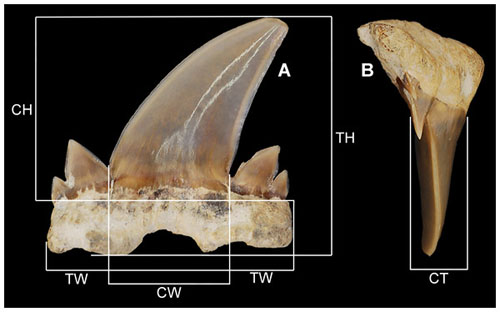
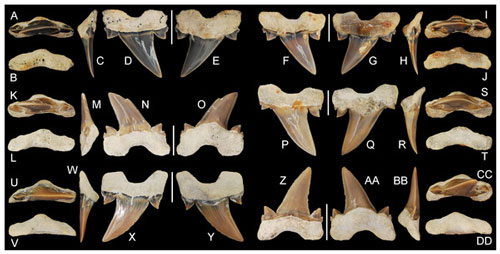
Views of the Holotype Tooth Helping to Define a New Species

Cretalamna fossil tooth.
Views of one of the fossil shark teeth helping to define a new Cretaceous shark species.

Picture credit: PeerJ

The picture shows the holotype fossil tooth (MSC 2984.1) in two views (A) labial view – a view of the tooth showing the side which would have faced the lips (if the fish had them), the side of the tooth facing the outside of the mouth and (B), mesial view, (directed to the middle of the body).  The scientists were able to establish a new species of a Cretalamna shark based on precise measurements of the features of the teeth within the study.

Key

(CH) = crown height.

(CT) = crown thickness.

(CW) = main cusp width.

(TH) = total height.

(TW) = total width

Thirty-Three Prehistoric Shark Teeth Collected

The shark has been described based on thirty-three teeth collected from four locations within Alabama over the best part of forty years.  The teeth all between two and two and three-quarters centimetres high, represent a shark known as an otodontid or “mega-tooth” shark.  As the skeletons of sharks are made from cartilage, they rarely fossilise but their teeth do survive the fossilisation process and as an individual shark may have hundreds or even thousands of teeth in its life, shark tooth fossils are relatively common.

Previously, the teeth had been assigned to the Cretalamna species C. appendiculatai, but these teeth are mostly associated with much older Cretaceous deposits found in Europe.  The Alabama shark teeth were collected from rocks representing two geological formations, the Tombigbee Sand Member and the slightly younger Lower Mooreville Chalk.  The fossils have been dated to 84 million to 82 million years ago, a time when this part of south-eastern America was covered by a shallow sea known as the Late Cretaceous Mississippi Embayment (part of the Western Interior Seaway).

Some of the Individual Teeth Examined in the Study

Cretalamna bryanti shark fossil teeth.
Cretalamna bryanti fossil teeth.

Picture credit: PeerJ

Explaining the postulated ancestry of the Megalodon sharks, lead author of the research Jun Ebersole (McWane Science Centre), stated:

“Over time, the sharks in the Megalodon line acquire [tooth] serrations, lose their cusplets (the little “fangs” on the sides of the main cusp) and grow to enormous sizes.   The newly described shark is an early member of this family, so its teeth are small and unserrated, with up to two pairs of cusplets.”

“Hell’s Aquarium”

The establishment of this new species adds to the database regarding megafauna and hypercarnivores within the Western Interior Seaway.   This new otodontid would have co-existed with other large predatory sharks, along with elasmosaurids, huge meat-eating fish and members of the Mosasauridae.  Such was the number of large carnivores, that the Western Interior Seaway has been nicknamed “Hell’s Aquarium”!

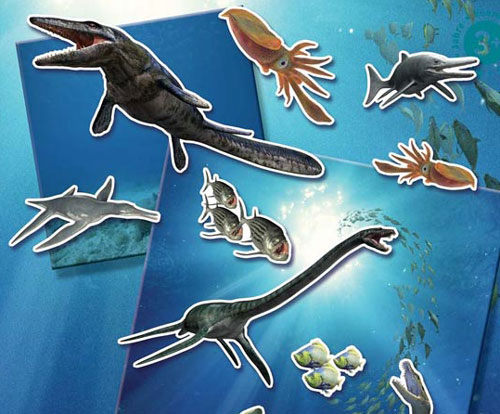
Marine Life in the Western Interior Seaway (Late Cretaceous North America)

Western Interior Seaway.
Typical Western Interior Seaway marine life.

Picture credit: Everything Dinosaur

Note

The prehistoric shark referred to as “Megalodon” has recently been reclassified and named Otodus megalodon.

Visit the Everything Dinosaur website: Everything Dinosaur.
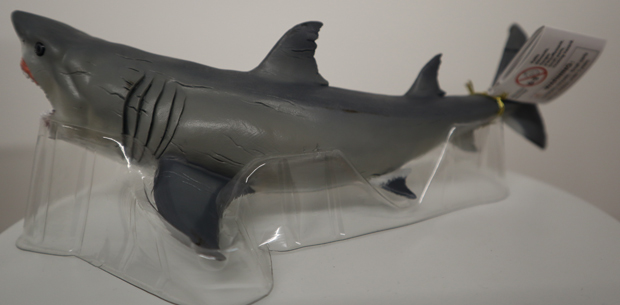
Papo Otodus megalodon model
The Papo Otodus megalodon model (lateral view). Picture credit: Everything Dinosaur.

Picture credit: Everything Dinosaur

To view the Papo model range: Papo Prehistoric Animal Models.

2 01, 2018

Palaeontology Predictions for 2017 – How did we do?

By |2023-07-01T22:05:06+01:00January 2nd, 2018|Categories: Dinosaur and Prehistoric Animal News Stories, Dinosaur Fans, Everything Dinosaur News and Updates, Main Page|0 Comments

Palaeontology Predictions for 2017 – How did we do?

Back in early January 2017, Everything Dinosaur team members had a go at predicting the news stories that our blog site would cover in the next twelve months or so.  After our crystal ball gazing we made a total of seven predictions:

1).  A New Epoch – Arise the Anthropocene!

2).  More Mini Dinos – The “Microsaurs” are Coming!

3).  “Enormosaurus” to Get a Formal Scientific Name.

4).  The Impact of the Dinosaurs of China Exhibition in the UK.

5).  Everything Dinosaur’s New Website.

6).  Fossil Sites and Vandalism.

7).  Dinosaur Fossilised Eggs Discovery.

Our Palaeontology Predictions – How Did We Do?

Arise the Anthropocene!

The impact of our own species on the planet was never far from the news channels last year, a trend that will be continued long into the future.  In the early 2017 blog article, we specifically highlighted the problem of non-biodegradable plastics and their impact on the ecology of the ocean.  This huge problem was brought into sharp focus with the excellent “Blue Planet II” television series broadcast by the BBC.

As yet, the Anthropocene has not been formally adopted as a distinct unit of geological time.  The body tasked with defining the start of this new Epoch and also defining the end of the current Epoch (the Holocene), the Anthropocene Working Group, has not reported back to the International Commission on Stratigraphy.  The idea to mark the impact on the environment by our own species, with the establishment of a new unit of geological time has been accepted, it is now a case of agreeing when in history our influence started to become profound.

Mini Dinosaur Discoveries

With the Dinosauria, it is often the big fossil specimens that grab the headlines. Everything Dinosaur predicted that a number of new species of small Theropod dinosaur would be named and described.  Sure enough, a number of “little critters” had scientific papers written about them, for example, in March, scientists from the Chinese Academy of Sciences announced the discovery of a new species of Early Cretaceous dromaeosaurid.  Zhongjianosaurus yangi was about eighty centimetres long (most of that was tail), it has been described as “Microraptor on stilts”.

Newly Described Chinese Dinosaur Z. yangi

The holotype fossil material of Zhongjianosaurus yangi.

The holotype of Zhongjianosaurus yangi.   A new “Microsaur” described in 2017.

Picture credit: Chinese Academy of Sciences

Patagotitan mayorum

“Enormosaurus” Gets Formal Scientific Name

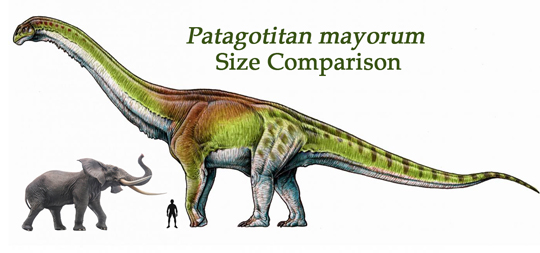
The huge Titanosaur dubbed “Enormosaurus”, which had been featured in the television documentary “Attenborough and the Giant Dinosaur” was finally named and described, just as we predicted.  A scientific paper published in the “Proceedings of the Royal Society B (Biology)” in August announced Patagotitan mayorum to the world.  Attenborough’s giant, sixty-nine tonne dinosaur finally had a scientific name.

An Illustration Showing the Size of Patagotitan mayorum

Patagotitan size comparison.

Patagotitan mayorum size comparison with an adult African elephant and a human for scale.

Picture credit: G. Lio/Everything Dinosaur

To read the article about the naming of P. mayorumGiant Dinosaur Gets a Name.

The Dinosaurs of China Exhibition Proves to be a Big Hit

In the summer and autumn of 2017, visitors to Nottingham were given the opportunity to view some amazing Chinese dinosaur fossils close up.  The “Ground Shakers to Feathered Flyers” exhibition show-cased some of the astonishing dinosaurs from north-eastern China that demonstrate the evolutionary link between Theropod dinosaurs and birds.  As we predicted, the exhibition proved to be a big commercial success with hundreds of thousands of visitors “flocking” to the East Midlands.

A Huge Gigantoraptor Towers Over the Exhibition

Dinosaurs of China 2017.

Giant dinosaurs featured in the exhibition. Picture credit: Everything Dinosaur.

Picture credit: Everything Dinosaur

A New Website for Everything Dinosaur

Everything Dinosaur is already working on a number of dinosaur, monster and prehistoric animal themed events for 2018…

The New Everything Dinosaur Website

Just as we said, our new website went live in the early Spring of 2018.  It is mobile device friendly, has lots more interactivity and permits us to make purchasing dinosaur toys and models so much easier than ever before.  Tens of thousands of orders processed and FEEFO 5-star ratings across the board provide testimony with regards to the site’s success.

Visit Everything Dinosaur: Everything Dinosaur,

Fossil Sites and Vandalism

Sadly, our prediction about more deliberate damage to fossil sites came true, all too frequently.  Over the course of the last twelve months we have reported upon the apprehension of a Chinese dinosaur egg fossil thief (March 2017) and last month, we reported the sad news that a three-toed dinosaur foot print fossil in Australia had been deliberately vandalised.

To read the story: Dinosaur Footprint Vandalised.

Dinosaur Fossil Eggs

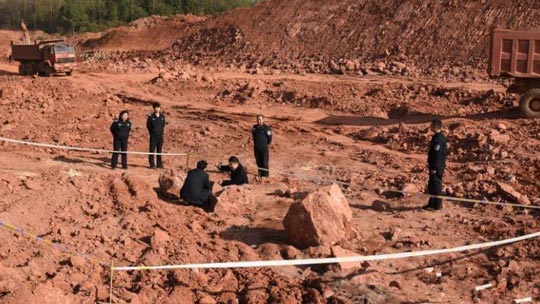
For such a geographically widespread group, with a huge temporal range, dinosaur eggs are relatively rare.  However, our last prediction concerned the discovery of dinosaur fossil eggs and sure enough, on December 25th (blogged about on December 27th), we picked up reports that Chinese construction workers had discovered more than twenty dinosaur egg fossils during the construction of a school in Jiangxi Province (south-eastern China).

Dinosaur Egg Fossil Discovery

Chinese dinosaur egg fossils.

Local scientists examine the dinosaur egg fossils.

Picture credit: Ming Kangping/China News Service

We wonder what amazing dinosaur news stories and fossil discoveries we will cover in this blog over the next twelve months or so…

31 12, 2017

Gigantism in Penguins Identified by New Study

By |2024-05-10T18:13:16+01:00December 31st, 2017|Categories: Dinosaur and Prehistoric Animal News Stories, Dinosaur Fans, Main Page, Photos/Pictures of Fossils|0 Comments

Giant Prehistoric Penguins Not Just Once But Several Times

A team of scientists writing in the academic journal “Nature Communications” have identified a new species of giant, prehistoric penguin.  This new species, named Kumimanu biceae is not closely related to previously described giant penguins and this suggests that gigantism in penguins evolved several times in the evolution of these birds.

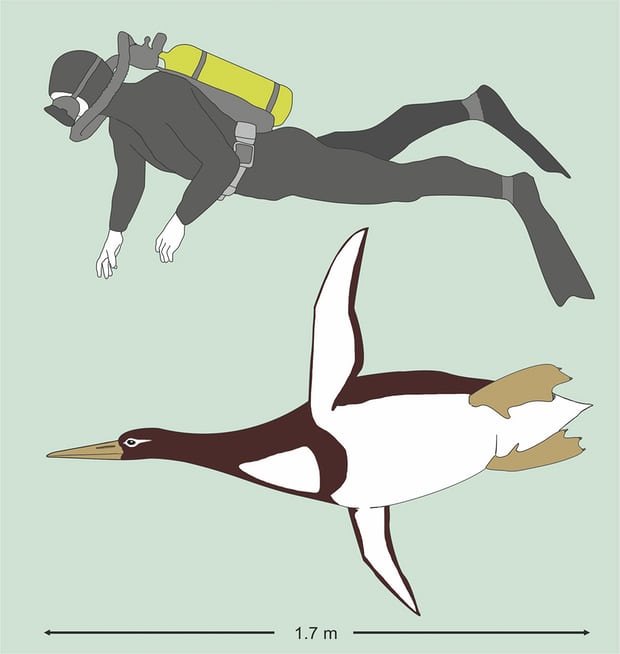
K. biceae was described based on a partial skeleton excavated from the Palaeocene Moeraki Formation at Hampden Beach in the Otago region in New Zealand’s South Island.  An accurate size is difficult to establish based on the fragmentary fossil remains, but when swimming with its long beak and flippers extended, this bird could have measured more than two metres in length.

When on the shore, it would have stood around 1.7 metres tall.   The new fossil is one of the oldest giant penguins found so far and is clearly outside a clade including the giant Eocene and Oligocene Sphenisciformes, substantiating multiple origins of gigantism in fossil penguins.

Kumimanu biceae Size Comparison

Kumimanu biceae size comparison.
Kumimanu biceae stood around 1.7 metres tall and weighed over 100 kilos.

Fragmentary Fossil Material

The partial skeleton represents a single individual and the fossil material consists of a fragment of a left scapula, an incomplete right coracoid, a portion of the sternum, a partial left humerus, incomplete proximal end of left ulna, a right femur, a right tibiotarsus lacking proximal end, a partial synsacrum, three vertebrae and various bone fragments.

The giant penguin’s name comes from Maori myth, kumi was a large, mythical monster and manu means bird.  The species or trivial epithet honours Beatrice (Bice) A. Tennyson, the mother of one of the paper’s authors, Alan Tennyson of the Museum of New Zealand Te Papa Tongarewa.  It was Alan’s mother who first inspired  him to take an interest in natural history.  The fossil material is believed to be somewhere between 59.5 and 55.5 million years old.

Comparing Kumimanu biceae with other penguins.
Kumimanu biceae fossils compared to other penguins.

Picture credit: Nature Communications

Giant Penguin Fossils

The picture above shows the wing and pectoral girdle bones of the new giant penguin.  (a) shows the partially prepared concretion with bones in situ, whilst (b) shows the partial right coracoid, the dotted lines indicate the reconstructed outline of the bone.  The left coracoid of the prehistoric penguin species Waimanu tuatahi (c) is shown for a size comparison.  Pictures (d-f) show the fragmentary end of the left ulna of K. biceae in various views, whilst pictures (g-h) depict a left ulna of an as yet, undescribed new species of penguin from the Waipara Greensand.

A CT image of the surface of the partial left humerus of K. biceae is shown in (i) whilst (j) shows the exposed surface of the bone.  Pictures (k-l) show the humerus with minimum (k) and maximum (l) size estimates for the bone based on the partial fossil material.  The left humerus of the Palaeocene penguin Crossvallia unienwillia is shown (m).  C. unienwillia was one of the largest known prehistoric penguins.  The left humerus of another giant penguin, Pachydyptes ponderous from the late Eocene of New Zealand (n) is provided for further comparison.  The scale bars in the picture above equate to 5 cm.

The research team conclude that based on the fragmentary fossils, Kumimanu biceae is amongst the largest of the fossil penguins reported so far and since it seems more basal to the family than other giant forms, this suggests that gigantism evolved several times over the long history of penguin evolution.

Visit the Everything Dinosaur website: Everything Dinosaur.
29 12, 2017

New Television Documentary Gives T. rex a Makeover

By |2024-05-10T18:14:14+01:00December 29th, 2017|Categories: Dinosaur and Prehistoric Animal News Stories, Dinosaur Fans, Main Page, TV Reviews|0 Comments

T. rex Gets a New Look for a Television Documentary

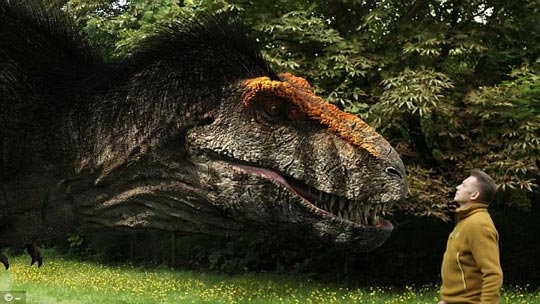
The most iconic vertebrate in the fossil record, Tyrannosaurus rex has been given a makeover as part of a new television documentary programme due to be shown on the BBC.  The hour-long documentary entitled “The Real T. rex with Chris Packham” is due to be shown on BBC Two on Tuesday, 2nd of January.  According to the latest scientific research, this formidable Late Cretaceous predator may have looked very different from the way it is usually depicted in books, television programmes and on the big screen.

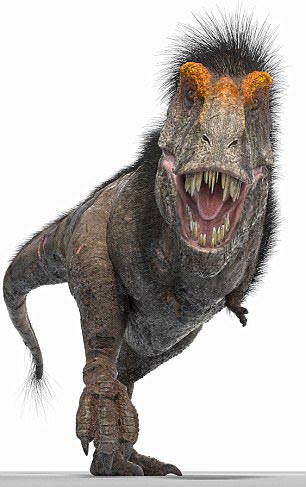
An Illustration of Tyrannosaurus rex (2018)

A fuzzy T. rex with orange eye-markings and bristles.
A new illustration of T. rex (2018).

Everything Dinosaur team members have known about the television documentary for several months, the aim of this programme is to update what T. rex might have looked like based on the very latest palaeontology, including studies of other feathered theropods and the publishing of a scientific paper on the skin of Tyrannosaurus rex.

To read about the forthcoming documentary: Rediscovering T. rex Television Documentary.

Confirmation of broadcast timings in the UK: New Time for Tyrannosaurus rex Documentary.

Covered in Bristles with a Markings Around the Eyes

The Tyrannosaurus rex makeover will not hold many surprises for dinosaur fans.  Most of the information the programme divulges is not new, but for those viewers who think that the solitary, scaly hunter with a huge roar as in “Jurassic World”, is an accurate depiction, they are in for quite a shock.

A New Look for T. rex

T. rex makeover (2018).
A new look for Tyrannosaurus rex (2018).

This iconic dinosaur from the Hell Creek Formation of North America is depicted as having a sparse covering of bristle-like feathers, a scaly skin covered in dark blotches and brightly coloured, orange flashes directly above the eyes.  Instead of a terrifying roar, this dinosaur was capable of producing a limited range of vocalisations, roaring is out, replaced by a virtually, inaudible low-frequency rumble, reminiscent of an elephant.

Over the course of the programme, presenter Chris Packham discusses with various experts what T. rex probably looked like and how it might have behaved based on the latest fossil evidence.  It is not that surprising, but the consensus of opinion is that Tyrannosaurus rex had more in common with birds than it does with today’s crocodiles.  Not an astounding revelation given that T. rex was a lot more closely related to birds than to crocodilians.

Covered in Dark Blotches

In the segment featuring Professor Julia Clarke (University of Texas), the skin colouration of this seven-tonne giant is discussed.  Professor Clarke postulates that this animal was covered in dark patches.  An analysis of fossilised dinosaur skin has identified structures similar to those that produce the natural pigment melanin.  This suggests that T. rex could have been dark coloured and blotchy, perhaps to help break up its outline in dappled light, in a similar vein to the markings on some World War II battleships.  The colouration of this dinosaur remains controversial, as the tendency to find structures that resemble melanin might reflect a bias in the fossilisation process.

The absence of a total body covering of feathers in an adult animal is explained by the concept of the rate of heat loss based on the ratio between surface area and volume.  A large animal in excess of thirteen metres long, such as Tyrannosaurus rex would have had a large volume compared to its surface area.  It would have lost heat to its surroundings more slowly than smaller animals.

Endothermic T. rex

Over-heating for an active predator could have been more of a problem rather than trying to keep warm, especially if T. rex was endothermic (warm-blooded).  Hence, the lack of feathers on the body, a few stiff bristles and some tufts rather than a thick, shaggy coat.  Younger animals with a larger surface areas compared to their volume, such as the sub-adult “Tristan” tyrannosaur that features in the programme, may have had a more substantial coat helping to insulate the animal.

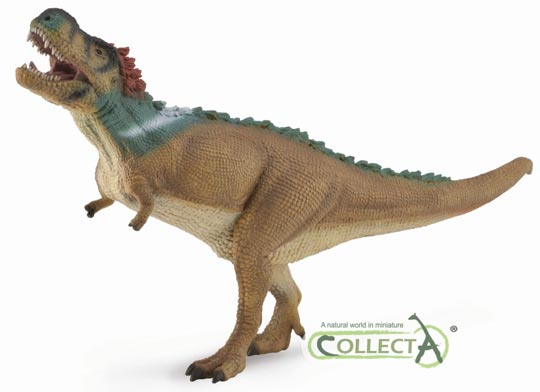
The idea of a sparsely feathered T. rex has already been explored by model manufacturer CollectA.  In 2018, they will be introducing a 1:40 scale replica of a Tyrannosaurus rex with fewer feathers than their current feathered T. rex model.  In a direct comparison with modern flightless birds such as the Cassowary, the television documentary suggests that this dinosaur may have retained “a light patching of feathery bristles strategically placed for social display”.

Less Feathers on the New for 2018 CollectA T. rex Replica

CollectA Deluxe 1:40 scale roaring T. rex.
CollectA roaring feathered T. rex dinosaur model.

The model (above) comes from the CollectA Deluxe model range.

To view this range of prehistoric animal models: CollectA Deluxe Prehistoric Life Figures.

Distinctive Markings Like a Bird of Prey

Detailed scans of the fossil bones suggest that these dinosaurs might have fought with each other, perhaps over food, mates or even to decide hierarchies within packs or family groups.  The bright orange crests over the eyes also portray T. rex with more affinities to the Aves.  Birds have colour vision and rely on colour for visual displays.  The scientists argue that the thickened ridges found on the skulls of adult animals may represent the remains of crests or prominent lumps that were very colourful and used to show maturity, dominance and perhaps played a role in ritual displays.

Chris Packham Comes Face to Face with the New T. rex

Chris Packham and the new T. rex.
Presenter Chris Packham comes face to face with T. rex.

Picture credit: BBC Media

To read an article on the study of the skin of T. rexT. rex Sheds Its Feathers.

The Everything Dinosaur website: Everything Dinosaur.
28 12, 2017

Attenborough and the Sea Dragon

By |2023-08-27T10:38:27+01:00December 28th, 2017|Categories: Dinosaur and Prehistoric Animal News Stories, Dinosaur Fans, Main Page, TV Reviews|0 Comments

Television Documentary on Ichthyosaurs Scheduled for BBC One

A television documentary exploring the life of a remarkable ichthyosaur is due to be shown on BBC 1 on the evening of Sunday 7th January.  Entitled “Attenborough and the Sea Dragon”, this hour-long programme follows the excavation of an Early Jurassic ichthyosaur fossil on the Jurassic Coast of Dorset.  Sir David Attenborough, a keen fossil hunter himself, joins a team of experts as they attempt to excavate the fossilised remains and piece together the life story of an ancient sea monster.

A Computer-Generated Image of an Ichthyosaur

A monster of the deep - Ichthyosaurus.
A computer generated image of an ichthyosaur.

Picture credit: BBC Media

Everything Dinosaur stocks a range of ichthyosaur figures.

To view ichthyosaurs and other marine reptile models: CollectA Prehistoric Life Models and Figures.

A Giant Sea Dragon

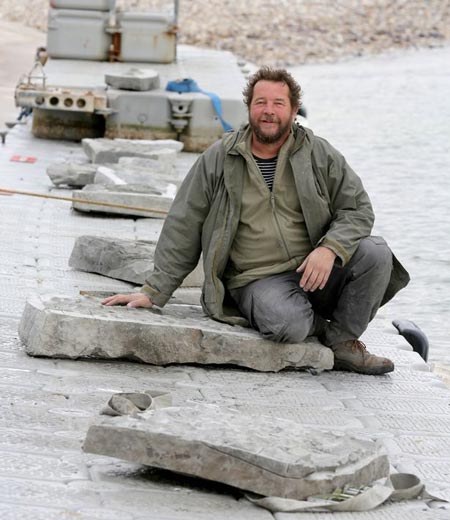
The fossilised remains, believed to represent the largest ichthyosaur known from the British Isles, were discovered by Dorset fossil hunter Chris Moore in 2016.  The documentary programme will include a segment in which the fossil bones are scanned and a replica skeleton of the 200-million-year-old “fish lizard” is created.  By examining the bones, the team hope to bring this prehistoric sea creature’s story to life.

Fossil Hunter Chris Moore with Some Blocks of the Ichthyosaur Material

Dorset Fossil Hunter Chris Moore.
Chris Moore with some of the blocks containing the ichthyosaur fossils.

Picture credit: Richard Austin

Chris spotted the fossil material eroding out of a high cliff and the material had to be removed before the winter storms hit, otherwise the rare fossils would have been lost forever.

The extraordinary fossil includes skin impressions, this leads to new revelations about how these predators might have looked.   As the story unfolds, Sir David compares the sea dragon to animals alive today, including dolphins, sharks, crocodiles and turtles.

A 200-million-year-old Murder Mystery

As more of the fossil bones are revealed the scientists make a startling discovery.  This ichthyosaur did not die of natural causes, it was attacked, but what fearsome beast could have killed this giant?  Using techniques more at home in a police forensics laboratory than a paleo-preparation lab, the team piece together evidence that points the figure of suspicion at another huge Ichthyosaur – a seven-metre-long monster called Temnodontosaurus.

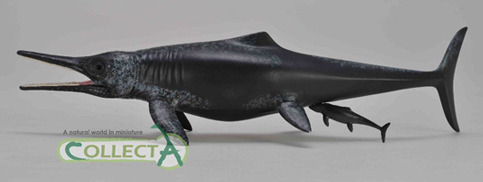
A Replica of a Temnodontosaurus (T. platydon) A Giant, Viviparous Ichthyosaur

CollectA Temnodontosaurus platyodon model.
Detailed ichthyosaur figure. Temnodontosaurus platyodon.

Picture credit: Everything Dinosaur

Using state of the art imaging technology and cutting-edge CGI the team build the skeleton and create the most detailed animation of an ichthyosaur ever made, bringing this Lyme Regis discovery to life as well as reconstructing its fate.

Programme Details

The one-hour television documentary is confirmed for BBC One on Sunday 7th January 8pm to 9pm.

It’s going to be well-worth watching.

Visit the award-winning Everything Dinosaur website: Everything Dinosaur.
27 12, 2017

Christmas Present for Chinese Palaeontologists

By |2023-08-27T10:31:09+01:00December 27th, 2017|Categories: Dinosaur and Prehistoric Animal News Stories, Dinosaur Fans, Main Page, Photos/Pictures of Fossils|0 Comments

Clutch of Chinese Dinosaur Eggs for Christmas

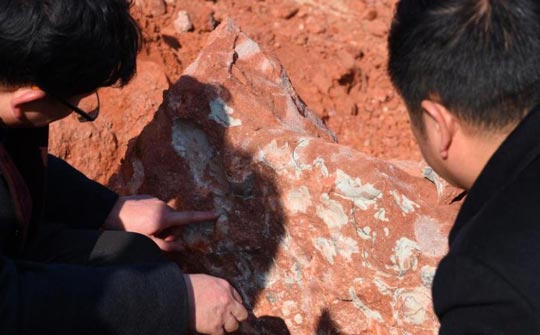
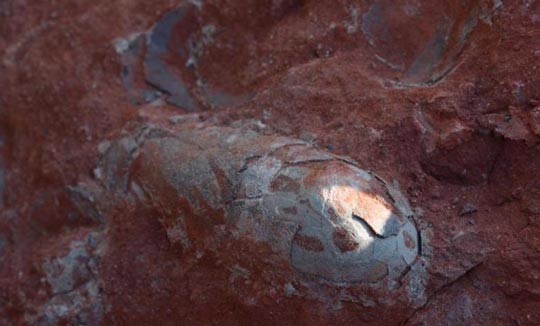
News agencies from China are reporting that Chinese palaeontologists have been given a special Christmas present with the discovery of the fossilised remains of a clutch of dinosaur eggs that date from the Early Cretaceous.  Construction workers were examining large boulders that had been blasted away as part of the preparations for a building project in Dayu County (Jiangxi Province, south-eastern China), when they noticed the series of white, semi-circular marks in the sandstone rocks, along with a number of almost complete oval-shaped eggs.

A Close View of One of the Better Preserved Chinese Dinosaur Egg Fossils

A fossilised dinosaur egg.
A close view of one of the fossilised dinosaur eggs from the Dayu County construction site (Jiangxi Province).

Picture credit: Ming Kangping/China News Service

December 25th Discovery

The clutch of eggs was found on December 25th.  Excavation work in the immediate vicinity was suspended and the area cordoned off to prevent any further damage to the fossil find.  The fossils were inspected by local scientists under the supervision of the authorities with strict security in order to deter any would-be egg fossil thieves.

Scientists Examine the Fossil Finds in the Company of Officials

The site of the dinosaur egg discovery (Dayu County).
Officials look on whilst local scientists examine the dinosaur eggs.

Picture credit: Ming Kangping/China News Service

Despite the removal and sale of such ancient artefacts having been made illegal in China, unfortunately, there is still a thriving black market in fossils, especially fossils of dinosaurs.  Everything Dinosaur has reported on several fossil theft cases from China.  For example, earlier this year, Everything Dinosaur reported on the arrest of a Chinese man from Zhejiang Province over the alleged theft of more than eighty dinosaur egg fossils.

To read the story: Dinosaur Egg Thief Suspect Arrested in China.

Examining the Fossil Material

Chinese dinosaur egg fossils.
Local scientists examine the dinosaur egg fossils.

Picture credit: Ming Kangping/China News Service

The Remains of at Least Twenty Dinosaur Eggs

The fossils of more than twenty dinosaur eggs have been taken away to a local museum for further study and preparation.  The site, which is a construction project for a new school, will be inspected closely before further building work takes place in case more fossils are at this location.  A spokesperson for the local museum stated that the fossils are around 130 million years old (Early Cretaceous).

26 12, 2017

Water Bird from the Late Cretaceous Identified in New Research

By |2024-05-10T18:14:50+01:00December 26th, 2017|Categories: Dinosaur and Prehistoric Animal News Stories, Dinosaur Fans, Main Page|0 Comments

Maaqwi cascadensis – Diving Bird from the Late Cretaceous

A team of scientists writing in the on-line academic journal PLOS One have named a new species of Late Cretaceous marine bird, based on a single coracoid bone and some fragments representing bones from the wing.  The animal has been named Maaqwi cascadensis and at an estimated 1.5 kilos in weight it was about the same size as your average domestic chicken.  However, this bird is believed to have been adapted to a marine environment, using its legs to paddle around under water in pursuit of fish.

Maaqwi cascadensis

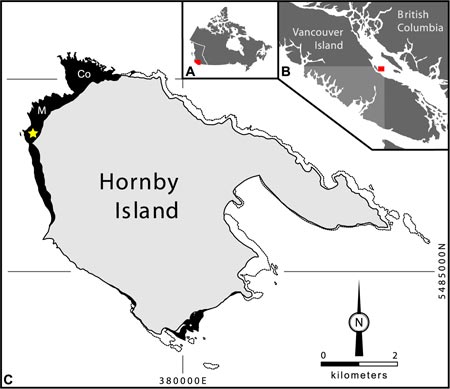
Fossils of birds from the Pacific Coast of North America are exceptionally rare, these marine deposits that form part of the Northumberland Formation have yielded fossil fish, marine reptile remains plus fragmentary elements of terrestrial animals including dinosaur bones, but very few avian fossils.  M. cascadensis was discovered on Hornby Island.  The strata are estimated to represent Late Campanian to Early Maastrichtian deposits (around 73 to 71 million years old).  The fossil specimen consists of a mudstone concretion which contains a right coracoid bone plus fragmentary wing bones (humerus, ulna and radius).

A Map Showing the Location of Hornby Island in British Columbia and the Fossil Site

The location of Hornby Island and the fossil site.
The location of the Late Cretaceous fossil bird find.

Picture credit: PLOS One

In the picture above (A) provides the geographical setting of British Columbia in Canada, whilst (B) shows the location of Hornby Island in the context of Vancouver Island.  The larger map (C) shows Hornby Island with the Northumberland Formation exposures highlighted in black.  The yellow star in (C) shows the location of the fossil discovery.

An initial description of the fossil material had been published previously (2011), but it was only with further cleaning and preparation that the full extent of the fossil material became known.

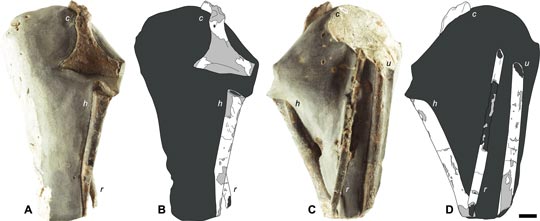
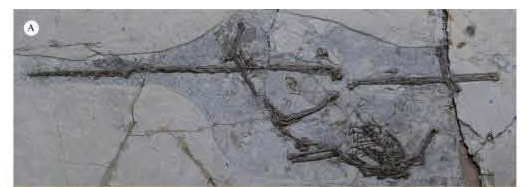
Photographs and Accompanying Line Drawings of the Fossil Material

Views and line drawings of the Maaqwi cascadensis fossil material.
Photographs and accompanying line drawings of the fossil material.

Picture credit: PLOS One

In the picture (above) photograph (A) shows the dorsal face of the right coracoid and the partial humerus (c and h) with an accompanying line drawing (B).  Photograph (C) shows the reverse side of the fossil (ventral) revealing more of the wing bones (u = ulna and r = radius).  A line drawing of the reverse side of the fossil is provided (D).  Note the scale bar (1 cm).  In the line drawings white shading denotes preserved cortical bone (dense bone found towards the outside of bones), whilst the light grey shading shows exposed trabecular bone (spongy internal bone).  The dark grey/black represents the mudstone matrix.

Robust Bones and Short Wings

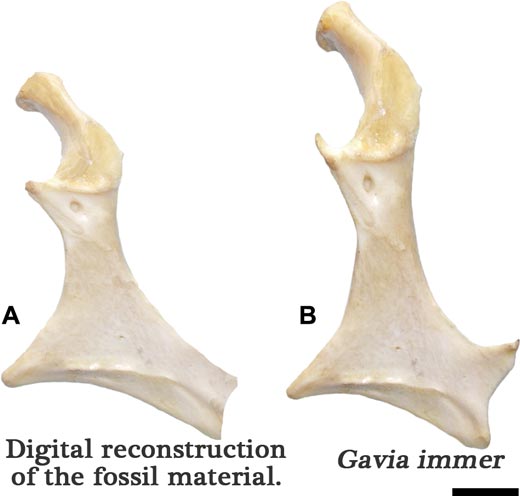
The size of the coracoid bone suggests a large bird, one weighing around 1.5 kilos.  The bones are robust with thickened walls, suggesting that this prehistoric bird was adapted for diving, such as modern grebes and loons.  The coracoid (part of the shoulder bones), is very reminiscent of the coracoid of extant diving birds (Gavia immer – the Common Loon).

A Comparison of Coracoid Bones Mcascadensis Compared to Gavia immer

Comparing coracoids - Maaqwi cascadensis compared to the coracoid of an extant bird (Common Loon - Gavia immer).
The digital reconstruction of the coracoid of Maaqwi cascadensis compared to the coracoid of an extant bird (Common Loon – Gavia immer).  Scale bar = 1 cm.

Picture credit: PLOS One with additional notation by Everything Dinosaur

An assessment of the arm bones (ulna, radius and humerus) suggests that M. cascadensis had short wings.  It is not known whether this bird was flightless, the wings were probably not the main means of propulsion through water.  It has been speculated that the feet were used to propel the bird underwater, in a similar way to the swimming action of cormorants, if this is the case, then Maaqwi probably had webbed feet.

The research team propose that this bird was a member of the Ornithurae, a natural group which includes the common ancestor of Ichthyornis, Hesperornis and all modern birds.  The generic name, Maaqwi, is derived from “ma’aqwi”, from the language of the indigenous Coast Salish people of the North-west Pacific.  The word means “water bird”.   The specific name or trivial name, cascadensis, reflects provenance in the Cascadia region of western North America.

A Sister Taxon to Vegavis iaai?

The scientists including Nicholas Longrich (University of Bath), propose that Maaqwi cascadensis might have been a sister taxon to Vegavis iaai of the Antarctic and along with the Ichthyornithes and Hesperornithes, Mcascadensis and Vegaviidae appear to represent a third clade of bird that evolved to exploit marine habitats in the Late Cretaceous.

To read an article about the voice box of Vegavis iaai: Ancient Bird Voice Box Sheds Light on the Voices of Dinosaurs.

A Speculative Illustration of a Diving Maaqwi cascadensis

Maaqwi diving to catch fish.
M. cascadensis diving.  Picture credit: Everything Dinosaur.

Picture credit: Everything Dinosaur

Visit the Everything Dinosaur website: Everything Dinosaur.
19 12, 2017

Rare Dinosaur Footprint Vandalised in Australia

By |2024-05-10T09:51:55+01:00December 19th, 2017|Categories: Dinosaur and Prehistoric Animal News Stories, Dinosaur Fans, Main Page|0 Comments

Australian Dinosaur Footprint Damaged

Vandals have severely damaged a 115-million-year-old dinosaur footprint in an Australian national park.  The park in question is the Bunurong Marine Park in Victoria, the three-toed footprint had been discovered in 2006, but rather than have the rare print removed to a museum, it was decided to leave it in situ allowing all the Park visitors to enjoy it.  Sadly, a person or persons unknown attacked the track with a hammer sometime last week and broke off elements from the toes.

The Dinosaur Footprint that has been Damaged

Vandalised dinosaur footprint.
theropod footprint vandalised in Australia.

Picture credit: Parks Victoria

The picture shows (left) the undamaged footprint and (right) a picture showing that the tips of the toes have been smashed, note the boot for scale.  The Flat Rocks locality near Inverloch (Victoria),  is exceptional in being one of only a handful of polar dinosaur sites in the world, it includes the dinosaur footprint.  Palaeontologists from Museum Victoria and Monash University made a silicon rubber mould of the footprint, when the track was discovered, but they decided it should be left in the rock, so visitors to the site could have the thrill of seeing it in its natural state.

Theropod Dinosaur Footprint

The tridactyl (three-toed print), probably represents a track left by a theropod dinosaur.  Parks Victoria are investigating this incident and have appealed for witnesses.

Parks Victoria Ranger Team Leader Brian Martin stated:

“It is sad to think a person or persons who knew the location of the footprint would deliberately damage an important local icon that is recognised as being off international scientific significance.”

Bunurong Environment Centre Education Officer, Mike Cleeland added:

“The thrill of seeing a real dinosaur footprint has been diminished with the callous act of vandalism.  Fortunately, I was able to retrieve some of the broken pieces of the footprint and hopefully the technicians at Museum Victoria may be able to restore the footprint to some degree.”

The location, known as Dinosaur Dreaming is popular with tourists, the Park officials are hopeful that witnesses to the incident will come forward.  Although repairs to the track can be made, the print will never be the same again.

A spokesperson from Everything Dinosaur commented:

“Sadly, such incidents are all too common.  At this stage it is unclear whether this was a clumsy attempt to remove the print or just simply a case of a deliberate act of vandalism on something that was formed in the Lower Cretaceous, a fossil that has survived for 115 million years only to be smashed in seconds.”

To read an article about an alleged attempt to illegally cast a fossil footprint on the Isle of Skye: Dinosaur Footprints Damaged.

For a story about the stealing of a dinosaur footprint from Utah: Dinosaur Footprint Stolen.

17 12, 2017

New Troodontid Dinosaur Described

By |2023-08-26T20:33:33+01:00December 17th, 2017|Categories: Dinosaur and Prehistoric Animal News Stories, Dinosaur Fans, Main Page, Photos/Pictures of Fossils|2 Comments

Almas ukhaa – Named after the Legendary Asian Bigfoot

A team of international scientists, including Dr Mark Norell (Curator of Palaeontology at the American Museum of Natural History, New York) and Professor Xing Xu (Chinese Academy of Sciences), have announced the discovery of a new species of Late Cretaceous troodontid dinosaur from Mongolia.  This small, carnivorous dinosaur (it was probably less than a metre long), has been named Almas ukhaa, after the mythical Bigfoot-type ape that, according to some cryptozoologists, is believed to roam the more remote parts of Central Asia.

An Illustration of the New Troodontid Dinosaur A. ukhaa

Almas ukhaa illustrated.
An illustration of the newly described (2017) troodontid Almas ukhaa. Picture credit: Everything Dinosaur.

Picture credit: Everything Dinosaur

From the Famous Djadokhta Formation

The fossil material which consists of an almost complete and articulated skull with an associated lower jaw and a substantial part of the postcranial skeleton, comes from the Ukhaa Tolgod region of the Gobi Desert, an area regarded as one of the richest concentrations of Cretaceous fossil vertebrates known to science.   Since this location was first mapped in 1993, numerous dinosaur skeletons have been found, including a nesting Oviraptor as well as several examples of Late Cretaceous mammals.  The rocks in this area form part of the Djadokhta Formation.

The Skull and Jaws of the Newly Described Late Cretaceous Troodontid Almas ukhaa

Almas ukhaa fossil skull and jaws.
Almas ukhaa cranial material (right lateral view).

Picture credit: The American Museum of Natural History

Compared to other troodontids from Asia and North America, A. ukhaa had a relatively short snout.  The orbit is quite large, and these fossils could represent a juvenile, but if this turns out to be the remains of an adult animal, then this large eye-socket could indicate an adaptation to hunting in low light, perhaps Almas ukhaa was an elusive animal rarely seen in daylight, similar to the legendary Alma after which, this troodontid dinosaur is named.

Ukhaa Tolgod Sandstone Deposits

The sandstone deposits of Ukhaa Tolgod date from approximately 80 million years ago, (Campanian faunal stage of the Late Cretaceous).  The highly fossiliferous site was discovered by a joint American/Mongolian expedition in 1993.  Almas ukhaa (pronounced Al-mass ook-uh) is unlikely to be the last dinosaur found in this area.  The fossils show a number of autapomorphies (unique characteristics), that distinguish this southern Mongolian troodontid from other Asian members of the Troodontidae.  For example, the ischium (part of the hip girdle), has a distinct spike-like process and unlike other troodontids, the front part of the lower jaw lacks a lateral groove.

The scientific paper: “Osteology of a New Late Cretaceous Troodontid Specimen from Ukhaa Tolgod, Ömnögovi Aimag, Mongolia.”

Visit the Everything Dinosaur website: Everything Dinosaur.
Go to Top