All about dinosaurs, fossils and prehistoric animals by Everything Dinosaur team members.

Fossil finds, new dinosaur discoveries, news and views from the world of palaeontology and other Earth sciences.

30 03, 2018

Ceratopsian Species – When and Where they Lived (Part 2)

By |2023-10-05T15:05:15+01:00March 30th, 2018|Categories: Dinosaur and Prehistoric Animal News Stories, Dinosaur Fans, Geology, Main Page, Palaeontological articles|0 Comments

Ceratopsian Species – Where and When did they Live (part 2)

We conclude our look at the remarkable data that was used to compile a statistical analysis of the Ceratopsia.  The research, published recently in the “Proceedings of the Royal Society B (Biology)”, examined the horned dinosaur family tree and set about building a picture of where and when horned dinosaur species lived.  Using this data, which involved more than seventy species, the scientists were able to conclude that horned dinosaur ornamentation probably evolved, not as a method of telling different species apart, but as a way of demonstrating an individual’s fitness for breeding.

Cataloguing Ceratopsian Species

Ostentatious and elaborate crests, horns and frills may have had numerous roles, defence being one, for example, but they would also (most likely), have had a “social-sexual” function.

As a spokesperson from Everything Dinosaur stated:

“All those lumps and bumps, horns and frills were basically signalling to other members of the species – look how big and strong I am, I can carry around all this extra weight, so I must be a healthy horned dinosaur and therefore an ideal mate!”

To read our original article on the ceratopsian research: Why Did Horned Dinosaurs Have Fancy Frills?

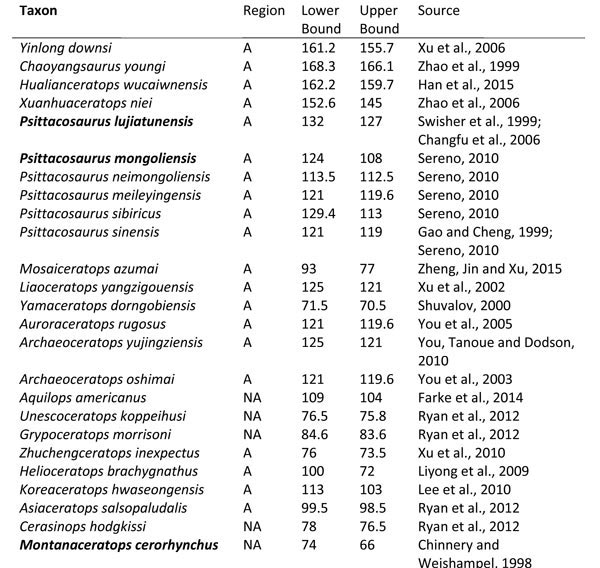
The supplementary data associated with the scientific paper included some fantastic details of the ceratopsian family tree.  In order to conduct their analysis, the research team compiled a table of horned dinosaurs and listed where they lived and approximately when (upper and lower margins of stratigraphical distribution).  In an earlier article, we published the first part of this extensive table, today, we conclude our blog articles on this fascinating piece of ceratopsian research by posting up the rest of the data.

Plotting Ceratopsian Species Against Temporal and Geographical Distribution (Part 3)
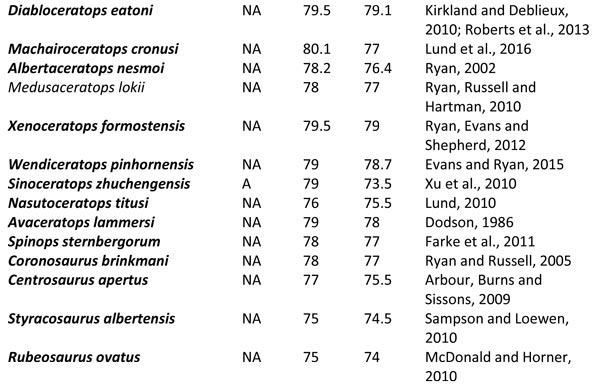
Ceratopsian species - where they lived and when (part 3).
Temporal calibrations and geographical locations of ceratopsian species (part 3).

Table credit: Andrew Knapp, Robert J. Knell, Andrew A. Farke, Mark A. Loewen, David W. E. Hone published in the Proceedings of the Royal Society B (Biology).

The table (above), shows part 3 of the temporal calibrations and geographical locations of ceratopsian species. Taxa that were included in the morphological character state analysis (the research into crests and horns), are indicated in bold type.  Region abbreviations: Asia: A; North America: NA; Europe: E.  The source of the table data is shown on the right.

This  part of the ceratopsian table helps to demonstrate the diversity of the horned dinosaurs in North America during the Late Cretaceous, especially on the western part of the continent, the landmass known as Laramidia.

For models of horned dinosaurs and other prehistoric animals: Dinosaurs and Prehistoric Animal Models.

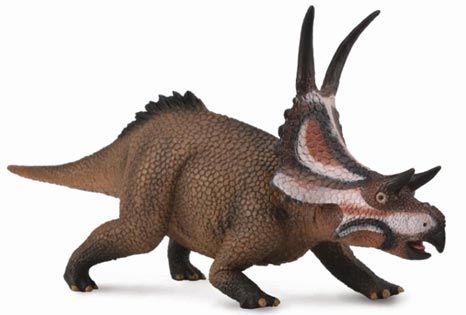
The Ornamentation of Diabloceratops (D. eatoni) was Included in the Study
Collecta Diabloceratops dinosaur model.
“Devil Horned Face” – Diabloceratops eatoni.

Campanian and Maastrichtian Stages

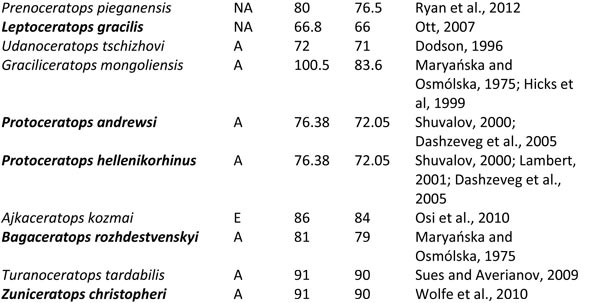
Tables (3 and 4) list the horned dinosaur species from the later stages of the Cretaceous (Campanian and Maastrichtian).  In part 4 (shown below), the dominance of ceratopsian species from North America continues with a further nineteen North American species listed.

Plotting Ceratopsian Species Against Temporal and Geographical Distribution (Part 4)
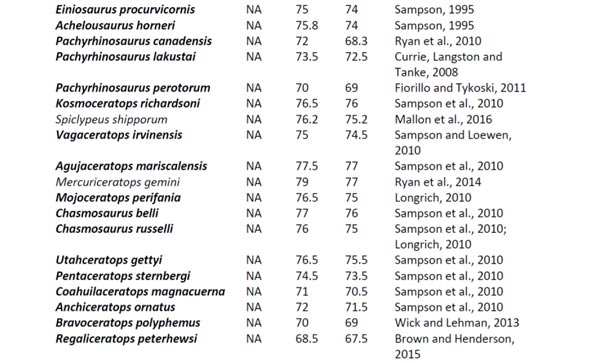
Ceratopsian species - where they lived and when (part 4).
Temporal calibrations and geographical locations of ceratopsian species (part 4).

Table credit: Andrew Knapp, Robert J. Knell, Andrew A. Farke, Mark A. Loewen, David W. E. Hone published in the Proceedings of the Royal Society B (Biology).

The Very Last of the Horned Dinosaurs

The last parts of the data table focus on the youngest species of horned dinosaur known.  These are the ceratopsians that lived during the last few million years of the Cretaceous.  Once again, North America is the only continent represented in this part of the table.  This does not mean that horned dinosaurs were extinct elsewhere in the world, that cannot be inferred from the information provided, but it is worth noting that no Asian horned dinosaurs for example, are known from the Maastrichtian faunal stage of the Late Cretaceous.

Plotting Horned Dinosaur Species Against Temporal and Geographical Distribution (Part 5)
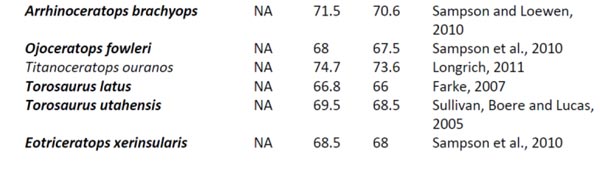
Ceratopsian Species - where they lived and when (part 5).
Temporal calibrations and geographical locations of ceratopsian species (part 5).

Table credit: Andrew Knapp, Robert J. Knell, Andrew A. Farke, Mark A. Loewen, David W. E. Hone published in the Proceedings of the Royal Society B (Biology).

Ceratopsian Species – Last of All Triceratops prorsus

The last three species listed are all believed to be the youngest of the horned dinosaurs described so far, in terms of geological age.  The two species of Triceratops are known from the Hell Creek Formation, whilst the controversial Nedoceratops (known from only one skull and therefore thought by some palaeontologists to be nomen dubium), comes from the Lance Formation of Wyoming.  All three species are classified as members of the Ceratopsidae sub-family Chasmosaurinae, which with Torosaurus also a chasmosaur (T. latus listed in table 5), suggests that centrosaurine dinosaurs may not have persisted to the very end of the Age of Dinosaurs.

Plotting Horned Dinosaur Species Against Temporal and Geographical Distribution (Part 6)

Ceratopsian species - where and when they lived (end).
Temporal calibrations and geographical locations of ceratopsian species (end of the Maastrichtian stage).

Table credit: Andrew Knapp, Robert J. Knell, Andrew A. Farke, Mark A. Loewen, David W. E. Hone published in the Proceedings of the Royal Society B (Biology).

Triceratops – One of the Very Last of All the Dinosaurs
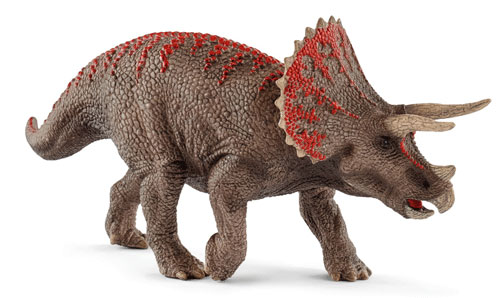
Schleich Triceratops dinosaur model (2018).
The new for 2018 Schleich Triceratops dinosaur model.

We once again congratulate the researchers for producing such an amazing study and for making available in the supplementary data all these really informative tables.

For the first part of our review of the ceratopsian data tables: Ceratopsian Species – When and Where They Lived (Part 1).

The Everything Dinosaur website: Everything Dinosaur.
28 03, 2018

A New Megaraptoran Theropod – Tratayenia rosalesi

By |2023-10-06T09:00:20+01:00March 28th, 2018|Categories: Dinosaur and Prehistoric Animal News Stories, Dinosaur Fans, Main Page, Photos/Pictures of Fossils|0 Comments

After the Carcharodontosaurids Tratayenia rosalesi Ruled

Scientists have described a new type of megaraptoran theropod dinosaur from Upper Cretaceous strata in north-western Patagonia (Argentina).  Although, less than five percent of the skeleton has been discovered, the fossil bones are similar to other megaraptorids such as Aerosteon (A. riocoloradense) and Megaraptor (M. namunhuaiquii).  This has enabled the researchers, that include Juan Porfiri from the Museo de Ciencias Naturales (Buenos Aires), and Matthew Lamanna of the Carnegie Museum of Natural History (Pittsburgh), to confidently assign these fossils to the Megaraptora clade, the clade of “giant thieves”!

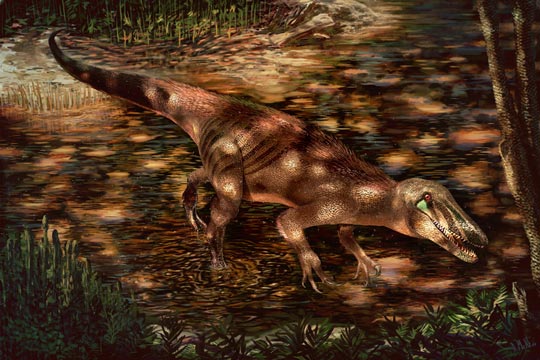
A Scientific Illustration of the New South American Megaraptoran T. rosalesi

Tratayenia stalking prey.
An illustration of the new Late Cretaceous megaraptoran dinosaur Tratayenia.

Picture credit: Andrew McAfee (Carnegie Museum of Natural History)

Tratayenia rosalesi

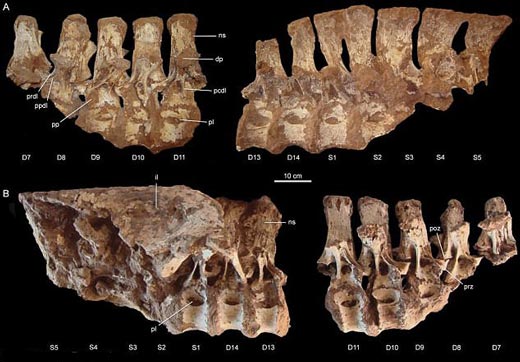
Described from a series of articulated dorsal and sacral vertebrae, along with two ribs and elements of the hips, the dinosaur named Tratayenia rosalesi is estimated to have been around eight to nine metres in length, possibly even bigger.  Tratayenia is the geologically youngest of the Megaraptora known to science and it is the first megaraptoran that preserves the complete sequence of sacral vertebrae (fused back bones located over the hips).

Its discovery has helped palaeontologists to learn more about the hips and pelvic region of these Late Cretaceous meat-eaters.  The genus name is from Tratayén, the area in the eastern part of Neuquén Province from where the fossils come from.  The trivial name honours Diego Rosales who made the initial fossil discovery.  Tratayenia rosalesi is pronounced tra-ta-yen-nee-ah rose-ah-less-eye.

View of the Articulated Dorsal and Sacral Vertebrae (Tratayenia rosalesi)

Tratayenia, dorsal and sacral vertebrae.
Views of the articulated dorsal and sacral vertebrae (Tratayenia rosalesi).

Picture credit: Cretaceous Research

Santonian Faunal Stage

The fossil material comes from a horizon of Upper Cretaceous-aged deposits (Santonian faunal stage), in the Bajo de la Carpa Formation of the Neuquén Group (Neuquén Basin), exposed close to the small town of Añelo.  Notwithstanding the fact that the age of the fossil material representing the megaraptorids Aerosteon and Orkoraptor (O. burkei) remains uncertain, these fossils could describe the geologically youngest megaraptoran to date, thus extending their temporal range.  In addition, it is the largest carnivorous vertebrate to have been found in the Bajo de la Carpa Formation, as such, the researchers speculate that this fearsome, long-jawed, long-clawed dinosaur was an apex predator.

Based on comparisons with close relatives like Megaraptor, palaeontologists estimate that this carnivorous dinosaur sported two, forty-centimetre-long talons on the innermost fingers of each hand.  The discovery of Tratayenia adds weight to the hypothesis that the megaraptorids became the top predators in the southern parts of Gondwana following the extinction of the carcharodontosaurids.

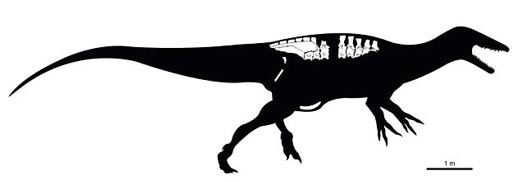
An Illustration of Tratayenia rosalesi Showing Known Fossil Material

Tratayenia silhouette, known bones in white.
The bones in white indicate the known fossil material (holotype) of Tratayenia.

Picture credit: Cretaceous Research

Megaraptoran Dinosaurs

An article that explains more about the megaraptoran dinosaurs including Murusraptor: Getting Our Claws into the Megaraptora.

For an article that outlines the potential origins of the Megaraptora: “Lightning Claw” – A Deadly Predator.

The scientific paper: “A New Megaraptoran Theropod Dinosaur from the Upper Cretaceous Bajo de la Carpa Formation of North-western Patagonia” by Juan D. Porfiri, Rubén D.Juárez Valieri, Domenica D.D.Santos and Matthew C. Lamanna published in the journal “Cretaceous Research”.

Visit the award-winning Everything Dinosaur website: Everything Dinosaur.
27 03, 2018

Ceratopsian Species – When and Where they Lived (Part 1)

By |2023-10-05T15:19:43+01:00March 27th, 2018|Categories: Dinosaur and Prehistoric Animal News Stories, Dinosaur Fans, Geology, Main Page, Palaeontological articles|0 Comments

Ceratopsian Species – Where and When did they Live (part 1)

A few days ago, Everything Dinosaur published an article which summarised some remarkable research into the ceratopsian family tree undertaken by a team of international scientists.  This research team, that included researchers from the University of London, postulated that all those fancy frills and horns associated with the horned dinosaurs, probably evolved to help individuals attract a mate.  This statistical study involved mapping when different species of horned dinosaur lived, where they lived and what other ceratopsians may have been contemporaneous.

Ceratopsian Dinosaur Study

In the supplementary data, the researchers provided a marvellous ceratopsian family tree plotted against geological time.  Quite a feat considering more than seventy species of horned dinosaur were analysed.  In addition, the team published very useful tables that summarised the data they had compiled.  The table listed the horned dinosaurs and provided information about which continent their fossils had been found and calibrated their approximate ages (upper limit and lower limit of stratigraphical distribution).

Plotting Ceratopsian Species Against Temporal and Geographical Distribution

Ceratopsian species and temporal calibration/geographical location.
Temporal calibrations and geographical locations of ceratopsian species (part 1).

Table credit: Andrew Knapp, Robert J. Knell, Andrew A. Farke, Mark A. Loewen, David W. E. Hone published in the Proceedings of the Royal Society B (Biology).

The table (above) shows temporal calibrations and geographical locations of ceratopsian species.   Taxa that were included in the morphological character state analysis (the research into horns and crests), are indicated in bold type.  Region abbreviations: Asia: A; North America: NA; Europe: E.

Yinlong downsi

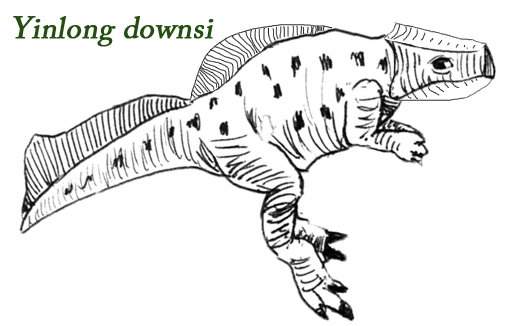
One of the earliest ceratopsians described to date is Yinlong downsi, fossils of which were found in Upper/Middle Jurassic aged rocks in Xinjiang Province (western China).  It is likely that the ceratopsian lineage originated in the Middle Jurassic and that these bird-hipped dinosaurs first evolved in Asia.

An Illustration of Yinlong downsi – An Early Ceratopsian

An illustration of Yinlong downsi.
Yinlong downsi, an early ceratopsian dinosaur.  The first horned dinosaurs were very probably small and bipedal.  Picture credit: Everything Dinosaur.

Picture credit: Everything Dinosaur

Building on the Shoulder of Giants

The research team collated a significant amount of data that had been produced by other scientists.  Using this extensive research (source of the data is recorded in the table), a table listing ceratopsian species, where they lived and when they lived was produced.

Plotting Ceratopsian Species Against Temporal and Geographical Distribution (Part 2)

Ceratopsian species - where they lived and when (part 2).
Temporal calibrations and geographical locations of ceratopsian species (part 2).

Table credit: Andrew Knapp, Robert J. Knell, Andrew A. Farke, Mark A. Loewen, David W. E. Hone published in the Proceedings of the Royal Society B (Biology).

For dinosaur models including ceratopsians: Dinosaur Models and Prehistoric Animal Figures.

The second part of the table lists horned dinosaurs from the Late Cretaceous (majority) and also includes the first reference to a horned dinosaur from Europe Ajkaceratops kosmai, which is known from anterior portions of the skull and jaws discovered in Hungary.

To read our article from 2010, which discusses the discovery of the first European ceratopsian (A. kosmai): Evidence of European Ceratopsians Grows With Hungarian Discovery.

We congratulate the research team conducting the statistical study into the ornamentation of the Ceratopsia and praise all those patient, dedicated scientists that helped to provide the data set for them to work on.  it is such a detailed ceratopsian dinosaur study. A second article will be published shortly that features the rest of the horned dinosaur temporal and geographical distribution table.

To read our original article on the ceratopsian research: Why Did Horned Dinosaurs Have Fancy Frills?

To view the timeline of ceratopsian species – (a family tree of horned dinosaurs): A Horned Dinosaur Family Tree Plotted Over Geological Time.

Visit the Everything Dinosaur website: Everything Dinosaur.
23 03, 2018

Why Did Horned Dinosaurs Have Fancy Frills?

By |2023-10-06T09:36:03+01:00March 23rd, 2018|Categories: Dinosaur and Prehistoric Animal News Stories, Dinosaur Fans, Main Page, Palaeontological articles|2 Comments

Why Did Horned Dinosaurs Have Fancy Frills (and Horns Too for that Matter)?

One of the great pleasures of working with so many young dinosaur enthusiasts is that we get to answer lots of their amazing questions.  We do get asked all sorts of things, such seems to be the fascination with dinosaurs and other prehistoric animals.  Scientists get to ask questions too, after all, the essence of scientific enquiry is all about seeking answers.  It is surprising just how often the question asked of us by an eight-year-old overlaps with the sort of enquiries being explored by palaeontologists.  Take for example, the question of why did horned dinosaurs have horns and frills?

Thanks to a some recently published fascinating statistical analysis, researchers are able to at least rule out one possible explanation for these very ornate and often bizarre examples of dinosaur head gear.

Studying the Frills of Horned Dinosaurs

Writing in the “Proceedings of the Royal Society B (Biology)”, researchers have concluded that all this ornamentation probably did not evolve to help a dinosaur distinguish itself from another species.  Yes, they may have had a role in defence, after all, many of the later ceratopsians had to contend with tyrannosaurs in their neighbourhood, but this new analysis lends weight to the idea that the diverse range of headgear sported by horned dinosaurs probably evolved to help them win mates.

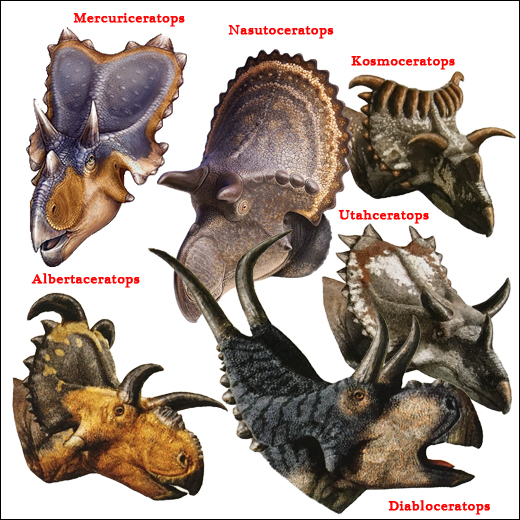
Lots of Horned Dinosaur Species – But Why all the Different Horns and Ornamentation?

So many different horned dinosaurs.
Illustrations of different horned dinosaurs but why the fancy headgear?

Picture credit:  Everything Dinosaur with artwork from Julius Csotonyi, Danielle Dufault and the Canadian Museum of Natural History/Andrey Atuchin

A Statistical Study of Ceratopsians

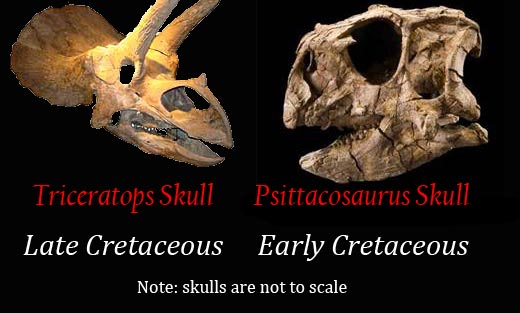
The research team which included scientists from the University of London, the Natural History Museum of Utah and the Raymond M. Alf Museum of Palaeontology in California, first set about building a list of all the known horned dinosaurs that had been described to date.  The Ceratopsia (horned dinosaurs), is a major clade of the bird-hipped dinosaur lineage, it contains over seventy species, all of which possessed some form of skull ornamentation, from the small “sticky-out” cheek horns of Psittacosaurus from the Early Cretaceous to the spectacular multi-faceted head crests and horns sported by Late Cretaceous giants such as Styracosaurus, Triceratops and Pachyrhinosaurus that lived some fifty million years later.

Members of the Ceratopsia with Differing Ornamental Traits

Comparing the skulls of Triceratops and Psittacosaurus.
Ornamental traits in the Ceratopsia. Psittacosaurus and Triceratops compared. Picture credit: Everything Dinosaur.

Picture credit: Everything Dinosaur

Looking for Sympatry

These horned dinosaurs had very different shaped skulls and to test the idea that these features evolved to help with species recognition, the researchers then set about looking at which horned dinosaurs lived at the same time and in the same parts of the world.  In essence, they looked to see if any two species were sympatric – this simply means whether two species live in the same area at the same time and therefore encounter each other.  A modern example can be found in the Serengeti National Park, where Impalas and Grant’s Gazelle, two species of antelope, live side by side.  There is sympatry between Impalas and Grant’s Gazelle.

Horned Dinosaurs – Diverse Skulls in All Shapes and Sizes

Once the fossil records for all the known species of ceratopsian had been analysed by location and when these animals lived, the team set about looking at the physical features of all those species which had enough fossil material associated with them to make any analysis statistically valid.  To test the idea that these horns and frills evolved to help in species recognition, there should be some evidence that at some point, several closely related species with different ornamentation lived at the same time in environments that at least partially overlapped and therefore these animals would have encountered each other.

Horned Dinosaur Skulls Come in All Shapes and Sizes

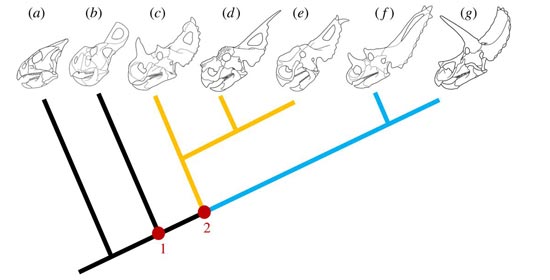
Line drawings of horned dinosaur skulls.
Line drawings of ceratopsian skulls showing different morphology.

Picture credit: Proceedings of the Royal Society B (Biology)/Scott Hartman

The picture above shows seven line drawings of horned dinosaur skulls namely:

a).   Liaoceratops yangzigouensis – from Asia with a temporal range of 125 to 121 million years ago (Aptian faunal stage of the Early Cretaceous).

b).  Protoceratops andrewsi – from Asia with a temporal range of 76.38 to 72.05 million years ago (Campanian faunal stage of the Late Cretaceous).

c).  Centrosaurus apertus – from North America with a temporal range of 77 to 75.5 million years ago (Campanian faunal stage of the Late Cretaceous).

d).   Achelousaurus horneri – from North America with a temporal range of 75.8 to 74 million years ago (Campanian faunal stage of the Late Cretaceous).

e).  Pachyrhinosaurus canadensis – from North America with a temporal range of 72 to 68.3 million years ago (Campanian/Maastrichtian faunal stage of the Late Cretaceous).

f).  Chasmosaurus belli – from North America with a temporal range of 77 to 76 million years ago (Campanian faunal stage of the Late Cretaceous).

g).  Triceratops horridus – from North America with a temporal range of 66.8 to 66.4 million years ago (Maastrichtian faunal stage of the Late Cretaceous).

The red node 1 represents the clade Coronosauria a sub-division of the Ceratopsia that contains all the horned dinosaurs with enlarged frills.  Node 2 represents the clade Ceratopsoidea, which is split into two branches, the Centrosaurinae (orange branch) and the Chasmosaurinae (blue branch).  It is these two branches, the centrosaurines and the chasmosaurines that exhibit the majority of the cranial ornamental diversity.

Looking at Traits/Examining Characteristics

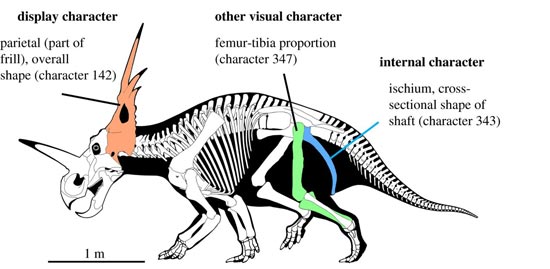
The next step was to classify those differences in the skeleton to separate out any features that may have played a role in inter-species recognition.  The scientists looked for anatomical traits within the skeleton.  Each trait was classed as either external or internal, based on whether it was likely to have an effect on the exterior appearance of the animal in life.  External characters were further subdivided into display and non-display, defined as whether or not the character or trait in question was deemed whole or part of an ornament (i.e. in ceratopsians, the frill, horns and bosses of the skull).

An Example of the Traits Identified by the Researchers (Styracosaurus)

Styracosaurus skeleton showing examples of traits used in the study.
A skeletal reconstruction of the centrosaurine dinosaur Styracosaurus (S. albertensis).

Picture credit: Proceedings of the Royal Society B (Biology)/Scott Hartman

The statistical analysis found no evidence to support the idea that the horns and frills of ceratopsians evolved to help these animals differentiate themselves from other species that they shared habitats with.

Palaeontologist David Hone (University of London), explained that this study suggests that these ornamentations evolved as “social-sexual functions” i.e. as both males and females of each species had similar ornamentation, the horns and frills evolved to help advertise the animal’s condition and fitness for breeding.

He stated:

“We think that, really, it’s mostly a big kind of display feature, so just as peacocks have the big showy feathers and lions have the big mane and deer have big antlers.  It’s some kind of big advertising feature for these animals to show off.”

The Frills of Horned Dinosaurs – Billboards for Mutual Attraction

These skull ornamentations may have been a horned dinosaur’s way of demonstrating that it was healthy, strong and had good genetic make-up.  In short, both males and females were advertising their fitness for mating.  In evolutionary terms, the more fantastic your head crest and the bigger the lumps, bumps and horns on your face the dinosaur is highlighting that it is fit and healthy. It shows that it can grow lots of bone and carry it around without suffering from any disadvantages, such as being too slow and heavy to avoid a T. rex.

Those Skull Features – Basically They Communicate Fitness for Breeding

Yehuecauhceratops Museum Replica
Scientists have constructed a model of the Mexican dinosaur called Yehuecauhceratops.  Those horns, crests and frills probably advertise the animal’s fitness for breeding.

Picture credit: Museo del Desierto, Mexico (The Coahuila Desert Museum)

Species Recognition Mechanism Theory is Not Supported

The researchers conclude that the theory that all this ornamentation evolved as a species recognition mechanism, has no statistical support among known ceratopsians.

The various features associated with the vast and diverse family of horned dinosaurs probably had other functions too.  Perhaps they played a role in thermoregulation and they may have functioned as defensive structures, plus they could have had a role in visual communication and display.  However, the idea that they developed to aid with inter-species recognition has been rejected by this research team.

The next time we get asked by an eight-year-old why did Triceratops have horns?  We can provide a more complete answer…

The scientific paper: “Patterns of Divergence in the Morphology of Ceratopsian Dinosaurs: Sympatry is not a Driver of Ornament Evolution” by Andrew Knapp, Robert J. Knell, Andrew A. Farke, Mark A. Loewen, David W. E. Hone published in the Proceedings of the Royal Society B (Biology).

Visit the Everything Dinosaur website: Everything Dinosaur.
20 03, 2018

“Arkansas Reptile” – A Rare Insight into Appalachian Dinosaurs

By |2023-10-06T15:17:00+01:00March 20th, 2018|Categories: Dinosaur and Prehistoric Animal News Stories, Dinosaur Fans, Main Page|2 Comments

Arkansaurus fridayi – A Basal Ornithomimosaur

Dinosaur fossils unearthed in Lockesburg, (Arkansas), nearly fifty years ago have been formally described in a scientific journal.  Writing in the academic publication the “Journal of Vertebrate Palaeontology”, researchers have assigned the fossil elements representing the right hind foot of an “ostrich mimic dinosaur” to a basal position in the Ornithomimosauria clade.  The dinosaur, named Arkansaurus fridayi, was previously thought to represent an animal related to Ornitholestes.  However, the researchers, led by palaeontologist ReBecca Hunt-Foster, who works at the Bureau of Land Management and is based in Utah, a U.S. state more accustomed to dinosaur fossils than “The Natural State”, suggest that A. fridayi is more primitive than contemporaneous Asian ornithomimosaurs.

An Illustration of an Ornithomimid Dinosaur (Ornithomimus)

Ornithomimus illustration.
Reconstructions of Arkansaurus have been based on better known ornithomimids such as Ornithomimus (above).

Picture credit: Julius Csotonyi

The State Dinosaur of Arkansas

Although only a handful of bones have been found, palaeontologists have built up a picture of this fleet-footed, lizard-hipped dinosaur, by comparing the fossil pedal (foot) material to more complete and better-known ornithomimids such as Struthiomimus and Ornithomimus that roamed western North America in the Late Cretaceous.

These Late Cretaceous ornithomimids lived on a landmass called Laramidia, it was separated from the eastern part of the continent by a shallow sea (the Western Interior Seaway).  Arkansas and consequently, Arkansaurus fridayi was on the other side of this waterway and very little is known about the dinosaurs that existed on this landmass (Appalachia).  The right foot, is the only known evidence of saurischian dinosaurs from Arkansas, despite the lack of skeletal information and the absence of a formal scientific description, last year, this dinosaur was named the official state fossil of Arkansas.

ReBecca Hunt-Foster, started working on the fossils more than a decade ago, whilst studying at the University of Arkansas.  Her co-author of the scientific paper, James Quinn works at the Department of Geosciences (University of Arkansas), they postulate these fossils will help to improve our understanding of the radiation and geographical dispersal of ornithomimosaurs.  Arkansaurus roamed Appalachia some 113 million years ago (Albian-Aptian) faunal stage of the Early Cretaceous, it may well have been an ancestor of the Late Cretaceous “ostrich mimics” such as Ornithomimus.

An Illustration of Arkansaurus fridayi (Estimated Scale)

Arkansaurus illustrated.
An illustration of Arkansaurus fridayi.  The actual size of the dinosaur is not known, but based on the size of the foot bones, the fossils may represent a dinosaur that was over 4.6 metres in length.

Picture credit: Brian Engh

Not Much Known About North American Early Cretaceous “Ostrich Mimics”

The fossilised foot bones come from the Lower Cretaceous Trinity Group.  Exposures in Texas have yielded plenty of dinosaur fossils, but as yet, no ornithomimids have been named from the Texas material, in fact Arkansaurus represents the second-oldest “ostrich mimic” dinosaur known from the whole of North America.

The oldest ornithomimid from North America described to date is Nedcolbertia, (N. justinhofmanni) which is known from fragmentary remains representing several juveniles found in Early Cretaceous sediments deposited in Utah.  Such is the paucity of the fossil material of Early Cretaceous ornithomimids from North America, that there is something like a fifteen-million-year gap between Nedcolbertia and the newly described Arkansaurus.

Vertebrate Palaeontologist ReBecca Hunt-Foster with a Cast of the Foot Bones

Arkansaurus foot bones and ReBecca Hunt-Foster.
Vertebrate palaeontologist ReBecca Hunt-foster with a cast of the Arkansaurus foot bones.

Picture credit: R. Hunt-Foster

Arkansaurus fridayi – A Lucky Fossil Discovery

The trivial name honours farmer Robert Friday who discovered the fossils on his farm back in 1972.  He was checking on his livestock when he spotted some bones in a ditch excavated by a road construction crew.  Any other parts of the skeleton that might have been preserved were probably lost as the construction crew worked.  Hunt-Foster and her colleagues are hoping to learn more about Appalachian ornithomimosaurs from any future fossil finds from Arkansas.  They hope to build up a picture of the Early Cretaceous palaeofauna and they have speculated that these types of dinosaurs may have originated in Europe and that they are not closely related to other, better known “ostrich mimics” from Asia.

To read an article about evidence of Appalachian horned dinosaurs: Horned Dinosaur Tooth Discovered in Northern Mississippi.

The scientific paper: “A New Ornithomimosaur from the Lower Cretaceous Trinity Group of Arkansas” by ReBecca K. Hunt and James H. Quinn published in the Journal of Vertebrate Palaeontology.

Visit the Everything Dinosaur website: Everything Dinosaur.
17 03, 2018

“Attenborough’s Sea Dragon” on Display

By |2023-10-07T06:29:53+01:00March 17th, 2018|Categories: Dinosaur and Prehistoric Animal News Stories, Main Page, Photos/Pictures of Fossils|0 Comments

Ichthyosaur Specimen on Display at Charmouth Heritage Coast Centre

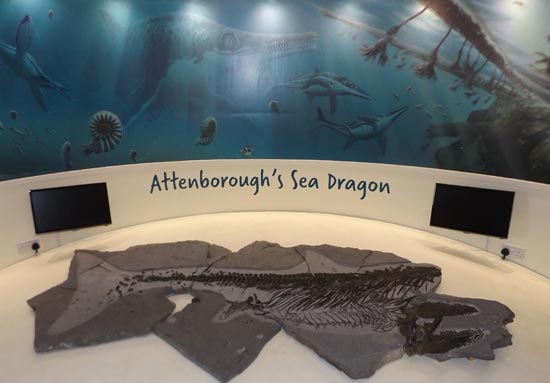
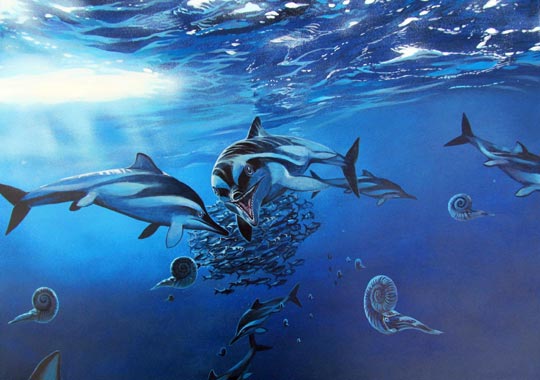
The fossilised remains of a new species of ichthyosaur are on display at the Charmouth Heritage Coast Centre for the rest of this year.  The Centre, based on the famous Jurassic coast of Dorset, will be home to the partial skeleton of a four-metre-long, new species of “fish lizard”, it’s discovery and excavation was documented in a BBC television programme shown back in January.

The New Ichthyosaur Display at the Charmouth Heritage Coast Centre

Ichthyosaur specimen on display.
The “Sea Dragon” fossil on display.  The head of the specimen has been lost, it probably was eroded out of the cliff face prior to Chris Moore’s discovery.

Picture credit: Charmouth Heritage Coast Centre

The Tale of a Sea Dragon

Narrated by Sir David Attenborough, the programme told the story of the fossil’s discovery by experienced local collector Chris Moore.  Chris along with a team of climbing experts and geologists spent weeks excavating the rock containing the creature by hand from a Dorset cliff.  The headless skeleton, that even retained evidence of ichthyosaur skin, was transported by boat back to Lyme Regis so that the matrix covering the bones could slowly be removed and full details of the 200-million-year-old specimen revealed.

To read Everything Dinosaur’s article about the BBC documentary: Attenborough and the Sea Dragon.

Experts from Southampton and Bristol Universities studied and analysed the skeleton as well as the exceptionally well-preserved skin still on the bones.  They identified it as a new species of ichthyosaur, probably an animal of the open ocean that for some reason had come closer to the shore, where, in the coastal waters, it was attacked and killed by a much larger animal.  The palaeontologists, preparators and researchers had a murder scene on their hands.  In the television programme, a CGI version of the unfortunate marine reptile was created and its final moments re-enacted, an attack by a super predator, one of the most dangerous animals on the planet during the Early Jurassic – a ferocious Temnodontosaurus.

Everything Dinosaur’s Illustration of Temnodontosaurus

Scale drawing of Temnodontosaurus.
Temnodontosaurus scale drawing (T. platyodon) shown giving birth. Picture credit: Everything Dinosaur.

Picture credit: Everything Dinosaur

For models and replicas of ichthyosaurs and other marine reptiles: CollectA Prehistoric Life Models.

Attacked by a Much Larger Ichthyosaur

As the fossilised skeleton was slowly but surely revealed, damaged vertebrae and broken ribs provided evidence of an attack by a much bigger marine reptile.  The assailant was probably a Temnodontosaurus, one of the largest of the Ichthyosauria, capable of growing to around ten metres in length with a body mass estimated at approximately two tonnes.  The attacker did not get its prize, the researchers speculated that the initial bite on the unfortunate victim, punctured the animal’s body cavity releasing air from the lungs and the ichthyosaur’s body descended into the deep.

The body of the ichthyosaur descended rapidly and it was soon out of the diving range of the attacker, coming to rest on the seabed.  The corpse was rapidly covered by fine sediment and fossilisation eventually took place, two hundred million years later, fossil hunter Chris Moore spotted part of the skeleton eroding out of a cliff and the process of excavating the specimen was begun.

Chris Moore (Foreground) with Sir David Attenborough and Sally Thompson (Producer/Director of the Television Documentary)

Chris Moore on the Dorset Coast
Chris Moore (foreground) with television programme director/producer Sally Thompson and Sir David Attenborough (background).

Picture credit: Charmouth Heritage Coast Centre

Sea Dragon Tale Narrated by Sir David Attenborough

Veteran naturalist, life-long fossil collector and highly esteemed broadcaster, Sir David Attenborough explained in the hour-long programme:

“It’s been a fascinating journey of discovery, but for me the real wonder is the bones themselves.  It is a long time spent just revealing the body of this creature, but it’s also revealed this extraordinary story of life and death, predator and prey fighting it out in the seas 200 million years ago, just down there (at the beach).”

Team members from Everything Dinosaur are hoping to visit the exhibit at the Charmouth Heritage Coast Centre when they will be working on the Dorset coast in the autumn.

As the BBC television programme drew to a close, Sir David Attenborough remarked:

“For Chris [Chris Moore], this has been a labour of love and its filled in another gap in the palaeontological jigsaw.  A story that all started with an odd-looking boulder on a Dorset beach.  It’s extraordinary to think that some 200 million years ago exactly here, the greatest predator of its time was swimming around in the sea, and that’s what I love about fossils and fossil hunting, it gives you an extraordinarily vivid insight into what the world was like millions of years before human beings even appeared on this planet.”

Attenborough’s Sea Dragon is on display at Charmouth Heritage Coast Centre throughout 2018.

For further information on the Charmouth Heritage Coast Centre: Charmouth Heritage Coast Centre.

Visit the award-winning Everything Dinosaur website: Everything Dinosaur.
15 03, 2018

New Study Suggests Pterosaurs More Diverse at the End of the Cretaceous than Previously Thought

By |2024-02-25T07:59:51+00:00March 15th, 2018|Categories: Dinosaur and Prehistoric Animal News Stories, Dinosaur Fans, Main Page, Photos/Pictures of Fossils|1 Comment

Getting to Grips with Six New Species of Pterosaurs

The Pterosauria, that Order of winged reptiles that thrived alongside the dinosaurs were thought to have had their heyday in the Early Cretaceous. Only a single family, the Azhdarchidae (several of whom were giants), was known from the very end of the Cretaceous (Maastrichtian faunal stage).  Many palaeontologists had thought that these flying reptiles, the first vertebrates to evolve powered flight, had gone into gradual decline, slowly but surely displaced by those rapidly evolving new masters of the air, the birds.

The Diversity of the Pterosaurs in the Late Cretaceous

However, a scientific paper, published this week in the academic journal “PLOS Biology”, challenges this view.  A total of six new species, representing three families of pterosaurs have been discovered in Late Cretaceous (Maastrichtian) rocks in Morocco.  This new discovery, the most diverse Late Cretaceous pterosaur fossil assemblage found to date, suggests that the Pterosauria may not have gradually faded away, as previously thought.  Their long lineage probably ended abruptly, in essence, the Pterosauria met the same fate at the end of the Cretaceous as their archosaur cousins the Dinosauria.

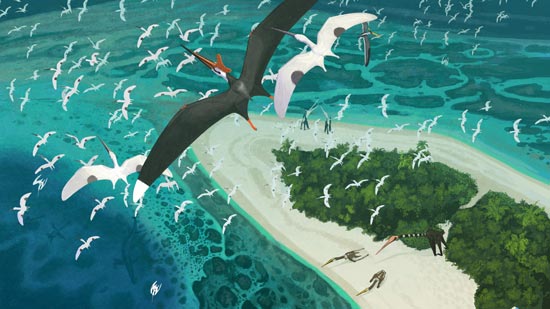
A Diverse Assemblage of Pterosaurs – Late Cretaceous Morocco

Pterosaurs of the Late Cretaceous (Morocco).
Six new species of pterosaur have been identified from Morocco.  This suggests that the Pterosauria were far more diverse and speciose at the end of the Cretaceous than previously thought.

Picture credit: John Conway

A Treasure Trove of Ancient Vertebrate Fossils

Writing in the journal PLOS Biology, the researchers from the University of Bath, Portsmouth University and the University of Texas at Austin, identified a total of seven species of flying reptile from fragmentary and largely isolated fossils found in marine rocks from phosphate mines in northern Morocco (Ouled Abdoun Basin).  Working in conjunction with local fossil hunters, the scientists were able to build up a collection of around two hundred pterosaur bones.

Over the years, commercial mining has revealed large numbers of marine vertebrates dating from the end of the Cretaceous and into the Palaeogene.  Cretaceous fauna associated with these deposits include turtles, plesiosaurs, mosasaurs, sharks and lots of different types of teleost (bony fish).  Occasionally the remains of terrestrial animals are preserved in such deposits, including the bones of Late Cretaceous dinosaurs, representing some of the youngest dinosaur fossils found.

To read our 2017 article about the discovery of an abelisaurid dinosaur: The Last Dinosaur in Africa.

Some of the Last Pterosaurs

The pterosaurs identified by the researchers range in size with the smallest found having a wingspan equivalent to that of an extant Golden Eagle (Aquila chrysaetos), to giants with wingspans approaching ten metres, three times bigger than the wingspan of the largest volant birds alive today.  The fossil material has been dated to just over 66 million years ago, making these pterosaurs amongst the very last of their kind on Earth.

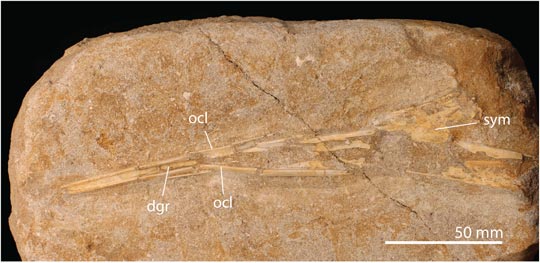
The Mandible of the Newly Described Nyctosaurid Alcione elainus

Pterosaur fossil mandible Alcione elainus.
The mandible of the newly described Moroccan pterosaur A. elainus.

Picture credit: PLOS Biology

Key

dgr = dorsal groove, ocl = occlusal ridge,  sym = symphysis.

Lead author of the study, Dr Nicholas Longrich, (Milner Centre for Evolution and the Department of Biology and Biochemistry, Bath University) stated:

“To be able to grow so large and still be able to fly, pterosaurs evolved incredibly lightweight skeletons, with the bones reduced to thin-walled, hollow tubes like the frame of a carbon-fibre racing bike.  Unfortunately, that means these bones are fragile and so almost none survive as fossils.”

Six New Species of Pterosaur

The researchers were able to identify six new species of pterosaur, representing three different families:

  1. Tethydraco regalis (Pteranodontidae) – the youngest member of the Pteranodontidae family described to date.  Estimated wingspan around 5 metres.
  2. Alcione elainus (Nyctosauridae) – wingspan estimated at about 2 metres.
  3. Simurghia robusta (Nyctosauridae) – a large pterosaur with a wingspan of around 4 metres.
  4. Barbaridactylus grandis (Nyctosauridae) – an even bigger pterosaur with a wingspan estimated to be about 5.2 metres.
  5. Quetzalcoatlus spp. (Azhdarchidae) – described from a single neck bone (cervical vertebra) which resembles the cervical vertebrae of Quetzalcoatlus (Q. northropi).  Size estimates for this flying reptile are very speculative, however, it could have had a wingspan of around 4 metres based on comparisons with better known azhdarchid pterosaurs.
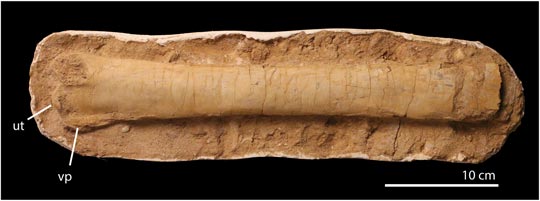
  6. Sidi Chennane specimen (Azhdarchidae) – not scientifically named as yet, known from a single, partial ulna (arm bone), measuring 362 mm long, but when complete it would have been around 600 to 700 mm in length.  This suggests a giant azhdarchid pterosaur with a wingspan of approximately 9 metres.  This specimen has been named after the phosphate mine where it was found, formal scientific description will depend on the discovery of more fossil material.  The researchers conclude that this animal was probably related to the giant azhdarchid Arambourgiania philadelphiae, which is known from the Late Cretaceous of Jordan and the United States.

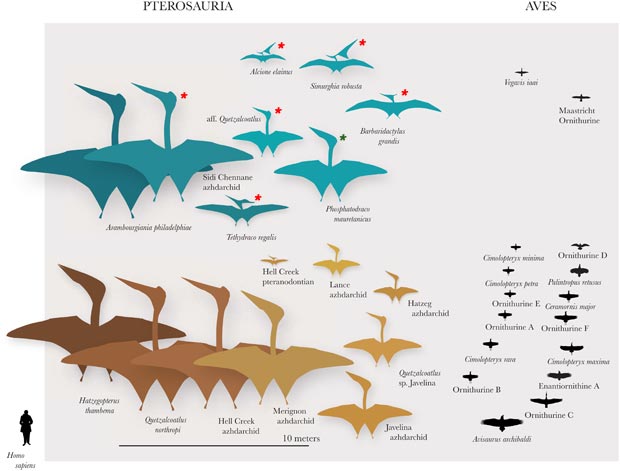
Late Cretaceous Pterosaur Faunas (Marine and Terrestrial) Compared to Late Cretaceous Birds

Late Cretaceous birds compared to Late Cretaceous Pteosaurs
Size disparity between Late Cretaceous pterosaurs and Late Cretaceous birds.

Picture credit: PLOS Biology with additional annotation by Everything Dinosaur

The diagram above compares the size disparity between Late Cretaceous pterosaurs with those of contemporaneous birds (coeval Aves – birds that lived at the same time as these flying reptiles).  Pterosaurs shaded blue are associated with marine environments, pterosaurs shaded in brown are associated with terrestrial habitats.  The six new species from the Ouled Abdoun Basin identified in the scientific paper have been given a red star.  The one species from the Ouled Abdoun Basin that had been previously described (2003), has been labelled with a green star (the azhdarchid Phosphatodraco mauritanicus).

A Giant Pterosaur

The giant pterosaur referred to as the Sidi Chennane specimen is estimated to have approached Quetzalcoatlus in size, but it was much more lightly built and therefore, presumably weighed less.  These proportions indicate a distinct flight mode and ecological niche, suggesting that giant pterosaurs occupied a range of niches in Late Cretaceous habitats.  In addition, the researchers conclude that this flying reptile fossil assemblage demonstrates that the Maastrichtian pterosaurs show increased ecological niche occupation when compared to earlier Late Cretaceous pterosaurs (Santonian to Campanian faunas).  This study also indicates that when it came to developing large body forms, the Pterosauria were able to outcompete coeval birds.

The Fossilised Partial Ulna of the Sidi Chennane Specimen

Fossil ulna of a giant azhdarchid pterosaur.
The ulna of the Sidi Chennane specimen.

Picture credit: PLOS Biology

Key

ut = ulna tubercle, vp = ventral process

A 5% Increase in Known Pterosaur Species

Co-author of the study, Dr Brian Andres, from the Jackson School of Geosciences at The University of Texas at Austin, commented:

“The Moroccan fossils tell the last chapter of the pterosaurs’ story – and they tell us pterosaurs dominated the skies over the land and sea, as they had for the previous 150 million years.”

With around 130 pterosaur species described to date, these fossils from Morocco have led to a 5 percent increase in the known number of flying reptile species.  This diversity of pterosaur species from Upper Maastrichtian deposits in Morocco suggest an abrupt mass extinction of the Pterosauria at the Cretaceous-Palaeogene boundary.

The scientific paper: “Late Maastrichtian Pterosaurs from North Africa and Mass Extinction of Pterosauria at the Cretaceous-Paleogene boundary” by Nicholas R. Longrich, David M. Martill and Brian Andres published in PLOS Biology.

Everything Dinosaur acknowledges the help of a press release from the University of Bath in the compilation of this article.

Visit the award-winning Everything Dinosaur website: Everything Dinosaur.
14 03, 2018

Are Palaeontologists Naming Too Many New Species?

By |2023-10-05T21:52:56+01:00March 14th, 2018|Categories: Dinosaur and Prehistoric Animal News Stories, Dinosaur Fans, Main Page, Palaeontological articles|0 Comments

Cautionary Tale When It Comes to Naming New Species from Fragmentary Fossils

In the 19th century when scientists were beginning to understand that there were many different types of dinosaur, lots of new species were erected, often from the most fragmentary of fossils.  As the western United States and Canada were explored, large quantities of dinosaur fossil material came to light.  This led to palaeontologists naming many new species.  Famous dinosaurs such as the hadrosaurid Trachodon (T. mirabilis), which graced an amazing number of dinosaur books in the 1960s and 1970s, named in 1856 by the American palaeontologist Joseph Leidy, is a typical example.

Leidy described Trachodon from just a few teeth found in Montana (Judith River Formation).  Today, palaeontologists regard the genus Trachodon as nomen dubium (its validity is doubted).  Those teeth used to describe this iconic duck-billed dinosaur probably represent several different plant-eating dinosaurs both hadrosaurs and even horned dinosaurs (ceratopsians).

As Seen in Numerous Dinosaur Books in the Late 20th Century – Trachodon

Postcard with Trachodon illustration.
An illustration of Trachodon.  A genus of dinosaur regarded as nomen dubium (validity is questioned). Picture credit: Everything Dinosaur.

Picture credit: Everything Dinosaur

Recognising new Fossil Species

It is not just the Dinosauria that has suffered from overzealous species naming, however, a comprehensive review of variations in ichthyosaur bones will help scientists to recognise new fossil species.  Dean Lomax (Manchester University) and Professor Judy Massare (SUNY College at Brockport, New York, USA), have examined hundreds of Ichthyosaurus specimens and they urge caution when it comes to erecting new species based on the evidence of a few fragmentary elements or isolated fossil remains.

Writing in the “Geological Journal”, the pair of scientists report that by focusing on just one part of the anatomy of an Ichthyosaurus an appreciation of the variation within a species can be obtained.  Their paper looked at the hind fin, (back paddle), the purpose being to evaluate different forms amongst the six known species that make up the Ichthyosaurus genus.  In total, ninety-nine specimens were examined, providing useful information on the variations within different species of “fish lizard”.

A Fossil Specimen of Ichthyosaurus somersetensis Named and Formally Described in 2017

Ichthyosaurus somersetensis specimen.
Ichthyosaurus somersetensis fossil specimen.  The black arrow in the photograph shows the location of the hind fin.

Picture credit: Dean Lomax/Manchester University

Large Sample Size Helps to Provide Robust Results

Early in their research, the scientists found different types of hind fin that initially appeared to represent different species.  As more specimens were studied, they found further examples of variation between the hind fins of individual animals.   The hind fins differed in a number of ways, hind fins had different numbers of bones, their shape differed and the size of the hind fin also varied.  From this work, it was concluded that a single hind fin alone could not be used to distinguish amongst the species of Ichthyosaurus, however, particular variations were more common in certain species than in others.

Palaeontologist Dean Lomax explained:

“As we have such a large, complete sample size, which is relatively unique among such fossil vertebrates, our study can help illustrate the limitations that palaeontologists face when dealing with few or even just one specimen.”

This new study shows that with only a few specimens in the sample, features can be found that differ substantially from one specimen to the next and this can cause confusion if these autapomorphies (distinctive traits) are used to classify organisms.  It can appear that there are several species.  In reality, with a much bigger sample, the gaps in the “unique” variations are filled in, showing that differences are simply the result of individual variations within a population.

Visit the website of Dr Dean Lomax: British Palaeontologist Dr Dean Lomax.

Judy Massare added:

“We described a few hind fins, which might have been called a new species if they were found in isolation.  Instead, we had enough specimens to determine that it was just an extreme variation of a common form.”

How Many Types of Ichthyosaurus Existed?

A Jurassic marine scene (Ichthyosaurus).
Ichthyosaurus life restoration.

Picture credit: James McKay

Palaeontologists – “Lumpers” and “Splitters”

Palaeontologists can be put into two distinct groups when it comes to naming new species, the “lumpers” and the “splitters”.   “Lumpers” group similar specimens together, whilst in contrast, the “splitters” opt to split specimens into new species.  In this new study, if the team opted to split-up the specimens based on the variation found, it would suggest that there were a large number of species.

Dean Lomax stated:

“If we considered the variation as unique, it would mean we would be naming about 30 new species.  This would be similar to what was done in the 19th century when any new fossil find, from a new location or horizon, was named as a new species if it differed slightly from previously known specimens.”

Just like the example of Trachodon given above.

As more fossil material is found and better dating techniques are developed, the decision to erect a new species has to be given extremely careful consideration.  This new study into variation within an extinct group of individual specimens can help scientists to make appropriate choices when it comes to classification.

The scientific paper: “Hindfins of Ichthyosaurus: effects of large sample size on ‘distinct’ morphological characters” by Judy A. Massare and Dean R. Lomax published in the Geological Journal.

Everything Dinosaur acknowledges the help of Manchester University in the compilation of this article.

Visit the Everything Dinosaur website: Everything Dinosaur.
6 03, 2018

The Remarkable Jinyunpelta sinensis – Oldest Swinger in Town

By |2024-05-04T18:01:24+01:00March 6th, 2018|Categories: Dinosaur and Prehistoric Animal News Stories, Dinosaur Fans, Main Page, Photos/Pictures of Fossils|0 Comments

Basal Ankylosaurine Dinosaur Jinyunpelta is Described

Scientists, including researchers from the Chinese Academy of Sciences have published details of a new genus of club-tailed, armoured dinosaur that roamed China around 100 million years ago.  The dinosaur has been named Jinyunpelta sinensis, it represents the first definitive ankylosaurid dinosaur from southern China.

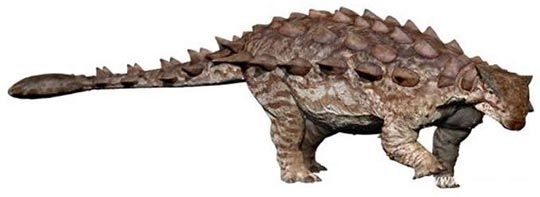
An Illustration of the Basal Ankylosaurine Jinyunpelta sinensis

Jinyunpelta sinensis illustrated.
An illustration of Jinyunpelta sinensis.

Picture credit: The Chinese Academy of Sciences

Two Fossil Specimens of Jinyunpelta sinensis

This new dinosaur, very distantly related to Late Cretaceous ankylosaurs like Euoplocephalus and Ankylosaurus (from which the group is named), has been described based on two fossil specimens.  The fossils come from Jinyun County, Zhejiang Province, China and have been excavated from rocks which form part of the Liangtoutang Formation, which covers the important boundary between Lower and Upper Cretaceous sediments (Albian faunal stage to the Cenomanian faunal stage of the Cretaceous).

The fossil material consists of an almost complete skull, parts of the jaw and postcranial remains including a beautifully-preserved tail club.

The Skull and Jaw of Jinyunpelta sinensis

The skull and mandible of Jinyunpelta sinensis.
Skull and jaw of Jinyunpelta (a) dorsal view, (b) ventral view and (c) anterior view, with accompanying line drawings.

Picture credit: The Chinese Academy of Sciences/Scientific Reports

The generic name derives from “Jinyun” (Mandarin) honouring Jinyun County where the fossils were found and “pelta” (Latin), a small shield, in reference to the osteoderms found on all ankylosaurians.  The root of the specific name “sin” (Greek) refers to China, the country of origin.

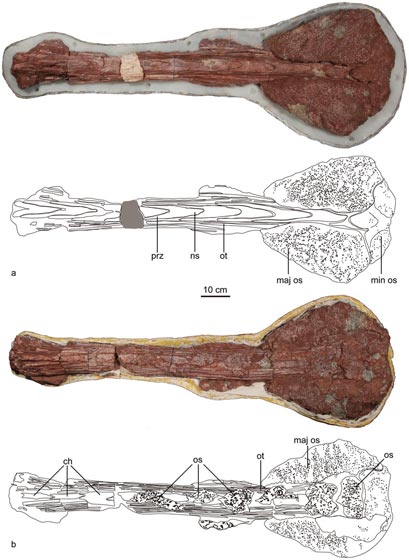
Photographs and Line Drawings of the Spectacular Tail Club

The Tail Club of Jinyunpelta sinensis.
The tail club Jinyunpelta sinensis paratype ZMNH M8963 in dorsal (a) and ventral (b) views.

Picture credit: The Chinese Academy of Sciences/Scientific Reports

The Oldest Swinger in Town

J. sinensis is described as a basal ankylosaurine dinosaur and it represents the oldest and the most basal ankylosaurian known to have a well-developed tail club knob.  It is quite a sizeable bony club too, getting on for nearly half a metre across at its widest part.  The researchers conclude that large and highly modified tail clubs evolved at the base of the ankylosaurine at least about 100 million years ago.

Jinyunpelta possesses unique cranial features which differentiates this Chinese dinosaur from other armoured dinosaurs known from the northern hemisphere, these autapomorphies support the establishment of a new genus.  Several other types of ornithischian dinosaur have been reported from this part of China, including another armoured dinosaur – a  nodosaur and basal ornithopod that was named and described in 2012 (Yueosaurus tiantaiensis)

The discovery of Jinyunpelta expands the known diversity and palaeogeographical distribution of ankylosaurians in Asia.

The scientific paper: “The Most Basal Ankylosaurine Dinosaur from the Albian–Cenomanian of China, with Implications for the Evolution of the Tail Club” by Wenjie Zheng, Xingsheng Jin, Yoichi Azuma, Qiongying Wang, Kazunori Miyata & Xing Xu published in the open access journal “Scientific Reports”.

Visit the Everything Dinosaur website: Everything Dinosaur.
5 03, 2018

Watching the Beautiful Birdie – Early Cretaceous

By |2024-05-04T17:53:36+01:00March 5th, 2018|Categories: Dinosaur and Prehistoric Animal News Stories, Dinosaur Fans, Main Page, Palaeontological articles, Photos/Pictures of Fossils|0 Comments

Early Cretaceous Enantiornithine Shines Light on Early Bird Evolution

A tiny, beautifully preserved fossil of a baby bird is helping scientists to shine a light on the early evolution of some of the first birds.  The fossil represents an enantiornithine bird and researchers, including Dr Fabien Knoll (Manchester University), have used synchrotron radiation to analyse the microscopic structure of the bird’s skeleton in order to assess at what stage of development the poor creature was at when it met its demise.

An Elemental Map of the Fossilised Skeleton was Created using Synchrotron Radiation

The enantiornithine bird fossil (elemental mapping).
Elemental mapping of the tiny bird fossil.  Mapping the slab and the counter slab of the fossil to determine the chemical composition of the skeleton.

Picture credit: Manchester University

The Enantiornithes – Early Birds

The Enantiornithes were a clade of diverse Cretaceous birds that possessed several characteristics of modern birds (Neornithines) but were also anatomically different in a number of respects.  They retained claws on their wings and most species had teeth, in contrast to all modern Aves which are edentulous.  Despite having an almost global distribution and being regarded as the most specious and successful birds of the Cretaceous, the Enantiornithes are thought to have become extinct at the same time as the last of the non-avian dinosaurs.

A study published in 2016 proposed that the evolution of a toothless beak may have helped some types of birds to survive the end Cretaceous mass extinction event.  To read an article summarising the study’s findings: Seed Eating May Have Helped Some Birds Survive the End Cretaceous Extinction Event.

The Enantiornithine Bird – One of the Smallest Mesozoic Avian Fossils Described

The specimen preserved on a slab and counter slab is one of the smallest Mesozoic bird fossils to have been found to date.  The specimen measures less than five centimetres in length and the baby bird would have been able to sit in an egg-cup.  However, it is remarkably well-preserved and the skeleton is virtually complete and what makes this fossil so significant is the fact that the baby bird died shortly after emerging from its egg.

The poor, unfortunate bird might have had an extremely short life, but it has given researchers a rare opportunity to analyse a baby bird’s bone structure and assess its skeletal development.

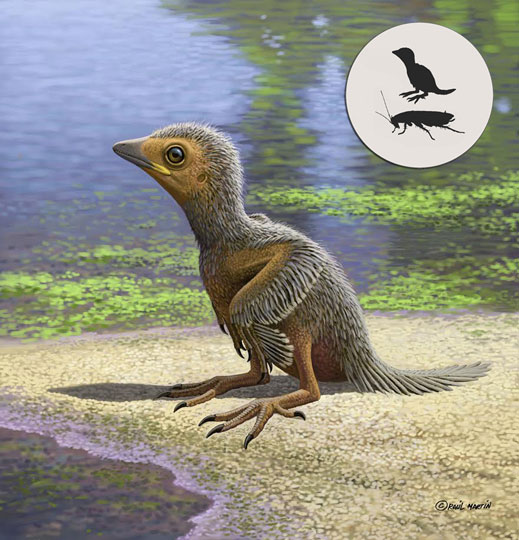
A Reconstruction of the Cretaceous Bird

A reconstruction of the baby Cretaceous bird.f
A reconstruction of the enantiornithine baby bird with insert showing scale.

Picture credit: Raul Martin

Assessing Bone Structure and Development

The scientists have been able to study the ossification of the bones, how they were growing and developing.  A better understanding of the skeleton of the very young bird will help researchers to better understand whether this bird species was capable of flight soon after birth and how independent it was.

Lead author of the study, Dr Fabien Knoll (Interdisciplinary Centre for Ancient Life [ICAL] at the School of Earth and Environmental Sciences, Manchester University) and the ARAID Dinopolis in Spain stated:

“The evolutionary diversification of birds has resulted in a wide range of hatchling developmental strategies and important differences in their growth rates.  By analysing bone development, we can look at a whole host of evolutionary traits.”

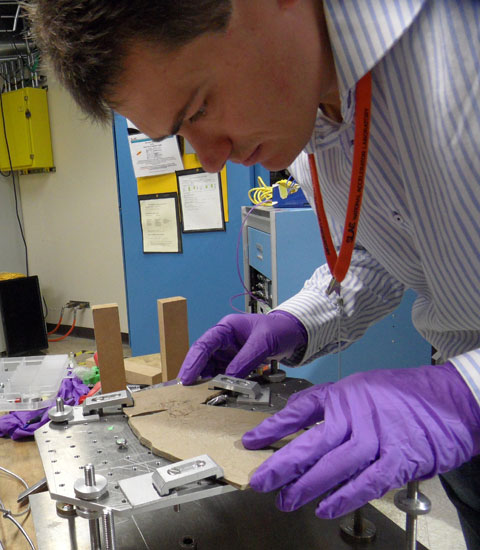
Lead Author of the Study Dr Fabien Knoll Prepares the Specimen for Analysis

Dr Knoll (Manchester University) studying the enantiornithine bird fossil.
Dr Fabien Knoll studying the slab and counter slab of the bird fossil.

Picture credit: Manchester University

Altricial, Precocial or Somewhere in Between

As the fossil was so small, being less than the length of the average person’s little finger, the team used synchrotron radiation to analyse the specimen at a “submicron” level.  The skeleton could be assessed in extreme detail and the microstructures of the bones observed.

Dr Knoll explained:

“New technologies are offering palaeontologists unprecedented capacities to investigate provocative fossils.  Here we made the most of state-of-the-art facilities worldwide including three different synchrotrons in France, the UK and the United States.”

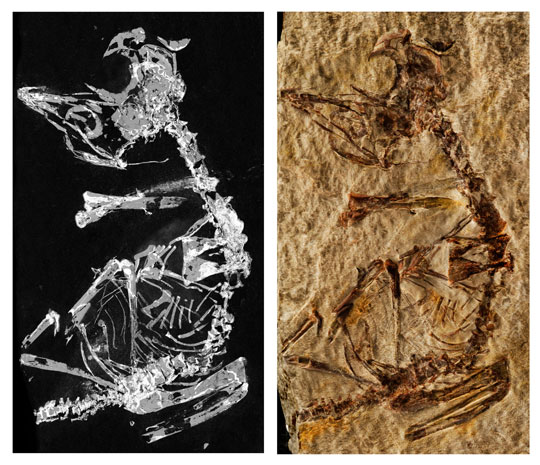
New Technology Helps to Map the Elemental Composition of an Ancient Bird Fossil

Phosphorous mapping and a photograph of the fossil.
A phosphorous map of the bird skeleton and photograph of the fossil.  The fossil is around 127 million years old (Early Cretaceous).

Picture credit: Manchester University

Synchrotron Analysis

The synchrotron analysis determined that the baby bird’s sternum (breastplate bone) was largely composed of cartilage and had not completely ossified.  The absence of hard bone in the sternum suggests that this bird could not fly.  The patterns of ossification observed in this and the other few, very young enantiornithine birds known to date also suggest that the developmental strategies of this particular group of ancient avians may have been more diverse than previously thought.

The researchers remain cautious and don’t wish to definitively come down on one side of the argument in terms of how dependent/independent this baby bird could have been.  The lack of bone development does not necessarily prove that the hatchling was reliant on its parents for feeding and care (altricial trait).

Bird Evolution

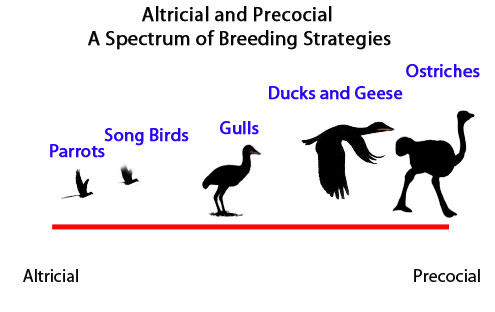
Modern birds demonstrate a variety of behavioural responses when it comes to bringing up babies.  Some bird species like chickens and ostriches have highly precocial young.  The babies are able to leave the nest and feed themselves within hours of hatching.  In contrast, most of the passerines (song birds) such as robins, blackbirds and thrushes are helpless when they hatch and rely on their parents to feed them and to keep them warm.

Altricial and precocial behaviours tend to be at opposite ends of a spectrum, the breeding strategy employed by this enantiornithine remains obscure.  As extant Aves exhibit a variety of breeding strategies from totally altricial through to super precocial (such as the megapodes, an example being the Australian brush turkey), it is difficult to clarify the development strategy of any extinct species.

Altricial and Precocial Behaviours can be Viewed as Opposite Ends of a Spectrum

Birds - altricial and precocial behaviours.
Altricial and precocial behaviours in Aves – a spectrum. Picture credit: Everything Dinosaur.

Picture credit: Everything Dinosaur

Co-author of the study, Luis Chiappe (Los Angeles Museum of Natural History) added:

“This new discovery, together with others from around the world, allows us to peek into the world of ancient birds that lived during the age of dinosaurs.  It is amazing to realise how many of the features we see among living birds had already been developed more than 100 million years ago.”

Everything Dinosaur acknowledges the assistance of a press release from Manchester University in the compilation of this article.

Visit the Everything Dinosaur website: Everything Dinosaur.
Go to Top