All about dinosaurs, fossils and prehistoric animals by Everything Dinosaur team members.

News stories and articles that do not necessarily feature extinct animals.

25 08, 2011

We are Amongst an Amazing 8.7 million Species – Give or Take a Million

By |2024-04-22T11:52:07+01:00August 25th, 2011|Categories: Animal News Stories, Educational Activities, Main Page|0 Comments

New Estimate for the Number of Species on Planet Earth

It was the Swedish physician and naturalist Carolus Linnaeus (1707 – 1778), who formed the basis for the classification of organisms in his Systema naturae, first published in 1735.  He grouped organisms with shared features and characteristics into different sets, creating an interrelated hierarchy of life, sometimes referred to as a “tree of life” as a result of its branching structure.  The basic unit in this classification is the species.  A species is defined as a group of organisms whose members have the potential to breed together and produce fertile offspring. Species are grouped into genera, genera into sub-families, families and so on.

Number of Species

Families are grouped into orders, for example our species Homo sapiens is classified with apes, monkeys into the primates (order).  Orders themselves are grouped into classes, and these in turn are grouped into phyla.  Members of different phyla differ in fundamental features such as body organisation and methods of locomotion and respiration.  Phyla are finally grouped into the largest commonly used classification a kingdom, such as the kingdom plantae (plants) and animalia (animals).

Scientists have argued ever since the time of Linnaeus as to just how many species there are on our planet.  Back in 1975, I recall reading a paper that estimated (conservatively as it turned out) that there were around one million species of insect on the Earth, other estimates have been made over the years using a variety of techniques and the total number of individual species estimated has varied widely, with as many as 100 million species being cited in some literature.

Not knowing how many species inhabit the Earth is one of the most fundamental questions in science.  Efforts to sample the world’s biodiversity to date have been limited and thus have precluded direct quantification of global species richness, and because indirect estimates rely on assumptions that have proven highly controversial.  However, a group of international scientists have used the basis of the classification system first devised by Linnaeus to propose a new calculation for the number of species.  This team calculates that we humans are amongst 8.7 million other species (plus or minus 1.3 million).

In a paper published in the online scientific journal PLoS Biology (Public Library of Science), the team state that the higher taxonomic classification of species (i.e. the assignment of species to phylum, class, order, family, and genus) follows a consistent and predictable pattern from which the total number of species in a taxonomic group can be estimated. Their work was validated against well-known taxa, and when applied to all domains of life, it predicted 8.7 million species in total with a margin for error of +/- 1.3 million eukaryotic species globally (with a nucleus in the cell).  Seventy percent of our planet’s surface may be covered by sea water, but according to these new calculations there are only 2.2 million species present in the sea.

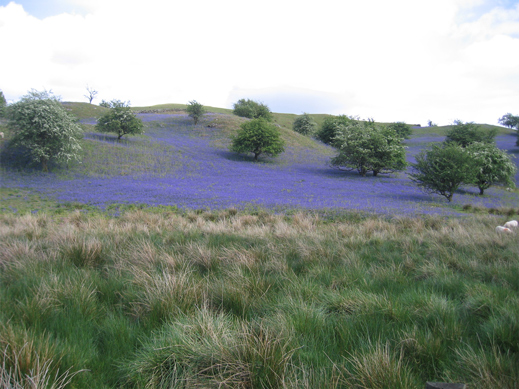
The Diversity of Planet Earth

The researchers including scientists from the Department of Biology, Dalhousie University, Halifax, Nova Scotia, Canada, the Department of Geography, University of Hawaii, Honolulu, Hawaii, and the United Nations Environment Programme World Conservation Monitoring Centre, Cambridge, United Kingdom, in conjunction with Microsoft research propose that some 86% of the species on Earth and 91% in the ocean, still await description.

Co-author Boris Worm of Dalhousie University stated that the recently-updated Red List issued by the International Union for the Conservation of Nature assessed 59,508 species, of which 19,625 are classified as threatened. This means the IUCN Red List, the most sophisticated ongoing study of its kind, monitors less than 1% of world species.

Our Planet’s Complex Biodiversity

Picture credit: Everything Dinosaur

It is important that scientists have an understanding of the biodiversity of planet Earth as without this, it would be very difficult to establish the current rate of extinction.  Many scientists believe that species are dying out at an alarming rate.  In what is known as the sixth mass extinction event, it has been estimated that as many as three species an hour are becoming extinct – many of these organisms are unknown to science.

To read Everything Dinosaur’s recent blog post about discovery of a new eel species: Primitive Eel Discovery “A Fishy Tale”.

As co-author of the study, Boris Worm of Dalhousie University points out:

“If we didn’t know – even by an order of magnitude (1m? 10m? 100m?) – the number of people in a nation, how would we plan for the future?  At its most basic, if we don’t know what we’ve got, we can’t protect it, and we can’t even be sure what we’re losing.”

For models and replicas of prehistoric and extinct creatures: Mojo Fun Prehistoric Life Models.

24 08, 2011

Which was the Largest Crocodile of All Time?

By |2023-03-08T13:52:40+00:00August 24th, 2011|Categories: Animal News Stories, Everything Dinosaur News and Updates, Main Page, Press Releases|35 Comments

Sarcosuchus, Purussaurus, Deinosuchus or Any Other Candidate?

With a Saltwater crocodile (Crocodylus porosus) at an animal park in Queensland (Australia), being recognised as the largest crocodile kept in captivity, team members at Everything Dinosaur started a debate amongst themselves as to which was the largest crocodilian known from the fossil record.

Largest Crocodile Ever

Crocodiles are certainly an ancient group of reptiles, with their origins predating the dinosaurs.  However, which of these animals would be classified as the largest – this might be difficult to say.

A few days ago, we reported that Cassius, an eighteen foot long “Salty” had been declared the largest crocodile in captivity by the Guinness Book of Records.

To read more about Cassius: Record Breaking Monster Crocodile.

However, a number of extinct types of crocodile are known to be much larger.  Indeed, having checked with the Guinness Book of Records, the largest prehistoric crocodile (according to them), is Sarcosuchus (Sarcosuchus imperator), a member of the Eusuchia, fossils of this crocodile are known from Cretaceous strata from Niger (Africa).  Although, there is a lack of fossil material, estimates of length provide a consensus that this reptile may have been ten to twelve metres long.

It has been suggested that this fearsome predator may have weighed eight tonnes.  This would make Sarcosuchus (flesh crocodile) a contender for the largest type of crocodile known.

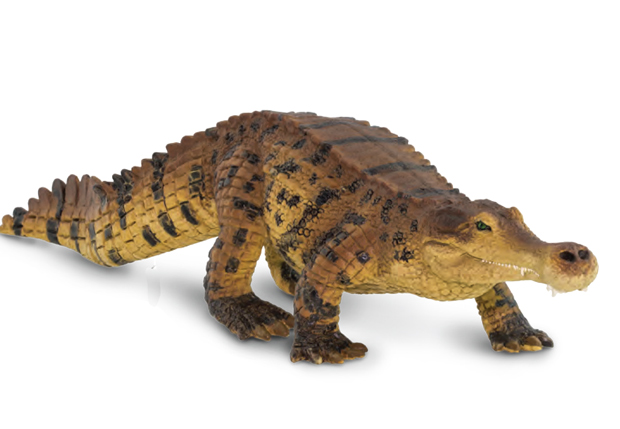
A Model of the Prehistoric Crocodile Sarcosuchus

2020 Wild Safari Prehistoric World Sarcosuchus.

Wild Safari Prehistoric World Sarcosuchus model.

Then there is the much more recent, South American, giant Purussaurus (Purussaurus brasiliensis).  This prehistoric caiman is known from a number of fossil locations in South America (Brazil, Peru and Venezuela).  An expedition to the Peruvian Amazon back in 2005 discovered more fossils and from one particular skull, which measures over fifty-five inches in length, it has been estimated that this caiman from the Miocene may have reached lengths of between ten and thirteen metres.  We think this member of the crocodile family is also known as Mourasuchus amazoniensis, but this is regarded as a junior synonym.

Deinosuchus

There is also Deinosuchus (Terrible Crocodile) to consider.  Deinosuchus (D. hatcheri) lived during the Late Cretaceous.  Its fossils have been found in the United States.  Once again size estimates are difficult to affirm.  When looking at extant species today, the head length can be assessed as being approximately one eighth the size of the entire animal measured from the tip of its snout to its tail.

This is a useful guide when trying to work out the size of a crocodile or alligator when it it swimming and only a portion of the head is above the water.  Using measurements taken from a huge, nearly complete skull, found in the Big Bend River formation, Texas, and described by the scientists Colbert and Bird back in the 1950s, Deinosuchus was estimated to be over fifteen metres long and to weigh in excess of eight Tonnes.  Since then further analysis of fossil fragments, bones and dermal armour (scutes) has been undertaken and palaeontologists now estimate Deinosuchus to be a little smaller, but it is still a contender for the largest croc of all time.

The jaws are more robust than those of Sarcosuchus, suggesting that Deinosuchus predated upon large animals, perhaps attacking dinosaurs as they came close to water to get a drink.

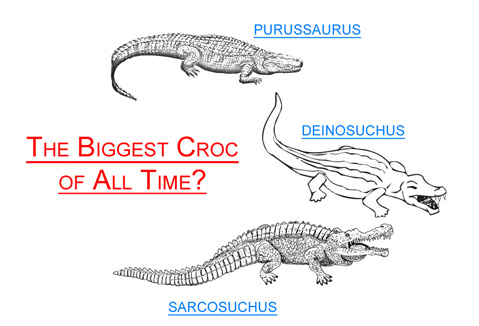
Which was the Largest Crocodile?

One for the Guinness Book of Records to contemplate.

Picture credit: Everything Dinosaur

Team members at Everything Dinosaur have had a go at producing art materials and drawings to illustrate the likely candidates for the title of largest crocodile known to science.

Recently, a group of scientists published a paper detailing their study of suspected Deinosuchus coprolites (fossilised dung), thus providing a potential insight into this reptile’s diet:

To read more about Deinosuchus and a follow up article: Ancient Crocodile Poop Provides Information on the Diet of Deinosuchus.

Update on Deinosuchus: Update on the Diet of Cretaceous Crocodiles.

The crocodiles are indeed an ancient group of reptiles, they evolved into a myriad of forms, some of these were gigantic but as to which genus was the biggest – it looks like we will be debating this for some time.

For models and replicas of prehistoric animals including many models of extinct animals from the crocodilian line of the Archosauria: Ancient Crocodiles and Prehistoric Animal Models.

21 08, 2011

Monster Crocodile Recognised as the Largest in Captivity

By |2023-03-08T12:36:40+00:00August 21st, 2011|Categories: Animal News Stories, Main Page|1 Comment

Cassius to Enter Guinness Book of Records

An enormous Saltwater crocodile (Crocodylus porosus) which measures a fraction under eighteen feet in length has been officially recognised by the Guinness Book of Records as the largest crocodile in captivity.  The fearsome croc, known as Cassius is a resident at Marineland Melanesia on Green Island off the coast of Cairns (northern Queensland, Australia).

The monster crocodile, believed to be over 100 years old has been in captivity since it was brought to the marine park back in 1987, having been captured in the wild near to Darwin a few years earlier.  It was captured as it had attacked a number of boats in the Darwin area and it was thought to be too big and dangerous to be left at large.

Monster Crocodile

Saltwater crocodiles are man-eaters and are responsible for a number of fatal attacks on people each year.  Despite his great size, Cassius can stay hidden in just eighteen inches of muddy water, ready to explode out of the water to catch his prey.  These reptile ambush specialists are extremely dangerous and we at Everything Dinosaur have reported upon a number of Saltwater crocodile attacks in recent months.  From the various slide marks and tail drags left in northern territory river banks and mud flats, some tourist guides believe that in the wild there may be one or two “Salties” that are in excess of twenty feet long.

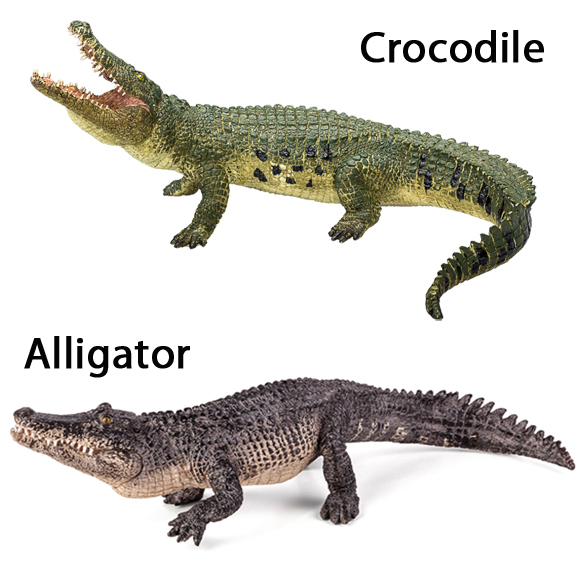
The Difference Between a Crocodile and an Alligator

Crocodile and Alligator comparison.

Crocodile (top) and Alligator (bottom).

The Largest Crocodile Ever

Guinness World Records also recognised the world record for the largest crocodile ever, set by Sarcosuchus imperator, which was a prehistoric species of crocodile which lived around 110 million years ago.

Recent fossilised remains found in the Sahara Desert suggest that this creature took around 50-60 years to grow to its full length of around 11-12 metres (37-40 ft) and its maximum weight of around 8 tonnes.  This is likely to prove controversial to palaeontologists as many would suggest that Deinosuchus (Deinosuchus hatcheri), a huge prehistoric crocodile from the Late Cretaceous of the United States, would have been bigger, certainly heavier.  Other scientists may argue that the Miocene crocodile Purussaurus (Purussaurus brasiliensis), known from fossils found in Brazil, Peru and Venezuela could be a contender.

To read an article about Sarcosuchus: Introducing Sarcosuchus.

Cassius the Crocodile

Cassius bears the scars from his battles with other crocs during his younger days, and has lost his left arm. But at times, the giant reptile has shown a softer side.

Marineland crocodile keeper Toody Scott stated:

“He has shown a bit of an affectionate side with some of the younger female crocs we’ve introduced to him.”

But as we know from bitter experience, never trust a crocodile, they are always looking for an opportunity to attack.

“He’s a very wise croc, very good at pretending that he is nice and gentle; added Mr Scott.

“He can very much lull you into a false sense of security, which is what crocodiles are very good at doing.  I wouldn’t trust him for a second.”

We agree, crocodiles and people do not mix, best to leave them alone or at least only view the likes of Cassius from behind the safety of the bars on his enclosure.

To view models of prehistoric crocodiles, dinosaurs and other prehistoric animals, take a look at the Mojo Fun prehistoric model range: Mojo Fun Prehistoric Animal Models.

20 08, 2011

Walrus Causes Mammoth Confusion

By |2023-01-20T17:05:37+00:00August 20th, 2011|Categories: Animal News Stories, Dinosaur and Prehistoric Animal News Stories, Main Page|0 Comments

Fossil Walrus Skull Causes Mammoth Alert

Lennon and McCartney may have written a song called “I am the Walrus” with the opening line “I am he as you are he as you are and we are all together”, but the Beatles could not have imagined that Russian authorities could have mixed up a fossil Walrus skull with a Woolly Mammoth fossil but that is what is being reported in on-line media this morning.

Fossil Walrus Skull

According to a number of news sources there was much excitement in Russian scientific circles when it was reported that a reindeer herder had found a perfectly preserved, fossilised baby Woolly Mammoth.  Woolly Mammoth tusks and other isolated fossils are frequently found in the Siberian Summer as ancient remains of these long dead elephants are washed out of melting permafrost.  To find a baby, a Woolly Mammoth calf, even a few articulated fossils would be an extremely significant discovery.  Back in the Summer of 2007, as reported by the Everything Dinosaur web log, Russian scientists were able to extract the deep-frozen remains of a one month old baby Woolly Mammoth which had been almost perfectly preserved.  This Woolly Mammoth, affectionately dubbed Lyuba is now part of a touring Mammoth and Mastodon Exhibition organised by the Chicago Museum.  This exhibition is due to arrive in the UK in 2013.

To read more about the discovery of Lyuba: New Baby Woolly Mammoth Found.

It was initially claimed that the find was as well preserved as Lyuba.   Believed to have died around 40,000 years ago, Lyuba is the best preserved Woolly Mammoth (Mammuthus primigenius) known to scienceAuthorities in the Yamalo-Nenets region said yesterday morning they were scrambling a helicopter to the location.  With the high Summer melt well underway, any flesh that has thawed will start to rot and therefore the Russian authorities were in a race against time to reach this remote location.

A spokesperson for the scientists, scrambled to reach the carcase stated:

“If what is said about how it is preserved turns out to be true, this will be another sensation of global significance.”

However, the scientists and researchers were to be disappointed, as when examined the fossil turned out to be that of a Walrus.  Leader of the Woolly Mammoth rescue mission Ms Fyordorova commented:

“It turned out to be a walrus skull; apparently a fossilised one.  It’s still a good present for us.  We don’t have any walruses yet.”

It may not be a Mammoth, but the fossilised remains of an ancient Walrus could provide the researchers with valuable information as to how the region has changed over thousands of years.

Better luck next time, as the Beatles sang “I am the Walrus, goo goo g’joob”.

To view a soft toy Woolly Mammoth soft toys and other prehistoric plush: Woolly Mammoth and Ice Age Soft Toys.

18 08, 2011

Jawbone Suggests Giant Birds May have Lived Alongside the Dinosaurs (According to New Research)

By |2024-04-22T11:52:41+01:00August 18th, 2011|Categories: Animal News Stories, Dinosaur and Prehistoric Animal News Stories, Dinosaur Fans, Main Page, Palaeontological articles|0 Comments

New Fossil Discovery Suggests Giant Birds Lived During the Mesozoic

Most scientists now agree that the birds (Aves) are descended from a particular group of dinosaurs – theropods, but the accepted view that birds were small, crow-sized creatures living very much in the shadow of their reptilian cousins has been challenged once again with the discovery of a single jawbone fragment.  This fossil suggests that giant prehistoric birds, the size of the largest bird living today (Ostrich), could have roamed amongst the dinosaurs during the Late Cretaceous.

Giant Prehistoric Birds

Ironically, the fossil languished in a museum collection before its significance was recognised, as we at Everything Dinosaur know from experience, sometimes an animal new to science can be found within a museum’s collection.  Either the key, holotype fossils have been incorrectly assigned to an already known species or in many cases the importance of the fossil is simply not recognised.  Even new dinosaur species can be found lurking inside museum cabinets and collections.

To read an article on discovery dinosaurs inside museums: The Best Place to Find a New Dinosaur Inside a Museum.

Two lengths of bone were uncovered at a dig site in southern Kazakhstan  (Kyzylorda district) by a joint Soviet-East German scientific expedition in the 1970s.  The fossil fragments were carefully prepared and put together to make a jaw almost thirty centimetres in length but the significance of the fossil was not recognised.  It was the property of a German collector for a number of years and then went on display in a Belgian museum.

Scientists Study Fossil

Fossils come from strata associated with the Bostobynskaya Formation (also known as the  Bostobe Formation).  It has been dated to the Late Cretaceous approximately 85 million years ago.  The team of scientists, including Gareth Dyke from University College Dublin, dissolved away the plaster and glue that had been used to prepare the fossil fragments in the 1970s to reveal the true fossil bone.

The research paper co-authored by scientists from University College, Dublin, University of Portsmouth, Museo Geologico e Paleontologico (Bologna) plus contributions from French and Belgium based researchers has been published in the scientific journal “Biology Letters”.

Dr Dyke commented:

“This is one of the largest birds that’s ever been described of any age.  We don’t have much of it, but we know the lower jaw is at least as big if not bigger than the Ostrich lower jaw.  At the age it is, it’s pretty exciting.”

Although, the toothless jawbone indicates a member of the Aves, some scientists have proposed that the specimen could represent a member of the Dinosauria, after all, toothless dinosaurs with beaks are known from the Late Cretaceous fossil record and a number of different types of dinosaur do have a number of anatomical features that closely resemble those of extant birds – dinosaurs such as members of the Oviraptorosauria, ornithomimids and Alvarezsauria for instance.

Giant Size in the Aves

Images show two possible body plans for S. nessovi, firstly that of a flightless bird such as an extant Emu or Ostrich, secondly, as a bird capable of flight.  The human figure (looking remarkably like the statue of David by Michelangelo), provides scale.  The small bird in the diagram represents the size of a typical Late Cretaceous flying bird as known from other fossil material found in Asia.

Dr Dyke added:

“We have always assumed that giant size in birds was something that evolved relatively late in the history of the group, so to find a specimen so early is remarkable.  This is a giant of a bird with no teeth from the Late Cretaceous.”

The world of fossilised birds has been subject to a number of seismic shocks recently.  For example, Chinese scientists have reported that the iconic fossil of Archaeopteryx (A. lithographica) may not actually represent a bird at all.  These scientists have postulated that Archaeopteryx may be a feathered, cursorial theropod.

To read more about this issue: Is Archaeopteryx about to be Knocked off Its Perch?

Samrukia nessovi

The fossil has been ascribed to the Aves and it has been formally named Samrukia nessovi.  This creature is named after a mythological phoenix-like bird from local legend – the Samruk. The specific name honours  Lev Nessov, an eccentric Russian palaeontologist who used to take the bus or train from St Petersburg into Central Asia to embark on long hikes into the desert to hunt for fossils.  He committed suicide in 1995 at the age of 48 after the breakup of the Soviet Union restricted his travels.

The researchers are unsure as to whether S. nessovi was flightless or not.  Based on measurements from the single fossil jaw, they have estimated that if it had the same body shape as an Ostrich, it would have stood between two and three metres tall.  If it resembled an Albatross it would have had a wingspan of over four metres.  Unfortunately, with only one fossil specimen to work with it is impossible to say much more about this creature.

Giant Birds of the Cretaceous

The fossil is only the second giant, land-living bird species to be discovered in Cretaceous-aged rocks and the first to be found in Asia.  A previously recognised species, Gargantuavis philoinos, was named in 1998 from France but experts have argued over its identification.  If Samrukia nessovi is a bird as scientists suggest the new, Kazakh specimen would help confirm the presence of giant prehistoric birds in the Cretaceous period.

Dr Darren Naish, an eminent palaeontologist from the University of Portsmouth, said that the creature provides significant new information on life in Cretaceous times.

He stated:

“Since the 1850s we’ve known that numerous bird species lived during the age of the dinosaurs (known as the Mesozoic Era), but virtually all were crow-sized or smaller.  The Ostrich-sized Gargantuavis from France is the one notable exception and now this new Mesozoic bird from Kazakhstan – known only from its toothless lower jaw – shows that gigantic birds also lived in Cretaceous Central Asia.”

Although unsure whether or not this bird was flightless or whether it took to the skies, Dr Naish added:

“We can now be really confident that Mesozoic terrestrial birds weren’t all thrush-sized or crow-sized animals, giant size definitely evolved in these animals and giant forms were living in at least two distinct regions.  This fits into a larger, emerging picture that Mesozoic birds were ecologically diverse, with lots of overlap between them and modern groups.”

Dr Naish concluded:

“The fragmentary nature of our Samrukia specimen will always mean that some people have doubts about it, but specialists who have seen the remains agree with our interpretation.  The French Gargantuavis has already demonstrated the presence of giant Cretaceous birds and we argue that Samrukia adds a second example and increases the significance of Gargantuavis since it shows that it wasn’t a one off.”

Unfortunately, the absence of other fossil material prevents the scientists from finding out much more about this creature that is new to science.  They can only speculate on what it ate for instance.  Did S. nessovi hunt small dinosaurs, or was it an omnivore perhaps? Just how big was this giant prehistoric bird?

Dr Naish commented:

“We have only the lower jaw, and this doesn’t provide key information on what the whole bird was like.  Hopefully new material will be unearthed to provide us with more information, such as understanding what role it was playing in Cretaceous ecosystems.  We do know that the fossil came from a floodplain environment.  This would have been a large flattish plain, criss-crossed by big, meandering rivers.  Fossil wood shows that forests were present nearby and aquatic animals indicate the continual presence of lakes, pools or big rivers.”

Dr Naish added:

“Samrukia was conceivably in danger from tyrannosaurs, dromaeosaurs and other predatory dinosaurs that occurred in the same region but we can’t say whether Samrukia itself was predatory, herbivorous or omnivorous as the lower jaws don’t reveal any obvious specialisations for, say, dedicated plant-eating or feeding on aquatic prey.”

Giant Prehistoric Birds Alongside the Dinosaurs

Hopefully, new fossil finds will help scientists to piece together (literally), more information about this strange creature from the Late Cretaceous.  If more fossil material is found, then scientists may be able to confirm that Samrukia nessovi is a bird to resolve the puzzle of whether or not it could fly and what it ate.

Dr Naish concluded:

“People tend to forget that birds co-existed with their dinosaurian relatives but it now seems that the Cretaceous was not a ‘dinosaurs-only theme park.’  This find confirms that large birds were living alongside dinosaurs and may have been more widespread than previously thought.”

For models and replicas of Late Cretaceous prehistoric animals: Wild Safari Prehistoric Animal Models and Figures.

9 08, 2011

Baby Frogs Leaving the Office Pond

By |2023-03-08T12:53:43+00:00August 9th, 2011|Categories: Animal News Stories, Main Page|1 Comment

Frogs Start Their Exodus

Over the last few days we have observed a number of tiny frogs in and around the office pond.  Although tadpoles have been difficult to spot we were confident that a number of tadpoles had been able to survive long enough to complete their metamorphosis into frogs.  We expect that over the next few days these tiny creatures, most measuring about a centimetre in length will make their way out of the pond and disperse around the yard and the surrounding area.

Office Pond

We are not sure whether this year’s frogs should be referred to as  froglets.  However, it is always pleasing to see these creatures complete the change from fully aquatic tadpole to amphibian.  Occasionally, we come across small frogs around the office buildings, we think that these are survivors from 2010.

To read our earlier post about the first frogspawn spotted in the office pond: First Frogspawn Spotted in the Pond.

Interestingly, when we look back at our records and previous web log articles, we note that frogs had been observed leaving the pond earlier in previous years.  There may be a number of reasons for this.  Firstly, the relatively poor Summer with lots of rain may have kept the water temperature lower than the seasonal norm and this may have slowed the tadpoles development.  Perhaps the poor Summer weather resulted in less food available and this too, would have inhibited the tadpoles growth.  It could also be that  we have simply not observed the frogs leaving as we did last year.

When working late yesterday evening, a went out with a torch to see what I could see in the yard by the pond.  It was raining and as we know from experience frogs seem to be more active in rain then when it is dry.  I counted three frogs within the vicinity of the pond, all of them were large so these were not from this year’s hatch.  Perhaps as the froglets are so small, I just did not see them, so this too could account for the lack of young frog observations outside the pond area.

A Fuzzy Picture of One of Last Years (2010) Frogs

Picture credit: Everything Dinosaur

Our records show that young frogs started to leave the pond in the middle of July back in 2009 and last year.  We have yet to observe one of this year’s tadpoles having left the pond as a fully formed adult, outside the immediate pond area.

For models and replicas of ancient tetrapods including prehistoric amphibians: CollectA Deluxe Ancient Tetrapods and Prehistoric Animals.

4 08, 2011

The First of the Great Apes

By |2023-01-20T13:47:09+00:00August 4th, 2011|Categories: Animal News Stories, Main Page|0 Comments

Newly Discovered Fossil Could Be the First Evidence of a Great Ape

Scientists believe the hominids evolved in Africa from apes, however, the paucity of the fossil record has prevented researchers from learning more about the evolution of the apes themselves.  Now the discovery of a twenty-million-year-old fossil in Uganda could help scientists piece together an aspect of primate evolution.

Great Ape

The freshly unearthed 20-million-year-old skull may have belonged to a common ancestor of humans and the other great apes so say excited palaeontologists.  A team led by Martin Pickford, a palaeoanthropologist at the College de France in Paris, and Bridgette Senut, at the National Museum of Natural History in Paris, discovered the fossils last month, while excavating the semi-arid region surrounding the extinct Napak Volcano in northeastern Uganda.

The team attributed the partially complete skull to the species Ugandapithecus major, a hulking Miocene epoch ape known mostly by its other body parts.

Pickford commented:

“It was a pretty big animal, almost as large as a gorilla, about the size of a chimpanzee.”

His team plans to analyse the fossil more closely in France (it will be cleaned and prepared in France) and describe it in a Ugandan scientific journal.  But he says its small brain already stands out.

He went on to add:

“You’re talking about an animal that has the muzzle of a gorilla with the brain size that would go with a baboon.”

Its small brain and other facial features such as its teeth and palette could suggest that modern chimpanzees and gorillas have evolved substantially from their ape ancestors, the researchers have concluded.  The skull shares a number of features with modern-day orangutans, suggesting that the evolutionary lineage that gave rise to modern orangutans changed less.

Evolutionary Origins of Great Apes

But the evolutionary origins of great apes – humans, chimpanzees, bonobos, gorillas and orangutans – are poorly understood, due to the paucity of the fossil record.  The discovery of well preserved elements of the skull are an important find.  The size of the canines indicate that this animal was probably a male, the lack of wear on the teeth (molars) and other characteristics indicate that it died when it was about ten years of age.

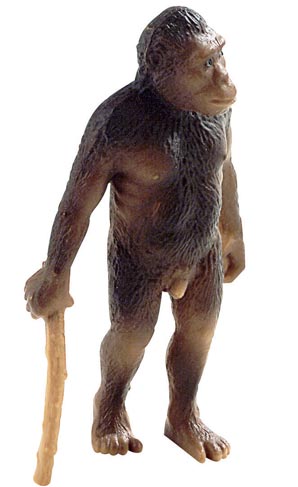
A Model of an Australopithecus

Australopithecus afarensis.

At home on the plains. A model of an Australopithecus.

Pickford stated:

“Finding the skull of Ugandapithecus is really going to focus the debate on that particular linage, but we must not forget there were quite a few other species running around at the same time.”

He went on to comment that closer examination should reveal more about the relationship between U. major and the extant great apes such as gorillas and orangutans that are alive today:

“My gut feeling at the moment is that it’s not far from the ancestor of modern African apes and orangutans.  I’ve been waiting for about 30 years for this kind of discovery.”

For models and replicas of primitive hominins and other prehistoric mammals: Wild Safari Prehistoric Mammals and Early Human Figures.

1 08, 2011

Crocodile Attacks and Kills Teenage Boy

By |2023-03-08T12:59:52+00:00August 1st, 2011|Categories: Animal News Stories, Main Page|0 Comments

Fishing Trip Ends in Tragedy

An Indonesian teenager, fishing from a boat with friends was attacked and killed by a large Saltwater crocodile over the weekend.  Despite frantic efforts from his companions the boy was dragged into the water by the large reptile and following an extensive search by locals and army personnel his body was recovered the next day.

Saltwater Crocodiles

Saltwater crocodiles, also known as Estuarine crocodiles (Crocodylus porosus) can be found over a vast area of the Pacific from Sri Lanka to the Fiji Islands, including northern Australia.  These crocodiles have a deserved, fearsome reputation.  Some specimens have been recorded as reaching lengths in excess of 7 metres and weighing over a tonne.  Unfortunately, attacks from crocodiles are on the increase as crocodile numbers recover from hunting and poaching and people move into areas where crocodiles are abundant.

The Difference Between a Crocodile and an Alligator

Crocodile and Alligator comparison.

Crocodile (top) and Alligator (bottom).

As a consequence of an increased number of crocodile attacks in northern Australia there have been calls for a re-introduction of culling to control crocodile numbers.

To read more about this: Calls for Crocodile Controls in the Northern Territories.

The teenage boy, Hanry Rumfable, was just fourteen.  He and his friends were fishing from a boat just five hundred metres from their village on the Salafem River, in North Misol, Raja Ampat when suddenly the crocodile attacked.

Crocodile Attacks

According to survivors Steven and Melki, the attack was sudden and Hanry stood no chance.

Melki, just fifteen tried in vain to pull Hanry to safety by grabbing his friends T-shirt but it was to prove futile.

He said:

“I saw when he was being pulled by the crocodile off the boat and dragged into the water.”

Villagers accompanied by soldiers conducted a search for Hanry’s body shortly after the incident was reported, though it was not until the next day that they found his body tucked between mangrove trees.  Melki said he was still in shock after witnessing the gory attack and had been too afraid to return home to tell Hanry’s parents what had happened to their only son.

Our thoughts are with Hanry’s family, unfortunately attacks of this nature are an all too common occurrence in areas where Saltwater crocodile numbers are known to be high.

31 07, 2011

Rare Fossil Reveals Some Ancient Lizards were Viviparous

By |2024-04-22T11:59:10+01:00July 31st, 2011|Categories: Animal News Stories, Dinosaur and Prehistoric Animal News Stories, Main Page|0 Comments

120-Million-Year-Old “Pregnant” Lizard Discovered

Most reptiles lay eggs, however, a number of extant species are viviparous, that is they bring forth live young, retaining the embryos inside the body of the female and not laying eggs that are deposited outside the body.  The ability to produce live young is found in a number of lizards and snakes species today (Order Squamata), scientists were not sure when this ability evolved, but the discovery of a heavily gravid fossilised lizard in China, shows that viviparity had evolved in lizards by the Early Cretaceous.

Ancient Lizards

Garter snakes, harmless snakes of the genus Thamnophis can be found over much of North America including high latitudes.  The twenty or so species of Garter snakes are all relatively small, if we exclude Thamnophis gigas, a species of Garter snake found in California which grows to over a metre long.  All of these snakes produce live young, broods of between 14 and 40 dependent on the particular species.   These snakes prefer semi-aquatic environments and many, resident in the northern part of their range, hibernate to escape the worst of the cold weather.  It is believed that the ability to bring forth live young, evolved as a response to the harsh environments members of the Order Squamata lived in.  Such conditions such as the cold springs of North America make the survival of any eggs laid outside the body less likely.

A Pregnant Lizard

The newly discovered fossil of a pregnant lizard proves that some squamate reptiles were giving birth to live young, rather than laying eggs, in the Early Cretaceous period, much earlier than previously thought.  The fossil shows a pregnant female filled with the tiny skeletons of more than 15 baby lizards at a stage of development similar to that of late embryos of modern lizards.  The mother lizard, which is 30 centimetres long (excluding her tail), probably died only a few days before giving birth.  The research into this heavily gravid lizard was carried out by scientists at the University College London in co-operation with researchers from the Institute of Vertebrate Palaeontology and Palaeoanthropology at the Chinese Academy of Sciences (Beijing).  The paper detailing this study has just been published in the scientific journal “Naturwissenschaften”.

The Slab and Counter Slab Showing the Gravid Lizard Fossil

Picture credit: University College London

The red circle in this picture indicates the area of the image that has been enlarged to reveal the fossilised embryos of the lizards.

A Close up of the Lizard Fossil Showing the Unborn Babies

The fossil evidence.

Picture credit: University College London

Joint lead-author of the research paper, Professor Susan Evans of the University College London stated:

“Mention live birth and most people think only of furry mammals, but roughly 20% of living lizards and snakes also produce live young rather than laying eggs.  We previously thought that lizards adapted to live birth after mammals, but now it looks like it happened at roughly the same kind of time.  This specimen is the oldest we have seen, which implies physiological adaptations, like adequate blood supply to the embryos and very thin shells, or no shells at all, to allow oxygen supply, evolved very early on.”

The fossil comes from world famous rocks of the Jehol Group of north-eastern China (Liaoning Province) that have produced hundreds of exquisite specimens of fish, amphibians, reptiles (including dinosaurs) birds and mammals, as well as plants and invertebrates.  Indeed, back in 2009, scientists published a paper on a small theropod dinosaur that proposed that at least one genus of the Dinosauria had a characteristic in common with members of the Squamata – it may have been venomous just like a rear-fanged snake.

To read an article about this: A Venomous Dinosaur from China.

Yabeinosaurus

The mother lizard is identified as a specimen of Yabeinosaurus, a large, slow-growing, and relatively primitive lizard that is well-represented in the Jehol Biota, although previously nothing was known of its reproductive habits.  Up until now the fossil records only contained examples of marine lizards giving birth to live young (for example, ichthyosaurs).

Images show a very famous fossil of a female ichthyosaur that perished whilst in the process of giving birth.  A young ichthyosaur can be seen emerging tail first from the mother, and inside the body cavity the remains of other baby ichthyosaurs can be seen.

To read more about viviparous ichthyosaurs: The Evidence to Prove that Ichthyosaurs gave Birth to Live Young.

The evolution from being oviparous (laying eggs) to giving birth to live young (viviparous) is usually associated with cold, dangerous environments where eggs are unlikely to survive.  The drawback is that the mother is limited in terms of movement and self-defence.  This explains why scientists previously thought that live birth in extinct reptiles was restricted to specialised aquatic groups, as movement in water is much easier for a gravid female.

Professor Evans went onto add:

“We do know that this lizard lived near to water and we think it likely that they could swim even though they primarily lived on land.  This would make sense as a pregnant lizard would be less constrained by carrying offspring, she would be able to escape into water if a hungry dinosaur came along!”

The work was funded by a joint Anglo-Chinese project funded by the Royal Society and the National Natural Science Foundation of China and we at Everything Dinosaur are grateful to the University College London for their help in putting together this article.

For models and replicas of ancient members of the Squamata: Prehistoric Squamata Models and Dinosaurs.

21 07, 2011

A Deep-Snouted Prehistoric Crocodile that could Gallop like a Horse

By |2023-01-20T12:13:29+00:00July 21st, 2011|Categories: Animal News Stories, Dinosaur and Prehistoric Animal News Stories, Main Page|0 Comments

Seventy-Million-Year-Old Prehistoric Crocodile

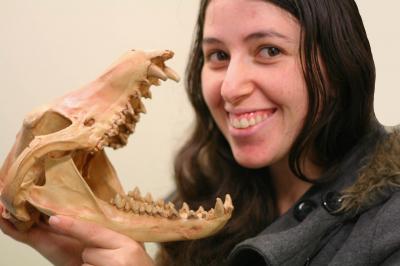
Researchers at McGill University (Montreal) and the University of São Paulo (Brazil) have described a new species of terrestrial crocodile that stalked the Late Cretaceous plains of Brazil.  This bizarre, deep-snouted crocodile had fang-like teeth and long legs indicating that this was a crocodile which, unlike its extant cousins was very comfortable out of the water.

To McGill palaeontology professor Hans Larsson, one of his graduate students Felipe Montefeltro and Professor Max Langer of the University of São Paulo, a recently discovered crocodile skull looks a little like the skull of a dog with its deep, broad features and its large teeth.  However, to the casual observer this is one creature that you would not like to come across, after all it could probably run quicker than your average person.

Named Pissarrachampsa sera, the fossil was discovered by a municipal worker in 70-million-year-old Cretaceous sediments in a small town in Minas Gerais, Brazil.  Sent to check it out by the Society of Palaeontology in Brazil, Langer and Montefeltro realised they had something very special.  The three researchers have documented their observations in the July edition of PLoS One (the public library of science).

Pissarrachampsa sera

Familiar with Hans Larsson’s work on crocodiles and dinosaurs, Montefeltro got a study grant from the Brazilian government and brought the fossil to Larsson’s lab at McGill’s Redpath Museum, where they have been studying the head and finding that this remarkable terrestrial crocodile reveals almost as much as it conceals.

Professor Larsson stated:

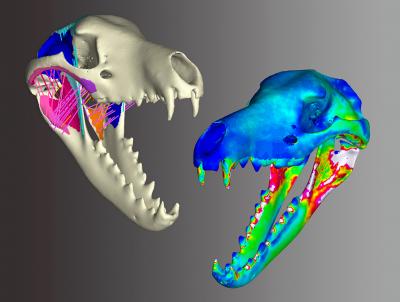
“Whereas modern-day amphibious crocodiles have low and flat heads, this new find gives us one of the first detailed insights into the head anatomy of this weird group of extinct crocs called Baurusuchia that feature tall, dog-like skulls with enlarged canines, and long-limbed body proportions.”

Their ecology was probably similar to that of wild dogs living today.  Given the number and size of their teeth, the researchers believe these carnivorous crocodilians fed on animals about as big as they were, in the 5 metre plus range.  So dinosaurs and other reptiles would have been on the menu.  Whether these crocs. formed packs like hunting dogs is unknown.  They would have used relatively stereoscopic vision to track prey and, rather than scramble like the crocs we see today, they galloped along on elongated limbs.

A sketch by Larsson imagines how this newly discovered species would have appeared in predatory motion.  Though the body might seem more dinosaur in shape than today’s crocodile, the fossil head carries the definitive characteristics of crocodiles from that era, including a well-developed secondary palate, socketed teeth, advanced cranial air spaces, roughened bone surfaces, plated armour, and massive attachments for jaw closing muscles.

Recent CT scans are offering more fascinating aspects of the fossil, such as its brain size and shape and hearing abilities.  Baurusuchian crocodiles are characterised by a significant number of unique anatomical features such as low tooth counts, tall, thin skulls, forward facing nostrils, and derived jaw-closing muscle attachments.  After comparing the new species to other Baurusuchids and their relatives, the researchers noticed large gaps on either side of the fossil’s morphology.

Montefeltro commented:

“We are dealing with an exceptionally divergent lineage of extinct crocodile diversity.  There are many fossils that still need to be found to link this crocodile to those who came before and after.”

Montefeltro explained that the name of this new member of the croc family pays homage to the location of the fossil’s discovery.  Piçarra is a regional word for sandstone and Champsa is a Latinisation of the Greek word for crocodile. Sera, is Latin for late – which refers to both the circumstances in which the fossil was found, that is, it was almost left behind in a 2008 expedition because of a tight schedule and, the Minas Gerais state flag that quotes Virgil “Libertas Quæ Sera Tamen” meaning “Freedom, Albeit Late.”  One thing that is for sure, if these animals were around today, then a any unwary tourist to its Brazilian homeland could very well end up “late and lamented”

Though their importance for Crocodyliform evolution is widely recognised, there are still a lot of questions about the internal relationships of the group not yet studied, but which all three researchers plan to explore.  A digital reconstruction of the fossil’s brain cavity is a work in progress and will be presented later this fall at the Society of Vertebrate Palaeontology’s annual meeting.

Recently, Safari introduced a model of Late Cretaceous terrestrial crocodile called Kaprosuchus.  To view the Safari model range and dinosaur models: Kaprosuchus and Other Archosaurian Models.

A Model of the Prehistoric Crocodile – Kaprosuchus

Papo Kaprosuchus model.

Papo Kaprosuchus model, the pen provides scale. Picture credit: Everything Dinosaur.

Picture credit: Everything Dinosaur

To view the Papo prehistoric model range: Papo Kaprosuchus and Prehistoric Animal Figures.

Reproduced with kind permission: The McGill Reporter who helped Everything Dinosaur compile this news story about a prehistoric crocodile from Brazil.

Go to Top