All about dinosaurs, fossils and prehistoric animals by Everything Dinosaur team members.

Everything Dinosaur’s work with photoshop and other platforms.

6 02, 2022

Rebor Deinosuchus “Estuary” Video Showcase

By |2024-10-23T07:25:10+01:00February 6th, 2022|Categories: Adobe CS5, Dinosaur Fans, Everything Dinosaur News and Updates, Everything Dinosaur Products, Everything Dinosaur videos, Main Page, Product Reviews|0 Comments

Everything Dinosaur team members have produced a short video highlighting the features of the Rebor Deinosuchus model in the estuary colour scheme. The brief video, which is up on the company’s popular YouTube channel has been created so that potential customers can get a really good look at this limited-edition figure.

A spokesperson for the UK-based mail order company confirmed that they were planning to make more product showcase videos and to post them up onto Everything Dinosaur’s website.

Video credit: Everything Dinosaur

Highlighting the Deinosuchus Model

The product video showcase features the limited-edition Rebor Club Selection: Meta the Hatchling Deinosuchus in the estuary colour scheme. The short video (it lasts a little over forty seconds), provides information on the number of replicas made, the model’s measurements and highlights the packaging as well as the unique product number located on the base of the Deinosuchus figure.
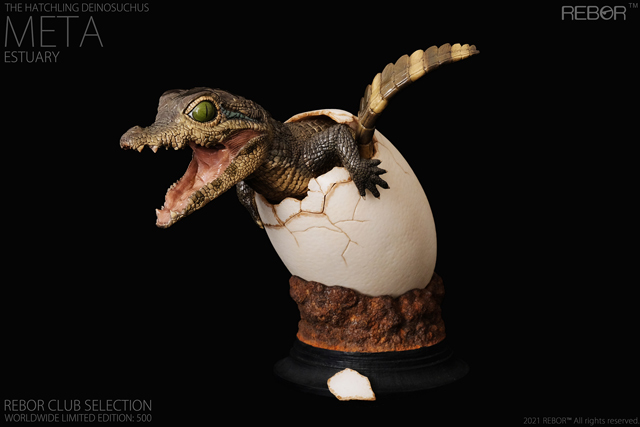
Rebor Meta the hatchling Deinosuchus model (Estuary Variant0

The Rebor Club Selection: Meta the hatchling Deinosuchus is about to leave its egg! It’s very keen to get to the safety of the water.

Collecting Collectable Crocodilian Figures

The Rebor Deinosuchus replica in the estuary colour variant is one of two versions that have been manufactured. The other replica is the swamp version, which will feature in a forthcoming Everything Dinosaur product video showcase. Both limited-edition figures are highly collectable and when current stocks are sold, these models will not be put back into production.

Rebor Club Selection Deinosuchus figures

The Rebor Club Selection Deinosuchus figures – the box contents. The limited edition Estuary variant (right) and the limited edition Swamp variant (left). Picture credit: Everything Dinosaur.

Picture credit: Everything Dinosaur

Visit the Everything Dinosaur website: Prehistoric Animal Models and Toys.

As with the swamp colour variant, Everything Dinosaur team members will include a free Deinosuchus fact sheet with sales of this excellent figure from the company’s website.

A spokesperson from Everything Dinosaur stated:

“This is the first Rebor Deinosuchus Club Selection product video showcase, the YouTube video featuring the other version, the swamp variant will be posted up onto Everything Dinosaur’s YouTube channel in a few days. Over the last few weeks, we have made several product video showcases that highlight Rebor models including the recently introduced Smilodon populator figures. Whilst we are unable to put up videos of every single item in the Rebor range we hope that the short videos that we have made provide customers with more information and allow them to appreciate the excellent quality of the models within this particular product portfolio.”

To view the range of Rebor models in stock at Everything Dinosaur: Rebor Models and Figures.
5 02, 2022

A Remarkable Miocene Fish Skull Fossil Filled with Fossil Worm Poo

By |2024-10-23T07:18:40+01:00February 5th, 2022|Categories: Adobe CS5, Dinosaur and Prehistoric Animal News Stories, Main Page, Palaeontological articles, Photos/Pictures of Fossils|0 Comments

The famous marine sediments of the Chesapeake Group, which outcrops across North Carolina, Delaware, Virginia and Maryland in the USA are regarded as some of the most extensively studied Cenozoic marine deposits in the world. The first fossil described from North America (Ecphora quadricostata) a marine snail which was scientifically described in 1685, comes from deposits associated with the Chesapeake Group (St Marys Formation)

A Miocene Fish Fossil

Many different types of fish and marine invertebrates have been named from fossils found at locations such as the Calvert Cliffs on the western shore of Chesapeake Bay (Maryland). Cetacean fossil material is also associated with these strata, along with sea cows and many seabirds such as gannets and fulmars. Marine turtles and the remains of land tortoises and freshwater crocodiles are also known.

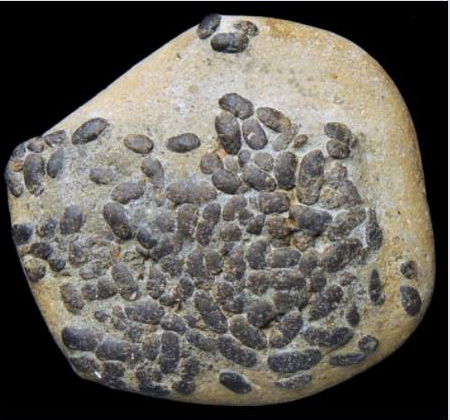
A researcher from the Calvert Marine Museum (Maryland), is one of the authors of a recently published scientific paper that highlights a first for these Miocene-aged deposits. The partial skull of a fish has been found crammed full of tiny, fossil poo probably created by scavenging worms that once feasted on the head of the fish.

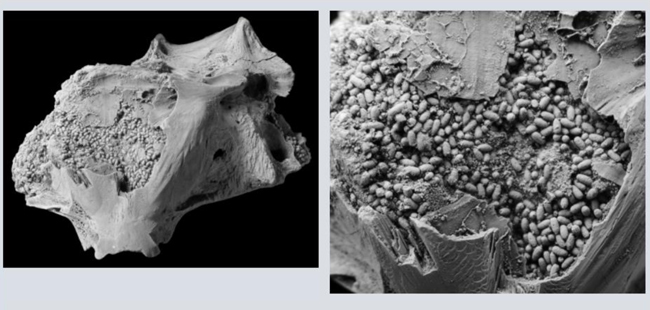
Invertebrate faecal matter in fossil fish braincase.

Photograph (left) of the partial skull of the Miocene Stargazer fish (ventral view). Some of the bone has broken away revealing hundreds of fossilised faecal pellets filling the braincase. A close-up view of the faecal matter (right). Picture credit: Calvert Marine Museum.

Picture credit: Calvert Marine Museum

Stargazer Skull (Astroscopus spp.)

The specimen represents the first skull completely infilled with faecal pellets ever recorded, the fossil poo (micro-coprolite) is an example of the coprulid ichnospecies Coprulus oblongus. The pellets range in size from 1 mm to 5 mm in length and the skull comes from a Stargazer fish (Astroscopus), a genus of bottom living fish that bury themselves in soft sediment lying in wait to ambush small fish and invertebrates that come within striking distance.

Miocene coprolite fossil.

A fossil of worm faecal pellets from Miocene-aged deposits from southern Maryland (USA). Each pellet is approximately 3 millimetres in length. Picture credit: Calvert Marine Museum.

Picture credit: Calvert Marine Museum

Crocodile Coprolites Studied Too

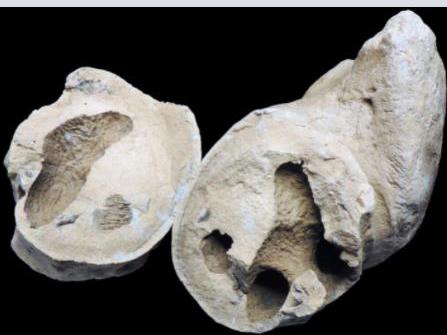
Writing in the academic journal “Rivista Italiana di Paleontologia e Stratigrafia”, the researchers also describe a series of trace fossils found in preserved crocodile coprolite from the Miocene Calvert Formation. The fossil crocodile poo was tunnelled into, presumably evidence of the faeces being consumed (coprophagy). The scientists are unable to identify the organism(s) responsible for producing the burrows although the sides of the burrows preserve evidence of scratches which are thought to be feeding traces.

Crocodile coprolite fossil with feeding traces.

Crocodile coprolite broken open showing trace fossil burrows made by a coprophagus organism. Feeding gouge marks can be seen on the walls of the burrow. Length of crocodile coprolite 17.5 cm approximately. Picture credit: Calvert Marine Museum.

Picture credit: Calvert Marine Museum

Whilst these remarkable fossils might not be as awe-inspiring as the whale bones that have been found in these rocks, they provide important evidence with regards to the recycling of nutrients from faecal matter in Miocene-aged marine environments.

The scientific paper: “Coprolites from the Calvert Cliffs: Miocene fecal pellets and burrowed crocodilian droppings from the Chesapeake Group of Maryland, USA” by Stephen J. Godfrey, Alberto Collareta and John R. Nance published in Rivista Italiana di Paleontologia e Stratigrafia.

4 02, 2022

Ice Age Animal Remains Found in Devon

By |2024-10-23T07:08:51+01:00February 4th, 2022|Categories: Adobe CS5, Dinosaur and Prehistoric Animal News Stories, Main Page, Photos/Pictures of Fossils|0 Comments

The remains of several different types of Ice Age mammal that inhabited south-western England have been recovered from a cave in Devon. The fossils, which are estimated to be between 30,000 and 60,000 years old provide scientists with a unique perspective on the fauna that existed during the Devensian, or the Last Glacial Period (LGP). Although ice sheets did not reach south-western England, Devon would have experienced extreme cold, tundra-like conditions.

Animal remains found in the cave include the partial remains of a Woolly Mammoth (Mammuthus primigenius), bones from a Woolly Rhinoceros (Coelodonta antiquitatis), the skeleton of a wolf, plus hyena, red fox, horse, reindeer and mountain hare fossils.

Ice Age Prehistoric Animal Remains found in Devon

The jumbled up bones of Ice Age animals found in a Devon cave. Picture credit: Historic England.

Picture credit: Historic England

An “Exceptional” Fossil Site

A substantial new town consisting of over 5,000 new houses and related infrastructure is being built close to Plymouth. The Sherford Consortium, the developers, state that the cave was located close to old lime kilns and Sherford Quarry. Commenting on the significance of the discovery, Duncan Wilson, Chief Executive of Historic England stated that these fossils were “exceptional” and added:

“To have found partial remains of such a range of species here in Devon gives us a brilliant insight into the animals which roamed around Ice Age Britain thousands of years ago, as well as a better understanding of the environment and climate at the time.”

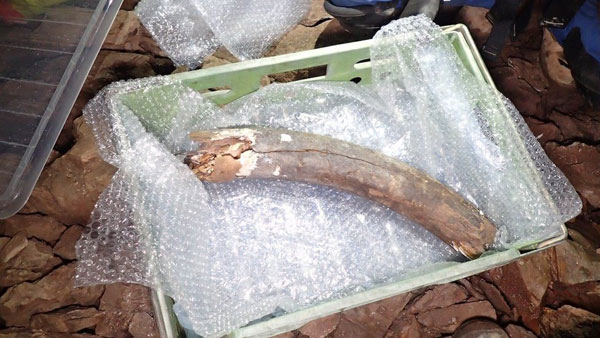
Mammoth Tusk from the Devon Cave

Part of a mammoth tusk carefully being packed into a box for transport off the dig site. Picture credit: AC Archaeology.

Picture credit: AC Archaeology

Ice Age Animal Remains

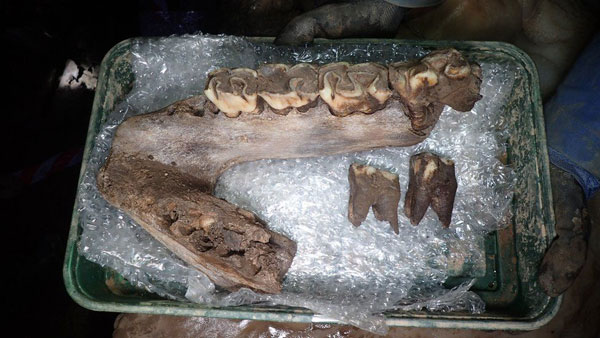
A team of experts have been brought in to carefully document and record the fossil finds. The fossils, including an exceptionally preserved lower jaw from a Woolly Rhinoceros (C. antiquitatis), are currently being studied. It is hoped that this collection of Ice Age remains will be able to stay in the county, with the most likely final destination for the fossils being “The Box”, a recently opened museum in Plymouth close to the University.

Woolly rhino jaw with dentition.

A lower jaw from a Woolly Rhinoceros with some teeth in situ with two additional teeth. Picture credit: AC Archaeology.

Picture credit: AC Archaeology

The Mammoth Gallery

Proposals have been made to put the fossils on permanent display in the Mammoth Gallery of The Box Museum. Plymouth’s former Museum and Art Gallery was re-opened as “The Box” in 2020 following extensive development and renovation. The Mammoth Gallery at the museum explores the natural history of Devon and includes many fossil specimens of the Ice Age fauna associated with south-western England.

The excavation and removal of the fragile fossils involved specialist archaeologists such as those from AC Archaeology, independent archaeological consultants and contractors who provide advice on historic environment issues to developers, local authorities and national bodies.

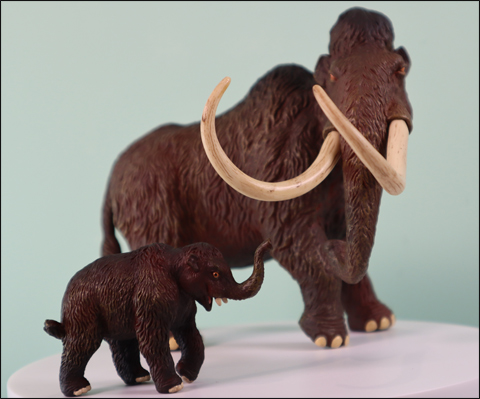
CollectA Woolly Mammoth models.

The CollectA Deluxe Woolly Mammoth model in 1:20 scale and the CollectA Prehistoric Life Woolly Mammoth calf. Woolly Mammoths roamed Devon. Picture credit: Everything Dinosaur.

Picture credit: Everything Dinosaur

3 02, 2022

PNSO Paul the Allosaurus Video Showcase

By |2024-10-22T21:58:34+01:00February 3rd, 2022|Categories: Adobe CS5, Dinosaur Fans, Everything Dinosaur Products, Everything Dinosaur videos, Main Page, Photos of Everything Dinosaur Products, Press Releases, Product Reviews|0 Comments

Everything Dinosaur team members have created a short, forty second video that highlights the PNSO Paul the Allosaurus dinosaur model. This replica of the Late Jurassic theropod Allosaurus has proved to be extremely popular amongst model collectors and dinosaur fans. Everything Dinosaur has set about creating short YouTube videos that are between thirty to sixty seconds in length that feature some of the prehistoric animal models that the UK-based company stocks.

The PNSO Paul the Allosaurus figure has been a top seller since it was introduced last year, so it was an obvious candidate for the company’s video showcase project.

Video credit: Everything Dinosaur

The Everything Dinosaur website: Dinosaur Models.

PNSO Paul the Allosaurus

Introduced in 2021, part of a substantial an enlargement of the PNSO not-to-scale mid-size model range, Paul the Allosaurus is also a firm favourite amongst Everything Dinosaur team members. The video showcase shows the figure on a turntable and demonstrates the articulated jaw. The packaging is shown and a team member holds the model so the size of the figure can be easily assessed. The model measurements (approximately 25 cm in length and around 9 cm in height), are also stated in the brief video.

PNSO Paul the Allosaurus

PNSO Paul the Allosaurus dinosaur model in lateral view.

Creating Videos to Help Customers

These short videos are designed to provide a “flavour” of the figure. The Everything Dinosaur website (and this blog), puts up lots of images of prehistoric animal models, but customers have requested videos and team members are busy compiling a library of short videos to provide customers with more information and to help them to make informed purchase decisions.

PNSO Paul the Allosaurus dinosaur model

The new for 2021 PNSO Paul the Allosaurus dinosaur model has an articulated lower jaw, just like the majority of the theropod figures that PNSO have produced in the larger size model series.

To view the range of PNSO prehistoric animal models and figures available from Everything Dinosaur: PNSO Age of Dinosaurs Models and Figures.

30 01, 2022

Rebor Smilodon “Ice Age” Video Showcase

By |2024-10-16T07:34:03+01:00January 30th, 2022|Categories: Adobe CS5, Dinosaur Fans, Everything Dinosaur News and Updates, Everything Dinosaur Products, Everything Dinosaur videos, Main Page|0 Comments

Team members at Everything Dinosaur have produced their second short YouTube video highlighting the features of a prehistoric animal model that the company has in stock. The first video showcase featured the Rebor Smilodon populator in the plain colour scheme, so it is only fitting that the second video in this new series should focus on another Rebor Smilodon figure, the Ice Age colour variant.

The forty-five second video shows the model, packaging and box contents. How easy it is to change the heads is demonstrated and the Smilodon figure placed on a revolving turntable is shown with the open jaws head and then with the closed head attachment.

Video credit: Everything Dinosaur

The Everything Dinosaur website: Prehistoric Animal Toys.

Rebor Smilodon populator Stray Cat in the Ice Age Colour Scheme

The captions in the video provide details of the model’s measurements and confirm that the Smilodon figure has a declared scale of 1:11. Team members took advice from Rebor and from viewers of the first Smilodon video showcase to improve the lighting and exposure on the turntable footage to permit the colouration of the model to be shown clearly.

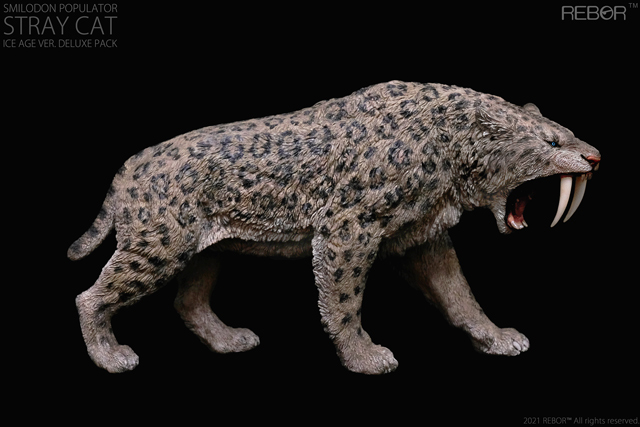
Rebor Smilodon populator Stray Cat Ice Age model

The Rebor Smilodon populator Stray Cat Ice Age colour variant.

A spokesperson from Everything Dinosaur commented that the Rebor Smilodon populator Stray Cat model in the Ice Age colour scheme had been selected for the second video showcase after the very positive feedback the company had received after their first YouTube video which featured the plain colour variant.

The spokesperson went onto add:

“We intend to create more showcase videos of models and figures. Our plan is to embed these videos into the product pages of our company website so visitors can see videos as well as images of the models that we sell. We aim to provide as much information as possible to help customers to make an informed purchase decision.”

To view the Rebor range of models and figures available from Everything Dinosaur: Rebor Models and Figures.
To visit Everything Dinosaur’s YouTube channel and subscribe: Subscribe to Everything Dinosaur on YouTube.

28 01, 2022

Rebor Smilodon “Plain” Video Showcase

By |2024-10-15T17:26:58+01:00January 28th, 2022|Categories: Adobe CS5, Dinosaur Fans, Everything Dinosaur News and Updates, Everything Dinosaur Products, Everything Dinosaur videos, Main Page|0 Comments

A few days ago, team members at Everything Dinosaur announced that they were looking at adding short videos to the company’s website that could highlight prehistoric animal models and their features. A video was posted on Everything Dinosaur’s YouTube channel outlining these plans and asking for feedback on the idea. This YouTube video also featured the first of the Everything Dinosaur products to get placed into the spotlight, the Rebor Smilodon populator Stray Cat in the plain colour variant.

This forty-five second video showcase has been posted up on the channel as a separate, stand-alone item and it can be viewed (see below).

Video credit: Everything Dinosaur

Demonstrating the Model

The idea behind these short, 30-60 second videos is that we can help customers to make informed purchase decisions. We do put up lots of images on our product pages, but the video will help us to demonstrate some of the features of the figure. For example, we can show the articulated jaw, poseable arms and the flexible tail. We can demonstrate how the model is put together as well as showing the box contents and the packaging.

These videos will help customers to get a really good look at the figure they are considering purchasing. Viewers will be able to gauge the quality and detail of a replica.

Feedback has been overwhelmingly positive and we are grateful for all the comments that we have received. A second product video showcase, this time featuring the Rebor Smilodon populator Stray Cat in the Ice Age colour scheme will be posted up shortly.

Rebor Smilodon populator Stray Cat Ice Age model

The Rebor Smilodon populator Stray Cat Ice Age colour variant.

A spokesperson from Everything Dinosaur commented:

“The first video showcase featuring a prehistoric animal model stocked by Everything Dinosaur has been posted up. The video features the Rebor Smilodon populator Stray Cat in the plain colour scheme. We intend to post up more videos in the coming weeks.”

To view the range of Rebor models and figures available from Everything Dinosaur, including the Smilodon populator replicas: Rebor Models and Prehistoric Animals.

27 01, 2022

The Popular Papo Pentaceratops Gets a Display Base

By |2024-10-15T17:22:57+01:00January 27th, 2022|Categories: Adobe CS5, Dinosaur Fans, Everything Dinosaur Products, Main Page, Photos of Everything Dinosaur Products|0 Comments

Our thanks to prehistoric animal model fan and collector James who sent into Everything Dinosaur some pictures of the display base he had made for his Papo Pentaceratops model. The clever design of the Papo Pentaceratops permits collectors to display this figure as a quadruped or in a rearing pose, the Pentaceratops being balanced on its hind legs supported by its tail. James has added a base to the figure and created a little prehistoric scene in which this large, horned dinosaur is confronted by a crocodilian.

Papo Pentaceratops with display base

The Papo Pentaceratops dinosaur model is confronted by a crocodilian. Although alarmed by the presence of a predator this large, ornithischian dinosaur has nothing to fear from the croc. Picture credit: James.

Picture credit: James

Crocodilians Prey on Dinosaurs

Palaeontologists have named and described a wide range of different crocodilians and their close relatives from fossils found in Upper Cretaceous rocks in North America. Pentaceratops fossils are known from the Kirtland Formation (late Campanian faunal stage), in New Mexico. The sandstones and mudstones that predominately make up these deposits were laid down in a wide, alluvial flood plain close to the western shore of a shallow sea that split North America into two landmasses – Appalachia to the east and Laramidia to the west.

Papo Pentaceratops Display Base

The Pentaceratops display base. The horned dinosaur is alarmed by the presence of the crocodilian. Picture credit: James.

Picture credit: James

Several crocodilians are known from the Kirtland Formation (Denazinosuchus, Leidyosuchus and Brachychampsa), but these genera would have posed no threat to a fully-grown Pentaceratops, or indeed any large plant-eating dinosaur.

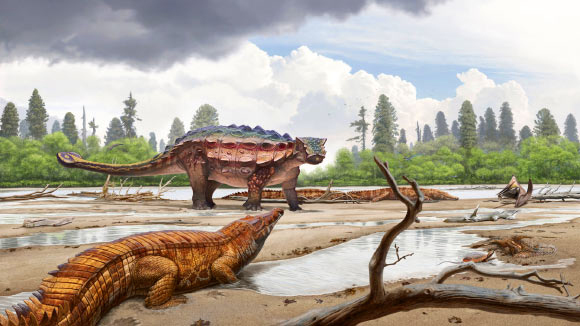
Akainacephalus johnsoni.

The Akainacephalus drawing shows some of the fauna associated with the dig site.

Picture credit: Andrey Atuchin (Denver Museum of Nature and Science)

An adult Deinosuchus could have been a threat to a Pentaceratops. Although this giant alligatoroid lived during the Campanian and its fossils are associated with estuarine environments of the Western Interior Seaway, team members at Everything Dinosaur are unaware of any Deinosuchus fossils having been excavated from Kirtland Formation deposits. Still, it is highly likely that dinosaurs such as Pentaceratops would have frequently come across large crocodilians at water holes or when attempting to cross rivers, so some interspecific interaction is entirely plausible.

Papo Pentaceratops display base.

A close-up view of the Papo Pentaceratops display base. Picture credit: James.

Picture credit: James

Papo Pentaceratops

The Papo Pentaceratops has proved to be a popular model, since it was introduced into the Papo “Dinosaures” range in 2019. A spokesperson from Everything Dinosaur stated that they had been delighted to receive the images of the dinosaur and praised the model collector for creating such a carefully constructed prehistoric scene.

Visit the Everything Dinosaur website: Dinosaur Toys.

Papo Pentaceratops dinosaur model.

The Papo Pentaceratops dinosaur model. Picture credit: Everything Dinosaur.

Picture credit: Everything Dinosaur

To view the Papo Pentaceratops and the rest of the Papo models in stock at Everything Dinosaur: Papo Dinosaurs and Prehistoric Animal Models.

26 01, 2022

An Exclusive Everything Dinosaur Video Showcase

By |2024-10-15T17:12:04+01:00January 26th, 2022|Categories: Adobe CS5, Dinosaur Fans, Everything Dinosaur News and Updates, Everything Dinosaur Products, Everything Dinosaur videos, Main Page, Photos of Everything Dinosaur Products|2 Comments

We at Everything Dinosaur get lots of feedback and suggestions from our customers and we are grateful for the comments that we receive. We read them all carefully and where we can, we implement customer recommendations.

Take for example, a suggestion we have had from several of our customers – wouldn’t it be great if there were short product videos on the Everything Dinosaur website, so visitors could get a really good look at the item before buying. A video showcasing the prehistoric animal model would help a potential customer to make an informed purchase decision.

Everything Dinosaur listens to its customers, we aim to create short 30-60 second videos and embed them into our website.

Here is a short YouTube video that explains our plans and reveals the first figure to receive a “video showcase” – the Rebor Smilodon populator Stray Cat in the plain colour version.

Video credit: Everything Dinosaur

Rebor Smilodon populator Video Showcase

As well as seeing images supplied by the model manufacturer, visitors to Everything Dinosaur’s website: Everything Dinosaur could get access to a short video that provides a showcase for the prehistoric animal model. Potential customers can view a video of the actual model, allowing them to see how the articulated jaws works, how much movement the flexible tail provides and they can gain an appreciation of the build quality.

In the case of the Rebor Smilodon populator Stray Cat figures, our video showcase demonstrates how easy it is to swap the heads over, allowing the figure to be displayed with either its mouth open or closed.

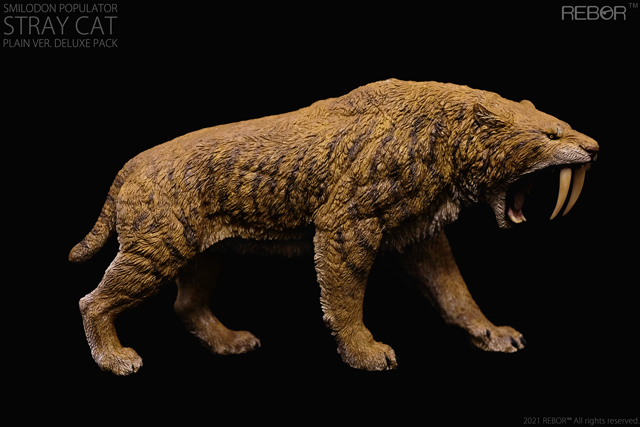
Rebor Smilodon model "plain".

The Rebor Smilodon populator Stray Cat in the “plain” colour scheme. The model is supplied with two interchangeable heads, one showing the mouth open, the other with the mouth closed as seen here. Picture credit: Everything Dinosaur.

Picture credit: Everything Dinosaur

Plans to Make More Product Video Showcases

A spokesperson from Everything Dinosaur commented that the company still intended to produce other videos such as more detailed model reviews, updates on new model introductions and videos providing hints and tips for collectors.

He explained:

“At the request of our customers, we plan to embed into our product pages short videos less than a minute in length that provide a visual guide to the figure, its packaging and the box contents. We have been asked to include footage of a person holding the model, viewers can instantly judge how big the figure is.”

Rebor Smilodon populator Stray Cat Plain

The Rebor Smilodon populator Museum Class Replica Deluxe Pack Stray Cat Plain displayed with its mouth open.

Providing Model Measurements

The model video showcase will permit us to reinforce the printed information we include about products on the Everything Dinosaur website. We do measure models and figures ourselves and post up this information under the “additional information” link on the product page, but we can also state the measurements and show any declared scale in the “video showcase”.

Rebor Smilodon populator (plain colour variant)

A still from the Rebor Smilodon populator (Stray Cat) in the plain colour variant showing model measurements and declared scale. Picture credit: Everything Dinosaur.

Picture credit: Everything Dinosaur

To view the Rebor Smilodon populator model and the rest of the Rebor replica range available from Everything Dinosaur: Rebor Models and Figures.
Everything Dinosaur’s YouTube channel is jam-packed with prehistoric animal videos. The channel contains lots of helpful information for dinosaur fans and model collectors: Subscribe to Everything Dinosaur on YouTube.

23 01, 2022

New Prehistoric Times Issue 140 Reviewed

By |2024-10-15T16:48:11+01:00January 23rd, 2022|Categories: Adobe CS5, Dinosaur and Prehistoric Animal Drawings, Dinosaur Fans, Magazine Reviews, Main Page|0 Comments

The winter edition (issue 140) of “Prehistoric Times” is a bumper issue with over 60 pages crammed full of articles, features and illustrations. Talented artist Mark Hallett provides the front cover for the magazine, an illustration entitled “Predator’s Moon”. It features a bear-dog (Amphicyon lydekkeri) crunching on some bones. Mark provides a guide to the bear-dogs inside and provides more artwork on these enigmatic mammals.

Collectors of “Prehistoric Times” will recall that Mark also provided the artwork for the front cover of issue 138 (Neanderthal woman).

Issue 140 of Prehistoric Times

Prehistoric Times issue 140 (winter 2022) the front cover illustration by Mark Hallett.

Picture credit: Mark Hallett

Neovenator and Megalictis

Phil Hore provides articles for the featured prehistoric animals in this issue. There is a piece on the Lower Cretaceous theropod from England – Neovenator (N. salerii), its inclusion ties in well with the palaeo news section, as lots of British research and English dinosaur discoveries are reported. There is also a special feature on the ferocious North American mustelid Megalictis with lots of reader artwork incorporated into it.

Jon Lavas continues his long-running history of the work of renowned Czech artist Zdeněk Burian. In issue 140, the focus is on Burian’s illustrations of ceratopsians and there are some truly iconic illustrations provided.

Styracosaurus illustration (Burian 1941).

The classical depiction of Styracosaurus albertensis by Burian (1941). The illustration depicts two horned dinosaurs emerging into a clearing. This image has inspired many other artists and box art packaging designers. Picture credit J. R. Lavas.

Picture credit J. R. Lavas

Tracy Lee Ford contributes part 2 of his in-depth analysis of dinosaur integumentary coverings (feathers). It includes a glossary of scientific terms and some beautifully detailed illustrations. On the subject of beautiful illustrations, palaeoartist Emily Willoughby is interviewed and the article includes an array of stunning images depicting feathered dinosaurs.

Randy Knol profiles some of the latest prehistoric animal model releases and magazine editor Mike Fredericks has been kept busy with new models and reviews of the latest books. Take a look at the “Mesozoic Media” section of the magazine, it includes a review of “Dinopedia: A Brief Compendium of Dinosaur Lore” by Tetrapod Zoology author Darren Naish from the University of Southampton.

The review concludes by stating that this book is “highly recommended as a handy reference guide for all your dinosaur questions.”

Dinopedia front cover illustration

The front cover of Dinopedia features a horned dinosaur. Picture credit: Everything Dinosaur.

Picture credit: Everything Dinosaur

Visit the award-winning Everything Dinosaur website: Dinosaur Models.

Prehistoric Coins, 3-D Printed Dinosaurs and “The Beast of Busco”

The magazine contains an article discussing the history of prehistoric animals depicted on coins written by Brian Novak. Model maker Sean Kotz provides a step-by-step guide to creating a unique Neovenator model from a 3-D print and Matt Howard provides an entertaining account of the giant turtle nicknamed “The Beast of Busco”.

There is some wonderful reader submitted artwork, special mentions to Samuel Pickens and John Sibbick for their Neovenator illustrations, for M. Elliot Massion for the Megalictis grabbing a goose as well as the Neovenator lurking behind a teapot. The Woolly Rhino painting by Jacek Major and the Edmontosaurus annectens by Sergey Krasovskiy are also impressive.

Pastorama Dimetrodon image

There is a lot to get your teeth into when examining the latest edition of “Prehistoric Times” issue 140. This black and white photograph is from an article that looks at the World’s Fair. Picture credit: Don Glut.

Picture credit: Don Glut

There is a lot to praise in the latest issue of “Prehistoric Times”.

To learn more about this magazine and to subscribe: “Prehistoric Times”.

22 01, 2022

Preparing for a New Nothosaurus

By |2024-10-14T13:25:30+01:00January 22nd, 2022|Categories: Adobe CS5, Dinosaur and Prehistoric Animal Drawings, Dinosaur Fans, Everything Dinosaur News and Updates, Everything Dinosaur Products, Main Page, Press Releases|0 Comments

The new for 2022 Schleich Nothosaurus model will soon be in stock at Everything Dinosaur and team members have been busy preparing a fact sheet all about this Triassic marine reptile. We research and write an information sheet on virtually every prehistoric animal model that we stock. The Nothosaurus fact sheet will be sent out with our sales of the Schleich model.

Schleich Nothosaurus model

The new for 2022 Schleich Nothosaurus marine reptile model.

Several Species of Nothosaurus Have Been Described

Several species of Nothosaurus have been named and scientifically described, although the taxonomy and exact composition of this genus is still debated. The type species, is N. mirabilis, named from fossils found in Middle Triassic rocks from Germany. It is estimated to have been up to four metres in length, although it shared its marine habitat with considerably larger nothosaurs such as Nothosaurus giganteus, which like the recently described Nothosaurus zhangi (2014), from China may have reached lengths of around seven metres, making these fish-eaters from the Triassic bigger than an extant Saltwater crocodile (C. porosus).

Nothosaurus drawing.

The illustration of Nothosaurus commissioned by Everything Dinosaur for use in the company’s Nothosaurus fact sheet. Picture credit: Everything Dinosaur.

Picture credit: Everything Dinosaur

A spokesperson from Everything Dinosaur commented:

“The Nothosaurus fact sheet will be sent out with the new Schleich model. Collectors will be aware that there is a small, blue nothosaur figure included in the Wild Safari Prehistoric World prehistoric sea life toob, but it is still great to see another replica of this important Triassic marine reptile incorporated within a manufacturer’s model range. We congratulate Schleich for introducing this figure. It is the only non-dinosaur model announced by Schleich for 2022 in their Dinosaurier range.”

Nothosaurus scale drawing.

Nothosaurus scale drawing. The largest nothosaurs are estimated to have measured around 4 metres in length. Picture credit: Everything Dinosaur.

Picture credit: Everything Dinosaur

A Piscivore

The jaws were lined with forward projecting and interlocking needle-sharp teeth, ideal for catching slippery prey such as small fish, although larger individuals may have hunted smaller marine reptiles.

Schleich Nothosaurus

The Schleich Nothosaurus marine reptile model with (top) a close-up view of the head.

The Schleich Nothosaurus model is due into stock at Everything Dinosaur shortly (January 2022), to view the range of Schleich models and figures available from Everything Dinosaur: Schleich Dinosaurs.

A Nothosaurus Model

A spokesperson for the UK-based mail order company stated that they were delighted to see this marine reptile model added to the Schleich portfolio.

The spokesperson added:

“This new figure will help children to understand the diversity of marine reptiles that lived during the Mesozoic.  We congratulate Schleich for introducing a Nothosaurus model.”

Visit the award-winning Everything Dinosaur website: Dinosaur Toys and Gifts.

Go to Top