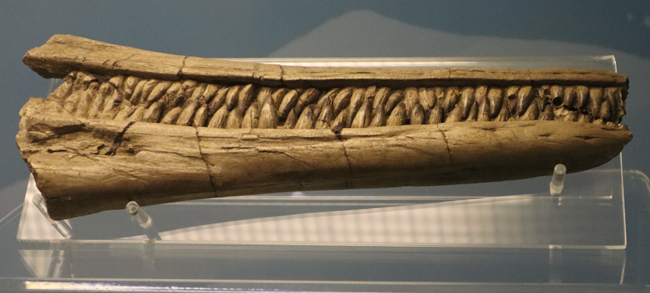
Whilst looking back at some pictures taken during a recent visit to Liverpool World Museum, team members came across a photograph of a museum exhibit that featured an ichthyosaur jaw.
A museum exhibit showing the jaw of a large ichthyosaur. Picture credit: Everything Dinosaur.
Picture credit: Everything Dinosaur
We expect amateur fossil hunters to return to the beaches at Lyme Regis and Charmouth after the recent storms and bad weather in a bid to find marine reptile fossils including ichthyosaur fossil remains. Isolated ichthyosaur bones such as those from the paddles, or vertebra (nicknamed “verts” by collectors), are relatively common but skull bones, particularly anything articulated and nearly complete are exceptionally rare.
We wish all those hardy fossil hunters planning their excursions happy hunting.
For models of ichthyosaurs and other marine reptiles such as plesiosaurs and pliosaurs take a look at this section of Everything Dinosaur’s award-winning website: Models of Sea Monsters and Marine Reptiles.
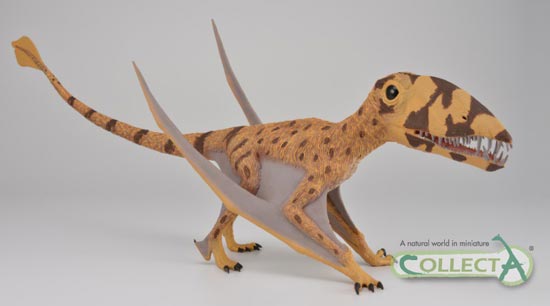
Since its introduction into the CollectA scale model range in 2017 the CollectA Deluxe Dimorphodon model has proved to be extremely popular with prehistoric animal model collectors and fans of the Pterosauria.
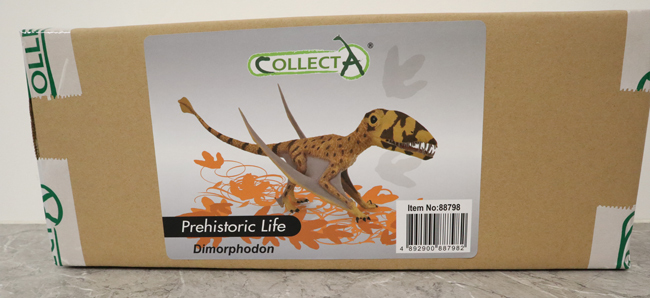
The CollectA Deluxe Dimorphodon with an articulated jaw. A photograph of the product packaging. Picture credit: Everything Dinosaur.
Picture credit: Everything Dinosaur
CollectA Deluxe Dimorphodon
Having been a part of the CollectA range of scale models for five years, team members at Everything Dinosaur thought they knew all there was to know about this 37.5 cm long pterosaur figure with its articulated jaw. However, we were informed earlier this week that this flying reptile model was created as a 1:3 scale figure.
An Award-winning Pterosaur Model
The CollectA Supreme Deluxe Dimorphodon model has been voted by readers of Prehistoric Times magazine the best non-dinosaur prehistoric animal toy of 2017. One of several awards received by CollectA and their design team for the figures that they have introduced.
The CollectA Dimorphodon model with a movable lower jaw.
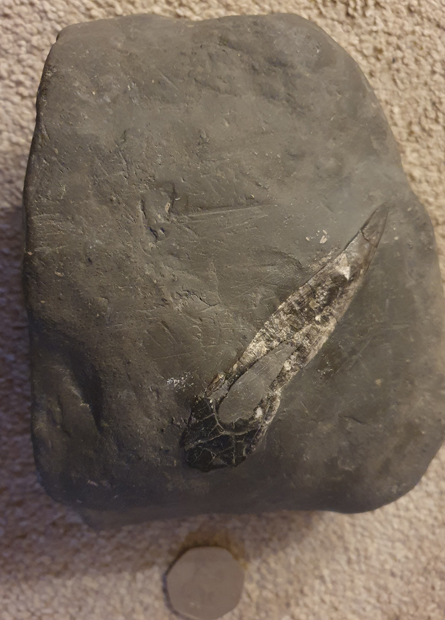
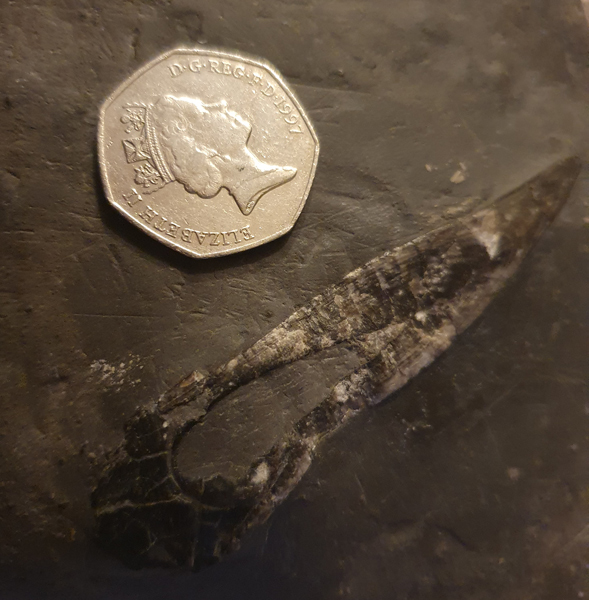
Recently, Everything Dinosaur was contacted by Lee who had collected a strange rock whilst visiting Yorkshire. Lee asked what the rock could be and sent in some photos. We contacted Lee and asked him to send in some more pictures, but this time including an object such as a coin that could provide a scale. In our email, we asked where this rock was found.
A fossil from Robin Hood’s Bay. Picture credit: Lee.
Robin Hood’s Bay Fossil
Lee commented that this rock was found at Robin Hood’s Bay on the north Yorkshire coast. This is a part of the world we know quite well and it is famous for its fossils. The Redcar Mudstone Formation dominates the geology of this part of the English coast and we suspect that the rock is mudstone and the unusual object is the remnants of a Jurassic shelly invertebrate.
An unusual fossil from Robin Hood’s Bay on the North Yorkshire coast. We suspect that this a mudstone from the Redcar Mudstone Formation, with the remnants of a highly eroded shelly fossil dating from the Lower Jurassic. Picture credit: Lee
Lower Jurassic
The shales, mudstones and sandstones that outcrop at Robin Hood’s Bay date from the Lower Jurassic (Sinemurian to Pliensbachian fauna stages) and we suspect that this fossil is around 195 – 185 million years old.
The specimen is heavily eroded, and we think it is being viewed as a cross-section. Ammonites are relatively common on this stretch of coastline as are Gryphaea fossils (Devils toenails) and crinoids. It is very difficult to identify this item, just from the photographs, however, we think that as there seem to be striations (lines) visible in the fossil that this is a highly eroded bivalve.
A close-up view of the fossil from Robin Hood’s Bay. The coin provides a scale. Picture credit: Lee.
Any Suggestions
We know that many of our blog readers are enthusiastic fossil collectors. We would welcome any suggestions and help with the identification of this specimen.
For replicas of ammonites and belemnites take a look at this section of the Everything Dinosaur website: CollectA Prehistoric Life Models.
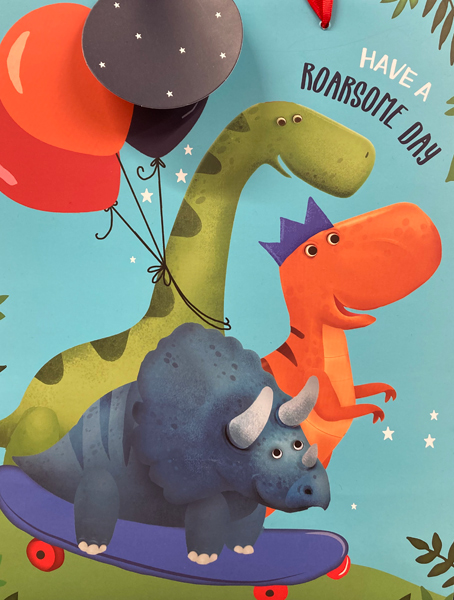
Whilst out of the office for a few hours, taking a break from picking and packing parcels for customers, a team member at Everything Dinosaur spotted a trio of cheerful dinosaurs on a gift bag. The three dinosaurs were off to a party and they were hoping that everyone was going to have a roarsome day!
A cheerful, trio of colourful dinosaurs spotted by an Everything Dinosaur team member. Have a roarsome day! Picture credit: Everything Dinosaur.
Picture credit: Everything Dinosaur
Have a Roarsome Day!
It is not often we come across an image of a blue Triceratops riding a skateboard, or an orange Tyrannosaurus rex wearing a paper hat. Indeed, we do not often see images of sauropod dinosaurs with balloons tied around their long necks.
Whilst the colouration of the non-avian Dinosauria remains a hotly debated topic amongst palaeontologists, we are quite confident that skateboarding, playing with balloons and wearing paper hats were not behaviours that dinosaurs indulged in. Perhaps, there is a remarkable fossil somewhere just waiting to be found that will challenge our assertions.
For models and replicas of dinosaurs, prehistoric animal themed toys and games, but no skateboards, take a look at Everything Dinosaur’s user-friendly and award-winning website: Everything Dinosaur.
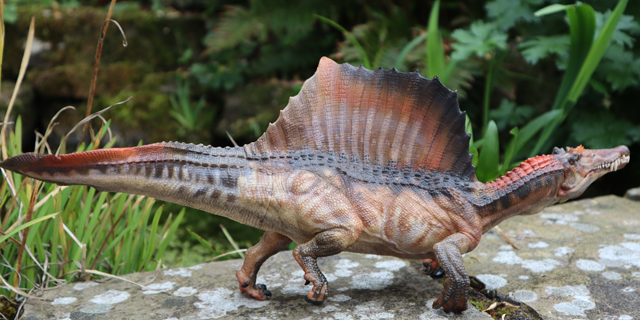
Everything Dinosaur can confirm the following Papo model retirement for 2023. Today, we announce that the limited-edition Spinosaurus figure is being withdrawn from the Papo “Les Dinosaures” range, this model is retired and now out of production.
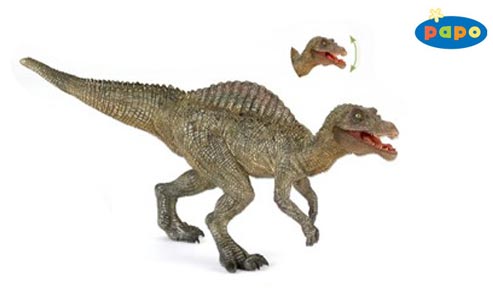
The Papo Limited-edition Spinosaurus dinosaur model which was introduced in 2019 has been retired and is now out of production. Picture credit: Everything Dinosaur.
The Limited-edition Papo Spinosaurus
The Papo limited-edition Spinosaurus replica, one of the largest dinosaur figures made by Papo, was originally introduced into the”Les Dinosaures” range in late 2019. Everything Dinosaur team members had seen prototypes several months earlier, but production issues led to delays and a launch orginally planned for the middle of 2019 got put back, initially until October, but it was not until December that year, that dinosaur fans and model collectors got their chance to acquire one.
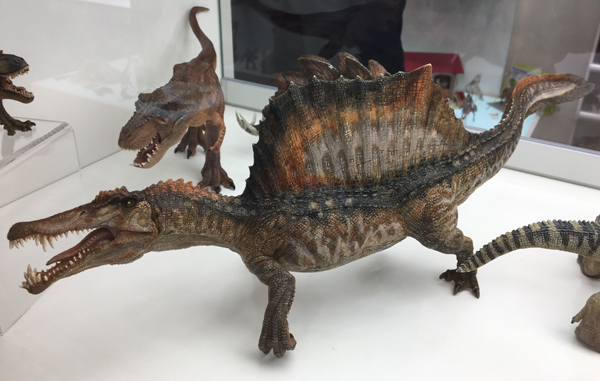
The awesome Papo Spinosaurus dinosaur model. Released late 2019, but retired an out of production in 2023.
Everything Dinosaur had already confirmed that the Papo roaring Smilodon and the Papo young Spinosaurus would be retired in 2023, to read our earlier blog post making this announcement: Papo Model Retirements in 2023 (Part 1).
Papo Model Retirement
When the Papo 2019 Spinosaurus was first introduced, it reflected some of the very latest scientific thinking relating to Spinosaurus aegyptiacus. The quadrupedal stance was praised as was the deep broad tail, which was later demonstrated to be quite accurate once a paper had been published describing this theropod’s fin-like tail “Tail-propelled aquatic locomotion in a theropod dinosaur” by Nizar Ibrahim et al (2020).
A spokesperson from Everything Dinosaur confirmed that this was the second Papo Spinosaurus figure to be retired this year, after the earlier announcement concerning the withdrawal of the young Spinosaurus model.
The spokesperson added”
“The Papo limited-edition Spinosaurus was a real show-stopper, the box containing the model was nearly half a metre in length. The actual model was nearly 42 cm long and that impressive spinosaur sail stood 16.5 cm high.”
The Papo limited-edition Spinosaurus is still available from Everything Dinosaur (whilst stocks last).
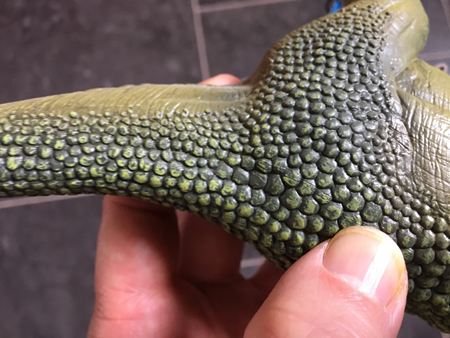
The debate over whether theropod dinosaurs were feathered, scaly or perhaps a combination of both continues. In contrast, the integumentary covering of sauropod dinosaurs has largely remained uncertain due to the very limited fossil evidence. However, at one remarkable location in Montana, patches of fossilised Diplodocus skin have been preserved and an analysis indicates that these long-necked dinosaurs were most likely covered in scales, but surprisingly their skin scales were not uniform. A range of scale shapes are indicated, all of them relatively small, but ovoid, rectangular, polygonal, domed scales and irregular (globular) scales have been identified.
The scales found on a replica of the sauropod Brachiosaurus (Schleich) research suggests that diplodocids were covered in a variety of scales. Globular and domed scales have been identified along with ovoid and more uniform polygonal scales. Picture credit: Everything Dinosaur.
A Research Paper
In a scientific paper published in the on-line, open-access journal PeerJ (April 2021), written by Tess Gallagher (currently a Masters student at Bristol University), in collaboration with colleagues from, what was known at the time as the Bighorn Basin Paleontological Institute, descriptions were provided of some patches of skin associated with juvenile Diplodocus fossils.
The fossil material comes from a single location known as the Mother’s Day Quarry, located in the Bighorn Basin, (Montana). The site was originally discovered in the 1990s and the Upper Jurassic deposits have yielded over two thousand Diplodocus fossil bones. Surprisingly, given the concentration of sauropod material found, very few other fossils have been discovered in this quarry. To date, some theropod teeth (allosaurid) are known plus one potential theropod footprint, preserved in association with the skin and a single invertebrate specimen.
It has been suggested that a herd of young Diplodocus dinosaurs died from lack of water at a dried up watering hole. Their bodies remained on the surface for some time and became desiccated. A flash flood occurred and swept the corpses downstream and these accumulated bodies were rapidly buried.
The dinosaur skin, having been bleached and dried out on the surface, once rapidly buried has an increased chance of becoming fossilised. Recently published research (October 2022), from Drumheller et al suggests that “mummified” skin might be more common in the fossil record than previously thought.
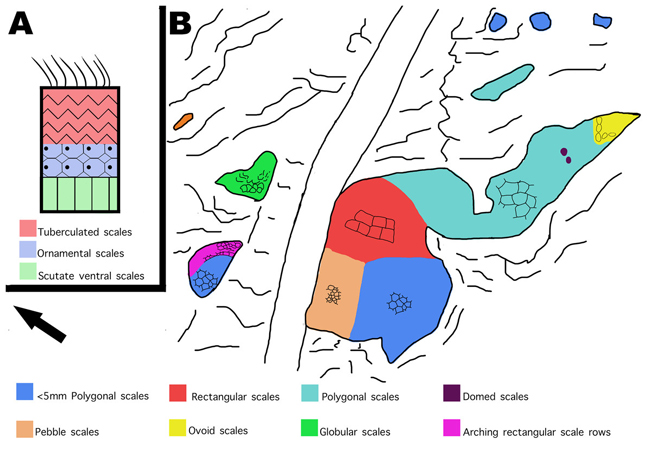
Although only a small portion of skin has been identified to date and the scientists remain uncertain as to which part of the body the skin patches covered, analysis has revealed a remarkably diverse quantity of scales. The team conclude that considering how diverse the scale shapes are in such a small area of skin, it is possible that these distinct scale shapes may represent a transition on the body from one region to another, perhaps from the abdomen to the dorsal side, or abdomen to the shoulder.
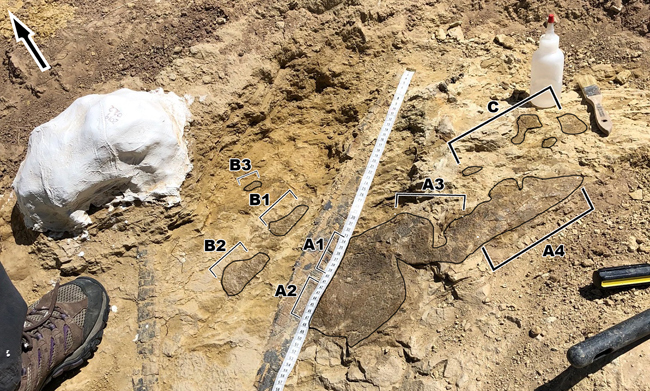
Photograph of specimen number MDS-2019-028 showing patches of diplodocid skin preserved between two rib bones. The black arrow indicates north. Picture credit: Gallagher, Poole and Schein.
At least six different types of Diplodocus scale have been identified, suggesting that the skin of these sauropod dinosaurs was complex. In addition, a further study presented at the recent annual meeting of the Society of Vertebrate Paleontology in Canada, provided a fresh perspective on the specialised skin of these sauropods.
Analysis of the scales using a high-powered microscope revealed that they had unusually large pores. It has been proposed that these large pores helped increase the surface area of this huge dinosaur. The greater the surface area of the skin the more assistance it would have been in helping to keep Diplodocus cool. Elephants have wrinkled skin, this increases the skin’s surface area which helps to minimise the impact of the “square-cube law” in relation to overheating.
“Square-cube” Law
The larger the volume of an animal, the smaller the overall surface area of the skin in contact with the air and this makes dissipating heat difficult for large animals. Just as elephants help to resolve issues with overheating with their wrinkled skin, the large pores associated with the Diplodocus skin had a similar effect.
Simplified line drawing showing the distribution of different scale shapes on the specimen number MDS-2019-028. The black arrow shows north. Drawing by T. Gallagher. Picture credit: Gallagher, Poole and Schein.
The scientific paper: “Evidence of integumentary scale diversity in the late Jurassic Sauropod Diplodocus sp. from the Mother’s Day Quarry, Montana” by Tess Gallagher, Jason Poole and Jason P. Schein published in PeerJ.
Everything Dinosaur can confirm the following Papo model retirements for 2023. Today, we announce that two figures are being withdrawn from the Papo “Les Dinosaures” range, models that are retired and now out of production.
Papo Roaring Smilodon
Papo Young Spinosaurus
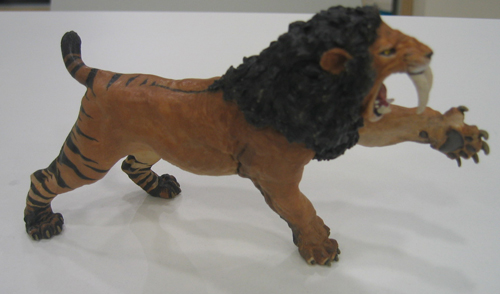
The Papo Roaring Smilodon model is now retired, and this figure is out of production.
Picture credit: Everything Dinosaur
The Papo Roaring Smilodon
This figure, with its mane like a male lion and posterior stripes like a tiger, was introduced into the Papo range of prehistoric animal figures back in 2017. Although, it is unlikely that any species within the Smilodon genus resembled this replica, it did prove popular especially amongst those Papo fans who also collected the company’s fantasy figure range.
With the introduction in 2022 of a young Smilodon model, for a short period, Papo had three Smilodon models in the “Les Dinosaures” series.
The Papo Young Spinosaurus
The Papo young Spinosaurus first made an appearance as part of a Papo, special edition box set that also featured the Ceratosaurus dinosaur model. It was later introduced into the range as a stand-alone figure.
The Papo young Spinosaurus dinosaur model originally part of a special edition box set prior to being launched as a figure. The young Spinosaurus model has been retired (2023).
Papo Model Retirements
Everything Dinosaur team members produced a blog article about the new for 2023 Papo prehistoric animals back in November, six new figures will be introduced, essentially four new models (Concavenator, Einiosaurus, Kronosaurus and Mosasaurus) and two reintroductions of replicas that had been retired (Archaeopteryx and Woolly Rhino).
A spokesperson from Everything Dinosaur commented that a blog post due to go live in a few days would reveal another Papo prehistoric animal model that was going out of production.
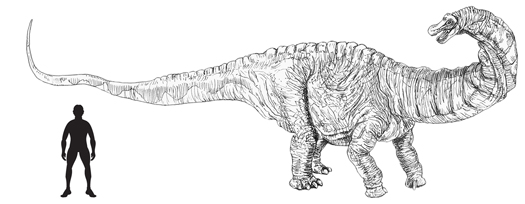
A recent study published in the academic journal “Scientific Reports” refutes the idea that some long-necked herbivores had supersonic sauropod tails. The controversial idea that some dinosaurs could lash their tails like a whip creating a supersonic crack as the tail travelled faster than the speed of sound has been refuted in newly published research. Instead, the researchers suggest that the tail of diplodocids such as Apatosaurus, Brontosaurus and Diplodocus could still play a role in defence, producing a painful blow to deter an attacker. It is also suggested that these long, whip-like tails could have been used in intraspecific combat.
Scale drawing of Apatosaurus (A. ajax). Note the long, whip-like tail. New research suggests that these long tails could not be used to create a “crack” as they broke the sound barrier. Picture credit: Everything Dinosaur.
Picture credit: Everything Dinosaur
Supersonic Sauropod Tails
A sauropod clade, the Flagellicaudata are characterised by their extremely long tails. This clade includes the Diplodocidae family and the closely related Dicraeosauridae. Although complete fossil sauropod tails are extremely rare, palaeontologists have a good idea of the anatomy of a typical diplodocid tail. It consisted of approximately eighty caudal vertebrae, that gradually decrease in size and morphological complexity towards the tail tip. There are approximately ten larger posterior vertebrae, followed by forty or so intermediate bones with finally around thirty progressively smaller rod-like caudal vertebrae.
Earlier studies had suggested that the tail could be whipped, and the tip would travel so fast (in excess of 500 metres per second), this action would break the sound barrier and produce a loud sound. This speedy tail would cause a significant injury should it come into contact with another dinosaur.
However, this new study used three-dimensional models and computer analysis to assess the stress on the bones, ligaments and soft tissues. They concluded that the maximum tip velocity generated would be around thirty metres a second, nowhere near the 330 metres per second required to break the sound barrier.
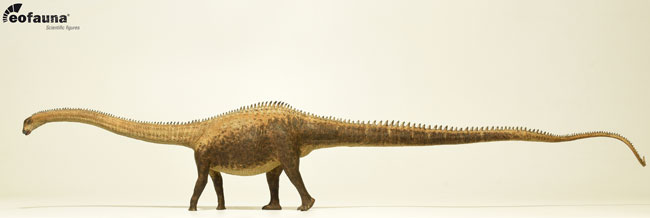
The Eofauna Diplodocus carnegii model measures around 60 cm in length and stands 11 cm tall. It is a 1/40th scale model. Most of the model’s length is made up of the long tail. Diplodocids are members of the Flagellicaudata clade.
The picture (above) shows the recently introduced Eofauna Scientific Research Diplodocus carnegii replica. When shown in lateral view, the extremely long tail can be seen.
Whilst the researchers conclude that the effect of friction on the musculature and aerodynamic drag would prevent the tail tip from reaching a speed capable of breaking the sound barrier, the pressure applied by the terminal section would not be enough to break bones or lacerate dinosaur skin, but it could still deliver a painful blow.
In summary, the scientists suggest that sauropod tail use remains speculative, these tails could have been used in intraspecific combat, or perhaps as a weapon against predators. Similarly, the use of the tail as a tactile element to retain herd cohesion is equally plausible.
The scientific paper: “Multibody analysis and soft tissue strength refute supersonic dinosaur tail” by Simone Conti, Emanuel Tschopp, Octávio Mateus, Andrea Zanoni, Pierangelo Masarati and Giuseppe Sala published in Scientific Reports.
The evolutionary development of the vertebral column has been extensively researched. Numerous fossil specimens have been studied as scientists pursue a greater understanding of the evolution of the backbone. Recently, a new scientific paper has been published in “Scientific Reports” that outlines the evolutionary development of ossification patterns in four-legged vertebrates.
Research from the Museum für Naturkunde
The study was undertaken by scientists from the Museum für Naturkunde (Berlin, Germany). Antoine Verrière and his colleagues were able to reconstruct the patterns of how the bones in the vertebral column formed in the ancestor to all land vertebrates based on a large dataset compiled from studies of extant and extinct vertebrates. The dataset also included new information on the spine of Mesosaurus tenuidens, widely regarded as the first reptile to adapt to an aquatic existence, back in the Permian some 300 million years ago.
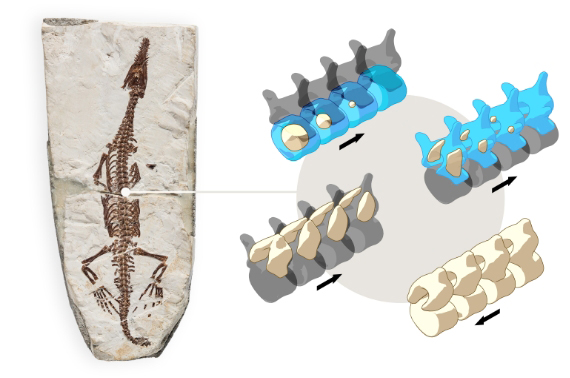
Understanding the evolution of ossification patterns in the backbones of four-legged vertebrates. Picture credit: Verrière and Fröbisch.
The Evolution of the Backbone
Lead author of the paper, Antoine Verrière explained that M. tenuidens had a long snout and a powerful tail that propelled it through the water. It inhabited an inland sea that once existed in the southern region of the supercontinent Pangaea.
The palaeontologist added:
“On some rare juvenile specimens, we observed that the neural arches, the spines sitting on top of the main part of a vertebra, were closing from head to tail as the animals grew, much like a zipper. We wanted to understand how this pattern would fit in the evolutionary history of land vertebrates, but quickly realised there was surprisingly little information available. So, we decided to investigate this ourselves!”
Four Major Developmental Patterns in Backbones of Amniotes
The research team looked at four of the major developmental patterns in the backbones of amniotes (mammals, reptiles and birds):
The ossification of the centrum (the main body of a vertebra).
The ossification of paired neural arches.
The fusion of the initially forming paired neural arch elements into one spine.
The fusion of neural arches with the centrum, also called neurocentral fusion.
Statistical analysis was used to model how these different patterns changed from the Permian through to today, their work roughly covering the evolutionary history of land-living vertebrates excluding amphibians. With this research the team could reconstruct the patterns in the common ancestor to all land vertebrates.
Co-author of the study, Professor Jörg Fröbisch (Museum für Naturkunde) commented:
“What surprised us the most was that these patterns appear to have been relatively stable for the last 300 million years. Modern and extinct vertebrates are enormously diverse in terms of their body shapes and lifestyles and the elements of their vertebral columns are organised in complex units that differ greatly between species. Nevertheless, the ossification patterns were much more conservative than was expected from the great morphological diversity.”
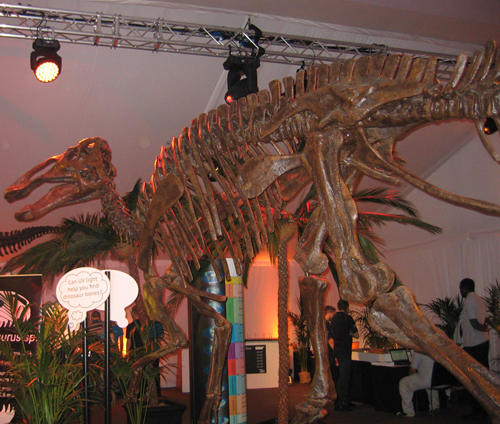
Duck-billed dinosaur on display showing the vertebral column. Despite vertebrates having extremely diverse body shapes and complex spines the observed ossification patterns were much more conservative than expected. Picture credit: Everything Dinosaur.
Picture credit: Everything Dinosaur
Some Deviations Identified
Although the patterns studied show relative stability through deep geological time, some deviations were identified. Notably, birds, mammals, and members of the Squamata Order (snakes and lizards) each evolved their own specific modes of vertebral ossification, which differ from the ancestral condition in amniotes. Yet again, within these groups, the patterns were also surprisingly stable.
Fellow co-author Professor Nadia Fröbisch (Museum für Naturkunde) explained:
“Ostriches and seagulls, for instance, have very different anatomies and lifestyles, but their vertebral columns ossify in similar ways. This shows that some changes can be observed between the major lineages of land vertebrates, but within each of the main lineages, spine development remained rather stable again.”
This study demonstrates how studying modern animals alongside their ancient ancestors can provide a much deeper understanding of the evolutionary development of key anatomical structures.
Everything Dinosaur acknowledges the assistance of a media release from the Museum für Naturkunde (Berlin) in the compilation of this article.
The scientific paper: “Regionalization, constraints, and the ancestral ossification patterns in the vertebral column of amniotes” by Antoine Verrière, Nadia B. Fröbisch and Jörg Fröbisch published in Scientific Reports.
As we start 2023, time for Everything Dinosaur to wish all our blog readers, customers and social media followers a very happy New Year. It does not seem too long ago that we were wishing everybody a happy New Year 2022, how time flies as we whizz through the Holocene or is this the Anthropocene?
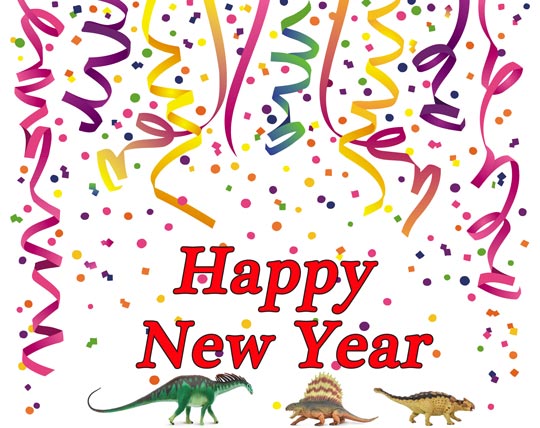
Happy New Year from Everything Dinosaur.
We have decorated our New Year message with some images of Wild Safari Prehistoric World animal models – an Amargasaurus (left), a Dimetrodon (centre) and a replica of an Ankylosaurus (right).
To view the range of Safari Ltd – Wild Safari Prehistoric World models in stock at Everything Dinosaur: Wild Safari Prehistoric World.