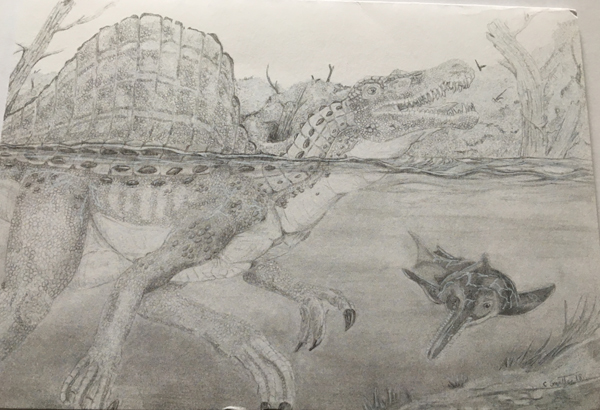
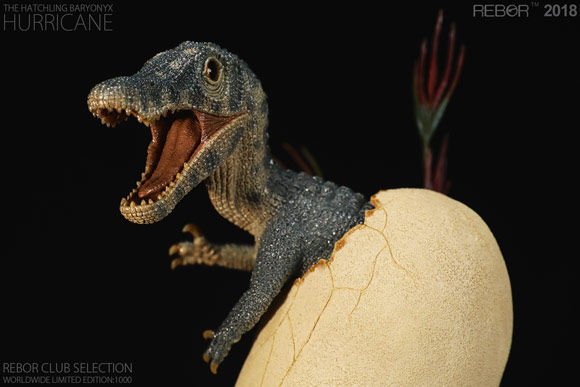
Our thanks to Caroline for sending into Everything Dinosaur, a beautiful, hand-drawn dinosaur themed card. Caroline had wanted to purchase one of the limited edition, Rebor hatching Baryonyx figures, but she was unable to make the purchase when these figures first came into stock. We received her request to reserve a Rebor “Hurricane”, one of just 1,000 replicas made. Our team members were happy to set a Baryonyx aside and a few weeks later Caroline was able to make her purchase.
A Spinosaurus Illustration
As a thank you, we received this splendid illustration of a swimming Spinosaurus. The Onchopristis (an extinct sawfish), swimming close by had better watch out! Spinosaurus is believed to have been a piscivore.
Spinosaurus Going for a Swim
Spinosaurus going for a swim.
Picture credit: Caroline Smalley
Thank you for Reserving a Baryonyx
Caroline included a message with her card. She thanked us for holding onto the Rebor Hatching Baryonyx “Hurricane” figure and congratulated us on our customer service.
A spokesperson from Everything Dinosaur commented:
“It is always a pleasure to receive illustrations such as the swimming Spinosaurus from our customers. There are so many incredibly talented people out there and to be able to reconstruct a long extinct animal and place it within an environmental context is a real skill. We even noted the small theropod dinosaur illustrated on the inside of the card. We are happy to know that the limited edition Rebor Hatching Baryonyx figure has found a good home.”
Even the Rebor Hatching Baryonyx “Hurricane” Looks Impressed!
The limited edition hatching Baryonyx figure “Hurricane” by Rebor. Even the Rebor figure looks awestruck at seeing the Spinosaurus illustration, after all, these two theropods belong to the same family (Spinosauridae), although Baryonyx (B. walkeri) lived tens of millions of years earlier than Spinosaurus.
To view the range of Rebor prehistoric animal figures in stock at Everything Dinosaur: Rebor Models and Figures.
Our thanks once again to Caroline for sending in her wonderful dinosaur themed thank you card.
Everything Dinosaur has won the Feefo Gold Service award, an independent seal of excellence that recognises that the UK-based dinosaur company delivers exceptional customer service as well as exceptional prehistoric animal models. Feefo product and service ratings are provided by real customers, Everything Dinosaur has over 600 customer reviews and comments posted up on its award winning website.
Everything Dinosaur’s Gold Trusted Service Award
Everything Dinosaur has won for the second year in a row, the top award from Feefo. We even got sent a certificate to prove it.
Picture credit: Feefo
The Feefo Gold Trusted Service Award
The accolade was created by Feefo. Trusted Service is only awarded to those businesses that use Feefo to collect genuine reviews and comments. Those organisations that meet this high standard, based on the number of reviews collected, and their average rating, are recognised with this award. It is regarded as a badge of honour, this accreditation remains unique, as it is based purely on the interactions with real people who purchase from Everything Dinosaur. As all reviews are verified as genuine, the accreditation is a true reflection of a Everything Dinosaur’s commitment to outstanding service.
To win this prestigious award, a company must meet the criteria of receiving at least fifty reviews between January 2018 and December 31st 2018, with a Feefo customer service rating of between 4.5 and 5.0. At the moment, Everything Dinosaur has six hundred reviews posted up on-line, over 98% of them are 5-stars.
A spokesperson from Everything Dinosaur commented:
“We are really pleased to receive this award from Feefo. This is the second year that we have been eligible for this honour and it is the second year in a row that we have been awarded it. The Feefo Gold Trusted Service award. We are committed to delivering the highest quality of customer service and these days it is vitally important for companies to listen, understand and respond to customers. We have lots of exciting plans for our websites in 2019, we are looking forward to another successful year.”
Praise from the CEO for the Feefo Gold Trusted Service Award
Matt West, the Chief Executive Officer at Feefo congratulated Everything Dinosaur and added:
“The Trusted Service award has always been about recognising those companies that excel beyond the norm. This year we’ve seen many remarkable businesses leveraging the full potential of Feefo to provide outstanding levels of experience for their customers – and rightly being awarded our most prestigious accreditation. I’m looking forward to the continual success of the businesses that work in partnership with us throughout 2019.”
Over the next few months, Everything Dinosaur will be introducing new prehistoric animal models from Papo, Safari Ltd, CollectA, PNSO, Rebor, Mojo Fun and a number of other organisations. For a company that specialises in dinosaurs, there is no sign that Everything Dinosaur is heading for extinction.
For some parts of the world, (but not all), today is Valentine’s Day. This is as good an excuse as any to post up some artwork that Everything Dinosaur team members commissioned when they were working on some new children’s t-shirt designs with a dinosaur theme.
Happy Valentine’s Day
Happy Valentine’s Day!
I love dinosaurs! Love in the time of the dinosaurs.Picture credit: Everything Dinosaur.
Picture credit: Everything Dinosaur
Dinosaurs Go Courting
Little is known about the courtship and mating habits of non-avian dinosaurs, after all such behaviours are difficult to interpret from the fossil record, but some insight might be gained by studying the behaviour of avian dinosaurs – the birds. Some birds engage in very elaborate and sophisticated courtship displays.
In August 2016, Everything Dinosaur published a blog post about a remarkable piece of research, scientists from Poland, the USA, China and South Korea has studied Late Cretaceous dinosaur trace fossils and some of these impressions were interpreted as representing nest scrape displays, as seen in living birds.
A Short Video of the Schleich Diabloceratops Model
Everything Dinosaur have posted up a short video previewing the new for 2019 Schleich Diabloceratops dinosaur model. This video is more of a teaser for fans of prehistoric animals and dinosaur model collectors. In the video, we confirm the length of this figure (it is approximately sixteen centimetres long and those impressive horns are approximately eleven centimetres off the ground).
A Quick Preview of the New for July 2019 Schleich Diabloceratops Dinosaur Model
Video credit: Everything Dinosaur
One of Four New Prehistoric Animal Models from Schleich in July 2019
The Schleich Diabloceratops will be replacing the recently retired Schleich Styracosaurus and the beautiful Pentaceratops figure. It will be one of four new prehistoric animal models from Schleich due to arrive at Everything Dinosaur’s warehouse in July (2019). The other figures are:
Schleich Dracorex – a model of the “dome-headed” dinosaur Dracorex hogwartsia. The Schleich Dracorex measures nineteen centimetres long and the head height is around ten centimetres.
The Schleich juvenile Giganotosaurus – this figure has an articulated lower jaw and it measures around twenty-six centimetres in length and stands over ten centimetres high.
Schleich Plesiosaurus – this marine reptile has a poseable neck and it is approximately sixteen centimetres long.
A spokesperson from Everything Dinosaur commented:
“The Schleich Diabloceratops model has certainly been getting a lot of attention. Within the Schleich range of large dinosaur models, there is one chasmosaurine (Triceratops) and one centrosaurine which is the new Diabloceratops. The two great tribes of Late Cretaceous horned dinosaurs are now represented by Schleich figures once again. Diabloceratops may have been very distantly related to Triceratops, but they would never have met. Diabloceratops lived millions of years before Triceratops evolved.”
A Closer View of the Beautifully Detailed Head of the Schleich Diabloceratops
The beautifully painted and very detailed head of the new for July 2017 Schleich Diabloceratops model.Picture credit: Everything Dinosaur.
Coming into Stock Soon at Everything Dinosaur (July 2019)
The Schleich Diabloceratops dinosaur model (available July 2019 from Everything Dinosaur).Picture credit: Everything Dinosaur.
Picture credit: Everything Dinosaur
Diabloceratops Fact Sheet
Dinosaur fans and prehistoric animal model collectors will receive a Diabloceratops (D. eatoni) fact sheet with every model purchased from Everything Dinosaur.
Visit the award-winning and customer-friendly Everything Dinosaur website: Everything Dinosaur.
A Preview of the New for 2019 Schleich Plesiosaurus Model
Schleich will be introducing four new prehistoric animal models in July 2019. Today, we take a brief look at the only non-dinosaur figure to come out with this batch of replicas, the Schleich Plesiosaurus. It had been rumoured that the German-based model manufacturer intended to produce a plesiosaur and thanks to Everything Dinosaur, we can now post up a quick video preview of this model that will be in stock in the summer.
A Short Preview of the New for 2019 Schleich Plesiosaurus Model
Video credit: Everything Dinosaur
Four New Schleich Models
The four new Schleich prehistoric animal models scheduled to be released in July (2019) are as follows:
A juvenile Giganotosaurus.
A Dracorex.
The horned dinosaur Diabloceratops.
A Plesiosaurus (marine reptile).
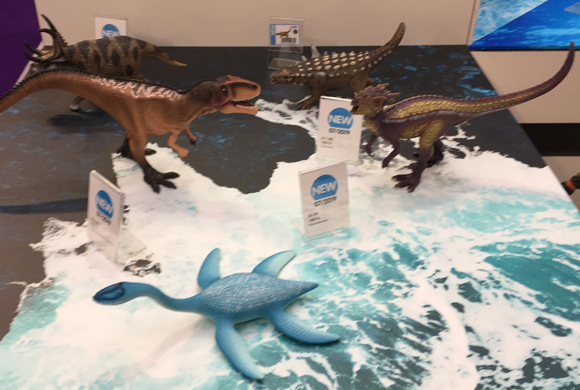
Coming into Stock at Everything Dinosaur in the Summer (July 2019) New Schleich Prehistoric Animal Models
New models being introduced into the Schleich prehistoric animal model range in July 2019. Foreground the new Schleich Plesiosaurus figure with a flexible neck, middle left the juvenile Giganotosaurus with an articulated jaw. Middle right the Dracorex figure and top left the new Diabloceratops model. In the top right, a Schleich Animantarx armoured dinosaur can be spotted, this figure was introduced in January.Picture credit: Everything Dinosaur.
Picture credit: Everything Dinosaur
Praising the Schleich Plesiosaurus
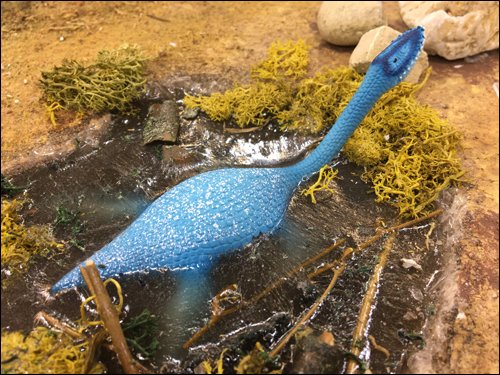
In the short video preview, a spokesperson from Everything Dinosaur comments on the unusual colouration on the top of the head of this figure, the dark blue markings have been described as looking like “goggles”, quite appropriate for an animal that spent much of its time under water. It can be speculated that these reptiles had good colour vision and their heads may have played a role in visual communication. Crests or horns on the head would have affected streamlining so such ornamentation is not known in the Plesiosauria, so perhaps subtle markings on the head could have helped signal the maturity of the animal and its fitness for breeding.
The overall colouration of the plesiosaur model is also discussed. The model is coloured a sky blue with flecks of white on the broad back. This combines well with a paler underside which represents countershading, a concept long linked with extinct marine reptiles and seen in many marine mammals today. The narrator in the video reflects on the fact that the colour scheme reminds him of polar conditions and states that as fossils of plesiosaurs have been found in high latitudes, such a colour scheme is appropriate as these reptiles are now known to have lived in cold waters.
On Display The New for July 2019 Schleich Plesiosaurus Model
The Schleich Plesiosaurus model on display.Picture credit: Everything Dinosaur.
Picture credit: Everything Dinosaur
A Model with a Flexible Neck
As with a number of earlier plesiosaur figures, the Schleich Plesiosaurus has a flexible neck. This permits the neck to be placed in a variety of poses. When tested the neck is quite stiff and this allows the figure to remain in the pose chosen without the head drooping down. The Schleich Plesiosaurus will be in stock along with the three other figures (Dracorex, Diabloceratops and the juvenile Giganotosaurus), in July (2019).
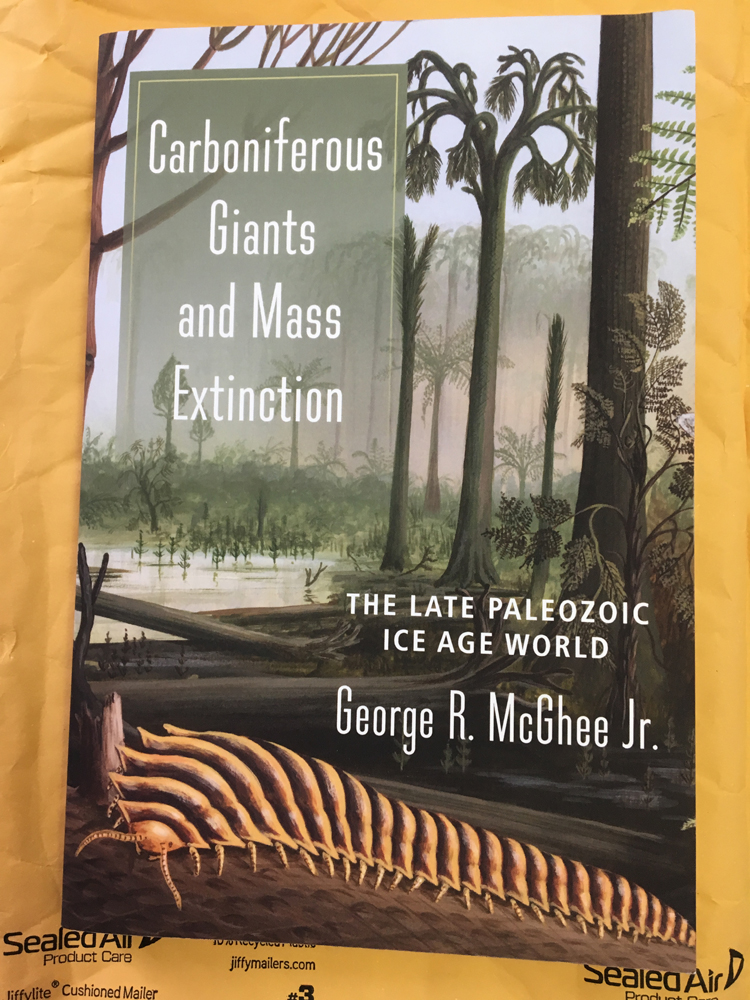
Long journeys and hours waiting around in train stations and airport terminals have been made bearable thanks to an excellent book written by George R. McGhee Junior, a Distinguished Professor of Palaeobiology at Rutgers University. The book is “Carboniferous Giants and Mass Extinction”. At this time of year, Everything Dinosaur team members seem to have to undertake a lot of travelling, what with their project work and teaching commitments, this eminently informative and enjoyable book has proved a worthy travelling companion.
The Front Cover of “Carboniferous Giants and Mass Extinction”
“Carboniferous Giants and Mass Extinction” an excellent book that explains the science behind our knowledge of the Carboniferous flora and fauna and explores the impact of the End-Permian mass extinction event.Picture credit: Everything Dinosaur.
Picture credit: Everything Dinosaur/Front Cover Artwork by Richard Bizley
Artwork by Richard Bizley
One of the ironies of having read this book from cover to cover is that we have only just noticed that the front cover artwork showing a typical Late Carboniferous rainforest dominated by lycophyte scale trees, giant horsetails such as Calamites and marattialean tree ferns, was produced by our dear friend Richard Bizley. Richard is a highly respected artist, he produces exquisite prehistoric scenes as well as landscapes and science fiction illustrations.
The huge millipede in the foreground is Arthropleura armata, which is estimated to have grown in excess of three metres long. This giant arthropod is illustrated inside the book too, Mary Persis Williams, another highly respected scientific illustrator, shows the scale of A. armata by comparing it to an extant American Alligator (A. mississippiensis).
Carboniferous Giants – An Insight into an Alien World
Life on Earth in the Carboniferous and Permian was very different from ecosystems today. As well as the giant arthropods found in terrestrial and marine environments, there were alien-looking plants and bizarre vertebrates some of which (synapsids), were the distant ancestors of mammals. Top predators in the Carboniferous forests and Early Permian swamps included salamander-like amphibian batrachomorphs such as the monstrous Eryops megacephalus, which grew to more than two metres in length and was capable of swallowing a small child whole (if humans had lived in the Palaeozoic).
An Illustration of Eryops megacephalus (Scale Drawing)
A scale drawing of Eryops.
Picture credit: Mary Persis Williams with additional annotation by Everything Dinosaur
Published by Columbia University Press, “Carboniferous Giants and Mass Extinction” makes a valuable contribution to our understanding of ancient environments and the incredible plants and animals that once inhabited the Earth. It can be found here: Columbia University Press.
For more information about the artwork and illustrations of Richard Bizley: Richard Bizley Art.
Everything Dinosaur team members had the opportunity this week to view the new for 2019 Papo Gorgosaurus dinosaur figure. As well as taking plenty of photographs, we were able to shoot a short video demonstrating that this dinosaur model stands on its hind legs and it does not need to balance on its tail in order to stand.
Papo Gorgosaurus Model
Everything Dinosaur Previews the New for 2019 Papo Gorgosaurus Dinosaur Model
Video credit: Everything Dinosaur
A Beautiful Model that is Beautifully Balanced
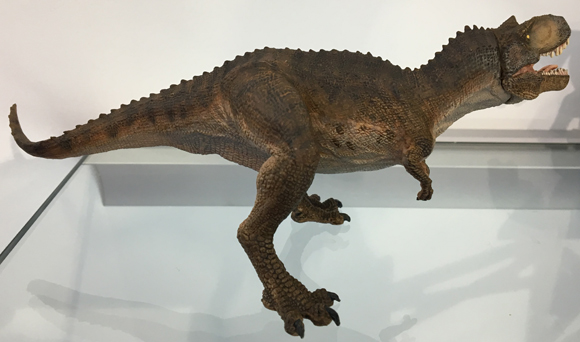
In this short video, we demonstrate that the Papo Gorgosaurus does not need to rest on its tail in order to balance. This figure is one of five new for 2019 Papo prehistoric animal models, it should be available in quarter three of this year, perhaps around June/July . It could arrive a little sooner, it could be in stock at Everything Dinosaur a little later. At least our customers and dinosaur model fans have had the chance of a sneak peek of this new tyrannosaurid dinosaur figure from the French manufacturer.
The Papo Gorgosaurus Dinosaur Model
The new for 2019 Papo Gorgosaurus dinosaur model. Picture credit: Everything Dinosaur.
Picture credit: Everything Dinosaur
New Papo Models for 2019
In total, five new figures are being introduced by Papo this year, there will (most likely), be a box set released in the autumn and we are already working on new for 2020 and 2021 production ideas.
The five new Papo models are:
Brown Running T. rex due into stock in a few days at Everything Dinosaur.
Papo Allosaurus (new colour variant), also due to arrive at Everything Dinosaur, in just a few days.
The Papo Gorgosaurus (see images and video), which is scheduled to be available sometime in quarter 3.
Papo Pentaceratops – also due to be in stock sometime in quarter 3 of 2019.
Stegosaurus, (new colour variant), this figure is also planned for launch in quarter 3 of this year.
Everything Dinosaur has also been made aware of a number of model retirements from the Papo “Les Dinosaures” range of figures.
To read Everything Dinosaur’s article about forthcoming Papo prehistoric animal model retirements: News of Papo Model Retirements.
Coming Soon a New Gorgosaurus Figure from Papo
The Papo Gorgosaurus dinosaur model. This dinosaur model will have an articulated lower jaw. Picture credit: Everything Dinosaur.
One of the great things about supplying dinosaur models and prehistoric animal figures to collectors all around the world, is that we get to examine the models in our warehouse before they get allocated space on the shelves in readiness for being purchased and dispatched. When a shipment of new models arrives, there is a lot of excitement around the office and whilst unpacking all the cases, we have the opportunity to examine up close and in detail the latest editions to Everything Dinosaur’s product portfolio.
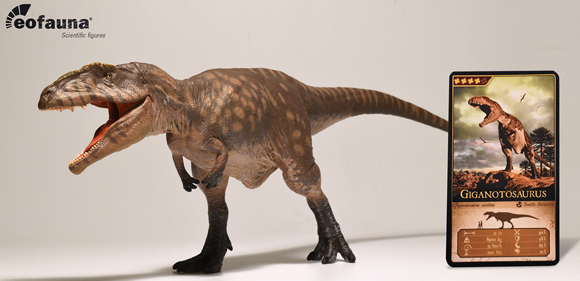
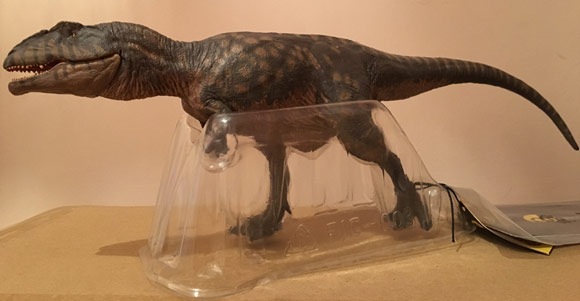
This week has seen the arrival of the eagerly anticipated Eofauna Scientific Research Giganotosaurus model in 1:35 scale. The model is beautifully detailed and we thought it fitting to make a short video of the articulated jaw, after all, the size estimate for this meat-eating dinosaur of around 13-14 metres in length was based on the discovery of some super-sized Giganotosaurus teeth.
Admiring the Articulated Jaw on the 1/35th Scale Giganotosaurus carolinii Dinosaur Model by Eofauna Scientific Research
Fifty New Prehistoric Animal Models Coming to Everything Dinosaur in 2019
At the beginning of the year, we predicted that we would be adding approximately fifty new models to our already extensive range. That’s just about one new model every week. To read about our palaeontology crystal ball gazing and other predictions for 2019: Our Predictions for the Forthcoming Year.
The Eofauna Giganotosaurus is the first dinosaur model to be created by this talented company. We knew about the introduction of this theropod many months ago, when we met up with the senior management team of Eofauna Scientific Research, we even helped with the production of the text that accompanies this beautifully-crafted dinosaur model.
We have added this figure to our own prehistoric animal model collection (we already have the two prehistoric elephants – the Steppe Mammoth and the Straight-tusked Elephant), we chose to create a short video just to demonstrate the skilfully sculpted skull and to highlight the model’s articulated jaw.
The Eofauna Giganotosaurus Dinosaur Model
The 1:35 scale Eofauna Giganotosaurus dinosaur model has an articulated jaw.
Over the last few days we have been busy emailing all those people who had contacted us so that they could reserve a model. We have already received lots of amazing feedback and even seen some of video reviews posted up by our customers. We are already looking forward to the fourth model to come out from Eofauna Scientific Research. No doubt, details about this will be posted up on this blog site and on Everything Dinosaur’s social media sites in the near future.
A Plastic Cradle Helps Protect the Model in Transit and Also Prevents any Issues with Legs Warping
Eofauna Giganotosaurus model. The third prehistoric animal model to be created in this exciting replica range.Picture credit: Everything Dinosaur.
Picture credit: Everything Dinosaur
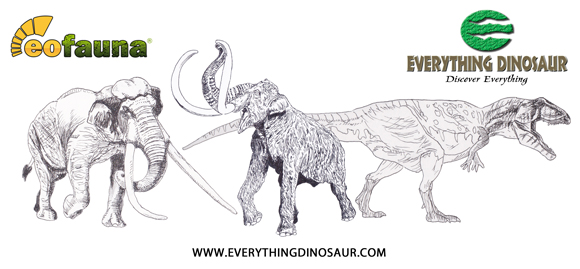
Three of a Kind – The Current Eofauna Model Range
Illustrations based on the three Eofauna replicas (left to right), Palaeoloxodon antiquus, Mammuthus trogontherii and Giganotosaurus carolinii.Picture credit: Everything Dinosaur.
Picture credit: Everything Dinosaur/Eofauna Scientific Research
Just a brief note to wish all our weblog readers, social media followers and customers a happy New Year. We wish everyone a peaceful, prosperous 2019. Team members at Everything Dinosaur have lots of exciting plans for the next twelve months, including adding numerous new prehistoric animal models to our range. We estimate that by the end of this year (2019), we will have added around fifty new prehistoric animal models to our inventory.
Happy New Year from Everything Dinosaur
We will also be updating our website and making some improvements to further aid navigation and enhance the website visitor experience.
Everything Dinosaur Team Members Wish Everyone a Happy New Year
Happy New Year from Everything Dinosaur. Picture credit: Everything Dinosaur.
Everything Dinosaur’s Top Blog Posts of 2018 (Part 2)
Today, we conclude our look at our most memorable blog posts of 2018, with a review of blog posts from July through to December. Since we try to post something up every day, there are certainly a lot of articles to choose from, in our previous posting covering the first six months of the year, we certainly came up with an eclectic mix: Top Blog Posts of 2018 (Part 1), part two is very much cut from the same cloth, with a wide range of scientific subjects covered.
July – Pink Life’s First Colour
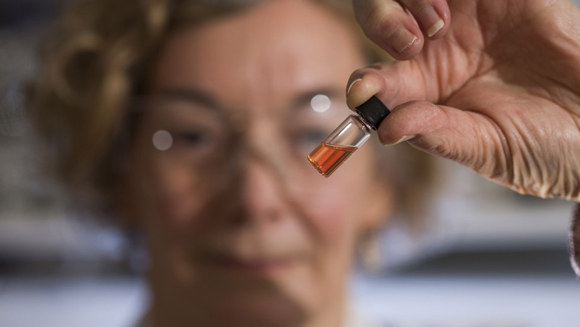
July featured marine crocodile evolution, a dinosaur discovery from Northern China (Lingwulong shenqi) that defied logic, Utah’s latest armoured dinosaur, Spanish plesiosaurs and French gomphotheres. However, we were “tickled pink” to be able to write about the analysis of 1.1 billion-year-old cyanobacteria that led to the extraction of pink coloured pigments from ancient marine shales. The world’s oldest biological colour turns out to be pink: In the Pink! The First Colour of Life.
A Team of International Scientists Have Isolated the Oldest Known Biological Colour
The oldest colours found to date.
Picture credit: Australian National University
August – DIY Taphonomy – (Make Your Own Fossils)
The beautiful summer weather continued into August and much of the UK faced drought conditions. However, fossil finds and prehistoric animal news stories did not dry up. Team members wrote about marine reptile discoveries in Queensland, a new nodosaurid from Mexico, Chinese alvarezsaurids, a challenge to the idea of aquatic spinosaurids, Scottish sauropods and toothy pterosaurs from the Late Triassic. It was an article on how a team of scientists had learned to mimic the fossilisation process, compressing millions of years into just 24-hours that really got our attention. After all, having a better understanding of how fossils form (taphonomy), will help to improve fossil interpretation: Do It Yourself Taphonomy!
September – Dickinsonia Definitely an Animal
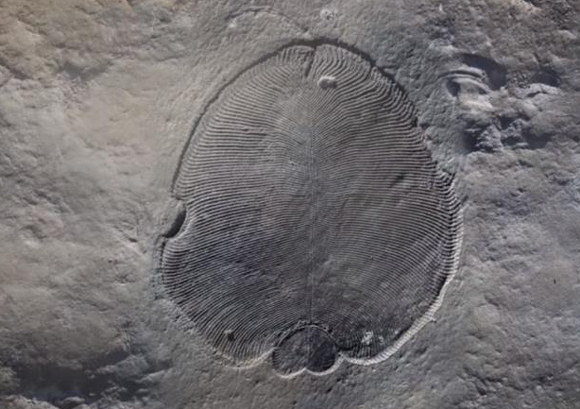
September turned the spotlight on the ediacaran fauna and one of the most puzzling of all the bizarre life forms to have ever existed – Dickinsonia. A research paper finally put to rest (most probably), a long-standing argument about this disc-shaped organism. It was an animal. What sort of animal? This remains an area of some debate, but the 550-million-year-old Dickinsonia is now in the same Kingdom as ourselves (Animalia). Here is our article: Mysterious Dickinsonia Classified as an Animal.
A Fossil of the Enigmatic Dickinsonia – Finally Classified and Placed in the Animalia
A beautifully preserved 558 million-year-old fossil of Dickinsonia, now classified as an animal (Metazoan).
Picture credit: Australian National University
October – A Better Understanding of the Sauropodomorpha (Sarahsaurus et al)
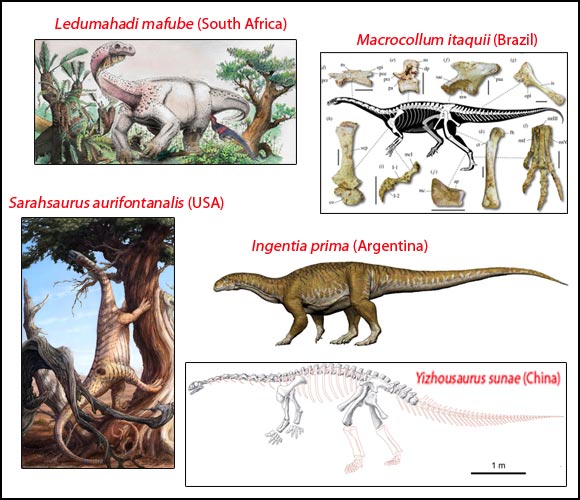
This year, we have seen numerous scientific papers published relating to the evolution and dispersal of the Sauropodomorpha (the sauropods and their ancestral forms). For example, researchers from the University of Texas concluded that ancestors of North American, Early Jurassic sauropodomorphs, such as Sarahsaurus were essentially migrants. In China, a study of Yizhousaurus fossil material yielded new data on the evolution of long-necked dinosaurs. The announcement of the discovery of a monstrous Late Triassic sauropodomorph from Argentina (Ingentia prima), demonstrated that gigantism in the Dinosauria occurred earlier than previously thought.
Amongst all these amazing sauropodiform/Sauropodomorpha articles, we even managed to publish a feature on the oldest, long-necked dinosaur described to date – Macrocollum itaquii. October like much of the year, was dominated by the sauropods: The Ancestors of Sarahsaurus Probably Did Not Originate in North America.
Great Strides in Our Understanding of the Sauropodomorpha in 2018
2018 will be remembered as the year that featured a lot of Sauropodomorpha fossil discoveries and research.
Picture credit: Viktor Radermacher (Witwatersrand University), R T Müller et al, Jorge A. González, Brian Engh, Xiao-Cong Guo and Everything Dinosaur
2018 is likely to be remembered by many vertebrate palaeontologists as the year in which the evolution of the Sauropodomorpha began to make more sense.
November – Fresh Insight into the “Siberian Unicorn”
Our blog posts in November were dominated by news of new models and figures for 2019.
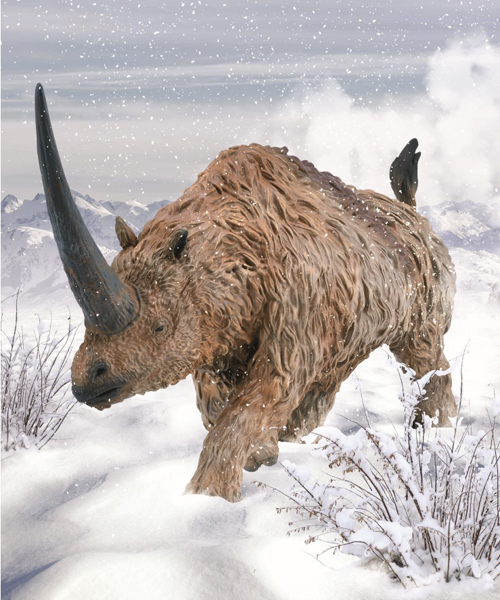
The weblog also covered elephant-sized Triassic dicynodonts, Oregon ornithopods, enantiornithine birds from Utah, ornithischian dental batteries, a new rebbachisaurid (Lavocatisaurus agrioensis), from Argentina and our work in schools. However, it was a feature on the enigmatic Elasmotherium, sometimes referred to as the “Siberian Unicorn” that stood out for us. A scientific paper published in November, revealed that the enormous Elasmotherium probably survived until as recently as 36,000 years ago. It was climate change that ultimately led to the demise of this beast, the paper on the relatively recent extinction of a member of the Rhinoceros family puts into focus the current plight of the remaining members of this once diverse and extensive family of hoofed mammals.
All extant members of the Rhinocerotidae face a very uncertain future.
An Illustration of the “Siberian Unicorn” – Elasmotherium
The CollectA Deluxe Elasmotherium model. A replica of the recently extinct Elasmotherium sibiricum.
Picture credit: Everything Dinosaur
December – Fuzzy Feathered Pterosaurs and the First New Ceratopsian of 2018
As the year drew to a close, the breadth and scope of the topic areas we attempted to cover did not diminish. Over the course of December lost Australian dinosaur toe bones, a new, dog-sized dinosaur from down-under (Weewarrasaurus pobeni), ichthyosaur blubber, new models and replica retirements all featured.
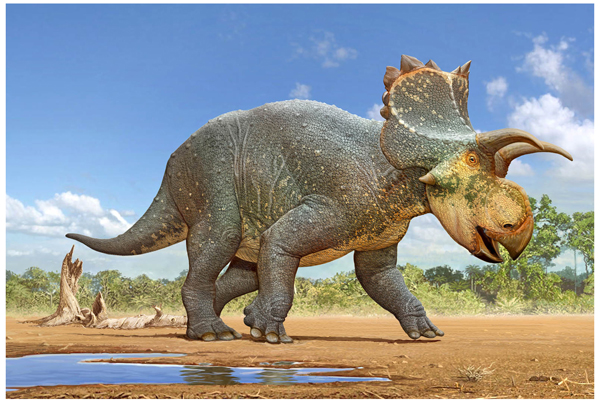
This month, we also wrote articles about a new Russian dinosaur (Volgatitan simbirskiensis) and featured a paper that demonstrated that the first flowering plants probably evolved at least fifty million years earlier than previously thought. Two articles we published stand out for us, firstly, on December 14th we produced an article on the ceratopsian Crittendenceratops krzyzanowskii, a new species of centrosaurine from Arizona. In the last twenty years or so, there have been an astonishing number of new horned dinosaurs described and named. Ironically, Crittendenceratops is the first (and only), new horned dinosaur to be named in 2018: A New Horned Dinosaur Species from Late Cretaceous Arizona.
A Life Reconstruction of Crittendenceratops krzyzanowskii
A life reconstruction of the newly described Ceratopsian Crittendenceratops (2018).
Picture credit: Sergey Krasovskiy
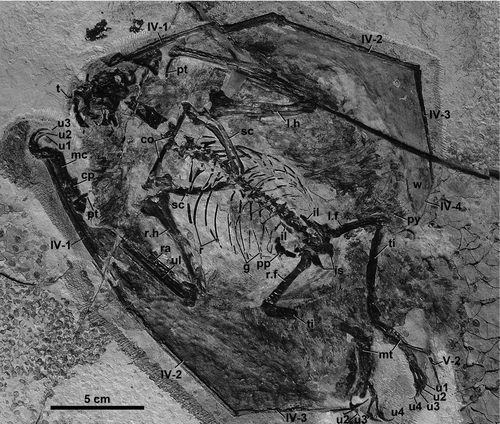
Secondly, our blog post from December 17th, featured the work of an international team of scientists who had identified four kinds of feather-like filaments on the fossils of pterosaurs: Are the Feathers About to Fly in the Pterosauria? If they are correct, then this suggests that either the Pterosauria evolved feathers as a form of convergent evolution separate from the Dinosauria, or, that feathers evolved many millions of years earlier than previously thought – in a common ancestor of the Dinosauria and the Pterosauria clades. Interesting times ahead for those palaeontologists that study flying reptiles.
Four Types of Feather-like Structures Identified in Chinese Pterosaurs
Pterosaur material. A study published in December 2018 suggests that flying reptiles had feathers.
Picture credit: Chinese Academy of Sciences/Journal of Vertebrate Palaeontology