All about dinosaurs, fossils and prehistoric animals by Everything Dinosaur team members.

Everything Dinosaur’s work with photoshop and other platforms.

27 07, 2019

JurassicCollectables Reviews the New”Green Day” and “Oasis”

By |2023-12-26T17:02:50+00:00July 27th, 2019|Categories: Adobe CS5, Dinosaur Fans, Everything Dinosaur Products, Everything Dinosaur videos, Main Page|0 Comments

Rebor Dilophosaurus Figures – Video Review

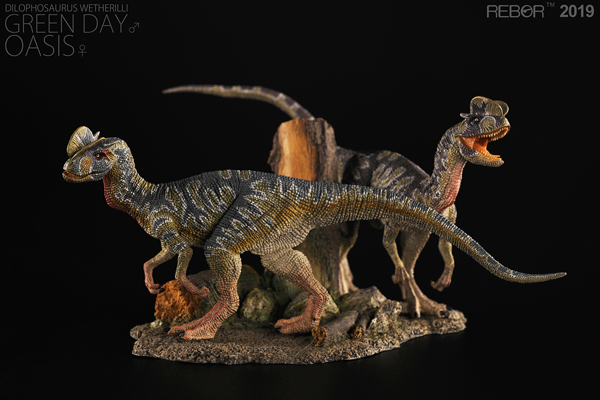
The talented team at JurassicCollectables have produced another Rebor model video review.  They have put together a most informative video review of the latest Rebor replica releases, the Dilophosaurus models “Green Day” and “Oasis”.  This in-depth analysis of these two scale model replicas looks at the packaging, examines the bases of the models in detail and of course, takes the viewer on a guided tour of each of the figures.

JurassicCollectables Reviews the Rebor Dilophosaurus Replicas “Green Day” and “Oasis”

Video credit: JurassicCollectables

Rebor Dilophosaurus wetherilli

With JurassicCollectables it is “ladies first” with the female Dilophosaurus “Oasis” taking centre stage for the first part of the video.  The narrator carefully unpacks the model and comments on the secure foam packaging that Rebor uses to protect its figures.  The model is assembled, but first, the beautifully painted base is examined and then the actual figure is reviewed, with a detailed examination of all the articulated parts and moveable features associated with this Rebor replica.

The Rebor Dilophosaurus “Oasis”

The Rebor Dilophosaurus "Oasis".
The Rebor Dilophosaurus “Oasis” reviewed by JurassicCollectables.

Picture credit: JurassicCollectables

In the video, the narrator explains why the box for the “Oasis” figure is larger, it has to accommodate the tree stump element of the figure’s base.  It is intriguing to see these 2019 sculpts compared to a vintage Kenner Dilophosaurus figure, they are in approximately the same scale.  “Off-colour Alan” makes an appearance maintaining the nod in the direction of the “Jurassic Park” film franchise and JurassicCollectables demonstrate how the base for “Oasis” can also be used in conjunction with the recently introduced Rebor “Killer Queen” Tyrannosaurus rex model.

A Close View of the Head of Rebor “Oasis”

Rebor Dilophosaurus "Oasis".
The Rebor Dilophosaurus “Oasis”.  The JurassicCollectables videos provide plenty of opportunity for dinosaur model fans to get a close look at the figures.

Picture credit: JurassicCollectables

Having Reviewed the Female Dilophosaurus Figure, “Green Day” the Male Dilophosaur Takes Centre Stage

The Rebor Dilophosaurus "Green Day".
Rebor Dilophosaurus “Green Day”.

Picture credit: JurassicCollectables

The YouTube video channel of JurassicCollectables is crammed full of well-written and beautifully shot video reviews of lots of different prehistoric animal  models.   Everything Dinosaur recommends that readers subscribe to this channel: Visit JurassicCollectables on YouTube.

Examining the Bases

One of the many benefits of a video review like this is that viewers get to see and hear about parts of the figure not necessarily shown in the official model photographs.  Take for example, the bases for these two Dilophosaurus replicas.  Each model can be displayed on its own, but they are designed to be used as a pair.  At Everything Dinosaur, we offer the Rebor Dilophosaurus pair at a special discounted price, this gives collectors the option of purchasing one, or choosing to pick up the pair together.  In the video, the narrator takes care to demonstrate how the bases fit together.

The Rebor Models Can Be Displayed Together

Rebor Dilophosaurus bases.
The base of the Rebor Dilophosaurus “Green Day” and “Oasis”.  The bases fit together really well allowing the two figures to be displayed together.

Picture credit: JurassicCollectables

Adding a Frill to your Dilophosaurus Figure

As well as providing size measurements and showing these two Rebor figures against other dinosaur models to give a size comparison, the narrator talks about Rebor’s innovative idea to provide a download so that you can customise these models and add a “frill”, to mimic how these dinosaurs were depicted in the first “Jurassic Park” movie.

Customising Your Dinosaur Model

Rebor Dilophosaurus models with their accessories (ruffs).
Rebor Dilophosaurus models with their ruffs.

 Picture credit: JurassicCollectables

Everything Dinosaur also offers a free download of these Rebor accessories, simply Email Everything Dinosaur and we will be happy to email the free download of the Dilophosaurus accessories to you.

Our thanks to JurassicCollectables for producing such an informative video.

To view the Rebor Dilophosaurus models “Green Day” and “Oasis” and the other Rebor replicas available from Everything Dinosaur: Rebor Prehistoric Animal Models.

Everything Dinosaur’s website: Everything Dinosaur.

25 07, 2019

New Beasts of the Mesozoic “Raptors” Feature in Newsletter

By |2023-12-26T11:45:54+00:00July 25th, 2019|Categories: Adobe CS5, Dinosaur Fans, Everything Dinosaur News and Updates, Everything Dinosaur Newsletters, Everything Dinosaur Products, Main Page, Photos of Everything Dinosaur Products, Press Releases|0 Comments

New Beasts of the Mesozoic “Raptor” Models in Stock

The latest additions to the amazing Beasts of the Mesozoic range of articulated “raptor” figures feature in Everything Dinosaur’s July newsletter.  New replicas arrived at the company’s warehouse a few days ago, including the limited edition, exclusive Velociraptor osmolskae replica (alpha) as well as the trio of white nestlings.  As an exclusive model, it is the limited edition V. osmolskae (alpha) that takes the headline spot in our newsletter.

Highlighting the New for 2019 Limited Edition Velociraptor osmolskae Figure (Alpha)

Beasts of the Mesozoic Velociraptor osmolskae (alpha).
The exclusive limited edition Velociraptor osmolskae is in stock at Everything Dinosaur. Picture credit: Everything Dinosaur.

Picture credit: Everything Dinosaur

Beasts of the Mesozoic “Road Runner” and a New Velociraptor mongoliensis

Also available is the beautifully coloured purple “raptor” – Saurornitholestes (S. sullivani).  This figure has been nicknamed “road runner” as its colouration is similar to the cartoon ground dwelling bird in the Wile E. Coyote and Road Runner cartoons (Looney Tunes and Merrie Melodies).  Saurornitholestes was certainly ground dwelling and cursorial.  Its velocity when running is not known, nor are we at Everything Dinosaur aware of any research that has attempted to calculate its maximum speed.

The fossil record is particularly sparse for this species, the bauplan (body plan), of this species is not known, it has been reconstructed based on more complete dromaeosaurids.  It is presumed, that like most dromaeosaurids, Saurornitholestes was nimble, agile and a fast runner – hence the “road runner” moniker.

The Beasts of the Mesozoic Velociraptor mongoliensis figure has proved to be one of the most popular figures in the entire range.  A new version (version 2), has been introduced and this figure also features in our newsletter.

The Purple Saurornitholestes sullivani Figure and the New Velociraptor mongoliensis Model (Version 2)

Velociraptor (black) and Beasts of the Mesozoic S. sullivani.
Beasts of the Mesozoic “road runner” and a Velociraptor. Picture credit: Everything Dinosaur.

Picture credit: Everything Dinosaur

Those clever designers behind the Beasts of the Mesozoic range have also added a beautifully sculpted model of the second Velociraptor species (V. osmolskae) in a wonderful, fiery red motif.  In addition, Everything Dinosaur will be stocking the Velociraptor (V. mongoliensis) black colour variant.

Everything Dinosaur Also Stocks the Velociraptor osmolskae (red) and the Impressive Velociraptor mongoliensis (black)

A pair of Velociraptors from the Beasts of the Mesozoic range.
Beasts of the Mesozoic Velociraptor osmolskae (red) and a Velociraptor (black). Picture credit: Everything Dinosaur.

Picture credit: Everything Dinosaur

An Extensive Dromaeosaurid-themed Range of Figures

The range of 1:6 scale figures also includes sets of baby dinosaurs.  These are available in a variety of colour combinations.  The Beasts of the Mesozoic white-coloured nestlings feature in the latest addition of our newsletter.  Everything Dinosaur stocks a huge range of Beasts of the Mesozoic models including the “Build-a-raptor” sets, the Deluxe figures and of course, the various environmental packs – mountain, desert, forest and wetlands.

To view the range of figures and models: Beasts of the Mesozoic Models.

A Trio of “Raptor” Nestlings and a Look at the Entire Beasts of the Mesozoic Model Range

Beasts of the Mesozoic "Raptor" models.
A trio of white “raptor” nestlings and a view of part of the extensive Beasts of the Mesozoic range. Picture credit: Everything Dinosaur.

Picture credit: Everything Dinosaur

To request to join the Everything Dinosaur newsletter subscribers list just send us an email: Email Everything Dinosaur.

The award-winning and customer-friendly Everything Dinosaur website: Everything Dinosaur.

22 07, 2019

The New Prehistoric Times Magazine Issue 130 Reviewed

By |2023-12-26T16:55:03+00:00July 22nd, 2019|Categories: Adobe CS5, Dinosaur Fans, Magazine Reviews, Main Page|0 Comments

Prehistoric Times Magazine Issue 130 Reviewed

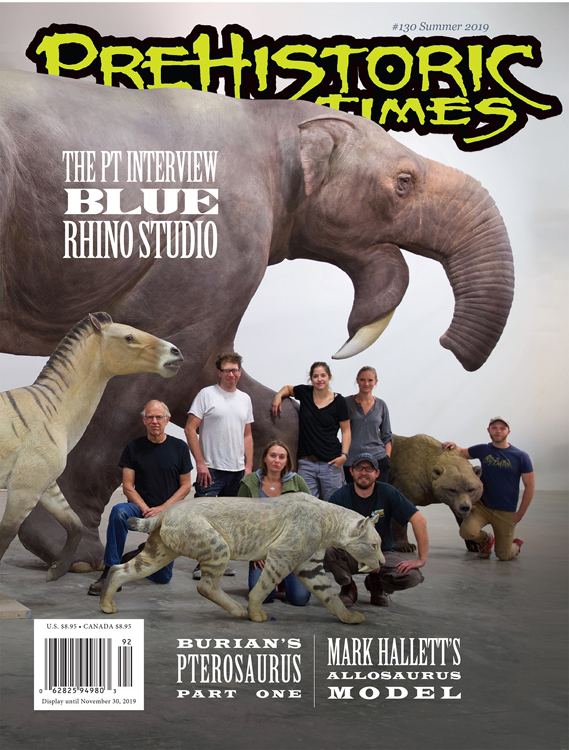
The latest edition of “Prehistoric Times” magazine has arrived at the offices of Everything Dinosaur.  This magazine is published quarterly and issue 130 (summer 2019), is packed full of reader’s palaeort, news about prehistoric animal discoveries, dinosaur model news, interviews, articles and so much more.

The Front Cover of Prehistoric Times (Issue 130)

The front cover of "Prehistoric Times" magazine - summer 2019.
“Prehistoric Times” magazine issue 130.

Picture credit: Mike Fredericks

A “Prehistoric Times” with a Sophisticated Cover

Inside the magazine, there is an interview with Timothy Quady of Blue Rhino Studio, the Minnesota-based producers of life-size prehistoric animal replicas for museums.  The front cover shows some examples of the team’s incredible work and best of all, this issue has a wrap around cover so readers can view a couple of additional Blue Rhino Studio sculpts.

Issue 130 of “Prehistoric Times” Magazine Has a Wrap Around Cover

The wrap around cover of "Prehistoric Times" magazine.
The wrap around cover of “Prehistoric Times” magazine features life-size prehistoric mammals. Picture credit: Everything Dinosaur.

Picture credit: Everything Dinosaur

Pterosaur Artwork by Burian

John Lavas continues his detailed examination of the artwork of the influential  Zdeněk Burian.  This edition features pterosaurs and there are some excellent examples of the famous Czech illustrator’s work including depictions of Rhamphorhynchus and Pterodactylus.

Phil Hore provides two prehistoric animal articles, the first on Allosaurus resulted in editor Mike Fredericks being inundated with images of this Late Jurassic predator.  Look out for fantastic illustrations by Luis Rey, Jorge Blanco, Mark Hallett and John Sibbick.  The second Phil Hore article discusses the enigmatic Elasmotherium, which ties in nicely to Mike Frederick’s “What’s New” review as it features the Elasmotherium illustration that we commissioned, when discussing the release of the CollectA Deluxe Elasmotherium figure.

Elasmotherium Featured in the Magazine

A scale drawing of Elasmotherium.
Elasmotherium scale drawing.  Picture credit: Everything Dinosaur.

Picture credit: Everything Dinosaur

The Everything Dinosaur website: Everything Dinosaur.

Eagle-eyed readers may also spot the image showing five of the new for 2019 Schleich prehistoric animal figures which is displayed on page 35.  This image was created by us and used to announce the first batch of new for 2019 Schleich figures back in December 2018.  The vast majority of the figures discussed in this article are already available from Everything Dinosaur, an exception being the limited edition Papo Spinosaurus which has now been delayed until the autumn.

Prehistoric Animal and Fossil News in “Prehistoric Times”

Recent news stories featuring fossil discoveries are succinctly covered in the “Paleonews” section, look out for a story about a small T. rex relative from New Mexico and a stark illustration of the power of Sabre-toothed cats, which could puncture the skulls of rivals.  Issue 130 also includes a fascinating look at the creation of a four-foot-long Bronze Allosaurus sculpture by Mark Hallett.  Tracy Lee Ford continues the Late Jurassic theme focusing on how to draw the body of Stegosaurus, with a particularly helpful review of Stegosaur plate shapes.

To subscribe to this quarterly magazine: Subscribe to Prehistoric Times.

20 07, 2019

The New Mojo Fun Tropeognathus

By |2023-12-26T16:51:33+00:00July 20th, 2019|Categories: Adobe CS5, Dinosaur Fans, Everything Dinosaur Products, Main Page, Photos of Everything Dinosaur Products|0 Comments

Mojo Fun Tropeognathus?

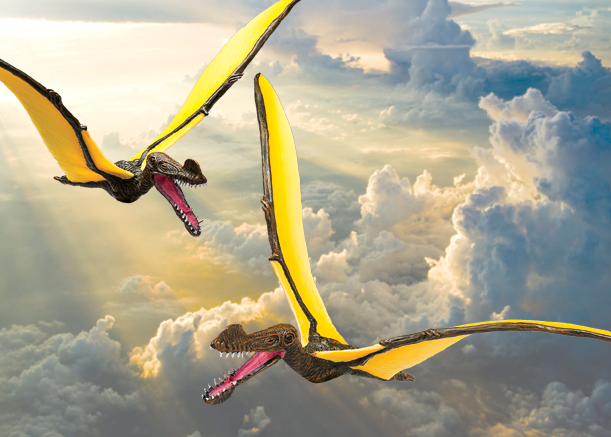
Pterosaur taxonomy is a tricky business.  Although, something like 110 different genera have been named and described at the time of writing (July 2019), the history of pterosaur research is littered with problems relating to taxonomic placement and phylogeny.  The Ornithocheiridae is one of the most notorious of groups when it comes to classification.  In the picture (below), there is the Mojo Fun Tropeognathus (T. mesembrinus), actually a pair of these flying reptiles taking to the skies.  Unfortunately, this genus has been subject to a lot of taxonomic revision too.

Illustrating an Ornithocheirid – Tropeognathus mesembrinus)

Mojo Fun Tropeognathus.
A pair of Mojo Fun Tropeognathus pterosaurs.  The Mojo Fun Tropeognathus is a very colourful and skilfully crafted flying reptile model.

The Problem Stems from the Middle of the 19th Century

In the middle of the 19th century, fragmentary and very worn pterosaur fossils began to be reported from the Cambridge Greensand deposits.  These marine deposits preserved pterosaur fossil material in three-dimensions, at least the specimens were not crushed as flat as a pancake, but this is probably their only redeeming feature.

These flying reptile fossils represent animals that died a long way out at sea (possibly drift deposits too).  The bones were subjected to attack from boring invertebrates and general decay until they were finally buried, only for these remains to be disinterred by ancient storms and subsequently buried again.  In the early days of the science of palaeontology, such luminaries as Richard Owen and Harry Govier Seeley strived to understand these enigmatic reptiles by studying these fragmentary fossils.

Many species were erected based on the most flimsy and scrappy fossil evidence.  Pterosaur researchers are still struggling to resolve some of these taxonomic issues today.

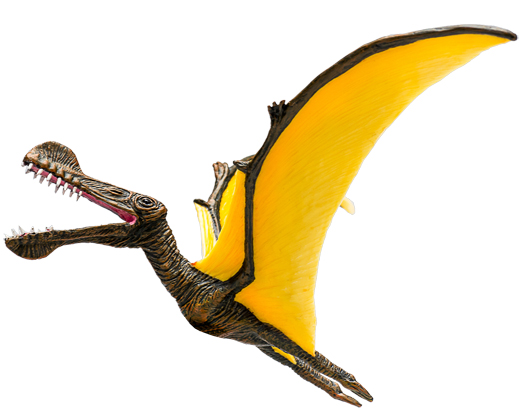
The Mojo Fun Tropeognathus Model – Or is it Ornithocheirus or Perhaps Criorhynchus?

Mojo Fun Tropeognathus.
The Mojo Fun Tropeognathus pterosaur model.

Criorhynchus, Tropeognathus or Ornithocheirus?

Initially named from a nearly complete skull acquired from Brazilian fossil dealers, all went well for two years and then the skull material was suggested to represent a type of anhanguerid pterosaur.  Subsequently, this skull was assigned to Coloborhynchus and then Criorhynchus before a reassessment undertaken in 2013 (Taissa, Rodrigues and Kellner), led to the conclusion that Tropeognathus mesembrinus was indeed, a valid taxon.

Perhaps, this pterosaur is best-known for its appearance in the ground-breaking BBC television documentary series “Walking with Dinosaurs”.  Episode 4, “Beneath a Giant’s Wings”, told the story of an Ornithocheirus as it made its journey to its traditional breeding grounds across the nascent Atlantic Ocean.

As if to reinforce the concerns over taxonomy, the pterosaur was described as an Ornithocheirus and the imaginary tale was set some 127 million years ago, some fifteen million years or so before, the pterosaur whose skull now comprises the holotype material for T. mesembrinus took to the skies.

The Ornithocheirus as Featured in the BBC Television Documentary.

Ornithocheirus from the BBC television documentary series.
The “Walking with Dinosaurs” Ornithocheirus.

Picture credit: BBC World

To view the Mojo Fun Tropeognathus and the other prehistoric animals in the Mojo Fun dinosaurs range: Mojo Fun Dinosaur and Prehistoric Animal Models.

19 07, 2019

PNSO Prehistoric Animals Now in Stock

By |2023-12-26T10:37:13+00:00July 19th, 2019|Categories: Adobe CS5, Dinosaur Fans, Everything Dinosaur News and Updates, Everything Dinosaur Products, Main Page, Photos of Everything Dinosaur Products, Press Releases|0 Comments

PNSO Prehistoric Animal Scale Models and Figures

New PNSO prehistoric animal scale models and figures are in stock at Everything Dinosaur.  A shipment of PNSO dinosaur and prehistoric animal models arrived at the company’s warehouse earlier this week and over the last few days Everything Dinosaur team members have been busy contacting all those customers who requested placement on reserve lists so that they could be notified when these figures arrived.

New PNSO Prehistoric Animal Models in Stock at Everything Dinosaur

New PNSO prehistoric animal models in stock.
In stock at Everything Dinosaur – new PNSO prehistoric animal models and figures. Picture credit: Everything Dinosaur.

Picture credit: Everything Dinosaur

The list of new PNSO models joining the dozens of PNSO prehistoric animal models and figures available from Everything Dinosaur is as follows:

  • Ron the Mosasaurus 1:35 scale scientific art model
  • Patton the Megalodon (Carcharocles megalodon) with an articulated jaw
  • Lucas the Giganotosaurus 1:35 scale scientific art model
  • Essien the Spinosaurus 1:35 scale scientific art model
  • Lucio the Amargasaurus 1:35 scale scientific art model
  • Dayong and Xiaobei Diorama – Dayong the Yangchuanosaurus and Xiaobei the Chungkingosaurus 1:35 scale scientific art models
  • Sede the Ankylosaurus
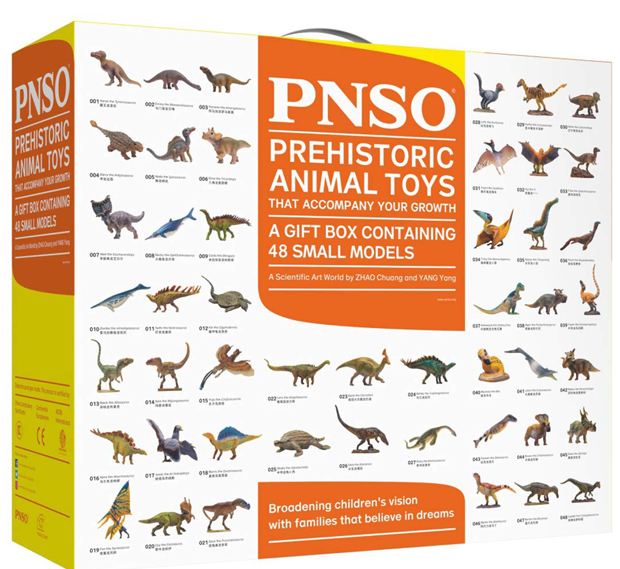
  • The special edition gift box containing all 48 of the PNSO “Toys that Accompany your Growth” model series

In Stock at Everything Dinosaur – PNSO Figures and Prehistoric Animal Models

Prehistoric animal models available from Everything Dinosaur.
Available from Everything Dinosaur PNSO models and figures. One of our packing rooms with a selection of the new for 2019 PNSO prehistoric animal figures and replicas. Picture credit: Everything Dinosaur.

Picture credit: Everything Dinosaur

To purchase any item from this exciting prehistoric animal model range: PNSO Prehistoric Animals.

Big and Small PNSO Megalodon Shark Models

As well as some new arrivals, the shipment enabled team members to replenish stocks of some PNSO lines that had already sold out.  For example, as well as “Patton” the new Carcharocles megalodon model with its articulated jaw, the larger PNSO “Patton” Megalodon figure is also now available.

Big or Small PNSO Megalodon Models – Which do you Prefer?

PNSO Megalodon shark models.
Which of the PNSO Megalodon models “Patton” do you prefer?

Picture credit: Everything Dinosaur

A spokesperson from the UK-based company Everything Dinosaur commented:

“We are delighted to receive our latest shipment of PNSO prehistoric animal models and figures.  We have been involved in this exciting model range for some years now and we are most impressed with these new replicas.  We have even managed to source some of the rare special edition gift boxes.  These gift boxes contain all forty-eight of the PNSO Toys that Accompany Your Growth model series.  They are a fantastic collector’s item.”

The PNSO Special Edition Gift Box – Toys that Accompany Your Growth

Forty-eight models in the PNSO gift box.
PNSO special edition gift box.  All forty-eight of the PNSO small prehistoric animal figures are inside.

Visit the Everything Dinosaur website: Everything Dinosaur.

17 07, 2019

The Etymology of Aquilarhinus and Mystery Fossil Material

By |2023-12-26T10:17:32+00:00July 17th, 2019|Categories: Adobe CS5, Dinosaur and Prehistoric Animal News Stories, Dinosaur Fans, Main Page, Photos/Pictures of Fossils|2 Comments

How Did Aquilarhinus Get its Name?  Mystery Fossils from Rattlesnake Mountain

Recently, team members at Everything Dinosaur wrote a blog article announcing the discovery of a primitive, “shovel-billed” hadrosaurid from the Big Bend National Park in south-western Texas.  We received an email asking us how this dinosaur got its name, here is a quick explanation of the etymology.

Aquilarhinus palimentus – What’s in a Name?

A life reconstruction of the head of Aquilarhinus.
An illustration of Aquilarhinus with a crest along its snout and its unusual beak that may have been used to shovel up soft plants.  Anatomical features related to the skull and jaws gave this dinosaur its name.

Picture credit: ICRA Art

Aquilarhinus palimentus

The genus name is derived from the Latin “aquila” which means eagle and the from the Greek “rhinos” meaning nose.  The combination of these two words – “eagle nose” describes the shape of the rostrum of this newly described dinosaur.  It had a bony crest on its snout.

The species or trivial epithet is derived from a combination of Latin words – “pala” meaning shovel and “mentus” which is translated as chin.  The species name has therefore been erected to describe the assumed front portion of the lower jaw (predentary), that resembled a shovel.  It is thought that this broad-skulled, shovel-mouthed dinosaur fed by scooping up marsh plants.

Could the Scientists Have Found Another Hadrosaurid in the Big Bend National Park?

In addition to the fossil material found and ascribed to Aquilarhinus palimentus, researchers have also found additional fossils which are from a hadrosaurid, but they remain unsure whether these fragments of bone from the skull represent A. palimentus or another type of duck-billed dinosaur.

All the fossils ascribed to Aquilarhinus palimentus were found within four square metres, but these other bones were found just a short distance from the Aquilarhinus remains.  The researchers writing in the “Journal of Systematic Palaeontology”, state that this material might pertain to A. palimentus but none of these isolated bones exhibit diagnostic features that would allow for certain attribution.  For this reason, the research team describes this material separately and refrain from referring it to as A. palimentus, instead it is regarded as Hadrosauridae incertae sedis.  The term “incertae sedis” is from the Latin, it means “uncertain placement”, the palaeontologists are unsure which type of dinosaur the fossils represent.

Hadrosaurid Skull Elements from Rattlesnake Mountain (Big Bend National Park)

Hadrosauridae incertae sedis fossil material.
Hadrosaurid facial and cranial material from Rattlesnake Mountain (south-western Texas). Hadrosauridae incertae sedis.  The fossils from the skull are not diagnostic of a species, therefore the material is incertae sedis.

Picture credit: Journal of Systematic Palaeontology

To read our previous blog post about the discovery of Aquilarhinus palimentus: An Unusual Shovel-billed Hadrosaurid.

Everything Dinosaur acknowledges the assistance of a media release from Texas Tech University in the compilation of this article.

The Everything Dinosaur website: Everything Dinosaur’s Website.

16 07, 2019

An unusual “shovel-billed” Hadrosaurid

By |2023-12-26T10:12:09+00:00July 16th, 2019|Categories: Adobe CS5, Dinosaur and Prehistoric Animal News Stories, Dinosaur Fans, Main Page, Photos/Pictures of Fossils|0 Comments

Aquilarhinus palimentus from the Early Campanian of Texas

Researchers writing in the “Journal of Systematic Palaeontology” have announced the discovery of a new species of duck-billed dinosaur (hadrosaurid), although this dinosaur possessed a very peculiar “duck-bill”.  The dinosaur named Aquilarhinus palimentus, seems to have had a shovel-shaped beak, suggesting that it had a unique way of feeding.   The front of the jaws of duck-billed dinosaurs meet in a U-shape to support a cupped beak used for cropping vegetation.  Aquilarhinus was different, analysis of the front of the lower jaw (anterior portion of the dentary), indicate that the jaws of this plant-eater met in a strange W-shape, creating a wide, flattened shovel.

A Life Reconstruction the Newly Described Late Cretaceous Hadrosaurid Aquilarhinus palimentus

Life reconstruction of Aquilarhinus palimentus
Aquilarhinus palimentus life reconstruction.

Picture credit: ICRA Art

From the Lower Shale Member of the Aguja Formation of Big Bend National Park (Texas)

In 1985, Tom Lehman, then a geology master’s student at the University of Texas was exploring Upper Cretaceous-aged outcrops in south-western Texas.  Whilst working on the western side of Rattlesnake Mountain, which is in the Big Bend National Park, he and his fellow field team members came across some badly weathered dinosaur fossil bones cemented together in an ironstone nodule.

For some years, the material remained in storage, a preliminary study of the skull material back in the 1990s identified a broad nasal crest and it was thought that this dinosaur was related to Gryposaurus.  This new research has identified a number of unique anatomical characteristics that merit these fossil bones being placed in their own genus.  Furthermore, Aquilarhinus was a more primitive hadrosaurid then Gryposaurus and as such, these fossils can perhaps help palaeontologists to understand how the huge variety of different duck-billed dinosaurs evolved.

Line Drawings Showing Views of the Skull and Jaws of Aquilarhinus palimentus

Views of the skull and jaws of Aquilarhinus.
Line drawing showing various views of the skull and jaws of Aquilarhinus palimentus.

Picture credit: Journal of Systematic Palaeontology with additional annotation by Everything Dinosaur

Aquilarhinus palimentus

The picture (above), shows line drawings that reconstruct the skull and jaws of A. palimentus.  The areas coloured brown indicate bones belonging to the holotype specimen.  Note (B), showing the skull viewed from the front, Everything Dinosaur has added an illustration of the symphyseal processes of the dentary indicating the unique “W-shaped” component to the lower jaw.  These bony struts are elongated and pushed upwards, causing the dentaries to meet with a “W-shaped” anterior profile.

The shales from which the fossil bearing nodules were recovered (Aguja Formation), date from the lower Campanian (about 80 million years old) and suggest that Aquilarhinus roamed a tidal marshland.  It may have been semi-aquatic using its “shovel-like” jaws to scoop vegetation out of the silt and mud.

The Lower Jaw of Aquilarhinus

The dentary of Aquilarhinus (lower jaw.
The lower jaw of Aquilarhinus palimentus (left lateral view).  Note, the white material is filler.

Picture credit: Albert Prieto-Marquez

Much Smaller than Gryposaurus

Comparisons with the skull bones of Gryposaurus suggest that Aquilarhinus was probably about half the size of Gryposaurus, indicating an animal around five metres in length, although the size of Aquilarhinus is only conjecture.  More fossil material is required in order to make a more certain diagnosis.

Corresponding author of the scientific paper, Dr Albert Prieto-Márquez from the Institut Català de Paleontologia Miquel Crusafont (Spain) commented:

“This new animal is one of the more primitive hadrosaurids known and can therefore help us to understand how and why the ornamentation on their heads evolved, as well as where the group initially evolved and migrated from.  Its existence adds another piece of evidence to the growing hypothesis, still up in the air, that the group began in the south-eastern area of the United States.”

A Life Reconstruction of the Head of Aquilarhinus palimentus

A life reconstruction of the head of Aquilarhinus.
An illustration of Aquilarhinus with a crest along its snout and its unusual beak that may have been used to shovel up soft plants.

Picture credit: ICRA Art

A Non-saurolophid Hadrosaurid

Phylogenetic analysis undertaken by the research team reveals Aquilarhinus to be superficially similar to dinosaurs like Kritosaurus and Gryposaurus but more likely to be more closely related to Latirhinus from the Late Campanian of Mexico.  As such, Aquilarhinus does not fit with the main group of duck-billed dinosaurs known as Saurolophidae.  It is more primitive than this group, suggesting there might have been a greater number of lineages than previously recognised that evolved before the great radiation that gave rise to the bewildering array of unadorned, solid and hollow-crested forms of duck-billed dinosaurs that thrived in northern latitudes during the Late Cretaceous.

Most saurolophids had bony head crests of many different shapes and sizes.  Aquilarhinus also sported a bony crest, albeit a simple one shaped like a humped nose.  The discovery of a solid crest outside the major radiation of hadrosaurids supports the hypothesis that all crests derived from a common ancestor that had a simple humped nose.

The scientific paper: “An unusual “shovel-billed” dinosaur with trophic specialisations from the Early Campanian of Trans-Pecos Texas, and the ancestral hadrosaurian crest” by Albert Prieto-Márquez, Jonathan R. Wagner and Thomas Lehman published in the Journal of Systematic Palaeontology.

Everything Dinosaur acknowledges the assistance of a press release from Texas Tech University in the compilation of this article.

The Everything Dinosaur website: Everything Dinosaur.

15 07, 2019

Celebrating the Arrival of Rebor Dilophosaurus Models

By |2023-12-26T10:05:33+00:00July 15th, 2019|Categories: Adobe CS5, Dinosaur and Prehistoric Animal Drawings, Dinosaur Fans, Everything Dinosaur Products, Main Page, Photos of Everything Dinosaur Products|1 Comment

Rebor Green Day and Oasis Models Get Their Portraits Painted

Our thanks to the young and talented Caldey who sent into us a wonderful illustration of two of her latest prehistoric animal acquisitions – the Rebor Dilophosaurus pair “Green Day” and “Oasis”. The Rebor models represent a male and female Dilophosaurus (D. wetherilli), from the Early Jurassic of the western United States.  These carnivores have a significant, distinguishing feature, a pair of thin, bony, semi-circular crests the run the length of the skull.  Caldey has captured this anatomical detail exceptionally well in her drawing.

An Illustration of the Pair of Dilophosaurus Dinosaur Models “Green Day” and “Oasis”

Rebor Dilophosaurus models illustrated.
An illustration of the Rebor Dilophosaurus dinosaur models “Green Day” and “Oasis” by young artist Caldey.

Picture credit: Caldey

The Rebor models have lots of amazing detail and Caldey’s illustration demonstrates the subtle variations between the two models and their different paint schemes.  Her depiction of the fine scales on the figures is exquisite.  It took many hours to produce this drawing, we congratulate Caldey on her efforts.

The Rebor Dilophosaurus Replicas “Green Day” and “Oasis”

Rebor Dilophosaurus models "Green Day" and "Oasis"
The Rebor Dilophosaurus replicas “Green Day” and “Oasis”. Two newly arrived Rebor figures.

Illustrating Rebor Figures

Caldey has sent in several illustrations to Everything Dinosaur.  A number of these drawings are based on other Rebor models and figures.  For example, in the autumn of last year (2018), Caldey kindly sent in an illustration of the recently introduced Rebor Ankylosaurus “War Pig”.  We have included a picture of this rare Rebor figure below, so that readers can compare Caldey’s interpretation to the actual Rebor figure.

An Illustration of the Rebor Ankylosaurus Model “War Pig” – Colour Variant = Plain

An illustration of an Ankylosaurus.
A drawing of the Rebor Ankylosaurus model “War Pig” – colour variant – “plain”.

Picture credit: Caldey

The Rebor Ankylosaurus “War Pig” – Plain Colour Variation

Rebor Ankylosaurus "War Pig" model.
A photograph of the Rebor Ankylosaurus magniventris model (1:35 scale replica) – Rebor “War Pig” in the “plain” colour scheme. Picture credit: Everything Dinosaur.

Picture credit: Everything Dinosaur

Visit the Everything Dinosaur website: Everything Dinosaur.
A spokesperson from Everything Dinosaur commented:

“Team members are always delighted to receive illustrations of prehistoric animals from our customers.  We know what a talented group our customers are and we get sent lots of artwork as well as examples of customised models, prehistoric animal dioramas and even pictures of models that our customers have built.  We enjoy looking at them all.  Our thanks to Caldey for sending into us a super illustration of the two Rebor Dilophosaurus models Green Day and Oasis.”

To view the Rebor “Green Day” and “Oasis” Dilophosaurus models, along with the rest of the impressive Rebor range of prehistoric animals in stock at Everything Dinosaur: Rebor Dinosaurs and Prehistoric Animal Models.

11 07, 2019

Terrestrial Bird-like Dinosaur is the Oldest Known from North America

By |2023-12-26T08:05:44+00:00July 11th, 2019|Categories: Adobe CS5, Dinosaur and Prehistoric Animal News Stories, Dinosaur Fans, Main Page, Palaeontological articles, Photos/Pictures of Fossils|0 Comments

Hesperornithoides miessleri – Helping to Map Out the Bird Family Tree

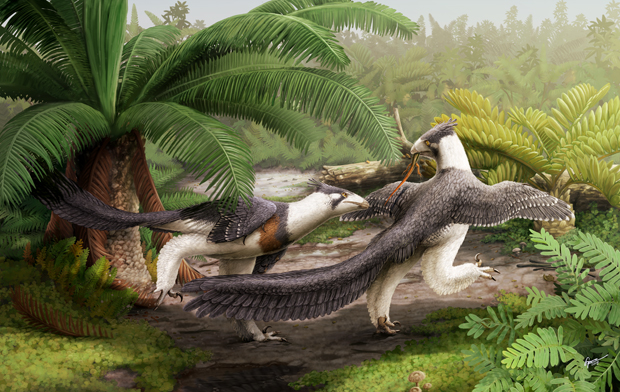
A joint team of British and American palaeontologists have announced the discovery of a new species of dinosaur that roamed the Late Jurassic of Wyoming.  The specimen consisting of both cranial and postcranial material lived around 150 million years ago and it has been tentatively placed within the troodontid branch of the Paraves part of the Theropoda.  It could help scientists to better understand the evolutionary relationships between feathered dinosaurs and true birds and it raises intriguing questions as to when powered flight evolved within the Dinosauria.

The little dinosaur, estimated to have measured less than a metre in length (single known specimen is either an adult or a sub-adult), has been named Hesperornithoides miessleri.

A Life Reconstruction of the Newly Described Dinosaur H. miessleri

Hesperornithoides miessleri - life reconstruction.
A life reconstruction of Hesperornithoides miessleri.

Picture credit: Gabriel Ugueto

Hesperornithoides miessleri – An Inhabitant of Wetlands

Writing in the academic journal PeerJ, the authors which include scientists from the University of Manchester, report the taphonomy of the fossil material suggests that this dinosaur was an inhabitant of wetland environments for at least a portion of its life history.  The fossil material was actually discovered back in 2001, whilst excavation work was being carried out on the fossil material associated with Supersaurus.

The fossil comes from Converse County (Wyoming), from strata making up the middle portion of the famous Morrison Formation.  The fossil-bearing strata from the “Jimbo Quarry” has been variously dated to the Oxfordian and Tithonian ages of the Jurassic.

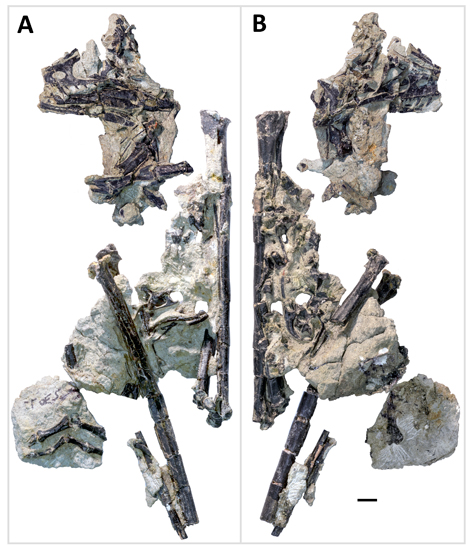
Full Skeleton of Hesperornithoides miessleri

Known fossil material associated with Hesperornithoides miessleri.
Hesperornithoides fossil material “left” (A) and “right” (B) sides of the blocks after final preparation (B).  Scale bar = one cm.

Picture credit: Levi Shinkle

A Resident of the Famous Morrison Formation

The Morrison Formation is famous for its vertebrate fossils, including many examples of dinosaurs, such as Allosaurus, Ceratosaurus, Diplodocus, Brontosaurus and Camarasaurus.  The carnivorous Hesperornithoides is the smallest dinosaur described to date from Wyoming.

Palaeontologist Bill Wahl  (Wyoming Dinosaur Centre), a co-author of the scientific paper, recalled how excited the field team were when they uncovered the block containing the partially articulated bones.

He stated:

“We were removing a ledge of overburden rock and found, unfortunately with a shovel, some tiny, delicate bones poking out.  We immediately stopped, collected as much of the bones as possible and spent the next few days frantically searching for more.  Only after some of the bones were cleaned did we realise that we had found something spectacular.”

Hesperornithoides miessleri – Donated to the Big Horn Basin Foundation

In 2005, the fossil specimen was donated to the Big Horn Basin Foundation, a research and education-based not-for-profit organisation that was merged with the Wyoming Dinosaur Centre back in 2016.  This is how Hesperornithoides miessleri came into the Wyoming Dinosaur Centre’s fossil collection.  The fossil, now known as WYDICE-DML-001, was nicknamed “Lori”  and was examined by Dean Lomax (University of Manchester) and co-author of the study back in 2008, a successful crowdfunding campaign permitted extensive research to be undertaken.

Dean commented:

“I remember the first time I laid my eyes on this little dinosaur.  Even back then, I knew it was a significant discovery.  But, it wasn’t until 2015 when our dino team formed and we began to study ‘Lori’ in much more detail than ever before.”

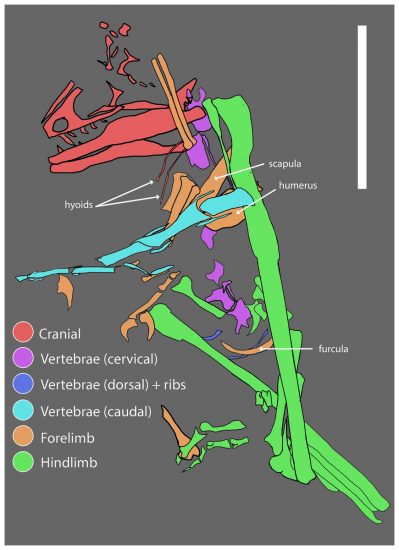
Reconstructed Quarry Map of “Lori” (Hesperornithoides miessleri)

A quarry map of the fossil material asociated with Hesperornithoides.
Association of skeletal elements assembled from 3-D scans of specimen blocks prior to final mechanical preparation.

Picture credit: PeerJ

Visit the website of the British palaeontologist Dr Dean Lomax: British Palaeontologist Dr Dean Lomax.

Found on Private Land

The specimen was found on private land owned by the Miessler family.  The trivial name honours their help, support and assistance in bringing this little theropod to the attention of the scientific community.  The genus name is a combination of “Hesper”, referring to its discovery in the American West and “ornis” a nod to its very bird-like anatomy.

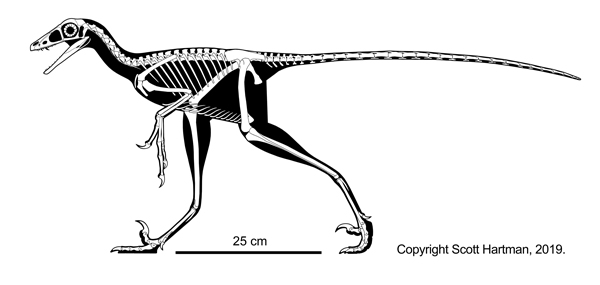
A Reconstruction of the Skeleton of Hesperornithoides miessleri

Hesperornithoides miessleri skeleton reconstruction.
Skeletal Reconstruction Hesperornithoides miessleri (scale bar = 25 cm).

Picture credit: Scott Hartmann

A Key Conclusion of the Study

A key conclusion of the scientific paper relates to the origin of powered flight within the Dinosauria.  Hesperornithoides was very probably entirely terrestrial.  It could not fly, but it has a very bird-like body, suggesting that many features associated with an avian anatomy evolved in dinosaurs that lived out their lives on the ground.  It is the oldest dinosaur of this type, known from more than just teeth fossils from North America.  The terrestrial and flightless lifestyle is consistent with the base of Paraves, and with the base of paravian subclades, suggesting that avian flight evolved within the Avialae, most likely in the Late Jurassic or Early Cretaceous.

For models and replicas of dromaeosaurs and other dinosaurs: Beasts of the Mesozoic Dinosaur Models.

Lead author of the paper and PhD student at the University of Wisconsin-Madison, Scott Hartman stated:

“We wanted to expand the dataset used to test dinosaur-bird relationships, so we added hundreds of new species and tens of thousands of new characters.  We found that Lori is a primitive member of a group of dinosaurs that includes Troodon, but perhaps more importantly we discovered that the smaller details of the family tree of bird-like dinosaurs isn’t quite as resolved as some researchers would claim.”

Scott Hartman continued:

“For example, it only takes a few changes in the dataset for Hesperornithoides to be found as a closer relative of Velociraptor than of Troodon.  One robust finding we did come up with is that even as the interrelationships changed, the primitive members of all these groups were non-flying ground dwelling dinosaurs.  That means that some small relatives of Velociraptor such as Microraptor that looks like it could have glided evolved this separately from the modern bird family.”

Hesperornithoides Cranial Material

Fossil material and accompanying line drawings Hesperornithoides.
Hesperornithoides cranial material and interpretative line drawings.

Picture credit: Levi Shinkle

The scientific paper: “A new paravian dinosaur from the Late Jurassic of North America supports a late acquisition of avian flight” by Hartman, S., Mortimer, M., Wahl, W. R., Lomax, D. R., Lippincott, J. and Lovelace, D. M and published in PeerJ.

Everything Dinosaur acknowledges the help of a media release from the University of Manchester in the compilation of this article.

The Everything Dinosaur website: Everything Dinosaur.

9 07, 2019

Wild Safari Prehistoric World Parasaurolophus

By |2023-12-26T07:48:31+00:00July 9th, 2019|Categories: Adobe CS5, Dinosaur Fans, Main Page, Photos, Photos of Everything Dinosaur Products|0 Comments

Wild Safari Prehistoric World Parasaurolophus

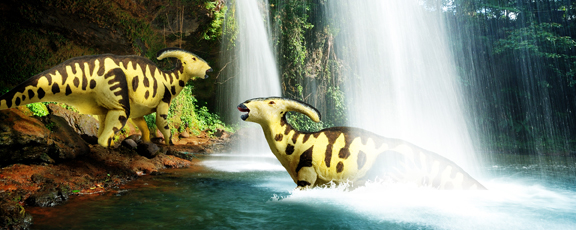
Safari Ltd have published a series of images depicting some of the latest introductions in the Wild Safari Prehistoric World model range.  Today, we feature the Parasaurolophus, a dinosaur that has been depicted several times over the history of Safari Ltd models.  The latest incarnation of Parasaurolophus, was introduced in 2017, one of thirteen prehistoric animal models launched by the U.S.-based company that year.

The Wild Safari Prehistoric World Parasaurolophus Dinosaur Model

Wild Safari Prehistoric World Parasaurolophus dinosaur model.
A pair of Parasaurolophus cooling off in the Late Cretaceous of North America.

Picture credit: Safari Ltd

To view the Safari Ltd range of prehistoric animal figures: Wild Safari Prehistoric World Models.

Parasaurolophus walkeri

Known from numerous very nearly complete and partial skeletons, Parasaurolophus was geographically widely distributed (Alberta to New Mexico – possibly), it is known from the Late Cretaceous (Campanian faunal stage), although there are some unverified reports that this dinosaur may have persisted into the Maastrichtian faunal stage of the Cretaceous.  It is easily recognisable for its long, backward pointing head crest.

Despite the amount of fossil material scientists have to study, the exact size of this herbivorous dinosaur remains open to speculation, with some estimates putting this dinosaur’s maximum length at more than ten metres.  Measurements of the femur (thigh bone), indicate that this duck-billed dinosaur may have weighed more than three tonnes.  Several species have been assigned to the Parasaurolophus genus, perhaps the best known of which is Parasaurolophus walkeri, mainly because this Parasaurolophus species had the more spectacular crest compared to other species in this genus.

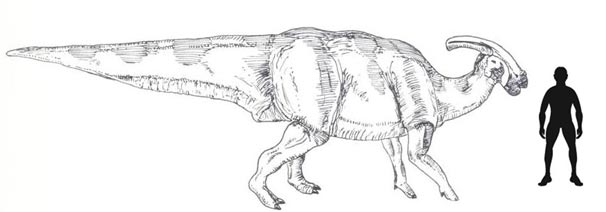
Parasaurolophus walkeri – Scale Drawing

Scale drawing Parasaurolophus walkeri.
A crested, duck-billed dinosaur.  A scale drawing of the Late Cretaceous lamebeosaurine dinosaur Parasaurolophus walkeri.  Note the thick-set upper legs and the wide tail.  Recent studies indicate that this facultative biped was very robust. Picture credit: Everything Dinosaur.

Picture credit: Everything Dinosaur

The website of Everything Dinosaur: Everything Dinosaur.

Go to Top