

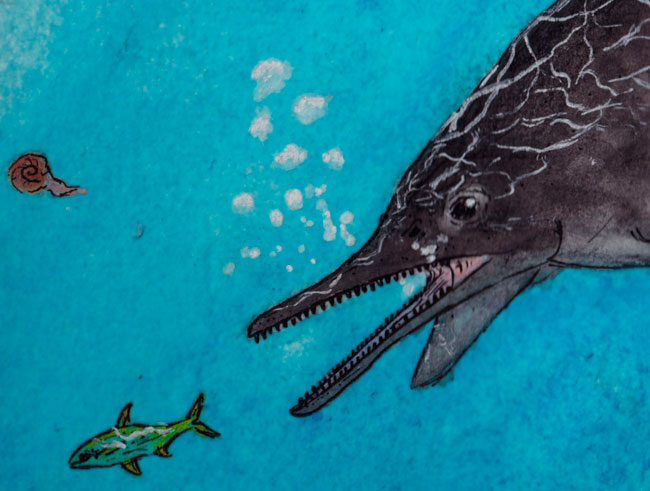
Scientists studying the newly described ichthyosaur Jabalisaurus tethyensis have gained a remarkable insight into its diet. A beautifully preserved fossil from southern Germany contains evidence of the animal’s last meals. In addition, the specimen preserves important details of the skeleton and body outline.
The fossil, specimen number JME-SOS-08369, was previously assigned to Aegirosaurus. However, researchers have now referred it to Jabalisaurus tethyensis. This specimen helps palaeontologists understand how this Late Jurassic ichthyosaur lived.
To read our recent article outlining the reassessment of Aegirosaurus fossil material to J. tethyensis: A New Species of Jabalisaurus Links Germany to Mexico.
Evidence of the Jabalisaurus Diet
JME-SOS-08369 preserves material interpreted as gastric contents. A small concentration of ganoid scales occurs in the anterior dorsal region of the body. The researchers interpret these remains as the partially digested remains of small ray-finned fishes. Therefore, scientists have direct evidence of the Jabalisaurus diet. This ichthyosaur consumed relatively small fishes.
The evidence also agrees with the anatomy of the skull. Jabalisaurus tethyensis had a slender skull armed with numerous relatively small teeth. Such jaws were well suited to catching small, active prey.

Jabalisaurus tethyensis, referred specimen JME-SOS-08369. A, overview photograph, box ‘G’ indicates the location of the preserved gastric contents, arrowhead indicates location of ischiopubis (not easily visible under natural light); B, close-up of skull; C, close-up of dentition. Picture credit: Maxwell, Neumann and Serafini.
Picture credit: Maxwell, Neumann and Serafini
The photograph of JME-SOS-08369 (above) shows the position of the preserved gastric contents. Close-up images also reveal details of the skull and dentition.
A Late Jurassic Hunter of Fish
The gastric contents provide rare direct evidence concerning the diet of a Late Jurassic ichthyosaur. Although ichthyosaurs have an extensive fossil record, direct evidence of what Late Jurassic species ate is surprisingly scarce. Other specimens have yielded fish remains and cephalopod hooklets. However, the gastric contents of JME-SOS-08369 add important information about the feeding ecology of Jabalisaurus tethyensis.
The researchers conclude that its diet included small ganoid-scaled actinopterygian fishes. These are ray-finned fishes characterised by distinctive scales covered with a hard, enamel-like substance.
A new life reconstruction (below) depicts Jabalisaurus tethyensis swimming close to the surface and pursuing halecomorph fishes. These are common Late Jurassic ray-finned fishes.

Artistic reconstruction of Jabalisaurus tethyensis, depicted in the water column close to the surface while pursuing halecomorph fishes. Picture credit: Giovanni Serafini.
Picture credit: Giovanni Serafini
The illustration provides a glimpse of this small ichthyosaur hunting in the warm waters associated with the ancient Tethys Ocean.
Examining the Jabalisaurus Skeleton
JME-SOS-08369 provides other important anatomical information. For example, the forelimbs preserve polygonal phalanges. These small bones formed part of the animal’s paddle-like limbs.
Both the right and left forelimbs preserve this distinctive polygonal morphology. Furthermore, ultraviolet light helped the researchers examine the ischiopubis, part of the pelvic region that is difficult to distinguish under natural light.

Jabalisaurus tethyensis, referred specimen JME-SOS-08369. A, phalanges from the right forelimb, with arrow indicating polygonal morphology; B, phalanges from the left forelimb, also showing polygonal form. C, ischiopubis, photographed under UV-light. Picture credit: Maxwell, Neumann and Serafini.
Picture credit: Maxwell, Neumann and Serafini
These anatomical characteristics helped the researchers compare JME-SOS-08369 with other Late Jurassic ichthyosaurs.
An Exceptionally Important Ichthyosaur Fossil
This specimen has already played an important role in studies of ichthyosaur soft tissues. Previous research examined its exceptionally complete body outline. The fossil even contributed to research suggesting that ichthyosaurs possessed an insulating layer of blubber. Now, JME-SOS-08369 has helped scientists investigate the anatomy, taxonomy and feeding behaviour of Jabalisaurus tethyensis.
To read more about this research: Ichthyosaurus Had Blubber According to New Research.
The fossil demonstrates how much information can be preserved in the fine-grained deposits of southern Germany. Bones reveal the animal’s anatomy, while traces of soft tissues help reconstruct its body. Remarkably, the contents of its digestive system provide evidence of what it ate.
Learning More About Jabalisaurus tethyensis
Everything Dinosaur recently reported the formal description of Jabalisaurus tethyensis (see link in this article). Fossils assigned to this species had previously been included within Aegirosaurus. Their reassessment has increased the known diversity of Late Jurassic ichthyosaurs from the German Plattenkalk deposits.
The discovery of Jabalisaurus in Europe is significant for another reason. Before this research, the genus was known only from Mexico. Its presence on both sides of the ancient Tethys region supports the idea of a distinctive Peri-Tethyan ichthyosaur fauna.
However, JME-SOS-08369 tells a more intimate story. Around 149 million years ago, this marine reptile hunted small fishes in a tropical sea. Thanks to exceptional fossil preservation, evidence of its prey has survived to the present day.
Everything Dinosaur acknowledges the assistance of one of the study’s authors in the compilation of this article.
The scientific paper: “Late Jurassic ichthyosaurs from southern Germany” by Erin E. Maxwell, Jule Neumann and Giovanni Serafini published in Palaeontologia Electronica.
The award-winning Everything Dinosaur website: Models of Ichthyosaurs and Other Marine Reptiles.

Leave A Comment