

A team of international researchers has named a remarkable new species of long-necked dinosaur from Thailand. Uragasaurus kalasinensis is the first formally described member of the Mamenchisauridae from Thailand. Although the fossil evidence consists of a single vertebra, the bone preserves a unique combination of anatomical features that enabled scientists to identify an entirely new dinosaur. It is the fifteenth dinosaur to be named from fossils discovered in Thailand.
The research, published as an open-access paper in the journal “Scientific Reports”, highlights the growing importance of Thailand in helping palaeontologists understand the evolution and distribution of giant sauropod dinosaurs during the Late Jurassic.
Uragasaurus kalasinensis and the Mamenchisauridae
The newly described dinosaur lived approximately 145–150 million years ago during the Late Jurassic. Its fossil was recovered from the Phu Noi locality in Kalasin Province, north-eastern Thailand, within the Phu Kradung Formation.
Mamenchisaurids are famous for their extraordinarily long necks. Most known mamenchisaurids have been discovered in China, so the identification of Uragasaurus kalasinensis (pronounced You-rah-ga-sore-us cal-ah-sin-en-sis), considerably extends the confirmed geographical distribution of this distinctive group.
Scientists estimate that Uragasaurus measured around twenty metres in length and was a huge plant-eater that browsed vegetation growing high above the ground. Its neck has been described as being as long as a cricket pitch.
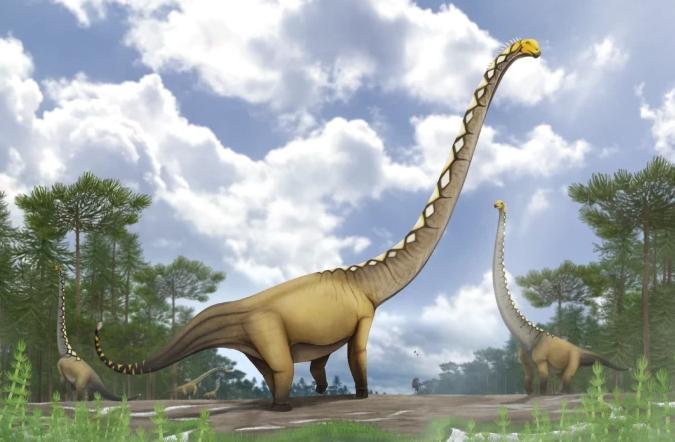
A herd of Uragasaurus kalasinensis feeding in a Late Jurassic forest in Thailand. A metriacanthosaurid theropod can be seen in the background along with a pair of rhamphorhynchoid pterosaurs. Picture credit: Pakorn Chotchaiyaporn.
Picture credit: Pakorn Chotchaiyaporn. Licensed under a Creative Commons Attribution 4.0 International License.
A Single Vertebra Tells an Extraordinary Story
The fossil consists of an anterior dorsal vertebra. At first glance, naming a dinosaur from just one bone might seem surprising. However, vertebrae contain numerous anatomical characteristics that are extremely useful for identifying different dinosaur groups. Individual sauropod vertebrae often preserve unique anatomical characteristics that enable researchers to recognise and describe new species.
The researchers carefully compared the fossil with vertebrae belonging to many other Asian sauropods. They found a unique arrangement of bony ridges, cavities and supporting structures, known as laminae, which had not previously been documented in any recognised species. This distinctive combination of features justified the establishment of the new genus Uragasaurus.
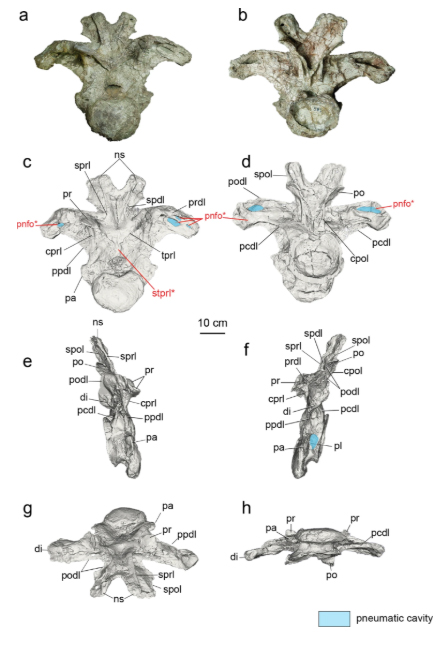
The holotype anterior dorsal vertebra of Uragasaurus kalasinensis (PRC 460) in anterior (a) and posterior (b) views. Digital rendering of the specimen in anterior (c), posterior (d), right lateral (e), left lateral (f), dorsal (g), and ventral (h) views. Asterisk refers to an autapomorphic character. The blue highlight indicates the pneumatic fossa and pleurocoel. Picture credit: Nilpanapan et al.
Picture credit: Nilpanapan et al. Licensed under a Creative Commons Attribution 4.0 International License.
A Growing Picture of Thailand’s Dinosaur Fauna
Thailand has become increasingly important for dinosaur research over the last three decades. Numerous excavations have revealed an impressive diversity of prehistoric animals, including theropods, ornithopods and several species of sauropod.
To read an article from 2019 highlighting the discovery of two new theropod species from north-eastern Thailand: Two New Theropod Dinosaurs from Thailand.
The discovery of Uragasaurus kalasinensis demonstrates that north-eastern Thailand preserves fossils of dinosaur groups previously thought to be largely restricted to China. It also suggests that mamenchisaurids dispersed more widely across eastern Asia than palaeontologists had previously appreciated. The researchers propose that continued exploration of the Phu Kradung Formation is likely to reveal additional fossils that will help clarify the evolutionary history of these spectacular long-necked dinosaurs.
The giant Nagatitan chaiyaphumensis, the fourteenth dinosaur to be described from Thailand: The Last Titan from Thailand.
A Single Vertebra Can Rewrite Dinosaur History
While complete dinosaur skeletons understandably capture the public imagination, they are extremely rare. Discoveries such as Uragasaurus kalasinensis remind us that experienced palaeontologists can extract an enormous amount of scientific information from isolated bones. Careful anatomical comparisons often reveal evolutionary relationships that would otherwise remain hidden.
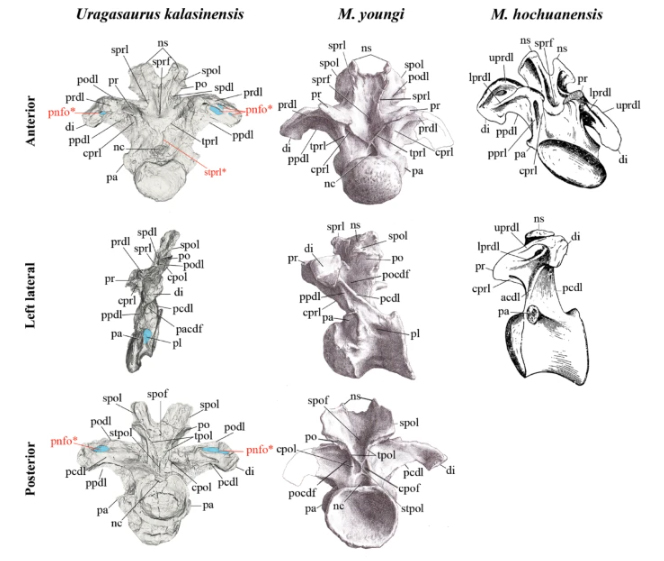
A comparison of the anterior dorsal vertebrae of Uragasaurus kalasinensis with other Late Jurassic mamenchisaurids. Mamenchisaurus youngi (Upper Shaximiao Formation of Sichuan, China) and Mamenchisaurus hochuanensis (Upper Shaximiao Formation of the Chongqing municipality, China). Abbreviations lprdl, lower prezygodiapophyseal lamina; uprdl, upper prezygodiapophyseal lamina. Other abbreviations can be found in the second image in this article. Asterisk refers to an autapomorphic character. The blue highlight indicates the pneumatic fossa and pleurocoel. Note images are not to scale. Picture credit: Nilpanapan et al.
Picture credit: Nilpanapan et al. Licensed under a Creative Commons Attribution 4.0 International License.
A Significant Discovery
The description of Uragasaurus kalasinensis represents another important milestone for Southeast Asian palaeontology. The discovery strengthens evidence that Thailand preserves an exceptionally important record of Jurassic dinosaurs and demonstrates that many new species remain to be discovered.
As fieldwork continues across the region, further fossil discoveries are likely to improve our understanding of how giant sauropods evolved and dispersed across Asia during the Jurassic.
Commenting on the research, Mike from Everything Dinosaur said:
“This fascinating study demonstrates how even a single fossil bone can significantly improve our understanding of dinosaur evolution. Thailand continues to produce scientifically important discoveries, and Uragasaurus kalasinensis adds another impressive dinosaur to the country’s growing fossil record.”
The scientific paper: “A new mamenchisaurid sauropod from the Lower Phu Kradung Formation, Upper Jurassic of northeastern Thailand” by Apirut Nilpanapan, Sita Manitkoon, Varavudh Suteethorn and Komsorn Lauprasert an open-access paper published in Scientific Reports.

Thank you so much for the article! This is my first publication, and it has long journey with revisions. I love dinosaur since I was a kid and to assign the new taxon is unbelievable!
You are most welcome, we look forward to reading more papers on Dinosauria from Thailand.