All about dinosaurs, fossils and prehistoric animals by Everything Dinosaur team members.
4 05, 2026

Newly Described Dacentrurus Skull Fossil Provides a Head’s Up for Stegosaur Evolution

By |2026-05-06T09:46:30+01:00May 4th, 2026|Categories: Palaeontological articles|0 Comments

A remarkable new, open access study published in the journal “Vertebrate Zoology” is transforming what we know about stegosaurian skulls and stegosaur evolution. Researchers describe the most complete stegosaurian skull ever found in Europe.  The skull fossil material (MAP-9029) along with an associated mid cervical vertebra (MAP-9030) are confidently assigned to the stegosaur taxon Dacentrurus armatus. This discovery provides rare insight into the anatomy and evolution of these iconic armoured dinosaurs.  The Dacentrurus armatus skull fossil provides valuable information concerning skull evolution in stegosaurs.

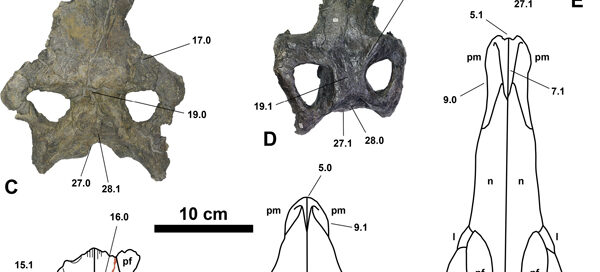
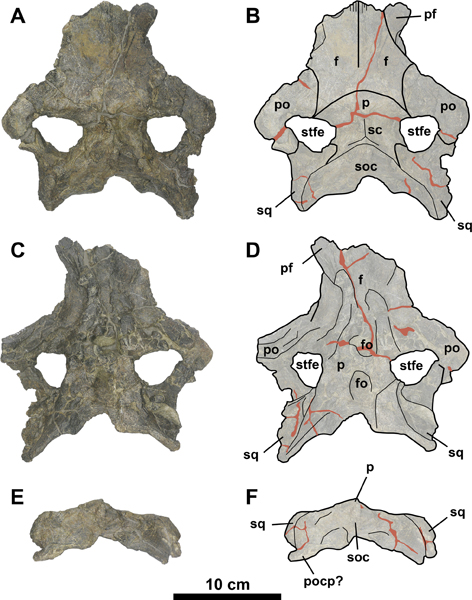
Dacentrurus armatus skull fossil (MAP-9029) and interpretative line drawings.

Skull fossil (MAP-9029) of Dacentrurus armatus Owen, 1875 from the Están de Colón (RD-34) fossil site (Riodeva, Teruel, Spain). Photographs (A, C, E) and interpretative drawings (B, D, F) of MAP-9029 in dorsal (A, B), ventral (C, D), and proximal (E, F) views. Picture credit: Sergio Sánchez-Fenollosa and Alberto Cobos.

Picture credit: Sergio Sánchez-Fenollosa and Alberto Cobos

Stegosaur Cranial Material is Exceptionally Rare

Stegosaur skull fossils are exceptionally rare. Most specimens are fragmentary or badly crushed. Only three stegosaur taxa have a considerable proportion of their skull known.

These taxa are:

  • Stegosaurus stenops – from the Late Jurassic of the western United States and Portugal.
  • Hesperosaurus mjosi – from the Late Cretaceous of the western United States (Wyoming and Montana).
  • Huayangosaurus taibaii – from the Middle Jurassic of south-western China.

A fossiliferous site was discovered in the municipality of Riodeva (Teruel Province, Aragón, north-eastern Spain) in 2004.  The site known as RD-34 consists of deposits from the Villar del Arzobispo Formation. The strata are believed to date from around 150 to 145 million years ago (upper Kimmeridgian to Tithonian faunal stages). Numerous dinosaur fossils have been excavated, including fossils that represent two stegosaurs.

Importantly, dinosaur skulls are rarely preserved. However, MAP-9029 includes key elements such as the snout, upper jaw and braincase. As a result, palaeontologists can now study Dacentrurus cranial anatomy in far greater detail than before. This helps scientists reconstruct feeding behaviour and sensory capabilities in stegosaurs.

Understanding Dacentrurus

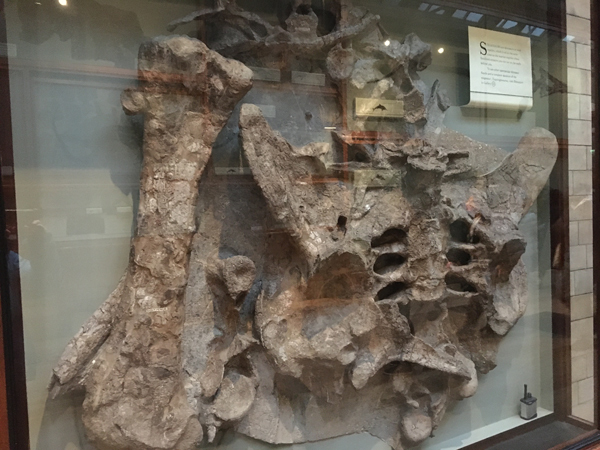
Dacentrurus is thought to be one of the largest European stegosaurs. Size estimates vary due to the fragmentary nature of the fossil material, but it could have reached a length in excess of nine metres. The first fossils of this armoured dinosaur were unearthed in a clay pit in Wiltshire in 1874. The jumbled block of postcranial material is on display at the London Natural History Museum. Dacentrurus material has been reported elsewhere in the UK and mainland Europe. It was one of the earliest stegosaurs to be discovered. Like other stegosaurs, it had rows of plates and spikes running along its body.

Dacentrurus armatus specimen on display at the Natural History Museum (London).

The Dacentrurus armatus specimen on display at the Natural History Museum (London).  It is specimen number NHMUK PV OR46013. Picture credit: Everything Dinosaur.

Picture credit: Everything Dinosaur

However, until now, its skull remained poorly understood. Most known material consisted of postcranial remains such as vertebrae and armour. Therefore, this new cranial material fills a major gap in our knowledge.

New Insights into Stegosaur Skull Evolution

The cranial material consists of the back part of the skull roof, including a fragment of the right prefrontal, both frontals, both postorbitals, both squamosals, the parietal, the supraoccipital, and a possible fragment of the left paroccipital process

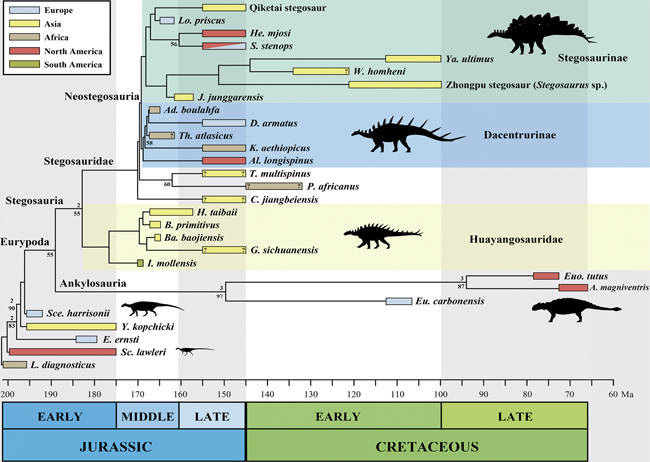
The study of the Dacentrurus armatus skull reveals several previously unknown characteristics of the Dacentrurus cranium.  In addition, the scientists identified a new diagnostic trait (an autapomorphy).  The new autapomorphy relates to the angle of the supraoccipital bone in relation to the roof of the skull. Moreover, the team conducted a new phylogenetic analysis. This resulted in a revised evolutionary tree for stegosaurs. Notably, the researchers proposed a new clade called Neostegosauria consisting of the Stegosaurinae and the Dacentrurinae subfamilies.

Thyreophoran phylogeny and geographical distribution.

Timeline showing armoured dinosaur taxa and geographic distribution during the Jurassic and Cretaceous. Picture credit: Sergio Sánchez-Fenollosa and Alberto Cobos.

Picture credit: Sergio Sánchez-Fenollosa and Alberto Cobos

The Neostegosauria includes medium to large stegosaurs from Europe, Africa, North America and Asia. Consequently, it highlights how widespread and diverse these dinosaurs were during the Jurassic and Early Cretaceous.

Dacentrurus armatus Skull Refines the Stegosauria

The new analysis also refines relationships within Stegosauria. Traditionally, stegosaurs were divided into major groups such as Huayangosauridae and Stegosauridae. However, this study suggests a more complex evolutionary pattern. It integrates new data from cranial anatomy, which was previously lacking. As a result, scientists can now test evolutionary hypotheses with greater confidence.

This is particularly important because skull features often provide critical phylogenetic signals. Therefore, this discovery has implications far beyond a single genus.

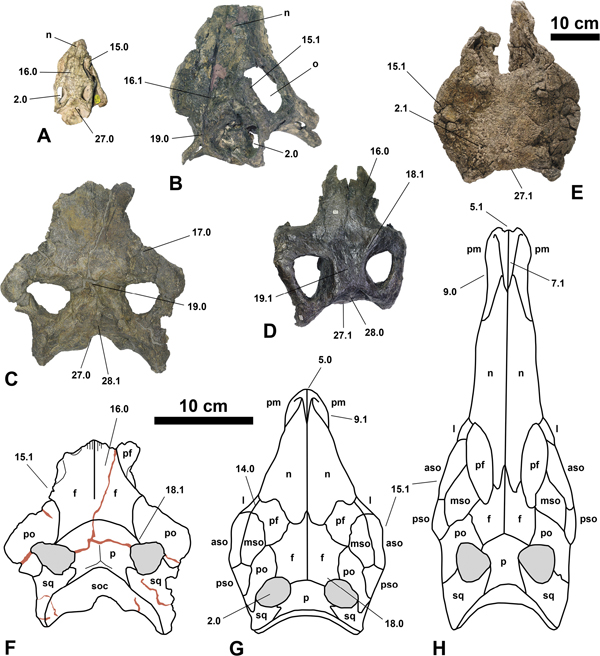
Skulls of ornithischian dinosaurs.

Skulls of ornithischian dinosaurs (A–E) and interpretative drawings in dorsal view (F–H). A, Lesothosaurus diagnosticus Galton, 1978 (NHMUK PV RU B23). B Scelidosaurus harrisonii Owen, 1861 (NHMUK PV R1111). C, F Dacentrurus armatus Owen, 1875 (MAP-9029). D Stegosaurus stenops Marsh, 1887 (NHMUK PV R36730). E Europelta carbonensis Kirkland et al., 2013 (AR-1-544/10). G Huayangosaurus taibaii Dong, Tang & Zhou, 1982 (modified from Sereno and Dong 1992). H S. stenops. The differently shaped skulls could suggest different feeding behaviours. Picture credit: Sergio Sánchez-Fenollosa and Alberto Cobos.

Picture credit: Sergio Sánchez-Fenollosa and Alberto Cobos

The study demonstrates the importance of skull material as an aid to phylogenetic analysis.  Well-preserved skull fossils can significantly improve knowledge about dinosaur evolution.  Furthermore, this research highlights how new fossil material can reshape long-standing ideas.

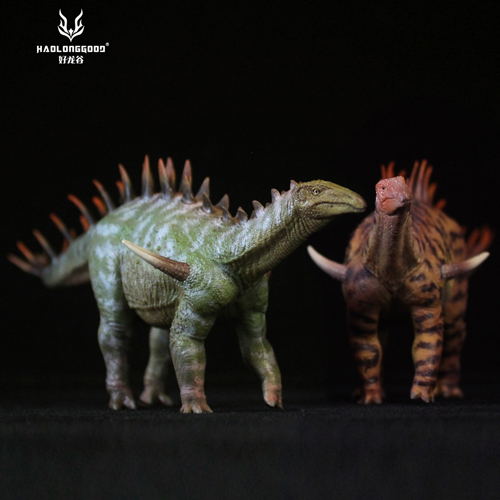
Haolonggood Dacentrurus dinosaur models.

Haolonggood introduced two detailed Dacentrurus models in 2024.

The picture (above) shows two Dacentrurus models from Haolonggood. These figures were introduced in 2024.  The models have been praised for their scientific accuracy.

To view the range of Haolonggood prehistoric animal figures in stock: Haolonggood Dinosaur Models.

Even relatively well-known dinosaurs like Dacentrurus can still surprise us. Moreover, the discovery strengthens Europe’s role in stegosaur research. The Iberian Peninsula continues to yield fossils that are crucial for understanding Jurassic ecosystems. As new fossils come to light, our picture of these remarkable armoured dinosaurs will only continue to evolve.

Everything Dinosaur acknowledges the assistance of one of the study’s authors in the compilation of this article.

The scientific paper: “New insights into the phylogeny and skull evolution of stegosaurian dinosaurs: An extraordinary cranium from the European Late Jurassic (Dinosauria: Stegosauria)” by Sergio Sánchez-Fenollosa and Alberto Cobos published in Vertebrate Zoology.

3 05, 2026

Newly Described Sauropod from Argentina Combines Brachiosaurid and Diplodocid Characteristics

By |2026-05-04T10:46:12+01:00May 3rd, 2026|Categories: Palaeontological articles|0 Comments

A remarkable new sauropod dinosaur discovery is the focus of a recent paper published in the open access journal “PeerJ”.  The study introduces Bicharracosaurus dionidei, fossils of which herald from Upper Jurassic deposits from the Cañadón Calcáreo Formation of southern Argentina. This research captures attention. Not only does it describe a new species, but it also reshapes how scientists understand sauropod evolution in the Southern Hemisphere.

Sauropod Evolution

Much of what we know about sauropod evolution comes from studying fossils from the Northern Hemisphere. Less is known about sauropod evolution and radiation in the Southern Hemisphere. Hence, the discovery of a new sauropod species from southern Argentina is especially significant. In March 2001, farmer Dionide Mesa reported the discovery of some dinosaur vertebrae.  Fieldwork commenced the following year and by 2011 much of the fossil material had been removed.  However, more neck bones (cervical vertebrae) were excavated in 2018.

In total, more than thirty vertebrae, ribs and parts of the pelvis were found.  The material dates from the Upper Jurassic (Oxfordian to Kimmeridgian faunal stages).  Palaeontologists estimate this sauropod fossil material to be approximately 155 million years old.  The fossils probably represent a mature, adult specimen.  Estimates suggest that this dinosaur measured between fifteen to twenty metres in length.

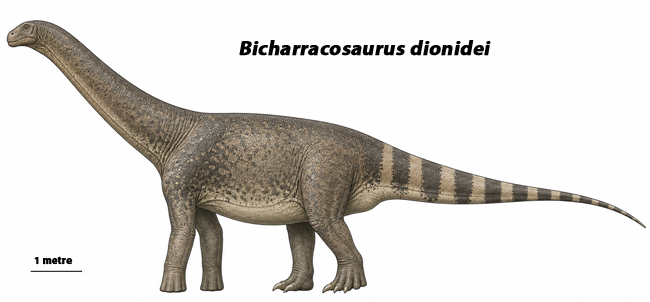
Bicharracosaurus dionidei scale drawing shown in lateral view.

Bicharracosaurus dionidei life reconstruction and scale drawing. Picture credit: Everything Dinosaur (AI assisted).

Picture credit: Everything Dinosaur (AI assisted)

Bicharracosaurus dionidei

What makes Bicharracosaurus dionidei particularly interesting is its unusual mix of sauropod traits. For example, the dorsal vertebrae are similar to the dorsal vertebrae of diplodocids.  However, some fossil bones are reminiscent of the bones of brachiosaurids such as the giant Giraffatitan brancai from the Late Jurassic of Tanzania.  This combination of autapomorphies is unexpected.  Consequently, the research team conducted a detailed phylogenetic analysis.  The results were inconclusive. The overall evidence supports a position of Bicharracosaurus within Macronaria with several analyses and diagnostic characters suggesting brachiosaurid affinities. Bicharracosaurus sits in a somewhat uncertain evolutionary position.

Intriguingly, if the brachiosaurid affinity proves to be correct, then Bicharracosaurus dionidei would be the first member of the Brachiosauridae from the Jurassic of South America.

A Sauropod Puzzle

Several sauropods have been described from fossil material associated with the Cañadón Calcáreo Formation.  For instance, Tehuelchesaurus benitezii which was named and described in 1999 (Rich et al). Tehuelchesaurus is thought to be a macronarian like Bicharracosaurus.  However, whilst Bicharracosaurus shows a combination of sauropod characteristics (diplodocid and brachiosaurid), Tehuelchesaurus is thought to be a member of the Camarasauridae family.

Despite some similarities between Bicharracosaurus and Tehuelchesaurus benitezii fossil material, only in some of the phylogenetic results were these two species recovered as closely related. Whereas in most analyses, Tehuelchesaurus formed a clade with Janenschia robusta, a sauropod from the Late Jurassic of Tanzania. In addition, several diagnostic characters of Bicharracosaurus are absent in Tehuelchesaurus and vice versa. The results also show that other putative macronarian taxa have incongruent positions depending on the dataset.  These inconsistencies are hindering understanding of the early evolution of the Macronaria.

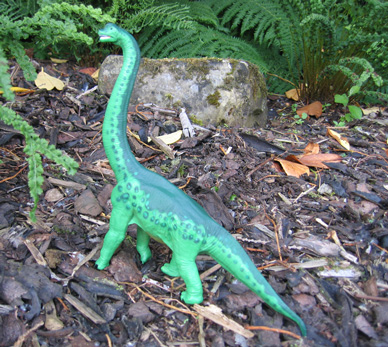
Wild Safari Prehistoric World Brachiosaurus.

A model of a typical member of the Brachiosauridae family. The Wild Safari Prehistoric World Brachiosaurus dinosaur model. Picture credit: Everything Dinosaur.

Picture credit: Everything Dinosaur

The image (above) shows a model of a Brachiosaurus.

For models and replicas of sauropods, including brachiosaurids, diplodocids and other dinosaurs: Dinosaur Models and Dinosaur Toys.

The Naming of Bicharracosaurus dionidei

The taxonomic affinity of this new dinosaur species remains uncertain. It demonstrates that early macronarian evolution was more complicated than previously thought. Until now, scientists relied heavily on fossils from North America and Europe. In contrast, southern continents such as South America and Africa were underrepresented. As a result, evolutionary models may have been biased. Thanks to this newly described sauropod, palaeontologists have the opportunity to test existing ideas and refine theories.  However, it does suggest that sauropod diversity in Gondwana was greater than expected.

The genus name comes from a Spanish term meaning “big animal”. Meanwhile, the species name honours Dionide Mesa, in recognition of the original fossil discovery.

Overall, this study provides fresh insight into one of the most iconic dinosaur groups. It highlights the importance of Southern Hemisphere sauropod fossils. At the same time, it reveals how much there is still to learn. Each new discovery has the potential to challenge established ideas. In this case, Bicharracosaurus dionidei offers a fascinating glimpse into the complex early evolution of macronarian sauropods.

The scientific paper: “Bicharracosaurus dionidei, gen. et sp. nov., a new macronarian (Dinosauria, Sauropoda) from the Late Jurassic Cañadón Calcáreo Formation of Argentina and the problematic early evolution of macronarians” by Alexandra Reutter​, José Luis Carballido, Guillermo José Windholz, Diego Pol and Oliver W.M. Rauhut published in PeerJ.

The multi-award-winning Everything Dinosaur website: Dinosaur and Scientifically Accurate Prehistoric Animal Models.

2 05, 2026

What is the Most Scientifically Accurate T. rex Model?

By |2026-04-28T16:30:26+01:00May 2nd, 2026|Categories: Dinosaur Fans|0 Comments

What makes a scientifically accurate T. rex model? It is a question often asked by collectors and enthusiasts. At Everything Dinosaur, we receive emails asking for advice about which Tyrannosaurus model is correct.  That is a difficult question as nobody has ever seen a living non-avian dinosaur.  However, we try our best to help.  It is often a question of stating that the term “correct” is probably not appropriate.  Indeed, it might be better to look at the evidence that suggests that the designers have consulted the fossil record.

So, how do we judge accuracy?  How do you determine whether a Tyrannosaurus rex is scientifically accurate?

Papo running T. rex

A Papo green running Tyrannosaurus rex model on display next to a replica of a T. rex tooth and a T. rex claw. An exhibit at the Manchester Museum of Natural History. T. rex is ubiquitous, images of the “tyrant lizard king” seem to be everywhere.  However, even museum displays may not incorporate an accurate representation of this famous dinosaur. Picture credit: Everything Dinosaur.

Picture credit: Everything Dinosaur

Starting with the Fossil Record

Tyrannosaurus rex remains one of the most studied theropod dinosaurs. So, when it comes to judging scientific accuracy, several factors come into consideration.  Firstly, any reliable figure must reflect the fossil evidence.  For example, is the tail in the correct position? Are the forelimbs demonstrating pronation? It is important to assess whether the design team have considered tyrannosaur anatomy and the skeletal proportions.

A classic issue with many T. rex figures (and bipedal dinosaurs generally), is that the feet are often made oversized to ensure the figure is stable.  Indeed, the feet of a Tyrannosaurus rex model can be as much as twenty-five percent larger to permit the figure to stand without the need for a support. Modern theropod reconstructions need to portray dynamic, active animals.  Hence companies like PNSO provide a clear, plastic support to help their figures stand.

The PNSO Megalosaurus model.

The new for 2023 PNSO Megalosaurus dinosaur model. It was supplied with a support stand to help this anatomically accurate theropod model to stay upright. Picture credit: Everything Dinosaur.

Picture credit: Everything Dinosaur

Considering Soft Tissue

To a palaeontologist bones only tell part of the story.  Dinosaurs were living animals and any prehistoric animal figure should try to convey the impression of a living, breathing animal.  For example, a scientifically accurate T. rex model would not show the fenestrae (openings on the skull).  Tyrannosaurus models can look too thin; they have an almost “shrink-wrapped” appearance.  It is true that T. rex may have lost condition, but it possessed a wide neck, deep chest and broad hips.  Scientists study muscle attachment scars on fossil bones.  These are then compared with extant animals.  Ideally, the design team should include a palaeontologist or at least someone with anatomical knowledge.

Tyrannosaurus rex Integument

It is important to consider the integument and skin texture.  Some small fossils of Tyrannosaurus skin are known.  These fossils can help with the texture of the figure.  Furthermore, while feathers may have been present in juveniles, most adult reconstructions favour a largely scaly appearance.  Although it is noted that some parts of the body of an adult T. rex may have had a sparse covering of simple feathers.

Importantly, scale size and distribution should vary. This avoids a uniform, artificial finish. As a result, high-quality models often display intricate detailing across the head and flanks.

Colour remains one of the biggest unknowns. Even so, informed speculation plays a role. Artists often look to modern animals for inspiration. For instance, countershading is common in large animals today. This means a darker upper body and lighter underside. Such a pattern can help with camouflage. Therefore, subtle and naturalistic tones are usually preferred over bold, unrealistic colours.  Designers should also consider the palaeoenvironment carefully.  For example, T. rex was very probably an ambush predator, therefore, it is important to consider aspects of camouflage and concealment.

Considering Inferred Behaviour and the Presentation for a Scientifically Accurate T. rex Model

Equally important is how the Tyrannosaurus rex is presented. A scientifically grounded model avoids exaggerated, “movie monster” poses. Instead, it should aim to reflect plausible animal behaviour. For example, a calm but alert stance may reflect a real animal at rest. In contrast, overly dramatic roaring poses can misrepresent anatomy. Consequently, many collectors now favour more naturalistic displays.

In recent years, dinosaur model collectors have seen two contrasting trends emerge:

  1. The increase of articulated figures (Creative Beast Studio, Nanmu Studio, PNSO)
  2. The desire to create anatomically accurate figures (Safari Ltd, CollectA, Everything Dinosaur Evolution)

A handful of manufacturers work with palaeontologists and other academics. This collaboration has raised standards across the hobby. Collectors now expect far greater scientific rigour.
For instance, some modern models incorporate detailed research into musculature, integument, and even ecological context. In addition, display bases can provide environmental clues linked to fossil formations.

Setting New Standards in Scientific Accuracy

The Everything Dinosaur Evolution series reflects this shift towards accuracy.  This range of figures sets out to produce accurate models shaped by the input of academics, anatomists and leading artists. Each model is developed using current scientific understanding. For example, the 1:33 scale T. rex features carefully considered proportions and posture. Moreover, its design avoids the clichés of cinematic depictions. Instead, it presents a grounded interpretation based on fossil evidence. After all, this dinosaur model has been developed by Everything Dinosaur team members in collaboration with top designer Glen Southern, famous palaeo-reconstruction artist Bob Nicholls and the well-known vertebrate palaeontologist Dr Dean Lomax.

A Long Design and Development Process for a Scientifically Accurate T. rex Model

It took three years to design and develop.  Famously, debate on the shape of the toe claws took three weeks. In addition, the paint application follows a complex structured plan. Natural tones and subtle contrasts help create a believable finish. The aim is not spectacle, but authenticity. Every aspect of the colour scheme has been carefully considered.

The Everything Dinosaur Evolution T. rex model on top of its beautiful box.

The 1:33 scale Everything Dinosaur Evolution T. rex model on top of its beautiful box.  Picture credit: Everything Dinosaur.

Picture credit: Everything Dinosaur

To learn more about the complicated colour scheme for the Everything Dinosaur Evolution T. rex model: Explanation of the Painting Plan for Everything Dinosaur Evolution Figure.

Furthermore, even the display base adds context. It has been designed to echo the ancient environment in which T. rex once lived. As a result, the model becomes more than a standalone figure. Indeed, if you are going to try to create a scientifically accurate T. rex model any display needs to be considered.

A view of the Everything Dinosaur Evolution T. rex display base.

The Everything Dinosaur Evolution T. rex display base. There is a metal rod to help secure the model to the base. In addition, the base, which represents a dried-up lake contains two tyrannosaur tracks and a pile of dinosaur dung. Both the tracks and dung are based on real fossils. If you are attempting to make a scientifically accurate T. rex model, the display base needs careful consideration too. Picture credit: Everything Dinosaur.

Picture credit: Everything Dinosaur

Drawing a Conclusion

So, what is the most scientifically accurate T. rex model? The answer depends on how closely a model follows current scientific thinking. It is unlikely that a consensus view will ever be achieved.  After all, no one has seen a living Tyrannosaurus rex. In summary, accuracy comes from anatomy, texture, colour, and behaviour working together. Collectors should consider the team behind the model.  Do they have the credentials and knowledge to create scientifically accurate prehistoric animal models? As science advances, so too will our reconstructions.

For collectors, this makes the search both exciting and rewarding. However, if we may be so bold, the tremendous feedback from collectors, dinosaur experts, academics and dinosaur model fans makes us extremely proud about our first dinosaur model.  We have high expectations for the rest of the Hell Creek series.

Perhaps, we have created a strong contender for the accolade of most scientifically accurate T. rex model.  That is, until the next significant fossil discovery or academic paper. So pleased we made an early call about our Everything Dinosaur Evolution Tyrannosaurus rex having lips.

View the Everything Dinosaur Evolution Tyrannosaurus rexEverything Dinosaur Evolution Dinosaur Model.

Mike from Everything Dinosaur commented:

“Our figure has earned recognition from many as one of the most scientifically accurate Tyrannosaurus rex models ever produced, and that achievement reflects the dedication of an exceptional team. We worked alongside leading experts in palaeontology, design, and palaeoart, whose knowledge and passion shaped every detail of our first dinosaur model.”

The Everything Dinosaur website: Scientifically Accurate Prehistoric Animal Models.

1 05, 2026

The Latest Issue of “Prehistoric Times” Magazine is Reviewed

By |2026-05-03T19:03:20+01:00May 1st, 2026|Categories: Magazine Reviews|2 Comments

Issue 157 of “Prehistoric Times” magazine arrived a couple of weeks ago.  It is an engrossing read and as always packed full of interesting articles. This edition celebrates prehistoric life with expert writing, detailed articles and inspiring artwork. Without any further ado let’s get “Prehistoric Times” magazine reviewed.

Talented artist Chuck Egnaczak provides the front cover artwork.  It features the giant Rhizodus of the Early Carboniferous.  Two species are known and it is thought that it was an apex predator in freshwater environments.  The front cover art features this fanged monster with the remains of some of its victims. Chuck Egnaczak is a regular contributor of cover artwork for the magazine. For example, he produced the Gryposaurus artwork for issue 153.

"Prehistoric Times" Spring 2026 front cover artwork.

The front cover of “Prehistoric Times” magazine. The artwork is by regular contributor Chuck Egnaczak. Picture credit: Mike Fredericks.

Picture credit: Mike Fredericks

“Prehistoric Times” Magazine Reviewed

Phil Hore discusses the evolutionary history of Rhizodus and explains how fossils were discovered. The article includes lots of amazing Rhizodus artwork including contributions from Yaroslav Koryakov, Wade Carmen, George Feldman and Sam Pickens. We also note the illustration of Rhizodus attacking a canoe by Lloyd Wilkiel and the two, wonderful contributions from M. Elliot Massion.  Many of the illustrations feature early tetrapods meeting their demise.

Fans of the diminutive, bucktoothed Incisivosaurus will not be disappointed with Phil Hore’s second article.  It provides an overview of this bizarre, Early Cretaceous theropod. We note that many of the artists who provided illustrations for the Rhizodus piece also submitted artwork featuring Incisivosaurus. Indeed, front cover artist Chuck Egnaczak submitted a pair of illustrations and artwork from Aaron March, Tim Bollinger from Total Dino and Charles Ferguson is also featured.  In addition, we noted the skull illustrations by editor Mike Fredericks and Paul Passano. Jaime Martinez prefers sculptures to illustrations.  Top marks for his duelling pair of Incisivosaurus and also for his Rhizodus maquette.

Illustrating Hadrosaurs

Tracy L. Ford updates his series looking at how to illustrate hadrosaurs.  For example, he considers the presence of soft tissue structures on the head, the size of the eye and whether duck-billed dinosaurs had cheeks. The palaeoart theme is continued by Allen A. Debus as he describes how prehistoric animal artwork has changed over the decades.  Furthermore, he documents a recent trip to some prehistoric animal themed attractions in the USA.

Randy Knol updates collectors with news about some of the latest prehistoric animal model introductions.  Figures from CollectA and Safari Ltd are discussed along with our own Everything Dinosaur Evolution T. rex. 

Randy concludes:

“I am excited and enthusiastic with the direction being taken by Everything Dinosaur because it matches my own hopes for the direction of the hobby.”

Editor Mike Fredericks examines new PNSO figures and also praises the Everything Dinosaur Evolution T. rex model.

The advertisement for the Everything Dinosaur Evolution T. rex in issue 157 of "Prehistoric Times".

The print advert for the Everything Dinosaur Evolution T. rex which is in issue 157 of the magazine. Picture credit: Everything Dinosaur.

Picture credit: Everything Dinosaur

The first four models in the “Evolution” series feature dinosaurs from the Hell Creek Formation.  Sam Allred penned a short story featuring dinosaurs from this geological formation writing about a Tyrannosaurus rex seeking a meal.  Palaeontologist Kenneth Carpenter continues analysing dinosaur footprints and John “Jack” Horner reflects on how our knowledge of the Dinosauria has changed over his long career.

Mike Fredericks reviews the latest book releases.  This section includes a review of the three separate volumes of the “Princeton Encyclopedia of Dinosaurs”.  Written by Bryce Jones these books catalogue every known species of sauropod, ornithischian and theropod dinosaur.  The third book in a series documenting the remarkable contribution of Czech artist Zdeněk Burian is also included.  Entitled “The Prehistoric World of Zdeněk Burian: The Path to Humans”, it focuses on the evolution of hominins and includes many examples of Burian’s sumptuous artwork.

On the subject of Burian, John Lavas continues his exploration of the Czech artist. Issue 157 covers Burian’s work on prehistoric rhinos and tapirs. There are some wonderful illustrations of Coelodonta.

The photograph of some early Aurora “Prehistoric Scenes” was a joy to behold in the Collector’s Corner section and rare Marx dinosaur figures are highlighted by Pat Schaefer.  Robert Telleria writes about Miller pewter models, and the back cover features some fantastic palaeoart by J. A. Chirinos.

Monster from the Deep

Talented model maker Sean Kotz guides readers through a marine reptile build.  An Elasmosaurus in 1:35 scale model designed by Dino and Dog Miniatures is skilfully constructed and painted.  The master model maker provides an informative and highly practical guide to constructing an Elasmosaurus figure, offering readers valuable insight into the techniques behind a professional-quality finish. The article carefully documents each stage of the build, from initial assembly through to the meticulous filling and smoothing of seams to ensure a clean, realistic form.

Elasmosaurus model build by Sean Kotz.

Talented model maker Sean Kotz provides details of an Elasmosaurus model build.

The application of primer is clearly explained, highlighting its importance in preparing the surface for paint. The feature concludes with a detailed overview of the painting process, with Kotz sharing tips on layering, colour selection, and subtle detailing to bring this iconic marine reptile convincingly to life.

In summary, issue 157 of Prehistoric Times proves to be another strong addition to this long-running and much-respected title. With its balanced mix of well-researched articles, expert contributions, and inspiring artwork, the magazine continues to appeal to a wide audience, from dedicated collectors to those with a broader interest in prehistoric life.

To subscribe to “Prehistoric Times” magazine: Subscribe to the Magazine.

Go to Top