

Researchers from Virginia Tech (Virginia, USA) have identified a new species of Late Triassic dinosaur. The dinosaur has been named Ptychotherates bucculentus. This new carnivorous dinosaur taxon has been erected based on the detailed examination of an incomplete, well-preserved but jumbled up skull fossil (specimen number CM 31368). The skull comes from the world-famous Coelophysis Quarry from the Ghost Ranch fossil site in New Mexico. Significantly, the scientists have assigned P. bucculentus to the Herrerasauria. It might be one of the last surviving members of this earliest-evolving clade of meat-eating dinosaurs.
A New Herrerasaurian Dinosaur
In 1982, a field team from the Carnegie Museum of Natural History (Pittsburgh, Pennsylvania, USA), excavated the fossil from the Coelophysis Quarry. This site contains the preserved remains of numerous vertebrates, but the fossil assemblage is dominated by fossils of the theropod Coelophysis bauri. The fossil bones of over a thousand individuals have been reported. The skull remained in storage and was not studied. However, one of the paper’s authors Sterling Nesbitt (Department of Geosciences, Virginia Tech), arranged for the skull to be scanned using computer tomography (CT). The individual bones were identified and a 3D model of the skull constructed.
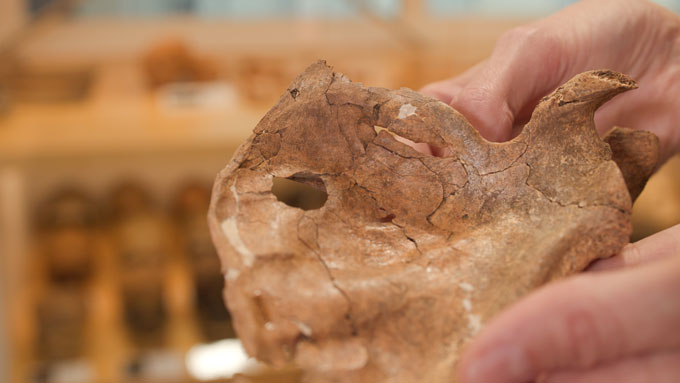
When digitally reconstructed the scientists discovered that the jugal bone was unusually tall. Ptychotherates has proportionately the dorsoventrally deepest jugal known for any Triassic-aged dinosaur. Phylogenetic analyses align Ptychotherates bucculentus with Tawa hallae, Chindesaurus bryansmalli and Daemonosaurus chauliodus within the Herrerasauria clade and closely related to the Herrerasauridae family. The researchers erected the clade Morphoraptora to nest these dinosaurs in. The Morphoraptora are united by several autapomorphies. For example, these dinosaurs have extremely fine serrations on their teeth.
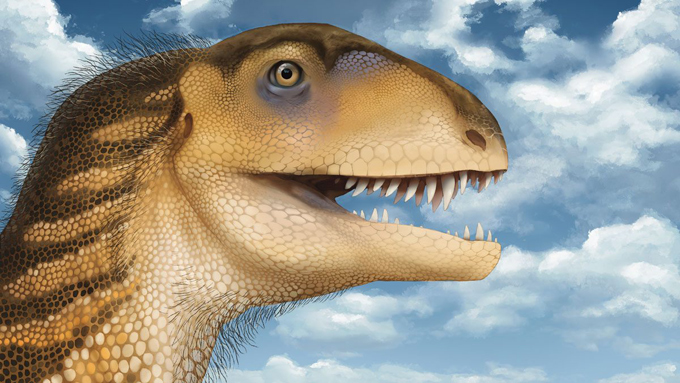
Artistic rendition of Ptychotherates bucculentus. Picture credit: Megan Sodano for Virginia Tech.
Picture credit: Megan Sodano for Virginia Tech
The Morphoraptora and Radiohead
Morphoraptora is from the Greek for “form”, “shape” and raptor for “robber”. This reflects the morphological convergence between members of this clade and theropod dinosaurs. It loosely translates as “body snatcher” a reference to the close anatomical similarities between the carnivorous Morphoraptora and the Theropoda. In addition, it honours the 2007 song by the English rock band Radiohead in the album In Rainbows, which one of the authors of the study listened to whilst preparing the manuscript.
The open-access paper was published in the journal Papers in Palaeontology.
To read Everything Dinosaur’s blog post from 2009 about the discovery of Tawa hallae: New Meat-eating Dinosaur from the Chinle Formation.
Our 2011 post about the discovery of Daemonosaurus: The Little “Demon” of Ghost Ranch.
Ptychotherates bucculentus – What’s in a Name?
The skull of Ptychotherates (pronounced Tie-cho-the-rate-ees), was relatively short, but proportionately deep. Although, no substantial postcranial material is known, scientists estimate that this dinosaur probably measured around 2.2 metres in length. Like the closely related Tawa, Chindesaurus and Daemonosaurus, it was probably lightly built with the tail comprising around fifty percent of the total body length.
The genus name means “folded jaw hunter”. This references the carnivorous nature of this dinosaur and also the “folds” and unusual orientations of the fossil material that hampered reconstruction. The species name is from the Latin and translates as “with full cheeks” in reference to the exceptionally tall jugal.
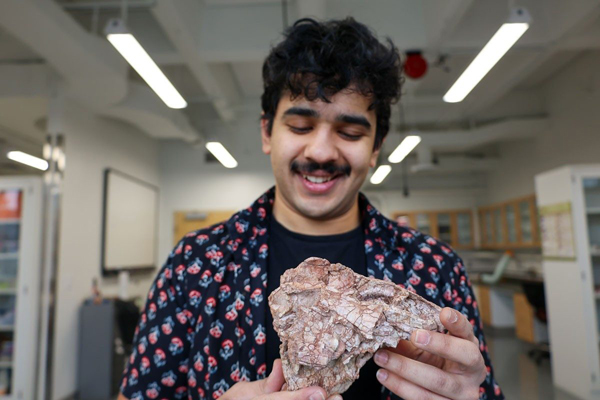
One of the co-authors of the study Simba Srivastava holding the preserved skull of Ptychotherates bucculentus. Picture credit: Spencer Coppage for Virginia Tech.
Picture credit: Spencer Coppage for Virginia Tech
A Late Triassic Hunter
The paper also notes that the phylogenetic relationships of these early saurischian dinosaurs remain controversial. Unfortunately, the fossil material ascribed to Ptychotherates bucculentus, Tawa hallae, Chindesaurus bryansmalli and Daemonosaurus chauliodus does not overlap sufficiently to permit direct fossil comparison. The lack of fossils makes determining the phylogeny difficult. However, the discovery of herrerasaurians in the Coelophysis Quarry establishes that different types of meat-eating dinosaur co-existed during the Late Triassic. Furthermore, the occurrence of morphoraptorans in the Coelophysis Quarry assemblage extends their stratigraphic range later in the Triassic than previously thought.
The exact age of Ptychotherates is hard to determine. However, it is estimated that this lithe meat-eater lived more recently than 210 million years ago. Ptychotherates bucculentus may have lived shortly before the great extinction event that marked the end of the Triassic. Moreover, scientists have not found any younger herrerasaurian fossils. This discovery suggests that the mass extinction event may have wiped out this dinosaur lineage. In addition, palaeontologists have not found Late Triassic herrerasaurians anywhere else in the world. Therefore, the region that is now southwestern USA may have served as the clade’s final refuge before their extinction.
It had been thought that the end-Triassic extinction wiped out competitors to the Dinosauria. However, with the discovery of Ptychotherates it suggests that some long-standing dinosaur lineages also died out at this time.
Everything Dinosaur acknowledges the assistance of a media release from Virginia Tech in the compilation of this article.
The scientific paper: “A new taxon of saurischian dinosaur from the Coelophysis Quarry of New Mexico, USA (Triassic: latest Norian or Rhaetian) highlights herrerasaurian diversity in the latest Triassic” by Simba Srivastava and Sterling J. Nesbitt published in Papers in Palaeontology.
The award-winning Everything Dinosaur website: Models of Triassic Dinosaurs and Prehistoric Animals.

Leave A Comment