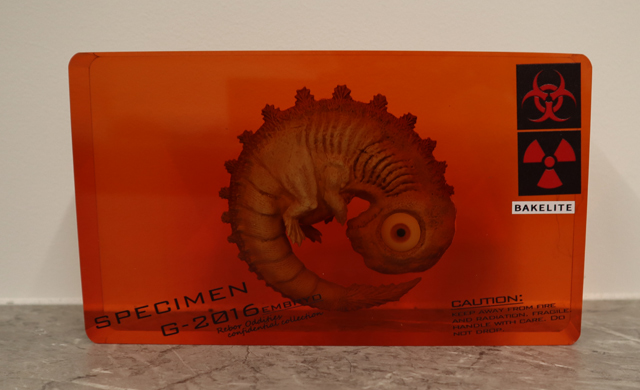
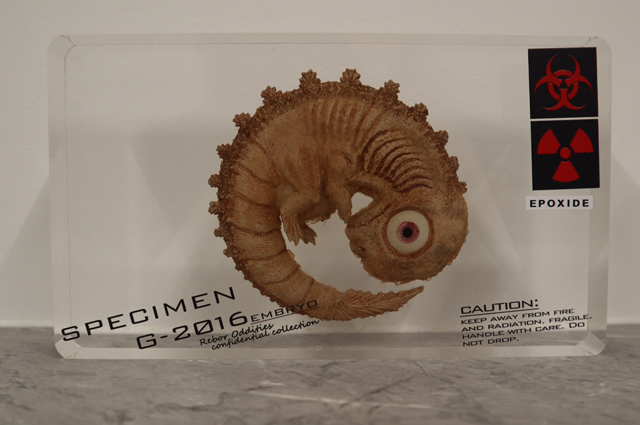
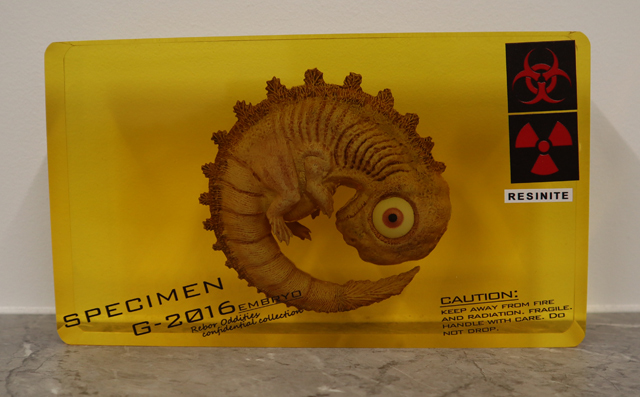
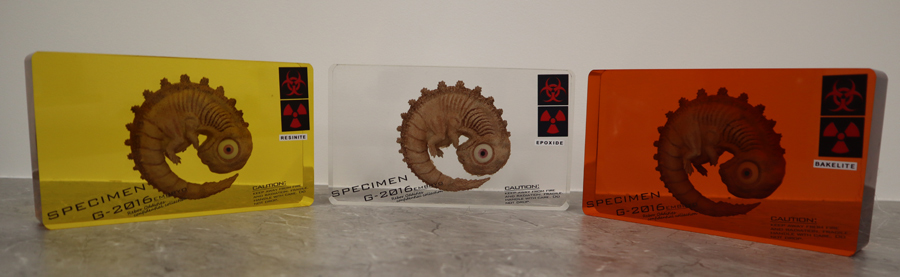
We at Everything Dinosaur, might know our dinosaur and prehistoric animal models, but every once in a while we come across a replica that simply takes our breath away. Rebor have produced three astonishing figures depicting science fantasy embryos entombed in resin.
These replicas entitled the Rebor Oddities Specimen: G-2016 Embryos are beautifully engineered and we wanted to mark the release of these limited-edition figures by producing a short YouTube video tribute.
The Rebor Oddities Specimen: G-2016 Embryo in Bakelite is a brilliant, science-fiction/fantasy model from Rebor. In our video we praise the model’s innovative design.
The Rebor Oddities Specimen G-2016 Embryo. A science fiction/fantasy embryo encased in a resin block. A beautifully engineered and highly innovative replica. Picture credit: Everything Dinosaur.
Picture credit: Everything Dinosaur
The very striking Rebor Oddities Specimen: G-2016 Epoxide figure – clearly proving to be a big favourite amongst collectors. Picture credit: Everything Dinosaur.
Only 500 of each type of model has been made and stocks of these fascinating figures are already low.
A spokesperson from Everything Dinosaur commented:
“Whilst we do not pretend to understand all the cultural references, we have had a lot of orders from Asia for these stunning figures. We might be more used to examining a T. rex foetus as per a previous Rebor model introduction, but we have been bowled over by these beautifully figures. They certainly are very different.”
Only 500 of each figure has been made. These limited edition figures have proved very popular with collectors. Picture credit: Everything Dinosaur.
Picture credit: Everything Dinosaur
The Rebor Oddities Specimen: G-2016 replicas make an attractive display. Picture credit: Everything Dinosaur.
Picture credit: Everything Dinosaur
The Rebor range of prehistoric animal models and fantasy figures has expanded since its first production run some eight years ago. Rebor have produced some amazing and highly innovative figures and if these three limited edition replicas are anything to go by then model collectors are going to have some exciting times ahead.
To view the range of Rebor models and figures available at Everything Dinosaur: Rebor Models and Figures.
As part of our commitment to education and science outreach activities, team members at Everything Dinosaur have been busy amending and updating information boards for a UK-based exhibitions company.
One of the many dinosaurs that we have been working on is Pachycephalosaurus (P. wyomingensis).
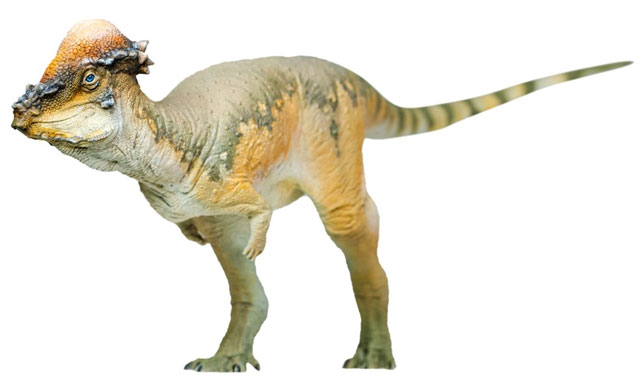
Austin the Pachycephalosaurus (P. wyomingensis). Everything Dinosaur’s work on the Pachycephalosaurus display boards coincided with the announcement from PNSO of a new for 2021 Pachycephalosaurus dinosaur model.
The picture (above) shows a PNSO Pachycephalosaurus model.
The recently announced Austin the Pachycephalosaurus (PNSO), is due to be in stock at Everything Dinosaur later this year. The display boards we have been working on have to be finished in just a few days so they can be produced in time for outdoor events that are due to start in the UK next month (late May 2021).
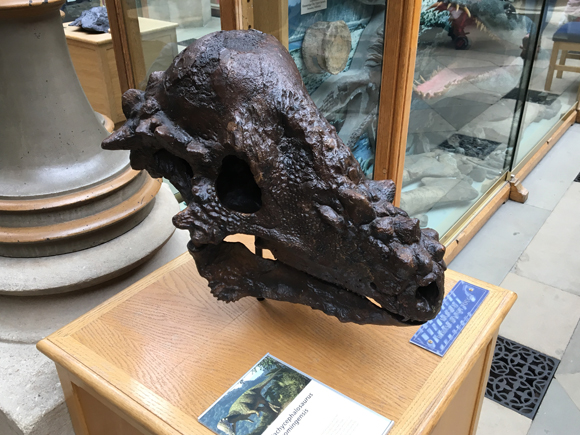
Pachycephalosaurus wyomingensis replica skull. Everything Dinosaur team members took this photograph of a replica the skull of the North American member of the Pachycephalosauridae on a visit to the Oxford University Museum of Natural History.Picture credit: Everything Dinosaur.
Picture credit: Everything Dinosaur
Focusing on the Cranium and Taxonomy
The information we have provided to the exhibitions company focuses on the story of this dinosaur’s discovery and looks at some of the theories that have been proposed to explain the very thick skull bones, which in some specimens are more than 25 cm thick.
We have also provided information on Dracorex and Stygimoloch in a bid to explain that many palaeontologists do not think that these genera are valid. It is thought that Dracorex and Stygimoloch may represent juvenile specimens of P. wyomingensis.
Today, might be St George’s Day (April 23rd), but team members at Everything Dinosaur have stopped all talk of “dragons” to post up news about a replica of the “feathered tyrant” being introduced by PNSO.
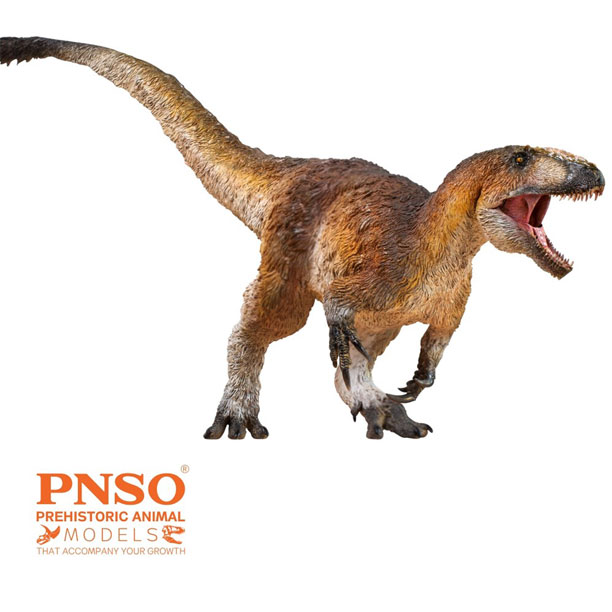
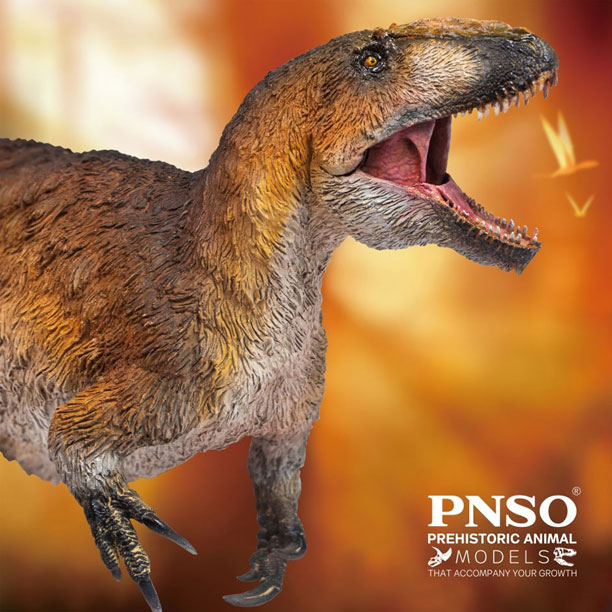
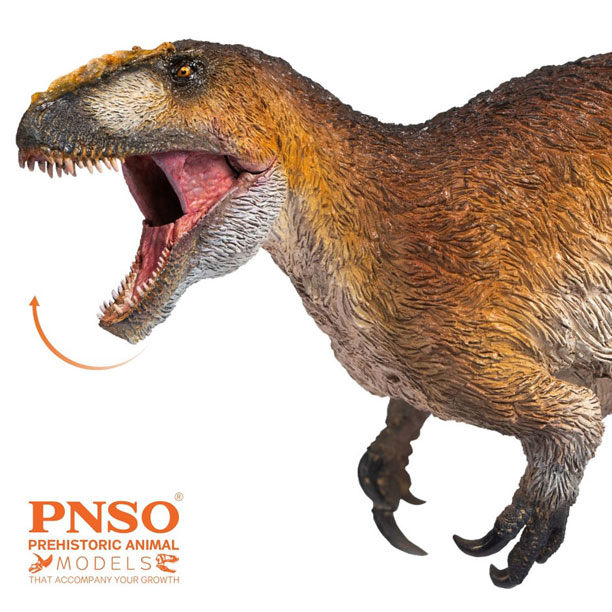
Yinqi the Yutyrannus (Y. huali) model in the PNSO mid-size model range has been announced in a joint release by Everything Dinosaur and representatives of the Chinese company.
The new for the summer of 2021 PNSO Yinqi the Yutyrannus dinosaur model.
The “Feathered Tyrant”
Known from three, nearly complete specimens found in Lower Cretaceous sediments in Liaoning Province, north-eastern China, Yutyrannus (Y.huali) translates as “beautiful, feathered tyrant”. Regarded as a basal member of the Tyrannosauroidea (primitive member of the tyrannosaur lineage), some of the fossilised feathers are more than fifteen cm long, demonstrating that even some extremely large theropods were feathered.
The PNSO Yinqi the Yutyrannus (anterior view).
PNSO Yinqi the Yutyrannus
The model measures around 25.5 cm long and the highest part of the raised tail is 12.3 cm off the ground. This is a beautifully detailed dinosaur model and a welcome addition to the PNSO mid-size model range.
The PNSO Yinqi the Yutyrannus model measurements.
The PNSO Yinqi the Yutyrannus will be available from Everything Dinosaur in the summer (estimated around July 2021).
With an Articulated Lower Jaw
The new PNSO tyrannosaur replica joins versions of Tyrannosaurus rex and Qianzhousaurus (Q. sinensis) in PNSO’s tyrannosaur range (mid-size models and larger). Just like the original “Wilson” the T. rex and A-Shu the Qianzhousaurus, Yinqi the Yutyrannus will have an articulated lower jaw.
PNSO Yinqi the Yutyrannus with an articulated jaw.
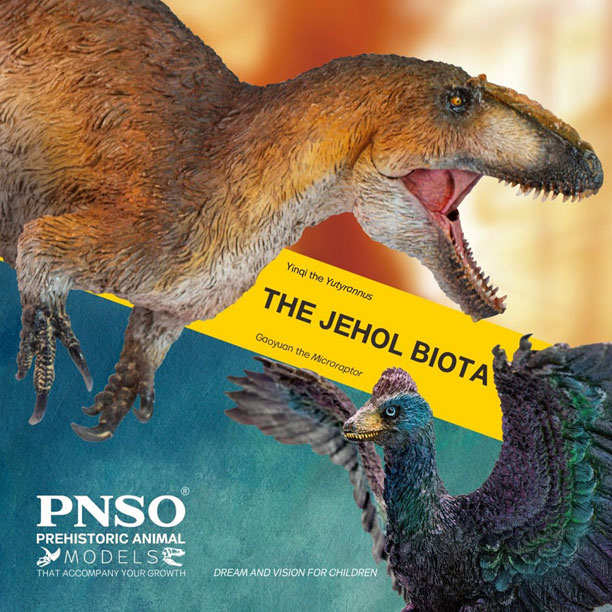
Celebrating the Jehol Biota
The introduction of this new figure (summer 2021), continues the trend whereby the Chinese manufacturer celebrates the dinosaur fauna associated with a specific geological formation. In this case, it is the Yixian Formation that forms one of the constituents of the famous Jehol biota.
The PNSO Yutyrannus and the Microraptor are replicas of dinosaurs associated with the Jehol biota.
A spokesperson from Everything Dinosaur commented:
“PNSO have ambitious production plans for quarter 2 and 3 of 2021. We at Everything Dinosaur know what’s coming and we think dinosaur fans and model collectors are going to be enthralled with PNSO’s product offerings.”
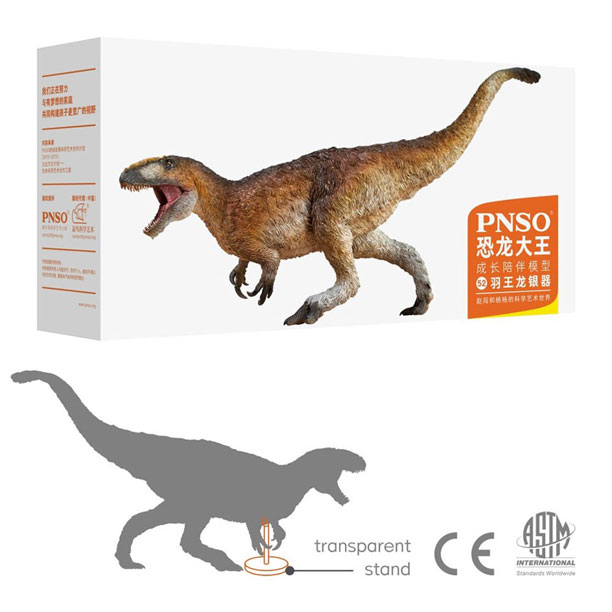
The PNSO Yinqi the Yutyrannus is supplied with a small, transparent stand that when placed in the middle of the replica’s chest helps to support this dinosaur figure.
Supplied with a Support Stand
PNSO Yinqi the Yutyrannus will be supplied with a small, transparent stand that when placed in the middle of the model’s chest will help to support this dinosaur in its dynamic pose.
PNSO Yinqi the Yutyrannus (lateral view).
The PNSO Yutyrannus will be available from Everything Dinosaur in the summer of 2021. To view the current range of PNSO models and figures available from Everything Dinosaur: PNSO Dinosaur and Prehistoric Animal Models.
Team members at Everything Dinosaur have been asked to cast their expert eyes over a display board that focusses on Spinosaurus (Spinosaurus aegyptiacus). Spinosaurus has become an increasingly popular dinosaur with children since it featured as the main protagonist in the third of the “Jurassic Park” films – “Jurassic Park III” that was released in 2001.
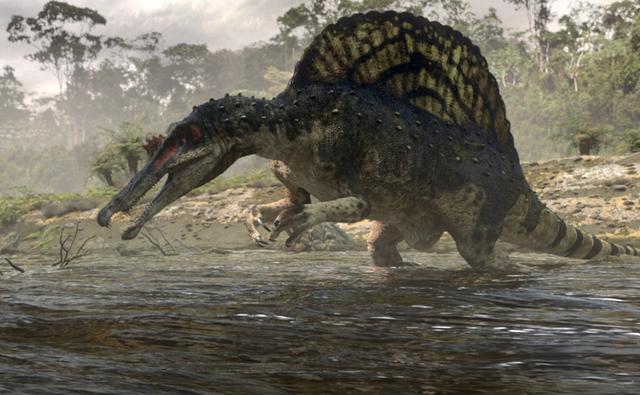
The public profile of this dinosaur was also boosted when it was featured in the first episode of the six-part BBC documentary series “Planet Dinosaur” that first aired ten years ago (2011).
From paddler to swimming the “evolving” image of Spinosaurus. The image (above) is from the BBC television series “Planet Dinosaur” that first aired in 2011. Picture Credit: Everything Dinosaur/BBC.
“Spiny or Thorn Lizard”
Known from the Late Cretaceous of North Africa (Cenomanian faunal stage), Spinosaurus (S. aegyptiacus) is regarded by many palaeontologists as the largest theropod dinosaur known to science. Its exact size remains controversial with various size estimates and assessments of body mass having been made. Several studies have indicated that this carnivore could have reached lengths in excess of 15 metres and perhaps weighed as much as 20 tonnes.
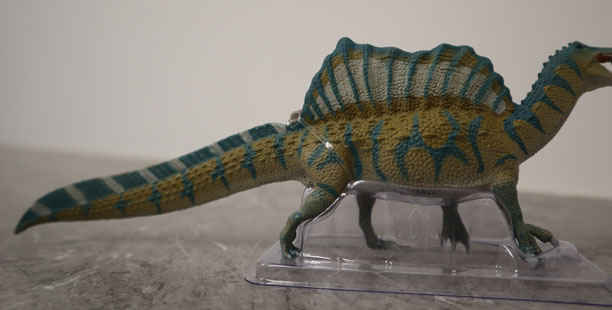
The beautiful markings on the Wild Safari Prehistoric World Spinosaurus dinosaur model. Picture credit: Everything Dinosaur.
Picture credit: Everything Dinosaur
The picture (above) shows the Wild Safari Prehistoric World Spinosaurus figure. The model makers depicted this dinosaur as a quadruped. They took great care to reflect the known science regarding the huge sail. The designers created the model after studying Spinosaurus fossils.
Much of what we know about Spinosaurus comes from research carried out over the last twenty-five years. Although it was named and scientifically described over a hundred years ago.
Spinosaurus (S. aegyptiacus), was described in 1915 by the famous German palaeontologist Ernst Stromer von Reichenbach based on fragmentary fossils found in series of expeditions to the Bahariya depression in the Western Desert of Egypt. Much of the fossil material collected during these expeditions was destroyed by allied bombing raids in World War II.
Everything Dinosaur team members have updated the information panel for the exhibition. The panel provides readers with details of some of the most recent research that suggests that Spinosaurus was quadrupedal and semi-aquatic.
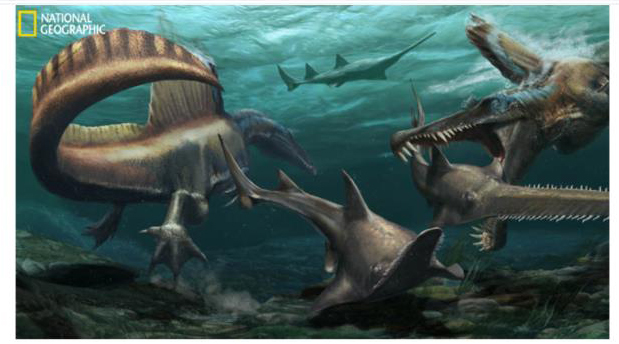
A pair of spinosaurids hunting the giant, prehistoric sawfish Onchopristis. Picture Credit: Davide Bonadonna/National Geographic.
The function of the enormous sail remains a mystery. This structure was formed by elongated spines that were extensions of the back vertebrae. The sail may have played a role in helping this large dinosaur keep cool (thermoregulation). It also may have played a role in visual communication between spinosaurs. The spines could even have supported a fleshy hump that stored reserves of fat. The display panel we have helped to prepare will help to tell the story of how our perceptions regarding “Spiny or Thorn Lizard” has changed over the years.
Everything Dinosaur team members are eagerly awaiting the arrival of the Beasts of the Mesozoic Wave 2 ceratopsian figures. There are going to be another nine articulated, horned dinosaur models added to this exciting range and the shipment of models is already on the water heading to our warehouse. However, unlike other companies, we like to offer a little more with every Beasts of the Mesozoic model that we supply. Everything Dinosaur customers receive a fact sheet to accompany their Beasts of the Mesozoic ceratopsian. As a result, we have been reviewing existing data sheets and preparing three new ones specifically for Spiclypeus (S. shipporum), Wendiceratops (W. pinhornensis) and Avaceratops (A. lammersi).
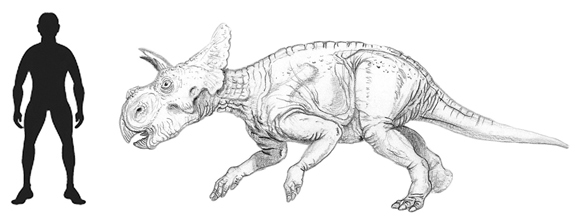
Our work also involves us commissioning illustrations of dinosaurs so we can include a scale drawing in our fact sheet.
A scale drawing of Avaceratops lammersi known from the Judith River Formation of Montana (USA). Picture credit: Everything Dinosaur.
Picture credit: Everything Dinosaur
Helping to Educate and Inform
A spokesperson from Everything Dinosaur commented:
“We might have had to stop our school visits due to the impact of the COVID-19 pandemic, but we still have at the very heart of this business the ethos of helping to educate and inform. For all the Beasts of the Mesozoic articulated figures we have a fact sheet available that tells customers something about the science behind the model. We have all the first wave of the Ceratopsia covered and shortly we will have completed our work on the data sheets required for Wave 2.”
The Beasts of the Mesozoic Avaceratops lammersi articulated dinosaur model. Part of the second wave of Beasts of the Mesozoic ceratopsians, the Avaceratops has nineteen points of articulation and is supplied with an Everything Dinosaur fact sheet.
The spokesperson added that these new articulated dinosaur models would be in stock at Everything Dinosaur in early May (2021).
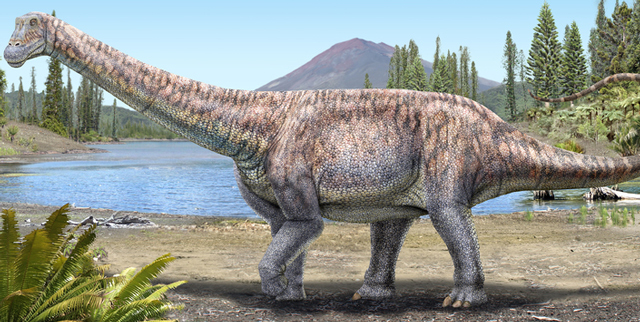
A new species of titanosaur has been named and described this week based on a partial skeleton unearthed in the Atacama Desert of northern Chile. The dinosaur has been named Arackar licanantay which translates as “Atacama bones” in the indigenous Kunza language.
A life reconstruction of the newly described Late Cretaceous titanosaur Arackar licanantay from the Atacama Desert of northern Chile. Picture Credit: Museo Nacional de Historia Naturala Santiago (Chile).
The Second Titanosaur from Chile to be Named
As far as Everything Dinosaur team members are aware, this is the second titanosaur to be named and described from fossil remains found in Chile. The first was Atacamatitan chilensis, fossils of which were discovered at the beginning of this century. Although Atacamatitan is only known from fragmentary remains, the alignment, shape and skeletal position of the femur in relation to the hips are very similar to that of Arackar, so, Atacamatitan was probably closely related to Arackar licanantay, although its fossilised remains were found many hundreds of miles to the north.
Three Chilean Dinosaurs to Date
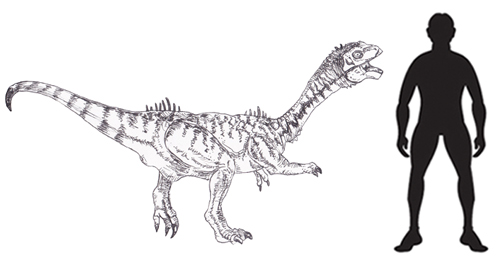
In total, three non-avian dinosaurs have been described from fossil remains discovered in Chile. The other dinosaur making up this trio is the peculiar Chilesaurus (Chilesaurus diegosuarezi), which is know from Jurassic deposits in the Aysén region of southern Chile. To read about the discovery of Chilesaurus: Chilesaurus – Shaking the Dinosaur Family Tree.
A scale drawing of the bizarre Late Jurassic dinosaur Chilesaurus. Chilesaurus is one of just three non-avian dinosaurs known from Chile (April 2021). Picture Credit: Everything Dinosaur.
Picture credit: Everything Dinosaur
Arackar licanantay – “Atacameño Bones”
Writing in the journal “Cretaceous Research”, scientists from the National Museum of Natural History (Chile), the Palaeontological Network of the University of Chile and the Dinosaur Laboratory of the National University of Cuyo describe a partial skeleton from the Upper Cretaceous (Campanian–Maastrichtian) beds of the Hornitos Formation, Atacama Region, of northern Chile. The holotype material consists of cervical and dorsal vertebrae along with limb bones and the ischium. The dinosaur’s name translates as “Atacameño bones” in the language of the indigenous Kunza people.
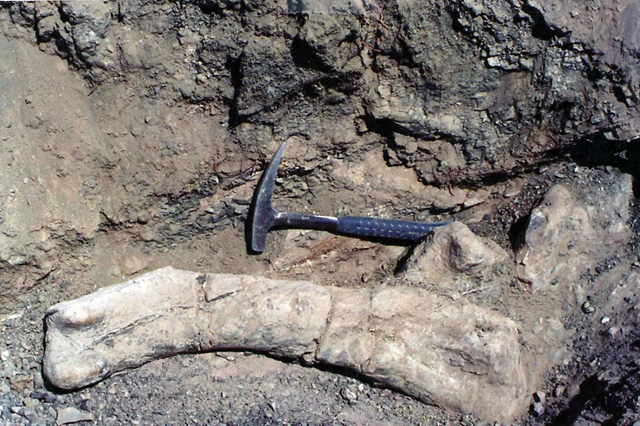
Identifying a limb bone from the new species of titanosaur (Arackar licanantay). Picture credit: Universidad de Chile.
A Sub-adult Specimen
The fossils were found in the 1990s by national geologist Carlos Arévalo (National Geology and Mining Service), at a site around 45 miles south of the city of Copiapó, (Atacama Region). The bones represent a sub-adult individual estimated to have been around 6.3 metres in length. Although the adult size of Arackar is not known, it has been suggested that when fully grown, this herbivorous dinosaur would have been around 8-9 metres long, relatively small for a titanosaur.
Arackar was certainly no giant unlike other titanosaurs such as Dreadnoughtus, Notocolossus or Argentinosaurus which lived millions of years earlier. The discovery of this dinosaur helps to support the idea that towards the end of the Cretaceous (Campanian to Maastrichtian stages), these types of dinosaurs got smaller, perhaps in response to climate change.
Bone Dry
The fossil site might be located in one of the driest parts of the world, but when Arackar roamed (sometime between 80 and 66 million years ago, the age of the Hornitos Formation is uncertain), the climate was much more humid with the lush vegetation consisting of many types of flowering plant (angiosperms), conifers such as araucarias and podocarpaceae as well as ferns and cycads.
Chile may have only three non-avian dinosaurs described to date, but the scientists are confident that many more genera will be named. For example, close to the Arackar fossils, the remains of a second, as yet undescribed titanosaur were discovered.
Fossil remains at the dig site, the preserved remains of limb bone. Another titanosaur specimen that has yet to be described was found close by. Picture Credit: Universidad de Chile.
Commenting on the significance of this discovery, Consuelo Valdés, the Minister of Culture, Arts and Heritage stated:
“This finding is a relevant opportunity to learn about and disseminate the value of our country’s palaeontological heritage, which is unique in the world. But, at the same time, we hope to motivate curiosity and interest in research in children and young people. Chile in the extreme north and south has palaeontological treasures still hidden in layers many millions of years old. These bones can tell the story of the animals and plants that have lived in our country long before the first human groups arrived here.”
South America – Home to the Titanosaurs
The scientific description of Arackar licanantay may have important implications for the taxonomy and phylogeny of the clade of derived and advanced titanosaurs known as the Lithostrotia. Of the eighty or so genera of titanosaurs named and described so far, fifty-five come from South America but most have been found to the east of the Andes in Brazil and Argentina.
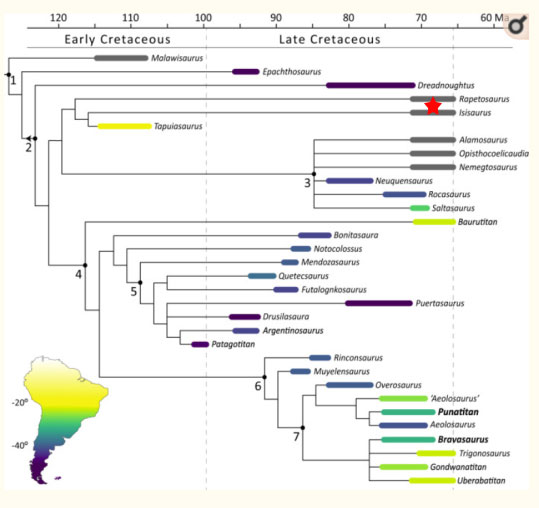
Unique autapomorphies (traits) in the skeleton such as the shape of the dorsal vertebrae that would have given this dinosaur a very straight withers and back indicate that A. licanantay is not only closely related to Chile’s other titanosaur – Atacamatitan chilensis, but also to Rapetosaurus from the Late Cretaceous of Madagascar and Isisaurus (from India).
The taxonomy of South American titanosaurs over time and geographical distribution. The red star represents the approximate placement of Arackar licanantay. Picture credit: Hechenleitner et al (Communications Biology) with additional annotation by Everything Dinosaur.
Co-author of the paper, Alexander Vargas (Palaeontological Network of the University of Chile), commented that it would be helpful if palaeontologists could understand the biogeographical distribution that allowed related titanosaurs to be so widespread.
Everything Dinosaur acknowledges the assistance of a media release from the Universidad de Chile in the compilation of this article.
The scientific paper: “Arackar licanantay gen. et sp. nov. a new lithostrotian (Dinosauria, Sauropoda) from the Upper Cretaceous of the Atacama Region, northern Chile” by David Rubilar-Rogers, Alexander O. Vargas, Bernardo González Riga, Sergio Soto-Acuña, Jhonatan Alarcón-Muñoz, José Iriarte-Díaz, Carlos Arévalo and Carolina S. Gutstein published in Cretaceous Research.
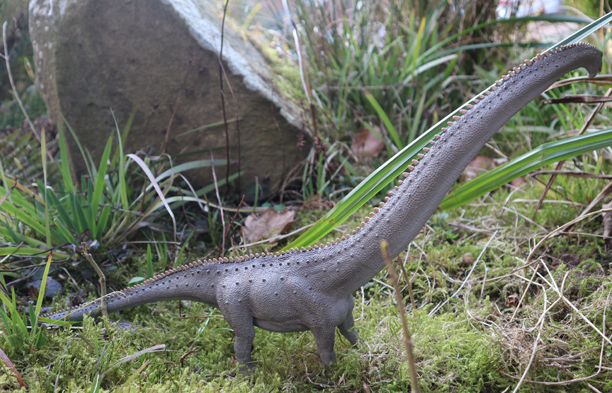
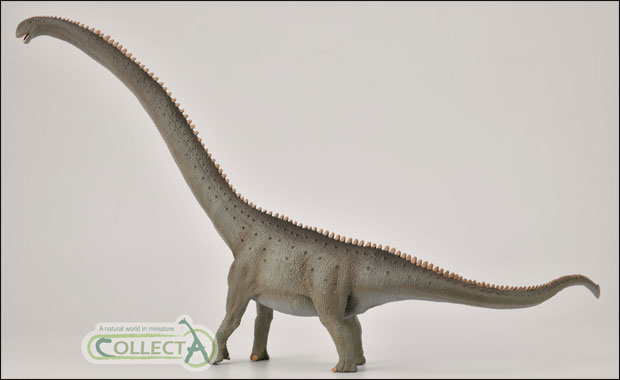
The new for 2021 CollectA Deluxe Mamenchisaurus dinosaur model is now in stock at Everything Dinosaur. This is one of the biggest sauropod figures that CollectA have made and this beautifully detailed replica has certainly impressed model fans and collectors.
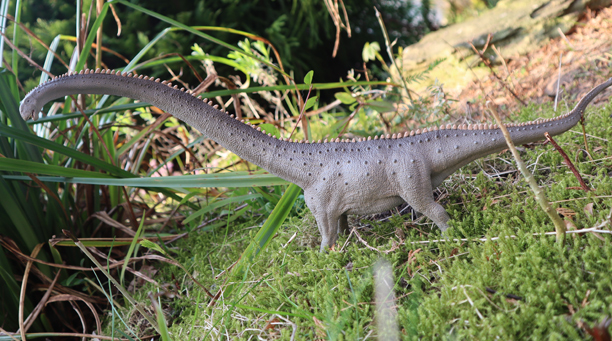
The beautifully detailed CollectA Deluxe Mamenchisaurus dinosaur model (lateral view). Picture credit: Everything Dinosaur.
Picture credit: Everything Dinosaur
Scale Dinosaur Model
CollectA have declared a scale of 1:100 for their Mamenchisaurus. As the model measures around 40 cm in length this figure represents a dinosaur that would have measured approximately 40 metres, this is perhaps a little too large for most of the Mamenchisaurus species named to date.
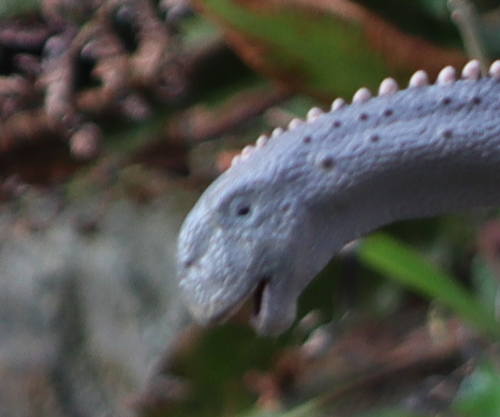
The model has been exquisitely designed. The neck is slightly curved and the small head is turned towards the animal’s left shoulder. This pose gives the model a more natural look, the animal is moving along and looking towards its left as it walks. The head has been beautifully crafted, the nostrils are visible and the mouth is open displaying the small teeth. There were teeth present all along the jawline and this has been accurately portrayed in the CollectA model.
A close view of the exquisitely detailed head of the CollectA Mamenchisaurus model. Picture credit: Everything Dinosaur.
Picture credit: Everything Dinosaur
Fine Detail of Scales and Dermal Armour
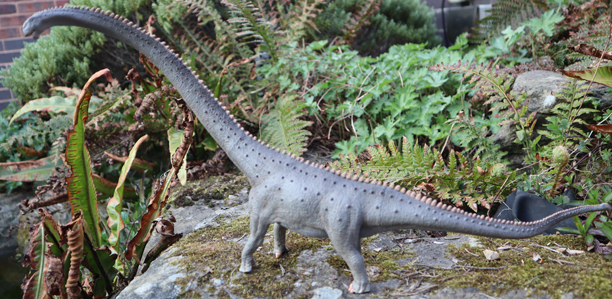
As well as having a row of prominent spikes that descend from the back of the head down to the end of the tail, the design team at CollectA have added rows of raised scutes along the neck, flanks and down the tail of the figure. There is much to be admired in the fine skin texture and the limbs have been proportioned to reflect the fossil record. The claws and toes have been painted in the same tan tone as the spikes and this realistic dinosaur model has been given a cloaca.
The dermal scutes and raised scales on the model can be clearly seen in this photograph. Picture credit: Everything Dinosaur.
Picture credit: Everything Dinosaur
An Asian Sauropod
It is refreshing to see CollectA create a scale model of a Chinese sauropod rather than a replica of a sauropod associated with western North America and the Morrison Formation. Due to the large number of fossils assigned to this genus, thanks to huge numbers of bones found in Shaximiao Formation exposures (Sichuan Province, China), Mamenchisaurus is one of the best known of all the Jurassic members of the Sauropoda. It is great to see a mainstream manufacturer such as CollectA make a model of this dinosaur.
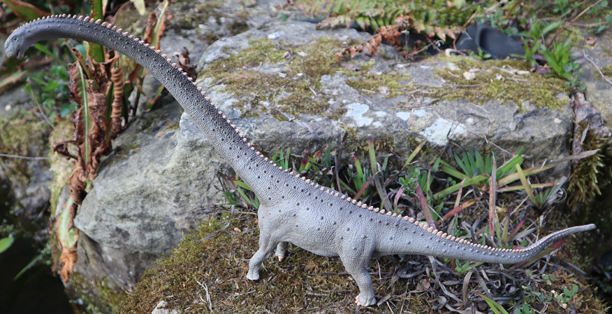
The new for 2021 CollectA Deluxe Mamenchisaurus dinosaur model. Picture credit: Everything Dinosaur.
Picture credit: Everything Dinosaur
Highly Recommended
The figure has been given a small defensive club on the end of its tail, reminiscent of Shunosaurus. There may be some debate as to whether this dinosaur possessed such a club, fused caudal vertebrae in at least one specimen does suggest that a tail club was present.
All in all, this is a very detailed model and it is a very welcome addition to the CollectA Deluxe model range.
To view the CollectA Deluxe Mamenchisaurus and to see the other figures available from Everything Dinosaur in this this range: CollectA Deluxe Prehistoric Life Models.
Team members at Everything Dinosaur have been asked to cast their eyes over a display panel being prepared to accompany an exhibition featuring the bizarre South American sauropod Amargasaurus.
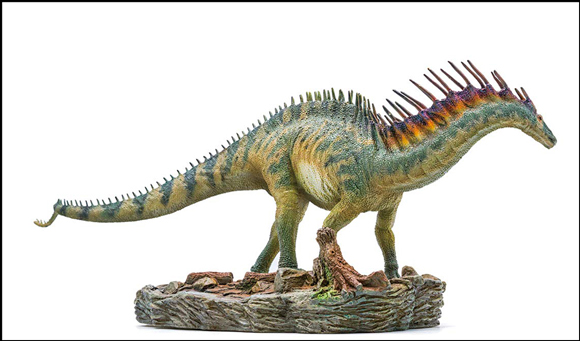
PNSO Amargasaurus “Lucio”. Everything Dinosaur team members have been busy updating a display board for an exhibition that will feature a life-size replica of Amargasaurus.
The image (above) shows a PNSO Amargasaurus model. To view the PNSO dinosaur range: PNSO Dinosaur Models.
“Reptile from Amarga Canyon”
Known from a single, partial skeleton discovered in 1984 in northern Patagonia (La Amarga Formation), Amargasaurus was related to Diplodocus although it was much smaller measuring around 10 metres in length with an estimated weight of approximately 5 tonnes.
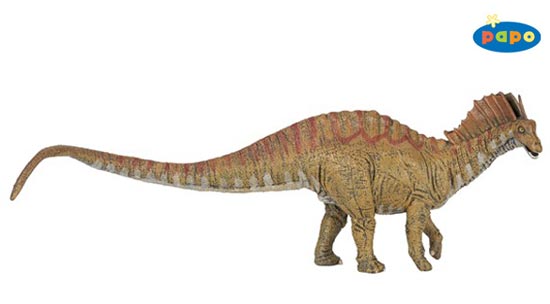
Papo Amargasaurus dinosaur model. Several model manufacturers have produced replicas of Amargasaurus.
Unlike most other sauropods, the neck was disproportionately short and it was probably a specialist browser of small trees and bushes, a feeding strategy that prevented it from competing directly with the numerous other types of sauropod dinosaur that shared its habitat.
This dinosaur had two rows of tall, thin spines sticking up from the vertebrae that ran from the top of the head down to the base of the short neck. These spines then tapered into a single row of smaller spines that continued down the animal’s back to the tail. When first scientifically described in 1991, it was suggested that these spines were defensive weapons used to deter attacks from predators or in combat between rivals. Some palaeontologists have suggested that these spines supported skin membranes that formed two parallel sail-like structures. These sails could have played a role in thermoregulation, visual communication between herd members or perhaps they were used in courtship displays.
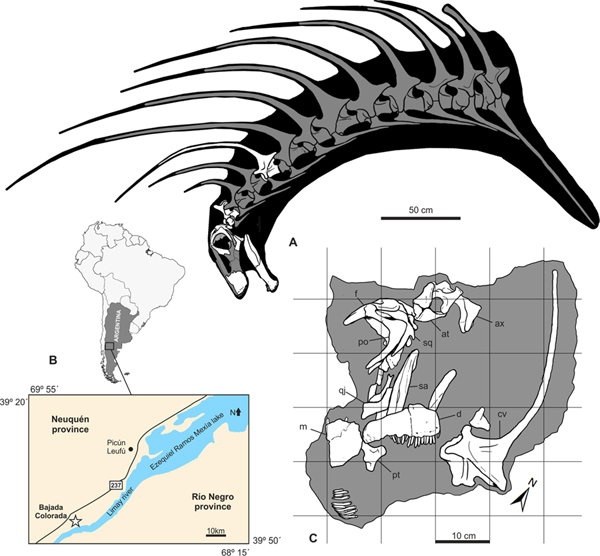
The discovery in northern Patagonia, of the closely related Bajadasaurus with its equally spiky array of neck spines that curve forward towards the head has led some palaeontologists to conclude that the neck spikes on these dinosaurs were indeed primarily defensive structures.
A skeletal reconstruction of Bajadasaurus, location map of fossil finds and drawing of the fossil material in situ.The discovery of the closely related Bajadasaurus has led some palaeontologists to conclude that the elaborate neck spines associated with Amargasaurus were primarily defensive structures. Picture credit: Gallina et al published in Scientific Reports.
The first of the new for 2021 CollectA prehistoric animal models are in stock at Everything Dinosaur. Team members have been busy contacting all those customers who wanted to be emailed when these figures came into stock.
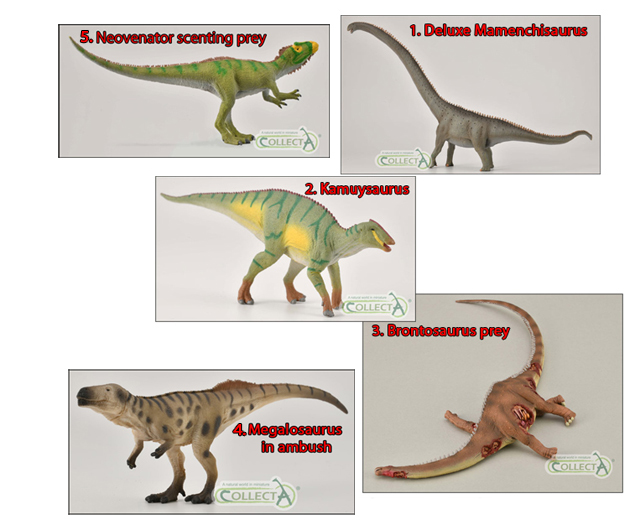
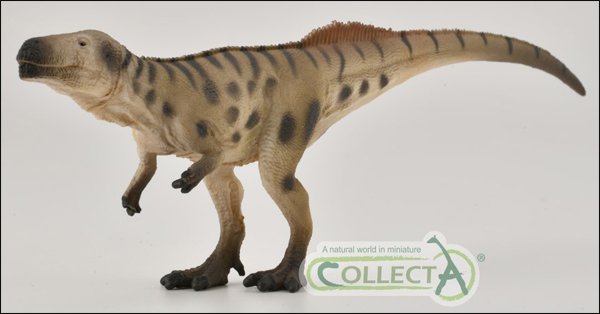
The first five new for 2021 CollectA prehistoric animal models are in stock at Everything Dinosaur. The new for 2021 figures are the Neovenator scenting prey (top left), CollectA Deluxe Mamenchisaurus in 1:100 scale (top right), the Age of Dinosaurs Popular range Kamuysaurus (middle) and the Megalosaurus in ambush (bottom left) and the Brontosaurus prey (bottom right). Picture credit: Everything Dinosaur.
By far the largest figure, in fact the biggest dinosaur model that CollectA will introduce this year is the Mamenchisaurus. It measures around 40 cm in length and that well-proportioned and detailed head stands some 24 cm high. CollectA state that this figure is in approximately 1:100 scale, so the figure represents a specimen around 40 metres long. This suggests that when creating this replica, the design team at CollectA had in mind one of the larger species known from this genus such as Mamenchisaurus sinocanadorum.
CollectA Deluxe Mamenchisaurus a 1:100 scale replica of an Asian sauropod.
A spokesperson from Everything Dinosaur praised CollectA for adding a model of this sauropod to their model range.
Brontosaurus Prey
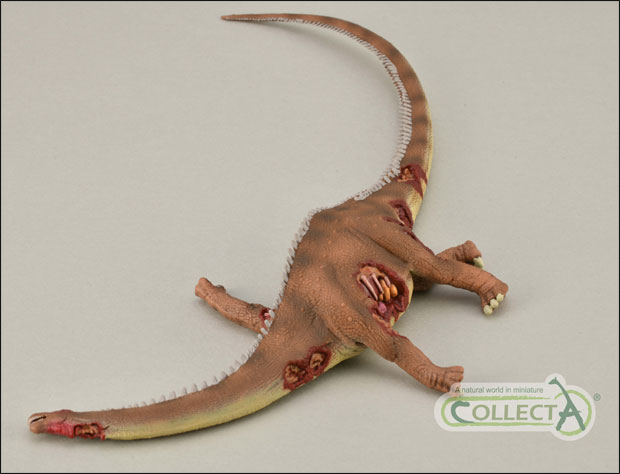
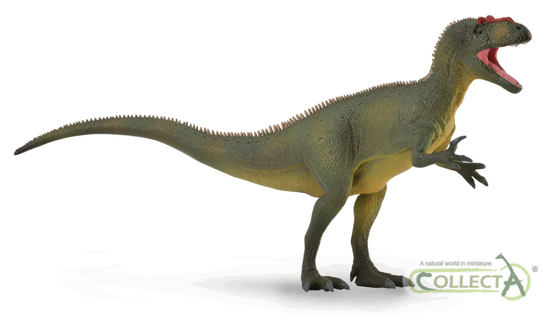
CollectA know what fans of dinosaurs like to see, lots of gore and blood and the new for 2021 CollectA Brontosaurus prey does not disappoint. It has been beautifully sculpted and depicts a deceased sauropod that is in the process of being consumed by a large theropod dinosaur, perhaps a member of the allosaur family. This would be appropriate as last year, CollectA introduced a model of an Allosaurus roaring.
The CollectA Age of Dinosaurs Brontosaurus prey model. The wounds inflicted on the Brontosaurus reflect attack and feeding strategies that have been postulated for large theropod dinosaurs.
The CollectA “Roaring” Allosaurus dinosaur model. This figure would make an ideal partner for the recently introduced CollectA Age of Dinosaurs Popular range Brontosaurus prey.
Kamuysaurus japonicus
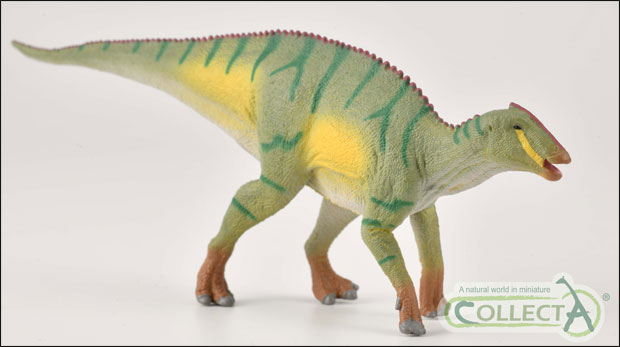
Formally named and described in 2019, Kamuysaurus continues the CollectA trend to include dinosaurs known from Japan in their product portfolio. Although known only from a single specimen, the fossils found represent a considerable proportion of the skeleton and as a result Kamuysaurus has been confidently assigned to the Edmontosaurini tribe.
The CollectA Age of Dinosaurs Kamuysaurus model. A replica of a hadrosaurid from the Late Cretaceous of Japan.
Two British Dinosaurs
The other two models that have just arrived in stock are the Megalosaurus in ambush figure and the Neovenator scenting prey. Both these dinosaurs are associated with Britain, although Megalosaurus has become a bit of a taxonomic waste basket over the last 200 years or so since this dinosaur was scientifically described.
The new for 2021 CollectA Megalosaurus in ambush dinosaur model. Available from Everything Dinosaur.
The new for 2021 CollectA Neovenator scenting prey dinosaur model.
Replacing Earlier CollectA Models
The new for 2021 Megalosaurus and the new Neovenator figures replace earlier sculpts in the CollectA Age of Dinosaurs Popular range that were introduced around ten years ago. The models have been updated to more accurately represent the known skeletal material and the dinosaurs have been given lips to reflect the current debate about this amongst palaeontologists.
PNSO have announced that they will be adding a model of the bone-headed dinosaur Pachycephalosaurus to their mid-size model range. Say hello to Austin the Pachycephalosaurus, this exciting new for 2021 dinosaur model is likely to be in stock at Everything Dinosaur in the early summer.
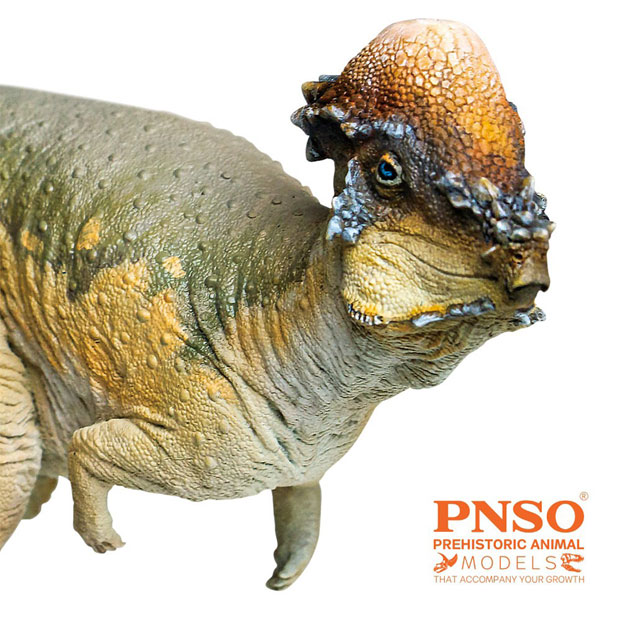
The new for 2021 PNSO Austin the Pachycephalosaurus dinosaur model.
Pachycephalosaurus wyomingensis
This new figure is a replica of Pachycephalosaurus wyomingensis, the largest known member of the bone-headed dinosaur group (Pachycephalosauridae). The dinosaur model shows meticulous detail and has been exquisitely painted.
Austin the Pachycephalosaurus (P. wyomingensis).
Model Measurements and Scale?
Austin the Pachycephalosaurus measures 17. 8 cm long and its beautifully detailed head is a fraction under 7 cm off the ground. PNSO does not publish a scale for their mid-size figures but based on an estimated length of P. wyomingensis of approximately 4.6 metres, this figure is in around 1:26 scale.
The PNSO Austin the Pachycephalosaurus dinosaur model measurements and known skeletal material. The Pachycephalosaurus figure measures 17.8 cm long and it has a head height of 6.6 cm.
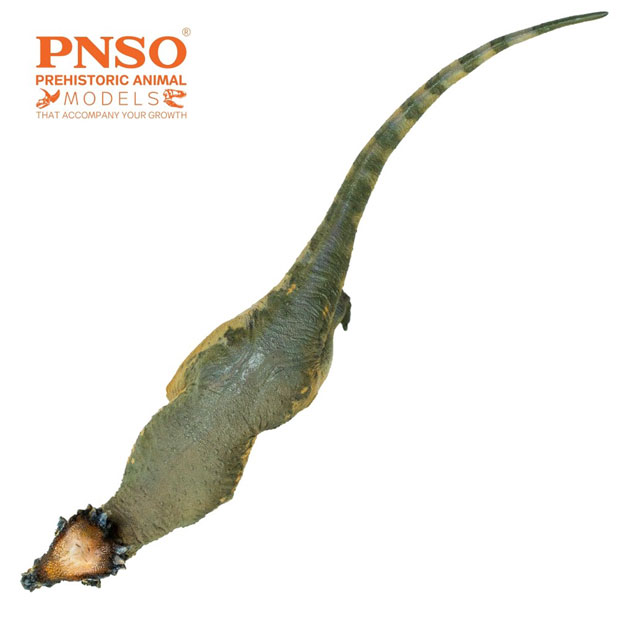
Austin the PNSO Pachycephalosaurus (dorsal view).
The Famous Hell Creek Formation
Pachycephalosaurus fossils (mostly cranial material), are associated with the famous Hell Creek Formation, although they are exceptionally rare compared to other ornithischians such as members of the Ceratopsidae and hadrosaurids. Austin the Pachycephalosaurus joins Doyle the Triceratops, Sede the Ankylosaurus and Wilson the T. rex dinosaur models in the PNSO portfolio that celebrates the dinosaur fauna of Hell Creek.
PNSO figures that celebrate the dinosaur fauna of the Hell Creek Formation.
Available in the Summer
A spokesperson from Everything Dinosaur commented that this figure was due to be announced at 10am on the 17th of April (Beijing time), but as images had been already leaked on-line by other companies, Everything Dinosaur received permission from PNSO to publish details about Austin the Pachycephalosaurus earlier than scheduled.