All about dinosaurs, fossils and prehistoric animals by Everything Dinosaur team members.
29 10, 2018

A Second Mamenchisaurid Dinosaur from Anhui Province is Described

By |2023-10-30T12:34:54+00:00October 29th, 2018|Categories: Dinosaur and Prehistoric Animal News Stories, Dinosaur Fans, Main Page, Photos/Pictures of Fossils|0 Comments

Anhuilong diboensis – From the Middle Jurassic of Anhui Province

Chinese scientists have published details of a new species of long-necked dinosaur from eastern China.  The fossilised remains, although fragmentary, have permitted the researchers to confidently assign the specimen (AGB 5822), to the Mamenchisauridae family of sauropods.  The dinosaur has been named Anhuilong diboensis and it suggests that by the Middle Jurassic, mamenchisaurids were already a diverse family.  It is likely that the sandstones and mudstones that form the majority of the fossil bearing, Middle Jurassic-aged strata near Huangshan (Anhui Province), will yield more dinosaur fossils.

A Life Reconstruction of a Typical Mamenchisaurid Dinosaur
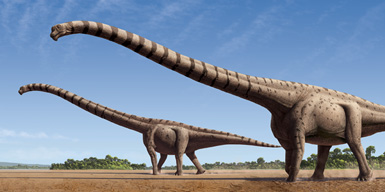
Old Long-neck takes a walk
A typical member of the Mamenchisauridae family (Mamenchisaurus).

Picture credit: Julius Csotonyi/Natural History Museum of Los Angeles County

The Second Member of the Mamenchisauridae from Anhui Province

The fossil material, consisting of the remains of a single forelimb, representing one individual dinosaur (humerus, ulna and radius bones), was distinct enough to permit the scientists, which included researchers from the Chinese Academy of Sciences and the Anhui Geological Museum, to establish a new genus.

Anhuilong diboensis

Anhuilong diboensis is the second mamenchisaurid to be identified from the Middle Jurassic Hongqin Formation of Shexian, Huangshan (Anhui Province, eastern China).  The first mamenchisaurid from this locality, Huangshanlong anhuiensis, was named and described in 2014.  The authors of the scientific paper describing A. diboensis were also responsible for the earlier study of H. anhuiensis.  A phylogenetic analysis of the limb bones from these two specimens suggest that Anhuilong is the sister taxon of Huangshanlong and with Omeisaurus from Sichuan Province, they together form a sister clade to all other members of Mamenchisauridae.

Views of the Right Humerus of Huangshanlong anhuiensis
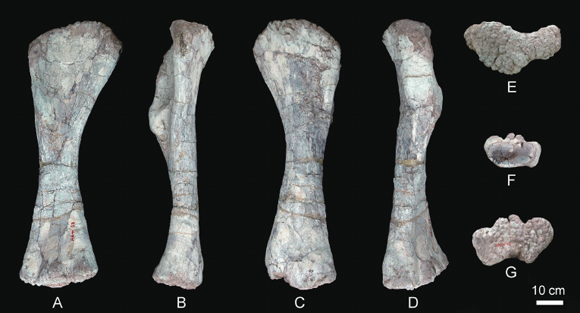
Various views of the humerus of the mamenchisaurid Huangshanlong anhuiensis.
Huangshanlong anhuiensis – views of the humerus of a typical mamenchisaurid dinosaur.

Picture credit: Vertebrata PalAsiatica/Jian-Dong Huang et al

The picture above shows various views of the right humerus (upper arm bone) of H. anhuiensis.  The morphology of limb bones and how they compare to each other (total length of the ulna to the humerus and the total length of the radius to the humerus), are distinct enough for palaeontologists to ascribe them to the Mamenchisauridae and to erect a new genus.

Key

A = humerus viewed from the front.

B = humerus viewed from one side (medial view).

C = humerus viewed from the back.

D = humerus viewed from the other side (lateral view).

E = viewed from the top down (cranial margin pointing upwards)

F = view of a cross section, near the narrowest part of the bone.

G = viewed from underneath (distal view).

The Spread of the Sauropoda

Until recently, palaeontologists had thought that although the Sauropoda were geographically widespread by the Middle Jurassic, sub-groups such as the Mamenchisauridae family and the Diplodocidae had restricted geographical ranges.  However, earlier this year, a diplodocid dinosaur was described from northern China, proving that these long-necked dinosaurs were present in Asia during the Middle Jurassic.  The fossil record for the Mamenchisauridae indicates that these types of Sauropods were restricted to China.

To read the article describing the diplodocid dinosaur (Lingwulong shenqi) from northern China: The First Diplodocid Dinosaur Described from China and the Earliest Known Member of the Diplodocidae.
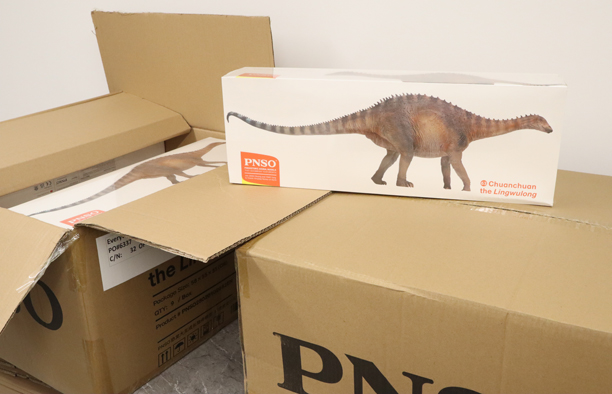
PNSO Chuanchuan the Lingwulong in stock at Everything Dinosaur.
The PNSO Chuanchuan the Lingwulong dinosaur model has arrived at Everything Dinosaur. Team members inspect boxes and check contents prior to booking this new for 2022 sauropod figure into stock. Picture credit: Everything Dinosaur.

Picture credit: Everything Dinosaur

The picture (above) shows Lingwulong dinosaur models arriving at Everything Dinosaur’s warehouse. These are PNSO figures.

To view the PNSO prehistoric animal model range: PNSO Age of Dinosaurs Models.

28 10, 2018

A New Species of Archaeopteryx

By |2023-11-04T11:35:37+00:00October 28th, 2018|Categories: Dinosaur and Prehistoric Animal News Stories, Main Page|0 Comments

Archaeopteryx albersdoerferi – A New Species of Archaeopteryx is Named

Those very rare Archaeopteryx specimens that have been found in the fine-grained, Upper Jurassic deposits of Germany are some of the most intensely researched fossils on our planet.  However, they can still surprise and it seems that we have much to learn about “Urvogel” as the Germans refer to this iconic transitional form between a dinosaur and a true bird.

Writing in the academic journal “Historical Biology”, a team of international researchers have subjected one particular fossil (specimen number eight), to the powerful X-rays of synchrotron microtomography and discovered that this example of the “first bird” is so different from other Archaeopteryx fossils that it merits being categorised as a separate species.

A Life Reconstruction of the Newly Described Archaeopteryx Species (A. albersdoerferi)

Archaeopteryx albersdoerferi life reconstruction.
A life reconstruction of the newly described Archaeopteryx species (A. albersdoerferi).

Picture credit: Zhao Chuang (supervised by lead author of the scientific paper Martin Kundrát of Uppsala University)

Closer to True Birds in Evolutionary Terms

The scientists, which included researchers from Uppsala University, the Chinese Academy of Geological Sciences and Manchester University’s John Nudds (School of Earth and Environmental Sciences), carried out a three-dimensional analysis of the fossil using the European Synchrotron Radiation Facility (ESRF), located in Grenoble.  The team found that specimen eight is closer to modern birds in evolutionary terms when compared to the other known Archaeopteryx specimens.

Dr Nudds explained:

“By digitally dissecting the fossil we found that this specimen differed from all of the others.  It possessed skeletal adaptations which would have resulted in much more efficient flight.  In a nutshell, we have discovered what Archaeopteryx lithographica evolved into – i.e. a more advanced bird, better adapted to flying – and we have described this as a new species of Archaeopteryx.”

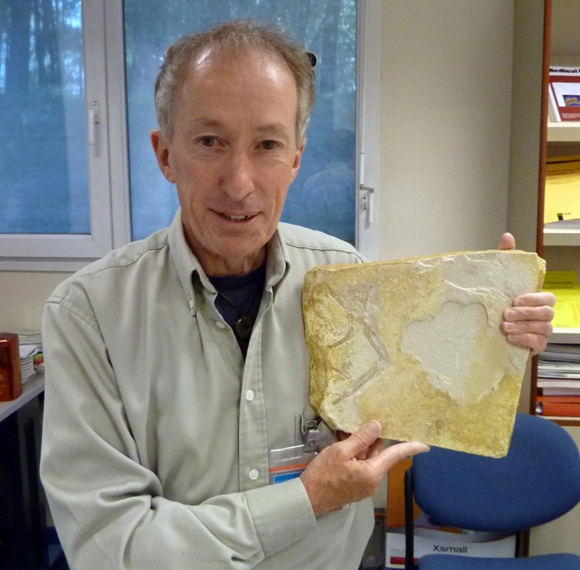
Dr John Nudds with the Archaeopteryx Specimen at the Synchrotron Facility

Dr John Nudds holding an Archaeopteryx fossil specimen.
Dr John Nudds (Manchester University) holding the Archaeopteryx specimen at the European Synchrotron facility (Grenoble, France).

Picture credit: Manchester University

Differences in the Skeleton – Better Adaptations for Powered Flight

The research team identified numerous, subtle skeletal differences between this specimen and the other Archaeopteryx fossil skeletons.  For example, specimen eight has fused cranial bones, a different pectoral girdle and wing elements and a more robust set of carpals and metacarpals (hand bones).  The X-ray scans revealed that this specimen had very light bones, with numerous air sacs in them.  These characteristics are observed more in modern flying (volant), birds and are not found in the older Archaeopteryx lithographica species.

The fossil studied is the so-called Mörnsheim or Daiting specimen, from strata which is around half a million years younger than the rocks associated with the majority of the German Archaeopteryx fossils.  As such, specimen eight is stratigraphically the youngest Bavarian archaeopterygid.

Archaeopteryx albersdoerferi – “The Phantom”

The Mörnsheim or Daiting fossil has had a colourful history.  It was (allegedly), discovered by a private fossil collector in a quarry near the town of Daiting in southern Bavaria, about twenty miles south of the city of Nuremberg (Germany), sometime in the early 1990s.  It was incorrectly identified as a pterosaur and this fossil changed hands several times.  Rumours began to circulate amongst the scientific community that there was another Archaeopteryx specimen but it remained elusive, so much so, that the fossil was nick-named “The Phantom”.  A cast of the fossil was briefly put on display at the Naturkundemuseum in Bamberg (Germany) in 1996 and a short report was written a year later, but this specimen remained out of reach and not accessible for study.

All this changed in 2009, when palaeontologist Raimund Albersdörfer of Schnaittach (Bavaria), purchased the specimen from a private collector and secured its scientific heritage by offering it on long-term loan to the Bavarian State Collection of Palaeontology and Geology in Munich, and obligated himself by contract not to sell the specimen to a non-public entity.  The species name honours the contribution made by Raimund Albersdörfer.  This is not the first time that Raimund has made a privately-owned Theropod specimen available to study.  In 2012, he was honoured by having the trivial name of a feathered dinosaur from southern Germany named after him (Sciurumimus albersdoerferi).

Lead author, Dr Martin Kundrát, commented:

“This is the first time that numerous bones and teeth of Archaeopteryx were viewed from all aspects including exposure of their inner structure.  The use of synchrotron microtomography was the only way to study the specimen as it is heavily compressed with many fragmented bones partly or completely hidden in limestone.”

Is This Really a New Species?

Palaeontologists are aware that this part of Germany where the Archaeopteryx fossil material comes from, was once a series of small islands surrounded by a tropical sea.  The strata were laid down over hundreds of thousands of years and it is therefore quite possible that different species of primitive “dino-bird” evolved over this period.  However, the Mörnsheim specimen was examined using computer tomography that provided an extremely detailed assessment of the fossil material.  It is quite possible, that, if other Archaeopteryx specimens were subjected to the same level of scrutiny, then new information about them would be discovered too.

To read an article from 2016, that reports on the discovery of a twelfth Archaeopteryx specimen, a fossil recovered from strata at least 200,000 years older than other Archaeopteryx fossil material: The Oldest Archaeopteryx in Town.

The scientific paper: “The First Specimen of Archaeopteryx from the Upper Jurassic Mörnsheim Formation of Germany” by Martin Kundrát, John Nudds, Benjamin P. Kear, Junchang Lü and Per Ahlberg published in Historical Biology.

Everything Dinosaur acknowledges the help of a press release from the University of Manchester in the compilation of this article.

Visit the Everything Dinosaur website: Everything Dinosaur.

27 10, 2018

Pachycephalosaurus – Was It Carnivorous? That’s a Great Question!

By |2024-05-11T06:42:44+01:00October 27th, 2018|Categories: Dinosaur and Prehistoric Animal News Stories, Dinosaur Fans, Main Page, Palaeontological articles, Photos/Pictures of Fossils|0 Comments

Theropod-like Front Teeth Identified in a Pachycephalosaur

Pachycephalosaurus, that dome-headed dinosaur that lived alongside such famous prehistoric animals as T. rex and Triceratops, in the Late Cretaceous of Montana, has always been a bit-player when it comes to depicting life in the very last couple of million years before the extinction of the non-avian dinosaurs.  Its more illustrious contemporaries tend to hog the limelight somewhat.

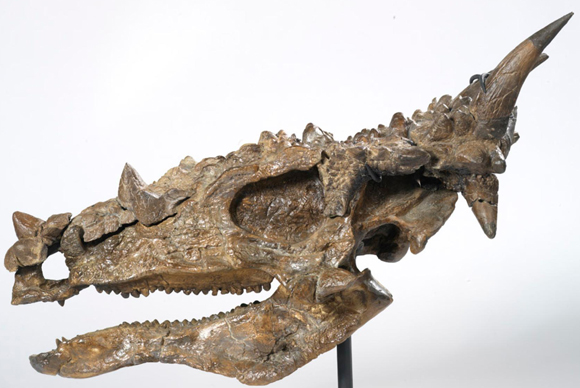
However, the scientific description of a nearly complete skull and jaws of what has been identified as a juvenile Pachycephalosaurus, might just have revealed a surprising side to this peaceful plant-eater.  The teeth in the front of jaws are triangular and pointed, reminiscent of the dentition of a meat-eating dinosaur.  Could palaeontologists have got Pachycephalosaurus wrong?

A Reconstruction of the Juvenile Pachycephalosaurus Skull and Jaws

Reconstruction of a Juvenile Pachycephalosaurus skull.
A reconstruction of the fossil skull of the juvenile Pachycephalosaurus that has theropod-like teeth in the front of the jaws.

Picture credit: Brian Boyle (Royal Ontario Museum)

Front Portion of the Jaws Suggests Omnivory in Certain Pachycephalosaurs

In a presentation made at the annual meeting of the Society of Vertebrate Palaeontology held in Albuquerque, New Mexico, Mark Goodwin (University of California Museum of Palaeontology) and David Evans (Royal Ontario Museum), described a near complete juvenile pachycephalosaur skull from eastern Montana.  The back of the jaws contained the broad, leaf-shaped teeth which seem well suited to herbivory.  It had been assumed that the teeth in the front of the jaws (premaxilla and the anterior portion of the dentary, immediately behind the predentary), were the same shape.  However, until this fossil specimen was found, no record of the front teeth of these dinosaurs existed.

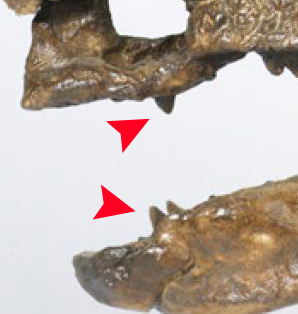
Palaeontologists may have to re-think their views on the diet of this member of the Hell Creek Formation biota.  The sharp, blade-like triangular teeth located at the front of the mouth seem adapted to ripping and tearing flesh.

The Teeth at the Front of the Jaws are Typical of a Meat-eating Theropod Dinosaur

Pachycephalosaurus Theropod-like teeth.
A close-up view of the teeth in the premaxilla (upper jaw) and the anterior portion of the dentary (lower jaw). Triangular theropod-like teeth have been identified in a juvenile Pachycephalosaurus.

Picture credit: Brian Boyle (Royal Ontario Museum) with additional annotation by Everything Dinosaur

Confusing Pachycephalosaurs

Pachycephalosaurus is the largest member of the Pachycephalosauridae family to have been scientifically described and notwithstanding a cameo appearance of a jail-breaking Stygimoloch in the recent “Jurassic World – Fallen Kingdom” movie, perhaps the most famous.  However, not a great deal is known about Pachycephalosaurus and other bone-headed dinosaurs.  Fossil remains tend to be very fragmentary and most species have been named from quite scrappy remains and then you have those amazing skulls to consider.

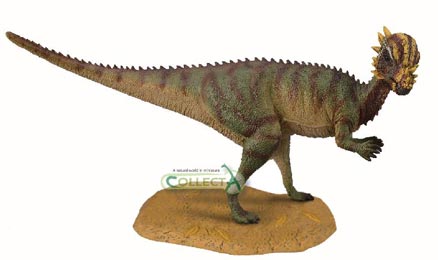
The CollectA Pachycephalosaurus Dinosaur Model

CollectA Pachycephalosaurus model.
A lithe Pachycephalosaurus dinosaur model.  Pachycephalosaurus (P. wyomingensis) is the largest known member of the Pachycephalosauridae with an estimated body length of 4.6 metres.

The model (above) is from the CollectA Prehistoric Life range.

To view this range: CollectA Prehistoric Life Models.

Several species have been named based on the shape and cranial ornamentation associated with those thickened skulls.  The thick bone may resist erosion and provide palaeontologists with some fossil bone to study, but it has been suggested that the skulls of these dinosaurs changed dramatically as the animal grew.  So much so in fact, that a number of academics, including Mark Goodwin, have published scientific papers that cast doubt on the validity of many pachycephalosaur species.  For example, palaeontologists such as Goodwin have put forward evidence to suggest that both Dracorex and Stygimoloch are not distinctive species, the fossils ascribed to these two genera could represent juvenile Pachycephalosaurus specimens.

It seems, just like many other types of Late Cretaceous ornithischian dinosaur, the pachycephalosaurs underwent extreme changes to the shape of their heads as they grew up.  Such changes in cranial morphology have resulted in the establishment of several species that may actually just represent examples of the same species but at different growth stages.

Some Palaeontologists Suggest that Radical Changes in Skull Shape and Ornamentation Do Not Indicate Different Species but Different Growth Stages

Different skull shapes and ornamentation linked to different growth stages.
It has been proposed that the cranial ornamentation and skull shape of Pachycephalosaurs changed as these animals grew and matured. This can cause confusion when trying to identify species.

Picture credit: Kari Scannella with additional annotation by Everything Dinosaur

To complicate matters, pachycephalosaur fossil material covers a period of approximately 2 million years.  Over this timescale, these animals evolved and their skull morphology changed, thus, further blurring the lines between different species and fossils of the same species but at different levels of maturation.

Confirming the Likely Diet of Pachycephalosaurus

It would be difficult to confirm that Pachycephalosaurus also ate other animals as well as plants, but not impossible.  Only one jaw fossil with the front teeth in situ has been found, so scientists don’t know whether the diets of these dinosaurs changed as they grew.  Perhaps, young pachycephalosaurs were omnivorous, whilst when fully grown, adults tended to consume plants rather than other animals.  The rib cages of those genera which have a more complete fossil record, suggest that these bipeds had large guts, this would indicate a digestive system adapted to processing vegetation.

Professor Philip Currie (University of Alberta), who also attended the Society of Vertebrate Palaeontology meeting, has proposed that studying carbon isotopes preserved in the tooth enamel might provide further evidence relating to diet.  In addition, the many hundreds of examples of isolated, broken teeth from the Hell Creek Formation could be re-examined and checked for any potential affinities with the Pachycephalosauridae.  Feeding traces from fossil bone could also yield more data in support of the idea that bone-headed dinosaurs ate meat.

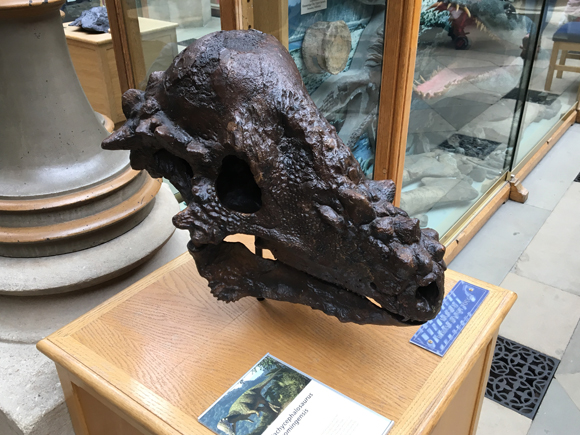
A Reconstruction of the Skull of an Adult Pachycephalosaurus

A replica skull of Pachycephalosaurus wyomingensis.
Pachycephalosaurus wyomingensis replica skull. Picture credit: Everything Dinosaur.

Picture credit: Everything Dinosaur

A spokesperson from Everything Dinosaur commented:

“It is likely that there are many more examples of pachycephalosaurs to be found in Upper Cretaceous rocks, hopefully, if more fossil material can be discovered, then palaeontologists will be able to piece together a more complete phylogeny of these strange dinosaurs.  Furthermore, if more examples of their dentition [teeth] come to light, then we might be able to gain a better understanding of their diets. “

Visit the Everything Dinosaur website: Everything Dinosaur.

26 10, 2018

Preparing for the Arrival of “Funeral Pyre Lord” – Citipati

By |2023-11-04T11:05:47+00:00October 26th, 2018|Categories: Dinosaur Fans, Everything Dinosaur News and Updates, Everything Dinosaur Products, Main Page, Photos of Everything Dinosaur Products, Photos/Pictures of Fossils, Press Releases|0 Comments

Finalising the Citipati Fact Sheet

In the new for 2019 Wild Safari Prehistoric World (Safari Ltd) model range, there is going to be a model of an oviraptorid – Citipati (C. osmolskae).  As a result, team members at Everything Dinosaur have been busy preparing for the arrival of these models by finalising the fact sheet that will accompany sales of this colourful dinosaur model.  The fact sheet has just about been completed, it needs only to have the scale drawing added to it.

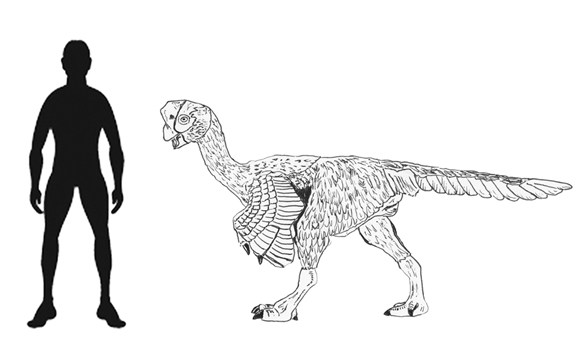
Everything Dinosaur’s Scale Drawing of the Mongolian Oviraptorid Citipati osmolskae

Citpati scale drawing.
Everything Dinosaur’s scale drawing of the oviraptorid Citipati (C. osmolskae). Picture credit: Everything Dinosaur.

Picture credit: Everything Dinosaur

Citipati osmolskae – “Funeral Pyre Lord”

Our scale drawing is an approximation, the true size of this dinosaur is not known.  It may have measured more than three metres long, although a body length of 2.5 metres is also possible.  In the late spring (2018), a scientific paper was published that reported upon the finding of another oviraptorid specimen discovered in association with a nest.

This specimen has been assigned to the Citipati osmolskae taxon, after all, fossils of this dinosaur are relatively common in the Ukhaa Tolgod region of Mongolia, where this new specimen was discovered.  Intriguingly, a comparison of the upper arm bones indicates that this new example of dinosaur nesting behaviour represents an adult animal more than 10% bigger than the original Ukhaa Tolgod nesting Citipati osmolskae specimen (IGM 100/979).  Estimating size for this member of the Dinosauria is therefore somewhat difficult.

Although several examples of nesting/brooding behaviour have now been described (we think the total to date is five), no evidence for colonial breeding for these dinosaurs has ever been discovered.

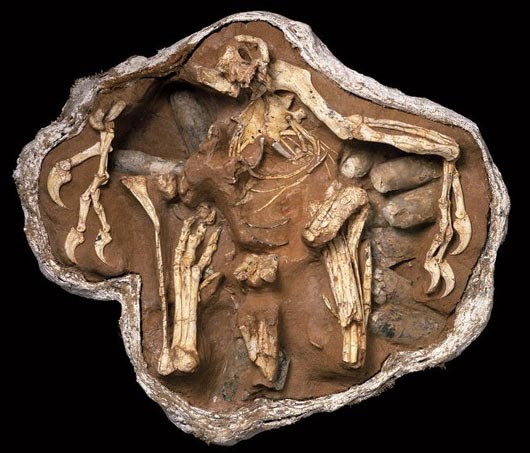
An Example of a C. osmolskae Fossil Found in Association with a Nest

Citipati osmolskae fossil.
The Citipati fossil sitting on a nest.  The fossil has been nick-named “Big Mamma”.

Picture credit: The American Museum of Natural History (New York)

The Wild Safari Prehistoric World Citipati replica is one of several new models in this range. Everything Dinosaur is hoping to have the first of the new for 2019 introductions, including the colourful Citipati replica, in their warehouse and available to purchase in December (2018).

To view the range of Wild Safari Prehistoric World models and the last of the now retired and out of production, Carnegie Collectibles: Wild Safari Prehistoric World and Carnegie Collectibles.

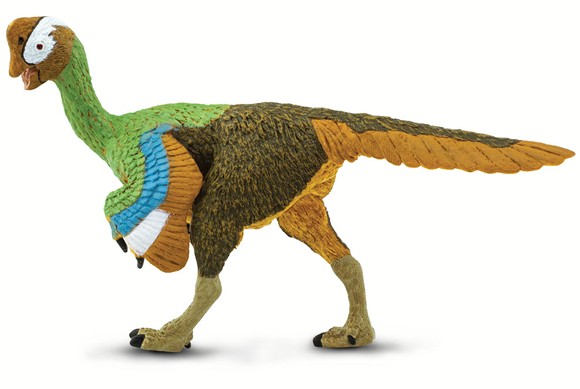
The Wild Safari Prehistoric World Citipati (C. osmolskae) Model

The Wild Safari Prehistoric World Citipati dinosaur figure.
The Wild Safari Prehistoric World Citipati dinosaur model.

Honouring the Polish Palaeontologist Halszka Osmólska

The genus name for this oviraptorid comes from the Sanskrit for “funeral pyre lord”, a reference to a story from Buddhist folklore about two monks that were beheaded by a thief.  These monks are frequently depicted as a pair of dancing skeletons surrounded by fire.  The beautifully preserved Citipati specimens excavated from the red sandstones of the Djadokhta Formation, reminded the research team responsible for their study (Clark, Norell et al), of the dancing monks. 

The species name honours the Polish palaeontologist Halszka Osmólska (1930 – 2008), who pioneered research into Mongolian dinosaurs and made a substantial contribution to our understanding of Theropoda from the Upper Cretaceous deposits of Mongolia.

Visit the Everything Dinosaur website: Everything Dinosaur.

25 10, 2018

Remarkable Giant Flying Squirrel Redraws Family Tree

By |2024-05-11T06:43:06+01:00October 25th, 2018|Categories: Dinosaur and Prehistoric Animal News Stories, Main Page, Photos/Pictures of Fossils|0 Comments

Flying Squirrel Fossil Sorts Phylogeny

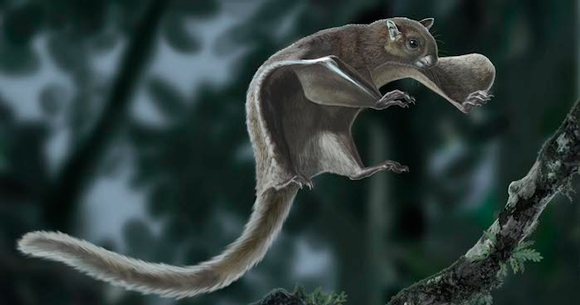
The fossilised remains of a large flying squirrel unearthed at a landfill site in north-eastern Spain (Catalonia), has helped researchers to re-write the family tree of the Sciuridae family.  Estimated to have been around one metre in length (including tail) and weighing up to 1.6 kilograms, the newly described squirrel species named Miopetaurista neogrivensis is around the size of the largest flying squirrels today, the Chinese giant flying squirrel (Petaurista alborufus).  Its fossils show that the flying squirrel body plan has not changed for millions of years.

A Life Reconstruction of the Newly Described Miopetaurista neogrivensis (Middle-Late Miocene of Europe)

Miopetaurista neogrivensis illustrated.
A life reconstruction of the giant prehistoric squirrel Miopetaurista neogrivensis.

Picture credit: Óscar Sanisidro

Mistaken for a Primate

The fossils, including most of the skull and jaws from a single individual, were discovered in 2002, when alterations were being made to the landfill site.  At first, it was thought that the long, thin bones represented a primate, as simian fossils are known from these Miocene-aged deposits.

One of the authors of the scientific paper, published in the journal eLife, Óscar Sanisidro (University of Kansas Biodiversity Institute and Natural History Museum), takes up the story:

“That area is very rich in fossils.  The recovered specimen was unearthed by an excavator machine while digging up a sector of the landfill.  They could only see a couple of bones poking out from the debris.  They thought it might be a species of primate because of its limb proportions, maybe Pliopithecus, a small monkey found in the area.  Additionally, the presence of a lot of early hominoids in the nearby deposits posed it as an excellent place to look for those animals.”

A Giant Flying Squirrel

Once the block of stone containing the fossil material had been removed and work had started to clean and prepare the bones, it soon became clear that the fossils represented a super-sized rodent.  The key to identifying the specimen as a flying squirrel came in the discovery of the specialised wrist bones (pisiforms) which are unique to flying squirrels.  These bones attach to a spur of cartilage that supports the skin membrane (patagium), that allows these arboreal specialists to glide.  Once a pisiform bone had been identified in the specimen, it became clear to the research team that these fossils represented a flying squirrel.

The fossils, dated to approximately 11.6 million years ago (Serravallian to Tortonian faunal stage of the Middle to Late Miocene), are very similar to the skeletons of living flying squirrels.  Miopetaurista neogrivensis, is the oldest flying squirrel fossil found to date that has a modern-looking anatomy and it shows that these mammals have remained almost unchanged for nearly 12 million years.

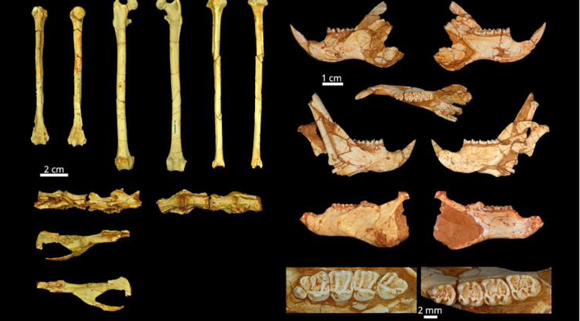
Views of the Fossilised Bones and Teeth of the Newly Described Miocene Flying Squirrel M. neogrivensis

Miopetaurista fossils.
The fossilised bones and teeth of the Miocene flying squirrel Miopetaurista.

Picture credit: Óscar Sanisidro

Redrawing the Evolutionary Family Tree of the Sciuridae

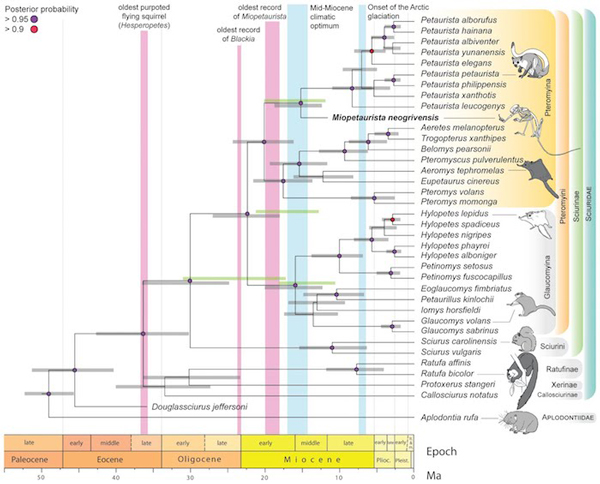
This Spanish fossil discovery has helped palaeontologists to redraw the evolutionary tree of the squirrel family.  That branch of the Sciuridae that led to modern flying squirrels must have diverged many millions of years earlier than previously thought.  This spilt is now believed to have occurred sometime between 31 and 25 million years ago.

The Phylogeny of the Flying Squirrels – M. neogrivensis Helps to Redraw the Squirrel Family Tree

Flying squirrel phylogeny.
The phylogeny of the flying squirrels has been revised after the description of Miopetaurista neogrivensis.

Picture credit: eLife

The researchers identified Miopetaurista neogrivensis as sister taxon of the living Petaurista taxon following an in-depth Bayesian statistical analysis that looked at over 100 anatomical characteristics in 38 taxa.  The team were also able to plot key periods in the evolution of these mammals and link them to incidences of environment and climate change such as the mid-Miocene climate optimum (global warming) and the onset of Arctic glaciation (global cooling).

Commenting on the significance of the fossils and their impact on squirrel phylogeny,  Óscar Sanisidro stated:

“When working with tree squirrels and flying squirrels, some of the features we thought were unique to flying squirrels have been found by our team in some non-flying squirrels.  Right now, we don’t have features unique to flying squirrels except for the wrist.  With fossils of micromammals, ninety-nine percent of the time you’re working with teeth.  Wrist bones are extremely rare.  But now we can link those traits to the postcranial skeleton.  Some of the flying squirrels found in the past might not be flying squirrels because they might have had features common to other groups.”

Well-adapted to a Forest Environment

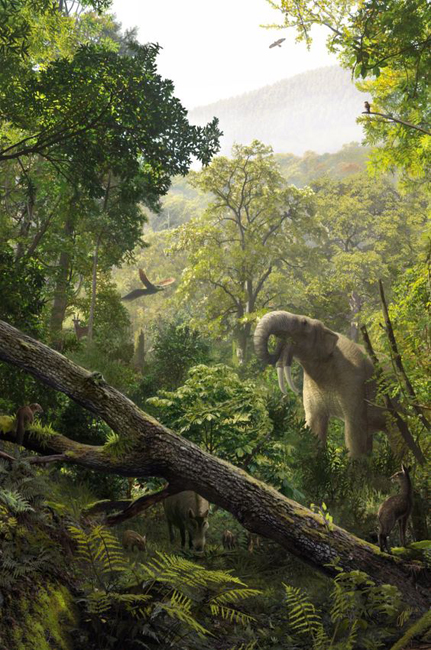
Flying squirrels today are globally distributed, but most species are found in Asia.  It is likely that, just like its extant descendants, Miopetaurista neogrivensis was probably nocturnal and very much at home in its sub-tropical forest environment.  It is not known what this ancient flying squirrel ate, today’s flying squirrels have a variety of feeding behaviours, however, Miopetaurista was probably omnivorous, feeding on nuts, fruit and insects.

Spain in the Mid Miocene – A Sub-tropical Forest Environment

The Middle Miocene - sub-tropical forests across much of Europe.
Spain in the Middle Miocene.

Picture credit: Óscar Sanisidro

Visit the Everything Dinosaur website: Everything Dinosaur.

24 10, 2018

Prehistoric Times New Issue 127 Reviewed

By |2024-05-07T13:59:33+01:00October 24th, 2018|Categories: Dinosaur Fans, Magazine Reviews, Main Page|0 Comments

A Review of Prehistoric Times Magazine (Issue 127)

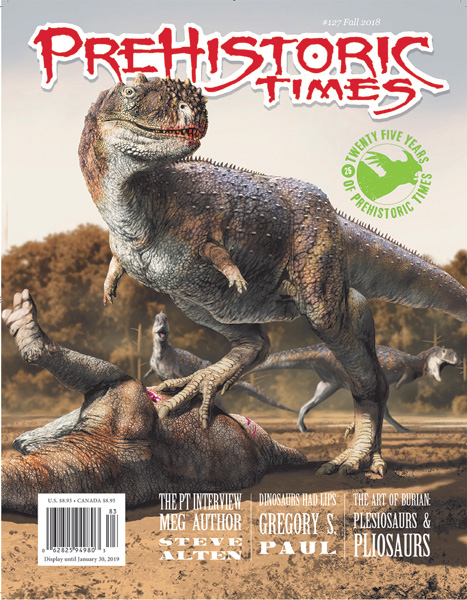
Autumn is very much with us, the long summer seems a distant memory already.  Our chums across the Atlantic refer to this season of mellow fruitfulness as the Fall, so time to review the latest copy of “Prehistoric Times” magazine, issue 127 (autumn/fall).  This issue of the quarterly magazine features “Prince Lizard” – Rajasaurus, on the front cover, the illustration has been created by renowned palaeoartist J. A. Chirinos.

The Front Cover of Prehistoric Times Issue 127 (Autumn/Fall 2018)

Prehistoric Times issue 127 (fall).
Prehistoric Times” issue 127 (autumn 2018).

Picture credit: Mike Fredericks/Prehistoric Times

The “Prehistoric Times” Interview: Steve Alten

Mike Fredericks  has included a summary of his recent YouTube interview with Steve Alten, the author of the book “Meg”, upon which the summer blockbuster movie of the same name starring Jason Statham was based.  The interview script is accompanied with some amazing illustrations featuring the giant prehistoric shark but look out for a marine reptile too.  On the subject of marine reptiles, New Zealander John Lavas discusses the artwork of Zdeněk Burian that portrays plesiosaurs and pliosaurs, as he continues his comprehensive overview of the work of the influential Czech artist and illustrator.

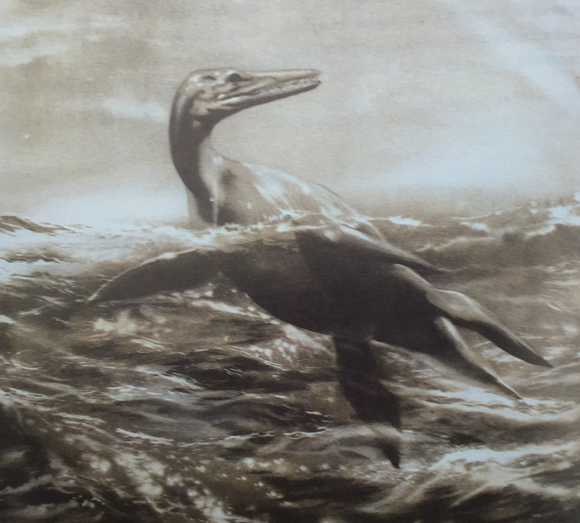
Burian’s Painting of the Pliosaurid Peloneustes philarchus Features in Prehistoric Times

Peloneustes illustrated.
An illustration of the mid-Jurassic pliosaurid Peloneustes by Burian.

Picture credit: John Lavas/Prehistoric Times

Dinosaurs with Lips

The debate as to whether dinosaurs had lips is discussed at length in a most informative article written by Gregory S. Paul, we wait to see whether future editions of “Prehistoric Times” will include the counter argument, perhaps Tracy Lee Ford, a regular contributor, can provide a summary of the evidence that contradicts this hypothesis.  For the time being, the aforementioned Tracy Lee Ford focuses on the skull of Triceratops in his regular feature “How to Draw Dinosaurs”.  This article is part one of a two part series, in the winter edition, the emphasis will be on drawing the body of this famous horned dinosaur.

Jordan Mallon of the Canadian Museum of Nature continues the horned dinosaur theme with an article on the safe removal of a Chasmosaurus skull from a dig site located near the South Saskatchewan River in Alberta.

As well as contributions from leading scientists, this magazine provides a platform for dinosaur fans to showcase their artwork.  A highlight for us was reading about the Rajasaurus inspired artwork produced by students at Brandywine Heights High School in Pennsylvania.  Look out also for the superb Leptoceratops painting supplied by Mohamad Haghani and Mike Landry’s beautiful Platybelodon artwork that is included in Phil Hore’s article on the “shovel tuskers”.

For further information on “Prehistoric Times” magazine and for details how to subscribe: Prehistoric Times Magazine.

Hunting Behaviour in Allosaurus

Jack Wilkin writes about Allosaurus, sometimes referred to as the “Lion of the Jurassic”.  The hunting behaviour of this iconic theropod is explored and the author suggests that Allosaurus hatchlings probably fed on insects before moving on to vertebrates.  Evidence for Allosaurus/prey interaction is presented and the theory that Allosaurus used its jaws like an axe to overcome its victims is explained.

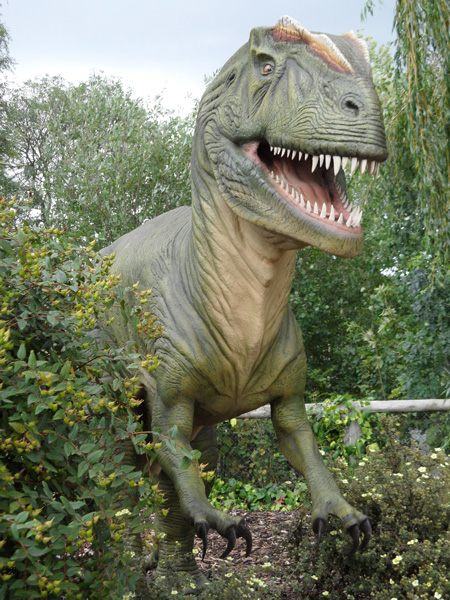
Allosaurus and Hunting Behaviour is Explored

The hunting strategy of Allosaurus is explored.
Allosaurus attacks!  How did it hunt? Picture credit: Everything Dinosaur.

Picture credit: Everything Dinosaur

What with information about new prehistoric animal models, fossil discoveries, classified advertisements and reviews of books related to palaeontology, there is certainly a lot going on inside the latest edition.  Look out also for a review of Tracy Lee Ford’s and Mike Frederick’s book “What Colour were Prehistoric Mammals?” which also features in this jam-packed publication.

Visit the Everything Dinosaur website: Everything Dinosaur.

24 10, 2018

An Amazing Dinosaur Beginning with “Z”

By |2024-05-11T06:43:29+01:00October 24th, 2018|Categories: General Teaching|Comments Off on An Amazing Dinosaur Beginning with “Z”

A Dinosaur Beginning with “Z” – Zhejiangosaurus

At Everything Dinosaur, we tend to get emails sent in by teachers, teaching assistants and pupils from all over the world.  Take for example, a request received in the early hours of yesterday morning from a teacher based in Australia.  The children in the teacher’s class had been learning all about dinosaurs and their focus had been on dinosaurs that lived in Australia and Asia.  The email requested that we provide some information on Asian and Australian members of the Dinosauria and our helpful team members were happy to oblige.

Specifically, we were asked to help furnish the classroom “Wow Wall” with a dinosaur beginning with the letter “Z”, as the teacher could not think of one.

We were able to send out some information and drawings on a number of dinosaurs that begin with the last letter of the alphabet – there are more than you might think!

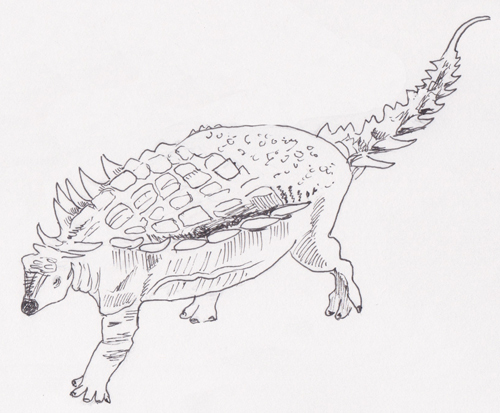
An Asian Armoured Dinosaur Beginning with the Letter “Z”

Zhejiangosaurus illustration.
The armoured dinosaur Zhejiangosaurus illusrated.

Zhejiangosaurus

Zhejiangosaurus (pronounced Zay-gee-an-go-sore-us), is an armoured dinosaur from the Late Cretaceous of China.  It is known from only fragmentary remains and scientists are not sure just how big this “walking tank” was.  It was named and described back in 2007 and it is one of a number of members of the Dinosauria that begin with the letter “Z”.

For dinosaur and prehistoric animal models: Dinosaur and Prehistoric Animal Models.

Our team members were happy to help out the antipodean teaching team.  After all, dinosaurs existed all over the world during the Mesozoic, their living relatives, the birds are very widespread today.  It looks like children learning about dinosaurs is a global phenomenon too.

The Everything Dinosaur website: Everything Dinosaur.

23 10, 2018

Breathing Life into the Bird Lungs Debate

By |2023-11-04T09:26:09+00:00October 23rd, 2018|Categories: Dinosaur and Prehistoric Animal News Stories, Dinosaur Fans, Main Page, Photos/Pictures of Fossils|0 Comments

Archaeorhynchus spathula – Lungs in an Ancient Bird Fossil?

Modern birds have a very efficient respiratory system.  Their lungs are much more efficacious than those of mammals.  However, scientists are not sure when and how this breathing system evolved.  It has been suggested that the origins of the bird’s respiratory system, complete with air sacs and the ability to stop de-oxygenated air mixing with oxygenated air as it is expelled from the lungs, is one anatomical trait inherited from their dinosaur ancestors.

Writing in the academic journal the “Proceedings of the National Academy of Sciences”, a group of international scientists claim that the fossilised remains of an Early Cretaceous bird breathes new life into the evolution of the bird lungs debate.

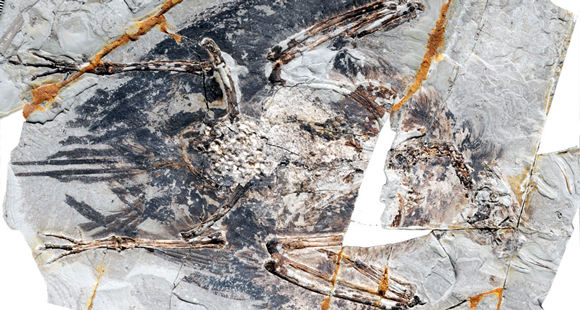
The Main Slab Showing the Archaeorhynchus spathula Specimen

Archaeorhynchus spathula fossil (main slab).
The main slab showing the fifth specimen of Archaeorhynchus spathula to have been described. Palaeontologists have identified what might be evidence for avian lungs as well as a pintail on this ancient bird.

Picture credit: J. Zhang/Institute of Vertebrate Palaeontology and Palaeoanthropology (IVPP)

The Fifth Specimen of Archaeorhynchus spathula to be Described

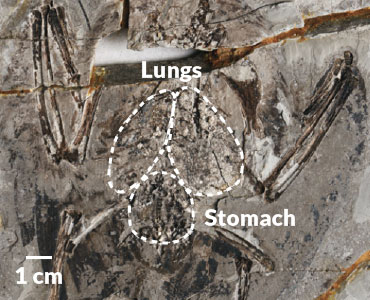
A study of the slab and counter slab representing the fossilised remains of a prehistoric bird (Archaeorhynchus spathula), suggests that, in this remarkably complete specimen, remnants of the animal’s soft tissues including internal organs such as the lungs could have been preserved.  Using scanning electron microscopy, the research team, including members of the Beijing based, Institute of Vertebrate Palaeontology and Palaeoanthropology (IVPP), identified what could be evidence of paired lungs.

The structures identified by the team suggest that Archaeorhynchus had a respiratory system capable of handling the large amount of oxygen required to sustain powered flight.  Although, the conclusions drawn in the scientific paper have been questioned by several academics, if these are lungs, then it indicates that physiological adaptations in Aves came before changes in their skeleton during the evolution of anatomically modern birds.

The Scientists Identified What Could be Paired Lungs on the Counter Slab of the Fossil Specimen

Archaeorhynchus spathula counter slab with possible lung preservation.
Counter slab of Archaeorhynchus spathula specimen interpreted as having lung preservation.  The dotted outlines mark the location of organs (paired lungs and the stomach).

Picture credit: X Wang et al (PNAS)

The Significance of this Research

Archaeorhynchus spathula is one of a number of bird genera known from the Lower Cretaceous Jiufotang Formation (China).  Copious amounts of gizzard stones associated with this and the previous specimens suggest that these primitive birds were probably vegetarian.  They form part of a rich prehistoric fauna known as the Jehol Biota.  In total, five specimens have been described to date but this fossil, consisting of a crushed specimen represented by a slab and counter slab, is the most complete.

Numerous feathers and traces of plumage can be made out and the researchers report that Archaeorhynchus had a pintail, a feature previously not seen in Mesozoic birds.  A. spathula has been classified as a basal member of the Ornithuromorpha, a group distantly related to today’s birds and one that possessed a mix of ancient and more modern anatomical features.

This fascinating fossil described as looking something like “road kill” by one observer, might have allowed palaeontologists to catch a glimpse of a stage of bird evolution where an advanced pulmonary system had evolved yet the skeleton lacked the adaptations seen in extant birds to permit efficient powered flight.

For an article published in 2007 that examined the respiration of dinosaurs: Study Indicates that Dinosaurs were Super-efficient Breathers.

22 10, 2018

Important News about Papo Model Retirements in 2019

By |2024-05-11T06:44:04+01:00October 22nd, 2018|Categories: Dinosaur Fans, Everything Dinosaur News and Updates, Everything Dinosaur Products, Main Page, Photos of Everything Dinosaur Products, Press Releases|1 Comment

Papo Model Retirements 2019

At Everything Dinosaur, we have had lots of interest already from customers, social media followers and blog readers asking about new for 2019 models from Papo.  We are not able to publish this information as yet, it remains embargoed.  However, when we can, we will put up information and pictures, all part of our plans to inform people about what is new and upcoming in terms of 2019 model introductions from manufacturers next year.

In the meantime, it is sensible to focus on those models and figures that are being withdrawn and are going out of production.  Papo will be retiring two figures from their “Les Dinosaures” range next year, ironically neither of the models represent a dinosaur.

Papo is retiring:

  • Archaeopteryx
  • Tupuxuara

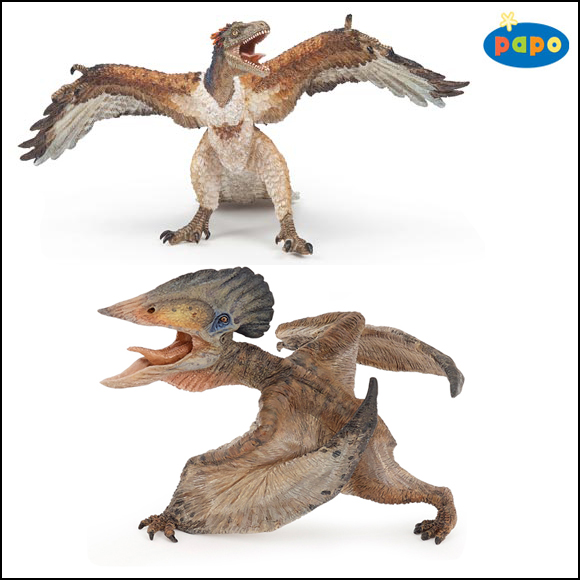
Papo Model Retirements – Archaeopteryx and Tupuxuara

Papo Tupuxuara and Papo Archaeopteryx retired 2019.
Papo model retirements 2019 – Archaeopteryx and Tupuxuara. Picture credit: Everything Dinosaur.

Picture credit: Everything Dinosaur

Winged Wonders Out of Production

Both these models represent animals from the Mesozoic that were capable of powered flight.  Of the two, palaeontologists believe that the pterosaur, Tupuxuara was probably more confident in the air.  Some of the latest research on the enigmatic “Urvogel” suggests that Archaeopteryx was actually quite a poor flier.  Whatever their volant abilities, both these figures are being retired and are now out of production.  However, thanks to Everything Dinosaur collectors and model fans are being pre-warned about their withdrawal.  There is still time to add these two models to your Papo figure collection.

Papo Archaeopteryx

The Papo Archaeopteryx figure was introduced in 2014 and at the time of its introduction, it received a lot of positive feedback as representations of Archaeopteryx lithographica were, if you pardon the pun, a bit thin on the ground.  Sadly, after nearly five years, this model has flapped its wings for the last time and has been officially withdrawn.

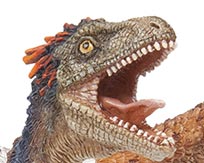
The Papo Archaeopteryx Model Received Lots of Praise When it was Introduced in 2014

The Papo Archaeopteryx model.
A close view of the head of the Papo Archaeopteryx model. Picture credit: Everything Dinosaur.

Picture credit: Everything Dinosaur

To view the range of Papo dinosaurs and prehistoric animal figures available from Everything Dinosaur: Papo Dinosaurs and Prehistoric Animals.

At the time of this model’s introduction, Everything Dinosaur published several reviews of this figure including a video review.  These releases have been seen thousands of times.

Papo Tupuxuara

It is always a pleasure to see more models representing the Pterosauria being introduced, so the loss of the Papo Tupuxuara is a big blow.  This figure was only introduced in 2015, alongside the Papo young Apatosaurus model.  Three species of Tupuxuara have been named to date, the first being described in 1988.  These pterosaurs are synonymous with Lower Cretaceous sediments found in north-eastern Brazil.

The Papo Tupuxuara is Flying Off into the Sunset

Papo Tupuxuara pterosaur model.
The head of the Papo Tupuxuara pterosaur model.  The diet of this large pterosaur from the Lower Cretaceous of Brazil remains uncertain. Picture credit: Everything Dinosaur.

Picture credit: Everything Dinosaur

One of the reasons suggested for the withdrawal of the Papo Tupuxuara figure, is the difficulty encountered when trying to pronounce the name of this flying reptile.  Tupuxuara was named after a spirit referred to within the culture of the local Tupi people of north-eastern Brazil.  Tupuxuara is pronounced “Too-pooh-hwar-ah”.

Visit the Everything Dinosaur website: Everything Dinosaur.

21 10, 2018

Flea Bites and Dermal Infections in Glyptodonts

By |2023-11-04T09:04:29+00:00October 21st, 2018|Categories: Dinosaur and Prehistoric Animal News Stories, Main Page, Palaeontological articles, Photos/Pictures of Fossils|2 Comments

Fleas on Glyptodonts

A new study examining one of the more bizarre types of megafauna from prehistoric South America has revealed that glyptodonts and their relatives suffered from fleas and dermal infections.  It seems that the hard, bony armour of some of these car-sized giants was no defence against flea bites.  Brazilian-based scientists writing in the open access, on-line journal “PLOS One”, have studied hundreds of pieces of glyptodont armour and discovered evidence of infections caused by fleas.

Such armour might have deterred a sabre-toothed cat from attacking, but the osteoderms and armoured tails were no defence against parasites.

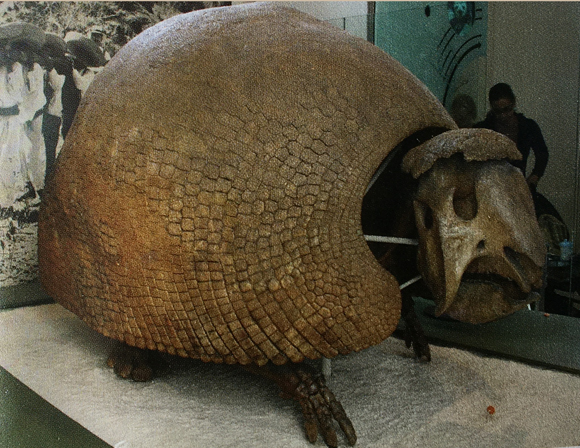
A Skeleton of the Giant Glyptodont Panochthus spp.

Fossil glyptodont Panochthus.
A glyptodont fossil (Panochthus frenzelianus).  Researchers studied the tiles of bone (osteoderms) that formed the protective bony exoskeletons of extinct types of armadillo and determined that these armoured giants suffered from parasites and skin infections.

Picture credit: R. Somma/Wikimedia Commons

Extinct Members of the Order Cingulata Studied

The scientists from Universidade Federal Rural do Semi-Árido, Mossoró (Brazil), studied the osteoderms that make up the exoskeleton of two extinct genera of glyptodonts Panochthus (pictured above) and Glyptotherium.  In addition, the research team examined the fossilised armour of another extinct armadillo-like creature Pachyarmatherium.

All these mammals belong to the Order Cingulata (armadillos and their relatives).  Damaged osteoderms were noted in all three genera and attributed to attacks by fleas and infections.  The scientists were able to identify the flea bites as coming from one particular genus  – Tunga.  The Tunga flea, sometimes referred to as the “jigger flea”, is native to South and Central America and is known to parasitise a number of large mammals including humans.  The bites cause well-defined circular lesions and perforations.  Such patterning was identified in a number of fossilised pieces of dermal armour.

Flea bites permitted secondary damage to be caused by the invasion of pathogenic microorganisms such as bacteria and fungi.

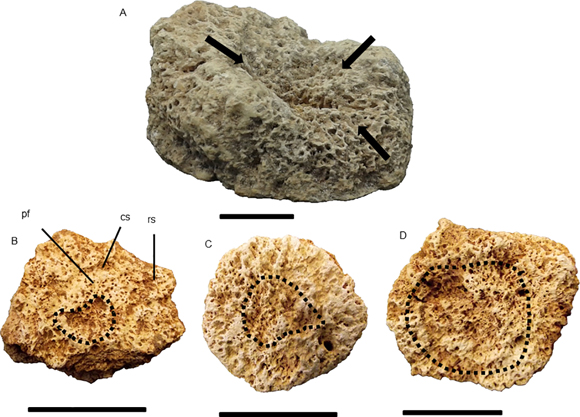
The External Surface of Osteoderms from the Glyptodont Glyptotherium Showing Pitting and Damage

Cingulata osteoderm parasite infection.
Osteoderms of the Brazilian glyptodont Glyptotherium showing damage from flea bites.

Picture credit: PLOS One

The picture (above) shows severe pitting (black arrows) in (A) and three other osteoderms attributed to Glyptotherium which show stages of damage from (B), slight, through to (D) advanced pitting and the response to the damage by the deposition of more bone (calcium deposition).  The scale bar in A = 3 cm, whereas, the scale bar in B-D is 4 cm.

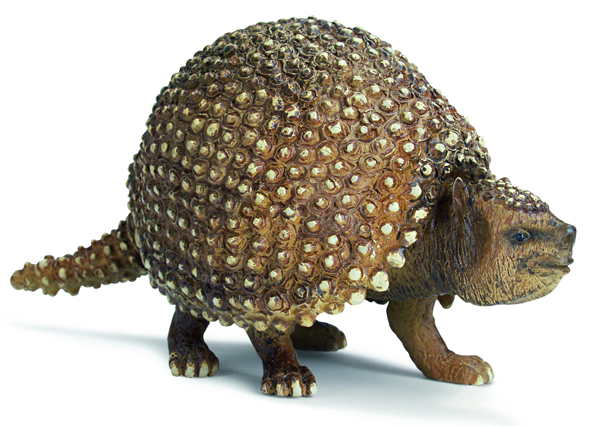
A Life Reconstruction of a Glyptodont

Schleich Glyptodon model.
The Schleich Glyptodon figure.

The bone alteration and re-growth identified in this study represent the first record of flea attack and pitting in two genera of large glyptodonts Panochthus and Glyptotherium and in a non-glyptodontid, large cingulate (Pachyarmatherium), from the Quaternary of the Brazilian Intertropical Region.  These newly identified flea bite occurrences and subsequent infections widen the geographic distribution of those diseases during the Cenozoic and provide more evidence for the co-evolution of parasites such as the Tunga flea and South American megafauna.

The scientific paper: “Ectoparasitism and Infections in the Exoskeleton of Large Fossil Cingulates” by Fábio Cunha Guimarães de Lima, Kleberson de Oliveira Porpino published in PLOS One.

Visit the Everything Dinosaur: Everything Dinosaur.

Go to Top