By Mike|2024-05-11T06:32:47+01:00November 7th, 2018|Categories: General Teaching, Key Stage 1/2|Comments Off on New Flip Facts “Dino Record Breakers”
Flip Facts “Dinosaur Record Breakers”
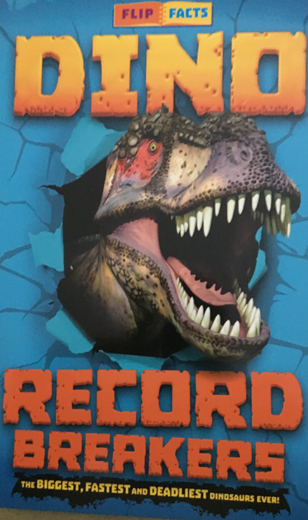
Here’s a great little book all about dinosaurs, the biggest, fastest, most heavily armoured and so forth. The book entitled “Dino Record Breakers”, consists of sixty, tough, wipe clean pages in a flip chart format that provides lots of amazing facts about dinosaurs.
“Dino Record Breakers”
The Front Cover of “Dino Record Breakers”
The front cover of the recently published book “Dinosaur Record Breakers”.
Amazing Dinosaur Facts
Children enjoy learning lots of facts about dinosaurs and prehistoric animals and this little book caters for their needs providing details on the biggest predator, which dinosaur had the strongest bite and which was the “fuzziest” dinosaur. The most popular dinosaurs such as Stegosaurus and Tyrannosaurus rex are featured along with some of the more obscure ones such as Pentaceratops, Edmontonia and Pelecanimimus. Produced by Carlton Books, this publication has been written by the renowned English palaeontologist Darren Naish, so you can expect the information contained therein to be accurate.
The text is written in a child-friendly format with lots of short sentences, interspersed with diagrams, fact files and clever illustrations to help inform and to educate.
The book does not just feature dinosaurs, members of the Pterosauria such as Quetzalcoatlus and the huge marine reptile (Pliosauridae), Liopleurodon are included too.
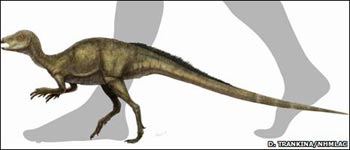
Dinky Dinosaurs – Fruitadens – The Smallest Plant-eater
An illustration of perhaps the smallest dinosaur known Fruitadens.
Picture credit: D. Trankina/NHMLAC
This colourful book makes a great Christmas gift for a budding palaeontologist and a super resource for use in schools to help educate and inform children when it comes to conducting independent research on dinosaurs and compiling non-chronological reports.
Written by the famous English palaeontologist Darren Naish, Flip Facts “Dino Record Breakers” is crammed full of super dinosaur and prehistoric animal facts and information.
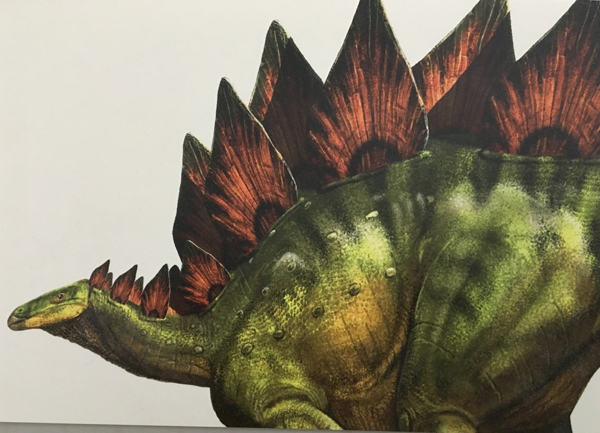
This morning, we feature a superb illustration of the Late Jurassic armoured dinosaur Stegosaurus by the renowned palaeoartist from China, Zhao Chuang. Enormous diamond-shaped plates were located on the neck, back and tail of Stegosaurus. These plates were not just made of bone, they also had a horny, keratin covering. This covering has not been preserved in the known fossil record so palaeontologists don’t know how big the plates were or indeed, what shape they were in life.
A Life Reconstruction of the Armoured Dinosaur Stegosaurus
Stegosaurus illustration by Zhao Chuang.
Picture credit: Zhao Chuang
What Colour were the Plates on Stegosaurus?
When first described by the American palaeontologist Othniel Charles Marsh in 1877, the bizarre plates of Stegosaurus were thought to provide protection against attack. They were regarded as armour, however, it was soon noted that although their exact position in life was difficult to determine (the plates are embedded in the skin and not attached to the bone), it was likely that these structures were too high on the back to be effective armour-plating for this plant-eating dinosaur.
As palaeontologists employed more sophisticated techniques to study these plates, it was revealed that they were quite thin with lots of blood vessels running through them. The theory that these plates played a role in thermoregulation was postulated. On cold mornings a Stegosaurus could face towards the sunrise and warm its plates. The blood running through the vessels close to the surface of the plates would then be warmed up, helping the dinosaur to raise its body temperature. Furthermore, in order to cool down, the Stegosaurus could face the sun in such a way that only a small surface area of the plates was exposed, thus permitting the body to cool down.
Thermoregulation
As the largest plates were high on the animal’s back, their position several metres in the air, would permit cooler air away from the ground surface to circulate around them, thus cooling the dinosaur still further.
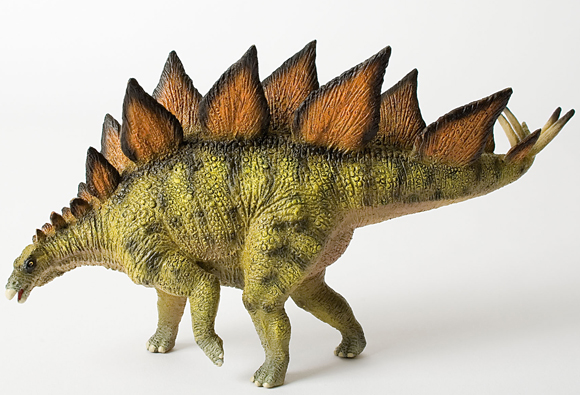
It was the scientist Kenneth Carpenter who first proposed that the plates could be flushed with blood at will and this led to the idea that these adornments could be used to display or to intimidate predatory dinosaurs. As a result, numerous Stegosaurus illustrations and indeed models, have tended to give Stegosaurus some reddish colour plates.
A Model of a Stegosaurus (Bullyland Stegosaurus) with Red Coloured Plates
Bird-like Lungs Could Have Helped Dinosaurs to Dominate
There has been a great deal of debate regarding the rise of the Dinosauria. How and when did these relatively unassuming members of the Dinosauria, which only made up a small proportion of terrestrial biota during the Middle Triassic, rise to dominance, out-competing a host of other reptilian groups? The respiratory system of dinosaurs could provide a clue. In a new study published in the open access journal of the Royal Society (Royal Society Open Science), a team of researchers postulate that the lung-air sac system could have helped dinosaurs thrive in Earth’s oxygen-depleted atmosphere.
Did a Super-efficient Pulmonary System Help the Dinosaurs to Thrive?
New research suggests super-efficient dinosaur lungs assisted the rise of the Dinosauria.
Picture credit: Chinese Academy of Sciences
Studying the Breathing Systems of Modern Birds and Alligators
Birds have a super-efficient respiratory system that is unique amongst the vertebrates. However, palaeontologists remain uncertain as to when the avian-style lung evolved. Did it evolve in dinosaurian ancestors or is it restricted to birds? After all, if you are going to fly, then you need a very efficient and powerful set of lungs to get enough oxygen to your flight muscles.
This area of anatomy has attracted a great deal of debate. Recently, Everything Dinosaur reported on a study conducted on a specimen of Archaeorhynchus spathula, a primitive bird (basal member of the Ornithuromorpha), from the Lower Cretaceous of China, that may show preservation of an advanced avian lung. To read more about this research: Breathing Life into the Bird Lungs Debate.
The scientists, including researchers from the University of Manchester, compared dinosaur lungs to those of living crocodilians and the lungs of extant birds. Lead researcher, PhD student Robert Brocklehurst (School of Earth and Environmental Sciences, Manchester University), stated:
“The respiratory system of non-avian dinosaurs has been the topic of considerable study over the years, both in an attempt to shed light on the biology of now extinct members of the dinosaur family, and in order to understand the origins and evolution of modern birds and reptiles.”
Low Oxygen Levels in the Triassic and Early Jurassic
Today, our atmosphere contains approximately 21 percent oxygen, however, things have not always been like that. During the Middle Triassic, through to the Early Jurassic, a time that saw the evolution and the radiation of the Dinosauria, the atmospheric oxygen percentage of our planet fell to around 15-17%. With less oxygen in the air, a group of vertebrates with more efficient lungs would have had a definite evolutionary advantage over other terrestrial animals.
During the Triassic A Wide Variety of Terrestrial Reptilian Vertebrates Co-existed
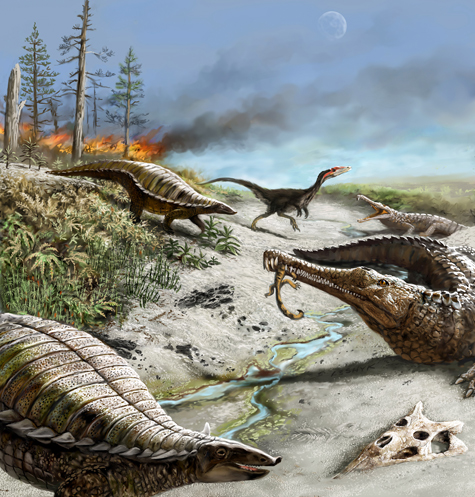
Dinosaurs, aetosaurs, phytosaurs and and rauisuchians co-existed in the Triassic, but did super-efficient lungs help the Dinosauria to become dominant.
Picture credit: Victor Leshyk
Studying the Lungs of the Dinosauria
To investigate the different kinds of respiratory systems the team used Computerised Tomography (CT) scans to look at the lung cavities of four modern crocodilians and twenty-nine modern birds, including the largest living bird today, the ostrich and compared their structure with those of sixteen different dinosaur species. The detailed scans revealed that all the dinosaurs had vertebrae more similar in shape to those of birds than those of crocodilians. In addition, the scientists discovered that the dinosaur vertebrae jutted into the lung cavity, the same as found in living birds.
Robert explained:
“We thought some of the dinosaurs would have lungs more like birds, and others would be similar to reptiles, but this wasn’t the case at all. Every dinosaur sample we scanned just looked like the birds we scanned.”
Dissection Used in this Study
As well as using CT scans, the team removed the lungs of an alligator and an ostrich, and found the skeletal support structures surrounding the lungs were very different in each animal. The alligator’s lung cavity was smooth and allowed the lungs and other internal organs to glide as they move to pump air in and out while the animal swims. However, the ostrich lung cavity was found to be furrowed, similar to the anatomical condition found in the dinosaurs.
The scientists concluded that having more efficient bird-like lungs permitted the dinosaurs to adapt and thrive in an oxygen depleted environment, whereas other groups including the the Crurotarsi clade of archosaurs that gave rise to modern crocodiles, struggled.
Commenting on the research, co-author Professor Bill Sellers (Manchester University) added:
“If even the very first dinosaurs to evolve had bird-like lungs, this goes some way to explaining why dinosaurs became the dominant animal species of their time. Other animal groups simply may not have had lungs as well suited to extracting oxygen from the air. That simple evolutionary difference may have let dinosaurs rule world.”
An Anatomical Advantage for the Dinosauria
The scientists concluded that respiratory and pulmonary modifications would have provided dinosaurs with more efficient means of oxygen uptake relative to other vertebrates during the environmentally hypoxic conditions which pervaded much of the early part of the Mesozoic. This anatomical advantage enjoyed by the Dinosauria could thus potentially have contributed to their radiation and dominance over terrestrial ecosystems, which was to last for around 150 million years.
The Lungs of Dinosaurs Helped to Power Their Evolutionary Success
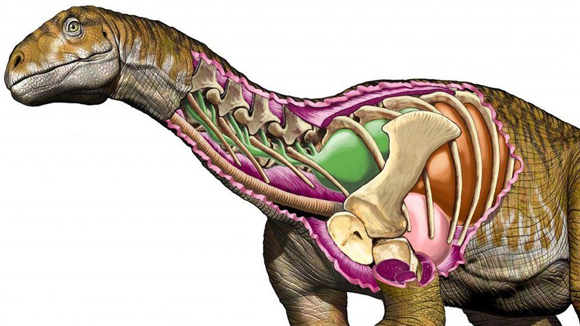
The air sacs of Ingentia prima (green) the lungs shown in brown. This large, Early Jurassic sauropod had a super-efficient respiratory system.
Picture credit: Jorge A. González
Everything Dinosaur acknowledges the assistance of a press release from Manchester University in the complilation of this article.
The scientific paper: “Vertebral Morphometrics and Lung Structure in Non-avian Dinosaurs” by Robert J. Brocklehurst, Emma R. Schachner and William I. Sellers published in Royal Society Open Science.
Lavocatisaurus agrioensis – A New Long-Necked Dinosaur from Argentina
A team of palaeontologists from Argentina and Spain have announced the discovery of a new species of long-necked dinosaur from the Early Cretaceous of Argentina. The dinosaur, represented by a set of bones that indicate the remains of at least three individuals, has been named Lavocatisaurus agrioensis and it will help to shed more light on a rare and enigmatic group of sauropods known as the rebbachisaurids.
A Skeletal Reconstruction and Photographs of Key Fossils from L. agrioensis
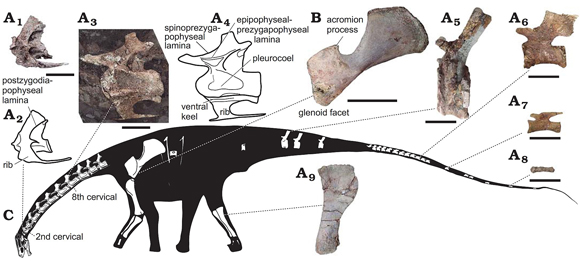
Skeletal reconstruction based on the holotype and paratype specimens of Lavocatisaurus agrioensis. Scale bars = 10 cm.
Picture credit: AFP/Agencia CTYS
The picture above shows the skeletal drawing of the adult dinosaur with illustrations of key bones from the excavation. Most of the neck and the skull has been recovered. Cranial fossils associated with the Rebbachisauridae are rare, the discovery of these specimens from Agrio del Medio (Neuquén Province, Argentina) will help scientists to better understand taxonomic relationships amongst members of this sauropod family, largely associated with Gondwanaland fossil deposits.
Fossils of a Family Group?
Writing in the journal “Acta Palaeontologica Polonica”, the scientists report the discovery of one large, presumably adult animal with two smaller sub-adults found in association. The fossil material come from terrestrial sandstone deposits laid down around 110 million years ago (Aptian to Albian faunal stage of the Early Cretaceous), in an arid environment with isolated oasis and other water sources (Rayoso Formation).
One of the authors of the scientific paper, José Luis Carballido, of the Egidio Feruglio Museum (Argentina), stated:
“We found most of the cranial bones: the snout, the jaws, a lot of teeth, also the bones that define the eye sockets for example and in that way, we were able to create an almost complete reconstruction. Not only is this the discovery of a new species in an area where you wouldn’t expect to find fossils, but the skull is almost complete.”
Lavocatisaurus agrioensis
The fossils represent one large dinosaur estimated to be around twelve metres in length and two smaller animals around six to seven metres in length. The research team postulate that this could represent a family group that lived together and perished together, perhaps unable to find a water source in a time of drought.
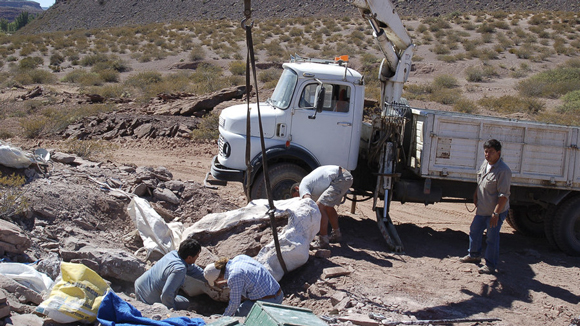
Preparing to Move Some of the Fossil Material (Lavocatisaurus)
The jacketed remains of one of the Lavocatisaurus specimens is prepared for transport away from the dig site.
Picture credit: AFP/Agencia CTYS
Lead author of the paper, José Ignacio Canudo (Zaragoza University, Spain) added:
“This discovery of an adult and two juveniles also signifies the first record of a group displacement among the Rebbachisaurus dinosaurs.”
The Rebbachisauridae Family
The Rebbachisauridae family of sauropods are a group of basal members of the Diplodocimorpha clade that includes more famous Late Jurassic dinosaurs such as Diplodocus, Apatosaurus and Brontosaurus. The rebbachisaurids are known from both Lower Cretaceous and Upper Cretaceous strata and had a wide geographical distribution throughout Gondwana and southern Laurasia with fossils reported from north and central Africa as well as South America and Europe (Spain).
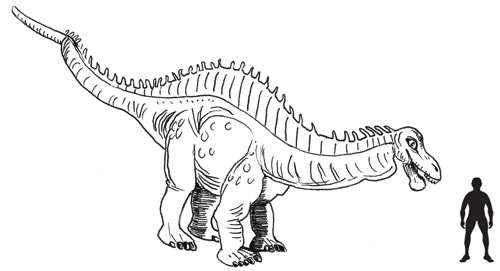
An Illustration of a Typical Rebbachisaurid Dinosaur (R. garasbae)
Scale drawing of Rebbachisaurus (R. garasbae). Picture credit: Everything Dinosaur.
Patterns on the Feathers of Confuciusornis as Complex as Modern Birds
A team of international scientists, including researchers from the China University of Geosciences (Beijing), the University of Ghent (Belgium) and the University of Texas at Austin (United States), have discovered that the patterns on the feathers of an Early Cretaceous bird may have been very similar to and as complex as the patterns seen on the feathers of extant Aves. Writing in the academic, on-line journal “PeerJ”, the researchers conclude that the patterning of Confuciusornis feathers probably performed similar functions to the patterning on modern bird’s feathery coats, that is, they provided camouflage and also played a role in display.
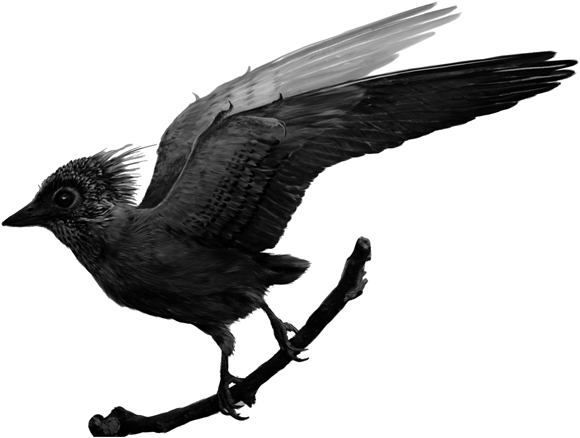
Reconstruction of the plumage of Confuciusornis (specimen number CUGB P140).
Picture credit: Li et al (PeerJ)
Complex Patterning Detected by Sophisticated Chemical Analysis
The specimen studied consists of a slab and counter slab of a single, individual bird from Early Cretaceous deposits in Fengning County, Hebei Province (north-central China). The fossils are from the vertebrate collection of the China University of Geosciences and represent an example of Confuciusornis sanctus.
The research team identified exceptional feather preservation but poor preservation of the bones, the unusual state of preservation permitted the scientists to identify melanin signals in the fossilised feathers indicating a complex patterning of spots on the wings, throat and on the tuft of feathers at the back of the head forming a small crest. The shape of the structures that form these patterns in conjunction with chemical analysis confirmed the diagnosis of the pigment melanin. However, specific colouration associated with the patterns could not be discerned.
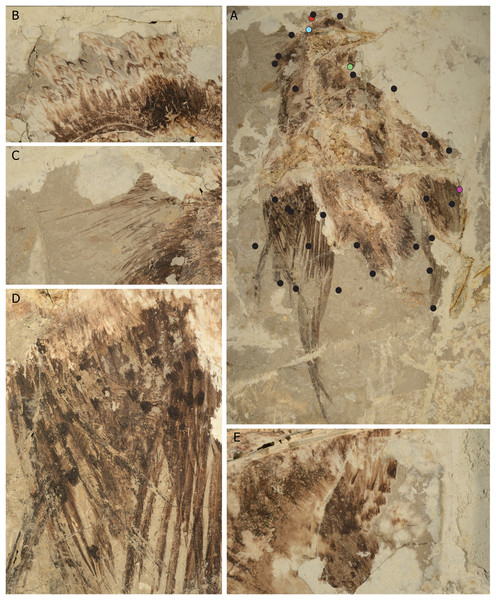
The Slab and Counter Slab or a C. sanctus Specimen Reveals Complex Patterning on the Plumage
Evidence of plumage diversity in the Confuciusornithidae from the new specimen (CUGB P1401).
Picture credit: Li et al (PeerJ)
The photograph (above) shows various views of the main slab of the fossil specimen showing details of the plumage. The dots in (A) indicate places that were subjected to sampling, whereas B and C reveal the crest located on the back of the head. Parts D and E show elements of the integumentary covering in close detail.
A Range of Analytical Techniques Used to Study Confuciusornis
Using a range of analytical techniques including scanning electron microscopy and ion mass spectrometry (ToF-SIMS) the researchers concluded that the elaborate spotting on this specimen exceeds that found in exceptionally-preserved troodontids and compsognathids and rivals that in modern birds, suggesting that plumage patterns evolved greater complexity through avian evolution.
The exact age of the strata is uncertain, although it is believed that the deposits from Fengning County are approximately equivalent in age with the Dawangzhangzi Member of the Yixian Formation, around 122-123 million years old (Aptian faunal stage of the Early Cretaceous). The data from this study suggests that Confuciusornis had more complex patterning than the patterning identified in Achiornis or in the stripes of the compsognathid Sinosauropteryx. The research team conclude that this specimen of a primitive bird provides evidence to support the idea that complex patterning of feathers evolved at a relatively early stage in avian evolution.
The Chinese manufacturer PNSO have produced a model of Confuciusornis.
Integumentary patterns and colours play a variety of roles in living birds. Such patterning in fossil specimens probably performed the same sort of functions and in addition, they can help to inform on the habitat in which the extinct creature lived. In some modern bird groups, barn owls for example (Strigiformes), it has been observed that the size and placement of the spots on the feathers play a role in mate selection. Male barn owls tend to prefer females with larger spots. The patterning identified on this C. sanctus specimen leads to the intriguing idea that for confuciusornithids, just like barn owls, the location and the size of the spots on the plumage played a role in choosing a mate.
The scientific paper: “Elaborate Plumage Patterning in a Cretaceous Bird” by Quango Li, Julia A. Clarke, Ke-Qin Gao, Jennifer A. Peteya and Matthew D. Shawkey published in PeerJ.
By Mike|2024-03-14T09:24:12+00:00November 2nd, 2018|Categories: General Teaching, Key Stage 1/2|Comments Off on A Rare Ammonite Model is in Stock
Ammonite Model is in Stock at Everything Dinosaur
At popular request, Everything Dinosaur has brought back into stock the ammonite model. This robust replica of an ammonite is ideal for schools and it has been used as a teaching resource in topic areas such as Year 3 (fossils, rocks and soils) and learning about Mary Anning (the famous fossil seashell collector from Lyme Regis in Dorset), in a dinosaur and fossil related term topic.
The Ammonite Replica – Model of an Ammonite
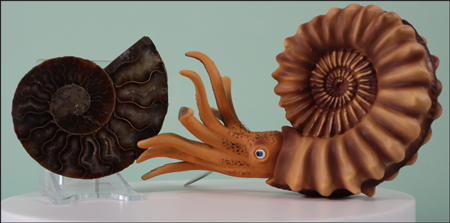
The Bullyland ammonite model is often used in museum displays to depict the living animal next to fossil material. Picture credit: Everything Dinosaur.
Ideal for creative play, school or home study, the ammonite model measures 17 cm long from the end of the shell to the tips of the tentacles and the shell has a diameter of 9 cm. The model has been specially designed to be handled by children from three years and upwards. A spokesperson from the teaching team at Everything Dinosaur commented:
“Ironically, models of ammonites tend to be more difficult to find than fossils of ammonites. Children can learn about the fossil shells, but they do not know what the actual animal that lived in the shell looked like. This child-friendly model helps young learners to appreciate that the fossils they are looking at represent the remains of living creatures that once swam in our seas and oceans. The model helps children to understand that whilst ammonites are extinct, they are very similar to animals living in the sea today, creatures like squid, cuttlefish and octopi for example.”
The ammonite model has a 5-star rating on Everything Dinosaur’s website, a typical review for this replica: “Very accurate model, impressive size.”
An Ammonite Model Used in Museum Displays
Everything Dinosaur also supplies this model to museums and other educational institutions. It can often be found in display cases showing a collection of ammonite fossils.
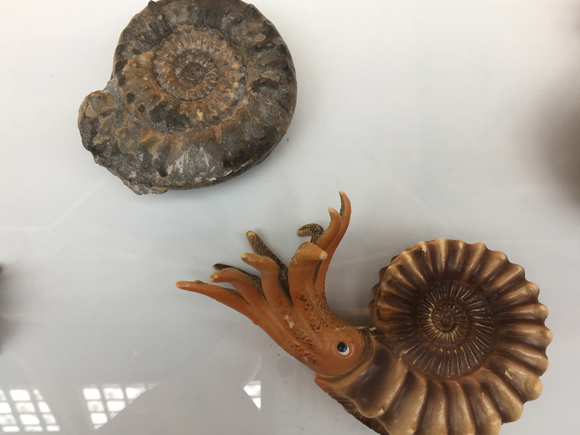
Everything Dinosaur’s Ammonite Model on Display at a Museum
A Bullyland ammonite model is used to help illustrate a display of ammonite fossils. Picture credit: Everything Dinosaur.
Picture credit: Everything Dinosaur
Helping to Bring Science Alive
The picture (above) shows an ammonite model next to a fossil of a Jurassic ammonite on display in a museum. The replica demonstrates what the living creature looked like and helps to bring the study of science alive and brings learning about fossils into context.
At this time of year, our friends at CollectA give Everything Dinosaur official clearance to publish information and pictures on the new for 2019 CollectA prehistoric animal models. Working closely with this manufacturer, we intend to put up a series of posts over the next few weeks informing dinosaur fans and figure collectors about what they have to look forward to in terms of new model introductions.
CollectA Prehistoric Animal Models
The first three we can announce are:
A Caiuajara pterosaur model with a moveable jaw (CollectA Supreme Deluxe range) – available first quarter 2019.
A Borealopelta armoured dinosaur model (CollectA The Age of Dinosaurs Popular range) – available first quarter 2019.
A CollectA box of mini prehistoric animals (prehistoric mammals, a “terror bird” and Estemmenosuchus – available first quarter 2019.
CollectA Borealopelta Model
CollectA will be adding another armoured dinosaur replica to their excellent not-to-scale range of dinosaur figures, a model of the Canadian nodosaurid Borealopelta (B. markmitchelli).
The CollectA Borealopelta Dinosaur Model
The Age of Dinosaurs Popular – CollectA Borealopelta.
Picture credit: CollectA
Borealopelta was officially named and described only last year, but this remarkable fossil was actually found back in 2011. It took the team of dedicated preparators more than five and half years to separate this 5.5 metre long giant from its fossil matrix. The lead preparator and one of the most patient people on the planet, was Mark Mitchell and the species name honours his efforts in the restoration and preparation of one of the most perfectly preserved large dinosaur specimens ever discovered.
An Early Cretaceous Nodosaurid
The CollectA figure accurately portrays this Early Cretaceous nodosaurid, the reddish/brown colouration and the presence of counter-shading reflects the conclusions drawn from a scientific paper describing the exquisite details of the armour published in August 2017.
The fossil, found at the Suncor Millennium Mine in north-eastern Alberta, was so well-preserved that the armoured scales and plates were in their original position. Small amounts of keratin that would have covered the spikes and skin was detected. The CollectA design team have done their own restoration work on this model. They modelled this figure to match the position of the fossil in situ and restored the missing pelvic area, which was unfortunately destroyed when a digger at the mine first broke into the block of stone that held the specimen.
CollectA Supreme Deluxe Caiuajara
Large pterosaur models are becoming a bit of a CollectA speciality. Joining the large Dimorphodon and Guidraco figures will be a beautiful and very colourful model of a Brazilian flying reptile – Caiuajara. The genus name is pronounced “Kay-you-ah-jar-rah”.
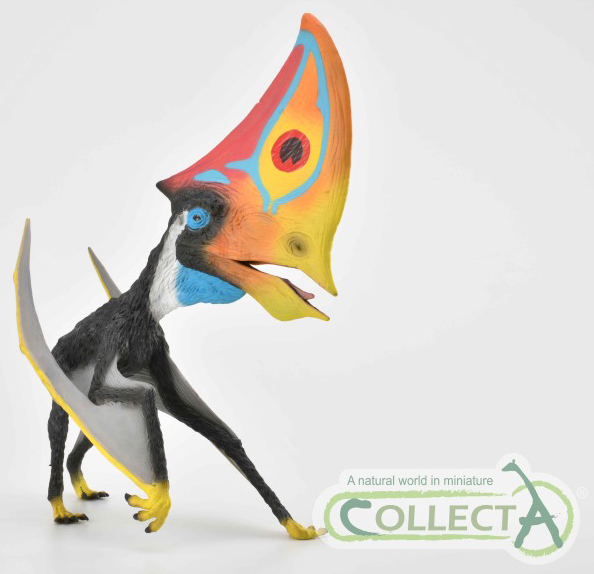
The New for 2019 CollectA Supreme Deluxe Caiuajara Pterosaur Model
The Age of Dinosaurs Deluxe Caiuajara pterosaur figure with a moveable jaw.
Picture credit: CollectA
Pterosaur Fossils from Brazil
Most pterosaur fossils associated with Brazil come from the north-eastern part of the country, but Caiuajara comes from southern Brazil (Paraná State). It is a member of the Tapejaridae family and like most tapejarids it had a very flamboyant crest. Both males and females sported crests, although it is thought that it was the males that tended to have the larger and more spectacular head ornamentation. The team at CollectA have provided their model with a vivid crest, complete with an eye-spot. Most palaeontologists believe that these crests were used in displays, so as far as a pterosaur is concerned, the flashier the crest the better. Like the other CollectA supreme pterosaur models, this figure is depicted on the ground.
Hundreds of fossils of Caiuajara have been discovered, all from the same locality. The first fossil discoveries were reported in 1971 but a formal analysis and scientific description was only completed in 2014. The remains are found in a series of sandstone layers that represent an arid area adjacent to a lake. The majority of the bones come from sub-adults and juveniles, palaeontologists have speculated that this was a colony and that these flying reptiles were highly social.
The Designer Comments about CollectA Prehistoric Animal Models
Model designer Anthony Beeson commented:
“The Brazilian taperjarid Caiuajara has been requested by a number of CollectA fans and we were happy to oblige. He is in the Supreme range for scale and has a moveable jaw. I chose to portray a fully grown adult because the head-crest was then at its most extreme. The head-crest seemed to need a striking decoration if it was to be used for species recognition or mating ritual, so I have given him a false eye decoration.”
Intriguingly, when the scientific paper describing Caiuajara (C. dobruskii) was published, the authors postulated, that the fossil site represented a staging post on a migration route for these pterosaurs. Expect this excellent CollectA Caiuajara to be migrating into Everything Dinosaur’s warehouse in the spring of 2019.
CollectA Box of Mini Prehistoric Animal Models
The third and final item to be announced this week is a box of mini prehistoric animals.
CollectA Mini Prehistoric Animals
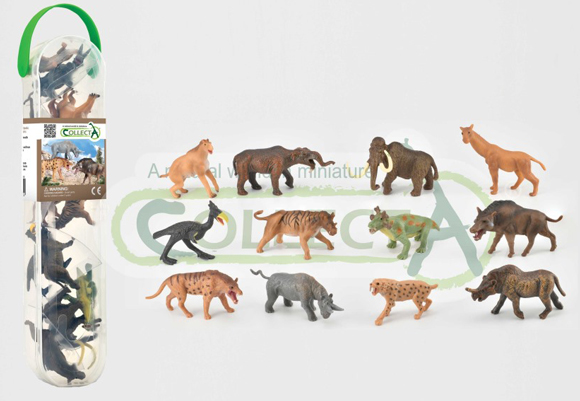
The CollectA box of mini prehistoric animal models which is going to be available in 2019. Twelve prehistoric animal models.
Picture credit: CollectA
This skilfully crafted set of mini figures features replicas of prehistoric animals already represented in the CollectA range termed “other prehistoric animals”. There are twelve figures in the set namely: Moropus, Deinotherium, Woolly Mammoth, Paraceratherium, Kelenken (terror bird), Uintatherium, Estemmenosuchus, Daeodon, Andrewsarchus, Arsinoitherium, Smilodon and Megacerops. CollectA have built up a strong reputation for the prehistoric mammal figures and it is great to see a mini set of these models introduced.
Rebor “Vanilla Ice”, Papo Update and the CollectA Brontosaurus
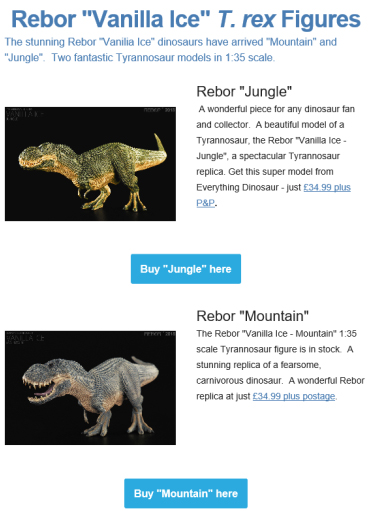
The October newsletter from Everything Dinosaur features the Rebor “Vanilla Ice” tyrannosaur figures, a Papo update and the CollectA Brontosaurus. The latest Rebor figures, the “Vanilla Ice” – Jungle (green colour scheme) and the “Vanilla Ice” – Mountain (slate grey colour scheme), have arrived at the company warehouse and after having alerted all those customers who had requested a model to be reserved for them, a newsletter was emailed out announcing that these two excellent figures were in stock.
The Two Tyrannosaur Figures “Vanilla Ice” Mountain and Jungle Headline the Everything Dinosaur October Newsletter
The Rebor “Vanilla Ice” Jungle and Mountain tyrannosaur figures feature in the October newsletter.Picture credit: Everything Dinosaur.
Picture credit: Everything Dinosaur
Rebor Replicas in Stock at Everything Dinosaur
The Rebor 1/35th scale tyrannosaur figures are stunning models. Each figure measures 42 centimetres approximately and both Mountain and Jungle have articulated lower jaws and poseable tails. In addition, to the arrival of these two tyrannosaurids, lots of other Rebor figures have come back into stock, including the very popular “Scout” series featuring juvenile dinosaurs such as “Hazelnut”, a young Triceratops and “Stan”, a baby Velociraptor.
To view the range of Rebor figures and replicas available from Everything Dinosaur, including the “Vanilla Ice” tyrannosaurs and the “Scout” series models: Rebor Dinosaurs and Prehistoric Animal Models.
Lots of Rebor Replicas and Figures Have Come Back into Stock at Everything Dinosaur
Rebor models feature extensively in the October newsletter. Picture credit: Everything Dinosaur.
Picture credit: Everything Dinosaur
The October newsletter features the set of hatching Velociraptors. These hand-painted Rebor Velociraptor figures are supplied in a mystery blind box. With nine different designs in the series, these little pocket money models are fun to collect.
Papo Prehistoric Animals and the CollectA Brontosaurus
Everything Dinosaur has also received a big shipment of Papo figures. The majority of the Papo range is now in stock at Everything Dinosaur including the superb Spinosaurus juvenile, the Iguanodon and the new for 2018 Quetzalcoatlus figure.
Papo Models and the New for 2018 CollectA Brontosaurus
Papo figures and the new for 2018 CollectA Brontosaurus.Picture credit: Everything Dinosaur.
The newsletter features the Papo Ceratosaurus figure, a famous dinosaur from the Morrison Formation of the western United States. Another replica of a Morrison Formation dinosaur is included as well, the CollectA Brontosaurus model. The CollectA Brontosaurus measures an impressive 30.5 centimetres long and the head height of this sauropod model is a fraction under 11 centimetres.
Everything Dinosaur newsletter subscribers are amongst the first to learn about new models coming into stock. Subscribers can also be the first to join a priority reserve list to ensure that they can acquire new figures. Our newsletter is sent out periodically and it is free to join.
To reserve a Rebor replica figure such as the Velociraptor figure “Sweeney” for example, or to request a subscription to Everything Dinosaur’s regular company newsletter, simply drop us an email: Email Everything Dinosaur.
A spokesperson from Everything Dinosaur commented:
“The newsletter is a great way for our customers to be kept informed and to stay in touch with developments at Everything Dinosaur.”
The “witching hour” is almost upon us, time to wish all our customers and readers a happy Halloween. “All Hallows Eve” is a time traditionally linked with monsters and demons and the fossil record is crammed full of very scary looking invertebrates and vertebrate specimens that would have been very much at home in the cast of a horror movie.
Take for example, a demonic dinosaur…
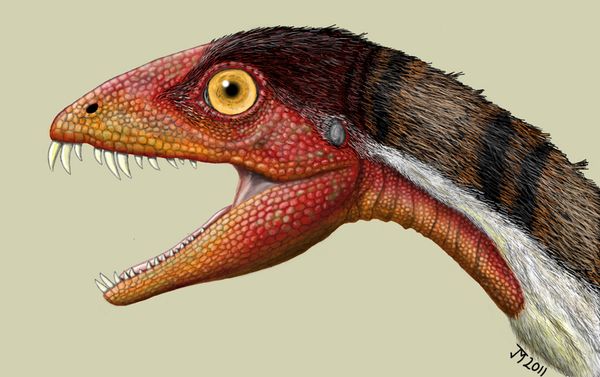
In April 2011, a scientific paper was published announcing the formal scientific description of a demonic-looking dinosaur. A fearsome, little meat-eater that would have terrorised New Mexico in the Late Triassic. The dinosaur was named Daemonosaurus chauliodus and the name translates as “buck-toothed evil spirit”.
Although small compared to some of its later descendants, (D. chauliodus measured less than two metres long), it had a deep skull and oversized teeth in the front of its jaws which gave this little theropod a strong and nasty bite.
A Life Reconstruction of Daemonosaurus chauliodus
The vicious-looking Late Triassic theropod dinosaur Daemonosaurus chauliodus from New Mexico.
Picture credit: Jeffrey Martz
Happy Halloween!
Visit the award-winning and user-friendly Everything Dinosaur website: Everything Dinosaur.
Mistralazhdarcho maggii – From the Upper Cretaceous of France
A team of scientists based in France and Belgium have announced the discovery of a new species of pterosaur from Upper Cretaceous rocks in south-eastern France (Bouches-du-Rhône). The fragmentary bones have been assigned to the Azhdarchidae family of pterosaurs, one of the last groups of flying reptiles to exist and a family that contains giants such as Quetzalcoatlus and Hatzegopteryx. With a wingspan estimated to be around 4.5 metres, the specimen, believed to be a juvenile, provides evidence of a third azhdarchid pterosaur size class from the cluster of islands that represented continental Europe towards the end of the Mesozoic.
The pterosaur has been named Mistralazhdarcho maggii pronounced (miss-tral-ads-dar-cho may-gee).
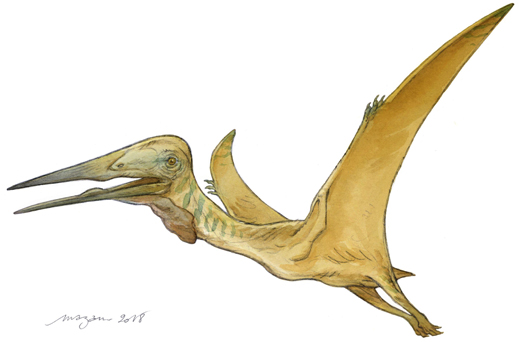
A Life Reconstruction of the Newly Described French Azhdarchid Pterosaur – Mistralazhdarcho maggii
An illustration of the newly described (2018) azhdarchid pterosaur from France Mistralazhdarcho maggii.
Picture credit: Pierre Lavaud
One of the Most Complete Pterosaur Fossils Known from Late Cretaceous Europe
Writing in the academic publication the “Journal of Vertebrate Paleontology”, the researchers describe the finding of part of a lower jaw, a neck bone and several other postcranial bones in 2009. The bones were found in association with each other and therefore, probably represent the fossilised remains of a single pterosaur. The material comes from the excavation site of Velaux, near Aix-en-Provence and from strata that dates to the Campanian faunal stage of the Late Cretaceous.
Views of the Fossil Material Ascribed to the New Pterosaur Mistralazhdarcho maggii
Fossil material associated with the newly described French pterosaur Mistralazhdarcho maggii.
Picture credit: Royal Belgian Institute of Natural Sciences
The photograph (above), shows a part mandible (a) with a distinctive ridge (mandibular symphysis). A cervical vertebra (b), left humerus (c), left radius (d) and two bones from the hand – metacarpal IV (e) and a finger bone (f).
Although the fossil material is fragmentary, such is the poor fossil record of Late Cretaceous pterosaurs from Europe that these few bones make Mistralazhdarcho one of the most complete European azhdarchids described to date. In addition, Mistralazhdarcho is the first partial skeleton of a flying reptile excavated from Upper Cretaceous deposits of western Europe.
Related to a North African Pterosaur?
The scientists, which included researchers from the University of Rennes, the Royal Belgian Institute for Natural Sciences and Poitiers University, conclude that Mistralazhdarcho was related to an earlier pterosaur called Alanqa (A. saharica), which lived in North Africa around 95 million years ago. When Alanqa was first described, back in 2010, it was assigned to the Azhdarchidae, but more recent studies incorporating skull material discovered in 2015, have cast doubt on the taxonomic position of Alanqa.
An Adult Probably Had a Wingspan of Around 5-6 metres
Examination of the fossil bones suggest that they were not fully ossified and that this was a sub-adult. The researchers speculate that a fully-grown Mistralazhdarcho would have had a wingspan of around 5 to 6 metres, possibly even bigger. This size estimate is in between the size estimates given for the two azhdarchids from the Maastrichtian of Romania (Hateg Formation), which also represents the European Late Cretaceous archipelago environment.
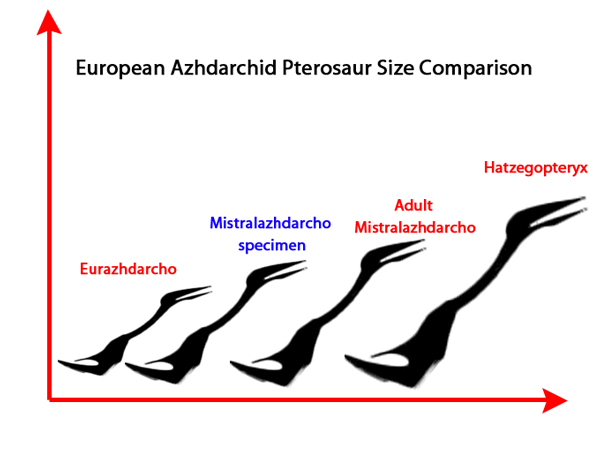
A Size Comparison of European Azhdarchid Pterosaurs
A comparison of European azhdarchid pterosaurs. Picture credit: Everything Dinosaur.
Picture credit: Everything Dinosaur
Mistralazhdarcho is estimated to be intermediate in size between the medium-sized genus Eurazhdarcho (wingspan of 3 metres) and the enormous Hatzegopteryx (estimated wingspan of 10 metres or more), the two other azhdarchids associated with the island ecosystem of the latest Cretaceous European archipelago. The different sized pterosaurs might reflect a form of niche partitioning, whereby, different sized animals did not directly compete with each other for resources.
The flying reptile’s genus name is from the “mistral”, a strong, north-westerly wind associated with southern France. The species name honours the former mayor of Velaux, Jean-Pierre Maggi, without whom, the excavation of the fossil material would not have been possible.
Field Team Members Working at the Velaux Excavation Site
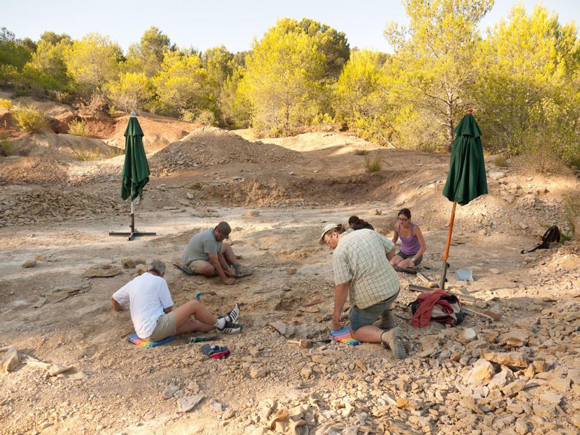
Fossil excavation work at one of the dig sites at Velaux (south-eastern France).
Picture credit: Royal Belgian Institute of Natural Sciences
The scientific paper: “Mistralazhdarcho maggii, gen. et sp. nov., a New Azhdarchid Pterosaur from the Upper Cretaceous of south-eastern France” by Romain Vullo, Géraldine Garcia, Pascal Godefroit, Aude Cincotta and Xavier Valentin published in the Journal of Vertebrate Paleontology.