All about dinosaurs, fossils and prehistoric animals by Everything Dinosaur team members.
24 03, 2013

Four Sets of Frogspawn in the Office Pond

By |2023-02-13T17:38:14+00:00March 24th, 2013|Categories: Animal News Stories, Everything Dinosaur News and Updates|2 Comments

Cold Weather May Kill Frogspawn

There are now at least four sets of frogspawn in the office pond, less than was laid this time last year and most certainly, we have not seen as many frogs in the pond as we have on previous spawnings.  The current cold weather does not seem to have disturbed the amphibians too much, day temperatures in this part of England have not exceeded two degrees Celsius and in the easterly wind there has been a considerable chill factor giving the feeling of an air temperature around minus four degrees Celsius throughout the morning and into this afternoon.

Frogspawn

Team members from Everything Dinosaur have been inspecting the pond at regular intervals to check on the progress of the frogs – Common Frogs (Rana temporaria), we should not really be surprised that these small creatures are able to tolerate and even breed in these chilly temperatures as this species of frog has a widespread distribution and can be found much further north in Europe.  However, there has not been the mass spawning activity that we have seen in recent years.  This could be down to a number of reasons, it could be because fewer adult frogs survived the winter and into the spring (if that is what you can it at the moment), to breed, or perhaps there have been less females about and the actual spawning season is likely to be prolonged.

A Cold Morning

With a thin layer of ice on the pond this morning, staff were concerned that some of the freshly laid spawn in the shallows may be frozen and the eggs killed.  We do not normally interfere but on this occasion it was decided to gently relocate the spawn to a slightly deeper area so that it could sink a little and thus avoid becoming exposed to too much of the ice.  We shall monitor the pond and see if the current cold weather and subsequent cold water temperature delays the hatching of the spawn.

23 03, 2013

American Researchers Suggest Chicxulub Crater Made by Comet

By |2023-02-14T06:22:18+00:00March 23rd, 2013|Categories: Dinosaur and Prehistoric Animal News Stories|0 Comments

Factor in Extinction of the Dinosaurs – Potentially a Comet Impact

A team of scientists based in the eastern part of the United States have published details of a paper that suggests that the extraterrestrial object that struck the Earth and marked the end of the dinosaurs may have been a comet.  The New Hampshire based research team outlined their theory at the forty-fourth Lunar and Planetary Science Conference which was being held in Texas.

Chicxulub Impact

It was father and son team Luis and Walter Alvarez and their study of the iridium-rich clay layer that marked the Cretaceous/Tertiary geological boundary across so many parts of the world, that first led to the theory that there had been a meteorite or asteroid object collision that had led to the deposition of iridium – a rare Earth element.

It was the discovery of the almost 190 kilometre wide Chicxulub crater in the Yucatan peninsula of Mexico that provided the “smoking gun” evidence that there had been an extraterrestrial impact some 65 million years ago that led to the demise of the Dinosauria and around seventy percent of all terrestrial life.  The theory that such a catastrophic event might have been a causal factor in the mass extinction that followed has now been largely accepted by the majority of the scientific community.

The actual date of the impact has even been calculated to around 66 million years ago, plus or minus either way a few thousands of years for margin of error.

To read more about the dating evidence: Dating the Cretaceous Mass Extinction.

Cretaceous Comet

However, this new paper proposes that a smaller, faster travelling comet collided with our planet and the culprit was not a larger, slower moving asteroid or meteorite.  The New Hampshire team (from Dartmouth College), studied the sediments and rock strata at the Yucatan site and concluded that the crater might have been caused by the impact of a much smaller object, but one that was travelling at immense speed.

The smaller mass of the colliding object would have reduced the kinetic energy released but the devastation caused could have been amplified by the much greater speed that a body like a comet would be travelling compared to a rocky meteorite or asteroid.

In an analysis of a second rare Earth element deposited  – osmium the team were able to hypothesise that the impact object deposited much less debris than previously thought.

Higher Levels of Iridium

The research team also concluded that the widely reported higher levels of iridium had been previously overstated.  This data was then examined in conjunction with the known geo-physical nature of the Chicxulub impact crater and the team deduced that to deposit on Earth that much iridium and osmium a meteor or asteroid of over five kilometres wide would be needed, but if a rocky object of that size smacked into the geology of the Gulf of Mexico a much larger crater would have resulted.

To read more about scientific studies of the Chicxulub crater: Getting to the Bottom of the Chicxulub crater.

The End of the Dinosauria

For a smaller object to have created the Chicxulub crater on impact it would have had to have had a greater terminal velocity and the research team point to a long-period comet as being  a more likely candidate for the harbinger of dinosaur doom.  Long period comets are believed to be remnants left over from the formation of our solar system.  They consist of rocks, dust and ice and they orbit the sun, often in very eccentric trajectories, with some comets taking millions of years to complete one circuit.  Other comets such as the famous Halley’s comet are known as a short-period comets – having an orbit of less than 200 years.

Other scientists challenge the Cretaceous comet impact idea, suggesting that a lot of debris may have been ejected up into and beyond our atmosphere.  If a lot of the impact object material was ejected into space and left our atmosphere then the evidence tips in favour of a larger rocky object such as an asteroid.

Whatever it was, the devastation caused was certainly terrific with earthquakes, fire storms, enormous tidal waves and acid rain.  It is likely that much of the light and heat from the sun was obscured by dust in the atmosphere, shrouding the Earth in what has been termed a “nuclear winter”.

Dinosaurs, marine reptiles, the last of the pterosaurs along with many types of invertebrate, plants and marine plankton became extinct.  Flowering plants including the hardwood trees, along with mammals also suffered but it was from the end of the Age of Reptiles that flowering plants and mammals rapidly diversified becoming the dominant and most prominent floras and faunas in most ecosystems today.

Visit Everything Dinosaur’s user-friendly website: Everything Dinosaur.

22 03, 2013

Updating Oviraptor – A Remarkable Feathered Dinosaur

By |2024-04-29T13:06:38+01:00March 22nd, 2013|Categories: Everything Dinosaur News and Updates, Everything Dinosaur Products, Photos of Everything Dinosaur Products|0 Comments

CollectA Oviraptor New Pics Put onto Everything Dinosaur Website

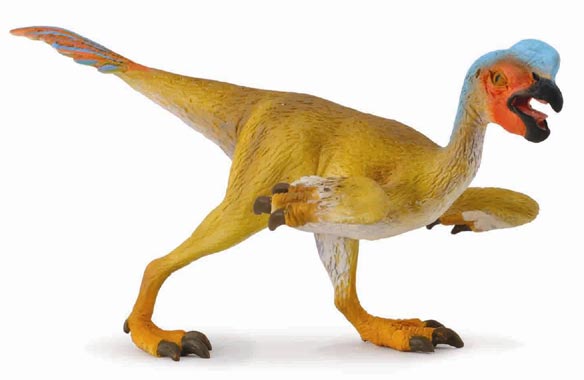
Team members at Everything Dinosaur continue to be big fans of the dinosaurs and other prehistoric animal models that feature in CollectA’s “prehistoric life” model range.  However, every once in a while we can be caught out by subtle changes that we miss, or in all honesty, we have forgotten about.  Take for example, the Oviraptor dinosaur model that is one of the replicas in that company’s not-to-scale prehistoric animal model series.  The images on the Everything Dinosaur website, were out of date and we had not noticed.

The Original Oviraptor Image

Oviraptor with nothing to stand on.

Oviraptor with nothing to stand on.

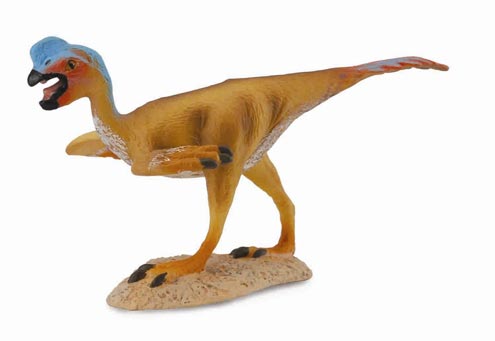
Oviraptor Dinosaur Model

There are over one hundred different prehistoric animal models in the CollectA series to collect, everything from Achelousaurus to Wuerhosaurus and the Oviraptor replica was first introduced in 2010.  Like many long-tailed, thin-legged dinosaurs, creating a stable model of this biped proved difficult.  It had been developed as a free-standing sculpt without a base.

However, the base was added before mass production as the model proved very difficult to balance on its finely crafted toes.  That’s what having a digitgrade stance can do for you.  The base was added after photos were taken for the company’s 2010 product catalogue and Everything Dinosaur received a set of original photos of the intended model in early 2010 before the base plate had been added.

The fact that this model now comes with a base was pointed out to us by a keen-eyed customer, so we have made it our business to ensure that this model is properly represented on the Everything Dinosaur website.

The CollectA Oviraptor Model (with Base)

Securing a stable future for Oviraptor.

Securing a stable future for Oviraptor.

Picture credit: Everything Dinosaur

The Base Plate

The base plate has a lovely texture and it looks like this little dinosaur is walking over sand, quite appropriate really as fossil material ascribed to the Oviraptor genus has been found in rock strata that indicate seasonally arid habitats.

To view Everything Dinosaur’s full range of CollectA prehistoric animal models: CollectA Prehistoric Life Dinosaur Models.

One thing that is for sure, anyone who says that we don’t listen to our customers, we can only say that such comments are “baseless”.

21 03, 2013

A New Azhdarchoidea Pterosaur from the Isle of Wight

By |2023-02-14T06:15:21+00:00March 21st, 2013|Categories: Dinosaur and Prehistoric Animal News Stories, Everything Dinosaur News and Updates|0 Comments

New Flying Reptile Named after Girl who Found the Fossils

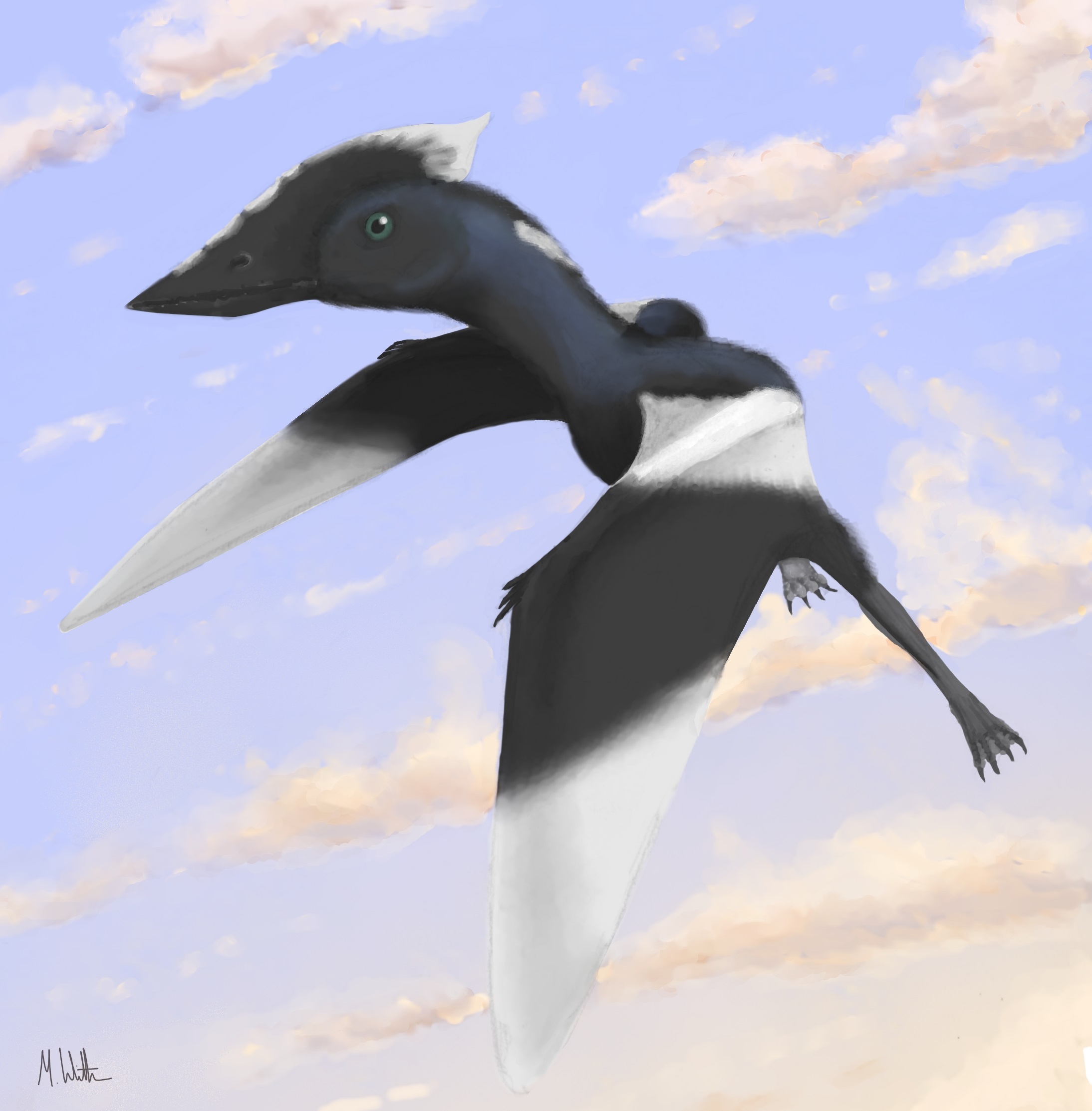
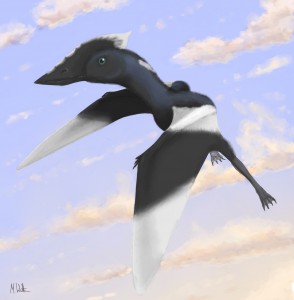
For Daisy Morris and her parents a walk along the beach on a winter’s day was going to turn out to be a rather special event, for the family spotted some fossils that represent a new species of flying reptile.  The discovery made back in November 2008 has led to young Daisy, who was nearly five years old at the time of the fossil find, having the honour of having a prehistoric animal named after her.  The new pterosaur is called Vectidraco daisymorrisae.  The name means dragon from the Isle of Wight (after Vectis – the old name for the island), the specific name honours Daisy.

Pterosaur

An Illustration of Vectidraco daisymorrisae
Pterosaur named after school girl.

Pterosaur named after school girl.

Picture credit: Mark Witton

The Morris family spotted a collection of small bones that had weathered out of a block of rock and now lay on a scree slope near the foot of the cliff immediately west of Atherfield Point (Isle of Wight), if the family had not discovered the fossils, this precious prehistoric material would have most likely have been lost for ever being washed away at the next high tide.

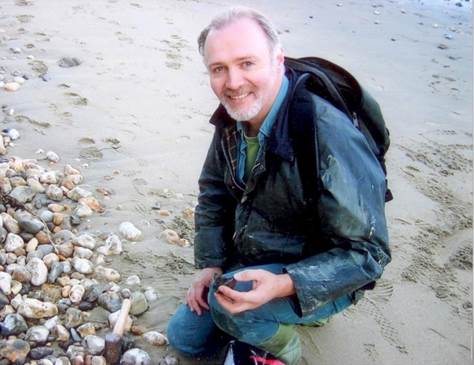
Daisy Morris – A New Pterosaur Named

Excited about her fossil find.

Excited about her fossil find.

Identified as a specimen from the basal part of the marine Atherfield Clay Formation of the Lower Greensand Group, this new pterosaur was probably about the size of a large crow and its discovery has helped palaeontologists to understand a little better the diversity of European pterosaurs from the Early Cretaceous.  The fossil material has been dated to the Aptian faunal stage of the Cretaceous and it has been estimated that this thirty-five centimetre long flying reptile lived some 115 million years ago.

Vectidraco daisymorrisae

The Lower Cretaceous strata of western Europe has provided scientists with a number of different types of Pterosaur fossils.  On the Isle of Wight itself, the first flying reptile fossil material was found in 1870 and although such discoveries are exceptionally rare, a number of different families of pterosaur are known from western Europe.  However, finding pterosaur fossils from strata dated to the Aptian faunal stage of the Cretaceous is a really exceptional event.

For models of pterosaurs and other flying reptiles: Pterosaurs, Dinosaurs and Prehistoric Animal Replicas (CollectA Deluxe).

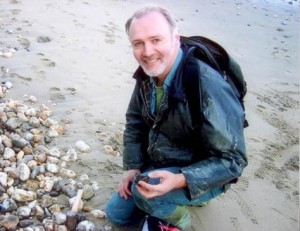
For Martin Simpson (University of Southampton) and a highly regarded vertebrate fossil expert on the island, that April day in the following spring when the fossils were brought in to show him, must have been a very memorable day indeed.  Realising their significance, the fossils were taken to the Natural History Museum (London).  The study of the fossils led to the erection of this new pterosaur genus and the holotype has now been accessioned, (become part of the museum’s vertebrate fossil collection).  The academic paper written by the highly talented Darren Naish (Ocean and Earth Sciences, University of Southampton) along with Martin and Gareth Dyke of the University’s Institute of Life Sciences has just been published.

“Fossil Man” – Martin Simpson
Looking for fossils, perhaps another Pterosaur?

Looking for fossils, perhaps another pterosaur?

This just goes to illustrate the importance of amateur fossil hunters when it comes to discovering significant new finds, a point we often make when we visit schools as the school children being closer to the ground and with their generally keener eyesight than us “oldies” have two big advantages over the grown-ups.

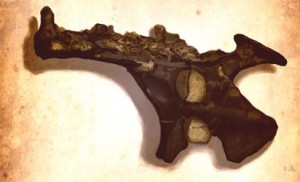
The actual fossil material represents the animal’s pelvic girdle and associated vertebrae (back bones), although no other fossil material has been retrieved, the research team have concluded that this was a small-bodied pterosaur that had a wingspan of around seventy-five centimetres. It was probably crested and an expert flier in its arboreal dominated habitat.  These deductions have been made by comparing the fossils of V. daisymorrisae to better known azhdarchid pterosaur fossil material.

The Fossilised Bones (Pelvic Girdle)
The fossilised bones.

The fossilised bones.

The types of pterosaurs known from the Lower Cretaceous of western Europe, large pterosaurs such as the ornithocheirids and the istiodactylids, such as Istiodactylus latidens, fossils of which have also been found at Atherfield Point on the island and the generally smaller azhdarchoids are very similar to the pterosaur faunas associated with the Liaoning Province of eastern China.  Although still very rare, the Lioaning assemblage represents a greater diversity and number of different pterosaurs when compared to western Europe.

Most of the European pterosaur fossils found to date come from fluvial environments and the fossils are usually substantially fragmented.  In contrast, the fossil material associated with the Lioaning Province is exquisitely preserved.  The Yixian and Jiufotang Formations of Lioaning are dominated by finely-grained sediment, an aid in fossil detail preservation.  In addition, there are substantial deposits of volcanic ash, it seems that this part of Asia was subjected to occasional volcanic eruptions which buried the landscape and resulted in the mass die-off of a number of organisms at a time, including numerous pterosaurs.    The rapid burial in the ash deposits also prevented the carcasses from being scavenged, another reason for the more complete fossil remains.

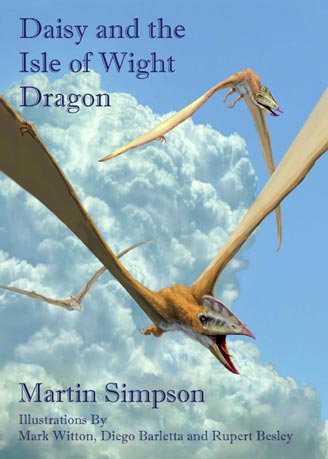
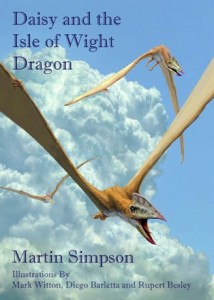
The story of this amazing fossil discovery has inspired Martin to write a book.  The book is entitled “Daisy and the Isle of Wight Dragon” and it is aimed at 7-12 year olds (as well as their mums and dads).  The story is based on the actual discovery made by young Daisy.  Not a bad start in life for a child under ten, her name honoured by science and a book published all about her adventures.

The Front Cover of the Book
Read all about the Pterosaur discovery.

Read all about the pterosaur discovery.

Well done to everybody involved in helping to preserve the 4-cm-long pelvis and associated bones.  It seems that the Isle of Wight has still many prehistoric animal secrets awaiting discovery – even by a sharp-eyed five year old.


20 03, 2013

New Walking with Dinosaurs in 3-D set for Cinema Release in December

By |2024-04-29T13:07:07+01:00March 20th, 2013|Categories: Dinosaur Fans|0 Comments

BBC Earth Films and Partners Prepare for 20th December 2013 Release of 3-D Dinosaur Movie

BBC Earth Films, the theatrical wing of the BBC brand “BBC Earth” has been working on an updated version of the Walking with Dinosaurs series, this time as a cinema release and it has been announced that the film will have its world-wide premiers in December.

Walking with Dinosaurs

The BBC has been working on its plans to develop more three dimensional programme formats.  Everything Dinosaur reported on the progress that had been made in an article produced for this blog site last year.  Ironically, much of the programme and output testing for the 3-D format had used footage from the BBC television series “Planet Dinosaur” that aired in the Autumn of 2011.

Filming back drops and background footage to help explain the scientific concepts behind the CGI film has already taken place with a number of locations, including the Isle of Wight (southern England), already visited.  The film represents the first 3-D cinema release for BBC Earth Films and “Walking with Dinosaurs: The 3-D Movie” ,  has been created by Twentieth Century Fox and Reliance Big Pictures working in collaboration with IM Global LLC.  BBC Earth is one of the brands managed by the BBC under the BBC Worldwide corporate umbrella – a part of the BBC dedicated to marketing and distributing the UK based production company’s natural history output.

Made by the BBC

The original six-part television series, “Walking with Dinosaurs” was first broadcast in 1999.  It remains one of the most expensive (in terms of monetary cost per minute of footage shown), projects in the corporation’s history.  However, it was a huge success world-wide and provided very significant revenues as a result of global rights, spin-offs and other ventures such as merchandising.

A source has reported that Oscar winning film director James Cameron (Avatar), has been brought in lending  his expertise to the BBC in this project to bring the “Walking with Dinosaurs” franchise up to date with a 3D version.

To view models and figures of many of the prehistoric animals that featured in the ground-breaking BBC television series: Dinosaur Figures and Prehistoric Animal Models.

19 03, 2013

We have Frogspawn in the Office Pond

By |2023-02-13T17:40:10+00:00March 19th, 2013|Categories: Dinosaur and Prehistoric Animal News Stories|0 Comments

First Batch of Frogspawn is Spotted

The first frogspawn has been spotted in our office pond.  This is approximately eight days later than last year and rather on a par with 2011 spawning records.  The frogspawn produced so far is from a single pair, we have not seen the number of frogs in the pond that we saw last year (a record ten), there have been as many as six individuals counted but so far we have not observed the frenetic activity that accompanied last year’s spawning.

Frogspawn

The spawn was laid in an extremely shallow part of the pond, so shallow in fact that only about one third of the mass of eggs was covered in water.  We were concerned about the eggs drying out should there be a period of prolonged sunny weather (some hope)!

Ensuring the Safety of the Eggs

To ensure the safety of this spawn we have carefully  made sure that the egg mass has been fully submerged.  It now resides in a slightly deeper, adjacent part of the pond.  The spawning probably took place in the early hours of this morning, according to the old folk tale, if frogspawn is found in shallow parts of a pond, that means we are in for a wet spring.  This is bound to please the farmers – not.

19 03, 2013

Saltwater Crocodile Shot after Fears of Attacks on School Children

By |2023-02-13T17:49:08+00:00March 19th, 2013|Categories: Animal News Stories|0 Comments

Community Lived in Fear of Crocodile

The remote community of Palumpa located in the Daly River Reserve (Northern Territory, Australia), can breathe a sigh of relief after local wildlife rangers and police officers trapped and shot a four and a half metre long Saltwater crocodile that had been threatening to attack school children.

Saltwater Crocodile

The crocodile, the second four metre plus specimen to be captured in the Northern Territory this week, was trapped and shot at a small billabong on the outskirts of the town.  Locals had reported that the crocodile had been in the area for about two years and it sometimes took up residence at a river causeway crossing used by children on their way to school.

Having to dodge the attentions of a large predator, getting on for fifteen feet in length would have been enough to deter all but the most determined scholar.  Unfortunately, attacks by Saltwater crocodiles (sometimes also referred to as Estuarine crocodiles), are becoming increasingly common in the Northern Territory as the crocodile population continues to increase after the imposition of a hunting ban some forty years ago.

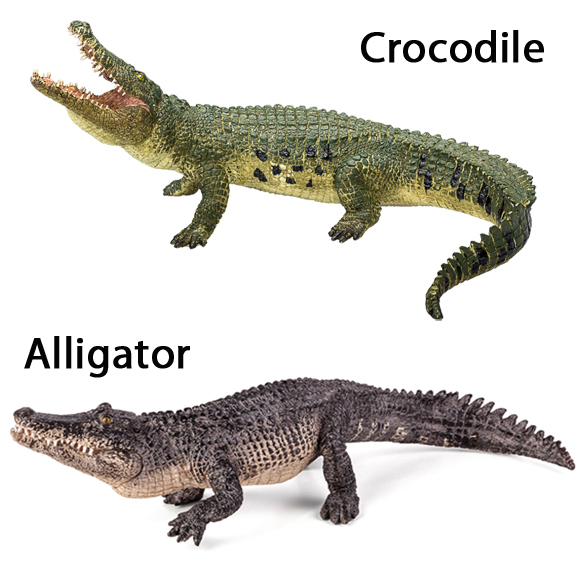
The Difference Between a Crocodile and an Alligator

Crocodile and Alligator comparison.

Crocodile (top) and Alligator (bottom).

A Call to Reinstate Hunting of Crocodiles

A number of Government officials have called for a reinstating of the permit system to hunt crocodiles, others favour a formal crocodile cull to reduce the threat of crocodile attacks.  For the school children at the small community of Palumpa, some 150 miles south-west of Darwin, their daily school run just got a little safer.

For models and replicas of extinct and extant archosaurs, visit Everything Dinosaur’s award-winning model section of the company’s website: Archosaurs, Dinosaurs and Prehistoric Animal Figures.

18 03, 2013

Papo Carnotaurus – What Everything Dinosaur Customers Think

By |2023-02-13T17:43:18+00:00March 18th, 2013|Categories: Dinosaur Fans, Everything Dinosaur Products|4 Comments

High Praise for Papo Carnotaurus Dinosaur Model

Since its launch just a few weeks ago the Papo Carnotaurus dinosaur model (Carnosauria) has been receiving a lot of complements with dinosaur fans and model collectors raving about this new Papo replica.

Papo Carnotaurus

The French manufacturer seem to have surpassed themselves with their interpretation of an abelisaurid.  We at Everything Dinosaur reviewed this model when it was first introduced, producing a written review and a short video about this new addition to the Papo “Les Dinosaures” range.

The Papo Carnotaurus Dinosaur Model (Introduced in Early 2013)

"Meat-eating Bull" from Papo.

“Meat-eating Bull” from Papo.

Picture credit: Everything Dinosaur

To read Everything Dinosaur’s review of the Papo Carnotaurus: A Review of the Papo Carnotaurus Dinosaur Model by Everything Dinosaur.

Customer Comments

Here are just a few of the comments we have received so far from Everything Dinosaur customers:

“Amazing! – This model is nothing short of astounding. Papo has ‘taken inspiration’ from Sideshow’s Dinosauria range Carnotaurus sculpture, but made subtle changes by widening the snout a little and placing the left hind leg on the ground. Outside of that, the model is just gorgeous.  The amount of detail packed into this model, particularly on the head, is amazing.   As an added bonus, since this was inspired by the Sideshow sculpture, this model may go down as one of Papo’s most scientifically accurate models to date and easily their best figure since the Papo Allosaurus.  I highly recommend this model for any dinosaur collection. Papo may ruffle some feathers with their lack of originality, but the amount of detail put into each model is worth the money, and only Papo seems to possess that organic believability. Other figures may be more accurate, but only Papo’s look alive!   Add this to your collection. You won’t regret it!”

Michael’s Review

Michael – New Mexico (United States)

Hot on the heels of the running T-Rex and the Allosaurus comes this little beauty, another triumph of detail and dynamism which can stand proudly alongside the best models in the collection!  The precariously yet exquisitely balanced form is sculpted in a lunging position with beautiful attention to the detail of the muscles and skin.  Carnotaurus was such an odd-looking animal this model could easily have missed the mark but Papo have hit it dead-on.  Even the realistically funny, stumpy little arms and fingers do not detract from how impressive this model looks.  Its expression is suitably cunning and oozing with menace, and the detail on the head is superb.  It is generally VERY well painted, there even seems to be a slight difference in the paint used within the model’s mouth to make it more glossy and moist-looking. Excellent! I really, really hope Papo have more ideas for their dinosaur series in the pipeline. I can’t get enough of them! Thank you Papo!

Feedback from Rhiannon

Rhiannon – Newcastle upon Tyne (United Kingdom)

Papo keep outdoing themselves with amazing models, and this Carnotaurus proves it.  What surprised me is that the model itself is small, but filled with so much detail.  The pose it is displayed in make it feel like a real animal on the prowl.  The jaw moves as well, showing off a deadly set of teeth.  This Carnotaurus is the best I’ve seen in a long time. Hopefully, Schleich’s will be just as good. Would definitely recommend.   An amazing and beautiful model.

Matthew – Wiltshire

Just some of the comments we thought we should share with our readers.  Feedback like this is passed back to Papo and their design team, this helps them to continuously improve the models and replicas.  Any suggestions as to future prehistoric animal models that Papo should make are also passed on by our team members.

To view the range of Papo prehistoric animal models in stock at Everything Dinosaur: Papo Prehistoric Animal Figures.

17 03, 2013

A Review of Deposits Magazine (Spring 2013)

By |2023-02-13T17:36:03+00:00March 17th, 2013|Categories: Magazine Reviews|0 Comments

Deposits Magazine (Issue 33) Reviewed

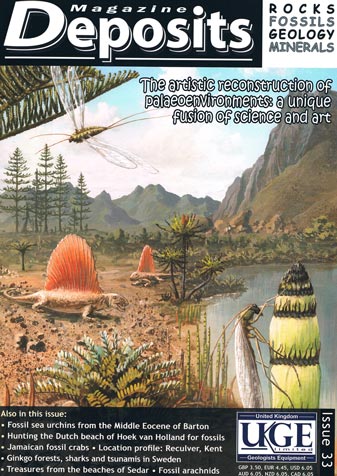
The spring edition of the magazine for geologists, mineralists and fossil fans has duly arrived and this UK produced magazine certainly packs a punch with issue 33.  The front cover shows an artist’s interpretation of the palaeoenvironment of Russia during the Late Permian.  This is an example of the artwork of Lyme Regis based illustrator Richard Bizley and inside there is a highly informative article all about Richard’s work re-creating prehistoric and alien landscapes.

Richard likes to focus on some of the unsung heroes from the fossil record.  His landscapes feature a whole range of prehistoric animals and plants, the fauna and flora depicted all painstakingly researched to ensure accuracy.  The artwork is truly stunning and the detail simply exquisite.

The Front Cover of Deposits Magazine (Spring 2013)

A huge array of topics covered inside.

A huge array of topics covered inside.

Picture credit: Everything Dinosaur

Deposits Magazine

Visitors to Holland can perhaps be inspired about an article about hunting for Ice Age fossils on the Dutch beach of Hoek van Holland. It seems that land reclamation and construction work to prepare sea defences leads to a lot of material being dredged up from the bottom of the North Sea – amongst the sand there are many fossils of prehistoric mammals that get deposited on the beaches of this low-lying country.

Fossil hunters can find teeth of Woolly Mammoths, bones from Woolly Rhinos (Coelodonta) and even Mesolithic spear tips and fishing harpoons.  Further afield, there are very well illustrated articles on fossil hunting for Mesozoic aged fossils including beautiful Ginkgo fossils in southern Sweden and a fascinating article on Jamaican fossil crabs.  Decapod crustaceans (crabs) have got their own army of dedicated fossil collectors who specialise in collecting specimens of these arthropods.  The article outlines the types of fossil crabs that can be found on the Caribbean island of Jamaica.  The handy glossary of terms presented at the end of the article helps the uninitiated to gain an insight into just how fascinating collecting fossils of crabs can be.

Arachnid Article

Arachnids, the likes of spiders, mites, scorpions and their near relatives have a large article dedicated solely to them in this issue of Deposits magazine.  This feature jointly written by Dr David Penney (University of Manchester) and Dr Jason Dunlop, the curator of myriapods and arachnids at the Berlin Natural History Museum is extremely comprehensive and packed with beautiful photographs and computer enhanced images.  As artist Richard Bizley loves to incorporate Arachnids into his artwork it makes perfect sense to include a detailed review of the Arachnid fossil record in the same issue as a feature on the artistic reconstruction of palaeoenvironments –  a unique fusion of science and art.

The magazine provides book reviews, including a couple on the volumes published to help walkers explore the Jurassic coast of southern England, lots of news stories and there is even a feature on fossil amber found in Scotland.  For those prepared to get out and about this spring there are articles on hunting for Middle Eocene sea urchins and a detailed review of the fossils to be found on a visit to Herne Bay in Kent.

Update on Recent Fossil Discoveries

For readers who live in Colorado (United States of America), there is an update on some of the rare, recent fossil discoveries from the famous Morrison Formation of western North America.    A rare fossil of a gastropod (snail) has been discovered, it has been turned to agate over millions of years (shell replaced by the mineral agate).  Dinosaur fossils may make the headlines but this snail fossil provides scientists with valuable evidence to help reconstruct life in freshwater habitats during the Late Jurassic.

All in all, this is an excellent magazine that covers a whole range of subject areas of interest to palaeontologists, geologists, mineralists and fossil fans.  The articles are written in a way that allows the layperson to follow what is being said with scientific terms reduced to a minimum.  Issue 33 of Deposits magazine is well worth reading.

Visit Everything Dinosaur’s award-winning website: Everything Dinosaur.

16 03, 2013

Scientists on the Isle of Wight Announce New Dinosaur Fossil Find

By |2023-02-13T17:32:11+00:00March 16th, 2013|Categories: Dinosaur and Prehistoric Animal News Stories, Dinosaur Fans|2 Comments

Fossil Location Kept Secret as Palaeontologists Plan to Excavate

Palaeontologists on the Isle of Wight (off the coast of southern England), are hoping that the discovery of an almost perfectly preserved set of fossilised dinosaur bones will help them to solve a mystery that is itself more than 100 years old.

The fossil material has been tentatively described to a genus of ornithopod (bird-hipped) dinosaur called Valdosaurus.  Up until now most of the fossil specimens, including the holotype material from which this plant-eating dinosaur was named, have been disarticulated and fragmentary.  These new fossils described by Isle of Wight palaeontologists as “absolutely amazing” represent a single individual but the fossils are articulated and much more of the skeleton has been preserved.

Dinosaur Fossil

The fossils were found last Autumn by a walker who observed a series of bones slowly eroding out of a block of rock on a cliff face on the island’s south-west coast.  The exact location is being kept a closely guarded secret as scientists hope to be able to return to the site to look for further fossil evidence.  The land is owned by the National Trust and permission was granted for the palaeontologists to remove several large blocks of sandstone from the site so that the fossils could be carefully extracted from their surrounding matrix under laboratory conditions.   The seven sandstone blocks contained much of the rear end of the skeleton including articulated caudal vertebrae (tail bones), elements from the pelvis, hind limbs and parts of the backbone.

Not a Cretaceous Crocodile

At first the scientists thought that the fossils represented a prehistoric, Early Cretaceous crocodile, but as the bones were revealed with the removal of the surrounding sandstone it soon became clear that they had an exceptionally well-preserved example of a Valdosaurus, perhaps the most complete specimen of this type of dinosaur discovered to date.

Scientists have remained uncertain as to the size of Valdosaurus and how closely it was related to other ornithopods.  It is hoped that these fossils will help to answer the many questions surrounding this herbivore from the Early Cretaceous.  Fossils ascribed to Valdosaurus have been found on the Isle of Wight and also from Weald Clay material located in West Sussex (southern England).  This new specimen suggests a body length of around 3.6 metres (12 feet), although some fragmentary remains now housed at the Natural History Museum in London suggest that a fully grown Valdosaurus could have reached a length in excess of five metres.

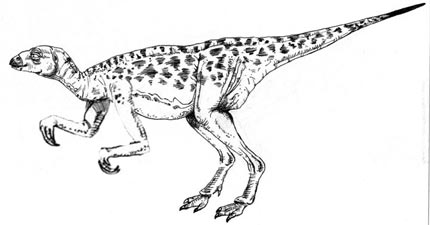
Everything Dinosaur’s Interpretation of Valdosaurus

Everything Dinosaur's interpretation of Valdosaurus.

Everything Dinosaur’s interpretation of Valdosaurus.

Picture credit: Everything Dinosaur

Once thought to be a type of theropod (meat-eating) dinosaur, Valdosaurus has been described as being a light, fast running, medium-sized browser feeding from the ground level to up to around two metres.

In Everything Dinosaur’s illustration we have given our Valdosaurus slightly longer arms than in representations of other dryosaurids.  It is thought that this dinosaur was a facultative quadruped.

Although it will take some months to complete the preparation of the fossil material, palaeontologists are hopeful that this specimen will be able to go on display at a dinosaur museum on the island, forming part of a new exhibit about the plant-eating dinosaurs that once roamed this part of the world.

To read an article highlighting the importance of the Isle of Wight to palaeontologists: Isle of Wight Declared the “Dinosaur Capital” of the British Isles.

The fossil material has been dated to approximately 128 million years ago (Barremian faunal stage of the Early Cretaceous).  Valdosaurus has been classified as a dryosaurid, although it remains uncertain as to the exact taxonomic relationship this dinosaur genus has to Dryosaurus (best known from Upper Jurassic strata of the western United States) and to Camptosaurus.

It is not known whether this specimen represents a new species of Valdosaurus.  The name of this dinosaur means “Weald lizard”, reflecting the fact that much of the material ascribed to this genus has come from the Weald Clay of West Sussex.

For figures and repilicas of iguanodontids and other ornithopods: CollectA Prehistoric Life (Popular) Models.

Go to Top