All about dinosaurs, fossils and prehistoric animals by Everything Dinosaur team members.

News stories and articles that do not necessarily feature extinct animals.

28 08, 2026

Remarkable New Museum für Naturkunde Berlin Galleries Open to Visitors

By |2026-08-22T16:08:32+01:00August 28th, 2026|Categories: Animal News Stories|0 Comments

Two remarkable Museum für Naturkunde Berlin galleries are being opened to visitors for the first time. The new “Mammal Skulls” and “Deer and Horned Animals” galleries will welcome members of the public during the Long Night of Museums event on Saturday 29th of August.

Until now, these collections have been reserved exclusively for researchers. Their opening represents an important milestone in the continuing development of the Museum für Naturkunde. These two, new galleries will initially only be accessible as part of a guided tour.

Opening Natural History Research Collections to the Public

The two galleries were created with funding from the Future Plan. They provide access to important scientific collections, but their purpose extends beyond displaying natural history specimens. Both galleries explore the history and provenance of objects within the collections. In addition, they demonstrate how specimens can be interpreted from different scientific, historical and cultural perspectives. The media displays were developed through an international co-curation programme. Nine co-curators from Tanzania, Rwanda, Burundi, Zambia, Togo, Cameroon, Kenya, Namibia and Egypt participated.

The layout of the two galleries reflect the Museum’s on-going commitment to work responsibly with specimens and objects originating from former colonial territories.

A comprehensive guide to recognising the colonial heritage of many of the specimens in the collection has recently been published.

To read more about this work: Colonial Natural History Collections Receive New Guidelines.

Working with natural science and humanities researchers at the museum, the co-curators helped bring together scientific findings, local knowledge systems, cultural experiences and historical perspectives.

Prof. Johannes Vogel, Director-General of the Museum für Naturkunde Berlin, explained:

“Natural history collections are far more than archives of biological diversity – they are repositories of knowledge about the relationships between humans and nature and, at the same time, testimonies to their era. With the opening of the new galleries, we are highlighting where research takes place and inviting visitors to critically examine the history of the objects, which is also part of our own history.”

New Museum für Naturkunde Berlin galleries including the "Deer and Horned Animals" gallery.

The new “Deer and Horned Animals” gallery at the Museum für Naturkunde Berlin. Picture credit: Verena Brüning.

Picture credit: Verena Brüning

New Museum für Naturkunde Berlin Galleries Including “Deer and Horned Animals”

The “Deer and Horned Animals” research collection contains approximately 8,500 sets of antlers and horns. These specimens document the diversity of cervids and other horned animals. Importantly, historical specimens can provide valuable information for modern biodiversity research. Collections assembled many decades ago can help scientists investigate geographical variation and changes in animal populations over time.

However, the gallery also examines how the collection was assembled. It highlights the influence of colonial collecting practices and political power structures and encourages visitors to consider the provenance and history of individual objects.

An Important Collection of Mammal Skulls

The museum’s mammal collection is one of the most significant of its kind in the world. It contains approximately 150,000 objects, including around 66,500 skulls. Many specimens originate from Africa and were brought to Berlin through colonial networks around the beginning of the 20th century.

Selected specimens have now been reinterpreted in collaboration with experts from their countries of origin. The displays include skulls from elephants, lions, manatees and jackals.

Alongside their zoological importance, the exhibits explore the cultural and spiritual significance associated with some of these animals. Visitors can also learn more about how particular specimens travelled from their places of origin to Europe.

Consequently, the gallery provides an opportunity to examine both the scientific importance of natural history collections and the historical circumstances surrounding their formation.

Elephant skulls on display in the new "Mammal Skulls" gallery.

Elephant skulls on display in the new “Mammal Skulls” gallery. Picture credit: Verena Brüning.

Picture credit: Verena Brüning

Examining the History of Museum Collections

The new galleries form part of a wider initiative at the Museum für Naturkunde Berlin to examine its responsibilities concerning specimens and objects acquired within colonial contexts. The approach demonstrates how natural history museums can preserve and study scientifically important specimens while simultaneously investigating and communicating their history and provenance.

Guided Tours Begin on Saturday 29th of August

The new Museum für Naturkunde Berlin galleries can currently only be visited as part of a guided tour. The first tours will take place during the Long Night of Museums event on Saturday 29th of August (2026). Tickets for the guided tours are available free of charge from the information desk in the Dinosaur Hall. However, tickets are subject to availability and will be distributed whilst stocks last.

Mike from Everything Dinosaur welcomed the opening of these new galleries and stated:

“For visitors interested in zoology, biodiversity research and the history of natural history collecting, the opening of these galleries provides a rare opportunity to explore collections that, until now, have remained the preserve of researchers.”

The award-winning Everything Dinosaur website: Prehistoric Animal and Dinosaur Models.

22 08, 2026

Important New Guidelines for Colonial Natural History Collections

By |2026-08-22T14:38:59+01:00August 22nd, 2026|Categories: Animal News Stories|0 Comments

The Museum für Naturkunde Berlin has published new guidelines concerning colonial natural history collections. The publication examines how museums and other institutions can work responsibly with specimens and objects originating from former colonial territories. Natural history collections provide an invaluable resource for scientists. However, specimens acquired during colonial periods can also reflect historical inequalities, power structures and the use of force. Consequently, museums are increasingly examining the circumstances in which parts of their collections were assembled.

The new publication represents an important contribution to this developing area of museum research.

Important new guidelines published for colonial natural history collections.

The mammalian collection at the Museum für Naturkunde Berlin. New guidelines have been published for the management of colonial natural history collections. Picture credit: Verena Brüning.

Picture credit: Verena Brüning

Colonial Natural History Collections

The publication is entitled “Dealing with Colonial Natural History Objects: Recommendations, Research, Reflections”. The German title is: “Umgang mit kolonialen Objekten der Naturkunde. Empfehlungen, Forschung, Reflexionen”.

It brings together practical recommendations, recent research and contributions from international museum experts. The Museum für Naturkunde Berlin explained that the guide should not be regarded as the final word on the subject. Instead, it is intended to be a living document that can evolve as research progresses and different perspectives are incorporated.

The aim is to combine scientific excellence with historical responsibility and cultural respect.

Professor Johannes Vogel, Director-General of the Museum für Naturkunde Berlin, commented:

“This guide represents an interim assessment of a journey we began over ten years ago and which we intend to continue. We share our knowledge and learn from our experiences – including our mistakes. We are an open research museum that seeks to continually learn through dialogue with others.”

Stuffed birds on display.

The Museum für Naturkunde Berlin has an enormous collection of stuffed animals including many birds from around the world. Picture credit: Everything Dinosaur.

Picture credit: Everything Dinosaur

Opening Up a Collection of Thirty Million Objects

The Berlin museum houses an enormous natural history collection comprising around thirty million objects. Ongoing cataloguing work is intended to create new ways for people around the world to access these collections. Furthermore, the project aims to democratise access to existing knowledge. It also seeks to encourage participation in the creation of new knowledge about museum specimens and their histories.

The guidelines have emerged from more than a decade of research and collaboration. Participatory projects, workshops and international exchange programmes have brought together researchers representing different academic disciplines and cultural backgrounds.

Many of the amazing dinosaur fossil specimens on display at the Museum für Naturkunde Berlin come from Tanzania.  They were collected during Germany’s colonial past.  These specimens including the enormous Giraffatitan mounted fossil skeleton will also come under these guidelines.

Museum für Naturkunde Berlin dinosaur gallery.

The spectacular dinosaur gallery at the Museum für Naturkunde Berlin. Picture credit: Everything Dinosaur.

Picture credit: Everything Dinosaur

The Museum für Naturkunde Berlin has recently been praised for its work on conservation and documenting the biota of the German capital.

To learn more about this work: Berlin Amphibian Population Falls According to New Study.

International Collaboration and Co-curation

Recent developments at the museum demonstrate how these principles can be applied in practice. New galleries focusing on deer and horned animals and mammal skulls were developed through an international co-curation programme. Nine co-curators from Tanzania, Rwanda, Burundi, Zambia, Togo, Cameroon, Kenya, Namibia and Egypt participated in the project. Their contributions enabled scientific research to be considered alongside local knowledge systems, cultural experiences and historical perspectives. The resulting displays demonstrate how natural history collections can be interpreted through dialogue involving different communities and areas of expertise.

Such an approach can provide additional context for specimens that might otherwise be viewed solely from a biological or taxonomic perspective.

A Resource for Museums and Researchers

The guidelines are intended for anyone working with natural history objects. This includes staff and researchers associated with museums, universities, archives, research institutions and other collections.

Importantly, the publication is available in both German and English. It has also been made freely available as an open-access resource.

The Museum für Naturkunde Berlin regards the publication as a starting point rather than an end point. As research into colonial natural history collections continues, the recommendations can be developed and adapted to suit different institutions and circumstances.

The publication highlights an increasingly important aspect of modern museum practice. Natural history specimens can provide remarkable insights into biodiversity and the history of life. However, understanding how specimens entered collections, who collected them and under what circumstances can add another important dimension to their scientific and cultural significance.

Publication Details

Kaiser, Katja and Heumann, Ina (eds.). Dealing with Colonial Natural History Objects: Recommendations, Research, Reflections. Heidelberg: arthistoricum.net, 2026.

The publication is available open access.

Everything Dinosaur acknowledges the assistance of a media release from the Museum für Naturkunde Berlin in the compilation of this article.

The award-winning Everything Dinosaur website: Dinosaur and Prehistoric Animal Models.

12 08, 2026

Berlin Amphibian Populations Plummet by 76% in Alarming Study

By |2026-08-10T15:42:57+01:00August 12th, 2026|Categories: Animal News Stories|0 Comments

A new study has revealed a dramatic decline in Berlin amphibian populations. Researchers report that frogs, toads and newts have declined by more than three-quarters since 1981. Furthermore, scientists found a substantial decline in the city’s dragonflies. Their populations have fallen by more than half since 1963. Much of Europe has been gripped by an unprecedented series of heatwaves this summer.  Here in the UK, we too have endured record-breaking temperatures. Indeed, more parts of England were declared as being in a drought this week. Extremes of weather have an enormous impact on wildlife.  For example, animals and plants that depend on small ponds and lakes to survive have been particularly hard hit.

More importantly, studies are revealing that many animals and plants are in long-term decline.

Common frogs (Rana temporaria) active in the office pond.

Several frogs (Rana temporaria) in the office pond. Six batches of frogspawn have been laid to date. At least two pairs are in amplexus, so perhaps more eggs will be laid over the next 24-hours or so. Unfortunately, many ponds have dried up, and amphibian populations are becomingly increasingly isolated. Picture credit: Everything Dinosaur.

Picture credit: Everything Dinosaur

Researchers from the Museum für Naturkunde Berlin led the study into the state of nature in Germany’s capital. For the first time, the team analysed decades of Berlin monitoring data using the internationally established Living Planet Index (LPI). The World Wildlife Fund (WWF) also uses this indicator to assess trends in wildlife populations around the world.

Berlin experts Falk Petzold and Klaus-Detlef Kühnel also participated in the research. They coordinate the long-term datasets used in the study. The researchers published their findings in the scientific journal “Global Change Biology Communications”.

Dragonflies and Amphibians Depend on Two Habitats

Dragonflies and amphibians share an important characteristic. Both groups depend on aquatic and terrestrial habitats during their lives. Their larvae or immature stages develop in water. However, adults also depend on terrestrial environments. Consequently, environmental changes affecting either habitat can threaten their populations.

The researchers examined two extensive datasets that had not previously been published. The Berlin dragonfly database contains almost 24,000 observations dating back to 1850. In addition, the Berlin amphibian dataset contains more than 16,000 records dating from 1970. Conservation organisations and local volunteers from specialist societies helped compile these valuable records.

The scientists focused on sixteen bodies of water. Researchers had surveyed these sites regularly and consistently over many decades.

The locations included forest lakes in Grunewald and bog pools in Köpenick. They also studied ponds in Marienfelde and Tegel.

Berlin Amphibian Populations Fall by 76%

The results reveal a disturbing picture. Between 1963 and 2023, Berlin’s dragonfly populations declined by an average of 51%. However, the researchers documented an even greater decline among amphibians. Berlin amphibian populations fell by 76% between 1981 and 2022.

Silvia Keinath, the study’s lead author and a scientist at the Museum für Naturkunde Berlin, commented on the findings.

“Given the general trend of species decline, it is unfortunately no surprise that both groups are in decline. What is striking, however, is how much more severely amphibians are affected.”

Sadly, the analysis was unsurprising given the wider loss of biodiversity. However, the much greater decline among amphibians is extremely concerning.

Frogs, toads and newts have considerably less mobility than dragonflies. Therefore, changes to the landscape can isolate their populations. Roads and development can interrupt migration routes between breeding ponds and terrestrial habitats. Furthermore, small ponds may dry out and disappear.

Dragonflies have an advantage because they can fly considerable distances. As a result, they can colonise new bodies of water more easily. Nevertheless, environmental change also threatens dragonflies. For example, ponds may dry out before their larvae complete their development.  Habitat loss is a serious threat to these insects.

New study highlights Berlin's declining damselfly and dragonfly population.

A Large Red Damselfly (Pyrrhosoma nymphula) at rest. New research highlights the decline in Berlin’s damselfly and dragonfly population. Picture credit: Jörg Freyhof, Museum für Naturkunde Berlin.

Picture credit: Jörg Freyhof, Museum für Naturkunde Berlin

Concerningly, no evidence of dragonflies emerging from our office pond have been found this year.

A beautiful dragonfly emerges from the office pond: A Spectacular Resting Dragonfly.

A New Way to Examine Urban Biodiversity

The scientists used the Living Planet Index to investigate long-term population trends. Essentially, the LPI combines changes in many individual populations into a single trend value. In this respect, it works rather like a stock market index.

Importantly, the index does not simply count the total number of animals. Instead, it measures the average change in populations over time. Therefore, scientists can examine long-term trends involving numerous species. This method also has another advantage. Researchers can use it when historical datasets contain gaps or were collected using different methods.

Consequently, the LPI provides scientists with a powerful tool for studying changes in urban biodiversity.

Berlin’s Drying Ponds Provide a Warning

The disappearance of small bodies of water could help explain the dramatic population declines. The researchers compared their findings with recent reports about Berlin’s small ponds and other water bodies. Alarmingly, they discovered that thirty-six previously studied sites have now completely dried out. Falling groundwater levels and reduced rainfall could have contributed to these losses. Moreover, these vanished water bodies could not contribute to the Living Planet Index calculations. Researchers no longer had continuous datasets for them. Therefore, the actual decline in Berlin’s amphibians and dragonflies could be even greater than the study indicates.

A similar pattern is being seen in the UK.  Even the small office pond looked after by Everything Dinosaur team members is under threat.  However, steps have been taken to conserve water.  For example, a water butt has enabled the water in the small pond to be topped up.

Long-term Monitoring of a City’s Wildlife

The new research forms part of a growing effort to understand and conserve Berlin’s urban wildlife. In 2024, Museum für Naturkunde Berlin researchers calculated another sobering statistic. Around 16% of the species once native to Berlin have disappeared since 1700. The latest study provides a much more detailed view of this biodiversity crisis. Crucially, scientists can now examine how populations change over decades. They do not have to wait until a species disappears completely from the city.

The research demonstrates that scientists can measure meaningful population trends at the level of an individual city. However, this approach depends on continuous and well-documented long-term datasets. In addition, researchers must have access to those records. At present, Berlin lacks a structured and permanent biodiversity monitoring programme. Therefore, valuable long-term datasets remain relatively rare.

Commenting on the publication of this study, Mike from Everything Dinosaur stated:

“Hopefully, the Museum für Naturkunde Berlin will establish a comprehensive wildlife monitoring programme. However, the issue of declining wildlife populations is not confined to Berlin.  Citizen science programmes can provide valuable data, and we all have a responsibility to do what we can to help conserve nature.  Even our tiny pond can be a lifeline for so many animals.”

Everything Dinosaur acknowledges the assistance of a media release from the Museum für Naturkunde Berlin in the compilation of this article.

The scientific paper: “Long-Term Population Declines of Habitat-Shifting Species in the City: A Living Planet Index Approach for Berlin, Germany” by Silvia Keinath, Frederic Griesbaum, Nike Sommerwerk, Falk Petzold, Klaus-Detlef Kühnel and Jörg Freyhof published in Global Change Biology Communications.

7 07, 2026

Evolution of Spider Eyes Explored in New Study

By |2026-07-04T21:09:06+01:00July 7th, 2026|Categories: Animal News Stories|0 Comments

A new scientific study has provided fascinating insights into the evolution of spider eyes. An international team of researchers has discovered that hunting spiders independently evolved forward-facing eye arrangements.

The study, led by Atal Pande from the Museum für Naturkunde Berlin, demonstrates that spider visual systems are highly flexible. Their eyes can evolve as separate modules, allowing these remarkable animals to adapt to different lifestyles and habitats.

Researchers examined fifty-two spider species to better understand how their eyes changed over millions of years.

Investigating the Evolution of Spider Eyes

Vision plays a crucial role in the lives of many animals. It helps them find food, avoid danger and navigate their surroundings.

In vertebrates, eye position often provides clues about an animal’s lifestyle. For example, many predators have forward-facing eyes. This arrangement helps them judge distances accurately when targeting prey. In contrast, many prey animals have eyes positioned on the sides of their heads. This gives them a wider field of view to help detect danger.

However, spiders present scientists with a very different challenge. Most spiders have eight eyes, and these can be arranged in a variety of ways.

The research team wanted to understand how these different arrangements evolved.

The evolution of spider eyes.

A wolf spider (Pardosa) looks into the camera; its six front-facing eyes give it a forward-looking gaze. Picture credit: Sam England.

Picture credit: Sam England

Studying the Visual Systems of Numerous Spider Species

Scientists used high-resolution X-ray computed tomography, geometric morphometrics and evolutionary modelling during the study. These techniques allowed them to examine eye position, orientation and field of view.

The results revealed that spider eye arrangements have changed dramatically throughout evolutionary history.

Early diverging spider groups, such as trapdoor spiders, retain a more centralised arrangement of eyes. Meanwhile, orb-weaving spiders evolved a different configuration, with eyes positioned around the front part of the body.

However, some visually active hunting spiders developed a particularly interesting adaptation. Several groups independently evolved arrangements where multiple pairs of eyes point forwards.

Hunting Spiders Developed Powerful Visual Centres

The study showed that hunting spiders display some of the greatest diversity in eye arrangement. Their visual systems also evolved at a faster rate.

By having several pairs of forward-facing eyes, these spiders can gather different types of information from the same area. This may improve movement detection, increase visual detail and help with judging distances.

Essentially, the front section of the spider’s body became a sophisticated visual centre. Different eyes specialised in different tasks but continued working together.

Flexible Eyes Helped Spiders Adapt

The research also demonstrated that spider vision is modular. This means that individual pairs of eyes can evolve independently rather than changing as a single system.

This flexibility gave evolution more opportunities to adapt spider eyesight to different ecological challenges.

Lead author Atal Pande explained:

“Spiders are an exceptional model system for understanding how vision has evolved over time. Unlike animals with only two eyes, spiders have multiple visual modules, some of which can evolve independently of one another. This gives evolution significantly more scope to adapt the visual system – and explains the remarkable diversity of eye arrangements in spiders.”

Spider Research Could Inspire Future Technology

The study provides important information about how natural selection shapes complex sensory systems.

Furthermore, understanding the evolution of spider eyes could have applications beyond biology. The research may help scientists develop new types of visual sensor systems for robotics and autonomous technologies.

Animals have evolved extraordinary solutions to survival challenges. Studying these adaptations can inspire new approaches to solving modern engineering problems.

Everything Dinosaur acknowledges the assistance of a media release from the Museum für Naturkunde Berlin in the compilation of this article.

The scientific paper: “Hunting ecology predicts eye arrangements in the modular visual system of spiders” by Atal Pande, Lucille Rose, Sam J. England, Imran A. Rahman, Ricardo Pérez-de la Fuente, Andrew J. Bodey, Kaz Wanelik, Christian M. Schlepütz, Jonathan Günther, Christoph Rau, Alexander Blanke and Lauren Sumner-Rooney published in Current Biology.

The award-winning Everything Dinosaur website: Models of Prehistoric Creatures.

4 07, 2026

New Colonial Collections Research Project Examines Museum Specimens from Togo and Ghana

By |2026-07-04T18:37:04+01:00July 4th, 2026|Categories: Animal News Stories|0 Comments

A new colonial collections research project has been launched involving several leading Berlin museums. Researchers will investigate the origins and histories of important natural history and cultural collections gathered during the German colonial period.

For the first time, Berlin institutions are working together to study collections linked to the former German colony of Togo. At that time, the colony included areas that are now part of Ghana. The two-year project will combine expertise from different scientific disciplines.

The project is entitled “Interconnected Stories: Colonial Collections from Togo and Ghana in Berlin’s Museums”. It is funded by the German Centre for Lost Cultural Property.

German museums embark on a colonial collections research project.

Bird skin with labels representing a blue-throated roller (Eurystomus gularis), sent by Ernst Baumann from the German colony of Togo. Picture credit: Schurian/Museum für Naturkunde Berlin.

Picture credit: Schurian/Museum für Naturkunde Berlin

Berlin Museums Collaborate on Colonial Collections Research Project

The research brings together the Museum für Naturkunde Berlin, the Botanical Garden and Botanical Museum at Freie Universität Berlin, as well as the Ethnological Museum and the Central Archive of the Staatliche Museen zu Berlin.

In addition, researchers are collaborating with the Archives Nationales du Togo and the University of Ghana. Traditional knowledge holders and local communities will also contribute to the study.

The project will examine botanical, zoological and cultural-historical collections. Researchers hope to better understand how these items were acquired, documented and interpreted.

Investigating the History of Museum Collections

The collaboration between Berlin’s museums can be traced back to the nineteenth century. In 1889, a Bundesrat resolution designated several Berlin institutions as central collection points for materials obtained from German colonies.

As a result, preserved plants, animal specimens and cultural artefacts were sent to Berlin. Many were collected by colonial officials and military personnel. These historical collections remain extremely important for modern research. However, the circumstances surrounding their acquisition are not always fully understood.

The new colonial collections research project aims to investigate these histories in greater detail.

Stuffed birds on display.

The Museum für Naturkunde Berlin has an enormous collection of stuffed animals including many birds from around the world. Picture credit: Everything Dinosaur.

Picture credit: Everything Dinosaur

Studying Collections from Bismarckburg and Misahöhe

The research will focus on material associated with Bismarckburg and Misahöhe. These were two early colonial outposts established in the interior of Togo.

Scientists and historians will examine how these locations became connected with collecting activities. Furthermore, they will investigate the links between scientific research, economic interests and colonial administration.

The project team will also explore the contribution of local knowledge holders. Their expertise and involvement were often not fully recorded in historical archives.

Combining Different Sources of Knowledge

By bringing together museum records, scientific collections and local perspectives, researchers hope to create a more complete understanding of the past. Importantly, oral traditions and memories from communities in Togo and Ghana will form part of the research. This approach will help include information that may be absent from colonial records.

The project also aims to create a model for future transdisciplinary provenance research. This could help museums around the world investigate collections that have previously been studied separately.

Understanding the History Behind Museum Collections

Natural history museums provide vital resources for scientific research. Specimens collected decades or even centuries ago can help scientists study biodiversity, extinction, evolution and environmental change.

However, understanding where specimens came from and how they were obtained is also important. Provenance research helps museums build a more detailed picture of their collections and their connections with people and places.

The “Interconnected Stories” project demonstrates how international collaboration can provide fresh insights into historic collections.

Everything Dinosaur acknowledges the assistance of a media release from the Museum für Naturkunde Berlin in the compilation of this article.

The Everything Dinosaur website: Dinosaur and Prehistoric Animal Models and Toys.

28 06, 2026

Helping Local Wildlife Through Sustainability

By |2026-06-29T16:17:00+01:00June 28th, 2026|Categories: Animal News Stories|0 Comments

Nature surrounds us.  A tiny frog (Rana temporaria) recently emerged from our office pond.  Although, little over a centimetre in length, this young amphibian reminded us why protecting the environment matters. At Everything Dinosaur, we are helping wildlife through sustainability.  We recognise our responsibilities and have changed business practices to reduce environmental impact.

The frog has entered a world that is changing rapidly. Following the recent record-breaking temperatures, the pond has started to shrink. In addition, prolonged dry spells and extreme weather are becoming more frequent. As a result, wildlife faces increasing challenges as habitats change.

Helping wildlife through sustainability. A tiny frog is spotted in a rapidly drying up pond.

Can you spot it? A tiny, recently metamorphosised Common frog (Rana temporaria) spotted in a pond that is rapidly drying up. Picture credit: Everything Dinosaur.

Picture credit: Everything Dinosaur

Helping Wildlife Through Sustainability

We know that every business has a responsibility to reduce its environmental impact. While we cannot solve climate change alone, we can make better choices every day.

That is why we have worked hard to remove single-use plastics from our own product packaging. We continue to recycle wherever possible and reduce waste throughout our business. Furthermore, we have embraced the principles of Extended Producer Responsibility by designing packaging that is easier to recycle and uses fewer resources. We believe manufacturers and retailers should consider the environmental impact of their products throughout their entire life cycle.

Small changes really do add up. Every plastic bag removed, every recycled box and every sustainable packaging decision helps reduce waste. Consequently, these actions contribute to a healthier environment for wildlife and people alike.

This little frog may seem insignificant. However, it serves as a timely reminder that our actions today help shape tomorrow’s world.

Mike from Everything Dinosaur commented:

“Watching this tiny frog leave the pond makes you think about the future it faces. Every sustainable choice we make, no matter how small, is an investment in the natural world. We all have a role to play in protecting habitats for future generations.”

The award-winning Everything Dinosaur website: Scientifically Accurate Dinosaur Models.

25 04, 2026

New Study Indicates Promiscuity and Parental Behaviour in Birds Driven by Demographics – Did Similar Processes Shape the Behaviour of Dinosaurs?

By |2026-04-25T06:43:54+01:00April 25th, 2026|Categories: Animal News Stories|0 Comments

A recent study published in “Nature Communications” is challenging how scientists interpret animal behaviour. Furthermore, as the study focused on birds, it may have implications for the Dinosauria. The research shows that population demographics drive mating systems and parental care in birds. Behaviour does not create population imbalance. Instead, population imbalance shapes behaviour.

The study’s conclusions could have wide implications. Birds are archosaurs.  They are members of the Dinosauria. Therefore, their biology offers valuable clues about their extinct relatives such as Triceratops and Tyrannosaurus rex.

Population Demographics

An international team including Tamás Székely (Milner Centre for Evolution at the University of Bath), examined 261 bird species. They analysed adult sex ratios, mating systems, and parental care. A clear pattern emerged. Sex ratios are shaped by survival differences, not behaviour. Males and females hatch in similar numbers. However, they do not survive equally. Some mature more slowly. Others face higher mortality risks. As a result, adult populations become skewed. This imbalance then drives behaviour. The rarer sex tends to mate with multiple partners. Meanwhile, the more common sex competes more intensely.

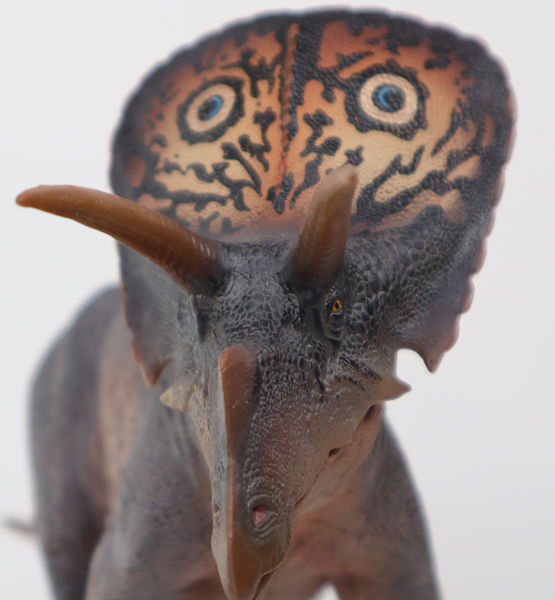
If such factors were at work in the Dinosauria, it might explain the evolution of ornate frills in the Ceratopsia for example.

A close-up view of the asymmetrical of the CollectA Deluxe Lokiceratops model.

Close-up view of the asymmetrical frill of the CollectA Deluxe Lokiceratops model. A study suggests that population demographics drive mating systems and parental care in birds. Could the same evolutionary dynamics have played out in the Dinosauria?

Behavioural Consequences

These demographic shifts have striking effects. For instance, parental care in birds often becomes uneven. One parent may invest heavily in raising offspring. The other may seek additional mates.
Moreover, sexual selection intensifies. The more common sex evolves exaggerated traits. These include bright colours, large size, or elaborate displays. For example, the ornate, colourful but cumbersome tail of male peacocks.

Another example is the Great Bustard (Otis tarda). Males mature slowly, which reduces their numbers in the breeding population. Consequently, the species shows a strong female bias. This imbalance drives extreme behaviour. Males grow much larger than females and compete for mates. Females, in contrast, handle all nesting and chick care.
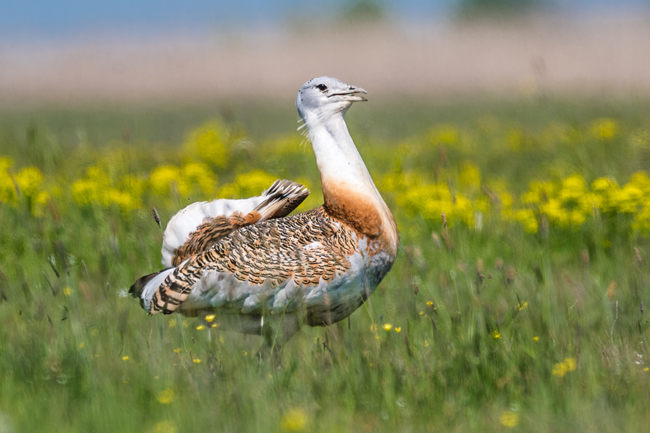
Sexual selection and parental care in birds and implications for the Dinosauria.

The Great Bustard (Otis tarda) which is found in north Africa and southern Europe. Polygamous birds such as the Great Bustard typically have more females than males in their population. Picture credit: Oliver Kruger.

Picture credit: Oliver Kruger

A Dinosaur Perspective

This research raises important questions. For instance, did similar processes shape the behaviour of extinct, non-avian dinosaurs? Direct evidence is rare. However, palaeontologists can look for indirect signals. These include growth patterns, display structures, and nesting behaviour. For example, some dinosaurs show delayed maturation. Bone studies of some theropods suggest individuals grew at different rates. If one sex matured later, it could reduce its breeding presence. This would create a skewed adult sex ratio, similar to modern birds.

Signals of Sexual Selection

Many dinosaurs evolved striking physical features. These may reflect competition driven by demographic imbalance.  Lambeosaurines evolved elaborate crests.  Hadrosaurs once thought to lack crests such as Edmontosaurus are now known to have sported soft crests, similar to the combs seen on some birds.

The new for 2020 Edmontosaurus model.

A close-up view of the new Edmontosaurus dinosaur model with its soft comb-like crest.

Read more: Duck-billed Dinosaur with a Comb like a Rooster.

Likewise, horns in ceratopsians may have played a role in mate competition. If one sex outnumbered the other, competition would intensify. Over time, this pressure could produce exaggerated ornaments, just as seen in birds.

Clues from Parental Care in Birds and Fossilised Nests

Research examining parental care in birds can offer further insight.  In addition, the fossils of non-avian dinosaurs could yield intriguing evidence. Nests of oviraptorosaurs and other theropods have been extensively studied.  Their nesting behaviour closely resembles that of many modern birds.  Some studies suggest that brooding individuals may have been males.  If correct, this indicates shared or male-dominated parental care. Such patterns of behaviour could arise from skewed sex ratios in the population.

To read a related article examining research into theropod dinosaur nesting behaviour: Oviraptorosaurian Incubation and Nesting Behaviour.

Is it Time to Interpret the Fossil Record Differently?

Importantly, fossil evidence for sex ratios in the non-avian dinosaurs remains limited. Males and females are often difficult to distinguish. Soft tissues rarely fossilise. As a result, direct demographic data are scarce. However, this new study provides a fresh framework. It suggests that survival differences shape population structure first. Behaviour then evolves in response.

This perspective changes how we interpret dinosaur biology. Features such as crests, horns, and size differences may not just signal display. They may also reflect deeper demographic patterns.
In short, the study highlights a powerful idea. Numbers matter. If one sex consistently dies younger or matures later, it reshapes behaviour across generations.

Birds offer a living window into dinosaur evolution. By studying them, scientists can better understand the lives of long-extinct species.

Everything Dinosaur acknowledges the assistance of a media release from the University of Bath in the compilation of this article.

The scientific paper: “Demographic causes and social consequences of adult sex ratio variation” by Zitan Song, András Liker, Yang Liu, Robert P. Freckleton and Tamás Székely published in Nature Communications.

The award-winning Everything Dinosaur website: Scientifically Accurate Prehistoric Animal Models.
25 03, 2026

Dogs Were Our Friends Earlier than Previously Thought

By |2026-03-28T16:00:05+00:00March 25th, 2026|Categories: Animal News Stories|0 Comments

A remarkable new study has identified the oldest genetic evidence of domestic dogs, pushing their confirmed history back thousands of years. The research, published in the journal “Nature”, highlights how dogs were already living alongside humans during the Late Upper Palaeolithic. This research examining the oldest domestic dog evidence pushes back the presence of dogs in human society by more than five thousand years.

Scientists analysed ancient DNA from archaeological sites in both the UK and Türkiye. Crucially, specimens from Gough’s Cave (Somerset) and Pınarbaşı date to around 15,800 years ago.

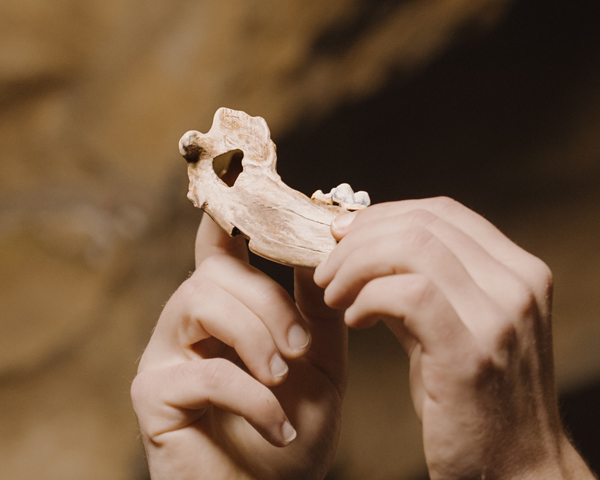
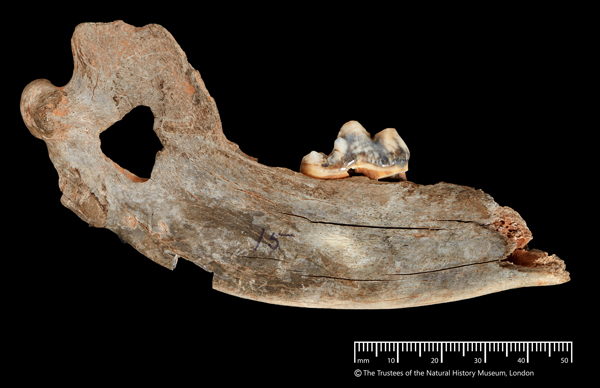
Gough's Cave dog jawbone.

The 14,300-year-old dog jawbone from Gough’s Cave in Somerset. Picture credit: The Trustees of the Natural History Museum, London.

Picture credit: The Trustees of the Natural History Museum, London

Dogs Living Alongside Ice Age Hunter-Gatherers

Researchers have long suspected that dogs evolved from grey wolves during the last Ice Age. However, early domestication has been difficult to prove. This is because dog and wolf skeletons from this period look almost identical. To overcome this difficulty, an international team, including researchers from Oxford University, studied complete genomes from ancient remains. They compared these with over a thousand modern and ancient dogs along with wolves. Consequently, they confirmed that several Ice Age specimens were indeed dogs. Moreover, the findings suggest that dogs were already widespread. By around fourteen thousand years ago, they had spread across Europe and into western Asia.

Dr William Marsh from the Natural History Museum explained that identifying these early dogs represents a major breakthrough. He noted that the discoveries show dogs were already widely distributed across different regions at the end of the Ice Age.

Early Dogs Spread Rapidly Across Eurasia

Interestingly, the genetic data revealed that these early dogs were closely related to modern European and Middle Eastern breeds. For example, they share ancestry with dogs such as the boxer dog and the saluki. This finding indicates that major dog lineages had already emerged during the Upper Palaeolithic. In contrast, they were less closely related to Arctic breeds like the Siberian Husky.

Dr Lachie Scarsbrook of LMU Munich highlighted the importance of this discovery. He stated that dogs with different ancestries already existed across Eurasia by 15,000 years ago. Therefore, domestication likely began much earlier than previously thought.

He commented:

“This means that by 15,000 years ago, dogs with very different ancestries already existed across Eurasia, from Somerset to Siberia. This raises the possibility that domestication occurred during the last Ice Age, more than 10,000 years before the appearance of any other domestic plants or animals.”

To read an Everything Dinosaur blog post from 2020 which explored the long history of human and dog interaction: Dog Evolution Examined in New Genetic Research.

A reconstruction of the 14,300-year-old dog jawbone

A reconstruction of the 14,300-year-old dog jawbone from Gough’s Cave (Somerset). Picture credit: Tom Anders and Longleat.

Picture credit: Tom Anders and Longleat

A Close Bond Between Humans and Dogs

Although the exact role of these early dogs remains uncertain, there are intriguing clues. For instance, isotope analysis suggests that people at Pınarbaşı fed dogs fish. In addition, some dog remains appear to have been intentionally buried. These findings point to a close relationship between humans and dogs. Furthermore, similar evidence from sites in Europe hints that dogs may have held cultural importance. Scientists also suggest that dogs may have been exchanged between different hunter-gatherer groups. This implies that dogs were not only useful but also valued across distinct communities.

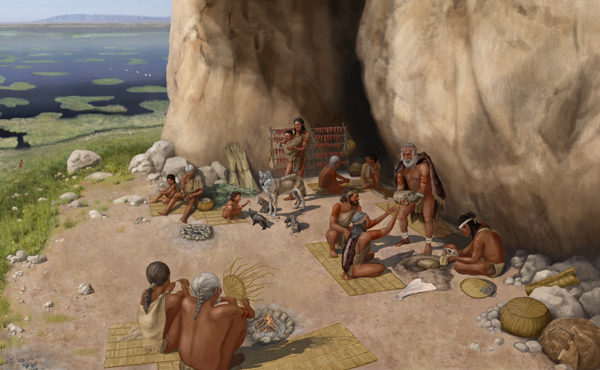
An artistic reconstruction of Pınarbaşı (Türkiye).

An artistic reconstruction of Pınarbaşı in Türkiye (Turkey) approximately 15,800 years ago based on the work of the University of Liverpool. Picture credit: Kathryn Killackey.

Picture credit: Kathryn Killackey

Oldest Domestic Dog Evidence Marks a Turning Point in Human Prehistory

Overall, this research provides new insight into one of the most important human-animal relationships. Dogs appear to have spread rapidly and become integrated into human societies long before agriculture began. As the study shows, the partnership between humans and dogs likely started during the harsh conditions of the last Ice Age. Ultimately, this bond would go on to shape both species in profound ways.

This fascinating research helps to reveal how early humans lived—and how dogs became our earliest companions.

Everything Dinosaur acknowledges the assistance of a media release from the London Natural History Museum in the compilation of this article.

The scientific paper: “Dogs were widely distributed across western Eurasia during the Palaeolithic” by William A. Marsh, Lachie Scarsbrook, Eren Yüncü, Lizzie Hodgson, Audrey T. Lin, Maria De Iorio, Olaf Thalmann, Mark G. Thomas, Mahaut Goor, Anders Bergström, Angela Noseda, Sarieh Amiri, Fereidoun Biglari, Dušan Borić, Katia Bougiouri, Alberto Carmagnini, Maddalena Giannì, Tom Higham, Ophelie Lebrasseur, Anna Linderholm, Marcello A. Mannino, Caroline Middleton, Gökhan Mustafaoğlu, Angela Perri, Joris Peters, Mike Richards, Özlem Sarıtaş, Pontus Skoglund, Rhiannon E. Stevens, Chris Stringer, Kristina Tabbada, Helen M. Talbot, Laura G. Van der Sluis, Silvia M. Bello, Vesna Dimitrijevic, Louise Martin, Marjan Mashkour, Simon A. Parfitt, Sonja Vukovic, Selina Brace, Oliver E. Craig, Douglas Baird, Sophy Charlton, Greger Larson, Ian Barnes and Laurent A. F. Frantz published in Nature.

The award-winning Everything Dinosaur website: Prehistoric Animal Models.
25 02, 2026

First Frogspawn Spotted in the Office Pond (2026)

By |2026-02-25T09:21:24+00:00February 25th, 2026|Categories: Animal News Stories|0 Comments

Exciting news we have spotted a batch of frogspawn in the office pond.  It is a spawn from a single female, and it was probably laid in the early hours of the morning.  A single frog had been observed in the pond over the weekend.  However, this morning there are at least four frogs present.  We did not want to disturb the frogs, but we did want to photograph the first frogspawn of 2026.

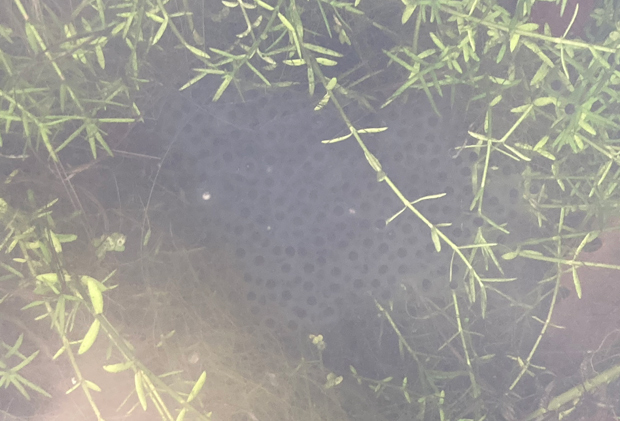
The first frogspawn spotted in the office pond (2026).

The first frogspawn in the office pond spotted on the morning of the 25th of February. Picture credit: Everything Dinosaur.

Picture credit: Everything Dinosaur

The First Frogspawn of 2026

The wet January means that the pond is very full.  We suspect the recent cold snap has delayed spawning.  Nevertheless, the first batch of eggs has been laid approximately two weeks earlier than in 2025.  This year’s start of the spawning season is not as early as previously recorded.  For example, in 2024 the first batch of frogspawn was observed on the morning of the 18th of February. This was the earliest date that it had been recorded since we began gathering this information.

Since we began recording egg laying dates there has been a trend for the frogs (Rana temporaria) to spawn earlier each year.  For instance, fifteen years ago the first frogspawn laid was recorded around the third week of March.  Recently, spawning has taken place earlier in the year, several weeks earlier in most cases.  We suspect that this is evidence of a changing climate.

Mike from Everything Dinosaur commented:

“Sue and I do our best to help nature.  We have tended and cared for this small pond and recorded the date of the first frogspawn laid every year since 2008.  In that year, the first frogspawn was recorded around the 16th of March.  Eighteen years later frogspawn is recorded twenty days earlier.  It is our way of measuring the impact of a changing climate.”

The multi-award-winning website: Dinosaur Models and Toys.

17 02, 2026

Celebrating the Chinese Lunar New Year

By |2026-02-17T13:40:36+00:00February 17th, 2026|Categories: Animal News Stories|0 Comments

As the Lunar New Year begins, we pause to celebrate renewal, hope, and partnership. This year, we proudly welcome the Year of the Horse. Across the world, families gather to share meals and exchange good wishes. Streets glow with lanterns. Fireworks light the sky. Meanwhile, homes fill with laughter and optimism for the year ahead.

The Horse symbolises energy, strength, and determination. It represents progress and resilience. Moreover, it reminds us to move forward with confidence and purpose. These qualities resonate deeply with our own journey as we developed the Everything Dinosaur Evolution range. In celebration of the Lunar New Year, we sent messages of goodwill to all our Chinese contacts.

Celebrating the Chinese Year of the Horse.

Everything Dinosaur celebrating the Chinese New Year (Year of the Horse) with a traditional red and gold image. Picture credit: Everything Dinosaur.

Picture credit: Everything Dinosaur

Celebrating the Chinese New Year (Year of the Horse)

At Everything Dinosaur, collaboration sits at the heart of what we do. We work closely with talented partners and friends in China. Together, we support the diverse and eclectic collecting community.

Therefore, this celebration feels especially meaningful to us. It gives us an opportunity to reflect on shared achievements. It also allows us to express sincere gratitude.

Over the past year, we have worked side by side on exciting new projects. We have overcome challenges together. Furthermore, we have strengthened relationships built on trust and mutual respect. Such partnerships truly drive innovation.  For example, we launched our own range of dinosaur figures – Everything Dinosaur Evolution.

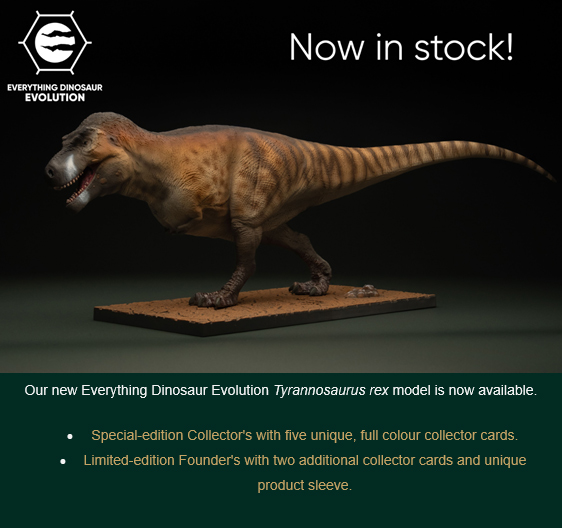
Everything Dinosaur Evolution T. rex is now in stock.

The Everything Dinosaur Evolution range is now in stock. Picture credit: Everything Dinosaur.

Picture credit: Everything Dinosaur

To view the Everything Dinosaur Evolution range: Everything Dinosaur Evolution Models.

As the Year of the Horse begins, we wish all our Chinese colleagues, manufacturers, artists, and friends a joyful and prosperous New Year. May this year bring health, happiness, and continued success. May it also bring new opportunities and fresh inspiration.

Finally, thank you for your dedication, creativity, and hard work. We value our collaboration enormously. We look forward to another remarkable year together.

Happy Lunar New Year, and best wishes for a thriving Year of the Horse!

The multi-award-winning Everything Dinosaur website: Prehistoric Animals and Dinosaur Figures.

Go to Top