

A remarkable new study has identified the oldest genetic evidence of domestic dogs, pushing their confirmed history back thousands of years. The research, published in the journal “Nature”, highlights how dogs were already living alongside humans during the Late Upper Palaeolithic. This research examining the oldest domestic dog evidence pushes back the presence of dogs in human society by more than five thousand years.
Scientists analysed ancient DNA from archaeological sites in both the UK and Türkiye. Crucially, specimens from Gough’s Cave (Somerset) and Pınarbaşı date to around 15,800 years ago.
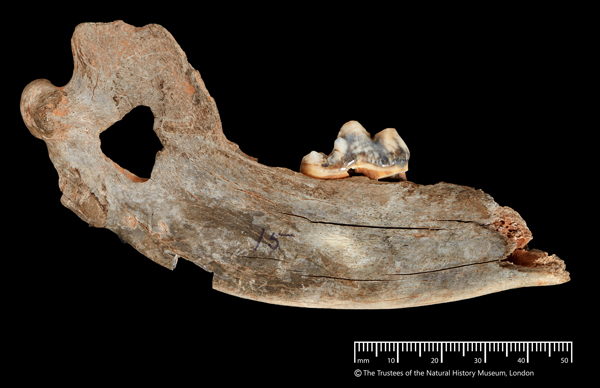
The 14,300-year-old dog jawbone from Gough’s Cave in Somerset. Picture credit: The Trustees of the Natural History Museum, London.
Picture credit: The Trustees of the Natural History Museum, London
Dogs Living Alongside Ice Age Hunter-Gatherers
Researchers have long suspected that dogs evolved from grey wolves during the last Ice Age. However, early domestication has been difficult to prove. This is because dog and wolf skeletons from this period look almost identical. To overcome this difficulty, an international team, including researchers from Oxford University, studied complete genomes from ancient remains. They compared these with over a thousand modern and ancient dogs along with wolves. Consequently, they confirmed that several Ice Age specimens were indeed dogs. Moreover, the findings suggest that dogs were already widespread. By around fourteen thousand years ago, they had spread across Europe and into western Asia.
Dr William Marsh from the Natural History Museum explained that identifying these early dogs represents a major breakthrough. He noted that the discoveries show dogs were already widely distributed across different regions at the end of the Ice Age.
Early Dogs Spread Rapidly Across Eurasia
Interestingly, the genetic data revealed that these early dogs were closely related to modern European and Middle Eastern breeds. For example, they share ancestry with dogs such as the boxer dog and the saluki. This finding indicates that major dog lineages had already emerged during the Upper Palaeolithic. In contrast, they were less closely related to Arctic breeds like the Siberian Husky.
Dr Lachie Scarsbrook of LMU Munich highlighted the importance of this discovery. He stated that dogs with different ancestries already existed across Eurasia by 15,000 years ago. Therefore, domestication likely began much earlier than previously thought.
He commented:
“This means that by 15,000 years ago, dogs with very different ancestries already existed across Eurasia, from Somerset to Siberia. This raises the possibility that domestication occurred during the last Ice Age, more than 10,000 years before the appearance of any other domestic plants or animals.”
To read an Everything Dinosaur blog post from 2020 which explored the long history of human and dog interaction: Dog Evolution Examined in New Genetic Research.
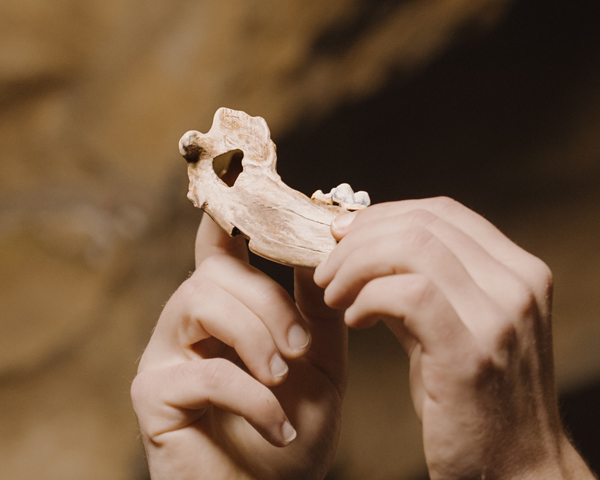
A reconstruction of the 14,300-year-old dog jawbone from Gough’s Cave (Somerset). Picture credit: Tom Anders and Longleat.
Picture credit: Tom Anders and Longleat
A Close Bond Between Humans and Dogs
Although the exact role of these early dogs remains uncertain, there are intriguing clues. For instance, isotope analysis suggests that people at Pınarbaşı fed dogs fish. In addition, some dog remains appear to have been intentionally buried. These findings point to a close relationship between humans and dogs. Furthermore, similar evidence from sites in Europe hints that dogs may have held cultural importance. Scientists also suggest that dogs may have been exchanged between different hunter-gatherer groups. This implies that dogs were not only useful but also valued across distinct communities.

An artistic reconstruction of Pınarbaşı in Türkiye (Turkey) approximately 15,800 years ago based on the work of the University of Liverpool. Picture credit: Kathryn Killackey.
Picture credit: Kathryn Killackey
Oldest Domestic Dog Evidence Marks a Turning Point in Human Prehistory
Overall, this research provides new insight into one of the most important human-animal relationships. Dogs appear to have spread rapidly and become integrated into human societies long before agriculture began. As the study shows, the partnership between humans and dogs likely started during the harsh conditions of the last Ice Age. Ultimately, this bond would go on to shape both species in profound ways.
This fascinating research helps to reveal how early humans lived—and how dogs became our earliest companions.
Everything Dinosaur acknowledges the assistance of a media release from the London Natural History Museum in the compilation of this article.
The scientific paper: “Dogs were widely distributed across western Eurasia during the Palaeolithic” by William A. Marsh, Lachie Scarsbrook, Eren Yüncü, Lizzie Hodgson, Audrey T. Lin, Maria De Iorio, Olaf Thalmann, Mark G. Thomas, Mahaut Goor, Anders Bergström, Angela Noseda, Sarieh Amiri, Fereidoun Biglari, Dušan Borić, Katia Bougiouri, Alberto Carmagnini, Maddalena Giannì, Tom Higham, Ophelie Lebrasseur, Anna Linderholm, Marcello A. Mannino, Caroline Middleton, Gökhan Mustafaoğlu, Angela Perri, Joris Peters, Mike Richards, Özlem Sarıtaş, Pontus Skoglund, Rhiannon E. Stevens, Chris Stringer, Kristina Tabbada, Helen M. Talbot, Laura G. Van der Sluis, Silvia M. Bello, Vesna Dimitrijevic, Louise Martin, Marjan Mashkour, Simon A. Parfitt, Sonja Vukovic, Selina Brace, Oliver E. Craig, Douglas Baird, Sophy Charlton, Greger Larson, Ian Barnes and Laurent A. F. Frantz published in Nature.
The award-winning Everything Dinosaur website: Prehistoric Animal Models.


Leave A Comment