

A new species of duck-billed dinosaur has been named. It is a lambeosaurine and it has been named Plesiolophus warnerensis. The researchers, writing in the “Canadian Journal of Earth Sciences”, conclude that at present it cannot be excluded as a potential ancestor to the iconic Parasaurolophus.
The discovery of Plesiolophus warnerensis is helping palaeontologists to better understand the early evolution of some of the most recognisable duck-billed dinosaurs. Researchers have described this newly named hadrosaur from southern Alberta, and it could represent one of the earliest known members of the lineage that eventually gave rise to the famous crested dinosaur Parasaurolophus.
The fossils were excavated from the Oldman Formation (Campanian) of Alberta, Canada. Although lambeosaurine hadrosaurs are abundant in the younger Dinosaur Park Formation, they are much rarer in the underlying Oldman Formation. As a result, Plesiolophus warnerensis provides valuable new information about an important stage in hadrosaur evolution.
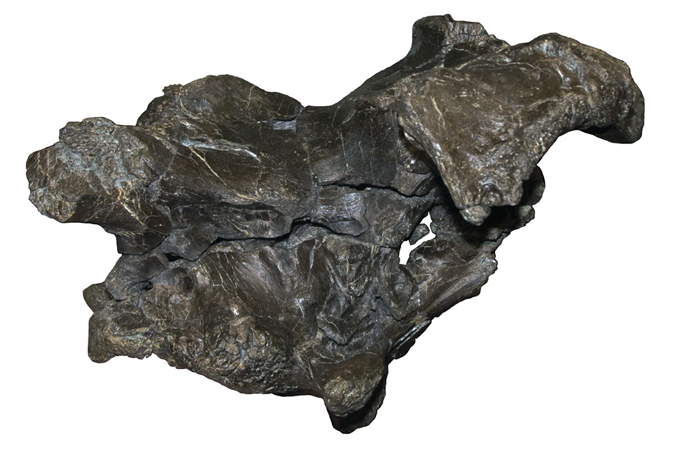
The partial skull roof and braincase of the newly described lambeosaurine Plesiolophus warnerensis. This holotype fossil is specimen number TMP 2016.023.0039. Picture credit: McFeeters et al.
Picture credit: McFeeters et al
The partial skull fossil was discovered by renowned fossil hunter Wendy Sloboda. Such is her reputation for finding fossils, Wendy has been invited to join field teams searching for dinosaur remains in Mongolia, Greenland, France and Argentina. She was honoured in 2015 with the naming of the centrosaurine Wendiceratops.
To read about the discovery and naming of Wendiceratops: Wendiceratops from Southern Alberta.
Part of the Skull Roof and Braincase
The fossil material consists of part of the skull roof and braincase from an adult animal. Despite being incomplete, the specimen preserves several distinctive anatomical features. These characteristics enabled the research team to identify it as a new genus and species. Furthermore, the skull exhibits features that firmly place Plesiolophus within the Parasaurolophini, the group that includes Parasaurolophus.
Interestingly, the skull also retains several ancestral features that had disappeared in later relatives. This unique combination of primitive and more advanced characteristics makes Plesiolophus warnerensis particularly significant. It provides a rare glimpse into an evolutionary transition that eventually led to the spectacular cranial crests seen in later lambeosaurine dinosaurs.
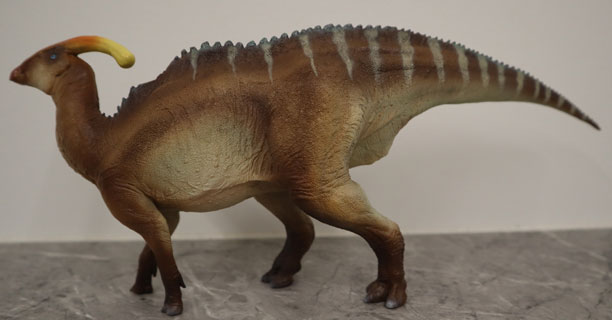
PNSO Wyatt the Parasaurolophus dinosaur model in lateral view, a stunning replica of a Late Cretaceous duck-billed dinosaur. Picture credit: Everything Dinosaur.
Picture credit: Everything Dinosaur
The image (above) shows a model of the iconic crested dinosaur Parasaurolophus. This Late Cretaceous, herbivorous dinosaur with its long head crest is one of the most recognisable of all the Dinosauria. The Parasaurolophus model comes from the popular PNSO model range.
To view the extensive range of PNSO models and figures: PNSO Age of Dinosaurs Models.
Plesiolophus warnerensis
To investigate its evolutionary relationships, the scientists compared Plesiolophus warnerensis with eighty-seven other dinosaur species. Their phylogenetic analysis consistently recovered the new taxon as one of the earliest members of the North American Parasaurolophini lineage.
The researchers noted that this newly described hadrosaur does not possess many unique features found only in this species. Consequently, they cannot rule out the possibility that it was close to the ancestry of Parasaurolophus, fossils of which occur in the younger Dinosaur Park Formation. While the available evidence does not allow the researchers to identify it as a direct ancestor, the discovery highlights an important chapter in the evolution of these remarkable duck-billed dinosaurs.
Commenting on the research, Mike from Everything Dinosaur explained:
“Discoveries such as Plesiolophus warnerensis help fill important gaps in the fossil record. Every new fossil provides another piece of the evolutionary puzzle, allowing scientists to build a clearer picture of how iconic dinosaurs such as Parasaurolophus evolved over millions of years.”
The discovery of Plesiolophus warnerensis also provides new insights into dinosaur communities that lived in Laramidia around 77 million years ago. As additional fossils are found, palaeontologists will continue to refine their understanding of how lambeosaurine dinosaurs diversified and evolved during the Late Cretaceous.
Everything Dinosaur acknowledges the assistance of Dr Bradley McFeeters who supplied the image of the dinosaur braincase included in this article.
The scientific paper: “A new parasaurolophin dinosaur (Hadrosauridae: Lambeosaurinae) from the Oldman Formation of southern Alberta” by Bradley D. McFeeters, David C. Evans, Michael J. Ryan, and Hillary C. Maddin published in the Canadian Journal of Earth Sciences.
The multi-award-winning Everything Dinosaur website: Dinosaur and Prehistoric Animal Figures.

Leave A Comment