

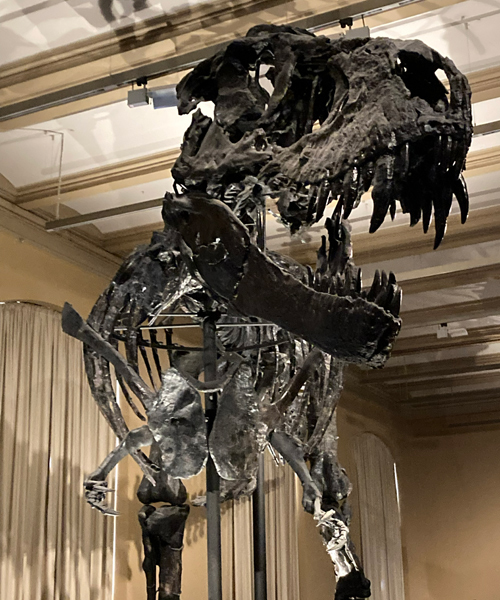
Scientists, using an innovative isotope method have calculated Tyrannosaurus rex body temperature. The novel research, published in the journal “Science Advances” sheds new light on the “King of the Tyrant Lizards”. Remarkably, this famous, carnivorous dinosaur had a body temperature comparable to our own.
Researchers used fossilised tooth enamel to estimate the T. rex body temperature. Their results suggest a temperature of approximately 36°C (97°F). Indeed, this is similar to the temperature range of healthy adult humans at around 97°F and 99°F (36.1°C to 37.2°C).
The research provides further evidence that Tyrannosaurus rex was warm-blooded (endothermic). Moreover, it helps palaeontologists understand how this enormous theropod lived and where it could survive.
Taking the Temperature of a T. rex
Scientists cannot put a thermometer into a dinosaur that died around sixty-six million years ago. However, its fossilised teeth can preserve chemical evidence relating to body temperature. Researchers from the University of California, Los Angeles (UCLA) refined a technique for analysing rare isotopes within tooth enamel. Certain isotopes of carbon and oxygen form chemical bonds together. The frequency of these bonds varies according to temperature. More bonds form at cooler temperatures, while fewer form under warmer conditions. Consequently, these chemical relationships can act as a prehistoric thermometer.
UCLA geobiologist and study co-author Robert Eagle explained:
“No one’s been able to make a temperature measurement like this before.”
The researchers calculated a temperature of approximately 36°C for T. rex with a margin of error of 2.5°C plus or minus. Furthermore, the result differs considerably from temperatures associated with many living reptiles.
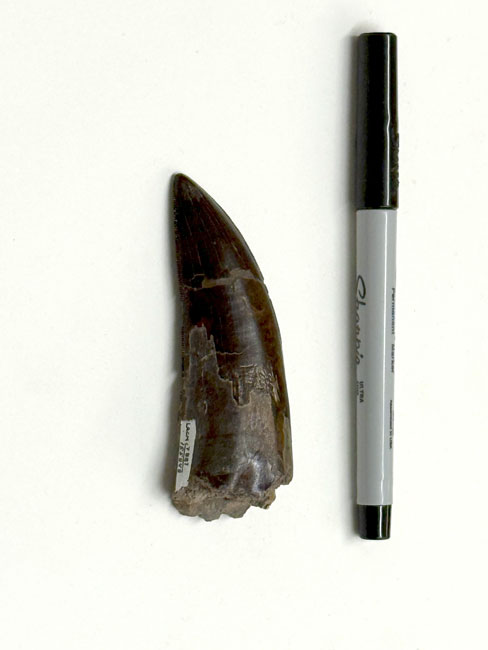
One of the T. rex teeth used to measure the body temperature of T. rex, with a sharpie pen for scale. Tooth provided by the Natural History Museum of Los Angeles County. Picture credit: UCLA.
Picture credit: UCLA
Tyrannosaurus rex Was Warmer Than Its Surroundings
Modern reptiles typically rely heavily on environmental heat to regulate their body temperatures. Reptiles are often referred to as being cold-blooded (ectothermic). In contrast, mammals and birds generate substantial amounts of heat internally (endothermy).
According to the UCLA media release, many living cold-blooded reptiles have body temperatures around 28°C to 30°C. Birds frequently maintain much higher temperatures of approximately 40°C to 43°C. Therefore, the T. rex result falls between these examples.
Importantly, the researchers concluded that the dinosaur was warmer than its surroundings. This supports growing evidence that large theropod dinosaurs possessed sophisticated metabolisms.
Robert Eagle added:
“We found T. rex was 36 Celsius (97 Fahrenheit), about the same as humans.”
This does not mean Tyrannosaurus rex regulated its temperature exactly like a modern human. Dinosaur thermoregulation remains a complex area of research. Nevertheless, the new measurement provides an important piece of direct evidence.
Dinosaur Teeth Provide the Evidence
The scientists analysed teeth belonging to “Thomas”, a Tyrannosaurus rex specimen at the Natural History Museum of Los Angeles County. This tyrannosaur was excavated from the famous Hell Creek Formation of Montana. Initially, the technique required relatively large fossil samples. Understandably, museums are reluctant to sacrifice significant portions of rare dinosaur fossils.
However, the UCLA team gradually refined its methodology. Over approximately a decade, researchers reduced the amount of fossil material required by around ninety percent. As a result, only a few milligrams were needed.
Senior author Aradhna Tripati (UCLA) explained:
“Nobody hands you a T. rex tooth unless you can show them you only need a few milligrams.”
The researchers carefully removed enamel using a dental drill. They then dissolved the resulting powder in phosphoric acid. This process released carbon dioxide containing the important isotope bonds. Subsequently, a mass spectrometer enabled the scientists to measure the isotope ratios. Tooth enamel was particularly useful for this research. Its large crystalline structures make it extremely durable. In addition, enamel resists chemical alteration after burial better than many other skeletal tissues.
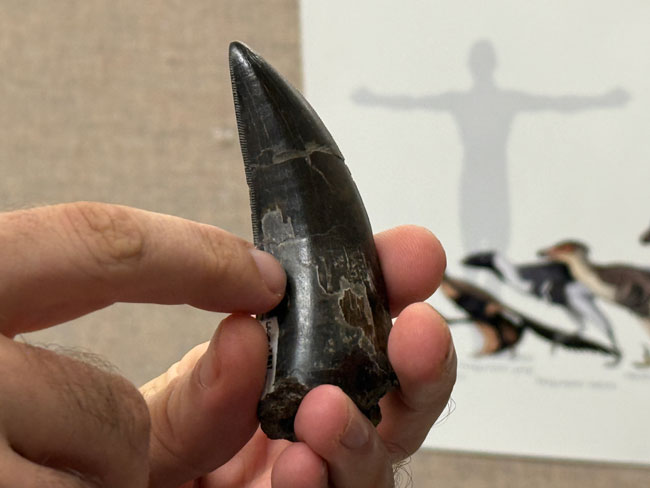
Study author and UCLA Professor Robert Eagle pointing to details on one of the T. rex teeth used to measure the body temperature of T. rex. Tooth provided by the Natural History Museum of Los Angeles County. Picture credit: UCLA.
Picture credit: UCLA
Checking Tyrannosaurus rex Body Temperature
The research team also needed to demonstrate that fossilisation had not distorted the temperature signal. Fortunately, the “Thomas” specimen came from the same locality as fossil crocodilian material available for analysis. The researchers calculated a temperature of approximately 30°C (86°F) for the crocodilian. In contrast, T. rex produced the substantially higher figure of 36°C.
If geological processes had produced the temperature signature, similar results might be expected from both animals. Therefore, the difference provides additional support for the interpretation of the tyrannosaur data.
An Active Tyrannosaurus rex
A warm-bodied Tyrannosaurus rex has important implications for how palaeontologists reconstruct this dinosaur. Maintaining an elevated body temperature requires energy. Therefore, the findings support interpretations of tyrannosaurs as active animals with relatively high metabolic demands. Such an animal would have required substantial quantities of food.
The findings are consistent with a T. rex capable of actively searching for prey and scavenging carcasses. They also move the dinosaur still further from outdated portrayals of a sluggish, lumbering reptile. Furthermore, a warmer body could have helped tyrannosaurs occupy cooler environments.
Scientific research also plays an important role in the development of accurate prehistoric animal models. Everything Dinosaur has produced a highly detailed 1:33 scale Tyrannosaurus rex, the first model in a series of four representing Hell Creek biota.
The replica reflects contemporary thinking about this iconic Late Cretaceous theropod. It forms part of a project designed to combine scientific research with highly detailed prehistoric animal replicas. It can be posed next to the Triceratops model (in development), thus reflecting the idea that it was an active predator.

Unbox history! The Everything Dinosaur Evolution T. rex model is the first dinosaur model to have a digital product passport. In addition, the plan is to remove single use plastic bags from the packaging. Picture credit: Everything Dinosaur.
Picture credit: Everything Dinosaur
Collectors can view the Everything Dinosaur Evolution Range Here.
New discoveries continue to change our perception of this remarkable predator. Evidence from its teeth now provides another fascinating insight. We at Everything Dinosaur try our best to reflect the known fossil evidence through our Everything Dinosaur Evolution range of models.
Tyrannosaurs at High Latitudes
Tyrannosaur fossils have been discovered at high northern latitudes. This raises an intriguing question about how these dinosaurs coped with cold conditions. During the Late Cretaceous, global temperatures were considerably higher than today. Nevertheless, high-latitude regions still experienced cold and prolonged winter conditions.
Study co-author Alessandro Chiarenza (University College London) used palaeoclimate models to investigate the implications. The researchers reconstructed suitable habitats stretching across North America. These extended from Mexico northwards towards Alaska.
Chiarenza stated:
“Now we have empirical evidence using this geologic thermometer.”
Significantly, fossils of many familiar reptile groups are absent from Cretaceous Alaska. Yet, tyrannosaur fossils occur at high latitudes. A warm-bodied physiology could help explain this distribution.
From Tyrannosaurs to Modern Birds
The findings also contribute to our understanding of dinosaur evolution. Birds are living dinosaurs and maintain high internal body temperatures. Therefore, researchers want to understand when elevated metabolic rates evolved within the Dinosauria. Tyrannosaurus rex belonged to the Theropoda. This enormous carnivore was consequently a distant relative of the lineage that produced modern birds. However, the estimated temperature of T. rex was lower than that of most living birds.
Robert Eagle described the result as higher than expected for a reptile or slow-moving mammal, but lower than an avian (bird) temperature. Consequently, the research provides another valuable datapoint for studying the evolution of dinosaur metabolism.
Palaeontologists have learned an extraordinary amount about theropod dinosaurs. Fossils provide evidence concerning their growth, locomotion, feeding and senses. Now, remarkably, fossil teeth can provide information about Tyrannosaurus rex body temperature too.
Aradhna Tripati commented:
“For an animal this famous, it is remarkable how little we actually knew.”
She added that thermal physiology influences behaviour, geographical range and an animal’s energy requirements. The new research therefore helps scientists reconstruct Tyrannosaurus rex as a living animal rather than simply a fossil skeleton.
New discoveries continue to change our perception of this remarkable predator. Evidence from its teeth now provides another fascinating insight. Tyrannosaurus rex was not simply enormous. It was a warm-bodied, metabolically active dinosaur capable of thriving across a surprisingly broad range of environments.
And, more than sixty-six million years later, its teeth have finally allowed scientists to take its temperature.
The research was supported in part by grants from the National Science Foundation.
Everything Dinosaur acknowledges the assistance of the University of California–Los Angeles in the compilation of this article.
The scientific paper: “The body temperature of Tyrannosaurus rex” by Randon J. Flores, Robert A. Eagle, Robin B. Trayler, Gabriele Larocca Conte, Sora L. Kim, Alfio Alessandro Chiarenza, Alex Farnsworth, Paul J. Valdes, Luis Chiappe and Aradhna Tripati published in Science Advances.


Leave A Comment