All about dinosaurs, fossils and prehistoric animals by Everything Dinosaur team members.

Everything Dinosaur team members working in schools, helping museums and other educational bodies. Our work with and in schools.

13 04, 2015

The Remarkable Achievosaurs – Reinforcing Positive Learning Behaviours

By |2024-05-05T10:24:02+01:00April 13th, 2015|Categories: Dinosaur and Prehistoric Animal News Stories, Dinosaur Fans, Educational Activities, Main Page, Teaching|0 Comments

Soft Toy Dinosaurs Helping Young Children to Learn Life Skills (Achievosaurs)

Using a range of soft toy dinosaurs to help encourage young children to learn life skills and to reinforce positive values in schools is something Everything Dinosaur team members are very familiar with.  Now that the three inch plus dinosaur range known as the Itsy Bitsies are back in production, our team members set out to examine how one teaching concept, the “Achievosaurs,” came into being.

Achievosaurs Dinosaur Soft Toys

We were contacted by retired Bristol school teacher Lori Mitchell who explained to us how her idea for using dinosaur soft toys took shape.

Ms Mitchell explained:

“The idea for the Achievosaurs came after a South Gloucestershire Early Years course “Providing Challenge, Improving Outcomes” in October 2010.  During the day, we were asked to consider how we encourage our children to reflect on their learning, rather than just talk about their activities, and how we can help them develop the skills needed to become life-long learners.  We discussed the learning-focused qualities we wanted to encourage in our children and a colleague shared the “Curious Cat” she used with her class.  One of the Early Years advisors then said something like “you know, dinosaurs would be another idea..you could have a Thinkasaurus”…and that was it…I went home after the course and devised the Achievosaurs!”

The Achievosaurs (Dinosaur Soft Toys) in 2015
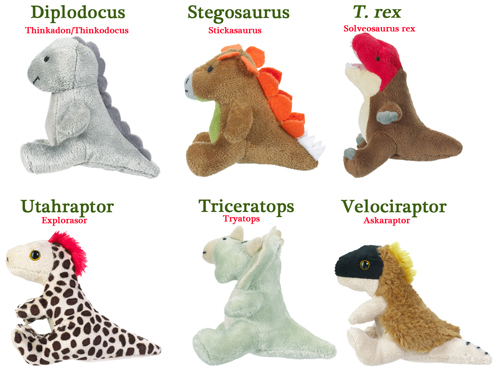
Helping to reinforce life-long learning skills.

Helping to reinforce life-long learning skills.

Picture credit: Everything Dinosaur

To view the dinosaur soft toys in stock at Everything Dinosaur: Dinosaur Soft Toys.

Soft Toys Help with Learning

With the rigours of a new curriculum being rolled out across England, there is a great deal of emphasis placed upon preparing pupils for the opportunities, responsibilities and experiences of later life.  For example, the idea of introducing scientific working and the scientific method underpins a lot of Everything Dinosaur’s teaching activities in schools.  It is essential for those children at the Early Years Foundation Stage to acquire appropriate social skills as well as developing positive behaviours to help them make good progress.

Naming the Achievosaurs

We asked Lori, how the names of the first Achievosaurs came about and she explained that she based her prehistoric animal names on the specific learning qualities that she wanted to encourage in her Reception class (FS2).  For the last seven years of her working career, before taking early retirement, Lori was a teacher at Cadbury Heath Primary School, Warmley, near Bristol, South Gloucestershire (south-west England).  Using her experience, Lori devised a series of dinosaurs (plus one flying reptile), which she could use as props to help reinforce desired behaviours.

The names of Lori’s Achievosaurs were:

  • Exploring ideas and resources: Explorasor
  • Sticking to a task: Stickasaurus
  • Sharing ideas and resources: Shareadactyl
  • Trying their best: Tryatops
  • Asking questions: Askaraptor
  • Working to solve problems: Solveosaurus rex
  • Thinking carefully about tasks: Thinkadon

Over the years we have come across a number of variants, with something like 1,200 different dinosaur genera described to date and a new one being named on average every 20-30 days or so, educationalists certainly have plenty of scope.

When asked about how she came up with her Achievosaur names, Lori said:

“When I first drafted the idea, all the names ended in “asaurus,” but when I found the wonderful collection of Itsy Bitsy dinosaurs at Everything Dinosaur, my 20 year-old son got involved (dinosaurs really are any age child friendly), and selected the dinosaurs and adapted their name to “fit,” so, for example, we took Velociraptor to make “Askaraptor”.

Sharing the Concept with Colleagues

Lori was invited to share her idea with a team of South Gloucestershire assessment co-ordinators and this simple, but very effective teaching aid has been taken up by a number of primary schools and other educational establishments.

Team members at Everything Dinosaur dedicate a lot of time to supporting teaching teams and many EYFS (Early Years Foundation Stage) and Key Stage 1 teachers incorporate a dinosaur themed topic into their scheme of work.

A spokesperson from the Cheshire based company stated that a topic based on prehistoric animals dove-tailed into desired learning outcomes across the curriculum, whether it was using the size and scale of dinosaurs to help build confidence with numbers or having a class imagine what it would be like to have a pet Triceratops in order to lay the foundations for some creative writing.

Dinosaurs as a Term Topic Can Encourage and Motivate Young Learners
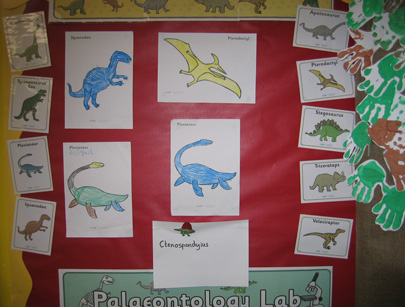
Pupils learn about the shapes and sizes of different prehistoric animals.

Pupils learn about the shapes and sizes of different prehistoric animals.

Picture credit: Everything Dinosaur

Everything Dinosaur

For further information on Everything Dinosaur’s extensive product range: Contact Everything Dinosaur.

When asked why the likes of Tyrannosaurus rex and Stegosaurus are so popular with young learners Lori suggested:

“One reason I think is their wonderful names.  They sound fascinating, and what child doesn’t like to impress an adult by knowing long words and being able to pronounce them?  Another is that, although huge and terrifying when they lived, dinosaurs are not around anymore so they can’t get us!”

Dinosaurs enduring popularity with children (quite a few adults as well), is an area that has been explored frequently.  Team member, “Dinosaur Mike”, part of the company’s teaching team was interviewed by the BBC on this subject and he hypothesised:

“Dinosaurs are never really out of the media, so children are exposed to prehistoric animals such as Diplodocus and Tyrannosaurus rex from an early age.  When talking to Mums and Dads we know how proud they are when their son or daughter explains all about their favourite dinosaur.  With so many facts and figures associated with these prehistoric reptiles, they do help sow the seeds for an appreciation of life- long learning.”

To learn more about the Everything Dinosaur team: About Everything Dinosaur.

A Big Success

Her Reception class loved the idea of Achievosaurs right from the start, but we wanted to know which was Lori’s own favourite.  Lori declared that she was very fond of them all as the encouragement these soft toys had given to her charges, getting them to think about learning skills and to develop positive behaviours, was of real benefit.

“It has been fantastic to hear the children identifying what they need to do in order to move their learning on, for example, suggesting they need to be a “Stickasaurus,” which concentrates, in order to learn their letters or a “Solveosaurus rex,” which makes links between ideas, when faced with a problem.  However, if I had to pick one favourite Achievosaur, I think it would be Tryatops”.

Lori explained:

“There is sometimes a perception that learning is just for “clever” children, and I think Tryatops helps to teach children that no matter what the activity or skill level, we can ALL try our best, never give up and in consequence, achieve.”

Tryatops Based on Triceratops

Tryatops – Based on the Horned Dinosaur Triceratops
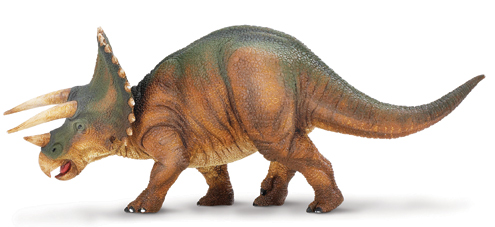
An excellent replica of a Triceratops.

An excellent replica of a Triceratops.

Picture credit: Safari Ltd/Everything Dinosaur

Not being discouraged, even when experimental results don’t quite turn out as expected, is an important aspect of scientific working.  Lessons learned early in life will help pupils face future challenges with more confidence.

In conclusion, we asked Lori if she could design her very own dinosaur what would it be like?

“The Achievosaurs were my first design attempt, with specific characteristics and names, to tie in with the Early Years Characteristics of Effective Learning.  I had a lot of fun inventing and writing about them and I couldn’t be more delighted that other Early Years professionals and schools have found the concept useful.  However, I’ve recently been thinking about the PSE side of things [personal, social and emotional development]: could an Achievosaur help children to take account of one another’s ideas (an Early Learning Goal) or be thoughtful/helpful?  What about a Respectadocus?  Now that the toys are back in production, anything is possible! “

At Everything Dinosaur we have had the privilege of working with a number of dedicated teaching professionals who have adopted and adapted dinosaur soft toys to assist them with their own learning objectives.  As a result, we have come across a large number of different Achievosaurs all aimed at reinforcing appropriate behaviours and encouraging the development of life-long learning.

Thank you Lori for being a wonderful “Shareosaurus” and sharing your story with us.
8 04, 2015

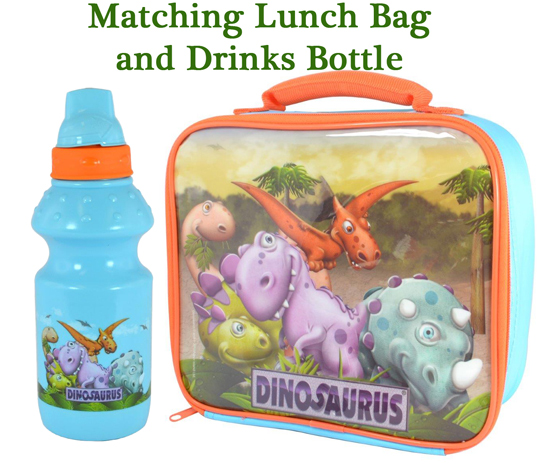
The New Dinosaurus Lunch Bag and Matching Drinks Bottle

By |2024-05-04T19:26:23+01:00April 8th, 2015|Categories: Early Years Foundation Reception, General Teaching|Comments Off on The New Dinosaurus Lunch Bag and Matching Drinks Bottle

Dinosaur Themed Lunch Bags and Bottles

The warmer weather (at least some of the time in the UK), leads to an increase in the number of children bringing packed lunches to school.  Everything Dinosaur team members have been asked to advise and recommend something suitable for very young dinosaur fans when it comes to lunch boxes and drinks bottles.  There are many different types of lunch bag and boxes on the market, but we ask parents to consider some practical points when it comes to making a purchase.

Lunch Bag and Matching Drinks Bottle

Here are some points to consider:

  • Make sure the lunch box has plenty of room so that the lunch and a drink can be fitted inside.
  • Can it be cleaned easily, at least able to be wiped over with a sponge?
  • Has it a sturdy zip and is it easy to carry for your child?
  • Has it got some insulation to help keep food fresh and cool?
  • Can it be personalised in some way, we recommend that all lunch bags/lunch boxes have a place for the child’s name?
  • Are drink bottles plastic and leak proof?

Everything Dinosaur recommends the Dinosaurus lunch bag and matching drinks bottle for young dinosaur fans.

The Dinosaurus Lunch Bag and Matching Plastic Drinks Bottle

Dinosaur themed lunch bag and matching drinks bottle.

Dinosaur lunch bag and matching drinks bottle.

Picture credit: Everything Dinosaur

To view the complete range of Everything Dinosaur back to school items: Everything Dinosaur – Back to School Items.

Please note: this article was written in April 2015 and the dinosaur lunch baga and matching drinks bottle is now longer available.

Recommended for School Use

Recommended for school use, this is an insulated dinosaur and prehistoric animal themed lunch box with a zip closure to help keep food safe.  Lunch bag can be wiped clean or sponged over.  It has a durable, padded carry handle.  A robust, plastic dinosaur drinks bottle is supplied including an attachable, leak-proof twist cap.  This is a super dinosaurus lunch bag and matching drinks bottle, ideal for school or for dinosaur expeditions!  To avoid any mix ups when it comes to dinner time, underneath the lunch bag, there is a clear plastic pocket with a card so that the lunch box owners name can be provided.

4 04, 2015

A Beautiful Dinosaur Timeline Poster

By |2024-05-05T09:41:46+01:00April 4th, 2015|Categories: General Teaching, Key Stage 1/2|Comments Off on A Beautiful Dinosaur Timeline Poster

Dinosaur Timeline Poster – A Great Educational Resource

Measuring a generous forty-two centimetres by fifty-nine and a half centimetres (42 cm x 59.5 cm), the dinosaur timeline poster provides helpful teaching support when it comes to identifying the length of the geological periods during the time of the dinosaurs and which prehistoric animals lived when.

The Dinosaur Timeline Poster

Dinosaur timeline poster.

The excellent dinosaur timeline poster.

Picture credit: Everything Dinosaur

Dinosaur Timeline Poster

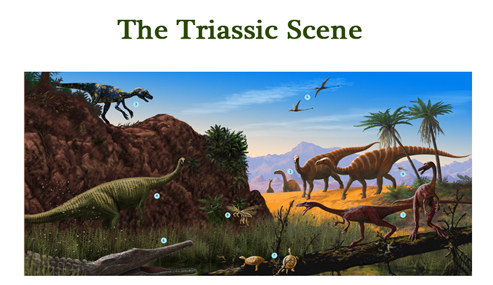
Each geological period, the Triassic, Jurassic and the Cretaceous is beautifully illustrated and each scene depicts typical animals and plants that existed during that part of our planet’s history.  In total, thirty prehistoric animals are picked out on the handy poster key and this poster is a valuable teaching resource when it comes to showing children how the world has changed.

To view the range of educational prehistoric animal themed posters available: Everything Dinosaur – Posters, Toys and Gifts.

Poster Themed Teaching Activities

  1. Block out the key using postage notes that have been cut so that they obscure the information about the length of the geological periods, challenge the class to research independently the age, length and order of the geological time periods.  Compare their answers with the information given out on the poster. Why does the length of the geological periods vary?  Over what time period in millions of years does the poster refer to- A great exercise for exploring the concept of deep time that dovetails into the section of the curriculum involving rocks and fossils.
  2. What similarities and differences can the children see in the animals and plants depicted in each scene?
  3. Can the children identify herbivores, carnivores and omnivores?
  4. What is the significance of the flowering plants/mammals/birds in the dinosaur timeline poster?
  5. Can the children write a story based on what they can see in the prehistoric scenes?

The poster is ideal for a dinosaur museum in a classroom or to be used as part of a classroom display and this dinosaur timeline poster is recommended by Everything Dinosaur and it retails at less than £2.30 plus post and packing!

The Triassic Scene from the Dinosaur Timeline Poster

A Triassic scene from the dinosaur timeline poster.

Triassic scene from the dinosaur timeline poster.

Picture credit: Everything Dinosaur

31 03, 2015

Meet a Girl Palaeontologist Rag Doll

By |2023-03-25T10:45:55+00:00March 31st, 2015|Categories: General Teaching, Key Stage 1/2|Comments Off on Meet a Girl Palaeontologist Rag Doll

Girl Palaeonlogist Rag Doll –  Encouraging Girls into Science

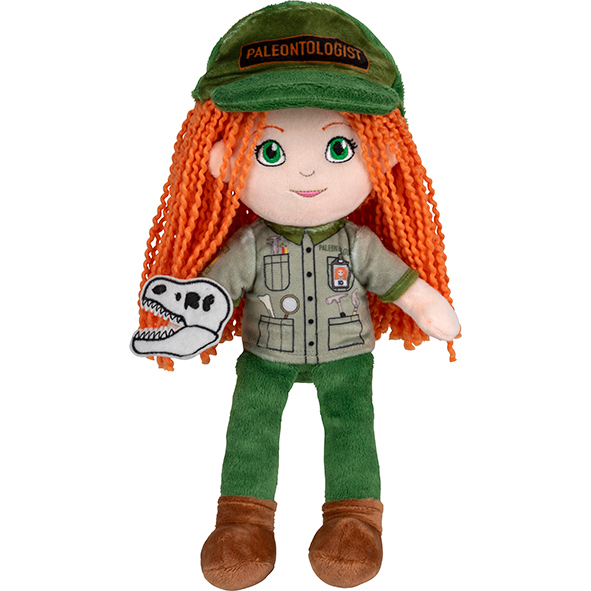
Everything Dinosaur is delighted to support science professionals and their assistants/colleagues who are keen to celebrate the role of women in archaeology, palaeontology and geology.  We at Everything Dinosaur have been lucky enough to met and work with some amazing female scientists and it is great to see a child’s doll on the market that encourages girls to explore the wonderful world of rocks and fossils.  Meet a girl palaeontologist rag doll, a modern-day Mary Anning.

A Palaeontologist Soft Toy is Available from Everything Dinosaur

Girl palaeontologist rag doll.

A prehistoric themed soft toy, a girl palaeontologist rag doll.

Picture credit: Everything Dinosaur

Girl Palaeontologist Rag Doll

The girl palaeontologist rag doll stands 30 cm high and she is obviously equipped for some series fossil hunting with her sturdy jacket, with plenty of pockets and fossil collectors cap.  This rag doll comes with a theropod dinosaur fossil to find and we are sure that this young lady is going to have some amazing fossil collecting adventures.

To view the girl palaeontologist rag doll and other educational, prehistoric animal themed soft toys: Soft Toy Dinosaurs and Prehistoric Animals.

Everything Dinosaur team members first came across this item several months ago, we have met some of the people behind her production and it is great to see a role model such as this for girls.

When we were puzzling over the name for this new doll, it was pointed out to us, very aptly by an eleven year old girl, that the name “Lottie” can be found in the word:

 PALAEONTOLOGIST.

Perhaps, we call this rag doll “Lottie”, however, the word “Ali” or “Isla” would also be fitting as these names too, can be constructed from the term “palaeontologist”.

The fossil hunter rag doll is recommended by Everything Dinosaur for its creative, imaginative play value and for the way it helps to challenge outmoded stereotypes when it comes to careers.

Visit Everything Dinosaur’s website: Visit Everything Dinosaur’s Website.

30 03, 2015

Lottie the Fossil Hunter is Great for Imaginative, Creative Play

By |2024-05-05T09:44:36+01:00March 30th, 2015|Categories: Dinosaur Fans, Educational Activities, Everything Dinosaur News and Updates, Everything Dinosaur Products, Teaching|0 Comments

Everything Dinosaur Supports Women In Science

With our school visits to deliver dinosaur and fossil themed workshops, Everything Dinosaur team members are heavily involved in helping to promote geology/palaeontology and careers in science to young people and it is wonderful to introduce a girl palaeontologist rag doll.  We are very aware of the need to promote science to both girls and boys and as we visit a large number of schools we recognise that our team members can make an important contribution.

It’s not just our school visits, we supply lots of helpful teaching resources to teachers and home educationalists and provide advice on all sorts of Earth science related subjects from “Anning to Zuniceratops” as our boss, known as “Tyrannosaurus Sue” likes to say.  This week alone, we have provided free lesson plan advice to a Year 6 teacher as they prepare to teach evolution as a term topic, supported a Key Stage 2 teaching team with their fossils and rocks scheme of work and answered questions from school leavers about the potential roles and vocations within the umbrella of palaeontology.

Fact sheets on Smilodon fatalis and Allosaurus fragilis have been emailed to India and we have supplied ammonite models to help a geologist explain about life in Jurassic marine environments – all this and it is still only Monday.

Dinosaurs and Fossils are Not Just for the Boys!

Encouraging women into the Earth Sciences!

Encouraging women into the Earth Sciences!

Picture credit: Everything Dinosaur

We have been so lucky to have met and worked with some amazing women scientists. That’s why Everything Dinosaur is delighted to introduce a “Girl Palaeontologist Rag Doll” into our extensive product range.

Girl Palaeontologist Rag Doll

Say Hello to a Girl Palaeontologist

Girl palaeontologist rag doll.

A prehistoric themed soft toy, a girl palaeontologist rag doll.

Picture credit: Everything Dinosaur

We first met this young palaeontologist quite a few months ago when she was very much at the prototype stage.  We applaud the efforts of those women behind the campaign to get more girls to study the sciences.  Celebrating the role of women in archaeology, geology and palaeontology who have done amazing work in the past, continue to do so today and will no doubt be at the cutting edge of the Earth Sciences in the future.  Our boss Sue, (volcanism is her thing), only wishes that this soft toy had been around when she was growing up.

To view Rag Doll fossil hunter and other educational soft toys: Prehistoric Animal Soft Toys.

Sue commented:

“There have been some wonderful women who have been pioneers in the development of palaeontology and geology and we are all keen to help encourage girls into science careers.  Sadly, in some quarters those Georgian/early Victorian  attitudes that dogged Mary Anning can still be found, but we are doing all we can to stress that dinosaurs and fossils are not just for boys.”

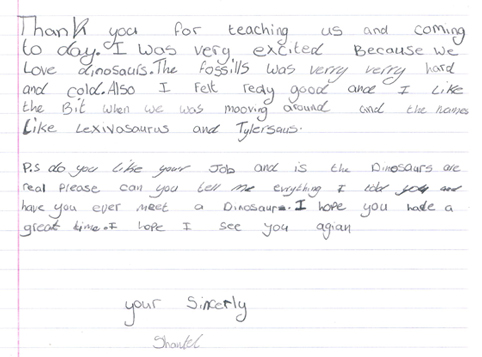
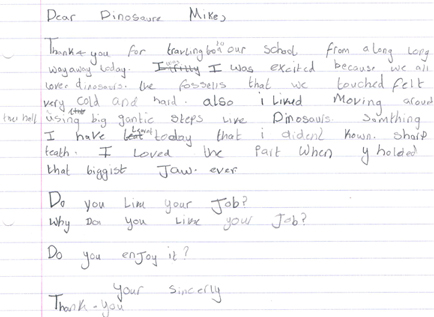
As if to affirm Sue’s comments, we received a letter from Shantel in Year 2 after a dinosaur workshop with her class.  Shantel was delighted that we came to her school as she was “very excited because we love dinosaurs”.

Shantel’s Thank You Letter (Year 2)

Encouraging girls to learn about fossils and life in the past.

Encouraging girls to learn about fossils and life in the past.

Picture credit: Everything Dinosaur

Great writing Shantel and thank you for your kind words, we know that this fossil hunter rag doll will be very impressed.

29 03, 2015

Harvard Scientists Mix Woolly Mammoth with Asian Elephant

By |2023-03-25T10:41:41+00:00March 29th, 2015|Categories: Key Stage 3/4|Comments Off on Harvard Scientists Mix Woolly Mammoth with Asian Elephant

Woolly Mammoth DNA Spliced into Asian Elephant Skin Cells – Cloning a Woolly Mammoth

A team of geneticists led by Professor George Church at Harvard Medical School have succeeded in merging fourteen genes from the Woolly Mammoth genome into skin cells from an Asian elephant that were being grown in a petri dish.  This is the first time that viable, hybrid cells have been produced.  Preliminary checks indicate that the cells are functioning normally, but this research has yet to be formally published and no peer review of the evidence has taken place.

Cloning a Woolly Mammoth

The team at Harvard, working in the largest research laboratory on the campus, have been involved in the mapping of the Woolly Mammoth genome and Mammoth experimentation for several years.  Using genetic material recovered from long dead, but very well-preserved Woolly Mammoth carcases from the frozen wastes of Siberia, the team are hoping that one day they will be able to clone a viable Woolly Mammoth and perhaps re-populate the tundra and the steppes with these elephants.

George Church is the Robert Winthrop professor of Genetics at Harvard.  He explained that although getting functioning cells was an important step, this was just part of a very long process and a Mammoth clone was still a long way off.

Outlining the research the professor explained:

“We won’t be seeing Woolly Mammoths prancing around any time soon, because there is more work to do.  But we plan to do so.”

Mammoth DNA

Inserting Woolly Mammoth genes such as those responsible for helping this type of elephant adapt to a cold environment can be regarded as an important break through, if the cells produced are functioning as they would have done without the spliced Mammoth material.  The next stage is to find a way of turning the hybrid material into specialised cells capable of producing the correct Mammoth traits and characteristics.  Asian elephants, the closest living relative to the extinct Mammoth, could be used as surrogate mothers, however, a number of animal rights groups have protested against the idea of using elephants in cloning experiments so any cells produced that would lead to an embryo may have to be adapted so that they can grow in an artificial womb.

Once an embryo had been created then there would be other difficulties, getting the baby to term, as well as the implications for science and the wider community confronting the ethical and moral issues surrounding the “de-extinction of the Woolly Mammoth”.

One Step Closer to Cloning the Woolly Mammoth?

The science behind de-extinction.

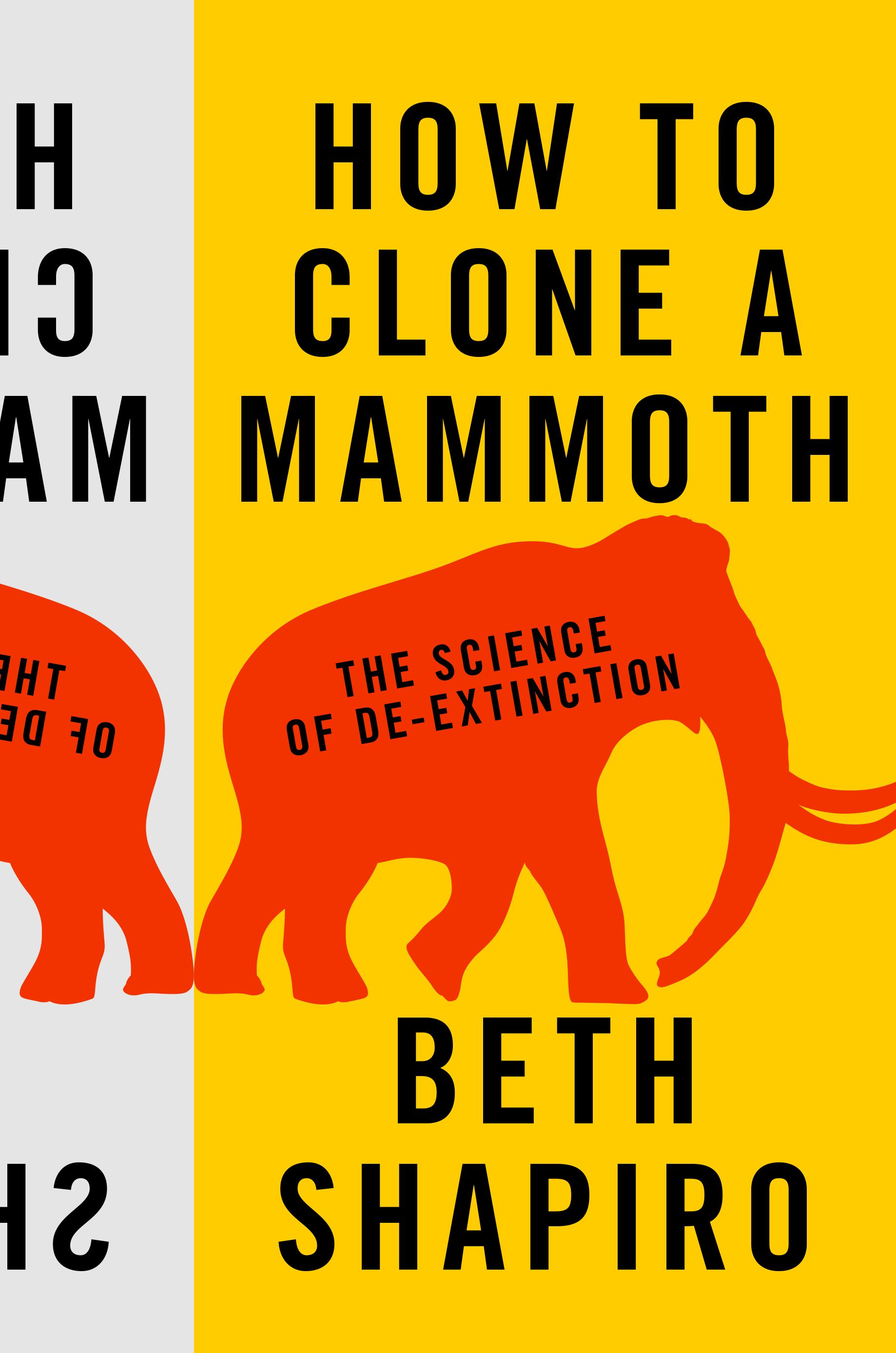
The science of de-extinction by Beth Shapiro.  Are we one step closer to cloning a Woolly Mammoth?

Picture credit: Everything Dinosaur

Activity Idea aimed at KS3 – Genetics and Evolution

Have the class research independently into the work being undertaken to clone the Woolly Mammoth (Mammuthus primigenius), then debate the moral and ethical issues raised by genetic experimentation to bring back a long extinct animal.

  • What are the implications for attempts to safeguard, extant endangered species?
  • What are the moral arguments for and against cloning in this case?
  • What implications could there be for research into the human genome and possible human cloning in future?
Carnegie Woolly Mammoth model.

A model of a Woolly Mammoth.

Everything Dinosaur stocks a wide range of prehistoric animal replicas including models of Woolly Mammoths: Models of Prehistoric Mammals.

26 03, 2015

Woolly Mammoth Genes Inserted into Asian Elephant Skin Cells

By |2023-03-25T10:27:46+00:00March 26th, 2015|Categories: Animal News Stories, Dinosaur and Prehistoric Animal News Stories, Educational Activities, Teaching|0 Comments

Potentially One Step Closer to Woolly Mammoth Resurrection (Woolly Mammoth De-extinction)

Researchers at Harvard Medical School led by genetics professor George Church have combined laboratory grown elephant cells with genetic material retrieved from the frozen remains of Siberian Woolly Mammoths.  The genetic material, a total of fourteen genes, was spliced into the skin cells of an Asian elephant (Elephas maximus), the closest living relative to the extinct Woolly Mammoth.  The results are promising with the altered skin cells functioning properly in their petri dish environment, but the scientists stress that cloning a viable Woolly Mammoth is still a very long way off.

Woolly Mammoth

Investigating the Possibility of a Return for the Woolly Mammoth (Mammuthus primigenius)

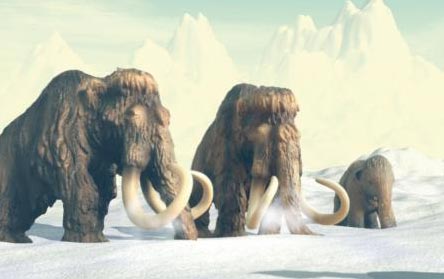
Will the Woolly Mammoth return?

Will the Woolly Mammoth return?

Picture credit: Everything Dinosaur

 Scientists from Harvard Medical School are working on a number of genetic projects, including research into the Woolly Mammoth genome.  They are however, competing against a number of other institutes including South Korea’s Sooam Biotech Research Foundation in a bid to extract viable DNA from a long dead animal with a view of investigating the possibility of cloning.

Ancient Genetic Material

The ancient genetic material was inserted into the cells using a complicated cut and splicing technique, an analogy would be to think of a film editor cutting and stitching snippets of film together so as to make a coherent movie.  The system used was CRISPR (clustered regularly interspaced short palindromic repeat).  Although this work has yet to be peer reviewed and no paper has been published describing the research in detail, preliminary findings suggest that the mutated cells are functioning normally.

If this is the case, then this is the first time that Woolly Mammoth genetic material has functioned since the very last of these Ice Age creatures became extinct the best part of 4,000 years ago.

Having a established a thorough understanding of the Mammoth genome, the team focused on identifying and then adding to the elephant skin cells those genes which are responsible for the Mammoth’s adaptations to a cold climate, genes such as those for small ears, long body hair and thick layers of subcutaneous fat.

Mammoth De-extinction

Professor Church pointed out that they were a long way off from “Mammoth de-extinction”, despite some remarkable finds in recent years, including one amazingly well-preserved female Woolly Mammoth carcase, nick-named Buttercup, that was the subject of a number of cloning documentaries that aired recently.

To read more about the Woolly Mammoth called “Buttercup”: To Clone or Not to Clone a Woolly Mammoth.

The genetics laboratory is the largest research facility at Harvard University and the researchers have been responsible for a number of important genome studies in recent years.  Much of the team’s work involves studying the human genome as well as working on how to manipulate the genes of mosquitoes to help fight the spread of malaria and other diseases such as dengue fever.

Professor Church commenting on their success with the combining of elephant cells and Woolly Mammoth genes stated:

“We won’t be seeing Woolly Mammoths prancing around any time soon, because there is more work to do.  But we plan to do so.”

Splicing the DNA into the skin cells of Asian elephants is only the first step in, what will be a very long process.  The next hurdle is to find a way of turning the hybrid cells into specialised tissues, to see if they produce the correct traits and characteristics.  For example, will the genes for small ears, actually produce ears that are small and able to lose less heat.

With animal rights groups preventing the use of elephants as surrogate mothers, hybrid cells will have to be adapt to being grown in an artificial womb.  If a viable embryo is created, then it is a case of being able to bring that embryo to term and to produce a viable offspring.

Using Mammoth DNA

If all this goes to plan and cold-adapted, hybrid elephants are produced then more and more Mammoth DNA can be introduced into subsequent generations to drive out the Asian elephant traits.  The Harvard team hope to genetically engineer an elephant that can survive in inhospitable, sparsely populated habitats, where such creatures would face fewer threats from humans.

A long term aim would be to develop herds of Woolly Mammoths, once more roaming the steppes of the northern hemisphere.

Everything Dinosaur stocks a range of prehistoric mammal models including Woolly Mammoth replicas: Models of Prehistoric Mammals.

Team members at Everything Dinosaur wait to read more about this research and to see the peer reviewed comments, although we have made a wager that by 2045, a viable Woolly Mammoth will be produced somewhere in the world.  Just thirty years to go then.

25 03, 2015

Year 2 Send Thank You Letters to Everything Dinosaur

By |2023-03-25T07:56:13+00:00March 25th, 2015|Categories: Educational Activities, Teaching|0 Comments

Schoolchildren Say Thanks after Dinosaur Workshop

Earlier this month, a team member from Everything Dinosaur visited Southglade Primary School to deliver a dinosaur workshop in support of Year two’s study topic all about dinosaurs.  As part of our follow up support for the teaching team, we discussed extension ideas and emailed over further resources to assist the enthusiastic teachers with their scheme of work.

Dinosaur Workshop

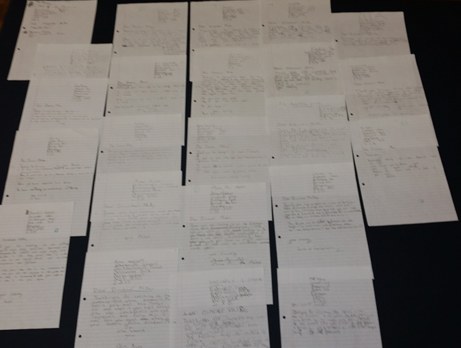
One of the things discussed was to encourage the children with their writing by asking them to write a thank you letter to Everything Dinosaur.  Sure enough, a couple of days ago we received a big envelope  from Mrs Hyland containing a super set of letters.  We have enjoyed reading them all and we have posted them up onto a notice board in our warehouse.

What a Lot of Thank You Letters we Received!

Year 2 pupils send in thank you letters to Everything Dinosaur.

Year 2 pupils send in thank you letters to Everything Dinosaur.

Picture credit: Everything Dinosaur

Thank You Letters

The children had taken great care in how they laid out their letters.  There was lots of proper addressing on display, some super, clear writing as well as effective use of punctuation.  Many of the children had incorporated some amazing vocabulary as well, words like “appreciate” and “sincerely” occasionally trip us up, so to see them used in a letter from a seven year old and spelled correctly too was fantastic!

Lots of Fantastic Letters to Read

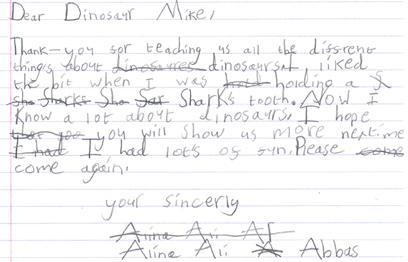
Thank you note from Alina.

Thank you note from Alina.

Picture credit: Everything Dinosaur/Alina

Dinosaur Mike who visited the school to conduct the dinosaur and fossil themed workshop exclaimed:

“We had so many letters from the children that we had to find a big space in our warehouse to lay them all out so we could take a photograph.  My colleagues and I really enjoyed reading them and I was delighted to see just how many facts that Year 2 had remembered.”

Keira, Aiden, Ella, Amr, Joy and Theo liked looking at the fossil teeth best, whilst Jude, Alex, Grace and Ewan enjoyed learning all about Triceratops.  For Tyler and Lexi-Mai they were delighted to hear all about Tylosaurus and Lexivosaurus, prehistoric animals that have names that are like their own.

Dinosaur Themed Thank You Letter

A thank you letter from Year 2.

A thank you letter from Year 2.

Picture credit: Everything Dinosaur/Aimee

Jayden, the other little boy called Theo, Milly, Kai and Demi-Lea all wanted to know whether Everything Dinosaur will be coming back to their school to teach about dinosaurs and fossils.

Young Aimee wrote:

“Thank you for travelling to our school from a long way away today.  I was excited because we all love dinosaurs.  The fossils that we touched all felt cold and hard and I liked moving around making gigantic steps just like a dinosaur.”

Ezekiel, Gracie-Jai, Amira and  Shantel asked how our dinosaur expert came to know so much about dinosaurs?  That’s easy, he had a really enthusiastic teacher at school just like the children in Year 2.

Visit Everything Dinosaur’s website: Everything Dinosaur.

23 03, 2015

Simple Dinosaur Themed Writing Exercise

By |2023-03-25T07:48:38+00:00March 23rd, 2015|Categories: Early Years Foundation Reception, Key Stage 1/2|Comments Off on Simple Dinosaur Themed Writing Exercise

Dinosaur Themed Writing Exercise for Reception and Lower Key Stage 1

Here is a simple and creative idea to encourage young children with their handwriting.  When an Everything Dinosaur team member delivered a dinosaur workshop to the Reception class at Egerton Primary School, the teacher requested if the children could write thank you letters to the dinosaur expert who conducted the morning of activities.  We were happy to oblige and to help enthuse the children, large dinosaur footprint drawings were used to create dinosaur notepaper for the budding young palaeontologists.

Lots of Dinosaur Footprint Thank You Letters from Reception

Reception children write thank you letters

Reception children at Egerton Primary write thank you notes to Everything Dinosaur.

Picture credit: Everything Dinosaur

Dinosaur Themed Writing Idea

By carefully punching a hole in the foot, a cord can be passed through the “dinosaur feet” and then a thicker pieces of coloured card can be added to the front and the back to provide the covers for a highly original dinosaur book.  This would be great as part of a literacy and writing themed section of a term topic all about fossils and prehistoric animals.

Really Simple but Effective Dinosaur Writing Idea

Thank you letters

Thank you letters shaped like dinosaur feet.

Picture credit: Everything Dinosaur

What a super, dino-tastic idea!  Notepads shaped like dinosaur feet are a great way to help encourage young children with their writing.

A spokesperson from Everything Dinosaur commented:

“What a great idea”  These dinosaur feet will help to motivate and encourage the Reception class children.”

Dinosaur Toys and Games

Everything Dinosaur stocks a wide range of dinosaur toys and games. All the merchandise has been tested and approved by the teaching team at Everything Dinosaur.

To view the extensive range dinosaur toys and games available from Everything Dinosaur’s award-winning website: Dinosaur Toys and Games for Kids.

21 03, 2015

Year 1 at Heasandford Primary School Study Dinosaurs

By |2023-03-25T07:37:05+00:00March 21st, 2015|Categories: Key Stage 1/2|Comments Off on Year 1 at Heasandford Primary School Study Dinosaurs

Dinosaur Workshops with Year 1 – Children Study Dinosaurs

Pupils in Year 1 at Heasandford Primary School in Lancashire enjoyed a dinosaur workshop conducted by team members from Everything Dinosaur this week.  The three classes in lower Key Stage 1 have been studying dinosaurs and prehistoric animals this term and a dinosaur workshop provided by Everything Dinosaur was aimed at reinforcing learning and helping the dedicated teaching team to check understanding.  The classrooms were full of prehistoric animal and fossil themed examples of work, including some very colourful poster displays.

Children Study Dinosaurs

Dinosaur Artwork on Display

Dinosaur Books - fiction and non-fiction

Helping to learn the difference between fiction and non-fiction texts.

Picture credit: Everything Dinosaur

Independent Learning

The children were keen to demonstrate how much independent learning that they had done.  The dinosaur expert was told lots of facts about dinosaurs such as Apatosaurus and Triceratops and posted up on the walls of the classroom were lots of facts about prehistoric animals.

Dinosaur Artwork Posted Up Around the Classroom

Dinosaur Artwork on Display.

Dinosaur artwork on display.

Picture credit: Everything Dinosaur

Dinosaur Workshop

The team member at Everything Dinosaur showed the children lots of fossils and he used a number of dinosaur models to help illustrate the workshop.

Dinosaur themed resources used in this workshop can be found here: Prehistoric Animal Models and Toys.

A spokesperson for the Cheshire based dinosaur company stated:

“Heasandford is one of the largest primary schools in England and this presents the teaching team with a number of challenges.  However, the teachers with the support of the rest of the staff at the school all work together to produce a co-ordinated and cohesive scheme of work that really enthuses and motivates the children.”

Go to Top