All about dinosaurs, fossils and prehistoric animals by Everything Dinosaur team members.

Pictures of fossils, fossil hunting trips, fossil sites and photographs relating to fossil hunting and fossil finds.

7 01, 2019

The Smallest Dinosaur Tracks Known to Science

By |2023-11-18T16:10:50+00:00January 7th, 2019|Categories: Dinosaur and Prehistoric Animal News Stories, Dinosaur Fans, Main Page, Photos/Pictures of Fossils|0 Comments

A New Tiny Dromaeosaurid Ichnogenus Dromaeosauriformipes

Catching up with our reading of scientific papers over the weekend and our attention was caught by the description of tiny, two-toed prints from South Korea that reaffirm the growing conviction amongst scientists that some types of non-avian dinosaur were very small, not much bigger than sparrows. The footprints might be the smallest dinosaur tracks discovered to date.

Writing in the academic journal “Scientific Reports”, researchers from South Korea, in collaboration with colleagues from Australia, China, Spain and the USA, describe eighteen diminutive, didactyl tracks that are attributed to either juveniles or tiny adult dinosaurs that may have had a hip height of around five centimetres.

Dinosaur Tracks

The tracks have been ascribed to a new ichnogenus – Dromaeosauriformipes (D. rarus), the name translates as similar in form to Dromaeosauripus*, small and rare.

A Life Reconstruction of the Recently Described Dromaeosauriformipes rarus
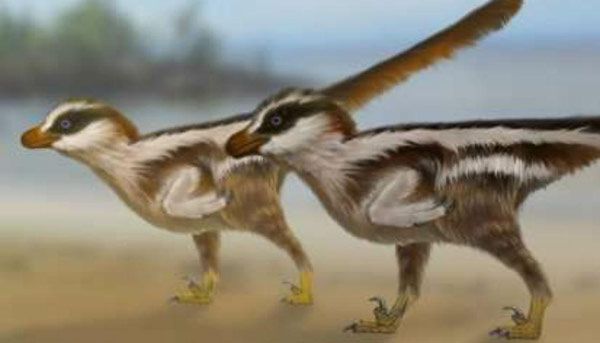
Dromaeosauriformipes illustrated.
A life reconstruction of the diminutive, dromaeosaurid ichnogenus Dromaeosauriformipes.

Picture credit: Anthony Romilio (Queensland University)

Dromaeosauripus* is an earlier described ichnogenus representing a larger set of tracks, three ichnospecies have been assigned to this ichnogenus to date.

Dromaeosauriformipes rarus – A Microsaur

The tracks were originally found by Professor Kyung Soo Kim (Chinju National University of Education, South Korea), one of the authors of the paper.  The tracks come from a series of remarkable multiple track-bearing horizons from the JinJu Formation of the south-eastern part of the Korean peninsula.  The deposits represent lakeshore sediments (Lower Cretaceous) and date from approximately 115 million years ago (Aptian faunal stage).

The trackways criss-cross an area that was once soft mud and the eighteen tracks are interpreted as representing an estimated 6 to 10 individual trackways possibly made by a similar number of different individuals.  It is suggested that the prints could resemble a Microraptor-like dromaeosaurid (microraptorine).  Some scientists have suggested that Microraptor was piscivorous (fish-eating).  The tracks found in association with a lakeshore, could represent a Microraptor-like dinosaur searching for food, but equally the tracks could represent other types of activity.

Microraptorine Activity in Lakeshore Setting (D. rarus)
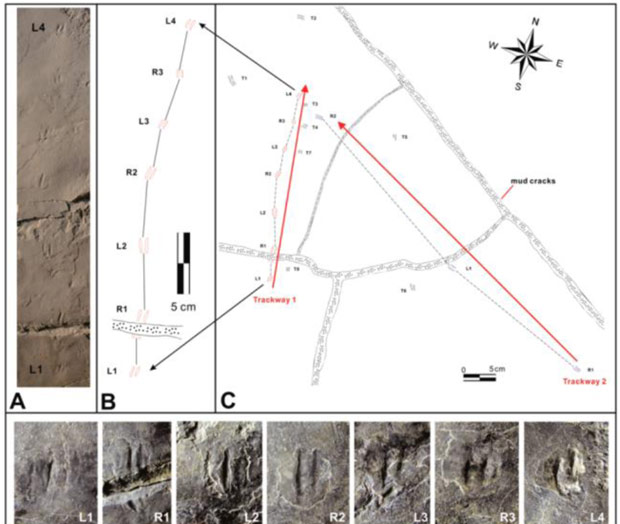
Mapping tiny tracks assigned to a dromaeosaurid dinosaur.
Diminutive dromaeosaurid tracks from South Korea (Dromaeosauriformipes rarus).

Picture credit: Scientific Reports  – original photo (A) by Professor Kim

The picture shows (A), the seven print trackway of the diminutive dromaeosaurian Dromaeosauriformipes rarus.  A line drawing of the trackway is shown (B) and (C) shows a line drawing of the track-bearing surface showing two tiny tracks but trackway 2 has a much bigger stride length indicating greater velocity than recorded in trackway 1.  Pictured below are seven photographs recording the individual prints.

One of the authors of the scientific paper, Dr Anthony Romilio from the University of Queensland stated:

“They are the world’s smallest dinosaur tracks.  These new tracks are just one centimetre in length, which means the dinosaur that made them was an animal you could have easily held in your hand.”

Hatched from Tiny Eggs

To estimate the size of the dinosaur that made the tracks, the team measured the footprint length and multiplied the value by 4.5 to get an approximate hip height.  The maker(s) of these tiny tracks would have had a hip height of around five centimetres.  The two-toed prints are definitively dromaeosaurid, as the second toe, the killing claw, is held off the ground as the dinosaur moves about, hence just two toe impressions are left behind in each print.  In the paper, the scientists comment upon the fact that these tiny dinosaurs must have hatched from very small eggs.

Back in 2016, Everything Dinosaur featured the discovery of tiny three-toed theropod prints that had been discovered in Lower Cretaceous sediments from south-western China.  As a result, a new “tiny-saurus” ichnogenus was erected – Minisauripus.  The South Korean prints assigned to Dromaeosauriformipes rarus are even smaller.

To read about the earlier discovery of tiny dinosaur footprints from south-western China: Minisauripus – the Smallest Dinosaur Known?

Professor Kyung Soo Kim commented that the lake deposits at this location created ideal conditions that allowed for the preservation of tiny footprints, rarely found anywhere else in the world.

Professor Kim added:

“In addition to tiny dinosaur tracks, we have footprints made by birds, pterosaurs, lizards, turtles, mammals, and even frogs.”

Comparing the Tracks of Dromaeosauriformipes rarus with Dromaeosauripus jinjuensis
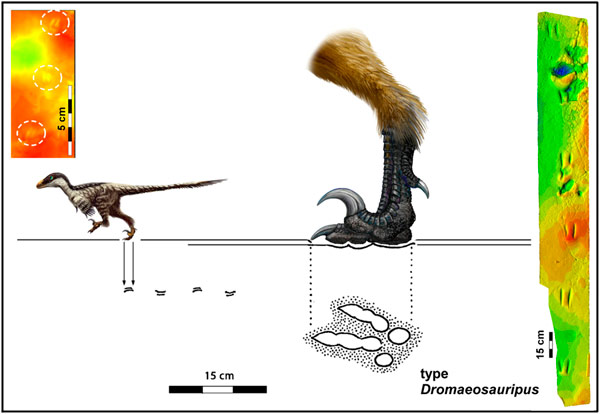
Comparing the didactyl tracks of different sized dromaeosaurid ichnogenera.
Dromaeosauriformipes rarus tracks compared in size and scale to Dromaeosauripus jinjuensis.

Picture credit: Scientific Reports

The image above compares illustrations of the tracks of  Dromaeosauriformipes rarus to the size of the trackways assigned to Dromaeosauripus jinjuensis.  Note the raised second toe which produces the characteristic two-toed print.  D rarus tracks suggest a much smaller dromaeosaur produced the tracks.  The image in the upper left is a colour photogrammetric image of Trackway 1 which helps to define track depth and characteristics.  This is compared to the photogrammetric colour image showing the type trackway of D. jinjuensis (right).

Are These Tiny Dinosaurs or Newly-Hatched Dinosaurs from a Much Larger Species?

The tracks support the idea that there may have been lots of very small dinosaurs, but their small bones would not necessarily be preserved in the fossil record so there may be a bias towards larger members of the Dinosauria due to their greater preservation potential.  However, if conditions are right, then diminutive prints and tracks can be preserved, providing tantalising evidence to support the idea of a much more diverse Theropoda then previously thought.  The researchers raise two fascinating questions in their published paper:

  1. What is the size range of “raptor” tracks based on footprints or inferred from skeletal remains?
  2. How might diminutive tracks of juveniles be distinguished from the prints made by tiny adults (microsaurs)?

Co-author Dr Martin Lockley (University of Colorado Denver’s College of Liberal Arts and Sciences), suggests that these tiny trackways could represent the prints of adult dinosaurs.

He commented:

“Rapidly growing dinosaurs don’t remain small or leave little footprints for very long.  But of all of the footprints we’ve found of the Minisauripus, none grew larger than one inch; a preponderance of evidence of a small species and not babies.  There’s a chance that we just found something smaller.”

For models and replicas of “raptors” and other prehistoric animals: Beasts of the Mesozoic Models and Figures.
5 01, 2019

First Fossil Record of a Yam from Asia

By |2023-11-18T15:39:56+00:00January 5th, 2019|Categories: Dinosaur and Prehistoric Animal News Stories, Main Page, Photos/Pictures of Fossils|1 Comment

Leaf Fossils from India Hint at the Origin of Yams

The edible, starch-filled tubers of the genus Dioscorea are an important food stuff for many people.  These flowering plants (Dioscoreaceae family), are often referred to as yams and several hundred species are known.  These plants are widely distributed throughout warm temperate, subtropical and tropical regions, but scientists were unsure of the evolutionary history of this important group of angiosperms.  However, researchers from the Birbal Sahni Institute of Palaeosciences (Lucknow, northern India), have named a new fossil species – Dioscorea eocenicus.

Ancient Yams

Two broad, heart-shaped leaf fossils unearthed at a Gurha lignite mine in Bikaner (western Rajasthan), hint that this important group of plants could have evolved on the southern super-continent of Gondwana.

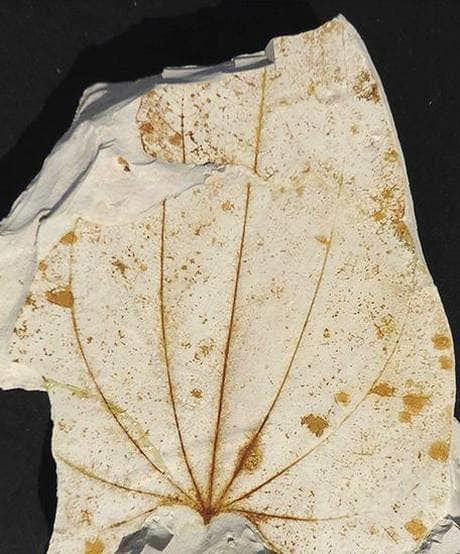
One of the Broad Leaf Fossils from the Mine – Dioscorea eocenicus

Ancient leaf fossils suggest Eocene Epoch yams.
Dioscorea eocenicus – ancient yam of the Early Eocene Epoch.

Picture credit: Rakesh Chandra Mehrotra and Anumeha Shukla published (Review of Palaeobotany and Palynology)

The First Record of Dioscoreaceae from Asia

Writing in the academic journal “Review of Palaeobotany and Palynology”, the researchers describe the two leaf fossils which measure around sixteen centimetres in length.  Comparative analysis with extant and extinct flowering plants led the authors to conclude that these fossils represent the first record of the Dioscoreaceae family from Asia.

Fossils representing ancient members of the Dioscoreaceae are known from Africa, Europe and America, but these Eocene fossils found on the Indian subcontinent suggest a southern hemisphere origin for this plant family and furthermore, it could mean that yams were present in the Cretaceous.  Perhaps, Late Cretaceous herbivorous dinosaurs fed on their leaves and succulent, energy rich tubers.

Analysis of other plant fossils found in the same deposits, reveal that when these early yams lived, Rajasthan was a humid, tropical paradise.  The climate of Rajasthan today is very different.  India’s largest state is arid and it contains the Thar Desert, sometimes referred to as the “Great Indian Desert” which covers and area bigger than the whole of England and Wales.

The scientific paper: “First Record of Dioscorea from the Early Eocene of north-western India: Its Evolutionary and Palaeoecological Importance” by Rakesh Chandra Mehrotra and Anumeha Shukla published in the Review of Palaeobotany and Palynology.

Visit the Everything Dinosaur website: Everything Dinosaur.

4 01, 2019

New Middle Jurassic Pterosaur Described

By |2023-11-18T15:24:19+00:00January 4th, 2019|Categories: Dinosaur and Prehistoric Animal News Stories, Dinosaur Fans, Main Page, Palaeontological articles, Photos/Pictures of Fossils|0 Comments

Klobiodon rochei – Fanged Flier of the Middle Jurassic

The famous Stonesfield Slate mines located in Oxfordshire have provided palaeontologists with a rich assemblage of Middle Jurassic (Bathonian), marine and terrestrial fossils, perhaps most famously, the theropod Megalosaurus, the first dinosaur to be scientifically described.  Joining “big reptile” as a member of the area’s prehistoric biota is a newly described, toothy pterosaur – Klobiodon rochei.

Writing in the academic journal Acta Palaeontologica Polonica, Dr Michael O’Sullivan, (University of Portsmouth), has reviewed the extensive but highly fragmentary pterosaur material and uncovered evidence of well-armed and substantial flying reptiles from historically important, but overlooked, British fossils.

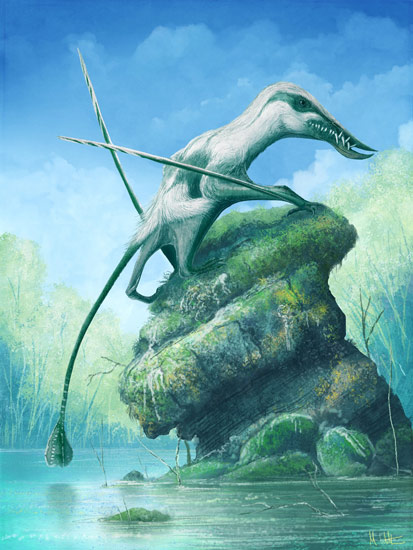
A Life Reconstruction of the Middle Jurassic Rhamphorhynchid Pterosaur Klobiodon rochei

Klobiodon rochei life reconstruction.
A life reconstruction of the Middle Jurassic pterosaur Klobiodon rochei.

Picture credit: Mark Witton

An Uexpectedly Large and Formidable Flying Reptile

Working in collaboration with Professor David Martill (University of Portsmouth), Dr O’Sullivan examined many of the 215 fragmentary pterosaur fossils that have been collected from the Stonesfield Slate mines, K. rochei is one of the largest known from any Middle Jurassic-aged deposits.  It had an estimated wingspan of two metres, making it about the size of a modern-day mute swan.  Living around 166-165 million years ago, Klobiodon is an unexpectedly large and formidably-armed species.

Commenting on the significance of the newly described member of the Rhamphorhynchidae family, Dr O’Sullivan stated:

“It’s large fangs would have meshed together to form a toothy cage, from which little could escape once Klobiodon had gotten a hold of it.   The excellent marine reptiles and ammonites of the UK’s Jurassic heritage are widely known, but we celebrate our Jurassic flying reptiles far less.  The Stonesfield pterosaurs are rarely pretty or spectacular, but they capture a time in flying reptile evolution which is poorly represented globally.  They have an important role to play in not only understanding the UK’s natural history, but help us understand the bigger global picture as well.”

Honouring Comic Book Artist Nick Roche

The genus name translates as “cage tooth”, a reference to its huge, fang-like teeth, up to 26 millimetres long, that lined the jaw (this pterosaur has been named based on the morphology of the lower mandible).  The species name honours comic book artist Nick Roche in recognition of the role this popular media has in how extinct animals are portrayed.  Comic books are a medium where prehistoric animals are portrayed in an increasingly scientifically accurate manner, Roche’s work at the turn of this century was one of the earlier examples of a revival of palaeoart.

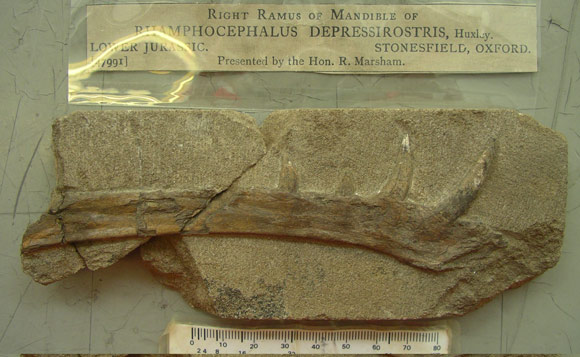
The Lower Jaw of Klobiodon rochei

Holotype fossil fo Klobiodon rochei.
The right lower mandible of the newly described Middle Jurassic pterosaur Klobiodon rochei.  The photograph shows the original label assigned to the fossil the validity of Rhamphocephalus depressirostris has now been questioned.

Only the lower jaw of Klobiodon is known, but it has a unique dental configuration that allows it to be distinguished from other pterosaurs.   It probably fed on small fish and squid, filling a role in the coastal ecosystem of an extant seagull or tern.

A Confused Pterosaur Picture

Much of Dr O’Sullivan’s research has involved untangling the messy science associated with these neglected specimens.  For example, the pterosaur specimens from the Great Oolite Group (Stonesfield Slate is a unit of the Great Oolite Group), are held in museums scattered across the world, although the majority are housed either at the London Natural History Museum or within the collection of the Natural History Museum of Oxford University.  Most of these fossils were assigned in the 19th century to the genus Rhamphocephalus and to one of three species namely: Rhamphocephalus prestwichi, Rhamphocephalus bucklandi, and Rhamphocephalus depressirostris.

This study reviewed the British Middle Jurassic Pterosauria assemblage, evaluating both their systematics and taxonomic diversity.  The holotype of Rhamphocephalus, an isolated skull table, is found to be a misidentified crocodylomorph skull and the genus is therefore considered a nomen dubium.  The holotype of Rhamphocephalus bucklandi is identified as missing and that of Rhamphocephalus depressirostris has characters diagnostic at a family level, not a generic or specific one.  Both species are considered dubious.

Klobiodon rochei

Detailed examination of the entire pterosaur fossil assemblage shows that these fossils actually represent at least five different taxa, representing three families.  The researchers propose that the fossil material includes the earliest occurrences of the Monofenestrata clade and sub-order Pterodactyloidea, that was to give rise to some of the largest flying reptiles known to science.

Dr O’Sullivan explained:

“Klobiodon has been known to us for centuries, archived in a museum drawer and seen by dozens or hundreds of scientists, but it’s significance has been overlooked because it’s been confused with another species since the 1800s.”

A spokesperson from Everything Dinosaur stated:

“The pterosaur fossils associated with Middle Jurassic deposits of Oxfordshire and Gloucestershire have been neglected.  Research undertaken in the 19th century suggested that this was a time of relatively low pterosaur diversity.  This new research suggests that this was not the case, the Bathonian pterosaur assemblage is actually quite diverse with important early representatives of key types of flying reptile having been identified from this English fossil material.”

Stonefield Slate’s Most Famous Resident

Perhaps the most famous member of the Great Oolite Group biota is Megalosaurus bucklandii, the first dinosaur to be formally described.  The name was first used by James Parkinson in 1822 and published by the Reverend William Buckland in 1824, when he described various fossil remains including an iconic lower jaw bone (right dentary).  Size estimates vary for M. bucklandii, it could have been around ten metres in length.  It was probably the apex predator within this ecosystem and it is intriguing to think that the likes of Klobiodon could have scavenged the kills of Megalosaurus.

A Life Reconstruction of the Stonefield Slate’s Most Famous Member – Megalosaurus bucklandii

A life reconstruction of Megalosaurus bucklandii.
Megalosaurus feeding.  An illustration of the Middle Jurassic Ecosystem (Great Oolite Group).

Picture credit: Mark Witton

The scientific paper: “Pterosauria of the Great Oolite Group (Bathonian, Middle Jurassic) of Oxfordshire and Gloucestershire, England” by Michael O’Sullivan and David M. Martill, published in published in Acta Palaeontologica Polonica (editor’s choice).

Everything Dinosaur acknowledges the assistance of a press release from the University of Portsmouth in the compilation of this article.

Visit the Everything Dinosaur website: Everything Dinosaur.

3 01, 2019

Picking Up a Pair of Peccaries in Tennessee

By |2023-11-18T15:17:29+00:00January 3rd, 2019|Categories: Dinosaur and Prehistoric Animal News Stories, Main Page, Photos/Pictures of Fossils|0 Comments

Picking up a Peccary or Two

Scientists from East Tennessee State University in collaboration with colleagues from the University of Tennessee and the University of California have published a scientific paper on the discovery of two types of Pliocene peccary from the famous Gray Fossil Site located Washington County (north-eastern Tennessee).

Two Types of Pliocene Peccary

The town of Gray harbours a remarkable fossil quarry that has highly fossiliferous strata that dates from around 4.9 to 4.5 million years ago.  The site represents a watery sink hole, that was once surrounded by an oak and hickory dominated forest.  Since this location’s discovery nineteen years ago, a treasure trove of vertebrate and plant fossils has been excavated, permitting palaeontologists and palaeobotanists to build up a detailed picture of the ecosystem.  Fossils of frogs, fish, salamanders and several reptiles including two types of alligator have been recorded, but perhaps the most spectacular fossils are the numerous specimens of mammals that have been discovered.

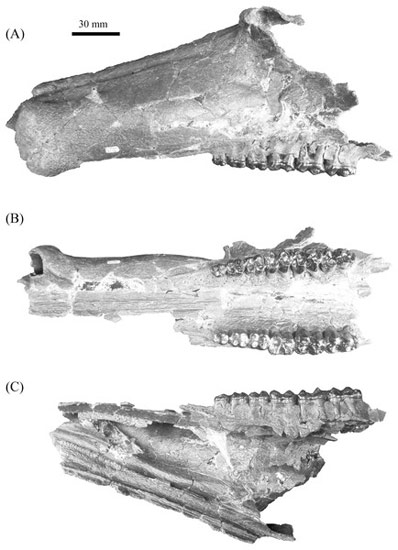
Views of part of the Skull of a Peccary from the Gray Fossil Site (assigned to Mylohyus elmorei)

Mylohyus elmorei fossil from the Gray Fossil Site.
Gray Fossil Site peccary jaw – assigned to Mylohyus elmorei. Note the scale bar = 30 mm, (A) lateral view, (B) occlusal view and (C) medial view.

Picture credit: PeerJ

Field teams have found evidence of short-faced bears, dwarf tapirs, sabre-toothed cats, prehistoric elephants (gomphotheres and Mastodons), camels, as well as rodents, bats and rabbits.  Scientists can add another animal to the ecosystem – a peccary, to be precise, fossils of two different types of peccary have been found.

Prehistoric Peccaries

Peccaries may look like pigs but they are not true pigs (members of the Suidae family).  Peccaries, or as they are sometimes known javelinas, are assigned to a different family (Tayassuidae).  They probably share a common Eocene ancestor with the true pigs, however, by around 35 million years ago peccaries were established in North America and they have evolved independently away from European and Asian suoids.

Writing in the academic journal “PeerJ”, the researchers identify two different extinct species of peccary from skull and jaw fossils found at the site.  The species are Mylohyus elmorei and Prosthennops serus.  They are not new to science, after all the genera were erected in 1860 and 1877 respectively but neither of these extinct species has ever been found in this part of the United States before.  P. serus has been found in fossil sites around the United States, but never before in the Appalachian region.  With the confirmation that the Gray Fossil Site contains specimens of Mylohyus elmorei, the range of this species has been extended by over 500 miles northwards.

The Lower Jaw of the Extinct Peccary Prosthennops serus

Prosthennops serus lower jaw.
The lower jaw of Prosthennops serus.  Note how the large canine teeth in the front of the jaw point straight up, this is an important characteristic that helps to distinguish peccary fossils from the fossils of true pigs (Suidae).

Picture credit: East Tennessee State University

Commenting on the significance of the published paper, Dr Chris Widga (East Tennessee State University Museum of Natural History at the Gray Fossil Site), stated:

“Details of the peccaries’ teeth suggest that they spent their lives browsing on the leaves and fruits of succulent plants, so they would have been right at home in the Gray Fossil Site ecosystem, which we know from plant fossils was rich with tasty vegetation.”

How to Tell a Peccary from a Pig (True Pig)

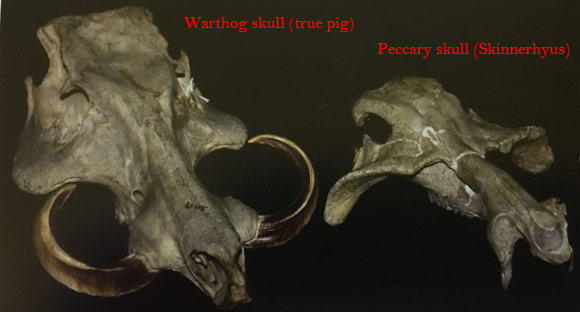
Peccaries look superficially like pigs, they fill the same niche in the ecosystem (ground dwelling omnivores), but there are a number of striking anatomical differences.  The canine tusks of peccaries are always very simple, either pointing up or down.  In contrast the canine tusks of true pigs usually are more elaborate affairs, with distinct curves and often flaring out to the side.  Peccary skulls tend to be much narrower and much shorter than pig skulls.

Comparing the Skull of a Pig (Warthog) to that of a Peccary

A pig skull (warthog) compared to a peccary skull.
Comparing a pig skull (left) with a peccary skull (right).

Picture credit: Christine Janis (Brown University) with additional annotation by Everything Dinosaur

The Gray Fossil Site

The Gray Fossil Site peccary material will help scientists to better understand subtle variations within each peccary species (intraspecific variation), which will aid peccary fossil interpretation and classification.  In addition, the Gray Fossil Site material includes the most complete mandible found to date of Mylohyus elmorei.

Everything Dinosaur acknowledges the assistance of a press release from the East Tennessee State University in the preparation of this article.

The scientific paper: “First Occurrence of the Enigmatic Peccaries Mylohyus elmorei and Prosthennops serus from the Appalachians: Latest Hemphillian to Early Blancan of Gray Fossil Site, Tennessee” by Evan M. Doughty​, Steven C. Wallace, Blaine W. Schubert and Lauren M. Lyon published in the journal PeerJ.

Visit the Everything Dinosaur website: Everything Dinosaur.

31 12, 2018

Scientists Publish Seminal Research into Plant Fossils

By |2023-11-14T13:44:06+00:00December 31st, 2018|Categories: Dinosaur and Prehistoric Animal News Stories, Main Page, Palaeontological articles, Photos/Pictures of Fossils|0 Comments

Permian Tropical Lowlands – A Hot Spot for Plant Evolution

Over recent days, team members at Everything Dinosaur have been reviewing the breadth and scope of the articles posted on this blog in the last twelve months.  The number of Sauropodomorpha themed articles (sauropods and their ancestors), has been commented upon.  There have certainly been some amazing early, long-necked dinosaur discoveries, but we have also had a lot of exciting fossil discoveries concerning the Plantae Kingdom to write about too.  In 2019, we have reported on research that suggests the very first land plants evolved earlier than previously thought.  We have also written about new compelling evidence that suggests that flowering plants (angiosperms), were present during the Middle Jurassic.

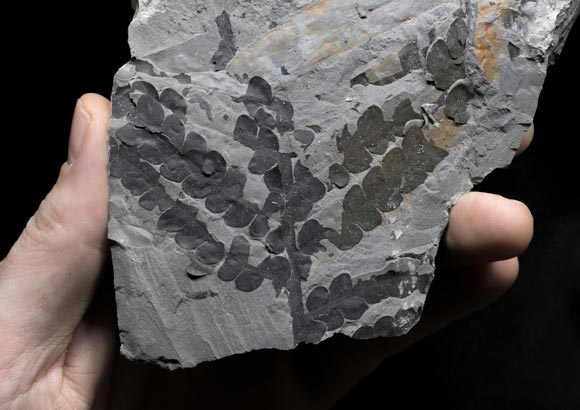
The Preserved Remains of a Seed Fern (Upper Permian Deposits – Jordan)

The fossilised remains of a seed fern.
A beautifully preserved seed fern frond in mudstone from the Jordan (Upper Permian).

Picture credit: Palaeobotany Research Group, University of Münster/Blomenkemper et al

It seems fitting that our last post for 2019, once again looks at some remarkable plant fossil discoveries.

Scientists led by palaeobotanists from the University of Münster (western Germany), have uncovered a series of well-preserved fossils representing important plant groups from Upper Permian rocks at a site in Jordan.  The location, on the Dead Sea, has revealed the fossils of three major plant lineages:

  1. Podocarpaceae – a type of conifer, an evergreen tree
  2. Corystospermaceae – a type of seed fern (Pteridosperm)
  3. Bennettitales – cycad-like plants which produced seeds in cone-like structures

All the fossils pre-date the End-Permian extinction event that wiped out around 95% of all the life on our planet and the fossils prove that all three plant groups evolved millions of years earlier than previously thought.  For example, the now extinct Bennettitales were thought to have evolved sometime in the Triassic.  These fossils confirm that their evolution took place much earlier and that all three types of plant evolved before and persisted through the greatest mass extinction event known in Phanerozoic Eon.

A “Hidden Cradle of Plant Evolution”

Fossilised twigs representing the Podocarpaceae, commonly referred to as southern conifers, as the vast majority of extant species are found in the Southern Hemisphere, have been found.  These fossils represent the oldest record of any living conifer family.  In collaboration with colleagues from the Smithsonian Institute (USA) and scientists from the University of Jordan, the team also discovered the preserved, carbonised leaves and reproductive organs of Corystospermaceae, a group of seed ferns that went extinct some 150 million years ago, as well as remains of Bennettitales, a peculiar lineage of extinct seed plants with flower-like reproductive organs.

Trekking Through the Wadis on the Dead Sea Coast Looking for Plant Fossils

Exploring the Dead Sea coast of Jordan for Permian plant fossils.
Exploring Upper Permian fossil deposits for evidence of an ancient, lowland plant community.

Picture credit: Palaeobotany Research Group, University of Münster/Blomenkemper et al

Evidence for the unexpectedly early occurrence of Corystospermaceae in the Permian of Jordan was first published about ten years ago by a research team led by Prof Dr Hans Kerp.  Since then, researchers have uncovered not only the well-preserved leaves but also the characteristic reproductive organs of this group of plants.  Like Bennettitales and Podocarpaceae, these plants were believed to have evolved millions of years later during the Early Mesozoic.

One of the co-authors of the scientific paper, published in the journal “Science”, Benjamin Bomfleur (Palaeobotany Research Group, University of Münster), stated:

“Analysis of characteristic epidermal cell patterns enabled us to resolve the systematic relationships of the plant fossils more precisely.  The study area is really exceptional, like a melting pot of floral provinces.”

An Unusual Mix of Plant Taxa

The researchers noted that the plant fossils at the site represent a diverse and very mixed assemblage of plant types.  The sedimentary deposits were laid down in an equatorial coastal environment with a distinct dry season – an ecosystem that rarely preserves delicate plant fossils.  The scientists conclude that, early evolutionary innovations can occur in drought-prone tropical habitats which rarely offer the conditions needed for fossil preservation.

Dr Bomfleur added:

“The occurrence of no less than three major ‘modern’ plant groups in deposits of just this single rock formation may indicate that such stressed and disturbance-prone tropical environments may have acted as evolutionary cradles also for other plant groups.”

Exquisite Details Revealed by Acid Etching

Once the fossil material had been collected by the field team, a variety of methods were employed in the preparation laboratory to help identify the plant types the fossils represented.  Powerful acids were used on some specimens to prepare plant cuticles for detailed microscopic analysis.  It can be very difficult to distinguish pteridosperms from ferns based on foliage alone.  Similarly, the fossil leaves of cycads are very difficult to tell apart from those of true Bennettitales.  Identification is usually confirmed by examining microscopic details preserved in cells and on the cell wall of the cuticle, hence the need to use a variety of delicate techniques to reveal fine details.

Careful Exposure to Acids Helps Prepare Delicate Fossils for Microscopic Analysis

A seed fern frond is prepared for analysis.
A fragment of a seed fern frond after acid preparation.

Picture credit: Palaeobotany Research Group, University of Münster/Blomenkemper et al

Survivors of a Mass Extinction Event

The plant fossils have been dated to approximately 255 million years ago (Lopingian Epoch of the Late Permian), so this ecosystem existed just a few million years prior to the “Great Permian Dying”, a mass extinction event that devasted both marine and terrestrial ecosystems.  The unexpected discovery of these three main groups of plants prior to this extinction event, not only pushes back the origins of these plant types in time, but also proves that all three groups survived the End-Permian extinction event.

Some of these lineages appear to span the mass extinction event, which suggests that the communities they supported may have been more stable than expected over this period of dramatic transition and change.  Thus, early evolutionary innovations can occur in drought-prone tropical habitats, which rarely offer the conditions needed for fossil preservation.  Seasonally dry tropical environments could be described as “cradles of evolution”.

The scientific paper: “A Hidden Cradle of Plant Evolution in Permian Tropical Lowlands” by Patrick Blomenkemper, Hans Kerp, Abdalla Abu Hamad, William A. DiMichele and Benjamin Bomfleur published in the journal Science.

Everything Dinosaur acknowledges the assistance of a press release from the University of Münster in the compilation of this article.

To read Everything Dinosaur’s blog post on the idea that the first land plants evolved millions of years earlier than once thought: Plants May Have Originated 100 Million Years Earlier.

To read Everything Dinosaur’s article about the discovery of fossils representing very early flowering plants: The First Flowering Plants Originated in the Early Jurassic.

Visit the Everything Dinosaur website: Everything Dinosaur.

26 12, 2018

“Little Foot” Reveals Her Secrets

By |2023-11-14T12:08:08+00:00December 26th, 2018|Categories: Dinosaur and Prehistoric Animal News Stories, Main Page, Palaeontological articles, Photos/Pictures of Fossils|0 Comments

Fourteen Years of Work to Tell the Story of “Little Foot”

Christmas is a time for family get togethers and spending time with relatives.  Today, we feature the astonishing story of the remarkable and nearly complete fossilised skeleton of an australopithecine nicknamed “little foot” a member of the Hominidae family and as such, a long, distant relative of us all.  The Sterkfontein Caves in South Africa are located around twenty-five miles north-west of Johannesburg in Gauteng Province (South Africa).

Numerous fossils of hominids are known from the Caves and the surrounding area, which is called the Cradle of Humankind and Everything Dinosaur has reported on several recent and highly significant australopithecine fossil finds, however, at an estimated 3.67 million years of age, “little foot” is the oldest australopithecine specimen ever found in southern Africa.

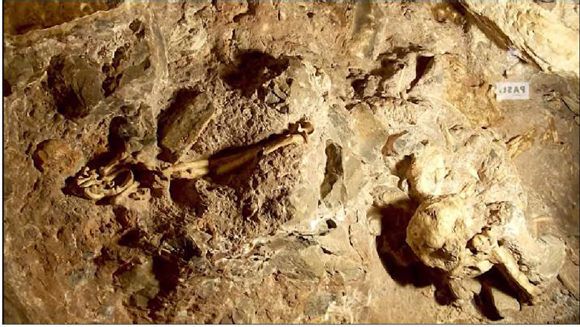
The Partially Uncovered Remains of the Australopithecine Nicknamed “Little Foot”

In situ fossils of the Australopithecine "little foot" in the Sterkfontein Caves.
The fossilised remains of the Australopithecus nicknamed “little foot” found in the Sterkfontein Caves.  The skull can be seen in the bottom right corner of the photograph.

Picture credit: PAST/Paul Myburgh

Lead researcher Professor Ron Clarke and his team have published the first, formal scientific description of the fossil material in the “Journal of Human Evolution”.  Such is the completeness of the skeleton, that anthropalaeontologists confidently predict that many more papers will be written, as this is the only known, virtually complete fossil skeleton of an Australopithecus discovered to date.  It has taken fourteen years of painstaking work to excavate the fossils and six years to clean and prepare them for detailed study.

Dedicated Research Leads to Scientific Breakthrough

In 1994 and 1997, Professor Clarke identified twelve foot and lower leg bones of one Australopithecus individual misidentified as animal fossils in boxes stored at Sterkfontein and at the University of Witwatersrand (Johannesburg).  Clarke and his assistants, Nkwane Molefe and Stephen Motsumi, then looked for and located the very spot where the bones had been blasted out by lime miners, probably sometime in the 1920s deep inside the Sterkfontein Caves.  It was a real case of detective work, as Nkwane and Stephen worked in the caves to try to identify the very spot where the fossils that had been stored in the boxes, actually came from.

After one and a half of days of carefully searching the caves, they found that the pieces matched with two broken-through shin bones in a concrete-like cave infill and started the excavation process, first with hammer and chisel to remove the overburden, before turning to the painstaking process of locating and exposing the bones with an airscribe.

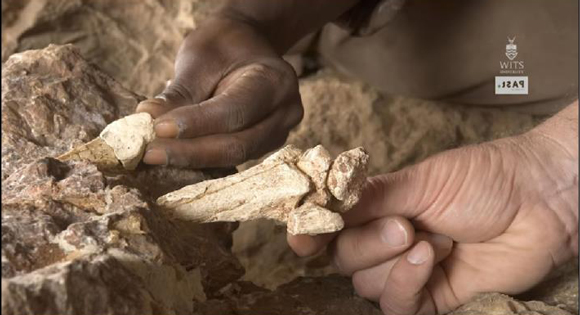
The Researchers were Able to Locate the Rest of the Skeleton by Matching Pieces Together

Identifying the rest of the "little foot" skeleton.
Researchers demonstrate how the rest of the skeleton was found by matching fragments of limb and ankle bones to fossil material exposed in the cave.

Picture credit: PAST/Paul Myburgh

Unusual Taphonomy of the Female Australopithecine

The taphonomy of “little foot” is unusual.  The female (identified by the shape of the pelvis), fell into a cave and the body became mummified in the exceptionally dry conditions.  The absence of predators allowed the body to remain undisturbed but at some time in the past there was a slight displacement of some skeletal parts through slippage on the rock-strewn talus slope in the cave, crushing and breaking of some bones through rockfall and pressure, calcification after a change to wet conditions, and then slight downward collapse of part of the cave infill.  This partial collapse left voids that were later filled with stalagmitic flowstone that encased breaks through the femurs.

When the first attempts to date the fossils was made, an analysis of the stalagmite flowstone encasing the fossil was made.  However, the flowstones were later infills in voids created by the collapse that had broken and displaced parts of the skeleton.  The data gave a more recent date for the fossil, “little foot” was actually much older, having lived during the Zanclean stage of the Pliocene Epoch.

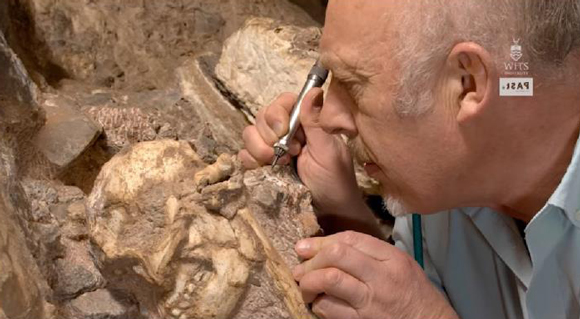
Professor Ron Clarke Demonstrates the Use of an Airscribe

Professor Ron Clarke demonstrates the use of an airscribe.
Professor Ron Clarke showing how an airscribe was used to remove the surrounding matrix.

Picture credit: PAST/Paul Myburgh

Commenting on the earlier attempts to date the skeleton, Professor Clarke stated:

“The flowstones do not date the skeleton.  In 2015, cosmogenic isochron dates using 26Al and 10Be were published in Nature, showing that the age of the actual breccia containing the skeleton dates back ca 3.67 million years.  This is consistent with the original age estimates of around 3.5 million years that were proposed based on the low stratigraphic position of the deposit within the cave.”

Helping to Reassess the Australopithecus Genus

Study of the anatomical features of “little foot” suggests that the skeleton is most similar to the australopithecine known as A. prometheus, which was proposed as a species in 1948 by the famous anthropologist Raymond Dart.  The phylogeny of the australopithecines and related genera is controversial.  It is hoped that the virtually complete skeleton, so painstakingly excavated, will shed new light on taxonomic relationships, helping to fill in a number of evolutionary gaps.

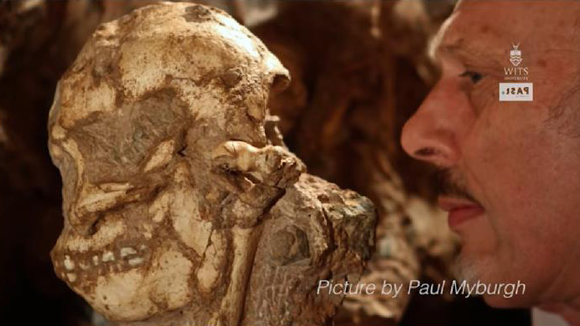
Professor Ron Clarke and the Skull of “Little Foot”

The skull of "little foot" with Professor Ron Clarke
Professor Ron Clarke with the skull and left humerus of “little foot”.

Picture credit: PAST/Paul Myburgh

Everything Dinosaur acknowledges the assistance of a press release from the University of Witwatersrand and supporting materials in the compilation of this article.

Visit the Everything Dinosaur website: Everything Dinosaur.

23 12, 2018

Evidence That Sharks Fed on Pterosaurs Identified in New Research

By |2024-05-10T18:48:40+01:00December 23rd, 2018|Categories: Dinosaur and Prehistoric Animal News Stories, Dinosaur Fans, Main Page, Photos/Pictures of Fossils|0 Comments

Cretoxyrhina Tooth Embedded in the Neck of a Pteranodon

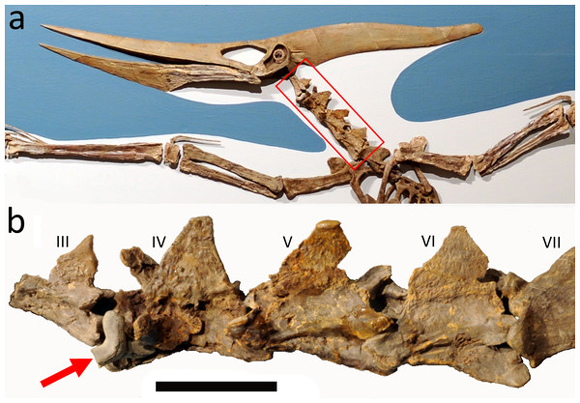
There has been quite a lot of media coverage this week, following the publication of a scientific paper that described the interaction between a shark from the Western Interior Seaway (Cretoxyrhina mantelli) and a pterosaur (Pteranodon).  A single tooth from the shark, was discovered wedged against the fourth cervical vertebra (fourth bone in the neck), of the flying reptile.  The association of the tooth and its proximity to the vertebra suggests that the preservation of bone and tooth together was more than mere coincidence.  The specimen is evidence of a Cretoxyrhina shark biting a Pteranodon.

Evidence for a Shark Bite on the Neck of a Pterosaur

Shark tooth found in association with pterosaur cervical vertebrae.
Evidence of a shark bite on the neck of a pterosaur.  The red arrow indicates the location of the shark tooth and its association with cervical vertebra IV.  Scale bar = 5 cm approximately.

Picture credit: (A) Stephanie Abramowicz, courtesy Dinosaur Institute, Natural History Museum of Los Angeles County, (B) David Hone

The Pteranodon specimen is housed in a glass case at the Los Angeles Museum of Natural History, so the researchers, David Hone (University of London), Mark Witton (Portsmouth University) and Michael Habib (University of Southern California), had difficulty in obtaining direct access to the fossils.  However, undeterred they made measurements of the embedded fossil tooth and it is estimated to be 24 mm high (root plus crown) and its morphology suggests that it came from a well-known lamniform shark from the Western Interior Seaway – C. mantelli. 

Based on the tooth dimensions, the shark is estimated to have been around 2.5 metres long, big, but not as large as some Cretoxyrhina mantelli specimens, this species of Late Cretaceous shark is believed to have reached lengths of around seven metres, making it larger than the extant Great White (C. carcharias).

Identifying the Attacker

Teeth associated with lamniform sharks are particularly common in marine deposits associated with the Western Interior Seaway.  The morphology of the tooth suggests that this tooth came from Cretoxyrhina mantelli and this fossil specimen (LACM 50926), is the first documented occurrence of this large shark interacting with any type of flying reptile.

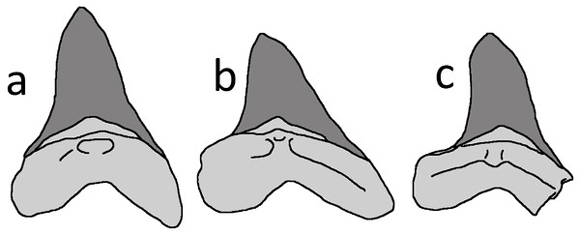
Typical Teeth Morphologies Associated with C. mantelli

Examples of Cretoxyrhina mantelli teeth from the front portion of the jaws.
Tracing of Cretoxyrhina mantelli anterior teeth.  The root of each tooth is shaded pale gray, whilst the crown is dark gray.  Tooth (a) is position 3 in the jaw, (b) represents a tooth from position 4, whilst (c) is a representation of the fossil tooth found in close association with the Pteranodon cervical vertebra.

Picture credit: David Hone

Evidence of Cretoxyrhina Biting Pteranodon

It is not possible to state categorically, whether the fossil specimen (LACM 50926), is evidence of predation or whether the shark took a bite out of a Pteranodon carcase.  Several examples of Cretoxyrhina spp. feeding traces are known on the fossilised remains of other vertebrates from the Western Interior Seaway.  In addition, there is evidence to suggest other types of fish, including sharks, consumed Pteranodon.  This is the first example of an interaction between Cretoxyrhina and “toothless wing”.

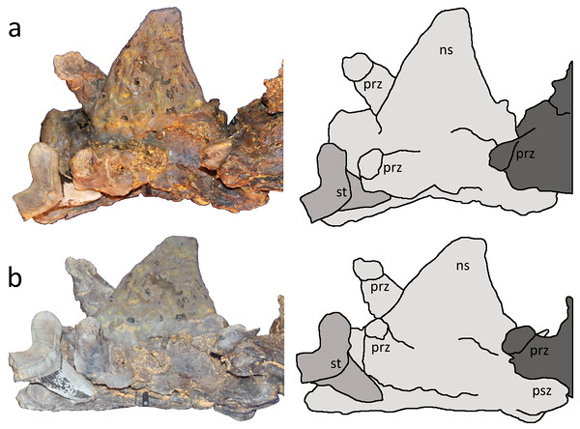
A Close-up View of the Neck Bone and the Shark Tooth

Cretoxyrhina tooth embedded in a pterosaur bone.
Shark tooth embedded in a Pteranodon neck bone.  Two views (a and b) of the tooth in association with the pterosaur vertebra and accompanying line drawings.

Picture credit: David Hone

Spectacular Palaeoart

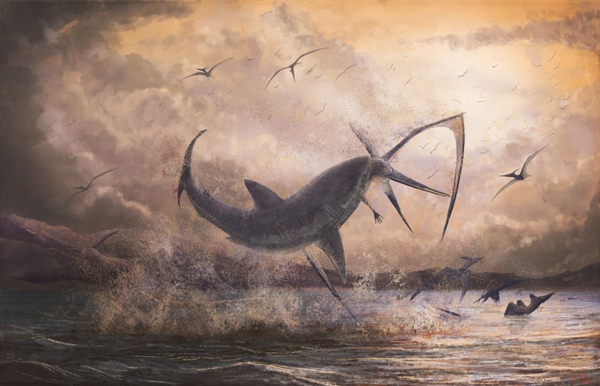
One of the co-authors of the paper, Mark Witton, is a highly respected palaeoartist, as well as an authority on the Pterosauria.  He has produced a stunning illustration of a Cretoxyrhina shark leaping out of the water as it bites the neck of a Pteranodon.

A Large Pteranodon Meets Its End in the Jaws of a Cretoxyrhina Shark

Cretoxyrhina shark attacks a flying reptile (Pteranodon).
A Cretoxyrhina shark leaps from the water as it attacks a Pteranodon.

Picture credit: Mark Witton

Pteranodon is widely believed to have foraged for small fish and other aquatic prey by alighting on the water and dip-feeding.  Once on the surface of the sea, it would have been within the reach of predatory sharks, although whether the breaching Cretoxyrhina portrayed by Mark Witton accurately depicts an attack by the shark on a pterosaur is open to speculation.  However, the image is visually stunning and as marine seabirds today are actively predated by sharks, an example being Tiger sharks attacking fledgling albatross chicks, such a dramatic scene could have taken place on the waters of the Western Interior Seaway.

However, the tooth in association with the cervical vertebra could have resulted from the scavenging of a pterosaur carcase.

Not All That it Seems

The Pteranodon fossil in the display case is not all that it seems.  Like many museum specimens, it is a composite, it is made up of bones from several animals to help make the skeleton more complete.  Furthermore, part of the fossil display is genuine, but numerous elements have been reconstructed to replace absent parts.

The authors note that the preservation quality and size of the vertebrae correspond well to the other elements (including the forelimb bones) and this implies that LACM 50926 may represent much of a skeleton.  However, the absence of both anteriormost and posterior cervical vertebrae means no anatomical continuity links the 50926 vertebrae with the rest of the material and subsequently, their association to the rest of the skeleton cannot be stated confidently.

A Link Between a Feeding Cretoxyhina and a Pteranodon

With all this said, LACM 50926 is the first palaeoecological link between a feeding Cretoxyrhina mantelli and a Pteranodon.  Such evidence of interactions like this are very rare in the fossil record.  Pteranodon seems to have been a relatively common flying reptile, it makes up some 97% of the Niobrara Formation pterosaur fossil finds.  Sharks feeding on large pterosaurs such as Pteranodon may have been a more frequent occurrence, but the hollow bones of these flying reptiles may have broken quite easily when subjected to the biteforce of a shark and so the likelihood of any fossil evidence being preserved would be diminished.  Chances are the evidence of such interactions just got consumed.

The scientific paper: “Evidence for the Cretaceous Shark Cretoxyrhina mantelli feeding on the pterosaur Pteranodon from the Niobrara Formation” by David W. E. Hone, Mark P. Witton and Michael B. Habib and published in the open access journal PeerJ.

Visit the Everything Dinosaur website: Everything Dinosaur.

22 12, 2018

New Giant Early Jurassic Predator from Italy

By |2023-11-14T07:33:14+00:00December 22nd, 2018|Categories: Dinosaur and Prehistoric Animal News Stories, Dinosaur Fans, Main Page, Photos/Pictures of Fossils|0 Comments

Saltriovenator zanellai – One Tonne Giant and Oldest Ceratosaurian Described to Date

Scientists from Natural History Museum of Milan and the Geological Museum of Bologna (Museu di Storia Naturale di Milano and the Museo Geologico), have published a scientific paper on a new predatory dinosaur from the Lombardy region of northern Italy.  This new species was a giant, weighing around a tonne and measuring approximately 7.5 metres in length. It lived some 25 million years before other known big predatory dinosaurs evolved and examination of the fossilised bones suggest that this dinosaur was still growing when it died.  The dinosaur has been named Saltriovenator zanellai and it is the largest theropod described to date from the Early Jurassic (Sinemurian faunal stage).

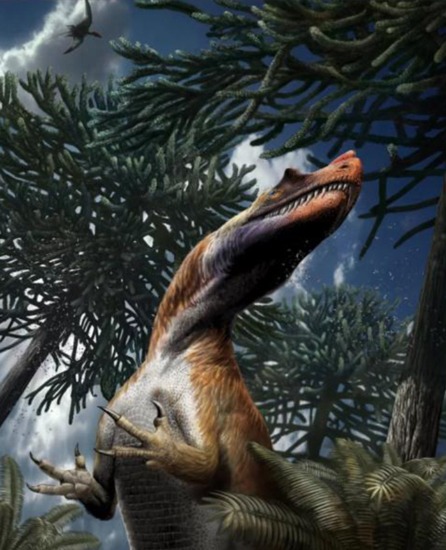
A Life Reconstruction of the Newly Described Ceratosaurian Theropod Saltriovenator zanellai

Saltriovenator zanellai life reconstruction.
A life reconstruction of Saltriovenator from the Early Jurassic of Italy.

Picture credit: Davide Bonadonna

A Chance Discovery

Saltriovenator was discovered by chance in the summer of 1996 by amateur fossil collector Angelo Zanella, whilst exploring fossil rich limestone layers associated with a marble quarry near the town of Saltrio (Varese Province, Lombardy).  The strata containing the fossilised remains represent marine deposits and explosives used in the quarrying process had broken up the fossil bearing layer into hundreds of pieces.  In total, 132 fossil pieces were excavated from the site, the remains of a single animal.

The bones show feeding traces from fish and borings from marine invertebrates.  The palaeontologists writing in the on-line academic journal “PeerJ” suggest that the carcase was washed out sea and stayed on the seabed for some time, permitting the scavenging to take place.

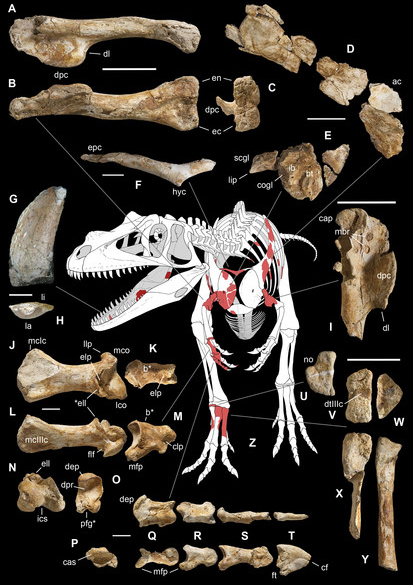
Fossil Elements Used to Confirm Ceratosaurian Affinity with a Skeletal Drawing

Fossil elements used to identify Saltriovenator as a Ceratosaur.
Selected fossils of Saltriovenator and a skeletal reconstruction. Sections coloured red indicate fossil material.

Picture credit: G. Bindellini, C. Dal Sasso and M. Zilioli and M. Auditore

The picture above shows key fossils that helped to classify Saltriovenator as a member of the Ceratosauria clade, it is the oldest ceratosaur described to date.

Key

A, B, C = views of the right humerus.

D = left scapula.

E = right scapular glenoid and coracoid.

F = furcula (wishbone).

G = single tooth from the anterior portion of the lower jaw.

I = partial left humerus, the circular depressions represent borings made by marine invertebrates feeding on the carcase.

J, L, N = views of the right second metacarpal (finger bone).

K, M, O, = views of the right second digit.

P-T = views of the right third digit.

U = distal tarsal IV.

V, X = third right metatarsal views.

W, Y = second right metatarsal views.

Z = reconstructed skeleton of Saltriovenator with identified fossil elements shaded red.

Scale bars: 10 cm in (A)–(E), (I), and (U)–(Y); two cm in (F), and (J)–(T); one cm in (G).

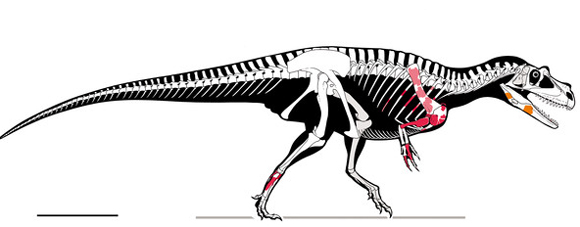
A Skeletal Reconstruction of Saltriovenator zanellai 

A reconstruction of the skeleton of Saltriovenator.
Saltriovenator skeletal reconstruction.  Colour key – right bones in red; counterlateral copies of the left bones in light red; bones from the medial side of the lower jaw in orange.  Note scale bar equals one metre.

Picture credit: M. Auditore

The First Jurassic Dinosaur from Italy

Saltriovenator is the first dinosaur to be described from fossils found in the Italian Alps.  It is the first dinosaur from the Jurassic Period to have been found in Italy and the country’s second theropod, the first being Scipionyx samniticus which lived during the Early Cretaceous and at just over two metres in length, was considerably smaller than S. zanellai.  A study of growth rings found in a cross-sectional analysis of the fossil bones indicates that the dinosaur was around twenty-four years of age when it died.

It was still growing, albeit slowly, so the maximum size of this predator is not known, although at an estimated 7.5 metres long, it was considerably bigger than any other theropod from the Early Jurassic described to date.

CollectA have produced a replica of Saltriovenator.

To view this model range: CollectA Deluxe Prehistoric Life Models.

Saltriovenator zannellai – A Mosaic of Basal and More Advanced Theropod Features

Saltriovenator exhibits a mosaic of features seen in four-fingered theropods and basal tetanuran dinosaurs.  The fossilised finger bones indicate that this dinosaur had a fully functioning four-fingered hand, well-adapted for grasping and coping with struggling prey.  Later ceratosaurs had only three fingers on each hand.  Study of the finger bones will help scientists to understand better the evolutionary relationships between the four-fingered cilophosaurs, ceratosaurs and later types of theropod such as the allosaurs with their atrophied hands.

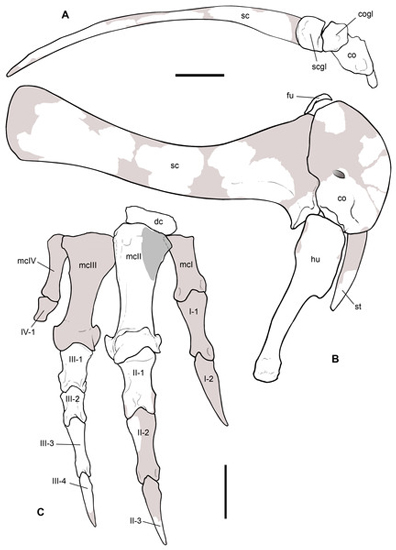
Views of the Pectoral Girdle and the Right Hand of Saltriovenator zanellai

Saltriovenator right hand and forelimb.
Saltriovenator pectoral girdle and forelimb with a line drawing of the right hand showing four fingers.  Preserved elements in white, reconstructed bone in light grey, exposed inner bone in grey, hidden bone in dotted lines.  Scale bar equals 10 cm in (A) and (B), five cm in (C).

Picture credit: M. Auditore

Commenting on the importance of this fossil discovery, one of the authors of the scientific paper, Dr Andrea Cau (Museo Geologico), stated:

“The grasping hand of Saltriovenator zanellai fills a key gap in the theropod evolutionary tree: predatory dinosaurs progressively lost the pinkie and ring fingers and acquired the three-fingered hand which is the precursor of the avian wing.”

A spokesperson from Everything Dinosaur commented:

“The evolution of large, powerful predatory dinosaurs at the very beginning of the Jurassic, may have been a factor in the evolution of bigger and bigger herbivorous dinosaurs such as the sauropods.  Think of it as an evolutionary arms race as carnivores got bigger, selection pressure was put on herbivores to become bigger and stronger themselves in order to avoid predation.”

Visit the Everything Dinosaur website: Everything Dinosaur.

21 12, 2018

The First Flowering Plants Originated in the Early Jurassic

By |2023-11-13T07:57:33+00:00December 21st, 2018|Categories: Dinosaur and Prehistoric Animal News Stories, Dinosaur Fans, Main Page, Photos/Pictures of Fossils|0 Comments

Nanjinganthus dendrostyla – Putting Back Flowering Plants by 50 Million Years

When did flowering plants (angiosperms) evolve?  That has been a puzzling question, one that has taxed the minds of leading scientists for more than 200 years.  Genetic studies indicate that the diverse and widespread angiosperms have an ancient lineage, but the fossil record does not support this idea.  Fossils of delicate flowers are very rare and the oldest known, date from the Early Cretaceous.  Time for the fossil record to catch up with the announcement of the discovery of a plant that produced flowers some 174 million years ago, during the late Early Jurassic (Toarcian stage).

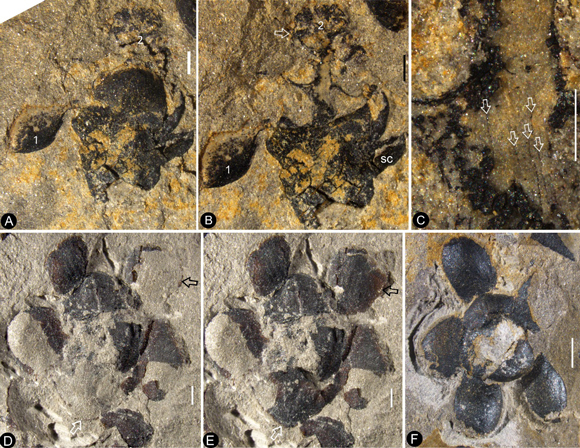
Specimens of the Newly Described Early Jurassic Flowering Plant Nanjinganthus dendrostyla

Nanjinganthus, a flowering plant from the Early Jurassic.
Views of individual specimens of Nanjinganthus, a flowering plant from the Early Jurassic.

Picture credit: (NIGPAS)

The newly described plant has been named Nanjinganthus dendrostyla and it comes from the South Xiangshan Formation (Nanjing, eastern China), which has been studied extensively since the turn of the century and is famous for its abundant plant fossils, which up until now had consisted of cycads, ferns, ginkgoes and horsetails.  Researchers from the Nanjing Institute of Geology and Palaeontology of the Chinese Academy of Sciences (NIGPAS), have been able to identify the earliest known examples of a flowering plant, one that predates most of the angiosperm fossil material by around 50 million years.

Fossils Catching Up with the Molecular Clock

Analysis of the genetic data contained in living plant taxa indicates that plants probably evolved earlier than previously thought.  In a study published in February, researchers from the Chinese Academy of Sciences as well as Bristol University, mapped the genetic make-up of 644 types of plant and concluded, based on molecular dating, flowering plants (angiosperms), probably evolved sometime between the Late Permian and the Late Jurassic.

To read Everything Dinosaur’s article summarising this research: When Did Flowers Evolve?

Lots of Fossil Specimens to Study

The researchers studied a total of 264 specimens representing 198 individual flowers preserved on 34 slabs of stone.  The scientists had the luxury of working on so many examples of the same fossil organism.  They produced numerous high resolution images of the flowers allowing the features of N. dendrostyla to be revealed in great detail.  With so many fossil specimens, the scientists were able to exclude other plant types and confirm that the fossils do indeed represent an angiosperm.

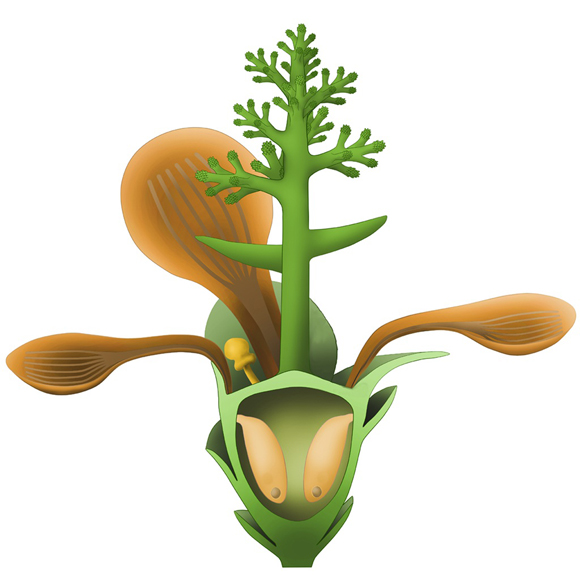
A Life Reconstruction of the Earliest Flowering Plant Described to Date

A life illustration of Nanjinganthus dendrostyla.
A life reconstruction of the flowering plant Nanjinganthus dendrostyla from the Early Jurassic of China.

Picture credit: (NIGPAS)

Commenting on the significance of the study, one of the researchers Wang Xin (NIGPAS), stated:

“The origin of angiosperms has long been an academic headache for many botanists.  Our discovery has moved the botany field forward and will allow a better understanding of angiosperms.”

Identifying a Key Feature of Angiosperms

The scientists were able to identify the presence of fully enclosed ovules in the fossilised flowers.  These are the precursors of seeds before pollination.  The reconstructed flower was found to have a cup-form receptacle and ovarian roof that together enclosed the ovules/seeds.  This botanical feature confirms that Nanjinganthus dendrostyla is definitely an angiosperm.

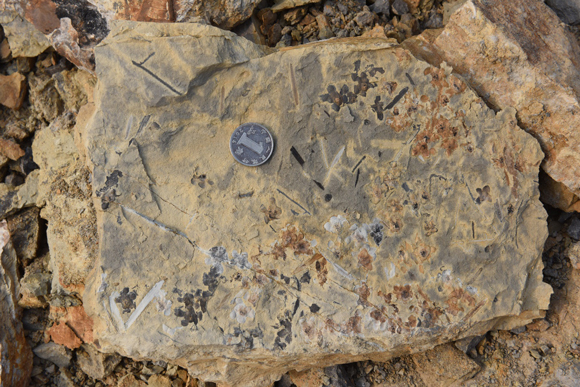
Numerous Examples of N. dendrostyla Preserved in Siltstone

A block containing evidence of the flowering plant Nanjinganthus.
One of the fossil blocks containing examples of Nanjinganthus (South Xiangshan Formation, China).

Picture credit: (NIGPAS)

Fossil Flowers in Jurassic Rocks

Discoveries of angiosperm-like fossils have been reported from Jurassic rocks before.  In January (2018), Everything Dinosaur published an article on the remarkable discovery of fossilised wing scales from butterflies and moths that lived during the Late Triassic.  This discovery challenged the theory of co-evolution between flowering plants and pollinating insects such as members of the Lepidoptera.

To read Everything Dinosaur’s article about this: Ancient Butterflies Flutter By.

The morphological features of Nanjinganthus distinguish it from other specimens and suggest that it is a new angiosperm genus.

The scientists hope to determine whether angiosperms are monophyletic (all flowering plants share a common ancestor).  If this is the case and Nanjinganthus is one of the earliest of all the flowering plants, then these fossils represent a stem group giving rise to all later species.  Angiosperms could also be polyphyletic, (a group descended from more than one common ancestor), meaning Nanjinganthus represents an evolutionary dead end and subsequently, it did not give rise to later types of flowering plant.

Visit the Everything Dinosaur website: Everything Dinosaur.

20 12, 2018

Russian Scientists Announce New Dinosaur Discovery

By |2023-11-13T07:51:10+00:00December 20th, 2018|Categories: Dinosaur and Prehistoric Animal News Stories, Dinosaur Fans, Main Page, Photos/Pictures of Fossils|0 Comments

Volgatitan simbirskiensis – Early Cretaceous Leviathan

A team of palaeontologists from Russia have announced the discovery a new genus of titanosaur from fossil bones found on the western bank of the River Volga close to the village of Slantsevy Rudnik in Ulyanovsk Oblast (western Russia).  The dinosaur has been named Volgatitan simbirskiensis, it is one of a trio of sauropods recently described from Russian deposits, the others being Tengrisaurus starkovi and Sibirotitan astrosacralis, both of these herbivorous, long-necked dinosaurs were named and described in 2017.

Volgatitan simbirskiensis

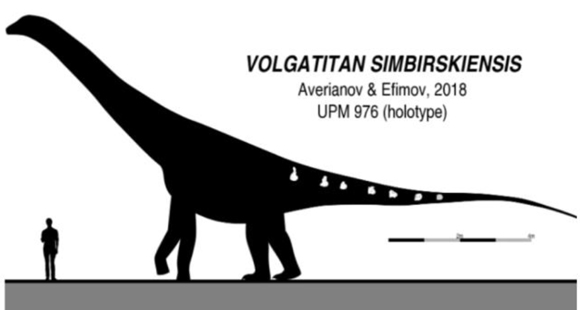
V. simbirskiensis has been named based on the study of seven tail bones (caudal vertebrae), the first of which were discovered following a rock fall on the Volga River back in 1982.

A Scale Drawing of Volgatitan simbirskiensis Showing the Anatomical Position of the Known Fossil Material

Volgatitan fossil tail bones shown in situ and scale drawing.
A reconstruction of Volgatitan simbirskiensis with a human being shown for scale.

Picture credit: St Petersburg State University

For models and replicas of titanosaurs and other sauropods: Dinosaur and Prehistoric Animal Models.

Tell Tale Tail Bones

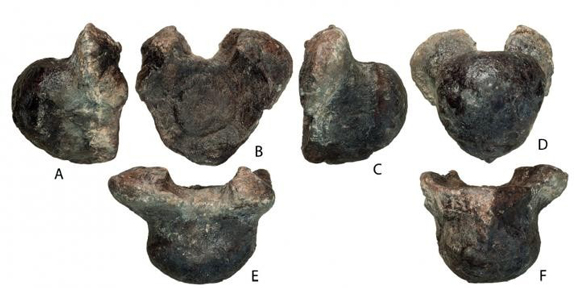
Fortunately, for the Sauropoda, vertebrae can be quite diagnostic when it comes to ascribing new genera.  Titanosaurs for example, have distinctive shaped caudal vertebrae, especially towards the base of the tail (proximal end close to the hips).  The proximal tail bones of titanosaurs are procoelous (pronounced pro-see-lus), that is, the front face of the bone is concave and the opposite face, the bit that points in the direction of the tail, is bulbous (convex).

Views of the Holotype Caudal Vertebra of V. simbirskiensis

Volgatitan caudal vertebra (holotype).
Views of a Volgatitan caudal vertebra.

Picture credit: Alexander Averianov and Vladimir Efimov

The photograph (above) shows the holotype caudal vertebra of Volgatitan simbirskiensis in right lateral (A), anterior (B), left lateral (C), posterior (D), dorsal (E) and ventral (F) views.

Dinosaur Nomenclature

The dinosaur’s genus honours the Volga River, whilst the trivial name is in honour of the old name for the city of Ulyanovsk (Simbirsk), after all, the fossils were found just three miles to the north of the city.  Aleksandr Averianov, one of the authors of a scientific paper describing this new titanosaur, published in the journal “Biological Communications”, explained that the description of dinosaur taxa in recent years has become possible due to the progress in understanding the anatomy and phylogeny of the Dinosauria.  Furthermore, the recent Russian sauropod discoveries have allowed scientists to learn more about how these species of lizard-hipped reptiles had lived and developed.

Based on comparisons with the fossilised bones of more complete titanosaurs, Volgatitan is estimated to have been around 16 metres long.  Fully fused neural arches on the centrum from the most proximal of the caudal vertebrae indicate that the bones came from a fully, mature adult animal.

It had been thought that titanosaurs evolved in the Southern Hemisphere, specifically South America, with some taxa migrating into North America, Asia and Europe later in the Cretaceous.  However, the formal description of Volgatitan coming so soon after the naming of Tengrisaurus from the Early Cretaceous of Transbaikal Region, suggests that Early Cretaceous titanosaurs were more widely distributed.  It is possible to postulate that important stages in the evolution of this group of long-necked dinosaurs may have taken place in eastern Europe and Asia.

For an article published in 2017 about the discovery of a new species of African titanosaur: Shingopana songwensis from south-western Tanzania.

To read about an Australian titanosaur discovery made in 2017: Titanosaur “Judy” from the Outback.

Go to Top