All about dinosaurs, fossils and prehistoric animals by Everything Dinosaur team members.

Articles, features and information which have slightly more scientific content with an emphasis on palaeontology, such as updates on academic papers, published papers etc.

22 02, 2019

New Fleet-footed Tyrannosaur Leaps 70-million-year Gap

By |2023-11-23T09:59:23+00:00February 22nd, 2019|Categories: Dinosaur and Prehistoric Animal News Stories, Dinosaur Fans, Main Page, Palaeontological articles, Photos/Pictures of Fossils|0 Comments

The Diminutive Tyrannosaur Moros intrepidus

A small, but speedy dinosaur is the newest member of the Superfamily Tyrannosauroidea, a distant relative of the most famous dinosaur of all Tyrannosaurus rex.  T. rex et al might have a reputation for being giant, bone-crunching apex predators, but for much of their evolutionary history, the tyrannosaurs have been rather over-shadowed by other super-sized dinosaur carnivores.  Indeed, it was only in the last few million years of the Cretaceous that these types of theropod emerged as the apex predators of northern latitudes.  The new dinosaur, named Moros intrepidus, at approximately 78 kilograms (data range 53 to 85 kilograms), around the same bodyweight as a South American Jaguar (Panthera onca), is about ninety times lighter than its famous top-of-the-food-chain relative.

Moros intrepidus

Ironically, contrary to public opinion, M. intrepidus might just be more typical of the Tyrannosauroidea bauplan than its more famous relatives – Gorgosaurus, Albertosaurus and T. rex.

The Newly Described Moros intrepidus from the Late Cretaceous of Central Utah

Life reconstruction Moros intrepidus.
Moros intrepidus from the Late Cretaceous of central Utah.

Picture credit: Jorge Gonzalez

Teeth and a Hind Limb from a New Theropod Dinosaur

The fossilised remains of a partial right leg consisting of a femur, a tibia, metatarsal bones and some toe bones from the fourth toe were discovered in sediments representing the lower Mussentuchit Member of the Cedar Mountain Formation located in Emery County (Utah).  These fossils, in conjunction with isolated teeth from the front portion of the upper jaw (premaxilla) found nearby provide the basis for this new taxon.  The deposits represent a terrestrial environment, a large delta and they date from approximately 96 million years ago (Cenomanian faunal stage of the Late Cretaceous).

Moros intrepidus represents the oldest known Cretaceous-aged tyrannosauroid discovered to date in North America. It extends the definitive fossil record for these types of dinosaurs by around 15 million years.

The Temporal Relationships and Phylogeny of the Tyrannosauroidea
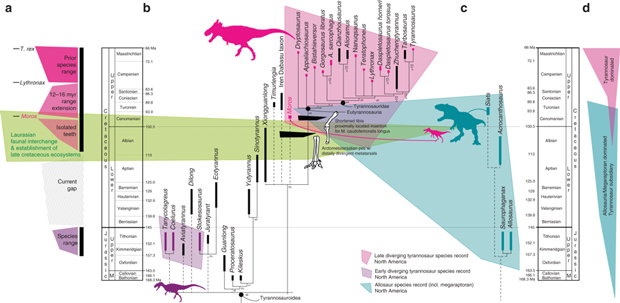
Moros intrepidus fills a 15-million-year evolutionary gap.
Phylogenetic and temporal relationships between tyrannosauroids and an examination of faunal turnover.  The allosaurs/Megaraptor apex predator niche was gradually taken over by tyrannosaurs.

Picture credit: Nature Communications Biology

In the diagram (above), the section on the left (a), shows the fossil record gap between Late Jurassic tyrannosauroids and much larger Late Cretaceous members of the Tyrannosauridae family such as Lythronax (L. argestes).  Section (b) demonstrates the temporal range of these theropods and the change in bauplan, whilst (c) demonstrates key evolutionary anatomical changes.  The blue and pink coloured shapes in (d) reflect the transition from allosaur/megaraptoran dominated ecosystems to tyrannosaur dominated palaeoenvironments.

A Changing of the Guard When it Comes to Apex Predators

Palaeontologists know that the tyrannosaur lineage dates back a long way.  For example, basal tyrannosaurids such as Stokesosaurus (S. clevelandi) are known from Upper Jurassic deposits of Utah.  By the Late Cretaceous (Campanian faunal stage), tyrannosaurs were large and had become the iconic apex predators beloved by dinosaur fans and film directors.  The fossil record for North American tyrannosaurs was essentially blank, giving palaeontologists a T. rex skull-sized headache when it came to piecing together how these theropods changed over time.

The discovery of Moros helps to narrow a 70-million-year-gap in the fossil record of tyrant lizards in North America.

Lead-author of the study, published in “Nature Communications” Lindsay Zanno of the North Carolina Museum of Natural Sciences explained:

“When and how quickly tyrannosaurs went from wallflower to prom king has been vexing palaeontologists for a long time.  The only way to attack this problem was to get out there and find more data on these rare animals.”

A Silhouette of M. intrepidus Showing the Anatomical Position of the Known Fossil Material
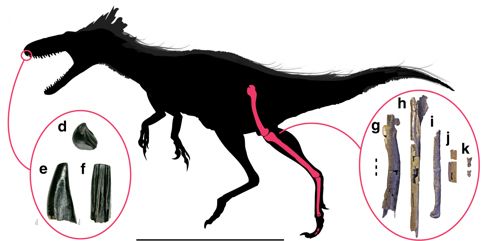
Moros intrepidus silhouette showing placement of known fossil elements.
Silhouette of M. intrepidus showing known fossil elements.  Key = (g) femur, (h) tibia, (i) fourth metatarsal, (j) second metatarsal, and (k) pedal phalanges of the fourth digit.   Scale bar (c) 1 m, (g–k) 5 mm.  Note the tooth (views d-f) are not to scale.

Picture credit: Nature Communications Biology

Living in the Shadow of Siats meekerorum

In 2013, two of the authors of the Moros intrepidus paper, Lindsay Zanno and Peter Makovicky (Field Museum, Chicago), published a study on a large allosauroid from similar-aged sediments.  The dinosaur, named Siats meekerorum is estimated to have measured around 12 metres in length, dwarfing the contemporary Moros, which had a hip height of around 1.2 metres.  The researchers conclude that within a palaeoenvironment dominated by giant, allosauroid theropods, tyrannosaurs such as M. intrepidus relied on their speed and small size and would have kept out of the way of the larger predators.

A spokesperson from Everything Dinosaur commented:

“During the Cenomanian, tyrannosauroids like Moros intrepidus were secondary predators within an ecosystem dominated by apex predators from a completely different part of the theropod family tree.  For the greater part of the tyrannosaur evolutionary history, these types of dinosaurs were marginal predators, living in the shadow of much bigger carnivorous dinosaurs.”

A Life Reconstruction of Siats meekerorum with two Tyrannosauroids shown in the Foreground
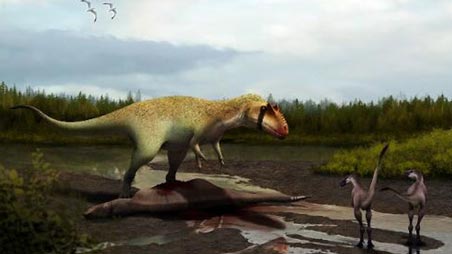
Siats meekerorum .
Siats meekerorum has nothing to fear from these two tyrannosaurs.  Moros intrepidus may have scavenged the kills of larger theropods but these types of tyrannosauroid were very much the secondary predators.

Picture credit: Julio Laceardo

To read Everything Dinosaur’s article on the discovery of Siats meekerorum: Unravelling the Apex Predators of the Cretaceous Before Tyrannosaurs.

Phylogeny Points at Asian Ancestry

A study of the longer limb bones indicates that the individual was around six to seven years of age when it died.  It was likely to have reached its adult size.  A phylogenetic assessment indicates an affinity with Asian tyrannosaur taxa, in essence, the ancestors of famous North American dinosaurs such as Gorgosaurus and Tyrannosaurus rex migrated into North America from Asia.

Assistant Research Professor Zanno stated:

“T. rex and its famous contemporaries such as Triceratops may be among our most beloved cultural icons, but we owe their existence to their intrepid ancestors who migrated here from Asia at least 30 million years prior.  Moros signals the establishment of the iconic Late Cretaceous ecosystems of North America.”

Views of the Lower Leg Bones from the Right Leg of M. intrepidus
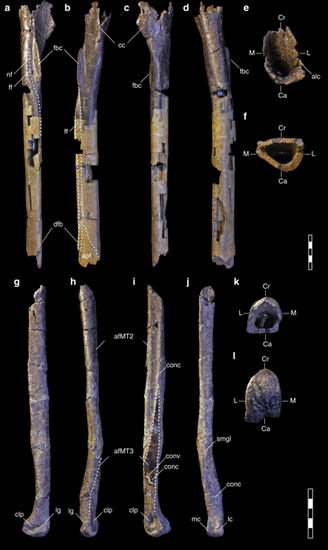
Views of the lower leg bones of Moros intrepidus.
Right tibia (a–f) and right fourth metatarsal (g–l) of M. intrepidus (NCSM 33392).

Picture credit: Nature Communications Biology

What’s in a Name?

The etymology of this new tyrannosauroid reflects the later faunal turnover that led to the apex predator roles in North America being dominated by tyrannosaurs.  The genus name is from the Greek “Moros”, the embodiment of impending doom, for the descendants of this fast-running dinosaur were to evolve into some of the largest and most formidable terrestrial predators known to science.  The species name is from the Latin “intrepidus”, a reference to these intrepid dinosaurs making the migration from Asia into North America and their subsequent dispersal.

Size is Not Everything

Although around ninety times lighter than Tyrannosaurus rex, Lindsay warns against underestimating the predatory abilities of Moros.

She added:

“Moros was lightweight and exceptionally fast.  These adaptations, together with advanced sensory capabilities, are the mark of a formidable predator.  It could easily have run down prey, while avoiding confrontation with the top predators of the day.  Although the earliest Cretaceous tyrannosaurs were small, their predatory specialisations meant that they were primed to take advantage of new opportunities when warming temperatures, rising sea-level and shrinking ranges restructured ecosystems at the beginning of the Late Cretaceous.  We now know it took them less than 15 million years to rise to power.”

The scientific paper: “Diminutive fleet-footed tyrannosauroid narrows the 70-million-year gap in the North American fossil record” by Lindsay E. Zanno, Ryan T. Tucker, Aurore Canoville, Haviv M. Avrahami, Terry A. Gates and Peter J. Makovicky published in Nature Communications Biology.

Visit the Everything Dinosaur website: Everything Dinosaur.

19 02, 2019

“The Dinosaurs Rediscovered” – New Book About Dinosaurs

By |2023-11-23T07:08:31+00:00February 19th, 2019|Categories: Book Reviews, Dinosaur Fans, Main Page, Palaeontological articles, Press Releases|0 Comments

“The Dinosaurs Rediscovered” – New Book About Dinosaurs

Everything Dinosaur has received an uncorrected proof of the eagerly awaited new dinosaur book by Professor Michael Benton.  Team members are looking forward to reading about how research into the Dinosauria has been revolutionised over the last two decades or so.

Professor Benton is one of the leading lights in vertebrate palaeontology and has written over fifty books covering a wide range of prehistoric animals and events from deep time.  As the head of the world-renowned Palaeobiology Research Group at the University of Bristol, Professor Benton has been involved in and led some of the most insightful and ground-breaking studies into the dinosaurs, helping to re-write scientific understanding.

“The Dinosaurs Rediscovered” – Exploring the Revolution in Dinosaur Research

A new dinosaur book "The Dinosaurs Rediscovered".
“The Dinosaurs Rediscovered” by Professor Mike Benton.

Picture credit: Thames & Hudson/Everything Dinosaur

The Changing Story of the Dinosaurs

The book runs to 336 pages with 163 illustrations (23 in colour), it explores the changing story of the dinosaurs, highlighting how the application of 21st century technologies have revealed new information about these remarkable reptiles, information that had been locked deep inside their fossilised bones and teeth.

Trace fossils are also explored in detail and Professor Benton demonstrates how biomechanical engineering combines with computer modelling and digital dinosaurs to calculate how fast theropod dinosaurs could run.  The work of the famous Bristol Dinosaur Project is covered and naturally, Bristol’s very own dinosaur Thecodontosaurus (T. antiquus) is included, but Professor Benton does not just feature dinosaurs from the south-west of England, this impressive publication provides a global perspective on the Dinosauria.

This beautifully written book includes chapters on feathered dinosaurs and even explores whether dinosaur DNA could be used to resurrect the Dinosauria.

The Book includes Chapters on Feathered Dinosaurs and Explores Whether Dinosaur DNA could be Found Preserved in Amber

Feathered dinosaur illustration.
An illustration of the feathered dinosaur, about to become stuck in amber.  Professor Mike Benton introduces the reader to some amazing recent dinosaur discoveries.

Picture credit: Cheung Chung-Tat

An Engaging Account

This is an engaging account of the evolution of the “terrible lizards” and is aimed at readers with a general interest in life in the past as well as academics and students.  Fans of prehistoric animals and dinosaur devotees don’t have to wait too long before this book is published.  The hardback is due out on April 25th (published by Thames and Hudson).

The Front Cover of Professor Benton’s New Book

"The Dinosaurs Rediscovered".
The jacket cover of the new book about dinosaurs “The Dinosaurs Rediscovered”.

Picture credit: Thames & Hudson

Visit the Everything Dinosaur website: Everything Dinosaur.

18 02, 2019

A New African Titanosaur is Announced

By |2023-11-22T11:55:19+00:00February 18th, 2019|Categories: Dinosaur and Prehistoric Animal News Stories, Dinosaur Fans, Main Page, Palaeontological articles, Photos/Pictures of Fossils|0 Comments

Mnyamawamtuka moyowamkia – Heart-shaped Tail Bones Help to Flesh Out Titanosaur Evolution

Scientists writing in the on-line, open access journal PLOS One, have published details of a new species of African titanosaur.  It took several years to carefully remove the fossil material from a high cliff wall overlooking the Mtuka riverbed in south-western Tanzania, but the fossils, representing a not fully mature dinosaur, are providing palaeontologists with important information about how African ecosystems changed over the course of the Cretaceous.  The new titanosaur has been named Mnyamawamtuka moyowamkia (pronounced Mm-nya-ma-wah-mm-too-ka mm-oh-yo-wa-mm-key-ah).  The name is derived from Kiswahili for “animal of the Mtuka river with a heart-shaped tail”.

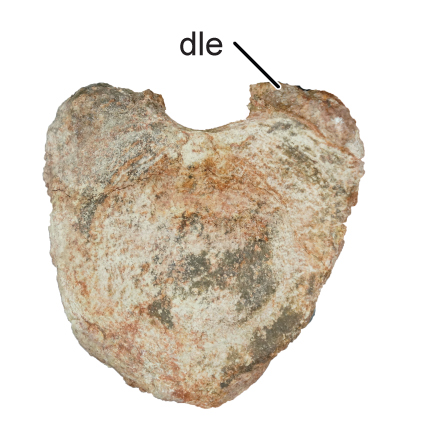
The heart-shaped tail element of the name refers to the strange shape of the most intact middle caudal vertebra described in the paper.  It bulges out at the sides (dorsolateral expansion of the posterior articular surface of the centrum), a unique tail bone morphology that resembles the shape of a romantic, love heart.

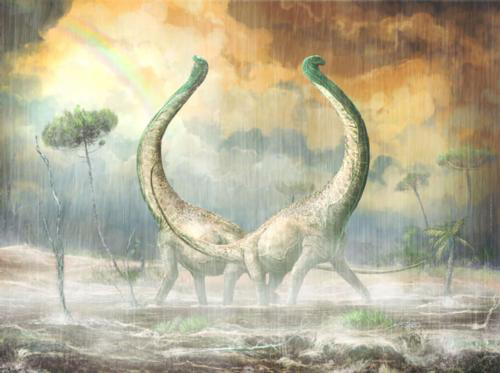
A Life Reconstruction of a Pair of  Mnyamawamtuka moyowamkia Titanosaurs

Mnyamawamtuka moyowamkia illustration
Mnyamawamtuka moyowamkia life reconstruction.

Picture credit: Mark Witton

Mnyamawamtuka moyowamkia

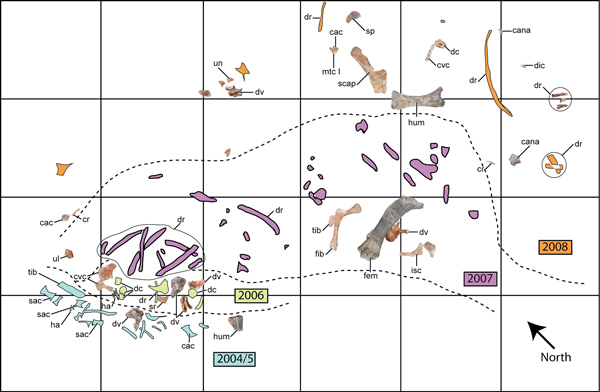
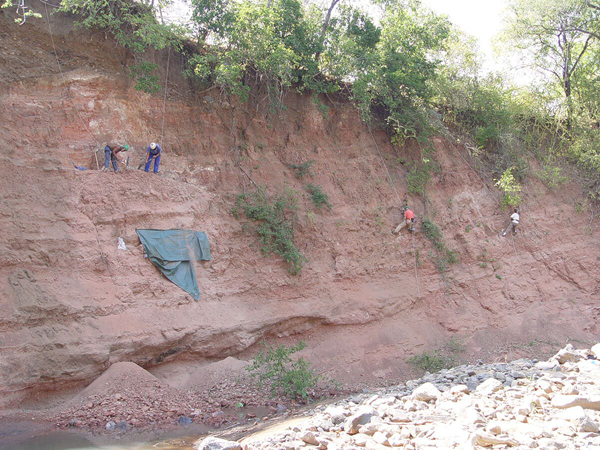
The first evidence of the dinosaur fossils was noted in 2004 and some fossils were excavated from the cliff face, in what were quite hazardous conditions, with field team members having to be lowered over the cliff on numerous occasions to work on the exposed bones.  Annual excavations took place until 2008, it was important to keep returning to the site as the fossils were in danger of being lost to the river in seasonal floods.

A Line Drawing of the Quarry Site Showing the Extent of the Annual Excavations

Quarry map of M. moyowamkia site.
Quarry map showing the layout and excavation timeline of the M. moyowamkia fossil material.

Picture credit: PLOS One

Around 110 -100 Million Years Old

The specimen was excavated from the Mtuka Member of the Cretaceous Galula Formation, which was deposited around 110 to 100 million years ago (Aptian to Cenomanian faunal stage of the Cretaceous).  A substantial portion of the postcranial skeleton has been recovered.

Dangerous Work!  The Excavation Site in 2007

The location of the Mnyamawamtuka moyowamkia fossils.
The quarry dig site above the Mtuka riverbed in south-western Tanzania.

Picture credit: Ohio University

Commenting on the importance of this discovery, in relation to the evolution of African titanosaurs, lead author of the paper, Dr Eric Gorscak, a recent PhD graduate of Ohio University and now an assistant professor at the Midwestern University (Illinois), stated:

“Although titanosaurs became one of the most successful dinosaur groups before the infamous mass extinction capping the Age of Dinosaurs, their early evolutionary history remains obscure, and Mnyamawamtuka helps tell those beginnings, especially for their African-side of the story.  The wealth of information from the skeleton indicates it was distantly related to other known African titanosaurs, except for some interesting similarities with another dinosaur, Malawisaurus, from just across the Tanzania–Malawi border.”

Adding to the Diversity of Titanosaurian Sauropods from Africa

The field team responsible for this discovery have also found the fossilised remains of two other titanosaurs in this part of Africa.  In 2017, Everything Dinosaur reported upon the discovery of Shingopana songwensis.

To read about S. songwensis: A New Species of African Titanosaur is Named.

In addition, Rukwatitan bisepultus another Titanosaurian sauropod dinosaur, was named and described in 2014: A New Species of Titanosaurian Sauropod Rukwatitan bisepultus.

The researchers conclude that Mnyamawamtuka moyowamkia was distantly related to both Shingopana songwensis and Rukwatitan bisepultus, fossils of which come from younger Cretaceous sediments, although it did share some anatomical characteristics with Malawisaurus dixeyi from Malawi, that might have been contemporaneous.  This new fossil discovery is helping palaeontologists to better understand the distribution of titanosaurs between Africa and South America and their evolutionary relationships.

Heart-shaped Tail Bones

One of the middle caudal centra (tail bone from the middle portion of the tail), exhibits a unique dorsolateral expansion of the posterior articular surface of the centrum.  This unique characteristic was found to be present in the most intact middle caudal vertebra described.  This unique shape inspired the dinosaur’s name.

Heart-shaped Tail Bone Centrum (Rear View)

Heart-shaped tail bone.
A posterior view of a middle caudal vertebra showing the characteristic heart shape.  The term dle = dorsolateral expansion.

Picture credit: PLOS One

Tail Bones of Different Titanosaurs Compared

Titanosaur tail bne comparison.
A comparison of caudal vertebrae between three titanosaurs. Mnyamawamtuka moyowamkia (A), compared with Malawisaurus dixeyi (B) and Lohuecotitan pandafilandi of the Late Cretaceous of Spain (C). Posterior views and lateral views, scale bar = 10 cm.  The term dle = dorsolateral expansion.

Picture credit: PLOS One

The scientific paper: “A New African Titanosaurian Sauropod Dinosaur from the Middle Cretaceous Galula Formation (Mtuka Member), Rukwa Rift Basin, Southwestern Tanzania” by Eric Gorscak and Patrick M. O’Connor published in PLOS One.

Visit the Everything Dinosaur website: Everything Dinosaur.

8 02, 2019

New Species of Late Cretaceous Oviraptorid Named

By |2023-11-22T09:38:31+00:00February 8th, 2019|Categories: Dinosaur and Prehistoric Animal News Stories, Dinosaur Fans, Main Page, Palaeontological articles, Photos/Pictures of Fossils|0 Comments

Gobiraptor minutus – The Diversity of the Oviraptoridae in the Late Cretaceous

A new species of oviraptorid dinosaur (Oviraptoridae family), has been described by an international team of scientists.  The little dinosaur was probably feathered and it possessed thickened jaws, an adaptation to feeding on hard food items such as seeds, nuts or the shells of bivalves, molluscs and crabs.  Animals that have a diet of hard items are referred to as durophagous.   

The fossilised remains of a single, very young individual were found in the Altan Uul area of Ömnögovi Province, Mongolia, in strata from the famous Upper Cretaceous Nemegt Formation.  The new species has been named Gobiraptor minutus and it helps to demonstrate that this part of Asia in the Late Cretaceous was home to diverse variety of oviraptorids, many of which, probably occupied specialist niches within the ecosystem in a bid to minimise competition for resources.

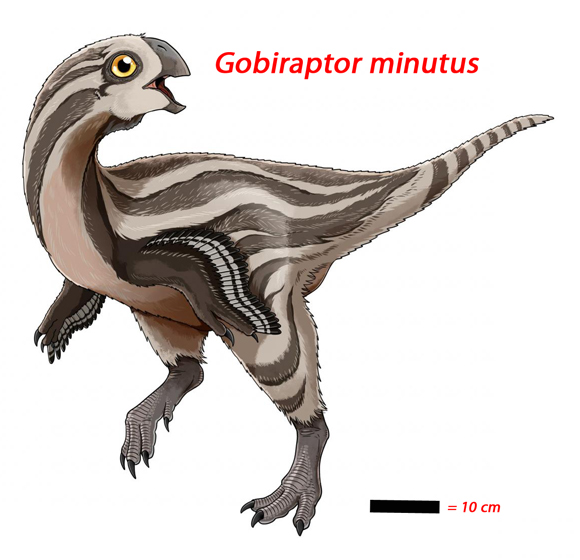
A Life Reconstruction of Gobiraptor minutus

Gobiraptor minutus life reconstruction.
A life reconstruction of Gobiraptor minutus.

Picture credit: Do Yoon Kim with additional annotation by Everything Dinosaur

Gobiraptor minutus – Rare for the Altan Uul Area of Southern Mongolia

Oviraptorid fossil specimens are relatively rare in the Altan Uul area of the Gobi Desert, however, within the Upper Cretaceous deposits exposed within the Gobi Desert, some ten oviraptorid taxa have so far been named and described.  Gobiraptor increases the diversity of oviraptorids known from the Nemegt Formation and demonstrates that these types of theropod dinosaurs were exceptionally abundant in the mesic environment* of that part of the world during the Late Cretaceous.

A mesic environment* – is a term used in ecology to describe an environment with a moderate amount of water.  Much of this part of Asia during the Late Cretaceous may be associated with a dry, arid environment, for example numerous types of other theropod fossils come from strata that represent almost desert-like conditions.  These fossils are found in the older Barun Goyot Formation which was laid down under more arid conditions.  The rocks in which the fossils of Gobiraptor were found consist mainly of river channel deposits, indicating that the palaeoenvironment changed and the environment became considerably wetter.

Thus, the finding of a new member of the Oviraptoridae family in the Nemegt Formation, which consists mostly of river and lake deposits, confirms that these dinosaurs were extremely well adapted to wet habitats.

Fragmentary Fossils and Skeletal Reconstruction of Gobiraptor minutus

Gobiraptor minutus skeletal reconstruction.
Grey shaded bones indicate known fossil material.  Note scale bar on skeletal drawing – 10 cm.

Picture credit: PLOS One

Robust and Thickened Jaws Hint at a Dietary Specialism

Gobiraptor minutus, can be differentiated from other members of the Oviraptorosauria clade in having unusually robust and thickened jaws.  This unique mandibular morphology suggests that Gobiraptor was adapted to feeding on hard food items, it used its strong jaws to crush, indicating potential niche partitioning in the palaeoenvironment to reduce competition amongst small theropods and within the local population of oviraptorids.  Osteological analysis of the femur suggests that the fossil material represents a very young individual.

The phylogenetic analysis carried out by the researchers defines Gobiraptor as a derived oviraptorid closely related to three taxa from the Ganzhou region of southern China, but, ironically, the analysis suggests that it was rather distantly related to other Nemegt oviraptorids which, as the results of recent studies, are also not closely related to each other.

The authors propose that different dietary strategies may explain the wide taxonomic diversity and evolutionary success of this group of dinosaurs in this part of Asia.

Post-cranial Elements of G. minutus

Post-cranial elements of Gobiraptor.
Left femur in caudal view (A) and medial view (B).  Partial right humerous (C) and ilium (D).  (E) left metatarsal I and pedal digit I in medial view.  (F) left pedal digit IV in lateral view.  Scale bar = 5 cm.

Picture credit: PLOS One

The genus name honours the Gobi Desert, whilst the specific epithet is from the Latin for small, a reflection on the small size of the holotype.

The scientific paper: “A New Baby Oviraptorid Dinosaur (Dinosauria, Theropoda) from the Upper Cretaceous Nemegt Formation of Mongolia” by Sungjin Lee, Yuong-Nam Lee , Anusuya Chinsamy, Junchang Lü, Rinchen Barsbold and Khishigjav Tsogtbaatar published in PLOS One.

Visit the award-winning Everything Dinosaur website: Everything Dinosaur.
1 02, 2019

Pachyrhinosaurus perotorum – New Research is Published

By |2023-11-22T06:50:06+00:00February 1st, 2019|Categories: Dinosaur and Prehistoric Animal News Stories, Dinosaur Fans, Main Page, Palaeontological articles|0 Comments

Puzzling Pachyrhinosaurs – The Remarkable Pachyrhinosaurus perotorum

Researchers from the Perot Museum of Nature and Science (Dallas, USA), in collaboration with the University of Toronto (Canada), have published an update on their research into one of the most remarkable Late Cretaceous dinosaurs known to science.

Pachyrhinosaurus perotorum

Back in 2011, Everything Dinosaur reported that field work in the high Arctic led by palaeontologists from the Perot Museum of Nature and Science had uncovered the fossilised remains of at least ten individual dinosaurs representing a new species of ceratopsian.  This horned dinosaur, a pachyrhinosaur, was named Pachyrhinosaurus perotorum and it became the third species to be assigned to this centrosaurine genus.  With numerous specimens to study, the palaeontologists could gain a fresh perspective on how horned dinosaurs changed as they grew up and develop a better understanding of the cranial ornamentation associated with the Ceratopsidae.

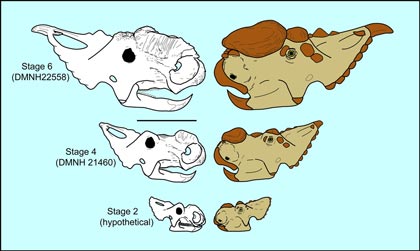
The Ontogeny of P. perotorum

Illustrating the ontogeny of a Pachyrhinosaurus (P. perotorum).
How a baby P. perotorum grew up.  With numerous individuals represented at the same dig site, palaeontologists can examine variation within a species and assess how these dinosaurs changed as they matured.

Picture credit: Perot Museum of Nature and Science

Updating Their Findings About Pachyrhinosaurus

The authors of the original scientific paper describing P. perotorum, Anthony Fiorillo and Ronald Tykoski, have published a new report in conjunction with Kentaro Chiba of the Department of Ecology and Evolutionary Biology at the University of Toronto, updating their research and providing more information on how this species can be distinguished from the two other species of Pachyrhinosaurus.

The continued preparation of fossil specimens collected from the type locality, the  Kikak-Tegoseak Quarry (Prince Creek Formation), has produced more skull elements to study.  The researchers note that their original reconstruction of the type parietal bone was incorrect, the parietal along with the squamosal bone form the neck frill in horned dinosaurs.  The parietal of P. perotorum is similar to the parietal bones of the other species – P. canadensis and P. lakustai.

It is postulated that Pachyrhinosaurus perotorum can be identified by an upturned tip of the rostrum, a dorsally shifted rostral bone lacking a sharply downturned, parrot-like beak and an enlarged median ridge at the posterior end of the nasal boss.  Other differences in cranial morphology are also tentatively proposed in the new scientific paper, published in the Journal of Systematic Palaeontology.

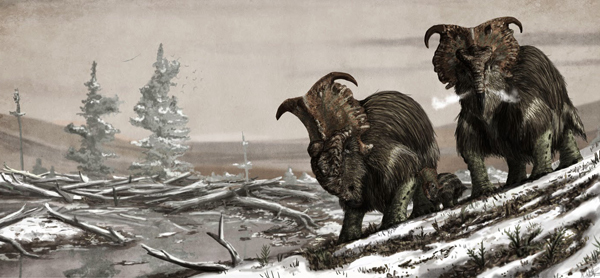
A Speculative Illustration of the High Northern Latitude Ceratopsian Pachyrhinosaurus perotorum

A northern Ceratopsian with a shaggy coat.
A speculative illustration of Pachyrhinosaurus perotorum with a shaggy coat of feathers.  Although northern Alaska was warmer in the Late Cretaceous than today, it would have been distinctly chilly, too cold for ectothermic reptiles and it has been speculated that the dinosaur biota of high latitudes may have been specifically adapted to cold climates.  In this illustration, Pachyrhinosaurus has been depicted with a long, shaggy coat of feathers to help keep out the cold.

Picture credit: Mark Witton

A Sister Taxon of Pachyrhinosaurus canadensis

A cladistic analysis undertaken by the team using this new dataset in conjunction with previous research confirms that the Pachyrhinosaurus genus is monophyletic (all descended from a common ancestor) and that Pachyrhinosaurus canadensis is the sister taxon to P. perotorum.  In addition, this research supports the idea that parietal and squamosal frill ornamentations alone do not adequately address the variables in craniofacial morphology needed to distinguish between species of Pachyrhinosaurus.

The continuing research into horned dinosaurs that lived at high latitudes is helping palaeontologists to gain a better understanding of a unique ecosystem that existed towards the end of the dinosaur age.  Pachyrhinosaurus perotorum is not only the youngest pachyrhinosaur species known, it is also the geologically youngest known centrosaurine.  With three species assigned to the genus, Pachyrhinosaurus is the most speciose of all the Centrosaurinae genera.

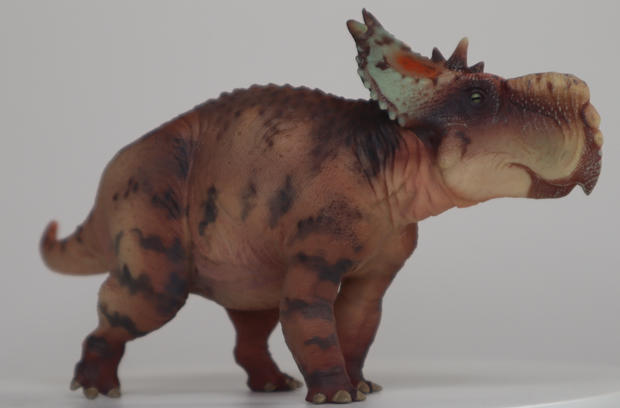
A Model of a Pachyrhinosaurus

The Haolonggood Pachyrhinosaurus dinosaur model (LvFang)
The Haolonggood Pachyrhinosaurus dinosaur model (LvFang) photgraphed in the studio. Picture credit: Everything Dinosaur.

Picture credit: Everything Dinosaur

The picture (above) shows a Pachyrhinosaurus model in the Haolonggood range of figures.

To view this range: Haolonggood Prehistoric Animal Models.

Commenting About Pachyrhinosaurus perotorum

A spokesperson from Everything Dinosaur commented:

“Pachyrhinosaurus perotorum holds a special place in Ceratopsidae research.  It lived at a higher latitude than any other horned dinosaur known to science and, as a consequence, had to endure some very tough and harsh climatic conditions.  Whether this dinosaur was a seasonal migrant to the area in summer to take advantage of the 24-hours of daylight that permitted abundant plant growth, or whether this reptile was a permanent resident remains uncertain.  However, the discovery of the fossilised remains of a juvenile at the Kikak-Tegoseak Quarry, suggests that this dinosaur could have been indigenous to northern Alaska during the Maastrichtian faunal stage.”

To read Everything Dinosaur’s original article from 2011 that announced the discovery of a third species of Pachyrhinosaurus: A New Species of Pachyrhinosaurus – P. perotorum.

The scientific paper: “New Data and Diagnosis for the Arctic Ceratopsid Dinosaur Pachyrhinosaurus perotorum” by Ronald S. Tykoski, Anthony R. Fiorillo and Kentara Chiba published in the Journal of Systematic Palaeontology.

Visit the Everything Dinosaur website: Everything Dinosaur.
29 01, 2019

Preparing to Introduce a New Oviraptorid

By |2023-11-21T18:11:23+00:00January 29th, 2019|Categories: Dinosaur Fans, Main Page, Palaeontological articles, Press Releases|0 Comments

Preparing to Introduce a New Oviraptorid

As Everything Dinosaur team members prepare to write about the formal scientific description of a new species of oviraptorid from the Late Cretaceous of southern Mongolia, we have been brushing up on our knowledge of the Oviraptorosauria clade.

No Need to Get into a Flap over the Oviraptorosauria

Is this an example of dinosaur courtship?
The Oviraptorosauria is a very diverse clade of theropods.

Picture credit: Sydney Mohr, University of Alberta

An Unusual Branch of the Maniraptora

The Oviraptorosauria clade is an atypical branch of the maniraptoran theropods.   They are characterised by short, deep skulls, jaws which lack teeth (edentulous in derived, advanced members of the clade), short, stunted tails and tail bones with lots of air sacs within them (pneumatised proximal caudal vertebrae).  The first of these dinosaurs were formally named and described in the 1920s (Oviraptor and Chirostenotes), over the last three decades, numerous new members of this clade have been identified, mostly from Upper Cretaceous strata.

The  oviraptorosaurs are likely to have originated in Asia.  The earliest fossil record of these dinosaurs is reported from the Lower Cretaceous Yixian Formation of China.  It is likely that these dinosaurs were feathered and most of them were relatively small and light-weight.   However, there were exceptions to this rule, such as the huge Gigantoraptor (Gigantoraptor erlianensis), that stood nearly as tall as a giraffe.  Gigantoraptor was named and described in 2007: New Giant Chinese Dinosaur Described.

A Scale Drawing of Gigantoraptor Atypical of an Atypical Theropod Clade

Gigantoraptor scale drawing.
The largest feathered animal known to science. Picture credit: Everything Dinosaur.

Picture credit: Everything Dinosaur

The picture (above) reflects the CollectA Prehistoric Life Gigantoraptor figure.

To view this model range: CollectA Prehistoric Life Models.

Three Families within the Oviraptorosauria

Palaeontologists consider the Oviraptorosauria to be a very diverse clade with numerous taxa, but it can be broadly classified into three distinct families:

  1. The Avimimidae  – which for the moment contains a single genus (Avimimus), with two species from the Nemegt Formation of Mongolia. Although the provenance of the first fossils associated with this genus is not clear.
  2.  The Caenagnathidae – which are known from North America and Asia with numerous genera including the giant Gigantoraptor erlianensis.
  3. The Oviraptoridae – which are only known from Asia, although there are more genera recognised than within the more geographically widespread caenagnathids.

Of these three dinosaur families, it can be argued that the Oviraptoridae are the best understood.  Many genera are known from nearly complete fossil skeletons, whilst in the case of most caenagnathids, these dinosaurs are mostly known from highly fragmentary and far from complete material.

We look forward to publishing an article in the very near future describing a new member of the Oviraptoridae from the famous Upper Cretaceous deposits of the Nemegt Formation of Mongolia.

Note

Our article has been published, say hello to a new Asian, Late Cretaceous oviraptorid – Gobiraptor minutus.

You can read our article here: New Species of Late Cretaceous Oviraptorid Dinosaur Named.

23 01, 2019

Prehistoric Shark Named after Video Game

By |2023-11-20T15:34:12+00:00January 23rd, 2019|Categories: Dinosaur and Prehistoric Animal News Stories, Dinosaur Fans, Main Page, Palaeontological articles, Photos/Pictures of Fossils|0 Comments

Galagadon nordquistae – Shark Resident of Hell Creek

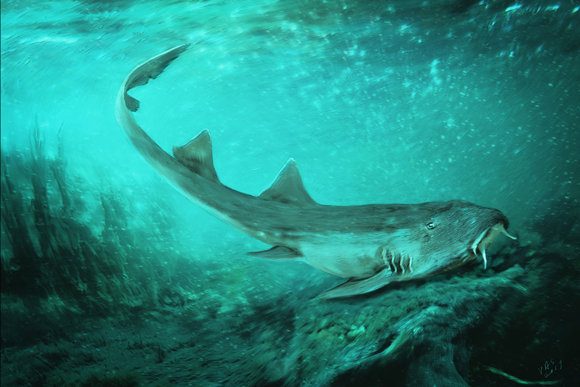
Perhaps the most famous exhibit at the Field Museum (Chicago), is the Tyrannosaurus rex specimen named “Sue”, the most complete T. rex fossil discovered to date.  A great deal of research has been carried out on the 66 million-year-old fossilised bones of this giant, meat-eating theropod that measures over twelve metres in length.  However, the matrix that surrounded the fossil material has helped to shed light on another resident of the famous Hell Creek Formation of South Dakota.  Fossil teeth found in the matrix surrounding the bones of the most famous T. rex in the world has led to the naming and description of a prehistoric shark that lived in freshwater, say hello to Galagadon nordquistae.

A Life Reconstruction of the Late Cretaceous Shark G. nordquistae

Galagadon nordquistae life reconstruction.
A life reconstruction of the Late Cretaceous shark Galagadon nordquistae.

Picture credit: Velizar Simeonovski (Field Museum)

Galagadon nordquistae – A Small, Freshwater Predator

Ever since the preparation work on “Sue” began in the 1990s, the leftover sediment (matrix), was carefully stored at the Field Museum.  Researchers examined this material searching for micro-fossils in a bid to build up a picture of what life was like in this part of Laramidia towards the end of the age of dinosaurs.  Teeth were found from a shark which would have measured around half a metre in length.

Peter Makovicky (Curator of Dinosaurs at the Field Museum) commented:

“This shark lived at the same as Sue the T. rex, it was part of the same world.  Most of its body wasn’t preserved, because sharks’ skeletons are made of cartilage, but we were able to find its tiny fossilised teeth.”

The shark, named Galagadon nordquistae, is described in a scientific paper published in the “Journal of Palaeontology”.

Named After a 1980s Video Game

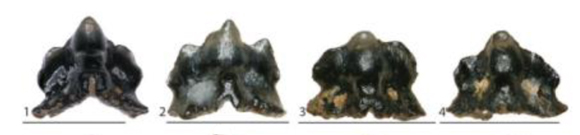
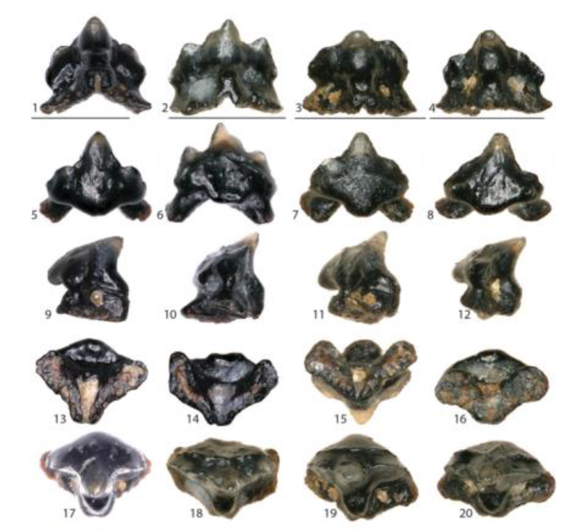
Lead author of the research, Terry Gates (North Carolina State University), explained that the shark’s name was inspired by the stepped, triangular shape of the teeth that reminded the research team of the spaceships in the 1980s video game Galaga.  The species epithet honours Field Museum volunteer Karen Nordquist who discovered the fossilised teeth in the matrix material.

Fossil Teeth Reminded the Scientists of Video Game Spaceships

Galagadon fossil teeth.
Specimens of shark teeth (lingual view) assigned to Galagadon.  Scale bars = 1 mm.

Picture credit: Terry Gates (North Carolina State University)/Journal of Paleontology

Commentating on her fossil find, Nordquist stated:

“It [a tooth] was so tiny, you could miss it if you weren’t looking really carefully.  To the naked eye, it just looks like a little bump, you have to have a microscope to get a good view of it.”

Tiny Teeth Change our View of the Prehistoric Environment

The tiny teeth are only about a millimetre wide, about the size of a pinhead.  Galagadon was small too, estimated at around thirty to sixty centimetres in length.

Dr Makovicky added:

“Galagadon was less than two feet long, it’s not exactly Jaws.  It’s comparable to bamboo sharks living today.  It probably had a flat face and was very likely camouflage-coloured, since its relatives today have a camouflage pattern.  It would have eaten small invertebrates and probably spent a fair amount of time lying on the bottom of the riverbed.”

Galagadon may not have been huge, but its discovery has forced scientists into a re-think over what they thought they knew about the area where the T. rex named “Sue” was found.  It had been thought that the fossil locality represented a lake formed from a partially dried-up river, the presence of a shark suggests there must have been at least some connection to the sea.

Galagadon nordquistae – A Member of the Orectolobiformes

The shark has been classified as a member of the Orectolobiformes Order of sharks, making it distantly related to extant carpet sharks including bamboo sharks.  These types of shark are believed to have originated in the Jurassic and had a global distribution, today they are mostly restricted to waters in southeast Asia and Australia.

Co-author of the study, Eric Gorscak (Field Museum) explained:

“It’s surprising to find their fossils at the Sue locality.  During the Late Cretaceous, the continents continued to drift apart, further isolating dinosaurs and other land animals, and at the same time created the Atlantic and Indian oceans.  With occasional seaways connecting these young oceans, we have found fossils of marine life flourishing globally, including Galagadon and its relatives.”

Various Views of the Galagadon Teeth

Views of Galagadon teeth.
Galagadon teeth. Specimens in lingual view (1–4), labial view (5–8), lateral view (9–12), basal view (13–16), and occlusal view (17–20). Scale bars = 1 mm.

Picture credit: Terry Gates (North Carolina State University)/Journal of Paleontology

Hell Creek – More than Flashy Dinosaurs

The study also reflects the importance of learning about fossils beyond big, flashy dinosaurs.  Each species discovered helps to build up a picture of the ecosystem in which the dinosaurs and other megafauna existed.

Karen Nordquist added:

“Most people, when they think of fossils, think of big huge dinosaur bones, but in the dirt, there are the bones of tiny animals.  When you get those bones and identify them, you get an idea of the whole environment, everything that lived with the big dinosaurs.  You learn so much from micro-sorting.”

The scientific paper: “New Sharks and Other Chondrichthyans from the Latest Maastrichtian (Late Cretaceous) of North America” by Terry A. Gates, Eric Gorscak and Peter J. Makovicky published in the Journal of Paleontology.

Everything Dinosaur acknowledges the help of a press release from the Field Museum (Chicago), in the compilation of this article.

Visit the award-winning and popular Everything Dinosaur website: Everything Dinosaur.
21 01, 2019

New Research into the Evolution of Jawed Vertebrates

By |2023-11-20T07:14:41+00:00January 21st, 2019|Categories: Dinosaur Fans, Main Page, Palaeontological articles, Photos/Pictures of Fossils|0 Comments

Research Changes Views over Evolution of Jawed Vertebrates

An international team of scientists, including researchers from Manchester University, have helped unravel the secrets hidden in the fossilised remains of an ancient hagfish, a slimy, eel-like fish whose descendants still swim the oceans of the world today.

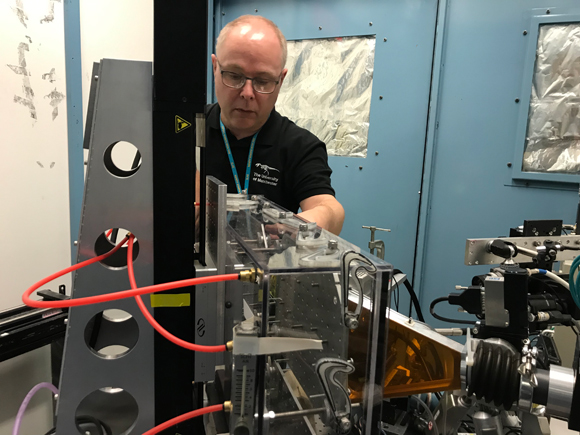
Working in collaboration with researchers from the University of Chicago (Illinois, USA), the Manchester University team have identified the first detailed fossil of a hagfish.  The Manchester team were led by Professors Phil Manning and Roy Wogelius, powerful X-rays were used to provide a detailed examination of the fossil specimen, providing a fresh perspective on the evolution of jaws in animals with back bones (vertebrates).

The Tethymyxine tapirostrum fossil Specimen Being Prepared for Synchrotron Analysis

Tethymyxine tapirostrum fossil.
Tethymyxine tapirostrum fossil being prepared for synchrotron X-ray analysis.

Picture credit: University of Manchester

The X-rays were produced using the Stanford Synchrotron Radiation Lightsource (SSRL), a cyclic particle accelerator at Stanford University (California).  Once the fossil had been scanned, the data produced helped answer the question as to when these ancient jawless fish branched-off the vertebrate evolutionary tree.

An Ancient Hagfish – An Important Discovery

This discovery is incredibly important as it changes our view of the evolutionary lineage that gave rise to modern-day jawed vertebrates (gnathostomes), from bony fish to humans.  The scientific paper is being published in the “Proceedings of the National Academy of Sciences”.  The fossil, a specimen of a hagfish from the Late Cretaceous comes from Lebanon and it measures just over thirty centimetres long.  The fossil represents a species named Tethymyxine tapirostrum.

Commenting on the importance of this research, Professor Phil Manning (Chair of Natural History at the University of Manchester) stated:

“This is an extremely significant discovery as it recalibrates our understanding of the evolutionary history of all early vertebrates, an ancestral line that leads to all jawed beasties including us. Humans!”

Professor Manning added:

“This wonderful fossil plugs a 100-million-year gap in the fossil record and shows that hagfish are more closely related to the lamprey than to other fishes.  The chemical maps produced at SSRL enabled our team to see for the first time the anatomical features so crucial to the interpretation of this very distant relative.”

Lampreys are another form of ancient, blood-sucking, jawless fish also still in existence today.  These findings show that both the hagfish and lamprey evolved their eel-like body form and strange feeding systems after they branched off from the rest of the vertebrate line of ancestry about 500 million years ago, during the Cambrian geological period.

Professor Manning at the SSRL (Stanford University)

Professor Phil Manning at the Stanford Synchrotron Radiation Lightsource (SSRL).
Professor Manning at the Stanford Synchrotron Radiation Lightsource (SSRL).

Picture credit: University of Manchester

Dr Tetsuto Miyashita, (Fellow in the Department of Organismal Biology and Anatomy at Chicago University), who led the research, explained:

“This is a major reorganisation of the family tree of all fish and their descendants.  This allows us to put an evolutionary date on unique traits that set hagfish apart from all other animals.”

The Bizarre Hagfish

The bizarre hagfish are entirely marine and are the only known living animals that possess a rudimentary skull but no vertebral column.  They do have very primitive vertebrae but instead of a back bone like other vertebrates they just have a modified notochord.  They have a unique defence mechanism to help them ward off ocean predators such as sharks.  Hagfish can produce copious amounts of slime, clouding the water in their proximity and clogging the gills of would-be attackers.  In some parts of Asia, such as South Korea, this slime is prized and used in cooking.

It was this ability to produce slime that made the Tethymyxine fossil all the more important and rare.  The discrete chemistry locked within the fossil could only be mapped using synchrotron-based imaging techniques developed by the Manchester/SSRL team.  Manchester University  is an established world leader in the synchrotron-based imaging of fossil remains.  This technique has permitted the team to identify the “chemical ghost” of the preserved soft tissue and slime glands of the fossil.  Soft tissues are rarely preserved as fossils, which is why there are so few examples of prehistoric hagfish for palaeontologists to study.

Detailed Scans of the Fossil

The detailed scans picked up the chemical signal for keratin, the same material that makes up your hair and nails.  Keratin is a crucial part of what makes the hagfish slime defence so effective.

Professor Wogelius, (Chair of Geochemistry at The University of Manchester), commented:

“Our team at Manchester has been using these increasingly sophisticated imaging techniques to help us better understand ancient fossils and resolve chemistry derived from both the organism and the environment in which they were preserved.”

Professor Manning added:

“This ‘chemical’ fossil has offered new and exciting evidence that has enabled a more robust reconstruction of the vertebrate family tree.  However, it was only made possible through the collaboration of an international team, as Darwin once said, ‘In the long history of humankind (and animal kind, too) those who learned to collaborate and improvise most effectively have prevailed’”.

Everything Dinosaur acknowledges the assistance of a media release from the University of Manchester in the compilation of this article.

Visit the Everything Dinosaur website: Everything Dinosaur.
14 01, 2019

Astonishing Basilosaurus – The Apex Predator

By |2023-11-19T16:13:10+00:00January 14th, 2019|Categories: Dinosaur and Prehistoric Animal News Stories, Main Page, Palaeontological articles, Photos/Pictures of Fossils|0 Comments

Research Confirms Basilosaurus Was a Top Predator

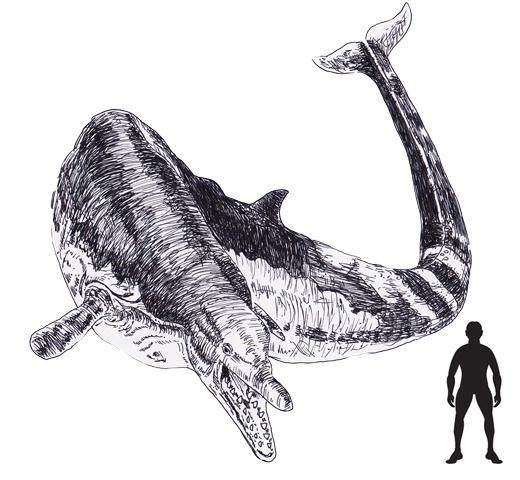
Readers with a long memory might remember an episode from the BBC “Walking with Beasts” television series that first aired in 2001.  In this sequel to “Walking with Dinosaurs”, the focus was placed upon the evolution of the mammals after the dinosaur extinction.  “Whale Killer”,  which was episode two in the six-part series, told the story of a pregnant Basilosaurus (archaic whale), desperately searching for food to help the calf growing inside her.  Thanks to raids on Dorudon whales and their young, the Basilosaurus is able to successfully give birth and this episode ends with the mother swimming away with her new-born calf following close behind.

An Illustration of the Fearsome Early Toothed Whale Basilosaurus

PNSO Basilosaurus illustration.
An illustration of Basilosaurus.  The human figure provides scale. Picture credit: Everything Dinosaur.

Picture credit: Everything Dinosaur

To view models and replicas of marine prehistoric animals: PNSO Age of Dinosaurs.

Analysis of Basilosaurus Stomach Contents

A team of researchers writing in the on-line, academic journal PLOS One, have published the results of stomach content analysis of Basilosaurus specimens from the Late Eocene-aged site at Wadi Al-Hitan in Egypt.  It is confirmed that Basilosaurus fed on smaller whales (juvenile Dorudon atrox) as well as large fish (Pycnodus mokattamensis).  The scientists, which included Manja Voss (Museum für Naturkunde Berlin) and Mohammed Sameh M. Antar from the Egyptian Environmental Affairs Agency, Cairo, state that this is the first direct evidence of Basilosaurus (B. isis) diet.

A Size Comparison Between an Adult Basilosaurus isis and an Adult Dorudon atrox

An adult Basilosaurus compared to an adult Dorudon whale.
Comparing an adult, fifteen-metre-long Basilosaurus isis museum mounted skeleton to a fully grown Dorudon atrox.

Picture credit: PLOS One/University of Michigan

Basilosaurus – Top of a Tethys Ocean Ecological Pyramid

The Late Eocene Epoch was a time of dramatic change and global extinction.  The once mighty Tethys Ocean was very much reduced, but the first, giant, toothed whales had evolved and the research team cite Basilosaurus isis, the Late Miocene Livyatan melvillei, and the extant Orca (Orcinus orca) as three marine apex predators known from relatively short intervals of time during the Cenozoic.  This research confirms the predator-prey relationship between the two most frequently found fossil whales at the Wadi Al-Hitan location.  Bite marks on the preserved skulls of Dorudon whales suggest predation and not scavenging behaviour by Basilosaurus.

A Photomosaic of a Basilosaurus Specimen (WH 10001)

Basilosaurus scattered remains.
Photomosaic of Basilosaurus isis (WH 10001) from the Gehannam Formation of Wadi Al Hitan.

Picture credit: PLOS One

The image above shows a photomosaic of a scattered and disarticulated Basilosaurus isis specimen from the Gehannam Formation of Wadi Al-Hitan.  The disarticulation of the fossil skeleton and the scattering suggests disturbance by scavengers and possibly long exposure on the seafloor prior to burial.

The researcher conclude that Basilosaurus was a top apex predator that hunted and ate its prey alive, rather than scavenging for scraps.  If the Wadi Al-Hitan site, represents a calving area for the Dorudon, then this would have made an ideal hunting spot for a hungry Basilosaurus.  The dramatic scenes in episode two of the “Walking with Beasts” television series, have more published scientific evidence to back up the screenplay.

The Everything Dinosaur website: Everything Dinosaur.

9 01, 2019

When Did Life on Land First Evolve?

By |2023-11-18T23:00:52+00:00January 9th, 2019|Categories: Dinosaur and Prehistoric Animal News Stories, Geology, Main Page, Palaeontological articles, Photos/Pictures of Fossils|0 Comments

Was There Life on Land During the Ediacaran?

The transition of vertebrates from fully aquatic to partially terrestrial animals has been well documented.  Transitional vertebrates such as the remarkable Tiktaalik roseae* provide evidence of the anatomical adaptations undertaken by back-boned animals as they conquered the land.  However, invertebrates got there first and before them the land was home to other organisms such as multi-cellular, photosynthesisng mats of algae.  When complex organisms, rather than members of the Plantae Kingdom or bacteria established themselves on land is somewhat controversial, but new clues might be emerging from fossils found in some of the oldest known soils on Earth.  Could land-dwelling organisms have been present during the Ediacaran?

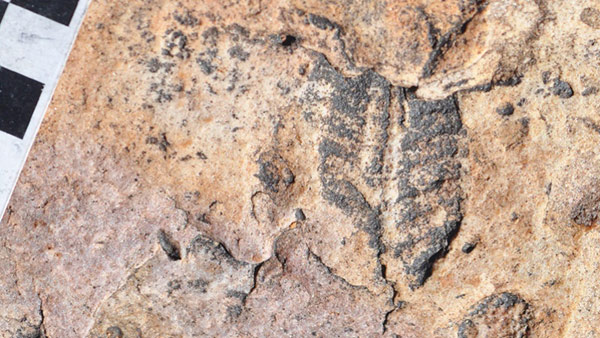
An Ediacaran Fossil Affected by Wind-drift Deposition

Evidence of wind-drift deposition in ancient Ediacaran sediments.
A portion of a quilted Ediacaran fossil is partly covered by ancient wind deposition – source Namibia.

Picture credit: Greg Retallack (Oregon University)

Not Marine Fossils But Fossils from a Fluvial Environment

Multi-cellular, terrestrial animals may have existed during the Ediacaran, that is the conclusion of Greg Retallack, fossil collections director at the University of Oregon’s Museum of Natural and Cultural History, writing in the journal Sedimentary Geology.  The evidence for such a conclusion emerged from fossil assemblages, previously considered to represent ocean organisms, found in thin layers of silt and sand located between thicker sandstone beds from Ediacaran-aged fossil localities of Nilpena, South Australia and in similarly aged rocks from Namibia.

The Ediacaran is the last geological period of the Precambrian (Neoproterozoic Era), it lasted from 635 million years ago to 542 million years ago and this period in Earth’s history was named after the Ediacara Hills, located north of Adelaide (South Australia), in which, geologist Reginald Sprigg discovered a remarkable collection of fossils representing bizarre, soft-bodied organisms.

Commenting on his new research Greg Retallack stated:

“These Ediacaran organisms are one of the enduring mysteris of the fossil record.  Were they worms, sea jellies, sea pens, amoebae, algae?  They are notoriously difficult to classify, but conventional wisdom has long held that they were marine organisms.”

Studying Interflag Sandstone Laminae

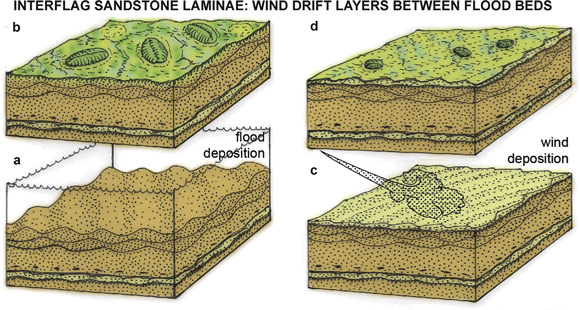
An in-depth, microscopic analysis of the sediments and their geochemical properties has led to a reassessment of the environmental conditions that led to their deposition.  The grains that make up the sediments, reveal telltale marks of ancient wind erosion, the sediments suggest wind-drift deposition between flood beds.  This indicates a terrestrial origin for them and not deposition in a marine environment, after all, wind (aeolian forces), hardly affect sand grains on the seabed.

These thin, silty to sandy layers that are “sandwiched” between thicker sandstone beds are referred to as interflag sandstone laminae, they are sometimes called “shims” or “microbial mat sandwiches”.  In the research paper, Greg Retallack found similar structures in modern river deposits as well as more ancient interflag sandstone laminae in Pennsylvanian (Upper Carboniferous), and Eocene fluvial levee facies.

Thin, Silty to Sandy Layers Deposited Between Thicker Layers of Sandstone

Interflag Sandstone Laminae
How interflag sandstone laminae form – wind deposition alternates with flood deposition – a phenomenon observed in modern fluvial environments.

Picture Credit: Greg Retallack (Oregon University)

Professor Retallack confirmed his diagnosis of an aeolian factor in the deposition by stating:

“Such wind-drifted layers are widespread on river levees and sandbars today.  They are present throughout the Flinders Ranges of South Australia and also in Ediacaran rocks of southern Namibia.”

If the sediments are affected by aeolian forces, then it follows that they were deposited in terrestrial environments and therefore the fossil assemblage associated with these deposits are very likely to represent a terrestrial biota.  The organisms that left these fossils would have been multicellular and quite complex, visible to the naked eye.  Such life would have preceded the emergence of the first land plants by many tens of millions of years.

Unearthing Important Clues

The Ediacaran biota remains extremely difficult to classify, only impressions have been preserved so the internal structure of most of these bizarre organisms is entirely unknown.  They could represent a “dead-end” in the evolution of complex life, or some of them might be ancestral to extant groups of animals.  The fauna of the Ediacaran might remain enigmatic, when it comes to learning what the fossils actually represent, but this new study offers some intriguing new evidence about the palaeoenvironment.

The Professor concluded:

“The investigation points to a terrestrial habitat for some of these organisms, and combined with growing evidence from studies of fossil soils and biological soil crust features, it suggests that they may have been land creatures such as lichens.”

*To read an article about Tiktaalik roseae: Scientists Get to Grips with Tiktaalik’s Rear End.

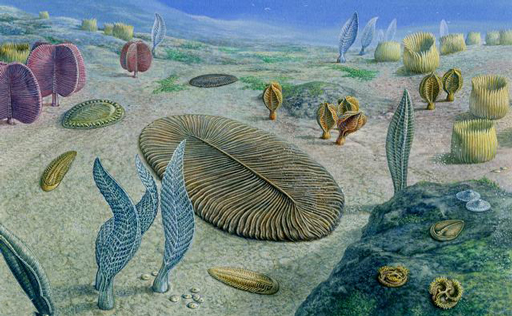
Life in the Ediacaran (Marine Biota)

Ediacaran marine life.
Life in the Ediacaran.  Up until now, most if not all of the life reconstructions have focused on a marine ecosystem scenario.

Picture credit: John Sibbick

The scientific paper: “Interflag Sandstone Laminae, A Novel Sedimentary Structure, with Implications for Ediacaran Paleoenvironments” by Gregory J. Retallack published in Sedimentary Geology.

Everything Dinosaur acknowledges the help of a press release from the Univesity of Oregon in the compilation of this article.

Visit the Everything Dinosaur website: Everything Dinosaur.
Go to Top