All about dinosaurs, fossils and prehistoric animals by Everything Dinosaur team members.
Articles, features and information which have slightly more scientific content with an emphasis on palaeontology, such as updates on academic papers, published papers etc.
The fearsome carcharodontosaurids (family Carcharodontosauridae), comprise some of the largest terrestrial predators that ever lived. Giant theropods such as Giganotosaurus, Carcharodontosaurus and Tyrannotitan rivalled the largest tyrannosaurs in terms of size and probably (in some cases), were even bigger. It had been thought that these types of carnivorous dinosaur were confined to the Cretaceous, but there is a growing body of evidence to suggest that this group was well established and geographically widespread by the Late Jurassic.
Lusovenator santosi
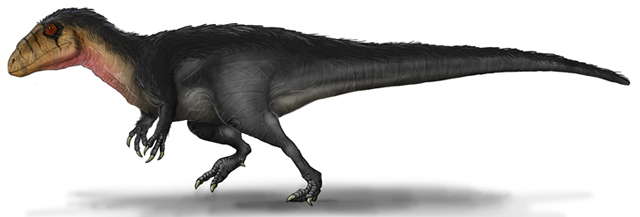
A team of scientists writing in the “Journal of Vertebrate Paleontology” have described a new species of carcharodontosaurid based on fossils found in Portugal. The dinosaur has been named Lusovenator santosi, the genus name translates as “hunter of Lusitania”, a reference to the Lusitanian Basin, the geological region where the fossils are from. Their research supports the idea that these types of predators were present in the Northern Hemisphere some twenty million years earlier than previously thought.
A Life Reconstruction of the Late Jurassic Carcharodontosaurid Lusovenator santosi
A life reconstruction of Lusovenator.
Picture credit: Carlos de Miguel Chaves
A Reassessment of Allosaur Fossil Material
The researchers, based in Lisbon and Madrid, re-evaluated fragmentary fossil material collected over the last two decades at sites located on the Portuguese coast about 35 miles (60 kilometres), north of Lisbon. Initial examination suggested that this material represented a member of the Allosauridae, but a more detailed analysis of the fossils led the researchers to conclude that this material represented a dinosaur from the Carcharodontosauridae, a family nested within the clade Allosauria, but distinct from famous Late Jurassic super-predators such as Allosaurus fragilis, which is known from the western United States.
Lead author of the scientific paper, Elisabete Malafaia (University of Lisbon), commented that this discovery demonstrates the importance of the Iberian Peninsula as a key region for understanding the dispersal of carcharodontosaurids as well as other types of dinosaur across the northern hemisphere during the Late Jurassic and Early Cretaceous.
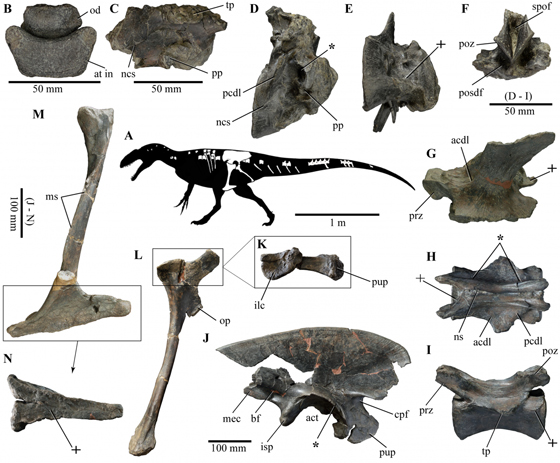
Fossil Material Assigned to Lusovenator santosi
Fossil material assigned to Lusovenator santosi with a silhouette showing skeletal location.
Picture credit: Malafaia et al (Journal of Vertebrate Palaeontology)
One of the Oldest Members of the Carcharodontosauridae
The oldest definitive carcharodontosaurid described to date is Veterupristisaurus (V. milneri) from the Middle Dinosaur Member of the famous Tendaguru Formation of Tanzania. Veterupristisaurus (pronounced Vet-ter-roo-pris-tee-sore-us), is believed to have lived around 154 million years ago (Kimmeridgian faunal stage of the Late Jurassic). Other fragmentary fossil remains from China and Germany have also been tentatively assigned to Late Jurassic carcharodontosaurids. Lusovenator lived around 145 million years ago, as such, it is the oldest carcharodontosaurian allosauroid yet discovered from Laurasia.
The fossil material is believed to represent a relatively young animal, with a body length of approximately 3.5 metres. Although, probably not fully grown, the vertebrae and the ilium show a number of anatomical traits that distinguish Lusovenator from the Allosauridae and nest it with the related, but distinct Carcharodontosauridae.
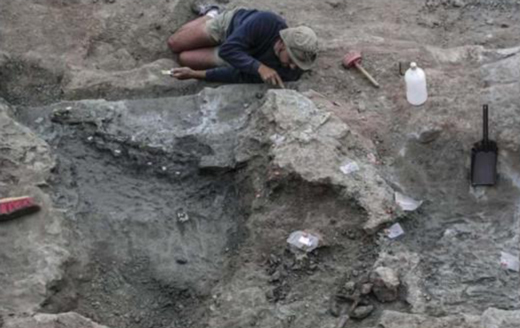
A Member of a Field Team Working on a Fossil Specimen
A field team member working on fossil material.
Picture credit: LUSA
Furthermore, the identification of this new species expands the diversity of theropod dinosaurs known from the Late Jurassic of Portugal and reinforces the theory that the Iberian Peninsula is a key region to help understand the dispersal of a number of different types of dinosaur across the Northern Hemisphere at the end of the Jurassic and into the Early Cretaceous.
The scientific paper: “A new carcharodontosaurian theropod from the Lusitanian Basin: evidence of allosauroid sympatry in the European Late Jurassic” by Elisabete Malafaia, Pedro Mocho, Fernando Escaso and Francisco Ortega published in the Journal of Vertebrate Paleontology.
Aratasaurus museunacionali Newly Described Basal Coelurosaur
This month a new basal member of the Coelurosauria has been named and described from limb bones sourced from the Romualdo Formation in north-eastern Brazil. The dinosaur has been named Aratasaurus museunacionali, the genus name translates as “lizard born of fire” a reference to the fact, the fossil had been in the National Museum of Brazil (Museu Nacional), when a fire ripped through the building. Fortunately, the fossil material was not damaged and the research could be successfully concluded and a new genus of Early Cretaceous dinosaur described.
A New Theropod – Aratasaurus museunacionali
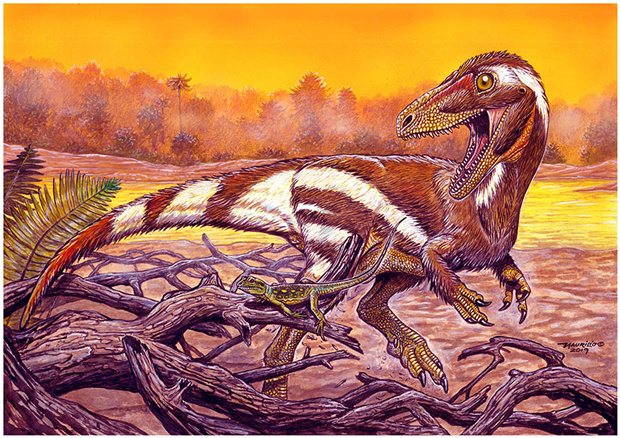
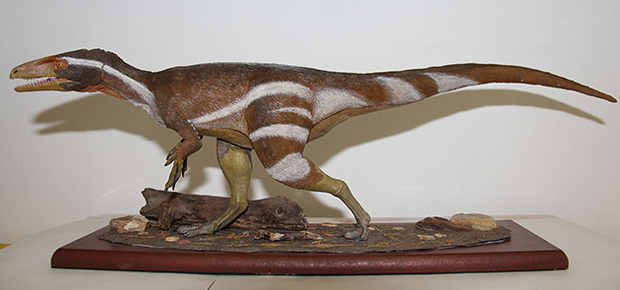
Aratasaurus museunacionali Life Reconstruction
Aratasaurus museunacionali life reconstruction.
Picture credit: Museu Nacional
The species name honours the Museu Nacional in recognition of the tragic fire that took place in September 2018. To read more about the fire: Devastating Fire at Brazil’s National Museum.
Helping to Better Understand the Coelurosauria
Juliana Sayão, a palaeontologist from the Federal University of Pernambuco and lead author of the scientific paper, commented that this new theropod will help scientists to better understand the evolutionary history of the Coelurosauria, an extensive clade of dinosaurs that consists of the tyrannosaurids, compsognathids, the ornithomimosaurs and the Maniraptora which includes birds.
A phylogenetic assessment suggests that Aratasaurus is closely related to Zuolong (Z. salleei), from the Late Jurassic of China, although it lived much more recently, the sediments from which the limb elements were excavated have been dated to approximately 110-115 million years ago (Albian faunal stage of the Cretaceous).
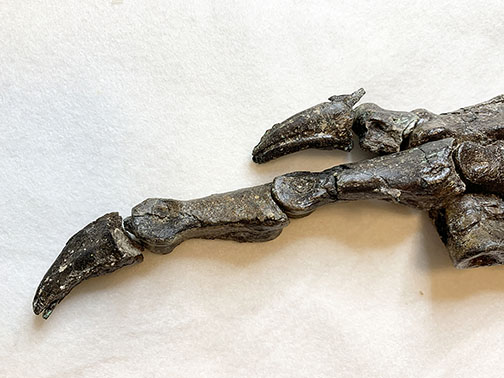
The Right Pes of Aratasaurus museunacionali after Preparation
Aratasaurus museunacionali fossils. The fossils although fragmentary and fragile were preserved in a partially articulated state.
Picture credit: Museu Nacional
Evidence of Seasonal Fires
The genus name might reflect the ordeal of the fire at the Museu Nacional but tiny pieces of fossilised wood found in association with the dinosaur bones suggest that Aratasaurus had to contend with forest fires within its ecosystem when it roamed this part of Gondwana more than 100 million years ago.
Highlighting the significance of this fossil discovery Juliana Sayão commented:
“Every discovery of a fossil is important because we obtain records that help to reconstruct the history of the planet and remake the path of evolution of the organisms that lived here millions of years ago. Many times the fossil is unique and provides all the information about that species or group of animals”.
Brazil’s Newest Carnivorous Dinosaur
A model of the Brazil’s newest carnivorous dinosaur from the Araripe Basin has been commissioned. Careful examination of the bone structure (histology), suggests that the individual was approximately four years old when it died. Based on the growth rates of other, better known coelurosaurs, the researchers propose that the fossils represent a sub-adult specimen. As such, the size estimate of around three metres in length probably does not represent the maximum size for this dinosaur species.
The Model of Aratasaurus museunacionali
A detailed model of the newly described Aratasaurus museunacionali.
Picture credit: Museu Nacional
The fossils, consisting of a partial femur, a tibia and foot bones representing an incomplete right limb were discovered in 2008 and first taken to the Museum of Palaeontology Plácido Cidade Nuvens, in Santana do Cariri but transferred to the Laboratory of Paleobiology and Microstructures, at the Academic Centre of Vitória, (Federal University of Pernambuco), for further preparation and study.
As part of the research project, the fossil material was taken in 2016 to the Museu Nacional for further analysis. Although caught up in the conflagration that destroyed much of the museum in 2018, the specimen survived and the analysis was able to be completed.
Photograph and Line Drawing Showing the Right Pes (Foot)
Part of the holotype material for Aratasaurus with an accompanying line drawing showing metatarsals and pedal digits. Scale bar equals 5 cm.
Picture credit: Manso Sayão et al (Scientific Reports)
Comments from Everything Dinosaur
A spokesperson from Everything Dinosaur commented:
“The specimen might be fragmentary, but it’s discovery underpins the significance of the Romualdo Formation and helps to extend our knowledge of the dinosaur biota inhabiting this part of Gondwana in the later stages of the Early Cretaceous. As this genus has been classified as the sister taxon of the Chinese Zuolong, it suggests that basal coelurosaurs may have been more widely distributed and had a greater temporal range than previously thought.”
Everything Dinosaur acknowledges the assistance of a media release from the Museu Nacional in the compilation of this article.
The scientific paper: “The first theropod dinosaur (Coelurosauria, Theropoda) from the base of the Romualdo Formation (Albian), Araripe Basin, Northeast Brazil” by Juliana Manso Sayão, Antônio Álamo Feitosa Saraiva, Arthur Souza Brum, Renan Alfredo Machado Bantim, Rafael Cesar Lima Pedroso de Andrade, Xin Cheng, Flaviana Jorge de Lima, Helder de Paula Silva and Alexander W. A. Kellner published in Scientific Reports.
The Big Difference that Tiny Kongonaphon kely Made
This month, we have seen the publication of a scientific paper that details the discovery and scientific description of a black-bird-sized ancestor of the dinosaurs and pterosaurs that suggests these two great Orders of reptiles had very humble beginnings. Standing less than ten centimetres high, Kongonaphon kely, along with the ever so slightly larger, probable ornithodiran Scleromochlus (from Scotland), indicate that there was a pronounced miniaturisation event close to the common ancestor of the Pterosauria and the Dinosauria.
Kongonaphon kely
Being small, means that you have a high surface area to volume ratio, so retaining body heat is a real problem. It can be speculated that fuzzy, downy coats first evolved in the Ornithodira to provide thermal insulation. There is some fossil evidence to suggest that the common ancestor of both dinosaurs and pterosaurs had a fuzzy integument. In addition, small size could have been a key driver for the evolution of flight within the Pterosauria.
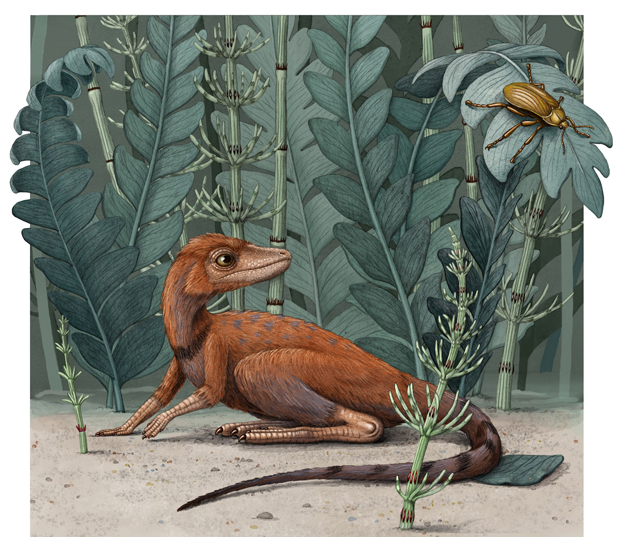
A Feathery Lagerpetid? A Life Reconstruction of Kongonaphon kely
Kongonaphon life reconstruction.
Picture credit: Kammerer et al (Proceedings of the National Academy of Sciences)
Assigned to the Lagerpetidae
The origins of the Ornithodira, the clade that contains the last known common ancestor of the dinosaurs and pterosaurs plus all its descendants, is poorly understood. If these animals were small and light, then this might explain their lack of presence in the fossil record. Kongonaphon comes from south-western Madagascar, its fragmentary remains were discovered by a field team in 1998. Significantly, the fossil material includes elements from the skull and the upper jaw (maxilla), with several teeth preserved in situ.
Analysis of the wear on the teeth suggests that this little animal fed on hard-shelled insects such as beetles, hence the insect illustrated in the top right of the Kongonaphon life reconstruction.
Phylogenetic analysis places Kongonaphon within the Lagerpetidae and as such it is the first lagerpetid known from Africa and the first to provide skull and jaw bones to extend our knowledge of this family. Analysis of the tiny bones suggest that Kongonaphon was at least two years old when it died, so the fossils are likely to represent a mature or semi-mature animal and not a juvenile.
You Say Ornithodira, I Say Avemetatarsalia
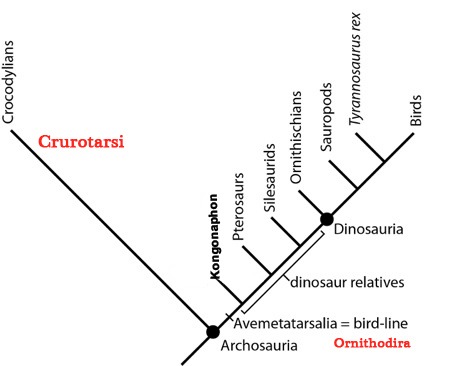
Within the Archosauria, there are two distinct clades, essentially classified by the shape and position of their ankle bones. The Crurotarsi lineage – essentially the crocodilians and their extinct relatives and the Avemetatarsalia, the “bird-line archosaurs” such as dinosaurs, Aves and pterosaurs. Ornithodira is another term sometimes used to describe the Avemetatarsalia.
In other words: Ornithodira = Avemetatarsalia.
Plotting the Taxonomic Relationship of Kongonaphon within the Avemetatarsalia
Kongonaphon placed on the Avemetatarsalia branch of the Archosauria.
Picture credit: Sterling Nesbitt of Virginia Tech with additional annotation by Everything Dinosaur
The scientific paper: “A tiny ornithodiran archosaur from the Triassic of Madagascar and the role of miniaturization in dinosaur and pterosaur ancestry” by Christian F. Kammerer, Sterling J. Nesbitt, John J. Flynn, Lovasoa Ranivoharimanana, and André R. Wyssand published in the Proceedings of the National Academy of Sciences of the USA.
Dinosaur Eggs Provide a View on a “Hidden Ecosystem”
Not all the dinosaurs that ever existed are likely to be named and described by scientists. Identifying these long extinct creatures relies on there being a fossil record of some sort to study. A team of researchers writing in the journal “Cretaceous Research”, report on a new Lower Cretaceous fossil egg locality in Hyogo Prefecture, Japan, that provides a tantalising glimpse into a hidden dinosaur dominated ecosystem.
The researchers, which include Kohei Tanaka (University of Tsukuba, Japan) and Darla Zelenitsky (University of Calgary, Canada), describe eggs and eggshell fragments associated with four ootaxa, two of which are new to science. The site reveals a hidden diversity of small dinosaurs, particularly non-avian theropods, in the Hyogo region and indicates the area was utilised for nesting by various small dinosaur species in the Early Cretaceous.
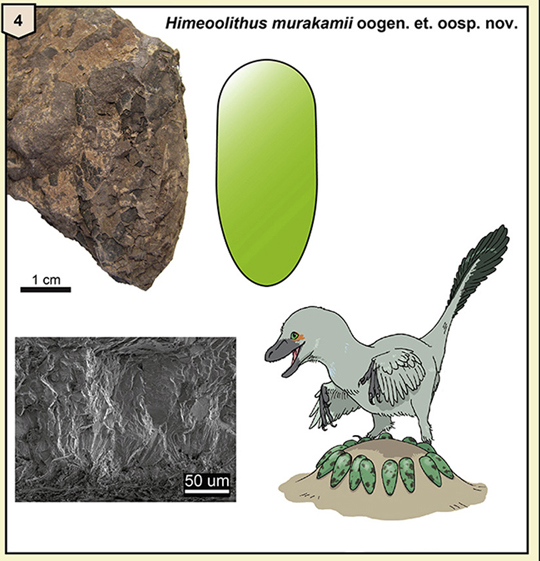
The Newly Erected Ootaxa Himeoolithus murakamii the Most Abundant Ootaxa from the Quarry Site
Himeoolithus murakamii egg fossil, high resolution image, line drawing of egg showing elongated shape and life reconstruction.
Picture credit: University of Tsukuba and Museum of Nature and Human Activities Hyogo Prefecture with life reconstruction by Ayaka Nagate
The Kamitaki Locality
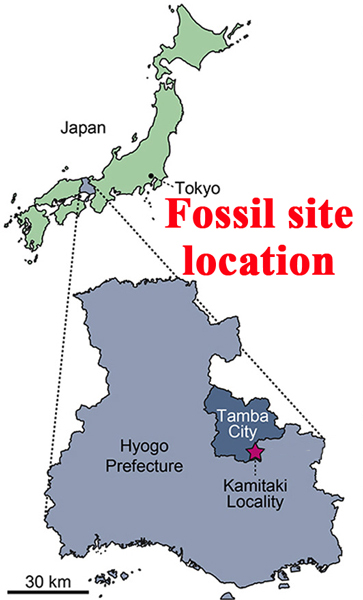
The fossil site, known as the Kamitaki locality lies close to the Sasayama River in Kamitaki, Sannan-cho, Tamba City, Hyogo Prefecture. One horizon has yielded a variety of small vertebrate fossils including frogs and lizards, plus a partial tail from a titanosaur that was formally named and described in 2014 (Tambatitanis amicitiae). Eggshell fragments are also associated with this part of the site. However, a horizon some 5.5 to 6.75 metres above the bonebed layer has yielded an astonishing quantity of egg fossils, including a nearly complete egg, several partial eggs and hundreds of eggshell fragments.
The researchers conclude that this horizon represents a nesting area in which a variety of small theropods raised their young.
As a result of this research, two new theropod egg taxa have been named – Himeoolithus murakamii and Subtiliolithus hyogoensis. Although no skeletal remains of these little dinosaurs have been found, the presence of all the egg fossils suggests that there were numerous different types of small theropod co-existing in this ancient ecosystem.
The Location of the Fossil Site within Hyogo Prefecture
The location of the Kamitaki fossil site and the discovery of the dinosaur eggs.
Picture credit: University of Tsukuba and Museum of Nature and Human Activities Hyogo Prefecture/Cretaceous Research with additional annotation by Everything Dinosaur
Examining the Mudstone Deposits
The mudstone deposits are thought to have been laid down around 110 million years ago (Albian faunal stage of the Lower Cretaceous) and the palaeoenvironment has been described as floodplain which was subjected to a extremes of seasonality with long periods of very dry conditions punctuated by a very wet season that led to flood events.
The most abundant ootaxon at the quarry, Himeoolithus, is represented by four eggs and over 1300 scattered eggshell fragments. Himeoolithus accounts for over 96% of all the egg fossils associated with this site. Himeoolithus is the smallest non-avian theropod egg known to date, the scientists estimate that the egg probably weighed about as much as a quail egg (around 9.9 grammes). It is also a very unusual shape, being elongate with its length 2.25 times its width (length : width ratio 2.25).
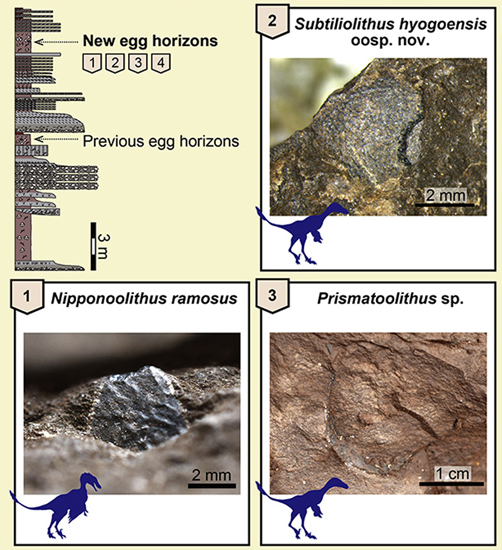
The new egg fossil horizon was discovered in 2015 and was mapped and intensively excavated in the winter of 2019. In total, the egg fossil horizon and the lower Kamitaki Bonebed (Ohyamashimo Formation), have yielded six small theropod ootaxa.
The Stratigraphy of the Kamitaki Locality and Examples of Associated Ootaxa
The stratigraphy of the Kamitaki locality with examples of theropod ootaxa from the site. Subtiliolithus hyogoensis is the second of the new ootaxa to be reported in the scientific paper.
Picture credit: University of Tsukuba and Museum of Nature and Human Activities Hyogo Prefecture/Cretaceous Research
Notable Biodiversity
The ootaxa demonstrate that this ancient habitat was home to a variety of small theropod dinosaurs. It is likely that many other palaeoenvironments associated with the Lower Cretaceous were also home to a diverse variety of small theropods too, these animals being currently under-represented in the fossil record.
Lead author of the paper, Professor Kohei Tanaka, confirmed that the research team thought that the new egg fossil horizon was a nesting site and the deposit was not the result of a transportation and subsequent burial of egg material from another location:
“Our taphonomic analysis indicated that the nest we found was in situ, not transported and redeposited, because most of the eggshell fragments were positioned concave-up, not concave-down like we see when eggshells are transported.”
Commenting About the Dinosaur Eggs
The professor added:
“The high diversity of these small theropod eggs makes this one of the most diverse Early Cretaceous egg localities known. Small theropod skeletal fossils are quite scarce in this area. Therefore, these fossil eggs provide a useful window into the hidden ecological diversity of dinosaurs in the Early Cretaceous of south-western Japan, as well as into the nesting behaviour of small non-avian theropods.”
Everything Dinosaur acknowledges the assistance of a media release from the University of Tsukuba (Japan), in the compilation of this article.
The scientific paper: “Exceptionally small theropod eggs from the Lower Cretaceous Ohyamashimo Formation of Tamba, Hyogo Prefecture, Japan” by Kohei Tanaka, Darla K. Zelenitsky, François Therrien, Tadahiro Ikeda, Katsuhiro Kubota, Haruo Saegusa, Tomonori Tanaka and Kenji Ikuno published in the journal Cretaceous Research.
Taxonomic status of Ugrunaaluk kuukpikensis is Challenged
Five years ago, Everything Dinosaur reported the naming of a new species of duck-billed dinosaur that lived well inside the Arctic circle during the Late Cretaceous. The dinosaur was named Ugrunaaluk kuukpikensis (pronounced 00-grew-na-luck kook-pik-en-sis). At the time of publication, Ugrunaaluk was thought to be closely related to Edmontosaurus. Since then, there has been quite a debate regarding the taxonomic validity of Ugrunaaluk. In the latest twist of a tale set in prehistoric polar latitudes, researchers writing in PLOS One conclude that this Arctic dinosaur is most probably a species of Edmontosaurus.
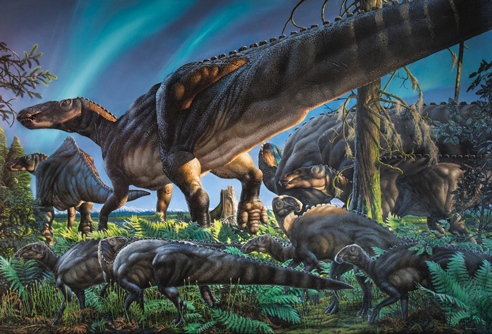
The Taxonomic Validity of the Arctic Hadrosaur Ugrunaaluk kuukpikensis is Challenged
The taxonomic validity of Ugrunaaluk kuukpikensis is controversial as this species was erected based on the study of the bones of immature, not fully adult individuals.
Picture credit: James Havens
The Prince Creek Formation Specimens
Duck-billed dinosaur fossils from the Liscomb Bonebed (Prince Creek Formation, North Slope, Alaska), were the first dinosaur bones discovered from the Arctic. When originally assessed, it was proposed that these hadrosaurids were Edmontosaurus, members of the sub-clade Hadrosaurinae. In 2015, a scientific paper was published that proposed the closely related species Ugrunaaluk kuukpikensis. However, the taxonomic status of this material is problematical. The fossils associated with the Liscomb Bonebed site represent immature, sub-adults and as such many of the anatomical traits used to characterise U. kuukpikensis, may reflect the developmental age of the individual and the shape of the bones may have altered as the dinosaur grew and matured.
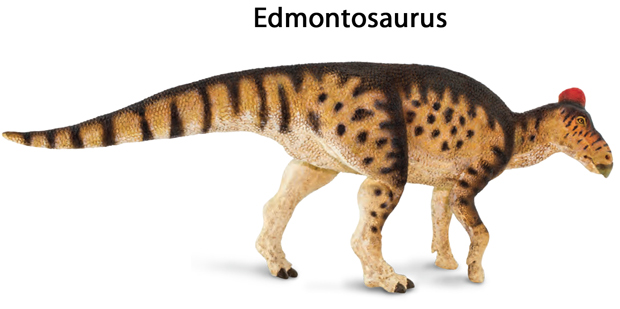
A Model of an Adult Edmontosaurus
The new for 2020 Wild Safari Prehistoric World Edmontosaurus dinosaur model.
Picture credit: Everything Dinosaur
The picture (above) shows an Edmontosaurus figure from the Wild Safari Prehistoric World model series.
Looking at the Evidence for an Edmontosaurus taxon Hypothesis
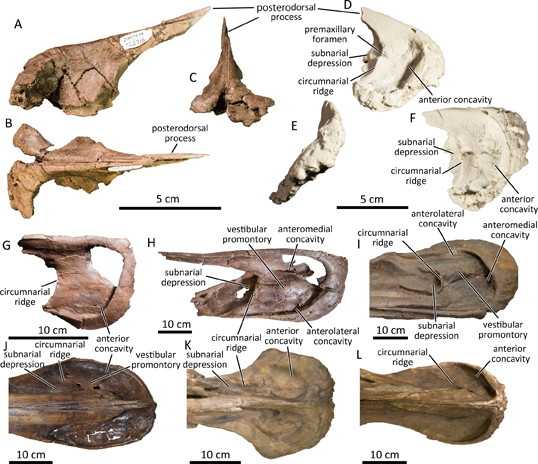
In this newly published paper, researchers from Okayama University of Science (Japan), the Perot Museum of Nature and Science (Texas) and Hokkaido University Museum (Japan), re-examined the skull bones from the Liscomb Bonebed and determined that the traits used to distinguish these Arctic fossils from those ascribed to Edmontosaurus were questionable.
In 2015, the scientific paper describing Ugrunaaluk kuukpikensis (Mori et al), proposed eight diagnostic characters for this new species. Among the eight characters identified, three were proposed to distinguish Ugrunaaluk kuukpikensis from the Edmontosaurus genus. Four of these eight characters distinguished Ugrunaaluk from Edmontosaurus annectens, which is known from Maastrichtian aged deposits from Montana and one character to distinguish Ugrunaaluk from the geologically older Edmontosaurus regalis, fossils of which are found in Canada.
It is likely that the shape of the skull of Edmontosaurus changed as it grew. The bones forming the skull would also undergo change in shape and size, because of this, any taxon erected solely based on the shape of skull bones from young animals is questionable. In this newly published paper, the researchers, which include Ryuji Takasaki, a researcher at the Okayama University of Science and Professor Yoshitsugu Kobayashi (Hokkaido University Museum), conclude that the Liscomb Bonebed hadrosaurid material should be ascribed to Edmontosaurus.
Comparing the Liscomb Bonebed Fossil Material with Known Edmontosaurus Skull Bones
A study of skull bones from the Prince Creek Formation (Alaska), suggests that the immature individual duck-billed dinosaurs found at this site are from the Edmontosaurus genus and that Ugrunaaluk kuukpikensis should be regarded as nomen dubium.
Picture credit: PLOS One (Takasaki et al)
Was Edmontosaurus Geographically Widespread
If the Arctic fossils are ascribed to Edmontosaurus, then this suggests that Edmontosaurus was geographically very widespread during the Late Cretaceous with fossils associated with this genus found in the northern states of the USA, Canada and Alaska. The scientists consider that the Prince Creek Formation Edmontosaurus should be regarded as Edmontosaurus sp. until further discoveries of mature hadrosaurines from the Prince Creek Formation Bonebed and/or equivalently juvenile Edmontosaurus specimens from the lower latitudes allow direct comparisons.
Furthermore, if Edmontosaurus is associated with the very far north of Laramidia, this has implications for the ancestry of Late Cretaceous Asian hadrosaurids. A number of duck-billed dinosaurs found in Asia may represent descendants of the Edmontosaurini lineage that migrated from Laramidia into Asia.
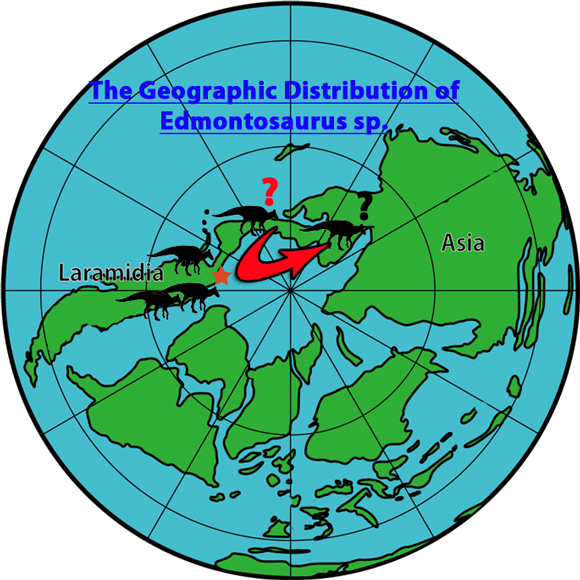
The Distribution of Edmontosaurus sp.
The researchers suggest that Edmontosaurus was geographically very widespread occupying much of northern Laramidia and many of the Late Cretaceous Asian hadrosaurs may have been descended from the Edmontosaurus lineage.
Picture credit: Scientific Reports with additional annotation by Everything Dinosaur
The map (above), illustrates the distribution of Edmontosaurus as proposed by the research paper. There is some evidence to suggest that Edmontosaurus preferred coastal environments and that this genus was widely distributed across northern Laramidia during the Late Cretaceous. If this assessment proves to be correct, Edmontosaurus had a geographical distribution spanning about 4,000 kilometres from north to south in North America.
The scientists speculate that the ancestor of Asian hadrosaurids such as Kamuysaurus migrated from North America.
Japanese Hadrosaurs Had North American Roots
Professor Kobayashi commented:
“It is possible that the ancestor of Kamuysaurus that adapted to the environment at the northern limit of the species’ habitat crossed from North America to Asia and eventually evolved to Kamuysaurus.”
If the Prince Creek Formation hadrosaurs are established as members of the Edmontosaurus genus, then they could represent a new species of Edmontosaurus. The large latitudinal distribution of this taxon could be re-established, the latitudinal range for Edmontosaurus would extend from about 40 degrees north to at least 70 degrees north.
The researchers conclude that despite the extensive geographical and temporal range of this taxon, the morphological disparity within different species associated with this genus is relatively small when compared to other members of the Hadrosaurinae. The lack of any substantial anatomical differences between widely distributed species could reflect the relatively low latitudinal temperature gradient during the Late Cretaceous compared to today. A relatively benign and unchanging environment would not have imposed significant pressure on species to evolve in order to adapt to new conditions.
The scientific paper: “Re-examination of the cranial osteology of the Arctic Alaskan hadrosaurine with implications for its taxonomic status” by Ryuji Takasaki, Anthony R. Fiorillo, Ronald S. Tykoski and Yoshitsugu Kobayashi published in PLOS One.
Did the Ancient Rhynchocephalians Out Compete Early Mammaliaforms?
Had you been around south Wales or south-western England some 200 million years ago, you would most probably have required a boat to get about. The area around the Bristol channel today (where you still need a boat), during the Early Jurassic, consisted of a series of small islands surrounded by a warm, shallow tropical sea. This archipelago (referred to as the Mendip Archipelago), was home to small dinosaurs and also to a variety of other reptiles including five species of Clevosaurus.
Studying Clevosaurus
Clevosaurs are members of an ancient Order of reptiles called the Rhynchocephalia. A new study published in the journal of the Palaeontological Association, suggests that these hardy reptiles may have filled the roles performed by early mammaliaforms on some of these small islands.
In addition, where Clevosaurus fossils are found, mammaliaform fossils tend to be lacking, so did these two types of tetrapod compete with each other for the same food resources? This new research carried out by members of the School of Earth Sciences (University of Bristol), indicates that this could have been the case. The scientists examined the biomechanics of the skulls of these lizard-like reptiles in a bid to gain an understanding of the likely diets of the species studied.
Different species of clevosaur had different bite forces, which hints at a degree of niche partitioning within this genus. This may explain why five different species were able to exist within a relatively small area.
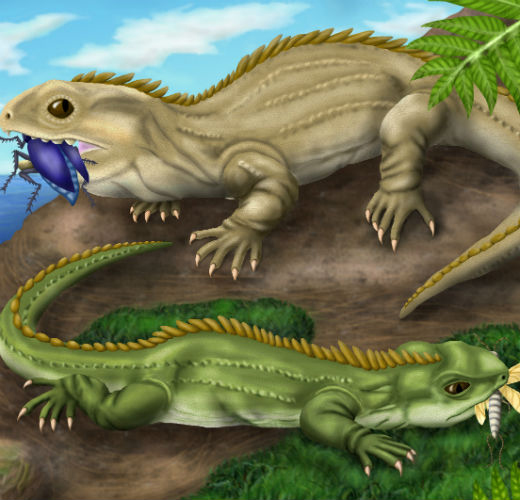
Different Species of Clevosaurus may have had Slightly Different Diets
Clevosaurus feeding habits – niche partitioning in Early Jurassic clevosaurs. The illustration shows two species of Clevosaurus associated with the Mendip Archipelago feeding on different types of insect prey. Clevosaurus hudsoni feeding on a hard-shelled beetle, whilst (bottom), Clevosaurus cambrica consumes a softer insect without a carapace.
Picture credit: Sofia Chambi-Trowell (University of Bristol)
Computerised Tomography Used to Analyse Skull Biomechanics
PhD student, Sofia Chambi-Trowell, from Bristol’s School of Earth Sciences, worked on CT scanned skulls of ancient rhynchocephalians and found differences in their jaws and teeth.
The student commented:
“I looked at skulls of two closely related species of Clevosaurus, Clevosaurus hudsoni and the slightly smaller Clevosaurus cambrica – the first one came from a limestone quarry near Bristol and the other one from South Wales. Clevosaurus was a lizard-like reptile, but its teeth occluded precisely, meaning they fit together perfectly when it was feeding. But what was it eating?”
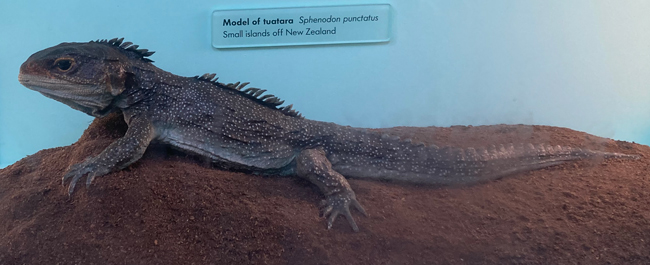
Rhynochocephalians (beak heads), were a very successful, globally distributed group of diapsid reptiles that flourished during the Mesozoic. The Tuatara (Sphenodon punctatus), is the only living member of this order, the Tuatara is confined to small islands off the coast of New Zealand and some specially designated and protected release sites on North Island.
Using Finite Element Analysis
Whilst studying the extant Tuatara is of great assistance to palaeontologists, expanding any findings to extinct members of this group is challenging. Likewise, identifying the feeding habits of long extinct species is equally difficult. However, finite element analysis conducted on two, near complete, three-dimensionally preserved skulls (Clevosaurus hudsoni and Clevosaurus cambrica respectively), provided bite force data and an assessment of jaw biometrics. From this information, the potential feeding preferences of these two closely related reptiles could be inferred.
The Last of the Rhynochocephalians – A Tuatara
A close-up view of a Tuatara specimen on display at the London Natural History Museum. Picture credit: Everything Dinosaur.
Picture credit: Everything Dinosaur
The researchers found that Clevosaurus had bite forces and pressures sufficient to break down beetles, and even small vertebrates easily, suggesting they could have taken the same prey items as the early mammals on the islands. Calculations of muscle forces show that Clevosaurus hudsoni could take larger and tougher prey than the more slender jaws of Clevosaurus cambrica.
Did Clevosaurus Compete with the World’s First Mammals?
Co-author of the scientific paper and the project supervisor, Professor Emily Rayfield (University of Bristol) stated:
“We wanted to know how Clevosaurus interacted with the world’s first mammals, which lived on the Bristol islands at the same time. I had studied their jaw mechanics a few years ago and found they had similar diets and that some fed on tough insects, others on softer insects.”
This study, having identified difference in jaw mechanics between different species of Clevosaurus provides a hypothesis as to why several species of Clevosaurus could co-exist in the same habitat. Niche partitioning could have been taking place with each species avoiding competition by specialising in hunting and eating different types of prey.
As the data generated in this study is roughly comparable to what is known about the jaws of early mammaliaforms, it raises the intriguing prospect that the jaws may have been functionally similar and thus rhynochocephalians and early mammaliaforms were in direct competition with each other for food resources.
Everything Dinosaur acknowledges the assistance of a media release from the University of Bristol in the compilation of this article.
The scientific paper: “Biomechanical properties of the jaws of two species of Clevosaurus and a reanalysis of rhynchocephalian dentary morphospace” by Sofia A. V. Chambi‐Trowell, David I. Whiteside, Michael J. Benton and Emily J. Rayfield published in Palaeontology.
Keraphyton mawsoniae – Late Devonian Fern-like Plant
A fossil found more than fifty years ago and described as a “fossilised stick” has proved to be a new species of Late Devonian plant and it is helping scientists to better understand the flora of the landmass of Gondwana. The specimen measures a little over 9 cm in length, with a width across its ribbed surface of around 2 cm.
It was found by amateur geologist John Irving whilst exploring the banks of the Manilla River in Barraba (New South Wales, Australia), after a period of extensive flooding. It remained unstudied in the fossil collection of the geological survey of New South Wales for five decades until it was despatched to France as part of a wider study to map plant evolution.
Keraphyton mawsoniae
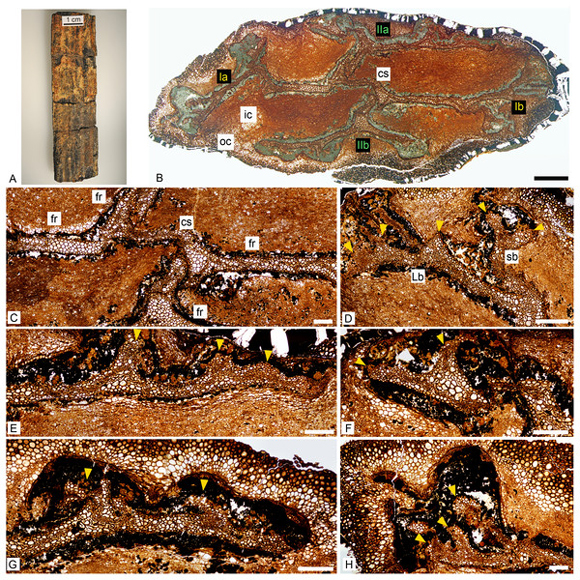
The Fossil and Cross-sectional Slices (K. mawsoniae)
The newly described Keraphyton mawsoniae a fern-like land plant from the Late Devonian of Australia. Scale bar in (B) equals 2 mm and scale bars in C-H equal 500 μm.
Picture credit: Champreux et al (PeerJ)
The picture (above), shows (A) the fossil specimen before preparation, (B) a general view of the stem system shown in cross-section, with (C-H) highly magnified areas showing the internal structure of the plant. The fossil is from the Mandowa Mudstone Formation (Upper Devonian) and it is believed to represent a plant stem.
A Very Rare Fossil Discovery
During the Middle to Late Devonian land plants were becoming larger, more complex and diverse. Major groups of plants that were to dominate the flora of the Mesozoic evolved and the first widespread forests and land-based ecosystems became established. Well-preserved plant fossils from this time in Earth’s history are exceptionally rare. Plants related to ferns and other types that produce seeds (Euphyllophytina), became more specious during this time in Earth’s history, fossils of fern-like plants are known from the northern hemisphere but the Gondwanan record is extremely sparse.
The French laboratory of Botany and Modelling of Plant Architecture and Vegetation (AMAP) in Montpellier has been collating data on early plant species from the Devonian/Carboniferous of Australia and Antoine Champreux, studied the fossil specimen as part of his Master’s Degree before completing his research whilst a PhD student at Flinders University in South Australia.
Gondwana During the Late Devonian (Position of Australia)
A map showing the location of Australia in relation to the rest of Gondwana during the Middle to Late Devonian. The position of the fossil discovery is highlighted.
Picture credit: University of Witwatersrand with additional annotation from Everything Dinosaur
A “Fossilised Stick”
Antoine commented:
“It’s nothing much to look at – just a fossilised stick – but it’s far more interesting once we cut it and had a look inside. The anatomy is preserved, meaning that we can still observe the walls of million-year-old cells. We compared the plant with other plants from the same period based on its anatomy only, which provide a lot of information.”
The research team found that this early land plant represents a new genus of plant, sharing some similarities with modern ferns and horsetails.
Antoine added:
“It is an extraordinary discovery, since such exquisitely-preserved fossils from this period are extremely rare. We named the genus Keraphyton (like the horn plant in Greek), and the species Keraphyton mawsoniae, in honour of our partner Professor Ruth Mawson, a distinguished Australian palaeontologist who died in 2019.”
The scientific paper: “Keraphyton gen. nov., a new Late Devonian fern-like plant from Australia” by Antoine Champreux, Brigitte Meyer-Berthaud, and Anne-Laure Decombeix published in the open access journal PeerJ.
The scientific paper has a succinct title, but the repercussions for vertebrate palaeontologists are seismic. This week has seen the publication in the journal Nature of a paper entitled “The first dinosaur egg was soft”. Palaeontologists have inferred and implied a great deal about dinosaur reproduction, but the assumption had been that, just like living archosaurs today, the crocodiles and birds, dinosaurs laid hard-shelled eggs.
Dr Mark Norell (American Museum of Natural History) and his co-authors propose that calcified, hard eggshells were not the “default setting” for the Dinosauria, the first dinosaur eggs were soft-shelled like those of a turtle or a snake. In addition, the researchers conclude that hard-shelled, calcified eggs evolved at least three times independently within the Dinosauria.
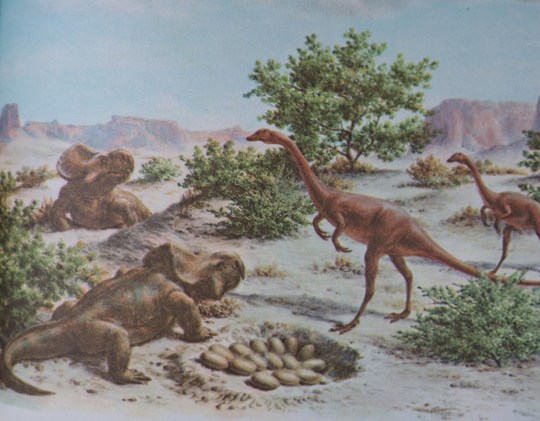
Protoceratops Protects a Nest from a Marauding Oviraptorosaur
Protoceratops confronts Oviraptor- the egg thief. An inaccurate portrayal of both the Oviraptorosaur and Protoceratops, but until now, not many had questioned the accuracy of those hard-shelled eggs.
The research led by the American Museum of Natural History in collaboration with colleagues from Yale University, Universidad de Buenos Aires (Argentina), Montana State University, University of Calgary (Canada) and the Museo Paleontológico Egidio Feruglio, Trelew, (Argentina), applied a series of sophisticated geochemical techniques to analyse the eggs of two different non-avian dinosaurs. They discovered that the eggs resembled those of extant turtles in their composition, microstructure and mechanical properties.
Commenting on the significance of this research, corresponding author Mark Norrell stated:
“The assumption has always been that the ancestral dinosaur egg was hard-shelled. Over the last 20 years, we’ve found dinosaur eggs around the world. But for the most part, they only represent three groups – theropod dinosaurs, which includes modern birds, advanced hadrosaurs like the duck-billed dinosaurs and advanced sauropods, the long-necked dinosaurs. At the same time, we’ve found thousands of skeletal remains of ceratopsian dinosaurs, but almost none of their eggs. So why weren’t their eggs preserved? My guess – and what we ended up proving through this study, is that they were soft-shelled.”
Ceratopsian Eggs Were Probably Soft-shelled and This Explains their Rarity in the Fossil Record
The leathery, soft shell of the common snapping turtle (Chelydra serpentina). The eggs of the first dinosaurs were probably very similar.
Picture credit: Jasmina Wiemann (Yale University)
Calcified Eggshells – An Evolutionary Hedge Against Environmental Stress
The amniotes, a group of tetrapods that includes the mammals, birds and the reptiles all produce eggs with an inner membrane, known as the amnion. This inner membrane helps to prevent the embryo from drying out. Some amniotes such as many turtles and squamates (lizards and snakes), lay soft-shelled, leathery eggs, whilst others such as birds and crocodilians produce eggs with a heavily calcified shell. It is thought that these calcified eggs help to protect the developing embryos inside the eggs from environmental stresses, thus giving the calcified egg layers an evolutionary advantage.
The evolution of the hard-shelled egg is seen as a major step in the global dominance of the amniotes, it leading to greater reproductive success for those members of this group that developed this trait.
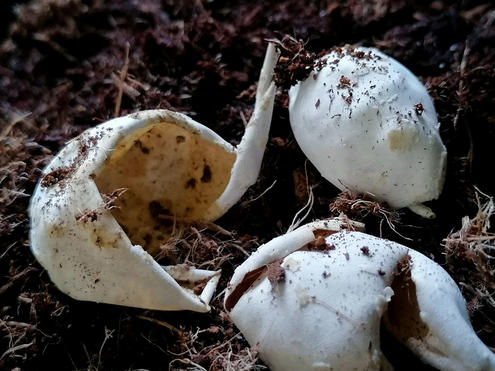
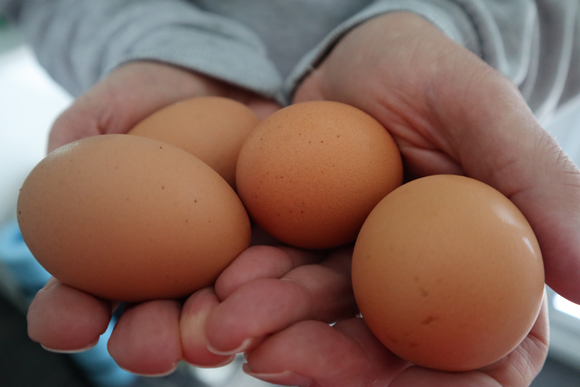
The Eggs from a Member of the Theropoda (Domestic Chicken)
Calcified, hard-shelled eggs such as these from a theropod (domestic chicken) were thought to be representative of all Dinosauria eggs.Picture credit: Everything Dinosaur.
Picture credit: Everything Dinosaur
The Fossil Record Shows Bias in Favour of Calcified Eggs
Soft-shelled eggs rarely preserve in the fossil record. It is very likely that ancient turtles laid soft-shelled eggs, just like their modern counterparts, but such evidence is hard to find in the fossil record. The same could be inferred for other amniotes, they too might have laid soft-shelled eggs but such evidence would be very difficult to find. Therefore, studying the transition from soft-shelled eggs to biomineralised, calcified eggs is a substantial challenge for palaeontologists. As birds and extant crocodilians lay hard-shelled eggs, this type of eggshell has been inferred for all the non-avian dinosaurs.
Protoceratops and Mussaurus
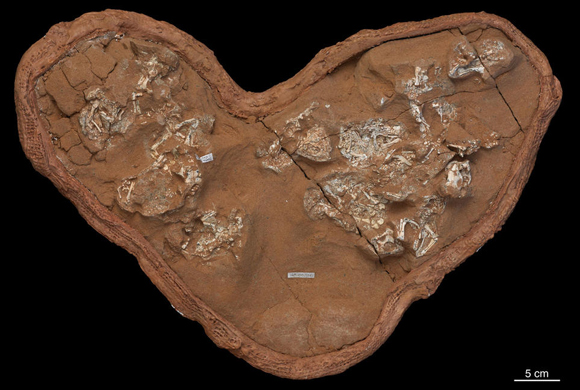
The research team undertook an intensive study of two fossil egg specimens appertaining to two very different dinosaurs – the neoceratopsian Protoceratops (P. andrewsi), known from the Upper Cretaceous Djadokhta Formation exposed in the Gobi Desert of Mongolia and Mussaurus (M. patagonicus) from the Upper Triassic-aged El Tranquilo Formation located in southern Argentina. The beautifully preserved Protoceratops fossils include a clutch of at least a dozen eggs with embryos, half of which preserve nearly complete skeletons. Most of the Protoceratops embryos are preserved in a posture in which their vertebrae and limbs are flexed, synonymous with a posture adopted by animals still inside their eggs.
The Protoceratops (P. andrewsi) Nest Fossil
The beautifully preserved nest with embryos of Protoceratops andrewsi.
Picture credit: M. Ellison (American Museum of Natural History)
Some of the skeletal material is obscured by a black and white egg-shaped halo. In contrast, two potentially recently hatched Protoceratops in the fossil specimen are largely free of this mineral halo. The research team analysed tiny slices of this halo material using a petrographic microscope. Further analysis was undertaken using Raman microspectroscopy, where light scattered by a high powered laser provides information on the molecular composition of a sample. The scientists discovered chemically altered trace residues of the proteinaceous eggshell membrane that makes up the innermost layer of the eggshell of extant archosaurs. Almost identical results were observed when the Mussaurus specimen was examined.
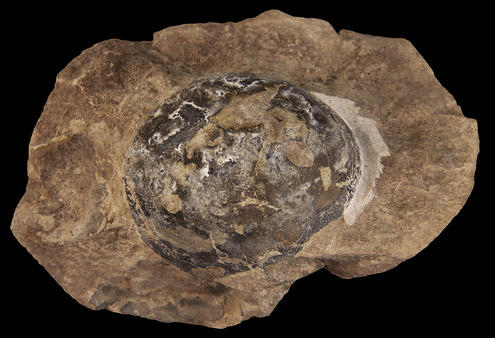
The Fossilised Remains of the Mussaurus Egg
The fossilised remains of a Mussaurus.
Picture credit: Diego Pol (Museo Paleontológico Egidio Feruglio, CONICET)
Comparing Biomineralisation Residue Signatures
The research team which included Diego Pol (Museo Paleontológico Egidio Feruglio CONICET), Darla Zelenitsky (University of Calgary) and Jasmina Wiemann (Yale University) then compared the data from the fossil material to eggshell data from other living amniotes such as turtles, birds, lizards and crocodiles. They determined that the Mussaurus and the Protoceratops eggs were non-biomineralised and therefore they would have resembled the leathery, soft-shelled eggs of living turtles.
Graduate student Jasmina Wiemann explained:
“It’s an exceptional claim, so we need exceptional data. We had to come up with a brand-new proxy to be sure that what we were seeing was how the eggs were in life and not just the result of some strange fossilisation effect. We now have a new method that can be applied to all other sorts of questions, as well as unambiguous evidence that compliments the morphological and histological case for soft-shelled eggs in these animals.”
Creating a “Supertree” to Track Eggshell Evolution
In total, data from 112 extinct and living amniotes was analysed by the research team. This enabled them to build a “supertree” to track the phylogeny of egg-shell evolution over geological time. They concluded that the ancestors of the Dinosauria probably produced an egg that lacked a calcified layer, that these animals laid soft-shelled eggs and that the first, true dinosaurs had the same type of egg.
This element of the research suggests that calcified, hard-shelled eggs evolved independently at least three times throughout the Mesozoic era in the Dinosauria, explaining the bias towards eggshells of derived dinosaurs in the fossil record. The calcified layer of eggshell evolved independently in ornithischian, sauropodomorph and theropod dinosaurs.
Co-author Matteo Fabbri (Yale University) added:
“From an evolutionary perspective this makes much more sense than previous hypotheses, since we’ve known for a while that the ancestral egg of all amniotes was soft. From our study, we can also now say that the earliest archosaurs, the group that includes dinosaurs, crocodiles and pterosaurs had soft eggs. Up to this point, people just got stuck using the extant archosaurs – crocodiles and birds to understand dinosaurs.”
Implications for the Pterosauria
This research has implications for the Pterosauria clade. Pterosaur eggs are exceptionally rare, a fossil of the wukongopterid (Darwinopterus modularis), reveals the outline of a single egg inside the body cavity. The egg confirms that the pterosaur fossil represents a female that was gravid when she died. More significantly, scientific papers detailing extensive fossil remains associated with the debris from a nesting colony of the pterosaur Hamipterus tianshanensis have been published and the three-dimensionally preserved eggs do resemble the leathery soft-shelled eggs now associated with members of the Dinosauria.
Fossilised Eggs of Hamipterus tianshanensis – Could They have the Same Biomineralisation Profile of Soft-shelled Dinosaur Eggs?
Everything Dinosaur acknowledges the assistance of a media release from the American Museum of Natural History in the compilation of this article.
The scientific paper: “The first dinosaur egg was soft” by Mark A. Norell, Jasmina Wiemann, Matteo Fabbri, Congyu Yu, Claudia A. Marsicano, Anita Moore-Nall, David J. Varricchio, Diego Pol and Darla K. Zelenitsky published in the journal Nature.
Antarcticoolithus bradyi – An Egg from a Giant Mosasaur
A football-sized palaeontological mystery might have been solved. A strange object found by a research team from Chile whilst exploring the López de Bertodano Formation on Seymour Island, in Antarctica back in 2011, is probably the fossilised remains of a mosasaur egg. That is the conclusion of a scientific paper published this week in the journal Nature.
A Giant Mosasaur Egg
The strange object, described as looking like a deflated football was found in Upper Cretaceous (Maastrichtian) deposits and these strata yield the fossils of dinosaurs and early birds, but they are essentially near-shore marine deposits and mosasaur fossils are found in the vicinity. The massive egg is the largest soft-shelled egg known to science and the second largest egg ever recorded. Only the enormous, hard-shelled eggs of elephant birds (family Aepyornithidae), that once lived on the island of Madagascar, are larger.
A Scientist Holding the Strange “Deflated Football” – Probably the Egg of a Giant Mosasaur
The strange object identified as the giant egg from a mosasaur. It was nicknamed “the Thing” in recognition of the 1982 American science fiction horror film directed by John Carpenter that told the story of an alien life form attacking a base in Antarctica.
Picture credit: Legendre et al (Universidad de Chile)
One of the scientific paper’s co-authors, David Rubilar-Rogers from Chile’s National Museum of Natural History had been part of the field team that found the fossil. It remained in the Museum’s fossil collection for years, unstudied and not classified. Visiting scientists and academics were not able to identify what it was until Julia Clarke from the University of Texas at Austin visited in 2018 and proposed that the specimen represented a giant, soft-shelled egg.
A Thin Eggshell
Microscopy confirmed that the object was indeed an egg, one with a shell five times thinner than that associated with the hard-shelled eggs of elephant birds. The structure of the fossil was similar to vestigial eggs laid by some snakes and lizards today (lepidosaurs). These types of eggs are laid but hatch almost immediately, the babies are fully developed and entirely altricial. Further analysis of the fossil discovered no evidence of an embryo to help confirm identification of the egg-layer, this was an eggshell, the baby having hatched. However, mosasaurs are lepidosaurs, (Order Squamata) and the scientists propose that the egg was laid by a giant mosasaur.
Photographs, Illustrations and Microscopic Analysis of the Fossil Egg
Photographs and illustrations of the fossil egg with (bottom) a microscopic structure analysis of the eggshell layers. In the illustrations (b, d and f) actual eggshell is shown in dark grey whilst the surrounding matrix is light grey. Note the scale comparison with a person on the far right.
Picture credit: Legendre et al
A Massive Egg Laid by a Massive Mosasaur
The scientists, which include lead author Lucas Legendre, of the Department of Geological Sciences (University of Texas at Austin), estimate that the egg would have weighed around 6.5 kilogrammes and it would have measured about 29 cm long when it was laid. The actual fossil measures 28 cm by 18 cm. The team compiled a data set comparing the body sizes of living and extinct amniotes to calculate the potential size of the animal that produced the massive egg. They calculate that the egg was probably laid by a mosasaur that had a length of around 7 metres (excluding the tail).
A Mosasaur Hatching
An artist’s impression of the hatching mosasaur emerging from the soft-shelled egg moments after the egg was laid.
Picture credit: Legendre et al (Universidad de Chile)
A Scale Drawing Showing the Proposed Size of the Female Mosasaur that Laid the Egg
Scale drawing showing the female mosasaur, the egg and the size of the hatchling with the fossil specimen. Scale bar = 1 metre
Picture credit: Francisco Hueichaleo
The First Fossil Egg from Antarctica
The visibly collapsed and folded fossil specimen represents the first vertebrate egg of any kind to be discovered in Antarctica. The researchers speculate that the near-shore, marine sediments of the López de Bertodano Formation represent an estuarine environment that linked onto a large, shallow bay. Vertebrate fossils found on Seymour Island include dinosaur bones and poorly preserved footprints, shorebird and waterfowl fossils as well as the remains of marine reptiles such as elasmosaurs and mosasaurs.
Legendre, a Postdoctoral Fellow at the Department of Geological Sciences, commented:
“Many authors have hypothesised that this was sort of a nursery site with shallow protected water, a cove environment where the young ones would have had a quiet setting to grow up.”
Was the Mosasaur Egg Laid on Land or Was it Laid in the Sea?
Did mosasaur females struggle ashore to lay their eggs in nests like turtles or did they lay vestigial eggs that hatched almost immediately having been laid in the open sea. The scientific paper does not specifically discuss how mosasaurs reproduced, but there are three competing hypotheses:
1). Mosasaur females left the water and excavated nests on the beach in which their eggs were deposited. When the eggs hatched, the young mosasaurs would scuttle down the beach and enter the water.
2). Mosasaurs were ovoviviparous – mosasaur embryos developed inside eggs that were retained inside the mother’s body until they were ready to hatch. This method of reproduction is similar to viviparity, but the embryos have no placental connection with the mother and they receive their nourishment from the yolk sac although some gaseous exchange between the egg and the mother takes place.
Ovoviviparity Reproduction in a Mosasaur
Ovoviviparity reproduction in mosasaurs.
Picture credit: Legendre et al (Universidad de Chile)
3). The female mosasaur remained mostly in the water, which helped to support its body weight, but manoeuvred its body so that it could reverse out of the water and deposits its eggs on the shore.
Although not convinced that mosasaurs laid their eggs on land, co-author of the scientific paper Julia Clarke explained:
“We can’t exclude the idea that they shoved their tail end up on shore because nothing like this has ever been discovered.”
An Artist’s Impression of an Ovoviviparous Marine Reptile
An ovoviviparous mosasaur lays its egg in the bay and the young mosasaur quickly emerges.
Picture credit: Legendre et al (Universidad de Chile)
Antarcticoolithus
This remarkable egg fossil has been given the oogenus Antarcticoolithuswhich translates as “late Antarctic stone egg”.
Everything Dinosaur acknowledges the assistance of a media release from the Universidad de Chile in the compilation of this article.
The scientific paper: “A giant soft-shelled egg from the Late Cretaceous of Antarctica” by Lucas J. Legendre, David Rubilar-Rogers, Grace M. Musser, Sarah N. Davis, Rodrigo A. Otero, Alexander O. Vargas and Julia A. Clarke published in the journal Nature.
Overoraptor chimentoi – Closer to Birds than Most other “Raptors”
Time for Everything Dinosaur team members to catch up on their reading. Whilst browsing through the various press releases, emails and news bulletins from around the world, our attention was drawn to the scientific description of a new, gracile “raptor” from the Upper Cretaceous of Argentina. Named Overoraptor chimentoi, fossils of this 1.3 metre-long, theropod dinosaur were first discovered in 2013 during field work on 90 million-year-old strata associated with the Huincul Formation in the Patagonian province of Rio Negro.
Further fossils were found during excavations in the same area in 2018. Although fragmentary, the bones of this small dinosaur suggest that it was more closely related to that lineage of dinosaurs that led to the birds than it is to the likes of Velociraptor and other dromaeosaurids.
A Life Reconstruction of a Pair of Overoraptor chimentoi
A life reconstruction of a pair Overoraptors. Although no feather impressions were found in association with the fragmentary fossils, it is very likely that Overoraptor chimentoi had feathers.
Picture credit: Gabriel Lio
Overoraptor chimentoi – A Very Bird-like Theropod
The fossil record of members of the Eumaniraptora group of dinosaurs known from the southern hemisphere is sparse. Evidence of those “raptors” that were closely related to that branch of this group that led to the modern birds is even rarer. At present, (2020), the fossil evidence is limited to the Unenlagiinae (mostly from the Late Cretaceous of Argentina such as Buitreraptor [B.gonzalezorum]) and the bizarre, bird-like Rahonavis (R. ostromi) from the Upper Cretaceous Maevarano Formation of north-western Madagascar.
Overoraptor exhibits a range of anatomical traits. The feet and legs are very typical of a dromaeosaurid. There is the second toe “killing claw” associated with the “raptors” and the lower limb bones indicate that this was a fast-running, cursorial predator. However, the upper limb bones are very different. The ulna for example, is very robust and long, reminiscent of the upper limb bones of modern birds.
The Fragmentary Fossils of Overoraptor chimentoi
Tiny but very significant Overoraptor fossil material including unguals.
Picture credit: Museo Argentino de Ciencias Naturales “Bernardino Rivadavia”
The picture above shows the fragmentary fossils associated with the new species – Overoraptor chimentoi. The genus name is from the Spanish “overo” which means piebald, a reference to the mixed colour of the fossil bones. The trivial name honours Roberto Nicolás Chimento who found the first remains.
Close to the Bird Part of the Dinosaur Family Tree
A phylogenetic analysis conducted by the researchers revealed that Overoraptor was closely related to Rahonavis, that roamed Madagascar some twenty million years later. The analysis suggests that these two dinosaurs are descended from a common ancestor (they form a monophyletic clade). Together they are stem avialans within the Eumaniraptora, a line of theropods in which some flight-related adaptations of the forelimbs are present in non-flying taxa.
Commenting on the importance of Overoraptor, one of the co-authors of the paper, Fernando Novas (Museo Argentino de Ciencias Naturales “Bernardino Rivadavia”) stated:
“Contrary to what we originally assumed, the Overoraptor is not part of the Unenlagia family, but from another group including a Madagascan species called Rahonavis.”
The discovery of Overoraptor sheds light on the acquisition of flight-related traits in non-avian dinosaurs and on the still poorly known paravian radiation in Gondwana.
The scientific paper: “New theropod dinosaur from the Upper Cretaceous of Patagonia sheds light on the paravian radiation in Gondwana” by Matías J. Motta, Federico L. Agnolín, Federico Brissón Egli and Fernando E. Novas published in The Science of Nature.