All about dinosaurs, fossils and prehistoric animals by Everything Dinosaur team members.

Articles, features and information which have slightly more scientific content with an emphasis on palaeontology, such as updates on academic papers, published papers etc.

11 11, 2020

The Earliest Paranthropus robustus Skull

By |2024-03-19T13:44:50+00:00November 11th, 2020|Categories: Dinosaur and Prehistoric Animal News Stories, Main Page, Palaeontological articles, Photos/Pictures of Fossils|0 Comments

The Earliest Paranthropus robustus Skull

The discovery of a near complete skull of the hominin Paranthropus robustus has shed new light on the evolution of this enigmatic species, related to but not likely to be a direct ancestor of the hominin lineage that led to the evolution of our own species.  The fossil was found at the world famous Drimolen Main Quarry (DMQ) site, some twenty-five miles north of Johannesburg, South Africa.  This site consists of in-fill deposits from an ancient cave system and it has produced a number of remarkable fossil specimens of early hominins that co-existed around two million years ago.

Paranthropus robustus

The specimen (DNH 155), is believed to represent the skull of a large, adult male and the fossil has been dated from approximately 2.04–1.95 million years ago (Gelasian age of the early Pleistocene), it is the earliest known Paranthropus skull discovered to date.

Specimen Number DNH 155 The Skull of Paranthropus robustus
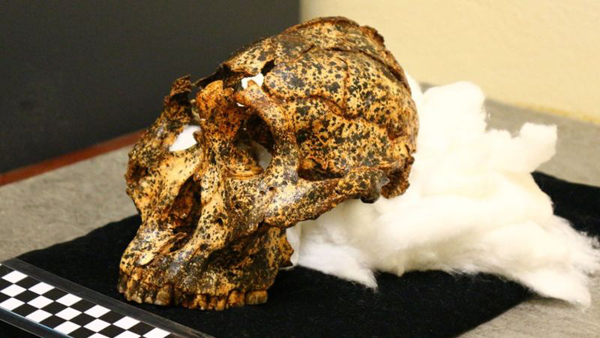
Paranthropus robustus skull fossil from South Africa.
The P. robustus skull has been pieced together from fragments found at the Drimolen Main Quarry (DMQ) archaeological site north of Johannesburg (South Africa).

Picture credit: Andy Herries, La Trobe Archaeology

Discovered on Father’s Day

Field team members from La Trobe University’s Archaeology Department (Melbourne, Australia), led the excavation work.  The rare skull fossil was discovered in 2018, on June 20th, appropriately Father’s Day in South Africa.  During the careful excavation, cleaning and preparation of the fossil, the specimen was nicknamed the “Father’s Day fossil”.

The skull was found close to the location of Homo erectus skull material, that at around two million years of age, provided strong evidence to support the hypothesis that H. erectus evolved in Africa rather than in Asia.  Lead author of the paper outlining the discovery of the partial H. erectus skull was Professor Andy Herries (La Trobe University), the Director of the Australian Research Council-funded Drimolen project, who also co-authored the scientific paper on DNH 155 that was published this week in the journal Nature Ecology & Evolution.

To read more about the Homo erectus discovery at the Drimolen Main Quarry site: Homo erectus Originated in Southern Africa.

The Drimolen Main Quarry – A Hugely Significant Location for Early Hominin Fossil Material
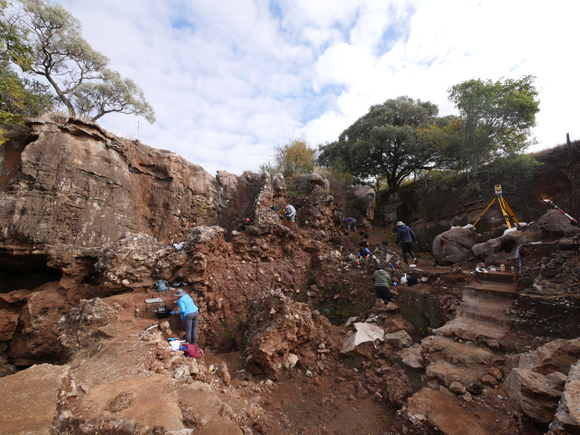
Field team members at the Paranthropus excavation site.
Paranthropus excavation site.  The Drimolen Main Quarry (DMQ) has provided palaeoanthropologists with a treasure trove of early hominin fossils as well as the bones and teeth of a number of contemporaneous early Pleistocene animals.

Picture credit: Andy Herries, La Trobe Archaeology

Describing Paranthropus robustus

Although, small in stature compared to modern humans, these early hominins were strongly built, small-brained and they possessed particularly robust jaws and large teeth.  Adaptations for a mainly vegetarian diet consisting of roots and tubers.  Paranthropus robustus co-existed with other direct human ancestors and is regarded as a “cousin species” to the hominin lineage that led to Homo sapiens.  The researchers postulate that the DNH 155 specimen provides the first high resolution evidence for microevolution within an early hominin species.

The most complete P. robustus skull (DNH 7), which was found at the DMQ site in 1994, differs from other P. robustus skull material found at other chronologically younger locations.  These differences had been put down to sexual dimorphism, with DNH 7 believed to represent the skull of a female.  This led palaeoanthropologists to speculate that if there was sexual dimorphism within the Paranthropus genus then these hominins could have lived in social groups like extant gorillas, with a large dominant male looking after a number of females and their offspring.

Examining the Skulls

However, the newly described DNH 155 skull shares a number of characteristics with the contemporaneous DNH 7 skull.

Co-lead author Jesse Martin (La Trobe University), explained the significance of DNH 155 stating that it could lead to a revised system for classifying and understanding the palaeobiology of human ancestors.

The PhD student commented:

“Demonstrating that Paranthropus robustus is not especially sexually dimorphic removes much of the impetus for supposing that they lived in social structures similar to gorillas, with large dominant males living in a group of smaller females.  The DNH 155 male fossil from Drimolen is most similar to female specimens from the same site, whereas Paranthropus robustus specimens from other sites are appreciably different.”

PhD Student Jesse Martin and Co-author Dr Angeline Leece Examine the Skull
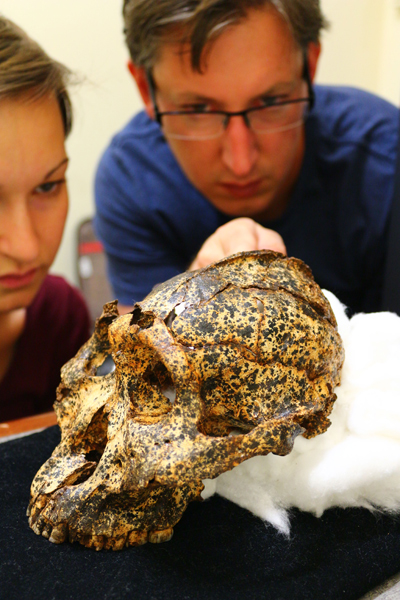
PhD student Jesse Marting and Dr Angeline Leece examine the Paranthropus skull.
Dr Angeline Leece and PhD student Jesse Martin examine the Paranthropus skull specimen.

Picture credit: Andy Herries, La Trobe Archaeology

A Rare Example of Microevolution within Hominins

Mr Martin said the discovery is a rare example of microevolution within a human lineage, showing that Paranthropus robustus evolved their powerful jaws and strong teeth, adaptations that evolved incrementally, possibly over hundreds of thousands of years in response to environmental change.

Mr Martin added:

“The Drimolen fossils represent the earliest known, very first step in the long evolutionary story of Paranthropus robustus.”

Professor Andy Herries elucidated:

“The DNH 155 cranium shows the beginning of a very successful lineage that existed in South Africa for a million years.  Like all other creatures on Earth, to remain successful our ancestors adapted and evolved in accordance with the landscape and environment around them.  For the first time in South Africa, we have the dating resolution and morphological evidence that allows us to see such changes in an ancient hominin lineage through a short window of time.

“We believe these changes took place during a time when South Africa was drying out, leading to the extinction of a number of contemporaneous mammal species.  It is likely that climate change produced environmental stressors that drove evolution within Paranthropus robustus.”

Staring at the Face of DNH 155 (Male P. robustus)
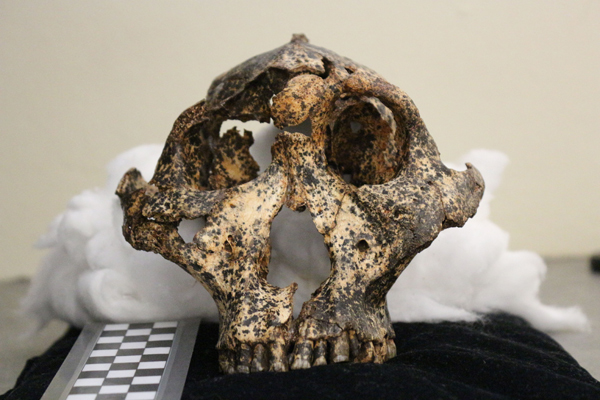
Paranthropus robustus specimen (anterior view).
The face of the Paranthropus specimen (DNH 155).

Picture credit: Andy Herries, La Trobe Archaeology

Paranthropus robustus Co-existed with Homo erectus

Co-lead author, La Trobe’s Dr Angeline Leece, said it was important to know that Paranthropus robustus appeared at roughly the same time as our direct ancestor Homo erectus, as demonstrated by the H. erectus fossil material representing the skull of a child found within a few metres of DNH 155.

Dr Leece commented:

“These two vastly different species, Homo erectus with their relatively large brains and small teeth, and Paranthropus robustus with their relatively large teeth and small brains, represent divergent evolutionary experiments.  Through time, Paranthropus robustus likely evolved to generate and withstand higher forces produced during biting and chewing food that was hard or mechanically challenging to process with their jaws and teeth – such as tubers.  Future research will clarify whether environmental changes placed populations under dietary stress and how that impacted human evolution.”

As Dr Leece pointed out, whilst the lineage made up of our direct ancestors survived this period of environmental change and the Paranthropus genus is extinct having left no direct descendants, the fossil record indicates that two million years ago, Paranthropus robustus was much more common than Homo erectus.  The Drimolen project is likely to continue to play a key role in helping us to understand the evolutionary history of our own species and the fates of those other hominins that ultimately became extinct.

Important Implications for Interpreting the Human Fossil Record

Co-author Professor David Strait (Department of Anthropology, Washington University in St. Louis USA), stated the DNH 155 skull fossil had important implications for interpreting diversity in the fossil record of hominins.

He explained:

“We think that palaeoanthropology needs to be a bit more critical about interpreting variation in anatomy as evidence of the presence of multiple species.  Depending on the ages of fossil samples, differences in bony anatomy might represent changes within lineages rather than evidence of multiple species.”

Everything Dinosaur acknowledges the assistance of a media release from La Trobe University in the compilation of this article.

The scientific paper: “Drimolen cranium DNH 155 documents microevolution in an early hominin species” by Jesse M. Martin, A. B. Leece, Simon Neubauer, Stephanie E. Baker, Carrie S. Mongle, Giovanni Boschian, Gary T. Schwartz, Amanda L. Smith, Justin A. Ledogar, David S. Strait and Andy I. R. Herries published in Nature Ecology & Evolution.

The Everything Dinosaur website: Prehistoric Animal Models and Dinosaur Toys.
7 11, 2020

The First Hadrosaurid Dinosaur From Africa

By |2024-03-19T12:22:58+00:00November 7th, 2020|Categories: Adobe CS5, Dinosaur and Prehistoric Animal News Stories, Dinosaur Fans, Main Page, Palaeontological articles|0 Comments

The First Duckbill from Africa

Fragmentary fossils including parts of a jawbone have led an international team of scientists to announce the discovery of a new species of dinosaur from the Late Cretaceous of Morocco.  A number of dinosaurs have been described from the marine sediments that comprise the economically important phosphate deposits associated with  the Ouled Abdoun Basin of north-central Morocco, but this new discovery is of particular significance.  These are the first fossils of a hadrosaur known from Africa and it suggests that these duck-billed dinosaurs were capable of crossing hundreds of miles of open ocean to reach new habitats.  The lambeosaurine dinosaur has been named Ajnabia odysseus.

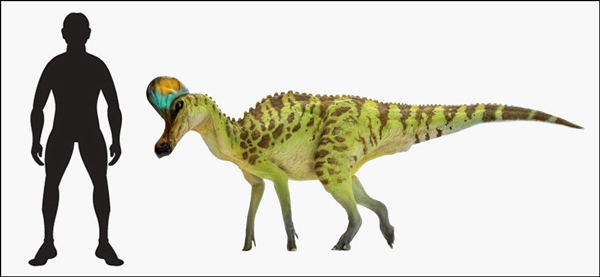
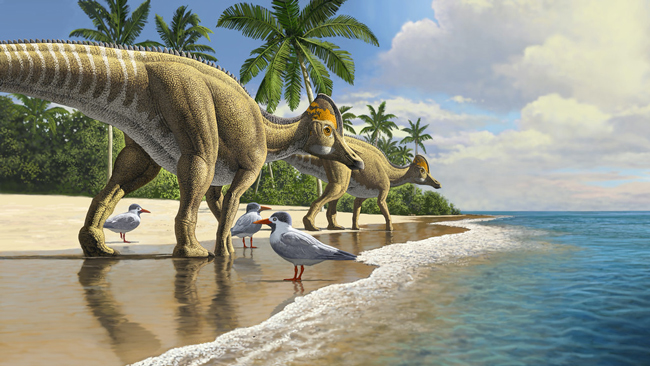
A Life Reconstruction of the Newly Described Lambeosaurine Ajnabia odysseus

Ajnabia odysseus life reconstruction.
A life reconstruction of the dwarf hadrosaurid Ajnabia odysseus.

Picture credit: Raul Martin

Ajnabia odysseus – A Lambeosaurine Hadrosaur

The genus name means stranger or foreigner in Arabic, a reference to the fact that these ornithischian dinosaurs were not known from Africa.  The species name is a reference to Odysseus the sea-faring hero of Homer’s epic poem “Odyssey”.  The researchers which include Dr Nicholas Longrich (University of Bath) and Professor Nour-Eddine Jalil  from the Department of Geology (FSSM), at the University Cadi Ayyad (Morocco), comment that this dinosaur lived about a million years before the end-Cretaceous extinction event (Late Maastrichtian).

A phylogenetic assessment suggests that Ajnabia was closely related to European hadrosaurs (the Arenysaurini, a clade of lambeosaurines previously known only from France and Spain).

The teeth and jawbone permitted the scientists to assign it to the lambeosaurine branch of the Hadrosauridae, a group of duck-billed dinosaurs famed for their elaborate and ornate hollow crests.  It is very likely that the lambeosaurine dinosaurs evolved in North America and then spread into Asia via a northern land bridge before moving into Europe and finally crossing deep and wide seas to reach North Africa.

The specimen suggests that this dinosaur was a dwarf when compared to its more famous and geologically older relatives from North America such as Corythosaurus, Parasaurolophus and Lambeosaurus.  The research team estimate the Ajnabia was around three metres long.

A Scale Drawing of the Newly Described Moroccan Lambeosaurine A. odysseus

Ajnabia odysseus scale drawing.
A scale drawing of the newly described lambeosaurine from Morocco Ajnabia odysseus. Picture credit: Everything Dinosaur.

Picture credit: Everything Dinosaur

Distinct Dinosaur Dominated Terrestrial Faunas

By the Late Cretaceous distinct dinosaur dominated terrestrial faunas had been established in the Northern and Southern Hemispheres.  This had been driven by the continued break-up of the landmass that once was the super-continent Pangaea, the widening of the Atlantic and a rise in global sea levels.

The Northern Hemisphere dinosaur biota was characterised by duck-billed dinosaurs, the Ceratopsia (horned dinosaurs) with tyrannosaurids occupying the niche of apex predators.

The Southern Hemisphere dinosaur biota was characterised by the continuation of the titanosaurian sauropods with members of the Abelisauridae as top predators.

The scientists conclude that hadrosaurs must have crossed hundreds of miles of ocean to rich Africa.  These plant-eating dinosaurs with their powerful, deep tails were very probably capable swimmers so such feats may not have been beyond them.  After all the estuarine crocodile (Crocodylus porosus), has been known to cross wide stretches of open water and has been spotted far out to sea.

Perhaps, dinosaurs were swept out to sea on rafts of vegetation following a storm event, which permitted them to colonise new habitats.

A Modern Analogy – Iguanas on the Island of Anguilla

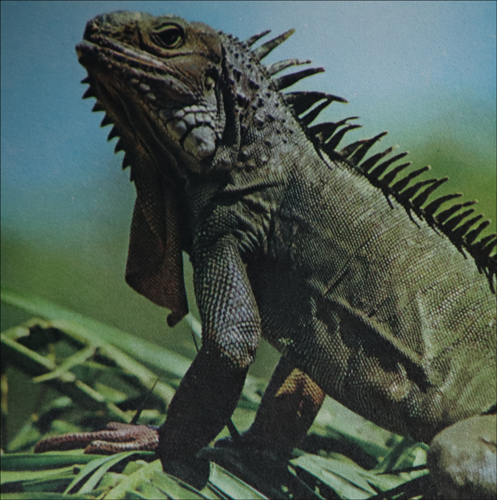
Green iguanas were found to be living on the Caribbean island of Anguilla when they had not been reported from the island before.   Biologists concluded that hurricanes in 1995 had led to trees that originated in Guadaloupe some two hundred miles to the south-east of Anguilla, where the iguanas are indigenous, being washed ashore.  It is thought that a group of these reptiles drifted out to sea and after about three weeks, the trees, with their unintentional lizard cargo made landfall on the island.

An Unlikely Seafarer – An Iguana

An iguana.
Iguanas made the sea crossing from Guadaloupe to Anguilla carried to the island by trees uprooted and washed out to sea during a hurricane. Picture credit: Everything Dinosaur.

Picture credit: Everything Dinosaur

Dr Longrich commented:

“Over millions of years, once-in-a-century events are likely to happen many times.  Ocean crossings are needed to explain how lemurs and hippos got to Madagascar, or how monkeys and rodents crossed from Africa to South America.”

Ajnabia odysseus Colonised New Territories

Writing in the academic journal “Cretaceous Research”, the scientists conclude that as there were extensive and long-lasting seaways separating Africa and Europe from other landmasses and in the absence of any evidence for a two-way faunal interchange characterised by land bridges, it is likely that some animals were able to colonise new territories either by swimming to them or perhaps by being castaways.  Such patterns of dispersal are seen with both extant or ancestral forms of mammals, reptiles and amphibians.  This newly published paper suggests that dinosaurs too, were capable of travelling across oceans.

Dr Longrich added:

“As far as I know, we are the first to suggest ocean crossings for dinosaurs.”

Co-author Professor Nour-Eddine Jalil summarised the importance of this fossil find from a Moroccan phosphate mine by stating:

“The succession of improbable events (crossing an ocean by a dinosaur, fossilisation of a terrestrial animal in a marine environment) highlights the rarity of our find and therefore its importance.  Ajnabia shows us that hadrosaurs have set foot on African land, telling us that ocean barriers are not always an insurmountable obstacle.”

The scientific paper: “The first duckbill dinosaur (Hadrosauridae: Lambeosaurinae) from Africa and the role of oceanic dispersal in dinosaur biogeography” by Nicholas R. Longrich, Xabier Pereda Suberbiola, R. Alexander Pyron and Nour-Eddine Jalil, published in Cretaceous Research.

Visit the Everything Dinosaur website: Everything Dinosaur.

3 11, 2020

Research Maps the Brain of an Early Dinosaur

By |2024-03-19T11:57:07+00:00November 3rd, 2020|Categories: Adobe CS5, Dinosaur and Prehistoric Animal News Stories, Dinosaur Fans, Main Page, Palaeontological articles|0 Comments

Buriolestes schultzi – A Relatively “Smart” Sauropodomorph

The huge sauropods such as Apatosaurus, Brachiosaurus, Mamenchisaurus and Brontosaurus are not regarded as particularly clever animals.  Their brains were extremely small when compared to their huge body sizes, therefore any consideration of a “smart” sauropod is greatly undermined by their miniscule encephalisation quotient (ratio of brain size to body size).  However, this lineage of lizard-hipped dinosaurs survived for over a 130 million years and they were extremely successful being both speciose and geographically widespread.

A newly published paper provides an insight into the evolutionary development of the brains of these types of dinosaurs.  Writing in the academic “Journal of Anatomy” scientists report upon the study of the near perfectly preserved neurocranium of Buriolestes schultzi, a member of the Sauropodomorpha known from the Carnian faunal stage of the Late Triassic of Brazil.  The researchers conclude that although the brain of this emu-sized dinosaur was very small, it probably had acute vision and fast reactions – very useful when you are actively pursuing prey.

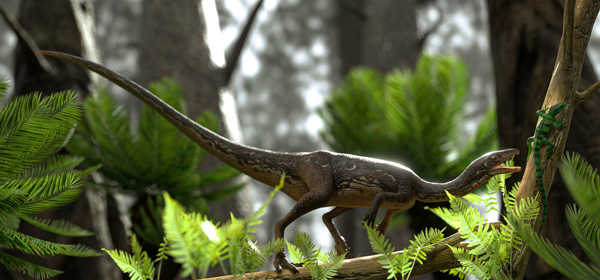
A Life Reconstruction of the Triassic Sauropodomorph Buriolestes schultzi

A Life Reconstruction of Buriolestes schultzi.
Buriolestes schultzi life reconstruction.  Scientists believe that this Late Triassic sauropodomorph as an agile, predator with a brain adapted to a fast, cursorial, predatory lifestyle.

Picture credit: Márcio L. Castro

A Well-developed Flocculus of the Cerebellum

Buriolestes roamed what is now the Rio Grande do Sul region of southern Brazil around 233 million years ago.  It was a lightweight, bipedal, omnivorous dinosaur part of a group whose descendants would evolve into the giant sauropods of the Jurassic and Cretaceous.  Researchers from the Federal University of Santa Maria in collaboration with colleagues from the Universidade de São Paulo (both institutions in Brazil), used computerised tomography to create a three-dimensional landscape of the inside of the skull of a fossil specimen in order to map the various regions of the brain.

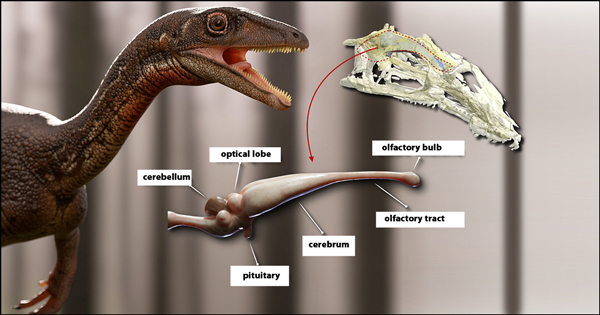
They discovered that Buriolestes had a well-developed flocculus region of its cerebellum, a part of the brain linked to motor skills and co-ordination.  The analysis also revealed an elongated olfactory tract (related to sense of smell), combined to a relatively small pituitary gland, but the area of the brain associated with processing information from the eyes was much more sophisticated.  The researchers inferred that the eyes were essential in the pursuit of prey, that vision was the dominant sense of Buriolestes.

Mapping the Brain of a Late Triassic Sauropodomorph (B. schultzi)

The brain of Buriolestes schultzi.
A diagram showing the skull of Buriolestes schultzi and the skull along with a diagram of the dinosaur’s brain.

Picture credit: Márcio L. Castro

The Senses of Buriolestes

Commenting on the research, one of the co-authors of the paper, palaeontologist Mario Bronzati (Universidade de São Paulo), stated:

“The dinosaur [Buriolestes] had a faunivorous diet.  Unlike a carnivore, which is restricted to eating meat from other animals, the faunivore also includes the ingestion of insects and other small invertebrate animals.  This characteristic, as well as its size, makes the species quite different from the most famous representatives of its lineage, the sauropod giants and herbivores which were the largest animals ever to walk the Earth.”

The team concluded that the characteristics of the brains of these types of dinosaurs changed dramatically as they evolved an entirely herbivorous diet and developed huge body sizes.  Whilst Buriolestes was an agile, swift hunter the later sauropods evolved brains more suited to their particular niche in dinosaur dominated terrestrial communities.

Jurassic sauropods such as Brontosaurus and Diplodocus had higher olfactory capabilities when compared to Buriolestes.   This more developed sense of smell is believed to play a role in foraging, helping plant-eaters to discriminate between digestible and indigestible vegetation.  Having a better sense of smell may also have been important in the later sauropods if they were social animals living in herds.  For example, higher olfactory capabilities are associated with vertebrates with more complex social behaviours, it is important for these herding animals to be able to detect and track chemical secretions.

First Calculations of the Reptile Encephalization Quotient (REQ) for a Triassic Dinosaur

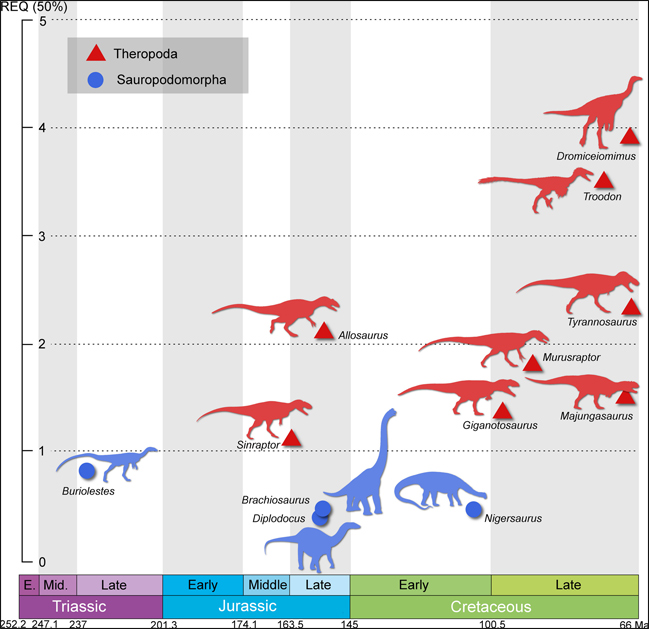
As well as providing information on how the brains sauropodomorphs evolved and changed over time, the researchers were able to plot the Reptile Encephalisation Quotient (REQ) for Buriolestes, the first time this has been calculated for a Triassic dinosaur.  The Reptile Encephalisation Quotient essentially correlates an animal’s physical characteristics with perceived intelligence, it provides an estimate of how “smart” an animal might be.

Time‐calibrated Reptile Encephalisation Quotient (REQ; 50%) of Selected Saurischians

Comparing the Reptile Encephalisation Quotient of selected saurischians.
Measuring the time-calibrated Reptile Encephalisation Quotient (REQ) of selected lizard-hipped dinosaurs.  The sauropodomorph Buriolestes had a higher REQ than later sauropods but its REQ was lower than the theropods included within the study.

Picture credit: Müller et al (Journal of Anatomy)

The scientists found that B. schultzi had a REQ lower than most Jurassic theropod dinosaurs, but much higher than that of later, much larger sauropodomorphs.  Although, the lack of fossils to study prevents the researchers from comparing the REQ of Buriolestes with contemporaneous animals, the team do suggest that when Jurassic sauropods are considered, it could be that encephalisation tended to decline in this dinosaur lineage.

To read an early article (2016) about Buriolestes by Everything Dinosaur: When Did the Dinosaurs Dominate the Land?

The scientific paper: “The endocranial anatomy of Buriolestes schultzi (Dinosauria: Saurischia) and the early evolution of brain tissues in sauropodomorph dinosaurs” by Rodrigo T. Müller, José D. Ferreira, Flávio A. Pretto, Mario Bronzati and Leonardo Kerber published in the Journal of Anatomy.

The Everything Dinosaur website: Everything Dinosaur.

28 10, 2020

Microscopic Analysis of Pterosaur Teeth Provides Guide to Diet

By |2024-03-19T08:31:31+00:00October 28th, 2020|Categories: Adobe CS5, Dinosaur and Prehistoric Animal News Stories, Dinosaur Fans, Main Page, Palaeontological articles, Photos/Pictures of Fossils|0 Comments

Members of the Pterosauria Undergo Dental Examination

Visiting the dentist can be a daunting experience for some, but for seventeen different species of pterosaur, a microscopic analysis of wear on the teeth has provided palaeontologists with a fresh perspective on the diets and lifestyles of these enigmatic flying reptiles.

Scientists from the University of Birmingham and the University of Leicester’s Centre for Palaeobiology Research studied dental wear patterns preserved on the fossilised teeth of the specimens and then compared these wear patterns to those found on the teeth of living reptiles including crocodilians and monitor lizards whose diets are known.

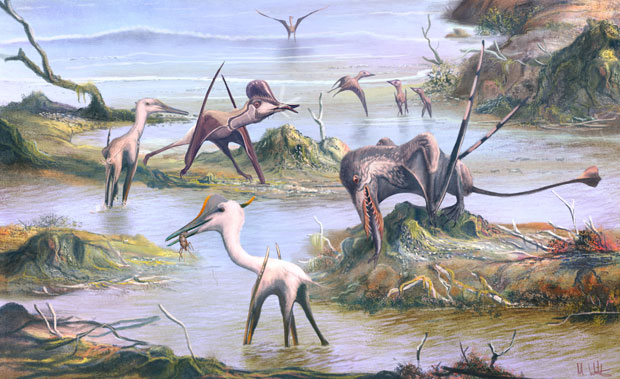
A Newly Published Scientific Paper Reveals New Data on the Diets of Pterosaurs

Pterosaur ecology, a fresh insight into the diets of the Pterosauria.
Pterosaur feeding strategies.  A study of dental microwear provides a new perspective on the diets of flying reptiles.

Picture credit: Mark Witton

Studying Pterosaur Teeth

The researchers were able to demonstrate for the first time how microscopic dental wear analysis can be used to inform palaeontologists about the diet of an extinct animal but to also challenge existing ideas and perceptions about lifestyle and behaviour.

The scientific paper detailing their results are published in the academic journal “Nature Communications”.

Lead author of the study, Dr Jordan Bestwick (University of Birmingham’s School of Geography, Earth and Environmental Sciences), commented:

“Most existing ideas about what pterosaurs ate come from comparisons of the shapes of their teeth with those of living animals.  For example, if the animal had conical teeth like a crocodile, we might assume it ate fish.  But this approach has obvious shortcomings – the teeth of pandas and polar bears, for example, are similar, but comparing them wouldn’t give us an accurate picture of their diets.”

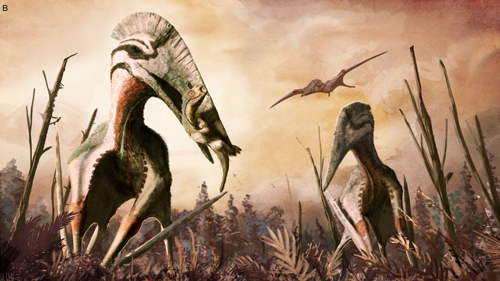
Did Some Super-sized Pterosaurs Eat Dinosaurs?

Powerful necked Hatzegopteryx feeds on a dinosaur.
Transylvanian giant azhdarchid pterosaur Hatzegopteryx sp. preys on the rhabdodontid iguanodontian Zalmoxes.

Picture credit: Mark Witton

Durophagus Diets

The analysis showed that modern reptiles with rougher wear on their tooth surfaces are more likely to have eaten crunchy things, such as shelled invertebrates – beetles or crabs.  Eating hard-shelled animals or creatures with a tough exoskeleton such as some types of insect is referred to as durophagy.  Reptiles which eat mainly soft items, such as fish, have smoother tooth surfaces, which show less wear.  By applying the technique to pterosaurs, the scientists were able to comment on the likely diet of each species.

Dr Bestwick added:

“Our analysis has yielded some fascinating insights into individual species, but also into some of the bigger questions around how these pterosaurs evolved and whether their lifestyles were more similar to those of extant birds or reptiles.  Evidence from dental microwear analysis can shed new light on this debate.”

Professor Mark Purnell, Professor of Palaeobiology at the University of Leicester explained:

“This is the first time this technique has been applied in this way to ancient reptiles, and it’s great to find it works so well.  Often, palaeontologists have very little to go on when trying to understand what extinct animals ate.  This approach gives us a new tool, allowing us to move from what are sometimes little more than educated guesses, into the realms of solid science.”

Examining the Diet of Rhamphorhynchus

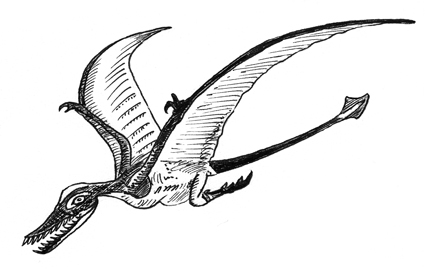
In one example, the team examined the teeth of Rhamphorhynchus, a long-tailed pterosaur from the Jurassic period.  Researchers found that juvenile Rhamphorhynchus had insect-based diets, whereas their adult counterparts – about the size of a large seagull – were more likely to have eaten fish.  This suggests a species in which the adults took little care of their young (precocial behaviour) – a behaviour that is common in reptiles and is not exhibited by birds.

A Rhamphorhynchus Illustration (R. muensteri)

Rhamphorhynchus illustration
Flying low over the water, an adult Rhamphorhynchus is looking for fish to eat. Picture credit: Everything Dinosaur.

Picture credit: Everything Dinosaur

Looking at Pterosaur Evolution

The research team also investigated whether their analysis could shed light on how different species of pterosaurs evolved.  The first pterosaurs evolved during the Triassic and they survived until the very end of the Mesozoic some 66 million years ago, becoming extinct at the same time as their archosaur relatives the dinosaurs.  In that time, according to the dental microwear analysis, there was a general shift in diet from invertebrates such as insects, towards a more meat or fish-based diet.

Commenting on the potential significance of this dietary shift, Dr Bestwick stated:

“We found that the earliest forms of pterosaurs ate mainly crunchy invertebrates.  The shift towards eating fish or meat coincides with the evolution of birds.  We think it’s possible, therefore, that competition with birds could explain the decline of smaller-bodied pterosaurs and a rise in larger, carnivorous species.”

Birds Competing with Pterosaurs

It is an intriguing thought, although the fossil record of the Pterosauria is far from complete and there is a degree of bias towards the most productive pterosaur-fossil bearing strata such as deposits associated with the Crato and Santana Formations of the Early Cretaceous, which prevents a detailed assessment of pterosaur diversity over the duration of the Mesozoic from the Norian onwards.

Natalia Jagielska, a PhD researcher in pterosaur palaeontology based at the University of Edinburgh, (not involved in this study), commented that the research adds much-needed clarity to the behaviour and ecological role of pterosaurs in ancient food webs.

“Pterosaurs are a fascinating group of Mesozoic reptiles with astounding diversity in tooth morphology.  This study is important for contributing to the idea that young Rhamphorhynchus were independent invertebrate hunters before becoming fish consumers, rather than being fed and nurtured by parents, like birds.  Or that in pterosaur-rich environments, like the Late Jurassic Bavarian lagoons, pterosaur species have partitioned to occupy variations of dietary niches.”

The authors of the scientific paper are confident that this new research will provide a benchmark assisting in the interpretation of the diet of long extinct reptiles and in doing so, will lead to an improved understanding of ancient ecosystems.

Everything Dinosaur acknowledges the contribution of a media release from the University of Birmingham in the compilation of this article.

The Everything Dinosaur website: Everything Dinosaur.

21 10, 2020

Remembering “Joe” the Baby Parasaurolophus

By |2024-03-19T06:52:33+00:00October 21st, 2020|Categories: Dinosaur Fans, Main Page, Palaeontological articles, Photos/Pictures of Fossils|0 Comments

Remembering “Joe” the Baby Parasaurolophus

This week, seven years ago, a remarkable paper was published in the academic journal PeerJ.  The research centred upon a beautifully-preserved fossil specimen of a baby Parasaurolophus that at around two and a half metres in length, represented the smallest and most complete specimen described to date for this genus.  Nicknamed “Joe” this dinosaur that roamed southern Utah some 75 million years ago, demonstrated the astonishing growth rates of duck-billed dinosaurs.  Although approximately a quarter of the size of a fully grown Parasaurolophus, bone histology suggested that “Joe” was less than a year old when it died.

Interpretive Drawing and Right Lateral View of the Fossilised Remains  -“Joe” the Parasaurolophus

"Joe" the baby Parasaurolophus.
The skeleton of “Joe” the Parasaurolophus (specimen number RAM 14000), in right lateral view (A) interpretive drawing and (B) photograph.   Note scale bar = 10 cm.

Picture credit: Farke et al (PeerJ)

A Baby Parasaurolophus Found by Students

The fossilised remains of the young Parasaurolophus were found in 2009 by a group of students on a field trip to the Kaiparowits Formation (Campanian faunal stage), exposures at the famous Grand Staircase-Escalante National Monument, with Andrew Farke of the Raymond M. Alf Museum of Palaeontology. When first shown a fragment of fossil bone eroding out of the surrounding sediment, Dr Farke dismissed it as an inconsequential piece of fossil rib.  It was only when they explored the area a little more closely did they realise the potential significance of the discovery.

The scientific paper on this remarkable specimen was published in October 2013.  The skull, measuring 24.6 cm in length showed signs of the tubular crest beginning to form, although a cross-section of bone from the tibia (lower leg bone), showed no lines of arrested growth (LAGs), implying that the Parasaurolophus may have been less than twelve months old when it died.  Based on a comparison with other Lambeosaurine fossils, the research team concluded that Parasaurolophus initiated development of its head crest at less than 25% maximum skull size, contrasting with 50% of maximum skull size in hadrosaurs such as Corythosaurus.

Parasaurolophus formed its unusual headgear by expanding some of its skull bones earlier and for a longer period of time than other closely related duck-billed dinosaurs.

An Interpretative Drawing of the Skull with Fossil Shown in Left Lateral View

Interpretive drawing and photograph of baby Parasaurolophus skull.
Left half of the skull of Parasaurolophus sp., RAM 14000, in lateral view. Interpretive drawing (A) and (B) photograph of the skull.

Picture credit: Everything Dinosaur

Named after Joe Augustyn

“Joe” was named after Joe Augustyn, a patron of the Raymond M. Alf Museum of Palaeontology, where the fossils can be seen on display.

To read Everything Dinosaur’s original article on “Joe” the baby Parasaurolophus: Fossilised Remains of a Baby Parasaurolophus from Southern Utah.

The scientific paper: “Ontogeny in the tube-crested dinosaur Parasaurolophus (Hadrosauridae) and heterochrony in hadrosaurids” by Andrew A. Farke, Derek J. Chok, Annisa Herrero, Brandon Scolieri and Sarah Werning published in PeerJ.

The award-winning Everything Dinosaur website: The Award-winning Website of Everything Dinosaur.

15 10, 2020

Catching Up with Ordosipterus planignathus

By |2024-03-18T07:23:53+00:00October 15th, 2020|Categories: Dinosaur and Prehistoric Animal News Stories, Dinosaur Fans, Main Page, Palaeontological articles, Photos/Pictures of Fossils|0 Comments

Ordosipterus planignathus – The First Pterosaur from the Ordos Region of Inner Mongolia

Time to catch up with developments in the world of the Pterosauria with a brief look at the recently described new dsungaripteroid pterosaur named Ordosipterus planignathus.  Researchers from the Chinese Academy of Geological Sciences have described a new species of flying reptile from a partial lower jawbone found in the Ordos region of Inner Mongolia.

Ordosipterus planignathus

This is the first confirmed pterosaur discovery from the Lower Cretaceous deposits associated with this region.  The Dsungaripteridae are both geographically and temporally widespread, with taxa known from South America, Asia, North America and Europe as well as China and Mongolia.  However, Ordosipterus enlarges the geographical distribution of this kind of pterosaur, from north-western China (with western Mongolia), to central northern China.

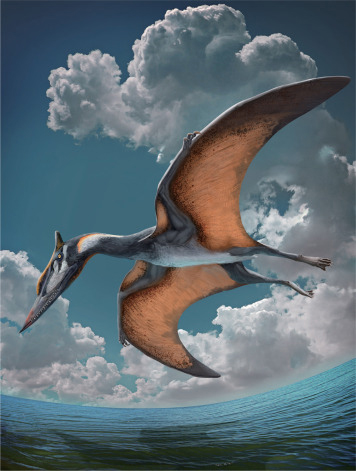
A Life Reconstruction of Ordosipterus planignathus

Life reconstruction - Ordosipterus planignathus.
A life reconstruction of Ordosipterus planignathus.

Picture credit: Ji/China Geology

Probing in the Mud for Crustaceans or an Insect Eater

Palaeontologists are uncertain as the trophic habits of these pterosaurs.  That is, it is hard to say what these animals ate.  Dsungaripteroid skulls are characterised by their stoutness and their study bones.  The skulls seem to be reinforced and strengthened to cope with disproportionately large bite forces.  These reinforced skulls in combination with the robust teeth associated with this family suggest that these types of pterosaurs might have probed in soft-mud to find molluscs such as snails and bivalves.  They may also have fed on hard-shelled insects.  The jaws and teeth of dsungaripteroid pterosaurs seem particularly suited to a durophagus diet.

To read a recent Everything Dinosaur blog post that looked at the evidence for probe feeding amongst flying reptiles: The Sensitive Beaks of Pterosaurs.

Only one tooth crown was found in situ, it appears to be short and blunt, perhaps, further evidence of durophagy in this type of pterosaur.

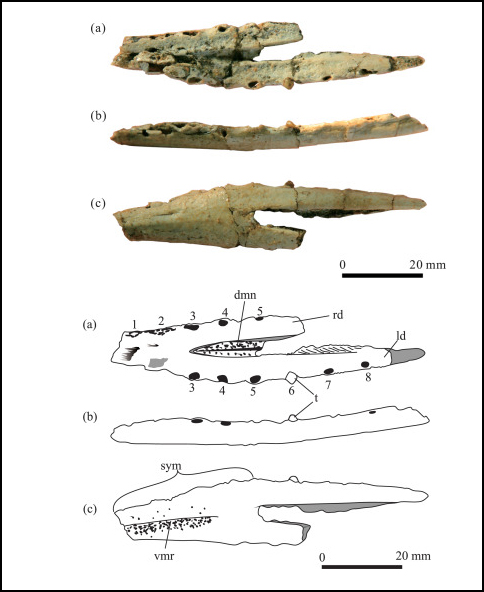
The Holotype Material for O. planignathus with Accompanying Line Drawings

Ordosipterus planignathus (holotype IG V13-011) with line drawings.
The incomplete but articulated lower jaw bones of Ordosipterus planignathus (Holotype IG V13-011) with accompanying line drawings.  Note scale bar equals 2 cm.

Picture credit: Ji/China Geology

The picture (above), shows the anterior portion of the lower jaws of the recently described flying reptile (a) dorsal view, (b) left lateral view and (c) ventral view.  The genus name honours the Ordos region, whilst the species or trivial name translates from the Greek and Latin as “flat-jawed”, in reference to the shape of the lower jaws.

Evidence of a Unique Biota in Northern China/Mongolia during the Early Cretaceous

The finding of a new species of Early Cretaceous (Aptian faunal stage), pterosaur unique to this area of Asia further strengthens the idea that two distinct terrestrial faunas existed.  It has been suggested that during the Early Cretaceous, two separate dinosaur/pterosaur dominated biotas could be identified in China and Mongolia.  The northern fauna was characterised by the presence of Psittacosaurus and a number of pterosaur genera (including Ordosipterus), whilst the southern fauna was distinguished by an absence of psittacosaurs.

The scientific paper: “First record of Early Cretaceous pterosaur from the Ordos Region, Inner Mongolia, China” by Shu-an Ji published in China Geology.

The award-winning Everything Dinosaur website: Everything Dinosaur.

13 10, 2020

A New Basal Abelisaurid is Described “Ghost Hunter”

By |2024-03-18T07:17:46+00:00October 13th, 2020|Categories: Adobe CS5, Dinosaur and Prehistoric Animal News Stories, Dinosaur Fans, Main Page, Palaeontological articles, Photos/Pictures of Fossils|0 Comments

A New Basal Abelisaurid – Spectrovenator ragei

Researchers from the Universidade de São Paulo (Brazil), in collaboration with colleagues from the Museo Paleontológico Egidio Feruglio (Argentina), have described a new species of basal abelisaurid from the Early Cretaceous of Brazil.  The theropod has been named Spectrovenator ragei, the genus name translates from the Latin as “Ghost Hunter” as the fossilised remains were found unexpectedly underneath the holotype of the titanosaur Tapuiasaurus macedoi when the fossils of this dinosaur were being partially prepared by the field team.

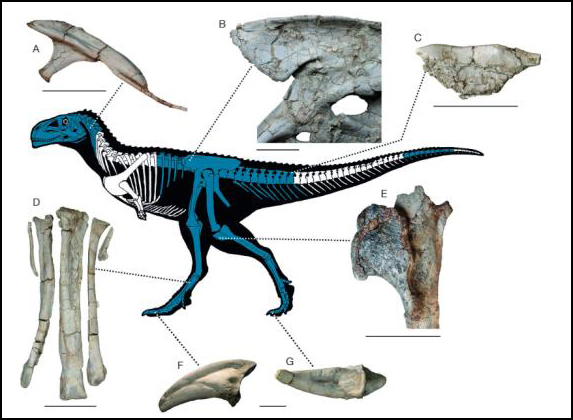
An Illustration of Spectrovenator ragei with Key Fossils Highlighted that Help to Define the Dinosaur’s Taxonomy

Spectrovenator key fossils.
Key fossil bones that helped to define Spectrovenator taxonomically.  Known fossil material shaded blue.

Picture credit: Zaher et al

Spectrovenator ragei

The species or trivial name honours the late Dr Jean-Claude Rage, an eminent French researcher who made a significant contribution to the study of South American Mesozoic vertebrates.

Described from a partially articulated skeleton including a virtually complete skull, the dinosaur is thought to have measured around 2.2 metres in length and it is the first Early Cretaceous abelisaurid known with an almost complete skull.  The cranial material has helped the researchers to demonstrate the evolution of abelisaurid skulls from the earliest, most basal Eoabelisaurus to the abelisaurids that existed in Gondwana during the later stages of the Cretaceous.

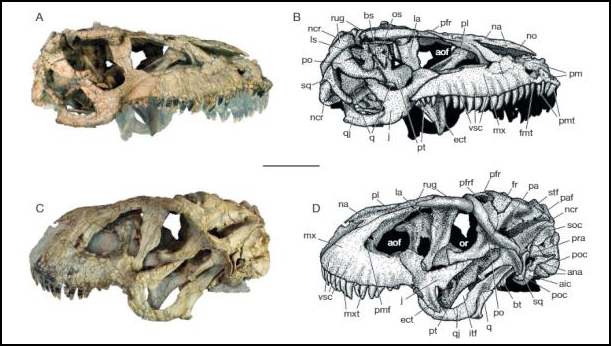
Views of the Skull with Accompanying Line Drawings

The Skull of Spectovenator (lateral view with line drawings).
The skull of Spectrovenator ragei (MZSP-PV 833) in (a) right lateral view with (b) line drawing and (c) left lateral view and accompanying line drawing (d).  Scale bar equals 5 cm.

Picture credit: Zaher et al

A Dinosaur Skull to Study

With a beautifully preserved skull to study, the scientists have been able to compare the function of the skull and jaws of Spectrovenator with more derived members of the Abelisauridae.  The Early Cretaceous Spectrovenator (Barremian-Aptian), lacks the specialisations, such as a high occipital region and highly flexible jaw joints linked to a modified feeding strategy suggested for much later abelisaurids.  For example, some scientists, think that large-bodied abelisaurids such as Carnotaurus (C. sastrei) specialised in hunting titanosaurs (large prey).

The lack of these specialisations in the skull of Spectrovenator suggests this modified feeding strategy may be restricted to Late Cretaceous abelisaurids and linked to an increase in body size by this type of predatory dinosaur which occurred during the Cenomanian and through to the Maastrichtian.

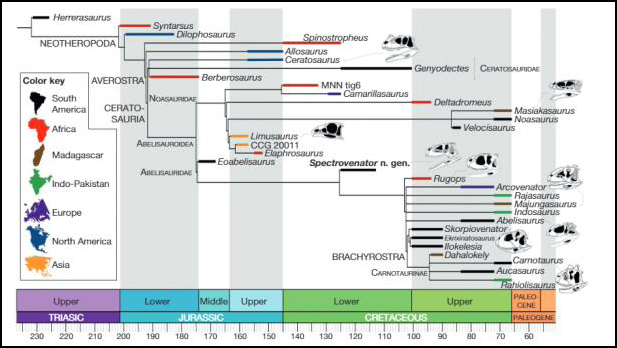
Phylogenetic relationships of Spectrovenator within the Ceratosauria

Phylogenetic relationships of Spectrovenator within the Ceratosauria.
Phylogenetic relationships of Spectrovenator within the Ceratosauria with a geographical and temporal break down of fossil material.  Spectrovenator is regarded as a basal member of the Abelisauridae.

Picture Credit: Zaher et al

Understanding the Abelisauridae

The discovery of Spectrovenator helps to fill a sizeable gap in the evolutionary history of the Abelisauridae.  The earliest member of the Abelisauridae described to date Eoabelisaurus (E. mefi), is known from the Middle Jurassic of Argentina (around 166 million years ago), whilst other abelisaurids such as Rugops and Skorpiovenator are known from Upper Cretaceous sediments (100 million years ago approximately).  Whereas Spectrovenator was found in strata that is approximately 120 million years old.

The scientific paper: “An Early Cretaceous theropod dinosaur from Brazil sheds light on the cranial evolution of the Abelisauridae” by Hussam Zaher, Diego Pol, Bruno Albert Navarro, Rafael Delcourt and Alberto Barbosa Carvalho published in Comptes Rendus Palevol.

The Everything Dinosaur website: Everything Dinosaur.

9 10, 2020

The Sensitive Beaks of Pterosaurs

By |2024-03-17T06:55:44+00:00October 9th, 2020|Categories: Adobe CS5, Dinosaur and Prehistoric Animal News Stories, Dinosaur Fans, Main Page, Palaeontological articles, Photos/Pictures of Fossils|0 Comments

Sensitive Probe Feeding Pterosaurs

Whilst it is not always sensible to compare the Pterosauria to birds, they do have a number of things in common.  As vertebrates they may not be very closely related but both birds and pterosaurs share some common anatomical characteristics that have helped them to conquer the sky.  Their skeletons show special adaptations to assist with powered flight and if we focus on modern birds for a moment, we can see that many forms have evolved to occupy different niches in ecosystems.  For example, some birds such as vultures and condors are primarily scavengers, whilst others are active predators (eagles, hawks and falcons).

Yet more are omnivores and some such as flamingos (filter feeders), swifts (aerial insect hunters) and hummingbirds (nectar feeders) occupy very specialist roles within food chains.

Studying the Beaks of the Pterosauria

Although the known fossil record of the Pterosauria probably grossly under-represents these flying reptiles, palaeontologists are becoming increasingly aware of the diversity of this enigmatic clade.  Around 130 genera have been described, probably only a fraction of the total number of genera that evolved during their long history and recently a combination of fossil finds from Morocco in conjunction with a re-examination of fossils from a chalk pit near Maidstone in Kent (England), has led researchers to propose yet another environmental niche for pterosaurs.

Some pterosaurs evolved sensitive beaks that allowed them to probe sediments to help them find food just like many types of modern wading birds and members of the Aves such as the kiwi.

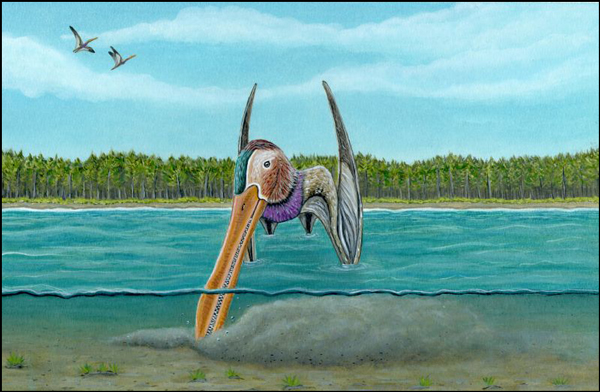
A Life Reconstruction of the Lonchodectid Lonchodraco giganteus Probing in the Mud to Find Food

Lonchodraco (pterosaur) probing mud for food.
A life reconstruction of a lonchodectid pterosaur using its sensitive beak to find food.

Picture credit: Megan Jacobs (The University of Portsmouth)

Unusual Foramina in a Fossil Specimen

Researchers from the University of Portsmouth in collaboration with Dr Nicholas Longrich (University of Bath), took a close look at the fragmentary remains of the anterior of the rostrum (front of the jaws), of the pterosaur Lonchodraco giganteus (formerly referred to as Lonchodectes giganteus).  These fossils had been found in a chalk pit, close to the village of Burham, near Maidstone, Kent.  They were originally described as a species of Pterodactylus by the British naturalist James Scott Bowerbank in 1846.

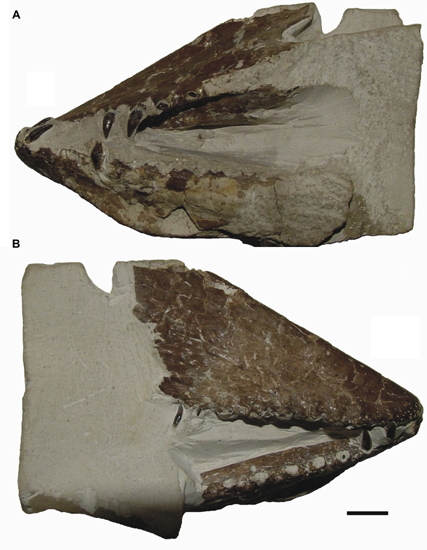
Lonchodraco giganteus Holotype Jaws

Lonchodraco giganteus holotype rostrum and mandible.
Holotype rostrum and mandible of Lonchodraco giganteus (NHMUK 39412) in (a) left lateral and (b) right lateral views.  Scale bar = 1 cm.

Picture credit: Martill et al (Cretaceous Research)

Extremely Fragmentary Pterosauria Fossil Remains

Like many pterosaur fossils from southern England, the fossilised remains are extremely scrappy, more recent studies have assigned these remains to the little-known lonchodectid pterosaurs (Lonchodectidae family).  These types of pterosaurs are united by having low profile jaws, raised teeth sockets and uniformly small teeth.

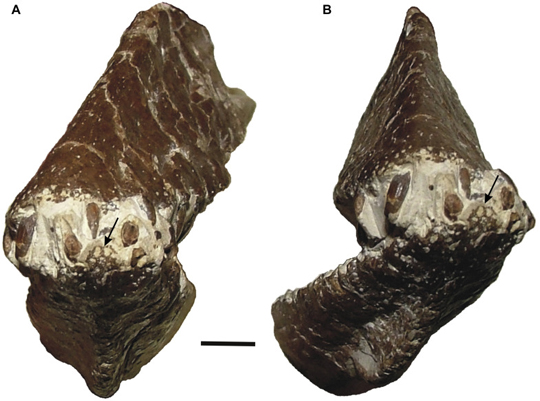
In a study of the holotype rostrum and mandible of L. giganteus, dozens of tiny holes (foramina) were discovered in the beak tip.  These are thought to represent sensory areas on the beak, where nerves pass through the bone and make contact with the beak’s surface.  Although foramina have been observed in the Pterosauria before, the pattern identified on the tip of the rostrum of Lonchodraco is unique.

Lonchodraco giganteus Holotype (Anterior View)

Lonchodraco giganteus holotype (anterior view).
Lonchodraco giganteus (NHMUK 39412).  Two views of anterior rostrum and mandible.  Photograph ( a) showing anterior margin of mandible with small, triangular symphysial process and (b), anterior view of rostrum showing the rounded termination of the beak and the fine perforations of the dental borders.  Black arrows indicate symphysial process/odontoid.  Scale bar = 1 cm.

Picture credit: Martill et al (Cretaceous Research)

Identifying Nerve Clusters

These types of nerve clusters are reminiscent to those found in living birds such as kiwis, sandpapers, spoonbills, geese, ducks and snipes.  These birds rely on their sense of touch when finding and catching food.  Typically, they either probe in water, mud, sand or soil to locate and catch prey.  This research, in combination with a second paper that also postulates on probe-feeding behaviour in the Pterosauria, suggests that just like modern birds, the pterosaurs were capable of evolving into a myriad of forms to exploit different food sources.

Concentration of Foramina at the Jaw Tips (Lonchodraco giganteus)

Lonchodraco line drawing showing concentration of foramina at the jaw tips
Hypothetical restoration of the jaw tips of Lonchodraco giganteus.  The black dots represent sensory areas (foramina).

Picture credit: Martill et al (Cretaceous Research)

The scientific paper: “Evidence for tactile foraging in pterosaurs: a sensitive tip to the beak of Lonchodraco giganteus (Pterosauria, Lonchodectidae) from the Upper Cretaceous of southern England” by David M. Martill, Roy E. Smith, Nicholas Longrich and James Brown published in Cretaceous Research.

A Second Example of Probe Feeding

Recently, Professor David Martill, along with colleagues from Portsmouth University, pterosaur expert Samir Zouhri (Université Hassan II, Casablanca, Morocco) and Nicholas Longrich (University of Bath), published a paper in Cretaceous Research describing a new species of long-jawed pterosaur from Morocco that also could have been a probe feeder.

The flying reptile was described as having exceptionally long jaws for its body size, which terminated in a flattened beak with thickened bony walls.  The shape of these jaws superficially resembled the beaks of probing birds such as kiwis, ibises and curlews.  The research team hypothesised that like these living birds, this pterosaur probed in soft sediments in search of invertebrates.  The age of the fossils is not certain, although an Albian to Cenomanian age was postulated.  This pterosaur was tentatively assigned to the azhdarchoids, but if it is a member of the Azhdarchoidea, then it represents an extremely atypical form.

The scientists conclude that this Moroccan pterosaur adds to the remarkable diversity of the Pterosauria known from the Cretaceous.

Everything Dinosaur acknowledges the assistance of media releases from the University of Portsmouth and the University of Bath in compilation of this article.

The scientific paper: “A long-billed, possible probe-feeding pterosaur (Pterodactyloidea: ?Azhdarchoidea) from the mid-Cretaceous of Morocco, North Africa” by Roy E. Smith, David M. Martill, Alexander Kao, Samir Zouhri, and Nicholas Longrich published in Cretaceous Research.

Visit the Everything Dinosaur website: Everything Dinosaur.

8 10, 2020

Two-fingered Oviraptosaur Sheds Light on the Success of the “Egg Thiefs”

By |2024-03-17T05:55:34+00:00October 8th, 2020|Categories: Adobe CS5, Dinosaur and Prehistoric Animal News Stories, Dinosaur Fans, Main Page, Palaeontological articles, Photos/Pictures of Fossils|0 Comments

Oksoko avarsan – New Species of Oviraptorosaur with Two Fingers

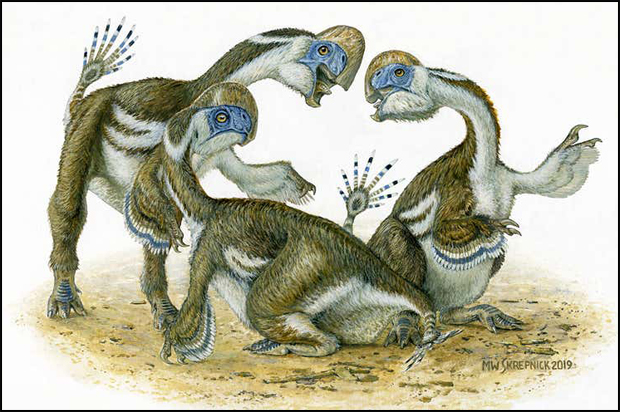
That inappropriately named clade of “Egg Thief Lizards”, the Oviraptorosauria has a new member.  Standing around one metre high at the hips, the newly described Oksoko avarsan (Oak-soak-oh), which had just two digits on each hand, instead of the default Oviraptor setting of three, is helping palaeontologists to understand the radiation and success of these feathered dinosaurs.

A Life Reconstruction of the Newly Described Oksoko avarsan

Oksoko avarsan life reconstruction.
A trio of oviraptors – a life reconstruction of Oksoko avarsan.

Picture credit: Michael Skrepnick

The First Evidence of Digit Loss in the Oviraptorosaurs

Over the last forty years or so, lots of new oviraptorosaur theropods have been named and described, principally from fossil finds made in China and Mongolia.   These feathered dinosaurs were highly successful and although their origins are uncertain, this type of dinosaur probably evolved in the Early Cretaceous of northern China and by the Late Cretaceous they had spread across much of Asia and into North America.

Whilst most palaeontologists confronted with the wealth of fossil material would concede that these theropods were geographically widespread, little research has been undertaken to ascertain the reasons for their evolutionary success.  The discovery of Oksoko with its reduced forelimb with only two functional digits suggests that this group could alter their diets, behaviours and habits which enabled them to diversify and multiply.  In essence, variation in forelimb length and hand morphology provides another example of niche partitioning in oviraptorosaurs, which may have contributed to their incredible diversity in the latest Cretaceous of Asia.

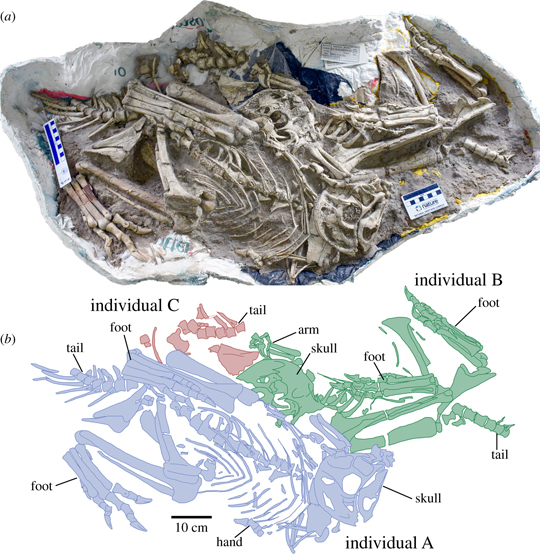
The Holotype Block Containing Three Specimens of O. avarsan

The holotype block consisting of three individuals (Oksoko avarsan).
The holotype block of Oksoko avarsan MPC-D 102/110 with an explanatory line drawing.  The holotype fossil is individual A coloured blue.

Picture credit: Funston et al (Royal Society Open Science)

Gregarious Behaviour in Oviraptorids

Oksoko is known from four specimens, a group of three (see picture above) and a fourth specimen found in the same crouched position that is believed to come from the same location.  All the fossil material was confiscated from poachers so the exact discovery site of these fossils remains unknown.  However, the researchers have confidently assigned them to the Nemegt Formation of the Gobi Desert and the material is estimated to be around 68 million years old.

It had long been suspected that oviraptorosaurs were gregarious social animals.  The finding of three individuals preserved together represents the first, definitive evidence that these animals probably lived in groups and that they were gregarious.  The fossil bones of all four individuals have provided the researchers with an almost complete skeleton of this two-metre-long dinosaur to study.

Key Fossils Representing the Anatomy of Oksoko avarsan

Key fossils associated with Oksoko avarsan.
Skeletal anatomy of Oksoko avarsan with key fossils including skull in lateral view (b) with line drawing (c).

Picture credit: Funston et al (Royal Society Open Science)

Oksoko avarsan – A Three-headed Eagle

The scientists which included Dr Gregory Funston (Edinburgh University) and Phil Currie (University of Alberta), named this dinosaur after the three-headed eagle of Altaic mythology, a reference to the holotype block which contains the skulls of three individuals.  The species or trivial name is from a Mongolian word for “rescued”, it alludes to the fact that these fossils were recovered from poachers.

The remarkably well-preserved fossil material provides the first documented evidence of digit loss in the usually three-fingered Oviraptorosauria.  The holotype block material represents the remains of three dinosaurs that were approximately the same size and bone histology reveals that these animals died when they were around a year old.  The fourth specimen is believed to represent an older animal that died around the age of five.

Commenting on the discovery, Dr Funston remarked:

“Oksoko avarsan is interesting because the skeletons are very complete and the way they were preserved resting together shows that juveniles roamed together in groups.  But more importantly, its two-fingered hand prompted us to look at the way the hand and forelimb changed throughout the evolution of oviraptors — which hadn’t been studied before.  This revealed some unexpected trends that are a key piece in the puzzle of why oviraptors were so diverse before the extinction that killed the dinosaurs.”

Finger Loss in a Dinosaur Family

Oksoko is the sixth genus of the Oviraptoridae family to be named from fossils associated with the Nemegt Formation.  This demonstrates the diversity of these types of dinosaurs in the Late Cretaceous of China.

The other five oviraptorids known from the Nemegt Formation of Mongolia as stated by Everything Dinosaur team members are:

  • Rinchenia mongoliensis
  • Nomingia gobiensis
  • Nemegtomaia barsboldi
  • Gobiraptor minutus
  • Conchoraptor gracilis

In addition, a number of closely related dinosaurs are known from the Nemegt Formation including the caenagnathid Elmisaurus rarus

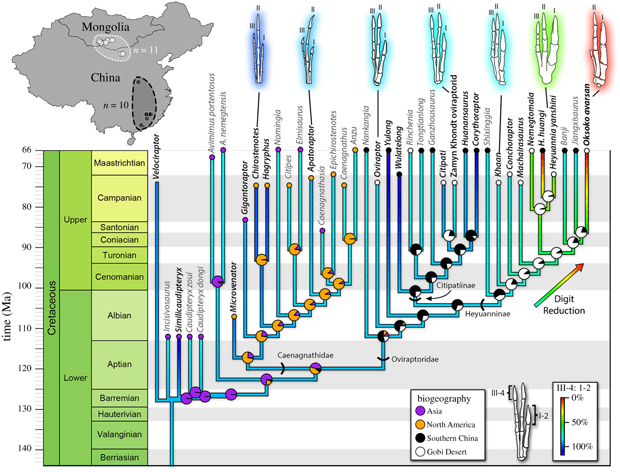
The scientists produced a phylogeny of the Oviraptorosauria based in a reduction in size and eventual loss of digit III as shown in the most derived form described to date (O. avarsan) and a corresponding increase in size and robustness of digit I.  They concluded that the arms and hands of these dinosaurs changed radically in conjunction with migrations into new geographical areas and presumably different habitats – specifically to what is now North America and the Gobi Desert.

Plotting the Change in Hand Morphology and the Radiation of the Oviraptorosauria

Phylogeny, biogeography and digit reduction in Oviraptorosauria.
Phylogeny, biogeography and digit reduction in Oviraptorosauria.  The map (top left) shows the distribution of oviraptorids during the Late Cretaceous of Asia.

Picture credit: Funston et al (Royal Society Open Science)

To read a related article that considered the holotype block as evidence for communal roosting in oviraptorids: Three Theropods Preserved in a Resting Pose.

The scientific paper: “A new two-fingered dinosaur sheds light on the radiation of Oviraptorosauria” by Gregory F. Funston, Tsogtbaatar Chinzorig, Khishigjav Tsogtbaatar, Yoshitsugu Kobayashi, Corwin Sullivan and Philip J. Currie published in Royal Society Open Science.

The award-winning Everything Dinosaur website: Everything Dinosaur.

7 10, 2020

Little Juravenator Had Sensory Scales on its Tail

By |2024-03-17T06:49:03+00:00October 7th, 2020|Categories: Adobe CS5, Dinosaur and Prehistoric Animal News Stories, Dinosaur Fans, Main Page, Palaeontological articles, Photos/Pictures of Fossils|0 Comments

Juravenator and a “Tale” of Sensory Scales

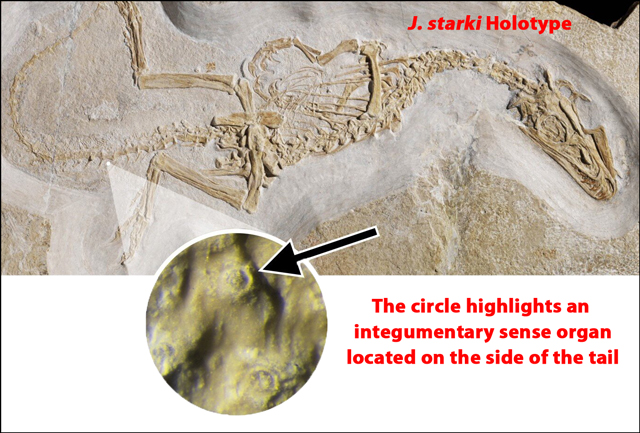
Researchers writing in the academic journal “Current Biology”, have revealed how dinosaurs may have made sense of their surroundings using special sensory nodes embedded in the scales on their skin.  A new paper focusing on the small, theropod Juravenator starki from the Torleite Formation (upper Kimmeridgian), Solnhofen, Bavaria, (Germany), reports on the discovery of dermal structures along the side of the dinosaur’s tail resembling the integumentary sense organs found in extant crocodiles.

Getting a Sense of Dinosaur Senses

Identifying integumentary sense organs in the Juravenator holotype specimen.
Integumentary sense organs identified in the Juravenator starki holotype.  The black arrow points to the sensory organ, which are found on polygonal scales covering the lower part of the tail

Picture credit: Bell et al Current Biology with additional annotation by Everything Dinosaur

Juravenator starki

Once thought to be a close relative of the contemporary Compsognathus longipes, Juravenator is known from a single, beautifully preserved fossil specimen (JME Sch 200), found in a limestone quarry in 1998.  Although squashed flat, the specimen is mostly articulated and complete with only some caudal vertebrae missing.  It is a juvenile and as such, placing it within the Theropoda has proved problematic.  The taxonomic position is uncertain, but it has been suggested that it could represent a basal member of the Coelurosauria or perhaps a primitive member of the Maniraptora.

The genus name is derived from the Bavarian Jura mountains and “venator” – Latin for “hunter”.  The species (trivial) name honours the Stark family who owned the quarry where the sixty-centimetre-long dinosaur fossil was discovered.

Soft tissue representing body scales have been identified associated with the lower leg bones and between the 8th and 22nd caudal vertebrae.  Other soft tissue structures have been found probably representing preserved tendons and ligaments.  It is these dermal structures that have been the centre of this new study.

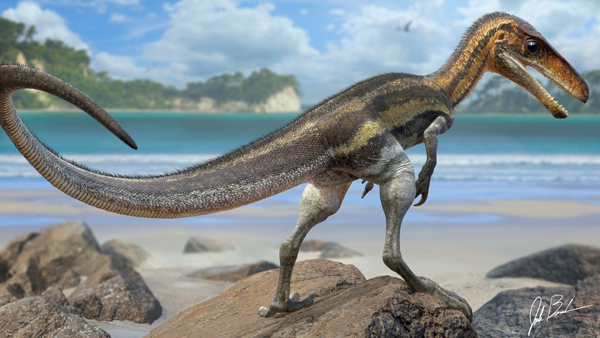
A Life Reconstruction of the Late Jurassic Theropod Juravenator starki

Juravenator starki illustrated.
An illustration of the theropod Juravenator starki.

Picture credit: Jake Baardse

Specialised Scales

Scientists are aware that early in the evolution of the first truly terrestrial tetrapods epidermal scales evolved to provide an effective barrier against ultraviolet radiation and to prevent excessive water loss.  This evolutionary development meant that stem reptiles were no longer constrained by having to stay close to freshwater like their amphibian ancestors.  Epidermal scales in extant reptiles are not simple, inert structures but can perform a suite of functions and assist in how the animal senses its environment.

Researchers Dr Phil Bell (University of New England) in Armidale, Australia along with his colleague Dr Christophe Hendrickx, from the Unidad Ejecutora Lillo in San Miguel de Tucumán, (Argentina), both specialists in dinosaur dermatology, identified a unique scale type with distinctive, prominent circular nodes on the preserved integumentary covering on the tail of Juravenator. They interpret these raised nodes as integumentary sense organs, analogous to those found today in living crocodilians.

Dr Bell commented:

“Few people pay much attention to dinosaur skin, because it is assumed that they are just big, scaly reptiles.  But when I looked closely at the scales on the side of the tail, I kept finding these little ring-like features that didn’t make sense; they were certainly unlike other dinosaur scales.”

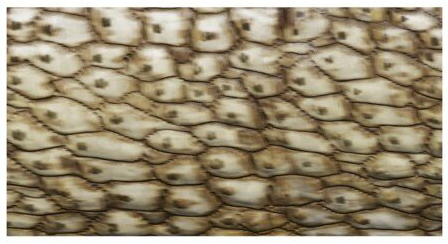
Integumentary Sense Organs Identified in a Dinosaur

Crocodilian integumentary sense organs.
Crocodilian integumentary sense organs, circular objects visible on the dermal scales.

Picture credit: Bell et al Current Biology

The First Direct Evidence of Integumentary Sense Organs

The surprising presence of such structures suggests the tail of Juravenator played a role in how this dinosaur sensed the world around it.  This is the first direct evidence of such structures being present on the skin of a dinosaur.

The shape and the orientation of the teeth, especially those in the upper jaw suggest Juravenator ate fish (piscivore).  During the Late Jurassic, this part of Europe was covered by a warm, tropical, shallow sea with numerous small islands.  This archipelago was home to a number of dinosaurs including the famous “urvogel” Archaeopteryx.  As crocodiles are aquatic predators, the research team speculate that Juravenator may have been an aquatic hunter too.

Alligators have integumentary sense organs on their snout, whereas crocodiles have these special scales all over their body including the tail.  These sensory nodes help these reptiles to detect temperature changes, chemical signals in the water as well as having tactile properties.  Although the entire integumentary covering of Juravenator is unknown, this lithe dinosaur could have submerged its tail to help it detect the movement of prey underwater.

To read an article about the sense of smell in the Dinosauria: Don’t Get Sniffy About Dinosaur Sense of Smell.

The scientific paper: “Crocodile-like sensory scales in a Late Jurassic theropod dinosaur” by Phil R. Bell and Christophe Hendrickx published in Current Biology.

The Everything Dinosaur website: Everything Dinosaur.

Go to Top