All about dinosaurs, fossils and prehistoric animals by Everything Dinosaur team members.
Articles, features and information which have slightly more scientific content with an emphasis on palaeontology, such as updates on academic papers, published papers etc.
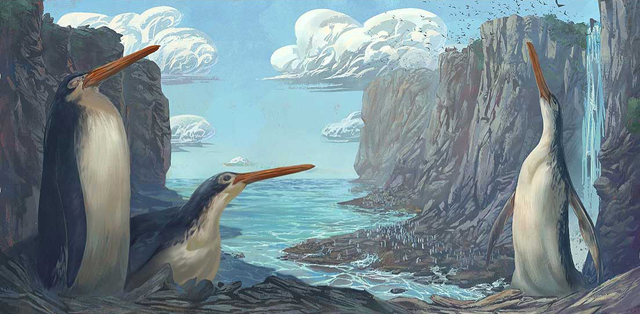
Fossils discovered on a beach by a group of school children on a field trip have been identified as a new species of giant, prehistoric penguin. The 1.4-metre-tall bird has been named Kairuku waewaeroa and it hunted fish in the waters off New Zealand’s North Island some 30 million years ago.
The ancestors of today’s penguins (Sphenisciformes), probably lived alongside those other famous archosaurs – the Dinosauria Penguins Probably Lived Alongside Dinosaurs. Fossils of penguins are known from the Palaeocene and over the last few years, palaeontologists have been able to build up arguably, the most complete and continuous fossil record of any type of bird. The new giant penguin K. waewaeroa comes from the Glen Massey Formation and the fossils found by the school children on a Hamilton Junior Naturalist Club (JUNATS) field trip to Kawhia Harbour, North Island in 2006, represents one of the most complete prehistoric penguin specimens found to date.
The Kawhia giant penguin Kairuku waewaeroa from the Oligocene of North Island (New Zealand). Picture credit: Simone Giovanardi.
CT Scans Used to Create Three-dimensional Models
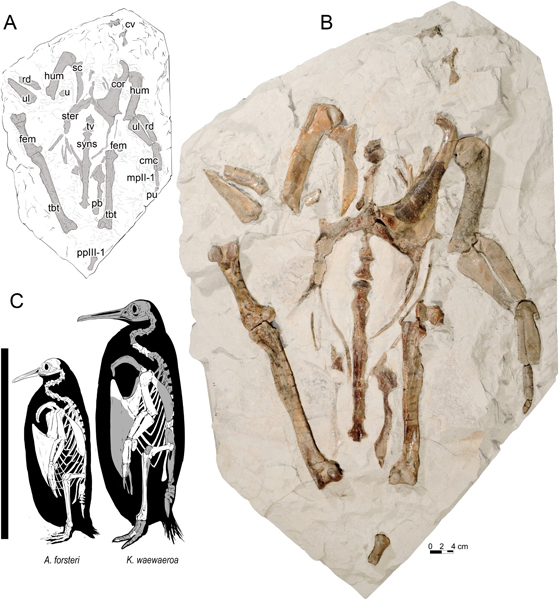
The partially articulated fossil material consisting of limb bones, cervical vertebrae and the pelvis preserved in a single block was presented to Waikato Museum Te Whare Taonga o Waikato, Hamilton, New Zealand in 2017. The research team studying the fossil bones, who included Simone Giovanardi and Daniel Thomas (Massey University, Auckland) and Daniel Ksepka (Connecticut, USA), used CT scans to create three-dimensional computer models. These computer models could then be used to make a 3D-printed replica which was presented to the Hamilton Junior Naturalists.
The holotype specimen of Kairuku waewaeroa (WM 2006/1/1). Line drawing of specimen (A), photograph of the holotype in ventral view (B) and (C) scale comparison with the largest extant penguin species the Emperor Penguin (Aptenodytes forsteri), known bones shown in white. Note scale bar for (B) equals 4 cm. Picture credit: Giovanardi et al.
Giant Penguin with Long Legs
Co-author of the scientific paper, published in the Journal of Vertebrate Paleontology, Dr Daniel Thomas (School of Natural and Computational Sciences at Massey University), stated the fossil dates from between 27.3 and 34.6 million years ago, a time when much of this area of North Island was underwater.
The Senior Lecturer in Zoology added:
“The penguin is similar to the Kairuku giant penguins first described from Otago but has much longer legs, which the researchers used to name the penguin waewaeroa – Te reo Māori for “long legs”. These longer legs would have made the penguin much taller than other Kairuku while it was walking on land, perhaps around 1.4 metres tall and may have influenced how fast it could swim or how deep it could dive.”
Everything Dinosaur acknowledges the assistance of a media release from Massey University in the compilation of this article.
The scientific paper: “A giant Oligocene fossil penguin from the North Island of New Zealand” by Simone Giovanardi, Daniel T. Ksepka and Daniel B. Thomas published in the Journal of Vertebrate Paleontology.
The award-winning Everything Dinosaur website: Dinosaur Toys.
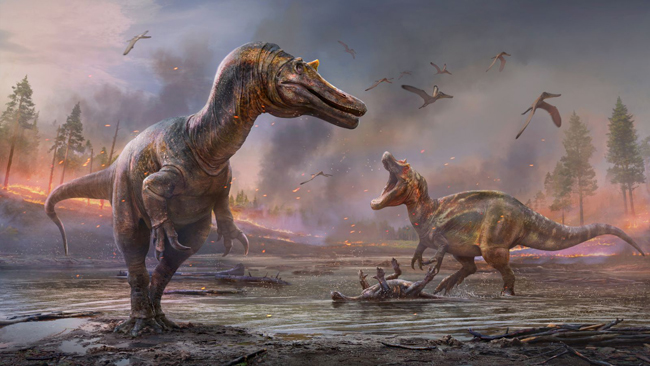
Spinosaurids are like buses, you wait for ages for one to come along and then two arrive together. Today, we can announce that two new members of the Baryonychinae have been named and described from fossil remains found on the Isle of Wight. Named Ceratosuchops inferodios and Riparovenator milnerae, their discovery supports the idea of a European origin for the Spinosauridae and suggests that different types of fish-eating dinosaur could happily co-exist in the same palaeoenvironments.
Two new species of spinosaurids described from the Isle of Wight Ceratosuchops inferodios (foreground) challenges a Riparovenator milnerae (background) over the carcase of an iguanodont. Pterosaurs flee a forest fire, whilst the dinosaurs squabble. The plant debris beds at Chilton Chine are dominated by charcoal, indicating that this area suffered numerous forest fires. Picture credit: Anthony Hutchings.
Spinosaurs Had Been Expected
Palaeontologists had long suspected that there were more spinosaurid dinosaurs awaiting discovery in the Lower Cretaceous Wealden Supergroup of southern England. The strata were deposited over large flood plains during the late Barremian and early Aptian stages of the Early Cretaceous and fragmentary fossils, mostly isolated teeth representing spinosaurids have been found. These fossils were usually ascribed to Baryonyx, which was formally named and described in 1986 and provided scientists with the first significant evidence of the body plan and diet of these specialised theropods.
New Spinosaurids Fossil Material
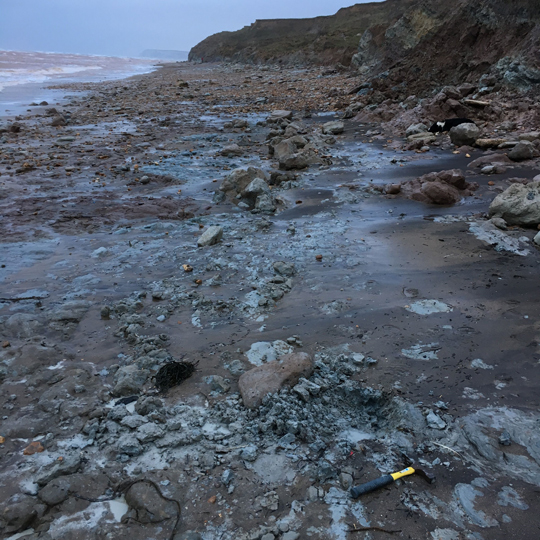
The fossil material was collected by Brian Foster from Yorkshire and Jeremy Lockwood who lives on the Isle of Wight in collaboration with several other local collectors and fossil enthusiasts, from the beach at Chilton Chine from 2013 to 2017, the rapidly eroding cliffs exposed the fossils and it is thanks to this dedicated group of amateur fossil hunters that these important specimens were saved from being washed away by the sea. More than fifty fossil bones were recovered from the site, including a partial tail which was excavated by a field team from the Dinosaur Isle Museum.
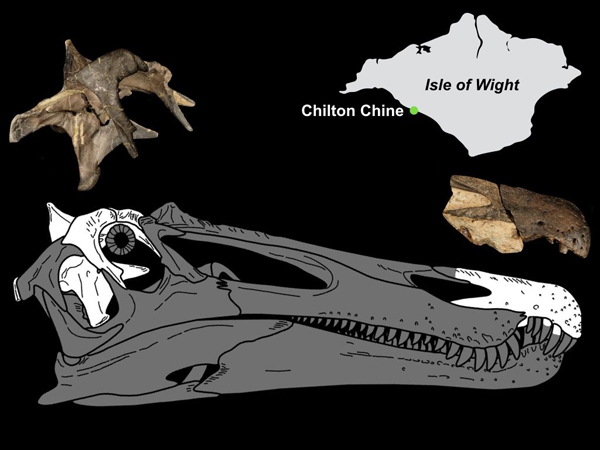
The location of the dinosaur fossil finds. Picture credit: Jeremy Lockwood.
Analysis of Bones Undertaken by the University of Southampton
Analysis of the bones carried out at the University of Southampton and published this week in the journal “Scientific Reports” has led to the establishment of two new species of spinosaurids, which have been named Ceratosuchops inferodios and Riparovenator milnerae. Although related to Baryonyx (B. walkeri), these two new theropods might be more closely related to Suchomimus from Africa.
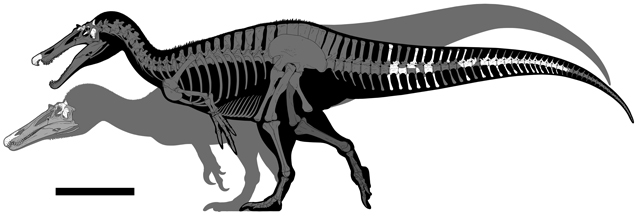
Scientists estimate that Ceratosuchops and Riparovenator were around 9 metres in length and their crocodilian-like skulls were about a metre long.
Known material referred to the baryonychines Ceratosuchops inferodios (rear) and Riparovenator milnerae (front) recovered at Chilton Chine (Isle of Wight). White bones represent recovered elements. Note scale bar = 1 metre. Picture credit: Barker et al.
Phylogenetic and Bayesian statistical analysis suggests that Ceratosuchops and Riparovenator are sister taxa and more closely related to Suchomimus than they are to Baryonyx but work on the taxonomy of the Spinosauridae is hampered by a lack of fossil material permitting direct comparison between genera. Most palaeontologists split the Spinosauridae into two separate clades, the Spinosaurinae which includes taxa such as Spinosaurus, Ichthyovenator and Irritator and the Baryonychinae. Ceratosuchops inferodios and Riparovenator milnerae have been classified as baryonychids along with Baryonyx, Suchomimus and an as yet unnamed taxon from Portugal (ML 1190).
University of Southampton PhD student, Chris Barker, the lead author of the study commented:
“We found the skulls to differ not only from Baryonyx, but also one another, suggesting the UK housed a greater diversity of spinosaurids than previously thought.”
Ceratosuchops skull fossils and illustrative drawing with location of Chilton Chine on the Isle of Wight highlighted. Picture credit: Chris Barker and Dan Folkes.
Ceratosuchops inferodios
The first specimen has been named Ceratosuchops inferodios, which translates from the Latin as the “horned crocodile-faced hell heron”. With a series of low horns and bumps ornamenting the brow region the name also refers to the predator’s likely hunting style, which would be similar to that of a (terrifying) heron. Herons famously catch aquatic prey around the margins of waterways but their diet is far more flexible than is generally appreciated and can include terrestrial prey too.
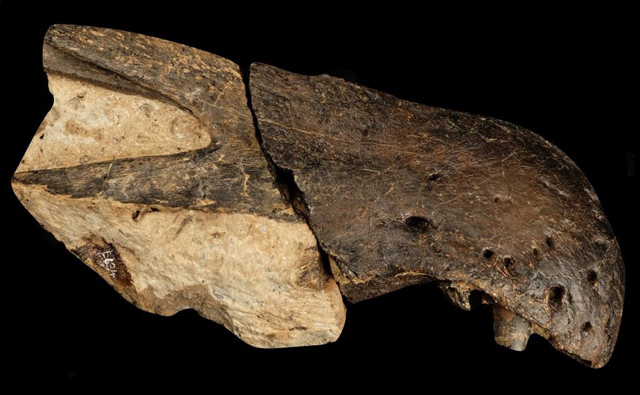
Ceratosuchops premaxillae. Picture credit: Chris Barker.
Riparovenator milnerae
The second new species to be named Riparovenator milnerae, translates from the Latin as “Milner’s riverbank hunter”, the species name honours the highly influential British palaeontologist Angela Milner who sadly, passed away in August. Angela, along with her colleague Alan Charig, studied and named Baryonyx (B. walkeri) and her work at the London Natural History Museum has done much to improve our understanding of theropod dinosaurs. It seems a fitting tribute to Dr Milner, for someone who was so involved in helping us to understand Baryonychids that a member of the Baryonychinae should be named in her honour.
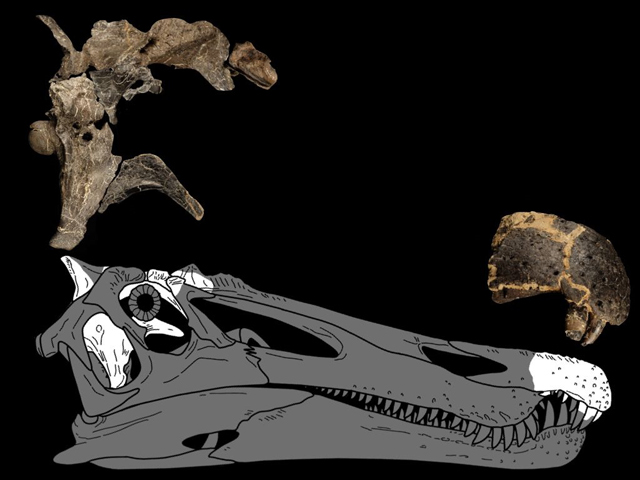
The braincase and the premaxilla of Riparovenator with skull drawing showing placement of the fossil bones. Picture credit: Chris Barker and Dan Folkes.
Many Large Predators in the Ecosystem
When looking at modern food webs, the number of large predators is normally limited by the available range of prey items and other resources such as space for territories and suitable breeding sites. Whilst there are many predators on the African plains, the apex predatory position tends to be occupied by just one species – Panthera leo (lion). In the forests of India, it is another big cat that occupies the apex predator position Panthera tigris (tigers). In several dinosaur dominated ecosystems another picture emerges, where at least two, equally sized and contemporaneous large theropods seem to occupy the apex predator role. Major dinosaur-fossil-bearing geological formations have revealed that several different types of large, carnivorous dinosaur co-existed.
Examples of Multiple Types of Theropod Dinosaur Predator from a Single Geological Formation
Dinosaur Park Formation (Canada – Upper Cretaceous) – Daspletosaurus and Gorgosaurus.
Morrison Formation (Western United States – Upper Jurassic) – Torvosaurus, Allosaurus, Saurophaganax, Ceratosaurus, Marshosaurus etc.
Lourinhã Formation (Portugal – Upper Jurassic) – Lourinhanosaurus, Torvosaurus, Allosaurus, Ceratosaurus, plus possible megalosauroids and abelisaurids.
Huincul Formation (Argentina – early Upper Cretaceous) – Mapusaurus, Gualicho, Skorpiovenator etc.
Shaximiao Formation (China – Middle to Upper Jurassic) – Sinraptor, Yangchuanosaurus, Gasosaurus, along with megalosauroids and other metriacanthosaurids.
Commenting on this phenomenon co-author of the scientific paper Dr David Hone (Queen Mary University) stated:
“It might sound odd to have two similar and closely related carnivores in an ecosystem, but this is actually very common for both dinosaurs and numerous living ecosystems.”
The presence of two or more spinosaurid taxa in the same geological unit (Wessex Formation) is therefore not without precedent and may in fact be typical. Furthermore, the Wessex Formation has revealed several other completely unrelated theropods that shared the environment with the spinosaurids, Eotyrannus (tyrannosauroid), the allosauroid Neovenator and at least one other, as yet unnamed large tetanuran.
Early spinosaurids may have been more generalist hunters, eating a varied diet, including fish and terrestrial prey. Only later did more specialised taxa adapted to underwater pursuit predation evolve, such as Spinosaurus. However, the degree of specialisation to an aquatic life in spinosaurids remains hotly debated and the evolutionary sequence by which aquatic adaptations came about remains unknown.
A European Origin for the Spinosauridae?
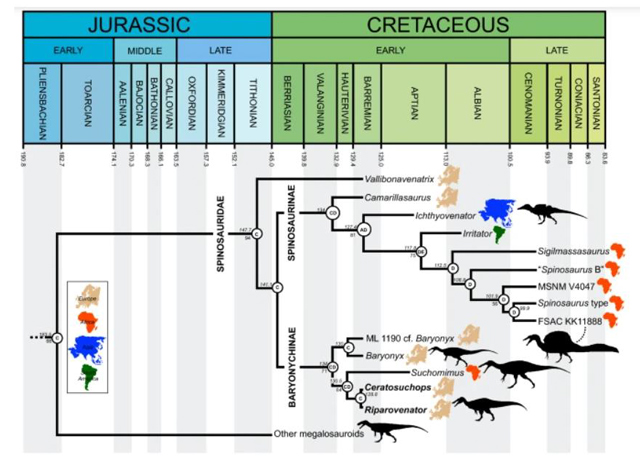
The discovery of these two new members of the Spinosauridae family and the subsequent analysis conducted by the research team supports the theory of a European origin for this family of theropods. They postulate that spinosaurs first evolved in Europe and dispersed into Asia and Western Gondwana (northern Africa and Brazil) during the first half of the Early Cretaceous. The range over which these types of dinosaurs roamed then begins to contract, by the Cenomanian faunal stage, spinosaurids are only present in north Africa.
A chart showing the temporal and geographic distribution of the Spinosauridae. Picture credit: Barker et al.
New fossil discoveries might change our understanding of the origins and eventual extinction of these enigmatic carnivorous dinosaurs, but based on the current fossil record, rising sea levels during the Cenomanian may have reduced the number of suitable habitats available. This may have contributed to the extinction of the Spinosauridae.
Everything Dinosaur acknowledges the assistance of a press release from the University of Southampton in the compilation of this article.
The scientific paper: “New spinosaurids from the Wessex Formation (Early Cretaceous, UK) and the European origins of Spinosauridae” by Chris T. Barker, David W. E. Hone, Darren Naish, Andrea Cau, Jeremy A. F. Lockwood, Brian Foster, Claire E. Clarkin, Philipp Schneider and Neil J. Gostling published in Scientific Reports.
The rise of the dinosaurs which led them to dominate terrestrial ecosystems for more than 150 million years was driven by environmental change caused by intense volcanism over 230 million years ago. That is the conclusion in a new study published today in the ” Proceedings of the National Academy of Sciences” (PNAS).
The Late Triassic Carnian Pluvial Episode (CPE) led to a huge rise in global temperature and humidity. This dramatic change had a significant impact on the development of animal and plant life, which was still recovering from the greatest mass extinction event known in the fossil record which had occurred at the end of the Permian, some 20 million years earlier.
Ecological changes following intense volcanic activity during the Carnian Pluvial Episode 230 million years ago paved the way for dinosaurs to become the dominant terrestrial fauna. Picture credit: University of Birmingham.
The Evolution of Modern Conifers
The researchers, including experts from the University of Birmingham, discovered four distinct pulses of volcanic activity during this time in the Late Triassic. The most likely source of this volcanism being the Wrangellia Large Igneous Province, remnants of which can still be seen in Alaska, British Columbia and the Yukon (western North America).
Jason Hilton (Professor of Palaeobotany and Palaeoenvironments at the University of Birmingham’s School of Geography, Earth and Environmental Sciences), a co-author of the study, explained:
“Within the space of two million years the world’s animal and plant life underwent major changes including selective extinctions in the marine realm and diversification of plant and animal groups on land. These events coincide with a remarkable interval of intense rainfall known as the Carnian Pluvial Episode.”
One of the major groups of plants to benefit from the dramatic climate change were cone-bearing seed plants (conifers). Ferns also benefitted and show an increase in numbers, range and species. Other archosaurs such as crocodyliforms show an increase in diversity and mammaliaforms, insects and turtles seem to have thrived as a result of this climate change.
“Our research shows, in a detailed record from a lake in North China, that this period can actually be resolved into four distinct events, each one driven by discrete pulses of powerful volcanic activity associated with enormous releases of carbon dioxide into the atmosphere. These triggered an increase in global temperature and humidity.”
The scientists discovered that each phase of volcanic activity coincided with widescale disruption to the global carbon cycle. The higher levels of carbon dioxide produced led to major climate changes with a hotter, wetter climates predominating. The ancient lake deposits reveal that it became deeper but oxygen levels in the lake reduced and stifled animal life.
Geological events from a similar timeframe in Europe, Argentina, eastern Greenland, Morocco and North America, among other locations indicate that increased rainfall resulted in widespread expansion of drainage basins converging into lakes or swamps, rather than rivers or oceans.
Co-author of the paper, Dr Sarah Greene (Senior Lecturer in the School of Geography, Earth and Environmental Sciences, University of Birmingham) added:
“Our results show that large volcanic eruptions can occur in multiple, discrete pulses demonstrating their powerful ability to alter the global carbon cycle, cause climate and hydrological disruption and drive evolutionary processes.”
Example pollen, spores and algae from the Carnian Pluvial Episode in China that record climate and environmental change following massive volcanism. Individual specimens range from 20 to 120 μm in size. Picture credit: University of Birmingham.
The research team investigated terrestrial sediments from the ZJ-1 borehole in the Jiyuan Basin of North China. They used uranium-lead zircon dating, high-resolution chemostratigraphy, palynological and sedimentological data to correlate terrestrial conditions in the region with synchronous large-scale volcanic activity in North America.
Everything Dinosaur acknowledges the assistance of a media release from the University of Birmingham in the compilation of this article.
The scientific paper: “Volcanically-driven lacustrine ecosystem changes during the Carnian Pluvial Episode (Late Triassic)” by Jing Lu, Peixin Zhang, Jacopo Dal Corso, Minfang Yang, Paul B. Wignall, Sarah E. Greene, Longyi Shao, Dan Lyu and Jason Hilton published in Proceedings of the National Academy of Sciences (PNAS).
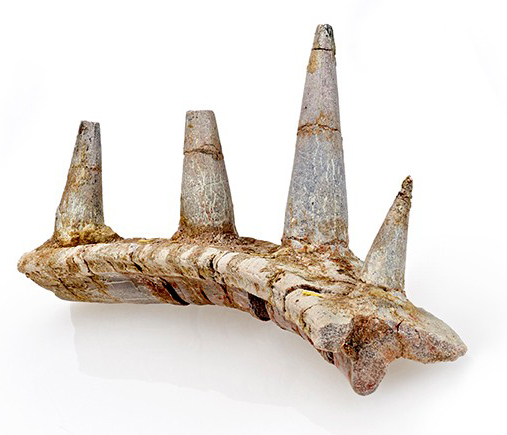
Scientists including researchers from the Natural History Museum in London, have published a scientific paper announcing the discovery of the first fossils assigned to the Ankylosauria from Africa. This is the first ankylosaur to have been named from fossil material found in Africa and also the oldest known member of this group of armoured dinosaurs described to date. The dinosaur has been named Spicomellus afer. The scientific name translates from the Latin as “spiked collar from Africa”.
The holotype fossil (NHMUK PV R37412). The protective, bony spikes are actually fused to the rib, this anatomical feature has not been seen in a vertebrate before. Picture credit: London Natural History Museum.
Acquired from a Fossil Dealer
The fossil was acquired from a UK-based commercial fossil dealer by the London Natural History Museum in 2019. At first the strange fossil, a rib bone with four bony spikes directly attached to it, was thought to be a forgery, but CT analysis proved the fossil to be genuine. It comes from the third subunit of the El Mers Group from the Atlas Mountains of Morocco. The fossil is estimated to be between 168 and 163 million years old (Bathonian to Callovian stages of the Middle Jurassic).
In recent times, Morocco has provided some tantalising glimpses into the potential wealth of armoured dinosaurs that await discovery. The Ankylosauria and Stegosauria form a clade within the bird-hipped dinosaurs (Ornithischia), the Eurypoda, which has been defined to include famous armoured dinosaurs Ankylosaurus, Stegosaurus and their most recent, common ancestor and all its descendants. Eurypoda fossils are mostly confined to Laurasia, fossils from the continents that made up Gondwana (essentially Africa, South America, Antarctica, India, Madagascar and Australia), are rare.
In 2019, Everything Dinosaur reported upon the discovery of the oldest stegosaur known from northern Africa, the dinosaur named Adratiklit boulahfa is also the oldest stegosaur described to date and it was roughly contemporaneous with Spicomellus.
The research team behind the paper on Adratiklit boulahfa were also responsible for much of the work behind the analysis of the rib bone fossil (specimen number NHMUK PV R37412), that led to the naming and scientific description of Spicomellus.
Identifying a Fossil as an Ankylosaur Fossil
Once the fossil had been established as genuine, the research team including Dr Susannah Maidment (London Natural History Museum), who specialises in studying ornithischian dinosaurs, were able to confirm that the specimen represented a rib bone from a stegosaur or an ankylosaur. Rib bones in most armoured dinosaurs tend to show a distinctive “t-shape” in cross section. Histological analysis of the composition of the bone matrix of the spikes demonstrated that their structure was reminiscent of an ankylosaur and therefore the scientists were able to confidently assign this specimen to the Ankylosauria.
The rib bone in cross-section shows a “t-shape” which is distinctive to the Stegosauria and the Ankylosauria. Histological study of the bone structure in the spikes identified that this bone was typical of an ankylosaur, allowing the research team to confidently assign the fossil to an ankylosaur. Picture credit: London Natural History Museum.
As for what Spicomellus might have looked like, any life reconstructions will have to be highly speculative, although based on comparisons with the ribs of more complete ankylosaur specimens the research team estimate that this individual Spicomellus was around three metres in length.
No Fossil Like This Ever Found Before
The rib with spiked, dermal armour fused to its top surface is unique. Nothing like this has ever been found before. This anatomical trait is not found in living or extinct vertebrates. Ankylosaurs tend to have their armour embedded into their skin and not directly attached to their bones. Spicomellus would have been less mobile and flexible as a result of its unique anatomy. Palaeontologists hope to return to northern Morocco and find more fossils to help them build up a better picture of this bizarre, armoured dinosaur.
Described as a basal ankylosaur, Spicomellus may represent an evolutionary experiment as armoured dinosaurs evolved probably as a result of predation pressure (megalosaurids are also known from the El Mers Group). How long these armour-attached-to-bone ankylosaurs persisted and how successful this group was remains unknown.
Implications for Armoured Dinosaur Evolution and Stegosaur Extinction
The discovery of Spicomellus suggests that we have a lot more to learn about the Eurypoda and that there probably are many more important but unknown fossil specimens of armoured dinosaurs awaiting discovery in the continents that made up Gondwana.
Spicomellus helps to fill a gap in the evolution of the Ankylosauria (Nodosauridae and Ankylosauridae). In addition, its discovery challenges current thinking about the demise of the Stegosauria. Stegosaur fossils are more common in Jurassic rocks than ankylosaur fossils are.
The Earliest Ankylosaur
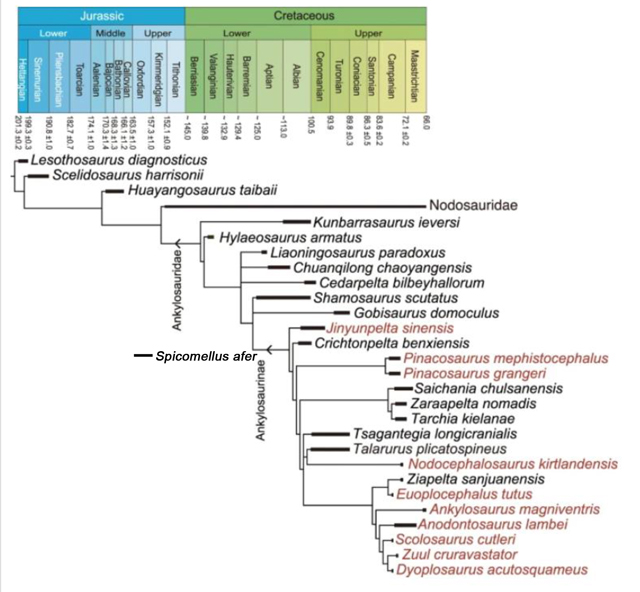
In Cretaceous sediments, stegosaur specimens become increasingly rare. It had been thought that the rise of the Ankylosauria played a role in the eventual demise and extinction of the Stegosauria. However, with the discovery of Spicomellus, palaeontologists now know that stegosaurs and ankylosaurs co-existed for around 20 million years. The extinction of the Stegosauria remains a mystery, Spicomellus suggests that the evolution of different types of armoured dinosaur may only have played a limited role in their extinction.
The discovery of Spicomellus afer changes dramatically the temporal phylogeny of the Ankylosauria. Picture credit: Zheng et al with additional annotation by Everything Dinosaur.
The scientific paper: “Bizarre dermal armour suggests the first African ankylosaur” by Susannah C. R. Maidment, Sarah J. Strachan, Driss Ouarhache, Torsten M. Scheyer, Emily E. Brown, Vincent Fernandez, Zerina Johanson, Thomas J. Raven and Paul M. Barrett published in Nature Ecology and Evolution.
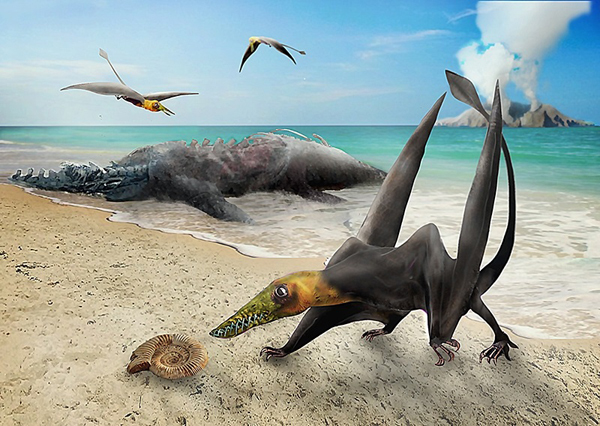
Fragmentary fossils collected from a location in the Atacama Desert of northern Chile have been assigned to a long-tailed pterosaur, specifically a rhamphorhynchid, this is the first time that evidence for this type of flying reptile has been found in Gondwana and the fossils, which are around 160 million years old, makes this specimen the oldest known pterosaur from Chile.
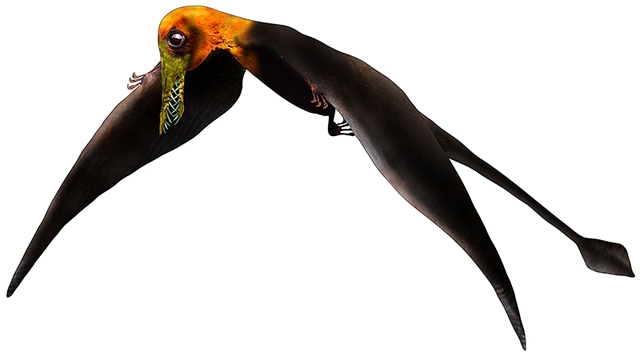
A life reconstruction of the rhamphorhynchid pterosaur from northern Chile. Several types of marine reptile have also been recorded from these deposits. Picture credit: Universidad de Chile.
The Cerro Campamento Formation
The fossil material, consisting of a left humerus (thigh bone), parts of the wing finger and a possible dorsal vertebra, was collected in 2009 from the fossil-bearing Cerro Campamento Formation near the locality of Cerritos Bayos in northern Chile. The bones were all found in the same block and their relative size has led the researchers to believe that all the bones came from a single individual.
The strata in this area have yielded abundant ammonite remains as well as the fossils of numerous marine reptiles and prehistoric fish. Based on the associated ammonite specimens found at this location, the research team are confident that that the pterosaur remains date from the middle Oxfordian age of the Jurassic.
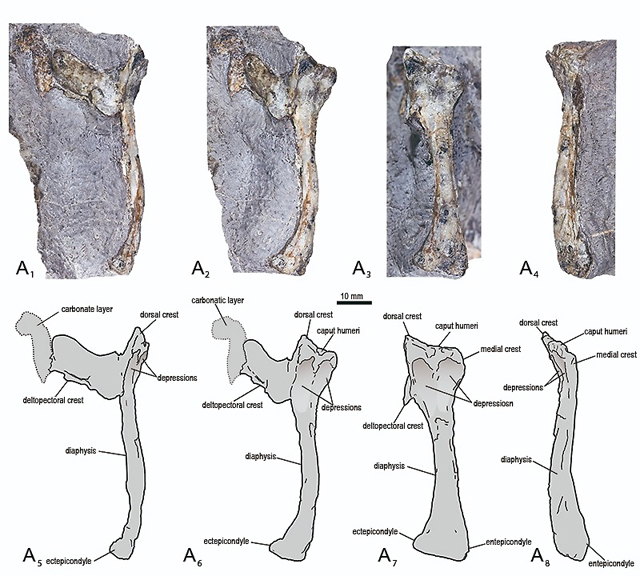
Views of the left humerus (MUHNCAL.20165) identified as a fossil bone from a rhamphorhynchid pterosaur with accompanying line drawings. Picture credit: Universidad de Chile.
Assigning the Fossils to the Rhamphorhynchidae
Although the remains represent a small proportion of the total skeleton their three-dimensional preservation permitted the research team to confidently assign the material to the Rhamphorhynchidae.
The humerus has a hatchet-shaped deltopectoral crest, proximally positioned, and its shaft is markedly anteriorly curved, which are characteristic features of the Rhamphorhynchidae. Furthermore, the presence of a groove that runs along the caudal surface of the phalanx, being flanked by two asymmetric crests, is a distinctive feature of the clade Rhamphorhynchinae. These traits provide evidence for an affinity to the Rhamphorhynchidae family and as such this reinforces the idea that these types of long-tailed pterosaurs were the first pterosaurs to achieve a relatively global distribution. Writing in the academic journal Acta Palaeontologica Polonica, the researchers who included Jhonatan Alarcón-Muñoz from the Universidad de Chile, assert that the specimen (MUHNCAL.20165), represents the first evidence of this group found to date in Gondwana. They are also the oldest pterosaur fossils to have been described from Chile.
Although it is difficult to estimate the size of the animal, comparisons with the well-known Rhamphorhynchus, most closely associated with the Solnhofen limestone deposits of Bavaria, (southern Germany), indicate that the Chilean pterosaur was large for a rhamphorhynchid. A wingspan in excess of 1.5 to 2 metres has been suggested.
A life reconstruction of a typical rhamphorhynchid pterosaur. The fossil remains from Chile are the first, definitive evidence for this type of pterosaur in Gondwana. Picture credit: Universidad de Chile.
The Caribbean Corridor
Rhamphorhynchid fossils are relatively rare from the Middle Jurassic, but they have been widely reported from Upper Jurassic strata associated with Laurasia. The Chile specimen was found in marine sediments that were deposited at the bottom of a shallow sea, most other rhamphorhynchid fossils are also found in rocks that represent shallow sea, near coastal environments. Some Rhamphorhynchus fossils (R. muensteri) from Solnhofen preserve fish remains as stomach contents and this supports the idea that these pterosaurs were piscivores and lived in coastal habitats.
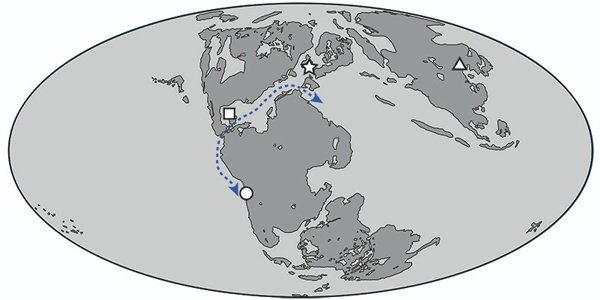
During the Oxfordian, internal seaways such as the Caribbean corridor and the Trans-Erythrean corridor provided similar coastal environments running down and between Laurasia in the north and Gondwana in the south. The researchers propose that the Caribbean corridor acted as a dispersal route permitting the spread of flying reptiles such as rhamphorhynchids. They postulate that this corridor helps to explain the faunal similarities amongst marine vertebrates found in Germany, the UK, Cuba and South America during the Oxfordian faunal stage.
The shape of the world’s landmasses during the Oxfordian of the Jurassic. The dashed line represents the hypothetical route that would have allowed the dispersal of marine vertebrates and invertebrates between Tethys and South America during the Late Jurassic. Picture credit: Universidad de Chile.
Map Key
The circle represents the Chile rhamphorhynchid, whilst the square indicates the location of two rhamphorhynchids from Cuba (Cacibupteryx caribensis and Nesodactylus hesperius), the star shape highlights these types of pterosaur discoveries associated with southern England whilst the triangle shows the location of Qinglongopterus guoi from the Tiaojishan Formation of China.
It is likely that more pterosaur fossils will be found in northern Chile. The prospect of further fossil discoveries will hopefully permit palaeontologists to erect a new genus to describe this South American rhamphorhynchid material.
The scientific paper: “First record of a Late Jurassic rhamphorhynchine pterosaur from Gondwana” by J. Alarcón-Muñoz, R. A. Otero, S. Soto-Acuña, A. O. Vargas, J. Rojas and O. Rojas published in Acta Palaeontologica Polonica.
Scientists now know that during the Late Cretaceous (Campanian to Maastrichtian), southern Patagonia was home to ankylosaurs and that predatory abelisaurids competed with terrestrial crocodyliforms when it came to scavenging the carcases of giant Titanosaurs.
Researcher have examined fossilised teeth and osteoderms (bony plates and scales embedded in skin) collected from a small area of Upper Cretaceous deposits from the Cerro Fortaleza Formation in Santa Cruz province and used these fossils to piece together an archosaur dominated palaeocommunity.
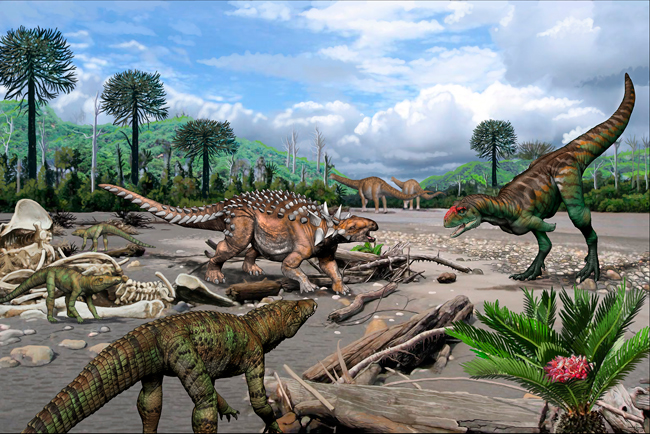
The peirosaurid and dinosaur dominated ecosystem as indicated by fossils from the Cerro Fortaleza Formation (Late Cretaceous of Patagonia). Picture credit: J. González.
Teeth from Abelisaurids, Titanosaurs and Ankylosaurs
The dinosaur fauna of the Cerro Fortaleza Formation is very poorly known with only a few dinosaurs named and described, such as the giant titanosaur Dreadnoughtus schrani. However, researchers who included scientists affiliated to CONICET as well as a researcher from Seoul National University (South Korea), have published a paper in the on-line, open access journal PLOS One reporting on the discovery of several very worn and broken teeth that along with fossil osteoderms have enabled the research team to reconstruct the fauna that once roamed this ancient landscape.
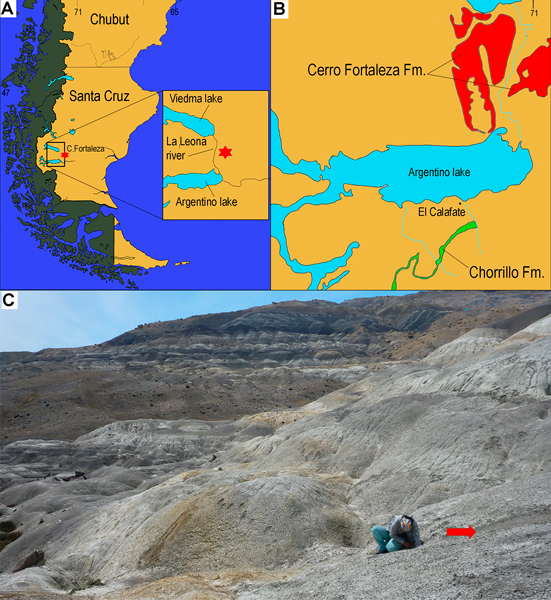
Location map (A) showing the provenance of the teeth and osteoderms (Cerro Fortaleza Formation). Region between Viedma and Argentino lakes showing the Cerro Fortaleza Formation (red colour) outcropping at both sides of La Leona river. The dinosaur-fossil-bearing Chorrillo Formation is indicated in green (B). Photograph of the dig site (C) the red arrow marks the level from where the osteoderms and teeth were collected. Picture credit: Paulina-Carabajal.
Lying some 100 miles (160 kilometres) to the south of the Cerro Fortaleza Formation exposures that yielded the teeth and osteoderm fossils, the Chorrillo Formation is also regarded as an important source of dinosaur fossils. Palaeontologists are not sure of the temporal relationship between these dinosaur-fossil-bearing units, although it has been postulated that the Chorrillo Formation is slightly older. Both units have provided evidence of titanosaurs, theropods and ornithopods, but up to now only the Chorrillo Formation had provided evidence of ankylosaurs. Whilst working at the Cerro Fortaleza locality in December 2016, field team members discovered several isolated osteoderms and a single, very worn tooth thus confirming the presence of armoured dinosaurs in the Cerro Fortaleza Formation too.
Whilst it is difficult to identify a specific type of ankylosaur from just skin scales and a single tooth, the researchers postulate that these fossils represent a nodosaurid.
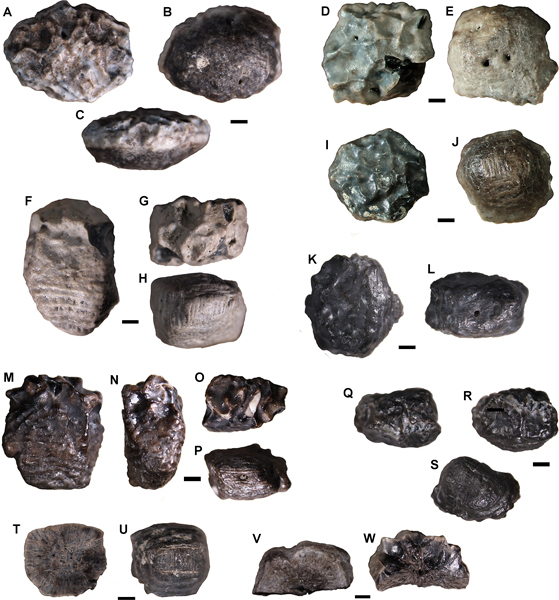
Views of various ankylosaur osteoderms collected from the Cerro Fortaleza Formation. These bony scales along with an ankylosaur tooth confirm the presence of armoured dinosaurs in this locality. Note scale bars equal 1 mm. Picture credit: Paulina-Carabajal et al.
The Dinosaurs of the Cerro Fortaleza Formation
The researchers were able to confirm the presence of a large abelisaurid theropod and an ankylosaur based on the fossil teeth. Very worn and broken titanosaur spp. teeth were also recorded. The types of dinosaurs that lived in the area represented by the Cerro Fortaleza Formation were similar to those reported from the Chorrillo Formation, although the two populations were very probably made up of different genera.
Intriguingly, evidence of hadrosaurs has been reported from the Chorrillo Formation, as yet no fossils that could be assigned to the Hadrosauridae have been reported from the Cerro Fortaleza Formation.
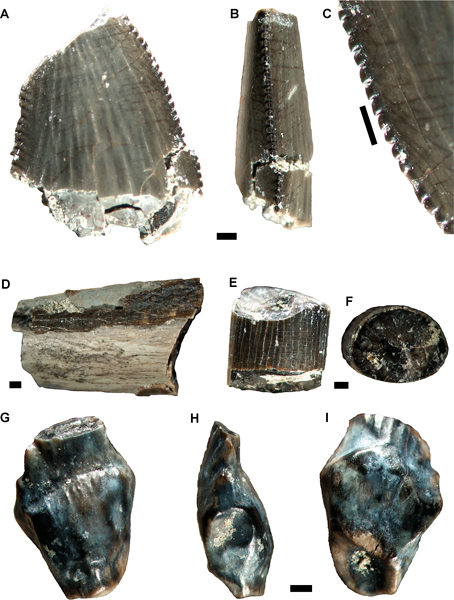
Dinosaur teeth from the Cerro Fortaleza Formation. Partial tooth assigned to an abelisaurid theropod (A-C). Partial tooth of an unidentified archosaur (D). Titanosauria partial tooth (E-F) and tooth assigned to an Ankylosaur (G-I). Note scale bars equal 1 mm (except A-B equals 5 mm). Picture credit: Paulina-Carabajal et al.
Crocodyliforms Competing with Carnivorous Dinosaurs
In addition to the dinosaur fossils, the researchers found a total of 9 broken teeth which they assigned to the Peirosauridae family. Peirosaurids are an extinct group of terrestrial crocodyliforms, not closely related to modern crocodilians and seemingly confined to Gondwana. Their upright gait and different shaped teeth (heterodont teeth) indicate that these archosaurs may have had a more varied diet than the carnivorous dinosaurs.
Most of the fossils found represent peirosaurid teeth (75%) and this suggests that there were more crocodyliforms present in the area than dinosaurs. The peirosaurid teeth represent the most southerly distribution of this type of archosaur recorded to date and since the teeth do not match those of Colhuehuapisuchus lunai which is known from Chubut Province to the north, this suggests at least two taxa of peirosaurids present in southern Patagonia during the Late Cretaceous.
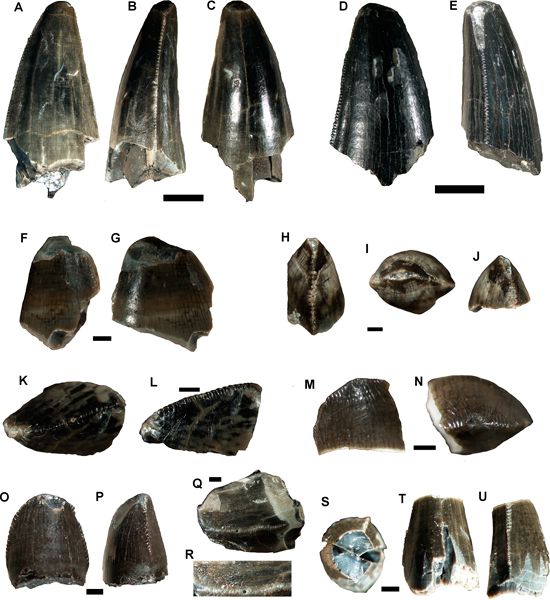
Examples of peirosaurid teeth from the Cerro Fortaleza Formation. Small fossils such as teeth and dermal armour have enabled palaeontologists to piece together the faunal composition of southern Argentina during the Late Cretaceous. Theropod dinosaurs (abelisaurids) would have competed with peirosaurid mesoeucrocodylians over food, but little can be deduced about food chain roles with regards to apex and secondary predators. Picture credit: Paulina-Carabajal et al.
The ankylosaur fossils from Cerro Fortaleza and Chorrillo formations, indicate that armoured dinosaurs lived in the region of southern South America during the Late Cretaceous. These fossils although fragmentary help to fill a gap in the fossil record between Antarctica and central-northern Patagonia. Thanks to this research the Late Cretaceous dinosaur record in southern South America has been improved.
The scientific paper: “A Late Cretaceous dinosaur and crocodyliform faunal association–based on isolate teeth and osteoderms–at Cerro Fortaleza Formation (Campanian-Maastrichtian) type locality, Santa Cruz, Argentina” by Ariana Paulina-Carabajal, Francisco T. Barrios, Ariel H. Méndez, Ignacio A. Cerda and Yuong-Nam Lee published in PLOS One.
New research published in the journal “Nature Communications” suggests that all extant snakes evolved from just a handful of species that survived the K-Pg extinction event 66 million years ago. The researchers conclude that this catastrophic extinction event, that wiped out the non-avian dinosaurs and something like 75% of all terrestrial life, was a form of “creative destruction” leading to a burst of evolutionary development within the Serpentes.
Snakes benefitted from the End-Cretaceous extinction event. It enabled them to evolve rapidly and to exploit new, ecological niches. Picture credit: Joschua Knüppe.
Snakes benefited from the extinction event, the loss of so many competitors allowed them to diversify rapidly and to occupy new niches in food chains.
The Snake Fossil Record
The fossil record of snakes is relatively poor because snake skeletons are typically small and fragile making the preservation of fossil material a rare event.
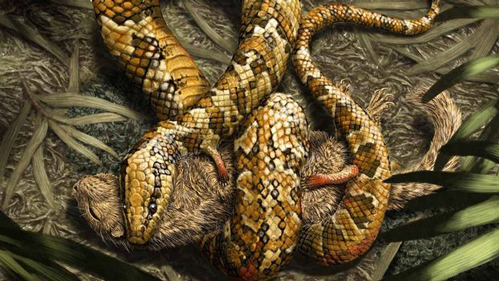
It is generally accepted that snakes (Suborder Serpentes), evolved from lizards. Snakes gradually losing their limbs, whether the first snakes were burrowers and evolved from burrowing lizards or whether the first snakes were adapted to a life in marine environments is an area of on-going debate between vertebrate palaeontologists. For example, in 2016 a team of scientists challenged the conclusions from the paper that described Tetrapodophis amplectus, a primitive snake-like animal from the Lower Cretaceous of Brazil. It had been suggested that T. amplectus, which had been described and named the year before, was adapted to a life underground, however, researchers from Canada and Australia challenged this view and proposed a marine habit for this 20 cm long animal that has been classified as being close to the base of the evolutionary lineage of true snakes.
The tiny limbs of Tetrapodophis may have been used to hold prey. Scientists are uncertain whether this animal was a burrower or adapted to a marine environment. Picture credit: Julius Csotonyi.
The research, led by scientists at the University of Bath in collaboration with researchers from Cambridge, Bristol and Germany, involved examining snake fossils and an analysis of the genomes of living snakes to pinpoint genetic differences permitting a picture of modern snake evolution to be built up.
The results indicate that despite the great variety of snakes alive today – cobras, vipers, pythons, boas, sea snakes and blind, burrowing snakes for example, all extant snakes can be traced back to a handful of species that survived the K-Pg extinction event that took place 66 million years ago.
Snake Survival Strategy
The authors postulate that the ability of snakes to shelter underground and go for long periods without food helped them survive the destructive effects of the bolide impact event. In the aftermath, the extinction of their competitors including Cretaceous snakes and small theropod dinosaurs, permitted snakes to move into new niches, new habitats and new parts of the world. Today, snakes are found in all but the highest latitudes and are present on every continent except Antarctica.
The researchers, which included lead author Dr Catherine Klein, a former graduate of Bath University but now based at the Alexander-Universität Erlangen-Nürnberg (FAU) in Germany, state that modern snake diversity – including tree snakes, sea snakes, venomous vipers and cobras, and huge constrictors like boas and pythons – emerged only after the non-avian dinosaur extinction.
Dr Klein commented:
“It’s remarkable, because not only are they surviving an extinction that wipes out so many other animals, but within a few million years they are innovating, using their habitats in new ways.”
A Change in Snake Vertebrae
Fossils also show a change in the shape of snake vertebrae in the aftermath, resulting from the extinction of Cretaceous lineages and the appearance of new groups, including giant sea snakes, such as Gigantophis garstini from the Eocene of northern Africa which may have reached a length of ten metres. Gigantophis was scientifically described in 1901, it was thought to have been the largest snake to have ever lived, until in 2009 when the giant, South American boa – Titanoboa cerrejonensis was described.
The Rebor Titanoboa Museum Class Maquette Monty Resurgent. A model of the largest snake known to science.
The picture (above) shows the Rebor Titanoboa Museum Class Maquette known as Monty Resurgent.
The research team also suggest that snakes began to spread rapidly around the globe. The “Greenhouse Earth” conditions that occurred close to the boundary between the Palaeocene and Eocene Epochs that led to the establishment of extensive tropical forests in the Northern Hemisphere, would have facilitated the geographical spread of cold-blooded animals such as snakes.
Although the ancestor of living snakes probably lived somewhere in the Southern Hemisphere, snakes first appear to have spread to Asia after the extinction event.
Corresponding author, Dr Nick Longrich, from the Milner Centre for Evolution (University of Bath), explained:
“Our research suggests that extinction acted as a form of “creative destruction”- by wiping out old species, it allowed survivors to exploit the gaps in the ecosystem, experimenting with new lifestyles and habitats. This seems to be a general feature of evolution – it’s the periods immediately after major extinctions where we see evolution at its most wildly experimental and innovative. The destruction of biodiversity makes room for new things to emerge and colonise new landmasses. Ultimately life becomes even more diverse than before.”
Further Serpentes Evolution Driven by Climate Change
The researchers also found evidence for a second major diversification event around the time that the world shifted from a warm and moist climate to a colder, more seasonal climate (Oligocene Epoch).
It seems, that for the snakes at least, global catastrophes can have their upsides. The patterns seen in snake evolution hint at the key role played by mass extinction events – they are the catalysts for driving rapid evolutionary changes.
The scientific paper: “Evolution and dispersal of snakes across the Cretaceous-Paleogene mass extinction” by Catherine G. Klein, Davide Pisani, Daniel J. Field, Rebecca Lakin, Matthew A. Wills and Nicholas R. Longrich published in Nature Communications.
In 1984, a field team led by the renowned Argentinian palaeontologist José Bonaparte uncovered the fossilised remains of a theropod dinosaur in Chubut Province (Patagonia). The articulated fossil remains included most of the front-portion of the skeleton and although some of the bones had been deformed and distorted due to taphonomic processes, skin impressions of parts of the right side of the animal had been preserved. Skin impressions associated with the head of this dinosaur were also present, but these were not recognised during laboratory preparation and sadly they were lost as the skull fossils were cleaned and prepared.
A year later, Carnotaurus (C. sastrei) was formally named and described. Remarkably, despite the Carnotaurus skin impressions being the most completely preserved of any theropod, no detailed study of the skin had been undertaken.
All that changed this week with the publication of a scientific paper in the journal “Cretaceous Research”.
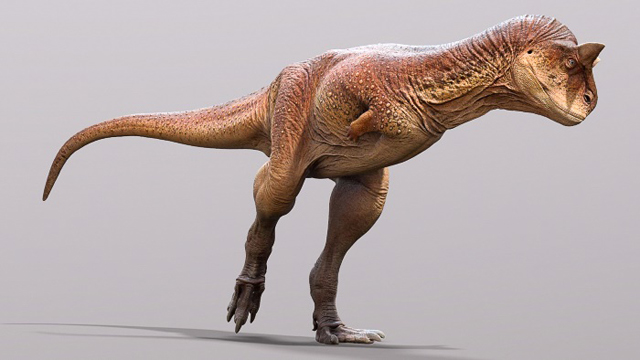
Researchers have described in detail the scaly skin of the abelisaurid Carnotaurus sastrei. The image shows a life reconstruction of Carnotaurus. Picture credit: Jake Baardse.
Not a Feather to be Found
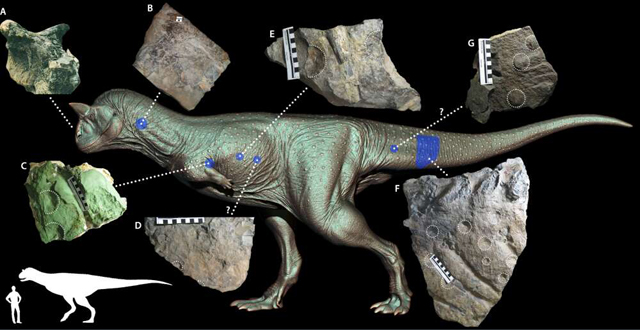
Palaeontologist Dr Christophe Hendrickx from the Unidad Ejecutora Lillo in San Miguel de Tucumán (Argentina), worked with Dr Phil Bell from the University of New England (New South Wales, Australia), an expert in dinosaur integumentary coverings. Whilst the skin impressions only cover part of the body, (the largest skin impression is associated from the base of the tail), the scientists were able to determine that the skin covering consisted of a diverse range of scales and bumps of different shapes and sizes.
No evidence for any bristle-like structures or feathers could be found.
The skin is preserved in the shoulder, flank, tail and, possibly, neck regions and consists of medium to large (20–65 mm in diameter) conical feature scales surrounded by a network of low and small (<14 mm) non-imbricating basement scales separated by narrow interstitial tissue. Picture credit: Christophe Hendrickx.
Dr Hendrickx remarked:
“By looking at the skin from the shoulders, belly and tail regions, we discovered that the skin of this dinosaur was more diverse than previously thought, consisting of large and randomly distributed conical studs surrounded by a network of small elongated, diamond-shaped or sub-circular scales.”
Have Carnotaurus Model Makers Got it All Wrong?
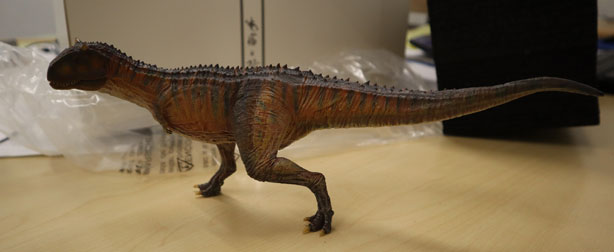
Contrary to previous interpretations and the attempts of model makers to depict Carnotaurus, the feature scales are randomly distributed and neither form discrete rows nor show progressive variations in their size along parts of the body. All those illustrations and replicas of Carnotaurus with a neat row of spines running down its back are not accurate according to the conclusions drawn from this research.
The Nanmu Studio Carnotaurus (Ranger), the distinct rows of prominent scales may not reflect the actual integument of this abelisaurid, but their random size fits the assessment of the skin composition as proposed by the researchers.Picture credit: Everything Dinosaur
Picture credit: Everything Dinosaur
The picture above shows a Carnotaurus replica in the Nanmu Studio Jurassic Series range.
The composition of the skin and the morphology of the scales reminded the researchers of the integument of the Australian lizard the Thorny Devil (Moloch horridus). This small, spiny lizard which is relatively common in the deserts of western and central Australia, uses its spines primarily for defence. It would be difficult for any would-be predator to swallow it. Grooves between the spines allow the lizard to channel water to its mouth, a useful adaptation when living in an environment with infrequent rain.
A close-up view of the scales from the base of the tail. The variety of bumps and scales are reminiscent of those found in the extant lizard the Thorny Devil (Moloch horridus). It has been suggested that the skin texture of Carnotaurus played a role in thermoregulation. Picture credit: Christophe Hendrickx.
At around 8 metres in length and since Carnotaurus is regarded as the apex predator in its environment, it is unlikely that the lumps and bumps on the skin were primarily for self-defence, but protection from intraspecific combat cannot be ruled out. However, recent studies have shown that Carnotaurus was a strong runner. If this large dinosaur had a very active lifestyle, then helping to regulate body temperature and permit heat-loss would have been very important.
Playing a Role in Thermoregulation
The researchers speculate that the skin may have played a vital role in thermoregulation, a role consistent with integument function in living mammals and reptiles.
No evidence for feathers on the skin of Carnotaurus was found in this study. Scientists conclude that the lumps, bumps and large scales on the skin could have played a role in thermoregulation. Picture credit: Christophe Hendrickx
The scientific paper: “The scaly skin of the abelisaurid Carnotaurus sastrei (Theropoda: Ceratosauria) from the Upper Cretaceous of Patagonia” by Christophe Hendrickx and Phil R. Bell published in Cretaceous Research.
A new species of carcharodontosaurid has been named from a single fragment of upper jawbone found in Uzbekistan. The dinosaur has been named Ulughbegsaurus uzbekistanensis and it was probably the apex predator in the ecosystem suggesting that carcharodontosaurids remained the dominant predators relative to tyrannosauroids, at least in Asia until around 90 million years ago.
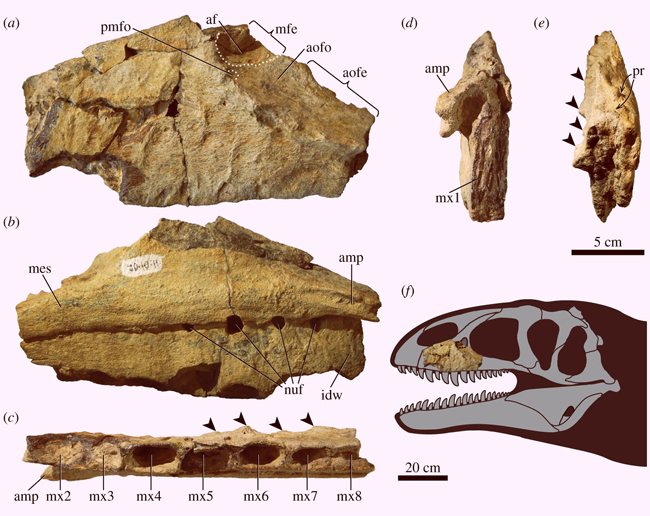
Left maxilla of Ulughbegsaurus (fossil specimen UzSGM 11-01-02) in (a) lateral, (b) medial, (c) ventral, (d) anterior and (e) posterior views. Reconstruction of skull in lateral view (e) – grey missing bones are based on Neovenator, modified from Naish et al. Picture credit: Tanaka et al.
The First Late Cretaceous Carcharodontosaurian from Central Asia
Ulughbegsaurus has been named based on partial maxilla found in strata associated with the Bissekty Formation of the Kyzylkum Desert (Uzbekistan). Several other predatory theropods have been described from fossils found in this formation, but all of them are considerably smaller. The tyrannosauroid Timurlengia euotica was coeval, but much smaller than Ulughbegsaurus providing further support for the idea that carcharodontosaurians were the dominant, apex predators in Laurasia until their extinction some 20 million years prior to the end of the Cretaceous, from which point onwards it was the tyrannosauroids that took over this niche in most Laurasian ecosystems.
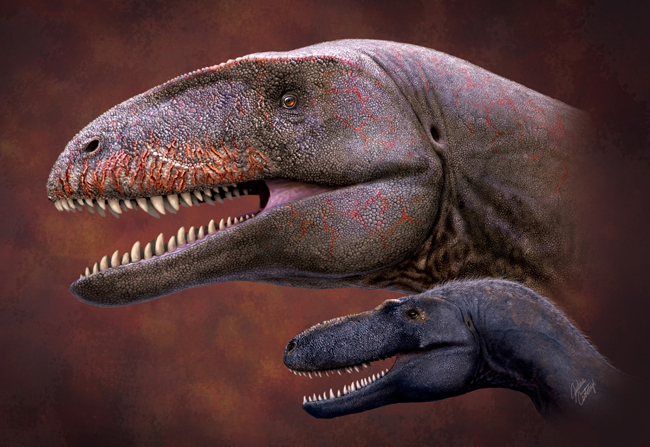
A life reconstruction of Ulughbegsaurus uzbekistanensis (top) compared in size with the coeval tyrannosauroid Timurlengia euotica which was named and described in 2016. Picture credit: Julius Csotonyi.
Estimating Size from a Single Fragment of Bone
Palaeontologists can use the size of the tooth row in the maxilla to help them estimate the body size of theropod dinosaurs. Studies of carcharodontosaurids and tyrannosaurids have demonstrated that the length of the tooth row in the maxilla is isometrically correlated with femur length, which is very helpful, as the length of the thigh bone is widely used to help calculate body mass. Based on this data, the authors of this paper, calculate that the Ulughbegsaurus specimen was at least 7 metres long and over a tonne in weight.
The researchers, which included corresponding author Kohei Tanaka (University of Tsukuba, Japan) and Darla Zelenitsky (University of Calgary, Canada), conclude that the individual represented by the single bone was probably 7.5 to 8 metres in length.
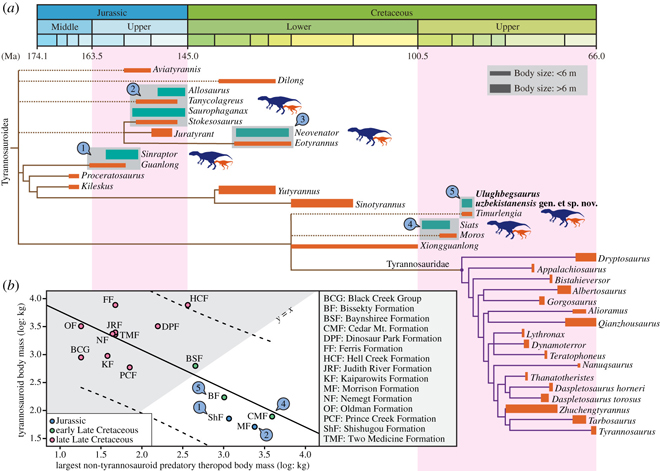
Ulughbegsaurus uzbekistanensis was much bigger than any other theropod known from this region. The tyrannosauroid Timurlengia was approximately 3-4 metres long and around 8 times lighter. This suggests that Timurlengia was a secondary predator along with an as yet, unnamed large dromaeosaurid, whilst Ulughbegsaurus occupied the niche of apex predator. The discovery of Ulughbegsaurus records the geologically latest stratigraphic co-occurrence of carcharodontosaurid and tyrannosauroid dinosaurs from Laurasia and evidence indicates carcharodontosaurians remained the dominant predators relative to tyrannosauroids, at least in Asia, as late as the Turonian faunal stage of the Cretaceous.
Tyrannosauroids Kept in Check by Carcharodontosaurians
For much of the Cretaceous allosauroids (part of the Carnosauria clade), including carcharodontosaurians were the largest terrestrial predators on Earth. It was only after their extinction that tyrannosauroids (members of another theropod clade, the Coelurosauria), became much larger and occupied the role of apex predators in most ecosystems across Laurasia.
Evidence of larger tyrannosauroids is not known until the Campanian of North America, some 7 million years after Ulughbegsaurus and Timurlengia lived. Palaeontologists remain uncertain as to the dynamics of apex predator evolution amongst the Theropoda as the fossil record from 90 to 83 million years ago (Coniacian-Santonian) is extremely poor.
Comparisons between small tyrannosauroid and large non-tyrannosauroid predatory theropods. Phylogenetic tree (a) comparing Tyrannosauroidea with sympatric allosauroid taxa. Guanlong with sympatric Sinraptor from the Late Jurassic Shishugou Formation of China (1); Tanycolagreus and Stokesosaurus with sympatric Allosaurus and Saurophaganax from the Late Jurassic Morrison Formation of the United States (2); Eotyrannus and sympatric Neovenator from the Early Cretaceous Wessex Formation of the United Kingdom (3); Moros and sympatric Siats from the early Late Cretaceous Cedar Mountain Formation of the United States (4) and (5) Timurlengia and sympatric Ulughbegsaurus from the Turonian Bissekty Formation of Uzbekistan indicating that sympatric large allosauroid taxa are found at least until the Turonian faunal stage of the Cretaceous. Bivariate plot of body mass between tyrannosauroids and non-tyrannosauroid predatory theropods that stratigraphically co-occur (b). The analysis indicates that tyrannosauroids were small when other large predatory theropods were present. The grey shadow is where tyrannosauroids are larger than non-tyrannosauroid theropods and demonstrates the tyrannosauroid apex predatory dominance during the Late Cretaceous. Picture credit: Tanaka et al.
Honouring a Sultan of the Timurid Empire
Ulughbegsaurus uzbekistanensis (pronounced Ul-lug-bey-sore-us uz-bek-ee-stan-en-sis), was named in honour of Ulugh Beg, a sultan and polymath of the Timurid Empire in the fifteenth-century. The species or trivial name honours the country of Uzbekistan.
A Significant Fossil Discovery
Although Ulughbegsaurus has been described from a single bone, its discovery is very significant. U. uzbekistanensis represents the first definitive fossil evidence of carcharodontosaurians from Central Asia. It fills a geographic gap in the clade between Europe and East Asia and shows that carcharodontosaurians were widespread across Asia.
The scientific paper: “A new carcharodontosaurian theropod dinosaur occupies apex predator niche in the early Late Cretaceous of Uzbekistan” by Kohei Tanaka, Otabek Ulugbek Ogli Anvarov, Darla K. Zelenitsky, Akhmadjon Shayakubovich Ahmedshaev and Yoshitsugu Kobayashi published in Royal Society Open Science.
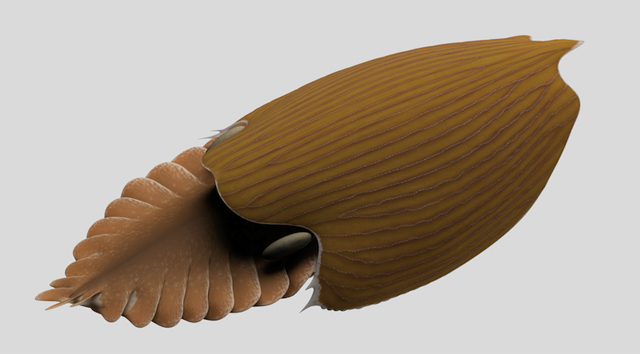
Researchers from the Royal Ontario Museum (Canada), have announced the discovery of a new species of armoured arthropod from the Burgess Shale of British Columbia. A study looking at 12 fossil specimens collected from Marble Canyon and Tokumm Creek in the Kootenay National Park (British Columbia), has been published this week by Royal Society Open Science. The arthropod has been named Titanokorys gainesi and at around 50 cm in length, it is a giant by Cambrian biota standards.
A life reconstruction of Titanokorys gainesi. Picture credit: Royal Ontario Museum.
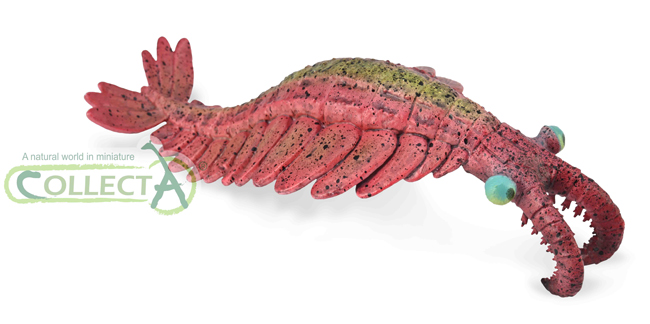
The authors of the scientific paper, Dr Jean-Barnard Caron of the Royal Ontario Museum, an expert on Burgess Shale fauna and PhD student Joe Moysiuk, classify Titanokorys as a member of the Radiodonta, a stem group of the Arthropoda. Radiodonts were extremely diverse and geographically widespread during the Late Cambrian and many of them were giants when compared to other animals alive during this time in Earth’s history. Perhaps the most famous radiodont is the taxon Anomalocaris, regarded by many palaeontologists as the world’s first super-predator.
The CollectA Anomalocaris model. A fantastic replica of an early apex predator. The CollectA Anomalocaris (Other Prehistoric Animal Models).
The picture (above) shows a model of an Anomalocaris. This figure is part of the CollectA Prehistoric Life model range.
Radiodonts are characterised by their compound eyes, disc-shaped mouthparts and paired frontal appendages, which in the case of Titanokorys consist of comb-like structures which may have been used to sift through mud in search of prey. The broad, flattened carapace of Titanokorys supports the idea that it was benthic – living on the seabed.
Life reconstruction of Titanokorys gainesi (a) dorsal view, (b) ventral view, (c) lateral view and (d) anterior view. Picture credit: Lars Fields/Royal Ontario Museum.
Dr Caron stated:
“The sheer size of this animal is absolutely mind-boggling, this is one of the biggest animals from the Cambrian period ever found.”
Coeval with Cambroraster falcatus
The bedding planes that provided the Titanokorys fossil material have also revealed an abundance of the smaller, but closely related Cambroraster falcatus, which was named and described by Caron and Moysiuk in 2019. Cambroraster was named after the Millennium Falcon from Star Wars franchise, as its carapace resembled the shape of this iconic spaceship. The co-occurrence of these two species on the same bedding planes highlights potential competition for benthic resources and the high diversity of large predators sustained by Cambrian communities.
Why some radiodonts evolved such a bewildering array of head carapace shapes and sizes is still poorly understood and was likely driven by a variety of factors.
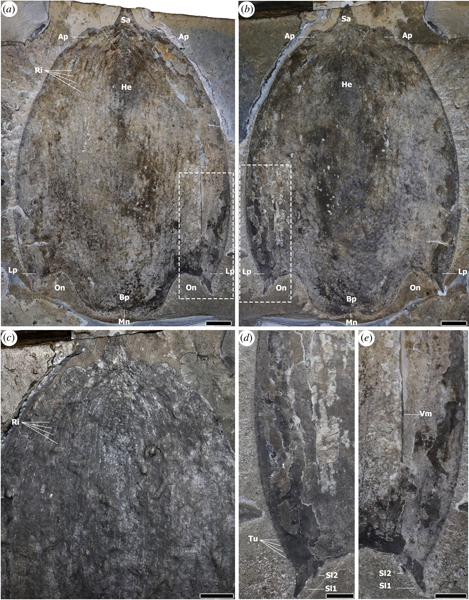
Views of the carapace of Titanokorys gainesi (paratype ROMIP 65168).
Dr Caron added:
“These enigmatic animals certainly had a big impact on Cambrian seafloor ecosystems. Their limbs at the front looked like multiple stacked rakes and would have been very efficient at bringing anything they captured in their tiny spines towards the mouth. The huge dorsal carapace might have functioned like a plough.”
Honouring Professor Robert Gaines
The genus name is derived from the Greek Titans, powerful gods of huge size and from the Greek “Korys” for helmet. The species or trivial name honours Professor Robert Gaines who was instrumental in the co-discovery of the Marble Canyon fossil deposit, where some of the Titanokorys specimens were found.
The scientific paper: “A giant nektobenthic radiodont from the Burgess Shale and the significance of hurdiid carapace diversity” by J.B. Caron and J. Moysiuk published by Royal Society Open Science.