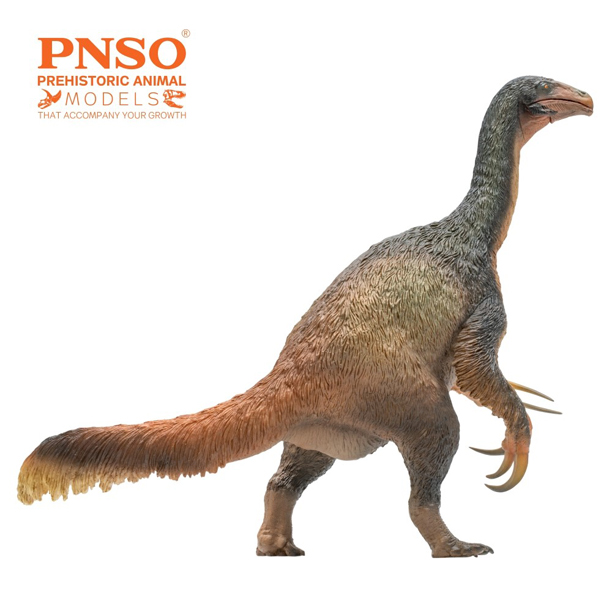
Everything Dinosaur has confirmed that they will be stocking the recently announced PNSO Qingge the Therizinosaurus dinosaur model. This figure is probably going to be in stock in the New Year (early 2023).
A PNSO feathered theropod dinosaur. This is the new PNSO Qingge the Therizinosaurus dinosaur model.
A PNSO Feathered Theropod
PNSO have developed several theropod replicas, but this is their first model of a “Scythe Lizard”. This beautifully crafted dinosaur model will join the feathered Nanotyrannus, and Jacques the Deinocheirus which is currently on the water and expected in stock at Everything Dinosaur in a few weeks (November 2022).
A close-up view of the detailed head and those dangerous-looking claws on the PNSO Qingge the Therizinosaurus dinosaur model.
PNSO Qingge the Therizinosaurus
As Everything Dinosaur understands the situation, this is the last PNSO dinosaur figure to be announced this year. The factory was keen to get this model launched and so, there is no beautifully painted life reconstruction as part of the official publicity photographs. Instead, the model has been photographed against a simpler background giving the impression of a forest environment.
The PNSO model has been photographed against a green, stylised background and a more detailed prehistoric scene has not been used in the background – such was the company’s eagerness to get this model announced.
Therizinosaurus Model Measurements
Named and described in 1954 (Evgeny Aleksandrovich Maleev), Therizinosaurus cheloniformis fossils are associated with Upper Cretaceous deposits of the Nemegt Formation in the Gobi Desert (Mongolia). The tyrannosaur Tarbosaurus was coeval (lived in the same habitat at the same time). Qingge the Therizinosaurus will join the PNSO Tarbosaurus (Chuanzi) in the company’s mid-size model range.
The model measures 15 cm tall and has an overall length of 19.5 cm. Although PNSO does not declare a scale for their mid-size model range, we estimate that based on an adult length of 10 metres, this model is in approximately 1:50 scale.
The PNSO Qingge the Therizinosaurus measures 19.5 cm long and stands 15 cm tall.
Therizinosaur Accessories
The dinosaur model will be supplied with an A3 Sci-Art poster depicting a life reconstruction. The box will also contain a fully illustrated, 64-page colour booklet and the outer packaging will show a QR code which links to a Therizinosaurus video.
The PNSO Therizinosaurus model is supplied with an A3 sci-art poster, a 64-page, full-colour illustrated booklet and the box will have a QR code on it giving customers access to a short video explaining how the model was made.
An Articulated Lower Jaw
Qingge the Therizinosaurus will have an articulated lower jaw. It is thought that therizinosaurs evolved from their meat-eating ancestors to become herbivores. Their strong arms with their enormous three-fingered hands and huge claws were used to grasp and pull down branches of trees upon which they could feed. As one of the tallest animals in their ecosystem (notwithstanding the presence of titanosaurs), Therizinosaurus could browse on parts of the plant canopy that other herbivorous dinosaurs could not reach.
The new PNSO Therizinosaurus model has a beautifully detailed head with lots of evidence of a shaggy coat of feathers on the neck. The model also has an articulated lower jaw.
PNSO Qingge the Therizinosaurus
A spokesperson from Everything Dinosaur confirmed that a shipment of PNSO prehistoric animal models was already on its way to the company’s warehouse. This shipment includes the new Deinocheirus and Sinopliosaurus figures, but the Therizinosaurus was not ready at the factory when the container vessel had to sail.
The PNSO Qingge the Therizinosaurus is likely to be in stock at Everything Dinosaur in the New Year (2023).
With the recent arrival of the Rebor display bases “Summer Kisses” and “Winter Tears”, team members at Everything Dinosaur have been busy preparing them for despatch to customers, however, we did take time out of our busy schedule to create a short YouTube video of these fabulous new additions to the Rebor range.
Everything Dinosaur reviews the Rebor non-scale diorama bases, “Summer Kisses” and “Winter Tears”.
“Summer Kisses” and “Winter Tears”
These are the first, bespoke display bases that Rebor have made, and they have been cleverly designed to accommodate a variety of models, bipedal theropods but also some of the Rebor ornithischians such as their Stegosaurus figures.
The Rebor non-scale diorama display base “Summer Kisses” provides a home for a pair of Rebor stegosaur replicas.
A Dry Season and a Wet Season
Each base has amazing details, but there is still plenty of room to pose a prehistoric animal figure or two. A large tree stump towards the rear of each base provides additional support for the model on the base. Although the bases depict the same area of prehistoric landscape, their colour schemes are very different. The lush, verdant “Summer Kisses” depicts the area during the wet season, whilst “Winter Tears” with its muted browns and greys depicts the same location but in the dry season when the lack of water leads to a reduction in the amount of vegetation.
A most impressive display. The large tree stump at the back of the display base provides additional support for the Rebor Vanilla Ice Mountain replica. The tyrannosaur has been placed on “Winter Tears” the display base that depicts the dry season. Picture credit: Everything Dinosaur.
Rebor Display Bases
These stunning Rebor display bases are delicate, fragile polystone casts and we advise customers to remove them from their protective foam packaging with care. In Everything Dinosaur’s short video (it lasts just under five minutes thirty seconds), we provide a really useful tip to help customers avoid damaging their display base when they attempt to unpack it.
In our YouTube video, we explain that each box has been opened and the contents checked and then the bases have been repacked with extra cardboard protection. Team members have included a helpful advisory note to assist with unpacking in the box.
Everything Dinosaur team members have checked box contents, added extra protective packaging and an advisory note in four languages to help ensure these beautiful bases are unpacked without damage. Picture credit: Everything Dinosaur.
Rebor Models and Figures
A spokesperson from Everything Dinosaur commented that the video gave viewers the opportunity to have a really good look at these two bases as well as providing advice and assistance to ensure that the polystone bases were not damaged when being removed from their packaging.
At Everything Dinosaur, we receive lots of emails from young collectors and fans of prehistoric animal models. For example, we recently received a suggestion for a new prehistoric animal figure for us to pass onto our chums at CollectA. We received a Smilodon cub model suggestion. The emailer can be assured that we have forwarded on this request.
A product suggestion sent into Everything Dinosaur by a young dinosaur fan. Could we ask our chums at CollectA to make a model of a Sabre-tooth cat cub?
Suggestions from Customers
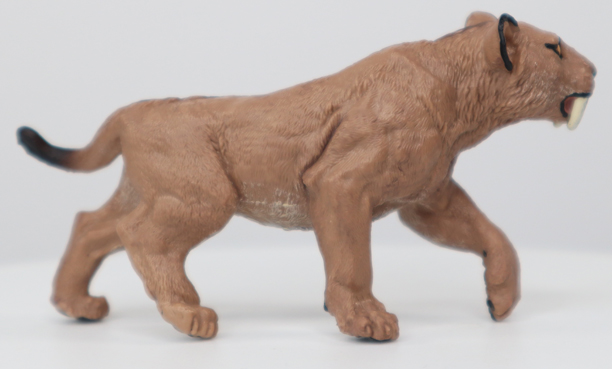
We receive lots of feedback from our customers, and as we await the announcements about new figures for 2023 from the manufacturers, we are happy to pass on such helpful information. Ironically, our chums at Papo recently introduced a replica of a Sabre-tooth cat (Smilodon), this model arrived at our UK warehouse earlier this year.
Papo young Smilodon figure in right lateral view. Picture credit: Everything Dinosaur.
The Papo range “Les Dinosaures” including a variety of Sabre-toothed cat models can be found here: Papo Prehistoric Animal Models.
Smilodon Cub Model Suggestion
The Smilodon (Sabre-toothed cat), is a popular Ice Age animal. It regularly appears in the top-ten of our prehistoric animal surveys, and we receive numerous requests for Smilodon fact sheets and drawing materials. It is one of two prehistoric mammals that feature in these surveys, the other being the largely contemporaneous Woolly Mammoth (M. primigenius).
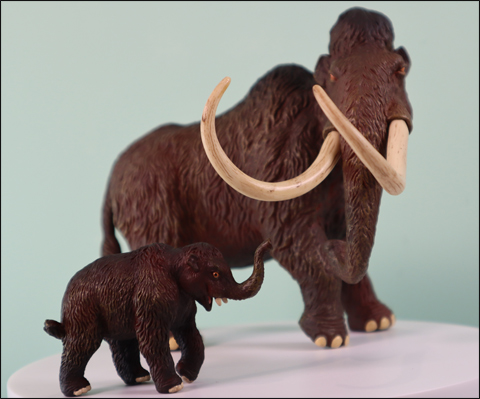
The CollectA Deluxe Woolly Mammoth model in 1:20 scale and the CollectA Prehistoric Life Woolly Mammoth calf. If there are models of juvenile Woolly Mammoths around could CollectA make a replica of a Sabre-tooth cat cub to accompany their adult Smilodon figure? Picture credit: Everything Dinosaur.
Nicely crafted Sabre-toothed Cat model. Can CollectA make a Sabre-toothed cat cub?
A spokesperson from Everything Dinosaur commented:
“We are grateful for all the new product suggestions that we get. We review all our correspondence, and we pass on the feedback about new prehistoric animal figures. We enjoy reading all the comments and suggestions about new dinosaur and prehistoric animal models.”
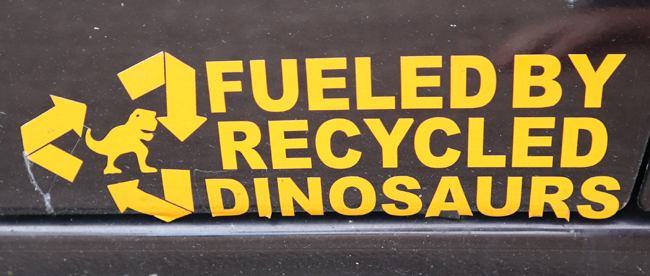
Sometimes dinosaurs can be spotted in the most unusual places. For example, an eagle-eyed Everything Dinosaur team member spotted a fuelled by dinosaurs sticker on a car parked next to our “dino van” at our warehouse the other day.
Fuelled by recycled dinosaurs. A decal spotted on a car which was parked next to Everything Dinosaur’s “dino van”. Not sure if the statement made is technically correct but we appreciated the sentiment. We note the Americanised spelling of “fueled”. Picture credit: Everything Dinosaur.
A Mistaken Assumption
The idea that petrol and other oil derived fuels are made up of the constituents of dead dinosaurs is a common assumption. Unfortunately, whilst it might please a petrol head to think that their super-charged, sports car is powered by long extinct animals like Triceratops and T. rex, this is not true. Fossil fuels such as petrol and natural gas are derived from the remains of (mostly) plant matter such as plankton (algae) laid down in a marine environment.
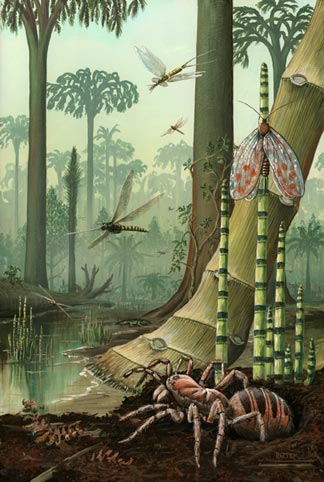
Most people understand that coal is derived from plant material, in the case of the UK, our plentiful and ubiquitous supplies of coal that fuelled the industrial revolution and industry until very recently largely consists of the remains of Carboniferous swamps and forests.
By the Carboniferous, the insects were already highly diversified. These swamps formed the extensive coal measures associated with the UK. Picture credit: Richard Bizley.
Fuelled by Dinosaurs
We are sorry car fans, for all you petrol heads out there, your vehicle is not powered by dinosaurs but by the ancient remains of some of the simplest, yet most important organisms on Earth – marine plankton.
Still, it’s a thought. Perhaps some clever car maker or another part of the oil or automotive industry will latch onto this misnomer and use it in their advertising. After all, not so long ago, a well-known brand of petrol advertised its fuel by stating put “a tiger in your tank”!
Team members at Everything Dinosaur were sent an email asking whether titanosaurs roamed southern Africa during the Early Cretaceous. We were able to answer in the affirmative and sent a fact sheet all about the controversial titanosaur Malawisaurus. We even sent a picture of the Wild Safari Prehistoric World Malawisaurus model, to provide further information about this herbivorous dinosaur’s appearance.
The Wild Safari Prehistoric World Malawisaurus dinosaur model.
We could have written about Karongasaurus (K. gittelmani) which is also known from Malawi, but as we had a Malawisaurus fact sheet to hand, it seemed sensible to provide information on Malawisaurus.
Malawisaurus dixeyi
Originally described nearly one hundred years ago (Haughton, 1928), this sauropod is known from the disarticulated remains of several individual animals excavated from Lower Cretaceous deposits exposed in northern Malawi (southern Africa). The taxonomic history of this sauropod is complicated, however, in 1993 following a review of the fossil material it was assigned its own genus Malawisaurus and although its placement within the Titanosauria clade is uncertain, it is widely regarded as a basal member of the Lithostrotia, a clade of derived titanosaurs that were geographically widespread and survived up until the end of the Cretaceous. The species name honours the British entomologist Frederick Augustus Dixey (1855 – 1935).
The Wild Safari Prehistoric World Malawisaurus dinosaur model. We sent this image in our email response as the Wild Safari Prehistoric World Malawisaurus is an excellent reconstruction of this sauropod from the Early Cretaceous of southern Africa.
Wild Safari Prehistoric World Malawisaurus
Introduced in 2018, the Wild Safari Prehistoric World Malawisaurus model tends to be one of the more difficult to obtain Safari Ltd sauropod figures, unless of course, you contact Everything Dinosaur.
Although sometimes overlooked by other stockists who prefer to stock the better-known dinosaurs such as Triceratops and Stegosaurus, the Malawisaurus replica has proved popular with collectors who appreciate the fine details of this prehistoric animal figure. For example, in the scientific description of Malawisaurus it was noted that this dinosaur had osteoderms (dermal armour) embedded in its skin. This anatomical trait has been faithfully recreated by the design team at Safari Ltd.
To view the Safari Ltd range of prehistoric animal models in stock at Everything Dinosaur: Wild Safari Prehistoric World.
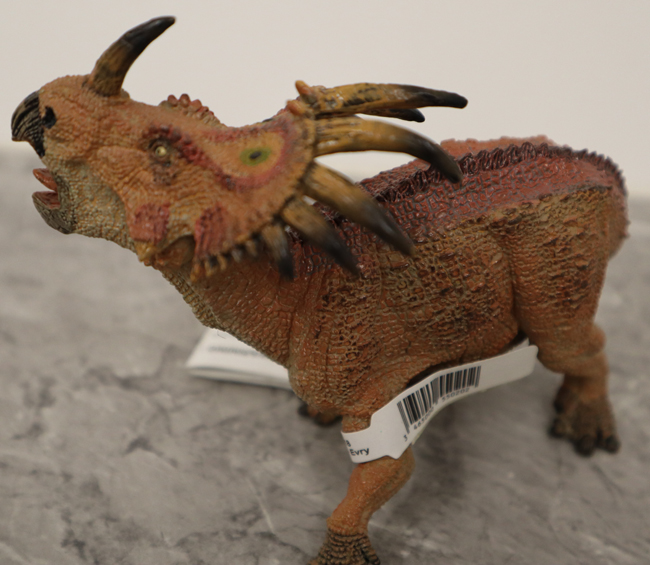
The Papo green Styracosaurus dinosaur model is now in stock at Everything Dinosaur. This figure is a new colour variant of the original (red) Papo Styracosaurus figure that was introduced into the “Les Dinosaures” model range in 2011, but has now been retired.
A close-up view of the beautifully painted Papo green Styracosaurus. Picture credit: Everything Dinosaur.
Picture credit: Everything Dinosaur
A Popular Horned Dinosaur
Styracosaurus is a popular horned dinosaur. Team members at Everything Dinosaur are often asked about this spiky centrosaurine, a dinosaur that was formally described and named more than a century ago (Lawrence Lambe in 1913). It is perhaps second only to Triceratops in terms of its popularity. Styracosaurus can be regarded as a superstar amongst the Ceratopsia.
The Papo green Styracosaurus figure. The skin texture shows lots of detail and this hand-painted figure has a striking colour scheme. Picture credit: Everything Dinosaur.
Picture credit: Everything Dinosaur
Papo Green Styracosaurus Dinosaur Model
One of a handful of new models to be added to the Papo range, this figure effectively replaces the original Papo Styracosaurus model. Everything Dinosaur has been able to source a limited stock of the retired Papo red Styracosaurus. The UK-based mail order company is able to, at least for a short while, to offer both Papo Styracosaurus figures (green and red).
Everything Dinosaur have been able to obtain some Papo red Styracosaurus dinosaur models. This model has been retired but Everything Dinosaur has been able to source some figures from the factory. Available whilst stocks last. Picture credit: Everything Dinosaur
A spokesperson from Everything Dinosaur commented:
“We are pleased to announce that the green Papo Styracosaurus figure is now available. It is great to have this figure in stock in time for the festive season.”
The new for 2022 Papo green Styracosaurus model. A new colour variant of the Papo Styracosaurus dinosaur figure that was originally introduced in 2011. Picture credit: Everything Dinosaur.
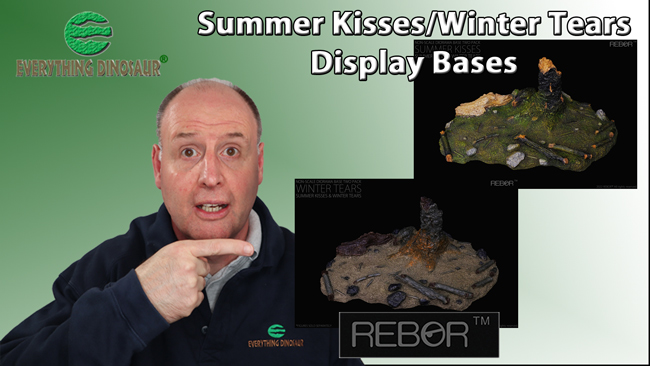
The next entry on Everything Dinosaur’s YouTube channel will be a Rebor display bases video review. The Rebor non-scale diorama base two pack entitled Summer Kisses, Winter Tears will be the focus of our next video. A short video highlighting these two excellent display bases will be posted up in a few days.
The Rebor non-scale diorama base two pack Summer Kisses and Winter Tears will be featured on Everything Dinosaur’s YouTube channel. Picture credit: Everything Dinosaur.
Picture credit: Everything Dinosaur
New Additions to the Rebor Range
Everything Dinosaur has stocked every Rebor figure, since the company burst onto the model collecting scene back in late 2014. This is the first time that Rebor have made display bases. The stunning bases are made from polystone resin and show the same landscape but at different times of the year. The Summer Kisses display base shows the landscape during the wet season and consequently, the ground is verdant and lush. In contrast, Winter Tears depicts the same ground but during the dry season, when there was little fresh vegetation about.
The Rebor diorama display bases Summer Kisses (top) and Winter Tears (bottom).
Rebor Display Bases
Although the bases have been cleverly designed, the cartons containing these beautiful models were damaged in transit. The outer carton (product packaging) is not in the usual high standard expected of the Rebor range. Everything Dinosaur has put up a note about the condition of the outer carton on the Rebor display bases product page:
“Please note the outer packaging for these figures has been damaged in transit to our warehouse. Whilst we have opened, inspected and checked all the display bases, unfortunately the outer packaging for the Rebor Non-scale Diorama bases is below the standard one would normally expect.”
Everything Dinosaur has announced that their next YouTube video will focus on the Rebor display bases – Summer Kisses and Winter Tears.Picture credit: Everything Dinosaur.
Team members concerned about customers receiving a broken model have set about opening all the Rebor bases that we have in stock. Each figure has been carefully unpacked, checked and then re-packed with extra card inserted to help support the outer carton and to prevent any damage to the beautiful bases.
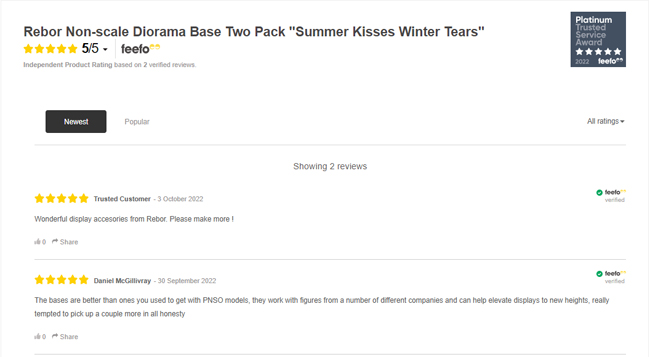
Our diligence is certainly paying off, it may be early days, these magnificent bases have only been in stock for a short while, but they have already picked up 5-star reviews.
Everything Dinosaur receives 5-star feedback for the Rebor display bases.Picture credit: Everything Dinosaur.
A spokesperson from Everything Dinosaur confirmed that they would take great care with the packing of these bases, doing all they can to ensure that the bases reach customers in tip-top condition.
The recently introduced (2022) CollectA deluxe Spinosaurus dinosaur model has been well received by dinosaur fans and model collectors. The latest incarnation of the largest theropod known to science is just one of the Spinosaurus figures that have been made by CollectA. Their range of Spinosaurus replicas helps to chart how our perceptions about this carnivorous dinosaur have changed.
The CollectA Deluxe Spinosaurus dinosaur model. A recently introduced (2022) updated replica of the giant, North African theropod Spinosaurus.
The CollectA Deluxe Spinosaurus
The first Spinosaurus model introduced by CollectA came out not long after the range was launched. It depicted this dinosaur as a colourful biped. The model was short-lived, it was replaced by a more muted version.
The first CollectA Spinosaurus model. The dinosaur was depicted as a colourful biped.
Spinosaurus Replicas and Models
Since the early days of the CollectA range, Spinosaurus has been an integral part of the company’s product offering. In 2010, the first Spinosaurus in the CollectA Deluxe range was added.
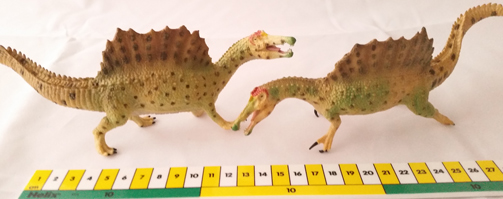
In 2015 CollectA introduced their first Spinosaurus replicas depicting this animal as an obligate quadruped (walking on all fours). Three models were introduced, a 1:40 scale CollectA Deluxe Spinosaurus replica and two smaller models (Spinosaurus walking and Spinosaurus swimming). The 2015 swimming Spinosaurus model was the first CollectA model to be introduced that depicted a swimming dinosaur. These figures commemorated the centenary of the formal scientific description and naming of this theropod (1915 Stromer). CollectA was the first toy company to make a model of S. aegyptiacus based on the comprehensive reassessment carried out the previous year in a scientific paper entitled “Semiaquatic adaptations in a giant predatory dinosaur” (Ibrahim et al). The 2015 swimming Spinosaurus model was officially retired in 2019.
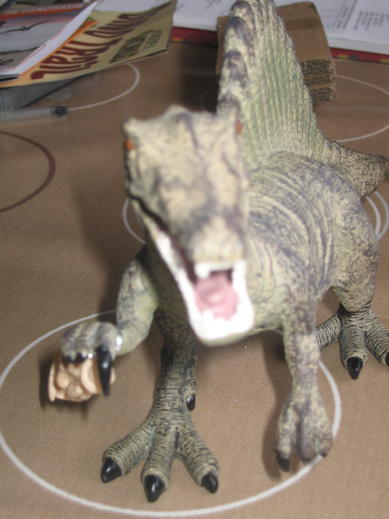
CollectA Spinosaurus available from Everything Dinosaur (2015). Picture credit Everything Dinosaur.
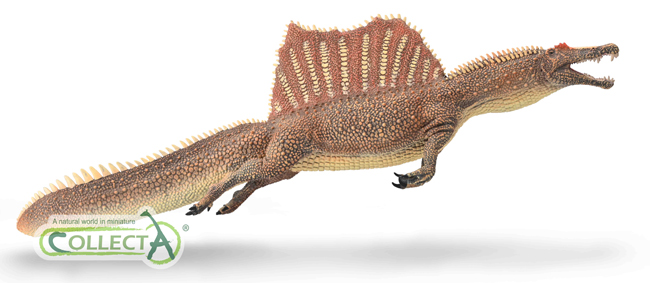
The latest version of this iconic carnivorous dinosaur to be added, the 2022 CollectA deluxe Spinosaurus has a restyled dorsal fin and the tail has been thickened to reflect yet more published research on this dinosaur: Spinosaurus – The River Monster.
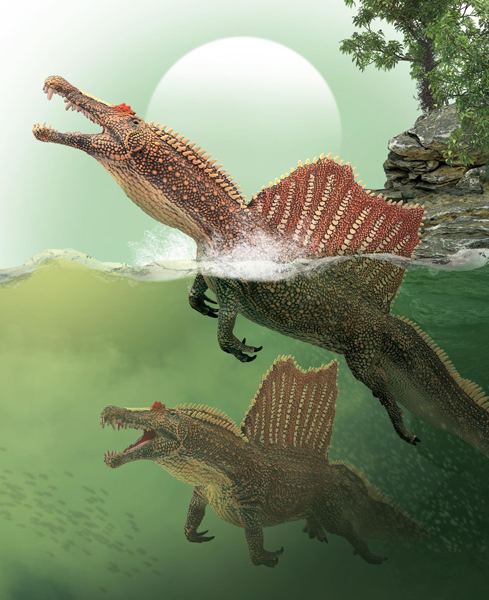
The CollectA Deluxe swimming Spinosaurus in 1:40 scale (approximately).
A spokesperson from Everything Dinosaur commented that the history of CollectA Spinosaurus models closely reflects the changing views held by palaeontologists. The changing models of Spinosaurus demonstrate how perceptions about this huge dinosaur have changed over the last two decades.
The new for 2022 Spinosaurus has certainly proved popular with one model reviewer posting on Everything Dinosaur’s website that this figure was the “best CollectA model ever”.
Team members are excited by the news that we are a finalist in our local Chamber of Commerce’s Business Awards. It is official, Everything Dinosaur has been nominated for an award, we are a finalist in the 2022 South Cheshire Chamber Business Awards in the “Excellence in Customer Service” category.
The award ceremony takes place on the evening of November 18th at Reaseheath College, one of the UK’s leading specialist land-based colleges and we are honoured and humbled to have been nominated.
Everything Dinosaur has been nominated for the Excellence in Customer Service category at the prestigious South Cheshire Chamber of Commerce Business Awards.
The South Cheshire Chamber of Commerce Business Awards 2022
The prestigious Business Awards celebrate the hard work and achievements of those in our South Cheshire business community and this year’s ceremony is extra special as the Chamber will be celebrating the 25th anniversary of the awards.
In total, there are nine award categories and Everything Dinosaur has received confirmation that our mail order business has been nominated for the Excellence in Customer Service award.
Mike Walley from Everything Dinosaur commented:
“We are immensely honoured to have been nominated. We try to place customers at the very heart of everything we do and in these difficult times it is wonderful to hear that have been selected to go through to the finalist stage of the 2022 South Cheshire Chamber Business Awards.”
A Reputation for Excellent Customer Service
Everything Dinosaur has already received recognition for its record of customer service. In 2018, within twelve months of working with the independent ratings company Feefo, Everything Dinosaur was awarded the Gold standard customer award. It was won again in 2019 and in the following year, when Feefo introduced the Platinum Trusted Service Award, Everything Dinosaur was awarded that as well.
Everything Dinosaur wins the Platinum Service Award. The company has won this esteemed customer service three years in a row (2020, 2021 and 2022).
Everything Dinosaur Nominated for an Award
Sue Judd, of Everything Dinosaur added:
“Being nominated is an achievement. We listen to our customers, and we respond to their needs. Their feedback and input helps to drive our business.”
This nomination provides an affirmation of Everything Dinosaur’s business strategy, being a finalist in these esteemed awards reflects our commitment to outstanding customer service.
Research into a beautifully preserved Edmontosaurus fossil suggests that dinosaur mummies might be more common than previously thought. The Edmontosaurus specimen found by Tyler Lyson when exploring Slope County (North Dakota) and Hell Creek Formation exposures contained therein is providing palaeontologists with an insight into the fossilisation process that might produce a “dinosaur mummy”.
A mummified dinosaur was thought to require two mutually exclusive taphonomic processes in order to form. Firstly, to have the carcase exposed on the surface for a considerable portion of time to permit the remains to dry out and become desiccated. Secondly, rapid burial and deposition to preserve what remains of the corpse.
The taphonomy of the Edmontosaurus specimen (NDGS 2000), suggests that there may be other circumstances the lead to the mummified remains of dinosaurs.
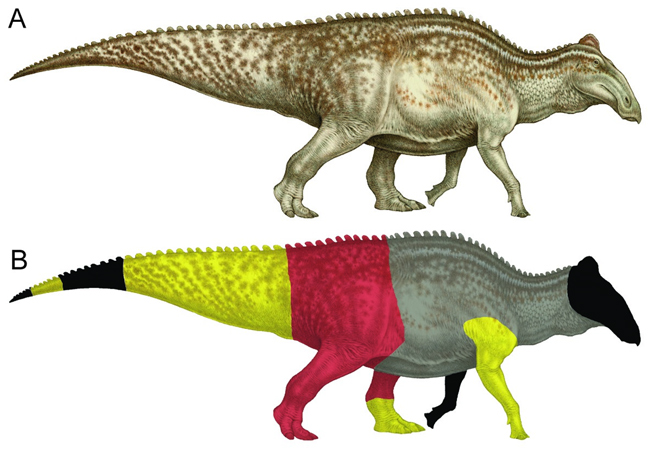
Distribution and current state of preparation of the preserved skin on the Edmontosaurus specimen (NDGS 2000). Life reconstruction by Natee Puttapipat. Black areas in the diagram indicate portions of the skeleton apparently absent from the specimen, light grey areas indicate regions where the skeleton is preserved but no skin is currently preserved, red areas indicate regions where skin is present and is still undergoing preparation. The yellow shading indicate areas where the skin is fully prepared and were examined in this study. Picture credit: Drumheller et al (PLoS One).
Dinosaur Mummies – Hooves and Fingers (E. annectens)
A team of scientists, including researchers from University of Tennessee–Knoxville, Knoxville, Tennessee and the North Dakota Geological Survey team, writing in the academic journal PLoS One propose a new explanation for how such fossil specimens might form. Large areas of desiccated and seemingly deflated skin have been preserved on the limbs and tail. Such is the degree of preservation of the front limb, (manus) that palaeontologists have discovered that Edmontosaurus (E. annectens) had a hoof-like nail on the third digit.
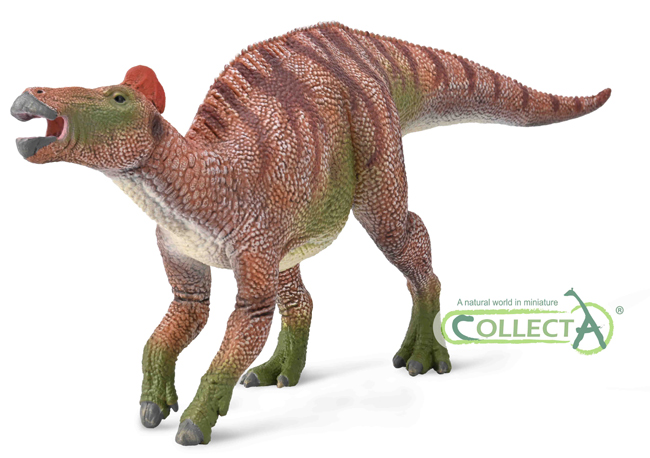
This discovery led to a substantial revision of Edmontosaurus limb anatomy in prehistoric animal replicas, as epitomised by the recently introduced CollectA Deluxe 1:40 scale Edmontosaurus.
The new for 2022 CollectA Deluxe 1:40 scale Edmontosaurus dinosaur model. CollectA had wanted to introduce a replica of this iconic Late Cretaceous hadrosaur for some time. Many of the details such as the hoof-like third digit on the hand and the enlarged scales on the neck replicate what the scientists have discovered by studying the Edmontosaurus dinosaur mummy known as Dakota.
The research team identified bite marks from carnivores upon the dinosaur’s skin. These are the first examples of unhealed carnivore damage on fossil dinosaur skin, and furthermore, this is evidence that the dinosaur carcass was not protected from scavengers by being rapidly buried, yet it became a mummy nonetheless.
Many of the marks suggest bites from the conical teeth of crocodyliforms, although pathology associated with the tail is more difficult to interpret. The researchers suggest that some of the “V-shaped” patterns identified suggest that flexible, clawed digits rather than more rigidly fixed teeth, may have been responsible for these injuries. Perhaps these marks were caused by feeding deinonychosaurs (Dakotaraptor steini) or perhaps a juvenile T. rex.
Examining the Decomposition of Carcases
If the carcase was scavenged, then it was not buried rapidly and one of the supposed pre-requisites for “dinosaur mummification” did not occur with this fossil specimen. Instead, the researchers propose an alternative route for the creation of such remarkable fossils, a theory that has been influenced by what is observed in the world today. When scavengers feed on a carcase, they rip open the body and feed on the internal organs. Punctures made in the body allow fluids and gases formed by decomposition to escape, thus permitting the skin to dry out, forming a desiccated, dried out husk.
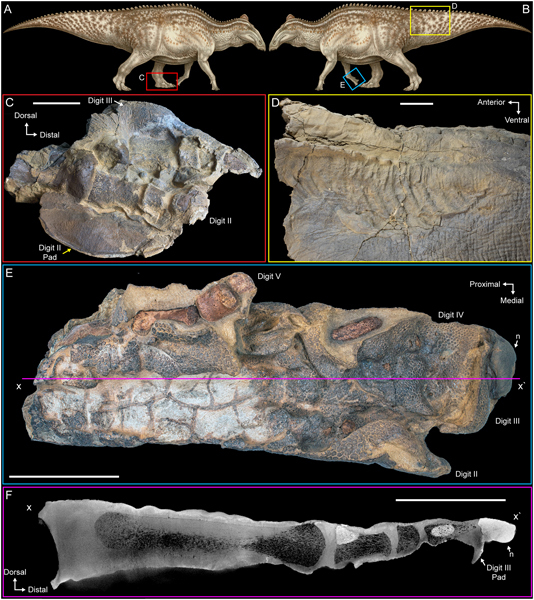
Evidence of desiccation in the preserved remains of the Edmontosaurus (specimen number NDGS 2000). Note all scale bars equal 10 cm. Life reconstruction by Natee Puttapipat. Picture credit: Drumheller et al (PLoS One).
Dinosaur Skin More Commonly Preserved
The research team postulate that if the more durable soft tissues can persist some months prior to burial to permit desiccation to occur, then dinosaur skin fossils, although rare, are possibly, more commonly preserved than expected.
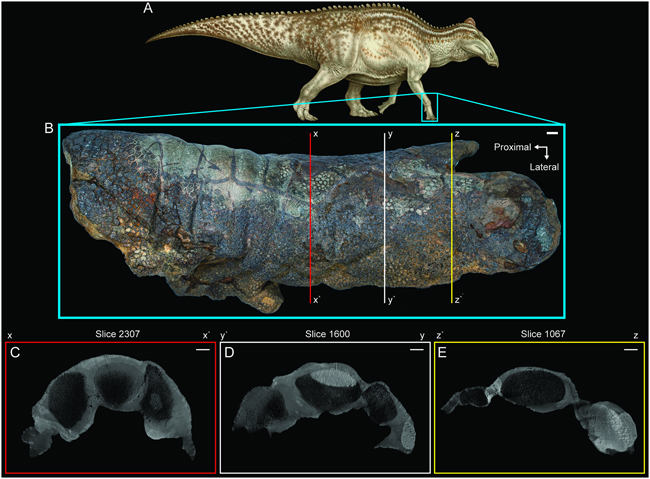
Cross sectional views through the right manus of the Edmontosaurus fossil (NDGS 2000). NDGS 2000 reconstruction in right lateral view (A). Right manus in dorsal view indicating the positions of the three cross sectional views (B). CT image along line x to x’ (C). CT image along line y to y’ (D). CT image along line z to z’ (E). In (C), (D), and (E), slice numbers from the original CT data are provided above each image. Paleoart in (A) by Natee Puttapipat. Scale bars equal 1 cm. Picture credit: Drumheller et al (PLoS One).
A New Theory on How “Dinosaur Mummies” Could Form
It is important to make clear that what a palaeontologist refers to as a “dinosaur mummy” is not the same as the mummified remains of an Egyptian deity. The skin and other soft tissues are permineralised, they are rock, although it is noted that molecular sampling of this Edmontosaurus specimen yielded putative dinosaurian biomarkers such as evidence of degraded proteins, suggesting that soft tissue was preserved directly in this specimen.
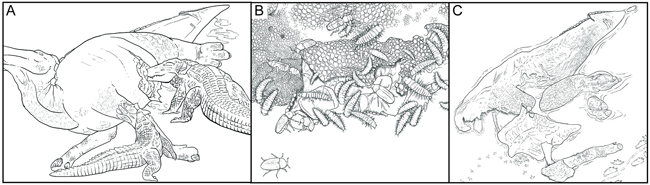
Generally, the two presumed prerequisites for mummification, that of being exposed on the surface for some time to permit the corpse to desiccate and rapid burial are incompatible. So, the researchers propose a new theory on how a “dinosaur mummy” could form:
A corpse is scavenged creating puncture marks to allow fluids and gases to escape.
Smaller organisms such as invertebrates and microbes exploit these punctures to access the internal organs and other parts of the skeleton.
Consumption from within in conjunction with decomposition allows the skin to deflate and to drape over the underlying bones that are more resistant to feeding and decay.
Proposed soft tissue preservational pathway for the Edmontosaurus fossil. Incomplete predation and/or scavenging of the carcass creates openings in the body wall through which fluids and gasses can escape (A). Invertebrates and microbes (B) use those openings to access the internal tissues. Removal of internal soft tissues and drainage of fluids and gasses associated with decomposition allows the deflated skin and other dermal tissues to desiccate and drape over the underlying bones (C). Illustration by Becky Barnes. Picture credit: Drumheller et al (PLoS One).
The scientists hope that this new paper will help with the excavation, collection and preparation of fossils. The presence of soft tissues and biomarkers such as degraded proteins demonstrate that rapid burial may not be a pre-requisite to permit their preservation. As a result, such evidence as skin, soft tissue and biomarkers may be more common in the fossil record than previously thought.
The scientific paper: “Biostratinomic alterations of an Edmontosaurus “mummy” reveal a pathway for soft tissue preservation without invoking ‘exceptional conditions'” by Stephanie K. Drumheller, Clint A. Boyd, Becky M. S. Barnes and Mindy L. Householder published in PLoS One.