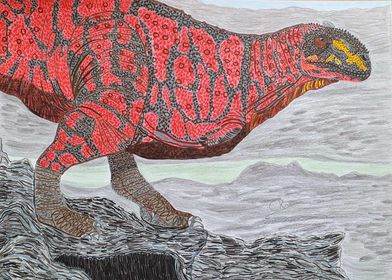
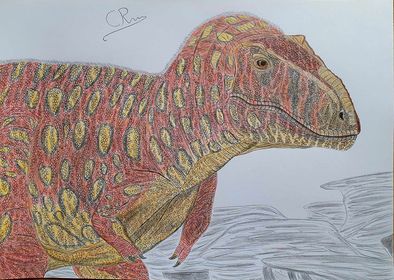
Our thanks to young artist Caldey who sent into Everything Dinosaur a beautiful Rajasaurus drawing inspired by this dinosaur’s appearance in a television series. The theropod Rajasaurus appeared in series two of the award-winning “Prehistoric Planet”. In an episode entitled “Badlands” (episode 2 of series 2), Rajasaurus is depicted feasting on recently hatched titanosaurs.
The stunning illustration of the abelisaurid from India known as Rajasaurus. Picture credit: Caldey.
Picture credit: Caldey
Rajasaurus Hunting Isisaurus Hatchlings
In a dramatic scene from the television series Rajasaurus is depicted hunting some recently hatched Isisaurus. The scientists advising the production company proposed that large titanosaurs such as Isisaurus laid their eggs in old lava flows associated with the extensive Deccan Traps. The warm ground would have helped to incubate the eggs. However, when the eggs hatched, the baby Isisaurus would have made an excellent snack for a hungry abelisaurid.
To avoid being eaten, baby Isisaurus hide amongst the many cracks and gullies in the rocky surface.
Rajasaurus (R. narmadensis) was named and scientifically described in 2003.
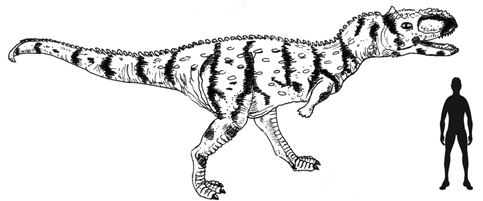
Probably an apex predator in its environment. Although recent research has suggested that this abelisaurid did not reach lengths of around 11 metres. A study into abelisaurid body size published in 2016 (Grillo and Delcourt) suggested a body length of approximately 6.6 metres. Picture credit: Everything Dinosaur.
Picture credit: Everything Dinosaur
The image (above) shows a scale drawing of R. narmadensis.
Fossils of both Rajasaurus and Isisaurus are known from the Upper Cretaceous Lameta Formation of India. These dinosaurs lived at the end of the Mesozoic (Maastrichtian faunal stage). Numerous dinosaur taxa and other vertebrates have been named and described from fossils found in these deposits.
Rajasaurus Drawing
A spokesperson from Everything Dinosaur congratulated Caldey on her artwork and commented:
“It is a superb dinosaur illustration. Caldey has taken great care to observe Rajasaurus as it was depicted in the television series. She has accurately reproduced the detailed skin texture and the body proportions of this Late Cretaceous predator.”
On thanks to Caldey for sharing her dinosaur illustration with us.
PNSO models and Rebor replicas feature in the latest Everything Dinosaur newsletter. The three new PNSO tyrannosaurs Cole, Keynes and Cameron are featured. These figures represent Daspletosaurus, Lythronax and Tyrannosaurus rex respectively. The latest Everything Dinosaur newsletter also features four Rebor figures. A Carnotaurus, Stegosaurus and two Rebor Scout figures Triceratops and Stegosaurus.
The latest Everything Dinosaur newsletter features the PNSO Cameron the T. rex figure. Picture credit: Everything Dinosaur.
Picture credit: Everything Dinosaur
The Latest Everything Dinosaur Newsletter
The headliner in the latest Everything Dinosaur newsletter is the 1:35 scale Cameron the T. rex dinosaur model. This figure is supplied with a replica Tyrannosaurus rex skull, twenty posters and a fully illustrated colour booklet.
The new for 2023 PNSO Cole the Daspletosaurus and Keynes the Lythronax are also included.
Keynes the Lythronax and Cole the Daspletosaurus dinosaur models feature in the newsletter. Picture credit: Everything Dinosaur.
The newsletter also highlights the return of some old favourites. The Rebor Carnotaurus replica “Crimson King Requiem” is back in stock. It is featured alongside the Rebor Stegosaurus figure, the mountain colour variant.
Rebor models feature in the latest Everything Dinosaur newsletter. The Rebor Carnotaurus “Crimson King Requiem” (left) and the Rebor Stegosaurus in the mountain colour scheme (right). Picture credit: Everything Dinosaur.
Hazelnut and Melon in the Everything Dinosaur Newsletter
The other two Rebor dinosaurs to feature in the latest Everything Dinosaur newsletter are 1:35 scale baby dinosaur figures. Hazelnut the young Triceratops and the baby Stegosaurus named Melon. Both these ornithischian figures were originally introduced in 2016.
The two ornithischian Scout figures – Triceratops and Stegosaurus. Picture credit: Everything Dinosaur.
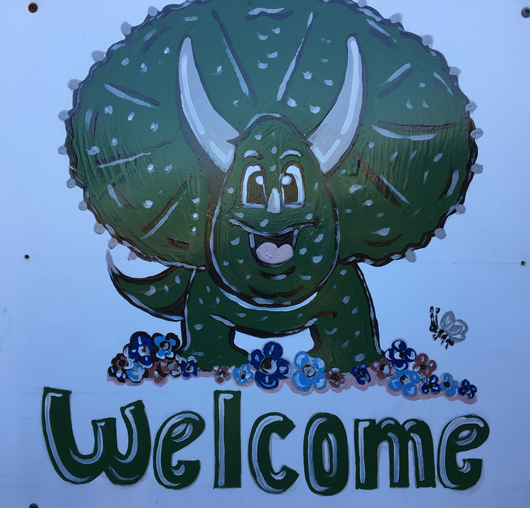
Whilst looking through their archive of school photographs, team members spotted a happy Triceratops. The artwork was on one of the gates at Thorpe Hesley Primary. Everything Dinosaur visited this school in May 2017. Children at the school were studying dinosaurs, rocks and fossils. Everything Dinosaur was invited to visit and to provide teaching support.
A friendly dinosaur is featured in the school artwork. A happy Triceratops to greet schoolchildren. Picture credit: Everything Dinosaur.
Picture credit: Everything Dinosaur
Happy Triceratops Artwork
The very friendly and happy horned dinosaur stands guard at one of the school gates. The Triceratops welcomes the children and visitors. Our congratulations to the artist for creating such a colourful piece of dinosaur-themed art.
Visit the award-winning, user-friendly website of Everything Dinosaur: Everything Dinosaur.
Rebor models in stock at Everything Dinosaur. Four Rebor 1:35 scale replicas have arrived at the Everything Dinosaur warehouse. The Rebor Carnotaurus “Crimson King Requiem” is now available along with the Rebor Stegosaurus “Garden” in the mountain colour scheme.
Joining these large figures are two models in the Rebor Scout range. Hazelnut the Triceratops figure has arrived and Melon the 1:35 scale Stegosaurus is also available.
Rebor models in stock at Everything Dinosaur. The Rebor Carnotaurus “Crimson King Requiem” (top left), the Rebor Stegosaurus Garden “Mountain” (top right). Bottom (left) the Rebor Scout Hazelnut model and (bottom right), the Stegosaurus model Melon. Picture credit: Everything Dinosaur.
Picture credit: Everything Dinosaur
The four Rebor figures are pictured together as the shipment was unloaded at the warehouse.
A spokesperson from the UK-based mail order company stated that they were delighted to see these four dinosaur models back in stock. Team members were busy informing customers that these 1:35 scale replicas were available once more.
The spokesperson added:
“The Rebor Carnotaurus replica was introduced in 2021, whilst the Stegosaurus came out in 2019. Collectors have experienced difficulties getting hold of these figures, but now their worries are at an end.”
When asked to comment on the Rebor Hazelnut (Triceratops) and Melon (Stegosaurus), the spokesperson remarked:
“Both Scout figures first came out seven years ago (2016). These little 1:35 scale models depicting baby dinosaurs have proved to be very popular with collectors. There are actually four figures in the Rebor Scout series. There are these two ornithischian figures plus a baby Velociraptor called Stan and a baby Utahraptor named Breeze.”
Everything Dinosaur stocks an extensive range of dinosaur and other prehistoric animal figures and replicas.
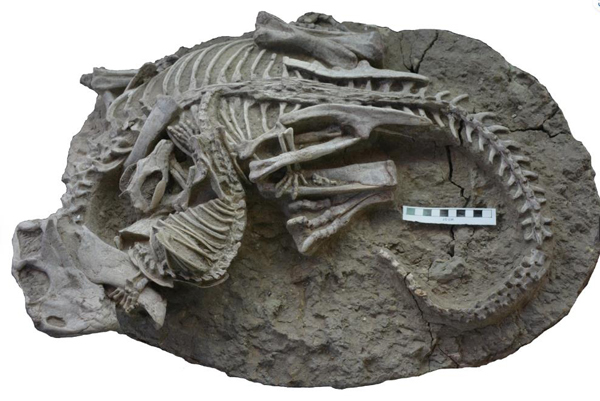
A joint Canadian and Chinese team of scientists have described a remarkable fossil that preserves a dramatic moment in time when a carnivorous mammal attacked a bigger herbivorous dinosaur. Repenomamus attacks Psittacosaurus, a stunning fossil specimen from the Lower Cretaceous from the Lujiatun fossil beds.
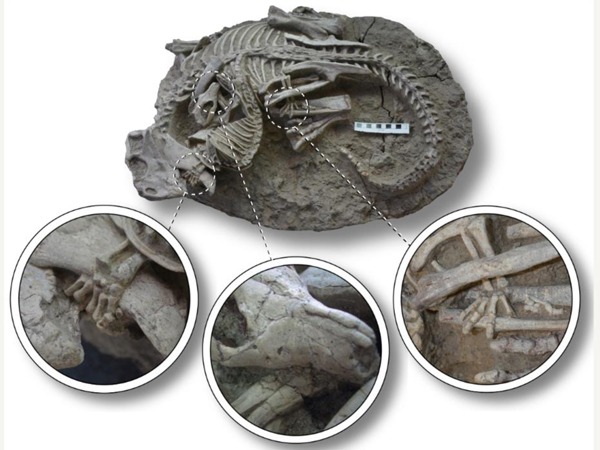
Entangled Psittacosaurus and Repenomamus skeletons showing details of their interaction. Scale bar equals 10 cm. Picture credit: Gang Han.
Mammal Attacks a Dinosaur
Dr Jordan Mallon (Canadian Museum of Nature), a co-author of the study published in the journal “Scientific Reports” commented:
“The two animals are locked in mortal combat, intimately intertwined, and it’s among the first evidence to show actual predatory behaviour by a mammal on a dinosaur.”
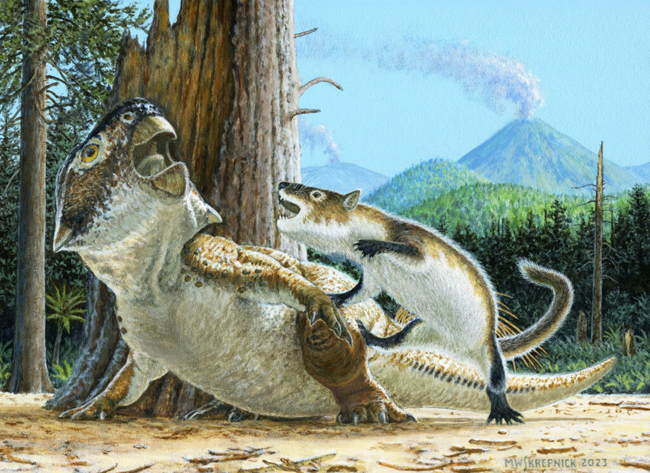
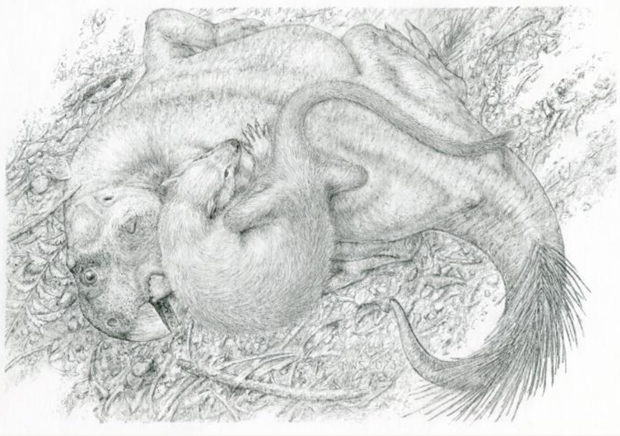
Life reconstruction showing Psittacosaurus being attacked by Repenomamus 125 million years ago. Picture credit: Michael W. Skrepnick/courtesy of Canadian Museum of Nature.
A Fossil from “China’s Dinosaur Pompeii”
The fossil’s discovery challenges the perception that dinosaurs had few threats from their mammal contemporaries during the Cretaceous. It is true to comment that in most terrestrial ecosystems the dinosaurs dominated. However, this exceptionally rare fossil demonstrates that some mammals may have attacked members of the Dinosauria.
The fossil was collected in China’s Liaoning Province in 2012, and both skeletons are nearly complete. Their completeness is due to the fact that they come from an area known as the Lujiatun fossil beds, which have been dubbed “China’s Dinosaur Pompeii”.
The fossil specimen is now in the collections of the Weihai Ziguang Shi Yan School Museum in China’s Shandong Province.
Entangled Psittacosaurus and Repenomamus skeletons showing details of their interaction. Scale bar equals 10 cm. Picture credit: Gang Han.
Repenomamus Attacks Psittacosaurus
The dinosaur victim has been identified as Psittacosaurus lujiatunensis. It was about the size of a large dog. It is being attacked by a Repenomamus robustus. Repenomamus is not closely related to placental mammals. It was a triconodont, larger and more powerfully built compared to most Mesozoic mammals. The taxonomic position of the Triconodonta within the stem mammals and the Mammalia remains controversial. With a body length of approximately one metre, R. robustus was smaller and lighter than Psittacosaurus lujiatunensis. However, this fossil provides evidence that this mammal attacked dinosaurs that were larger than itself.
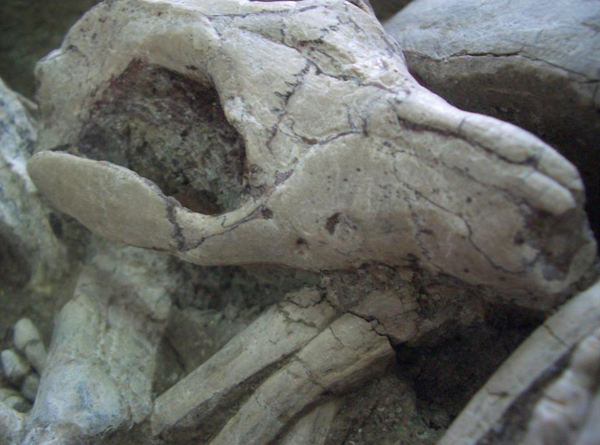
Detail of fossil showing Repenomamus biting the ribs of Psittacosaurus. Picture credit: Gang Han.
Repenomamus Ate Psittacosaurus
It was already known that Repenomamus ate dinosaurs. A scientific paper was published in 2005 that documented the discovery of a large Repenomamus fossil specimen with the preserved remains of a juvenile Psittacosaurus in what would have been the animal’s digestive tract.
Dr Mallon explained:
“The co-existence of these two animals is not new, but what’s new to science through this amazing fossil is the predatory behaviour it shows.”
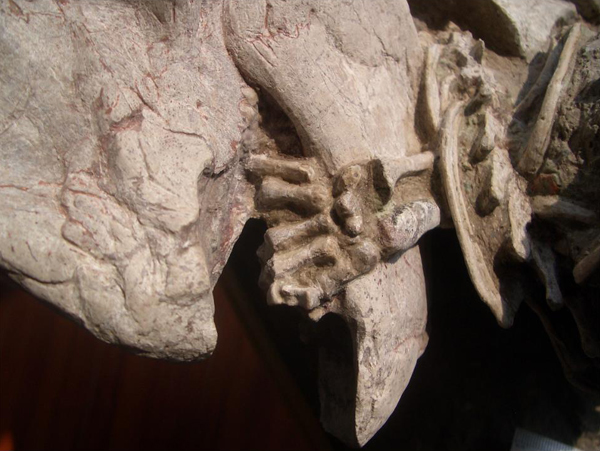
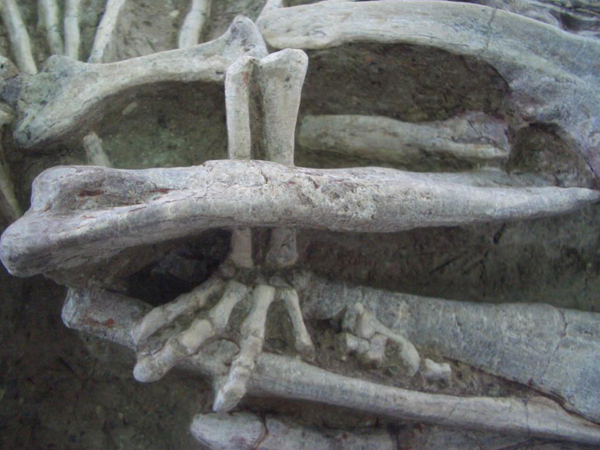
Detail of the fossil showing the left hand of Repenomamus wrapped around the lower jaw of Psittacosaurus. Picture credit: Gang Han.
The Lujiatun Member (Yixian Formation)
The Lujiatun Member of the Lower Cretaceous Yixian Formation of China is famous for its extensive vertebrate fossil remains. Animals were buried by mudslides and debris following volcanic eruptions. These pyroclastic flows entombed these unfortunate creatures preserving their last moments of life more than 125 million years ago.
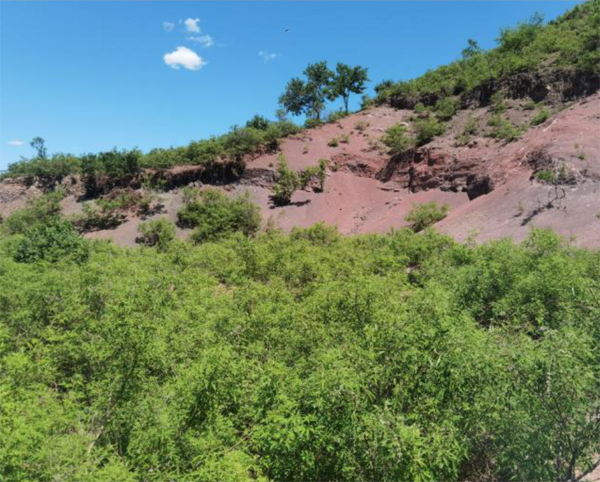
Hillside where the fossil was collected from the Lujiatun Member of the Yixian Formation of north-eastern China in 2012. Picture credit: Gang Han.
The Psittacosaurus-Repenomamus fossil was in the care of study co-author Dr Gang Han in China, who brought it to the attention of Canadian Museum of Nature palaeobiologist Xiao-Chun Wu. Whilst fossil forgeries are known from the Jehol Group of China, the research team excavated more of the matrix and confirmed that this was an authentic specimen, most likely preserving predatory behaviour.
Repenomamus the Aggressor
A detailed examination of the fossil pair shows that the Psittacosaurus is lying prone, with its hindlimbs folded on either side of its body. The body of the Repenomamus coils to the right and sits atop its prey, with the mammal gripping the jaw of the larger dinosaur. The mammal is also biting into some of the ribs, and the back foot of Repenomamus is gripping onto the dino’s hind leg. These animals are locked in mortal combat.
Dr Mallon postulated that the weight of evidence suggested that an attack from the Repenomamus was underway when the pyroclastic flow killed both animals.
Detail of fossil showing the left hind foot of Repenomamus gripping the left lower leg of Psittacosaurus. Picture credit: Gang Han.
Not Scavenging a Carcase
The research team have ruled out the possibility that the Repenomamus was scavenging a Psittacosaurus corpse. Tooth marks on the dinosaur bones are absent, suggesting that this fossil represents evidence of a mammal attacking a dinosaur.
It is unlikely the two animals would have become so entangled if the dinosaur had been dead before the mammal encountered it. The position of the Repenomamus on top of the Psittacosaurus suggests it was also the aggressor.
Attacks on herbivores by smaller carnivores are seen today. Mallon and Wu note that some lone wolverines are known to hunt larger animals, including caribou and domestic sheep. On the African savanna, wild dogs, jackals and hyenas will attack prey that are still alive, with the prey collapsing, often in a state of shock.
Dr Mallon stated:
“This might be the case of what’s depicted in the fossil, with the Repenomamus actually eating the Psittacosaurus while it was still alive—before both were killed in the roily aftermath.”
Repenomamus robustus attacks Psittacosaurus lujiatunensis moments before a volcanic debris flow buries them both circa 125 million years ago. Picture credit: Michael W. Skrepnick/courtesy of Canadian Museum of Nature.
The research team speculates in their research paper that further amazing fossils await discovery. The volcanically derived deposits from the Lujiatun fossil beds will continue to yield new evidence of interactions among species.
Everything Dinosaur acknowledges the assistance of a media release from the Canadian Museum of Nature in the compilation of this article.
The scientific paper: “An extraordinary fossil captures the struggle for existence during the Mesozoic” by Gang Han, Jordan C. Mallon, Aaron J. Lussier, Xiao-Chun Wu, Robert Mitchell and Ling-Ji Li published in Scientific Reports.
Our thanks to young artist Caldey who sent into Everything Dinosaur a Tarbosaurus dinosaur drawing. The drawing was inspired by a recent television programme. Tarbosaurus features in both series 1 and series 2 of “Prehistoric Planet” which was shown on the Apple TV+ network.
Tarbosaurus lived in Asia during the Late Cretaceous. It was closely related to Tyrannosaurus rex.
A stunning Tarbosaurus (T. bataar) illustrated. The dinosaur drawing was inspired by the tyrannosaurs seen on the recent “Prehistoric Planet” television series. Picture credit: Caldey.
Tarbosaurus Dinosaur Drawing
Caldey has taken great care over her Tarbosaurus dinosaur drawing. It is a striking composition and a very accurate reflection of the Tarbosaurus seen in the television series.
A spokesperson from Everything Dinosaur praised the artist and commented:
“It is a superb tyrannosaur illustration. The details around the head and those lipped jaws of this super-sized theropod are excellent. We congratulate Caldey for her artwork.”
Our thanks to young artist Caldey for sending into Everything Dinosaur her Tarbosaurus illustration.
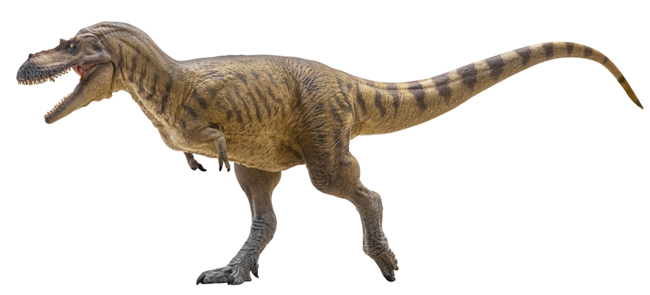
Everything Dinosaur can confirm that the UK-based company will be stocking the PNSO Wally the Albertosaurus model. This new PNSO tyrannosaur figure will be in stock in a few weeks.
The PNSO Albertosaurus dinosaur figure shown in lateral view.
PNSO Wally the Albertosaurus
PNSO has been working on several new tyrannosaur figures. Cameron the new Tyrannosaurus rex figure was announced a few months ago. Shortly afterwards, Lythronax and Daspletosaurus models were added to the replica range.
Cameron the T. rex, Cole the Daspletosaurus and Keynes the Lythronax models are coming into Everything Dinosaur in the next few days (July 2023). The Albertosaurus figure is expected on the next shipment from the factory.
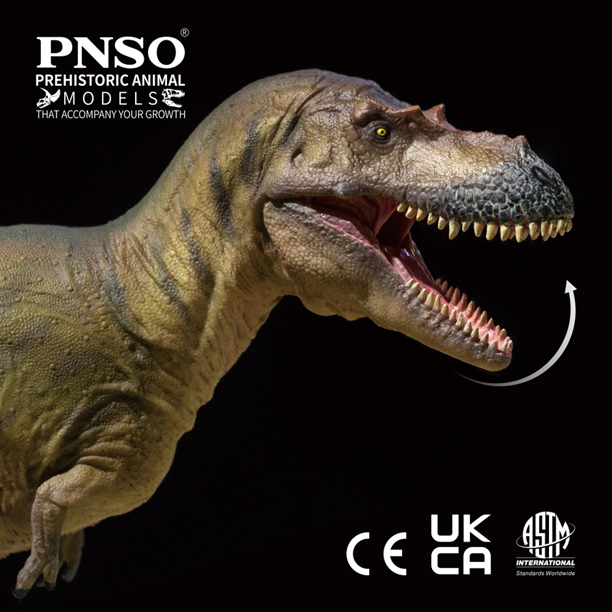
All three theropod dinosaur models have articulated jaws.
The PNSO Wally the Albertosaurus dinosaur model has an articulated jaw.
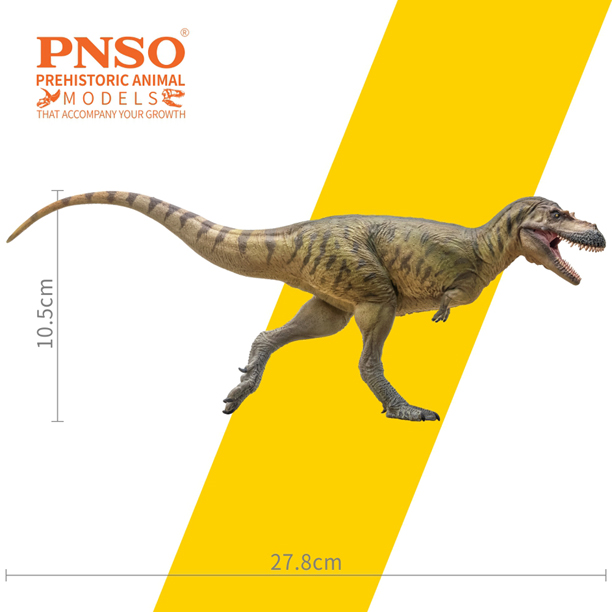
The Wally the Albertosaurus dinosaur model measures a fraction under twenty-eight centimetres in length and the tail is posed approximately ten and a half centimetres off the ground.
The PNSO Albertosaurus model measures 27.8 cm long and the tail is 10.5 cm off the ground.
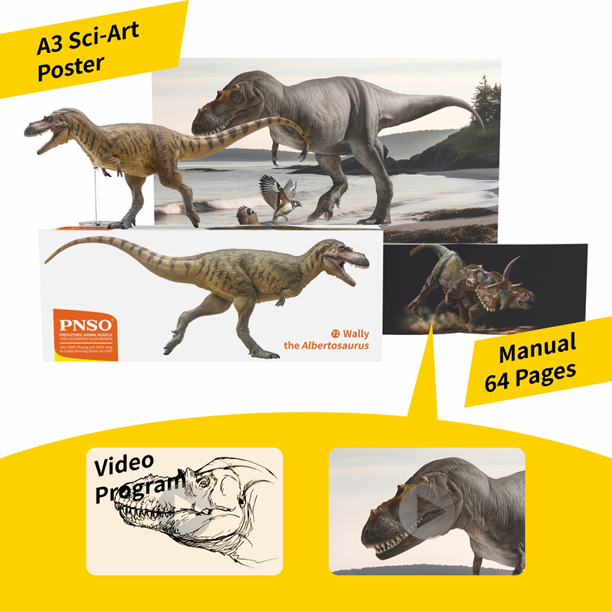
The latest PNSO tyrannosaur figure is supplied with a stunning, A3-sized scientific poster and the model has a transparent support stand. Wally the Albertosaurus is accompanied by a 64-page, full-colour illustrated booklet. A QR code on the box provides purchasers with access to a short video that explains how this figure was made.
The PNSO Wally the Albertosaurus dinosaur model is supplied with a full-colour Sci-Art poster and a 64-page, colour booklet.
The Everything Dinosaur Website
The Everything Dinosaur website features hundreds of different dinosaur and prehistoric animal figures. The UK-based, mail order company stocks a huge range of PNSO models and figures.
To view the range of PNSO prehistoric animal replicas in stock at Everything Dinosaur and other fantastic model ranges: Visit Everything Dinosaur.
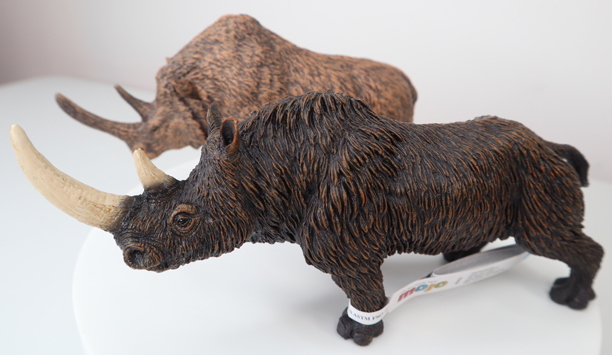
Recently introduced and reintroduced Woolly Rhino models are compared by Everything Dinosaur. Mojo Fun recently added a replica of a Woolly Rhinoceros to their prehistoric animal model range. This year (2023) has also seen the return of the Papo Woolly Rhino model. The Papo Woolly Rhino was originally launched in 2013. It was retired, but this year it has made a return to production.
A pair of Woolly Rhinoceros figures. The recently introduced Mojo Fun Woolly Rhino (front) and the reintroduced Papo Woolly Rhino (back). Picture credit: Everything Dinosaur.
Picture credit: Everything Dinosaur
The figure in front is the Mojo Fun Woolly Rhino model.
Photographing a Pair of Woolly Rhinos for a Customer
Team members had taken several photographs of these two Coelodonta models. A short YouTube video was also created that showed the two Woolly Rhinos and asked the question which one do you prefer?
An Everything Dinosaur customer requested that we show the two figures beside one another. We were happy to oblige and even posted up a short video on our social media platforms showing the two figures together.
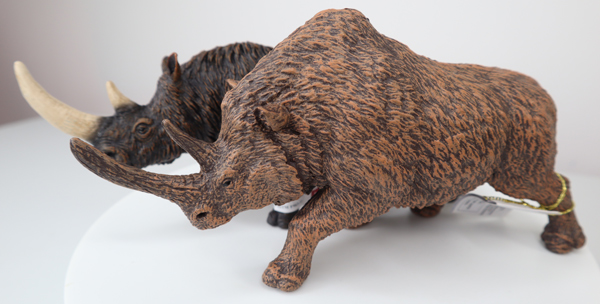
The Papo Woolly Rhino model (front) is wider and has a more prominent hump than the Mojo Fun Woolly Rhino figure. Picture credit: Everything Dinosaur.
Picture credit: Everything Dinosaur
The reintroduced Papo Woolly Rhino figure can be seen in front of the Mojo Fun Woolly Rhinoceros in the photograph (above).
A spokesperson for the UK-based mail order company remarked:
“After our YouTube short went live, we received a request to show these figures beside each other. We were happy to oblige and even recorded a short video to highlight the differences between these two Woolly Rhinos.”
Team members try their best to respond to customer requests. Our thanks to everyone who has posted up comments about these two Woolly Rhino figures on Everything Dinosaur’s social media pages.
Following the completion of a YouTube short (video), team members at Everything Dinosaur created a new video end-card promoting the company’s award-winning website. The image shows the home page of the Everything Dinosaur website. The Eofauna Scientific Research slider image is visible in the screen shot.
At the end of the YouTube short viewers are reminded to visit the award-winning Everything Dinosaur website. Picture credit: Everything Dinosaur.
Picture credit: Everything Dinosaur
An International Award-winning Website
The Everything Dinosaur website has achieved several accolades. It has been awarded Platinum Trusted Service status for the last four years by Feefo. The company has won the prestigious Feefo Platinum Trusted Service award since its inception.
Everything Dinosaur has won the prestigious Feefo Platinum Trusted Service award ever year that it has been offered. Picture credit: Everything Dinosaur.
A spokesperson from the UK-based mail order company commented:
“We are keen to post up more YouTube and Instagram shorts highlighting aspects of prehistoric animal model collecting. We know our customers and social media followers like these posts. For our part, we enjoy corresponding with fellow collectors and dinosaur model fans.”
Everything Dinosaur asks the question – Which Woolly Rhino model do you prefer? Are you a fan of the reintroduced Papo Woolly Rhinoceros or do you prefer the recently added Mojo Fun Woolly Rhino? Picture credit: Everything Dinosaur.
The Everything Dinosaur YouTube channel contains dozens of dinosaur and prehistoric animal model reviews. The channel also provides helpful tips and advice about model collecting. For example, team members recently posted up a short video demonstrating a quick way to assemble the new for 2023 Rebor Diplodocus model.
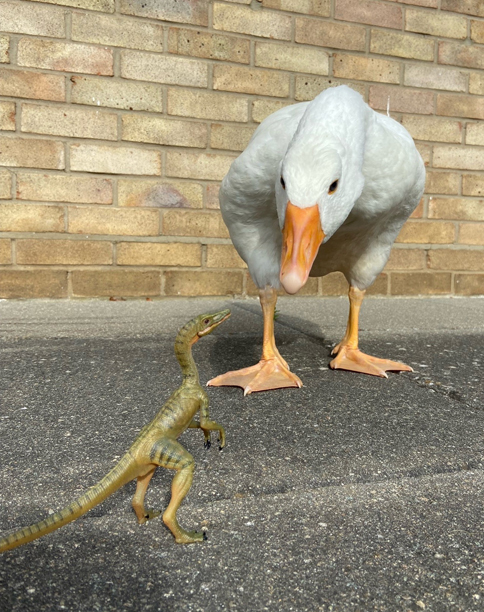
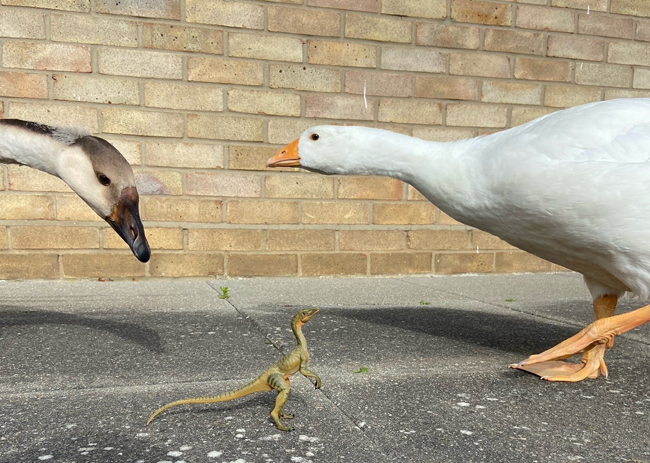
A goose meets a dinosaur! Our thanks to dinosaur fan and model collector Jessica who sent into Everything Dinosaur some photographs of her recently acquired Papo Compsognathus dinosaur model. The Compsognathus was photographed being studied by her pet geese.
A curious seven-week-old goose studies the Papo Compsognathus dinosaur model. Picture credit: Jessica.
Three Theropods Together
Ducks and geese are members of the Anseriformes, an ancient Order of birds that probably originated in the Late Cretaceous. Waterfowl would have co-existed alongside non-avian dinosaurs and pterosaurs. The earliest Cretaceous anseriform known to science is Vegavis (V. iaai). Its fossils come from the Late Cretaceous (Maastrichtian faunal stage) of Antarctica. A study published in 2017 postulated that just like modern geese, Vegavis probably honked!
Anseriforms, like all birds are descended from theropod dinosaurs.
Three members of the Theropoda together. A pair of geese and the Papo Compsognathus figure. Picture credit: Jessica.
Jessica emailed Everything Dinosaur stating:
“I just received my latest order today and I thought that you might like to see the Papo Compsognathus making friends with some of his distant relatives…”
Goose Meets a Dinosaur
The geese are seven weeks old. They already resemble adult birds. Their rapid growth is a possible ancestral trait passed on by their ancient non-avian dinosaur ancestors.
The birds seem to be very interested in the Papo Compsognathus figure.
Jessica added:
“I think they are possibly the most curious creatures on Earth!”
The Papo Compsognathus figure was introduced to the Papo “Les Dinosaures” range in 2018. It has proved to be a popular model, especially as it resembles the Compsognathus dinosaurs depicted in the film “The Lost World: Jurassic Park”, which was the second instalment of the “Jurassic Park” franchise.
A spokesperson from Everything Dinosaur thanked Jessica for the photographs and commented:
“What delightful photographs! It is always a pleasure to hear from our customers. We wonder what the Compsognathus thought about it all the attention it was getting from these very distant relatives.”