All about dinosaurs, fossils and prehistoric animals by Everything Dinosaur team members.

Drawings of dinosaurs and other prehistoric animals either done by team members or sent into Everything Dinosaur.

6 07, 2021

New “Prehistoric Times” Magazine Summer 2021

By |2024-05-27T13:42:25+01:00July 6th, 2021|Categories: Dinosaur and Prehistoric Animal Drawings, Main Page, Prehistoric Times|2 Comments

Editor Mike Fredericks kindly sent Everything Dinosaur a preview image of the forthcoming summer edition of “Prehistoric Times” magazine. This quarterly magazine is aimed at prehistoric animal enthusiasts and collectors of dinosaur models. Each edition is packed with amazing articles, reviews of the latest models and interviews with leading artists and Earth scientists.

Issue 138 (summer 2021), features the stunning artwork of renowned American palaeoartist Mark Hallett.

Oregon-based Mark was working on a book describing the evolution of the horse, to be published by Columbia University Press. He had been busy preparing illustrations for “The Horse: A Natural History”, however, he has found time to produce some stunning artwork reflecting current thinking about our close cousins the Neanderthals.
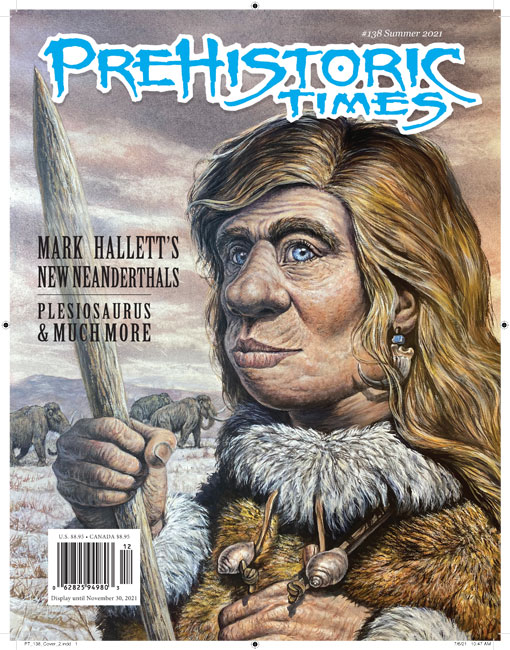
"Prehistoric Times" magazine - summer 2021
The front cover of “Prehistoric Times” magazine edition 138 (summer 2021).

Neanderthals Revisited

Our views of the hominin Homo neanderthalensis have changed dramatically over the last three decades or so. Early perceptions about Neanderthals being brutish ape-like creatures have largely been replaced with a very different view. They made a variety of sophisticated tools, cooked using fire, lived in shelters and made and wore clothing. Neanderthals were very capable hunters of large game, hence the herd of mammoths in the background of Mark Hallett’s front cover art as a wooden spear wielding female Neanderthal looks on.
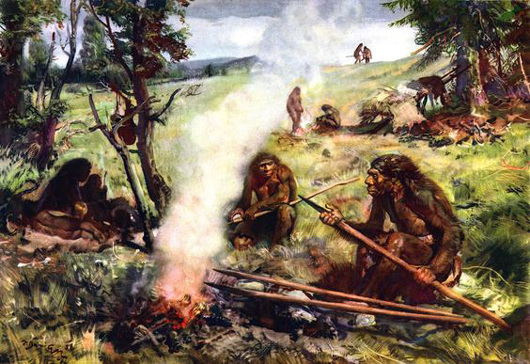
Ancient hominins by Zdenek Burian.
Neanderthals depicted as quite primitive “ape-men”. A 20th century illustration of Neanderthals by Zdenek Burian.

Neanderthals Made Jewellery

Evidence has emerged that Neanderthals deliberately buried their dead and in some instances marked the graves and provided grave goods and offerings such as shells and flowers. They probably had language skills and they made jewellery. Artefacts found in the Iberian Peninsula and dated to around 40,000 years ago prove that Neanderthals used eagle talons as necklace pendants. The female in the Mark Hallett illustration is wearing a shell necklace and has a very fetching eagle talon earring. Only two species of hominins are known to have demonstrated such sophisticated behaviour, the Neanderthals and our own species Homo sapiens.

We look forward to reading the article about Mark Hallett’s work in the forthcoming edition of the magazine.

To read more about “Prehistoric Times” magazine and to subscribe: Subscribe to “Prehistoric Times”.

Visit the Everything Dinosaur website: Everything Dinosaur.
5 07, 2021

Preparing for Elasmosaurus – Creating a Special Illustration

By |2024-05-27T13:41:06+01:00July 5th, 2021|Categories: Dinosaur and Prehistoric Animal Drawings, Dinosaur Fans, Educational Activities, Everything Dinosaur Products, Main Page, Photos of Everything Dinosaur Products, Press Releases|0 Comments

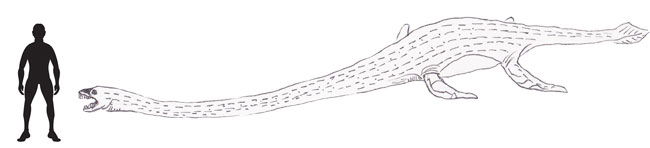
We are expecting the rest of the new for 2021 CollectA prehistoric animal models to be in stock in a few weeks’ time. As team members at Everything Dinosaur prepare for their arrival, we have been updating our illustration of Elasmosaurus on our Elasmosaurus fact sheet.

Everything Dinosaur commissions illustrations of prehistoric animals – just one of the many ways in which we support the palaeoart community.

Elasmosaurus scale drawing
The Elasmosaurus scale drawing commissioned by Everything Dinosaur as the company’s fact sheet is updated.  Picture credit: Everything Dinosaur.

Picture credit: Everything Dinosaur

A Change in the Tail

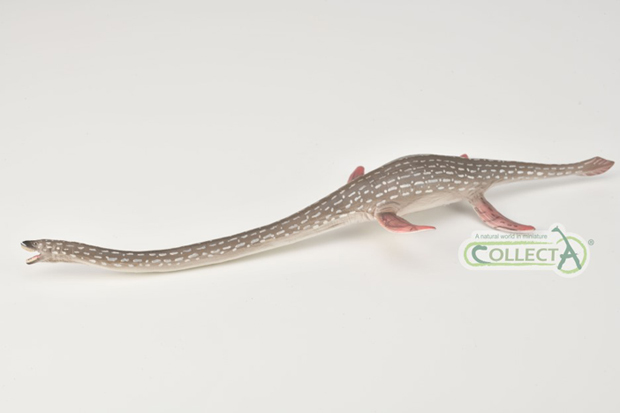
Observant readers will spot that the tail of our Elasmosaurus has been given a fin. This reflects some of the latest research into this Late Cretaceous, long-necked member of the Plesiosauria. The CollectA Elasmosaurus has also been given a tail fluke. Back in November 2020, when we announced the new for 2021 CollectA figures we created a short video highlighting the fossil evidence that supports the presence of a caudal fluke in members of the Plesiosauria.

To read more about this: New Prehistoric Animal Models for 2021 from CollectA (Part 3).

CollectA Age of Dinosaurs Popular Elasmosaurus model.
CollectA Elasmosaurus marine reptile model. A new for 2021 marine reptile model from CollectA.

Everything Dinosaur Fact Sheets

For virtually every named prehistoric animal model we supply, Everything Dinosaur researches and writes a fact sheet on that creature. These fact sheets are then sent out free to our customers with their model purchases. This is one of the ways in which team members help to inform and educate the public about the amazing animals that once existed on our planet.

Everything Dinosaur fact sheets, supplied with prehistoric animal models.
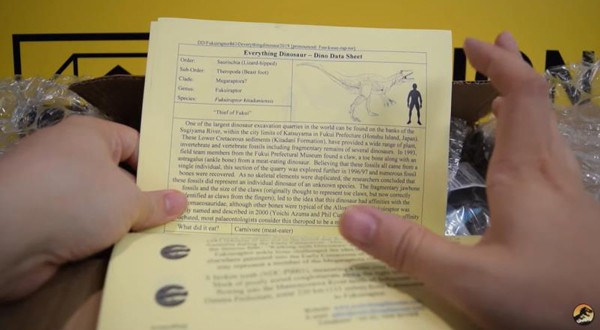
The unboxing video features some Everything Dinosaur fact sheets. Dinosaur fans and model collectors appreciate the free fact sheets that we supply. Picture credit: JurassicCollectables.

CollectA Age of Dinosaurs Model Range

The CollectA Age of Dinosaurs model range contains a wide variety of prehistoric creatures including lots of marine reptile models including the elasmosaurid Hydrotherosaurus. Team members are looking forward to the arrival of the new CollectA Age of Dinosaurs Elasmosaurus replica and sending out free fact sheets with purchases.

To view the range of CollectA Age of Dinosaur figures in stock: CollectA Prehistoric Life Models.

Visit the Everything Dinosaur website: Everything Dinosaur.
27 06, 2021

“Dragon Man” from North-eastern China

By |2024-05-27T09:14:24+01:00June 27th, 2021|Categories: Dinosaur and Prehistoric Animal Drawings, Dinosaur and Prehistoric Animal News Stories, Main Page, Palaeontological articles, Photos/Pictures of Fossils|1 Comment

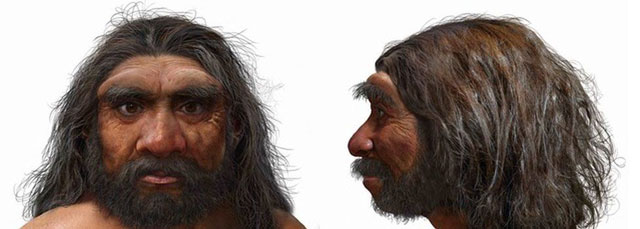
No sooner have we praised the remarkable artist Zhao Chuang for his work illustrating the mammaliamorph biota associated with Early Cretaceous China, then he produces another stunning piece of palaeoart – this time illustrating the newly described “Dragon Man” or to give the proposed formal scientific name Homo longi.

Dragon Man life reconstruction.
A life reconstruction of “Dragon Man”. Picture credit: Zhao Chuang.

A Completely New Species of Human

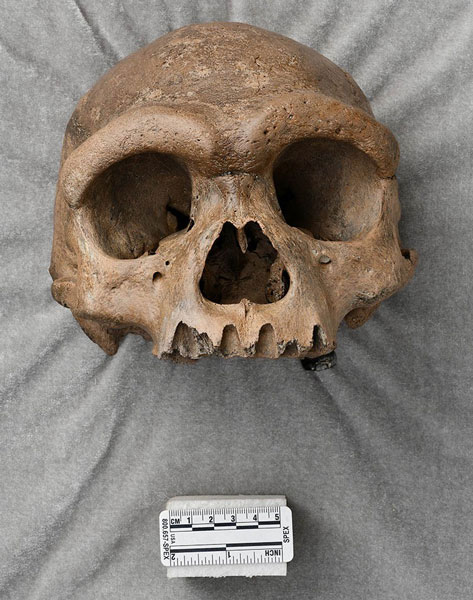
Researchers including Professor Chris Stringer from the London Natural History Museum have published a paper in the journal “Innovation” that describes and dates a remarkable and very complete fossil skull from Heilongjiang Province. The team have concluded that the ancient skull believed to be at least 146,000 years old represents a completely new species of human. They postulate that the skull could be from our closest evolutionary relative among known species of hominin such as Homo erectus and Homo neanderthalensis.

Harbin hominin skull.
The skull of the archaic hominin from the Harbin region of China. It could represent a new species of human. Picture credit: Chinese Academy of Sciences.

“Dragon Man”

The skull was reportedly discovered in 1933 by a construction worker helping to build a bridge over the Songhua river running through the city of Harbin. The river means “Black Dragon River” in the local language which explains why this skull representing a male was nicknamed “Dragon Man”.

The province was occupied by imperial Japanese forces at the time, so the construction worker hid the skull at the bottom of his family’s well to prevent it falling into the hands of the Japanese. According to media reports he only told relatives about the fossil find shortly before his death. The specimen was handed over to scientists so that a full examination of this extraordinary fossil could be carried out.

Where the fossil was found remains a mystery, but geochemical analysis suggests it came from lakebed sediments (lacustrine sediments). The research which involved non-destructive X-ray fluorescence, the analysis of rare earth elements and strontium isotope degradation, placed the date of this fossil between 138 to 309 thousand years old.

Uranium isotope analysis indicated that the fossil was at least 146,000 years old.

The face of "Dragon Man"
Views of the face of “Dragon Man”. Picture credit: Kai Geng

Commenting on the significance of this discovery, Professor Chris Stringer stated:

“The skull has a large brain capacity, fully within the range of modern humans and Neanderthals. It also shows features resembling our species, including flat and low cheekbones with a shallow canine fossa, and the face looks reduced and tucked under the braincase. It’s widely believed that the Neanderthals form the sister group of the Homo sapiens lineage. But our analyses suggest that this skull, and some other Middle Pleistocene human fossils from China, form a third East Asian lineage, which is actually closer to sapiens than the Neanderthals are”.

Is “Dragon Man” a Denisovan?

Other researchers have suggested that the skull might represent an example of the ancient human known as a Denisovan. Where “Dragon Man” fits on the human family tree remains uncertain, but it is true that the evolution of hominins during the Pleistocene Epoch has yet to be fully explained. There may have been a number of human lineages inhabiting our planet and the exact taxonomic relationships between them will continue to attract controversy and lively debate.

The scientific paper: “Geochemical provenancing and direct dating of the Harbin archaic human cranium” by Qinqfeng Shao, Junyi Ge, Qiang Ji, Rainer Grün and Chris Stringer published in the journal Innovation.

For the article featuring the mammaliamorph illustration by Zhao Chuang: The Jehol Biota and a Wonderful Illustration.

The artist Zhao Chuang is associated with the remarkable PNSO range of prehistoric animal figures.

To view the PNSO prehistoric animal model range: PNSO Scientific Art Figures.

23 06, 2021

The Fascinating Jehol Biota – Zhao Chuang

By |2024-05-27T09:03:49+01:00June 23rd, 2021|Categories: Dinosaur and Prehistoric Animal Drawings, Dinosaur Fans, Main Page, Photos|0 Comments

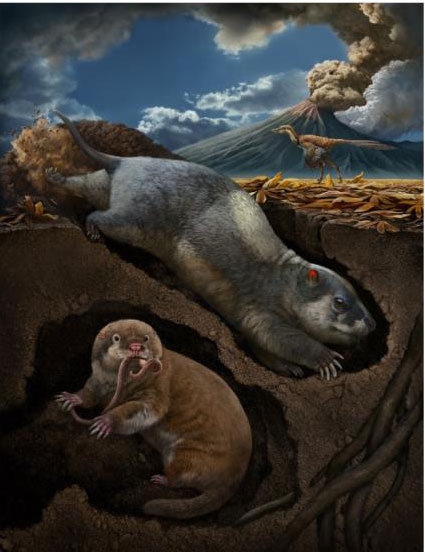
Whilst looking at a scientific paper published earlier this year which featured the description of two new species of burrowing mammals from the Early Cretaceous of north-eastern China, team members came across a superb illustration of the types of mammals and mammaliamorphs associated with the famous Jehol biota. The artwork had been created by world-renowned palaeoartist Zhao Chuang and it depicts the biota associated with the Lower Cretaceous deposits associated with the Yixian Formation and Jiufotang Formation. What a stunning piece of art.

The Early Cretaceous Jehol biota with emphasis on mammaliamorphs.
The Early Cretaceous Jehol biota with emphasis on mammaliamorphs. Picture credit: Zhao Chuang.

Fossiomanus sinensis and Jueconodon cheni

The two new ancient ancestors of modern mammals were both burrowers, with powerful hands, claws to help with digging, compact bodies and short tails. Although they shared similar anatomical traits, – adaptations to life underground – they were not closely related. The slightly smaller Jueconodon cheni has been classified as a eutriconodontan, a distant cousin of modern placental mammals and marsupials, it was around 20 cm in length. Fossiomanus sinensis is a herbivorous mammal-like animal called a tritylodontid and was around 30 long.

One of the co-authors of the scientific paper, published in the journal “Nature”, Dr Jin Meng from the American Museum of Natural History (New York), commented:

The Early Cretaceous Jehol Biota has generated many well-preserved fossils that have furnished a great deal of information on the morphology and evolution of early mammals. The two new species expand the diversity of the mammaliamorph assemblage and increase its morphological disparity, as they show unequivocal evidence of convergent adaptation for a fossorial lifestyle.”

Jehol mammals Fossiomanus sinensis and Jueconodon cheni
Two new species of Early Cretaceous mammals were described from fossils found in north-eastern China. Fossiomanus sinensis (upper right) and Jueconodon cheni in their burrows. Picture credit: Zhao Chuang.

The Diverse Jehol Biota

As well as reading about the diverse nature of the mammaliamorph biota associated with the Early Cretaceous Jehol ecosystem, we have the opportunity to admire the stunning artwork of Zhao Chuang. Fossils from north-eastern China have revealed that during the Early Cretaceous, the forests and lakes were home to a wide variety of different mammaliamorphs. The mammaliamorpha is defined as a clade of cynodonts including mammaliaforms and their close relatives. It is therefore a broader definition of early mammals than the mammaliaformes.

The artist Zhao Chuang is synonymous with the range of PNSO prehistoric animal models.  He produces the artwork for the product packaging.

To view the range of PNSO dinosaurs and prehistoric animals: PNSO Dinosaurs.

The Everything Dinosaur website: Dinosaur Models and Toys.

16 06, 2021

The Fauna Associated with the Alcântara Formation

By |2024-05-27T07:39:33+01:00June 16th, 2021|Categories: Adobe CS5, Dinosaur and Prehistoric Animal Drawings, Dinosaur Fans, Main Page|0 Comments

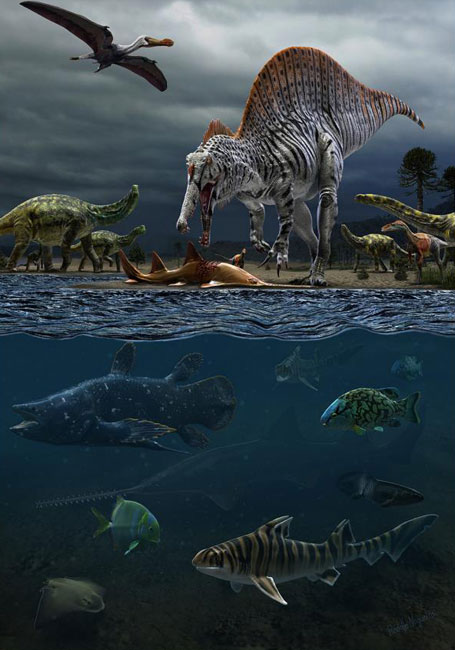
Whilst researching the background to a dinosaur model based on fossils found in Brazil (Irritator challengeri), team members at Everything Dinosaur stumbled upon a superb illustration of the fauna associated with the Alcântara Formation.

Alcantara Formation biota
The fauna associated with the Alcântara Formation. Picture credit: Rodolfo Nogueira.

Illustrating the Ancient Ecosystem (Cretaceous of Brazil)

The stunning artwork created by Rodolfo Nogueira (above), illustrates the biota associated with the Laje do Coringa bone bed found in early Late Cretaceous (Cenomanian stage) deposits of the Alcântara Formation of north-eastern South America.

Terrestrial element: sauropod titanosaurids (left) and andesaurids (right), whilst a giant spinosaurid feeds on an Atlanticopristis equatorialis (centre). The other, smaller theropods depicted in the scene represent noasaurids. A pterosaur (member of the Anhangueridae), soars overhead.

Marine element: a coelacanth (Mawsonia gigas) swims close to the surface on the left of the picture. Pycnodontiform (middle) Myliobatis sp. (bottom) and on the right of the picture Tribodus sp. (sharks), Lepidotes sp. can be seen whilst a giant sawfish Onchopristis sp. swims in the background.

The Lungfish and Irritator challengeri

The new Dino Hazard Irritator challengeri model comes with a lungfish (genus Equinoxiodus) which can be held in the claws of the theropod. The lungfish is a replica of Equinoxiodus alcantarensis which was named and described in 2011 from fossilised tooth plates found in deposits associated with the Alcântara Formation.

Dino Hazard Irritator with Prey
The theropod Irritator challengeri is associated with the Romualdo Formation whilst the lungfish (Equinoxiodus alcantarensis) is associated with the geologically younger Alcântara Formation. Picture credit: Everything Dinosaur.

Picture credit: Everything Dinosaur

For dinosaur models and prehistoric animal figures: Dinosaur Figures and Prehistoric Animal Replicas.

Whilst the dating of the Irritator challengeri fossil material has proved to be challenging (no pun intended), most palaeontologists estimate that this spinosaurid roamed north-eastern Brazil around 110 million years ago (Albian faunal stage of the Early Cretaceous). The lungfish model (Equinoxiodus alcantarensis) is known from the geologically younger Alcântara Formation (Cenomanian faunal stage).

If Irritator was a piscivore (fish-eater), it may well have hunted lungfish, but E. alcantarensis might be more than ten million years younger than the theropod.

A Unique Record of Cenomanian Fauna of South America

Examination of fossils found in rocks associated with the Alcântara Formation has provided a unique record of the South American Cenomanian continental flora and fauna. Palaeontologists have been able to piece together the ancient ecosystems that existed in this part of the world during the earliest stage of the Late Cretaceous. This has helped scientists to understand the changes in fauna and flora as Gondwana broke apart and the Atlantic Ocean widened. The fossils of the Laje do Coringa bone bed reveal a diverse vertebrate community that lived in the coastal forested areas of the Northern Maranhão state surrounded by a dominantly dry and arid environment.

The bone bed reveals that vertebrate fauna was more similar to the northern African fauna at the time than it was to the fauna associated with rest of South America. This suggests that land bridges permitting faunal interchanges between Africa and north-eastern Brazil may have persisted until the early Cenomanian (about 100 million years ago).

Whilst no Irritator challengeri fossils are known from the Alcântara Formation, fragmentary evidence, mainly in the form of isolated teeth indicate that spinosaurids were present. Teeth found have been ascribed to the roughly coeval Spinosaurus aegyptiacus which is known from Egypt and Morocco.

Discussing the remarkable terrestrial and marine biotas associated with the Alcântara Formation does permit us an opportunity to post up a super illustration by Rodolfo Nogueira.

Visit the Everything Dinosaur website: Everything Dinosaur.
5 06, 2021

An Exclusive Helicoprion Scale Drawing

By |2024-05-26T21:23:27+01:00June 5th, 2021|Categories: Adobe CS5, Dinosaur and Prehistoric Animal Drawings, Dinosaur Fans, Everything Dinosaur News and Updates, Everything Dinosaur Products, Main Page, Press Releases|0 Comments

As Everything Dinosaur team members prepare for the arrival of the new for 2021 PNSO Helicoprion model a scale drawing of this strange fish from the Permian has been commissioned. Haylee the Helicoprion model is due to be in stock at Everything Dinosaur later in the summer (2021).

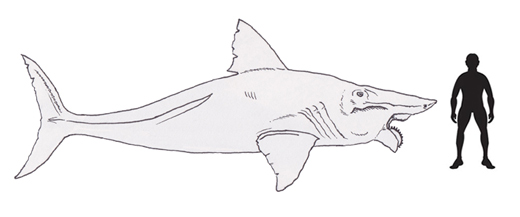
Helicoprion scale drawing
As Everything Dinosaur prepares for the arrival of Haylee the Helicoprion model from PNSO a scale drawing of this Permian fish has been commissioned.  Picture credit: Everything Dinosaur.

Picture credit: Everything Dinosaur

The Everything Dinosaur website: Prehistoric Animal Models and Toys.

Helicoprion bessonowi

Three species in the Helicoprion genus are currently assigned, each one being distinguished from the others by variations identified in the distinctive tooth whorl. The size of this predator remains uncertain, although based on the morphology of other smaller related fish, Helicoprion has been estimated to have been around 5 to 8 metres in length. In the Everything Dinosaur scale drawing that we have prepared, our image indicates that this strange fish grew to lengths of around 7.5 to 8 metres.

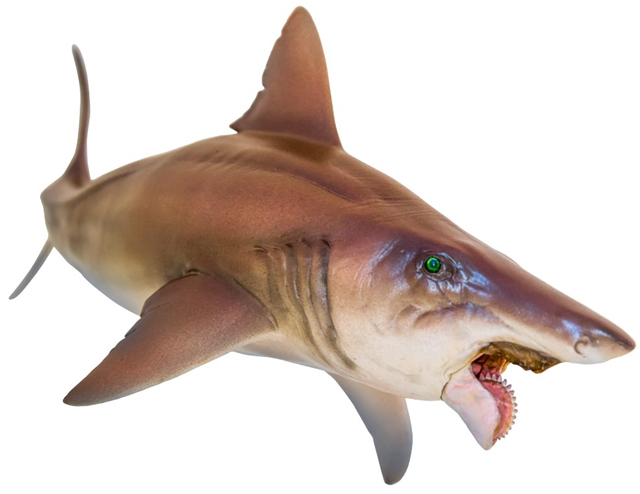
PNSO Haylee the Helicoprion anterior view
PNSO Haylee the Helicoprion replica. The stunning emerald eye on the model is reminiscent of the eye of a Chimaera such as the deep water Rabbit Fish (Chimaera monstrosa) to which Helicoprion is distantly related.

Haylee the Helicoprion

As with the other mid-size PNSO replicas, this stunning model has been given a nickname. The figure is called Haylee the Helicoprion, Everything Dinosaur team members are not sure why Haylee was chosen; however, it is certainly a welcome addition to the PNSO product portfolio and we are looking forward to stocking it later on this year (2021).

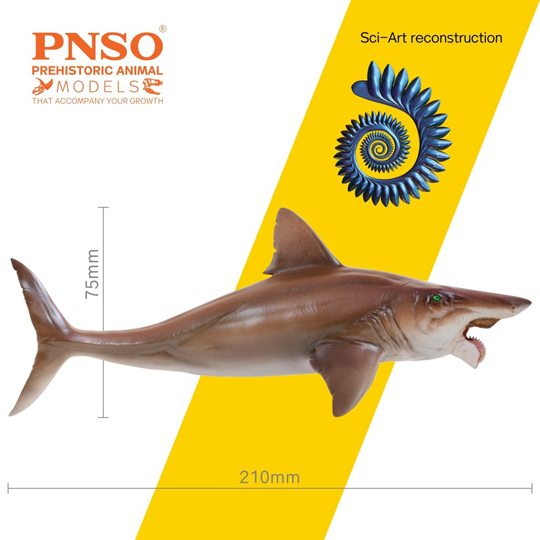
PNSO Haylee the Helicoprion model measurements
The model measures 21 cm in length and from the base of the tail fluke to the top of the dorsal fin of the Helicoprion is 7.5cm

Model Measurements

The model measures around 21 cm in length and although PNSO do not declare a scale for this range of prehistoric animal figures, team members estimate that if Helicoprion was around 8 metres in length then this model would be in approximately 1:38 scale or thereabouts.

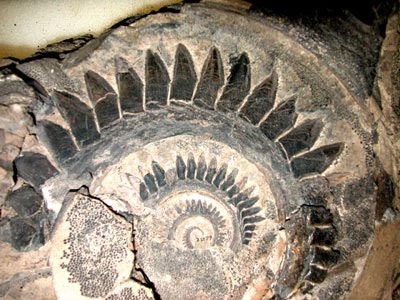
The fossilised teeth of Helicoprion
Fossilised teeth whorl from a cartilaginous fish. The famous tooth whorl associated with the Permian fish genus Helicoprion.

A spokesperson from Everything Dinosaur commented that they were looking forward to bringing this model into stock and they were also excited about making more new product announcements about PNSO models in the very near future.

To view the range of PNSO prehistoric animal models and figures in stock at Everything Dinosaur: PNSO Age of Dinosaurs.

21 04, 2021

Preparing for a New Avaceratops

By |2024-05-25T14:45:33+01:00April 21st, 2021|Categories: Adobe CS5, Dinosaur and Prehistoric Animal Drawings, Dinosaur Fans, Everything Dinosaur News and Updates, Everything Dinosaur Products, Main Page, Photos of Everything Dinosaur Products, Press Releases|0 Comments

Everything Dinosaur team members are eagerly awaiting the arrival of the Beasts of the Mesozoic Wave 2 ceratopsian figures. There are going to be another nine articulated, horned dinosaur models added to this exciting range and the shipment of models is already on the water heading to our warehouse. However, unlike other companies, we like to offer a little more with every Beasts of the Mesozoic model that we supply. Everything Dinosaur customers receive a fact sheet to accompany their Beasts of the Mesozoic ceratopsian. As a result, we have been reviewing existing data sheets and preparing three new ones specifically for Spiclypeus (S. shipporum), Wendiceratops (W. pinhornensis) and Avaceratops (A. lammersi).

Our work also involves us commissioning illustrations of dinosaurs so we can include a scale drawing in our fact sheet.

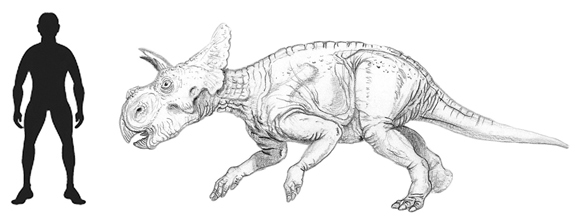
Avaceratops Scale Drawing
A scale drawing of Avaceratops lammersi known from the Judith River Formation of Montana (USA).  Picture credit: Everything Dinosaur.

Picture credit: Everything Dinosaur

Helping to Educate and Inform

A spokesperson from Everything Dinosaur commented:

“We might have had to stop our school visits due to the impact of the COVID-19 pandemic, but we still have at the very heart of this business the ethos of helping to educate and inform. For all the Beasts of the Mesozoic articulated figures we have a fact sheet available that tells customers something about the science behind the model. We have all the first wave of the Ceratopsia covered and shortly we will have completed our work on the data sheets required for Wave 2.”

Visit the Everything Dinosaur website: Dinosaur Toys and Prehistoric Animal Figures.

Beasts of the Mesozoic Avaceratops lammersi
The Beasts of the Mesozoic Avaceratops lammersi articulated dinosaur model. Part of the second wave of Beasts of the Mesozoic ceratopsians, the Avaceratops has nineteen points of articulation and is supplied with an Everything Dinosaur fact sheet.

The spokesperson added that these new articulated dinosaur models would be in stock at Everything Dinosaur in early May (2021).

To view the range of Beasts of the Mesozoic models and replicas available from Everything Dinosaur: Beasts of the Mesozoic “Raptors” and Horned Dinosaurs.

13 04, 2021

Latest Prehistoric Times Magazine a Sneak Peek

By |2024-05-25T14:00:47+01:00April 13th, 2021|Categories: Adobe CS5, Dinosaur and Prehistoric Animal Drawings, Dinosaur Fans, Magazine Reviews, Main Page|1 Comment

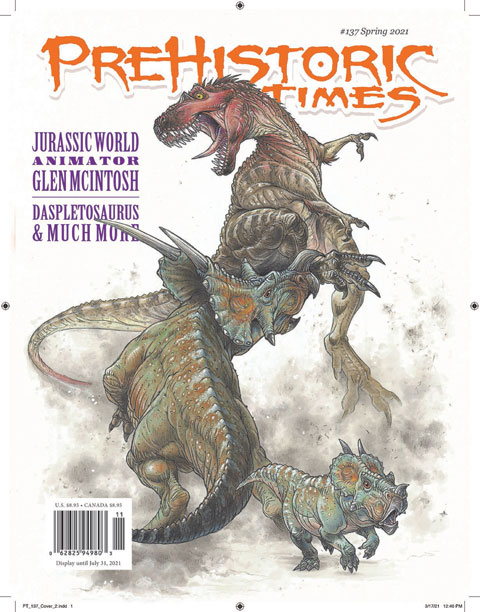
Here is a sneaky peek at the forthcoming edition of “Prehistoric Times” magazine, the quarterly publication aimed at fans of prehistoric animals, model collecting and artwork depicting dinosaurs and other long extinct creatures. This stunning illustration of interspecific combat within the Dinosauria will adorn the front cover of issue 137 (spring 2021).

Prehistoric Times Front Cover Spring 2021
The front cover image of the forthcoming edition of “Prehistoric Times” magazine (issue number 137 – spring 2021)

“Prehistoric Times” Magazine

Editor Mike Fredericks, who sent Everything Dinosaur the front cover image says that issue 137 is going to be jam-packed with all the articles, artwork and features that makes this publication so popular.

Mike commented:

“We have an interview with Glen McIntosh one of the Jurassic Park and Jurassic World animators who is also a great artist who designed the Indominus rex, plus much more.”

With the latest instalment of the “Jurassic Park/Jurassic World” movie franchise due to hit cinemas shortly, the timing of this interview could not have been better.

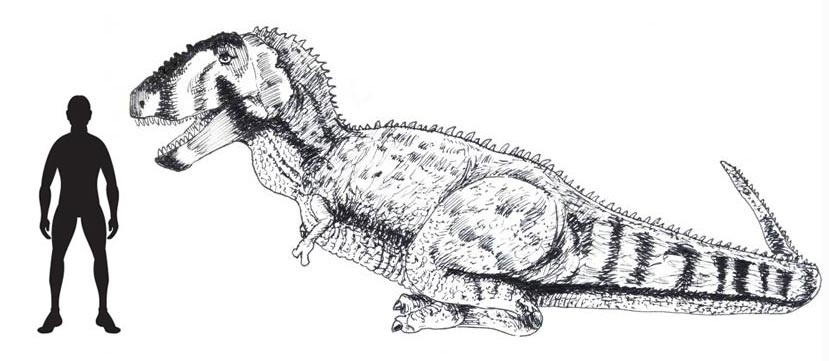
Look out for a special feature on the Late Cretaceous North American tyrannosaur Daspletosaurus, an apex predator known from Montana and Alberta.

Drawing of Daspletosaurus.
Daspletosaurus – a large tyrannosaur present in the Late Cretaceous ecosystem of North America. Two species have been assigned to this genus, but possibly two more might be added in the near future as more scientific papers are published.  Picture credit: Everything Dinosaur.

Picture credit: Everything Dinosaur

Subscribe to Prehistoric Times

Team members at Everything Dinosaur recommend that blog readers subscribe to “Prehistoric Times”. Published four times a year, this is a fantastic magazine for followers of palaeoart, collectors of dinosaur models and for the general reader with an interest in prehistoric life.

To subscribe to “Prehistoric Times” magazine: Subscribe to “Prehistoric Times” magazine.

The Everything Dinosaur website: Dinosaur Toys.

18 03, 2021

Caldey Illustrates a Beautiful Tyrannosaurus rex

By |2024-05-11T17:53:30+01:00March 18th, 2021|Categories: Dinosaur and Prehistoric Animal Drawings, Dinosaur Fans, Main Page|0 Comments

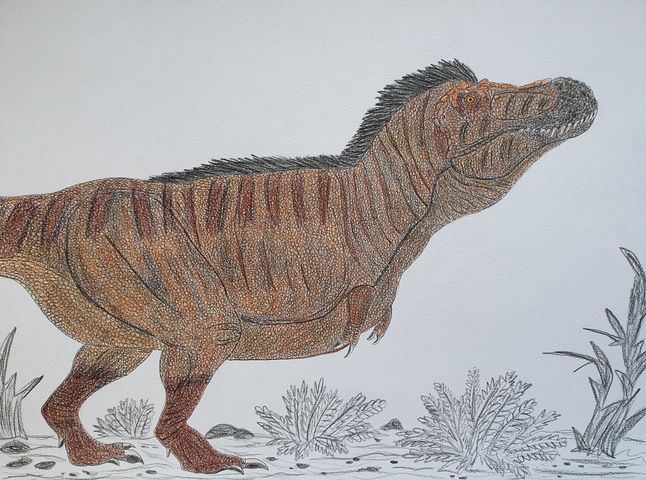
Our thanks to young artist Caldey who sent into Everything Dinosaur her interpretation of Tyrannosaurus rex that incorporates some of the latest scientific thinking.

Caldey Illustrates Tyrannosaurus rex
Caldey has produced an interpretation of Tyrannosaurus rex based on some of the latest scientific research. Picture credit: Caldey.

Muted Tones and Colours

Caldey has chosen to depict her T. rex in muted tones. Recently, Everything Dinosaur team members were asked to comment on the potential colouration of large, terrestrial, apex predators such as the “King of the Tyrant Lizards”. The consensus reached by the various experts that were consulted, was that large predators might not have had the striking, obtrusively bright colouration and markings that some dinosaur models and figures show.

Although the colouration of models is highly speculative, the darker tones and stripes featured in this drawing work well and contrast with the monochrome vegetation included in the artwork.

Bristles on a Theropod

The row of protofeathers running from the top of the head to the hips is a nice touch, as is the overbite depicted on the tyrannosaur, perhaps a nod to the on-going debate about whether dinosaurs had lips.

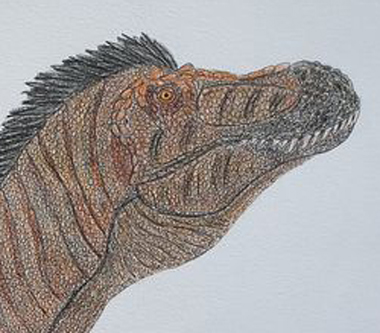
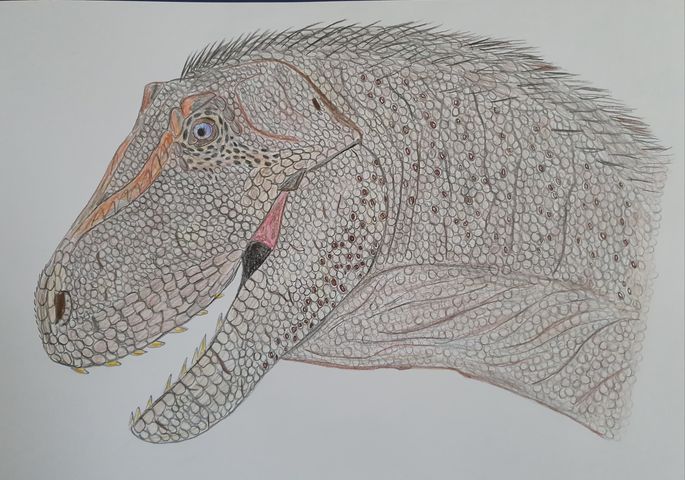
A close-up view of a dinosaur illustration
A close-up view of the head of Caldey’s T. rex illustration. The overbite can be seen and in close-up the fine detailing of the scales can be made out. Picture credit: Caldey.

A spokesperson from Everything Dinosaur commented:

“Our thanks to Caldey for sending into Everything Dinosaur another super dinosaur illustration”.

An Earlier Illustration of T. rex
Caldey sent into Everything Dinosaur an illustration of T. rex in November 2020. It is intriguing to see how Caldey’s illustration skills are developing. Picture credit: Everything Dinosaur.

Visit the Everything Dinosaur website: Everything Dinosaur.

12 03, 2021

An Exclusive Kamuysaurus Scale Drawing

By |2024-05-22T06:54:53+01:00March 12th, 2021|Categories: Adobe CS5, Dinosaur and Prehistoric Animal Drawings, Dinosaur Fans, Main Page|0 Comments

Team members at Everything Dinosaur have commissioned a scale drawing of the Japanese duck-billed dinosaur Kamuysaurus (K. japonicus) as they await the arrival of the first batch of new for 2021 prehistoric animal models from CollectA.

Kamuysaurus scale drawing
A scale drawing of the hadrosaurid Kamuysaurus (K. japonicus) that was formally named and described in 2019. This Late Cretaceous duck-billed dinosaur is estimated to have measured around 8 metres in length and weighed 4 tonnes. Picture credit: Everything Dinosaur.
Picture credit: Everything Dinosaur

The scale drawing is being prepared to coincide with the arrival of CollectA models.

To view the CollectA model range: CollectA Prehistoric Life Models.

To see the CollectA Deluxe model range: CollectA Deluxe Prehistoric Life Figures.

Kamuysaurus japonicus – A Kamuysaurus Scale Drawing

Described as Japan’s best-known dinosaur by a number of media sources. This dinosaur was officially named and described back in 2019. CollectA have been planning a model of this Japanese dinosaur for some time, they have expressed an interest in expanding their replicas of Japanese dinosaurs since the introduction of Fukuiraptor and Fukuisaurus.

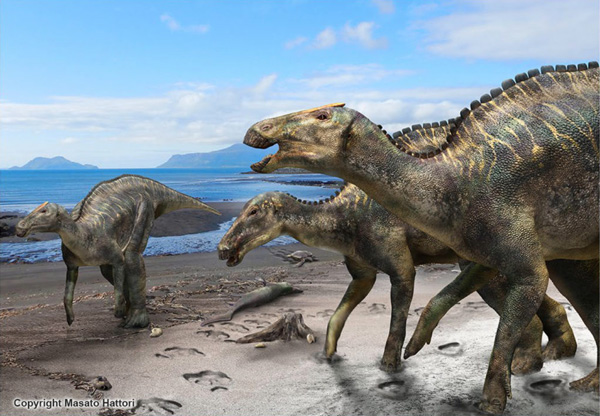
Kamuysaurus life reconstruction.
A herd of Kamuysaurus wander along a beach. Picture credit: Masato Hattori. The fossilised remains of a single individual dinosaur were found in marine sediments. These fossils were formally assigned to a new dinosaur species in 2019 (Kamuysaurus japonicus).

How Big was Kamuysaurus?

Although only known from a single specimen, the skeleton represents the most complete dinosaur fossil found in Japan. Scientists were able to assign Kamuysaurus to the Edmontosaurini clade within the hadrosaur subfamily the Saurolophinae.

Kamuysaurus is estimated to have reached a body length of around 8 metres and to have weighed 4 tonnes.

Palaeontologists who have studied the fossil material have suggested that Kamuysaurus is closely related to Kerberosaurus which was unearthed in Russia and Laiyangosaurus which is known from China. Kamuysaurus was named after the indigenous people of the island of Hokkaido, the trivial or species name refers to Japan. It translates as “the deity of Japanese dinosaurs”.

Visit the Everything Dinosaur: Everything Dinosaur.
Go to Top