Everything Dinosaur customer and prehistoric animal fan Luke du Toit combines his skills as an artist and graphic designer to create stunning dinosaur themed artworks. Take for example, this very colourful Dilophosaurus illustration shown below.
A colourful Dilophosaurus artwork created by talented artist and graphic designer Luke du Toit. Picture credit: Luke du Toit.
Mesozoic Art
Mesozoic Art was started by Luke back in 2016, he has been selling his unique creations to fans of prehistoric animals and palaeoart all over the world from his company’s website.
Commenting on why dinosaurs have inspired him so much, Luke explained:
“I have a deep love and obsession for dinosaurs and have been drawing them since I was 5 years old. Their variety of different shapes, sizes and colours really tap into my imagination. The fact that dinosaurs existed and are now not readily available for us to access make them almost mythical in nature. For me, they are a great source of creative expression. “
A striking Parasaurolophus illustration. The duck-billed dinosaur is surrounded by a border of flowering plants (angiosperms). Flowering plants would have been familiar to this Late Cretaceous herbivore. Picture credit: Luke du Toit.
Inspired by the “Jurassic Park” Movie Franchise
Based in Pretoria, South Africa, Luke uses a variety of reference sources to inspire his illustrations. In particular, he is a big fan of the “Jurassic Park” movie franchise and a number of the iconic dinosaurs from that famous film franchise feature in his artwork.
An illustration of Velociraptor Blue inspired by the “Jurassic Park” movie franchise. Artwork entitled “Clever Girl” by South African graphic designer and artist Luke du Toit. Picture credit: Luke du Toit.
Each detailed illustration is meticulously drawn, then scanned and turned into an electronic file before being digitally redrawn and then coloured.
“My artwork looks equally beautiful in a child’s bedroom, a study as well as an art piece in a living room or even a “Man Cave” setting,” commented the talented artist.
A striking illustration of the horned dinosaur Triceratops. Picture credit: Luke du Toit.
Take a look at the Mesozoic Art website to see the full portfolio of artwork and illustrations of the artist.
Team members at Everything Dinosaur are busy preparing for arrival of the latest batch of PNSO prehistoric animals including the PNSO Requena the Livyatan model. With production delays and difficulties with logistics, many companies have struggled to receive stock but plans at Everything Dinosaur are well advanced and a shipment of new PNSO models including the Livyatan figure along with Tucson the Himalayasaurus, Evan the Tylosaurus and the eagerly anticipated Aidan the Cretoxyrhina shark model should be in stock at the end of next month (November 2021).
The PNSO Requena the Livyatan prehistoric whale model. This prehistoric whale model should be in stock at Everything Dinosaur in November 2021.
Livyatan melvillei – Leviathan
Formally named and described in 2010 (Lambert et al), from a partial skull discovered in southern Peru (Pisco Formation) two years earlier, the exact size of this prehistoric whale remains unknown. Based on scaling up the 3-metre-long fossil skull with those of extant Sperm whales (Physeter macrocephalus), palaeontologists have estimated that Livyatan could have been between 13.5 and 18 metres in length.
Not knowing the size of this ancient cetacean has made creating a scale drawing challenging for Everything Dinosaur team members. Male Livyatans were probably considerably larger than females, as seen in Sperm whales today. Bull Sperm whales can be up to 20 metres in length, whilst females rarely exceed 12 metres and these bulls can be up to 3 times heavier.
Livyatan Scale Drawing
After having reviewed the scientific literature, Everything Dinosaur team members have given their illustration of Livyatan melvillei a length of approximately 15 metres.
As only the skull and some teeth are known, the size of this predatory whale remains uncertain. Size estimates vary from between 13.5 to 18 metres, males may have been larger than females as seen in the largest extant toothed whale, the Sperm whale (Physeter macrocephalus). Picture credit: Everything Dinosaur.
Originally named Leviathan melvillei, with the genus name reflecting the biblical sea monster and the species name honouring Herman Melville, the author of Moby Dick, it was discovered that the word “Leviathan” was a junior synonym for a Mastodon, so under the rules of scientific nomenclature the genus name was changed. Livyatan is derived from the Hebrew word for the biblical sea monster.
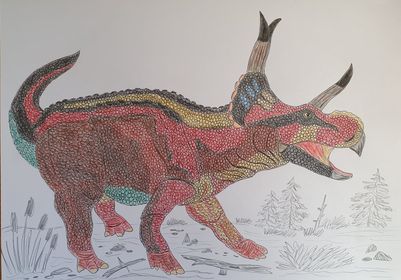
Our thanks to Caldey who sent into Everything Dinosaur another drawing of a horned dinosaur. This time Caldey has chosen to illustrate a centrosaurine, the spectacular Diabloceratops (D. eatoni), a plant-eater that roamed Utah during the Campanian faunal stage of the Late Cretaceous.
With its huge pair of horns extending beyond the headshield and its large, brow horns, Diabloceratops (devil horned face), was one very impressive-looking dinosaur.
The very colourful horned dinosaur by talented young artist Caldey. We think that Caldey drew inspiration from the Beasts of the Mesozoic Diabloceratops (D. eatoni) replica. Picture credit: Caldey.
Inspired by a Beasts of the Mesozoic Ceratopsian
Team members at Everything Dinosaur think that this colourful ceratopsian illustration was inspired by the colour scheme on the Beasts of the Mesozoic articulated Diabloceratops figure.
The Beasts of the Mesozoic articulated Diabloceratops eatoni model. This replica of a centrosaurine was part of the first wave of ceratopsian figures to be produced in the Beasts of the Mesozoic range.
The picture above shows the articulated Diabloceratops in the Beasts of the Mesozoic model range.
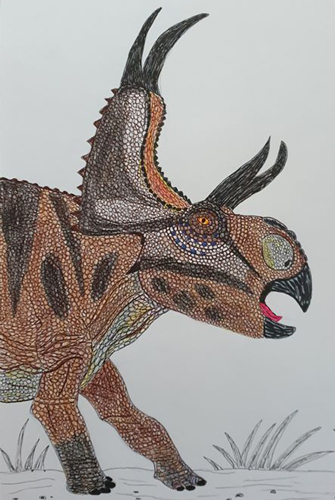
This Diabloceratops illustration we received this week is not the first Diabloceratops drawing from Caldey that we have been sent. In 2019, Schleich introduced a Diabloceratops figure, this model proved to be extremely popular and shortly after its introduction Caldey sent into Everything Dinosaur her illustration of the Schleich model.
The Schleich Diabloceratops inspired Caldey to illustrate this dinosaur back in 2019. Picture credit: Caldey.
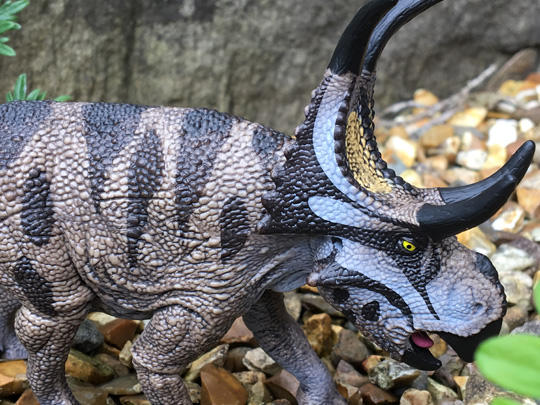
A close-up view of the front end (anterior portion) of the Schleich Diabloceratops dinosaur model. This horned dinosaur model, introduced in 2019 inspired Caldey to produce her first illustration of Diabloceratops that was sent to Everything Dinosaur.Picture credit: Everything Dinosaur.
Picture credit: Everything Dinosaur
A spokesperson from Everything Dinosaur commented:
“Some of the spectacular horned dinosaurs that have been recently named and described have proved very popular with palaeoartists of all ages. Our thanks to Caldey for sending into us her Diabloceratops drawing. Her artwork is greatly appreciated”.
Our thanks to dinosaur model fan and artist Caldey who sent into Everything Dinosaur a very colourful and striking illustration of a horned dinosaur. Caldey has been inspired by the paint schemes of several of the Beasts of the Mesozoic ceratopsians and we think that Caldey’s most recent artwork has been influenced by the Styracosaurus albertensis in this range.
The very colourful horned dinosaur illustration produced by Caldey. Team members at Everything Dinosaur think that the centrosaurine illustrated is Styracosaurus. Picture credit: Caldey.
The skin covering the fenestrae in the fill have been coloured crimson and their colour almost matches the vivid tree depicted in the background.
An Impressive Horned Dinosaur Drawing
As crocodilians and birds which are the closest living relatives to the Dinosauria, have colour vision, most scientists are confident in the assertion that dinosaurs had colour vision too. The bold patterns and colours chosen by the illustrator would certainly make this horned dinosaur conspicuous, but if you want to attract a mate, or to obtain high social status within a herd, having a striking appearance is one way to go about it. Caldey’s colour scheme is bold with the white flashes on the flanks in stark contrast to the russet tones and greys of the rest of the body.
The dinosaur also sports a tuft of bristles from the end of the ribs running towards the base of the tail, a nod to the integumentary covering associated with the distantly related Psittacosaurus which Caldey has also illustrated (see below).
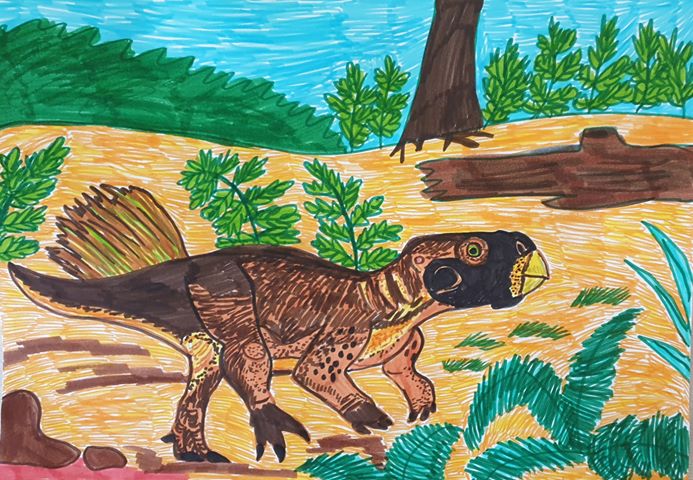
Caldey’s illustration of the early member of the Ceratopsia – Psittacosaurus. Picture credit: Caldey.
When commenting upon Caldey’s latest, colourful ceratopsian a spokesperson from Everything Dinosaur stated:
“It is always a pleasure to receive illustrations and drawings from dinosaur fans. We have been very impressed with the artwork that we have been sent by Caldey. Thanks to Caldey we have received artwork featuring several horned dinosaurs including Triceratops and Diabloceratops. We know that she has been inspired previously by the Beasts of the Mesozoic models, so we think her latest drawing was influenced by the Beasts of the Mesozoic Styracosaurus figure.”
The back cover illustration of the Beasts of the Mesozoic Styracosaurus dinosaur model (S. albertensis). Did this colour scheme inspire the young artist? Picture credit: Everything Dinosaur.
Picture credit: Everything Dinosaur
Our thanks once again to Caldey for sending into Everything Dinosaur her prehistoric animal drawing.
Time to take a sneak peek at the front cover of the forthcoming edition of the quarterly magazine “Prehistoric Times”. It features a close-up view of the head of the African spinosaurid Suchomimus on the front cover.
Team members at Everything Dinosaur are grateful to magazine editor Mike Fredericks for sending us an image of the front cover of the next edition (issue 139) of this popular magazine.
The front cover of the next issue of “Prehistoric Times” magazine (issue 139) features a close-up view of the head of the spinosaurid Suchomimus. Picture credit: Mike Fredericks.
Issue 139 (Fall/Autumn 2021)
As well as Phil Hore’s articles on Suchomimus and placodonts (Henodus), we can look forward to the next instalment of Jon Lavas’s long-running series highlighting the work of the influential Czech artist Zdeněk Burian. In issue 139, the focus will be on Burian’s illustrations of Stegosaurus.
The classic depiction of a Late Jurassic scene by Burian (1950). Everything Dinosaur team members wonder whether this iconic image of the armoured dinosaur Stegosaurus will feature in issue 139 (fall/autumn 2021)? Picture credit: Zdeněk Burian.
The front cover text hints at an article by the talented polymath Tracy Lee Ford on dinosaur feathers. At this time, team members at Everything Dinosaur do not know whether dinosaur feathers are the subject of his regular “how to draw dinosaurs” feature of if this is an especially commissioned piece focusing on the various integumentary coverings associated with the Dinosauria. The article is bound to be most informative and we look forward to issue 139 dropping through our letter box sometime in the next few weeks.
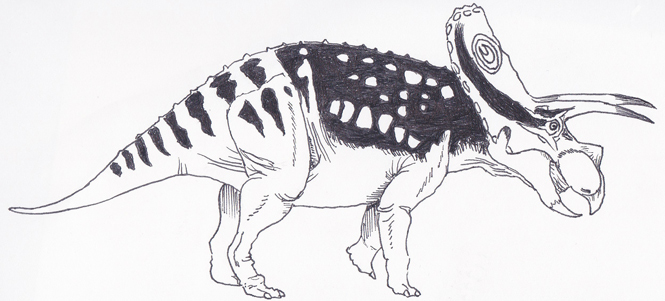
A few days ago, team members at Everything Dinosaur posted up a picture of a recently commissioned dinosaur drawing and challenged our blog readers and social media followers to identify the species illustrated. Sure enough, these knowledgeable collectors of prehistoric animals were quickly able to identify Torosaurus (T. latus).
Everything Dinosaur set a challenge, could you identify the dinosaur species illustrated in their recently commissioned drawing?Picture credit: Everything Dinosaur.
Picture credit: Everything Dinosaur
Beasts of the Mesozoic Torosaurus Dinosaur Model
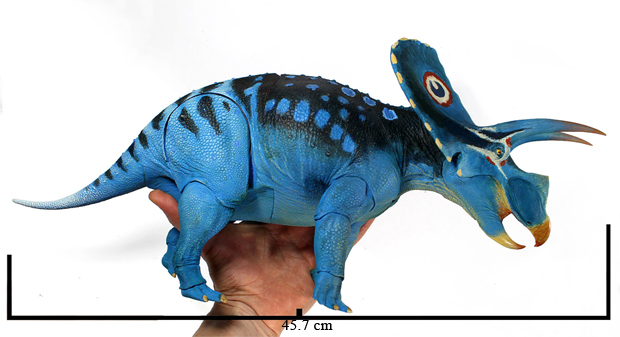
The drawing of Torosaurus was commissioned in preparation for the arrival this autumn of the Beasts of the Mesozoic Wave 3 ceratopsians, seven new, articulated horned dinosaur models including a Torosaurus replica. The drawing (above), was inspired by the photograph of the Torosaurus shown below.
The Beasts of the Mesozoic Torosaurus dinosaur model with its striking blue colour scheme. A fantastic dinosaur model part of the Wave 3 ceratopsians series.
The Wave 3 ceratopsians (Albertaceratops, Pentaceratops, Sinoceratops, adult Triceratops, Utahceratops, Xenoceratops and the Torosaurus model), are due to be shipped from the factory in September (September 2021). It is difficult to predict when these figures will be in stock at Everything Dinosaur, but they could be available sometime after the middle of October. Team members will do all they can to expediate delivery into their UK warehouse.
The target spots on the headshield of the Beasts of the Mesozoic Torosaurus dinosaur model can be clearly seen in this image.
A spokesperson from Everything Dinosaur commented:
“We like to set little puzzles and quizzes on our Instagram, Facebook and other social media pages. We thought that our picture puzzle would prove a bit of a challenge, but once again, our fans and followers have demonstrated their in-depth knowledge of prehistoric animals as well as dinosaur models and figures. Not only did respondents correctly identify Torosaurus latus but they recognised that our illustration had been inspired by the Beasts of the Mesozoic Torosaurus model. Perhaps it was the prominent target spots on the headshield that gave the game away.”
Torosaurus Model Measurements
The Beasts of the Mesozoic Torosaurus is a huge model! It is considerably bigger than both the Pachyrhinosaurus lakustai and the Centrosaurus apertus figures that were introduced earlier. The articulated Torosaurus measures nearly 46 cm in length. The dinosaur model has a declared scale of 1:18.
The Beasts of the Mesozoic Torosaurus (T. latus) dinosaur model measures nearly 46 cm long.
The spokesperson from Everything Dinosaur added:
“The Torosaurus and the adult Triceratops figures are the largest horned dinosaur models in the Beasts of the Mesozoic model range. These two figures and the other models in Wave 3 are going to make a big splash when they touch down at Everything Dinosaur’s warehouse.”
The stunning Beasts of the Mesozoic Torosaurus (T. latus) articulated dinosaur model.
To view the range of Beasts of the Mesozoic models currently in stock at Everything Dinosaur: Beasts of the Mesozoic.
At Everything Dinosaur, we are amazed at the in-depth dinosaur and prehistoric animal knowledge that is often demonstrated by our customers. Our fans, followers and supporters on the various social media platforms that we occupy such as Facebook, Instagram and YouTube constantly impress us with their knowledge of palaeontology.
We are often humbled by the sheer breadth and depth of knowledge they collectively possess. So, it’s time for another little tease, time to put our customers and social media fans to the test.
Below, we have posted up a dinosaur drawing that we at Everything Dinosaur recently commissioned.
Can you identify the dinosaur species from the drawing?
An illustration of an ornithischian dinosaur commissioned recently by Everything Dinosaur, but can you identify the dinosaur species from the drawing? Picture credit: Everything Dinosaur.
Picture credit: Everything Dinosaur
Dinosaur Picture Puzzle
Based in the UK, Everything Dinosaur is run by teachers and knowledgeable dinosaur enthusiasts helping collectors of prehistoric animal models and promoting education and an appreciation of the Earth sciences. We research and write fact sheets for many of the models and figures we sell and we commission illustrations of prehistoric animals that can be used in these fact sheets and in our other educational activities.
The dinosaur drawings that we commission help to support a network of palaeoartists and illustrators. Our financial support of these illustrators is just one of the ways in which Everything Dinosaur assists the wider community.
A spokesperson from Everything Dinosaur commented that they would reveal the identity of the dinosaur featured in the drawing in a blog post to be published later this week.
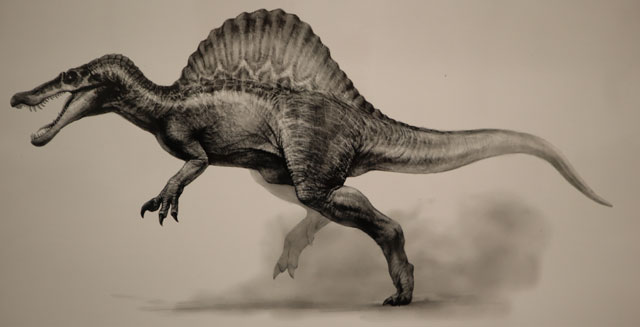
A few days ago, team members at Everything Dinosaur teased their Facebook and Instagram followers with a stunning illustration of the huge theropod dinosaur Spinosaurus. The artwork is supplied with the W-Dragon Spinosaurus (S. aegyptiacus) replica. Team members challenged followers and fans on social media to see if they could correctly identify the illustration.
A stunning Spinosaurus illustration based on an interpretation of this giant theropod around 30 years ago. Fans and followers of Everything Dinosaur on social media were asked to identify the prehistoric animal model based on the illustration. Could you work out the model that comes with this splendid Spinosaurus drawing?Picture credit: Everything Dinosaur.
Picture credit: Everything Dinosaur
Clever Collectors
Our well-informed customers, dinosaur model fans and clever collectors were able to identify the Spinosaurus artwork. We are going to have to set some sterner challenges if we are to stump our fans and followers on social media.
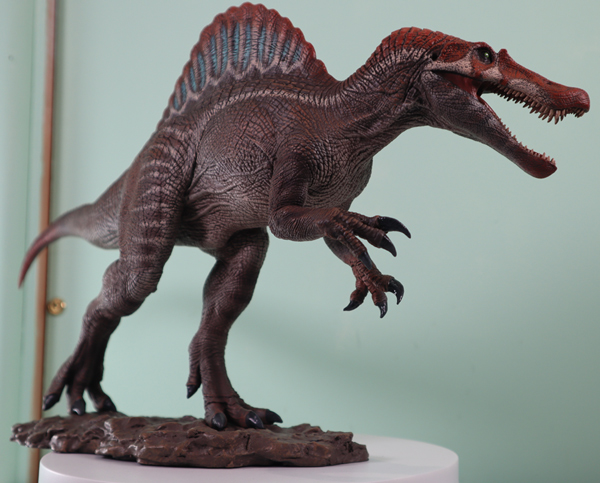
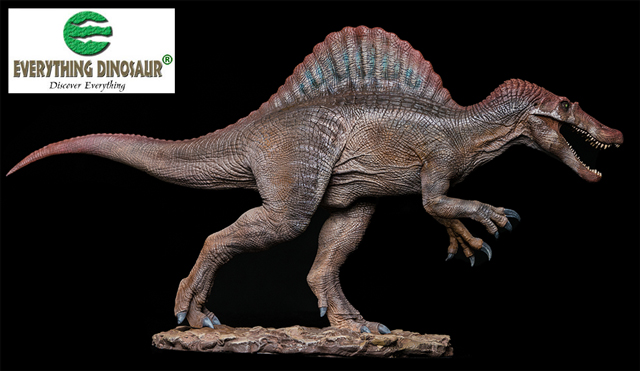
The W-Dragon Spinosaurus dinosaur model on its display base. This figure is supplied with superb Spinosaurus illustration. The artwork and the model honour the Spinosaurus that appeared in the third of the “Jurassic Park” trilogies – “Jurassic Park III”, the first film in this hugely successful franchise that was not based on a book by the late Michael Crichton.Picture credit: Everything Dinosaur.
Picture credit: Everything Dinosaur
A spokesperson from Everything Dinosaur commented:
“We have a very knowledgeable and discerning customer base and we like to set the occasional challenge to test how much they know about the models that we sell. Team members have been very impressed with the level of knowledge that has been demonstrated. We might have to set some harder challenges in the future.”
The W-Dragon Spinosaurus arrived in stock at Everything Dinosaur at the beginning of 2021. A special production run had been commissioned by Everything Dinosaur in response to requests from customers.
Earlier this month (July 13th, 2021), Everything Dinosaur announced that PNSO were adding a replica of the controversial Late Cretaceous tyrannosaur Nanotyrannus to their product range. Logan the Nanotyrannus will join several other tyrannosauroid figures in the exciting and highly respected PNSO mid-size, prehistoric animal model range. A Tarbosaurus figure has been announced (Chaunzi the Tarbosaurus) and earlier this year, Everything Dinosaur announced that this range would also include a replica of Yutyrannus huali (Yinqi the Yutyrannus).
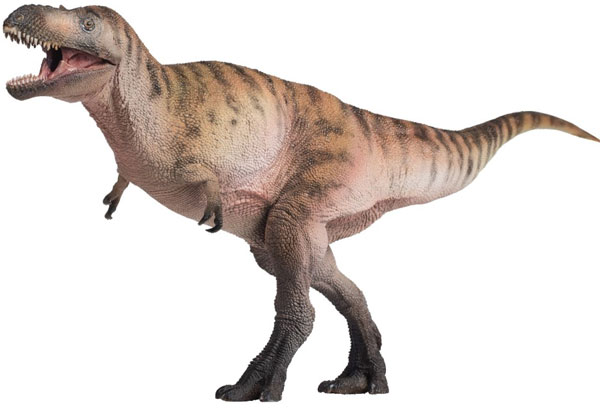
The new for 2021 PNSO Nanotyrannus dinosaur model (Logan the Nanotyrannus).
A Controversial Tyrannosaur Genus
Nanotyrannus (N. lancensis) was named and scientifically described in 1988 (Bakker et al), based on a slender skull (CMNH 7541) discovered by David Dunkle from the Cleveland Museum of Natural History (Ohio) in 1942. Bakker et al concluded that the skull represented an adult animal, but this has been refuted by a number of authors since publication. Other T. rex fossil finds, most notably the teenage specimen known as “Jane” excavated by palaeontologists from the Burpee Museum of Natural History (Illinois) and now part of a permanent tyrannosaur display, have demonstrated that the body shape of T. rex changed dramatically as it grew.
The narrow-skulled, long-limbed and more gracile tyrannosaur specimens probably do not represent a pygmy form of tyrannosaur that shared the Late Cretaceous habitat with the bruiser T. rex, these specimens are juveniles. However, as part of Everything Dinosaur’s commitment to education, we still have to prepare a fact sheet on Nanotyrannus to accompany sales of the PNSO Logan the Nanotyrannus dinosaur model.
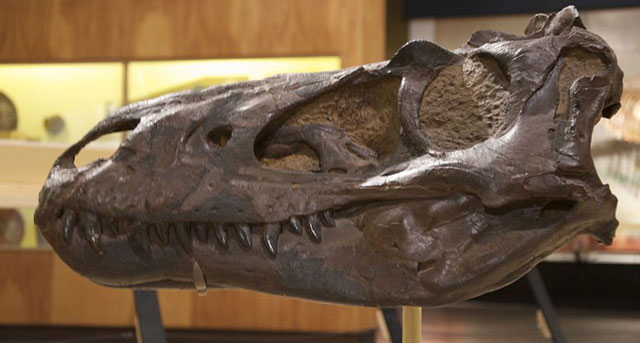
A cast of CMNH 7541 skull of Nanotyrannus lancensis (lateral view). Picture credit: S. Anselmo.The teeth of juvenile T. rexes are more slender compared to the very robust teeth of adult T. rexes which also tend to be “D-shaped” in cross section.
Nanotyrannus Scale Drawing
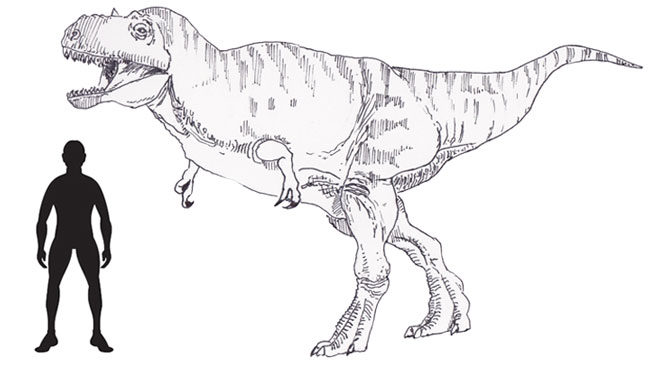
Logan the Nanotyrannus could represent N. lancensis or perhaps it could represent a teenage T. rex. That decision ultimately rests with the purchaser, team members at Everything Dinosaur will be supplying their customers with a fact sheet and this will contain a scale drawing based on the original estimated size for Nanotyrannus of a little over five metres in length.
A spokesperson from the UK-based mail order company confirmed that the illustration will be used in the Nanotyrannus fact sheet. In addition, the spokesperson explained how commissioning such drawings helped to support the wider community.
To view the PNSO prehistoric animal models currently in stock at Everything Dinosaur: PNSO Age of Dinosaurs.
Scientists have reported the discovery of a hadrosaur pedal ungual (the bone on the end of a toe that supported the keratin claw or hoof), that shows a series of small bite marks made by a theropod dinosaur. The toe claw seems to have been bitten repeatedly and although scrapes and scratches on fossil bones that are incidental feeding traces left by meat-eating dinosaurs have been well documented, these bite marks might represent something very different.
Did a baby tyrannosaur or possibly a dromaeosaurid gnaw on the toe bone of a dead duck-billed dinosaur?
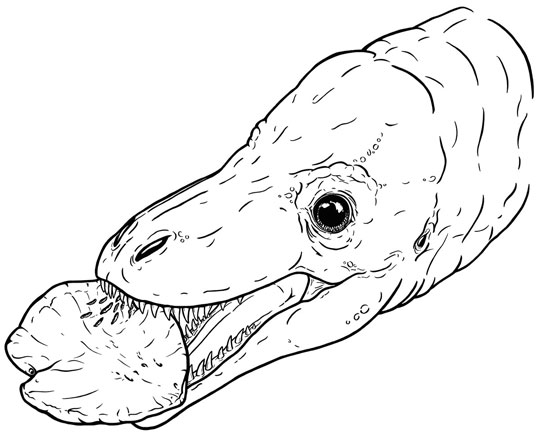
A life reconstruction of a juvenile tyrannosaur biting down on the hadrosaur pedal ungual causing the bite marks that have been preserved in the fossil (TMP 2018.012.0123). Picture credit: Joshua Doyon.
Gnawing Behaviour
Gnawing behaviour is synonymous with many types of mammals, specifically members of the Carnivora and rodents (Rodentia), but it is not commonly associated with the Dinosauria. Coprolites thought to have come from tyrannosaurs contain a lot of bone fragments, tests demonstrate that large tyrannosaurids were capable of crushing bone and it had been thought that coprolite bone content came about as bones were ingested through general consumption.
However, a trio of scientists – Caleb Brown and Darren Tanke from the Royal Tyrrell Museum of Palaeontology (Alberta) in collaboration with Dr David Hone, Senior Lecturer in Zoology at the University of London, have recently published a paper in PeerJ, that suggests that the unusual bite marks on the hadrosaur pedal ungual might represent dinosaur gnawing behaviour.
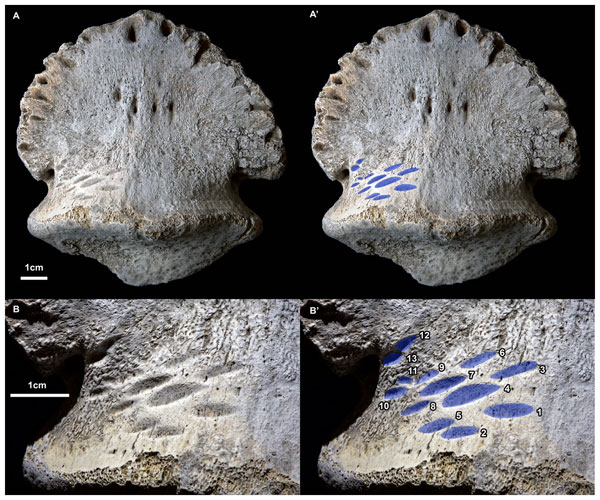
Ammonium chloride powder coated photographs of the hadrosaurid pedal showing bite marks (viewed from the bottom – ventral/plantar view). (A) View of TMP 2018.012.0123 (A), with marks highlighted in blue (A’). Close-up of the bitten region (B), with marks highlighted in blue and numbered in Arabic numerals (B’). Note scale bars = 1 cm.
Documenting Unusual Dinosaur Behaviour
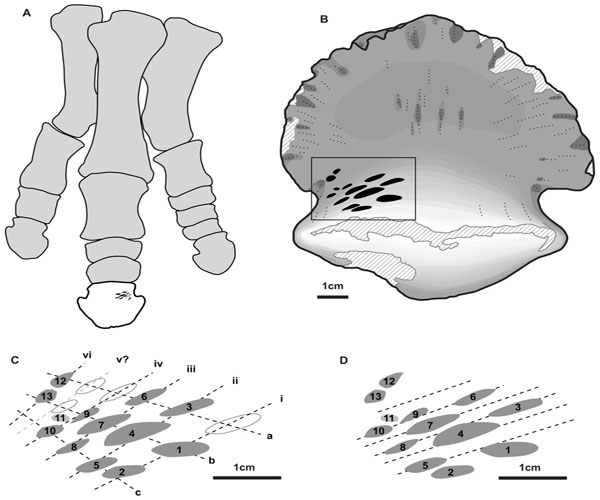
The fossil toe claw bone (specimen number TMP 2018.012.0123), comes from a bonebed (bonebed 50) that contains the disarticulated remains of several different types of duck-billed dinosaur including Corythosaurus. Although the bone came from an adult, it is not possible to confirm the dinosaur species. Thirteen, distinct and highly localised tooth marks have been identified. Their pattern suggests that a small, meat-eating dinosaur delivered up to six repeated, powerful bites to the claw bone. There would have been very little meat on this part of the hadrosaur’s body, gnawing on the pedal ungual represents an unusual and rare form of behaviour.
The researchers reviewed pedal unguals of duck-billed dinosaurs from the Dinosaur Park Formation. They identified tooth marks and feeding traces on four other toe claw bones, but this represents less than 1% of all the hadrosaur toe bones found and feeding traces were much more common on other bones.
Right articulated hadrosaurid pes in dorsal view (A), with ungual of digit three highlighted (white) and the position of the tooth marks (ventral side) indicated in black. Shaded line drawing of the ventral view of the ungual (B), showing the position of the bite marks (black). Close-up view of bite mark size (C) and (D) Close-up view of bite marks showing potential alignment of tooth row parallel with the long axes of the tooth marks. Hollow fills in C indicate potential bite marks missing from rows/columns. Note scale bars = 1 cm.
Dromaeosaur or Tyrannosaur?
The tracemaker cannot be definitively identified but the researchers rule out crocodilians, small mammal feeding traces and snake bites, leaving a theropod dinosaur as the likely tracemaker whose unusual behaviour has been recorded in the fossil. The number of theropods capable of causing such marks and known from the Dinosaur Park Formation is relatively small. The scientists considered dromaeosaurids and their close relatives the Troodontidae, as the tooth marks could have been made by a large troodontid such as Latenivenatrix. The team also considered whether the tracemaker was a young tyrannosaurid.
Given the lack of evidence of denticle spacing present on the bite marks, and that both Tyrannosauridae and Dromaeosauridae were capable of delivering bites resulting in deep furrows and pits to the bone surface, the team speculated that either a dromaeosaur (such as Dromaeosaurus or Saurornitholestes), caused the damage or perhaps the marks were made by a very young tyrannosaurid. Two genera of tyrannosaur are known from the Dinosaur Park Formation, namely Gorgosaurus and Daspletosaurus.
Perhaps, a very young Gorgosaurus, the lowest ranked animal in the pack was left to pull at and gnaw on the toe of the hadrosaur, whilst the rest pack gorged themselves on the more attractive, nutrient rich parts of the carcase.
Can Dogs Provide an Answer?
Anyone who has kept horses and dogs will tell you that when the horse’s hooves are trimmed dogs love to eat the trimmings. The hooves are made from keratin, the same protein responsible for the toe claw on the hadrosaur. Dogs can get very excited when the farrier starts to tidy up the hooves, they seem to crave the soft, recently trimmed parts of the hoof.
Many dog treats are made from horse’s hooves. Could your pet dog provide an insight into dinosaur feeding behaviour?
Could a tyrannosaur similarly have craved the taste of the toe claw of a duck-billed dinosaur?
The scientific paper: “Rare evidence for ‘gnawing-like’ behavior in a small-bodied theropod dinosaur” by Caleb M. Brown, Darren H. Tanke and David W. E. Hone published in PeerJ.
Visit the Everything Dinosaur website for models of theropod dinosaurs: Everything Dinosaur.