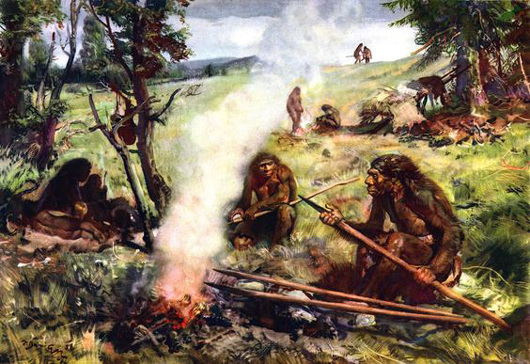
Our perception of our close cousins the Neanderthals (H. neanderthalensis) has changed dramatically over the last four decades or so. Once thought to be brutish thugs with limited intelligence recent discoveries have revealed that the “apemen” of prehistory were just as sophisticated as ourselves and their demise and eventual extinction remains a mystery. When Everything Dinosaur team members posted up some Ice Age inspired artwork by the famous 20th century wildlife illustrator and palaeoartist Charles Robert Knight earlier this month*, we were asked by a blog fan to post up some similarly themed artwork by Zdeněk Burian.
The Illustration of a Group of Neanderthals (Homo neanderthalensis) by Zdeněk Burian
Neanderthals depicted a quite primitive “ape-men”.
Picture credit: Zdeněk Burian
Burian was an equally influential 20th century artist. He produced numerous illustrations of prehistoric mammals and Ice Age scenes, but we thought we would reflect on how our views have changed regarding what is arguably the most closely related** hominin species to our own – Homo neanderthalensis by posting artwork from Burian illustrating a Neanderthal campsite.
The exact taxonomic relationship between Homo sapiens and Homo neanderthalensis remains controversial. Some palaeoanthropologists consider H. neanderthalensis to be a sub-species of H. sapiens, whilst others suggest that both H. sapiens and H. neanderthalensis are descended from Homo heidelbergensis.
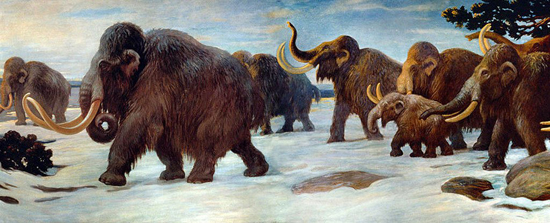
The weather might be decidedly chilly (at least here in the UK), at the moment. With this in mind, time to post up an iconic Ice Age scene painted by the renowned American palaeoartist Charles Robert Knight, depicting a herd of Woolly Mammoths on the move. This talented artist might be most famous for his depictions of dinosaurs but he also produced many artworks and illustrations of prehistoric mammals and hominins.
A Herd of Woolly Mammoths a Famous Illustration by the American Artist Charles R. Knight (1874-1953)
A Woolly Mammoth herd (Charles R. Knight). An iconic painting of a herd of Mammuthus primigenius. An ideal illustration given the chilly weather here in the UK.
Picture credit: Charles R. Knight
The artwork, illustrations and murals of Charles R. Knight can be found on display in numerous museums in the United States, such as the National Museum of Natural History (Washington – District of Columbia), the Field Museum (Chicago) and perhaps most famously of all, the American Museum of Natural History (New York).
He also painted many extant animals and several of these illustrations can be found in American Zoos such as the Bronx Zoo (New York) and the National Zoo (Washington – District of Columbia).
His illustration of a herd of mammoths is in keeping with the cold weather we are currently experiencing. The detailed and beautifully crafted artworks of Charles R. Knight are all the more remarkable given his poor eyesight. For most of his life, this highly talented and gifted person who has left a legacy of superb artworks, was virtually blind.
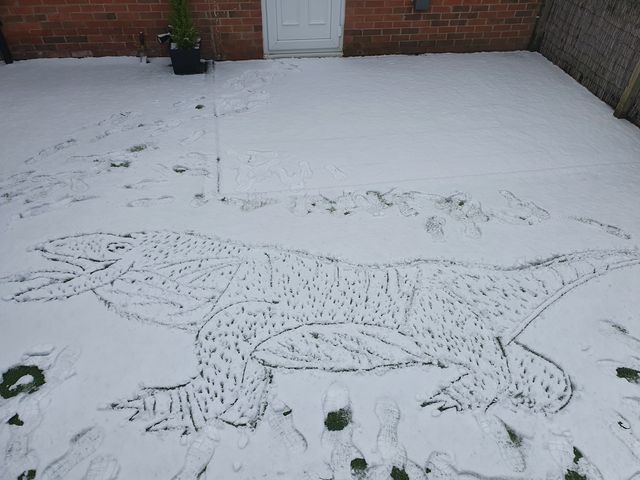
A good artist can turn their hand to using a variety of materials and techniques to express themselves. Take for instance, this excellent illustration of a Komodo dragon (V. komodoensis), created after a recent snowfall by Caldey. A fine example of snow art, depicting the largest living lizard, a reptile that would have been very uncomfortable in such a cold environment, however Caldey’s Komodo dragon looks very much at home in her back garden.
A Komodo Dragon in the Snow
Creating a Komodo dragon in the snow.
Picture credit: Caldey
Plotting Proportions and Adding Details
When working on a large project, many professional artists sketch out their design at first and use this as a blueprint for the much larger artwork. By taking this approach, the proportions can be plotted prior to the outline being made and the details added. We are not sure how Caldey created her lizard, but she has done well to plot the proportions and scale the animal to fit the space that was available. Our congratulations! What a clever and innovative piece of work.
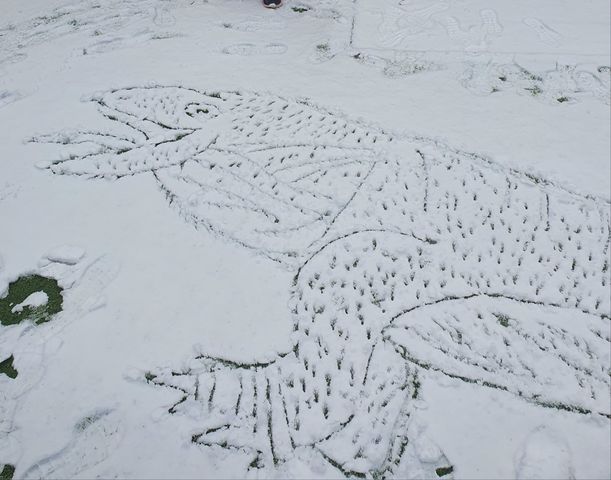
Getting Creative in the Snow – Creating a Komodo Dragon
Getting creative in the snow. An illustration of a Komodo dragon by Caldey. A close-up view of the head of the Komodo dragon snow drawing.
Picture credit: Caldey
A spokesperson from Everything Dinosaur commented:
“With the recent snowfalls in the UK, we have seen lots of pictures of snowmen on social media, but we can’t recall ever seeing a Komodo dragon before. Our congratulations to Caldey for her clever and innovative use of “solid precipitation”. We suspect there are not many gardens graced with drawings of lizards.”
Sadly, given the vagaries of the British weather, the Komodo dragon will not be on view for very long.
A new species of basal neoceratopsian has been described from fossils found near the town of Barunnbayan in the Gobi Desert of Mongolia. The little dinosaur, which was probably less than a metre long, has been named Beg tse in honour of the Himalayan deity Beg-tse. In Mongolian culture, prior to the spread of Buddhism, Beg-tse was a god of war, often depicted as heavily armoured with large, roughened patches on its body. The researchers studying the fossil material noted that, like other members of the Neoceratopsia, Beg had rugosities (roughened areas), on its skull, notably on the jugal and the surangular.
Beg tse – A Newly Described Dinosaur
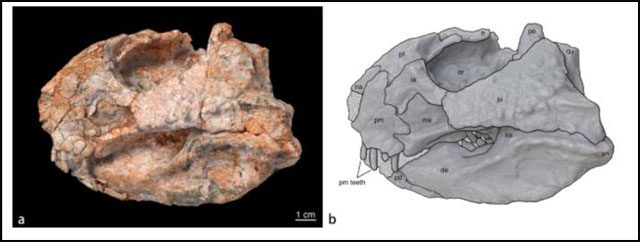
The Compressed Skull of Beg tse with an Accompanying Line Drawing
Lateral view of the holotype skull of Beg tse with line drawing. The compressed skull measures 14 cm in length approximately.
Picture credit: Yu et al (Nature)
The Most Basal Neoceratopsian Described to Date
The only known specimen of Beg tse (specimen reference: IGM 100/3652), was discovered by a joint American Museum of Nature/Mongolian Academy of Sciences expedition in 2015. The fossils probably represent a single individual and consist of an articulated partial skull along with postcranial elements consisting of a fragmentary right ischium, a partial left scapula, one rib bone and numerous bone fragments.
A phylogenetic analysis conducted by the scientists, which included Dr Mark Norell (American Museum of Natural History), indicates that Beg is the most basal neoceratopsian dinosaur known to date and is more derived than both the Psittacosauridae and Jurassic Chaoyangsauridae.
A Speculative Life Reconstruction of the Basal Neoceratopsian Beg tse
A speculative life reconstruction of the basal neoceratopsian Beg tse. The illustration has been based on the neoceratopsian Liaoceratops yanzigouensis from north-eastern China.Picture credit: Everything Dinosaur.
Picture credit: Everything Dinosaur
Proving Difficult to Date
It is difficult to estimate the date of the fossil bearing strata for many of the Gobi Desert dig sites due to the lack of detailed geological mapping and the limited number of sediments suitable for radiometric dating. The sandstone dominated deposit has been dated to between 113 – 94 million years ago, with a most probable date of circa 100 million years ago. As a result, the researchers conclude that Beg dates from the latest Early Cretaceous or the earliest Late Cretaceous.
The Ceratopsia may have originated around the Middle Jurassic, but the skull of Beg tse exhibits a combination of primitive and more derived traits which suggests that the basic ceratopsian bodyplan persisted until at least the Early-Late Cretaceous boundary. Beg along with other Asian neoceratopsians such as Auroraceratops and Mosaiceratops represent transitional forms between basal ceratopsians and more derived forms. With a wide geographical range from South Korea, China and Mongolia and a long time span from the Aptian to possibly the Campanian, the early evolutionary history of the horned dinosaurs is probably much more complex than previously thought.
The scientific paper: “A neoceratopsian dinosaur from the early Cretaceous of Mongolia and the early evolution of the ceratopsia” by Congyu Yu, Albert Prieto-Marquez, Tsogtbaatar Chinzorig, Zorigt Badamkhatan and Mark Norell published in Nature (Communications Biology).
Preparing for the Beasts of the Mesozoic Zuniceratops
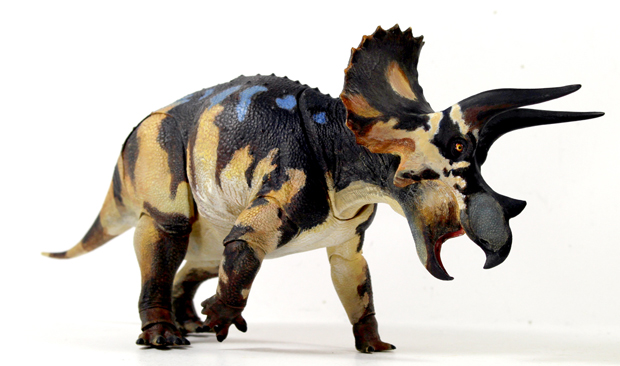
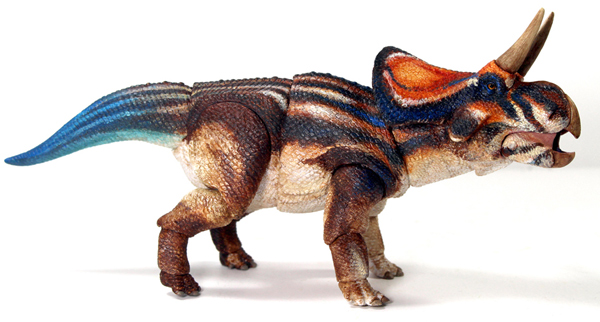
A neoceratopsian is drawing nearer. Everything Dinosaur will soon be receiving stock of the new Beasts of the Mesozoic ceratopsians, including the wonderful Zuniceratops figure. This colourful creation depicts Zuniceratops christopheri, the oldest North American ceratopsian possessing prominent, well-developed brow horns, a foretaste of what was to become with the evolution of the centrosaurine and chasmosaurine lineages of horned dinosaurs.
The Beasts of the Mesozoic Zuniceratops Model
Beasts of the Mesozoic Zuniceratops dinosaur model (lateral view).
Preparing Fact Sheets on Horned Dinosaurs Including Zuniceratops
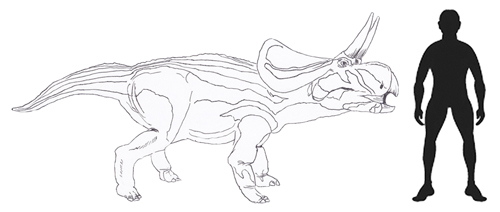
Everything Dinosaur likes to supply a free fact sheet with sales of dinosaur models. Over the years, the company has researched and written hundreds of fact sheets. As a result, most of the Beasts of the Mesozoic Ceratopsidae are already covered, but Zuniceratops is one of the exceptions. Staff are currently completing their fact sheet all about this neoceratopsian from the Middle Turonian Moreno Hill Formation of west-central New Mexico. A scale drawing of this relatively small member of the horned dinosaurs has already been commissioned.
A Scale Drawing of the Neoceratopsian Zuniceratops (Z. christopheri)
Everything Dinosaur’s scale drawing of the neoceratopsian Zuniceratops christopheri. Picture credit: Everything Dinosaur
Picture credit: Everything Dinosaur
Stocks of the new for 2020 Beasts of the Mesozoic ceratopsians are due to arrive at Everything Dinosaur’s UK warehouse in a few weeks. In addition, new supplies of the popular Beasts of the Mesozoic Raptors will be arriving too.
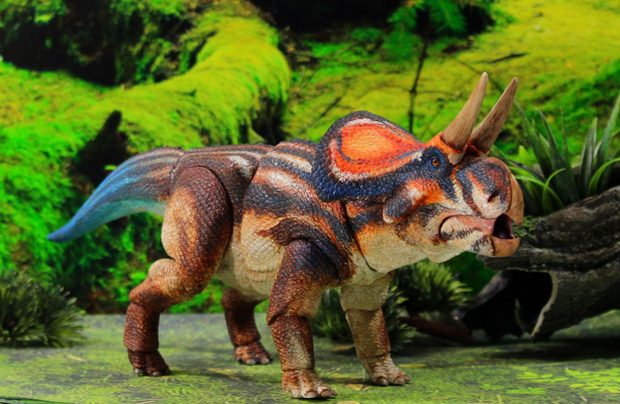
At Home in the Landscape Zuniceratops christopheri
Zuniceratops in the landscape. The beautiful Beasts of the Mesozoic Zuniceratops dinosaur model.
Zuniceratops christopheri
Zuniceratops was formally named in 1998 (Douglas Wolfe and James Kirkland), in a preliminary description. The publishing of the scientific paper coincided with the discovery of a substantial Zuniceratops bonebed that provided hundreds more fossil bones representing at least seven individuals (based on the number of lower jaws found).
The bones are disarticulated and represent a group of different sized animals, so calculating the maximum size for Zuniceratops is problematic, but most palaeontologists estimate that this horned dinosaur that lived around 90 million years ago (Turonian stage of the Late Cretaceous), measured between 2.2 and 3.3 metres in length. As such, it was very much smaller than its descendants, the centrosaurine and chasmosaurine dinosaurs that were so diverse and numerous during the Campanian and Maastrichtian faunal stages of the Late Cretaceous.
The co-association of individuals of various sizes in the bonebed suggests that this dinosaur lived in herds, with adults and younger animals demonstrating communal behaviour.
As Everything Dinosaur team members prepare to put together a video on their YouTube channel all about the dinosaur taxon Edmontosaurus, we have been busy exploring our archive and database and reviewing the original paper on this famous North American duck-billed dinosaur written by Lawrence Lambe.
The Title Page for the Scientific Paper on Edmontosaurus (Lambe 1917)
The title page from the original 1917 Edmontosaurus paper written by the eminent Canadian palaeontologist Lawrence Lambe. The paper is entitled: “A new genus and species of crested hadrosaur from the Edmonton Formation of Alberta.”
Picture credit: Archive of the “Ottawa Naturalist”
The First Two Fossil Specimens Attributed to Edmontosaurus were found by Brothers
The genus Edmontosaurus was first erected by the Canadian palaeontologist Lawrence Lambe back in 1917, in an article published in the “Ottawa Naturalist”. He described two specimens found in the Red Deer River area of Alberta, Canada, from a formation known at the time as the Edmonton Formation, but now referred to as the Horseshoe Canyon Formation. The first specimen, the type specimen for this genus, consisting of a disarticulated skull plus extensive post cranial material was collected in 1912 by Levi Sternberg. The second fossil specimen which Lambe also described in his 1917 paper, was collected by George Sternberg, Levi’s older brother, during fieldwork in 1916.
Lambe named this new “crestless hadrosaur” in recognition of the geological formation from whence these fossils came and not in honour of Edmonton, the capital city of the Province of Alberta. He did note the resemblance of the Edmontosaurus material to other duck-billed dinosaur fossils associated with the geologically younger Lance Formation of Dakota, these fossils once described as Diclonius mirabilis, were also referred to as Trachodon mirabilis and form part of an extensive fossil collection from the northern United States that went through a number of taxonomic revisions, leading eventually to the establishment of the species Edmontosaurus annectens.
The Illustration of the Skull of Edmontosaurus (1917)
The illustration of the type skull from the 1917 Edmontosaurus paper. Illustration by Arthur Miles. The paper described this lateral view of the skull as being in approximate 1:7 scale when it was reproduced in the Ottawa Naturalist.
Picture credit: Archive of the “Ottawa Naturalist” skull diagram attributed to Arthur Miles
Everything Dinosaur on YouTube
The Everything Dinosaur YouTube channel contains over 170 dinosaur and prehistoric animal-themed videos. The Edmontosaurus video will be posted up shortly and team members encourage blog readers to subscribe to our YouTube channel.
A Life Reconstruction of the Hadrosaurid Edmontosaurus
The new for 2020 Wild Safari Prehistoric World Edmontosaurus dinosaur model.
The model (pictured above), is the new for 2020 Edmontosaurus dinosaur model. To view this figure and the rest of the models in the Wild Safari Prehistoric World range: Wild Safari Prehistoric World Models and Figures.
Prehistoric animal model collectors will probably already know that CollectA is about to introduce a range of models of iconic invertebrates, animals such as a straight-shelled nautiloid, an ammonite, trilobite and an extant nautilus (Nautilus pompilius). These figures are due to be in stock at Everything Dinosaur very soon. As part of our preparations for the arrival of these replicas, our team members have been busy compiling fact sheets and data files on these key taxa.
Prehistoric Animal Model Fact Sheets
A Scale Drawing of the Nautilus
A scale drawing of an extant nautilus (Nautilus pompilius).Picture credit: Everything Dinosaur.
Picture credit: Everything Dinosaur
A spokesperson from Everything Dinosaur commented:
“We have compiled hundreds of fact sheets over the years. They are supplied to our customers, being sent out with model purchases. For example, purchasers of the CollectA nautilus model from Everything Dinosaur will also be sent a free fact sheet about this amazing cephalopod. We have also prepared fact sheets on the straight-shelled nautiloid and the horseshoe crab.”
The New for 2020 CollectA Nautilus Model (N. pompilius)
CollectA Nautilus pompilius sometimes referred to as the “Emperor nautilus” because of its large size.
A Horseshoe Crab Scale Drawing
Horseshoe Crab Scale Drawing
A scale drawing of an extant horseshoe crab. The silhouette of the hand helps to provide a scale for the illustration.Picture credit: Everything Dinosaur.
Picture credit: Everything Dinosaur
These invertebrate figures are due to arrive at Everything Dinosaur’s warehouse shortly. However, due to issues arising from the COVID-19 global pandemic affecting global logistics, we are unable to provide an exact date as to when these models will arrive. Followers of Everything Dinosaur on social media such as our Facebook page and newsletter subscribers will be alerted very quickly when these figures are in stock and available to purchase.
Our thanks to Mark for emailing Everything Dinosaur an illustration depicting life in the Western Interior Seaway around 75 million years ago. Lots of Everything Dinosaur customers all over the world are in lockdown and we have been receiving more prehistoric animal drawings and other artworks than we usually do over the last few weeks. Mark’s illustration depicts one of the apex predators of marine environments in the Late Cretaceous, a Tylosaurus (T. proriger) grabbing a marine turtle.
The turtle is described as a protostegid turtle (Protostegidae), a representative of an extinct family of marine turtles whose taxonomic position within the Order Testudines remains uncertain. One thing known about this group, which seem to be confined to the Cretaceous, is that some of these protostegids evolved into giants! For example, the largest turtle known to science Archelon (A. ischyros), has been assigned to the Protostegidae. At nearly five metres in length with a flipper span of four metres, Archelon inhabited the northern sector of the Western Interior Seaway during the Late Campanian of the Cretaceous.
The Western Interior Seaway
Tylosaurus Attacks a Protostegid Turtle (Western Interior Seaway – Late Cretaceous)
An illustration of the Western Interior Seaway in the Late Cretaceous. Surrounded by invertebrates and small fish, the Tylosaurus lunges and grabs the unfortunate turtle, whilst hesperornithiform seabirds go about their business catching squid.
Picture credit: Mark Massion
In Mark’s email he explained:
“Please find enclosed a drawing of the mosasaur, Tylosaurus proriger, attacking a protostegid turtle. This incident is taking place in the Late Cretaceous, Western Interior Sea, in what we now identify as the State of Kansas. Kansas is located in America’s Midwest.”
The artwork shows a dorsal view (top down) of the scene. The powerful jaws of the mosasaur have grabbed the turtle whilst hesperornithiform seabirds go about their business of catching squid. Our thanks to Mark for sending us this illustration.
Inspired by the “Oceans of Kansas”
Mark went onto explain the inspiration behind his artwork:
“An illustration in Michael J. Everhart’s Oceans of Kansas, caught my attention and became the impetus for this drawing. I would like to acknowledge his help and suggestions on how to correctly depict Tylosaurus. In addition, Russell Hawley’s superb drawings in Oceans of Kansas also need to be recognised.”
Many Artists Have Been Inspired by the Fossil Discoveries from the Marine Sediments of North America
A dramatic scene from the Western Interior Seaway painted by Zdeněk Burian (1905-1981), the Czech artist and illustrator who is credited for playing a pivotal role in the development of prehistoric animal illustration.
Picture credit: Zdeněk Burian
A spokesperson from Everything Dinosaur stated:
“We are always delighted to receive drawings, illustrations and other artworks from fans of prehistory and prehistoric animals. In these uncertain times, with many of our customers in lockdown, doing something creative such as drawing or model making can be very therapeutic and helpful. We have seen a rise in the number of emails we have received which contain the results of these endeavours, we hope that indulging in these creative activities helps to keep people safe and well.”
Our thanks once again to Mark for sending in his illustration.
Back at the end of March (2020), Everything Dinosaur team members published news of the discovery of four new taxa of flying reptile from the remarkable Kem Kem beds of south-eastern Morocco. Three of the pterosaurs (all members of the Ornithocheiridae), were dealt with in one scientific paper, which was published in the academic journal “Cretaceous Research”, whilst the fourth, a tapejarid named Afrotapejara zouhrii, was described in a subsequent paper also published in Cretaceous Research.
Afrotapejara zouhrii
Aware of the publication of these scientific papers, Everything Dinosaur was able to put up a blog post, prior to illustrations of the newest member of the Tapejaridae being released. However, thanks to a media release from the University of Portsmouth, we can show a life illustration of Afrotapejara zouhrii in all its glory.
An Illustration of the Recently Described North African Pterosaur Afrotapejara zouhrii
A life reconstruction of the newly described Moroccan pterosaur Afrotapejara zouhrii.
Picture credit: University of Portsmouth
The colours chosen by the artist are speculative, but tapejarids, characterised by their oversized and elaborate head crests, are regarded as some of the “flashiest” and flamboyant of all the Pterosauria, their crests probably played a role in visual communication, so why not make their crests bright and colourful.
The First Tapejarid Known from Africa
Tapejarids were geographically widespread in the Lower Cretaceous. Fossils are known from China, Brazil and Europe. It had long been suspected that these types of pterosaurs would be found in the famous Kem Kem beds, but the fragmentary remains associated with these strata delayed positive identification.
Professor David Martill (School of the Environment, Geography and Geosciences, University of Portsmouth), a co-author on the ornithocheirid paper and lead order on the Afrotapejara study, commented:
“The study of Moroccan material shows that we are still far from having found all the paleontological treasures of North Africa. Even fragmentary fossils, like the jaw piece of the new pterosaur, can give us important information about the biodiversity of the past.”
Honouring Professor Samir Zouhri
In our earlier blog post, we stated that the specific or trivial name chosen for this flying reptile honoured Moroccan palaeontologist Professor Samir Zouhri. We can now confirm that this is correct, the professor is being honoured for his contribution to field work over many years and for helping to develop the science of palaeontology in Morocco. Pleasingly, the fragmentary remains of the newest member of the Tapejaridae family are staying in Morocco, they are now part of the collection of the Faculty of Sciences Aïn Chock, Casablanca Hassan II University.
Everything Dinosaur acknowledges the assistance of a media release from the University of Portsmouth in the compilation of this article.
The scientific paper: “A new tapejarid (Pterosauria, Azhdarchoidea) from the mid-Cretaceous Kem Kem beds of Takmout, southern Morocco” by David M. Martill, Roy Smith, David M. Unwin, Alexander Kao, James McPhee and Nizar Ibrahim published in Cretaceous Research.
In the last few weeks, a number of scientific papers have been published detailing new pterosaur discoveries and fossil finds. We really do seem to be living in a “golden age” of flying reptile research. For example, researchers have identified the fragmentary fossil remains of three types of pterosaur from the famous Cretaceous Kem Kem beds of Morocco (Anhanguera, Coloborhynchus and Ornithocheirus). Even before the dust had settled on that publication, another scientific paper, published this week, describes Afrotapejara zouhrii, the newest member of the Tapejaridae, fossils of which also come from the enigmatic Kem Kem beds.
The “Golden Age” of Pterosaur Research – Illustration of Three of the New Pterosaur Types Described
The pterosaur Anhanguera soars over the skies of North Africa with Coloborhynchus and Ornithocheirus to keep it company.
The Kem Kem Formation is exposed in south-eastern Morocco and neighbouring Algeria. The extensive deposits represent an inter-tidal, estuarine environment with large, wide lagoons and a broad floodplain criss-crossed by numerous rivers. These sediments were laid down in the Albian to Cenomanian faunal stages of the Cretaceous, approximately 100 to 95 million years ago.
The terrestrial landscape was dominated by dinosaurs, surprisingly, there seems to have been an overabundance of big theropods present – Spinosaurus, Rugops (other abelisaurs), Sauroniops, Deltadromeus, Carcharodontosaurus, potential dromaeosaurids and a wealth of other fossil bones and isolated teeth that represent indeterminate species.
Trouble is, the transport of material due to river and tidal action has resulted in a mixing up of fossil material. Fossil beds contain a vast array of jumbled up, disarticulated material, much of which may also have been re-deposited from its original stratigraphic layer. These deposits have been colourfully described as representing fossils that have been put in a blender, such is their mixing and depositional status.
Typical Isolated and Fragmentary Vertebrate Fossil Remains from the Kem Kem Beds
Assorted vertebrate fossil remains from the Kem Kem beds of Morocco.
Pterosaurs as Piscivores
In the first scientific paper, researchers from the University of Portsmouth, Baylor University (Waco, Texas), the University of Detroit Mercy (Detroit), Leicester University, the Laboratoire Santé et Environnement (Morocco) and the University of Bath report on the discovery of fragmentary jaws and associated teeth that led to the identification of three new types of pterosaur.
The remains suggest three ornithocheirid pterosaurs, a second species of Coloborhynchus and an Ornithocheirus reminiscent of Ornithocheirus fossil material known from the Cambridge Greensand deposits of southern England. In addition, a portion of a lower jaw (mandibular symphysis), closely resembles that of the South American ornithocheirid Anhanguera piscator, fossils of which are known from the roughly contemporaneous Romualdo Member of the Santana Formation (Brazil).
An Illustration of Anhanguera (Ornithocheiridae Family)
A typical member of the Anhanguera genus. Note the large and very prominent, conical teeth in the jaw. All three newly described genera are believed to have been primarily fish-eating (piscivores).
Fossils from Morocco
As well as representing a turbulent depositional environment, the fossiliferous beds of south-eastern Morocco provide an additional challenge for scientists. Local residents mine the sedimentary rocks, often using only rudimentary tools and materials, so that they can sell their fossil finds to dealers and collectors. Fortunately, in this case, the fragments of jaw were acquired by scientists enabling a proper academic investigation to be carried out. The teeth of these pterosaurs suggest that they were probably piscivores, the largest of which probably had a wingspan in excess of four metres.
In the paper, the researchers conclude that the Kem Kem fossil assemblage includes at least nine species of pterosaur, of which the majority (five), are members of the Ornithocheiridae. These strata help to support the theory that toothed pterosaurs remained diverse throughout the late Early Cretaceous, before going into decline and eventually disappearing after the Cenomanian faunal stage.
And There’s More – Another Moroccan Pterosaur This Time a Tapejarid
New pterosaur discoveries are behaving a bit like buses at the moment (prior to the coronavirus pandemic), three come along and then shortly afterwards another one turns up. Many of the same scientists from the first academic paper, have published, albeit a little earlier than expected, another paper, this time naming a new species tapejarid pterosaur. Unlike the other three, this flying reptile was edentulous (no teeth in the jaws). The newly described tapejarid has been named Afrotapejara zouhrii, based on yet more fragmentary material including jaw elements.
A Typical Illustration of a Tapejarid Pterosaur
A scale drawing of the tapejarid Pterosaur Tupandactylus imperator. A typical tapejarid – a family of pterosaurs famed for their striking and often over-sized head crests. Picture credit: Everything Dinosaur.
Picture credit: Everything Dinosaur
Fossils of Pterosaurs from the Kem Kem Beds
Fossil jaws seem to be taphonomically selected for in the Kem Kem beds. Other pterosaur remains have been frequently reported from these deposits, but rarely are the fossils diagnostic. Isolated mandibular material had hinted at the present of tapejarids in northern Africa in the Early Cretaceous, but Afrotapejara is the first genus to be erected. It represents the fourth example of a toothless pterosaur taxon to have been described from the Kem Kem beds and it provides the first unambiguous evidence to support the presence of the Tapejaridae in Africa. The genus name translates as “African tapejarid”, whilst we suspect that the specific name honours Samir Zouhri, one of the authors of the first pterosaur paper reported upon in this blog post.
Based on this evidence, it seems that we really are living in a “golden age” of pterosaur research.
The first scientific paper: “New toothed pterosaurs (Pterosauria: Ornithocheiridae) from the middle Cretaceous Kem Kem beds of Morocco and implications for pterosaur palaeobiogeography and diversity” by Megan L. Jacobs, David M. Martill, David M. Unwin, Nizar Ibrahim, Samir Zouhri and Nicholas R. Longrich published in Cretaceous Research.
The second scientific paper: “A new tapejarid (Pterosauria, Azhdarchoidea) from the mid-Cretaceous Kem Kem beds of Takmout, southern Morocco” by David M. Martill, Roy Smith, David M. Unwin, Alexander Kao, James McPhee and Nizar Ibrahim published in Cretaceous Research.