All about dinosaurs, fossils and prehistoric animals by Everything Dinosaur team members.

Fossil finds, new dinosaur discoveries, news and views from the world of palaeontology and other Earth sciences.

31 08, 2017

Siberian Villager Finds Steppe Mammoth Remains

By |2023-08-11T14:19:42+01:00August 31st, 2017|Categories: Dinosaur and Prehistoric Animal Drawings, Dinosaur and Prehistoric Animal News Stories, Main Page|0 Comments

A Mammoth in the Vegetable Patch

Everything Dinosaur has been informed about an article recently published in the “Siberian Times” reporting that a resident of the small and relatively remote village of Oy, in the Sakha Republic of north-eastern Russia, has found the fossilised remains of a Steppe Mammoth (M. trogontherii).  The local man was hoping to plant cabbage and potatoes in their vegetable patch.  Instead the digging uncovered the substantial tusks of a long-extinct member of the elephant family.

The Steppe Mammoth

The newspaper reports that the tusks measure 2.7 metres in length and at their base they are around 50 centimetres in diameter.  Palaeontologists and a regional historian, Prokopiy Nagovitsyn, were called in to assess the villager’s fossil discovery.  Officials are quoted as estimating the tusks at around 400,000-years-old.

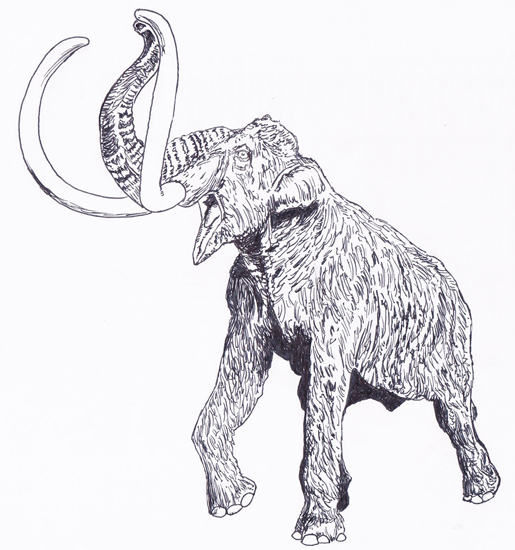
A Line Drawing of a Steppe Mammoth (Mammuthus trogontherii)

Steppe Mammoth illustration.

An illustration of a Steppe Mammoth (Mammuthus trogontherii). Picture credit; Everything Dinosaur.

Picture credit: Everything Dinosaur

To view models of prehistoric elephants: Eofauna Scientific Research Models.

Not Revealing the Exact Location of the Fossil Find

The historian (Prokopiy Nagovitsyn), explained that due to “understandable reasons”, the exact location of the fossil find was not being revealed.  If the location was known, this might attract unscrupulous ivory hunters who might attempt to steal the valuable tusks or they might be tempted to start their own excavations.

The vegetable patch discovery is described as “an extraordinary fossil find”.  Numerous Woolly Mammoths (Mammuthus primigenius), specimens are known from the Sakha Republic, the finding of the fossilised remains of a much more ancient Steppe Mammoth is a much rarer event.  Steppe Mammoths predate the Woolly Mammoth by hundreds of thousands of years.  Larger than M. primigenius, probably the largest of the Mammoth family, with adult males estimated to have weighed as much as fifteen tonnes, the Steppe Mammoth roamed Siberia from around 600,00 years ago to as recently as 370,000 years ago.

Everything Dinosaur stocks a large range of Ice Age models.  These models include a variety of prehistoric elephants and other ancient mammals.

To visit the models section of the Everything Dinosaur website: Prehistoric Mammal Models and Ice Age Replicas.

In 2015, an almost complete fossil skeleton of a Steppe Mammoth was discovered in the same region of Russia.  The Steppe Mammoth is believed to have evolved from the southern, ancestral Mammoth (Mammuthus meridionalis).

Visit the Everything Dinosaur website: Everything Dinosaur.

30 08, 2017

The Oldest Elasmosaurid in Town a New Basal Elasmosaurid is Described

By |2024-05-09T08:42:25+01:00August 30th, 2017|Categories: Dinosaur and Prehistoric Animal News Stories, Dinosaur Fans, Main Page|0 Comments

A New Basal Elasmosaurid is Described (Lagenanectes richterae)

It has been a busy week for Sven Sachs of the Bielefeld Natural History Museum, Germany.  A few days ago, Everything Dinosaur blogged about the discovery of the largest Ichthyosaurus specimen known (I. somersetensis), Sven was a co-author of the scientific paper published in the “Acta Palaeontologica Polonica”.  Today, we feature another marine reptile discovery, this time it concerns one of the oldest-known members of the Elasmosauridae and Sven is one of the co-authors of this paper too.

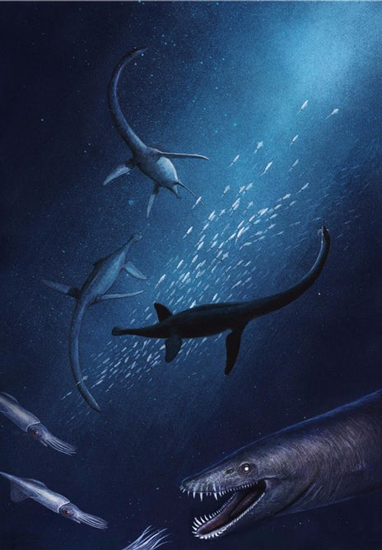
An Artist’s Impression of the Newly Described Basal Elasmosaurid Lagenanectes richterae

Newly described basal elasmosaurid Lagenanectes.

A pod of Lagenanectes attack a shoal of squid.

Picture credit: Joschua Knuppe

A Marine Reptile Discovery

Writing in the “Journal of Vertebrae Paleontology”, the researchers Jahn Hornung and Benjamin Kear as well as Sachs, describe a previously unrecognised new species of elasmosaur from Lower Cretaceous sediments at Sarstedt near Hannover (northern Germany).  The Elasmosauridae are a diverse family of plesiosaurs that are characterised by the extraordinarily long necks, with some specimens having more than seventy cervical vertebrae.  They were predominately piscivores, preying on small fish and squid, which they swallowed whole.

Older definitions of the Elasmosauridae included many Jurassic long-necked forms, however, most palaeontologists now restrict elasmosaurids to just the Cretaceous taxa.

The fossilised bones of the marine reptile were unearthed in 1964 as workmen were excavating a clay pit near the town of Sarstedt.  The fossils consist of a partial skull (cranium and mandible), the atlas-axis complex, additional cervical vertebrae, caudal vertebrae, an ilium, and limb elements.  The material was added to the vertebrate fossil collection of the Lower Saxony State Museum (Hannover), where it remained until scientists were recently invited to make a formal examination of the specimen.

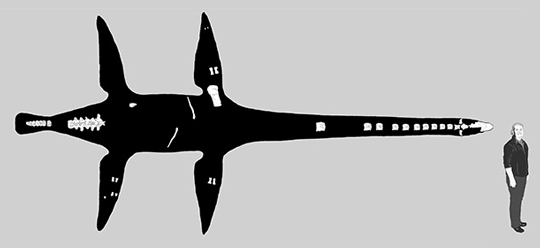
A Line Drawing of Lagenanectes richterae Showing the Known Fossil Material

Lagenanectes richterae scale drawing.

A scale drawing of Lagenanectes richterae.

Picture credit: Joschua Knuppe

Lead author of the study, Sven Sachs stated:

“It was an honour to be asked to research the mysterious Sarstedt plesiosaur skeleton.  It has been one of the hidden jewels of the museum and even more importantly, it has turned out to be new to science.”

“Lagena Swimmer”

This basal elasmosaurid lived around 132 million years ago (Hauterivian faunal stage of the Lower Cretaceous), it has been named Lagenanectes richterae.  The genus name is the Latinised form of the Leine River, which flows through the townscape of Sarstedt.  The species name honours Dr Annette Richter, (Chief Curator of Natural Sciences at the Lower Saxony State Museum), who facilitated documentation of the fossil.  Dr Richter also makes a handy scale reference in the drawing (above), L. richterae is estimated to have been around eight metres in length.  The skull of Lagenanectes will be displayed as a centrepiece in the “Water Worlds” exhibition at the Lower Saxony State Museum.

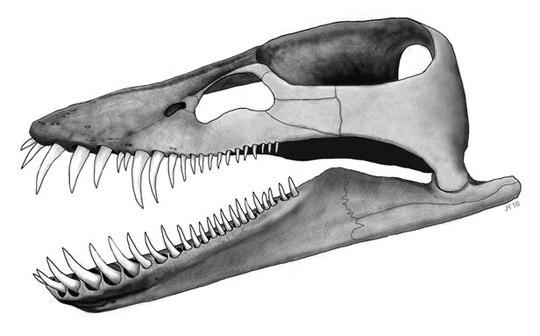
A Drawing of the Skull of L. richterae

Lagenanectes skull drawing.

The needle-like and forward pointing teeth are ideal for catching slippery prey.

Picture credit: Jahn Hornung

For models and replicas of marine reptiles including elasmosaurids: Models of Marine Reptiles and Other Prehistoric Animals.

Lagenanectes richterae

Co-author of the paper, Dr Jahn Hornung, a palaeontologist based in Hamburg said:

“Its broad chin was expanded into a massive jutting crest, and its lower teeth stuck out sideways.  These probably served to trap small fish and squid that were then swallowed whole.”

Internal channels in the upper jaws might have housed nerves linked to pressure receptors or electroreceptors on the outside of the snout that would have helped Lagenanectes to locate its prey.

Bones at the back of the skull and the atlas show evidence of a chronic bacterial infection (osteomyelitic infection).  This pathology is clearly visible in the fossil bones and this infection could have eventually claimed the animal’s life.

Dr Benjamin Kear (Museum of Evolution, Uppsala University, Sweden), who also contributed to the study, explained the significance of this Plesiosaur specimen:

“The most important aspect of this new plesiosaur is that it is amongst the oldest of its kind.   It is one of the earliest elasmosaurs, an extremely successful group of globally distributed plesiosaurs that seem to have had their evolutionary origins in the seas that once inundated Western Europe.”

To read the earlier article chronicling the work of Sven Sachs in relation to the largest specimen of Ichthyosaurus described to date: Palaeontologists and the Pregnant Ichthyosaurus.

Visit the Everything Dinosaur website: Everything Dinosaur.

29 08, 2017

New Species of African Titanosaur Described

By |2023-08-11T13:43:22+01:00August 29th, 2017|Categories: Dinosaur and Prehistoric Animal News Stories, Dinosaur Fans, Main Page|0 Comments

Shingopana songwensis – Hinting at a Diverse African Titanosaur Biota

A team of international scientists including Dr Eric Gorscak, a recent PhD graduate of Ohio University and now a post-doctoral researcher at the Field Museum of Natural History (Chicago, USA), have identified a new species of Cretaceous long-necked dinosaur from south-western Tanzania.  This new species of plant-eating giant has been named Shingopana songwensis and its discovery helps to demonstrate how diverse the dinosaur fauna was in southern Africa during the Cretaceous.

Writing in the Journal of Vertebrate Palaeontology, the scientists, describe the new titanosaur, one that shows anatomical affinities to South American titanosaurs, indicating that Shingopana was more closely related to South American dinosaurs than it was to those species known from Africa.

The first fossils of this new dinosaur were found in 2002 by scientists affiliated with the Rukwa Rift Basin Project, an international effort led by Ohio University Heritage College of Osteopathic Medicine researchers Patrick O’Connor and Nancy Stevens.  Other elements associated with the specimen were found over the next two years.  All the fossils come from Namba Member of the Galula Formation.

An Illustration of Shingopana songwensis

Shingopana illustration.

An illustration of Shingopana songwensis.

Picture credit: Mark Witton

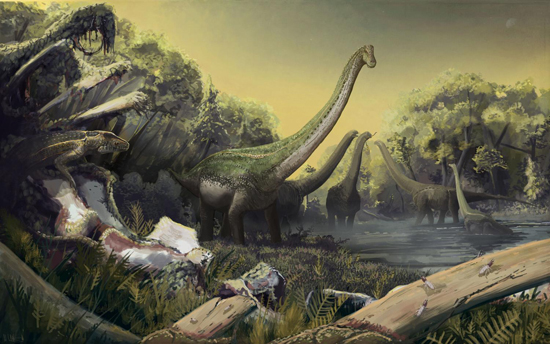
In the beautiful illustration created by palaeoartist Mark Witton, (above), a herd of Shingopana can be seen in the background, whilst the foreground is dominated by the rotting carcass of S. songwensis.  A crocodylomorph is scavenging and the corpse has attracted the attention of numerous carrion beetles some of which can be clearly seen on an exposed rib bone.

The Enigmatic Galula Formation

The Galula Formation consists of a 600-3000 metre-thick sequence of amalgamated, braided fluvial deposits that were deposited across an extensive braidplain system via multiple parallel channels that had their source in the highlands of Zambia and Malawi.  Dating these mainly sandstone sediments has proved challenging.  Magnetostratigraphic studies place these deposits, split into two main members (the Namba and the geologically older Mtuka members), as being no older than mid-Late Cretaceous (Turonian-Campanian) for the Namba and constraining the Mtuka to the Middle Cretaceous (Aptian – Cenomanian).  Although most of the vertebrate fossils discovered to date are fragmentary in nature, they hint at a rich biota made up of numerous crocodyliforms, turtles, theropods, sauropods plus evidence of several types of small mammal.

The fossils represent around 10% of the total skeleton.  They were excavated from a single location and the fossils were disarticulated.  A comparison of the left humerus to that of the contemporaneous but not closely related Malawisaurus suggests that Shingopana might have exceeded 16 metres in length, although other media sources report that this dinosaur was under ten metres in length.  Other fossils include part of the jaw (left angular), part of the hip girdle, cervical and dorsal ribs along with neck bones (cervical vertebrae).

“Wide Neck” from the Songwe Region

The name of this new dinosaur (Shingopana songwensis), is derived from the local Swahili term “shingopana” for “wide neck”.  The neural spine of the cervical ribs show a bulbous expansion, that led the researchers to assign this new genus to the Aeolosaurini, all the dinosaurs assigned to this clade (as far as we at Everything Dinosaur know), come from South America.  The trivial name honours the location of the discovery, the Songwe region of the Great Rift Valley.  Shingopana is the first African titanosaur that is closely related to Aeolosaurines.

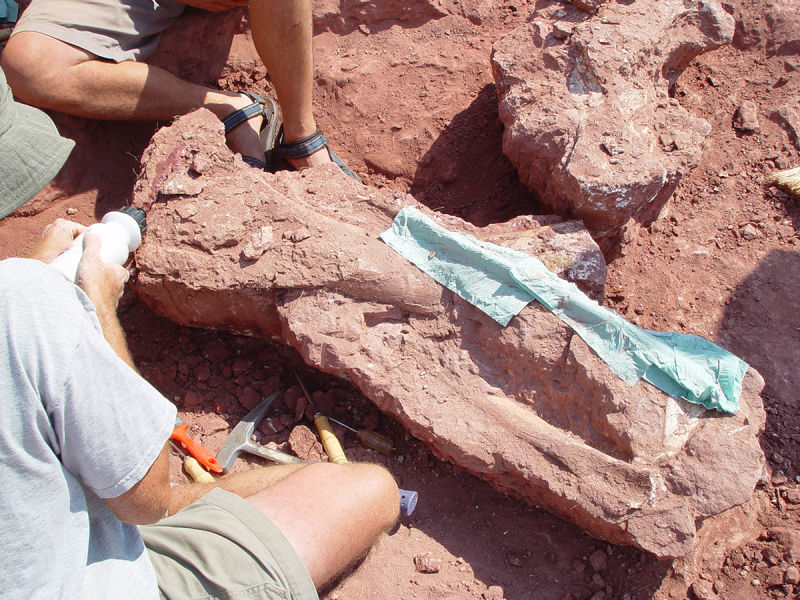
Shingopana Fossil Bones Being Excavated and Prepared for Field Removal

Shingopana fossils at the dig site.

A limb bone and rib are carefully stabilised in the field prior to removal.

Picture credit: Nancy Stevens

Commenting on the phylogeny of Shingopana, Dr Gorscak stated:

“There are anatomical features present only in Shingopana and in several South American titanosaurs, but not in other African titanosaurs.  Shingopana had siblings in South America, whereas other African titanosaurs were only distant cousins.”

This discovery supports the hypothesis that the biota of southern and northern Africa were very different during the Cretaceous.  Dinosaurs from the southern part of the continent were probably more closely related to South American dinosaurs than they were to the dinosaurs that lived on the northern part of Africa.  Shingopana co-existed with another titanosaur, Rukwatitan bisepultus, but just like Malawisaurus, Rukwatitan was not closely related to Shingopana.

To read Everything Dinosaur’s article on the discovery and naming of Rukwatitan bisepultusA Rare African Giant – Rukwatitan.

Dinosaur CSI

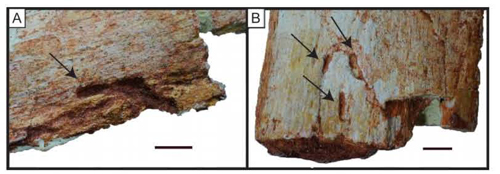
The researchers noted that the bones had been weathered prior to fossilisation.  The fossils show extensive borings, most likely caused by the activities of carrion beetles.  The presence of these trace fossils are particularly notable on the cervical vertebrae, the humerus and the pubis.  Over 150 separate bore holes were identified on 10 different bones from the dig site.  Insect borings such as these give palaeontologists an opportunity to reconstruct the timing of death and the taphonomy (the fossilisation process), of the fossil material.

A Close-up View of Rib Bones with Trace Fossils (Insect Borings)

Damaged rib bones of Shingopana.

Rib bones show damage, the preserved bore holes of carrion beetles.

Picture credit: Journal of Vertebrate Palaeontology

A Changing Cretaceous Landscape

As the super-continent of Gondwana began to break up, so Madagascar and Antarctica split from the landmass that we now know as southern Africa. This was followed by the gradual northward “unzipping” of South America.  Northern Africa maintained a land bridge with South America, but southern Africa slowly became more isolated until the continents completely separated around 105 – 95  million years ago.

Other factors such as terrain and climate may have further isolated southern Africa.  The discovery of Shingopana highlights the different regional faunas between north Africa and southern Africa and suggests that tectonically driven separation of the landmasses may have influenced the development of progressively isolated southern African faunas throughout the Cretaceous.

Visit the Everything Dinosaur website: Everything Dinosaur.

28 08, 2017

Palaeontologists and the Pregnant Ichthyosaurus

By |2023-08-11T13:35:23+01:00August 28th, 2017|Categories: Dinosaur and Prehistoric Animal News Stories, Dinosaur Fans, Main Page|0 Comments

Largest Ichthyosaurus on Record Springs a Couple of Surprises

A team of scientists from the UK and Germany have discovered the largest Ichthyosaurus known to science, what’s more, the specimen was pregnant at the time of its demise some 200 million years ago.  In addition, the fossilised marine reptile, part of a collection at the Lower Saxony State Museum (Hannover, Germany), turned out to be a chimera.  The specimen did not represent two ichthyosaurs (mum and the baby), but actually three!  There’s a twist in this tale.

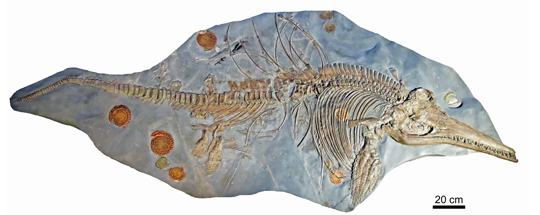
Ichthyosaurus somersetensis Specimen in the Study

Ichthyosaurus specimen turns out to be a chimera with an embryo.

Ichthyosaurus specimen from the study.

Picture credit: Manchester University

Largest Ichthyosaurus

The new specimen is estimated to be between three and three and a half metres long.  It is an adult female.  The Ichthyosaurus genus consists of a number of species, several of which have been named and described in the last two years, with palaeontologist Dean Lomax of Manchester University, one of the authors of this new study, playing a prominent role in the description of Ichthyosaurus anningae (2015), I. larkini and I. somersetensis (both 2016).

The very first Ichthyosaurus species to be erected was Ichthyosaurus communis, that took place way back in 1822, thanks to the fossil finding exploits of Mary Anning.  Lots of Ichthyosaurus fossils have been collected, mostly from Lower Jurassic rocks of Europe, as a result, this genus is the best known of all the ichthyosaurs.

An Illustration of a Typical Ichthyosaur

An ichthyosaur illustration.

An ichthyosaur (courtesy of Robert Richardson).

Picture credit: Robert Richardson

Not the Biggest Genus in the Ichthyosauria

Ichthyosaurus is so well known in the scientific community that the Order to which this genus belongs (Order Ichthyosauria), was named after Ichthyosaurus.  Most fossil examples of Ichthyosaurus show specimens of around two metres in length, this specimen was considerably larger, making it the largest Ichthyosaurus on record, although it would have been dwarfed by other members of the Ichthyosauria – giants such as Himalayasaurus and Shonisaurus that grew to lengths in excess of fifteen metres.

This fossil specimen was originally discovered on the Somerset coast, sometime in the mid 1990s.  It remained unstudied until it ended up in the vertebrate fossil collection of the Lower Saxony State Museum.  Co-author of the scientific paper, published in “Acta Palaeontologica Polonica”, Sven Sachs (Bielefeld Natural History Museum, Germany), first examined the fossil in August 2016, whilst on a routine visit to Hannover.  He contacted Dean Lomax and the two scientists set about investigating just what the fossil actually represented.

The pair identified the fossil as an example of Ichthyosaurus somersetensis, a species that Dean and another colleague, Professor Judy Massare (Brockport College, New York), had named a year earlier.

Dean Lomax commented:

“It amazes me that specimens such as this [the biggest] can still be ‘rediscovered’ in museum collections.  You don’t necessarily have to go out in the field to make a new discovery.  This specimen provides new insights into the size range of the species, but also records only the third example of an Ichthyosaurus known with an embryo.  That’s special.”

Ichthyosaurus Embryo

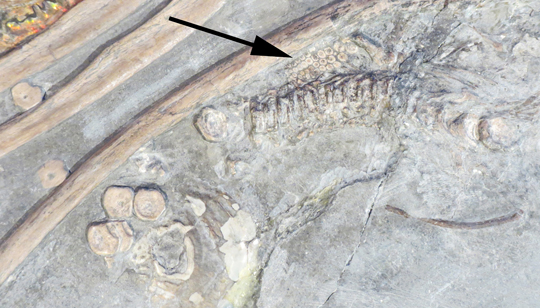
The embryo is incomplete and preserves only a portion of the back bone (vertebrae), a forefin, ribs and a few other bones.  The preserved string of vertebrae is less than 7 centimetres in length.  The bones of the embryo are not fully ossified, indicating that the embryo was still developing, when it and its mother perished.

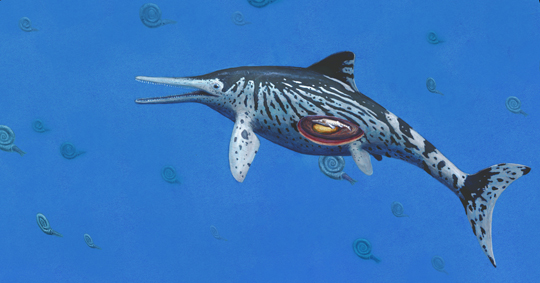
A Life Reconstruction of the Ichthyosaurus with Location of the Embryo

Life reconstruction of the Ichthyosaurus showing embryo location.

An illustration of the Ichthyosaurus showing the location of the embryo.

Picture credit: Joschua Knüppe

A Close View of the Embryo Fossil Material in the Body Cavity

Ichthyosaurus embryo fossil material.

The black arrow indicates the position of the embryo fossil material.

Picture credit: Manchester University

Not the Right Tail

Dean and his co-author Sven, also made another intriguing discovery.  The tail of this newly described specimen did not belong with the rest of the fossil skeleton.  The rear portion of another ichthyosaur had been added, probably to make the exhibit more visually appealing.  As well as being an expectant mother this Ichthyosaurus turned out to be a chimera.

Sven added:

“It is often important to examine fossils with a very critical eye.  Sometimes, as in this instance, specimens aren’t exactly what they appear to be.  However, it was not ‘put together’ to represent a fake, but simply for a better display specimen.  But, if “fake” portions remain undetected then scientists can fall foul of this, which results in false information presented in the published record.”

To read about the discovery of I. larkini and I. somersetensisTwo New Species of British Ichthyosaurus Swim into View.

Sven Sachs went onto state:

“Specimens like this provide palaeontologists with important information about when these animals lived.  Many examples of Ichthyosaurus are from historical collections and most do not have good geographical or geological records, but this specimen has it all.  It may help to date other Ichthyosaur fossils that currently have no information.”

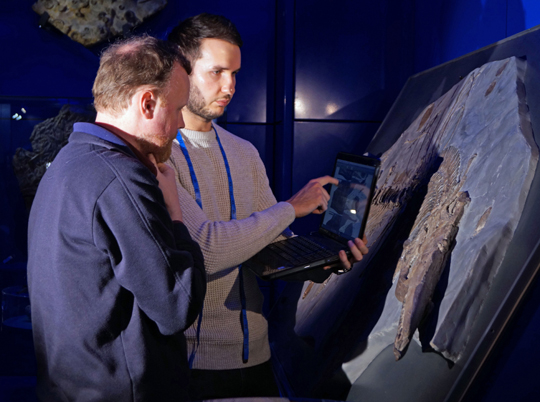
Dean Lomax and Sven Sachs Examining the Specimen

Sven Sachs and Dean Lomax study the specimen.

Dean Lomax and Sven Sachs study the specimen.

Picture credit: Manchester University

Visit the website of Dean Lomax: Dr Dean Lomax.

The scientific paper: “Lomax, D. R. and Sachs, S. 2017. On the largest Ichthyosaurus: A new specimen of Ichthyosaurus somersetensis containing an embryo” published in Acta Palaeontologica Polonica.

Visit the Everything Dinosaur website: Everything Dinosaur.

23 08, 2017

New Long-Necked and Horned Stem Archosaur from India

By |2023-08-11T10:16:55+01:00August 23rd, 2017|Categories: Dinosaur and Prehistoric Animal News Stories, Dinosaur Fans, Main Page, Photos/Pictures of Fossils|0 Comments

The Weird and Wonderful Shringasaurus indicus

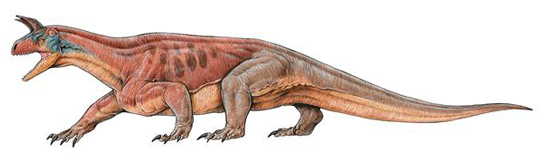
The Triassic had some very weird and wonderful animals.  Fantastic phytosaurs, the first pterosaurs, evolving and radiating members of the Dinosauria and joining this menagerie is the newly described Shringasaurus indicus, a large, herbivorous, horned plant-eater that superficially resembled a horned dinosaur.

An Illustration of the Newly Described Basal Archosaur S. indicus

The Triassic stem Archosaur Shringasaurus indicus.

An illustration of the newly described Triassic stem archosaur Shringasaurus indicus.

Picture credit: Conicet

A Pair of Large Supraorbital Horns

The most surprising feature of this reptile is the pair of large, forward pointing horns located on the top of the animal’s skull.  These horns resemble those of some Cretaceous ceratopsian dinosaurs, famous beasties from the fossil record such as Triceratops, Torosaurus and Chasmosaurus.  The fossilised remains of Shringasaurus indicus were recovered from a red mudstone in the upper part of the Denwa Formation (north, central India).  At least seven individuals of different growth stages were excavated from an area of approximately twenty-five square metres.

Most of the specimens were disarticulated, with the exception of one partially articulated skeleton.  Back in the early Middle Triassic, when Shringasaurus roamed, India was located in the Southern Hemisphere, part of a super-continent called Pangaea.

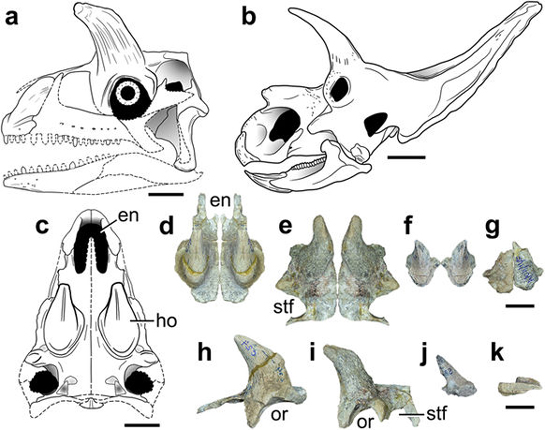
The Horns of Shringasaurus are Similar to Those of a Horned Dinosaur

Shringasaurus skull material compared to a horned dinosaur.

Cranial anatomy of Shringasaurus indicus compared to a Ceratopsian.

Picture credit: Scientific Reports

The picture above shows a line drawing (lateral view) of the skull of an adult S. indicus (a) compared to a lateral view of the skull of the Canadian, chasmosaurine dinosaur Arrhinoceratops brachyops, (b) which was distantly related to Triceratops.  The line drawing (c) shows the skull of S. indicus in dorsal view, (looking down onto the skull).  Photographs d-g show dorsal views of several individuals at different growth stages.  To produce a complete dorsal view of the skull, missing fossils have been reconstructed by digitally mirroring their preserved counterpart.

As these reptiles grew, so the horns became larger and more prominent.  Photographs h-j show lateral views of the bony horns.  Specimens d to f and h-j possess horns and the two smallest specimens, representing the youngest individual (g and k) lack horns.

Scale bar = 4 cm for (a) and (c to k), the scale bar for the ceratopsian skull is 20 cm (b)

Key

en = external naris

ho = horn

or = orbit

stf = supratemporal fenestra

The researchers conclude that these horns were probably used in intraspecific combats, perhaps over mates, or to decide the hierarchy of the herd.  This new study supports the idea of sexual selection pressure leading to the evolution of bizarre ornamentation within the Archosauria.

Recently, Safari Ltd introduced a replica of Shringasaurus.

To view this range of models and figures: Wild Safari Prehistoric World Figures.

Shringasaurus is Remarkable For its Horns

Commenting on the significance of this discovery, one of the authors of the scientific paper, Martín D. Ezcurra (CONICET–Museo Argentino de Ciencias Naturales, Buenos Aires, Argentina), stated:

“An animal like Shringasaurus is remarkable for its horns, a completely unexpected feature in this group of reptiles.  It shows that sexual selection led to the development of strange anatomical structures in the early evolutionary history of the arcosauromorphs, a group that includes dinosaurs, crocodiles and birds.”

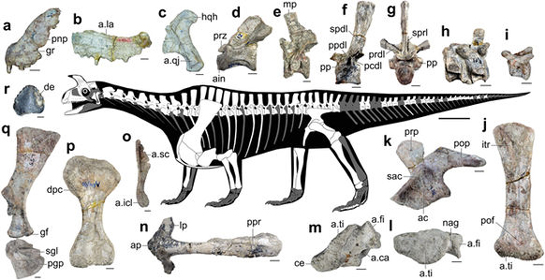
The Fossil Material Associated with Shringasaurus

Shringasaurus indicus fossil material.

Shringasaurus indicus fossils.

Picture credit: Scientific Reports

The genus name is a combination of Greek and ancient Sanskrit, it means “horned reptile”.  This unusual reptile with its pair of horns has provided an insight to the diverse range of reptiles that occupied this part of Pangaea during the Anisian faunal stage of the Middle Triassic some 245 to 243 million years ago.

Visit the Everything Dinosaur website: Everything Dinosaur.

18 08, 2017

How the Chloroplast Got Started as New Paper Published

By |2024-05-06T16:15:02+01:00August 18th, 2017|Categories: Adobe CS5, Animal News Stories, Dinosaur and Prehistoric Animal News Stories, Main Page|0 Comments

The Origin of the Chloroplast

At the centre of most of our planet’s ecosystems are plants and algae that utilise sunlight and transform carbon dioxide and water into carbohydrates and release oxygen.  These very specialised organisms can make their own food, by using light energy combined with CO2 and H2O.  As part of this process, the water molecule is split and oxygen is produced as a by-product.  This process takes place in specialised subunits within a cell called a chloroplast.

Plants and Algae are Fundamental to Most Food Chains on the Planet

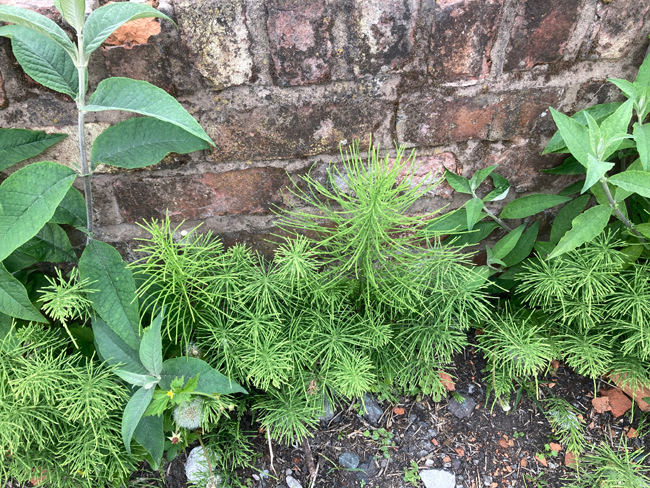
Horsetails

Horsetails (Equisetum) continue to thrive as they are able to grow in areas where other plants would find it difficult to get a foothold. Often regarded as weeds, these tough little plants are essentially living fossils as the earliest examples of the genus Equisetum date from the Early Jurassic of South America. New research provides data on the evolution of the chloroplast.  Picture credit: Everything Dinosaur.

Picture credit: Everything Dinosaur

The Origin of the Chloroplast

The theory as to how algae and plants evolved goes something like this – an ancient single-celled eukaryote absorbed a photosynthesising bacterium (blue-green algae otherwise known as photosynthesising cyanobacteria).  Such an event would normally have been disastrous for both parties, but for some reason, both the eukaryote and the cyanobacteria survived and this led to the development of a symbiotic association.  Whilst it is accepted that the cyanobacteria are the ancestors of the chloroplast, it is not clear which of the myriad of cyanobacteria are the closest relations of the chloroplast and when this association began, or indeed where on our planet this fortuitous event took place.

The Evolution of More Complex Life Via the Symbiotic Fusing of Different Kinds of Bacteria

The origins of complex life.

Complex eukaryote cells evolved by the symbiotic fusing of different kinds of bacteria.

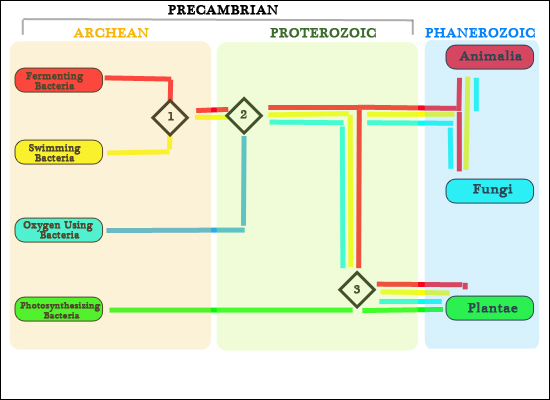
The diagram above shows one theory of how more complex lifeforms evolved.  Four different types of bacteria, each with their own specific adaptations and biological characteristics may have merged to create the three main forms of multi-cellular life – animals, plants and fungi.

  • Merger 1 – Bacteria with the ability to produce food via fermentation merged with a swimming bacterium.
  • Merger 2 – An oxygen utilising bacterium invaded this first host and formed the cell mitochondria.
  • Merger 3 – Algae fused with photosynthesising cyanobacteria, which then became the cell chloroplast – the subject of the newly published study.

A Published Scientific Paper

A team of scientists, including researchers from Bristol University, may have found the answers to these questions.  Writing in the Proceedings of the National Academy of Sciences, they postulate that the chloroplast lineage split from their closest cyanobacterial ancestor more than 2.1 billion years ago and this took place in low salinity environments.  The team conclude that it took another 200 million years for the chloroplast and the eukaryotic host to be fully united into a symbiotic relationship.  Marine algae groups diversified much later, at around 800 to 750 million years ago, sometime in the Neoproterozoic Era.

Lead author of the study, Dr Patricia Sanchez-Baracaldo (University of Bristol’s School of Geographical Sciences), commented:

“The results of this study imply that complex organisms such as algae first evolved in freshwater environments, and later colonised marine environments – these results also have huge implications to understanding the carbon cycle.  Genomic data and sophisticated evolutionary methods can now be used to draw a more complete picture of early life on land; complementing what has been previously inferred from the fossil record.”

Co-author, Professor Davide Pisani (Bristol University) added:

“Our planet is a beautiful place and it exists in such a sharp contrast with the rest of the solar system.  Think about those beautiful satellite pictures where you see the green of the forests and the blue/green tone of the water.  Well, Earth was not like that before photosynthesis.  Before photosynthesis it was an alien place, uninhabitable by humans.  Here we made some big steps to clarify how Earth become the planet we know today, and I think that that is just wonderful.”

Phylogenomic and Bayesian Analytical Methods

The team used a combination of phylogenomic and Bayesian analytical methods to conclude that the chloroplast lineage branched deep within the cyanobacterial tree of life, around 2.1 billion years ago, and ancestral trait reconstruction places this event in low-salinity environments.  The chloroplast took another 200 million years to become established, with most extant (modern groups living today), forms originating much later.

Everything Dinosaur acknowledges the assistance of a Bristol University press release in the compilation of this article.

Visit the Everything Dinosaur website: Everything Dinosaur.

17 08, 2017

New Chilesaurus – Shaking the Dinosaur Tree

By |2024-05-06T16:15:46+01:00August 17th, 2017|Categories: Dinosaur and Prehistoric Animal News Stories, Dinosaur Fans, Main Page|0 Comments

Chilesaurus diegosuarezi Transitional Fossil – Root and Branch Reform of the Dinosaur Family Tree

A bizarre Late Jurassic dinosaur called Chilesaurus diegosuarezi had been described as a member of the Theropoda group, but this strange little dinosaur that seemed to possess anatomical characteristics reminiscent of sauropods, ornithischian dinosaurs as well as meat-eating theropods, has been re-described, this time as a “missing link” between the theropods and the bird-hipped, ornithischians.  The re-think has to do with the use of datasets to assess the taxonomic relationships between different types of dinosaur.  Chilesaurus may be the first dinosaur to be reassessed in the light of a new way of looking at the dinosaur family tree, chances are, it won’t be the last.

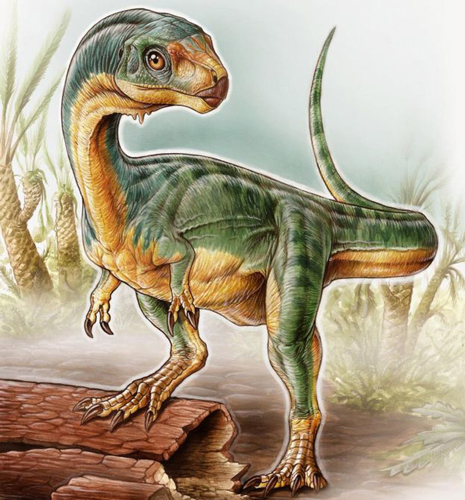
An Illustration of the Bizarre Late Jurassic Dinosaur from Southern Chile C. diegosuarezi

Chilesaurus illustration.

An illustration of Chilesaurus, once classified as a theropod now regarded as a transitional fossil towards the Ornithischia.

Picture credit: Nobumichi Tamura

Chilesaurus diegosuarezi Discovery and Description

The first fossils of this three-metre long dinosaur were found by a pair of geologists who were hiking in the remote Aysén region of southern Chile.  Scientists have mapped and explored these deposits (the Toqui Formation – Upper Jurassic) and a description of this dinosaur was published in the journal “Nature” in 2015.

To read Everything Dinosaur’s article written in 2015 reporting the discovery of Chilesaurus: Chilesaurus – a Dinosaur Designed by a Committee.

Strange Features

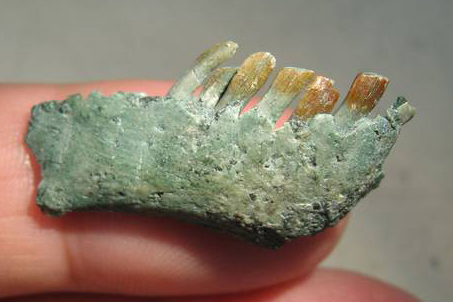
The dinosaur had some strange features that set it apart from other dinosaurs.  Some of these features, such as the over-sized claw which could be extended outwards, on the first digit on the hands of Chilesaurus were reminiscent of the large claws found on the first digits of the front limbs of primitive sauropods.  However, it had a skull similar to that seen in theropods, but the jaws were lined with spoon-shaped teeth that pointed outwards at a slight angle.  These teeth were unique in the Theropoda and suggested a plant-eating diet.

In addition, the pubic bone in the pelvis was pointing backwards not forwards as in the theropods, this pelvic arrangement was typical of a bird-hipped dinosaur, an ornithischian.  These and other anatomical features made Chilesaurus into a bit of a conundrum for the palaeontologists studying it.  This dinosaur was difficult to place on the Dinosauria family tree, because of its combination of characteristics.  In the original 2015 paper, Chilesaurus was described as a Tetanuran theropod, a member of the “stiff-tailed” group of bipedal, mainly carnivorous dinosaurs, meaning that it was distantly related to Megalosaurus, the ornithomimids and the tyrannosaurs.

The Teeth in the Lower Jaw of Chilesaurus were Unlike Any Other Teeth of a Theropod

The fossilised jaw of Chilesaurus.

Teeth adapted for cropping plants.

Picture credit: Dr Fernando Novas (Museo Argentino de Ciencias Naturales (Buenos Aires, Argentina)

New Dataset – New Classification

Researchers Matthew Baron (Cambridge University) and Paul Barrett (Natural History Museum), writing in the Royal Society journal “Biology Letters” describe how they applied a different dataset to assess the phylogenetic relationship between Chilesaurus and other dinosaurs.  When C. diegosuarezi was first described, back in 2015 the researchers used several datasets to test the interrelationships within the Dinosauria, but crucially, the focus of this analysis was on looking at the relationships within the Saurischia.  In March of this year, Matthew and his co-researchers proposed re-drawing the dinosaur family tree, in essence, resurrecting work undertaken by Thomas Huxley in the late 19th century, that unites the Saurischia and the Ornithischia together into a new clade called the Ornithoscelida.

Theropods Grouped with Ornithopods

Under this revision, the Theropoda, which are closely related to extant birds and classified as Saurischian dinosaurs (lizard-hipped), were united with the bird-hipped dinosaurs, the ornithopods, Thyreophora, ceratopsian, hadrosaurs etc.

When Chilesaurus was examined again, using the taxonomic relationships proposed by the newly drawn dinosaur cladogram, Chilesaurus was placed in a new position.  The idea that it was a Tetanuran theropod based on this dataset could be discounted.  Instead, Chilesaurus is placed at a point in the dinosaur family tree where the Ornithischia diverged from their close relatives.  The basal position of Chilesaurus within the clade and its suite of anatomical characters suggest that it might represent a “transitional taxon”, bridging the morphological gap between the Theropoda and the Ornithischia.

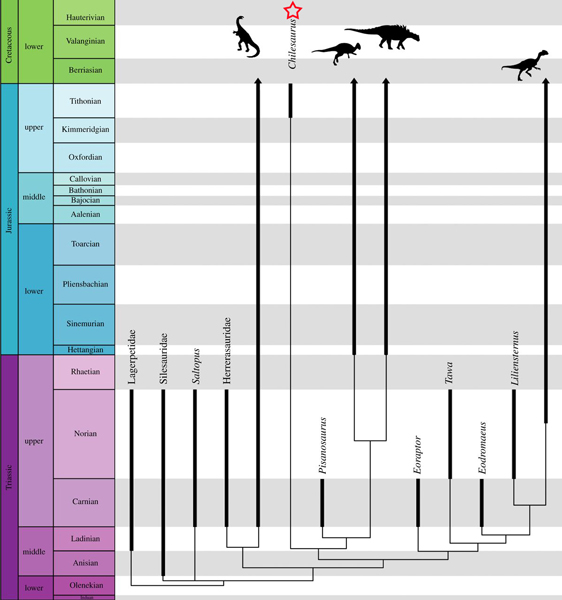
Chilesaurus “Missing Link” on the Road to the Ornithischia

Chilesaurus consensus tree.

In this new Chilesaurus study, the consensus tree formed via the phylogenetic analysis indicates this dinosaur was a basal ornithischian.

Picture credit: Royal Society Biology Letters

In the diagram above, the Chilesaurus (red star) is seen as a potential link between the saurischian Theropoda and the ornithischian dinosaurs.  Chilesaurus may therefore provide an insight into the evolutionary origins of the bird-hipped dinosaurs.  It may also have an extensive ghost lineage (thin black line), going back to the Middle Triassic.

To read the Everything Dinosaur article, published in March 2017, about the redefinition of the Dinosauria: Root and Branch Reform in the Dinosaur Family Tree.

Chilesaurus – A Puzzling Dinosaur

Co-author of the research, Professor Paul Barrett (Natural History Museum) explained the significance of this new paper:

“Chilesaurus is one of the most puzzling and intriguing dinosaurs ever discovered.  Its weird mix of features places it in a key position in dinosaur evolution and helps to show how some of the really big splits between the major groups might have come about.”

Papo have introduced a replica of Chilesaurus into their model range.

To view the Chilesaurus (whilst stocks last) and the other Papo dinosaur figures: Papo Prehistoric Animal Models.

Finding a Better Fit within the Dinosauria – Chilesaurus diegosuarezi 

The bizarre Chilesaurus.

An illustration of Chilesaurus that shows a suite of dinosaur traits.

Picture credit: Gabriel Lio

Visit the award-winning Everything Dinosaur website: Everything Dinosaur.

16 08, 2017

New Damselfly Species Honours Sir David Attenborough

By |2024-05-06T16:16:24+01:00August 16th, 2017|Categories: Dinosaur and Prehistoric Animal News Stories, Main Page, Photos/Pictures of Fossils|0 Comments

Mesosticta davidattenboroughi – Sir David’s Cretaceous Damselfly

Broadcaster, naturalist and all-round good guy, Sir David Attenborough has been honoured yet again by having a newly described species named after him.  This time, it is a new species of Cretaceous damselfly discovered in a piece of Burmese amber (burmite).  Fossils of insects are extremely rare and the fossil record for this extremely important Class of arthropods has been significantly enriched thanks to the preserved insect remains found in fossilised tree resin.

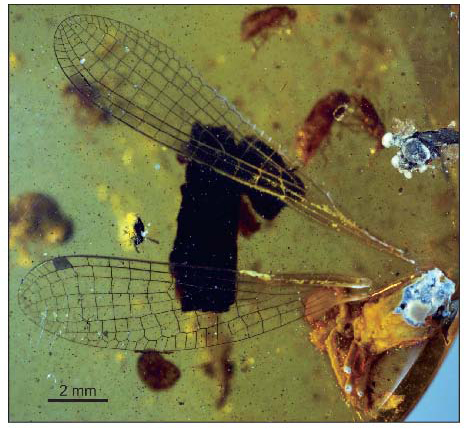
A Picture of the Holotype Specimen – Mesosticta davidattenboroughi

Mesosticta davidattenboroughi Cretaceous damselfly in amber.

Mesosticta davidattenboroughi sp. nov., holotype, NIGP164541, photograph of specimen.

Picture credit: Journal of Systematic Palaeontology

Sir David Attenborough is Honoured

The remains of this winged insect were discovered in the Hukawng Valley of Kachin Province, northern Myanmar, an area famed for its amber deposits.  Details of some remarkable fossils have recently been published, for example, back in 2016 Everything Dinosaur blogged about the discovery of a partial tail from a feathered dinosaur in burmite.  As recently as June (June 2017), we wrote about the finding of the remains of a primitive bird, a hatchling that had become entombed and preserved.

To read the article about the discovery of the dinosaur tail: The Tale of a Dinosaur Tail.

For the article on the baby bird fossil: Watch the Birdie! Enantiornithine in Amber.

Mesosticta davidattenboroughi

The full, binomial scientific name for the new species, belonging to a group more commonly known as shadowdamsels, is Mesosticta davidattenboroughi.  The researchers decided to name the new species after David Attenborough because of his long-standing appreciation of dragonflies, and to celebrate his recent 90th birthday, which he celebrated in May 2016.

Co-author of the scientific paper, Professor Edmund A. Jarzembowski commented:

“Dragonflies in amber are extremely rare and the recent discoveries by my Chinese colleagues are a new window on the past.  It is tradition in taxonomy [the naming of a new species] to contact the person concerned.  Sir David was delighted because he is not only interested in the story of amber, but also a president of the British Dragonfly Society.”

The fossil itself is extremely well preserved as it is encased in yellow transparent amber and includes a complete set of wings.  With the aid of photo technology, the scientists were able to digitally enhance and build a clear three-dimensional image of the new species, showing that it differed from previously described fossils, Mesosticta had quite stubby, short wings when compared to other Mesozoic species.

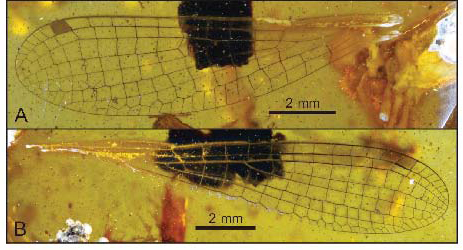
Images of the Forewings of Mesosticta davidattenboroughi

Mesosticta davidattenboroughi forewing images.

Mesosticta davidattenboroughi sp. nov., holotype, NIGP164541. A, photograph of left forewing; B, photograph of right forewing.

Picture credit: Journal of Systematic Palaeontology

Lead author of the scientific paper, Daran Zheng (Nanjing Institute of Geology and Palaeontology, Chinese Academy of Sciences), stated:

“Mesosticta davidattenboroughi is quite unique because we have uncovered a new species and it confirms the previous attribution of Mesosticta to the Platystictidae.  It is the first fossil group of modern platystictid damselflies and documents the appearance of Platystictidae as early as middle Cretaceous.”

A Poor Fossil Record

Finding insect remains in amber is not unusual, however, this family of damselflies are very poorly recorded in the fossil record and as a result this discovery from northern Myanmar is especially significant.

Mesosticta davidattenboroughi is just the latest in a long line of animals which have been named in honour of Sir David Attenborough:

Silurian Arthropod honours Sir David Attenborough: Fossil Named after Sir David Attenborough.

Kitten-sized marsupial lion named after Sir David Attenborough: Attenborough’s New Kitty.

The scientific paper: “Mesostictinae subfam. nov., an archaic group of platystictid damselflies (Odonata: Zygoptera) from mid-Cretaceous Burmese amber” by Daran Zheng, Bo Wang, André Nel, Edmund A. Jarzembowski, Haichun Zhang & Su-Chin Chang published in the Journal of Systematic Palaeontology.

Read the full article online: Scientific Paper.

Visit the Everything Dinosaur website: Everything Dinosaur.

12 08, 2017

A New Giant Dinosaur Gets a Name (Patagotitan mayorum)

By |2024-05-09T08:40:44+01:00August 12th, 2017|Categories: Dinosaur and Prehistoric Animal News Stories, Dinosaur Fans, Main Page|0 Comments

Patagotitan mayorum – 69 Tonnes of Titanosaur

This week has seen the long-awaited publication of a scientific paper on the super-sized titanosaur fossils that Everything Dinosaur blogged about in May 2014.  Writing in the “Proceedings of the Royal Society B (Biology)”, the researchers, which included José L. Carballido and Diego Pol (Museo Paleontológico Egidio Feruglio, Trelew, Argentina), have described this new dinosaur and given it a formal scientific name.  Patagotitan mayorum translates as “the Mayo family Patagonian Titan”.

Patagotitan may already be familiar to readers, as this fossil discovery was documented in a BBC television programme narrated by Sir David Attenborough back in 2016.  Indeed, a life-size cast of this dinosaur has been on display at the American Museum of Natural History (New York) for nearly eighteen months.

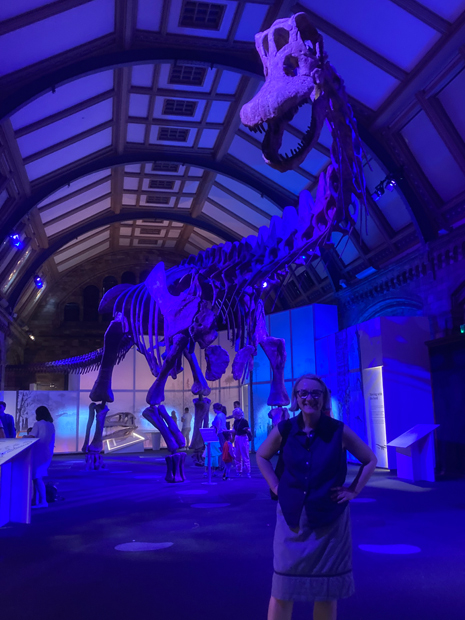
The Life-size Mounted Exhibit of the Newly Named Titanosaur (Patagotitan mayorum)
Patagotitan skeleton on display.

Sue from Everything Dinosaur poses in front of the colossal Patagotitan skeleton which is being exhibited at the Natural History Museum (London). Picture credit: Everything Dinosaur.

Picture credit: Everything Dinosaur

Patatotitan mayorum – Size is not Everything

Most of the media sources that have covered this announcement have focused on the estimated weight of Patagotitan.  When first studied, the body weight estimate of this beast, (represented by the fossilised remains of at least seven individuals) was put at 77 tonnes.  The researchers have down-sized Patagotitan somewhat in the scientific paper, but at a reported 69 tonnes, this is still an immensely heavy beast, potentially close to the theoretical limit for a body weight of a terrestrial animal.

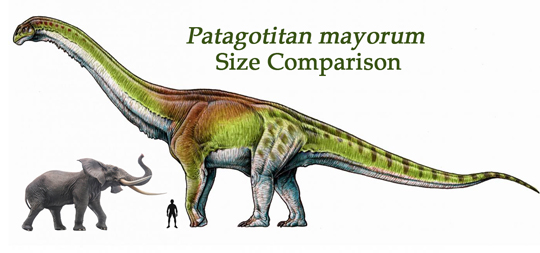
Patagotitan mayorum – A Size Comparison
Patagotitan size comparison.

Patagotitan mayorum size comparison with an adult African elephant and a human for scale.

Picture credit: G. Lio/Everything Dinosaur

With an estimated body length of 37 metres and a weight of 69 tonnes, Patagotitan can lay claim to the title of the largest land living animal to be described to date based on substantially complete fossil remains.

To read an article on the initial excavation of the titanosaur fossil bones: Biggest Dinosaur of all – a New South American Contender.

For an article providing information on the BBC documentary: Attenborough and the Giant Dinosaur.

An Unprecedented Quantity of Titanosaur Fossil Material

The species’ scientific name was inspired by the region where this new species was discovered, Argentina’s Patagonia (Patago); by its strength and huge size (titan), and by the Mayo family, on whose ranch the fossils of this new sauropod species were discovered.  The substantial amount of fossil material including a celebrated 2.4-metre-long femur was discovered in three distinct layers, representing flood plain deposits.  The researchers have concluded that these large herbivores must have been regular visitors to this area, perhaps this was on a migration route.  The water flow was unable to dislodge most of the fossil bones, their sheer bulk allowing the remains to be preserved relatively “in situ”, although in a disarticulated state.

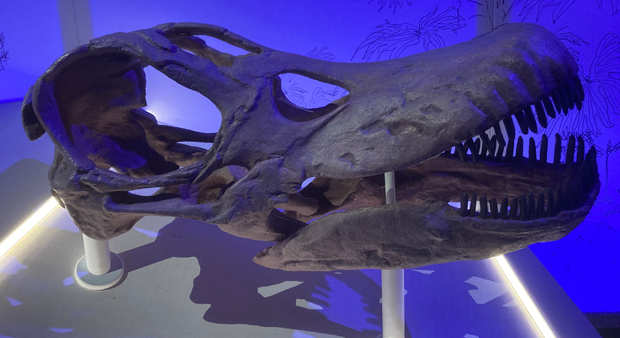
The Life-size Cast of Patagotitan mayorum at the American Museum of Natural History (New York)
A replica of the skull of Patagotitan

A replica of the skull of Patagotitan on display. Picture credit: Everything Dinosaur.

Picture credit: Everything Dinosaur

For models and replicas of titanosaurs and other other sauropods: CollectA Deluxe Scale Models.

Estimating the Body Weight of Giant Titanosaurs

The Titanosauria clade represents the most disparate group, in terms of body size of all known sauropods.  Some of the smallest members of the Sauropodmorpha are represented by titanosaurs such as the five-metre long Magyarosaurus from Romania, whilst this clade also contains giant animals like Argentinosaurus, Alamosaurus, Dreadnoughtus and the newly described Patagotitan.  Calculating the body weight of an extinct animal, even one with numerous fossil bones to study, is a challenging task, body weight has to be inferred using a variety of methods.

Dr José Luis Carballido (Museum of Paleontology Egidio Feruglio) explained:

“We compared the remains of Patagotitan mayorum with all the species that could be related to it, not only in terms of size, but also those that lived at the same time or had certain features in common.  Among them we included species such as Argentinosaurus, Puertasaurus and Futalognkosaurus, which are other giant species of dinosaurs from Argentina.”

A Phylogenetic Study

The researchers undertook a phylogenetic study and concluded that the majority of the giant titanosaurs of Patagonia belong to a single lineage.  This suggests that gigantism within the Titanosauria evolved only once and not multiple times.  The scientists conclude that all the truly huge dinosaurs were related to each other and form a natural group – the Lognkosauria.

Dr Diego Pol added:

“This group of giants probably emerged by the end of the Lower Cretaceous (Patagotitan mayorum would be the oldest) and had survived until the middle Late Cretaceous between 100 and 85 million years ago.”

Patagonia – A Paradise for Titanosaurs such as Patagotitan mayorum

Titanosaurs diversified and radiated around Gondwana during the middle Early Cretaceous and as a group they survived right up to the end of the Cretaceous, but in Patagonia during the early Cenomanian faunal stage some species obtained enormous sizes the reasons for an evolutionary pressure to grow so big are unclear.

Dr Pol commented:

“About 100 million years ago, a subgroup of titanosaurs really went crazy in body size.  There must be something in the environment, in how much resources and food was available, in the climate, something must have allowed this fantastic size.  All these contenders for the heavyweight championship of dinosaurs, they all lived in same place, in the same time…understanding why and how these animals evolved into such a fantastic size is the million-dollar question.”

The Enormous Fossilised Femur of Patagotitan mayorum
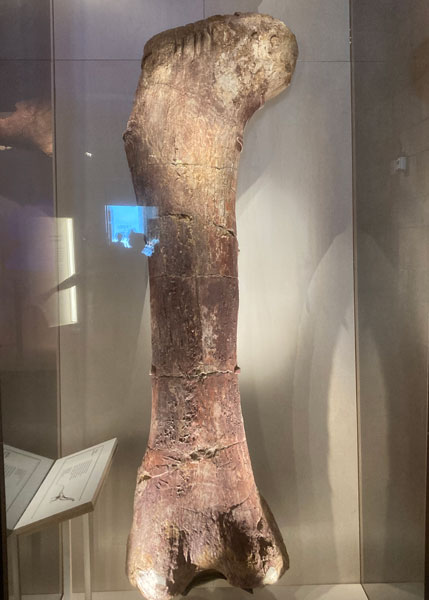
Patagotitan mayorum - the giant fossil femur.

The giant fossilised femur of Patagotitan mayorum on display. Picture credit: Everything Dinosaur.

Picture credit: Everything Dinosaur

Links to the Rinconsauria

In addition, the scientists consider this super-sized lineage of titanosaurs a sister group to the Rinconsauria, a clade of titanosaurs also known from Argentina which are regarded as basal to the group, or at least retaining primitive traits.  The Rinconsauria, which includes Rinconsaurus caudamirus and Aeolosaurus were not giants themselves, in fact, this clade includes some of the smallest South American titanosaurs described to date.

For the time being the moniker used to describe this huge dinosaur when it was being excavated – “enormosaurus” is redundant, that is until the next huge sauropod fossil find!

The scientific paper: “A New Giant Titanosaur Sheds Light on Body Mass Evolution Among Sauropod Dinosaurs” by José L. Carballido, Diego Pol, Alejandro Otero, Ignacio A. Cerda, Leonardo Salgado, Alberto C. Garrido, Jahandar Ramezani, Néstor R. Cúneo, Javier M. Krause published in “The Proceedings of the Royal Society B”.

Visit the award-winning website of Everything Dinosaur: The Everything Dinosaur Website.

10 08, 2017

New Monster Jurassic Crocodile Honours Motorhead’s Frontman

By |2024-05-08T20:38:51+01:00August 10th, 2017|Categories: Dinosaur and Prehistoric Animal News Stories, Dinosaur Fans, Main Page|0 Comments

Lemmysuchus obtusidens – Named after Lemmy from Motorhead

On December 28th 2015, the English heavy-metal musician, Lemmy, the founder of Motörhead and doyen of the metal-music genre passed away.  Since that day, many scientists who were fans of Lemmy’s music have sought out ways to honour him*.  It seems that tracks such as “Bomber”, “Overkill”, “Louie Louie” and the iconic “Ace of Spades” are very popular with academics and scientists from a number of disciplines and this week, hard-drinking, hard-living Lemmy, was honoured by having a particularly nasty Jurassic teleosaurid crocodile named after him.  Say hello to Lemmysuchus obtusidens, the newest member of the Teleosauridae, the name means “Lemmy’s blunt-toothed crocodile”.

Lemmysuchus obtusidens

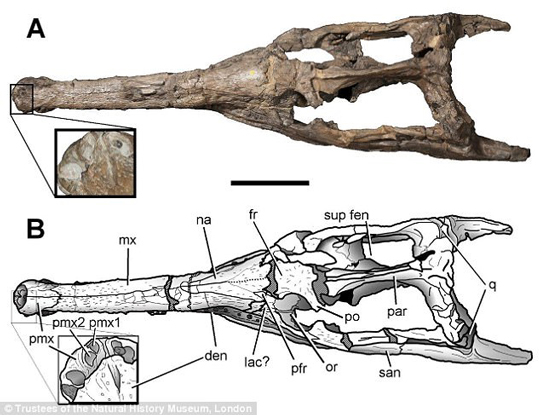
Dorsal View of the Skull of Lemmysuchus obtusidens

Skull fossil and line drawing.

Skull fossil and accompanying line drawing of Lemmysuchus.

Picture credit: Trustees of the Natural History Museum, London

From a Clay Pit Near Peterborough

The fossil material now assigned to this new genus was excavated in 1909 from a clay pit near the town of Peterborough (Cambridgeshire), several specimens were collected from the Middle Jurassic strata (Callovian faunal stage).  It was incorrectly catalogued and assigned to a different species, several cladistic and anatomical reviews later and the blunt-snouted, blunt-toothed teleosaurids have undergone a significant revision and fossil material formerly assigned to Steneosaurus obtusidens has ended up in need of a new taxa hence the establishment of Lemmysuchus within the academic literature.

One of the authors of the scientific paper, which has just been published in the Zoological Journal of the Linnean Society, Michela Johnson (University of Edinburgh), described Lemmysuchus:

With a metre-long skull and a total length of 5.8 metres, it would have been one of the biggest coastal predators of its time.”

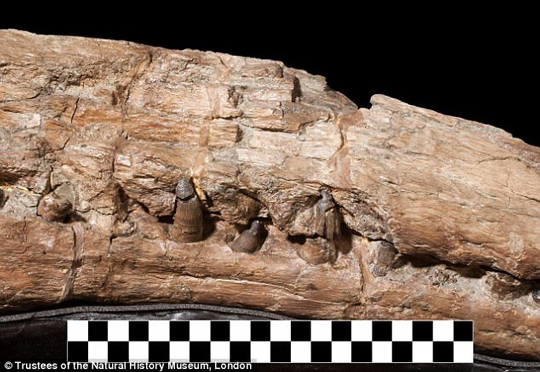
A Close View of the Jaw Showing the Robust Teeth

The jaw of Lemmysuchus.

Part of the jaw of Lemmysuchus showing the robust teeth.

Picture credit: Trustees of the Natural History Museum, London

Lemmysuchus – Durophagous or Macrophagous Diet

In contrast to several other Middle Jurassic teleosaurids, Lemmysuchus had a broad snout and large, robust teeth, this suggests that this substantial crocodylomorph had a different diet to its relatives.  Most teleosaurids were fish-eaters and their jaws, teeth and skulls show adaptations to a piscivorous diet.  The jaws of Lemmysuchus indicate that this reptile might have dined on turtles or other hard-shelled creatures such as ammonites.

It could have made short work of any small marine reptile carcass that it found, it could even have been an active predator of other marine reptiles.

A Nasty Crocodile from the Middle Jurassic of England

A illustration of the Jurassic teleosaurid Lemmysuchus.

Lemmysuchus obtusidens illustration.

Picture credit: Mark Witton

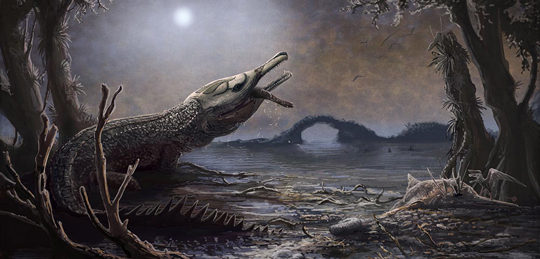
Paleoartist Dr Mark Witton has recreated the terrifying world of Lemmysuchus obtusidens.  The beautiful reconstruction shows a large Lemmysuchus feeding on a plesiosaur, whilst rhamphorhynchoid pterosaurs scavenge the remains of an ichthyosaur that has been washed ashore.

Subtle Nods to Lemmy and to John Martin

The atmospheric image created by Mark Witton, includes a subtle hint towards one of the pieces of artwork associated with Motörhead.  The pattern on top of the crocodylomorph’s skull is a homage to the “snaggletooth” logo that adorned a number of album covers.  In addition, this stunning artwork, depicting a European shoreline some 164 million years ago, pays tribute to one of the earliest depictions of ancient marine reptiles, an illustration by John Martin for the seminal publication “Great Sea Dragons”, by Thomas Hawkins, which was first printed back in 1840.

John Martin depicted a savage, violent seascape dominated by great serpent-like creatures.  Having noted the serpentine archway in Dr Witton’s illustration, Everything Dinosaur contacted Mark and enquired how this archway came to be included.

Mark explained:

“The archway in the background is a nod to the serpentine creature in the background of John Martin’s classic 1840 illustration “The Sea-Dragons as They Lived”.  Much of the right side of the image is a tribute to this work, as is the fact that virtually all the animals in my painting are savage and predatory.  We know that the Jurassic didn’t have any serpentine creatures like those imagined by Martin, so I had to improvise a little by changing his animal to a rock feature and landmass (the adjacent island is where the second ‘hump’ of his creature would be).”

Mark added:

“I decided to homage his work because, in a lot of ways, 19th century palaeoart is not dissimilar to iconography associated with the harder side of rock music, to which Lemmysuchus has an obvious connection.  Both are a bit silly in how dark and aggressive they are so, though stemming from very different cultures, they’re actually artistic bedfellows.”

“Great Sea Dragons” Illustration by John Martin circa 1840

"Great Sea Dragons" illustration by John Martn

The 1840 illustration of marine reptiles and pterosaurs by John Martin.

Talented paleoartist Mark has recently published a new work, highlighting his illustrations and providing an insight into the process or imagining and then recreating prehistoric scenes.  The book is entitled “Recreating an Age of Reptiles”, it is highly recommended.

To read a review of “Recreating an Age of Reptiles”A Review of “Recreating the Age of Reptiles”.

Dr Witton added:

“It was quite fun bringing three very different influences together for this painting: the science of the animal itself; the aggressive, dark imagery associated with Motörhead and the influence of old school palaeoart.”

Lemmy from Motörhead (Ian Fraser Kilmister)

Co-author Lorna Steel, (Dept. of Earth Sciences, Natural History Museum), proposed that the fearsome crocodylomorph should be named after her late musical hero.

Dr Steel stated:

“Although Lemmy passed away at the end of 2015, we’d like to think that he would have raised a glass to Lemmysuchus, one of the nastiest sea creatures to have ever inhabited the Earth.”

*In early 2016, a petition was organised to get the discoverers of the recently named, super-heavy element 115 Ununpentium, to change its name to Lemmium.  Despite attracting a reported 100,000 signatures the bid to place the heavy metal music pioneer onto the Periodic Table failed.  Still it’s not every day that you get a bone-crushing, Jurassic marine crocodile named after you.

Visit the award-winning Everything Dinosaur website: Everything Dinosaur.

Go to Top