All about dinosaurs, fossils and prehistoric animals by Everything Dinosaur team members.

Fossil finds, new dinosaur discoveries, news and views from the world of palaeontology and other Earth sciences.

8 08, 2017

A Beautiful Customised CollectA Deluxe Dimorphodon

By |2024-05-09T08:32:15+01:00August 8th, 2017|Categories: Dinosaur and Prehistoric Animal News Stories, Dinosaur Fans, Everything Dinosaur Products, Main Page, Photos of Everything Dinosaur Products|0 Comments

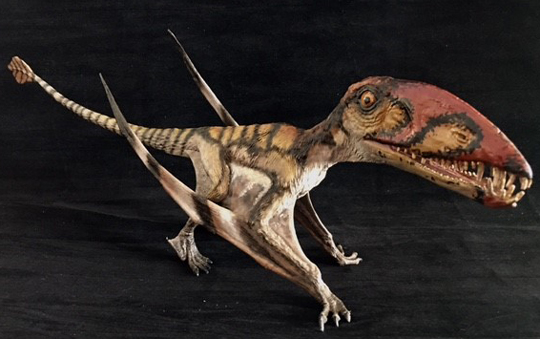
Customised CollectA Deluxe Dimorphodon

At Everything Dinosaur, it is always a pleasure to hear from our customers.  We get sent lots of photographs of customised models, collectors having taken a model and given it a unique paint job.  Sometimes subtle changes are made to the body plan as well.  Take for example, Elizabeth who is a long-time collector of prehistoric animal replicas.  When CollectA introduced a large replica of the flying reptile Dimorphodon, Elizabeth jumped at the chance of acquiring it and then commissioned talented model maker Martin Garratt to re-paint the pterosaur, providing her with a marvellous centrepiece for her model collection.

The Repainted CollectA 1:40 Scale Dimorphodon Model
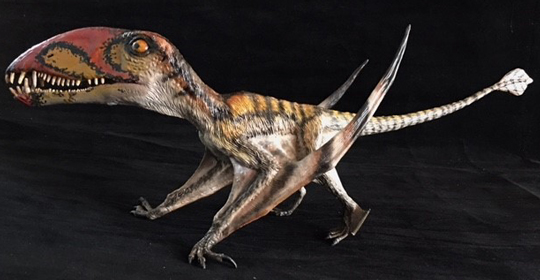
A repainted CollectA Dimorphodon model.

The repainted CollectA Dimorphodon replica.

Picture credit: Marilyn (UMF models)

Exquisite Dimorphodon Figure

Dimorphodon is known from the Early Jurassic of England (fossils found at Lyme Regis by Mary Anning) and a second species has been described from Mexico.  It was a member of the rhamphorhynchoid “Ram-for-rink-oid” pterosaurs, a sub-order of the Pterosauria characterised by their long tails, with most genera having teeth but lacking a bony crest.  The term rhamphorhynchoid helps to distinguish early pterosaurs from later forms (Pterodactyloidea), although the term is beginning to fall out of favour with palaeontologists due to the difficulties of defining newly described Jurassic species using this grouping.

With a wingspan of around 1.4 metres and weighing approximately 1.5 kilogrammes, this pterosaur was no giant and many early illustrations of this flying reptile placed it in a coastal environment, however, a number of scientists including the eminent pterosaur expert Dr Mark Witton, have suggested that this strong-legged, big-headed fellow was probably more at home in forests away from sea.

A Closer View of the Wonderful Paintwork by Martin Garratt
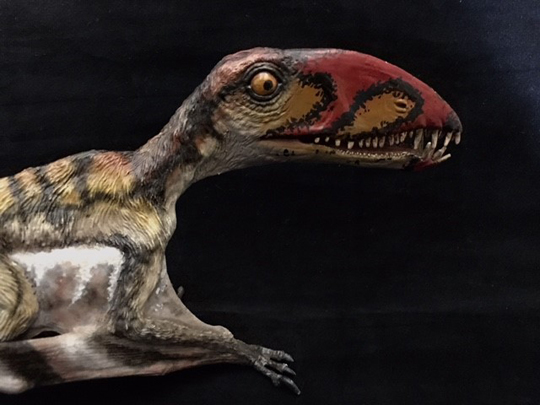
CollectA Deluxe Dimorphodon repainted.

A closer view of the beautifully painted snout.

Picture credit: Marilyn (UMF Models)

The CollectA Deluxe Dimorphodon Replica
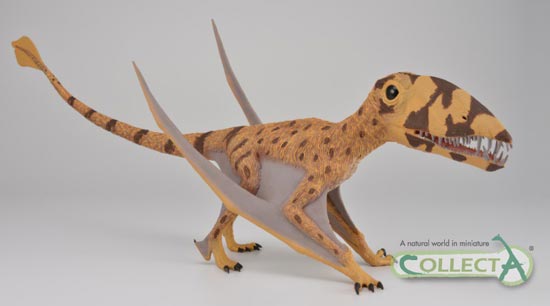
CollectA Dimorphodon pterosaur model.

The CollectA Dimorphodon model with a movable lower jaw.

Picture credit: Everything Dinosaur

The CollectA Deluxe Dimorphodon Replica

Measuring a fraction under thirty-eight centimetres in length the CollectA Supreme Deluxe Dimorphodon (part of the CollectA Deluxe Prehistoric Life Collection), is a strong candidate for customisation.  The model even has an articulated lower jaw, making access to the inside of the mouth easier for painting.  The sands and browns of the original paint scheme have been replaced by much more dynamic and vibrant palate in Martin’s interpretation.  The “leopard spots” have been replaced by “tiger stripes” and the finished repainted model is superb.

Commenting on her commission, CollectA model fan Elizabeth stated:

“I have always been a great admirer of John Sibbick’s work (and several of his original paintings hang on my walls).  I have a soft spot for John’s painting of Dimorphodon that adorns pages 70-71 of Wellnhofer’s book “The Illustrated Encyclopedia of Pterosaurs” (1991) and I asked Martin if he would do something along those lines.”

The Artwork of John Sibbick

We at Everything Dinosaur are also great fans of John Sibbick’s amazing artwork.  Team members were asked to write the press releases that accompanied the Royal Mail British prehistoric animal stamps that John was commissioned to paint.  The Dimorphodon illustration has been reproduced on numerous occasions, to illustrate both Dimorphodon macronyx and the sub-order of pterosaurs as a whole.  For example, the Dimorphodon painting that inspired the colour scheme on the CollectA Dimorphodon can be found on page 172 of “The Concise Dinosaur Encyclopedia” published in 2004 by Kingfisher.

The Illustration by John Sibbick that Inspired the CollectA Dimorphodon Repaint
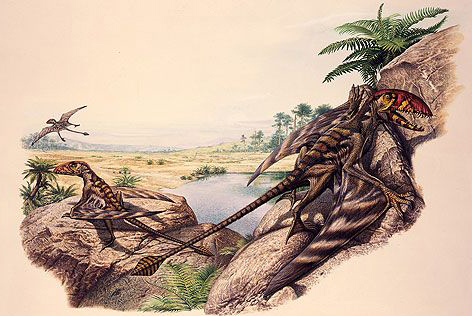
Dimorphodon illustration (John Sibbick).

Dimorphodon male and female by John Sibbick.

Picture credit: John Sibbick

The picture above shows the John Sibbick artwork, the Dimorphodon on the right of the image is probably a male, the repainted CollectA model has been inspired by such illustrations and the resulting figure after Martin Garratt’s makeover is a truly unique and stunning model.

The Repainted CollectA Deluxe Dimorphodon
CollectA Deluxe Dimorphodon repainted.

A repainted CollectA deluxe Dimorphodon replica.

Picture credit: Marilyn (UMF Models)

A Comment from Everything Dinosaur

A spokesperson from Everything Dinosaur commented:

” We always enjoy seeing how the models and replicas that we supply are customised by their owners.  We have known Martin and Marilyn at UMF Models for a number of years and we do get asked by our customers to send purchases direct to them for modification and personalisation.  Elizabeth’s Dimorphodon figure is fantastic and it just goes to show what can be achieved when a good, anatomically accurate production figure is repainted by a top-quality model maker and artist.”

See more of UMF Models on their Facebook page: Martin Garratt/UMF Models on Facebook.

To view the CollectA Deluxe Dimorphodon and the other figures in the CollectA Deluxe range: CollectA Deluxe Prehistoric Life Model Range.

Visit the Everything Dinosaur website: Everything Dinosaur.
7 08, 2017

The “Jaws” of the Early Triassic

By |2023-08-09T07:35:08+01:00August 7th, 2017|Categories: Dinosaur and Prehistoric Animal News Stories, Main Page, Photos/Pictures of Fossils|0 Comments

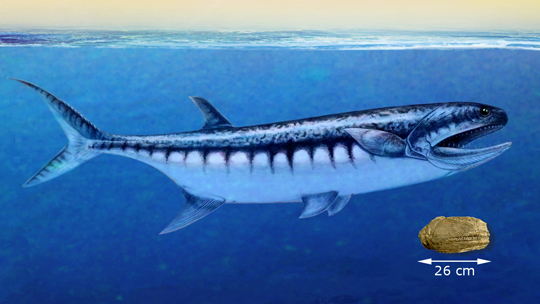
Birgeria americana – Big Mouthed Fish of the Early Triassic

Birgeria americana – the jaws of the Early Triassic.

The end-Permian mass extinction event is widely regarded as the most devastating extinction known from the Phanerozoic Eon.  An estimated 57% of all marine families died out, virtually all the corals became extinct and ecosystems were effectively destroyed.  Notable casualties were the Trilobita, sea-scorpions (eurypterids) and many kinds of fish.  Life on land did not fare any better with many groups of amphibians and reptiles perishing.

Recently, some evidence has emerged that ecosystems bounced back remarkably quickly after this catastrophic event.  Further evidence of a speedy recovery comes in the form of a large fossilised skull from a new species of predatory marine fish discovered by palaeontologists from the University of Zurich during field work in Nevada.

Birgeria americana –A Top Marine Predator of the Early Triassic

Birgeria americana illustration.

A reconstruction of Birgeria americana with the fossil skull (bottom right).

Picture credit: Nadine Bösch

The new species has been named Birgeria americana, a member of the ray-finned fishes (Actinopterygii) and fossils of this genus are mostly associated with Middle Triassic, much younger rocks, but the lineage can be traced back into the Late Permian.  Intriguingly, most species are much smaller, less than a metre in length, Birgeria americana in contrast, was a relatively giant, measuring around 1.72 to 1.85 metres long.

The “Jaws” of the Early Triassic

Recovered from rocks that have been dated to less than one million years after the end Permian extinction event, the discovery of such a large, voracious predator came as something of a surprise to the researchers.

Lead author of the study, recently published in the “Journal of Paleontology”, Dr Carlo Romano (Palaeontological Institute and Museum, University of Zurich) stated:

“The surprising find from Elko County in north-eastern Nevada is one of the most completely preserved vertebrate remains from this time period ever discovered in the United States.”

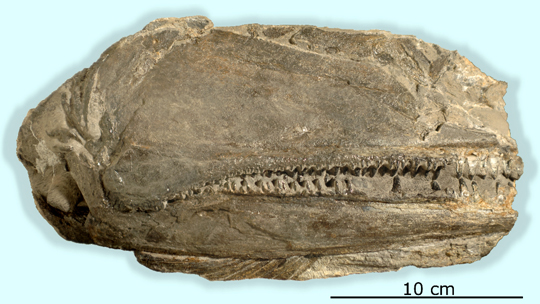
The new species has been described on the basis of a twenty-six-centimetre-long partial skull and jaws.  The jaws contain three parallel rows of robust, sharp teeth, the largest of which were up to two centimetres long.  This formidable dentition was further reinforced by several small teeth inside the mouth.

The Fossil Skull of B. americana

Birgeria americana fossilised skull and jaws.

The fossilised skull of Birgeria americana.

Picture credit: University of Zurich

Hunting Like a Great White Shark

The research team postulate that this species of super-sized Birgeria hunted in a similar fashion to the extant Great White Shark (Carcharodon carcharias).  Prey fish were pursued and then bitten, resulting in massive blood loss for the victim.  The unfortunate prey was then swallowed whole.  The partial skull, preserved in a limestone nodule, was excavated from Lower Triassic beds close to Winecup  Ranch in Elko County (Nevada).  The area is famous for its Triassic vertebrate fossils including early ichthyosaurs.

Prior to this discovery, researchers had assumed that ancient equatorial regions were too hot for vertebrates to survive during the Early Triassic (Nevada was close to the equator during the Early Triassic), the discovery of such a large, obvious predator suggests a rich and diverse food chain existed even at low latitudes.

Finds such as the newly discovered Birgeria species and the fossils of other vertebrates now show that marine hypercarnivores existed shortly after the end-Permian mass extinction.  The existence of bony fish close to the equator, where Nevada was located some 250 million years ago, indicates that the temperature of the sea was a maximum of 36°C.  The eggs of today’s bony fish cannot develop normally at constant temperatures above 36°Celsius.

Ecosystems Recovering After a Mass Extinction Event

Dr Romano added:

“The vertebrates from Nevada show that previous interpretations of past biotic crises and associated global changes were too simplistic.  Despite the severity of the extinctions of that time and intense climatic changes, the food webs were able to redevelop faster than previously assumed.”

For an article on fossil finds from China, providing further evidence of marine biota recovery following the end-Permian mass extinction: Window into an Ancient Marine Ecosystem.

The scientific paper: “Marine Early Triassic Actinopterygii from Elko County (Nevada, USA): Implications for the Smithian Equatorial Vertebrate Eclipse” by Carlo Romano, James F. Jenks, Romain Jattiot, Torsten M. Scheyer, Kevin G. Bylund, and Hugo Bucher published in the Journal of Paleontology.

Visit the Everything Dinosaur website: Everything Dinosaur.
6 08, 2017

The Armour of Borealopelta markmitchelli

By |2023-08-09T07:27:42+01:00August 6th, 2017|Categories: Dinosaur and Prehistoric Animal News Stories, Dinosaur Fans, Main Page, Photos/Pictures of Fossils|0 Comments

The Armour of Borealopelta markmitchelli

With the publishing of the formal description of the nodosaurid Borealopelta markmitchelli in the academic journal “Current Biology” this week, Everything Dinosaur has received a number of emails concerning this amazing fossil discovery.  The specimen, was lovingly prepared by museum technician Mark Mitchell who worked on the fossil for five and a half years, a total of something like 7,000 hours, as the dinosaur was exposed from its matrix one grain at a time.

Borealopelta markmitchelli

The holotype (TMP 2011.033.0001), is currently on display at the Royal Tyrrell Museum, part of an exhibition entitled “Grounds for Discovery”.  This exhibition highlights the personal stories and amazing fossils that have been discovered as a result of the Museum’s collaboration with numerous industries such as road construction, house building, mining, and oil and gas extraction.

The emails we received concerned aspects such as the animal’s size (5.5 metres long and weighing around 1.3 tonnes) and from which part of Alberta did the fossil come from (north-eastern Alberta).  However, most of the emails were enquiring about the preservation of the armour.

The diagram below should help.

A Schematic Drawing of the Borealopelta markmitchelli Holotype Specimen

Dermal armour of Borealopelta.

Schematic line drawing of the dermal armour of Borealopelta.

Picture credit: Current Biology

Studying the Armour of a Dinosaur

The picture above shows a schematic drawing of Borealopelta (A), with line drawings (B) and (C) showing the skull in dorsal and lateral views.  The different colours illustrate the preservation of different tissue types and the photographs (D to G) with accompanying line drawings show the range of dermal armour including osteoderms and scutes.  A close-up view of the neck (D), shows alternating cervical osteoderm bands (and preserved keratinous sheaths) and polygonal scales.

Photograph (E) shows a close-up view of the flank illustrating lateral thoracic osteoderms (with keratinous coverings) and polygonal scutes (scales).  A close view of the sacral shield area (F) showing more elements that make up the dermal armour and (G) shows a view of the forearm of Borealopelta (antebrachium) showing the amour (osteoderms and scales).

Note

Scale bar = 1 metre (A) and scale bar = 10 cm (B to G).

Body Armour in Life Position

The wonderful thing about this particular armoured dinosaur is that the osteoderms and scales that make up the body armour have been preserved in the position they were in when this dinosaur roamed Alberta during the Early Cretaceous.  The three-dimensional nature of the fossil has really helped the research team to understand how the mosaic of scutes, scales and osteoderms combined to provide the dermal armour.  The remains of the keratin sheaths and overlying skin was also preserved in some areas, melanosomes identified provide evidence of this dinosaur’s colouration.

To read an article about Borealopelta markmitchelliAmazing Armoured Dinosaur Fossil Reveals Countershading.

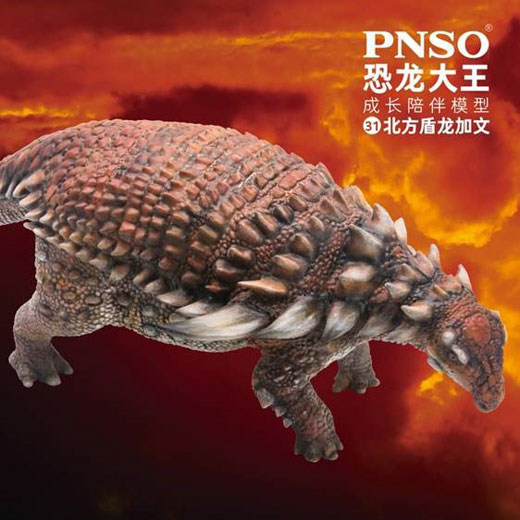
PNSO Gavin the Borealopelta armoured dinosaur model.
The PNSO Borealopelta dinosaur model.

The picture (above) shows a PNSO Borealopelta dinosaur model.

To view this range: PNSO Age of Dinosaurs Models.

Visit the award-winning Everything Dinosaur website: Everything Dinosaur.

5 08, 2017

Cambrian Worm with a Big Bite

By |2023-08-08T21:26:53+01:00August 5th, 2017|Categories: Dinosaur and Prehistoric Animal News Stories, Main Page|2 Comments

New Species of Fossil Worm – the Jaws of the Cambrian

Despite the Burgess Shale fossil deposits having been studied for more than a hundred years, these ancient shales can still spring a few surprises.  For example, this week saw the publication of a description of a new fossil species of arrow worm, one that at ten centimetres long, is a relative giant compared to other members of its phylum, living or extinct.

A New Species of Fossil Marine Arrow Worm Described from Burgess Shale Deposits

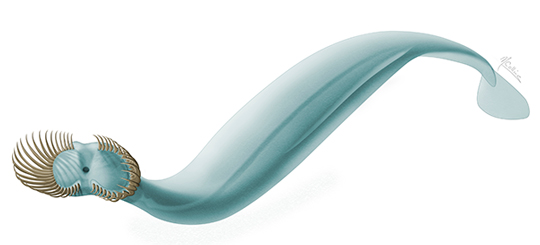
Capinatator praetermissus illustrated.

An illustration of the Cambrian chaetognath Capinatator praetermissus.

Picture credit: Marianne Collins

Capinatator praetermissus – Big-mouthed Predatory Marine Worm

The mysterious Chaetognatha, the bristle-jawed worms, often referred to as arrow worms, probably originated in the very Early Cambrian, but their soft bodies are rarely preserved in the fossil record.

However, a team of scientists, including Burgess Shale expert Jean-Bernard Caron (Royal Ontario Museum), have identified a new fossil species, based on around fifty specimens preserved in fine sediments in strata that make up part of the Middle Cambrian Burgess Shales (British Columbia).

The feeding apparatus comprises of up to twenty-five spines around each half of the simple mouth, nearly double the maximum number found in extant chaetognaths.  the large body size and formidable-looking mouth parts suggest that these arrow worms were important predators in the Cambrian marine environment.  This is one predator that could claim to be the “Jaws of the Cambrian”!

A Close-up View of the Fossilised Mouth Parts of C. praetermissus

Capinatator fossil.

Capinatator head showing the bristle-like feeding structures.

Picture credit: JB Caron/Royal Ontario Museum

The Famous Walcott Quarry

The picture above shows a fossil specimen from the collection site – the Walcott Quarry, Burgess Shale (Yoho National Park, British Columbia, Canada).  Capinatator praetermissus translates as “a swimming and grasping animal which remained overlooked for a long time”, in reference to the animal’s suggested ecological niche and the fact that despite decades of research centred around the Walcott Quarry, these fossil worms had been overlooked.

Writing in the academic journal “Current Biology”, the researchers examined numerous specimens that had soft tissue preservation.  It is likely that these animals swam near the seabed and that a population was buried rapidly by a mud flow.

The bristles of these worms have a relatively high fossil preservation potential.  For many years, these tough bristles were reported as conodont elements (conodonts are an extinct Class of small, jawless, marine vertebrates with pairs of robust tooth-bars that may have been used as filter-feeding apparatus), however, this research suggests that these marine worms occupied a different range of ecological niches compared to their living descendants today.

Most living members of the Chaetognatha are very small and make up a major component of marine zooplankton, but this newly named fossil species, Capinatator praetermissus was probably an active, pelagic (living above the sea floor), predator.  It has also been proposed that this animal could have been benthic, living on the sea floor.

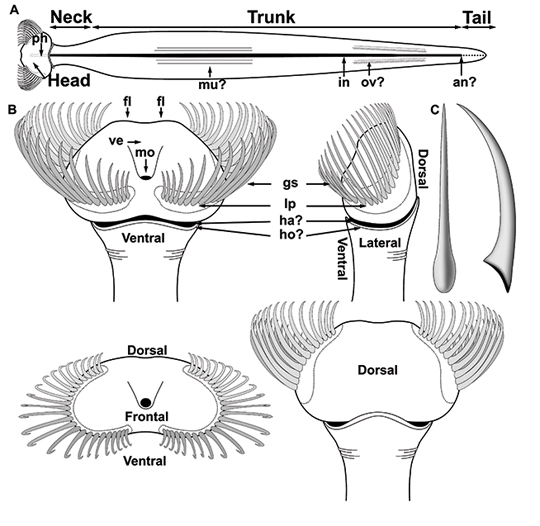
An Illustration of the Body Plan of Capinatator praetermissus

The morphology of Capinatator.

Illustration of Capinatator showing body morphology along different angles.

Picture credit: Marianne Collins

Studying Arrow Worms

Primitive arrow worms were much larger and had evolved a greater number of spines around their mouths compared to their modern-day counterparts.  Capinatator represents one of the oldest species of arrow worm known from the fossil record.  The discovery of Capinatator suggests that miniaturisation and evolving into free floating zoo plankton may have been secondary, these animals becoming smaller and changing their roles in the marine biota as other predators such as the arthropods became larger.

For an article about another Burgess Shale fossil worm discovery: Cambrian Suspension Feeder Provides Clue to Common Ancestor.

To read an article about a monster marine worm from the Devonian: Monster Worm of the Devonian.

Everything Dinosaur acknowledges the help of the Royal Ontario Museum in the compilation of this article.

The scientific paper: “A Large Cambrian Chaetognath with Supernumeracy Grasping Spines” by Derek E.G. Briggs and Jean-Bernard Caron published in the journal “Current Biology”.

Visit the Everything Dinosaur website: Everything Dinosaur.
4 08, 2017

Amazing Armoured Dinosaur Fossil Reveals Countershading

By |2023-08-08T21:18:10+01:00August 4th, 2017|Categories: Dinosaur and Prehistoric Animal News Stories, Dinosaur Fans, Main Page, Palaeontological articles|0 Comments

Borealopelta markmitchelli – Big but There was Something Bigger and Very Nasty Out There!

You’re about as heavy as a Ford Focus, your body is covered in bony armour and you have lethal spikes running down your flanks, including a pair of wicked-looking shoulder spines, yet you rely on camouflage to help keep you safe.  That’s the conclusion reached by an international team of scientists as they have studied the best-preserved armoured dinosaur ever found.  Borealopelta might have weighed in excess of 1.3 tonnes and measured more than 5.5 metres long, but it relied on countershading to help hide it from predatory dinosaurs.

Borealopelta – a “Walking Tank”

This is an amazing piece of research, perhaps, more amazingly, this research implies that for a dinosaur described as a “walking tank”, there was one or maybe several super-sized meat-eating dinosaurs that despite the heavy armour, it was best to hide away from.  Trouble is, palaeontologists can only speculate about what sort of multi-tonne Theropod might have been the stuff of nightmares for Borealopelta, we simply don’t know.

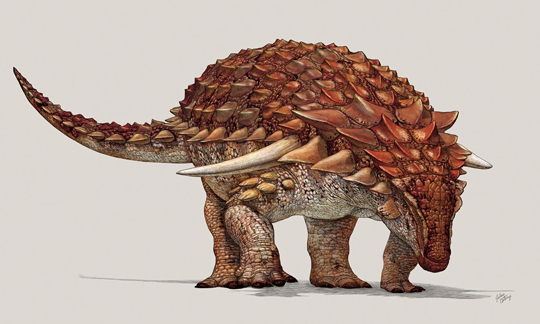
An Illustration of the Armoured Dinosaur Borealopelta (B. markmitchelli)

Borealopelta markmitchelli illustrated.

An illustration of the nodosaurid Borealopelta markmitchelli.

Picture credit: Julius Csotonyi

For models and figure of armoured dinosaurs including Borealopelta (whilst stocks last): PNSO Age of Dinosaurs Models.

The First Line of Defence – Not to be Seen in the First Place

Writing in the academic journal “Current Biology”, the researchers, which included Caleb Brown and Donald Henderson (Royal Tyrrell Museum, Alberta, Canada) along with Jakob Vinther (Bristol University), Ian Fletcher (Newcastle University) and colleagues from the Massachusetts Institute of Technology, conclude that Borealopelta possessed countershading to help camouflage it and avoid detection from sharp-eyed Theropod dinosaurs.

Using chemical analysis of organic compounds in the horns and skin to infer the dinosaur’s pigmentation pattern, the scientists found that the skin exhibited countershading, a common form of camouflage in which an animal’s underside is lighter than its back.  The top part of the animal was coloured a reddish-brown.  The russet colouration contrasted with the lighter shaded, paler underbelly.

Dr Vinther, an expert on the detection of colour signals within the fossil record commented:

“We found a lot of sulphur bearing organic compounds, which we later could confirm was evidence for reddish brown colouration.”

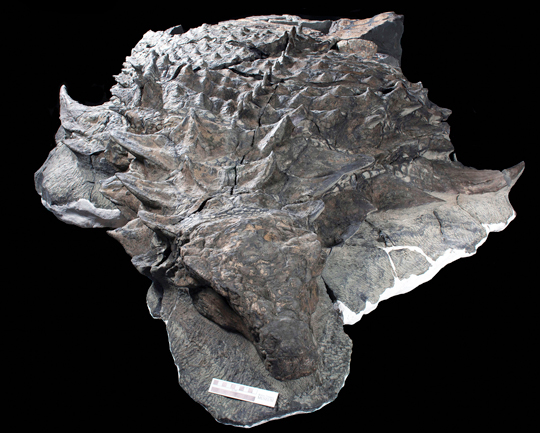
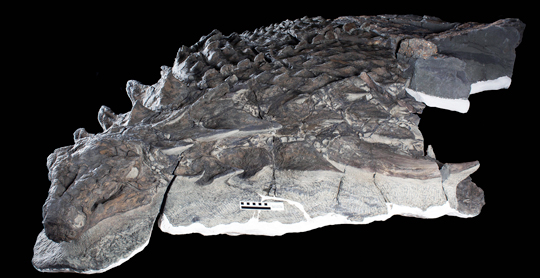
The Superbly-Preserved Holotype Specimen of Borealopelta markmitchelli

Borealopelta markmitchelli holotype.

Borealopelta markmitchelli fossil (scale bar = 10 cm).

Picture credit: Royal Tyrrell Museum

A Sleeping Armoured Giant

The researchers used two mass spectroscopic techniques called Time of Flight Secondary Ion Mass Spectroscopy and Pyrolysis Gas Chromatography Mass Spectroscopy to reveal the armoured dinosaurs’ colouration.  Such procedures were only possible due to the exceptional preservation of the specimen, which is currently on display at the Royal Tyrrell Museum.  The fossil material was discovered in 2011 at the Suncor Millennium Mine, in north-eastern Alberta, during the removal of overburden.  This was the first dinosaur to be found in these sediments.

To read more about the fossil discovery: Oil Worker Digs Up Dinosaur.

The strata represent sediments laid down in an offshore marine environment.  The carcass sank to the bottom of the seabed, its back hitting the seafloor hard enough to deform the underlying sedimentary layers.  The specimen was preserved in exquisite detail and is almost complete.  The articulated skeleton gives the impression that this armoured giant is merely sleeping and likely to be roused at any moment.

Holotype Specimen of B. markmitchelli

Borealopelta specimen.

The sleeping giant Borealopelta from north-eastern Alberta.

Picture credit: Royal Tyrrell Museum

The Implications of the Countershading

Borealopelta comes from the Wabiskaw Member of the Clearwater Formation, these rocks were laid down in the Early Cretaceous (Albian faunal stage).  Marine reptiles are known from these rocks, but this is the first time that a dinosaur has been found, the body of Borealopelta probably floated out to sea, an example of “bloat and float”.  The discovery of countershading in such a large animal begs the question, what sort of dinosaur was Borealopelta trying to hide from?

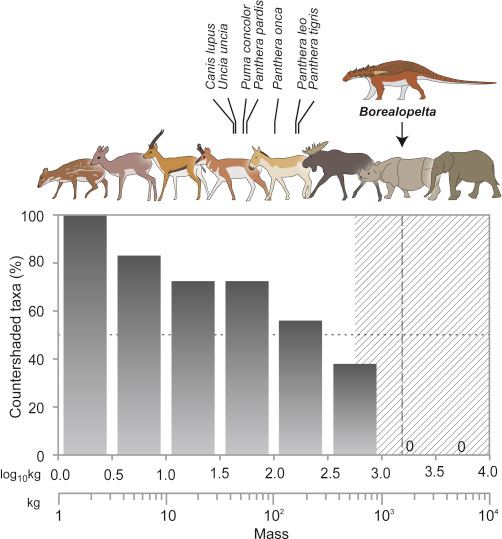
Countershading is a common evolutionary strategy seen in many prey animals today.  However, no extant animal exceeding one tonne in weight is counter shaded.  Lots of ungulates possess countershading but they are all far smaller than Borealopelta.

The researchers assessed the body mass of typical mammals that have such camouflage and compared them to the body weights of the carnivorous mammals that predate them.  The scientists concluded that as prey body size increases within typical terrestrial mammalian prey, so the number of species demonstrating countershading decreases.  Once you get to be the size of a rhino or an elephant, countershading in extant, terrestrial ecosystems is not present.  However, in the Early Cretaceous, things were very different.

A Chart Illustrating the Loss of Countershading as Body Mass Increases (Terrestrial Mammals)

A chart illustrating counter-shading compared to body size.

As body size increases so the amount of counter-shading seen in terrestrial mammals decreases.

Picture credit: Current Biology

The chart above shows the relative proportion of species that exhibit countershading.  The diagonally hatched area represents the mass above which significant predation of adults does not occur.  Animals illustrated above the chart are representative taxa within each mass bin, the species names in italics at the top indicates the body masses of the largest carnivores (Canivora).

Dr Vinther explains:

“Although countershading is common, our findings come as surprise because Borealopelta’s size far exceeds that of counter shaded animals alive today.  It suggests the dinosaur was under enough pressure from predators to select for concealment.  This means that the Cretaceous period was a really scary time to be around in.  Large theropod dinosaurs with excellent colour vision would have made life stressful for many a dinosaur, both big and small.”

What was Borealopelta trying to Hide from?

As no other dinosaur remains have been found in the Wabiskaw Member, the large, meat-eating dinosaurs Borealopelta tried to hide from can only be speculated.  Huge theropod footprints found in rocks of a similar age and nearby formations in northern Alberta and British Columbia can hint at what sort of fearsome creature shared Borealopelta’s world.  For example, substantial, three-toed dinosaur tracks from the Cedar Mountain Formation of eastern Utah have been described and assigned to the ichnogenus Irenesauripis.

Some of these tracks are nearly ninety centimetres in length and the huge claw marks indicate that whatever dinosaur made these tracks, it was a formidable predator.  The authors of this study suggest that the apex predators were probably allosaurid/carcharodontosaurid taxa and suggest something like the twelve-metre-long Acrocanthosaurus, fossils of which are found in similarly-aged formations further south.

An Illustration of an Acrocanthosaurus (A. atokensis)

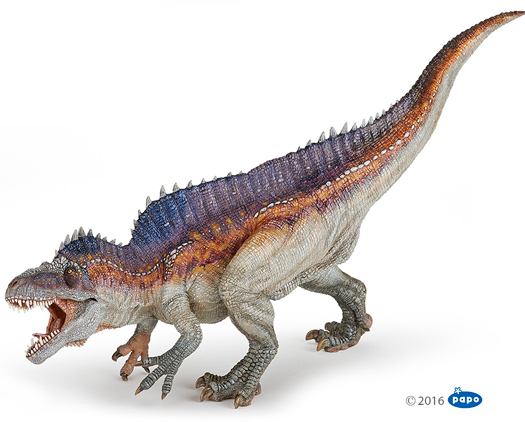
Papo Acrocanthosaurus

The Papo Acrocanthosaurus.

The image (above) shows an Acrocanthosaurus dinosaur model in the Papo model range.

To view this range: Papo Dinosaur and Prehistoric Animal Models.

Heavily armoured dinosaurs were camouflaged to avoid being spotted by a predator, but what sort of predator is open to question.  Perhaps, in a remote part of British Columbia, the fossil remains of an entirely new type of theropod dinosaur are awaiting discovery…

“Northern Shield” and 7,000 Hours of Painstaking Work

The genus name means “northern shield” a reference to the latitude of the fossil discovery, whereas, the species name honours museum technician Mark Mitchell who spent more than 7,000 hours carefully removing the fossil from the surrounding rock, one grain at a time.  Researchers are now examining the preserved gut contents to find out the nature of its last meal, and working to characterise the body armour in even greater detail.

Comparing Borealopelta to Other Well-Preserved Ankylosaurs

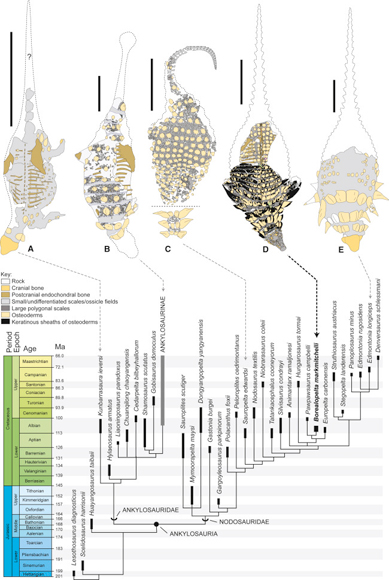
Ankylosaur armour comparisons.

Borealopelta armour compared to other Ankylosaurs.

Picture credit: Current Biology

The picture above shows a time-calibrated strict consensus tree showing the position of Borealopelta markmitchelli within the Ankylosauria, with representative well-preserved Ankylosaurs provided for comparison.  In this analysis, Borealopelta is regarded as the sister taxon of Pawpawsaurus, also from the Albian faunal stage of the Cretaceous.

Scale bar = 1 metre

(A) Kunbarrasaurus, (QM F18101).

(B) Euoplocephalus, (NHMUK 5161).

(C) Sauropelta, (AMNH 3035 and (3036 composite).

(D) Borealopelta, (TMP 2011.033.0001)

(E) Edmontonia, (AMNH 5665).

The scientific paper: “An Exceptionally Preserved Three-Dimensional Armoured Dinosaur Reveals Insights into Coloration and Cretaceous Predator-Prey Dynamics” by Caleb M. Brown, Donald M. Henderson, Jakob Vinther, Ian Fletcher, Ainara Sistiaga, Jorsua Herrera and Roger E. Summons published in Current Biology.

To read an article on an earlier study regarding the counter-shading of Psittacosaurus: Calculating the Countershading of Psittacosaurus.

Visit the Everything Dinosaur website: Everything Dinosaur.
3 08, 2017

Surveyor Stumbles Across Rare Dinosaur Bone

By |2024-05-09T08:33:19+01:00August 3rd, 2017|Categories: Dinosaur and Prehistoric Animal News Stories, Dinosaur Fans, Main Page|0 Comments

Plans for a Bike Trail in Colorado Disrupted by Dinosaur Find

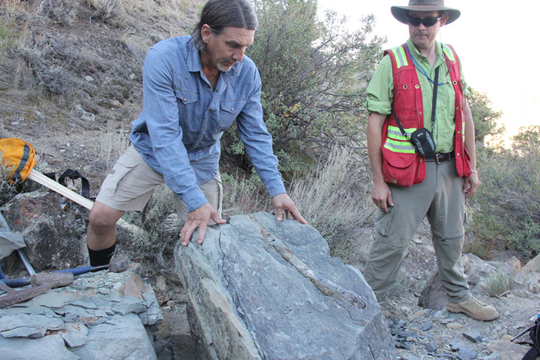
Mountain biking trails in the rugged landscape close to the town of Grand Junction (Colorado), are big business, with keen cyclists from all over the United States taking to the trails.  However, plans to extend the range of courses available had to be halted when a surveyor discovered a boulder with a dinosaur fossil bone embedded within it.

Bureau of Land Management (BLM), geologist Chris Pipkin had been undertaking a survey in a bid to identify new potential trackways when he spotted a large bone in a boulder.  The trail, named the Palisade Plunge Bike Trail had its unusual dinosaur visitor thanks to erosion.  It is likely that the boulder tumbled down from the cliffs that overlook this area of the single lane track.

Bureau of Land Management Staff Inspect the Boulder and the Fossil Bone

Dinosaur bone found on bike trail.

The dinosaur bone found on the mountain bike trail is inspected.

Picture credit BLM

Five Feet from the Bike Trail

The boulder came to rest just five feet (1.5 metres), from the bike trail and although cyclists could get past the obstruction, officials concluded that it would be in the best interests of all parties if the fossilised bone was removed.  The sixty-centimetre-long bone would weather away in just a few years if it were to be left at the site and being so prominent and obvious, it might attract the interest of unscrupulous fossil dealers who might be tempted to steal it.

BLM officials and local palaeontologists suspect that the fossil is a limb bone from a duck-billed dinosaur, although it is impossible to determine a genus from this single specimen.  More fossils may be found further up the trail in the cliffs.  The bone was extracted from the boulder and it has been sent to a local museum for further analysis.

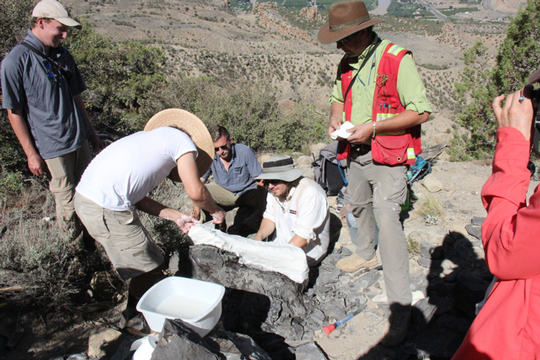
The Fossil Bone is Carefully Prepared for Transport Away from the Mountain Bike Trail

Dinosaur fossil bone being removed.

BLM staff and volunteers carefully wrap the fossil in burlap and plaster.

Picture credit: BLM

Dinosaur Fossil Bone

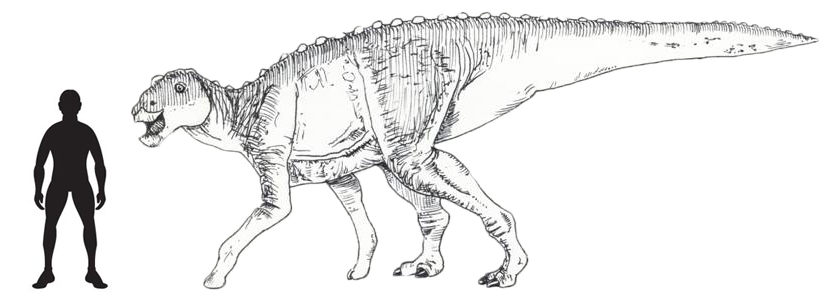
A spokesperson from Everything Dinosaur, commented that the dinosaur fossil bone may have come from exposures related to the Mesa Verde Group.  Dinosaur fossils have been found in these rocks (sandstones and shales, laid down in a coastal, near shore environment) and the fossil, if it is confirmed as hadrosaurid, could represent a Gryposaurus

An Illustration of Gryposaurus (Scale Drawing)

Gryposaurus scale drawing.

A scale drawing of the duck-billed dinosaur Gryposaurus.  Picture credit: Everything Dinosaur.

Picture credit: Everything Dinosaur

The image (above) is based on the Gryposaurus dinosaur figure from the Safari Ltd range.

To view this range: Wild Safari Prehistoric World Figures and Models.

The fossil material dates from the Campanian faunal stage of the Late Cretaceous and is described as being in “remarkably good shape”.

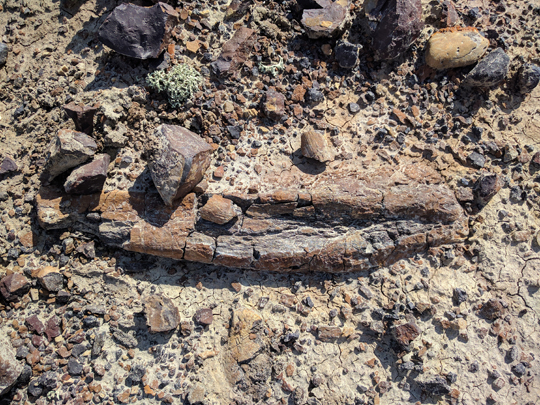
The Dinosaur Fossil Bone Could be a Limb bone from a Gryposaurus

Dinosaur bone found on mountain bike trail.

Limb bone from a hadrosaurid.

Picture credit: BLM

It is hoped that once fully prepared and stabilised, the fossil bone could be put on display at a Grand Junction museum.

To read an article about Upper Cretaceous hadrosaurid fossils being found by scientists prospecting for a location suitable for a Mars Rover robotic challenge: Dinosaur Fossils on Mars – Not Quite.

Visit the Everything Dinosaur website: Everything Dinosaur.

1 08, 2017

Dinosaur Fossils on Mars – Not Quite but a New Fossil Discovery

By |2024-05-09T08:35:26+01:00August 1st, 2017|Categories: Dinosaur and Prehistoric Animal News Stories, Dinosaur Fans, Main Page, Photos/Pictures of Fossils|0 Comments

Students Looking to Test Mars Rovers Discover Dinosaur Fossils

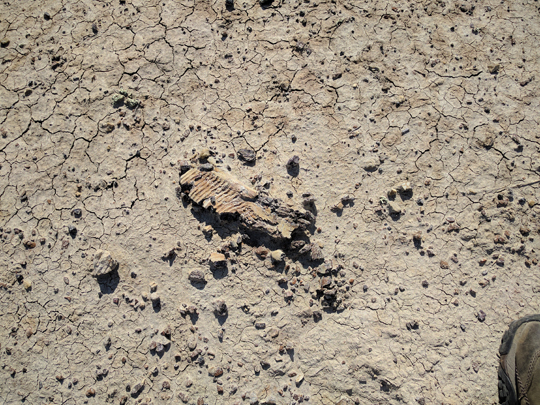
University students looking for a suitable landscape to test robots to take part in the exploration of Mars, have stumbled across the remains of a duck-billed dinosaur eroding out of the landscape.  Dinosaur bone discovery made by students.

Members of the University of Saskatchewan Space Design Team (USST), were visiting Midland Provincial Park in southern Alberta (Canada), in early June, scouting for suitable sites for an upcoming robotics contest.  The team were looking to identify terrain that resembled that found on the surface of Mars, the object of the competition being to test designs for Mars Rovers – robotic vehicles that could help with further exploration of the red planet.  What the team did not anticipate, was that their search would lead to the discovery of several fossilised bones from a Late Cretaceous hadrosaurid.

Duck-billed Dinosaur Bones Discovered

Dinosaur bone discovery.

Duck-billed dinosaur bone discovered by University of Saskatchewan students.

Picture credit: Adam McInnes

Dinosaur Bone Discovery

The students were exploring the area around Drumheller in a bid to identify sites suitable for hosting the first Canadian International Rover Challenge, a globally significant event, with a number of universities and institutions showcasing their robotics and automated vehicles that could help future scientific missions to Mars.  The team were looking for locations which were very dry, with lots of rocky terrain, plenty of sand and a mixture of different stone sizes coupled with a minimal of vegetation.  For a palaeontologist, areas with lots of rocky exposures, very few plants and which are subject to high levels of erosion, can also be great places to find fossils, especially if the rock is sedimentary in nature.  This part of Alberta is famous for its extensive exposures of Upper Cretaceous strata and numerous dinosaurs have been identified from their fossilised remains.

An Eroded Hadrosaurid Jaw Bone from the Site

Hadrosaurid jaw bone.

Partial jaw bone from a duck-billed dinosaur.

Picture credit: Adam McInnes

The picture above shows a very weathered portion of a jaw bone from a duck-billed dinosaur.  The grooves seen in the fossil equate to locations in the jaw for the dental battery, the rows of tightly packed teeth that helped this herbivore process the coarse plant-material such as pine needles that this type of dinosaur consumed.  Hadrosaurid fossils are probably the most common large dinosaur fossils to be found in this part of Canada, team members at Everything Dinosaur, whilst working with Royal Tyrrell Museum staff have come across several specimens themselves. Often the fossils are too weathered and fragmentary to permit extraction and formal identification down to the species level.

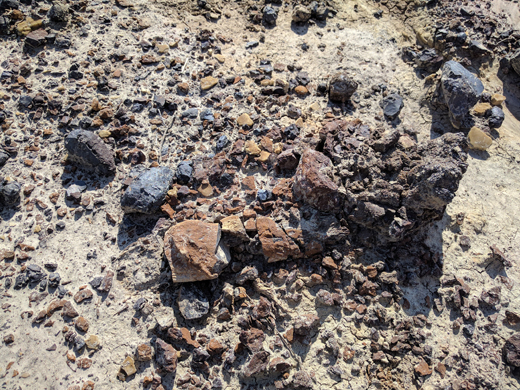
Severely Weathered Dinosaur Bones

A Severely Weathered Dinosaur Fossil Bone

Severely weathered dinosaur fossil bone.

It may look like a jumble of “weird-looking” rock but that is a dinosaur bone.

Picture credit: Adam McInnes

Conservation officials from the Alberta Parks Department and staff from the Royal Tyrrell Museum (Drumheller), were able to assist the USST members and helped them to identify suitable venues for the robotic vehicle tests.  The locations chosen were well away from sites of significant geological interest, after all, it is hardly a valid test for a potential Mars Rover to be able to ascend and descend a dinosaur bone, that is one object that these machines are not going to encounter on Mars.

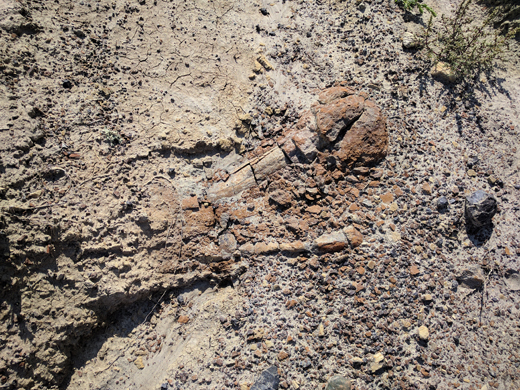
A Femur (Thigh Bone) from a Hadrosaurid

Duck-billed dinosaur leg bone.

Hadrosaurid leg bone.

Picture credit: Adam McInnes

USST President, Danno Peters explained that whilst discovery dinosaur bones certainly generated a degree of excitement amongst the group, none of the USST members were thinking of changing their careers and becoming palaeontologists.  Plans are already well underway for the 2018 Mars Rover competition and the USST team were looking forward to pushing their designs to the limit in even more challenging terrain.

Everything Dinosaur acknowledges the help of the media team at the University of Saskatchewan for their help in the compilation of this article.

Visit the award-winning Everything Dinosaur website: Everything Dinosaur.
29 07, 2017

Evidence of Iguanodontids from Early Cretaceous Alberta

By |2023-08-08T14:10:33+01:00July 29th, 2017|Categories: Dinosaur and Prehistoric Animal News Stories, Dinosaur Fans, Main Page|0 Comments

Fossilised Footprint Hints at Iguanodontids Present in Early Cretaceous Alberta

The iguanodontids were one of the most successful groups of ornithischian dinosaurs to evolve.  These herbivores with their batteries of teeth and the ability to chew their food attained a near global distribution by the late Early Cretaceous.  However, despite numerous body fossils representing several genera being found in Upper Jurassic and Lower Cretaceous strata of the western United States, their fossilised remains have never been recorded from western Canada.

Palaeontologists have suspected that iguanodontids were present in western Canada but the fossil evidence was lacking – until now that is.  Analysis of a single dinosaur footprint suggests that these plant-eating dinosaurs were roaming south-western Alberta during the Early Cretaceous, the footprint, if interpreted correctly, helps to fill a gap in western Canada’s dinosaur fossil record.

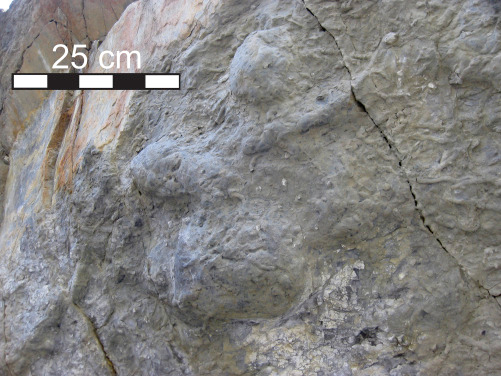
Track Indicates Iguanodontids Present in Western Canada

Dinosaur footprint from south-western Alberta.

A natural cast of a dinosaur footprint identified as iguanodontid.

Picture credit: Royal Tyrrell Museum (Drumheller)

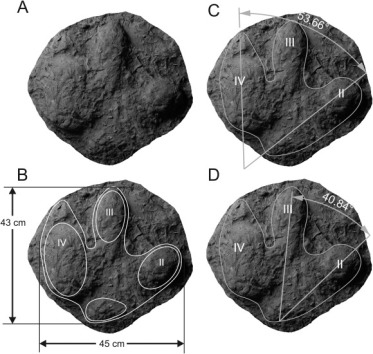
The picture shows the fossilised dinosaur footprint, preserved as a natural cast on the underside of a sandstone ledge from a site in south-western Alberta.  For Dr Donald Henderson (Curator of Dinosaurs, at the Royal Tyrrell Museum), this single track has enough similarities to iguanodontid tracks found elsewhere in the world, to conclude that this print does indicate, that as expected, these types of dinosaur were living in the Early Cretaceous of western Canada.

Writing in the journal “Cretaceous Research”, Dr Henderson cites this fossil as the first evidence of iguanodontids in Alberta and asserts that this fossil is helping to clarify the distribution of iguanodontian dinosaurs.

Those Successful Iguanodontians

The Iguanodontia is a clade of ornithopod dinosaurs that evolved in the Late Jurassic, diversified into many different families and had an almost global distribution.  They thrived in the Early Cretaceous and some genera survived until the end of the Cretaceous.  Within the Iguanodontia there are several sub-clades.  For example, the Ankylopollexia “stiff thumbs”, a clade of iguanodontians which are considered to be more derived than other members of the Iguanodontia and they are united by a common feature, that of having a conical thumb claw.  Members of the Ankylopollexia include Camptosaurus from the Upper Jurassic of the western United States and the Iguanodon genera including Iguanodon bernissartensis from the Early Cretaceous of Europe.

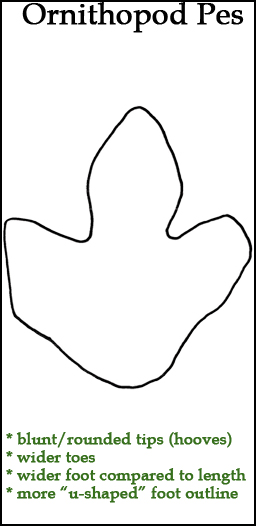
Most large iguanodontids were facultative bipeds and they produced characteristic tracks, with substantial, tri-dactyl hind footprints, with blunt tips to the toes (see illustration below).

A Line Drawing of the Hind Footprint of a Typical Large Ornithopod Dinosaur (Iguanodontian)

Ornithopod pes. Dinosaur footprints found on beach.

Line drawing of the hind footprint of a large Ornithopod (iguanodontid).  Picture credit: Everything Dinosaur.

Picture credit: Everything Dinosaur

Iguanodontids and the Ankylopollexia

The Ankylopollexia can be further sub-divided into the camptosaurs and the Styracosterna, which contains the hadrosaurids (duck-billed dinosaurs), that went onto dominate many terrestrial habitats in the Late Cretaceous.

Dr Henderson compared the track with numerous iguanodontid specimens and concluded that this footprint was most likely made by an iguanodontid.  The fossilised footprint comes from the Gladstone Formation (south-western Alberta), and the host rock is dated to the Early Cretaceous (Barremian faunal stage), a time when these types of dinosaurs were evolving rapidly and diversifying.

Dr Henderson Identified Common Characteristics Between the Tracks in the Study

Iguanodontid trackway.

Comparing the Gladstone Formation track and identifying it as iguanodontid.

Picture credit: Royal Tyrrell Museum

This is an exciting development, as it helps to fill in a gap in Alberta’s dinosaur fossil record.  Dr Henderson suggests that the lack of iguanodontid fossil material might be because older rock layers are found in areas which are in relatively inaccessible, remote locations, that are heavily forested and often deeply buried under younger rocks.  The Royal Tyrrell Museum staff member believes that other iguanodontid fossil material including body fossils are likely to found in future.

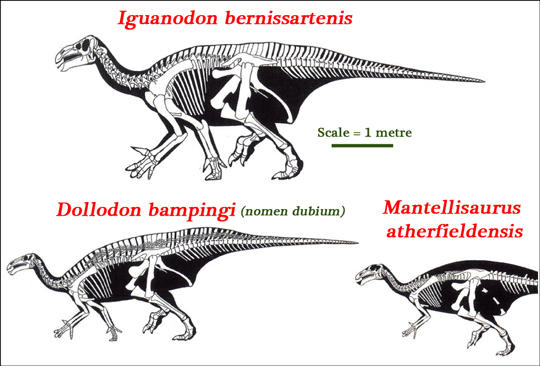
Skeletal Comparisons of Three Typical Iguanodontids (Ankylopollexians – family Iguanodontidae)

Skeletal comparisons (iguanodontids)

Iguanodontid comparisons. D. bampingi is regarded as Nomen dubium.

The scientific paper: “The First Evidence of Iguanodontids (Dinosauria, Ornithischia) in Alberta, Canada: A Fossil Footprint from the Early Cretaceous” published in April 2017 in the journal “Cretaceous Research”.

Visit the Everything Dinosaur website: Everything Dinosaur.
28 07, 2017

Yet Another New Ganzhou Oviraptorid

By |2024-05-09T08:36:30+01:00July 28th, 2017|Categories: Dinosaur and Prehistoric Animal News Stories, Dinosaur Fans, Main Page, Photos/Pictures of Fossils|3 Comments

Corythoraptor jacobsi – Built Like an Ostrich with the Crest of a Cassowary

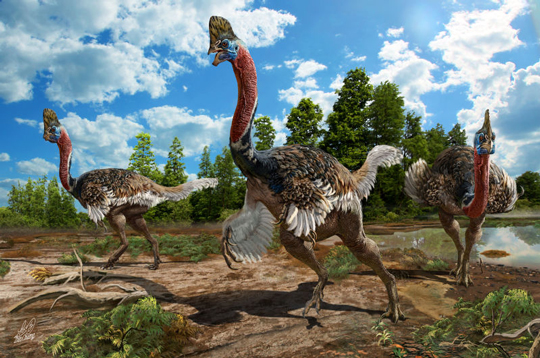
Yet another new species of oviraptorid has been named from fossils found in Ganzhou, Jiangxi Province (southern China).  This new dinosaur, which was probably feathered, had a longer neck than its oviraptorid contemporaries making it resemble an ostrich.  It also possessed a crest on top of its skull, called a casque, which was very similar to that seen in the extant, Australian flightless bird, the Cassowary.  This could be a case of convergent evolution between a dinosaur and a non-avian dinosaur.

This new dinosaur has been named Corythoraptor jacobsi, the genus name translates as “helmet speedy thief”, whilst the trivial name honours Professor Louis L. Jacobs of the Southern Methodist University, (Dallas, Texas, USA), who acted as a mentor to three of the authors of the scientific paper, published in the journal “Scientific Reports”.

An Illustration of the Newly Described Oviraptorid from Southern China (Corythoraptor jacobsi)

A flock of crested Corythoraptors.

Corythoraptor jacobsi illustration.

Picture credit: Zhao Chuang

The Magnificent Seven

The naming of Corythoraptor brings the total of Late Cretaceous oviraptorids known from this part of China to seven.  All seven oviraptorids come from the Nanxiong Formation which relates to the Late Campanian/Early Maastrichtian faunal stages of the Late Cretaceous, around 73 – 71 million years ago.

Palaeontologists are uncertain as to why this part of China seems to have been a “hot spot” for oviraptorosaurs, the palaeoenvironment might have favoured these cursorial theropods, which are believed to have been omnivorous, or this type of dinosaur may simply be under represented in other Upper Cretaceous deposits elsewhere in the world.

Intriguingly, of the seven oviraptorid dinosaurs named to date some are known to have been crested and different shaped crests have been identified.  All these dinosaurs are approximately the same size, around two metres in length and all of them were probably feathered.  The long neck (twice as long as the dorsal vertebral column), of Corythoraptor might have evolved to permit this dinosaur to exploit a food source that its contemporaries could not, in the same way that many modern-day antelopes on the African savannah have different neck lengths to help them browse on different plants – an example of niche partitioning.

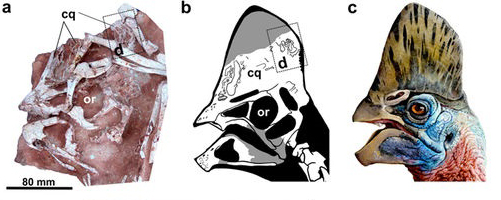
The Crest of Corythoraptor

The crest of Corythoraptor jacobsi.

The cranial casque of Corythoraptor. Fossil material (a), line drawing (b) and colour restoration (c).

Picture credit: Scientific Reports

The Seven Oviraptorids from the Nanxiong Formation (to date)

The Seven Oviraptorids from the Nanxiong Formation (so far) – green text indicates information on crests (casques)

  • Banji long (named and described in 2010) small, flat crest.
  • Ganzhousaurus nankangensis (named and described in 2013) with a potentially, slightly raised crest.
  • Jiangxisaurus ganzhouensis (named and described in 2013) potentially crested – small crest.
  • Nankangia jiangxiensis (named and described in 2013) insufficient fossil material to establish a crest being present.
  • Huanansaurus ganzhouensis (named and described in 2015), potentially crested (top part of the skull is missing, but in a phylogenetic analysis carried out by the authors, Huanansaurus was found to be the sister taxon to the newly described Corythoraptor jacobsi.  H. ganzhouensis skull material is insufficient to conclusively prove the presence of a crest although the thickened naris and parietal indicate that a crest is likely.
  • Tongtianlong limosus (named and described in 2016), it possessed a small crest.

To read a previous article on the discovery of an oviraptorid Huanansaurus (Huanansaurus ganzhouensis), which is believed to be very closely related to Corythoraptor: 2015 – New Oviraptorid Dinosaur from the Late Cretaceous of Southern China.

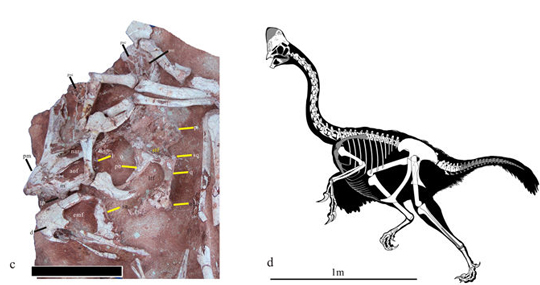
A Close View of the Skull and Jaws with a Line Drawing of Corythoraptor

Corythoraptor skull and line drawing of the dinosaur.

A close up of the skull, jaws and the head crest of Corythoraptor with a line drawing showing body plan.

Picture credit: Scientific Reports

The picture above shows a close-up of the skull, crest and jaws of the holotype material, accompanied by a line drawing showing the estimated size and Corythoraptor and what it probably looked like.

The scale bar in (c) is 8 centimetres and the scale bar in (d) is 1 metre.   Note that the shape of the crest is inferred, as the actual portion of the skull that represents the majority of the proposed crest is not present, only the lower portion of the bony core of the casque (crest) is preserved.  The preserved portion of the nasals exhibits highly pneumatised bone structure.  The suture between the parietal and frontal is not clear, but it seems the bones project dorsally and formed a distinct crest together with the nasals, very reminiscent of the crest shape seen in living, non-avian dinosaurs, the Cassowaries.

What were the Crests (Casques) used for?

Lead author of the study,  Junchang Lü (Chinese Academy of Geological Sciences), proposes studying the living Cassowary to help shed light on the functional role played by the casque.  This could represent an example of convergent evolution, where a similar physical character has evolved independently in two, unrelated species.  A study of the fossilised bones suggest that this specimen represents an immature individual, a sub-adult Corythoraptor that may have been around eight years of age when it met its demise.  The casque may not have been fully formed when it died, but its function remains a mystery.  However, such a prominent casque could have served a multitude of purposes, just like the crest of the Cassowary.

Crest (Casque) Function

  • With lots of different oviraptorids living in the same habitat, the crest could have played a role in species recognition (interspecific recognition).
  • The crest could have been used in visual communication, in displays to determine social hierarchy or perhaps in ritualised displays over mate selection (intraspecific combat).
  • Crest shape could have indicated maturity, with crest shape changing as the animal became older.
  • The crest (or casque) could have indicated fitness for breeding during the mating season.
  • This structure could have played a role in helping to differentiate between males and females (sexual dimorphism).
  • The crest (or casque) shape in oviraptorids could represent the evolution of character as part of sexual selection.

For an article describing the discovery of T. limosusStuck in the Mud Dinosaur and Oviraptorosaur Diversity.

Links to the Dinosaurs of China Exhibition at Wollaton Hall (Nottinghamshire)

Readers in the UK, have the opportunity to get up close to a number of Chinese feathered dinosaurs including a specimen of Oviraptor (O. philoceratops) and a giant relation of the oviraptorids, the giraffe-sized Gigantoraptor, at the Dinosaurs of China exhibition in Nottingham.  In addition, the superb illustrations found throughout this exhibition and seen at the nearby Nottingham Lakeside Arts Centre, were created by Zhao Chuang, who was responsible for illustrating Corythoraptor in the scientific paper (illustration is seen at the top of this article).

For figures and replicas of feathered theropods: Dinosaur and Prehistoric Animal Models.

26 07, 2017

Unravelling the Mysteries of Complex Life

By |2023-08-08T09:33:09+01:00July 26th, 2017|Categories: Dinosaur and Prehistoric Animal News Stories, Main Page, Photos/Pictures of Fossils|0 Comments

First Non-Destructive Internal Images of Rangea

Travel back in time far enough and the distinction between what is a plant and what is an animal becomes blurred.  For a palaeontologist, unravelling the mysteries of the origins of multi-cellular life is daunting.  Firstly, when examining the few fossils of multi-cellular organisms known from rocks laid down in the Proterozoic Eon, what strikes you is the paucity of the fossil record, in essence there is very little fossil evidence to study. Secondly, some of the lifeforms represented are so bizarre that there is nothing alive today that can begin to provide scientists with any hints as to structure, form, lifestyle or behaviour.

However, an international team of scientists, writing in the journal of “Precambian Research”, have conducted a remarkable assessment on three-dimensionally preserved Ediacaran fossils and they have shed light on the evolution of complex life.  The organism in question is Rangea, a bizarre fern-like animal/plant/? that did not possess bilateral symmetry like us, or indeed radial symmetry like starfish and sea urchins, but a fractal structure, like nothing alive today.

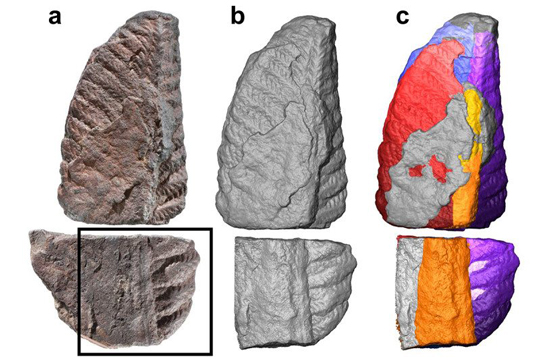
The Fossil and Internal/External Scans of a Three-dimensionally Preserved Rangea Specimen

Fossil and scans of bizarre Precambrian life form.

The fossil (a), an external scan (b) and an internal scan (c) of the Ediacaran organism Rangea.

Picture credit: Precambrian Research

The picture above shows the fossil (a), a computer-generated model of the external structure (b) and a computer-generated model of the internal structure of Rangea (c).

High Resolution X-ray Micro-computed Tomography

At Everything Dinosaur, we suspect that the fossil specimens come from rocks laid down in shallow, marine sediments that make up the Nama Group in southern Namibia.  Rangea is known from this location and has also been reported from other Ediacaran-aged sites in Australia and Russia.  The Namibian material is remarkable as the fossils are typically moulds and casts of the fern-like structures, preserved in ironstone nodules, which despite representing lifeforms that existed somewhere between 540 and 580 million years ago, have not been squished and deformed to a huge extent as a result of the fossilisation process and the enormous time these fossils have existed in the strata.

The scientists used high resolution X-ray micro-computed tomography (microCT) to investigate the 3-D internal morphology of these exceptional fossils.  This is the first non-destructive internal imaging of Rangea.  Ranging from a few centimetres to tens of centimetres in length, the soft-bodied Rangeomorphs (a natural taxon, established to help classify these frond-like, fractal organisms), are perhaps best known to fossil fans in the UK as organisms similar in structure to Charnia, named and described from a single fossil specimen found in Charnwood Forest, Leicestershire by a school boy in 1957.

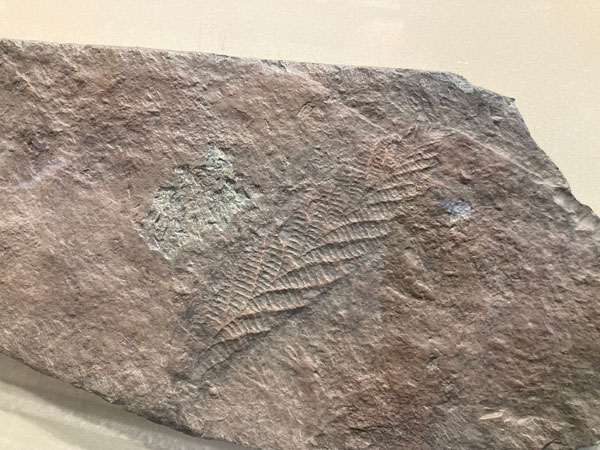
A Specimen of a Fern-like, Soft-bodied Charnia

Pre-Cambrian life form Charnia.

A Charnia fossil on display at the Manchester Museum. Picture credit: Everything Dinosaur.

Picture credit: Everything Dinosaur

Analysing the Results of the Pre-Cambrian Fossil Study

Lead author of the study, Dr Alana Sharp (School of Science and Technology, University of New England, New South Wales, Australia) and her colleagues think that all six fronds may have been inflated like long balloons, they may have touched each other creating a large surface area for the passive absorption of nutrients which sustained the organism.  It had been thought that these fronds, regarded as some form of feeding structure, were flat.

Dr Sharp commented:

“Our work supports a lifestyle of absorption of nutrients through membranes inflated to the maximum, increasing the surface area across which these organisms seemed to feed.”

Soft Bodies but Stone Hearts

The CT scans also revealed something else about Rangea.  It had a cone-shaped channel running vertically up its central trunk.  The lower part of this channel seems to have been filled with sediment that has a different composition from that seen in the rest of the fossil.  The researchers have concluded that this was probably present in the organism when it was alive, helping to prevent it from buckling or being compressed.  The sediment acted like internal scaffolding for Rangea, a sort of primitive skeleton.  These findings support the idea that Rangea was benthic (lived on the sea floor) and that it was probably sessile (attached to the sea floor and immobile).

Despite these remarkable computer-generated images, one big mystery remains, as Dr Sharp explains.

“They may or may not be animals, we can’t say from this study.  But they are the first of the truly large, multi-cellular organisms that radiated broadly before the first true animals evolved.”

The Scientific Paper: “First non-destructive Internal Imaging of Rangea, an Icon of Complex Ediacaran Life” by Alana C. Sharp, Alistair R. Evans, Siobhan A. Wilson and Patricia Vickers-Rich, published in the journal “Precambrian Research”.

Visit the Everything Dinosaur website: Everything Dinosaur.
Go to Top