Remaining New for 2020 CollectA Models Due in Stock
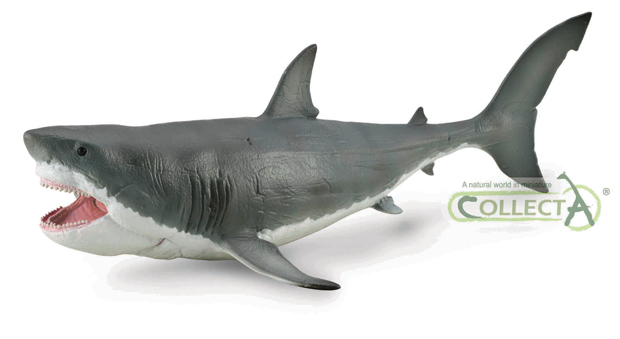
The rest of the new for 2020 CollectA prehistoric animal models are due to arrive at Everything Dinosaur’s warehouse in a few days. The remaining figures, the last of what are eighteen new figures introduced by CollectA this year are expected in about six days. The models include the 1:60 scale megalodon model with an articulated jaw, the 1:2 scale pterosaur Caviramus and the Early Jurassic theropod Saltriovenator (S. zanellai). Model collectors do not have long to wait for these new CollectA prehistoric animal models.
CollectA Prehistoric Animal Models
Everything Dinosaur Will Have All the Remaining CollectA Prehistoric Animal Models in Stock Soon
Some of the illustrations we used in our recent videos announcing the new for 2020 CollectA prehistoric animal models. The rest of the new for 2020 CollectA prehistoric animal figures will be in stock very soon.Picture credit: Everything Dinosaur.
CollectA Dinosaurs, Pterosaurs, Sharks and Invertebrates (plus a Dicynodont)
The production of these models has been delayed due to the COVID-19 pandemic. Everything Dinosaur was able to bring in some of the new for 2020 figures earlier in the year, but the likes of the hunting Mapusaurus, the Allosaurus, the cephalopods, the horseshoe crab and the replica of the huge dicynodont Lisowicia bojani were all held up. Team members have been busy sorting out reservation lists for these figures, making room to accommodate the models in the company’s warehouse as well as researching and writing fact sheets to accompany sales.
The Mapusaurus model (CollectA Age of Dinosaurs – Prehistoric Life)
CollectA Mapusaurus hunting dinosaur model. Due in stock at Everything Dinosaur.
A spokesperson for the UK-based company commented:
“It has been a while, but the hard-working and enthusiastic team at CollectA have been doing all they can to expediate the delivery of these excellent figures into our warehouse. We are looking forward to receiving them and we have prepared plans to ensure that we contact all those people on our reserve lists for these models as quickly as possible. We have even ensured that we can work through next weekend if required to make sure we swiftly dispatch orders.”
“Something Fishy” – The CollectA Deluxe 1:60 scale Megalodon will Swim into Stock
The CollectA 1:60 scale Megalodon shark model.A spectacular model of Otodus megalodon.
Bristol Channel Could Provide Oldest Evidence of Insular Dwarfism
The flamboyant Baron Franz Nopcsa did much to establish the concept of island dwarfism, that is animals on islands with limited resources often evolve into much smaller forms. Baron Nopcsa was the first person to suggest dwarf dinosaurs based on specimens associated with the Late Cretaceous Hateg Island, but a team of researchers including scientists from Bristol University, have uncovered evidence of island dwarfism in strata laid down in the Upper Triassic millions of years before the Hateg biota evolved.
Late Triassic Island Dwarfs
Writing in the “Proceedings of the Geologists’ Association”, the researchers report on an analysis of fossil remains from strata laid down around 205 million years ago that suggests ancient North American reptiles lived on an island archipelago in the area that now forms South Wales and the Bristol Channel.
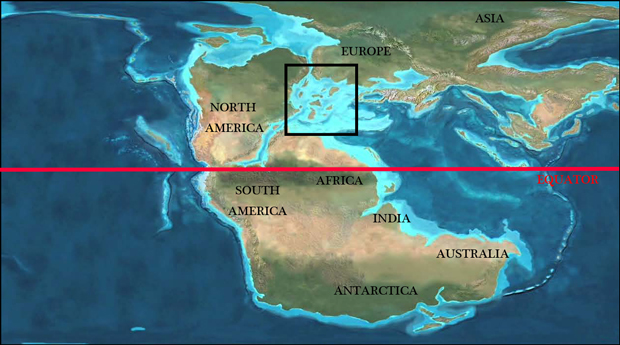
Student Matthew Skinner, (School of Earth Sciences at Bristol University), studied a treasure trove of fossil material that had been collected from Ruthin Quarry back in the 1950s and housed as part of the fossil collection at the National Museum of Wales (Cardiff). The fragmentary and very fragile material documented life on a small tropical island during a time in Earth’s history when the Atlantic Ocean did not exist and Europe and North America were only partly separated and what division there was consisted of narrow, shallow seaways dotted with small islands.
World Map (Late Triassic) The Black Square Shows the Approximate Location of the Island Archipelago
Pangaea in the Late Triassic, the black square highlights the island archipelago linking Europe and North America.
Eleven Different Taxa
In total eleven different taxa were identified, many of the vertebrates identified from the Ruthin Quarry fossils were reminiscent of fossils associated with much older strata in North America. The researchers describe the Ruthin Quarry biota as “relictual”, they are the remnants of a population that was once much more widely distributed. The Ruthin Quarry specimens are some 25 million years younger than the similar fossils known from North America.
Matthew Skinner commented:
“We were amazed to discover that most of the Ruthin beasts showed greatest similarity to relatives from North America. Of course, at that time, one could just hop across from South Wales to New York. The islands provided little space and food and so regular-sized animals couldn’t survive on them; the Ruthin animals were all dwarf versions of their closest mainland relatives, maybe half the size on average.”
Professor Mike Benton (Bristol University), who supervised the research study, explained:
“Our other questions were about the effects of island life. We know today that animals on remote islands can evolve in different ways from on the mainland. Often they become smaller, as there is less food, and they might be anachronistic – meaning they are throw-backs to much more ancient animals from the mainland.”
As most of the taxa identified from the site possess closest relatives that are found in much older strata and their body size is small, the scientists have concluded that these fossils record evidence of island dwarfism, also referred to as insular dwarfism. This is the oldest known record of this biological phenomenon.
A New Species – Smilodonterpeton ruthinensis
The team identified cartilaginous fish including the primitive shark Rhomphaiodon minor from a single tooth which helped to date the material. Numerous reptiles were described including parareptiles from the Procolophonidae family, one procolophonid is a new species and has been named Smilodonterpeton ruthinensis (chisel-toothed reptile from Ruthin).
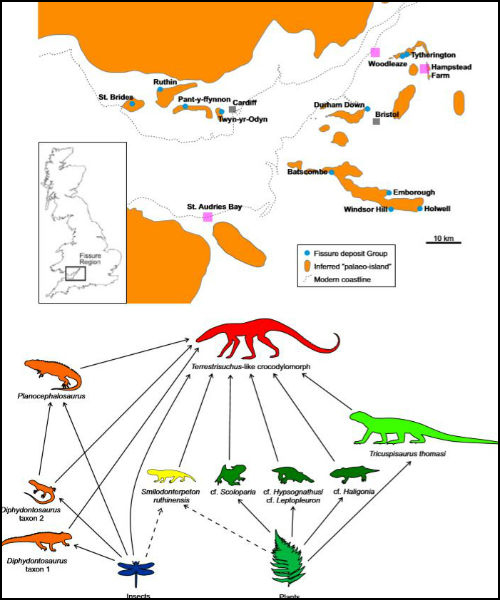
Other reptiles identified include three species of rhynchocephalians (beak lizards, distantly related to the living Tuatara of New Zealand), the herbivore Tricuspisaurus thomasi and archosaurs including a small, predatory crocodylomorph similar to Terrestrisuchus. Although less than a metre in length, this crocodylomorph may have been the top predator on the island. From this inventory, a simple food chain for the Ruthin Quarry fossil site could be constructed.
Location of the Fossil Finds and the Ruthin Quarry Food Chain
A map of the Bristol Channel/South Wales area during the Late Triassic showing the ancient islands in relation to the modern coastline. With (below) a food web for Ruthin Island.
Picture credit: Bristol University
CT Scans and Three-Dimensional Computer Models
A number of the delicate fossil specimens were subjected to non-destructive CT scans to help reveal their anatomical details. Tricuspisaurus had been named and scientifically described in 1957, but its taxonomic relationship with other reptiles was unclear. This research has enabled the scientists to challenge the view that Tricuspisaurus was a procolophonid.
Co-author of the paper, Dr David Whiteside (Bristol University and the Palaeontology Department of the London Natural History Museum), stated:
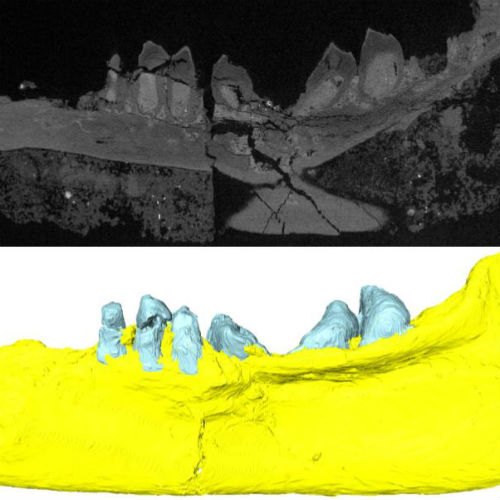
“It has been questioned for many years how Tricuspisaurus is related to the other reptiles. I was keen we found out what it really was, and Matthew was able to CT scan the specimens and this showed that its teeth were located in tooth sockets and it had a beak at the front of its jaws. This confirms it was not a procolophonid, as had been thought, but a distant relative of birds, crocodiles and dinosaurs.”
CT Scan and Digital Image of the Lower Jaw of Tricuspisaurus
CT scan and 3-D digital computer model of the lower jaw of Tricuspisaurus. The scan shows the base of its teeth embedded in tooth sockets. A clear tooth socket lacking a tooth is visible at the back of the jaw. Scale bar equals 5 mm.
The scientific paper: “Late Triassic island dwarfs? Terrestrial tetrapods of the Ruthin fissure (South Wales, UK) including a new genus of procolophonid” by M. Skinner, D. Whiteside, and M. Benton published in the Proceedings of the Geologists’ Association.
Everything Dinosaur team members have produced a short YouTube video praising the Late Cretaceous duck-billed dinosaur Edmontosaurus. A juvenile Edmontosaurus might be on display at the moment, stuck in the jaws of a life-size replica of “Sue” the famous Tyrannosaurus rex exhibit, but Edmontosaurus was more than just lunch for a large theropod. In our short video, we highlight just how successful the Edmontosaurus spp. were. Indeed, the genus may have persisted for as much as seven million years and roamed over an enormous part of the western northern hemisphere.
It’s time to show Edmontosaurus some respect!
Edmontosaurus Not a Helpless, Hapless Hadrosaur
Video credit: Everything Dinosaur
Edmontosaurus regalis and Edmontosaurus annectens
In our short video, it lasts a fraction under eight minutes fifteen seconds, we discuss Edmontosaurus and explain that this genus was extremely successful. It made up a considerable portion of the Late Cretaceous biota of Laramidia and some individuals may have grown to truly gigantic proportions. The narrator discusses both Edmontosaurus regalis and E. annectens looking at some of the unpublished fossil evidence that suggests that this herbivore could have reached lengths in excess of fifteen metres. A large, mature adult Edmontosaurus could perhaps have weighed as much as nine tonnes.
In the Video Edmontosaurus was Compared to the Chinese Hadrosaur Shantungosaurus
Comparing hadrosaurs. Shantungosaurus compared to Edmontosaurus. Could Edmontosaurus have rivalled Shantungosaurus giganteus for the title of the largest facultative biped that ever existed?Picture credit: Everything Dinosaur.
Picture credit: Everything Dinosaur
The YouTube Video
—Video Contents— 0:00 – Introduction, an outline of the video’s contents and objectives. 0:28 – Introducing Edmontosaurus, you might think you know this dinosaur, but be prepared for some surprises. 0:54 – Field Museum Life-size T. rex, the amazing replica created by Blue Rhino Studios. 1:32 – Subscribe! To view Everything Dinosaur on YouTube, we recommend subscribing to our YouTube channel: Everything Dinosaur on YouTube. 1:43 – Two species of Edmontosaurus, an explanation of where, in general, fossils of E. regalis and E. annectens are found. 2:12 – Edmontosaurus roamed Alaska? Hadrosaur fossils associated with the Prince Creek Formation of northern Alaska, could represent a species of Edmontosaurus. 2:43 – Edmontosaurus versus T. rex. Tyrannosaurs predated upon Edmontosaurus, probably targeting the young, the old, or injured/sick individuals. 3:12 – How Big was Edmontosaurus? Fossils provide evidence with regards to the size of this genus. 3:48 – Edmontosaurus “mummies”. Analysis of soft tissues associated with Edmontosaurus specimens indicates that these herbivores were bigger than previously thought. 4:07 – Which species was Bigger? Comparing the two species of Edmontosaurus that have been described to date. 4:21 – Super-sized Edmontosaurus! Just how big could Edmontosaurus be? 4:55 – Biggest Biped that Ever Lived! It may have rivalled Shantungosaurus giganteus for the title of the largest facultative biped that ever lived. 5:13 – Two Edmontosaurus models. Looking at the Wild Safari Prehistoric World 2020 Edmontosaurus and the 2011 replica (see image below). 5:45 – Soft Crest on Edmontosaurus? Did Edmontosaurus have a crest of soft tissue on the top of its skull? We look at the fossil evidence. 6:02 – Successful Edmontosaurus! Time to show Edmontosaurus some respect, it was a truly amazing member of the Dinosauria. 6:32 – Question of the Day! Which T. rex model would you display next to the Wild Safari Prehistoric World Edmontosaurus figure? 7:10 – Respect to Edmontosaurus. Concluding our video, it’s time to show some respect to Edmontosaurus spp.
Showing this Dinosaur Some Respect
The Two Safari Ltd Edmontosaurus Models Compared
Two Safari Ltd Edmontosaurus models (2020 and 2011). Picture credit: Everything Dinosaur.
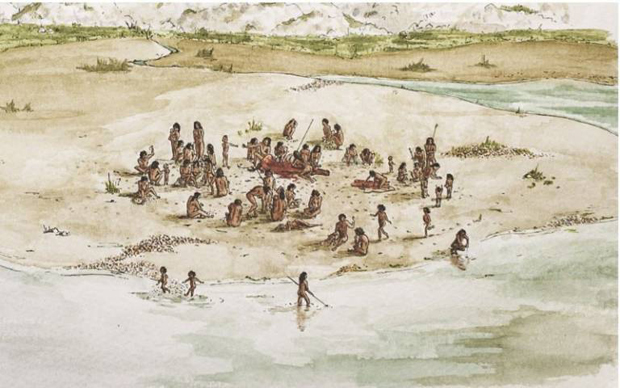
Not far from the location of one of the greatest anthropological hoaxes of all time, the Piltdown Man, lies Boxgrove quarry. This site in picturesque, rural West Sussex provides evidence of the earliest known residents of the United Kingdom, some of the very first Europeans. The gravel quarry reveals a chalk cliff and a bedding plane that represents an ancient beach. Around 500,000 years ago this location was the gathering place for a group of Homo heidelbergensis as they butchered and processed the big game that they had brought down after a successful hunt.
Studying Homo heidelbergensis
Boxgrove has been meticulously studied for over forty years with the University College London Institute of Archaeology taking a prominent role. Their work is detailed in a new book about the discoveries entitled “The Horse Butchery Site”, published by University College London Archaeology South-East’s “Spoilheap Publications”.
At Boxgrove a Number of Large Animals were Butchered including Prehistoric Horses
An artist’s impression of the social event of butchering the horse.
Picture credit: Lauren Gibson / University College London institute of Archaeology
Documenting the Activities of Very Ancient Britons
The book documents the activities and movements of a group of early Britons (H. heidelbergensis) as they knapped flints to make stone tools, modified bones to make implements and butchered a horse around 480,000 years ago or thereabouts.
Leader of the project, Dr Matthew Pope (Institute of Archaeology), commented:
“This was an exceptionally rare opportunity to examine a site pretty much as it had been left behind by an extinct population, after they had gathered to totally process the carcass of a dead horse on the edge of a coastal marshland”
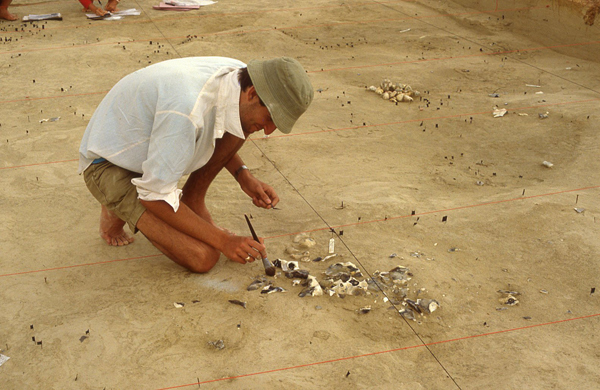
Investigating a Site where Flint Knapping Took Place
Knapping site under excavation (1989).
Picture credit: University College London institute of Archaeology
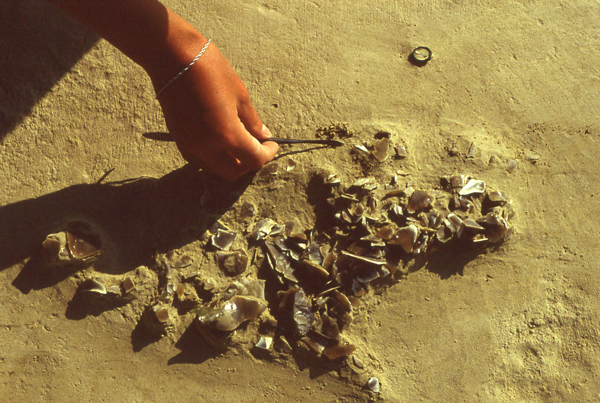
For over a decade from the 1980s and into the 1990s, a dedicated team of volunteers and archaeologists led by Mark Roberts (Institute of Archaeology) uncovered a treasure trove of prehistoric remains, that permitted the researchers to document the activities of these ancient people. More than 2,000 sharp flint fragments were recovered from eight separate areas, known as knapping scatters. These are individual workstations where humans knelt to make tools and left behind a concentrations of flint fragments. In some places the impression made by the worker’s knees as they knelt on the sand can still be seen.
Boxgrove Knapping Site with Preserved Knee Impression
Examining a flint knapping site, note the preserved knee imprint (bottom right).
Picture credit: University College London institute of Archaeology
The “Flint Shadow” Trace Fossils Homo heidelbergensis
At one location, the “flint shadow” of a man has been preserved. The outline of his legs, as he sat, perhaps all day making tools and relentlessly flaking away at the flint, so that a shower of tiny fragments fell on him and around him, leaving a stencil impression of his limbs on the ground.
A spokesperson from Everything Dinosaur commented:
” The communal activity recorded at Boxgrove, where a number of large animals were skilfully cut up, their bones broken and the marrow removed suggests a very high degree of co-ordination and co-operation. Everything in this behaviour indicates planning and a need to communicate, this suggests that Homo heidelbergensis was using a language to explain abstract concepts, organise work and to exchange ideas.”
As Everything Dinosaur team members prepare to put together a video on their YouTube channel all about the dinosaur taxon Edmontosaurus, we have been busy exploring our archive and database and reviewing the original paper on this famous North American duck-billed dinosaur written by Lawrence Lambe.
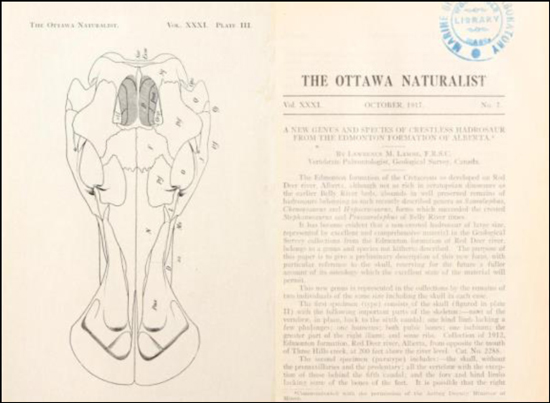
The Title Page for the Scientific Paper on Edmontosaurus (Lambe 1917)
The title page from the original 1917 Edmontosaurus paper written by the eminent Canadian palaeontologist Lawrence Lambe. The paper is entitled: “A new genus and species of crested hadrosaur from the Edmonton Formation of Alberta.”
Picture credit: Archive of the “Ottawa Naturalist”
The First Two Fossil Specimens Attributed to Edmontosaurus were found by Brothers
The genus Edmontosaurus was first erected by the Canadian palaeontologist Lawrence Lambe back in 1917, in an article published in the “Ottawa Naturalist”. He described two specimens found in the Red Deer River area of Alberta, Canada, from a formation known at the time as the Edmonton Formation, but now referred to as the Horseshoe Canyon Formation. The first specimen, the type specimen for this genus, consisting of a disarticulated skull plus extensive post cranial material was collected in 1912 by Levi Sternberg. The second fossil specimen which Lambe also described in his 1917 paper, was collected by George Sternberg, Levi’s older brother, during fieldwork in 1916.
Lambe named this new “crestless hadrosaur” in recognition of the geological formation from whence these fossils came and not in honour of Edmonton, the capital city of the Province of Alberta. He did note the resemblance of the Edmontosaurus material to other duck-billed dinosaur fossils associated with the geologically younger Lance Formation of Dakota, these fossils once described as Diclonius mirabilis, were also referred to as Trachodon mirabilis and form part of an extensive fossil collection from the northern United States that went through a number of taxonomic revisions, leading eventually to the establishment of the species Edmontosaurus annectens.
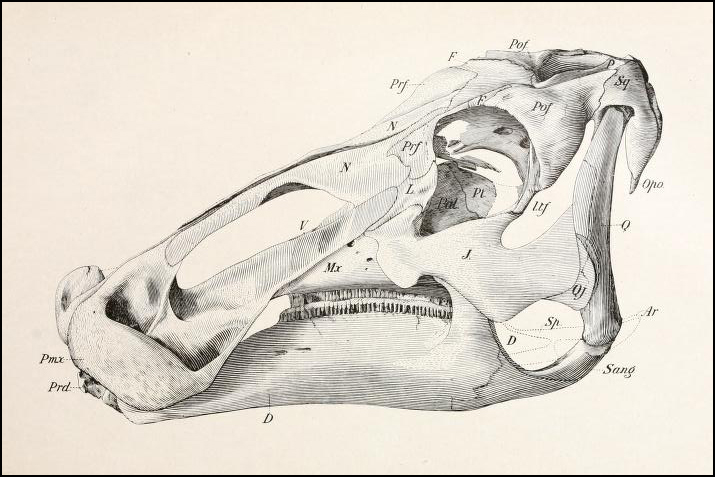
The Illustration of the Skull of Edmontosaurus (1917)
The illustration of the type skull from the 1917 Edmontosaurus paper. Illustration by Arthur Miles. The paper described this lateral view of the skull as being in approximate 1:7 scale when it was reproduced in the Ottawa Naturalist.
Picture credit: Archive of the “Ottawa Naturalist” skull diagram attributed to Arthur Miles
Everything Dinosaur on YouTube
The Everything Dinosaur YouTube channel contains over 170 dinosaur and prehistoric animal-themed videos. The Edmontosaurus video will be posted up shortly and team members encourage blog readers to subscribe to our YouTube channel.
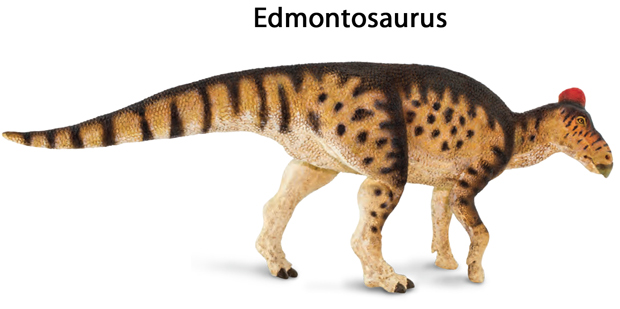
A Life Reconstruction of the Hadrosaurid Edmontosaurus
The new for 2020 Wild Safari Prehistoric World Edmontosaurus dinosaur model.
The model (pictured above), is the new for 2020 Edmontosaurus dinosaur model. To view this figure and the rest of the models in the Wild Safari Prehistoric World range: Wild Safari Prehistoric World Models and Figures.
The fossilised remains of a little, lithe reptile that wandered South Africa during the Middle Triassic have come into the spotlight more than a hundred years after they were first scientifically described. The fossils represent the taxon Euparkeria (pronounced Yoo-park-air-ree-ah) and they are regarded as highly significant in terms of plotting the evolution of tetrapods.
Formally named and described in 1913 (Robert Broom), Euparkeria is phylogenetically regarded as a basal member of the Archosauria. As such, by studying the fossil remains of this animal, palaeontologists can gain a better understanding of the evolution of the archosaurs – a diverse group of tetrapods that includes the crocodilians, birds and of course, the dinosaurs.
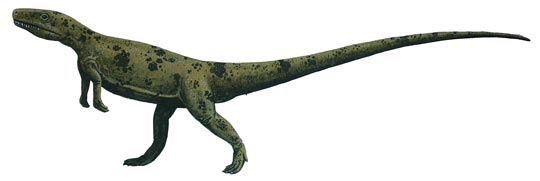
A Life Reconstruction of Euparkeria (Euparkeria capensis)
A life reconstruction of the basal archosauriform Euparkeria. Picture credit: Everything Dinosaur.
Picture credit: Everything Dinosaur
Represented By More Than Ten Fossil Specimens
The fossils all come from a single locality, Aliwal North on the Eastern Cape and Free State Province boundary in South Africa. The fossilised bones having been collected from a solitary stone quarry, adjacent to a small stream.
Measuring around sixty centimetres in length (the tail made up more than half the body length), Euparkeria is known from at least ten specimens. This material was extensively reviewed in 1965, but over the last six decades or so, there have been huge advances in fossil bone imaging techniques and the researchers led by Roland B. Sookias (Museum für Naturkunde in Berlin), subjected Euparkeria material to CT scanning at the Evolutionary Studies Institute, University of the Witwatersrand, Johannesburg.
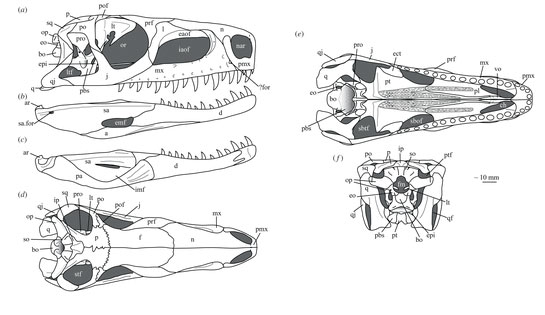
The Research Has Enabled Detailed Diagrams of the Skull of Euparkeria to be Compiled
Reconstruction of the skull and mandible of Euparkeria capensis. Cranium (a) and right mandible (b) in right lateral view; (c) left mandible in medial view; and cranium in (d) dorsal, (e) ventral and (f) posterior view.
Picture credit: Sookias et al (Royal Society Open Science)
Examining the Skull of Euparkeria
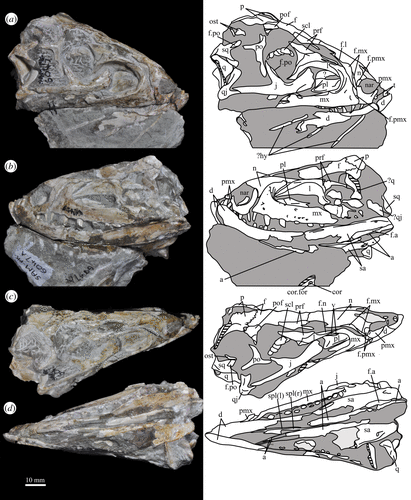
The CT scans enabled the scientists to describe the skull and jaw of Euparkeria in much greater detail than ever before. Anatomical features previously unclear, are fully described for the first time. The researchers were able to examine the palate, determine the number of teeth in the premaxilla (4 teeth in each premaxilla) and reconstruct the braincase. The modular composition of the skull would have ensured that the cranium was quite flexible, adapted to coping with the stress of prey struggling in the jaws.
The study, published by the Royal Society Open Science, confirms Euparkeria as a major advance in tetrapod evolution and helps to place the crown Archosauria in greater context informing palaeontologists about the early stages of archosaur evolution. Euparkeria most probably spent most of its time on all fours, a comparison of forelimb versus hindlimb length suggests that it was a facultative biped (usually walking on all fours but capable of walking as a biped when it needed to). It was one of the first reptiles capable of running on just its hind legs.
Skull of Euparkeria capensis Specimen (SAM-PK-6047A) with Line Drawings
Skull of Euparkeria with accompanying line drawings.
Picture credit: Sookias et al (Royal Society Open Science)
Euparkeria from the Triassic
Euparkeria, which lived approximately 245 million years ago, shows a number of anatomical advances including an increase in brain size with improved senses, upright locomotion and a likely rapid metabolism placing this taxon in a pivotal position between ancestral diapsids the very first members of the Archosauria.
The scientific paper: “The craniomandibular anatomy of the early archosauriform Euparkeria capensis and the dawn of the archosaur skull” by Roland B. Sookias, David Dilkes, Gabriela Sobral, Roger M. H. Smith, Frederik P. Wolvaardt, Andrea B. Arcucci, Bhart-Anjan S. Bhullar and Ingmar Werneburg published by the Royal Society Open Science.
Prehistoric animal model collectors will probably already know that CollectA is about to introduce a range of models of iconic invertebrates, animals such as a straight-shelled nautiloid, an ammonite, trilobite and an extant nautilus (Nautilus pompilius). These figures are due to be in stock at Everything Dinosaur very soon. As part of our preparations for the arrival of these replicas, our team members have been busy compiling fact sheets and data files on these key taxa.
Prehistoric Animal Model Fact Sheets
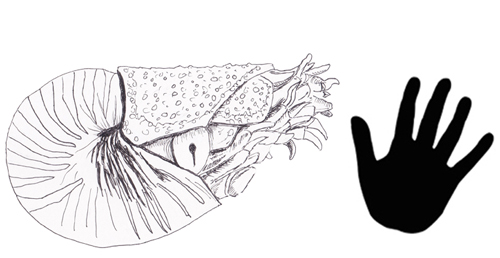
A Scale Drawing of the Nautilus
A scale drawing of an extant nautilus (Nautilus pompilius).Picture credit: Everything Dinosaur.
Picture credit: Everything Dinosaur
A spokesperson from Everything Dinosaur commented:
“We have compiled hundreds of fact sheets over the years. They are supplied to our customers, being sent out with model purchases. For example, purchasers of the CollectA nautilus model from Everything Dinosaur will also be sent a free fact sheet about this amazing cephalopod. We have also prepared fact sheets on the straight-shelled nautiloid and the horseshoe crab.”
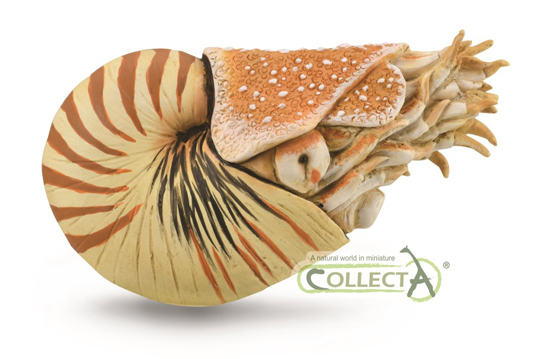
The New for 2020 CollectA Nautilus Model (N. pompilius)
CollectA Nautilus pompilius sometimes referred to as the “Emperor nautilus” because of its large size.
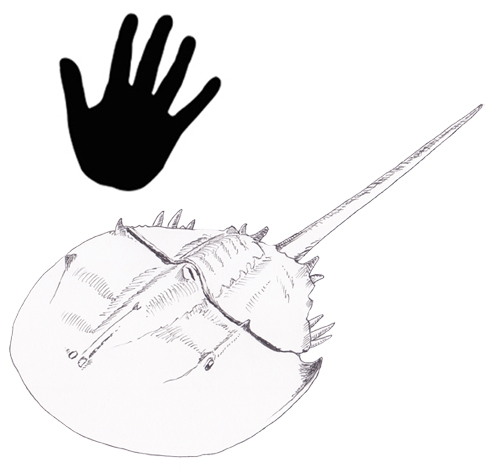
A Horseshoe Crab Scale Drawing
Horseshoe Crab Scale Drawing
A scale drawing of an extant horseshoe crab. The silhouette of the hand helps to provide a scale for the illustration.Picture credit: Everything Dinosaur.
Picture credit: Everything Dinosaur
These invertebrate figures are due to arrive at Everything Dinosaur’s warehouse shortly. However, due to issues arising from the COVID-19 global pandemic affecting global logistics, we are unable to provide an exact date as to when these models will arrive. Followers of Everything Dinosaur on social media such as our Facebook page and newsletter subscribers will be alerted very quickly when these figures are in stock and available to purchase.
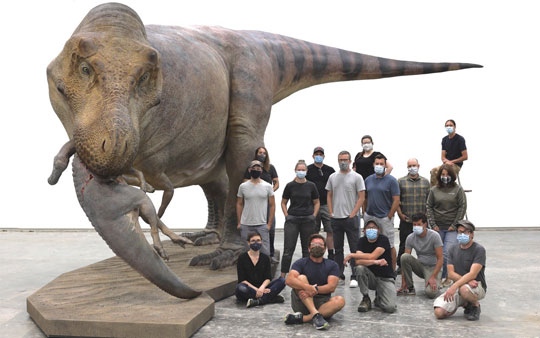
One of the most famous museum exhibits in the world, “Sue” the enormous T. rex mount located at the Field Museum in Chicago has something new to keep her company. A life-size replica of the skeleton has been installed and museum visitors can get to see “Sue” in the flesh. The 13 metre-long life-size model was created by the amazing talented people at Blue Rhino Studio (based in Minnesota).
Staff at Blue Rhino Studio Pose Next to the Completed Tyrannosaurus rex Replica
Staff at Blue Rhino Studio photographed next to their life-size replica of Tyrannosaurus rex.
Picture credit: Blue Rhino Studio
Say Hello to “Fleshy”
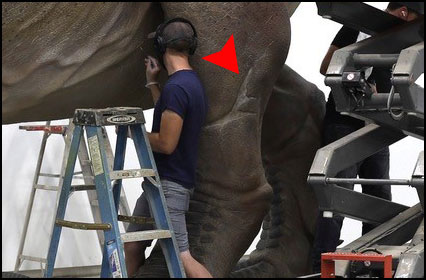
The beautifully crafted replica is currently on display at the Field Museum, but is due to go shortly on a nationwide tour. The huge theropod figure is based on the skeleton of “Sue”, it shows some of the pathology associated with the fossil specimen. For example, there is a substantial scar just above the left ankle. This was the site of a bone infection, probably resulting from an injury that “Sue” had sometime during her long life. This amazing replica has been named “Fleshy”.
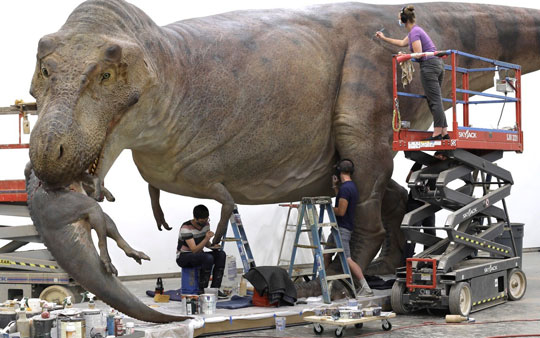
Blue Rhino Studio Staff Working on the Huge T. rex Replica
Blue Rhino staff working on the huge model.
Picture credit: Blue Rhino Studio
A Close-up View of the Area Above the Left Ankle Showing the Scar
A close-up view of the area above the left ankle showing the scar. The red arrow points to the patholoy on the replica.
Picture credit: Blue Rhino Studio with additional annotation by Everything Dinosaur
Tyrannosaurus rex Sharing a Home with a Titanosaur
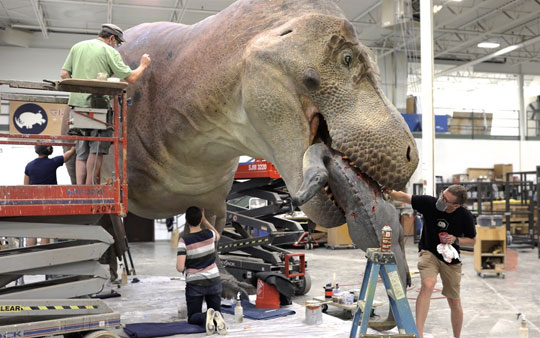
The fossilised remains of perhaps the most famous dinosaur in North America were moved in the winter of 2018 to a new location at the museum. “Sue” can now be found within the museum’s Griffin Halls of Evolving Planet, alongside a skeleton of a titanosaur (nicknamed Máximo). The replica stands nearly 4.5 metres tall and it has a juvenile Edmontosaurus in its mouth. It is likely that E. annectens was on the menu for this Late Cretaceous apex predator.
The Life-size “Sue” T. rex Replica has a Baby Edmontosaurus in its Mouth
Team members working on the giant T. rex figure – complete with juvenile Edmontosaurus.
Picture credit: Blue Rhino Studio
The figure took two whole days to set up in the Field Museum, the staff responsible for the set build and dismantling of “Sue” hope to reduce this to just a day when the figure is on tour.
A spokesperson from Everything Dinosaur commented:
“This is an amazing piece of work! Yes, you can debate the lack of feathers, but this wonderful exhibit will really help visitors to appreciate just how large Tyrannosaurus rex actually was.”
Whilst working on their YouTube video explaining about the newly published scientific paper on Dilophosaurus, team members at Everything Dinosaur needed a visual to explain the importance of this North American dinosaur to palaeontologists as they try to improve their understanding about Early Jurassic dinosaur biota. Interpreting Dilophosaurus fossil material has been hampered by their fragmentary nature and poor preservation.
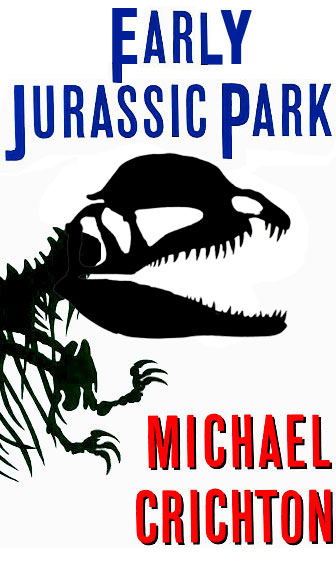
Attempting to summarise the research since the University of California field work from 1942, it was decided to modify an iconic book cover “Jurassic Park” by Michael Crichton. The new research suggests that Dilophosaurus may have looked very different, it was probably not a weak-jawed scavenger but an apex predator, the most dangerous dinosaur in the ecosystem.
The Importance of Dilophosaurus wetherilli – An Important Dinosaur from the Early Jurassic
“Early Jurassic Park” – demonstrating the significance of the Early Jurassic theropod Dilophosaurus wetherilli.
Picture credit: Everything Dinosaur
Dilophosaurus
Dilophosaurus was popularised in the famous dinosaur movie “Jurassic Park” which was released in 1993. It also appeared in the novel written by Michael Crichton, upon which the film was based. The small venomous dinosaur with its neck frill, reminiscent of the frilled-neck lizard of Australia (Chlamydosaurus kingii) was regarded as a major departure from the science by many movie-goers although Dilophosaurus played a prominent role in one of the most significant scenes of the whole franchise when Dennis Nedry, the computer programmer who had been bribed to smuggle dinosaur embryos off the resort, was attacked and eaten.
The Dilophosaurus from the Film “Jurassic Park”
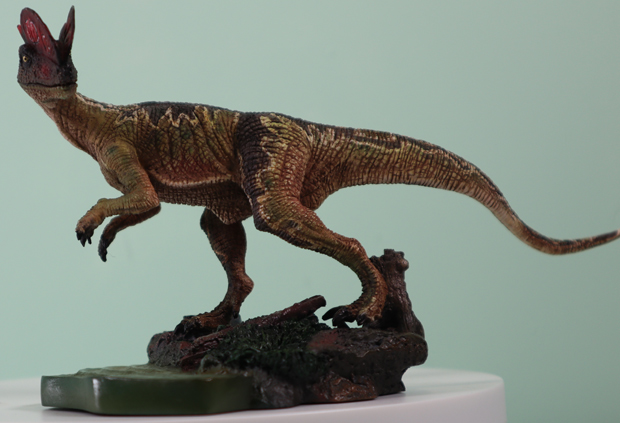
The ITOY Studio Dilophosaurus dinosaur model has an articulated jaw. Picture credit: Everything Dinosaur.
In the newly published paper (Marsh and Rowe 2020), Dilophosaurus is depicted as a more robust, powerful animal and as far as the fossil record known to date goes, Dilophosaurus represents the largest terrestrial vertebrate known from the Early Jurassic of North America.
A Life Reconstruction of Dilophosaurus wetherilli Based on the 2020 Scientific Interpretation
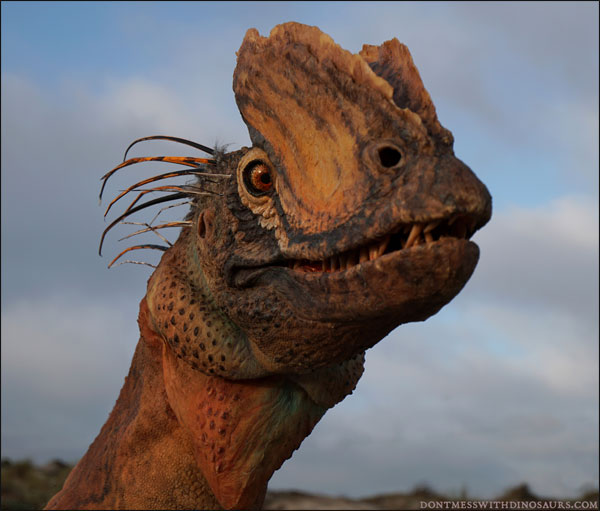
An amazing puppet depicting Dilophosaurus wetherilli using the data from the newly published scientific paper was created by Brian Engh.
The Everything Dinosaur YouTube channel, is packed with lots of amazing videos all about dinosaurs and prehistoric animals. The channel has over 175 videos on it, providing lots of information to dinosaur fans and model collectors: Subscribe to Everything Dinosaur on YouTube.
A comprehensive review of the fossil material associated with the Early Jurassic crested theropod Dilophosaurus (D. wetherilli) has been published. The consequences of this newly published paper for manufacturers of dinosaur models are profound. It is likely that our view of “double crested lizard” will change and with the writing of this paper, all the Dilophosaurus figures and replicas are very probably all wrong!
It’s time to “beef up” Dilophosaurus and to stop depicting it as a lightly built, gracile, weak-jawed scavenger but to recognise that this dinosaur was an apex predator!
Everything Dinosaur team members have produced a short YouTube video that explains what has happened.
Time to “Beef Up” Dilophosaurus (D. wetherilli)
Video credit: Everything Dinosaur
All Dilophosaurus wetherilli Dinosaur Models May be Wrong!
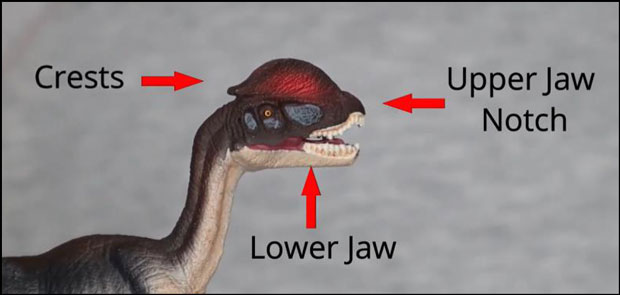
An analysis of the five most-complete Dilophosaurus specimens reveals that Dilophosaurus had stronger jaws than previously thought. That distinctive notch between the premaxilla and the maxilla (the upper jaw bones), which is so carefully depicted in numerous replicas and figures, might be much less pronounced. The original interpretation of the “kink” being put down to the fragmented and poor condition of the fossil material. The shape of the upper jaws may be a result of taphonomy and it might not reflect the actual shape of the bones.
Lots of Dilophosaurus Dinosaur Models Feature in Everything Dinosaur’s Video
The Wild Safari Prehistoric World Dilophosaurus model came out in 2009 and it shows the characteristic anatomical traits formerly associated with this theropod dinosaur.Picture credit: Everything Dinosaur.
Picture credit: Everything Dinosaur
Nasal and Lacrimal Bones Form the Crests
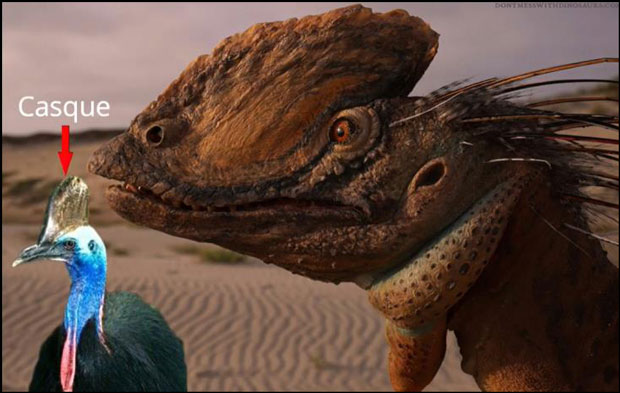
It is the nasal and lacrimal bones that form the famous crests. This new paper suggests that these features were not thin and bony but the hollow, pneumatised cores were covered with keratin or keratinised skin making them much larger than previously thought. Although their overall shape remains uncertain, these crests may have played a role in helping this large animal to lose heat. Recently published research (Eastick et al), suggests that the casques of large, ground-dwelling birds such as cassowaries might act as thermal windows.
The casque on the top of the head of the cassowary could help this large bird to lose heat when it is very hot and restrict heat loss in cooler conditions. At the time of publication (2019), it was proposed that these findings might have implications for the function of similar structures in avian and non-avian dinosaurs and that includes Dilophosaurus wetherilli.
Used for Display and Thermoregulation?
The new interpretation depicts Dilophosaurus as an apex predator which was very bird-like. Those crests could have played a role in thermoregulation.
Picture credit: Everything Dinosaur (puppet of Dilophosaurus created by Brian Engh)
Everything Dinosaur’s YouTube video highlighting the scientific paper on Dilophosaurus that may change the way models of this dinosaur are made lasts for a fraction over eleven minutes. It provides an overview of the recent paper and discusses how future Dilophosaurus dinosaur models might look.
To read Everything Dinosaur’s blog post about the newly published research reviewing the Dilophosaurus wetherilli fossil material: Beefing Up Dilophosaurus.
Everything Dinosaur’s YouTube channel contains over 175 dinosaur and prehistoric animal videos, including model reviews, tips and hints about prehistoric animal model collecting, new releases, fossil discoveries, updates and insider information.
Discover Everything Dinosaur on YouTube: Everything Dinosaur on YouTube. We recommend that you subscribe to our YouTube channel.
Everything Dinosaur would like to acknowledge the help and support of University of Texas at Austin/Jackson School of Geosciences for their help in creating our YouTube video.