All about dinosaurs, fossils and prehistoric animals by Everything Dinosaur team members.

Everything Dinosaur’s work with photoshop and other platforms.

26 09, 2020

Rebor “Bites the Dust” and New Fossil Skulls

By |2024-03-16T06:34:09+00:00September 26th, 2020|Categories: Adobe CS5, Dinosaur Fans, Everything Dinosaur News and Updates, Everything Dinosaur Newsletters, Everything Dinosaur Products, Main Page, Photos of Everything Dinosaur Products, Press Releases|0 Comments

Rebor “Bites the Dust” and Oddities Fossil Studies Skulls

Everything Dinosaur despatched a special newsletter to its subscribers earlier this month announcing the arrival of the two T. rex carcasses in the Rebor “Bites the Dust” model line.  In addition, the newsletter announced that pre-orders were being taken for the exciting Rebor Oddities Fossil Studies Skulls (Wave 1).  All three, beautiful theropod skulls, Yutyrannus huali, Ceratosaurus dentisulcatus and Carnotaurus sastrei were available to pre-order from Everything Dinosaur at very special prices.

The offers don’t just stop there, the newsletter included a special offer on the duo of dead dinosaurs too!

The Rebor “Bites the Dust” Tyrannosaur Carcasses (Plain and Jungle)
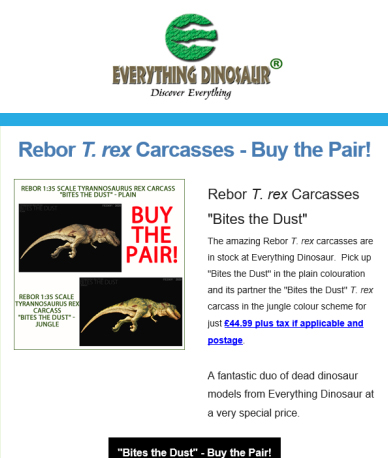
Rebor T. rex carcasses "Bites the Dust" plain and jungle colour variants.
The Rebor T. rex carcasses “Bites the Dust” provide the headlines for the latest Everything Dinosaur customer newsletter.  Buy the pair at a special discounted price courtesy of Everything Dinosaur. Picture credit: Everything Dinosaur.

Picture credit: Everything Dinosaur

Rebor “Bites the Dust” T. rex Didn’t Always Win!

The Rebor “Bites the Dust” figures are available in two colour schemes.  Firstly, there is a brown dominated model called “plain”, there is a second model “jungle” with more of a greenish hue.  These carefully constructed carcasses are in 1:35 scale and reflect the fact that tyrannosaurs like most predatory dinosaurs had very tough, short lives.

Most dinosaurs did not make it to adulthood and for tyrannosaurs such as T. rex, life at the top of the food chain was particularly hard.  It was a question of kill or be killed, not only did these theropods have to battle horned dinosaurs and hadrosaurs, they also had to contend with attacks from their own kind as well.  The fossil record provides evidence of tyrannosaurs biting other tyrannosaurs, for example, in 2010, a paper was published in PLOS One entitled “Cannibalism in Tyrannosaurus rex”.  The eminent authors, Longrich, Horner, Erickson and Currie identified four T. rex specimens that preserved potential T. rex bites on their bones.

The Two T. rex Bites the Dust Carcass Models (Plain and Jungle)
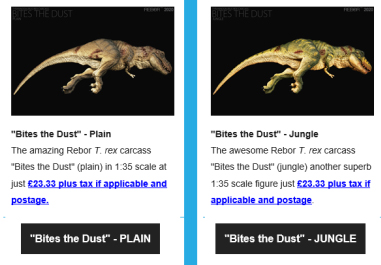
The two Rebor "Bites the Dust" T. rex carcasses.
The Rebor T. rex carcass plain (left) and the Rebor T. rex carcass jungle (right) two beautiful 1:35 scale replicas of a deceased Tyrannosaurus rex. Picture credit: Everything Dinosaur.

Picture credit: Everything Dinosaur

The scientists concluded that Tyrannosaurus rex routinely hunting full-grown members of its own species was unlikely, however, it is possible that intraspecific combat led to casualties, with the dead becoming a convenient source of food for the victorious T. rex.  These figures show bite marks from another very large predator, since T. rex is the only enormous terrestrial carnivore known from the latest Upper Cretaceous deposits of North America, it can be inferred that these two Rebor models show the result of an intraspecific combat.

Rebor Oddities Fossil Studies Skulls

The newsletter also provided subscribers with details of the forthcoming Rebor Oddities Fossil Studies skulls, a set of three amazing theropod skulls, namely, C. sastrei, Y. huali and C. dentisulcatus.  These museum quality replicas are available to pre-order from Everything Dinosaur.

The Rebor Ceratosaurus dentisulcatus and Yutyrannus huali Fossil Skulls
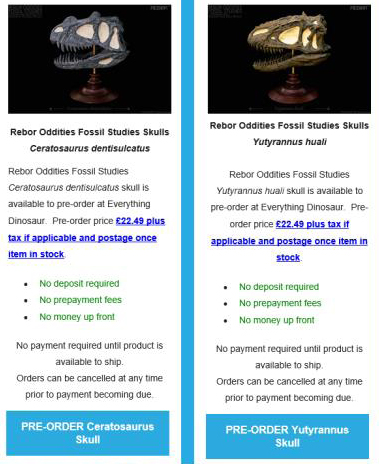
The Rebor Oddities Fossil Skulls (Ceratosaurus and Yutyrannus).
The Rebor Oddities Fossil Skull Ceratosaurus dentisulcatus (left) with the Rebor Oddities Fossil Skull Yutyrannus huali. Picture credit: Everything Dinosaur.

Picture credit: Everything Dinosaur

Visit the Everything Dinosaur website: Everything Dinosaur.

Buy All Three Models

The three fossil skulls, regarded as the first wave in an intended series of skull models are likely to be in stock at Everything Dinosaur in November (2020).  Customers have the opportunity to pre-order the replicas and to take advantage of a special offer to purchase all three Rebor Oddities Fossil Studies models.

A Trio of Amazing Fossil Skulls

Rebor Oddities Fossil Studies skulls.
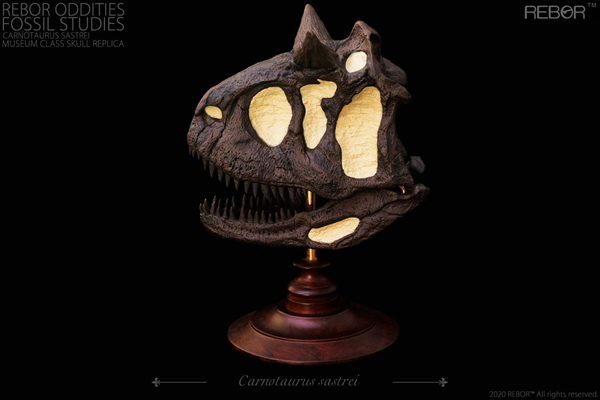
The Rebor Oddities Fossil Studies Carnotaurus sastrei model (left) and the opportunity to pre-order all three skulls at a special discounted price (right).

Picture credit: Everything Dinosaur

The Rebor “Bites the Dust” T. rex carcasses and the pre-order options for the fossil skulls can be found here: Rebor Models and Figures.

To subscribe to Everything Dinosaur’s newsletter, simply email the company and request a subscription: Email Everything Dinosaur to Subscribe to Newsletters.

25 09, 2020

New Rebor Titanoboa Models Ready to Pre-order

By |2024-03-16T06:27:34+00:00September 25th, 2020|Categories: Adobe CS5, Dinosaur Fans, Everything Dinosaur News and Updates, Everything Dinosaur Products, Main Page, Photos of Everything Dinosaur Products, Press Releases|0 Comments

New Rebor Titanoboa Models Ready to Pre-order

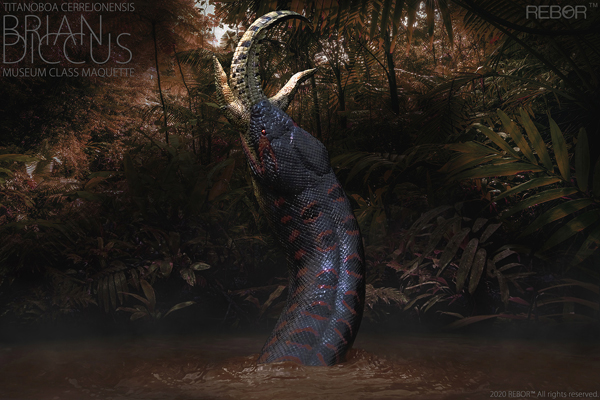
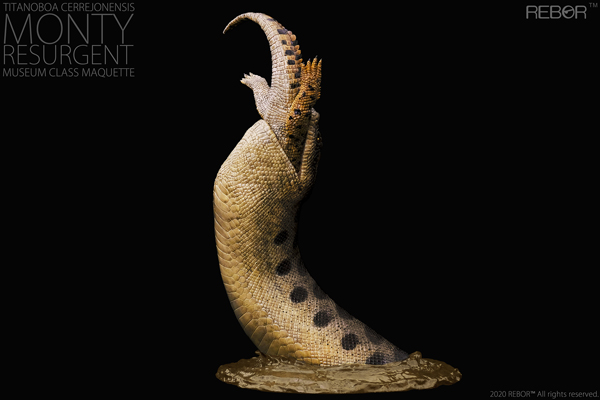
The stunning Rebor Titanoboa Museum Class Maquette Monty Resurgent and the Rebor Titanoboa Museum Class Maquette Brian Diccus are available to pre-order at Everything Dinosaur.  These amazing models of a Titanoboa (T. cerrejonensis) swallowing a crocodilian are going into production in the next few months and both replicas are expected in stock at Everything Dinosaur sometime around quarter two of 2021.

The New for 2021 Rebor Titanoboa Museum Class Maquette Monty Resurgent Figure

Rebor Titanoboa Museum Class Maquette Monty Resurgent.
The Rebor Titanoboa Museum Class Maquette Monty Resurgent.  A stunning replica of the largest snake known to science – Titanoboa cerrejonensis complete with its unfortunate crocodilian victim which is in the process of being swallowed whole.

Rebor Titanoboa – Hot on the Heels of Monty

This year (2020), saw the release of the limited edition Rebor Titanoboa figure “Monty”, this beautiful replica of the largest snake described to date, sold out very quickly.  Aware of how popular this prehistoric animal is Rebor have plans to introduce two more Titanoboa replicas.  Each one “Monty Resurgent” and “Brian Diccus”, will have a single production run and they are going to be made in a few months’ time.  Customers of Everything Dinosaur have the chance to secure their figures early.

The New for 2021 Rebor Titanoboa Museum Class Maquette Brian Diccus Replica

Rebor Titanoboa Museum Class Maquette Brian Diccus.
The Rebor Titanoboa Museum Class Maquette Brian Diccus.  Each model has a different colour scheme and this extends to the crocodilian prey as well with the “Monty” Titanoboa having a brown crocodilian victim, whilst Brian Diccus has a green crocodilian prey item.

Pre-order Available from Everything Dinosaur

Both colour variants are available for pre-order.  Customers can choose which figure they want and then add it to their shopping cart and go through the checkout process as per usual.  However, with Everything Dinosaur, there are no fees to pay, no upfront costs, no surcharges, no deposit required.

Customers also need to note that due to the complexity of the pre-order checkout process, an order may contain only a single pre-order Titanoboa product, and no other products, pre-order or otherwise.  If a customer adds a pre-order product to a non-empty cart, the cart will be automatically emptied and the pre-order product will be added. This means that if you want both Titanoboa colour variants, customers will have to place two pre-orders (one for each prehistoric snake figure).

The Rebor Titanoboa Museum Class Maquette Brian Diccus

Rebor Titanoboa Museum Class Maquette Brian Diccus.
The Rebor Titanoboa Museum Class Maquette Brian Diccus.

Rebor Titanoboa is Praised

A spokesperson from Everything Dinosaur commented:

“These are two beautifully crafted figures.  Each replica shows the anterior portions of the giant snake emerging out of the water as it gulps down its unfortunate victim.  We look forward to bringing these products into our warehouse sometime around the early summer of 2021.”

The Everything Dinosaur website: Everything Dinosaur.

Swallowed Whole the Rebor Monty Resurgent Titanoboa Makes Short Work of a Large Crocodile

Rebor Titanoboa Museum Class Maquette Monty Resurgent.
The Rebor Titanoboa Museum Class Maquette Monty Resurgent.

The two Rebor Titanoboa figures can be found on this part of Everything Dinosaur’s website: Rebor Models and Figures.

24 09, 2020

“Dung and Dusted” – A Scatological Approach to Archaeology

By |2024-03-15T22:54:06+00:00September 24th, 2020|Categories: Adobe CS5, Main Page, Photos|0 Comments

Did Ancient Potters use Sheep Dung to Fire their Clay Pots?

A project is underway to provide “hands-on” information about how ancient Britons could have fired clay pots before the invention of kiln technology.  By undertaking practical experiments trying different sorts of fuel to fire clay vessels, archaeologists hope to find out more about the way our ancestors lived their lives.

Ancient Potters and Sheep Dung

A new study, with the catchy title “Dung and Dusted”, aims to do just that, specifically by examining whether sheep dung could have been used to fire pots before the widespread use of kilns.  Dr Michael Copper, from the School of Archaeological and Forensic Sciences in the Faculty of Life Sciences (University of Bradford), hopes that these practical experiments will help researchers to gain a better understanding of how different, ancient communities were organised.

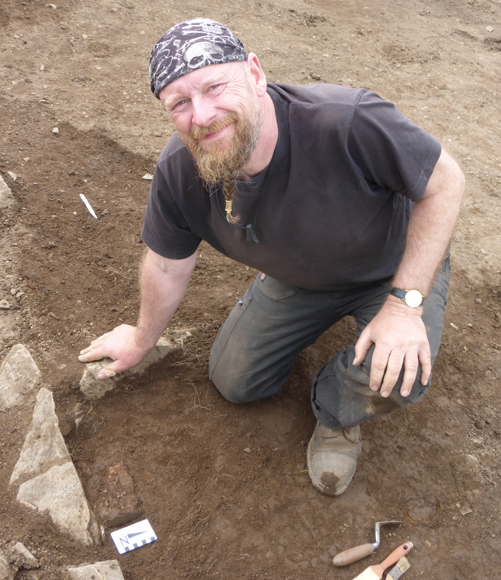
Dr Mike Copper – Part of the “Dung and Dusted” Project

Dr Mike Copper who will be part of the "Dung and Dusted" project.
Doctor Mike Copper on location in Orkney. The project aims to uncover the secrets of ancient potters.

Picture credit: University of Bradford

Dr Copper explained:

“Despite considerable advances in our knowledge of how ancient pots were made and used, archaeologists still know remarkably little about how prehistoric pottery was fired before the introduction of the potter’s kiln, including what fuels were used.  One abundant and freely available fuel source in prehistory would have been animal dung.  Could it then have been the case that dried dung was used to fire pottery in prehistoric Britain and Ireland?”

A Six-month Project

The research project is funded by the Gerda Henkel Foundation and is planned to last around six months.  A series of firings of hand-built replica prehistoric pots using sheep dung and other fuels are planned.  The vessels and firing sites will then be analysed to see whether residues left behind can be matched to ancient pottery or can be used to help archaeologists identify dung firing evidence at archaeological digs.

Dr Copper, a specialist in prehistoric pottery and ancient ceramic technology, added:

“In terms of why it is significant, experimental projects such as this provide an important way for archaeologists to understand how prehistoric people went about tasks such as pot firing using materials and techniques with which we are no longer familiar.  Pottery is one of the most important finds made on archaeological excavations.  Its varied forms help us to date sites and analysis of burnt food residues can tell us about what the inhabitants ate.  If we find that animal dung was used to fire the pots then it could be that people were managing animals with one eye on using dung as a product.”

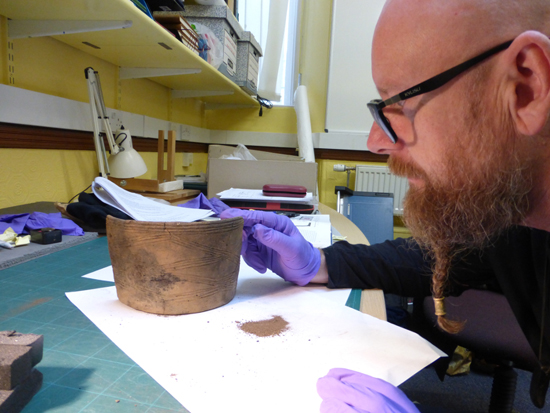
Dr Mike Copper Examining an Ancient Clay Pot

Dr Mike Cooper examines a prehistoric clay pot.
Dr Mike Copper, inspecting a prehistoric clay pot.

Picture credit: University of Bradford

Learning the Secrets of Ancient Potters Through Experimentation

The researchers, which include Dr Cathy Batt, an expert in magnetic studies with extensive experience of investigating ancient firing sites and Dr Gregg Griffin, a recent PhD graduate who looked at ways to identify fuels from residues discovered on archaeological excavations, hope to gain an understanding of how ancient societies were organised with pot-making and firing a central part of the community.  Variations in the use of technology, such as choice of fuel for pottery making, are passed down from one generation to another.  This can provide archaeologists with a lot of additional information about how a community organised itself.

We look forward to hearing more as this project concludes and we wonder whether the sheep will be cited in the subsequent paper as contributors…

Everything Dinosaur acknowledges the assistance of a press release from the University of Bradford in the compilation of this article.

The Everything Dinosaur website: Prehistoric Animal Figures, Toys and Gifts.

23 09, 2020

New Rebor Oddities Fossil Studies Dinosaur Skulls

By |2024-03-19T14:43:31+00:00September 23rd, 2020|Categories: Adobe CS5, Dinosaur Fans, Everything Dinosaur News and Updates, Everything Dinosaur Products, Main Page, Photos of Everything Dinosaur Products, Press Releases|0 Comments

Rebor Oddities Fossil Studies Dinosaur Skulls

The Rebor Oddities Fossil Studies dinosaur skulls, a set of three, amazing museum quality theropod skull models are available to pre-order from Everything Dinosaur.  The set referred to as “wave 1”, suggesting that more skull models are likely to be added to this range in the future, consists of replicas of the skulls of Carnotaurus (C. sastrei), Ceratosaurus (C. dentisulcatus) and Yutyrannus (Y. huali).  Each replica has been carefully crafted and give the impression that a complete skull has been lifted from the surrounding rock matrix.

The Rebor Oddities Fossil Studies Yutyrannus huali Skull Replica

Rebor Oddities Fossil Studies Y. hauli skull model.
The Rebor Oddities Fossil Studies Yutyrannus huali museum quality skull model.

Picture credit: Everything Dinosaur

Tyrannosauroids, Abelisaurids and a Member of the Basal Ceratosauria Clade

Although each amazing figure represents a carnivorous theropod dinosaur, these three animals were very distantly related to each other. For example, Ceratosaurus dentisulcatus, regarded as one of the largest of the Ceratosaurus species, like all ceratosaurs, is part of a clade that diverged from the Coelurosauria Theropoda lineage that was ultimately to lead to the evolution of birds, during the Jurassic.  Carnotaurus (C. sastrei) is a Late Cretaceous representative of the Abelisauridae, a family of predatory dinosaurs mostly associated with Africa, South America, India and the island of Madagascar.  Although part of the Ceratosauria clade, Carnotaurus is both geographically and temporally very distant from Ceratosaurus.

The Rebor Oddities Fossil Studies Ceratosaurus Skull (C. dentisulcatus) Replica

Rebor Oddities Fossil Studies C. dentisulcatus museum quality skull model.
The Rebor Oddities Fossil Studies Ceratosaurus dentisulcatus museum quality skull model.  The characteristic nasal horn associated with this genus is prominent in the Rebor figure.

Picture credit: Everything Dinosaur

Yutyrannus huali

Yutyrannus huali is known from the Liaoning Province of north-eastern China (Yixian Formation).  It lived during the Early Cretaceous, approximately 125 million years ago.  Many palaeontologists classify Yutyrannus as a member of the Proceratosauridae family and as such a member of the Tyrannosauroidea.  The proceratosaurs, despite their name, which translates as “before ceratosaurs”, are not members of the Ceratosauria.  The confusion arises due to the naming and description of Proceratosaurus bradleyi from a partial skull with a distinctive nasal horn associated with the Middle Jurassic Forest Marble Formation of Gloucestershire, England.  When Proceratosaurus was named in 1910, it was proposed that it was an ancestor of Ceratosaurus.

Research carried out some seventy years later demonstrated that this was incorrect and that Proceratosaurus is in fact a very early representative of that lineage of theropods that was to eventually lead to the evolution of the tyrannosaurs and that most famous dinosaur of all T. rex.

The Rebor Oddities Fossil Studies Carnotaurus sastrei Replica

Rebor Oddities Fossil Studies C. sastrei museum quality skull model.
The Rebor Oddities Fossil Studies Carnotaurus sastrei museum quality skull model.

Picture credit: Everything Dinosaur

A spokesperson from Everything Dinosaur commented:

“Although these three figures represent very different theropod dinosaurs, they all reflect the same high quality standards we have come to expect from Rebor.”

Pre-order with Everything Dinosaur

All three Rebor skull models are now available for pre-order from Everything Dinosaur.

  • No prepayment fees
  • Money up front is not needed
  • No deposit required
  • No payment required until the item is available for despatch
  • Orders can be cancelled at any time prior to payment becoming due on the release date

We are expecting these figures to be in stock around week commencing 2nd of November (2020)

Visit the Everything Dinosaur website: Prehistoric Animal Models and Toys.

Everything Dinosaur is also offering the set of three skulls at a special discount (whilst stocks last).

Buy All Three Rebor Skull Replicas Together!

A special offer on a set of Rebor fossil skulls.
Buy all three Rebor Oddities Fossil Studies museum class fossil skulls (whilst stocks last). Picture credit: Everything Dinosaur.

Picture credit: Everything Dinosaur

To find the Rebor Oddities Fossil Studies skulls visit this section of Everything Dinosaur’s website: Rebor Models and Figures.

22 09, 2020

A New Book Review “Dinosaurs How They Lived and Evolved”

By |2024-03-15T22:08:33+00:00September 22nd, 2020|Categories: Adobe CS5, Book Reviews, Dinosaur Fans, Main Page, Press Releases|0 Comments

“Dinosaurs How They Lived and Evolved”

Team members at Everything Dinosaur have been re-reading the second edition of the excellent dinosaur book “Dinosaurs How They Lived and Evolved”.  We reviewed this publication in the early summer, but as the autumn darkness descends we have been visiting once again its chapters on the dinosaur family tree and dinosaur biology, ecology and behaviour.  This really is an excellent and most informative dinosaur book.

A Book and One Model but Two Tianyulongs

Dinosaurs How They Lived and Evolved and a dinosaur model.
The front cover of “Dinosaurs How They Lived and Evolved” features an illustration of the Jurassic dinosaur Tianyulong so we included a model of a Tianyulong in our photograph. Picture credit: Everything Dinosaur.

Picture credit: Everything Dinosaur

“Dinosaurs How They Lived and Evolved”

The front cover of “Dinosaurs How They Lived and Evolved” features an illustration of the Jurassic heterodontosaurid Tianyulong munching on some ginkgo leaves.  This illustration was created by the very talented Bob Nicholls.  As this bizarre Chinese dinosaur is featured on the cover we included a model of a Tianyulong (PNSO) in our photograph.  The authors of this wonderful dinosaur book, much updated and revised from the first edition, are to be congratulated for compiling such a well-crafted book on the Dinosauria.

“Dinosaurs How They Lived and Evolved” is crammed full of fascinating facts and amazing information, all presented in a writing style that makes it easy for the general reader to follow.  The myriad of drawings, charts, maps, diagrams and prehistoric animal themed artwork help to illustrate key points in the story of the Dinosauria.

This book is highly recommended and would make an excellent gift for the festive season.

Co-author Darren Naish now sells copies of his books here (subject to availability), ask him nicely and he might include a special customised dinosaur illustration for you.

To read Everything Dinosaur’s review of “Dinosaurs How They Lived and Evolved” by Darren Naish and Paul M. Barrett: Everything Dinosaur Reviews “Dinosaurs How They Lived and Evolved”.

The Everything Dinosaur website: Everything Dinosaur.

19 09, 2020

Spinosaurus – Very Much at Home in the River

By |2024-03-15T17:06:40+00:00September 19th, 2020|Categories: Adobe CS5, Dinosaur and Prehistoric Animal News Stories, Dinosaur Fans, Main Page, Photos of Everything Dinosaur Products, Photos/Pictures of Fossils|0 Comments

Spinosaurus A River Monster

An examination of more than a thousand fossil dinosaur teeth collected from an ancient Cretaceous-aged riverbed in Morocco suggests that the giant theropod Spinosaurus was very much at home in an aquatic environment.  This new study, conducted by researchers from the University of Portsmouth, lends further support to the idea that Spinosaurus spent a great deal of time in water, that this enormous theropod, arguably one of the largest of all the carnivorous dinosaurs was a “river monster”.

More Evidence Suggests that Spinosaurus was an Aquatic Animal

Swimming Spinosaurus (2020)
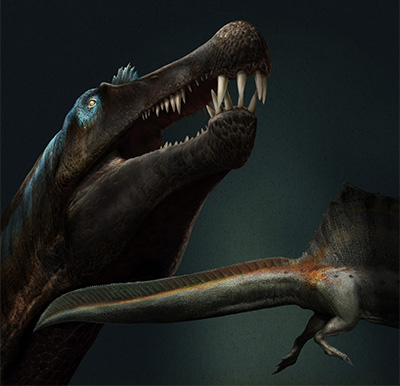
View of the crocodile-like snout of Spinosaurus and the new interpretation of the tail.  This new paper supports the earlier hypothesis that Spinosaurus aegyptiacus was an aquatic animal.

Picture credit: Davide Bonadonna/National Geographic

This new study builds on a research paper published in the journal “Nature”, earlier this year, which also involved co-author Professor David Martill (University of Portsmouth).  The May (2020) paper focused on the examination of Spinosaurus aegyptiacus caudal vertebrae, it was concluded that Spinosaurus had a wide, flexible, fin-like tail, ideal for helping the dinosaur to propel itself through the water.

To read more about the Spinosaurus tail bones: Spinosaurus – The River Monster.

A Study of Fossil Teeth from the Kem Kem Formation

Writing in the academic journal “Cretaceous Research”, the scientists conclude that Spinosaurus was a water-dwelling dinosaur, a giant “river monster”.

A total of 1,200 broken teeth were collected from the site of an ancient riverbed in the Kem Kem Formation of Morocco.  Each tooth was carefully analysed and documented and it was discovered that Spinosaurus teeth made up the majority of the fossil specimens.

Professor David Martill, Professor of Palaeobiology at the University of Portsmouth explained:

“From this research we are able to confirm this location as the place where this gigantic dinosaur not only lived but also died.  The results are fully consistent with the idea of a truly water-dwelling, “river monster”.”

Examples of Typical Fossils from the Kem Kem Formation (Morocco)

Fossil remains (Kem Kem beds).
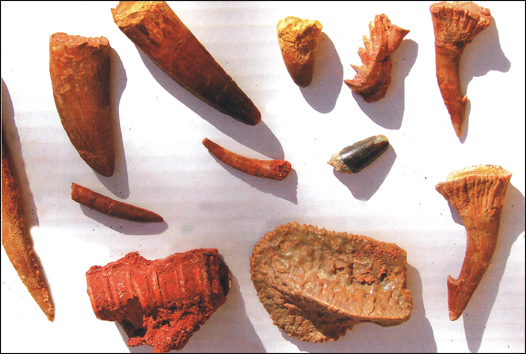
Assorted vertebrate fossil remains from the Kem Kem beds of Morocco.  The elongated conical tooth (top left) and the large, slender conical tooth which is partially obscured (far left) are likely to be spinosaurid.

Studying Spinosaurus

Around forty-five percent of all the teeth fossils were ascribed to Spinosaurus.

Professor Martill added:

“The huge number of teeth we collected in the prehistoric riverbed reveals that Spinosaurus was there in huge numbers, accounting for 45 per cent of the total dental remains.  We know of no other location where such a mass of dinosaur teeth have been found in bone-bearing rock.  The enhanced abundance of Spinosaurus teeth, relative to other dinosaurs, is a reflection of their aquatic lifestyle.  An animal living much of its life in water is much more likely to contribute teeth to the river deposit than those dinosaurs that perhaps only visited the river for drinking and feeding along its banks.”

Professor Martill worked alongside two students (Aaron Quigley and Thomas Beevor), studying for the Masters Degree in Palaeontology at the university.

Thomas Beevor commented:

“The Kem Kem riverbeds are an amazing source of Spinosaurus remains.  They also preserve the remains of many other Cretaceous creatures including sawfish, coelacanths, crocodiles, flying reptiles and other land-living dinosaurs.  With such an abundance of Spinosaurus teeth, it is highly likely that this animal was living mostly within the river rather than along its banks.”

Identifying Spinosaurus Teeth

Sorting fossil teeth can be quite a challenging process.  However, enough is known about the Kem Kem biota to enable most of the teeth remains to be assigned to a genus or at least at the family level.  Numerous theropod dinosaurs are known from this geological formation, but spinosaurid teeth are distinctive.  They are conical, lack serrations and are not recurved.  Aaron Quigley explained that the teeth of Spinosaurus have a distinct surface.  They have a smooth, round cross-section which glints when held up to the light.

A Model of Spinosaurus Introduced in 2019 (Papo Spinosaurus)

Papo Limited Edition Spinosaurus Model.
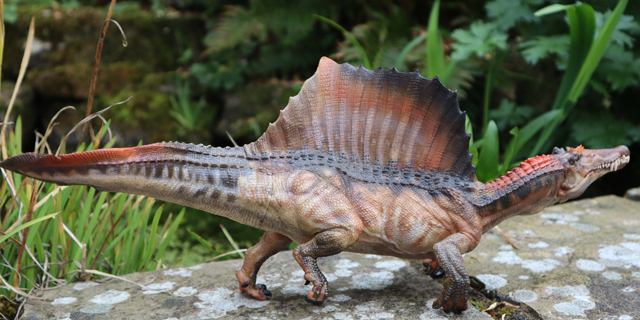
The Papo limited-edition Spinosaurus dinosaur model (2019).  Depicting Spinosaurus as an aquatic animal with deep, fin-like tail. Picture credit: Everything Dinosaur.

Picture credit: Everything Dinosaur

The picture (above) shows the Papo limited-edition Spinosaurus figure.

To view the range of Papo dinosaurs and prehistoric animals: Papo Prehistoric Animal Figures.

The Sigilmassasaurus Confusion

Whilst the prevalence of spinosaurid teeth in the sample might indicate that spinosaurids spent more time in close proximity to the ancient river than other dinosaurs, this research does not represent definitive proof that Spinosaurus was aquatic.  It lends weight to the idea.

A large amount of spinosaurid teeth associated with the site, could be a result of some form of depositional bias or general taphonomy.  In addition, the paucity of Spinosaurus remains from the Kem Kem Formation has led to controversy over the classification of fossil bones.  For example, in 1996 a second genus of spinosaurid was named and described from fossilised cervical vertebrae found close to the Tafilalt Oasis in eastern Morocco.

This dinosaur was named Sigilmassasaurus brevicollis (Russell), but its taxonomic validity remains in doubt.  Sigilmassasaurus may be a valid genus, if it is, then it was very closely related to Spinosaurus aegyptiacus.  Other scientists think that S. brevicollis is not a valid genus and a junior synonym of Spinosaurus.  It is possible that the teeth involved in this study could represent another type of spinosaurid, other than S. aegyptiacus.

Everything Dinosaur acknowledges the assistance of a media release from the University of Portsmouth in the compilation of this article.

Visit the Everything Dinosaur website: Everything Dinosaur.

16 09, 2020

CollectA Deluxe Lisowicia Video Review

By |2024-03-15T16:30:34+00:00September 16th, 2020|Categories: Adobe CS5, Dinosaur Fans, Everything Dinosaur Products, Everything Dinosaur videos, Main Page, Photos of Everything Dinosaur Products|0 Comments

CollectA Deluxe Lisowicia bojani Video Review

Everything Dinosaur has created a short video review of the new for 2020 CollectA Deluxe Lisowicia bojani model.  As well as reviewing the figure, we have provided an outline of some of the science behind the discovery and naming of this huge, Late Triassic dicynodont.  In the video, (it lasts just over ten minutes), we also discuss a “secret” Placerias replica and pose the question which prehistoric animal models would you put in a diorama with these two members of the Dicynodontia?

Everything Dinosaur’s Video Review of the CollectA Deluxe Lisowicia bojani Model (Dynamic Dicynodonts)

Video credit: Everything Dinosaur

A Dicynodont Duo

There are not that many dicynodont models made by mainstream manufacturers.  Creatures from the Triassic tend to be somewhat underrepresented in model ranges when compared to prehistoric animals that lived during the Jurassic or Cretaceous.  However, fans of the Dicynodontia have two protomammals to choose from.  There is the CollectA Deluxe Lisowicia bojani, which was introduced this year (2020) and an eye-catching Placerias replica to add to your collection.

A Dicynodont Duo – Lisowicia and Placerias

CollectA Lisowicia and a Placerias model.
The CollectA Deluxe Lisowicia bojani model (background) and a Placerias replica (foreground). Picture credit: Everything Dinosaur.

Picture credit: Everything Dinosaur

The CollectA Deluxe 1:20 scale Lisowicia bojani model can be found in this section of our website: CollectA Deluxe Prehistoric Life Models and Figures.

Model Measurements

In the short video review, we measure the two models and comment on their size and scale.  The CollectA Deluxe Lisowicia replica measures around nineteen centimetres in length, stands approximately 7 cm high at the shoulder and that high-arched back is more than 10 cm tall.  The Placerias figure, is smaller, it measures about 10 cm in length and it stands around 5 cm high.  The sizing is apt, as although Placerias was a large dicynodont, it would have been dwarfed by the elephant-sized Lisowicia, should a Placerias ever encounter one.

Measuring a Prehistoric Protomammal – The Tale of the Tape (Lisowicia bojani)

Measuring the CollectA Deluxe Lisowicia model.
In the Everything Dinosaur video review the CollectA Lisowicia replica is measured. Picture credit: Everything Dinosaur.

Picture credit: Everything Dinosaur

The Everything Dinosaur website: Everything Dinosaur.

The CollectA Deluxe Lisowicia bojani Helping to Inform and Educate

One of the aims of our videos is to help explain some of the science behind the prehistoric animal that a particular figure might represent.  In our video review of the Lisowicia, we highlight where the fossils of this giant dicynodont were found and what other fossils were discovered in association with the remains. 

Thanks to the thousands of bones that have been excavated from the Lisowicia dig site, researchers have been able to build up a comprehensive picture of the many different types of animals that co-existed with L. bojani.  For example, the narrator comments upon the discovery of the archosaur Smok wawelski and points out the difficulties in classifying this predator as either a member of the Theropoda or a rauisuchid – a diverse group of predatory archosaurs that sit on the crocodilian segment of the Archosauria family tree.

To view Everything Dinosaur’s YouTube channel: Everything Dinosaur on YouTube.  We recommend that you subscribe to our YouTube channel.

15 09, 2020

“Prehistoric Pets” – New Book Links Pets with Their Ancestors

By |2024-03-15T07:49:16+00:00September 15th, 2020|Categories: Adobe CS5, Book Reviews, Dinosaur Fans, Main Page, Photos, Press Releases|0 Comments

“Prehistoric Pets” – New Book Links Pets with Their Ancestors

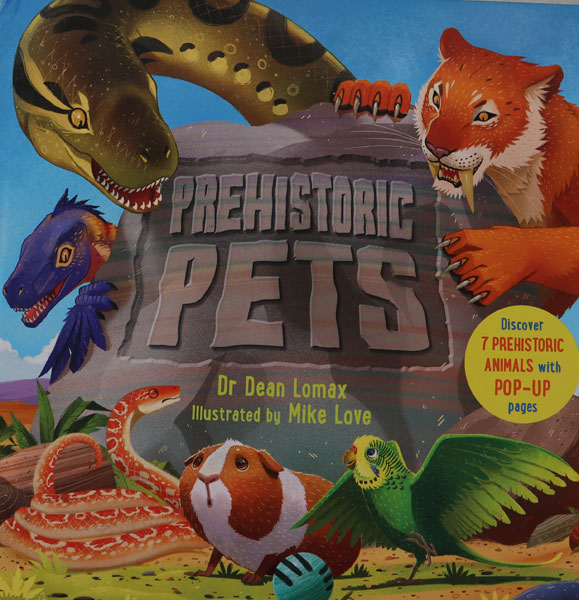
A new book is due to be published shortly entitled “Prehistoric Pets”.  It has been written by the very talented palaeontologist Dr Dean Lomax, with illustrations by Mike Love.  This exciting forthcoming publication links pets with their prehistoric ancestors, helping to bridge a gap in children’s understanding about fossils and deep geological time.

The Front Cover of “Prehistoric Pets” by Dr Dean Lomax with Illustrations by Mike Love

The front cover of "Prehistoric Pets".
This colourful and well-written book takes the reader on a journey back in time, linking common household pets today with their prehistoric ancestors.  If you have ever wondered about the ancestors of cats, dogs and guinea pigs, then this exciting new publication will provide the answers.

Picture credit: Templar Books/Everything Dinosaur

Highly Informative, Fact Filled and Humorous

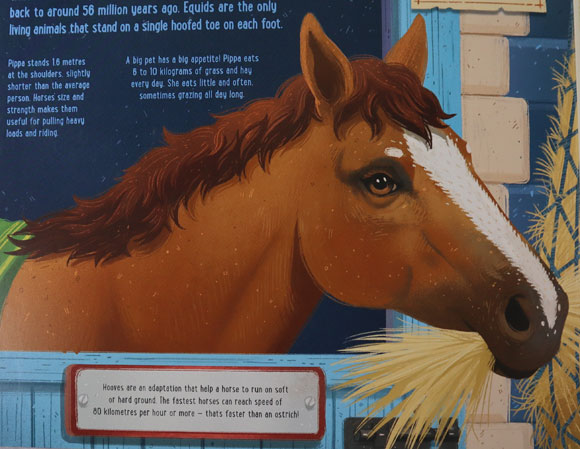
Dr Dean Lomax is one of a very select number of academics who have the ability to communicate complex ideas in simple terms so that general readers can comprehend.  The book is crammed full of fascinating facts and snippets of information that children will relish.  Beautifully designed pop-ups feature amazing prehistoric creatures, animals such as the tiny Sifrhippus (siff-rip-uss), the oldest known ancestor of the modern horse.  A cat-sized creature that roamed Wyoming during the Eocene Epoch.

“Prehistoric Pets” – Tracing the Ancestry of the Modern Horse

Horses feature in the book "Prehistoric Pets".
One of the beautiful animal illustrations from the book “Prehistoric Pets” by Dr Dean Lomax (illustrated by Mike Love).

Picture credit: Templar Books/Everything Dinosaur

“Prehistoric Pets” is an Awesome Book

This awesome book is due to be published next month (October 2020), it will make an ideal Christmas gift for a young palaeontologist.

The website of Dr Dean Lomax: British Palaeontologist Dr Dean Lomax.

When this book is available, Everything Dinosaur will be writing a review of “Prehistoric Pets”.

Well-written and Cleverly Designed – A Great Christmas Gift Idea “Prehistoric Pets”

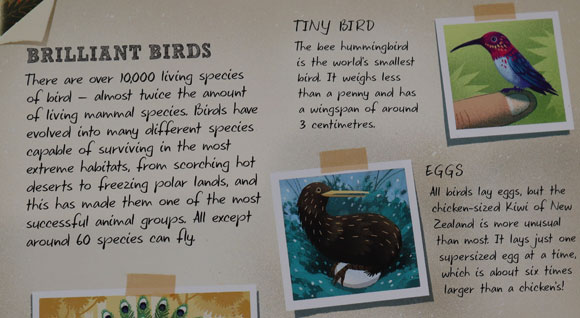
"Prehistoric Pets" - brilliant bird facts.
Brilliant bird facts in the awesome new book written by Dr Dean Lomax and illustrated by Mike Love.  The book contains lots of amazing information and facts.  Written in a humorous style, “Prehistoric Pets” takes the reader on a journey back in time, linking familiar pets alive today with their prehistoric ancestors. 

Picture credit: Templar Books/Everything Dinosaur

For advice and further recommendations about dinosaur/prehistoric animal books aimed at young readers: Email Everything Dinosaur.

The Everything Dinosaur website: Everything Dinosaur.

14 09, 2020

Pachycephalosaur Squamosals – Examining Research Papers

By |2024-03-15T07:44:40+00:00September 14th, 2020|Categories: Adobe CS5, Dinosaur Fans, Main Page, Photos/Pictures of Fossils|0 Comments

Pachycephalosaur Squamosals

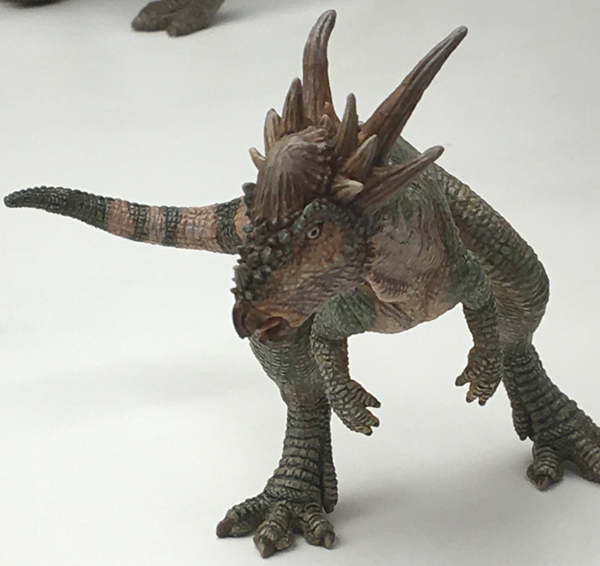
As Everything Dinosaur team members prepare for the arrival of the new for 2020 Papo Stygimoloch dinosaur model, team members have been examining the scientific papers that led to the erection of this pachycephalosaur genus (Peter Galton and Hans-Dieter Sues in 1983).

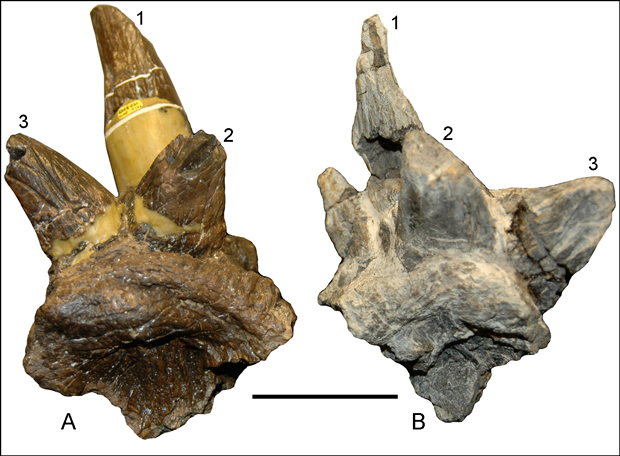
An isolated fossil bone referred to as a left squamosal (a bone from the back part of the skull) was found in Hell Creek Formation deposits located in McCone County, eastern Montana.  This fossil bone was given the catalogue number UCMP 119433 and although its prominent horns and raised bony bumps were very distinctive, it was not formerly described until 1983.  This fossil bone became the holotype fossil for the new species of North American pachycephalosaur Stygimoloch spinifer.

Stygimoloch spinifer

Distinctive Squamosal Bones Attributed to S. spinifer

Squamosal Bones Associated with Stygimoloch spinifer
The holotype left squamosal (UCMP 119433) in (A) and a right squamosal (UCMP 131163) in (B) in posterior view.  Note scale bar equals 5 cm.

Picture credit: Horner and Goodwin (published in PLOS One)

The picture (above), shows the holotype left squamosal (UCMP 119433) alongside a right squamosal which also comes from the Hell Creek Formation of Montana (UCMP 131163).   When first described, the flat-headed, narrow skull of Stygimoloch with its array of horns and bumps that were most prominent at the back of the skull, was thought to represent a different type of pachycephalosaur than the dome-skulled species such as Pachycephalosaurus wyomingensis.

Extremely Scrappy Fossil Remains

Stygimoloch had been described from extremely scrappy fossil remains.  Although a more complete skull found in North Dakota was also assigned to this genus, Stygimoloch remained poorly known.

The New for 2020 Papo Stygimoloch Dinosaur Model

Papo Stygimoloch model.
A view of one of the production prototypes of the Papo Stygimoloch dinosaur model.  Picture credit: Everything Dinosaur.

Picture credit: Everything Dinosaur

Stygimoloch spinifer is Probably a Subadult Pachycephalosaurus

A paper presented at the annual meeting of the Society of Vertebrate Paleontology in 2007 challenged the validity of the Stygimoloch taxon.  Palaeontologists John (Jack) Horner of the Museum of the Rockies, Montana State University and Mark Goodwin of the Museum of Paleontology at the University of California, Berkeley published a paper in the on-line, peer reviewed journal PLOS One (2009), that proposed that both Dracorex hogwartsia and Stygimoloch spinifer represented younger individuals of the Pachycephalosaurus wyomingensis species.

More recent fossil discoveries from the Hell Creek Formation and further analysis of existing pachycephalosaur fossil material from North America supports the idea that Dracorex hogwartsia, Stygimoloch spinifer and Pachycephalosaurus wyomingensis are the same taxon.

Pachycephalosaur Ontogeny – Three Hell Creek Formation Taxa May Actually Represent Just One Taxon

Different skull shapes and ornamentation linked to different growth stages.
It has been proposed that the cranial ornamentation and skull shape of pachycephalosaurs changes as these animals grow and mature.  This can cause confusion when trying to identify species.

Picture credit: Kari Scannella with additional annotation by Everything Dinosaur

When first described, (Galton and Sues), the suggested morphology of the skull of Stygimoloch (narrow and lacking a raised, thickened dome), led the researchers to propose that unlike other pachycephalosaurs Stygimoloch probably did not indulge in any head-butting behaviour.

To view the range of Papo figures in stock at Everything Dinosaur, including a Pachycephalosaurus figure (whilst stocks last): Papo Models and Figures.

The 2009 scientific paper: “Extreme Cranial Ontogeny in the Upper Cretaceous Dinosaur Pachycephalosaurus” by John R Horner and Mark B Goodwin published in PLOS One.

The Everything Dinosaur website: Everything Dinosaur.

13 09, 2020

A Beautiful and Practical Dinosaur Water Bottle

By |2024-03-15T07:38:07+00:00September 13th, 2020|Categories: Adobe CS5, Dinosaur Fans, Everything Dinosaur Products, Main Page, Photos of Everything Dinosaur Products, Press Releases, Product Reviews|0 Comments

A Colourful Dinosaur Water Bottle

The return to school for the start of the autumn term has been very strange for many children.  Thanks to the COVID-19 pandemic, some pupils in the UK have not been in school since March.  This term is likely to very different for children, teachers and teaching assistants alike.  Everything Dinosaur has seen sales of its dinosaur-themed water bottle surge as parents, grandparents, guardians and carers prepared for the start of the new school year.  Children are encouraged to bring their own reusable water bottles and our tough, robust, dishwasher safe, plastic dinosaur water bottle with its large 500 millilitre capacity, has proved to be very popular with young dinosaur fans.

A Dinosaur Water Bottle

The Dinosaur Themed Water Bottle from Everything Dinosaur

A 500 ml capacity dinosaur water bottle.
The plastic dinosaur drinking bottle available from Everything Dinosaur (whilst stocks last). Picture credit: Everything Dinosaur.

Picture credit: Everything Dinosaur

Visit the Everything Dinosaur website: Everything Dinosaur.

An Ideal Water Bottle for School

The plastic water bottle is ideal for school.  It is dishwater safe and very sturdy.  The bottle has a large screw-on lid making it easy for little ones to top up and a secure flip cap top to permit no-spill drinking.  Just what a budding, young palaeontologist needs to quench their thirst.  The colourful dinosaur design in the front features a trio of dinosaurs, a Tyrannosaurus rex, a long-necked, plant-eating dinosaur with some prehistoric plants and trees to munch and a fabulous Triceratops.  There are even a couple of terrific pterosaurs to keep the dinosaurs company.

A Colourful Triceratops Features on the Front of the Dinosaur Water Bottle

A colourful Triceratops illustration.
A colourful Triceratops adorns the dinosaur water bottle. Picture credit: Everything Dinosaur.

Picture credit: Everything Dinosaur

Diswasher Safe

The water bottle has been made from BPA-free plastic (free from bisphenol A or any other bisphenol compounds.  It is impact resistant and exceptionally tough, helping to extend the useful life of water bottles, potentially reducing plastic waste.  This product has exceptional dishwasher durability, encouraging proper sanitation and helping to keep plastic surfaces clean and free from bacteria and viruses.  With a substantial 500 ml capacity the bottle is big enough to provide plenty of refreshment, but it is lighter than glass, making it easier to handle for small hands without the fear of breaking.

By using this refillable bottle, you have will have helped to reduce the plastic pollution threat to oceans.

At just £4.16 plus tax (if applicable) and postage, this colourful dinosaur themed drinking vessel makes a welcome addition to a young person’s rucksack or school bag.  Prices accurate on date of publication (September 2020).

The dinosaur water bottle can be found (whilst stocks last), on this section of Everything Dinosaur’s website: Dinosaur Themed School Items (Back to School).

Go to Top