All about dinosaurs, fossils and prehistoric animals by Everything Dinosaur team members.

Everything Dinosaur’s work with photoshop and other platforms.

9 09, 2021

Titanokorys gainesi – A New, Giant Cambrian Radiodont

By |2024-07-02T07:29:37+01:00September 9th, 2021|Categories: Adobe CS5, Dinosaur and Prehistoric Animal News Stories, Dinosaur Fans, Main Page, Palaeontological articles, Photos/Pictures of Fossils|0 Comments

Researchers from the Royal Ontario Museum (Canada), have announced the discovery of a new species of armoured arthropod from the Burgess Shale of British Columbia. A study looking at 12 fossil specimens collected from Marble Canyon and Tokumm Creek in the Kootenay National Park (British Columbia), has been published this week by Royal Society Open Science. The arthropod has been named Titanokorys gainesi and at around 50 cm in length, it is a giant by Cambrian biota standards.
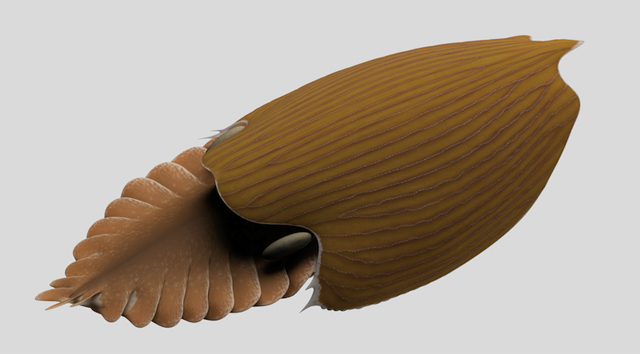
Titanokorys gainesi life reconstruction.
A life reconstruction of Titanokorys gainesi. Picture credit: Royal Ontario Museum.

The authors of the scientific paper, Dr Jean-Barnard Caron of the Royal Ontario Museum, an expert on Burgess Shale fauna and PhD student Joe Moysiuk, classify Titanokorys as a member of the Radiodonta, a stem group of the Arthropoda. Radiodonts were extremely diverse and geographically widespread during the Late Cambrian and many of them were giants when compared to other animals alive during this time in Earth’s history. Perhaps the most famous radiodont is the taxon Anomalocaris, regarded by many palaeontologists as the world’s first super-predator.
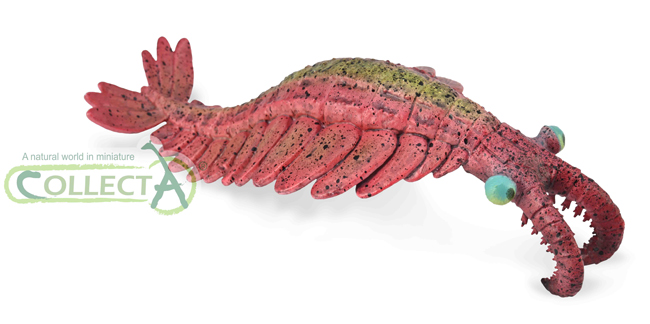
CollectA Anomalocaris

The CollectA Anomalocaris model. A fantastic replica of an early apex predator. The CollectA Anomalocaris (Other Prehistoric Animal Models).

The picture (above) shows a model of an Anomalocaris.  This figure is part of the CollectA Prehistoric Life model range.

To view this range: CollectA Prehistoric Life.

Living on the Seabed – A Benthic Existence

Radiodonts are characterised by their compound eyes, disc-shaped mouthparts and paired frontal appendages, which in the case of Titanokorys consist of comb-like structures which may have been used to sift through mud in search of prey. The broad, flattened carapace of Titanokorys supports the idea that it was benthic – living on the seabed.

Views of the Cambrian radiodont Titanokorys gainesi
Life reconstruction of Titanokorys gainesi (a) dorsal view, (b) ventral view, (c) lateral view and (d) anterior view. Picture credit: Lars Fields/Royal Ontario Museum.

Dr Caron stated:

“The sheer size of this animal is absolutely mind-boggling, this is one of the biggest animals from the Cambrian period ever found.”

Coeval with Cambroraster falcatus

The bedding planes that provided the Titanokorys fossil material have also revealed an abundance of the smaller, but closely related Cambroraster falcatus, which was named and described by Caron and Moysiuk in 2019. Cambroraster was named after the Millennium Falcon from Star Wars franchise, as its carapace resembled the shape of this iconic spaceship. The co-occurrence of these two species on the same bedding planes highlights potential competition for benthic resources and the high diversity of large predators sustained by Cambrian communities.

To read about the discovery of Cambroraster falcatus: Prehistoric Predator with a Mouth Shaped Like a Pineapple Ring.

Why some radiodonts evolved such a bewildering array of head carapace shapes and sizes is still poorly understood and was likely driven by a variety of factors.
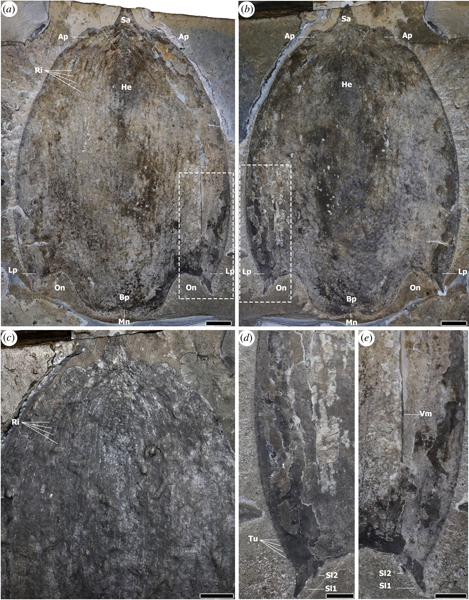
Titanokorys gainesi fossil material.
Views of the carapace of Titanokorys gainesi (paratype ROMIP 65168).

Dr Caron added:

“These enigmatic animals certainly had a big impact on Cambrian seafloor ecosystems. Their limbs at the front looked like multiple stacked rakes and would have been very efficient at bringing anything they captured in their tiny spines towards the mouth. The huge dorsal carapace might have functioned like a plough.”

Honouring Professor Robert Gaines

The genus name is derived from the Greek Titans, powerful gods of huge size and from the Greek “Korys” for helmet. The species or trivial name honours Professor Robert Gaines who was instrumental in the co-discovery of the Marble Canyon fossil deposit, where some of the Titanokorys specimens were found.

The scientific paper: “A giant nektobenthic radiodont from the Burgess Shale and the significance of hurdiid carapace diversity” by J.B. Caron and J. Moysiuk published by Royal Society Open Science.

Visit the Everything Dinosaur website: Dinosaur Models and Toys.

8 09, 2021

New PNSO Models Arriving at Everything Dinosaur

By |2024-07-02T07:21:41+01:00September 8th, 2021|Categories: Adobe CS5, Dinosaur Fans, Everything Dinosaur News and Updates, Everything Dinosaur Products, Main Page, Photos of Everything Dinosaur Products, Press Releases|0 Comments

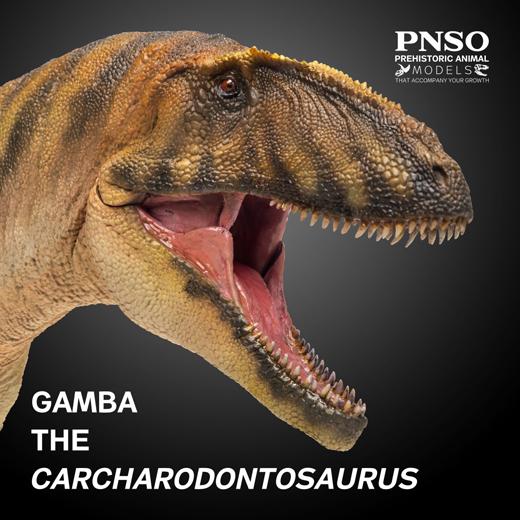
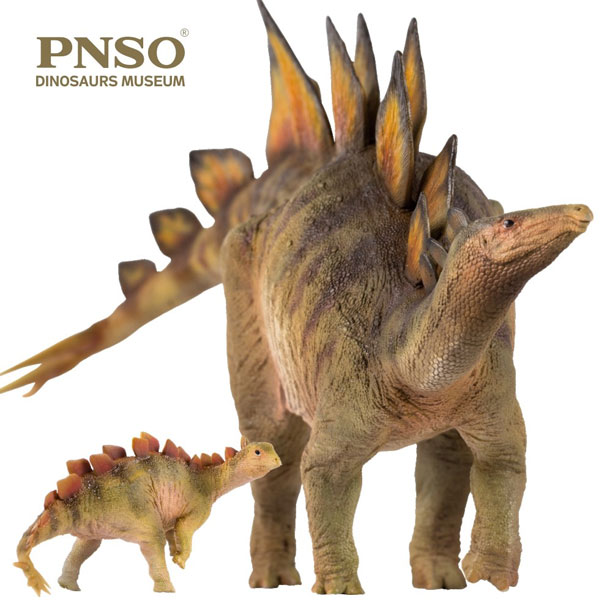
Everything Dinosaur has received news from our freight forwarders that a shipment of PNSO prehistoric animal models should be delivered to our warehouse tomorrow (September 9th, 2021). The delivery will include six new for 2021 PNSO figures – Haylee the Helicoprion, Connor the Torvosaurus, Gamba the Carcharodontosaurus, Yinqi the Yutyrannus and the 1:35 scale Stegosaurus model set (Biber and Rook).

PNSO prehistoric animal models due in stock at Everything Dinosaur (September 2021
In total six new for 2021 PNSO models are due in stock tomorrow (September 2021) at Everything Dinosaur. They are Connor the Torvosaurus, Haylee the Helicoprion, Gamba the Carcharodontosaurus, Chuanzi the Tarbosaurus, Yinqi the Yutyrannus and the 1:35 scale Stegosaurus models Biber and Rook.  Picture credit: Everything Dinosaur.

Picture credit: Everything Dinosaur

PNSO Models

The delivery should include a total of 31 different PNSO prehistoric animal product lines. This will enable Everything Dinosaur to replenish stock of existing models as well as allowing them to post up the six new figures on the company’s website.

A spokesperson from Everything Dinosaur commented that they did not know exactly when the delivery would arrive, but team members would be at work even earlier than usual and they would do all they could to get the models safely unloaded, stored in the warehouse and then made available on-line as quickly as possible.

PNSO Gamba the Carcharodontosaurus dinosaur model
The PNSO Gamba the Carcharodontosaurus dinosaur model. Due into stock at Everything Dinosaur on September 9th 2021.

The spokesperson added:

“We know how keen dinosaur fans and collectors are to get hold of these wonderful replicas. Team members will be busy emailing all those Everything Dinosaur customers who have asked to have one of these prehistoric animal models reserved for them. Staff will be working late into the night to ensure that everyone is contacted.”

Visit the Everything Dinosaur website: Dinosaur Toys and Models.

Mid-size Model Range

The majority of the new for 2021 figures coming in are from the PNSO mid-size model range. The exception is the PNSO 1:35 scale Scientific Art Stegosaurus pair Biber and Rook.

PNSO Stegosaurus dinosaur models (Biber and Rook)
The PNSO Stegosaurus dinosaur models (Biber and Rook) in anterior view, these two figures are due to be in stock at Everything Dinosaur. This 1:35 scale model set consists of an adult Stegosaurus and a juvenile.

To view the range of PNSO prehistoric animal models in stock at Everything Dinosaur: PNSO Prehistoric Animals and Dinosaurs.

5 09, 2021

The New Mojo Prehistoric Life Smilodon

By |2024-07-02T07:08:27+01:00September 5th, 2021|Categories: Adobe CS5, Dinosaur Fans, Everything Dinosaur News and Updates, Everything Dinosaur Products, Main Page, Photos of Everything Dinosaur Products, Press Releases|1 Comment

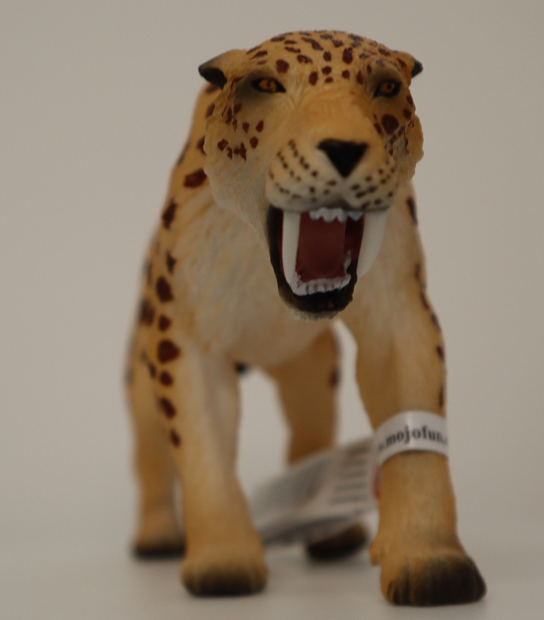
The Mojo Prehistoric Life Smilodon is in stock at Everything Dinosaur. This new sabre-toothed cat model is the only prehistoric animal figure being added to the Mojo Fun prehistoric animal model range for 2021.

Mojo Prehistoric Life Smilodon
Mojo Prehistoric Life Smilodon (sabre-toothed cat).  Picture credit: Everything Dinosaur.

Picture credit: Everything Dinosaur

A New Model of “Knife Tooth”

Mojo has had a long history of producing sabre-toothed cat figures. Almost ever since a prehistoric animal range was conceived, a Smilodon figure has been part of the range. In 2017, Mojo added an updated version to their product portfolio and now there is a new sculpt depicting this iconic cat.

A spokesperson from Everything Dinosaur confirmed that at this stage, no information about the continued production of the 2017 Smilodon model had been released, although it had been speculated that the addition of a 2021 figure might lead to the retirement of the 2017 Smilodon model.

The Smilodon genus was first established by the Danish palaeontologist and naturalist Peter Wilhelm Lund in 1842 following the study of fossil material from Brazil. The genus name means “knife tooth” a reference to the animal’s oversized and exceptionally long upper canine teeth, that in some specimens of Smilodon populator reach 28 cm in length.

Mojo Smilodon prehistoric animal figure
The Mojo Smilodon model is a replica of a sabre-toothed cat. The Smilodon model measures approximately 13 cm long.  Picture credit: Everything Dinosaur.

Picture credit: Everything Dinosaur

Everything Dinosaur Supplies Photography

The original images of this new model supplied by Mojo did not reflect the actual colour scheme of the figure. Team members at Everything Dinosaur took their own images of the new for 2021 Smilodon figure as they did not want the official images to mislead model collectors.

Mojo Prehistoric Life Smilodon
The new for 2021 Mojo Smilodon model is in stock at Everything Dinosaur.  Picture credit: Everything Dinosaur.

Picture credit: Everything Dinosaur

The Everything Dinosaur website: Prehistoric Animal Toys and Models.

Mojo Prehistoric Life Smilodon – Original Images

The original studio image for the new Mojo Prehistoric Life Smilodon showed a figure with a much lighter, paler colouration and more muted spotting. The side of each ear was also painted white. The sclera of the eye in the studio images is a pale yellow, whilst the production model has an amber-coloured sclera. The actual colour scheme on the model is much bolder with the spotted patterning of the figure much more pronounced. The sides of the ears are painted black.

Mojo prehistoric life
One of the original catalogue images of the Mojo Prehistoric Life Smilodon model. The actual production model colour scheme differed from the promotional stills.

A spokesperson from Everything Dinosaur commented:

“We had been alerted by Mojo that the actual model had a different colour scheme to their studio images. We decided that it would be best to show the model rather than to rely on the studio shots as we did not want to confuse customers. It is our understanding that Mojo will commission new model photography in the near future and replace their original images with more accurate photographs of the Mojo Prehistoric Life Smilodon.”

To view the new Mojo Smilodon model and to see the rest of the figures available from Everything Dinosaur in this model range: Mojo Prehistoric Life Models and Figures.

4 09, 2021

Beasts of the Mesozoic Xenoceratops

By |2024-07-02T07:04:13+01:00September 4th, 2021|Categories: Adobe CS5, Dinosaur Fans, Everything Dinosaur Products, Main Page, Photos of Everything Dinosaur Products|0 Comments

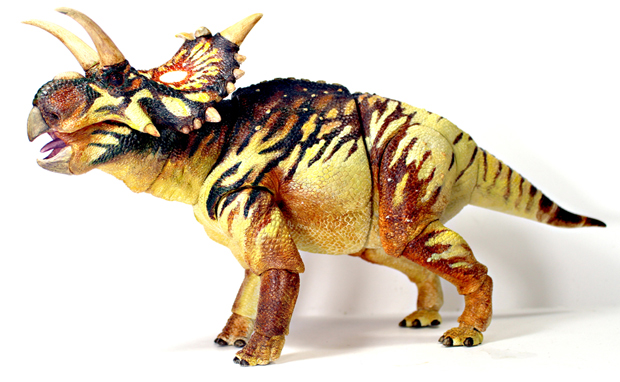
Today, we feature an image of one of the forthcoming Wave 3 Ceratopsians in the fabulous Beasts of the Mesozoic model series. The image shows the magnificent Xenoceratops (X. foremostensis), a Canadian centrosaurine ceratopsid that was formally named and described back in 2012.

Beasts of the Mesozoic Xenoceratops
The Beasts of the Mesozoic Xenoceratops (background shot) a magnificent articulated dinosaur model in 1:18 scale.

“Alien Horned Face”

Fossils collected in south-western Alberta, close to the small community of Foremost, back in 1958 had been held in storage for decades. The fossils represented skeletal material from at least three individual animals. The scientific paper describing this new horned dinosaur, the first member of the Ceratopsia to be described from material associated with the Foremost Formation, was published in the Canadian Journal of Earth Sciences on the 8th of November 2012.

The genus name translates as “alien horned face”. A common misconception is that this dinosaur was named due to the “alien-looking” arrangement of horns on its head. Xenoceratops certainly had some very impressive ornamentation, including two large horns above its eyes. It may have had a nose horn too, but in the stunning Beasts of the Mesozoic model, the sculpting team have decided to give their Xenoceratops a prominent boss, on the naris, rather than a nose horn.

Beasts of the Mesozoic Xenoceratops

The “alien” reference is a reflection of the limited vertebrate fossil material collected from the Foremost Formation. In comparison to other Upper Cretaceous rocks in North America, the sandstones, shales, mudstones and coal deposits of the Foremost Formation have yielded very few dinosaur specimens and what has been found is extremely fragmentary. Xenoceratops was regarded as “alien” by the scientific team describing this plant-eating dinosaur, as it was quite a surprise to find a ceratopsid.

To read Everything Dinosaur’s article from 2012 about the discovery of this new Canadian ceratopsid: New Horned Dinosaur from Alberta.

Xenoceratops foremostensis
The Beasts of the Mesozoic 1/18th scale figure – Xenoceratops foremostensis. An articulated horned dinosaur model.

A spokesperson from Everything Dinosaur commented that the Xenoceratops model, along with the other Wave 3 ceratopsians in the Beasts of the Mesozoic series would be in stock before Christmas (2021).

To see the current range of Beasts of the Mesozoic articulated dinosaur models: Beasts of the Mesozoic.

3 09, 2021

New Rebor Smilodon Models

By |2024-07-02T07:01:26+01:00September 3rd, 2021|Categories: Adobe CS5, Dinosaur Fans, Everything Dinosaur News and Updates, Everything Dinosaur Products, Main Page, Photos of Everything Dinosaur Products, Press Releases|1 Comment

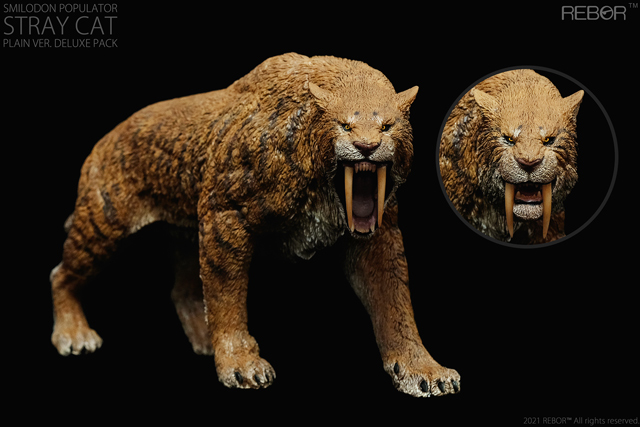
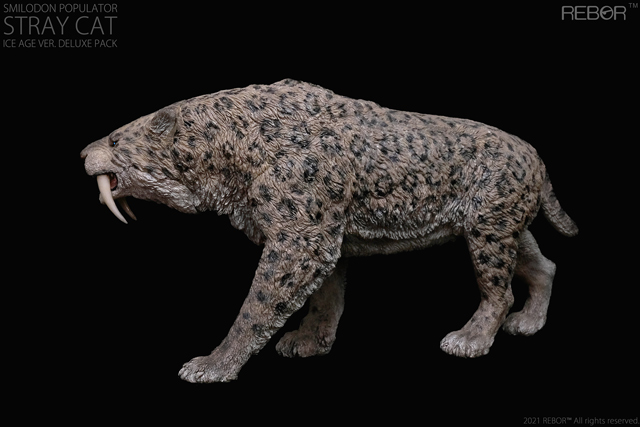
Everything Dinosaur has opened a waitlist for the two new Rebor Smilodon models (plain and ice age colour variants). These exciting new Rebor models depicting Sabre-toothed cats are likely to be in stock at Everything Dinosaur in mid-December or thereabouts and collectors can join a waitlist on the company’s website so that they can get a priority email alert when these Smilodon replicas arrive.

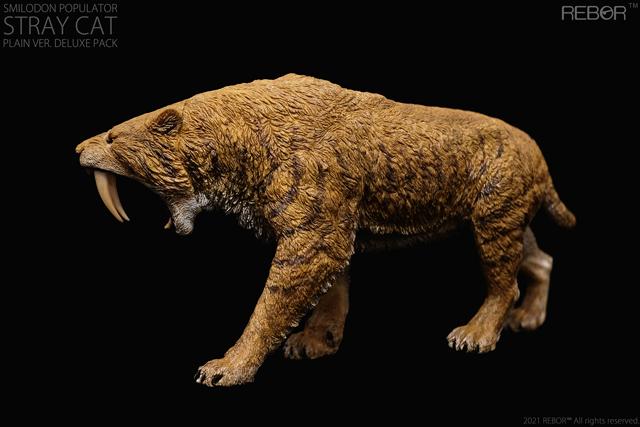
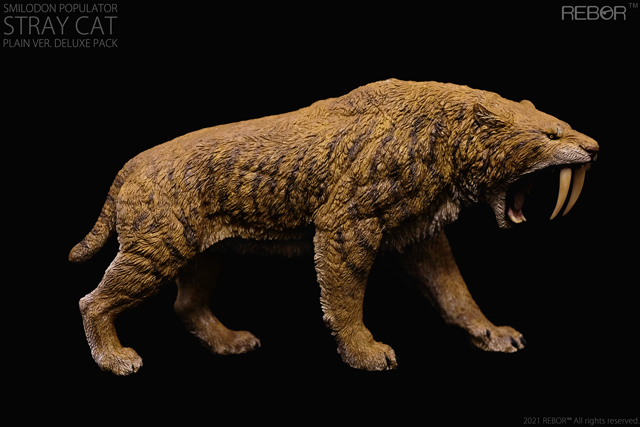
Rebor Smilodon populator Museum Class Replica Deluxe Pack Stray Cat Plain
The Rebor Smilodon populator Museum Class Replica Deluxe Pack Stray Cat Plain comes with two interchangeable heads so collectors can display this 1:11 scale model with either its mouth open or closed.

Smilodon populator Models with Interchangeable Heads

These innovative and cleverly designed models come with two interchangeable heads so that the figures can be displayed with their impressive mouths open or closed.

Smilodon populator is known from the Pleistocene of South America and is regarded as the largest species within the Smilodon genus. With a bodyweight estimated at over 300 kilograms and with a shoulder height of around 1.2 metres, S. populator is one of the largest members of the cat family (Felidae).

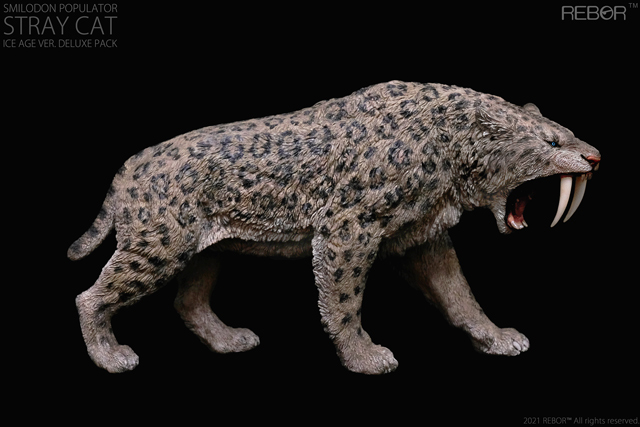
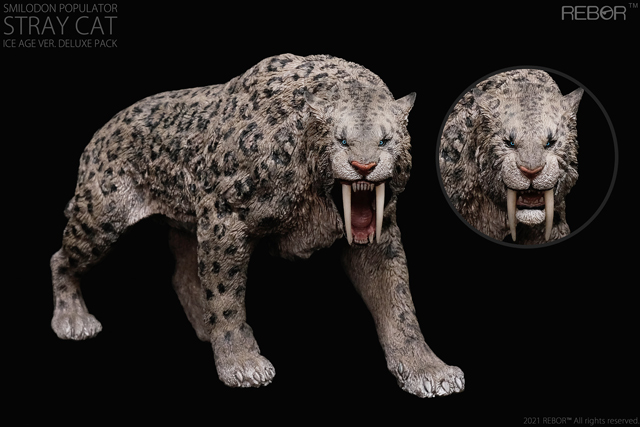
Rebor Smilodon populator Stray Cat Ice Age model
The Rebor Smilodon populator Stray Cat Ice Age colour variant.

To see the range of Rebor models in stock at Everything Dinosaur: Rebor Models.

Choose Your Favourite Stray Cat – Plain or Ice Age?

The models entitled Rebor Smilodon populator Museum Class Replica Deluxe Pack Stray Cat Ice Age and Rebor Smilodon populator Museum Class Replica Deluxe Pack Stray Cat Plain are the same sculpts but they have different colour schemes. The “Ice Age” colour variant (above), has a body patterning reminiscent of a Snow Leopard (Panthera uncia) and the sclera of the eyes is an icy blue colour. In contrast, the Rebor Smilodon populator Museum Class Replica Deluxe Pack Stray Cat Plain, (see below), carries the more traditional tan markings associated with this genus, in keeping with a predator of the open grasslands and scattered woodlands of South America.

Rebor Smilodon populator Museum Class Replica Deluxe Pack Stray Cat Plain
The beautiful Rebor Smilodon populator figure measures around 26.5 cm in length and has a declared scale of 1:11.

Innovative Model Design

A spokesperson from Everything Dinosaur commented:

“These are the first prehistoric mammal models made by Rebor and only their second mammal after their Alpha male Mountain Gorilla replicas. These beautiful Smilodon figures have been cleverly designed. Each model is supplied with two heads so collectors can choose to display their Sabre-toothed cat with the mouth open or with the mouth closed.”

Rebor Smilodon populator Stray Cat Ice Age
The Rebor Smilodon populator Museum Class Replica Deluxe Pack (Ice Age) is so called as the model comes with two interchangeable heads. This stunning Smilodon can be displayed with mouth closed or mouth open.

Waitlist for these Models is Open

Everything Dinosaur expects these models to ship out from the factory sometime in late October and if all goes to plan, these stunning Smilodon figures should be in stock at Everything Dinosaur in December (2021). These models can be found on Everything Dinosaur’s website and collectors can join a waitlist for each figure so that they can receive a priority email alert when the stock arrives.

Rebor Smilodon populator Stray Cat Plain
The Rebor Smilodon populator Museum Class Replica Deluxe Pack Stray Cat Plain displayed with its mouth open.
Rebor Smilodon populator Stray Cat Ice Age
The Rebor Smilodon populator Stray Cat Ice Age model shown with its mouth closed.

Both the Rebor Smilodon populator Museum Class Replica Deluxe Pack Stray Cat Plain and the Rebor Smilodon populator Museum Class Replica Deluxe Pack Stray Cat Ice Age models can be found on the Rebor section of Everything Dinosaur’s award-winning website and collectors and Rebor fans have the chance to join a waitlist for each figure.

To enquire about reserving any Rebor models, contact Everything Dinosaur: Email Everything Dinosaur.

Rebor Smilodon populator Stray Cat Plain waitlist is here: Rebor Models and Figures.

Rebor Smilodon populator Stray Cat Ice Age waitlist is here: Rebor Smilodon populator Stray Cat – Ice Age.

Here are a couple of “Stray Cats” collectors and fans of the Rebor model range won’t mind bringing home.

The award-winning Everything Dinosaur website: Prehistoric Animal Models.

30 08, 2021

African Plesiosaurs – Highlighting New Research

By |2024-05-28T14:57:32+01:00August 30th, 2021|Categories: Adobe CS5, Dinosaur and Prehistoric Animal News Stories, Dinosaur Fans, Main Page, Palaeontological articles, Photos of Everything Dinosaur Products|0 Comments

Earlier this week, we posted up an article summarising the newly published research into an exquisitely preserved skull of an elasmosaurid plesiosaur from Angola. The African marine reptile is Cardiocorax mukulu, which had been formally named and described from post-cranial material found just 250 metres away from where the skull and other associated bones that were the subject of the scientific paper we reported upon, were discovered.

To read our article on the skull of Cardiocorax: Getting Inside the Head of a Plesiosaur.

How Many African Plesiosaurs?

Whilst reading the paper (Marx et al 2020), it was stated that currently, six valid plesiosaurian taxa have been named and identified from the continent of Africa. This surprised Everything Dinosaur team members, only six valid plesiosaurian taxa known from the whole of Africa? This suggests that more plesiosaur genera are known from southern England than from the whole of the African continent. We are no experts, but we thought we would have a dig into our database to see if we could identify the six valid taxa mentioned in the scientific paper.

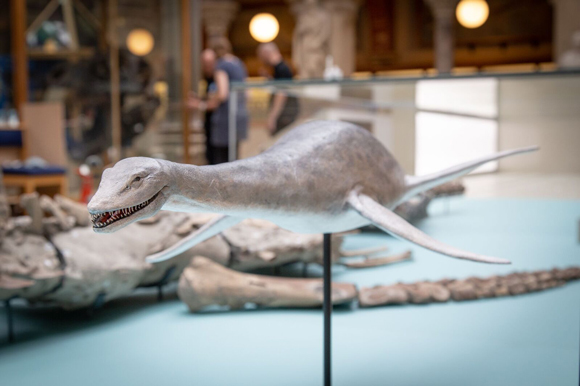
Oxford University Museum of Natural History plesiosaur.
A replica of a long-necked plesiosaur swims into view. It is surprising that so few members of the Plesiosauria clade are known from Africa.  Picture credit: Everything Dinosaur.

Picture credit: Everything Dinosaur

Plesiosaurs – A Very Ancient but Diverse Group of Marine Reptiles

Plesiosaur fossils have been found on every continent and this marine reptile clade is represented by a fossil record that extends for over 130 million years, with the first plesiosaurs probably evolved in the Late Triassic and they survived until the end of the Cretaceous, becoming extinct at the same time as the terrestrial non-avian dinosaurs. This diverse clade can be split into two distinct body types:

  • Plesiosauromorph – long necks and small heads such as the elasmosaurid Cardiocorax.
  • Pliosauromorph – short necks and large heads typical of apex predators such as Liopleurodon.
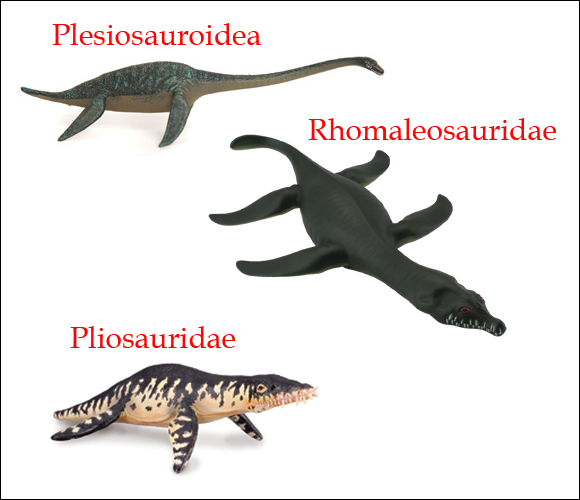
The Plesiosauroidea illustrated
The three groups that make up the Plesiosauroidea. It used to be thought that the Plesiosauroidea consisted of long-necked forms, whilst the Pliosauridae was made up of the short-necked forms with large heads, but palaeontologists now realise this was an oversimplification of plesiosaur taxonomy. The Rhomaleosauridae evolved during the Early Jurassic, they are related to the pliosaur lineage within the Plesiosauria clade.  Picture credit: Everything Dinosaur.

Picture credit: Everything Dinosaur

The prehistoric animals in the image (above) are from the CollectA range.

To view the CollectA Prehistoric Life model range: CollectA Prehistoric Life Dinosaur Models and Toys.
Listing the African Plesiosaurs We Know

Looking at our extensive database we were able to list the following African plesiosaurs:

  • Cardiocorax mukulu – Late Cretaceous (Angola), approximately 71.5 million years ago, named and described in 2015.
  • An unnamed aristonectine elasmosaurid plesiosaur coeval to Cardiocorax.
  • Thililua longicollis – Late Cretaceous (Morocco), a polycotylid plesiosaur dating from approximately 93-92 million years ago, named and described in 2003.
  • Manemergus anguirostris – Late Cretaceous (Morocco), another polycotylid plesiosaur dating from approximately 93-92 million years ago which was named and described in 2005.
  • Leptocleidus capenensis – Early Cretaceous of South Africa, formerly known as Plesiosaurus capensis dating from 139-132 million years ago.
  • Zarafasaura oceanis – Late Cretaceous (Morocco), an elasmosaurid and the geologically youngest plesiosaur known from Africa (Late Maastrichtian – around 67- 66 million years ago).
  • Brachauchenius lucasi (Turonian of Morocco), described in 2015, a pliosaurid from 93-92 million years ago. This genus is most closely associated with the Western Interior Seaway of North America.
  • Libonectes morgani – Late Cretaceous (Morocco), formerly known as Libonectes atlasense, an elasmosaurid dating from 93-92 million years ago. Just like B. lucasi, fossils of this marine reptile are closely associated with North America.

Numerous fragmentary bones, isolated teeth and such like have been found in Africa that purport to represent plesiosaurs, but these are the valid taxa that we could retrieve from our database.

We have probably missed a few, no doubt our well-educated readers will be able to give us a steer.

Visit the Everything Dinosaur website for prehistoric animal models and figures: Prehistoric Animal Models and Figures.

28 08, 2021

Solving the Picture Puzzle – Torosaurus

By |2024-05-28T14:43:16+01:00August 28th, 2021|Categories: Adobe CS5, Dinosaur and Prehistoric Animal Drawings, Dinosaur Fans, Main Page|0 Comments

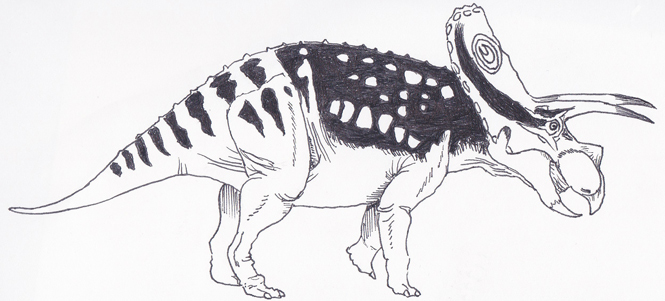
A few days ago, team members at Everything Dinosaur posted up a picture of a recently commissioned dinosaur drawing and challenged our blog readers and social media followers to identify the species illustrated. Sure enough, these knowledgeable collectors of prehistoric animals were quickly able to identify Torosaurus (T. latus).

Dinosaur drawing commissioned by Everything Dinosaur.
Everything Dinosaur set a challenge, could you identify the dinosaur species illustrated in their recently commissioned drawing? Picture credit: Everything Dinosaur.

Picture credit: Everything Dinosaur

Beasts of the Mesozoic Torosaurus Dinosaur Model

The drawing of Torosaurus was commissioned in preparation for the arrival this autumn of the Beasts of the Mesozoic Wave 3 ceratopsians, seven new, articulated horned dinosaur models including a Torosaurus replica. The drawing (above), was inspired by the photograph of the Torosaurus shown below.

Beasts of the Mesozoic Torosaurus.
The Beasts of the Mesozoic Torosaurus dinosaur model with its striking blue colour scheme. A fantastic dinosaur model part of the Wave 3 ceratopsians series.

The Wave 3 ceratopsians (Albertaceratops, Pentaceratops, Sinoceratops, adult Triceratops, Utahceratops, Xenoceratops and the Torosaurus model), are due to be shipped from the factory in September (September 2021). It is difficult to predict when these figures will be in stock at Everything Dinosaur, but they could be available sometime after the middle of October. Team members will do all they can to expediate delivery into their UK warehouse.

Beasts of the Mesozoic Torosaurus in anterior view
The target spots on the headshield of the Beasts of the Mesozoic Torosaurus dinosaur model can be clearly seen in this image.

Visit the award-winning Everything Dinosaur website: Everything Dinosaur.

A spokesperson from Everything Dinosaur commented:

“We like to set little puzzles and quizzes on our Instagram, Facebook and other social media pages. We thought that our picture puzzle would prove a bit of a challenge, but once again, our fans and followers have demonstrated their in-depth knowledge of prehistoric animals as well as dinosaur models and figures. Not only did respondents correctly identify Torosaurus latus but they recognised that our illustration had been inspired by the Beasts of the Mesozoic Torosaurus model. Perhaps it was the prominent target spots on the headshield that gave the game away.”

Torosaurus Model Measurements

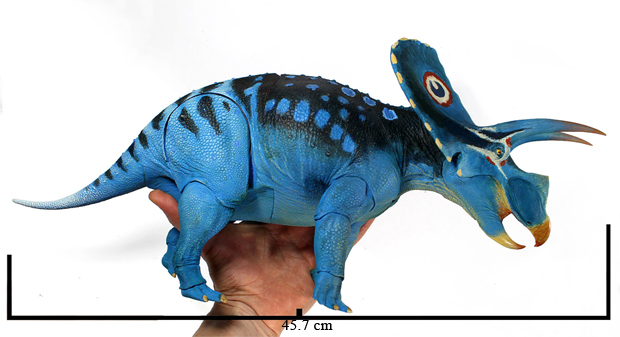
The Beasts of the Mesozoic Torosaurus is a huge model! It is considerably bigger than both the Pachyrhinosaurus lakustai and the Centrosaurus apertus figures that were introduced earlier. The articulated Torosaurus measures nearly 46 cm in length. The dinosaur model has a declared scale of 1:18.

Beasts of the Mesozoic Torosaurus model measurements.
The Beasts of the Mesozoic Torosaurus (T. latus) dinosaur model measures nearly 46 cm long.

The spokesperson from Everything Dinosaur added:

“The Torosaurus and the adult Triceratops figures are the largest horned dinosaur models in the Beasts of the Mesozoic model range. These two figures and the other models in Wave 3 are going to make a big splash when they touch down at Everything Dinosaur’s warehouse.”

Beasts of the Mesozoic Torosaurus dinosaur model.
The stunning Beasts of the Mesozoic Torosaurus (T. latus) articulated dinosaur model.

To view the range of Beasts of the Mesozoic models currently in stock at Everything Dinosaur: Beasts of the Mesozoic.

27 08, 2021

Tupandactylus Gets a Body Thanks to New Research

By |2024-05-28T14:41:49+01:00August 27th, 2021|Categories: Adobe CS5, Dinosaur and Prehistoric Animal News Stories, Dinosaur Fans, Main Page, Palaeontological articles, Photos/Pictures of Fossils|0 Comments

A superbly preserved and almost complete specimen of the pterosaur Tupandactylus navigans has enabled researchers to get a better understanding of the body of this Brazilian flying reptile. The skull too, with its exquisite preservation has provided new data on the amazing super-sized sagittal crest associated with this genus.

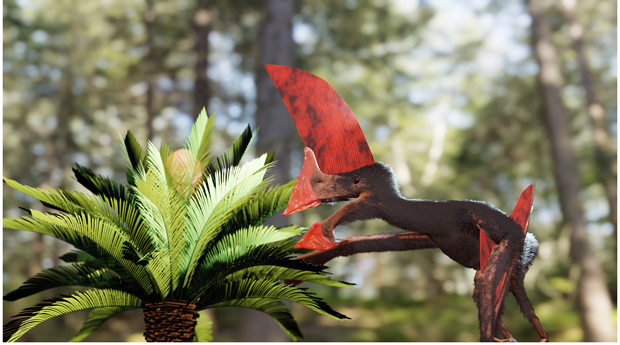
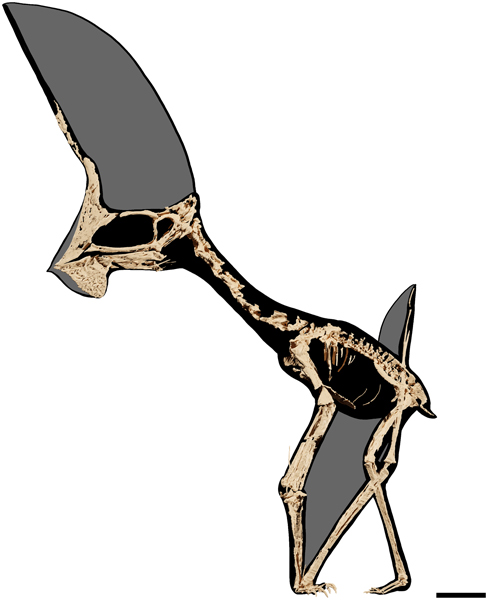
Tupandactylus navigans life reconstruction
Tupandactylus navigans life reconstruction. The study of a nearly complete articulated specimen confiscated in a police raid has provided palaeontologists with the opportunity to study post-cranial fossils of this spectacular tapejarid pterosaur for the first time. Picture credit: Beccari et al.

Confiscated in a Police Raid

The fossil specimen (number GP/2E 9266), was confiscated in a police raid at Santos Harbour, São Paulo State (Brazil), along with several other beautifully well-preserved fossils. Unfortunately, illegal fossil collection and sale of specimens on the black market is an increasing problem in Brazil. However, the successful raid prevented this hugely significant pterosaur fossil from ending up in the hands of a private collector.

The specimen is now housed at the Universidade de São Paulo (Brazil) and most of the researchers involved in the scientific paper are also based in Brazil, except for Octávio Mateus (Museu da Lourinhã, Portugal). Writing in the on-line, open access journal PLOS One, the scientists conclude that this specimen is the best-preserved tapejarid skeleton discovered to date. Their analysis has shed new light on the anatomy of this Tapejaridae family.

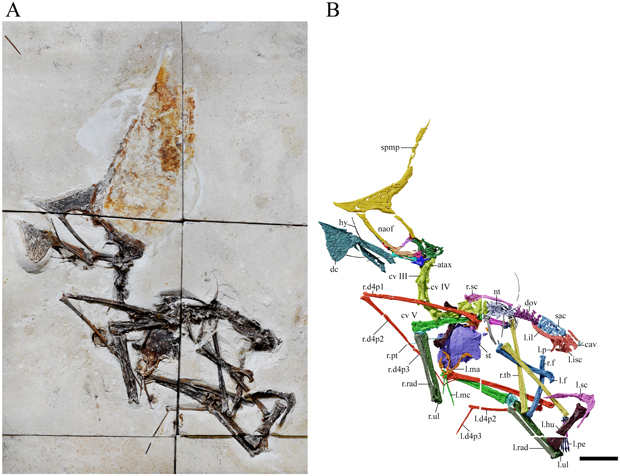
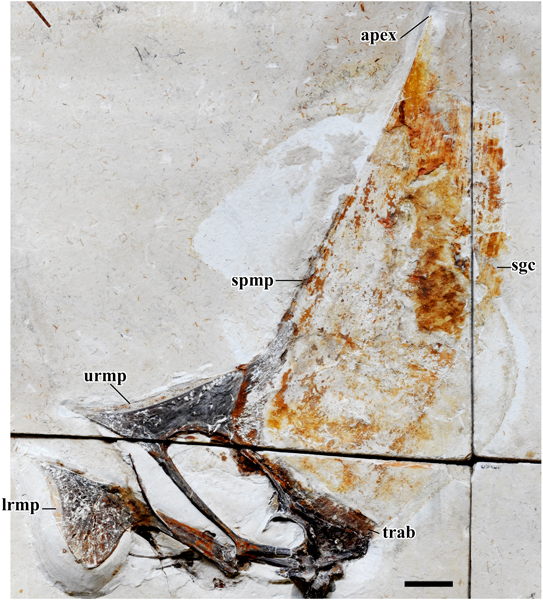
Tupandactylus navigans specimen and model
Tupandactylus navigans specimen number GP/2E 9266. Photo of specimen (A) and three-dimensional model of specimen based on CT scans (B). Picture credit: Beccari et al.

CT Scans

The pterosaur fossil is comprised of six limestone slabs. As this fossil was collected illegally, its provenance is unknown. However, by studying the yellow-stained, laminated limestone matrix, the research team were able to confidently assign the fossil to the Aptian-aged Crato Formation. The fossil took a trip to the local hospital in São Paulo, to enable CT scans to be undertaken. The subsequent three-dimensional models generated enabled the scientists to reconstruct the body of Tupandactylus for the first time. Prior to the discovery of this fossil, most Brazilian tapejarids had been described based on isolated skull bones.

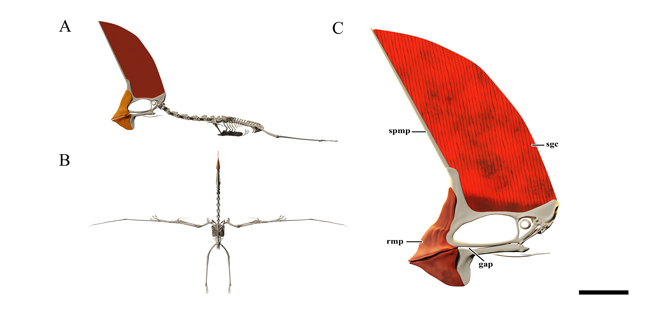
Tupandactylus skeletal reconstruction and close-up of skull.
Skeletal reconstruction of Tupandactylus navigans based on specimen number GP/2E 9266 in (A) lateral view and (B) dorsal view. Skull reconstruction (C). Scale bar in C = 10 cm. This superb, articulated specimen enabled scientists to learn more about the anatomy of tapejarid pterosaurs. Picture credit Beccari et al.

Tupandactylus and a Remarkable Head Crest

Soft tissue from the huge crest on the top of the head, extends to more than five times the actual height of the skull. Analysis of the crest enabled the research team to confirm differences between Tupandactylus navigans and the closely related T. imperator. Specimens of T. navigans tend to be smaller than T. imperator and it had been speculated that just one species was represented with the differences between T. imperator and T. navigans being explained by sexual dimorphism. Thanks to the exquisite preservation of this fossil specimen the research team were able to identify several anatomical traits that support the idea that Tupandactylus navigans and Tupandactylus imperator are indeed separate species.

Different colour patterns seen in the sagittal crest do not represent fossilisation of any colour patterning but may have occurred due to oxidation of the material. However, a more detailed analysis of the soft tissues associated with GP/2E 9266 is currently being undertaken.

Close-up view of the skull of T. navigans with soft tissue preservation.
A close-up view of the skull of T. navigans showing the soft tissue preservation. Picture credit: Beccari et al.

Tupandactylus navigans

Tupandactylus navigans was named and scientifically described in 2003 based on a study of two fossil skulls (Frey, Martill and Buchy). At the time, it was postulated that the huge head crest could have been used as a sail to help with flight stability and assist with aerial propulsion. For this structure to work in this way, the neckbones would have had to be robust, relatively short and supported by powerful tendons to combat stresses imposed on the neck. With an almost complete, articulated skeleton to study, the scientists led by Victor Beccari (Universidade de São Paulo), discovered that this pterosaur had a long neck, long limbs and relatively short wings (estimated wingspan 2.7 metres).

The enormous crest probably did not play a role in aiding powered flight. Such a huge structure may well have hindered this pterosaur’s aerial abilities.

A spokesperson from Everything Dinosaur commented:

“The sagittal crest of Tupandactylus may have evolved due to sexual selection pressure, females showing a bias towards males with larger crests. The crest may have been used for display or to denote maturity, status or fitness for breeding. Many living birds sport crests, wattles and other structures, perhaps adult T. navigans sacrificed some aerial ability by growing enormous crests in a bid to attract mates.”

For models and replicas of pterosaurs and other prehistoric creatures: Prehistoric Animal Models.

Tupandactylus navigans skeleton reconstruction.
Skeleton reconstruction of Tupandactylus navigans based on specimen number GP/2E 9266. Scale bar = 5 cm. Picture credit: Beccari et al.

Spotting a Notarium

The front five dorsal vertebrae form a notarium which helps brace the chest and counter the stresses on the torso created by the flapping of the wings. This structure is found in living birds and some types of pterosaur but this is the first time, as far as Everything Dinosaur team members are aware, that a notarium has been identified in a tapejarid.

he scientific paper: “Osteology of an exceptionally well-preserved tapejarid skeleton from Brazil: Revealing the anatomy of a curious pterodactyloid clade” by Victor Beccari, Felipe Lima Pinheiro, Ivan Nunes, Luiz Eduardo Anelli, Octávio Mateus and Fabiana Rodrigues Costa published in PLOS One.

26 08, 2021

A Token of Appreciation from a Customer

By |2024-05-28T14:36:34+01:00August 26th, 2021|Categories: Adobe CS5, Dinosaur Fans, Everything Dinosaur News and Updates, Main Page, Photos, Press Releases|0 Comments

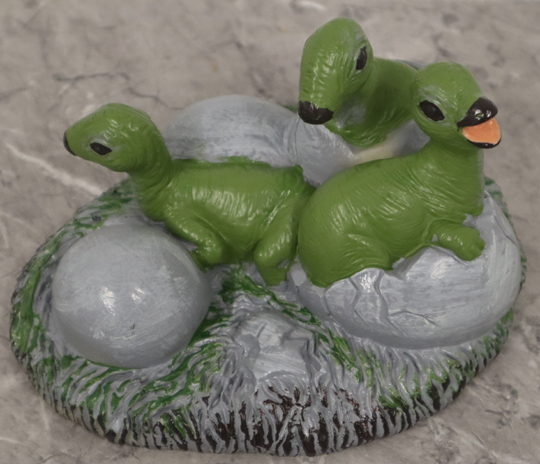
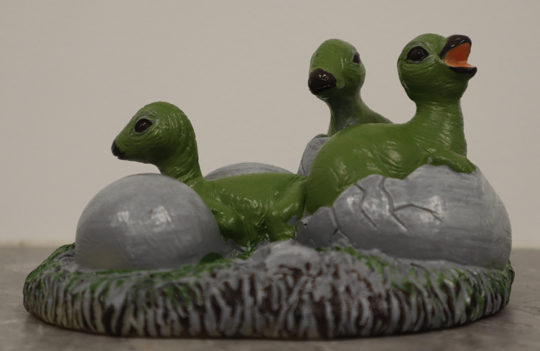
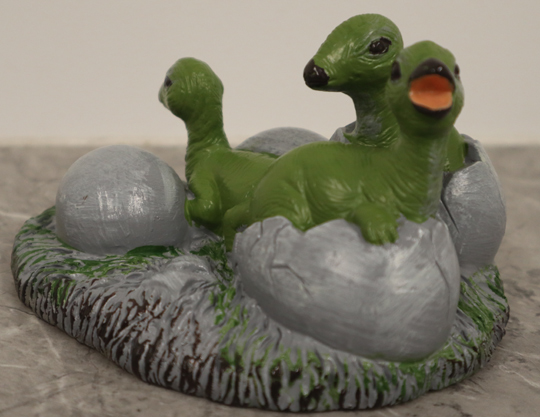
Everything Dinosaur team members have been helping fossil collector and dinosaur fan Robert source various prehistoric animal figures and replicas to accompany his fossil collection. As a token of appreciation, he sent a little gift to our offices to say thank you for our work.

The parcel got mislaid on its way from Scotland to our warehouse but it finally arrived yesterday and when the package was opened we found this model of three hatching dinosaurs inside.

A model of hatching dinosaurs
A model of three hatching dinosaurs sent to Everything Dinosaur by a delighted customer. Picture credit: Everything Dinosaur.

Picture credit: Everything Dinosaur

Maiasaura peeblesorum

Recently Robert had telephoned asking us to help him source a model of a Maiasaura with young. A dinosaur model featuring a Maiasaura with a nest was once part of the Carnegie collection of figures, but this range was retired and went out of production back in 2014. We were able to provide Robert with a fact sheet on this herbivorous dinosaur from the Late Cretaceous of Montana.

In gratitude and as a token of appreciation we were sent this little gift of hatching dinosaurs.

Dinosaur Hatchlings
Dinosaur hatchlings. After providing some information on the Late Cretaceous hadrosaurid Maiasaura (M. peeblesorum) to a customer, Everything Dinosaur received this little gift in return – a trio of hatching dinosaurs. Picture credit: Everything Dinosaur.

Picture credit: Everything Dinosaur

A spokesperson from Everything Dinosaur commented:

“We were very touched to receive this little gift. We try our best to help customers and we provide all kinds of advice, information and support. Team members took some photographs of the hatching dinosaurs in our packing room and now we have put this on display in one of our offices.”

Hatching dinosaur models.
A trio of hatching dinosaurs complete with eggs. A little token of appreciation sent to Everything Dinosaur from a grateful customer. Picture credit: Everything Dinosaur.

Picture credit: Everything Dinosaur

Thank you for the Token of Appreciation

When the parcel arrived, we sent an email to Robert, just to let him know that the parcel had got to us safely and to thank him for his very kind gesture.

To visit the award-winning Everything Dinosaur website: Everything Dinosaur.

25 08, 2021

Time for a Picture Puzzle

By |2024-05-28T14:33:50+01:00August 25th, 2021|Categories: Adobe CS5, Dinosaur and Prehistoric Animal Drawings, Dinosaur Fans, Main Page|0 Comments

At Everything Dinosaur, we are amazed at the in-depth dinosaur and prehistoric animal knowledge that is often demonstrated by our customers. Our fans, followers and supporters on the various social media platforms that we occupy such as Facebook, Instagram and YouTube constantly impress us with their knowledge of palaeontology.

We are often humbled by the sheer breadth and depth of knowledge they collectively possess. So, it’s time for another little tease, time to put our customers and social media fans to the test.

Below, we have posted up a dinosaur drawing that we at Everything Dinosaur recently commissioned.

Can you identify the dinosaur species from the drawing?

Dinosaur drawing commissioned by Everything Dinosaur.
An illustration of an ornithischian dinosaur commissioned recently by Everything Dinosaur, but can you identify the dinosaur species from the drawing? Picture credit: Everything Dinosaur.

Picture credit: Everything Dinosaur

Dinosaur Picture Puzzle

Based in the UK, Everything Dinosaur is run by teachers and knowledgeable dinosaur enthusiasts helping collectors of prehistoric animal models and promoting education and an appreciation of the Earth sciences. We research and write fact sheets for many of the models and figures we sell and we commission illustrations of prehistoric animals that can be used in these fact sheets and in our other educational activities.

The dinosaur drawings that we commission help to support a network of palaeoartists and illustrators. Our financial support of these illustrators is just one of the ways in which Everything Dinosaur assists the wider community.

A spokesperson from Everything Dinosaur commented that they would reveal the identity of the dinosaur featured in the drawing in a blog post to be published later this week.

In the meantime, visit the Everything Dinosaur website: Dinosaur Toys and Models.

Go to Top