All about dinosaurs, fossils and prehistoric animals by Everything Dinosaur team members.

Everything Dinosaur’s work with photoshop and other platforms.

7 01, 2022

Research into Fossils Affected by a Significant Colonial Bias

By |2024-10-10T13:56:31+01:00January 7th, 2022|Categories: Adobe CS5, Dinosaur and Prehistoric Animal News Stories, Dinosaur Fans, Main Page, Palaeontological articles, Photos/Pictures of Fossils|0 Comments

The study of fossils, the science of documenting the history of life on our planet, is heavily biased by influences such as colonialism, history and global economics. That is the conclusion from new research conducted by palaeontologists from the University of Birmingham in collaboration with colleagues from the University of Erlangen-Nürnberg (Germany), Rhodes University (South Africa), Federal University of Rio Grande do Norte (Brazil), Cambridge University and IISER Pune, Department of Earth and Climate Science (India).

Distorting Estimates of Past Biodiversity

The research team discovered that sampling biases in the fossil record distort estimates of past biodiversity. However, these biases not only reflect the geological and spatial aspects of the fossil record, but also the historical and current collation of fossil data. These findings have significance across the field of palaeontology, but also for the ways in which researchers are able to use our knowledge of ancient fossil records to gain clearer, long-term perspectives on Earth’s biodiversity.

Writing in the journal “Nature Ecology & Evolution”, the researchers investigated the influence and extent of these biases within the Paleobiology Database, a vast, widely-used and publicly-accessible resource which forms the foundation for analytical studies in the field.

They found significant bias in areas such as knowledge production, with researchers in high or upper-middle-income countries contributing to 97 per cent of fossil data. This means that wealthy countries, primarily located in the Global North control the majority of the palaeontological research power.
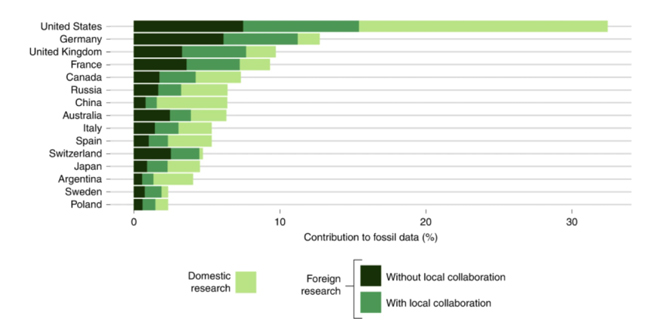
Percentage contribution of the top 15 countries to the total fossil data analysed in this study.

Percentage contribution of the top 15 countries to the total fossil data analysed in this study. The colour of each bar represents whether the authors of each country conducted their research domestically (that is, in the same country), in a foreign country, or in a foreign country without collaboration with local palaeontologists. Picture credit: Raja et al.

Picture credit: Raja et al

Lack of Involvement for Local Researchers

The team also found the top countries contributing to palaeontological research, carried out a disproportionate amount of work abroad, more than half of which did not involve any local researchers (researchers based in the country where the fossils are being collected).

There are many famous examples of colonial, political and economic biases across the natural sciences and humanities. During the 19th century and for most of the 20th century, specimens uncovered following exploratory expeditions were shipped back to respective imperial capitals to be housed in museums, where many are still used for scientific research today.

In a press release from Birmingham University the plight of the Parthenon sculptures, sometimes referred to as the Elgin Marbles was provided as an example. The Greek government has repeatedly requested that they be returned since they were taken from Athens in the early 19th century and transported to Britain.

There are also many other examples, such as the fossil excavations undertaken in Egypt by the German palaeontologist Ernst Freiherr Stromer von Reichenbach or the removal of many Cretaceous-aged dinosaur fossils by French field teams from the island of Madagascar.

Research into Fossils Has a Colonial Bias

The researchers postulate that these biases affect the way in which palaeontologists conduct their research and can lead to unethical practices in the most extreme cases.

Co-lead author Dr Emma Dunne (University of Birmingham) stated:

“Although we know there are these irregularities and gaps in our knowledge of the fossil record, the historical, social and economic factors which influence these gaps are not well understood. Many of the research practices that are informed by these biases still persist today and we ought to be taking action to address them.”

Dr Dunne added:

“We are familiar, for example, with ‘scientific colonialism, or ‘parachute science’, in which researchers, generally from higher income countries drop in to other countries to conduct research, and then leave without any engagement with local communities and local expertise. But this issue goes further than that – the expertise of local researchers is devalued, and laws are often violated, hindering domestic scientific development and leading to mistrust between researchers.”

The first step towards conducting research that is more equitable and ethical, argue the researchers, is to address the power relations driving the production of scientific research. This means properly involving and acknowledging local expertise.

One project which strives to do this is a research project involving researchers from both European and African universities, based in a remote area of Western Cape in South Africa. Here palaeontologists from University of Witwatersrand and the University of Johannesburg are at the forefront of the research and are working with local education specialists Play Africa to create interactive materials that can be toured around schools in the region.

The scientific paper: “Colonial history and global economics distort our understanding of deep-time biodiversity” by Nussaïbah B. Raja, Emma M. Dunne, Aviwe Matiwane, Tasnuva Ming Khan, Paulina S. Nätscher, Aline M. Ghilardi and Devapriya Chattopadhyay published in Nature Ecology & Evolution.

The Everything Dinosaur website: Prehistoric Animal Models.

6 01, 2022

Caldey Illustrates a Wonderful Spiclypeus

By |2024-10-10T13:48:36+01:00January 6th, 2022|Categories: Adobe CS5, Dinosaur and Prehistoric Animal Drawings, Dinosaur Fans, Everything Dinosaur Products, Main Page, Photos of Everything Dinosaur Products|0 Comments

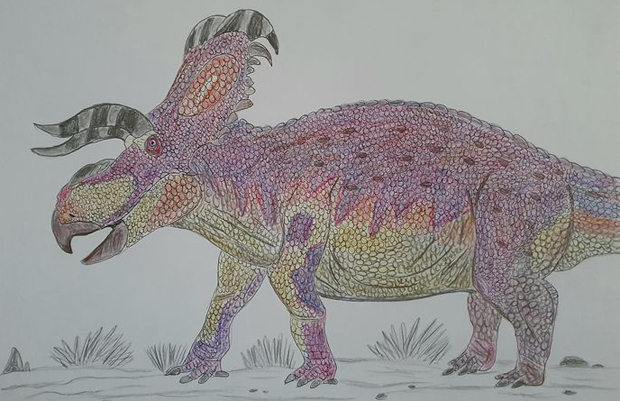
Talented young artist Caldey has sent into Everything Dinosaur her latest dinosaur artwork. She has produced a drawing of the Late Cretaceous chasmosaurine Spiclypeus (S. shipporum) having once again been inspired by prehistoric animal models in her collection.

Named and scientifically described in 2016, fossils of this large ceratopsian come from Judith River Formation exposures in Montana. When the fossils were being excavated the dinosaur was nicknamed “Judith” by the field team. Officially this specimen is CMNFV 57081 and it is now housed in the fossil vertebrate collection at the Canadian Museum of Nature in Ottawa, Ontario.

Spiclypeus shipporum illustrated

A very colourful illustration of the Late Cretaceous chasmosaurine Spiclypeus shipporum. Picture credit: Caldey.

Picture credit: Caldey

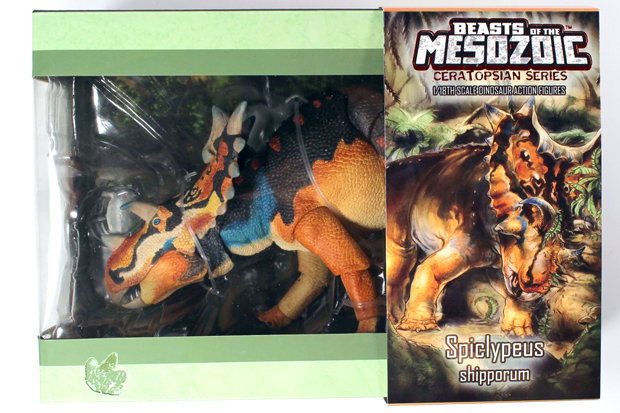
Beasts of the Mesozoic Spiclypeus shipporum

Caldey has sent into Everything Dinosaur several horned dinosaur drawings, many of which have been based around the colourful Beasts of the Mesozoic model series. These articulated dinosaur models are well-known for having stunning box art, so it is quite fitting to see these figures encouraging and inspiring young artists.

Beasts of the Mesozoic Spiclypeus shipporum packaging

The Beasts of the Mesozoic Spiclypeus shipporum artwork that is featured on the front of the box.

To view the range of Beasts of the Mesozoic figures in stock at Everything Dinosaur: Beasts of the Mesozoic Articulated Models.

A Wave 2 Ceratopsian

The Beasts of the Mesozoic Spiclypeus model, was one of nine figures added to this popular range in the second production wave. Caldey has already sent into Everything Dinosaur her drawing of another wave 2 figure, an illustration of Medusaceratops (M. lokii).

An illustration of Medusaceratops

An illustration of Medusaceratops. Picture credit: Caldey.

Picture credit: Caldey

A spokesperson from Everything Dinosaur commented:

“Our thanks to Caldey for sending into us such a splendid Spiclypeus drawing. We always enjoy receiving prehistoric animal illustrations and it never ceases to amaze us how talented some of these young artists are.”

To read Everything Dinosaur’s 2016 article about the discovery of Spiclypeus: Spiked Shield Horned Dinosaur from Montana.

Visit the Everything Dinosaur website: Everything Dinosaur.

5 01, 2022

The New PNSO Jennie the Centrosaurus

By |2024-10-10T13:23:03+01:00January 5th, 2022|Categories: Adobe CS5, Dinosaur Fans, Everything Dinosaur News and Updates, Everything Dinosaur Products, Main Page, Press Releases|1 Comment

PNSO will be adding a replica of the Late Cretaceous horned dinosaur Centrosaurus to their mid-size model range. Jennie the Centrosaurus will be in stock at Everything Dinosaur in a few weeks. Centrosaurus was named and scientifically described back in 1904 (C. apertus) by the famous Canadian palaeontologist Lawrence Lambe.

It’s wonderful to see a new replica of “pointed lizard”.

PNSO Jennie the Centrosaurus

PNSO Jennie the Centrosaurus. This dinosaur model in the PNSO mid-size model range will be in stock at Everything Dinosaur around March (2022).

A Host of Horned Dinosaurs

PNSO have been busy extending their mid-size model range and they have more exciting figures to introduce. There are a number of horned dinosaurs already represented in this series. For example, back in December, Everything Dinosaur announced that there would be a new version of “Doyle” the Triceratops introduced complete with a fossil skull and previously we have announced a Machairoceratops, Spinops and a Pachyrhinosaurus as well as a model of the horned dinosaur from China – Sinoceratops.

PNSO Jennie the Centrosaurus dinosaur model.

The spectacular PNSO Centrosaurus model.

Supplied with an Illustrated Booklet and Coloured Posters

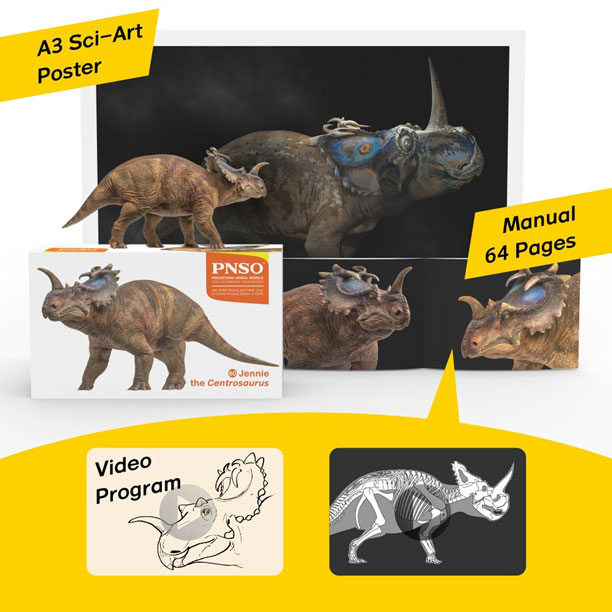
Jennie the PNSO Centrosaurus model will be supplied with a full-colour, 64-page booklet as well as posters. A QR code on the product packaging links to a short video that explains how the figure was developed. The posters and booklet help to showcase the fabulous artwork of the very talented palaeoartist Zhao Chuang.

PNSO Jennie the Centrosaurus posters and booklet

The PNSO Jennie the Centrosaurus comes complete with a 64-page booklet, posters and a QR code that links to a video that explains the model’s development.

Model Measurements

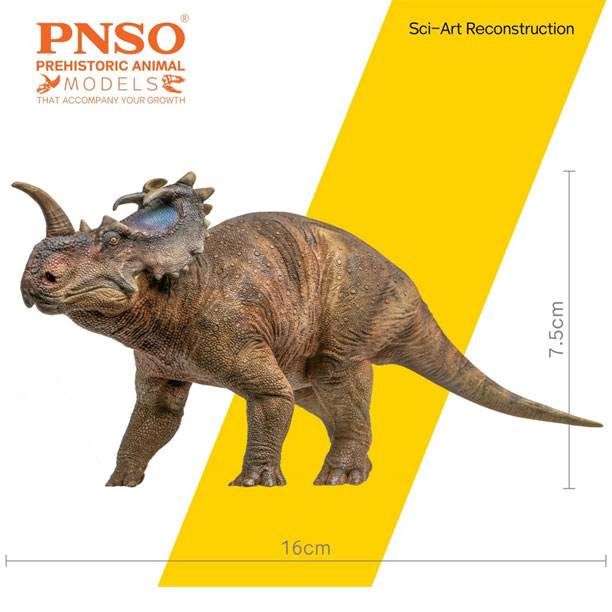
The Centrosaurus dinosaur model measures 16 cm in length, and the bony projections (epoccipitals) on top of the impressive neck frill are approximately 7.5 cm off the ground. Although, PNSO as a rule, does not declare a scale on their mid-size models, based on an approximate length of an adult Centrosaurus apertus of around 5.5 metres, team members at Everything Dinosaur estimate a scale of 1:35.

PNSO Jennie the Centrosaurus model measurements

PNSO Jennie the Centrosaurus measures 16 cm in length and those beautiful epoccipitals on top of the skull are around 7.5 cm off the ground.

A spokesperson from Everything Dinosaur, confirmed that this figure was due to be in stock in a few weeks, it would be on the same shipment as the recently announced “Doyle” the Triceratops and “Harvey” the Iguanodon. These figures could be in stock at Everything Dinosaur in March (2022).

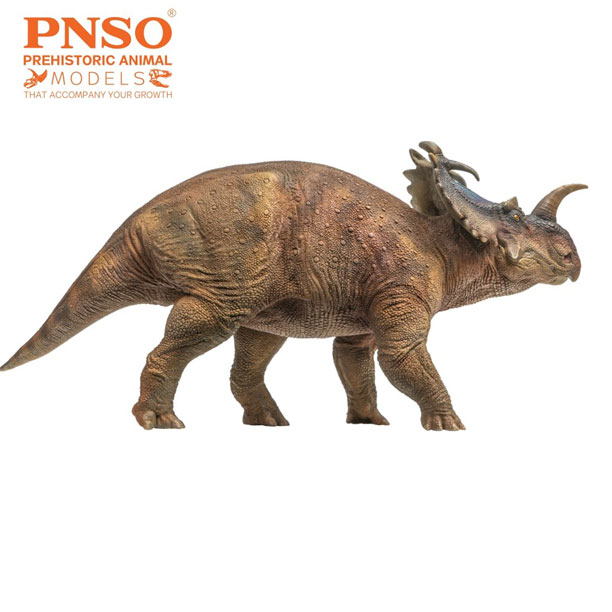
PNSO Jennie the Centrosaurus.

The PNSO Jennie the Centrosaurus dinosaur model in lateral view.

To view the current range of PNSO prehistoric animal models in stock at Everything Dinosaur: PNSO Age of Dinosaurs.

The Everything Dinosaur website: Dinosaur Models.

4 01, 2022

Aiding a Spectacular Ammonite

By |2024-10-10T13:18:00+01:00January 4th, 2022|Categories: Adobe CS5, Educational Activities, Everything Dinosaur News and Updates, Main Page, Photos/Pictures of Fossils|0 Comments

Team members at Everything Dinosaur, try their best to help their customers. Our knowledgeable staff can provide lots of information and advice when it comes to prehistoric animals, but our contacts and connections are not just confined to models and model collecting.

For example, when a customer enquired about getting a fossil ammonite that he had found prepared and cleaned, we were able to provide assistance.

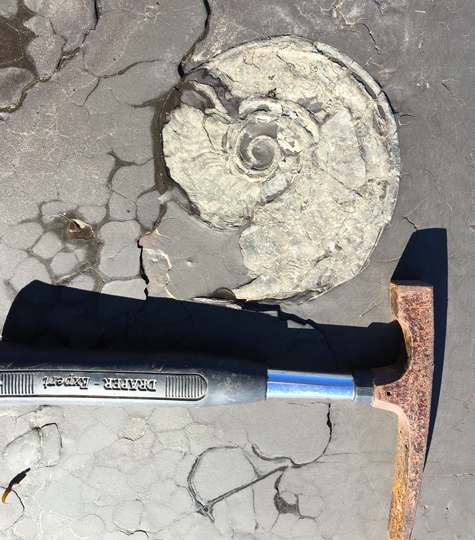
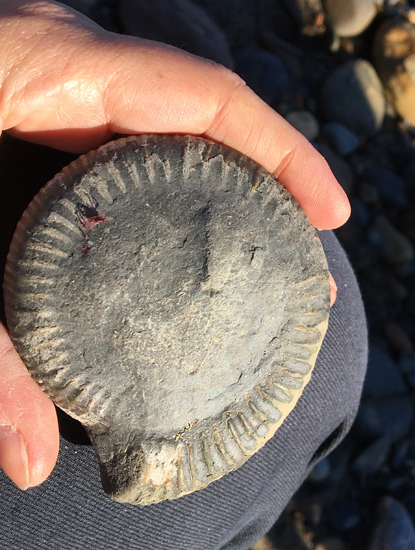
Fossil ammonite (geological hammer provides scale).

Large ammonites preserved on the beach. Picture credit: Everything Dinosaur.

Picture credit: Everything Dinosaur

For replicas of iconic animals from the fossil record and models of famous fossils: Replicas of Fossil and Prehistoric Animals.

A Mollusc Fossil from the Midlands

The Everything Dinosaur customer explained that they had found an ammonite fossil when visiting a large construction site in the midlands (UK). The mollusc fossil dates from the Jurassic and they wanted to have it cleaned and conserved, with the iron pyrites elements that did not constitute the fossil removed.

We were able to text them with the contact details of a talented nearby preparator who was very experienced in cleaning and preparing ammonites and had probably worked on a few examples from the same location.

An ammonite fossil find.

An ammonite partially eroded out of a nodule. We think this is an example of Dactylioceras commune. Picture credit: Everything Dinosaur.

Picture credit: Everything Dinosaur

We are happy to help with customer’s enquiries and do our best to put them in touch with professionals who can assist them with their fossil collections.

The Everything Dinosaur website can be visited here: Everything Dinosaur.

3 01, 2022

A Collector Shows His Dinosaur Model Collection

By |2024-10-10T13:14:35+01:00January 3rd, 2022|Categories: Adobe CS5, Dinosaur Fans, Everything Dinosaur Products, Main Page, Photos of Everything Dinosaur Products|0 Comments

Our thanks to dinosaur model fan and collector John who sent into Everything Dinosaur some photographs of his recent PNSO prehistoric animal purchases. At Everything Dinosaur, we enjoy seeing how collectors set about putting their figures on display.

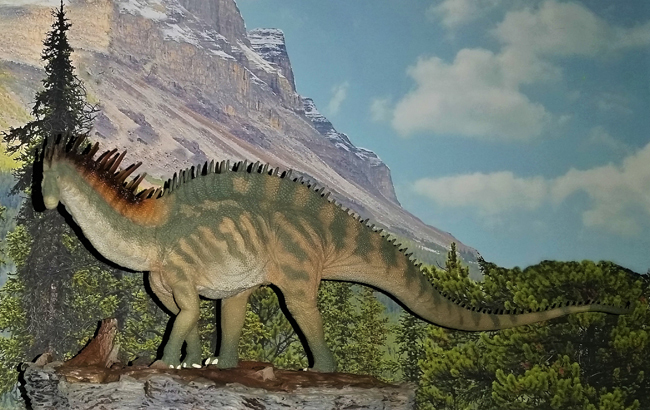
PNSO Amargasaurus model on display

The PNSO Lucio the Amargasaurus model is displayed against a mountain backdrop. Picture credit: John.

Picture credit: John

A Trio of Hadrosaurs

PNSO have increased their range of mid-size dinosaur models significantly in the last two years. John has only just started to collect PNSO figures, but he has already picked up Audrey the Lambeosaurus, Caroline the Corythosaurus (both 2020 introductions) and a beautiful Wyatt the Parasaurolophus figure, which came into stock at Everything Dinosaur in 2021.

PNSO hadrosaur models on display.

A trio of PNSO hadrosaur models. The collector has added bases to the duck-billed dinosaur replicas. Picture credit: John.

Picture credit: John

For PNSO models and replicas: PNSO Age of Dinosaurs.

John has provided bases for his duck-billed dinosaurs as well as supplying a background as part of his dinosaur-themed display.

Recently, PNSO added a stunning replica of “titanic swan”, an Olorotitan to their mid-size model range, yet another superb lambeosaurine hadrosaur to put on display.

Ivan the Olorotitan dinosaur model on display.

Ivan the Olorotitan model on display. Picture credit: John.

Picture credit: John

Whilst many collectors choose to display their collections on shelves or within specially constructed glass cabinets, John has opted to provide backdrops for his figures, producing the illusion of the dinosaur having been photographed in natural surroundings. We think his choice of backgrounds are most effective.

A Dinosaur Battle

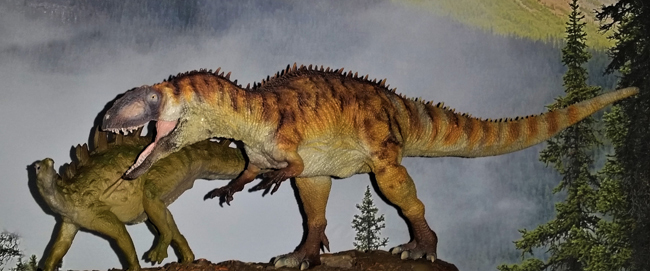
PNSO introduced a diorama that featured a ferocious Yangchuanosaurus attacking the Chinese stegosaur Chungkingosaurus. The fighting pair are presented on a detailed base and John has added to this by sliding in a suitable background to depict this dinosaur conflict from the Jurassic. The prominent conifers on the backdrop fit well with a Middle/Late Jurassic prehistoric scene.

PNSO Dayong the Yangchuanosaurus and Xiaobei the Chungkingosaurus on display.

A pair of dinosaurs do battle! The PNSO Dayong the Yangchuanosaurus and Xiaobei the Chungkingosaurus have been placed against a misty background, the conifer forest provides a fitting backdrop for this dinosaur encounter. Picture credit: John.

Picture credit: John

A Pair of Stegosaurs on Display

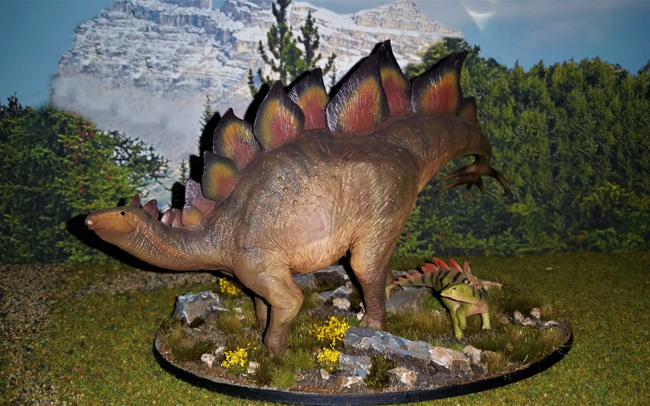
In 2021, PNSO introduced a model set that featured an adult Stegosaurus and a juvenile. The Chinese design team wanted to highlight how these famous dinosaurs changed as they grew and matured. The figures entitled Biber and Rook certainly do that and John has added emphasis to the pair by placing them on their own circular display base and adding a carefully chosen background.

PNSO Biber and Rook on display.

The pair of stegosaur models Biber and Rook depicting thyreophoran ontogeny. Picture credit: John.

Picture credit: John

Our thanks to John for sending in his photographs. A splendid selection of PNSO dinosaur models on display.

Visit the Everything Dinosaur website: Everything Dinosaur.

1 01, 2022

Happy New Year from Everything Dinosaur

By |2024-10-10T12:57:21+01:00January 1st, 2022|Categories: Adobe CS5, Dinosaur Fans, Everything Dinosaur News and Updates, Main Page, Photos of Everything Dinosaur Products, Press Releases|0 Comments

Today, being the first day of January, it is appropriate for us at Everything Dinosaur to mark the start of 2022 by wishing all our readers, customers, fans and followers a peaceful and prosperous new year. We are certainly living in challenging times. Team members have lots of exciting plans for the next twelve months or so and we are looking forward to sharing them with you.

In the meantime, we hope everyone stays safe and we would like to take this opportunity to wish everyone a Happy New Year!

Happy New Year (2022)

Everything Dinosaur team members wish all their customers, fans and followers a happy new year! Picture credit: Everything Dinosaur.

Picture credit: Everything Dinosaur

Let’s hope there are better times ahead.

We incorporated a couple of dinosaurs into our new year banner, can you identify them?

From everyone at Everything Dinosaur, we wish everybody a Happy New Year!

The Everything Dinosaur website: Dinosaur Toys.

29 12, 2021

Penarth Prints are Rare Dinosaur Tracks

By |2024-10-10T06:11:01+01:00December 29th, 2021|Categories: Adobe CS5, Dinosaur and Prehistoric Animal News Stories, Dinosaur Fans, Main Page, Palaeontological articles, Photos/Pictures of Fossils|0 Comments

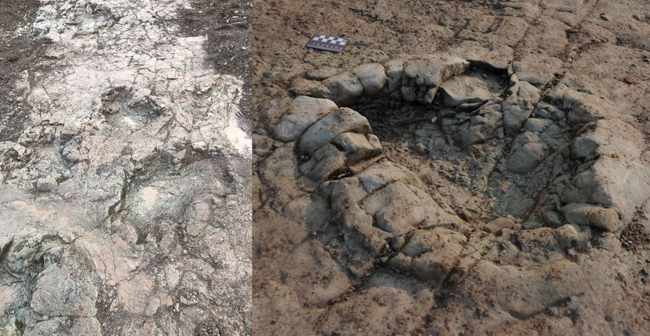
A team of researchers writing in the journal “Geological Magazine”, have confirmed that the strange impressions exposed on the beach at Penarth (south Wales), are indeed dinosaur tracks. The site had been examined back in 2009, further evidence of tracks was revealed in 2020 after more of the bedding plane was laid bare by tidal erosion. The site some 800 metres south of Penarth pier, probably represents tracks made by different types of dinosaurs but they are too badly eroded for a more precise diagnosis other than to tentatively assign the largest, rounded tracks to the ichnogenus Eosauropus.

Dinosaur trackway from south Wales.

A part of the brushed and cleaned up trackway (left) with (right) a close-up view of a single print. Picture credit: NHM/Peter Falkingham.

Picture credit: NHM/Peter Falkingham

Carefully Mapped and Recorded

The tracks, some of which are more than 50 cm in diameter, are associated with the Upper Triassic Blue Anchor Formation. Although it is difficult to identify individual trackways, the high density of impressions suggests that the area was a trample ground that might have been visited by many individuals. Although the number of taxa making these impressions cannot be reliably inferred because of their poor preservation, based on their large size, round shape and digit impressions, the research team consider it likely that they were made by large sauropodomorph dinosaurs. As such, Late Triassic sauropodomorph tracks are exceptionally rare and the research team, which consisted of scientists from Liverpool John Moores University, the London Natural History Museum, Cardiff University, the University of Lyon and National Museum of Wales, conclude that these tracks provide additional information regarding the Late Triassic biota of the UK.

Penarth dinosaur tracks

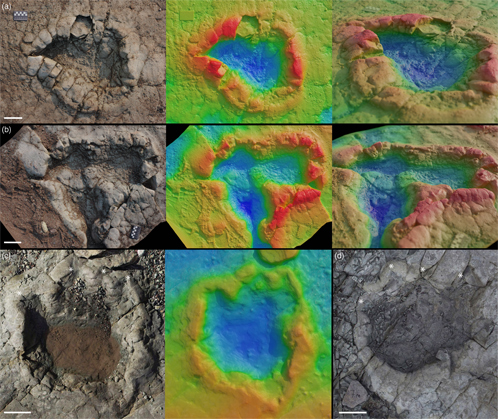
Detail images of individual tracks. (a) Individual D-shaped impression recorded in 2020, presented as photo-textured and height-mapped digital models. (b) Two to three overlapping impressions recorded in 2020, with a displacement rim spanning the centre of the deepest areas, presented as photo-textured and height-mapped digital models. (c, d) Individual tracks recorded during 2009, but showing clearer morphology in the displacement rims that we interpret as digit impressions (marked with *) (c). White scale bar = 10 cm. Picture credit: Falkingham et al.

Picture credit: Falkingham et al.

Likely to be Eroded Away in Just a Few Years

The team highlight the rapidly eroding site, more than one metre of the exposed surface has been lost since the first examination made in 2009 and the detailed mapping carried out in 2020. The loss of the bedding surface highlights the transient and vulnerable nature of these fossils. The site has been extensively photographed and mapped digitally ensuring that a computer record of these trace fossils can be stored in perpetuity.

Dinosaur tracks Penarth Tracks

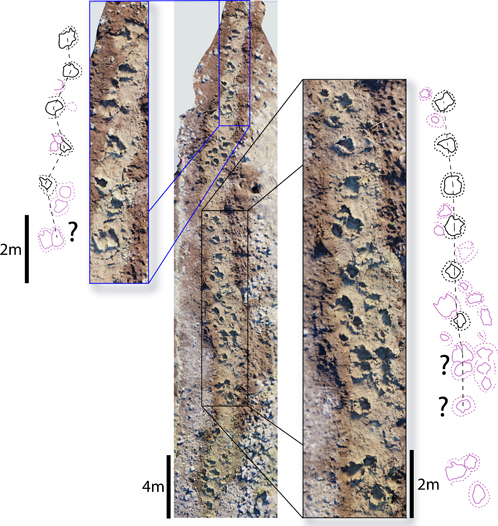
Possible trackways observed on the northern surface, photo-textured models and interpretive outlines; dashed lines indicate extent of displacement rims. Picture credit: Peter Falkingham et al.

Picture credit: Peter Falkingham et al.

Team members from Everything Dinosaur visited the area in 2019 and had planned to return the following year to help record the tracks, unfortunately, COVID-19 restrictions prevented this. Still, this new study published this week confirms the presence of sauropodomorph tracks along the coastline and provides additional information on the Late Triassic biota of the British Isles.

The scientific paper: “Late Triassic dinosaur tracks from Penarth, south Wales” by Peter L. Falkingham, Susannah C. R. Maidment, Jens N. Lallensack, Jeremy E. Martin, Guillaume Suan, Lesley Cherns, Cindy Howells and Paul M. Barrett published in the journal Geological Magazine.

28 12, 2021

New Rebor Saurophaganax Notorious Big

By |2024-10-10T06:04:26+01:00December 28th, 2021|Categories: Adobe CS5, Dinosaur Fans, Everything Dinosaur News and Updates, Everything Dinosaur Products, Main Page, Photos of Everything Dinosaur Products, Press Releases|0 Comments

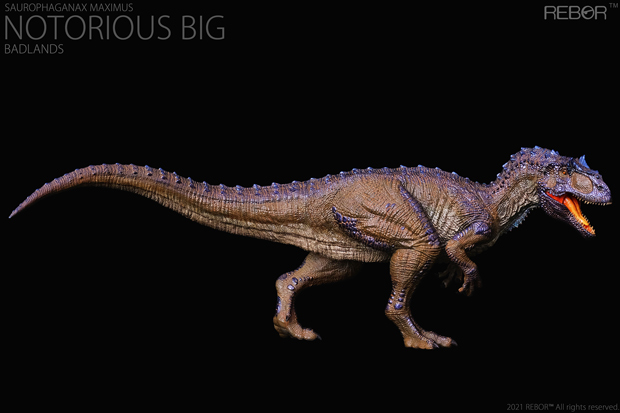
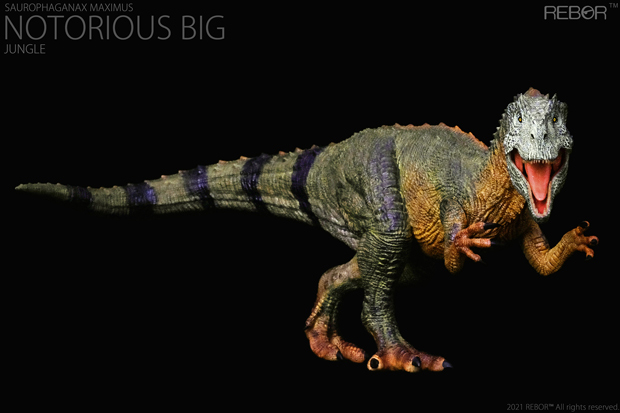
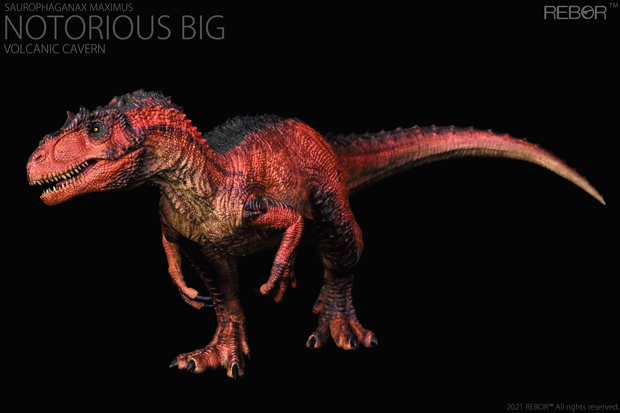
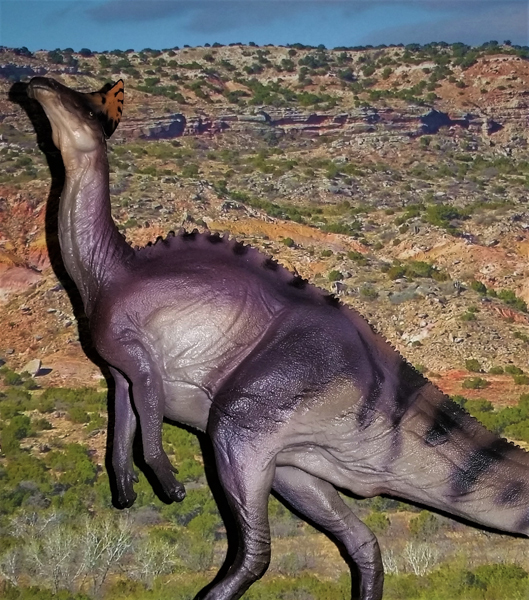
Those talented model makers at Rebor are to add a replica of the Late Jurassic theropod Saurophaganax to their range. This 1:35 scale dinosaur figure, which comes in three different colour versions should be in stock at Everything Dinosaur around March 2022.

These replicas of Saurophaganax maximus will be available in “Badlands”, “Jungle” and “Volcanic Cavern” colour schemes and each dinosaur model will have an articulated lower jaw and moveable arms.

Rebor Saurophaganax dinosaur model "Badlands"

Rebor 1:35 Saurophaganax maximus Museum Class Replica “Notorious Big” in the “Badlands” colour scheme.

Saurophaganax maximus

Saurophaganax is regarded by many palaeontologists as the largest carnivorous dinosaur known from the Morrison Formation of the western United States. Size estimates vary, but it has been suggested that this huge predator could have reached a length of around 13-14 metres and weighed in excess of 3 tonnes. The original fossil material used to describe this genus was found in 1931 in Cimarron County (Oklahoma). The genus Saurophagus was erected in 1941, but it was later discovered that this scientific name was already occupied. The debate continues as to whether this dinosaur is a valid genus or examples of exceptionally large Allosaurus.

Rebor Saurophaganax maximus dinosaur model (jungle colour variant).

The Rebor Saurophaganax maximus Museum Class replica in the jungle colour scheme. All three colour variants will be available from Everything Dinosaur.

The fossil material from the 1930’s was re-examined by palaeontologist Daniel Chure and in 1995 the genus Saurophaganax was established, although it is still regarded as “nomen dubium” by some scientists. Hopefully, fossil material recently found in New Mexico will confirm the taxonomic status of S. maximus. The genus name translates as “greatest lizard-eater” whilst the trivial or specific epithet reflects the huge size of this theropod.

Rebor Saurophaganax Model Measurements

All three of these stunning, new for 2022 dinosaur models are 41.5 cm long. The head height is around 13 cm. The declared scale for these figures is 1/35th so they will fit well with other Rebor theropod replicas. Based on size estimates of between 10.5 metres and 14 metres long, team members assess the approximate scale of this figure to be between 1:25 and 1:34. Given the variation in dinosaur size proposed by palaeontologists and the difficulties of assigning a maximum size to dinosaurs, team members consider the stated scale on the packaging to be reasonable when all factors are considered.

Rebor Saurophaganax volcanic cavern colour scheme

The impressive Rebor Saurophaganax maximus dinosaur model in the “volcanic cavern” colour scheme.

Confirming that the intention was to have these figures despatched from the factory before the start of the Chinese New Year holidays, a spokesperson from Everything Dinosaur commented that they were looking forward to receiving all three colour variants and that they should be in stock sometime around March 2022.

To view the current range of Rebor dinosaurs and prehistoric animals available from Everything Dinosaur: Rebor Dinosaur and Prehistoric Animal Models.
The Everything Dinosaur website: Dinosaur Figures and Toys.

27 12, 2021

The Amazing Rebor Smilodon populator Stray Cat (Ice Age)

By |2024-10-10T05:59:32+01:00December 27th, 2021|Categories: Adobe CS5, Dinosaur Fans, Everything Dinosaur News and Updates, Everything Dinosaur Products, Main Page, Photos of Everything Dinosaur Products, Product Reviews|0 Comments

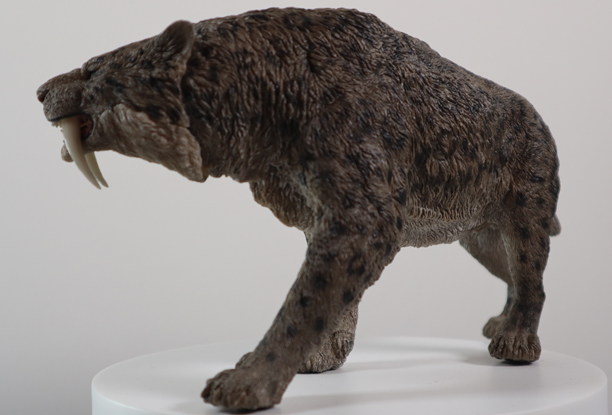
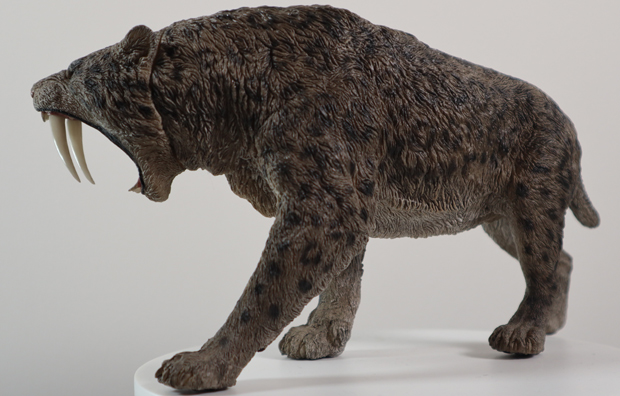
Team members at Everything Dinosaur have taken some photographs of the impressive Rebor Smilodon populator Stray Cat model in the Ice Age colour scheme. The figure is a colour variant on the Rebor Smilodon “plain” replica. The colouration would provide excellent camouflage for a predator in a snowy landscape, although there is very little fossil evidence to indicate whether Smilodon populator inhabited mountainous areas where snow might have fallen on a regular basis.

Rebor Smilodon Stray Cat (Ice Age colour scheme)

The Rebor Smilodon populator Stray Cat model in the Ice Age colour scheme. The model is shown in an oblique, lateral view and the figure has the mouth-closed head attachment. Picture credit: Everything Dinosaur.

Picture credit: Everything Dinosaur

Two Heads are Better than One

The Rebor Smilodon figures are supplied with two heads. One head depicts the mouth open, the other shows the mouth closed. The heads can be securely fixed into the body by a large peg on the back of the head. This peg fits into a socket in the neck and it cannot be seen (as demonstrated in the pictures on this post). The heads are interchangeable so collectors can display their figure with its mouth open or closed. How they choose to display the model is entirely a matter of personal choice. The use of interchangeable heads prevents the need for an articulated lower jaw, the large and obvious joint would have spoiled the look of this most impressive prehistoric cat model.

Rebor Smilodon populator Stray Cat Ice Age

The Rebor Smilodon populator 1:11 scale model. The figure is shown in lateral view with the open-mouth head attachment. The model measures approximately 26.5 cm long and stands around 13.5 cm tall. Picture credit: Everything Dinosaur.

Picture credit: Everything Dinosaur

Rebor Smilodon populator Model Measurements

Both the Rebor Smilodon populator Stray Cat models (plain and Ice Age colour variants) measure approximately 26.5 cm in length. The figures stand around 13.5 cm tall and the declared scale is 1:11. Since these figures arrived at Everything Dinosaur, they have received excellent reviews from model fans and collectors. The detail on these figures is extremely impressive, Rebor are to be congratulated for producing such beautiful Smilodon models.

Rebor Smilodon model in the Ice Age colour scheme.

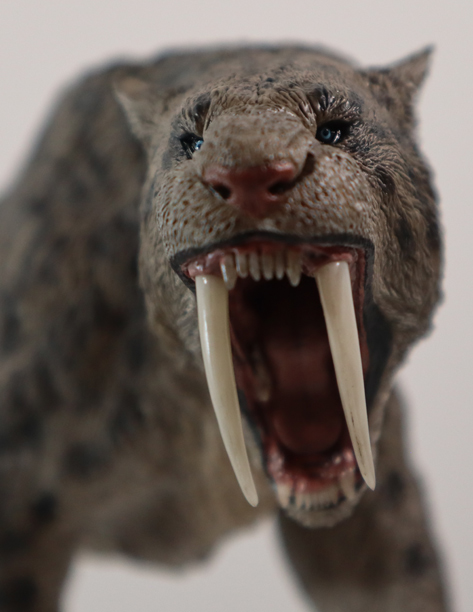
A close-up of the head of the Rebor Smilodon populator figure (mouth open head attachment). The exquisite detailing or the teeth and the inside of the mouth can be clearly seen. Picture credit: Everything Dinosaur.

Picture credit: Everything Dinosaur

To view the Rebor Smilodon populator Stray Cat model and the other figures in the Rebor range: Rebor Prehistoric Animal Models and Figures.

The award-winning Everything Dinosaur website: Prehistoric Animal Models and Toys.

26 12, 2021

The New for 2022 CollectA Triceratops Video Review

By |2024-10-09T22:24:54+01:00December 26th, 2021|Categories: Adobe CS5, Dinosaur Fans, Everything Dinosaur News and Updates, Everything Dinosaur Products, Everything Dinosaur videos, Main Page, Photos of Everything Dinosaur Products, Product Reviews|0 Comments

Everything Dinosaur has published regular updates on the company’s YouTube channel keeping dinosaur fans and model collectors informed about the new for 2022 CollectA prehistoric animal models. Our blog post today features the fourth and final video in this sort series. We provide a video review of the new, 1:40 scale CollectA Triceratops horridus model.

Video credit: Everything Dinosaur

The CollectA Deluxe 1:40 Scale Triceratops horridus

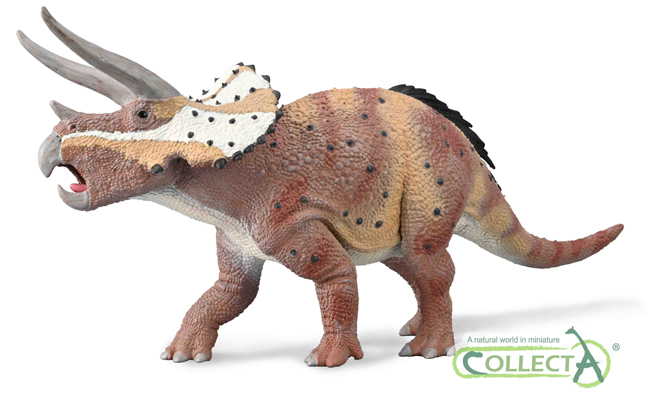
Triceratops might be one of the most recognisable of all the dinosaurs, but scientists have learned a great deal about “three-horned face” over the last decade or so and the new for 2022 CollectA Triceratops (T. horridus) dinosaur model reflects some of the latest scientific thinking.

CollectA Deluxe Triceratops horridus

The new for 2022 CollectA Deluxe Triceratops dinosaur model.

The Shape of the Skull and Neck Frill

The CollectA model has been based on “Horridus”, an almost complete Triceratops horridus specimen excavated from Hell Creek Formation deposits exposed in Montana. This superbly preserved Triceratops skeleton has the most complete skull and neck frill of any Triceratops specimen described to date. It is more than 99% complete. The design team at CollectA have been able to use this skeleton to accurately depict the head and the neck frill on their dinosaur model.

A close-up view of the head of the new for 2022 Collect Deluxe Triceratops.

A close-up view of the head of the new for 2022 CollectA Deluxe Triceratops model.

Almost a Complete Tail

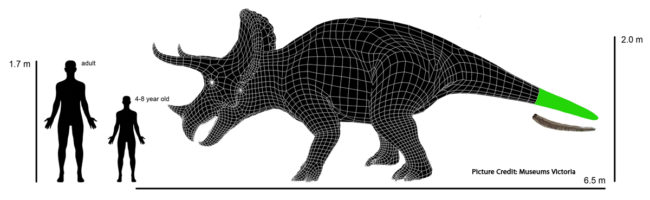
In total, around 87% of the entire skeleton of a single, individual animal has been recovered, including much of the tail apart from a few posterior caudal vertebrae. This has permitted palaeontologists to reconstruct the tail of this horned dinosaur. Its length, depth and relative proportions in relation to the rest of the body are reproduced in the new CollectA Triceratops figure.

Scale drawing T. horridus

Triceratops horridus scale drawing. The design team at CollectA have been able to use the Melbourne Museum specimen “Horridus” to accurately recreate the tail of a Triceratops.

Triceratops Video Contents

In this brief video, it lasts around ten minutes and thirty seconds, the narrator looks at the science behind this new dinosaur model, provides information on when it will be in stock and highlights the model’s measurements.

To subscribe to Everything Dinosaur on YouTube: Subscribe to Everything Dinosaur on YouTube.

The Video Contents

0:00 – A New Triceratops!
0:25 – Triceratops horridus.
1:25 – Subscribe!
1:34 – The Science Behind the Model!
2:57 – Melbourne Museum Specimen.
4:11 – Triceratops Tail Length!
4:40 – Skull and Neck Frill.
5:02 – Pattern of Scales!
6:22 – Model Measurements.
7:15 – In Stock 2022?
8:04 – Question of the Day!
8:58 – Links to Previous CollectA Videos.
9:21 – Everything Dinosaur Social Media.
9:32 – CollectA Product Range!
9:52 – Our Blog Post.

The question posed in the video is:

“What Other Horned Dinosaur would you like CollectA to add to their Deluxe Model Series?”

To view the range of CollectA Deluxe prehistoric animal models in stock at Everything Dinosaur: CollectA Deluxe Prehistoric Life Models.

To see the range of CollectA Prehistoric Life models: CollectA Prehistoric Life.

Go to Top